
Roland DürreMonday October 8th, 2018
Some Facts About the “Free Schools” as Exemplified at Christophine (III)
16 Landmarks for Free and Agile Schools.

Roland’s first day at school.
With each year I gain in age, there is a growing belief that we experience such a huge amount of unconceivable nonsense, enmity and cruelty in life because we are socialized as young persons in such a way that we will later, as adolescents and adults, do all these stupid things. We are enveloped in our socialization.
The first diapers immediately after we are born might well serve as a metaphor for such a development. We need the diapers because otherwise we would leave too many tracks. And with every day of our young lives, the development continues. We learn what we should and should not do, what is good and what is evil, what is right and what is wrong, what is bad and what is nice,…
In order to de-velop autonomously, we must anti-en-velope ourselves – which, naturally, is difficult or even impossible.
I have the hope (or illusion?) that, as parents, along with the parents and supported by the external instance that we call school, you could do a far better job making the future generation happy than it happens now.
As a reaction to my article on “schools“, I learned that I am not the only person who starts getting impatient with educational politics.
So why don’t we do something about it!
In my IF-Blog, I wrote how I experienced my visit at Marbach Christophine (Cristophine I), as well as how school could and should work, My next article (Christophine II) on the topic had some arguments why I consider a new form and implementation of school absolutely necessary.
I recently discovered an old paper buried under other papers that deals with the Freien Schule Christophine (FSC). The paper describes sixteen landmarks for positioning the FSC. For me, every one of the block we call landmarks named in the paper is a metaphor for a dimension of thinking that a free school needs to have. Since I feel that it is a waste if such precious ideas sit in drawers unread, I will now publish these sixteen landmarks.
Every one of the blocks/landmarks describes a dimension of thinking and the sum of them is the mind-set that a free school must have. They show how pupils, parents and teachers as the important stakeholders of a free school, but also the school management and school college as relevant councils think and feel.
I found the landmarks as the structured establishment of this special school, the marbacher christophine (marbacher christophine). I assume that the landmarks, too, have been written by Lorenz Obleser, who is the father of the “Marbacher Pädagogik“.
In this article, the “Christophine“ is a metaphor for a “free, agile school that is self-organised by teachers, parents and children”. I assume that there are quite a few of them and that many educational experts would like to proceed in the same way. This makes me quite happy, because before long the first of my grandchildren will start school.
In the sixteen mile-stones listed below, pupils, teachers, parents, but also the teaching college and the school management will be heard. To me, what these stakeholders of the school say sounds authentic. They provide a story about the standard defined in the landmarks of the FSC (Freien Schule Christophine) which, for me, is an exceptional model for a functioning, agile, self-organized and free school. The landmark is a block that tells you about the stakeholder – and at the end of each block, the importance will once more be summarized (inversely) .
Now let us just read the landmarks and let the impression sink in. it might help if we switch off our brains and just be open for the messages.
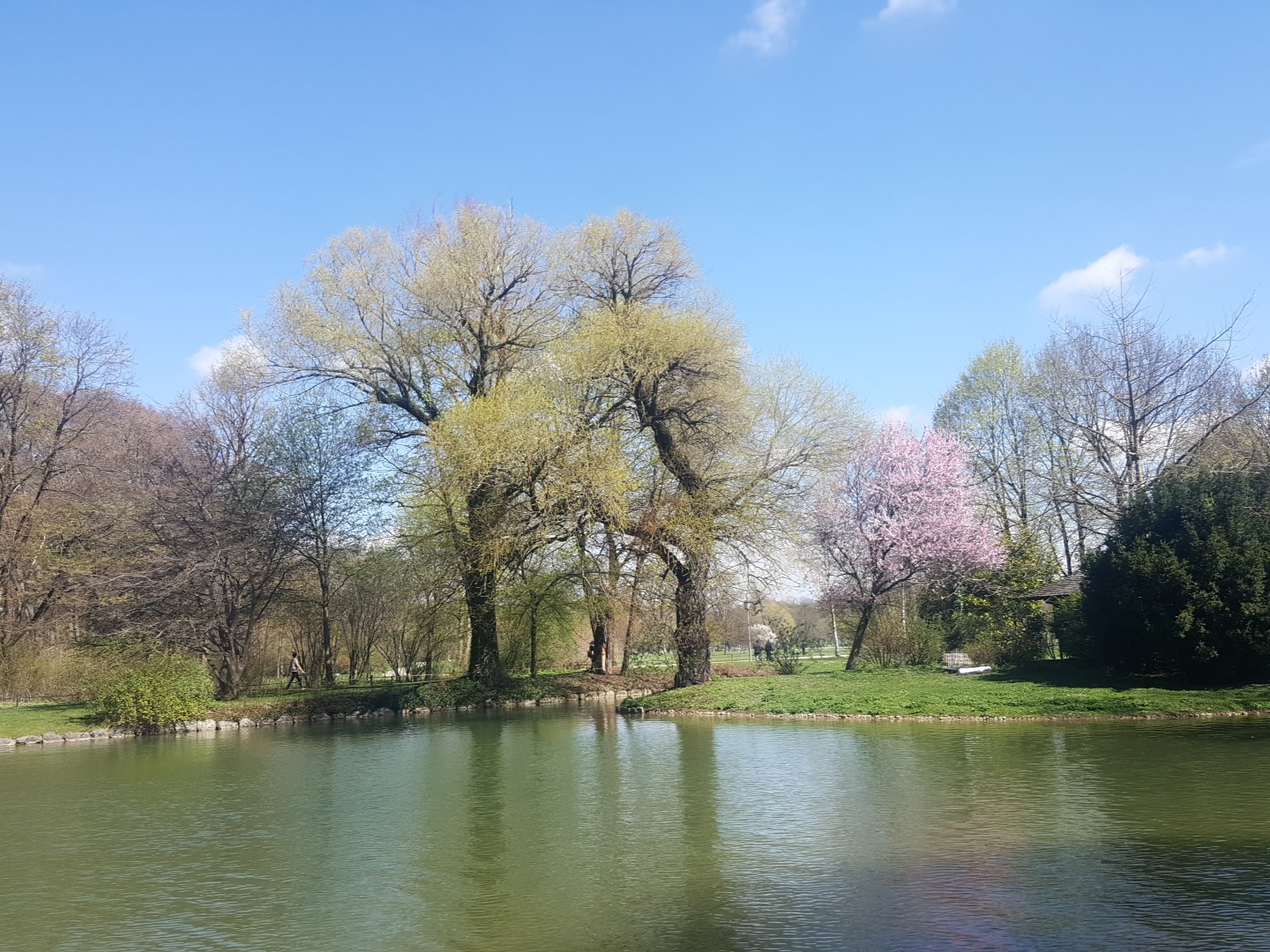
Being open while walking and thinking in springtime.
16 landmarks
Landmark #1: Individuality in Schools
Pupils
I learn mathematics, write a story, work in my exercise book, practice orthography. We do some research, observe a cat. I go upstairs to dance, play outside with Diabolo.
Parents
If I were a teacher, I do not think I would be able to react adequately if a child behaved like my son. He is certainly very special.
College of teachers
The solutions the children find are very different. Two children have never been the same.
School management
Who of us knows what they are really talking about when we say ”individuality”? For far too many years, it was an unknown quantity.
At Chrisophine, the children are constantly encouraged to try what they can do, to find new formulations and to be creative. In this culture of self-education, everyone, regardless of intellectual potential, can learn about his or her individuality and maintain his or her identity. That is true both for the pupils and the adults. If this is how you treat each other, the respect for the individuality of the other party will grow. This honesty will enrich daily school life, because all parties concerned with school can productively contribute during the various learning processes.
Landmark #2: Ways of learning at school
Pupils
I will do this later. First I want to read something.
Parents
Luckily, a look at the mathematics exercise book will tell you what the children already learned.
Pupils
Too easy? Well, I did this for N. He is a first grader.
College
Why do they say “continuous learning” when you are talking about adults but “additional learning” when you are talking about children?
Pupils
Now I want to learn how to write with a pen.
School management
Activity-oriented? That sounds quite well. For me, it is more important to make children understand that they can actually act.
Not only from the physiological viewpoint, learning is one of the most individual and personal processes. It always happens in cognitive, aesthetical and social connections. The school Christophine accompanies the children on their way towards finding successful learning approaches. They can make experiences through all the sensual channels because, after all, stored knowledge, too, will be retrieved in different ways. The individual learning approaches characterize the different types of learners. Through our individualized work in open classrooms, we help the children to find and also move to a higher level of frustration tolerance thresholds through experiences of success.
Landmark #3: Self-organization as a goal of learning
School management
Please write on your work cards what you do.
College
I have to do all the documentation, the children will forget.
School management
It has been a long time since you last did any mathematics, hasn’t it?
Pupils
Today, I did some mathematics because my mother told me to. Otherwise I would have had to do it at home.
School management
If a child tells me he/she find something boring, I will not respond. If it asks for recommendations what to do, I say: do your mathematics. They like procrastinating.
Parents
He always does his homework, there is never a problem.
At the Christophine, our work is based on findings that show that children have enough creative potential to notice their learning situation and to also make themselves part of the formulation of said learning situations. Children can form their environment quite well in a structured and creative way in order to adopt them to their needs. The school Christohine supplies the pupils with the tools they need in order to give them the necessary room for self-projection. At the Christophine, all parties concerned can find their own structures because structures developed in this way can have more stability. This is true both for learning and being together.
Landmark #4 – Activity and Co-operation
Pupils
Come here, I will show you how you can easily find out about this.
College
If N says he does not want to do anything, or if he does not even say anything, then this is always initially shocking for me.
Pupils
Why do you ask if I enjoy this? At school, I only do things I enjoy. That is why, once in a while, I also do nothing at all. We are the same age and our birthdays are in the same week. But what grade are you in?
Parents
Again and again, we hear during parent interviews that he is not working at all. I asked you before: do you think our son learns enough?
Christophine clearly and pointedly counts on the initiative of the pupils. Starting from such initiatives, questions that often lead to other work will develop. Sometimes there will be a call for employees or corrections, for motivators or partners that share some of the learning experience. The fact that pupils like to rely on familiar things in the form of structured work materials shows that they like to know that they actually made some progress in learning.
Landmark #5 – Self Effectiveness
College
Why don’t you go to the city council and tell them about it?
Pupils
I will ask the bus driver.
Parents
We then went to all the bakeries in town and asked them for their pasta recipes.
School Administration
Well, you are correct. It was not a good idea of mine to say this.
Parents
It is not important that he attends grammar school. The only thing that matters is that, in the coming months, he gets his balance back and can again enjoy school.
College
I do not appreciate this kind of manners.
Pupils
Why don’t you let him have his say …
As the philosopher Peter Sloterdijk says, learning is not a step towards a later state but joy in the current state: “Learning means looking forward to finding out about yourself. This state of looking forward to the next phase in your life is what matters”. The Christophine school insists that the original joy of learning and the creativity and self-effectiveness remain important during the learning process. Even if the ease with which a person used to learn is lost later in life: if he remembers that learning was always a joy, he will still be able to learn later in life.
Milestone #6 – Social Competences
Pupils
Take a look at the school compass. At this school, that is our sixth finger: togetherness.
Parents
I was truly impressed by how self-relying and strong every child looked as they stood there.
Teachers
However, you can also see how they all constantly get stuck in dependencies.
School Management
Our school thrives on doing things together. That includes playing together and sharing your knowledge. Everything else can actually easily be done by private tutors.
It is important that the children learn to orient and assert themselves in society. If you want to gain technological competence at school, you cannot get it without cooperation. Remarkably, many children grow up without siblings. Since, simultaneously, many spaces of freedom for children away from school have been abolished, school as a social space for learning has gained importance. Just as the children have to assert themselves at school, so the entire school system has to manifest itself in the educational environment.
Milestone #7 – Knowledge and Competences
School Management
Please ask R., he tackled the same problem yesterday.
Parents
It always surprises me to hear his stories.
Pupils
There is nobody who has no competence anywhere. Everybody can show you something.
Teachers
Well, we do want a child to succeed at a higher school without him/her having to take extra private tuition.
We give the cultural achievements mathematics and writing a huge priority. Our school is a place full of challenges. Learning and working both enjoy a huge amount of appreciation. In this sense, our school wants to be an actual space where there is a lot to realize and to enjoy but little to just consume. The high degree of motivation is supposed to inspire not only the pupils, but also the grown-ups.
Milestone #8 School as an Environment for Experiences
Teachers
If that is what you want, then start organizing what you need. I will gladly help you. You only need to let me know.
Parents
We parents do not even know how the school gained its experience.
School Management
Well, the school is, after all, a place that learns, too.
Pupils
I cannot do this. I do not want to do this. This was a failure.
Teachers
Let us analyse why this project failed.
Pupils
I want us to vote … but there is already a rule. Basically, we said … I am the circle leader and will decide how we do it. You can change this procedure if you are the circle leader. I want to include this in the final discussion.
It is not at all true that, in order to make learning possible, we exclusively take advantage of original situations. Enlightenment does not have to strike quasi epiphani-like in the lecture hall. A lot of experience is necessary during all those many strenuous moments of everyday school life. In this sense, we also consider the usual work a practice that can expand our possible courses of action.
Milestone # 9 – School in the Context of the City
Pupils
It is about time that we visit there again.
School Management
I am sure that the children will be taken seriously wherever they go. Because everybody knows our Christophine School.
Pupils
“Dear Mayor, we would like to see you and talk about the defunct traffic lights“. – “Dear Police, could you please come and visit our classroom. Three four-graders need to do the bike test.“
Teachers
At long last, we managed to visit the museum again.
School Management
The sports club offers us their facilities during the third hour of the school day.
Parents
Parents always have to make some kind of contribution. Basically, the school cannot do everything. I take my son to painting and sports lessons.
Thank you so much for taking the children on the outing.
Our city of Marbach and its regional environment are the topsoil on which our school will grow and on which our lives will succeed. The pupils either come from here or go by bus or train. We can climb the city walls, jump around in the castle ruins or read poems in the house where Schiller was born. Here, we have neighbours who get angry with us if we sneak into their gardens and take the strawberries.
Milestone # 10 Fear-Free School
Parents
My son is always unhappy when the school is closed.
School Management
I am not always free of worries when I enter the school building. But in the assembly hall, I always see that we are actually quite well equipped.
Teachers
Well, it is normal if you see the coming school day with respect, isn’t it?
Pupils
If someone acts around with a wooden stick in the garden, I get scared. But only if he/she hits me. Whenever someone hits me, I will see to it that he gets one week of stick ban.
We should not fear fear. However, we must not make anybody fearful. We are a school that encourages, we are capable of enjoying mistakes, of making a glitch the reason to take a break and of once in a while laughing about minor errors. Emotions regulate the quality of teaching in the lecture room. However, sometimes our feelings can also be our own impediments.
Milestone # 11 – Role of the Grown-Ups
School Management
See what I found for you. It seems that you still have a problem or two to solve.
Pupils
I need a certain tool. Do you know where I can find it?
Teachers
I take up what the pupils suggest. If there is not enough coming from them, I will start doing something, produce something in the sense of our definition of work.
Pupils
These things have all been self-taught.
Parents
I presume you accompany the children more when they learn?
We only have one teacher. But everybody is sometimes the master, the school master and the one who accompanies them when they learn. Some persons are players. Some have responsibility. They are the boss. But that is not a question of age. It is more a question of standards, competence and desires.
Milestone # 12 – Common Reflexion in the Assembly Hall.
Teachers
What can we change to improve matters for next time?
School Management
Our school needs an institutionalized place for doubts. I mean doubts about the pedagogical concept, the things we do, our teaching material, our policy, everything we get upset about.
Teachers
Innovative? The children are more conservative than I am.
School Management
Our school is now in its third evaluation year. I will not continue in the same way as before.
Even our furniture shows the importance of communication. We have a meeting corner, the quadratic shape of our pedagocical circle. Here is where our community has a place to meet, here is where we discuss difficult situations and here is where we meet friends for easy leisure. The role of discussion moderator changes all the time. This guarantees an e.ducation that is not only supposed to lead towards a democratic understanding, but that also has its place in interdependencies made aware through discourses and democratic circumstances.
Milestone # 13 – School Celebrating
School Management
Welcome to our big festival in May, our show at year’s end, our big party on the first vacation day. …
Pupils
Today, we must celebrate three birthdays: the birthdays of J. and C. were during vacation times.
School Management
If someone managed to do something great or discover something new, that in itself is worth celebrating. I say: that is a reason to celebrate.
Pupils
Why don’t we sing the other song again? Oh, no!
Taking the citizen society as a model, people meet at Christophine in order to take charge of their affairs and thus contribute towards a successful school life. Both the management of everyday problems and the planning and realization of school parties or excursions are part of this concept. The grown-ups motivate this process of management by pointing towards future events or problems during discussion time.
Milestone # 14 – School versus Family
Teachers
Basically, we highlighted the partnership with the families quite well in our school contract.
Parents
This is what I keep telling everybody: they talk a lot more with each other at this school.
Pupils
You have no right to order me around. You are not my mother.
School Management
However, I do not consider chatting on the corridors a binding exchange of ideas between school and family. It is more like the lubricant for common pedagogical activities.
Pupils
Last Saturday, my mom took me along when she went to clean the school building. I had the run of the entire house.
In many school situations, you can observe a family spirit. It is responsible for all parties concerned feeling comfortable in their groups. They also know that there is a feeling of belonging in what they do. There are intimate situations full of self-recognition and also affection. Since, however, our school, too, is an independent institution, i.e. an institution of learning, we will not allow families to delegate their jobs to us. School and family are two fields that need not follow the same rules.
Milestone # 15 – Diversity at School
School Management
I certainly want to represent diversity.
Parents
Basically, the families come from various milieus.
School Management
We motivate everyone to visit us in the assembly hall. And if you want to visit, you will have to bring something in return. Because we also want to benefit from your visit.
Teachers
Starwars, Ninjago and James Bond. More often than not, you do not get too many diverse ideas.
Having to make decisions at all times is quite demanding for all parties concerned. The plurality of school work and stimulations you get as a consequence will guarantee that the content is multiplied and that you get quite surprising friction areas and points of contact. It is the duty of the school to enable the students to get a good grip on their own strength and their own images in order to offer them an alternative to the one-dimensional consumption society.
Milestone # 16 – Great Expectations and Modest Pretences
Pupils
The children decide by themselves … you said so yourself.
School Management
The pedagogic development and the economic growth are harmoniously intertwined. If you do not need to pay back debts, it is easier to learn.
Parents
The way we follow their progress is always linked with the development of the children. There will come a day when they will have to attend another school…
Teachers
The Christophine is our place of work. Where everything grows, you would expect that, some day, perhaps you could earn a little more than now?
The School Christophine was built into the educational environment because there was a huge political impatience in the educational sector. By now, it has four years of experience. The supporter has four years left to pay off the initial debt. There is still room for eleven pupils in the building. That is how long the wish of the parents to get a secondary school will have to wait. …
Here is the source of my ideas:
CHRISTOPHINE – marbach – free school
Freie Schule Christophine e.V. · Ludwigsburger Straße 24a · 71672 Marbach am Neckar · 07144/305 80 98
info@freie-schule-christophine.de · www.freie-schule-christophine.de
Kreissparkasse Ludwigsburg BLZ 604 500 50 Konto 300 520 11· GLS Gemeinschaftsbank BLZ 430 609 67 Konto 700 5615 700
I published the milestones because I think they are an excellent and rather commonly acceptable inspiration for all those who are interested in school life and yearn for an agile and free school!
RMD
(Translated by EG)
Roland DürreFriday October 5th, 2018
Is Democracy in Danger?
Here is what I think about the Bavarian Elections in a little more than a week.

Between ruins (South Georgia – whaling).
Democracy in Danger?
I hear this question more and more often.
And my answer is:
Yes – but it has been in danger for a long time already!
The democratic idea includes that people who live in a country (and therefore are this social system) elect their representatives who then find social consensus in parliament and realize said consensus in the form of prudent legislation. But this has not worked well in a long time.
My friend Detlev Six writes:
Liberal democracy is the most sensitive creature of the world. Nurse the baby!
Well, I, too, think that democracy is a rather tiny plant that should be well tended. However, that is not what we do. Instead, said plant has been threatened and harmed by various pests for decades.
I identified the following reasons why democracy in Bavaria and many other countries has been in the decline:
- A general weakness in education and learning.
Schools and universities produce consumers and workers who are more and more adapted to what the system needs, instead of autonomous persons in an ethically responsible awareness of values. - Party oligarchy.
The parties no longer work towards the “social consensus”. They do not want the best for the people but continuing power. For said power, you need votes, which they want at any cost. - Interest associations and lobbyism.
The citizens see that the government, the parliament and the parties are ruled by foreign powers where the individual interest has priority over the interests of the people. - Marketing makes elections ridiculous.
How electoral campaigns are organized irritates the people and de-values the elections. You can now again see it in Bavaria. What nonsense you read on the posters that have been distributed all over the streets? Neither do the manifestos of the parties convince anybody. You get the impression that the party where most money flows into marketing and where people are best manipulated will win the elections. - The candidate selection and the internal party sleaze.
Again and again, party members that have never been elected into top positions get them. - Feeling powerless.
Huge parts of the population see themselves as powerless (either because that is how they feel or because they really are).
However, the “democracy in danger” question is now asked because the populists in Europe have such success and because of the imagined – and perhaps also real – threat of rightist movements and nationalist tendencies in Germany.
However, I believe that these problems are just a consequence of the factors I listed above and other similar developments. For me, this means that we ourselves caused the entire dilemma. By democratic failure. Both actively and passively.
And, as so often, those that lament most about what is wrong are those who caused it. We will probably have to accept that it is all our own fault, if we like it or not.
So whom am I supposed to give my vote?
I do not yet know. I do not like the Green Party because they were the ones who, along with the SPD, made it possible for our armed forces to be stationed abroad. CSU and SPD do not look electable to me. As far as the CSU is concerned, this is not only because of the current protagonists. The SPD did not understand #newwork at all, although this could (should?) be their topic. The FDP covers its clientele policy by promoting an “educational push“ and is millions of miles away from a “liberal“ policy, which means I cannot give them my vote. As I see it, the Left Party has some nice and good things in their program, but they also say many adventurous things. When it comes to “work life”, they are just as bad as the SPD. The AfD is not at all my world. That leaves only the ÖDP, which looks honest to me, or the “Die Partei”, which at least does not have a manifesto that makes you laugh as much as that of the other parties. Well, and ever since they tried to write a common political manifesto (see IF-Blog five years ago), I no longer like the Pirates either.
But here comes what is most important: Many of us are really well off. Let us enjoy life and give a little bit of our strength and nourishment (and nursing) to the little plant “liberal democracy”! And the first step is probably to actually go and vote.
RMD
(Translated by EG)
Roland DürreWednesday October 3rd, 2018
BUSINESS Visualisation
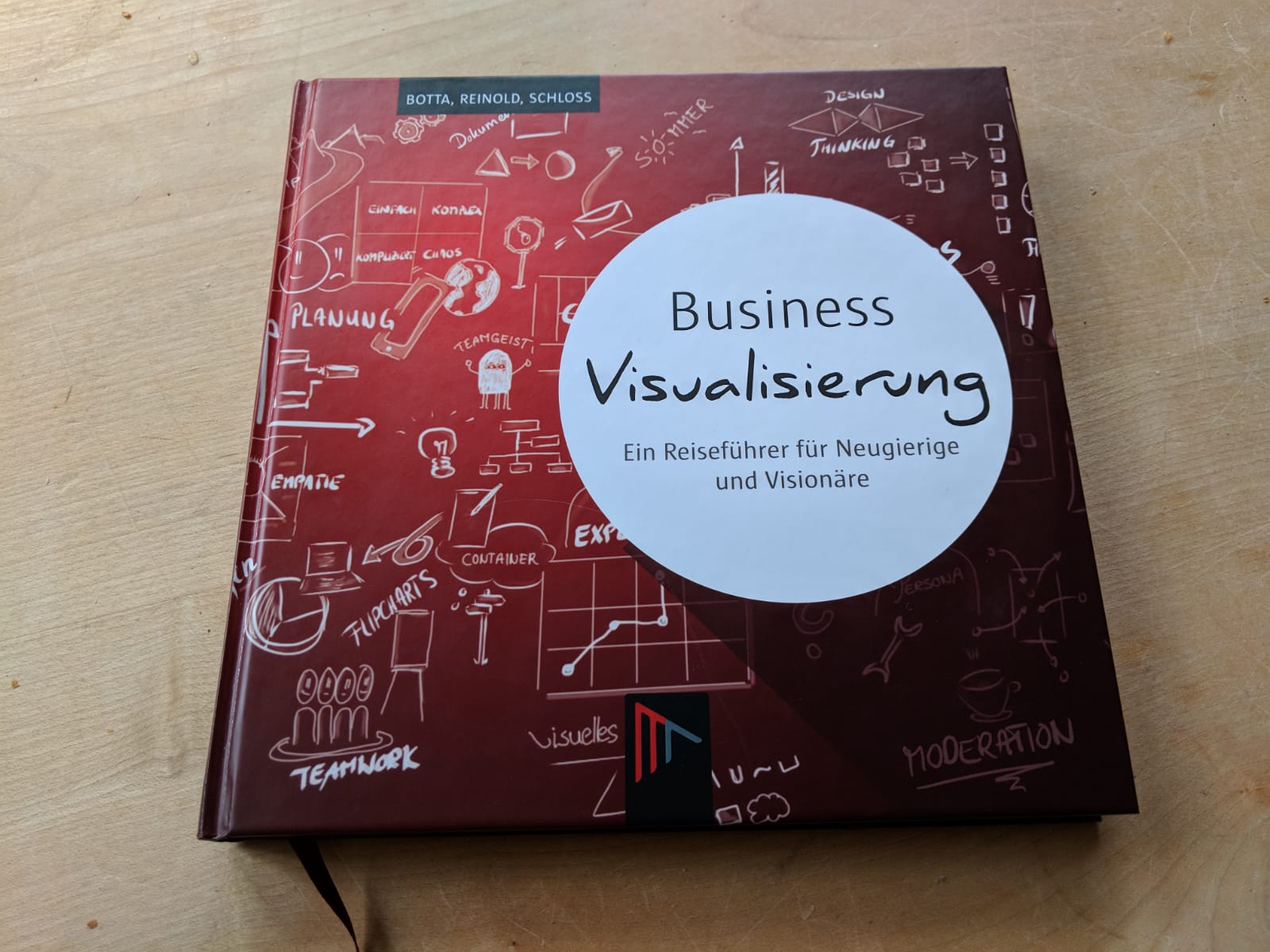
THE BOOK by
Botta/Reinold/Schloss
Behind this really harmless title, you will find a truly exciting non-fiction book. I would call it a book for people between six and ninety who want to have more joy and success in life.
The sub-title
A tour guide for curious and visionary persons
already gives an idea about the book being something really special.
Special? Well, I read it and I would call it revolutionary. It is about a trip into a new world I very much love and cherish. It is a world full of creative and appreciative communication and of “living together”. And it leads into a world that will continue to change and grow.
Basically, it is not a book you will read, but more a book you will feel your way through. In an exciting and humorous way, the trip of a young lady whose name is Barbara (Babs) into an agile adventure is described. This trip brings her through the world of modern communication, beginning from listening and understanding and ending in a very rounded way via the creative when the results are documented.
For me, it is quite clear: communication is the basis for all kinds of “social systems”. And communication will work better if we make use of innovative formats (some of them are actually very old). Part of this concept is the use of images and haptic – as part of a new and very sympathetic mental frame.
During my activities, I am often surprised to see how many people simply ignore the “agile change” that takes place around them, or else they are almost overrun by it. The book, which was written as a co-operation project between Botta, Reinold and Schloß, could be a solid introduction to this “new world“ for non-experts. But also the “experienced agilest” will find quite a few innovative ideas.
I can guarantee that this book will remain exciting from the first to the last page. It is not one of those works where the message is clear after the first fifty pages and where said message is then artificially lengthened and repeatedly proven in a boring way. No – you will find something new on every page. It remains full of humour at all times and the joy of reading will never end.
I would wish that the authors were to write more books about more trips, because the wonderful world of modern communication is endless. The book really contains a lot of it – but naturally not all of it. Barbara (the hero an inspiration of the authors in real life) could easily take us with her on many more great trips.
That would be nice. But I already very much recommend the first trip. For entrepreneurs and (project) managers, the book is a must.
RMD
(Translated by EG)
Roland Dürre
DIESEL
Selfie: “I cannot understand it.“
For many days, the main topic in the media and news has been nothing but “The Diesel”. I find this rather frustrating, because there are so many much more important social issues that need to be tackled. It is all Greek to me (Ich verstehe nur noch Bahnhof).
Basically, it is very simple:
If I buy a low quality product, then I have a claim. If the transaction was a fraud, then I can try to bring the claim forward against the fraudulent salesperson.
That is something the rule of justice in a country should guarantee. If this no longer works because the concerns have become too powerful, then that is just too bad.
This is probably true for all goods, no matter if we are talking food or other products and also for services – and it should also apply to cars.
There are many things I no longer understand!
Why has nobody come up with the idea, especially when we are talking the current Diesel discussion, to simply abolish the subsidies on the Diesel tax? I mean, if the Diesel is such a bad product? After all, it is 22 Euro-Cent per litre in subsidies (in Germany, you have to pay 22 Euro-Cent less for Diesel than for petrol) that lets our “greed is great“ society crave for Diesel vehicles. Regardless of the fact that, in general, the “Diesel car” is more expensive than the competition, but in a state of greed, you do not tend to be very good with calculations.
Isn’t it normal, rather than a national emergency, if the greedy people will, once in a while, be the losers? Mind you, this is not meant to be gloating.
Neither do I understand that there seems to be nobody left who introduces a speed limit. Both on motorways and highways, this would considerably economize on fuel (and on human lives). And it has been obvious for a long time that, in cities, the rule of “driving 30” should be a matter of course. And that the “50” and “60” should be the exception to the rule.
I also do not understand why the Diesel is now such a huge topic. After all, we have a situation where, de facto, all combustion motors in individualized traffic (and, so I hope, not only where cars and motorbikes are concerned, but also where lawnmowers and leaf-blowers are concerned) will (hopefully soon) face their exodus.
Don’t we agree that, today, the discussion is not about whether my SUV has a Diesel or a petrol motor. Instead, it is all about whether you still drive a car at all. Because a) perhaps the climate catastrophe is real after all and b) I do not wish to have all those exhaust fumes in my lungs. It is not even necessary for me to ride my bike on the Rosenheimer Strasse in Munich during rush hour if I want to suffer. Even riding to the bakery on a Sunday morning on the Putzbrunner Strasse in Ottobrunn will do the job!
Neither do I understand that kerosene for airplanes and heavy oil for ships is taxed in the same way as petrol, although we know full well that we need to fly less. And why do they want to build still more runways? And why do we still burn brown coal (Hambacher Forst), thereby making life unnecessarily hard for alternative energies.
And I also do not understand why we celebrate the German Unity Day today. Wouldn’t it be better to use the day for working towards a decent Europe of Regions where people can live in confidence and courage?
These days, there is a lot I do not understand. Not only with respect to mobility, we are surrounded by mania. Is it already too late for our planet (Permafrost). I almost tend towards resignation?
RMD
(Translated by EG)
Roland DürreTuesday September 25th, 2018
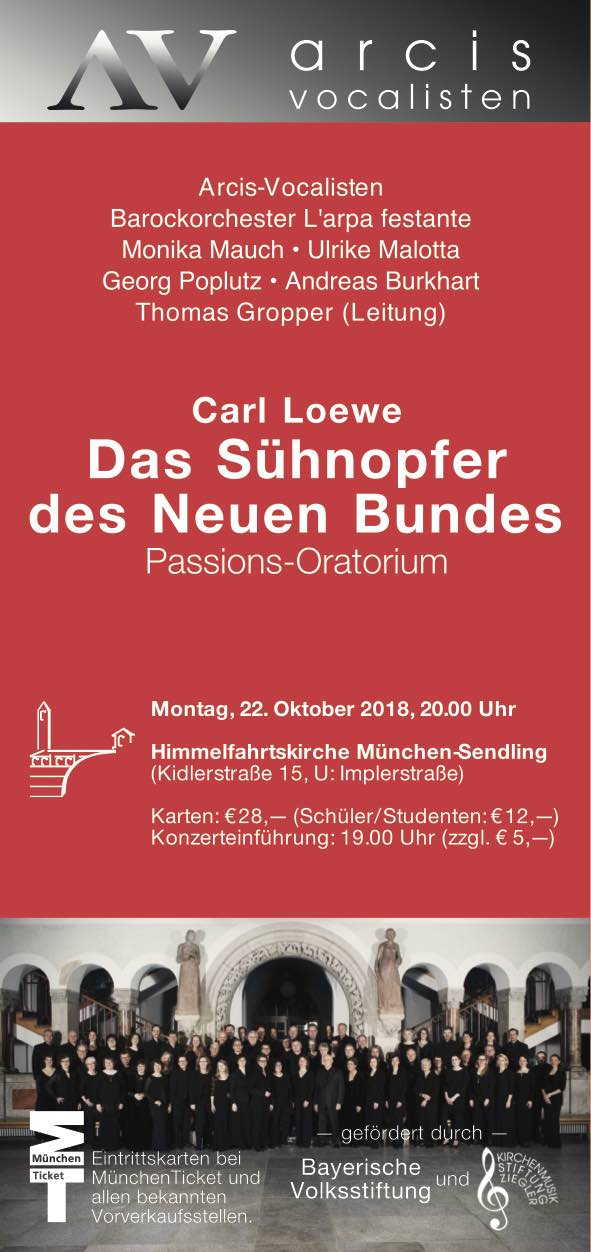
The Arcis-Vocalisten Will Sing CARL LOEWE (on October, 22nd, 2018)
Once again, there will be a concert by the Arcis-Vocalisten. And as always, it is my pleasure to do some advertising for the choir. After all, I personally know at least two of the singers.
Ropes of Death – the passion oratory by Carl Loewe.
Most of the musically interested people will know Carl Loewe (1796-1869) as a prolific composer of songs and master of ballads who was quite adept at mirroring character. Only few people know that his major profession was that of cantor at Stettin’s main church, St. Jacobi, where he also worked as the town’s musical director. We have 17 clerical and secular oratories that document his work. The passion oratory “Das Sühneopfer des Neuen Bundes”, which he probably wrote in 1847, is one of the central pieces.
The Arcis Vocalisten will present this concise and penetrative music that is well worth re-discovery with an excellent set of soloists and the renown orchestra in original pitch “L’arpa Festante”. They will also make a recording with the Bayerischer Rundfunk and the label OehmsClassics in a time-consuming studio production.
Loewe’s language of sound expertly combines the power and suggestiveness of Händel’s choirs with the sound of Bach’s passions, especially in the words of Jesus, and with his own melodious and sensual song artistry in the arias and ensembles. The composer made a conscious effort at creating something meaningful that lies between opera and oratory.
RMD
(Translated by EG)
Roland DürreMonday September 24th, 2018
Disruptive Technologies & Fear of the Future
 Afraid of IT?
Are you scared of the more and more speedily growing complexity? And do you long for such buzzwords as agile, resilient, anti-fragile?
I never knew either of those fears. For me, the change was something exciting and I looked upon all the buzzwords as the normal result of more and more nonsense being talked without any responsibility in our times.
Because I believed that, even today, we experience nothing but very ordinary progress. Which, of course, at all times, has massively changed the world and society. Just remember the times between 1918 and 1938! Those were twenty years during which everything was in uproar.
And those times, too, can be summarized quite adequately by the words of Bertrand Russell:
» Every increase in technology will cause the same increase in wisdom, provided it is also meant to mean more instead of less human happiness. «
Because even then, it did not work.
There are at least three exceptional and particularly exciting technological dimensions.
- World-machine interaction (sensors) instead of human-machine interaction.
- Total networking of machines (IoT).
- Learning machines at the roots (artificial intelligence) .
Well, these factors have the potential of new superlatives when it comes to change. Because the machines get exponentially more intelligent, they are connected world-wide and they will no longer need humans as connecting agents between themselves and the world.
Taken together, this will probably change our world and society as much as (or even more than) the triumphal procession of the “individual mobility based on combustion motors“ changed it. And that is an idea that brings even me to a point only slightly short of fear. Because the triumphal procession of the car really had tremendous consequences and it probably minimized the happiness of mankind considerably.
Well, the only hope that remains is that people will become wiser with the same speed as the “technological advancement“ gains momentum.
RMD
(Translated by EG)
Roland DürreSunday September 16th, 2018
Hambacher Forest. Ethics. Primary. Secondary. Virtue

Dracula as a Metaphor.
Years ago, I liked writing about ethics. For me, it was a very simple topic. It was primarily about virtues and the question which virtues are primary and secondary virtues. Then this sort of ethics started to get boring.
Now, what happens around brown coal in the Hambacher Forest makes me more concerned. In fact, I am not just concerned, I am appalled.
And I believe it is about time that we again talk about primary and secondary virtues.
When I was a child, I was taught many virtues. Well, it was more than just teaching, I was literally trained in them. It started with the demand that I should always be nice. I was to be washed clean at all times and my (short) hair had to be combed nicely. When adults were in a conversation, children had to shut up. I was admonished to be obedient, nice and never recalcitrant. However, the worst sins were if you lied or – God forbid – steal. Respecting the property of others and telling the truth at all times were the highest virtues of all.
As I grew up, I started to have my own ideas. And I understood very early on that there were quite a few glitches to my education. And that, for example, the categorical demands that you must not lie and must not steal will not hold after a thorough ethical test.
Later, I studied the philosophers and I remember reading the letters exchanged between the older Kant and a younger French philosopher. Well, the Frenchman with his arguments caused quite some sweat on the forehead of the then so famous and well-liked Kant. Kant’s reaction was very irrational and, in my opinion, very emotional.
This is how I learned that categorically sticking by the Eighth Commandment will certainly cause a lot of damage and thus can only be a secondary virtue. In fact, in normal life there are many situations where ethical behaviour actually forces us to lie in order to prevent damage to ourselves or others.
I also saw very quickly that the Seventh Commandment is not much better. I do not even have to mention Robin Hood and the questionability of a society that is dominated by property. It will suffice the imagine a child that might die from hunger but could be saved by theft.
This is why the Hambacher Forst Activists are definitely not criminals, even if they are not necessarily heroes.
Because they act upon virtues that I consider primary virtues. They are autonomous and they study the situation. They live up to virtues that I consider primary virtues, such as civil courage and constructive disobedience. They even do it in a very responsible and peaceful way.
The only thing I could ethically hold against these people in their tree houses is that they cultivate a martyrdom and that their actions in favour of a “good cause“ will eventually have negative consequences for their own lives. Because it is an important – and for me also a primary – virtue that your self-esteem is high and that you do not ruin yourself. Especially not for others!
Because, basically, we all know that matters cannot continue as they are, just like we also know that, when all is said and done, we will all suffer under the destruction of the world.
As opposed to an omniscient minister, I do not know what is the “mother of all problems“. All I can say is that I believe our system practices a very questionable approach on how to treat humans and nature.
We have several problems. The source of these problems are probably weaknesses in our approach to poverty, education, climate protection and mobility. The reason why our social system has these problems is probably that values, priorities and power structures have changed in our country and its politics.
For instance, we know that a polarization into poor and rich parts of the population can have quite unpleasant consequences. We also know that our social welfare state tumbles towards a future full of crises. We also know that our mobility with big cars and the combustion motor has no future. We also know that stricter speed limits on motorways, other streets and also in the cities are more than necessary. We also know that subsidies granted to the motorized traffic in general and to the Diesel engines in particular are total nonsense.
To be honest, we also know that electricity-powered vehicles will not improve the situation at all. On the contrary, they will have an even worse environmental footprint, especially if the electricity they need is produced from brown coal.
Incidentally, this is not only true for brown coal, but also for higher-quality coal that is processed by overexploitation in Australia, then driven to the coast, then loaded onto huge container ships and thus brought to Hamburg. In Hamburg, the coal will be distributed to various means of transportation – and later it will be used up somewhere in Germany. Well, this is certainly not a solution.
Most of the electricity we consume world-wide is made from coal. This is still true today! Regardless of the fact that there is now a social consensus that says we must not produce electricity from coal for many well-known reasons. However, we cannot manage the exit because of “economic interests“. Yet we need this exit very soon if we want to replace all those combustion motors by electrical solutions.
The opposing party for the activists at the Hambacher Forest is an industrial sector. Or rather: it is a concern the domineering and driving factor of which was the shareholder value over many decades. And it used all the legally possible – and sometimes even borderline legal – means to achieve a sensational shareholder value. Few sectors were able to make their shareholders as rich as the EVUs over a long period of time. It all happened at the cost of our environment and – as with (not only) nuclear energy – at the cost of our country. And it was all achieved through legal procedures, thanks to great lobbyism and soft blackmail.
Now more and more people want to change this, and for good reasons, too. Because they understand that it has to end. And soon. I mean people who show civil courage and who put the virtue of constructive disobedience over obedience. Even though they know that, in the end, they will stand no chance against the omnipotence of the country and business. Which is why their actions are detrimental to their own lives.
In my book, these people are not criminals but people who live important primary virtues. The only thing I regret is that they do not have the slightest chance of success – and that they should actually be aware of this. But then, this has always been the problem with idealism and idealists. Which opens yet another, totally different discussion.
RMD
(Translated by EG)
Roland DürreSaturday September 15th, 2018
Manifesto of Life
Currently, you get manifests like mushrooms sprouting from the soil, for example the Manifesto of New Work (Manifest zur neuen Arbeit) as a Microsoft (!) denomination on #newwork.
Inspired by #PMCampBER and beautiful discussions in the last few days, I now came up with a manifesto of life. Naturally, the agile manifesto (this time you get the link to the English version), stood in as a model.
Here is how my proposal for a manifesto of life:
Manifesto for Life
We are looking for values that make it possible to live in joy and with courage
and we try to live said values in our own lives and when in contact with others.
Looking for these attitude of mind, we learned to appreciate:
- Self-responsibility and self-organisation beat being controlled by others and immaturity!
- Values and positions (mind-set) beat morals and dogmata!
- Love and peace beat hatred and war!
- Freedom and abstinence beat suppression and extravagance!
- Trust and transparency beat distrust and secrecy!
Signed by
Now all we need is a few equally minded people who wish to sign!?
(recommendations for improvements welcome)
RMD
(Translated by EG)
P.S.
A short time ago, Dr. Marcus Raitner came up with 10 google theses for “good leadership” (10 Thesen von Google für “Gute Führung). They might be a good basis for a “leadership manifesto”.
Roland DürreWednesday September 12th, 2018
Culture Engineering. Terminology. Methods, Tools

Wearing my new Hanseatic hat after my return from #PMCampBER in the Grosshesselohe forest restaurant.
Let me give you a short report on the PM Camp Berlin session on Culture Engineering before I will write about the “contradictions” in social systems. It was one of many exciting sessions I participated in at the anti-conference #PMCampBER.
The topic was “Culture Engineering” – as a method and tool that helps to influence, change and control the culture in a social system that has an economic goal, i.e., in an enterprise.
The person who had initiated the session himself had felt suspicious about the term “Culture Engineering”. His “feeling uncomfortable” was due to his scepticism about question if a culture can actually be actively influenced with an “engineering-approach“. He feared that such a concept could or would easily end in manipulation with negative or at least unpredictable results.
One session participant said that there is a successful “Culture Engineering“ stream of studies in Leipzig and that the graduates of this school are actually quite sought after by the human resources departments of companies, especially huge companies. I find this rather exciting, which means that we are in the middle of the world of culture engineering and human resource (HR).
As far as titles are concerned, I constantly get visiting cards with job titles such as engineer, officer, manager or president on them. And I must admit that, of all these titles, the one I like best is the engineer who, for instance, is in charge of a project. But “German-English“ is modern, so I am getting into it. Now we have the CEO, CTO and CIO and, more and more often, also the CHRO (HR as an abbreviation for human resources). That is where you will find the innovation manager and the culture engineer. In general, I am quite suspicious of officers and managers, and the same is true for presidents and vice presidents.
In our session, the first thing we approached was terminology. Someone proposed that maybe we could say “culture gardening”, instead of “culture engineering”. I found this rather appealing. But then I thought that, in analogy to “garden cultivation”, the task could be called “cultural cultivation”.
Then we discussed the definition of entrepreneurial culture. We found the answer (from entrepreneurial theory):
Entrepreneurial culture is the memory of an enterprise.
? Honi soit qui mal y pense, but, for me, this is immediately associated with “memory manipulation”.
When I looked up the term in Wikipedia, I discovered a Wikipedia call on copyright.
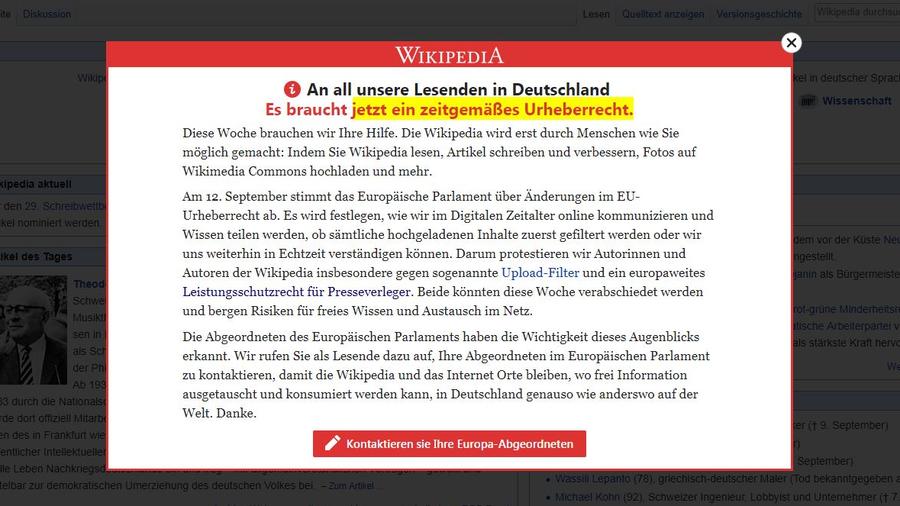
I support this call with all my heart and consequently I publish it here.
However, I am not sure that it will suffice if you contact your representative in the European Parliament. You will probably have to do more than that.
Yet this is a good example for controlled change in values and rules. And the motives are very capitalist.
Back to Culture Engineering. As with many buzzwords, I find the term a little ridiculous. The same is true for a culture engineer or innovation manager at HR.
I certainly believe that you should be aware of and actively live the culture of an enterprise, just like that of all other social systems. And it is also quite legitimate to use modern technology and methods. But it is a something that must happen between the leaders and all the others. Leadership as defined in Google (see the article article by Dr. Marcus Raitner).
However, culture cultivation will only be a success if as many people as possible participate in the cultivation process – and I mean with a lot of attention and actively.
RMD
(Translated by EG)
Roland DürreMonday September 10th, 2018
PMCamp Berlin – Experiences, Adventures, Contemplation.

The first day #PMCampBER 7/9/2018
Between September, 6, and September, 8, the sixth PM-Camp Berlin took place (PM-Camp Berlin). As always, it was an exceptional event. One of the reasons why it was excellent is the extraordinary quality of the organizational team and Ralf Eicher, another reason, naturally, are the more than 100 great people who took part.
As we all know, the train trip from Munich to Berlin is a mere “jump“ these days, which means it was no problem for me to go there. Since I am one of the PM Camp founders, I went to Berlin for more than just nostalgic reasons. I also wanted to retrieve my knowledge and learn new things. And, above all, I wanted to exchange ideas with nice people and simply share my experiences. As always, it was a total success. The two days were particularly nice because I met so many old friends.
And I returned with many new considerations and various insights. I also learned about tools and methods that had been unknown to me before. Let me share some of it here.
Again, I was part of LSP (Lego serios play). Julian Kea (known as @kiLearning in Twittter) showed us that, in a team with modern methods, you can actually do such as thing as Story making. Besides, I heard about tools such as the Mentimeter. With this tool, you can represent the mentality found in a creative community (that is ”the cultural standard of a social system or community“, also known as mind set) as a tag cloud in no time. This is really quite convenient.
The sessions on the following topics gave me a huge number of impulses:
- “culture engineering“ as a science that strives towards finding methods that can change the entrepreneurial culture.
- What exactly is meant with “coaching“ and “agile coaching, and the question
- whether or not it makes sense for a medium-sized enterprise to position itself “against right-wing populism”.
My experiences were so fundamental that I want to – and probably will – relate them in the IF blog.
Generally speaking, I once again realized to what a huge extent we are all responsible for our own actions. How it is important that we do not allow our rationality to suppress everything else. And during peer2peer conversations and rounds of different sizes, I also saw how many people, also as a community, can have a wonderful “mindset“ – which makes me look forward to the future.
However, I also noticed that most people have a basic conviction that I need to contradict. They assume that, in many dimensions of our life, we have a speed-up process and an increase in complexity that forces us to be prepared to accept change and innovation at all times. And the hope is that we will be better equipped to do this if we increase the agility in our lives.
Here is how that sounds:
“We have to become more agile in order to be better equipped to deal with complexity and acceleration and develop more resiliency and anti-fragility.“
Mind you, there is no doubt at all in my mind that some (or better: many) things both in our private and business lives will improve. But I am not at all sure that in our private and professional lives everything will really become more complex in the future. My experience (analysis) does not support such a statement, but my analysis should definitely be just as much under scrutiny as the following sentence:
“There is a lot of nonsense in all kinds of social systems – often bordering on mania!“
I will write a few articles on “the contradiction between processes and common sense” and “the contradiction between trust and secrecy” to illustrate this.
And I truly believe that an agile mindset – combined with a few shared values – can help considerably. The agile manifesto describes four huge contradictions and proposes positions that should be given priority (it is always the arguments on the left side that should have priority over those on the right side). I discussed this with many people and the majority of them saw it as I see it. Here is my link to the German version of the agile manifesto although I like the English version better.
Back to #PMCampBER. Yes, it was great. Many thanks to all the participants, and, of course, especially to the orga team.
I am inspired and look forward to writing about “contradictions” as a fundamental problem of the culture in social systems. I also believe this might be a good topic for a future PM Camp session – wherever it takes place.
RMD
((Translated by EG)


