
Roland DürreThursday September 6th, 2018
Vacation. Over. Short Report and Contemplation.

The campground directly on the ocean.
Now we are back. The vacation is at an end.
On the first September Sunday, we went back to where autumn greeted us. After more than two weeks of the simple lifestyle under the Greek sun. It was not a luxury vacation – it was very hot, we spent a lot of time in natural surroundings with little civilization and very basic sanitary facilities. But there was plenty of swimming and riding our bikes – and there was much to enjoy every day.

And, once again, a deflated tyre.
When we were riding our bikes, the thorns were often a nuisance, because they kept puncturing our tyres. Mosquitoes were after us and small fish kept nibbling where the mosquitoes had bitten us. It was really hot and quite warm in the tent, even at night. The fresh wind and the ocean were extremely welcome.
It was no luxury vacation, but we had a great time with many experiences. Riding our bikes, there was much we really got a chance to inspect closely. There were up to five grandchildren and they all enjoyed the days just as much as the grown-ups. Naturally, that was a particular joy for us.

Once, it even rained.
There was one rainy day, after which the days were only slightly colder. At night, there were no lights and we saw the stars – during the middle part of our stay, we even saw the full moon. The stellar configurations I had learned as a young boy re-appeared.
And, in the middle of one night, I was wondering what it would be like if the sun were not to rise one morning. To be sure, I was well aware of the fact that, so far, this is not very likely to happen. But do we really know? Well, I can only say that I was quite happy to see the sun rise every morning!
In this simple world, I understood how important the sun is for us humans – and why, over many millennia, the human race saw the sun as a deity.
The beauty of nature has always impressed us.

During our bike tour.
You only have to ride up a mountain, and already you see the world below become smaller. Unfortunately, what you see is sometimes misleading – more often than not (too often), there is a lot of trash hidden among the beauty. Our paradise, too, has its set-backs.
Another notion gave me pause. Because I swam along the beach every morning and then went on a leisurely stroll on my way back. I was really looking forward to my cup of coffee for breakfast. And on the way, I had to climb over quite a lot of small rubbish.

No beach is free of trash.
And I though: “Why don’t I carry a plastic bag with me on my swimming/hiking tour, so I can collect all these many straws? It would certainly do me no harm, would it? And I should have enough of a personality to not mind people certainly then looking at me in a strange way.“
? And perhaps the Goddess Sun would like such behaviour?
However, the next morning came and I had forgotten the small plastic bag, which means the plastic rubbish was not picked up.

On the Mavrouni cemetery, the corpses can see the ocean.
So far remote from the noise of our cities, you also start thinking about life and death. And you realize that camping might also be one of those things that potentially get a little harder as you grow older. Regardless, I would like to try it again. And if I can still do it next year, I will carry a small plastic bag whenever I go swimming in the morning – and then I will collect some trash on my way back. And I will not mind if people look at me in that peculiar way!
I promise!
RMD
(Translated by EG)
Roland DürreSunday September 2nd, 2018
SIEMENS. #MyLife
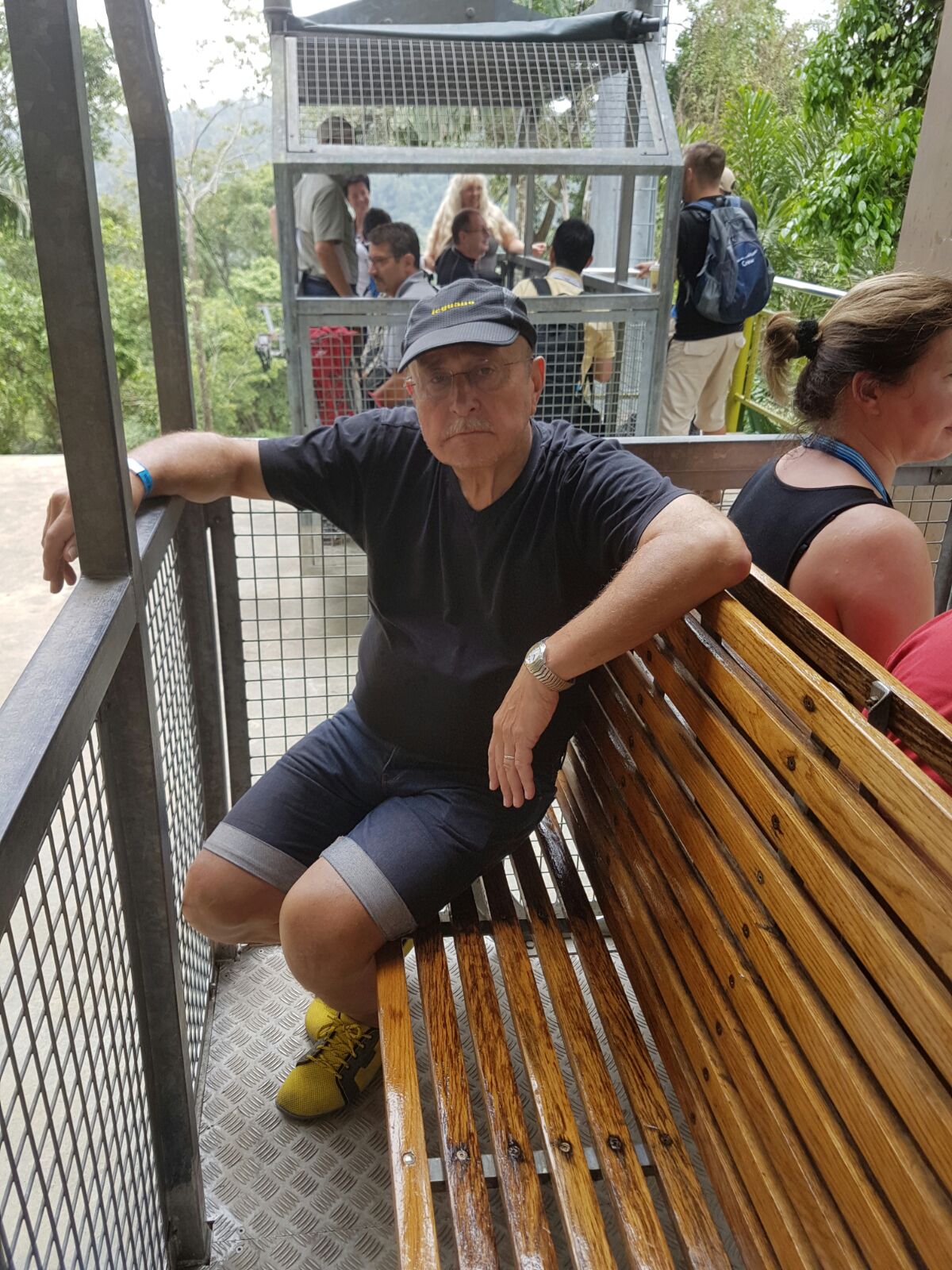
Siemens technology as I experienced it during a wonderful trip to the Veragua-Rainforest and Puma Waterfall Research Centre in Costa Rica
In the early 1970ies, while studying in Munich, I ended up at Siemens AG. I was a working student at Kopp-Strasse. My office was there and our tests were done at the Feurich Building IT Laboratory. The Kopp-Strasse was beyond the “Hofmannstrasse” compound, the Feurich Building inside.
Siemens was a wonderful enterprise. Perhaps it is (was) The German Enterprise.
Our motto was “building high technology for and with everything that is related to electricity”. There were more than 20 sectors, and every one of them did exceptional technological work. We complemented each other in a synergetic way. In addition, the entire enterprise was under excellent business leadership.
In the technological areas, there was an atmosphere of departure. The challenges were never big enough and the solutions were absolute works of genius.
In those days, the directors were very approachable. One of them described his view of his role as follows:
“Most of the more than 25 Siemens AG departments are doing economically very well. There are a few that need a little extra help. It is my job to make those strong again. I am not worried that there will be a day when I no longer have any work, because it is quite normal that another “strong” sector will need a little support at some time”.
To me, that sounded plausible. Such is life, also business life. There is no such thing as continuing top performance. Consequently, it is also quite normal that one sector or another will occasionally need some support.
I admired the economic strength and the exceptional business competence of the enterprise as a total unit. That was something that clearly distinguished us – Siemens – from the competition, such as AEG or Telefunken. As far as D was concerned, also from Nixdorf. And when occasionally some people lovingly and with irony called Siemens “a bank with an electronics sub-sector”, then this was not something I found so bad. It is quite a good idea for an enterprise to have “the funny stuff”.
Their mentality, at least as far as engineering areas were concerned, fascinated me. We worked in the same way as employees at google later told me they worked (during the good years). There were huge technological challenges, a high degree of self-responsibility and a faire error tolerance in case of failure. In addition, they had a clear reporting strategy without any restrictive processes and roles. Those were virtues that catapulted us to the front in technology. And we were (often more than) at eye-level with IBM and the other mostly US competition. The few European competitors had been left behind a long time ago, anyway.
In the late 1970ies, I was a tenured Siemens employee. In 1980, they also sent me to Neuperlach. And then I soon left the enterprise. Because the aforementioned virtues were getting lost.
They defined roles and introduced processes. Bureaucracy became the domineering factor and all decisions were made with a strong consideration of the shareholder value. A huge wave of paralysis was combined with irrational planning approaches, thus making it harder and harder, if not impossible, to work successfully. This is how a great technology went down the river.
After having founded my own enterprise, I did a lot of business with Siemens. Initially this was an excellent situation. Siemens was an honest customer and business partner. I can tell and already have told you many positive stories about it.
In the 1990ies, the climate started changing more and more for the providers, too. The providers came up with a nice German bonmot: “Partnerschaft ist, wenn der Partner schafft“. (If the partner does the work, they call it partnership). This is also something I could tell many stories about.
Then, the distance between me, and the same is true for InterFace, and Siemens grew. As the years went by, I followed the decline of the biggest German enterprise in the third millennium. Thus, the pain I, as an original Siemens person, felt became less and less and was finally relieved to some extent by a morbid joy of seeing a sick system collapse.
Now, in 2018, there are again exciting news from the one-time electronics concern. A new enterprise organisation is under way. They want to become „meaning oriented“. But what exactly does that mean?
Incidentally, all the stakeholders are to benefit – but above all, they mean the shareholders, then to some extent the customers, the people who work in the enterprise, the providers and the external social systems. It seems that Siemens did not learn a lot from what they saw in the last decades, because those decades show that this is not how it works.
The emotional distance between me and Siemens has grown. Today, I can look upon Siemens with more serenity than a few years ago. And I notice:
Again, the employees are verbally made the ”centre“. And there they are more in the way than anything else.
The first priority is given to the shareholder, i.e. the international capital. As I see it, Siemens wants to tread on a path that I already saw several other enterprises take.
You divide an enterprise into two (here: three) parts and take the new enterprises to the stock exchange. As soon as each of the enterprises alone has a higher stock exchange value than the old one ever had – the champagne corks can fly. This is especially true for the capital.
It is a totally different story what will become of the three successor concerns. However, it will have nothing to do with the old Siemens company.
Well, this is neither here nor there, because the times when they said “we produce everything that has something to do with electricity” are history. Which is also true for the other German enterprises that, with their more or less enthusiastic employees (and many guest workers) created the “economic miracle”.
RMD
(Translated by EG
Klaus HnilicaMonday August 13th, 2018
Climate Change and the Damned Ice-Cream Time Carl and Gerlinde (Instalment # 59)
Hi
Carl and Gerlinde (Instalment # 59)
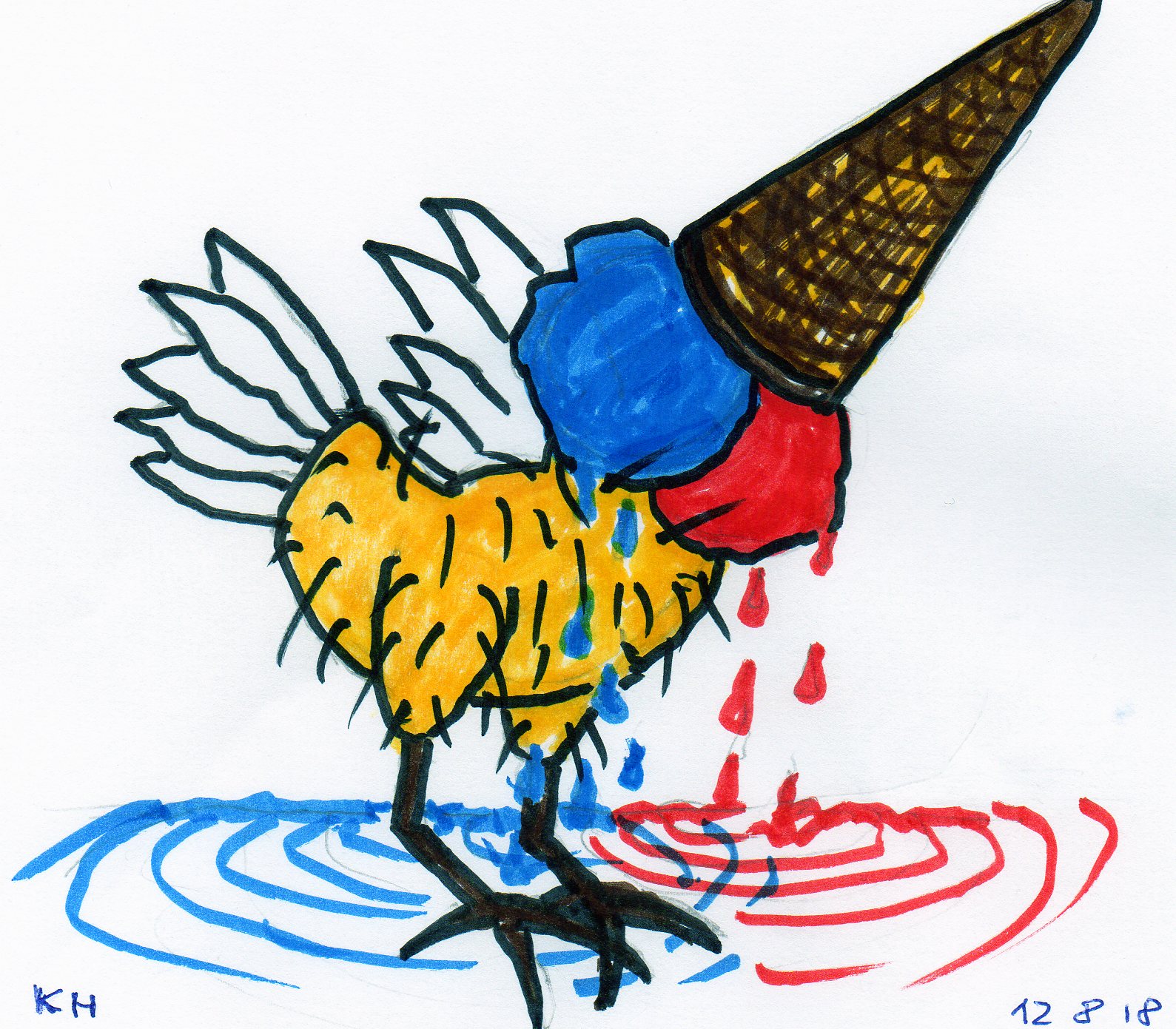 By the way, Gerlinde, when I accidentally met our friend Kurt last Tuesday at REWE, he told me – under the pledge of secrecy – that, regardless of his considerable age, he will separate from Hannelore if, like in the previous years, she insists as stubbornly as she always did that we again book our next summer vacation together, Carl said at 22.20 hours when the temperature was still 28 degrees Celsius directly in front of the ice bar. This must have been the eighteenth time he wiped over his forehead with the same paper napkin.
Mind you, he added while steering Gerlinde towards the interior of the parlour, the nightmare was basically due to the word ‘together‘ as Kurt had put it while simultaneously, with the usual anxious nodding of his head, he had stacked ten cartons of ‘Philadelphia Cheddar‘ into his trolley.
Because his lamentable experiences last year between October and the end of the year regarding this year’s summer vacation was decidedly over the top, even if said top were that of a huge pregnant dairy cow, Kurt had said as they stood in the middle of the air-conditioned food area at REWE!
Since, however, neither Gerlinde nor Carl were able to decide spontaneously which of the numerous unoccupied tables to take in the neon-yellow sub-tropically warm ice-cream parlour – which was wide open at the front towards the street -, Carl shortly interrupted his report about Kurt’s confidential separation revelation while meandering from one table to the next until Gerlinde flung herself on a chair at the very back of the establishment and declared with a moan: it will be either here or I will suffer a break down on the spot!
Carl raised his eyebrows in disappointment but then – still dripping with perspiration – , after having joined Gerlinde and in the process almost having toppled over the neighbouring table, said that Kurt had talked about 34 travel brochures from five different travel agencies. Hannelore had forced him to work through all of them meticulously, along with making him to listen to 18 presentations in various adult education centres and libraries about travelling through Patagonia and diverse pole regions, through Australia and New Zealand, doing a desert safari and three different round-the-world-trips, as well as four meditation courses in Austrian and Greek convents. And all of it just because Hannelore could not make up her mind about what sort of vacation she wanted in which region of the world…
Gerlinde – holding the open ice-cream menu and pointing at a vanilla ice-cream fruit cup with plenty of cream with her right, almost stiff, index finger – said that she was not really surprised by this lament of Kurt’s. In fact, she, too, had already noticed that Hannelore seemed to become more and more indecisive as she grew older!
Since this was already the third time the waiter asked for their order, Gerlinde finally, with a threatening look at Carl, ordered her fruit ice-cream cup while Carl, although sitting in front of the several-page long ice-cream menu, was not yet ready to order more than a bottle of sparkling mineral water. Beyond that, he asked for a little patience as far as his ice-cream order was concerned and told Gerlinde that, when they were talking about this ‘monstrous vacation choice procedure‘ at REWE, Kurt had, above all, been angry with Hannelore because they were now, as a result of all this tedious work, starting a two-week trip to Portugal. To be precise: to a wellness hotel in the Algarve, where currently you had to endure 42 degrees Celsius in the shade and there were already forest fires twenty kilometres away that looked like they were never going to end …
Great – was Gerlinde’s laconic reply, before she took pity on the desperate waiter and ordered a CARLOS I (which was the least she could do) while Carl now at long last started to really get involved with the ‘ice-cream varieties‘ on the menu. Without giving the waiting steward a single glance, he told Gerlinde that, basically, his order was very easy. After all, he only wanted three balls of ice-cream without anything on it and consequently the only thing about which to make up his mind was the choice between dark and light chocolate, or about vanilla, hazel nut, stracciatella, strawberry, yoghurt, latte macchiato, cream-cherry, mango, maracuja, lemon, banana, pomegranate, raspberry, dragon fruit, bounty, cream grit, cinnamon, raffaelo, and seaberry- chinaberry! Nothing could be easier than that, which he found really hilarious..
But since the waiter still stood before him like a vengeful deity, he said, to the surprise of everybody, that he wanted an espresso.
Double – or single?, the waiter asked.
No – but maybe two balls of vanilla ice-cream after all, Carl said.
So: vanilla ice-cream!, the waiter typed it into his gadget.
No – just bring me a CARLOS I like the one Gerlinde has ordered.
And when, at long last, the incompetent waiter had left, Carl noted with a sour face that, for the first time, he now really pitied Kurt: because if he had a partner who was as indecisive as Hannelore, he would probably go crazy every single day of the year. With these words, he pushed the ice-cream menu towards Gerlinde with satisfaction. Gerlinde got up without a word and left.
Hopefully, she was only washing her hands?
KH
(Translated by EG)
Roland DürreSaturday August 11th, 2018
The Things I Do #MyLife
I have been part of the “Forum Agile Verwaltung | Austausch und kollegiale Beratung“ (a closed facebook group) for many years. I enjoy it very much and learn a lot. Now there was a call to all members of the group asking them to introduce themselves. It was my pleasure to reply to the call. Here is my contribution:
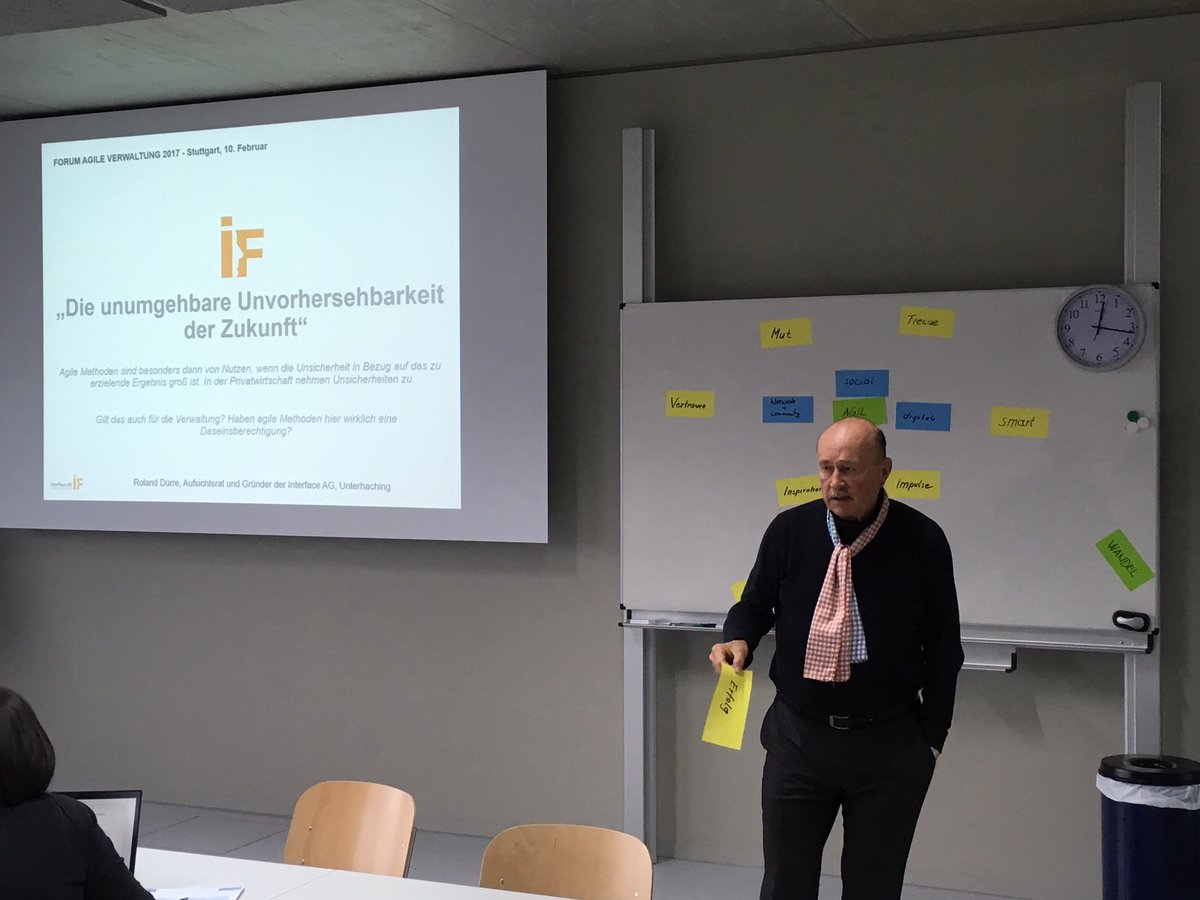
At fav17! Many thanks to Jan Fischbach, agility master and my photographer this time.
In this group, I feel that I am a guest who can get his first input on interesting topics and both listen carefully and learn. I became part of this forum because I was once invited to give a presentation on the “Unpredictability of the Future“ in the forum.
About me: after my university studies of mathematics (major) and computer science (minor) at Munich Technical University that started in 1969, I became a programmer. After some apprentice years at Siemens AG and Softlab GmbH I founded my own company, the InterFace AG, in the early 1980ies with Wolf Geldmacher . During a PM camp, I met and learned to appreciate Thomas Michl.
Thanks to our product CLOU/HIT, we (InterFace) won many customers from the public office sector (police and county jurisdiction, the Central Employment Agency, and many more federal and county offices). And we learned a lot in the process.
During the development phase of CLOU/HIT, it did not take us long to understand that a customer-oriented development of complex software products will no longer work with “old concepts“, which is why we replaced “hierarchically organized groups“ by “networking teams“. At the time, this was revolutionary and extremely successful.
Today, I am no longer operatively active. Instead, I now limit my involvement to handing my experience (knowledge and expertise) on, mostly to younger persons. Some of them are individual persons, others are teams (start-ups).
I try to avoid giving advice (an advice is also a vice). Instead, I try to inspire people and generate impulses. And I try to find good (the right) questions in mutual agreement with all the parties concerned. Because a good question is the requirement for a good answer.
My goal is mainly to make other people, and especially young people, more successful and happier.
I think this is a concise description of what I currently do.
RMD
(Translated by EG)
Roland DürreSunday July 22nd, 2018
Love & Hatred.
 I used to quite like a few proverbs. For example:
(i) No pain no gain!
(ii) No risk no fun!
(iii )No hate no love!
You can use them in all kinds of situations. There are people who actually gain eternal notoriety by cultivating these proverbs. All these proverbs have one thing in common – they signal that you cannot get one thing without accepting another thing.
In some way or other, these ideas were also part of my kitchen philosophy. They were part of my cynical approach towards life.
Today, these – perhaps wise – sentences no longer mean much to me. I want to win without having to suffer. I want to be happy without having to risk something. And, above all, I want to love without having to hate.
I think it is a basic decision of every individual human being if he/she wants to live by the principles (i – iii). Or if they prefer living without those principles and instead focus on what is positive?
RMD
(Translated by EG)
Gastautor(en) Friday July 20th, 2018
Article by a Young Guest: The Transatlantic Circus.
Today, I (Roland Dürre) would like to introduce Götz, the son of Detlev Six. In the past, Detlev contributed hugely to the IF Blog with his articles. Among the things he wrote was also the Radio Philosophy. Let me remind you of former times: the radio philosophy (Radiophilosophie) consists of 80 – as I see it, a little underestimated – philosophical articles, all of which follow the motto: “success regardless of thinking“.
But now, let us give his son the spot light. His topic is:
The transatlantic circus:
One would imagine that it is a good thing if the presidents of the two biggest nuclear powers meet in order to reduce tensions, especially since it is not the first time that an American President officially meets a Russian President. However, as we all know, there are people who see this differently. One of these people is the “Zeit” columnist Matthias Naß, who finds Trump’s politics “scary”. In his opinion, he gets support from Stefan Kornelius, who is the boss of the foreign correspondents department at “Süddeutsche“ and who writes: “These days, democracy suffers its worst setback since the fascist 1930ies”. In other words, Trump meeting Putin reminds Kornelius of the rise of Adolf Hitler – and Naß even calls him a “special transatlantic person“ for saying this [1]. Well, boys, I would like to thank you for this chip pass. Incidentally, both of them – like many other journalists [2] – are members of the transatlantic political lobby “Atlantik Brücke”.
Basically, one could just find such a circus hilarious, but there are quite a few problems with this attitude: the positions of Naß and Kornelius are such that they are considered far from obscure clowns. They are important clowns. Besides, this one example, sadly, covers the complete mainstream range of opinions. Additionally, there are still many people who actually consider these kinds of comments journalism. So now let us look at the reasons the mainstream press gives for their demand that Trump should not talk with Putin.
The “Annexation” of the Crimea:
In the UN Charta, which is the so-called international law, the terms annexation and secession do not exist, i.e. these words are not defined. In said Charta, we find the “right of self-determination of all peoples” and the “territorial integrity of countries”. When they sent the green men to the Crimea in order to make the former possible, Russia violated the latter. So regardless of the fact that international law allows a referendum that decides secession, the majority of the experts argue that the vote cannot be in accordance with international law because it was initiated through a breach of international law. However, some experts argue in favour of a secession [3]. There is no doubt that the so-called annexation of the Crimean is not a fact but an opinion. On the other hand, there is no doubt at all that the United States annexed the Island of Guam [4].
War in the Eastern Ukraine:
The MSM is quite good at not mentioning that Janukovich was not overthrown by the people, but by sharp-shooters. They shot from buildings that, at the time, were controlled by the opposition [5]. After the citizens of the Eastern Ukraine, who did not accept the forced coup, had declared their independence, a new Ukrainian government sent the army to the eastern regions, calling the entire process “anti-terror operation“. This activity triggered the fights in the Donbass region and made it a popular holiday destination for Russian soldiers. To be sure, Russia makes this war possible by supporting ethnic Russians in their neighbouring country, but the conflict was definitely triggered by others.
The influence on the elections:
Between 1946 and 2000, the USA influenced 81 elections and Russia and the Soviet Union influenced 36 [6]. If now the USA get upset about an alleged election influence, then this is a little like a Mexican drug cartel calling the rocker crime rate in Europe un-ethical. Additionally, there is the fact that, to this day, there is no publicly available proof. Most of the material is based on what the secret service said – and I mean the same secret service that faked the proof of Iraq mass destruction weapons. And those allegations do not even claim that what the Russians did actually had an influence on the election results [7]. But what about Mueller’s accusations? Yes, it is possible that, at long last, they will find something that sticks, but as of now, the benefit of the doubt still seems appropriate. The accused are all Russian citizens and companies operating in Russia. Basically, it is not very likely that any of them will appear in front of a court, which means Mueller does not necessarily count on having to provide proof. Surprisingly, now one of the firms that were accused of being troll farms appeared at court and pleaded “not guilty”, wishing to see proof. The first reaction by Mueller was that he tried to delay the release of said proof [8]. Unfortunately, German media had not time to write about this.
This is basically how propaganda works. Once in a while, some piece of information is withheld, some connections are not mentioned. The process is called fragmenting and de-contextualization of information. It generates a distorted image onto which then an unnaturally simplified range of opinions is imposed. And said distorted image is then held to be the whole truth and nothing but the truth. This is how you can lie without telling a lie and it all sounds very realistic, because the information fragments you presented are mostly true. However, the same is not true for the overall image. Currently, the press massively promotes Cold War. Any attempt at closer contact or de-escalation needs to be avoided. But it is important that you do not let yourself be brainwashed by this propaganda. There is a lot you can say against Trump, but his approach to Russia is a good approach.
[1] https://www.zeit.de/politik/ausland/2018-07/donald-trump-nato-gipfel-usa-demokratie-5vor8
[2] http://spiegelkabinett-blog.blogspot.com/2013/03/journalisten-der-atlantikbrucke-in.html
[3] http://m.faz.net/aktuell/feuilleton/debatten/die-krim-und-das-voelkerrecht-kuehle-ironie-der-geschichte-12884464.html
[4] https://de.m.wikipedia.org/wiki/Kolonien_und_Protektorate_der_Vereinigten_Staaten
[5] https://www.rubikon.news/artikel/propaganda-statt-journalismus
[6] https://en.m.wikipedia.org/wiki/Foreign_electoral_intervention
[7] https://m.youtube.com/watch?v=PSieUmpeDSw
[8] https://www.politico.com/story/2018/05/04/mueller-russia-interference-election-case-delay-570627
So much for Götz Six.
My conclusion? Perhaps we should listen more carefully to what young persons have to say and also give them more responsibility in politics and in enterprises?
RMD
(Translated by EG)
Roland DürreTuesday July 17th, 2018
Innovation. Management. Future.
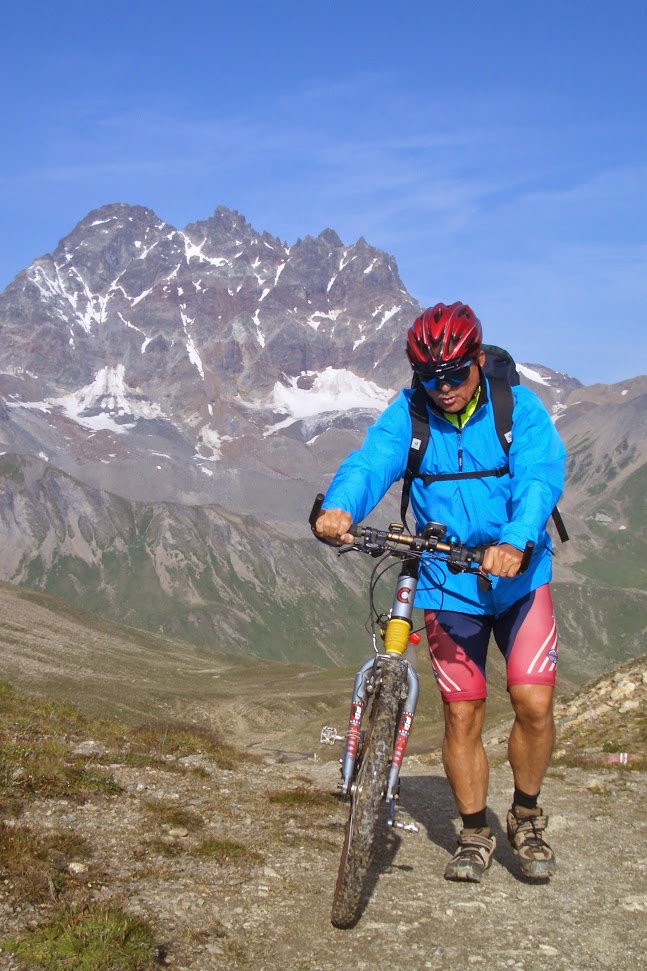
I did it ?!
More and more enterprises create positions that they call “innovations management”. Whenever I hear such a thing, I am tempted to ask these managers what exactly their job-description is (regardless of the fact that I do not really believe in precise job descriptions).
More often than not, the Innovation Manager will sit in the Human Resource (HR) Department. After all, it is his main task to make the employees “more innovative“. Besides, I do not really know why you need HR.
“What exactly is innovation?“
That is a question I rather like asking the “Innovation Managers”. Mind you, this is not with an evil purpose. I really do not know what innovation is. Except that it is a buzz-word everybody seems to use these days.
I particularly like asking such stupid questions when I meet people who are supposed to make very classical-style enterprises more innovative. For instance when we are talking the financial sector, i.e. banks and insurance companies.
In such situations, I always remember the definition given by Simon Grand (St. Gallen). He called innovation “creative destruction”. This might not be very helpful. But at least it is a definition that indicates that innovations usually cause change. And nobody likes change. Except when you have a massive problem.
Which brings us to the next question:
“What exactly is a problem?“
I find a definition that describes rather drastically what a problem is:
“A state of affairs that cannot continue“.
It might be the task of innovation to change such states of affairs …
And then we are in the middle of such horrifying scenarios as fragility and disruption, which threaten our stability. After all, innovation is supposed to help when it comes to strengthening the anti-fragility of systems that are threatened by disruption. And if you listen to what managers generally believe today, then disruption obviously increases. Which is due to the ever increasing complexity (also one of the general managerial beliefs).
“Disruption and anti-fragility “
Two more of those nice buzz-words. You fear the one and you are supposed to create the other. And if the Innovations Manager sits in the HR department, then, naturally, he has to create the innovation with his resources – that is with the people. Consequently, he has to provide the employees with better equipment for dealing with disruptions, thus taking the system for which they all work to a higher level of anti-fragility.
“How do you go about doing this?“
Here are a few ideas.
Perhaps you want to tell stories. You could describe a nice working and living environment. You could introduce values that may sound well but are really hard to realize in old systems. Because the opposition among the persons and institutions can hardly ever be overcome.
Or maybe you will want to introduce new forms of communication such as barcamps with which you hope to penetrate walls and bunkers in the enterprises.
But who knows if any of this is enough?
I do not know. I look forward to reading or hearing stories about successful innovations management. I would really like to tell those stories to a broader audience.
RMD
(Translated by EG)
Roland DürreThursday July 5th, 2018
Fuckup! Nights! Munich!
Something new happens all the time. A few days ago, I discovered the FUCKUPNIGHTS. And I decided that I want to be part of it. ? .
We Live Life Without Filters
That is the motto of this movement, which calls itself FUCKUPNIGHTS. It started in Mexico, from where it continued its triumphal procession into large parts of the world.
It is about failure. We also discussed this in June 2016 at the Berlin PM-Camp. Because failure is simply part of life. It might sometimes even be a source of success. Because there is a lot you can learn from failure. And you can not only benefit quite a lot from what you learned from your own failures. You can also share it with others. It can help those others to avoid failure (= to be a success).
The Techdivision– Marketing brought the Fuckup Night to Munich and Rosenheim. On July, 5th, (that is today), the FuckupNight will be held in the Munich Balanstrasse. And they were still looking for a speaker. Consequently, Sacha (the boss of Techdivision at Balanstrasse) asked me:
Hi Roland, would you like to present a personal fuckup example from your life in seven minutes and with a maximum of 10 slides?
Here is all the information on FUCKUPNIGHTS in Munich. Today, the event is already overbooked, as mostly happens with Techdivision events (you will find them all at meetup).
Well, I gladly obliged. However, it also meant that I needed to prepare. Consequently, I started thinking:
- What were my greatest errors, my worst blows below the belt?
- When did life really make me feel small?
- What was it like when I felt I was an absolute failure?
- What can you relate publicly without exposing other people?
There is also a FuckUpNichts Speaker Manual:
Speaker Manual: What exactly are FuckUp-Nights?
“FuckUp-Nights“ sounds offensive? Well, it is not! The FuckUpNights were initiated in order to publicly speak about projects, work and ideas that failed and to share these experiences in the community. In a relaxed atmosphere, precious experiences made by successful managers, enterprises and start-ups are discussed during these evenings in order to learn from the mistakes they made.
For seven minutes, three or four people tell you, for a change and with lots of wit, humour and openness, not about their great successes, but about how everything can go wrong – which means they had so-called fuck-ups.
How to present my FuckUp in seven minutes?
- Please send in advance 10 slides that illustrate your failure.. The images should be numbered from 1 to 10 and later appear in that sequence. Please remember that each image has only about 40 seconds, because otherwise you will need more than seven minutes.
- A short biography, because we need to introduce you on the day of the event (1-2 paragraphs).
During your presentation, you will want to remember the following:
- Who am I?
- What was the original idea for the project/business?
- What went wrong?
- What should I have done differently? What have I learned from the experience?
And please do not forget!!!
We are talking FuckUp-Nights! People make mistakes. All is well as long as you can tell them with enthusiasm, wit and humour. So enjoy your presentation! ?
I rather like that. So I gladly think about my personal fuck-ups. I am always hardest hit if a disappointment is personal, especially if people are concerned. They hurt – but I would not wish to publicly speak about them on a fuckup-night, because in doing so, I might not do justice to others or even hurt others.
Consequently, I will focus on my entrepreneurial failures. One of them was the great visionary idea of magicHIT. It cost the InterFace Connection a lot of money and eventually turned into a total failure from the economic viewpoint. It might be a good presentation, I will relate it tonight. And I will write down the story here. It starts with: I was a …
i) Third Generation IT-Pioneer (Computer Science after 1969) and
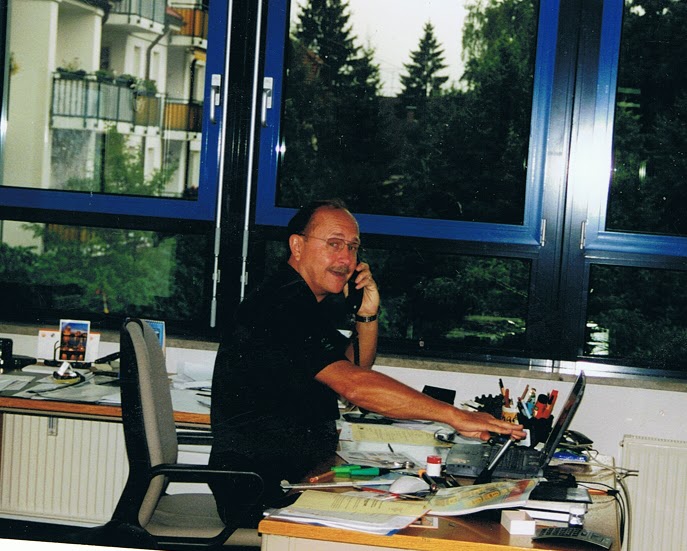
no longer all that young – but, considering the times, a rather young entrepreneur.
Years of training at Siemens and Softlab.
Focus on: industrial computer science (knowledge for the sake of domination).
Unfortunately, I paid too little attention to “the toys“ produced by Commodore and Atari.
Later, it turned out that this was a huge disadvantage.
ii) late founder with instant start (1984 – I was already 34 years old)

Here is a happy entrepreneur, because things worked out.
- The start went well – Wolf (my partner, whom I had spent a long time looking for) and yours truly were in paradise. Especially when we had our first team and were able to develop a product.
- In a nutshell, you have four relevant business/income model types in an enterprise:
- Service, i.e. time and material,
- the lot,
- full service,
- a product
Unix is our topic! And a product is the best of all disciplines. Consequently, our goal was:
We want to develop a product for Unix (because a product will give you identity and a scalable income).
We build CLOU/HIT!
iii) Innovation is creative destruction

Evening event BICCnight it at media / Foyer Funkhaus Bayern /Muenchen / 22.07.2011
Foto: Stephan Goerlich
Foto: Stephan Goerlich
Also Digitalization. Which means: no more filing cabinets, typewriters and telefax machines (all of which were still relevant communication tools at the time).
Data bases instead of paper. Documents will be automatically generated, the communication is via computer networks.
We start with the destruction of the old world.
iv) Life is a dream

Absolutely guaranteed: far from everyday problems – a few years ago in the South Sea.
Our product CLOU-HIT sells marvellously.
If your are the leader on the market in no time, this feels wonderful. Major customers (both public offices and enterprises) use our software at a huge scale. They fill our purses with money and give us prid
v) The competition does not sleep!
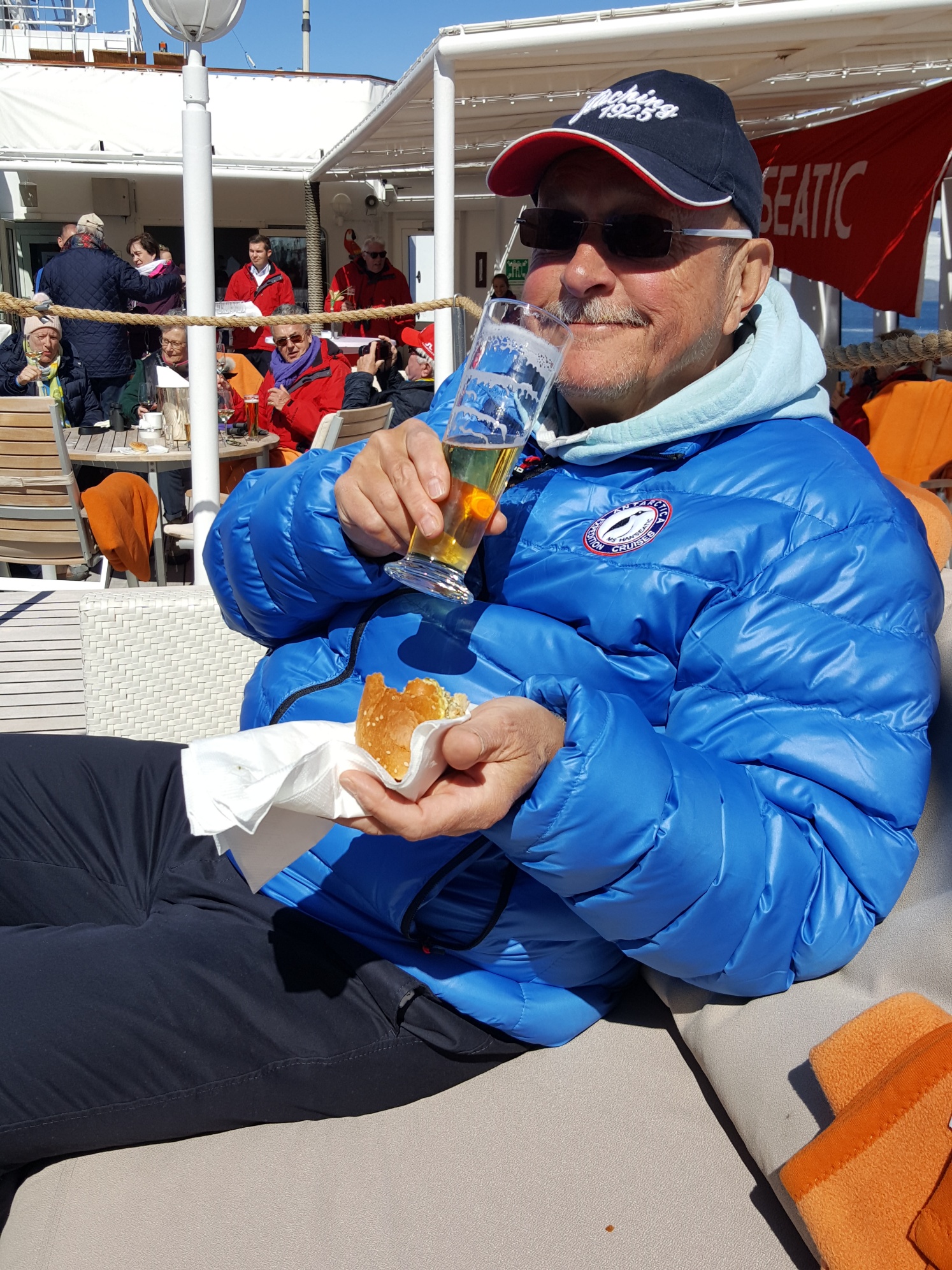 CLOU/HIT is a success. But the product is no longer the newest.
We know that. Regardless, we enjoy the success of our product. And we celebrate it. Parties are an important part of every enterprise.
Yet we know that innovation continues and that we need something new. Because if you sit on your laurels, you have them at the wrong part of your body.
vi) We start developing MagicHIT …
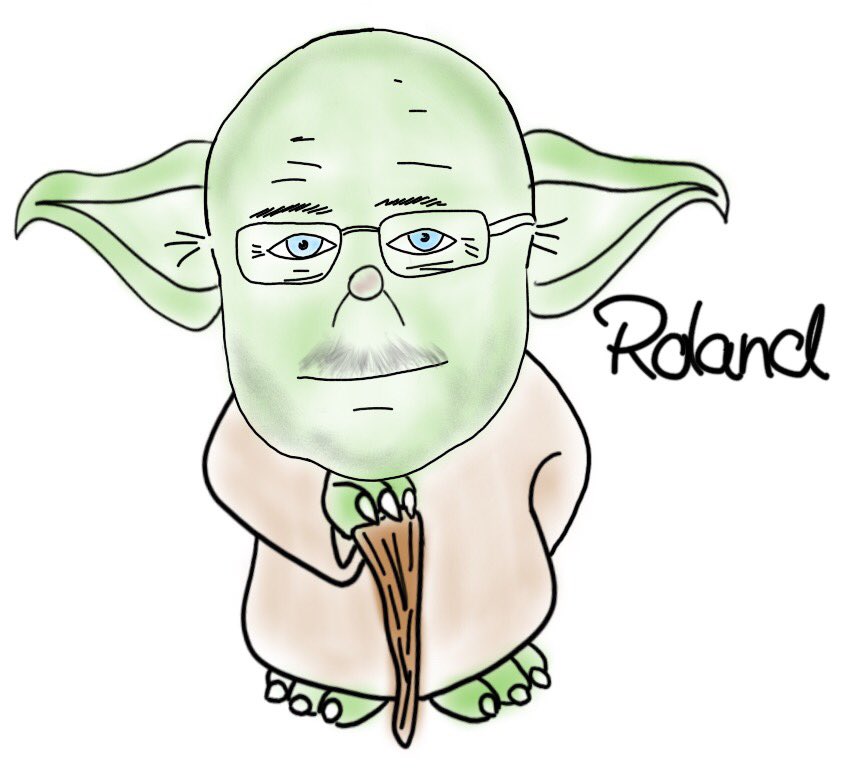
This is how Christian and Daniel see me(©
Visual-Braindump) – at least it is how they saw me on the last Dornbirn PM Camp in 2016.
… the first ODA-/ODIF-EDITOR (ODA/ODIF is ISO norm) world-wide, as a “wysiwyg“ system with the extremely powerful semantics on UNIX and X11).
Every document is an object of a category, its semantics are determined by the category (examples: invoice, contracts, official orders, …).
We port MagicHIT on Windows
A special team with ten employees works in a huge old flat Im Tal near the Munich Viktualienmarkt, where they have their special work environment.
After a few years, the first version of the product is finished. There is a wonderful manual.
vii) Many warnings!
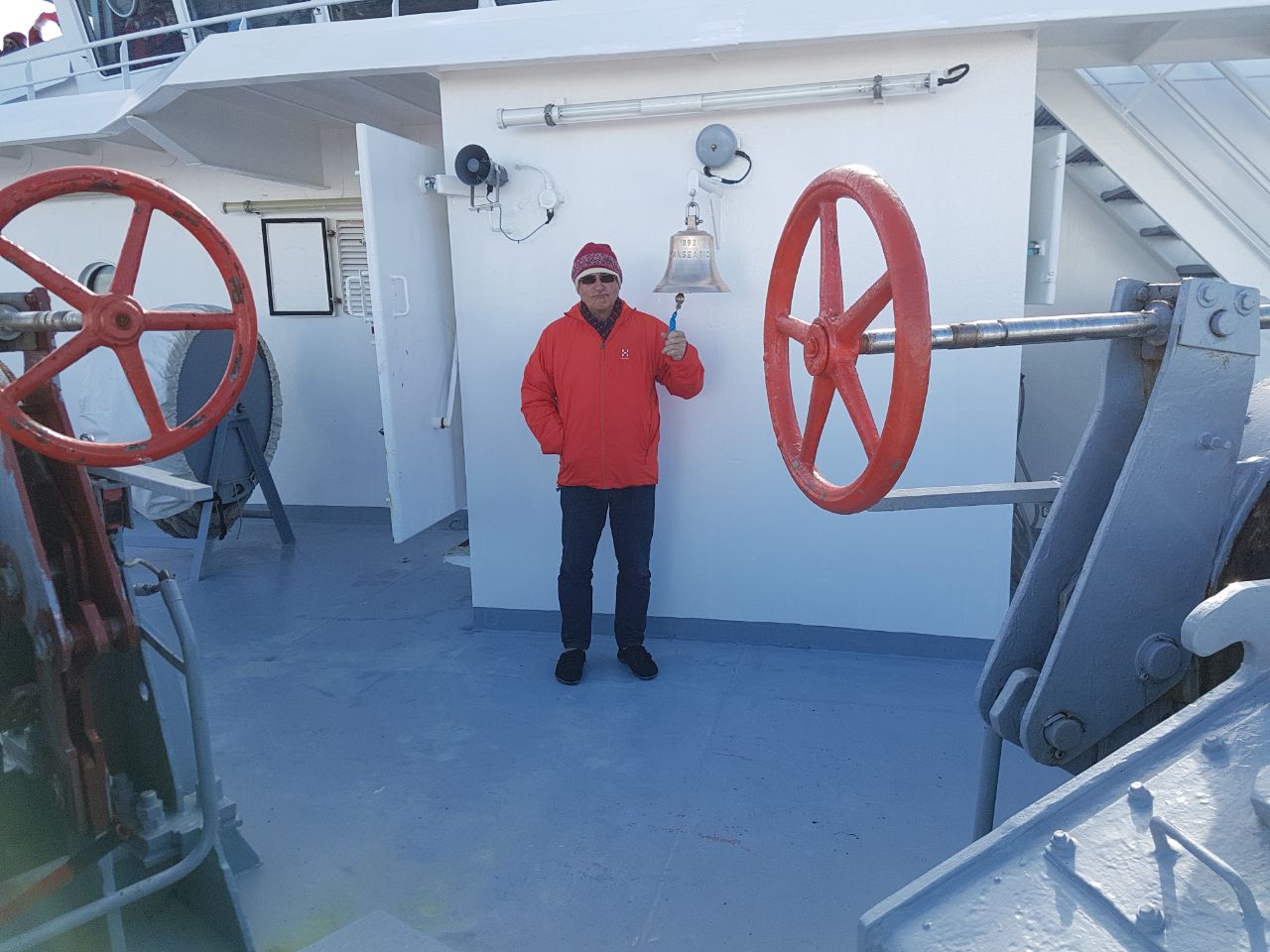
Wake up! The bell rings!
Famous partners from huge enterprises and offices warn us:
“You must be suffering from brain-damage. You cannot win against MS?!“
We are idealists and ignore the warnings.
After all, there is (still) enough money.
viii) One customer is not enough!
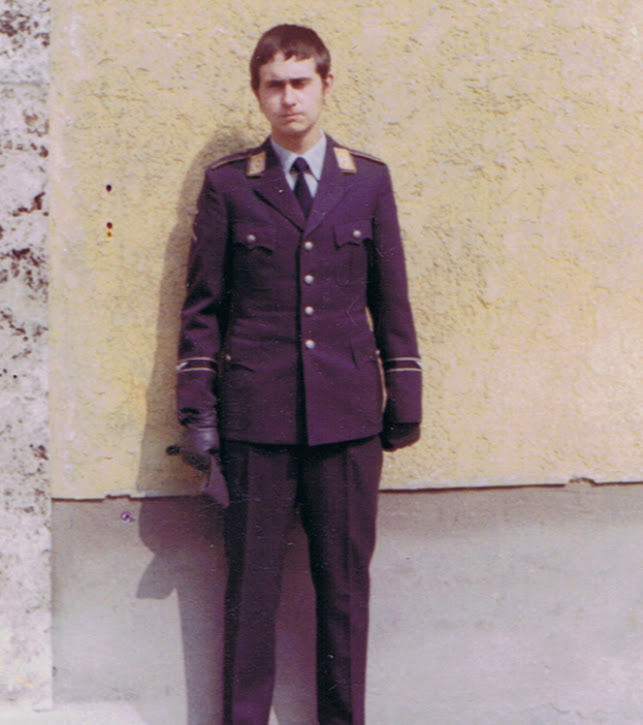
CAREFUL – I know them.
After huge efforts in sales, we have found only one customer for the new MagicHIT – the German Armed Forces.
They want to turn their command posts into automated commands through MagicHIT.
Things start to get messy. The costs remain, but there is no success.
ix) Game over

“My post – InterFace life ?“
All offices and huge concerns buy word and windows. It no longer makes any sense. We capitulate and give up. The development of MagicHit is terminated.
Maybe someone will need it many years from now.
? And I must postpone my exit …
x) Fiasco and Happy End
 We have to do the calculations. For almost ten years, ten or more of our best employees worked for nothing. Depending on how you do the calculations, that is an investment of between 10 and 20 million DM/EURO. For nothing!
But:
The know-how we gained in this way is extremely helpful. We learned a lot. That helps us to survive for the next ten years. Basically, it helped right up to this day.
xi) Lessons learned
Many thanks to Jan Fischbach, agility master and my photographer this time.
David will not always win against Goliath.
Wonders will not repeat themselves.
The product that is most beneficial will not always win.
Progress is slow.
More often than not, you cannot fight against power, corruption and fraud.
But still, it was nice!
RMD
P.S.
Basically, it was a three-times fuck-up. Because around ten years later, we again implemented MagicHIT for Siemens and the Bavarian Justice System – we called it ForumStar-Text for them.
Due to the ignorance of a partner, we later lost the bidding process that had already been practically won (second fuck-up). For similar reasons, we also lost the visionary project to – in cooperation with TUM – bring ForumStar to the Bavarian Justice System and Siemens AG as an Open Source. Even Siemens, represented by (chairman of the IT provider ), had already agreed. It might have been a great hour for Germany or even Europe.
Then Siemens AG cancelled the meeting between representatives of TUM, the Bavarian Justice System and us at short notice. They did not appear. Fuckup, von Hammerstein left the SBS a short time later and became an important reformer at Kabel Deutschland. You can admire the remainder of SBS at ATOS and the InterFace AG still does its business, now with IT compliance, CLOUD and still with software development (our motto is: ”long live devop!“). … And the Justice Systems in Bavaria and
Germany public authorities concerning judiciary are now serviced by IBM. Such is life.
P.S.1
And many thanks to the great Lydia of Techdivision for all the huge support she gave me!
Klaus HnilicaTuesday June 19th, 2018
Advantages of Integration and Progressive Digitalization
 Ever since a new British study has found out that the progressive digitalization also offers massive advantages and totally new perspectives in this field, there is a new urgency to the question: To what extent vampires can actually be integrated?
Mind you, it was not the old and ancient protagonists who initiated this revolution. It is yet again the often so scolded youth who make the decisive steps towards this ’young future that cuts the edges’: they are the ones who not only talk about digitalization, which is what any second-class provincial politician does these days, but who also actually live digitalization!
Yes, it is the ’generation smart-phone’ who, in the 21st century and totally surprisingly and unplanned, restore a tiny bit of freedom to the vampires by letting them return to free biting!
After all – and you want to be honest about this – there is nothing more suitable for the direct and unhindered bite of a vampire than the naked and exposed little neck of a fifteen-year-old female smart-phone user who is fascinated by what she sees on her screen. And I mean all the time: on the street, in the train, on her bike, on the toilet and while doing her homework.
There is definitely nothing, absolutely nothing more suitable!
And this suitability for quick access is, naturally, not only true for the aforementioned fifteen-year-old girl, but also for all smart-phone users, regardless of their age and the colour of their skin: when they act as mentioned above, all these persons remain in the exact same position, with exactly identical ’bite invitations to their jugular’ in front of their device. In fact, the author of the British study I mentioned before even assumes that the inventor of the smart-phone must have had or have a ’vampire background’. This assumption becomes even more of a probability since all the smart-phone users are so fixated on their devices that they not only fail to notice the quick bite into their jugular, but also never even realize how they have been sucked out afterwards!
They are actually so immersed in their smart-phone world that they are not available for any other observation: the first time they actually often start yelling and getting aggressive is when – due to some unfortunate mistake – blood drips on their screens, because that is when they start soiling their own screens as they wipe around with their own blood on their fingers!
This is one of the reasons why leading vampires in business and politics started several years ago to vehemently demand from companies such as Apply, Samsung and Nokia to come up with the ’blood-absorbing screen’ at long last! After all, such a modification is absolutely necessary unless you want to carelessly miss this unique opportunity of integrating vampires into society: and I mean all vampires! This includes the less dexterous ones – those who, when they bite, sometimes cause a drop or two to fall where it should not!
It goes without saying that the sector data security, too, needs massive modifications: it happens quite frequently that smart-phone users take pictures of vampires while they feed on blood and then immediately send the pictures to the smart-phones of those who have been bitten!
This is often the moment when those who have been bitten actually realize that they are currently donating blood – and since they see it on their smart-phones, they also believe it. Their reaction is that they often start hectic defence movements – which might then again cause unnecessary extra blood loss.
Consequently, what we need immediately is legislative initiatives with a ’filming ban on blood feeds’. And these initiatives cannot be national solos but have to be coordinated on EU and UNO level. Basically, this should not be too much of a problem if all parties concerned mean the same blood and refrain from overeager bloody comments.
Another problem is probably far harder to solve.
What I mean is the bite into the ’wrinkled neck of an older person’ – which, as the aforementioned British study shows, is something some of the vampires also favour.
Luckily, these few ’connoisseurs’ will also find enough older smart-phone users today – even if their enthusiasm and stamina are nowhere near what we have with the young generation. That is something that does not really make quick bites easier!
But when all is said and done, this is not the central problem! The real problem is that, even if the bite on the ’far-from-fresh wrinkled neck’ is a success, the blood you get there tastes like a wine-soda mixture that contains one eighth of Riesling and one litre of soda water!
Which is nothing. Well, it is less than nothing!
That is because today practically all older people get huge amounts of expensive blood thinners from all their doctors and health insurances: this is certainly a good thing for the pharmaceutical industry and for the blood-thinned elderly people – but for vampires, it is a pure nightmare!
And I am not just talking the taste, but also the amount you need: due to this practice, vampires are not only forced to swallow immense amounts of blood, but also to visit the toilet all the time in order to get rid of all the water. This will quite often cause individual blockage situations at public toilets! Humans who suffer from weak bladders are those who will suffer most in the end!
Taking all these aspects into consideration, it can be said that much remains to be done before vampires enjoy the same paradise-like state of affairs in Germany that, according to our Federal Chancellor, the rest of the citizens can boast of!
But if the problems that still need to be solved are at long last tackled by politics without prejudices and without further loss of precious time, and if the entire society refuses to have a rising blood pressure because of all these concepts, then the integration advantages offering themselves through more digitalization – as shown by the British study – will soon be realized. Especially if measures are taken to make sure that blood will always remain thicker than any wine-soda mixture, because otherwise the elderly people will cause unacceptably long blood trails in their wake after each vampire bite. And said blood trails will then again cause massive data security problems, which certainly nobody can want; after all, we all know that there is nothing vampires want more than a chance to, at long last, have their blood feed undisturbed and in peace.
That is really all they want!
K.H.
(Translated by EG)
Roland DürreThursday June 14th, 2018
RPA. ROBOTIC. PROCESS. AUTOMATION.
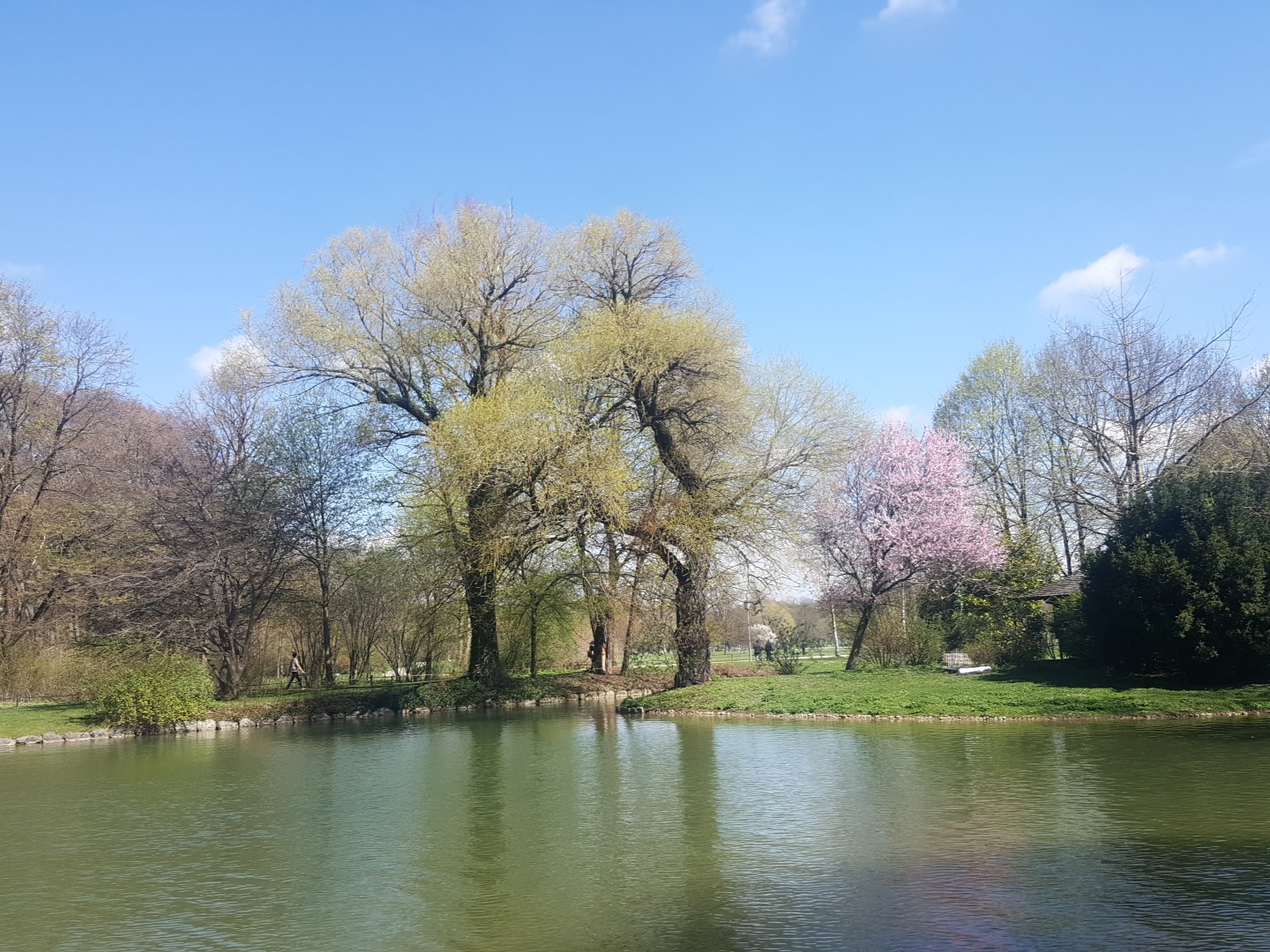
Walk & Think in the springtime sun.
Englischer Garten, Munich, 2018, 11th of Avril
In my conversations with young friends, RPA (Robotic Process Automation) has soften been introduced to me as the new “business hype topic“.
Officially, my first contact with RPA was at the “Symposium Digitale Verwaltung“ – which was organized by ITSMF – on April, 24th, 2018 in Nuremberg.
As you can see from the agenda, the “crème de la crème” of German digitalization was there. And, besides the topics “block-chain” and “artificial intelligence, which are probably unavoidable these days, many presentations were about RPA .
Then I found an article in the facebook forum Agile Administration | Exchange and Peer Counselling, which unfortunately is a closed community (due to the high quality of its discussions in this forum) with a comment that contained a note about Johann Herzberg, who is a group leader at the “county-wide IKT strategy” in the Berlin Senate of Interior Affairs.
”… the smart, i.e. automatically and real-time self-controlled, organization of situations and processes. (…) it is imaginable and probably, for reasons of efficiency, even desirable that an application system that is embedded in an AI environment can promote and finalize processes independently in the future. In the smart world, control will no longer happen through written notes but through decisions that will most likely have been reached through algorithms and only corrected by humans where necessary.“
This statement is an excellent description of the current development. Also, it will not only happen in public offices, but also in many areas of the “free economy” where white-collar jobs dominate, for instance everywhere in the financial sector. This future development is also called Robotic Process Automation (RPA). Many protagonist assume that RPA will cost many well-paid jobs. I am not yet quite sure how to judge this development. I will write an IF blog article about it. Various aspects…
Well, the statement is really loaded, isn’t it? Official orders will no longer be written by humans but by machines (robots). I am sure there are quite a few people who will not like the idea. But then, the assumption is that humans are expensive and IT is cheap. And that humans make mistakes and machines do not. There is certainly some truth in this.
As I see it, Herzberg describes the current development quite well. I find the definition of “smart” in the context of organization quite appealing.
However, I have two reservations:
My opinion about the first sentence is that such a system that processes these applications will not need artificial intelligence. In my book, “artificial intelligence” is a “self-learning system”. And a fully automated organization that controls itself in real-time is probably necessary even for “traditional programming” (the implementation of what today is often called algorithms) and will not need artificial intelligence.
About the second sentence: of course, there will still be decisions that come as a written “order”. The data with the results will continue to be saved in digital form. It does not really matter if these (hopefully public) entries in a database will then be embedded in traditional text and perhaps even printed on paper. Because also an “order document” on paper has its inner semantics and therein structured data that symbolize the result of the “order”.
The development Herzberg describes will not only take place in probably all sectors of public administration but also in many (all?) areas of “free economy“. I am sure this development will be particularly obvious in the white-collar jobs. The financial sector is a good example. Many employees who now earn good money in banks and insurance companies will probably become redundant. It might happen quite soon.
This future development is also called Robotic Process Automation (RPA). Many protagonists assume that RPA will kill well-paid jobs on a huge scale.
Personally, I am not really worried. We had the same situation frequently in the past. In Germany, most of the jobs used to be in agriculture. Today, the number of people working in agriculture is by far the minority. Then we had industries such as the coal and textile industries. They also disappeared, just like the big post-war heroes Grundig, Telefunken and others. Just like the German automobile industry will some day disappear.
But we will certainly come up with new nonsense that absolutely needs to be produced in order to give us something to occupy our time with. And if there really comes a time when we want to restrict ourselves to the necessities – and perhaps that is what we will have to do in order to save the world – then there will be two options. Either we will finally be allowed to work less. Which is what I would like best.
However, I assume that the idea that less is more and growth is nonsense will only dawn on us when it is too late. And then we will have to really work hard in order to survive.
RMD
(Translated by EG)


