
Roland DürreMonday May 13th, 2013
Bi-Weekly News #33: IF Academy – Thursday, May, 16th, 2013; Craftsmanship – Thursday, June, 13th; IF Forum – Thursday, July, 11th, 2013
Dear IF blog readers,
Today, you are getting an invitation for two presentations and one workshop:
On May, 16th, (next Thursday), Alexander Jachmann of the IF-TECH AG will be the speaker in our series of lectures: “Craftsmanship – Technology from Computer Scientists for Computer Scientists!” (also known as Beer&Informatics).
His presentation is about:
UBUNTU&ANDROID – Test in Practice
What exactly can the windows alternatives do?
Features, problems and solutions. An overview.
For more information and registration, click here:
https://archiv.if-blog.de/rd/16-mai-2013-craftsmanship-bierinformatik-alexander-jachmann-ubuntuandroid/
As always, the event will start at 18.00 hours in the seminar zone/top floor of the Unterhaching InterFace AG building. The presentation is scheduled for 6.15 p.m. – you are welcome to arrive from 5.30 p.m.
There are still some vacancies!
And for all those who cannot come, we broadcast the presentation live on the internet. From around 18:15 hours, you can see the video stream of the presentation on http://www.ustream.tv/channel/IF-Forum.
In addition, we will do a video recording and publish it on youtube (Kanal InterFace AG) if necessary.
Here are the other dates of the IF Forum:
Technological IF Forum 2013: Workshop Craftsmanship accompanied by Wolf Nkole Helzle (Social Media Art artist) on June, 13th, 2013 starting at 13:00 hours!
https://archiv.if-blog.de/rd/workshop-bei-der-interface-ag-craftsmanship/
and then the second IF Forum 2013 this summer:
IF Forum
Jean Paul and Hypertext
Annina Klappert
July, 11th, 2013 | 18.00 Hours
I would be happy to welcome you on one or more of these events and wish you a very nice month of May!
Roland Dürre
RMD
(Translated by EG)
Roland DürreSaturday May 11th, 2013
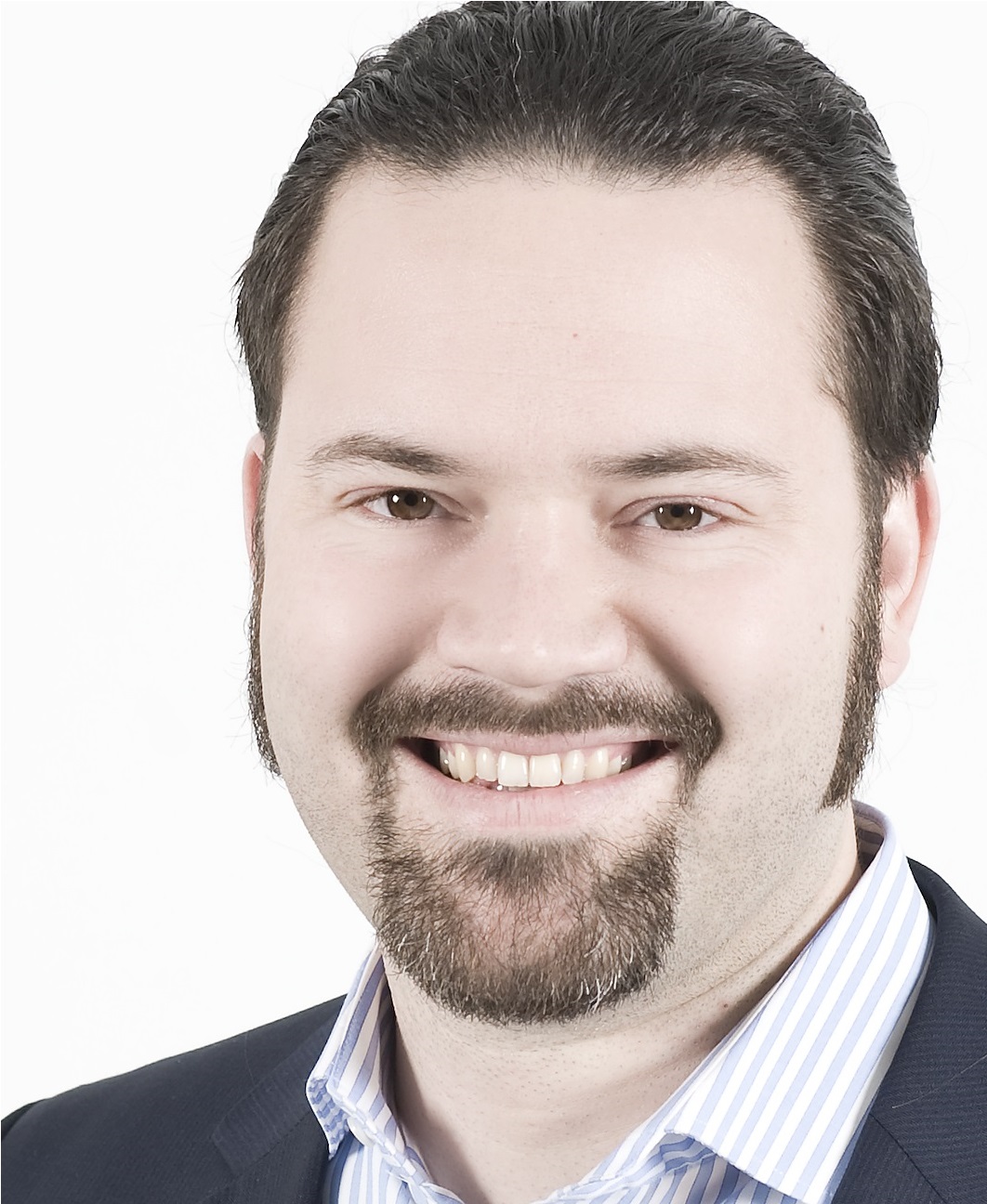
Speaker at Craftsmanship: Dr. Elmar Jürgens at the IF Forum
Dr. Elmar Jürgens is one of the speakers at our Craftsmanship workshop on June, 13th, 2013. His presentation will be about:
 Knowledge Transfer through Lightweight Reviews
Experiences from six years of working in a heterogeneous team
Here is the abstract of the presentation he will give for us:
Experience, competence, culture, quality and knowledge are the focal issues of the IF Forum on craftsmanship. How can we generate a software development culture that promotes mutual exchange of experience, competence and knowledge in such a way that the software quality will benefit?
For me, the answer is a culture of lightweight peer reviews. There is hardly any quality control mechanism the usefulness of which has been more thoroughly investigated than peer reviews. Moreover, they give us an effective tool for knowledge transfer. We have been using it for many years now. Regardless of this, many teams still do not conduct any peer reviews during their development phases.
In my presentation, I will introduce a lightweight approach for continuous code reviews where the programming and review phases are separate. This gives the programmer and reviewer respectively the chance to decide by themselves when, where and how fast they wish to work. In the development of the Open-Source programming tool ConQAT, we have been using these reviews for seven years in quality control of all code modifications. On a voluntary basis. We are convinced that this is the main reason why ConQAT is so easy on maintenance and so flexible. I will tell you about our experiences and will also report social challenges and best practices.
About the Speaker:
Dr. Elmar Jürgens is founder and associate of the CQSE GmbH. Elmar wrote his dissertational thesis at Munich Technical University about the discovery, consequences and handling of clones, for which he was awarded the software engineering prize of the Ernst Dehnert Foundation in 2011. As one of the founders of CQSE GmbH, he supports enterprises when they analyse and improve the quality of their software systems. He was among the five best speakers of the Software Quality Days 2013.
Moreover, Elmar is the co-chair of the Nineteenth International Workshop on Software Clones held in San Francisco this year. It is part of the “International Conference on Software Engineering”.
Elmar also initiated a very special community: together with other doctoral candidates of TUM and colleagues of CQSE GmbH, he organizes a regular “Tasting Group”. Whenever they meet, the “Tasting Group” tries out a new idea (in the form of an established scientific paper in the field of software quality) and a new taste (for instance in the form of testing wine or a special cuisine). To me, this sounds like a truly innovative concept!
RMD
(Translated by EG)
Roland DürreFriday May 10th, 2013
Is IF AGORA Now Headhunting – Or What!!??
Nonsense!
HEADHUNTING is a NOGO
for the IF AGORA!
 If you promote an enterprise or work a small firm, you have a certain concept of the business model. Sometimes it works better, sometimes worse. And then, all of a sudden, you discover a new added value in your enterprise, which is both a surprise and a delight.
That is what I experienced with IF AGORA. Here is how it happened: a friend of mine was looking for a second managing director for a medium-sized technology enterprise on the incline. And immediately, I was able to recommend three persons who are very suited for the task he described.
The reason for this is that all these great “white collar workers” are linked to IF AGORA. Because they are all just nice and have many friends and friends of friends, all of whom are also nice persons. And there you are: finding the right persons for the important job in no time through IF AGORA.
Consequently, I am now offering a totally new IF AGORA service: we help you when you are looking for the ideal candidate to occupy a vacant position.
No, the IF AGORA definitely will not do any head hunting. Instead, we look for the person who would fit and be interested in doing something and offering opportunities in our big network of trust.
RMD
(Translated by EG)
Roland DürreThursday May 9th, 2013
PM-Camp Goes Berlin!
Yesterday, at 22:03 hours, I received the following message by Heiko Bartlog at Google+:
Events: Save the date: September, 13th to 15th, 2013! Not to forget! Tell your friends (official invitation and information for registration to follow soon) #pmcamp13ber
Now isn’t that fantastic news? PM Camp goes Berlin! The Capitol City of barcamps and the city of re:publica! 🙂 You could almost say “#pmcamp returns home”!
Now this year will first have Stuttgart (#pmcamp13str – May, 3rd to 4th, 2013 – 3./4. Mai 2013), then Vienna (#pmcamp13vie – June, 21st to 22nd, 2013 – 21. / 22. Juni 2013) and then Bad Homburg
(#pmcampRM – June, 27th to 29th, 2013 – 27. – 29. Juni 2013). Besides Berlin. And perhaps even more.
Here are a few pictures from the Stuttgart meeting – maybe they can motivate you:
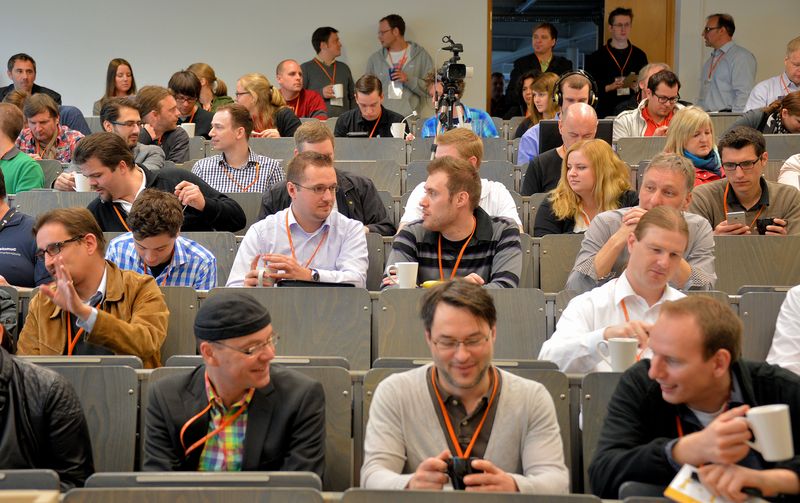
Again, the InterFace people took part and you can see them at the front!
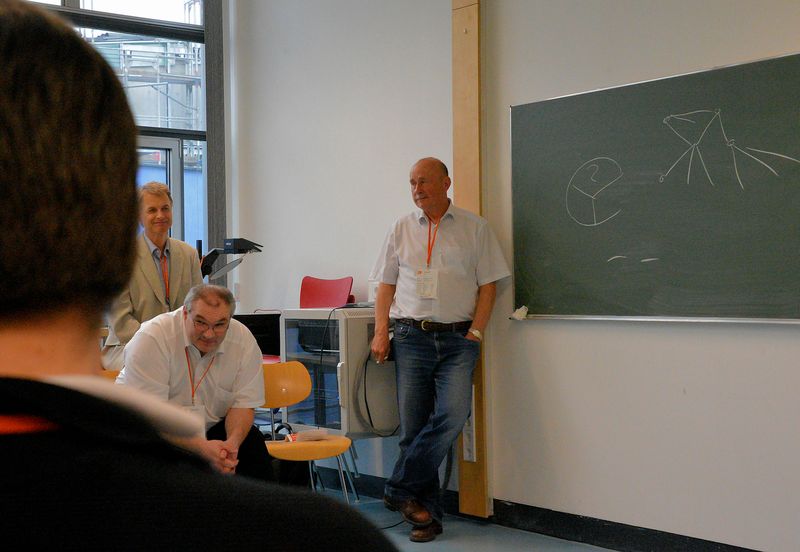
I was also permitted to do a session.
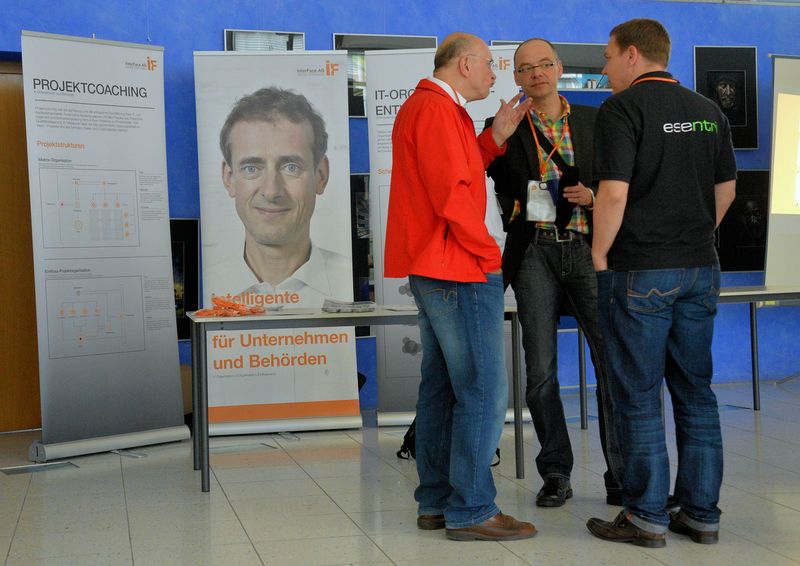
And, of course, there was plenty of networking!
RMD
(Translated by EG)
Roland DürreTuesday May 7th, 2013
IF Forum Video Recordings of “Jean Paul, The Entrepreneur” – Now Online! And New Events!
Now the video recordings of this year’s first IF Forum Jean Paul, the entrepreneur (Jean Paul, der Unternehmer) have been made available to the general public:
Herr Bernhard Echte of the Zürich Nimbus Publishing Company was our speaker. On Thursday, April, 11th, he started the IF Forum year 2013. To celebrate the 250-ieth birthday of Jean Paul, he told us about entrepreneurship in Jean Paul.
We made three video recordings.
Presentation PART 1 – Why Jean Paul was a successful entrepreneur:
Presentation PART 2 – How Jean Paul was able to stabilize his success as a writing entrepreneur over a long period of time:
Here is a short PART of the discussion after the presentation: what was Jean Paul’s “success drug?”:
InterfaceAG would like you to enjoy!
Here is a list of future presentations/workshops:
IF Academy
Ubuntu & Android as Used in Business (Ubuntu & Android im Business Einsatz)
Alexander Jachmann
May, 16th, 2013 | 18.00 hours
Technological IF Forum
Craftsmanship
Craftsmanship
Workshop
June, 13th, 2013 | 14.00 hours, prologue starting at 13:00 hours
IF Forum
Jean Paul and Hypertext (Jean Paul und der Hypertext)
Annina Klappert
July, 11th, 2013 | 18.00 hours.
You are cordially invited to all and any of these. For registration, just send me E-Mail!
RMD
(Translated by EG)
Roland DürreMonday May 6th, 2013
… What I Brought Back From the #pmcamp13str …
The PM Camp 2013 on May, 3rd and 4th in Stuttgart was a magnificent experience.
Let me just write down some questions/insights I brought back from Stuttgart. I will start with the questions, because if you want to come up with insights and solutions, the first thing you have to do is find and ask reasonable and good questions:
My Questions:
- Would it not be better if the abbreviation PM were a short form for “People Management”, instead of “Project Management?”
Reason:
Projects mostly fail because of the people, not because of the tools or technology.
Consequence:
Change your strategy when you teach PM-s, use fewer and different tools!Note:
People Management as a term also has a negative connotation.
- Should you not, before you start the project, do a critical evaluation to find out whether a project is just a Routine Project or a Research Project?
Reason:
If you are talking a research project, you have a considerable amount of trial-and-error and experiments to do, but you cannot easily say in advance how much of it!
Consequence:
Perhaps you have to “forego too much innovation” in a classical project and instead should “migrate solutions into the future step-by-step”? Note: Especially where established big and powerful solutions/systems are to be completely replaced by something totally new, most of the projects fail. The remainder basically always fail to meet time and budget and are often criticized for not being satisfactory.
- Are not all projects “research projects” to some extent?
Reason:
Due to the permanent change in society and technology, the requirements, too, change permanently.
Consequence:
You have to organize the time and money needed for trial-and-error, experiments, research and well-structured “one-way-road management”.
- Is it true that technology projects are “nothing but routine”? Do we, perhaps, when talking project management, often just think routine projects and forget that “true” projects always also have a research component?
(I am sure this depends on your definition of project)
Reason:
If the requirement has been fulfilled numerous times already and the surrounding parameters have not changed, then technology projects can become routine projects (building terraced houses on gravel planes). But can these still be called projects? You will often make surprising experiences in new application/requirement situations with new technology. Social change and/or a change in values, too, can lead up to totally new and unexpected requirements!
Consequence:
Before you start a project, even if you believe it to be a routine project, you have to critically ask whether or not there might be some hidden innovation requirements and a huge amount of research and experimenting.
- Do we, perhaps, talk too much about mistakes and learning from mistakes when talking projects?
Reason:
‘The very term “trial-and-error” already includes a potential failure. If we then continue by considering the sheer process of trial and error a failure, because it was not a success, then we are belittling ourselves. You will always be wiser afterwards and if you punish yourself for failed experiments, you will kill positive courage.
Consequence:
Not to talk mistakes and learning from mistakes in PM.
- Will a greater number of parallel projects in an enterprise not considerably increase the complexity of the individual projects?
Reason:
There will be more and more dependencies, eventually even on the competitors.
Consequence:
Limit yourself to what is important, more serial than parallel working, make dependencies less complex…
My Insights:
- For whatever reasons: the incompetence among project stakeholders is on the incline.
- There is a huge amount of desperation going on in this country, especially when we are talking big projects.
- The actual usefulness of projects is often questionable.
- People do not spend enough time thinking about the usefulness of projects.
- The usefulness-scenarios of projects are often not balanced, which puts a huge damper on the motivation both of the parties concerned and the victims.
- The impact a project has on the citizens are often not taken into consideration.
- I believe that I am now better able to explain why projects never seem to have an end.
- Let us first clarify the terms we use, before discussing the issues?
I think there will probably be some IF Blog articles on this in the near future, or else there will be a PM-Camps session dealing with the problem, for instance at Bad Homburg, Wien or Dornbirn.
RMD
(Translated by EG)
P.S.
So here is the meta question:
Many bridges still collapse all over the world. How is that possible? We have more than a thousand years of experience with building bridges. Wherever a relevant bridge collapses, engineers and professors visit the site of the accident, trying to find the reasons why the bridge collapsed. And they learn from it and hand on their findings. And still, bridges collaps. Why?
Roland DürreTuesday April 16th, 2013
Video: “Get in Shape!” Now Available (Beer&Informatics)
In our Lecture Series (Vortragsreihe)
“IF Technology – from Computer Scientists for Computer Scientists”
(also known as Beer&Informatics), Johannes Schmidt gave a presentation on March, 21st, 2013:
Get In Shape!
How Video games and activity control will get us off the sofa?
We made a recording of this beautiful and interesting presentation and filled two video tapes with it. Here they are – very much to be recommended!
In the first part of the presentation, Johannes Schmidt gives an overview of the history of activity control.
What is the difference between Sony EyeToy & Nitendo Wii and Microsoft Kinect?
The second part shows you how easy it is nowadays to program this technologically very challenging topic.
Including live programming!
Our next Beer&Informatics presentation will be on May, 16th, 2013. Again, the location is our Unterhaching office building.
The presentation will be about:
“Ubuntu & Android as Used in Business”
The practical test. – What exactly can the windows alternatives do? Features, problems and solutions. An overview.
Alexander Jachmann (IF-Tech AG) will tell us everything about the current state of affairs on that Thursday. And, of course, there will again be beer and meatloaf afterwards.
RMD
(Translated by EG)
Roland DürreMonday April 15th, 2013
Bernhard Echte: Jean Paul, the Entrepreneur!
On Thursday, April, 11th, our first IF Forum speaker of the year 2013, Bernhard Echte did a marvellous job with his presentation about: Jean Paul, the Entrepreneur (Jean Paul, der Unternehmer).
In a fascinating manner, Herr Echte built the bridge between modern life and concepts and those around two hundred years ago. He gave us some sort of modern guide line which values to stick to as an entrepreneur if you want to be a success and then preserve said success. During the entire presentation, he never forgot to give countless examples taken from the events around and the life of Jean Paul.
Our speaker particularly impressed the audience with his historical competence. He managed to draw us all into the time he spoke about with excitement and precision, right up until the last phase of Jean-Paul’s life – which was spent in misery during the Napoleonic Wars.
We will publish the video recording of the presentation soon. For now, here are a few pictures taken during the event:

Bernhard Echte, a competent speaker, always with a smile on his face…

… who manages to really take his audience along.

At the end of the discussion, he has more than deserved our gratitude!
RMD
(Translated by EG)
P.S.
The pictures were taken by Johannes Naumann.
Roland DürreSaturday April 13th, 2013
The End of Management
Why do we always talk about “managing” and “managers”, instead of supporters and shapers?!
Why do we believe a project has a beginning and an end?!
Who says goals are static?!
These, along with the following theses, are among the questions I would wish to ask and discuss during one of the future PM-Camps. After all, said PM Camps are coming up in the months of May and June in Stuttgart, Vienna and Bad Homburg.
Time and again, we talk and think in terms of projects. Both in enterprises and in life. And we witness how projects fail. One after the other. More and more of them. There is hardly any project these days that actually renders the desired result in “time & budget”. And even if, by some accident, you seem to have come up with the desired result, it turns out said result does not solve the original problem.
What is even worse:
Many enterprises invest their entire dynamics in a number of projects. The criteria for choosing their projects are rather strange. More often than not, the protagonists who yell the loudest will win. Frequently, they even compete against each other, probably foul-mouthing each other, along with each other’s project.
Most of these projects will later fail. It is often predictable and the damage is quite huge. And what is worse – everybody knows this is not how matters can ever work out well. But that is ignored. To be sure, the pressure on the parties concerned is increased, but eventually, the shattered glassware will be brushed under the carpet. Because, after all, you are harming yourself if you admit failure with your own project.
And it often seems like a miracle if these enterprises actually continue to thrive, regardless of their many failed projects.
So what do we learn from this? Projects do not play a role any more. They are irrelevant when it comes to the evolutionary/innovative development of enterprises. Instead, enterprises are moved by their own dynamics. It might be good or bad, but it can hardly be influenced by projects any longer.
Enterprises will go their own way, sometimes up, sometimes down. But, mostly, they are not influenced or impressed by projects someone has announced or by an armada of manager(ial type)s. To be sure, they pretend to actually sit at the steering wheel, but when all is said and done, their influence on the development of the enterprise is negligible.
The future of institutions and enterprises will not be shaped by projects. The survival or downfall of enterprises will be caused by other, often not rationally explainable powers – and those powers might sometimes actually appear magical.
Because “thinking mechanistically” will no longer work. Deducing something from facts, then planning and determinedly executing something can be done less and less often. That is how we used to learn it in management in former times: gather information, then evaluate and decide. It seems, or maybe it is, a concept of the past.
It probably never worked anyway. It was all an illusion of ours. A world, seemingly without growth limits, made this illusion possible.
We live in the era of co-operation, co-working, co-creation, col-laboration and com-munication. We talk and live Teams and Communities. We mention humans and social systems. And, as it happens, they will not function with classical project concepts. However, this is not threatening. Instead, it is a chance! How else are we supposed to find our way back from the over-complicated distractedness that confuses us all over the place and get back to the simple things in life?
The old misery starts as early as the terminology. Why do we always talk about the “project manager”? Why do we talk quality manager, knowledge manager and future manager? Why do we always start with phrases such as “directing a project” and the like?
It was a huge mistake to assume that every project has a beginning and an end. In fact, that was the very definition of a project. They also stated that a project always has a well-defined goal! And that detailed planning, including exact milestones, is possible. Except: change is not a soccer game that lasts 90 minutes and then the referee will announce the end with his whistle. And inflexible goals will collapse with change.
Formerly, the dynamics and unpredictability of the future was denied or at least underestimated and suppressed. It was embedded in a mechanistical concept of the world. Humans were considered resources that had to work perfectly in a Tayloristically organized division of work. In a predictable future, unwanted factors would allegedly be avoided or at least realistically calculated!
Those times are over. It no longer works that way. If you have huge projects, it is quite apparent. But most of the medium-range and small projects, too, run behind planning. They never get finished and eventually there comes a day when they are silently buried.
In the tradition of Taylorism, there is a strange specializing. Exceptional persons will be made project leaders. More and more, their main job gets to camouflage or explain why the project failed.
Mind you, they have no chance at all. Because this approach of an “outward skeleton” for living development is the wrong approach. Everyone on the team must be a project leader? Just like everyone on the team must deliver and understand quality.
The sum total must be that a task is taken responsibility for, because an entire team works for a common goal. But said goal is not something static that is reached. Instead, it develops dynamically and moves and our future actions will be based on it. Basically, it is the normal state of affairs that a goal is a “moving target”. And we can never reach it, because it permanently changes itself.
Let us look left and right. Let your competence and your common sense prevail.
Cooperation cannot be controlled. It must be lived. And all those many project managers should contribute with their special knowledge and participate in life while disposing of this task. Then we would no longer have PM’s (project managers). Instead, we would have PS’s (project supporters). And under such PS responsibility, all other “co-workers” would gladly joint forces.
And one would hope that with this kind of change in terminology, the understanding of some project managers, too, might change.
RMD
(Translated by EG)
Roland DürreTuesday April 9th, 2013
Bi-Weekly News #32: For Those Of You Who Make Up Their Minds Spontaneously: Tomorrow, April, 11th, IF Forum
Dear If-Blog readers,
Here, once again, some news due to a special occasion:
Tomorrow is the first 2013 IF Forum!
Bernhard Echte will talk about
Jean Paul the entrepreneur.
Entrepreneurship more than two hundred years ago.
For more information on the presentation, look at
https://archiv.if-blog.de/rd/erstes-if-forum-in-2013-j-p-der-unternehmer-11-april/
As usual, the event will be at the seminar zone of our InterFace AG building at Unterhaching and start at 6 p.m. We would like to start the presentation at 6.15 p.m. and welcome our guests from 5.30 p.m.
There are still a few vacancies!
I would be very happy to welcome some spontaneous visitors who read about it here at the IF blog.
And for all those who cannot come, we will again broadcast the presentation live on the internet. Click here
http://www.ustream.tv/channel/IF-Forum after 6.15 p.m. and you will get to the live stream.
Additionally, we will do a video recording and later publish it on youtube (Kanal InterFace AG).
With my best wishes for a beautiful spring season!
Roland Dürre (RMD)


