
Roland DürreTuesday September 17th, 2013
What Annoys Me #32 – Many Speakers’ Degenerateness …
I keep attending events sponsored by all sorts of organisations, where I hope to learn something new. Perhaps also because I wish to extend my social network. At these events, I listen to presentations.
More often than not, the speakers are glamorous personalities with impressive titles. In their visiting cards, you can read things like “author and key speaker”, “innovative constructor and instructor” or “trainer and speaker”. Naturally, they are all members of the GSA (German Speaker Association) or similar associations. And they pretend to have special expertise on some not very precisely defined topic.
And then they lay it on thick. Using too obviously trained rhetoric skills, they present slides like zillions of times before where the only things they modified are the place and the date. In their show, they link commonly known psycho tricks with banalities, interspersing caricatures that only seem funny at first sight. To make up for it, they keep mixing populist with allegedly provocative theses.
Each of their presentations is full of the same old flat jokes and they always laugh routinely at the same places. They make use of the prejudices of their audience for confirmation of many a thick theory. If you are lucky, they will at least give you a nice cabaret performance.
Then they take their money and disappear. We even celebrate them because, after all, we are used to far worse presentations. Presentations given by persons who have no talent at all but bought their speaker invitation with sponsoring or something similar.
To me, it seems like the number of these make-believe speakers increases all the time. A presentation should be humble and moderate. The speaker should relate what is important to him in an authentic and truthful way. He should talk about what moves him, share his knowledge and experience in life and do without all this knick-knack. Because, when all is said and done, you will otherwise only get distracted from what is really important. Well, getting distracted will also keep you from noticing mistakes.
In a nutshell:
I am fed up with this narcissistic mixture of cheap showmanship, claptrap, semi-truths, more or less hinted at conspiracy theories and the constant game with all kinds of effects used by this commercialized new world of speakers.
And I know from my personal experience as a speaker that it is not at all necessary.
RMD
(Translated by EG)
Roland DürreSunday September 15th, 2013
Before the #pmcamp is after the #pmcamp … (1)
My Contribution to #pmcamp13ber
I am sitting in the Berlin DB lounge, waiting for my train to Munich. The PM camp and sessions I attended yesterday and today is still on my mind. And since I received so much positive criticism, here is a concise version of today’s presentation by yours truly.
It is a description of what a modern manager who wants to be both successful and ethically responsible might (or should?) look like. From other sessions before my own presentation, I got the impression that it might be a good idea to start with a definition of “moral conduct” and “ethics”. So this is how my presentation started:
Moral Conduct and Ethics
As I understand it, moral conduct is characterized by rules and laws. Some of them have been written down, some of them are valid without the written form. It is generally assumed that moral conduct is a requirement for the common good (bonum commune) in social systems, or at least that it will be very useful in this sense.
If you violate the rules of moral conduct, this will have consequences: you will suffer either punishment – if you broke the law – or social ostracism or something similar. The fact that moral conduct can also cause damage is accepted. And this kind of damage is often done because, basically, laws cannot foresee all “morally problematic” situations in life, no matter how you amend or add to them.
Ideally, the citizens agree to adhere to the rules, since they understand how beneficial this is for the entire society. Unfortunately, however, this is not what usually happens.
Problems with moral conduct:
If you insist on moral conduct as being normative for your behaviour, this will cause lots of problems. More often than not, the accepted damage is too much. The world changes, yet moral conduct is more or less static, which makes it a contradiction to new developments. Different groups of society (age, sex, socialization, religion, …) might well have totally different opinions on some relevant topics.
Ethics, give you a rule. Behaving ethically means you make this rule the maxim for your own decisions and behaviour in a responsible way. In order to do so, you have to be able to decide and act according to an ethical balance of values following the rule. Consequently, “ethical behaviour”, too, will usually be in the interest of the “bonum commune”. It is an important goal of ethical behaviour to minimize damage.
Examples for ethics:
- Happiness-Ethics (Eudämonismus) Its roots are in Greek philosophy. It aims at maximizing lust yet avoiding pain
- The Golden Rule It means “treat others the way you would like to be treated“
- Duty Ethics Duty ethics simply tell you to follow the law (and the orders of your boss).
- Conscience Ethics “follow your conscience”
- The principle of biophile behaviour.
I do not think the Happiness Ethics and the Golden Rule can be practiced. Management is not the only sector where it probably will not be very helpful. Moreover, these two ethics only seem to be applicable to humans. Today, however, there is a broad consensus that ethics far exceeds human affairs.
The duty ethics are something I mistrust as a matter of principle. Too many atrocities and crimes have been committed “just doing your duty”.
“Follow your conscience” is not really conceivable to me, because as a general rule, conscience will always come after the decision and the act.
My next two articles will discuss the image of the “new manager” and the “biophile principle”.
RMD
(Translated by EG)
Roland DürreSunday September 8th, 2013
Entrepreneur’s Diary #90 – The Magic Management Triangle
At InterFace alone, I have now had thirty years to think about what exactly I am doing and what is my job. How to describe my job and what qualities you should have for it? And whether I am doing a good or a bad job in my position.
Because I am a manager.
Well, basically, I am a project manager, because my professional (and private) life consists of many projects. In these projects, I am sometimes more and sometimes less involved. But they always concern me in some way or other. Sometimes I initiate projects or try to direct them. Sometimes I delegate the responsibility. Occasionally, I also have to terminate them. But I am always involved. Even if it is only the results that are returned to me.
And during those many years, my view and understanding of management constantly developed. Sometimes it was a zig-zag line, yet as the years went by, the lines converged. Many friends, teachers, masters and mentors accompanied me on the way – and they helped me a lot. Consequently, I was able to write a lot about management, leadership, entrepreneurship and all other topics that move me (also in the IF blog). Also, I was able to give numerous presentations, particularly for young people.
This is how my small and totally private management model was created. I defined it as a triangle. To be sure, I could also have come up with a more multi-dimensional definition, but the number three has the advantage that our finite brain actually can manage three dimensions quite reasonably. Consequently, a model with three bases is probably easier to understand.
The three dimensions of my management model are:
- operative issues
- leadership and
- entrepreneurship.
Let me describe my concept of these three dimensions:
- Operative Issues
As I see it, the operative issues are about what is “self-evident” about the job of a manager. They are about the daily routine of decisions on the technological, mercantile or personal levels. A good technological education, common sense, the ability to judge quickly and such kind of things are useful and sometimes necessary. A certain degree of intelligence, a healthy ability to accept conflicts, a suitable socializing process and the like are desirable. A bit of an extrovert personality and self-esteem are helpful. It is a huge advantage if you have courage and can share what joy you have. The same is true for a positive communicative competence, both by word of mouth and in the written form. Besides, a good general education, or at least the ability and willingness to learn something new and alien will do no harm to an operative manager. - Leading and Leadership
Leading and leadership are two wonderful words. For me, the first and most important factor is that you are capable of leading yourself, i.e. to develop your own “leadership”. After this is achieved, you might perhaps be able to share some of your leadership capacity with others, thereby trying to “lead them” (careful: the very terminology is offensive). As I see it, “leading” requires a certain degree of humility towards the task and the people in the “social system” you are active in and surrounded by.
Here are some of the qualities that turn an operative “functionary” into a leadership personality:
being able to listen, having a healthy degree of empathy, embodying and living values as a person (both your own and those of the enterprise), accepting criticism, being critical with yourself and being immune against too many set statements, certainties or even dogmata; in other words, you have to have a certain amount of autonomy. - Entrepreneurship
In my opinion, a leader becomes an “Entrepreneur” if he is also willing to accept a special responsibility. For me, this means that the person will put himself beyond all randomness. He will “identify” with all “matters” concerning the enterprise in a healthy way. This means a commitment to actively participate, including the courage and willingness to change things. It necessitates a high readiness to take responsibility even on the normative level, thereby making you the protagonist for the promotion of the entrepreneurial values and culture. You can only achieve this if you, as an entrepreneur, are no longer pushed by having to say “I MUST” and/or by a strong “Super-Ego”. Instead, you have to have achieved a huge degree of inner freedom. This is how you will eventually be enabled to question all those established “worlds” every system seems to have developed without criticism. And again and again, you will ask the philosophic core questions: “How do you know this” or “How do you know this is the truth?”.
Because the mental concepts of the worlds as developed in social systems such as enterprises are, after all, just an attempt at mirroring reality. In the worst but most frequent case, they will become doctrines or dogmata. So if now the manager or leader tries to deduce decisions with “dominant logics” from the established world, these decisions will, of course, only too often turn out to be the wrong decisions. To be sure, even with correct logics, you can deduce correct things from erroneous assumptions. But that is mostly accidental. As a general rule, it will not happen. Basically, it is a very human desire to strive towards stable judgement. After all, they make life easier for the manager – but often with terrible consequences. I would name the qualities of an entrepreneur “agile competence”. For instance, a “top manager” fully competent in the operative issues and at the same time being a leading personality and entrepreneur, should be particularly good at adequately dealing with “errors and coincidence”.
On the whole, I think management means you have to be particularly good with combining the opposing ends of the individual and collective worlds (of the social system). Because the expectations, interests and needs of persons in the diverse social systems are basically very different from those of the social system. Yet the manager has to deal both with the persons and the social systems. He has to bring them together.
It all sounds like an almost super-human challenge. Since there are no super-humans, there are probably no persons who actually meet the ideal I just described. Consequently, there is no need to be ashamed of your own imperfection.
That means we should not despair too much when we discover the occasional shortcoming or fault in ourselves. But we can take this list of criteria to see how far we have already advanced towards being “Top Managers” – or if, perhaps, we are still on the level of “operative manager”. Or maybe we are already on our way to the leadership personality? And we can see what could be done in order to get better.
Wel l- this is my current view of things.
RMD
(Translated by EG)
P.S.
For all the articles of my entrepreneur’s diary, click here: Drehscheibe!
Roland DürreSaturday August 24th, 2013
barcamps and PM Camp (4) – Twittern is a Necessary Part of It.
In my little series of articles on barcamp and PM Camp (#pmcamp), I described some models for three kinds of sessions in the last instalmnt. Today’s article is about twittering and some behavioural rules directly related to it!
Can you twitter during a barcamp in general and during sessions in particular?
During a PM Camp, you not only can, but actually should (must) twitter. In fact, twittering is a very important part of the Camp. Incidentally, you are also permitted to play on your mobile phone in the middle of a session and to leave the room in order to attend another session.
As a general rule, you have a minimum of one “Twitterwall” at a PM Camp. On it, all tweets written in twitter and marked with the tag of the event will run there in real-time (for example #pmcamp13ber for the next PM Camp in Berlin). Thus, you get a central theme which actually can be taken as first documentation and comments on the entire event. You will know what happens on the PM Camp, how other persons feel and what their experiences and thoughts are.
Naturally, all participants can also take a look at the twitterwall on their individual devices. And they will often see that many persons who are not physically present will actually take part in “real-time” in this way. For instance when I first went to the Dornbirn PM Camp in November 2011, I could not come before noon of the first day. Sitting in the train on my way out, I read the barcamp tweets (#pmcamp) and was absolutely enthusiastic – I was literally driven towards getting to Dornbirn as fast as possible.
Through your own tweets, you also can and should make your own evaluation known to others as soon as possible. In this way, becoming part of the whole is even better guaranteed and you can again inform others. Taken together, all tweets are a nice retrospective report of the event. Later, you will enjoy looking at them and mentally reviving the camp.
Incidentally, there is no “official” documentation of a PM Camp, such as proceedings or the like. This is absolutely intentional! Because the documentation, too, is voluntary. It is organized and determined quasi automatically by the participants. This works quite well and thus you get a thorough multi-media documentation which, above all, is also correctly weighted. It contains text, images and videos and covers everything important, on top of being available centrally on openPM and inter-linked.
Of course, in twitter and on barcamps in general, the same rules should apply as in normal life:
You cannot make others small or hurt them. Personal attacks must be avoided, even if there are times when you are very disappointed. And if it happens that you really did something inexcusable, you have to apologize.
When all is said and done, it is particularly true for the internet and open communities that all you do will reflect upon yourself.
So, please, do also accept weaknesses – and if there is something that annoys you very much, you will just have to leave.
The only thing you cannot tolerate on a PM Camp is intolerance. But intolerance, in particular, is something you should address personally, rather than talk about behind people’s backs.
In this article, I only referred to twittering. Of course, you may also write in facebook or in Google+ during the Camp. You might even wish to create a community there – ideally after coordinating it with the other parties concerned. Twittering is very open and my personal favourite medium, because it is very short and thus will not distract you for too long. And after deducting the day, you have 100 characters left with which you can formulate quite much and with quite a high precision.
RMD
(Translated by EG)
Roland DürreWednesday August 21st, 2013
barcamps and PM Camp (3) – “Session Typology”
After having described in my last article why barcamps and PM Camps are such a great success, I will now introduce three exemplary model sessions in my barcamp and PM Camp series:
Type 1 – Sharing Knowledge!
The initiator of this kind of session believes he knows something that is important for him and wishes to share it!
Maybe someone had an extraordinary experience, learned something totally new or came to a basic understanding …
And he is assuming that, maybe, others also could be interested. Consequently, he will announce a session, telling people in advance what he will be talking about. Naturally, he will not want to bore his audience with a long presentation. Perhaps all he is going to do is come up with a few theses and then describe shortly what he experienced. And then the debate and discussion will start.
Type 2 – Make Use of Other People’s Experience!
The initiator finds himself in a new situation and is looking for help!
Perhaps someone would like to ask a question he has spent a lot of time thinking about already. Or maybe something happened in his life and he does not really know how to cope with it. He might even be facing a huge problem, wishing to talk about it with friends.
And then he will announce a session and see who is coming.
Of course, with this type of session, we need particularly “good” listeners. I mean listeners who try to first listen as carefully as possible and are then capable of mirroring what they understood with as little distortion as possible.
Most importantly, the participants should be capable of empathy and be persons who do not immediately wish to “know everything better”, wanting to make a good impression with “uncalled-for advice”.
If you get this kind of group, this type of session will often result in something really great. And I am surprised at how great the “participants” of these kinds of sessions behave.
Type 3 – New Experiences!
The initiator wants to do something active, play or try something out!
There is an unlimited number of possibilities for these kinds of sessions to be a success. Every PM Camp will give you a surprise. It can have something to do with movement or make people thoughtful. New experiences are actively made and relevant things are experienced playfully. Novelties and well-tried strategies are tested. More often than not, we discover “new frontiers” together. And if you try something new in one of these sessions and find out it is not a good concept, then it is not a problem if you just tried it during a PM Camp.
All you need is the courage to take part and also be prepared to leave your own shadow behind. And before you even notice it, something extraordinary will happen. There can be a regression and many creative and wise concepts are suddenly set free.
More Types …
Of course, these three types are just examples out of many. They are only three patterns for sessions you will often remember for a long time!
In my next article, I will write about PM Camp rules.
RMD
(Translated by EG)
Roland DürreMonday August 12th, 2013
Technological IF Forum – Mailserver and Mailclient –September, 19th, 2013
On September, 19th, 2013, at 18.00 hours, we of the InterFace AG invite you for another interesting presentation in our “IF Academy” series:
Mailserver & Mail-Client
“History, Basics, Spam&Virusses” or “Concepts for a Private Secure and Reliable Mail Server”.
(Hans Bonfigt / Marc Haber – redoxSystems)
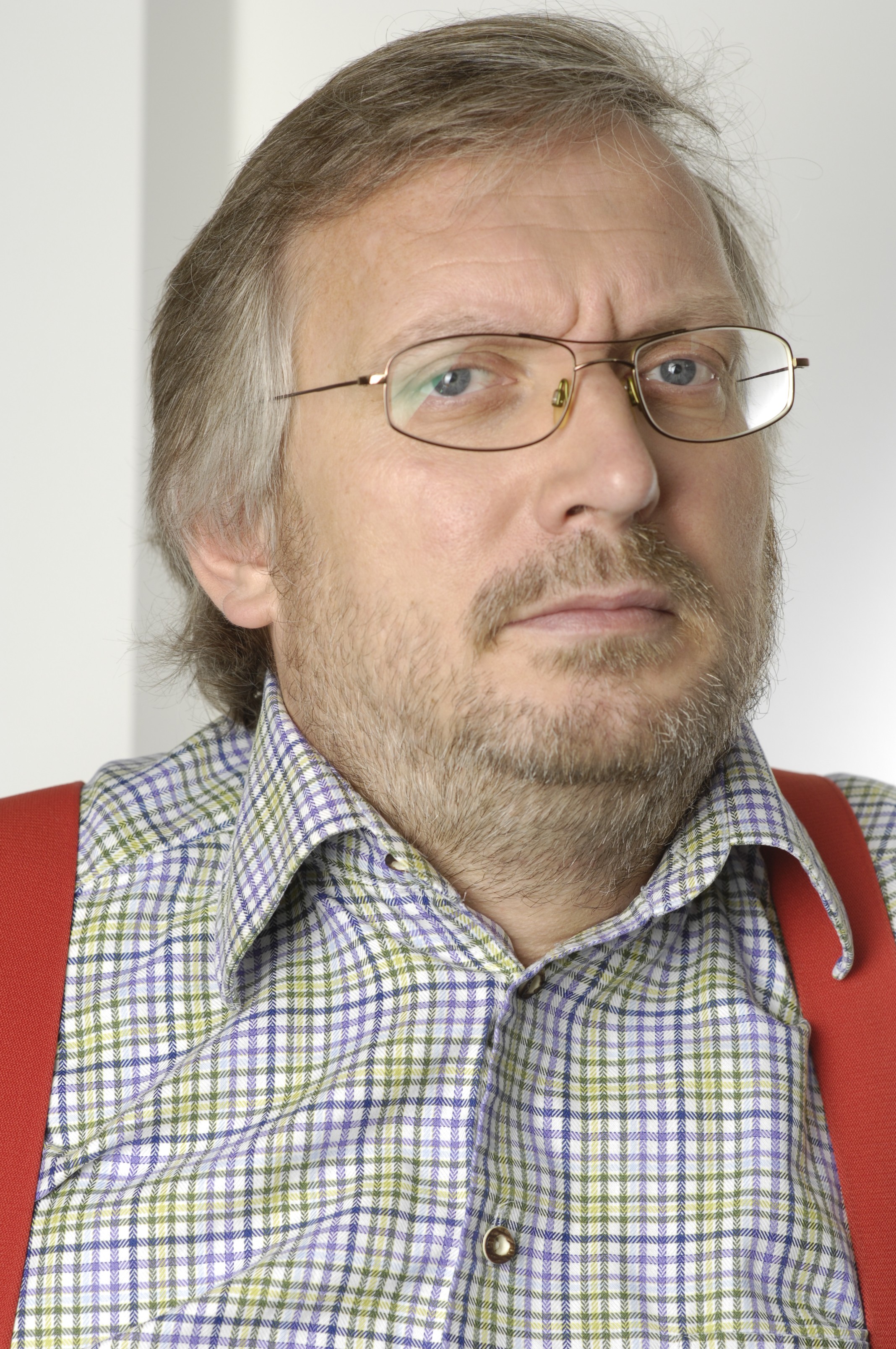 Hans Bonfigt will be our speaker. We are optimistic that his co-author Marc Haber can also come. After the current events and in times of PRISM and Tempora, the timing for this presentation about email and mail in general is just ideal. Consequently, and because we have two of the best experts in the field with us with Hans Bonfigt and Marc, we decided to make a technological IF Forum of this IF Academy event and invite the extended circle.
Every day, we send and receive many emails. It is our totally normal routine and we might very well often be quite thoughtless about it. The underlying technology seems to be a matter of course, even though, more often than not, it is nowhere near as easy as it looks. Hans Bonfigt will introduce the deep secrets and abysses of email traffic and the underlying technology. Here is his summary:
I will give you a historical introduction to the topic “mail”. You will get to see the roots where rats like spammers, viruses and other parasites feast. Also, I will give a clear differentiation between the terms mail server and mail client. This distinction is important, because a mail client is also among those devices you can host centrally. Eventually, I will show you two operating concepts.
My presentation will be structured as follows: warming-up, basics, introduction (around 20 minutes), actual operating concepts (less than 30 minutes) and live demonstration (10 minutes). This should leave enough time for a discussion.
As always in our IF Forum, we will have our “happy hour” after the discussion. I am quite certain that there will be plenty of exciting material to discuss, especially after this kind of presentation.
About the Speaker:
I first met Hans Bonfigt through the IF blog. Hans is a passionate programmer and IT technologist. He actually learned his craft from scratch and consequently also knows all the “camouflaged” levels of many systems. You will find various articles and comments written by him in the IF blog. They are always straight to the point. He ruthlessly criticizes where the development goes astray and where technology is poorly executed. Also, he points directly towards mistakes frequently made. His outstanding ability is to put things in a nutshell.
Registration:
As always, the presentation will be held in the seminar zone under the roof of our Unterhaching headquarter building, starting at 18.00 hours. We look forward to welcoming our guests! For registration to this IF Forum, send an E-Mail.
RMD
(Translated by EG)
Roland DürreMonday August 5th, 2013
Entrepreneur’s Diary #89 – Knowledge, Leadership, Organization & Managment
Here are a few theses ….
We often call people good or bad people. There are, however, no bad or good people. The only things that might be good or bad are what these people do. Consequently, you should judge behaviour, rather than persons.
That is more or less what I learned in ethics and philosophy.
It is similar with knowledge. There is no such thing as good or bad, useful or useless knowledge. With applying knowledge, you can “make an impression” or “have an effect”. Knowledge itself is of no value. In order to be useful – for instance for solving problems or on the way towards progress or innovation – it has to live.
You have to share knowledge – then it will actually increase. But how to organize the sharing of knowledge? After all, knowledge is dynamic and always depends on the context. Context-dependent dynamics cannot easily be packed into a container. That is the problem you face with knowledge management.
Here are a few terms probably related to knowledge:
Education • Cultivation • Experience (of Life) • Enlightenment • Expertise • Practice
This is how I arrive at ideas such as craftsmanship. We discover the master and the apprentice. We understand the importance of handing your expertise on, showing someone how to do things, learning and practicing! And how these processes can be promoted through the four-eyes-principle and p2p reviews (peer-to-peer). Mind you, this is not only true for software development.
And new questions arise, as well:
Where to use knowledge? Who uses knowledge? Is it the “white-collar” workers? Can you really call them “brain workers”?
And:
How do people work in enterprises – which I call social systems with an economic goal?
How can you design such a system to be both successful and bearable?
Ideas such as self-organization and self-determining spring up. I believe that the knowledge and expertise of many can be merged in an ethical and dominance-free way, thus being formative for our future.
But in self-organized systems, there will also be roles or activities you can summarize as follows:
Decisions • Leadership • Communication • Management • Responsibility
So what exactly does that mean in such a system? Here is what I propose:
Decisions
Decisions are always accompanied by a certain degree of uncertainty and must have a significant consequence. Otherwise we are not talking a decision. A “good” decision maker can try to do more good than harm by trying to base his decisions on an ethically responsible balancing of values. But he cannot question the unpredictability of the future, neither can he try to burden others with it.
Leadership
Leadership means that you set the scene for all parties concerned in the environment you are responsible for so that their personal lives are more enhanced than reduced in many dimensions. For instance by creating a fear-free zone. And I mean full of the necessary respect you show towards the task of leadership.
Communicating
The requirement for good communication is that you are prepared to meet at eye-level and to listen. You also have to have empathy, think in an altero-centric way and have respect for others.
Management
Basically, it only means you have to treat change with responsibility. If an enterprise is in a state of stability, it will generally do very good business. Except: there comes a time when too much stability will mean death. On the other hand, constant change will be detrimental for the balance sheets. If you manage to give justice to both ends of the scale, then what you are doing is “management”.
Responsibility
The environment I accept responsibility for is where my decisions have an effect. Consequently, I must be aware what consequences my decisions will have. I cannot ignore them.
Persons who decide, lead, communicate, manage and take responsibility are persons I call entrepreneurs.
Entrepreneur
A good manager is a manager whose decisions are more often correct than wrong. Someone whose judgement is more often good than poor.
All of these ideas are contrary to what I officially learned. Consequently, I am now arriving at the
Classical Error:
Many people still believe you can plan the world. Their image of the world is mechanistic and Tayloristic. In this combination, they believe knowledge and dominant logics to guarantee success.
I no longer believe this. The era of a working world strongly based on the division of labour (tayloristic) with mechanized processes disregarding humans is on the decline. It was a very simplistic image of the world. To be sure, it brought us prosperity, but the price was far too high. In order to survive now, we must become AGILE.
RMD
(Translated by EG)
P.S.
At one time, we had a young lady as guest at InterFace. Daniela Blettner (she is now a university teacher) worked on her dissertational thesis for HSG (Hochschule St. Gallen). Her topic was “Dominant Logics During Enterprise Foundation”. And the results were surprising. All the very successful enterprises she examined had been free of “dominant logics” during their founding process. What is worse: some of them almost failed due to “dominant logic strategies”.
P.S. 1
For more articles of my entrepreneurial diary, click here: Drehscheibe!
Roland DürreThursday August 1st, 2013
brand eins in August
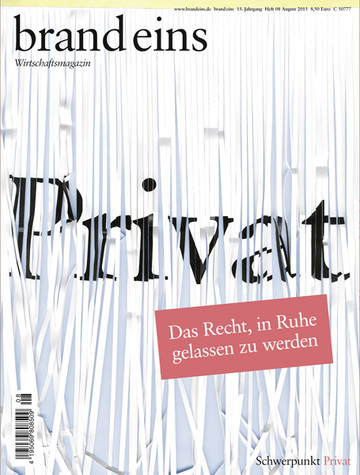 Yesterday, as I was going home to Munich, I opened the “brand eins” August edition. I sat in the last ICE late at night from Nuremberg – after a very exciting business meeting.
The first thing I read is the editorial by Frau Fischer. She says exactly what I feel. That is particularly true for her open words about the production and unexpected timeliness of parts of the pre-designed August edition. To me, this sounds like truly authentic and honest journalism.
Next, I take a look at the “world of numbers”. They give me pause. Because, for instance, the federal debt per child in Germany is around 40 times higher than in Estonia. Neither is it any consolation that this number is another three times higher per child in Japan. It is also a surprise for me that the USA bought seven times more land from other countries than China. I would have assumed totally differently.
Suddenly, an envelope falls out of the magazine and floats down to the floor. I pick it up. It is an advert apparently trying to be creative. Because it is a closed envelope, totally devoid of any writing. No address, no sender. Just like this. The perfect black mail.
Well, you all know my opinion on adverts, don’t you? Consequently, I act very un-creative and put the envelope into the waste disposal on the small table of the ICE. This is just too stupid. Later, I wonder what kind of rubbish it contained. I am sure it is nothing relevant that would have made me happier. So it was better to just dispose of it without a second glance.
And then I arrive at the focal point on page 21. The first article is about “disturbance of the peace”. I almost get a dizzy spell. After all, I know it: an extraordinary development is under way. To be sure, due to my profession, I actually know what this is all about, but reading it like this…
The August edition contains much to make you thoughtful. Part of it is truly uncomfortable summer holiday material. Eventually, however, I managed to find a few articles in the magazine that give me hope. But why don’t you read yourself? It is definitely worth reading.
That reminds me of one of my “super-egos”. The one forcing me to vote. Regardless of the fact that I stopped believing it might make sense a long time ago. In fact, reading “brand eins” seems to make a lot more sense. Perhaps we should make it an obligation for all citizens to read “brand eins”? And perhaps that would motivate more people to get the idea: our country (along with the world) needs new politicians.
RMD
(Translated by EG)
Roland DürreSunday July 7th, 2013
(Deutsch) Industrie 4.0
Roland DürreSaturday July 6th, 2013
2nd IF FORUM 2013: “Jean Paul & Hypertext”
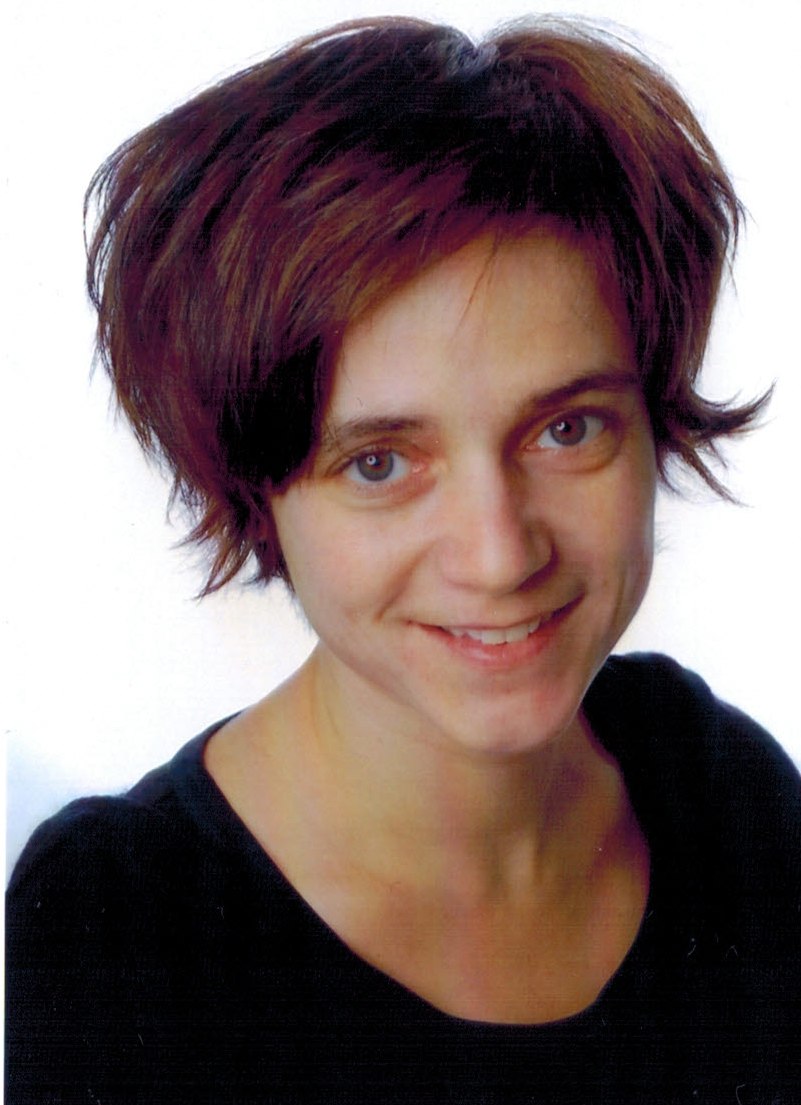 Frau Dr. Annina KlappertFrau Dr. Annina Klappert
is our speaker at the second IF Forum of 2013. She will tell us about:
Jean Paul and Hypertext
On July, 11th, 2013, she will give an entire IF Forum presentation at our Unterhaching InterFace building.
Here is a short outline:
During the 20ieth century, the data volume kept increasing – and along with it the problem of data access.
Well, considering when he lived, Jean Paul actually was quite a “professional” when it came to collecting data. Also, he was already confronted with the same problems, though on his own scale. Using his special excerpt technology, he not only collected knowledge, but also linked it in an intelligent way.
So we can actually ask today as Jean Paul asked then: how can data be stored and linked?
And how can we acquire new knowledge from those data?
A short glimpse at the aesthetics of Jean Paul can show us his concept of wit and also teach us possible linking technologies. On the whole, the method of writing as theoretically overloaded in Jean Paul’s ‘pre-school of aesthetics’ and practiced in his poetic works can show us why today’s hypertext systems are so helpful, how they function in their structuring of knowledge and what are their challenges.
About the speaker:
Frau Dr. Annina Klappert wrote her dissertational thesis at Bonn University on: “Die Perspektiven von Link und Lücke. Sichtweisen auf Jean Pauls Texte und Hypertexte” – The Perspectives of Link and Gap. Views on Jean Paul’s Texts and Hypertexts. Between 1999 and 2004, she worked at the Köln Forschungskolleg SFB/FK 427 “Medien und kulturelle Kommunikation”.
Frau Klappert is currently an employee at the chair of General and Comparative Literature at Erfurt University. Her interests and special fields of research are: virtual theories, hypertext theories, slip boxes as knowledge technology and digital practice, as well as modern literature.
Registration:
The If Forum will take place at our Unterhaching headquarter building in the seminar zone on the top floor. We start at 18.00 hours. We look forward to welcoming our guests! As always, you can register for the IF Forum by sending an E-Mail.
Here is an overview of the three “Jean Paul presentations” of the year 2013.
A Visit to the Present
Jean Paul presentations at the IF Forum
In 2013, our IF Forum will be about how modern Jean Paul’s topics and ideas actually are.
With presentations on entrepreneurship, hypertext, wit and new media, we want to project new perspectives and questions to the Here and Now. Why don’t you join us?
Jean Paul the entrepreneur
Jean Paul was one of the first German authors who actually made a living out of his writing. Mind you, he did so regardless of a start under very difficult circumstances. He visited the intellectual centres of his time: Leipzig, Weimar, Berlin – and his books were a success to make Goethe envious. When Jean Paul married, even the Prussian Queen invited him for tea and gave him a silver tea set.
Jean Paul did not owe his ascent and success to accident, but to careful planning with entrepreneurial instinct. Even when times turned bad and the Napoleonic wars devastated half of Europe, he still was able to maintain his position. The way Jean Paul combined success and sustainability looks still remarkably modern today. .
Our speaker Bernhard Echte, scientific literature expert, exhibition organizer and publicist, worked many years as director of the Zürich Robert Walser archive. Today, the entrepreneur has his own publishing company: “Nimbus, Kunst und Bücher”.
The presentation will be on: April, 11th, 2013 (Thursday) | Starting at: 18.00 Hours | At InterFace AG, Unterhaching
Jean Paul and Hypertext
Even before he called himself Jean Paul, young Johann Richter read everything he could lay hands on: hardly any of the books actually belonged to him. Whatever he read, he excerpted in notebooks. In those same notebooks, he also commented ideas currently coursing through his head. Jean Paul added catch phrases to his entries, now called tags. In this way, he created a huge private encyclopedia. It was structured like a modern database and was the foundation of his literary work. Only through his database, Jean Paul was able to realize his unique style. A style that is at the same time erratic and precise. He managed to turn the financial misery of his youth into a virtue the result of which surprises us to this day.
Our speaker Annina Klappert, is a scientist at the seminar for General and Comparative Literature at Erfurt University. Her dissertational thesis is a structural comparison of Jean Paul’s texts and hypertexts. Her scientific research is mainly concerned with media, references and virtual reality.
The presentation will be on: July, 11th, 2013 (Thursday) | Starting at: 18.00 Hours | At InterFace AG, Unterhaching
Jean Paul, wit, post-modernism and the new media
He was a “God-Denier” and an “intellectual disintegrator”, a fervent cosmopolitan, sceptic and joker. His educational theory “Levana” is highly praised, since it advertises wit and irony against the strict no-nonsense attitude of Fichte’s oratory as the basis of a healthy personality. In his policy of “the third person between Germandom and Bonapartism”, you can anticipate the post-modern indecision between the opposing poles of “the truth”. With his aesthetics of straying, he already uses the interruptive and jumpy hypertext aesthetics of the internet. Who was this man who hardly ever left home and still intellectually and mentally was way ahead of his contemporaries?
Our speaker Roberto Simanowski is professor for media sciences at Basel University. He is concerned with the changes in writing caused by the digital era and publishes the online journal dichtung-digital – journal for digital aesthetics.
The presentation will be on November, 7th, 2013 (Thursday) | Starting at 18.00 Hours | At InterFace AG, Unterhaching
RMD
(Translated by EG)


