
Roland DürreThursday May 15th, 2014
My Three Leadership Principles
A short time ago, the entrepreneur’s coach, leadership trainer and author Bernd Geropp started a Blog Parade (Blog-Parade) on “leadership principles”. He also asked my opinion. Well, why not take part?
Bernd asked what my three most important leadership principles were. To start with, I had to do some intense thinking. But then all was immediately clear.
I only have three principles! Because I am an ALO-Type!
ALO is my abbreviation for
“A” = Agile, “L” = Lean and “O” = Open!
So this is all about:
Agile
Speaking of agile, I cite the agile manifesto. Everything you need to know is written in there, there is no need to add anything. Incidentally, this manifesto is not restricted to programming, but can also be applied to your entire life (Link).
Lean
My way of communicating and working must be simple.
Keep it simple, stupid!
Because I am stupid and therefore should not make things look complicated. Otherwise, I myself might no longer understand what I am talking about. And that means I have to try and improve all the time. For instance by reading, trying out new things, experiences and adventures.
It is a little like my personal “leadership Kaizen”.
Open
Whatever I say and do should always be open and transparent! That’s all!
Well, those are three very simple principles, aren’t they? But careful: living them is not quite as easy as talking about them.
RMD
(Translated by EG)
P.S.
I found a wonderful article (Artikel) by Marcus (Dr. Marcus Raitner) on the “blog parade”. He writes:
The basis of my ideas is the right attitude in the sense of a fitting concept of man. Based on this, you get the central principle of trust and finally the serenity for working totally relaxed on the leadership level.
Those are wonderful values, I absolutely agree. I might perhaps have chosen humility or civil courage instead of serenity. In fact, I would have found it hard to restrict myself to three, because there are so many dimensions. Basically, there should be no “either/or” in management. Instead, you should always think “both of them” (one of the theses presented by Hans Ulrich on “Change in Management”).
But then, I was supposed to write about principles. So what is the definition of principles? Is it values? Aren’t values also principles? Clarity? Well: everything ALO!
Roland DürreTuesday May 13th, 2014
27. Juni bei InterFace AG: 30-Jahresfeier mit IF-Forum!
Am Tage unserer 30 Jahresfeier veranstalten wir auch unser viertes fachliches IF-Forum. Hans Ulrich (der “Erfinder” des St. Gallener Management Modells) hat Anfang der 80iger Jahre in einem Aufsatz “Acht Thesen zum Wandel im Management” genannt. Eine der Thesen war:
“Selbstorganisation als Gestaltungsmodell für Unternehmen”
Diese These wollen wir in unserem fachlichen IF-Forum 2014 debattieren.
Das IF-Forum startet am 27. Juni 2014 um 13:00 im Alpenbauer Sortpark in Unterhaching statt. Dort feiern wir anschließend unsere 30-Jahr-Feier. Das IF-Forum findet aber nicht im VIP-Bereich statt sondern im Seminarraum der SpVgg Unterhaching im 1. Stock über der Gaststätte im Sportpark noch außerhalb des Stadions.
Hier die vorläufige Agenda:
Ab 13:00 Unsere Gäste treffen ein …
Eintreffen / Welcome
13:15 Wolfgang Menauer, InterFace AG
Hinführung
13:45 Dr. Eberhard Huber, pentaeder
Resilienz vor Effizienz
14:15 Dominik Rose, InterFace AG
Agil, Lean und Open
Pause
15:00 Bernhard Findeiss, InterFace AG
Kanban und Scrum
15:30 Roger Dannenhauer, Turnaround
Geisteshaltung
16:00 Roland Dürre, InterFace AG
Hierarchie oder Netz
Um 17:00 geht es dann weiter zu unserer 30-Jahr-Feier in und um den VIP-Bereich des Alpenbauer Sportparks.
Wir freuen uns auf Ihr Kommen. Anmeldung ans IF-Forum bitte per E-Mail!
RMD
Roland DürreWednesday May 7th, 2014
The Philosophical Legacy of Rupert Lay
On March, 29th, 2014, Rupert Lay spoke about “Constructivism and Society” at a Ronneburger Kreis event in Frankfurt. The presentation was about the development and effect of social constructs.
On June, 14th, Rupert Lay will be 85 years old. He says this was his last public presentation. He calls this presentation – along with the two others about “Constructivism and Belief” of September, 7th, 2013 and “God – New Concepts of Thought” of September, 8th, 2012, his philosophical legacy.
The Ronneburger Kreis recorded all the three presentations and is very happy to present this legacy to a broad public.
„Konstruktivismus und Gesellschaft”
„Konstruktivismus und Glauben – Teil 1″
„Konstruktivismus und Glauben – Teil 2″
„Gott – neu denken”
RMD
(Translated by EG)
Roland DürreFriday April 18th, 2014
Entrepreneur’s Diary #98 – Instrumentalising Life
Everything is subjected to instrumentalisation.
But why? An attempt at explaining.
Enterprises are social systems. You can distinguish them from other systems because their purpose is economic. As all social systems, enterprises tend to develop according to what is beneficial and useful for them, instead of according to what is good for the customers and employees. Too often, this will end in a “de-personalization” of the system, including the “de-humanization” of the interactions therein.
Naturally, in the long run, such a development will be more detrimental than beneficial. However, this is often forgotten, because everybody believes in short-term thinking. Only the next three months count – and everything beyond that is now irrelevant.
Why does this happen in social systems?
Every social system creates its own collective construct, just like the people create their own individual constructs. It determines the values of the social system and defends it against attacks both from inside and outside. The (collective) morals are an example for a typical result of such a collective construct creation.
Humans have to liberate themselves from personal and collective compulsions if they want to unfold their lives in its many possible dimensions. More often than not, the morals of a system as a massive construct block the way. There is a “you” which tells everybody what to do: “you do not do this kind of thing”” or “this is how you want to do it, there is no other way”.
This is how an ideological system develops. The reign of a collectively constructed system of values and ideas will be drastically overrated. And the collective constructs will continue to develop – but always with the main purpose of being beneficial for the system itself! Mostly, the end of the development is that the survival of the system gets highest priority. All other issues are radically subordinated. And this will eventually cause “fascist” structures. Those kinds of systems always give me pause.
Naturally, there are some typical consequences:
The persons inside the system will become comfortable. They will fall victim to their material independence. They get a feeling of security – which is often an illusion. This feeling causes the fear to lose something, which again increases the dependency upon the system. A vicious circle will develop. It causes cowardice and lack of independence, at the same time making courage and constructive disobedience rather hard.
Simultaneously, the systemic complexity of the vocabulary of concepts within the enterprise will be semantically emptied by the system agents, either knowingly or accidentally. The values are simplified, the prevailing value system will be made to serve just the economic usefulness. Along with it, all concepts and values are more and more emotionalized.
Based on this kind of change, the demagogy of the system agents will easily find the “right” arguments which tell you that all that matters now is the system – and what matters for the people is totally irrelevant. Maybe you could call this phenomenon “misled ratio” and perhaps it is the problem of our society and times? Because this “misled ratio” will easily let you forget that justice is also something that needs fairness at eye-level. Incidentally, the same is true for everything that concerns human beings. Because it leads towards “no alternatives”?
Systemic construct development will make the social system “enterprise” – just like many other systems – something that only serves itself. Of course, the important rule that humans – be it customers, employees or stakeholders – should not be there to serve the enterprise but vice versa does no longer play any role!
What can be done about this?
We must not allow “our systems” to make us totally addicted to them and incorporate them as part of ourselves. Also, we have to avoid being torn between unquestioned enthusiasm followed by bitter disappointment (introjection). No, we must try and strive towards a healthy identification with our system. This means that we have to pair loyalty with ethical control. Our interaction in and with the system has to be subjected to a conscious balance of values and we have to still be prepared to object and display civil courage.
What remains is the question:
How can you learn this “immunity against systemic forces”?
A good friend and mentor once advised me:
Judge yourself every day! Which of your activities today contributed more towards increasing your life in its many dimensions than towards minimizing them? For instance by making other persons feel better/greater? Or have you made other persons feel small?
Are you aware of using “interested sources”? Because the small and big systems, also construct their stories. This is how they create reality out of stories. The powerful want to consolidate their reign and will use the ideological myths and stories.
Consequently, you should always question those truths and mattes of course.
And not to forget:
Systems that make persons look small are just as bad as humans who make other humans look small. “Leader personalities”, in particular, should characteristically have the gift of making the persons they are surrounded by look great. In the same way, the social systems should aim at making “their” people look bigger rather than smaller.
RMD
(Translated by EG)
P.S.
The person who gave me this good advice was Rupert Lay. The ideas I related in this article have been strongly influenced by what I learned and developed from and with Rupert.
P.S.1
For more articles of my entrepreneur’s diary, click here: Drehscheibe!
Roland DürreThursday April 10th, 2014
Entrepreneur’s Diary #97 – Today Again on Sales and Distribution
Service / Counselling / Matters of Trust
High-end services are a matter of trust. Especially if we are talking a service that is not a “commodity”. Then, trust is all. But trust is something that develops step by step, it takes its time.
When all is said and done, the only persons who can build up trust are those who deliver. They have to do the right thing. If they do a job well for the customer, then there will be some kind of word-of-mouth marketing. The circle of those who trust you will increase and additional “trust-based” turnover will develop. This is how you get constant growth, which, however, usually will not be exorbitant.
In our growth-oriented world, this process is too slow for many enterprises. They have high expectations, the growth must be sped up by all means. This is why enterprises, again and again, try to sell even high-end services “through professional promotion”, building up their own sales and distribution machinery.
Mostly, this will not work. Why?
You will hardly ever have sales persons who have a) the emotional conviction and passion for the service product , b) the technological competence and c) the very special feeling for what the customer actually needs to the degree the experts who do the job in-loco have these qualities.
And if they fail, they will always be able to explain their sales failure away easily. After all, they had to fail! In order to be successful, they would have needed a clearly defined product with a precisely describable added value.
Except – is it possible at all for a service which is totally tailor-made and offering support, on top of completely taking into account the customers’ needs, to be such a simple product?
I see the entire question as an encouragement for the honest owner of a medium-sized enterprise. It is one more reason for the “small ones” to have a chance against the “big ones”. Because in a concern, the first thing that matters will – for structural reasons – never .be the customers’ interest. Instead, they will always focus on optimization of their own goals and processes. And, of course, the sales department has to sell what is in accordance with the goals of the enterprise, rather than what is best for the customer.
And consequently, I know a number of enterprises that tried to achieve quick growth through the employment of a sales person. With beautiful regularity, the end result was “a waste of time and effort”, along with the expensive lease of a sales limousine that is still sitting in the driveway.
RMD
(Translated by EG)
P.S.
For more articles of my entrepreneur’s diary, click here: Drehscheibe!
Roland DürreSunday March 30th, 2014
brand eins in April
Today is a beautiful spring Sunday. I am on my way back home from Frankfurt. Yesterday, I met my mentor Rupert Lay and many other well-loved friends in Frankfurt. I listened to a wonderful presentation, added many new memories of long-gone times to my stock, made new discoveries, ate a good dinner, slept soundly through a quiet night in a good hotel, enjoyed a small breakfast in the DB lounge at Frankfurt central station – so what more can you want?
Now, I am going back home on the EC 113. My first-class ticket was extremely cheap, around the cost of a long-distance coach. The EC 113 even has a waggon going all the way to Zagreb. This is actually something you still find these days. It reminds me of the “Autoput”. However, the train goes at a leisurely pace, passing Darmstadt Central Station, Bernsheim, Weinheim (Bergstr.), Heidelberg, Stuttgart, Ulm, Augsburg, Günzburg on its way to Munich Central Station.
Of course, you cannot really call it leisurely – the train takes less than four hours. The EC 113 is not very crowded, so I can clearly understand why the Bahn AG still suffers under a deficit. I enjoy the ride in the huge compartment and read my “brand eins” copy. And again, my love of the good old trains is reawakened.
This time around, the “brand eins” looks rather multi-coloured. On the title page, I find a cloud with catch-phrases your normal “oldie” might consider the usual linguistic outpourings of the young generation. But fear thee not: the young and attractive ones are already ahead of this.
The magazine is an appeal: ”Quiet!“ Consequently, the focal point is Concentration. It perfectly fits the train trip. The very idea of now sitting in a car and driving from Frankfurt to Munich – which, unbelievably, I actually did quite frequently in former times …

About the magazine: even the very first glimpse at it pointed me towards the fact that some of the topics are exactly what I have been looking for:
Bitcoins
Here is where I meet again a good and very cherished acquaintance of mine – Dolf. Dolf Diederichsen – at the time he was still a business consultant – used to be a mentor at the same start-up as me. I had a huge amount of respect for what he did: I guess we probably supplemented each other quite well. The “brand eins” article about bitcoins is the first objective and balanced one I ever found in the press – perhaps thanks to Dolf.
For me, it is obvious that the artificial construction “money” will also undergo radical change. Even if technology were to simply remain on the current level, the traditional understanding of a means of payment is totally outdated. But even if change continues with the same speed as before – which is what I expect – totally new and differently organized ways of accounting will win. As I see it, it is totally irrelevant if the Bitcoins will prevail or disappear – such strange currencies as the EURO, US-Dollar or RMB will not survive the coming transformation.
Bike Trailers
Of course, this is one of the topics where I see everything through my spectacles as a person who no longer drives a car. Personally, I firmly believe that the future belongs to the bike, including the bike trailer, and that it will be the classic innovation of tomorrow.
As always, the World of Numbers shatters collective concepts (number of prisoners in various countries …).
It is cheaper to throw things away than to donate them to charity.
Again, we are reminded of the well-known and basically unbelievable fact that, in Germany, an enterprise will have a considerable economic disadvantage if they donate left-overs to charity, rather than destroying them.
They show a ”utopian enterprise“ in Egypt which, basically, should not exist at all (and as I see the local circumstances, it will soon have disappeared). Mind you, utopian ideas can also work out – as you can best see with the company that makes my favourite bike. In the 1980ies, they called their newly founded bike manufacturing firm “Utopia“, because they could not believe that you can actually make good money selling good bikes.
There is a nice description in numbers of the FIAT Coup. It is a didactic play showing how you can sell desperation as a dubious success.
The long article on energy is a balm for the soul (“what moves business”). In my opinion, this is the first correct and neutral summary of this unfortunately stupidly emotionalized topic that truly covers all the relevant dimensions.
Without having to look very long, I also found two other very important and competently discussed topics, both of which move me very much indeed: “open-plan office“ and ”meetings“. With these articles, “brand eins” is carrying coals to Newcastle for me. After all, I believe that open-plan offices are detrimental for your psychological well-being. As I see it, they also have a negative effect on your achievement. And the more I listen to what happens in the world and start understanding it, the more I realize that 90 % of all meetings are pointless – and mostly they are even doing damage.
Somehow or other, “brand eins” and I, again, think alike. However, this does not make the magazine less interesting for me. Now I am in Stuttgart, where you actually find a railway station that is worthy of its name. I will finish writing and instead continue reading in solitude.
A good Sunday to you!
RMD
(Translated by EG)
Roland DürreTuesday March 18th, 2014
It was a nice IF Forum with Jörg Schindler!
Turn of an era – end of fossil energy – transformation.
As of now, the IF Forum video recordings of the presentation (Vortrag) by Jörg Schindler of February, 27th, 2014 are available. The presentation was about the current turn of an era which we witness as a consequence of the “end of fossil energies”.
You can view it in four parts. The first three follow the structure of the presentation: they deal with the last two times we had a turn of an era and with the current one, which is also called the “Great Transformation”. The fourth video contains the “best” parts of the subsequent discussion, which, this time, was particularly exciting.
Here are the four videos:
Part 1: The mental turn of an era with Galileo Galilei.
Part 2: The material turn of an era during the Industrial Revolution.
Part 3: The current turn of an era, aka Great Transformation.
Part 4: Parts of the discussion.
Enjoy!
RMD
(Translated by EG)
Roland DürreTuesday March 11th, 2014
Programs and Documents
In former times, we mostly dealt with programs. They were, for instance, written in “c”. They were part of a Source Control System. Initially, this was the “sccs”, then progress came along and “sccs” became “rcs” and later “ClearCase” and such.
Everyone on the team had access to all modules. Because it happened quite frequently that you had to modify something your colleague had written. Otherwise your own module could not work properly. Every modification had to be documented. Not too long and not too short. And it made me even a little proud that I had to modify other peoples’ programs more often than they had to modify mine.
Today, I work with documents. Quite a few of them are shared with or/and worked on by other persons, as well. Usually, my documents are filed on Google Drive. It is beautifully “object-oriented” (another term from former times). The tools are simple and logical. And I can work on my own and my friends’ documents from any device and place.
And I enjoy seeing all the different cursor colours of my “collaborators”. If necessary, I can “chat” with them or confer with them via “hang out”. And, of course, I also can leave comments in a document.
Which brings us back again into the middle of culture: how many comments and notes are a good idea and will make sense? But honestly, these new forms of collaboration are absolutely magnificent (in a very positive sense)!
🙂 As I see it, this is another instance where less is more.
🙁 But then, I still live in old worlds. Actually, I copy the content of my comments and send them via email!
RMD
(Translated by EG)
Roland DürreMonday March 10th, 2014
brand eins – Conference
This Is How To Do Future.

That is the title of the first “brandeins” conference to take place on May, 22nd, 2014 in Hamburg. As you all know, I am notoriously in favour of anti-conferences such as barcamps …
Since I very much appreciate “brand eins” and its makers, I assume that this conference will be an event where lots of interactive discussing will be done. Consequently, I am now advertising it.
The following invitation for “This Is How To Do Future” was originally written by Natalie Wöhrmann of the brand eins Wissen GmbH & Co. KG:
It will prepare you for a world where customers determine the development of business, ideas become a productive factor and technology will make new ways of thinking both possible and necessary.
What happens if people do not just want to own products, but also use them? How can you remain informed in a world of constant change? And what will an enterprise in this kind of world look like?
Those are the topics of the “brandeins” conference, where you will be armed for tomorrow’s business. With famous persons from theory and practice, we will discuss new technologies, new business models and new ways towards success.
Meet Stefan Sagmeister, who is one of the world’s most sought-after designers, meet the entrepreneur and Vimeo founder Zach Klein; meet the risk and innovation researcher Professor Ortwin Renn and many more.
This is how to do future. It is a conference for all those who not only want to accompany business, but also design it.
If I can manage, I will actually try a normal conference, which means that I will be in Hamburg on May, 22nd.
For more information and ticket sale, click here: Link. I wonder if the IF blog can contribute a little towards the success of the “brand eins” conference.
RMD
(Translated by EG)
Roland DürreFriday March 7th, 2014
IF AGORA and the Knowledge Workers
For several years, I have now nourished the IF AGORA as a market place of knowledge. On this market place, I asked speakers who fascinated me with their presentations to publish their “knowledge opportunity” in order to make it possible for other persons to benefit from this knowledge and experience. Depending on the situation, customers either paid for their service, or it was provided free of charge.
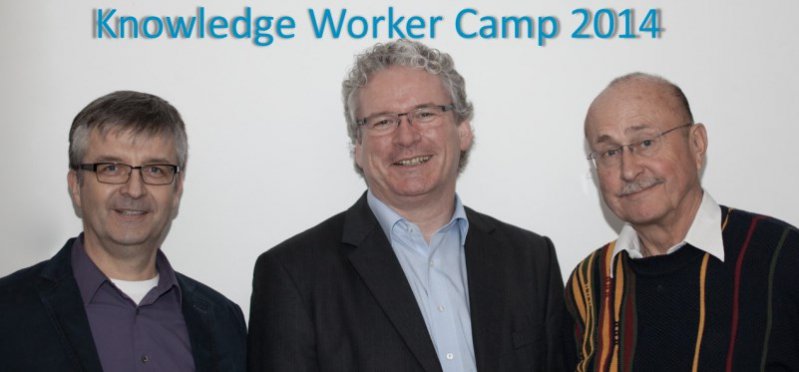 From left to right: Bernd Fiedler, Thorsten Schlaak and yours truly.
I did it all more or less whenever I had nothing more important to do and every few weeks, I added a new “knowledge opportunity”. There simply was not time to do more than that.
Now three of us decided to let IF AGORA also get a real life. First and foremost, we wish to organise a Knowledge Worker Camp, where hopefully many persons offering knowledge will participate, along with many other persons who are prepared to take a little responsibility for the future.
But before starting to plan and organize such an event, we want to find out what actually moves us all today. Consequently, we started a survey – and we are quite excited about the result.
As soon as we have the results, we will plan how to structure the event and when it should take place. And we will invite many, many people. We will assume that those who come will be exactly the people we needed.
RMD
(Translated by EG)


