
Roland DürreTuesday July 8th, 2014
Bernhard Findeiss – Kanban or Scrum
Here is a second presentation of our technological IF Forum series
“Self-organization as a Formative Model for Enterprises”
Of June, 27th, 2014. It is now accessible for everybody (creative commons).
Enjoy!
Many thanks to our speaker Bernhard Findeiss!
I am assuming more presentations will now be made available on a daily basis.
Thanks to: Friedrich (Friedrich Lehn).
RMD
(Translated by EG)
Roland DürreMonday July 7th, 2014
Eberhard Huber – “Resilience beats Efficiency”
Here is the first presentation of our IF Forum
“Self-organization as a formative model for enterprises”.
It was held on June, 27th, 2014 and is now available online (creative commons –
Enjoy!
Many thanks to our speaker (Dr. Eberhard Huber)!
I am assuming that all other presentations will now follow in quick succession. Many thanks for this to Friedrich (Friedrich Lehn).
RMD
(Translated by EG)
Roland DürreSaturday July 5th, 2014
Weekend Contemplations
Sine ideas of mine have their origin in the fact that probably all of us have to find a balance between good and bad, right and wrong, constructive and destructive in various dimensions and at different times in our lives. I, too know it only too well.
Consequently, I wish for myself and you, dear friends and readers, that we may have great success when trying to overcome the ever new obstacles put before us! And I would ask you and myself – even if you are just as frustrated and desperate as I am and when everything seems in vain and hopeless – to just continue.
Because I believe constructive work is possible in every environment. The goal and the way towards it might change, but in the end, there will always remain something positive (constructive). You only have to really want to do the constructive thing, particularly in destructive worlds. And you should always find the courage to do it
Here is a sentence I do not yet quite understand:
”There is no right life in wrong life“.
I do not know if it is correct. Often, I think: yes, then I think: no. But there probably “a constructive life even in destructive life”!
Well: hands on!
RMD
(Translated by EG)
Roland Dürre
Your Value, My Value!
What Should I Cost?
I have known Gebhard Borck for a long time. Several of the friends I know through the pm camp movement pointed me towards his presentations.
And, of course, I particularly liked his “Monkey Tales (Affenmärchen)”. During the wonderful Stuttgart PM Camp this spring, I finally had the chance of meeting him – he gave a great impulse presentation for us there (#pmcamp). It was just magnificent!
His new book “Your Value” officially appeared on July, 1st. It is about something really useful: how to find out what you are worth and how to innovatively write it down in value contracts.
And Gebhard manages to describe this procedure in his book in such an exciting way that there is not a single line that could bore the reader. After all, even the usual wage contracts drawn up around dependency and/or coupled with the number of hours worked are all but modern. And Gebhard actually shows us an alternative model – the value contract (as opposed to the contract for services).
He absolutely convinced me. And as soon as I will have terminated my directorship at InterFace on December, 31st, 2014, I intend to base all my counselling – provided I will still be asked to do some counselling – on a value contract.
Because now, I know my value – thanks to Gebhard. Many thanks!
RMD
(Translated by EG)
Roland DürreSunday June 29th, 2014
Networks versus Hierarchies
On the future of enterprises
The feedback on the technological IF Forum on June, 27th, 2014 at the Unterhaching Sportpark was wonderful. Many thanks to all who where there. I already look forward to watching the video recordings of all the presentations.
Here are the lecture notes for the presentation I held after the event.
The IF Forum was about:
“Self-organisation as a formative model for enterprises in the 21st century”
 On one of his first days as our new (!) colleague in the board gave me the Sudbury-Book – a gesture I found both courageous and really great.
The book is about liberal schools. It is a very radical plea for liberal education. Compared to “Sudbury”, the good old “Summerhill” model we all appreciated so very much during our youth is truly authoritarian.
Incidentally, I believe a little more “Sudbury” would be good advice, and not just for our schools. It would also help our enterprises. Mind you, I am not just talking so-called “brain workers”.
Why?
Once upon a time, we had an “industrial revolution”. Many workers were needed in the factories. However, there were no skilled workers on the human market. To make up for it, there was a huge surplus of unskilled persons, some of whom had grown up on farms. Farms, in particular, were places where – due to new technology – masses of employees were made redundant. They had all worked in a rural environment. They were simple people, not used to time-oriented discipline and without any experience with technological work.
The first conveyor-belt production of Ford’s T Model is a nice example of this industrialization 2.0, which followed after the extended use of the steam engine as a power machine (industrialization 1.0). Suddenly, time and the clock became relevant factors. The “caste of engineers” took over production control and ruled over the unskilled labour. “Modern Times” as in Charlie Chaplin had begun.
In the 21st century, we have a totally different image of humans and the world – at least in our society:
”War is over!“
”Future is female!“
”We want freedom and peace!“
…
“because we no longer believe in a life after death!“
And the science of management, too, underwent change. For example, Hans Ulrich of the Hochschule St. Gallen founded the “Management Model” in the early 1980ies and wrote an article titled:
”Eight theses on the change in management“.
They are:
To accept the unpredictability of the future as a normal state of affairs;
To extend your personal borderline of thinking;
To let yourself be governed by “both”, instead of “either-or”;
To think multi-dimensionally;
To understand self-organization and self-control as formative models;
To consider management as a meaningful function;
To focus on what is really important;
To make use of group dynamics.
To me, this looks clear and rational.
Basically, with this list, Hans Ulrich said everything that needed to be said in the early 1980ies. But it seems that some “managers” have not heard any of it to this day.
25 years after the essay by Hans Ulrich, I met Simon Grand, who is also from St. Gallen. I cooperated with him during several workshops. And I learned from him that, when all is said and done, the one thing that makes a manager a good manager is that he knows a little more often than others which decision is good and which is bad for his enterprise. And this is how the good manager makes the right decision a little more often than your average person! According to other research done by the Hochschule St. Gallen, the ratio of wrong decisions is gigantically huge.
A short time ago, I tried to come to terms with the meaning of the words collateral damage (Kollateralnutzen). In Wikipedia, you will find it defined as fringe damage or accompanying damage, which is accepted even if not predictable. I would have defined it as secondary damage.
So far, Wikipedia does not give you any explanation for “collateral benefit”. I am sure this will soon be remedied. In google, you can find the term collateral benefit at the top of (today’s) list as fun opposite of »collateral damage«.
Isn’t it sad: whenever something “evil” happens, you have collateral damage, but there is no “collateral benefit” accompanying “good” things happening. At least not in Wikipedia. Incidentally, I am quite sure that all these things have been written about in philosophy. Except – in our omniscient internet, which certainly has a huge influence and educational value for us, the “collateral benefit” as fringe, accompanying or secondary benefit is not yet known. The philosophers really should do a better job.
I will just claim that a “good” manager will create mostly collateral benefit for (not just) his enterprise. His behaviour is “constructive”. Just like a “bad” manager will create collateral damage – which means he is “destructive”.
And you can see that the classic management doctrine reaches its limits in the times of “Generation Y”.
🙂 Surprise, surprise: all of a sudden you realize that good decisions cannot be made just by rationally deducing from collected facts. Instead, intuition of experience is quite important. And you notice that it can even be proved scientifically.
Consequently, what we get is a set of questions which do not just apply for creative intellectual jobs:
Is Taylorism still constructive?
Maybe regionalization should again be put before globalization?
Have we finally understood that the future cannot be predicted?
How do we cope with this truth?
Do we accept that
- planning things gets harder and harder, that we have to prudently learn as we try to find our way through these complex worlds and that human beings are more important than efficiency? – #agile in the sense of the “Agile Manifesto”,
- there will (or has to) come a time of participating and sharing – #open,
- we will have to go back to doing things the simple way and to always do better – #lean?
Will we manage to contribute with our own talents and competence as each individual situation requires?
Are we courageous enough for civil courage and constructive disobedience?
Maybe we should go back to giving intuition again a relevant role when it comes to making decisions?
Is efficiency still the prior goal? Or is it more about resiliency, the ability to adapt?
Should we not – first and foremost – try to adopt a constructive mind-set. After all, it is immensely important for what we decide and what we do.
Do we really still need persons to tell us what to do?
Why is nobody confident that we will learn together and then do the right thing? In the sense of the Common Interest.
We will not solve tomorrow’s problems by using yesterday’s solutions and we must limit the power of all kinds of hierarchical systems. This is the only chance we have to live (and survive) in freedom through shared and collaborative behaviour based on ratio and to shape the future in the interest of man and our creation.
RMD
(Translated by EG)
Roland DürreFriday June 20th, 2014
You Have to Make Your Own Miracles Happen.
You Have to Make Your Own Miracles Happen.
Or:
You can do differently!
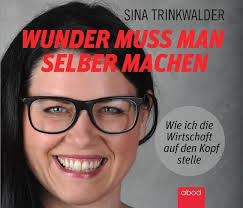
I spent years following her on twitter – Sina Trinkwalder alias @manomama. And in all the time, I was positively impressed by what she did. Not just because she comes from Augsburg – which is my native town.
A short time ago, a friend of mine gave me her book to read. And I was fascinated. There are quite a few good reasons for said fascination.
Firstly, I discovered that we have many things in common. Be it the attitude towards life in general or the best school for your children: everything sounded very familiar to me.
Another reason is that this book contains many things which simply happen to be as described. No matter if we are talking banks or politics, (almost) all the experiences the author writes down in her book are similar to my own experiences.
Also, it feels good to read her radically abandoning many excuses, references to inherent necessities and collective constructs why such and such has to be like this and unfortunately cannot be helped.
The best about this book is its honesty. As the reader, I perceived every experience described as absolutely authentic and believable.
And what is even better: the book is as exciting as a who-done-it – and once in a while it actually gives you goose-flesh. Which is something really extraordinary for such a radical “business book”.
In a nutshell: it is a book which truly fascinated me and for which I would wish that as many persons as possible read it.
RMD
(Translated by EG)
Roland DürreTuesday June 3rd, 2014
June, 20th, 21st, 22nd – PM Camp in Berlin #pmcamp14ber
”Cooperation in the 21st Century” and „Wisdom and Intuition of the Multitude“
Those are the two focal points of the Berlin PM Camp between June, 20th and June, 22nd, 2014 – which means from Friday evening until Sunday afternoon.
Doesn’t that sound exciting!
Consequently, late in the evening of my birthday, I will board the sleeping compartment of the night-train from Munich to Berlin and leave it to said train to bring me to my destination. And I already look forward to meeting many friends and in particular Heiko (Heiko Bartlog).
Heiko is a member of the organization team of Berlin PM Camp and put enormous energy into preparing for this event. He asked me if I would like to supervise a session about the two exciting topics of the Berlin PM Camp. Isn’t that nice of him?
Well, I would certainly always like to do just that. Consequently, I now start thinking about it. There are certainly a lot of topics. Here is a list of what comes to mind:
- Target Agreements
In 30 years as “The Boss” of InterFace AG (and even before that in my more passive role as employee at Siemens AG and Softlab GmbH) I made a lot of surprising experiences with goals and target agreements. I learned that target agreements are very problematic in many respects. Consequently, I believe it is quite possible that more and more of these “control mechanisms for humans by material rewards” will be abolished in the future.
For instance, I could tell my life story, including paying models and target agreement design as an entrepreneur and in projects.
- The Change in Management
In the early 1980ies, Hans Ulrich, perhaps the founder of the St. Gallen Management Model, wrote a wonderful essay on “8 Theses on Change” in management. By now, we already have the Version V4.0 of the St. Gallen Management Model. We did a review of this model with Professor Dr. Johannes Rüegg-Stürm and many Swiss enterprises. In the process, we discovered how unique and modern Hans Ulrich’s theses are still today.
- Leadership – Principles and Values
Being an active participant in a Blog Parade initiated by Bernd Geropp, I have recently been made aware of how diverse the answers to the simple question: “What are your three relevant leadership principles?” are. I took quite some time thinking about it, and then suddenly, it was very clear to me: I am an ALO man (agile, lean, open). But how does this translate into daily practice? Or why will this often not be possible? And what could we do in order to use this principle more frequently?
- Leadership is Communication!
Another topic is communication. Communication has always been a difficult issue. But here, too, humans and their values, expectations, interests and needs changed. And I mean radically. Similar to “basic beliefs” and “basic behaviour”. Except that some bosses, project managers, managing directors and superiors did not notice. And consequently, many of them communicate like in times long past – which is true in several respects. There is really a lot you could improve – and in fact, you have to improve on these things if you wish to make the “future” a success.
- “The Future Cannot be Predicted”
and all decisions will always have an “uncertainty factor”.Well, this is just how it is. And in managerial circles, the awareness that this is how it is now also is being heard. So this would be another exciting session topic.
I think a team cooperating at eye-level is better equipped to distinguish between “good” and “evil”, for instance when it comes to a project. And this is how, with a shared effort, more “right” than “wrong” decisions can be made than, for instance, if an isolated project manager has to make them.
- Discovering Collective Constructs!
Projects or enterprises are social systems, mostly with a decided goal. Social systems, however, tend to develop collective constructs which increase by themselves in a very special way, often also when those who are normatively and strategically responsible become system agents. Social systems can then easily make themselves independent and de-personalize.
The only way to prevent this phenomenon is to have a culture of civil courage lived by the majority in the enterprise or project, thus making it possible to fight back against a perversion of collective system constructs in constructive disobedience. In other words, an immunity guaranteed by a “Crowd” inhibits the social system.
These are all topics I find extremely fascinating. I also have lots of personal experience with these topics and learned much from my mentors. It is my pleasure to share my experiences. However, this kind of thing always has to be in harmony with the barcamp and consequently, with the PM Camp. That is why I always wish to decide at short notice what exactly I will talk about. For instance after having digested the impulse presentation and the feedback in the discussion. Or maybe after the first PM Camp day.
Besides, I am quite ready to let others do the speaking, only getting active when I notice that there seems to be a shortage of volunteers for session. Except if I find something really incentive :-).
So I look forward to being in Berlin. And as to the rest: let us wait and see. In other words: instead of planning, I just let things develop.
There is no doubt that the Berlin PM Camp will be a first-class event. I can promise!
RMD
(Translated by EG)
P.S.
At this time, I would also like to inform you about the next two PM Camps:
The PM Camp Rhein-Main is all about “project communication” It will be from the evening of June, 26th, until the afternoon of June, 28, in Bad Homburg #pmcamprm and #pmcamp14rm. Unfortunately, I cannot be there, because on June, 27th, we have our big 30-year-party – all PM Camp fans are invited.
In July, Munich will host an event between the 24th and the 26th (again Thursday evening through Saturday afternoon). The motto of the PM-Camp München is: “sharing knowledge – increasing knowledge”. And that certainly also sounds familiar: #pmcampmuc or #pmcamp14muc. Of course, I will again be one of the participants at the PM Camp in my home town!
Roland DürreThursday May 29th, 2014
The Goal is During the Journey …
It happens all the time, both in enterprises and in other social systems. People suffer from something that is wrong or getting worse each day, although, basically, this would not be necessary. Perhaps because processes and/or the supporting technology have outlived their usefulness. But perhaps only because technological debts have accumulated. Because a system that used to be quite useful became totally out-dated as time went by. After all, a system that used to be a good tool can also suffer from old age.
Those enthusiastic people in the enterprise who worked with the system found out about this and are now unhappy with the situation. The same is true for those responsible. Consequently, the old world has to be improved. Everybody desires the same thing, because they know quite well what they need and want.
And then there is the job for the project head. He gets the great task. He is supposed to significantly improve a state of affairs which is making many people unhappy.
Basically, everything seems quite simple: both the users of the system and those responsible for the technology know exactly what they want. The “leaders”, too, back the project. Even the budget is available and actually seems quite generous.
But then come the eggheads with their strange ideas: legal service, worker’s council, data security, quality popes, administrative instances and diverse persons responsible for processes want to be heard. Additionally, quite a few “minor zones of battle” are created for personal reasons.
A complex Requirement Engineerung (RE) is initiated. The most adventurous extra functions are created through bizarre mind games. And all of a sudden, you will find functions on the documents that you will probably never need. To make up for it, the most elemental basics were forgotten.
In doing so, the people pervert a project goal in such a way that it becomes the natural enemy of all parties involved in the project. Naturally, the project will blunder from the outset. And even when the project starts, “wise ones” will already foresee that the entire thing is going to end in disaster.
However, the “wise ones” prefer to keep quiet. After all, they do not want to seem to be the eternal grumblers. Besides, they know that their arguments will not be heard, anyway. Just like they know that the morbidly pleasant anticipation, too, will not help anybody. Instead, it will only harm everybody. So what to do?
Isn’t it really a shame?
Incidentally, what I related here is not something that rarely happens. As I perceive it, it actually happens at least with fifty per cent of all projects. The idle power will climb infinitely. And only because we sometimes find heroes who in the end will see to it that the damaged projects will work out after all, you mostly get some desired results. Even if in a rough-and-ready manner.
Well, this is when I start dreaming of an improvement process which is supported by all parties concerned and where simple improvements are carried out in small, shared steps like pearls strung together pragmatically on different chains. This is when the journey becomes the goal. Very “agile”, “lean” and “open”.
Why not with Mobprogramming and similar innovative methods? But I will write about mob programming and that it might actually be a helpful collaboration model for leadership teams at some other time.
RMD
(Translated by EG)
Roland DürreTuesday May 27th, 2014
From Collateral Damage to Collateral Benefit
You often hear people talking about “collateral damage” (Wikipedia). Of course, you will also find the term “collateral damage” in Wikipedia.
Looking for collateral benefit however, the only entry I find on the internet is one I do not find satisfying: collateral benefit (Kollateralnutzen), so they write, is the “humorous counterpart of collateral damage”. And in Wikipedia, I cannot find the term “collateral benefit”, either.
I think this is a pity and wrong.
After all, here is what we have: you do something evil, inimical or just wrong. For instance wage war. You want to do damage to someone, namely your enemy. And apart from the damage you wanted to do, you actually do a lot more massive damage. This extra damage is called collateral damage.
On the other hand, you can do something good, humane or simply right. And I am sure in this case, there will also be some additional – even if not predictable – collateral benefit.
Perhaps we should simply integrate the term collateral benefit into our language and at the same time push aside collateral damage. People might actually more often be able to distinguish between good and evil, which again might make them do the right thing more often than the wrong thing?
So please remember: whenever you do something good, there will always be lots of additional collateral benefit – why not do the right thing?
RMD
(Translated by EG)
Roland DürreSaturday May 17th, 2014
Profit, Turnover, You can Measure Profit – Unlike Intangible Value!
An Interview for the DOAG
During the big Nuremberg DOAG conference, Dietmar Neugebauer asked me for an interview on “leadership and management”. DOAG is the German Oracle User’s Association, or simply the German “Oracle-Community”.
Here is the text supplementing the video on the DOAG-Website:
InterFace managing director Roland Dürre thinks managers today are confronted with ever higher expectations. He tells DOAG managing director Dr. Dietmar Neugebauer what he thinks are the criteria for successful management. Among those criteria are ethics, civil courage and empathy. However, as opposed to the material values, such as profit, turnover and advantages, you cannot easily measure them.
And, of course, here is the video:
The video was made by DOAG.TV. Many thanks!
RMD
(Translated by EG)


