
Roland DürreTuesday November 20th, 2012
Data Security and Industrial Espionage …
When discussing data protection and security, you often hear the term “industrial espionage”. Federal agencies or our oh-so-important business associations keep warning us:
Over the last few years, industrial espionage increased dramatically!
And, of course, the focus of said espionage is on German enterprises and their know-how.
The same sentences can also be read in a survey done by “CORPORATE TRUST – Business Risk & Crisis Management GmbH”.
You can access it through the following link . It is rather worth reading, especially with respect to how you can make people fearful?
You will find the warning that “cyber war has become reality a long time ago” and that it “has arrived in the middle of our society”. Neither can the “computer worm Stuxnet“ be ignored. After all, it was “probably developed especially in order to sabotage the control mechanism Simatic S7 – which controlled the frequency converter of the motors in Iranian nuclear programs.”
(Note the word “probably”).
To be sure, the exact goals of the customers were unknown, but the complexity of the attack shows that we went from an era of script kiddies and crackers towards a new dimension of danger – etc.
 Mind you, these are all original sentences taken from the study. The very choice of words in its martial character already makes me sceptical.
Regardless of this, I take the subject of data theft a lot more seriously than, for example, the fear of personal data being abused. I also believe that “stolen” data will help you to reach your goal faster than having to develop “something new”.
I have a vivid memory of a project we did a little less than 30 years ago. We were asked to develop something totally new. Except that we did not have the slightest idea how the “new” could be done. In those days, studying the sources the competition used was quite helpful. And to this day, I do not know if we made use of said sources legally or, maybe, in a certain shady area.
Still, I do not think industrial espionage is quite as menacing as it is projected – and not only in the internet. One of the reasons I give for this is that these fear-inspiring studies originate with firms which want to sell special counter-espionage services and products. And, of course, federal agencies and business associations are quite ready to chase the pig through the village. After all, there is nothing else they are busy with. What a nice idea to employ James Bond! Isn’t it a beautiful shiver you feel whenever you hear how evil the world is and how you yourself are absolutely powerless?
But let us remember what it used to be like!
 When I worked for Siemens, we were absolutely prohibited to take any secret documents with us when we left the building complex. And almost everything was secret. Consequently, there was a random generator at the portal. Occasionally, it lit up. When it did so, you had to open your briefcase and show what was inside. It went without saying that taking pictures on the factory premises was not allowed.
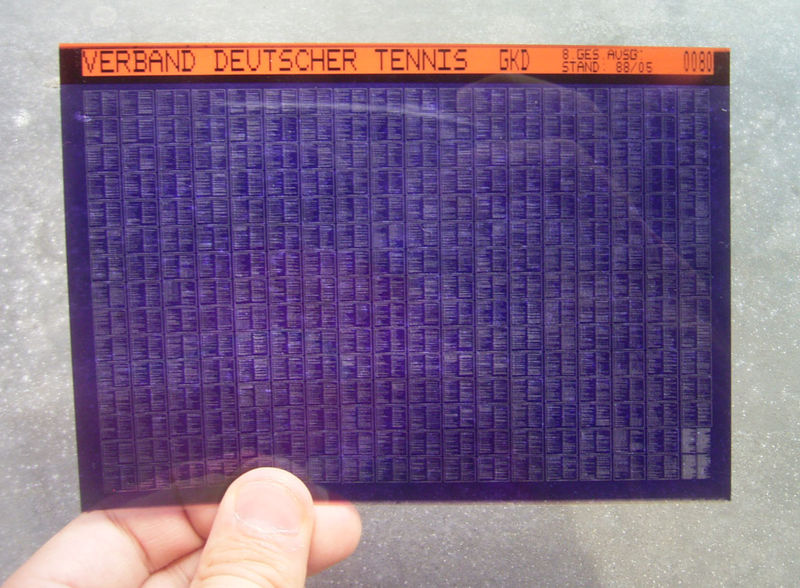
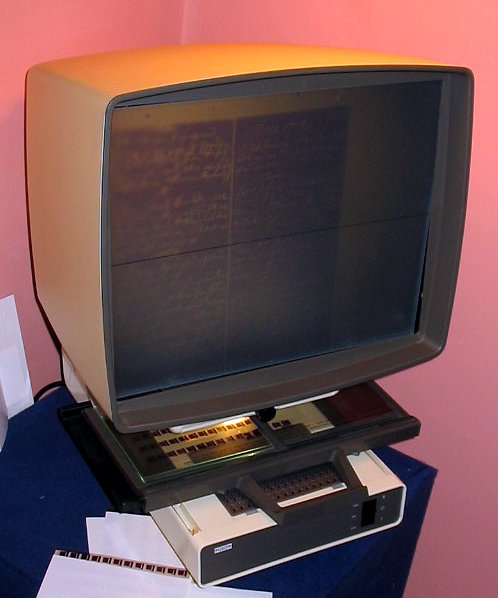
Those were also the times when we used those blue “Micro-Fiche-Films”, along with the reading devices that went with them. Micro-Fiche, or rather microform is the first technology I know which you could use for storing many data on little material. For us, it was usually sources of complete operating systems that were stored on a small square of film so we could carry it around with us in our briefcases.
Of course, it was not realistic that the secret papers were never leaving the factory premises. For one thing, our firm was quite distributed. Some data were needed when you went to see a customer. And once in a while, you also wanted to do some work at home. Consequently, we had permission papers. If you had this paper, you were permitted to take any secret paper you needed. The higher echelons – I do not remember up from which AB or GB level you qualified – were also permitted to take secret documents without the permission paper. I also do not remember if AB truly was short for “departmentally authorized“ and GB for “generally authorized“.
But then what a strange (and totally stupid) kind of firewall was that? It was certainly no more secure than the modern firewalls offered by IT?
Incidentally, the first two colleagues from the former GDR we employed directly after the re-unification confirmed this opinion. They came directly from Robotron Dresden. And they told us that, naturally, at Robotron, they always had the latest plans of the Siemens chip developers on their desks the moment they were made. Except they were not able to put them to any use. The necessary raw material (purest Silicium) could not be obtained in the GDR. Neither did they have the necessary tools to even produce the prototypes.
To be sure, I do not know if our ex-GDR engineers were just after spinning us a good yarn, but I can easily imagine that this is actually how it happened. Basically, I believe data will always end up where they should not be. But mostly it makes not the slightest difference, even if, perhaps, you get quite annoyed, and justly so.
But I also believe the methods changed. And the new methods are a lot more efficient, even though they have nothing at all to do with IT. Let us take a look a China, where, allegedly, the enterprises want to spy on Western firms. Do they really need to do that? Or are there, perhaps, far easier methods?
Here is what you can read in “invest in Bavaria” at “China in Bayern”
Currently, more than 130 Chinese enterprises, for instance Huawei Technologies, Pearl River Piano, ZTE, Yingli Solar, ET Solar and a little under 11,000 Chinese citizens reside in Bavaria. About a third of them live around Munich. Approximately 3,000 Chinese students at Bavarian universities further attest to how attractive the Bavarian universities are.
I also know that there are Chinese branches in the “regions with weak infra-structure“ in Bavaria that have such lovely scenery. Those Chinese branches specialize on R&D (research and development). Actually, these enterprises are quite heavily subsidized by the Bavarian authorities – and accordingly, their moving here is celebrated quite bombastically. Because, as a general rule, F&E is a clean sector. It does not damage the environment and attracts intelligent engineers.
And what is the first thing a Chinese F&E enterprise will do? No question! They lure away the German engineers formerly employed by their German competition. And the best ones at that! Those with exactly the kind of know-how most urgently needed in China. And the German engineers are happy to come. They are quite attracted to live cheaply in a nice place, do some F&E in a modern laboratory and mostly even be paid better than before. This is how the Chinese can choose from the best persons with the right knowledge. Now isn’t that a lot more efficient than having to crack networks and servers?
Neither can I find any fault with it. After all, we live in a globalized world and I rather like the Chinese with their friendliness and tasty cuisine… And I seem to remember “knowledge is the only raw material that grows as you share it“!
After all these ideas, I read the aforementioned “study” with totally different eyes. “Installing fear“, is, after all, a very successful marketing strategy…
RMD
(Translated by EG)
P.S.
I took the pictures from the central media archive Wikimedia Commons. They were taken by Nichtich and Tomasz Sienicki [user: tsca, mail: tomasz.sienicki at gmail.com]
Roland DürreSunday October 21st, 2012
Ownership – Personal Data – Copyright – Ownership – The Law– Content …
Even with actual objects, no matter if mobile or not, ownership is all but a simple issue. From the ethical, moral, rational viewpoint, etc. …
It gets even harder when we are talking ownership of non-material, abstract, content or even “mental“ things. For life and survival, the latter basically is of no consequence – as opposed to a warm meal, clothes and a place to stay. And a little love. But there I remember: love, too, is something abstract, non-material. Can you own love? The phrase itself shows you how stupid the concept would be.
Debates about ownership of data and content are rather confusing. What exactly is this: data and content? And how can you own them? Who owns the date of birth of a human being? Does it belong to the mother (or the father), or to the child, or to the authorities where the child lives? Is it important who owns those data? Is the date of birth important at all? Does it exist at all in the course of the universe?
Who does a story belong to? Does it belong to the one who tells it or to the audience? What exactly is this: an idea, a concept, an invention, a story? What is its value? You cannot eat or drink it. So can it be something similar to money? A commodity of exchange?
Or is this about how something abstract can be made into money? Does such a thing as a unique story exist at all? Or is not everything based on something you experienced or learned? What can one individual person claim to be his own and what belongs to us all? Is the idea already the achievement, or is the value only created after it has been edited? Does something like justice exist?
Copyright and patents can be interpreted as the result of cunning businessmen’s work. They demanded that their interests be protected and then they put it into practice through good lobbying. Their – certainly understandable – goal was to gain a maximum of riches with a minimum of effort. Just like a Russian neo-oligarch who can become a billionaire in 10 years.
But is this goal (which actually was achieved) legitimate? Should you be allowed to “earn money” with the help of rights that have been scaled beyond all proportion – as otherwise is only possible if you are backed by capital? The motto would be: “here I am sitting at the beach and enjoying life while my money is working hard and very successfully for me”.
Except in this case it is the rights that work hard for those who own them. Historically, the entire copyright is simply another attempt at separating income from work and increase profit geometrically or even on a logarithmical scale, instead of linearly. Probably (and of course), it is all detrimental for the common good, i.e. for the people living on this planet and the planet itself.
So it is just a new method for increasing profit infinitely. Infinitely? Yes! We are talking billions – and for average citizens, one billion Euros feels like an infinite amount of money.
Thus, the interest group “intellectual property“ managed to initiate strange regulations and make them pass as law. The result is the current situation in the patent and copyright areas. These regulations have been promoted with arguments such as: otherwise there will be no progress. Mind you, those arguments were probably never true, but now, in the internet age, they have been definitely proved wrong. By now, “progress“ happens through a free sharing of knowledge. Even slogans such as “protection of intellectual property” will not make the slightest difference.
This is how knowledge and stories were confiscated (bought?) and privatized. The producers of content and illusions, in particular, claimed special rights in our cultural circle during the primitive times of media and start-up periods – and then they politically pushed those rights through with a strong lobby. Isn’t it remarkable that those laws are called “Micky-Mouse-Legislation”?
Many violations against laws thus passed, such as illegal copying, could be called self-defense. All you have to do is claim that the free sharing of knowledge is a necessary requirement for an innovative collaboration as part of the evolutionary development of humans.
Since my trip to China, I often feel Chinese. Chinese persons look upon themselves as one big family with no secrets. Regardless of the fact that there is no doubt they live in a dictatorship.
You have to share knowledge voluntarily in an open and free manner, simply in order to advance together! Isn’t the entire human race one family for which, basically, there may soon be nothing left but the struggle for survival?
RMD
(Translated by EG)
P.S.
P.S.
Two lines out of the wonderful song “Imagine” (John Lennon):
…
Imagine all the people
Sharing all the world … (yuhuuuh)
…
Roland DürreSaturday October 20th, 2012
Video: Dr. Eberhard Huber at the IF Forum “Project Coaching”
Our last speaker at the technological IF Forum on September, 25th was Dr. Eberhard Huber. He managed to summarize all the results and information gathered during this wonderful afternoon in an excellent manner before we finished with a discussion in the “Fish Bowl”.
Now – “at last but not at least” – the recording of his presentation is also available on Youtube.
The Third Technological IF Forum was about “Project Coaching“, with the motto “best of PM-Camp“. So now we have made all the videos from this event available.
Many thanks once again to Eberhard for his presentation. It contributed hugely towards the success of our IF Forum.
Eberhard’s motto is “project“ in a team – here is the link to his blog “projekt (B)LOG“.
RMD
(Translated by EG)
Roland DürreMonday October 15th, 2012
Video: Dr. Stefan Hagen at the IF Forum “Project Coaching”
You can now watch the opening presentation of our technological IF Forum by Dr. Stefan Hagen from Lustenau on Youtube. It is a true pleasure to watch.
The Third Technological IF Forum was about “Project Coaching“, the motto was “best of PM-Camp“.
Again, many thanks to Stefan for his presentation. He was responsible to a huge extent for making our IF Forum a success. Stefan is also the author of the most frequently read German language blog on Project Management – pm-blog.com.
RMD
(Translated by EG)
Roland DürreSaturday October 13th, 2012
Who is Scared of the Boogey Man?
Everybody is scared of the “Cloud”. Because the Boogey Men inside the Cloud eat our data and/or use them in an illegal way. Our precious personal data!
It is particularly bad if the Cloud is outside our country. After all, there is no control possible. The US secret service might well read our data. However, matters are not really improved if the Cloud sits (hovers over) Germany. Perhaps the US secret service cannot read our data in that case, but the German secret service certainly will. And, basically, I do not care which secret service reads my data.
Why are we feeling so protective of our data? I cannot understand it. Nothing has as little importance in my life as my data. If there is anything you wish to know about me, just go ahead and ask! It will be my pleasure to answer – even publicly. Most of the things about me will be found at duerre.de or if-blog.de, anyway.
If I were the anxious type, I would certainly be scared of Clouds. But I mean totally different Clouds. Those I am actually dependent on. Those that are the basis for all I truly need in order to survive.
Water
Water comes through the tap. It gives me access to the water Cloud. It is rather insecure, isn’t it? Evil-doers could pour poison in it at many places. To be sure, we only know the poison terror at the water station from the cinema – but it could easily become reality. An evil terrorist would be all it takes to kill us all.
Bottled water from the supermarket will not help, either. This Cloud, too, has too many weak points. An evil-doer would easily find ways in. Today, hardly anybody still has his or her own well. Incidentally, it would not help, because the Cloud of dioxins or radioactivity is already on its way to poison it, anyway.
Nor is it a brilliant idea to drink beer instead. Too often, it comes from the InBev Cloud. And on a rather risky way at that. Until finally it ends up in the safe haven of my refrigerator.
Food
All food, be it deep-frozen, corn, all kinds of basic nourishment, vegetables and fruit, fish or meat, canteen food: all comes from the Cloud. And once in a while, something unfortunate happens there. Sometimes the Cloud produces chicken that contains a little dioxin, sometimes it is the deep-frozen strawberries. They come from China and make our children sick. I certainly cannot understand why we in Germany would need to eat deep-frozen strawberries from China. After all, there are enough apples, pears, plumes… right here in the country. But the Cloud makes it possible. And certainly not from the neighborhood.
But we trust in the Cloud. It will certainly feed the entire world and continue to do so tomorrow, as well …
Energy
Electrical energy comes from the electrical socket. It is the interface to the Cloud. The fuel comes from the pump at the gas station. When the Cloud will no longer supply us with electrical energy, the lights go out. When the pump at the gas station provides only drops, the cars will just stand around and be useless.
We do not know where the electrical energy or the fuel originated. Neither do we want to know. The Cloud will certainly provide. With or without an about-face in energy politics. Besides, energy is, after all, not quite as important as water or food. Nothing serious is happening if the electrical energy is sometimes polluted.
Money
You cannot eat money. For life, it is even less important than energy. Most of us have too much, anyway. Which is why we buy all kinds of useless things we do not really need. Whatever is left of our money will be stored at the bank. That is how we learned it! For too many years, we have been instructed that the only person hiding her money in her socks or underneath the sofa is the stupid grandmother. No! Apparently, we think the money Cloud is very nice and even system relevant. And consequently, we hand our entire money over to it. Because we want the Cloud to let our money work for us. And when we do not have enough money, we go and get it there.
Water, food, energy, money and much more comes from the Cloud. Basically, I cannot imagine anything today not coming from the Cloud. And still we have no problems sleeping soundly …
Only when our data are inside the Cloud, we cannot sleep any more. Why is that so? Are we scared of our data? Why are we so afraid that others might get to know who we really are? Do our data remind us of our evil deeds? Quasi like a modern bad conscience?
I must confess that I generally fail to understand the sometimes collective sometimes individual hysterical reaction when it comes to personal data. And, to me, it does not matter if these data are in the Cloud or somewhere else. I still have quite a few plans for my life. But I would never, ever agree to do the job of data protection commissioner.
RMD
(Translated by EG)
P.S.
In my book passphrases and passwords for internet pages such as Ebay or for the bank are not data, but keys. And, of course, you should always be careful with keys. Even though I must admit that I am actually quite careless with my house keys.
Roland DürreFriday October 12th, 2012
Data _Theft
This morning, there was an extremely unsettling item of news (Nachricht) on the radio (as always, I listened to Bayern2 – Radio):
In probably two hospitals, data were stolen. We are talking of the hospitals at Rastatt and Mittelbaden in Baden-Württemberg. The objects stolen are patients’ data, diagnoses, letters by doctors and internal hospital communication. These data were probably stolen on September, 19th. According to the hospital, they filed a complaint against an unknown person. It says that the Rastatt hospital noticed the violation on September, 27th – eight days after the alleged theft.
Today, on October, 12th, this item of news makes the current headline!
Basically, I assume that, of course, some “secret” data of German hospitals will end up where they do not belong on a daily basis. It is probably unavoidable. But this case seems to be particularly important. After all, it made the current news of October, 12th, 2012!
Well, why don’t we savor this topic? There was a data theft. Theft – which means some property was stolen. But then, the property – that is the data – would have to be gone after the violation of the law happened. Consequently, the thief would have had to copy the data and then delete the file at the place of theft. Otherwise, all you get is “half a theft”.
Yet I presume this was not what happened – it is probably not even possible. All those intended copies (backups) and unintended “data in work” make it basically impossible to completely delete anything. Except if the thief practiced total vandalism and destroyed everything. Or else if he was a perfectionist who also destroyed all the backups. But only a genius can do that – and even he can only do it if he has internal knowledge.
But let us look at the person who probably committed the theft. I write “probably” because, de facto, the “theft” is only an assumption. They assume that an unknown person copied certified data from the system. So what will the thief now do with them?
Is there a personal interest, because he wants to know more about a procedure that actually concerns him? Is it simply revenge? Does he only want to look important? Is this espionage, maybe by the press? Someone who wants to detect unethical behavior on the part of the hospitals (I assume that can be found everywhere)? Or was it, maybe, even a Federal Agency working clandestinely (and rather clumsily)?
Or is it a (minor) culprit who wants to win money by using data, for example by blackmail? And in that case: who would be the recipient of blackmail? Who is the owner of the data? If it is a diagnosis, is it the hospital or the patient? If it is communication between doctors: the hospital or the doctors? The sender or the recipient of the letter?
More and more question. I am sure I could continue in this fashion for a long time. But that is not what I want. I assume that this is again one of the instances where no damage will be done by the “data abuse”. And if damage is done, it will be quite small and short-lived. A trifle. But in the land where people get hysterical about data security, this is the kind of news you can use for painting the most demonic pictures.
I file the article among “storms in the water glass”.
RMD
(Translated by EG)
P.S.
I would find it a lot more interesting to read about the number of malpractices or the many cases of operations or other therapeutic actions where business considerations and optimization, such as capacity utilization and strategic billing were the determining factors.
Roland DürreFriday September 7th, 2012
Some More Details on the IF Forum of September, 25th, at Unterhaching
In less than tree weeks!
On September, 25th, there will be another very special technological IF Forum in our Unterhaching building. After 2010 (AGILE) and 2011 (LEADERSHIP), this is the third “Technological IF Forum”.
In 2012, the protagonists of the PM Camp will visit Munich (Unterhaching) on the 12th of September. They will bring with them the “Best of PM Camp”.
The day is about:
Projects and work, coaching and success!
Here are the agenda and a short introduction of all speakers and their papers:
Presented by – Roland Dürre
14:00 – 14:15 Welcome (Kornelia Hietmann)
Segment I
14:15 – 14:45 Integrated Project Management (Dr. Stefan Hagen)
14:45 – 15:15 Post-Industrial Project Management (Dr. Marcus Raitner)
15:15 – 15:45 “Fishbowl” on Segment I
Break
Segment II
16:15 – 16:45 Systematic Creativity (Jens Hoffmann)
16:45 – 17:15 Purpose, Nonsense and Chances of Life (Nadja Schröer-Petranovskaja)
17:15 – 17:45 “About Onions and Cultures” (Dr. Eberhard Huber)
17:45 – 18:30 Fishbowl on Segment II
Afterwards:
Happy Hour (discussions, fun, laughter, beverages and snacks)
Now let me introduce the speakers to you and give a short summary of their presentations:
Dr. Stefan Hagen will open up the first section with his presentation about “integrated project management“.
 Stefan is the founder and owner of the Hagen Management GmbH.
In the truest sense of the word, Stefan lives his life
Project Management – Organization – Strategy
Consequently, he is also the author of the perhaps best-read German project management blog (pm-blog). In his IF Forum 2012 opening statements, he will plead for “integrated project management“. Here is a short summary of his theses:
- Problems arising in project management can probably only be solved using a conventional approach and methods. Just look at the poor success rate.
- Integrative approaches will be necessary. Basically, this means we have to look beyond our own horizons.
- Horizontal Integration: classic and agile approaches;
- Vertical Integration: humans in (social) systems.
- Stefan will mainly discuss systemic principles currently neglected in an unpardonable way in most projects.
- His conclusion is: we need a “change of level“ in order to generate better frameworks for successful project and team work.
The ideas introduced by Stefan will be completed by “post-industrial project management” as introduced by Dr. Marcus Raitner.

 Marcus wrote his dissertational thesis in Informatics at Passau University.
After five years as a senior project manager with a huge IT service company, he started a new career as senior partner and board member of the esc Solutions GmbH in 2010.
His focus is on IT project management and IT project coaching.
Dr. Marcus Raitner has his own quite famous PM blog. He is on the organizing team of the PM Camp and initiated openPM.
Read what Marcus says about his own presentation:
Many projects are two-class systems: a few persons do all the intellectual and leadership work, while all the rest of the people just execute it. That is what I call planning apartheid. You cannot miss the similarities with the organization of huge enterprises: industrial project management with the main goal of efficiency. Industrial project management will work quite well if the complexity is so small that the creativity of the planning class is sufficient for overcoming obstacles. Except that most of the projects are far beyond this level of complexity. What then?
After the presentations by Stefan and Marcus, we will conduct the “Fishbowl”. Together, we will process all we have heard.
Then, we will take a break.
The second part will be opened up by Jens Hoffmann.

 Jens, born 1967, is managing director and founder of the Hoffmann Consulting GmbH. Originally from Düsseldorf, he started his career very young – at 20 – with Munich Microsoft, before joining Roland Berger & Partner in 1987. He soon advanced to the posts of project leader in Frankfurt, Vienna and Zurich.
In 1999, he founded the Hoffmann Consulting GmbH. It specializes on consulting services for IT communication. His main areas are governance, risk management, compliance and business innovation (Business Model Design, Product and Service Innovation).
One of his most important topics is creativity. That is why he will talk about
Systematic Creativity
Identify new challenges and solve problems efficiently.
Here are some ideas on his paper for you to take a look at in advance:
Just like the enterprises that provide them, products and services, too, get more and more interchangeable. Technological and social competence are matters of course, but creativity is the one skill currently most on demand. Your competence at identifying and addressing the needs of your customer – and then to solve problems efficiently – will certainly determine whether you are a success or not.
For many people, the connection between creativity and business is something they find hard to get used to. Jens will give you an overview about how creativity can be integrated into business as a process and then be developed and used systematically, either by individual persons or in a team.
When Jens has finished, we will all be looking forward to hearing Nadja Schröer-Petranovskaja speak.
 This is how Nadja sees herself:
Human, Russian, psychologist, project leader, business muse, photographer, mother, author, blogger.
She is always looking for something and finding it between countries, (entrepreneurial) cultures, along their inhabitants and sectors. Nothing is pre-assigned with her, except that:
It must make sense.
Freedom-loving, lazy and courageous.
She will tell us her ideas about:
Purpose, nonsense and chances in life!
Nadja’s presentations are always very special affairs. I very much look forward to her impulse presentation. Said presentation will give us new questions, combine facts and introduce new propositions about how we might design the rest of our lives.
Incidentally, this is the one question that I am mostly concerned with these days.
Our cycle of presentations will be closed by Dr. Eberhard Huber.

 Dr. Eberhard Huber is the embodiment of experience and knowledge. He can look back on: 25 years of project leadership, having been trainer and coach for project management, group dynamics and team development, project management in research and education (at the universities of Mannheim and Magdeburg), and practice.
His Credo is:
Making a team out of a group of people, developing cooperation that is more than just an accumulation of individual competences, often depends on a few lucky coincidences, the leadership qualities, or the project leader’s charisma. This is where team-oriented project leadership comes in. It accompanies the process of building a team during the project.
Team-oriented project leadership that leaves room for and promotes self-organization will enable you to really make proper use of all the potential you have at your disposal.
This time, Eberhard will tell us about
“Onions and Cultures”
His “onions“ will actually close the circle opened by Stefan. Culture and the active promotion of culture can serve as one solution for the change of level Stefan demands. Eberhard chose the title “onions and cultures“ deliberately, because the plural is important for what this will all be about.
Now is the time for our second “Fishbowl“. We will finish the exciting afternoon together and recuperate from the strains of the intense work during our Happy Hour!
I find it great to have the chance of presenting this super event. I look forward to an exciting and beautiful day with Stefan, Marcus, Jens, Nadja, Eberhard and many friends and partners.
RMD
(Translated by eG)
Roland DürreSaturday August 4th, 2012
We Are Informatics.
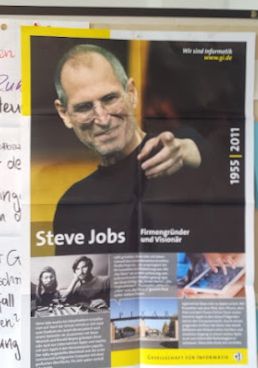 This poster in DIN A2 format was included in some of the GI Informatik Spektrum Volume 35/4 editions of August 2012.
Of course, the first thing I did was hang it on a Metaplan board in my office. Now I am eye-to-eye with Steve Jobs whenever I look up from my desk. And he always points toward me in a friendly manner as I sit at my big Apple Pro.
For all those of you who do not know it: the GI is the Gesellschaft für Informatik e.V.. Their slogan is “We Are Informatics“ and the Informatik Spektrum is the official organ of this association and their associated organizations.
I do not know what exactly the GI is. As I understand it, it is the association of German computer scientists. To me, its purpose is not conclusive. It does not seem to be an association of professionals or interests. Wanting to develop some social relevance, it still does not do any lobbying. Perhaps they see themselves more like an academic circle that wants to publish computer science topics and organize events on a regional and national level.
At least, the GI has the domain gi.de. That is doubtless some achievement, since two-letter domains were really hard to come by until recently.
Besides the GI, we also have the GChACM (German Chapter of the ACM) in Germany. That is the regional association of the big (American) ACM (Association for Computing Machinery) with the slogan Advancing Computing as Science & Profession. As it happens, the GChACM has the domain informatik.org.
In their charter, the German Chapter makes it their obligation to promote informatics by translating English articles into German.
Then there is the Bitkom – Federal Association of Information Business, Telecommunications and New Media e.V. It calls itself “Hightech Association” and is perhaps an interest association of enterprises of the IKT industry (IKT = information and communication association). Perhaps it is the lobbyist of informatics enterprises.
I do not know. But that is irrelevant. After all, I am skeptical as a matter of principle when it comes to associations, because I doubt that these institutions can still contribute significantly to either the well-being of their members or the general public.
But back to the poster:
Why does the GI now pay homage to Steve Jobs with a poster saying “We Are Informatics“? To be sure, Steve Jobs was a relevant person. Of course, he, too, had dark spots.
His first product was a device you could use in order to make free calls, because it created a signal that simulated the “service call“ at the telephone company Bell, thus making it possible to call for free. So you see: it was a device the use of which was definitely a crime. As a businessman, it was not a good joke to be working at Pixar at the time. And if you want to believe his biography, his first relationships with women were not something to be proud of, either. When all is said and done, Steve Job was only human, after all. You have to respect him and might either love or hate him.
But was he a computer scientist? And on top of this, was he one who actually fits the bill of the highly academic GI with its attempted social relevance and standards? Or is this poster just elegantly camouflaged advertising of a sponsor named Apple?
But I do not wish to foul-mouth the GI. After all, I am quite happy that the GI, a few decades ago, did not recognize the ideal moment and jump on the bandwagon of “certifications”. Because if they had done that, we would now have a GI that became really prosperous and powerful through standardizing and norming the numerous technologies of the IuK.
In this light, let us happily join in when they cheer: “We Are Informatics“! This is certainly better than the alternative: “We Certify Informatics”
RMD
(Translated EG)
Roland DürreSunday July 22nd, 2012
A Highway Code for the Internet?
» Every technological improvement, if it is supposed to improve human happiness, will also be an improvement in wisdom. « (Bertrand Russell)
A short time ago, I heard the following statement at an Informatics&Sustainability (Informatik&Nachhaltigkeit) event:
As more and more automobiles appeared in the public domain early in the last century, a highway code became necessary.
And then someone asked:
Do we want/need something like it for the internet?
At first sight, it sounds quite reasonable, doesn’t it? At least I would spontaneously answer: yes. Communication, too, must be regulated sensibly. On various levels, as, for example, the ISO-7 layer model outlines quite nicely. In former times, the national postal services had introduced and successfully realized communication models in the CCITT. That was in the good old times when we still had letters, postcards, parcels, telephone an telex. And it worked quite well, didn’t it?
🙂 To be sure, even at the time, there were such negative things as spams. But it was rather tedious to send someone a spam – you had to walk up to their letter box. Or else you had to buy a “bulk mail service”. It did cover a hundred per cent of the postal code area, but at least it was rather expensive!
Only when radio and TV technology made it possible to transport spams directly into the households without much of an effort, the dam was broken. And CCITT could not do anything about it. After all, this was about economic interests. And traditionally, economic interests have always justified everything.
Consequently, the call for some sort of “highway code“ on the internet seems to make sense to me.
But then comes the “but”:
The development of individual mobility, including a highway code, should, first and foremost, be a warning for us. Because, as I see it, it is an extremely good example for how, regardless of – or due to (?) – the extreme regulation mania displayed by the legislative body, technological progress (in this case individual mobility) was improved, but at the same time the common good was severely injured. Mind you, it all happened even though we have a compulsory driving licence, a complex system of punishments and penalties, including a system of minus-points and similar things.
And the damage that was done was not really noticed at all, because we “got used to it” in typical human fashion. Although said damage is massive and concerns many dimensions of our lives:
- Just think of the massive soil sealing cars brought in their wake. How many square metres of ground were filled with concrete for streets and parking places? In modern semi-detached housing areas, we often find more ground covered by garages and car parking than for greenery. All in all, the landscape was destroyed.
- Individual mobility, especially as we live it today, gave us extreme resource exploitation, gigantically wasteful habits and a massive amount of rubbish. It is the best example for a non-sustainable life-style.
- Noise disturbance has reached unimaginable dimensions. There is hardly any place left where it is really quiet. Even in the “upscale housing areas”, there is still noise from motorways.
- This development of public traffic cost us time. Many people spend several hours every day behind the wheels or their cars. Although they have a good job, they spend a lot of their time doing something otherwise only done by people in an extremely low income group. And they say they enjoy it and are prepared to give “their last shirt” for the car and even indebt themselves for the car.
- But the worst of it is that this development costs us an immense bloodlet. In Germany alone, there were years with more than 20,000 fatal traffic accidents. Today, we still have more than 5,000 fatal traffic accidents – and the numbers increase again.
World-wide, we have between 1 and 1.2 million estimated deaths caused by individual traffic each year (source). That is more than the victims of illness, wars and hunger. If you add up the last 60 years, you easily get a number higher than 50 million. That is about as many victims as WW-II cost. I will not even think about the really astronomical number you get when you count the people injured in traffic accidents.
Now the question is if a wise legislative body could have done better a hundred years ago and then during all those years?
I do not know. I do not even know if, in retrospect, we can say what should have been done differently all those years ago.
But I have a few ideas:
For example, I am sure it was a mistake to permit and even support the industry when it promoted the introduction and, above all, the sale of automobiles through sports. Motor sports and also the race courses, such as the Nürburgring were goal-oriented cooperative projects initiated by state and industry in order to promote the acceptance of the then still little-loved new technological product “car”. Thus, we were (almost genetically) pointed towards driving cars as an athletic activity where it is important to be faster than others.
Perhaps we should not have let it happen that the users of the competing means of transportation bike were publicly degraded as early as the first years of the economic miracle. I myself witnessed how my father, against his wishes, changed from using his bike to using his car for the less than two kilometers he had to go between our flat at Rosenaustr. 18 in Augsburg to the General Railway Office Building at Prinzregentenstr. near Augsburg Central Station. Simply because both the neighbors and his own wife thought it no longer appropriate to go by bike in his position.
In those days, going by bike was synonymous for “being poor”. To make matters worse, there was an overflow of cheap bikes from the stores. They all sparkled rather nicely, but unfortunately were not very reliable. And who wanted to be poor and additionally have to get annoyed all the time? But could or should we have resisted against the judgment “if you ride a bike, you belong to the poor” and the avalanche of cheap products at the time?
Perhaps we should have promoted the general welfare in individualized traffic by installing reasonable car-sharing regulations? Or maybe we could have made stricter laws and restrictions?
But how to limit the number of fatal traffic accidents? No law was sufficient (and that is still true today) to put a stop to all the ruthlessness and readiness to assume risk. It probably comes automatically as soon as you sit behind the wheel of an automobile.
Perhaps introducing an archaic mechanism, such as an obligatory blood-feud against “traffic killers“ might have diminished the number of deaths? But, of course, this kind of idea is polemics. I do not mean is seriously. And, naturally, “the end can never justify the means“.
Or maybe humans are just not fit to cope with the (imagined) omnipotence they have behind the wheel of their machines. We are talking humans for whom the (imagined) freedom and independence others cunningly made them believe they really want and for which they are actually prepared to jeopardize both their own and – which is worse – other person’s physical health. Neither do these humans care if they have to pay taxes, compulsory insurance and penalties. For their car, these humans made many sacrifices and sometimes even indebted themselves. And now they want to enjoy the intoxication and even accepts the potential death and injury of third parties.
In fact, to me it seems that this genetics of omnipotence is so deeply rooted that even cyclists sometimes act it out as soon as they mount their bikes. Nowadays – as I witness every day – even the female biker does it!
I am not sure if we would have been a success if we had tried to give the development of individualized traffic with all its terrible consequences other rules and laws a hundred years ago.
We might have avoided some of the damage if we had collectively developed a different attitude! Regulations, however, will certainly not make a difference.
Our present position is what it is. The damage has been done and the coming generations will either put things right or not. Evolution will put things right or not. It will go its way. What will come will be the right thing. No matter what. Even if it seems more like it works without purpose and in a chaotic way.
So what is my consequence with respect to the internet? Can we learn anything from the history of individualized mobility for internet data and knowledge networks?
As I see it, regulations will not help. Maybe developing an “ethical” awareness would be a better way. But how?
RMD
(Translated by EG)
Roland DürreSaturday July 21st, 2012
Remaining on Course and Project Management – A Compass for Eventful Times
During weekends, I enjoy reading the blogs my friends write. For example, Dr. Stefan Hagen (Stefan) informs you about the Nürnberg PM Forum 2012 by GPM in his PM-Blog. He also wants to attend it, because he thinks it is time for him to remember what a traditional conference feels like.
I already look forward to hearing what Stefan is going to tell me about the GPM PM Forum, both from reading it in his blog and meeting him in person. And I can already predict to some extent what he will probably tell me.
Personally, I no longer like traditional conferences. Still, once in a while, I attend them. Depending on the actual event, I usually end up more or less disappointed (or rather, my prejudices turn out to be correct). Once in a while, you will see some brilliant speakers. You also meet people you would like to see again, but that is usually about it.
What I find remarkable about the PM forum is its title:
“Remaining on Course with Project Management – A Compass for Eventful Times”
Now that already causes the first disagreement in me:
I am actually fed up with hearing catch-words such as “Eventful Times” or “Crisis”. Today, we are all better off than ever before. If this is what you call crisis, then crisis must be a beautiful thing. In fact, it is a pretty nice life-style – if you ask me, I would say let us remain there!
As opposed to common sentiment, I think we live in a time of luxury. Unfortunately, however, this luxury made us collectively (and probably also individually) obese and inactive. We live beyond our means – and on borrowed money to boot.
The only movement I can discover is society trembling with fear of losing prosperity and our desperately clinging to what we own. Is that what you call “eventful times” or “crisis”?
And then here comes the association preaching:
“Remaining on Course with Project Management – A Compass for Eventful Times”
To me, this sentence sounds strange, both linguistically and with respect to its content. Maybe people should think a little harder before creating and publishing these kinds of slogans.
So what exactly is the meaning of “remaining on course”?
Doesn’t a reasonable and courageous “remaining on course“ necessitate a lot more than project management? First and foremost, you would have to know where you want to go, wouldn’t you? You want to know which business model you aim at. We are talking culture and values, responsibility, knowledge, courage, pleasure, respect, tolerance, civil courage…
I could just as well come up with the motto:
“Remaining on Course with Requirement“.
Or, even better: Let us install an association for course finding that certifies course finding. The motto might be: finding your course through dominance-free and upright discourse. (Adorno, Habermas).
Of course, this is not entirely meant seriously. But give me a break: “Remaining on course with project management“ might sound nice, but all it is is a complex and confusing shell of words. First and foremost, you have to find the path you want to tread on. Or at least you have to find your direction. And this is certainly a very difficult project. You cannot sell project management as the trivial solution for the problem.
Suggesting that “project management is the compass in eventful times“ sounds adventurous to me. Or at least very simple (or a technocratic concept?). Why don’t you go on to say:
“With PM, we will solve all our problems!”?
But so what. As I see it, the slogan is more like advertising a milky bar. And that is probably all it is – simple advertising nonsense as we will find it all over the place. Except I do not know if, maybe, the association is harming itself by this method, rather than promoting its interest. Even if, being the powerful system “association”, you already think (and perhaps that is what you have to think) you own the certified truth cut up into standards.
I would find it truly outrageous if, for example, the PM Camp, for which I feel partly responsible, would advertise itself with such a primitive slogan. Among my own friends, I would fight such a slogan.
If you want something that brings a smile to your face, here is the original introduction from the PM Forum program brochure 2012 Programmheft PM Forum 2012 (pdf):
Internationally spoken, the weather is still inclement and the general outlook will remain stormy. To be sure, in Germany, the economic outlook is positive enough, but here, too, the entrepreneurs will have to be prepared to fight rough seas. During this stormy up and down of the economy, we now need to remain on course. It is a good thing that the enterprises invested in project management, thereby improving their position among the competitors. Through project management, you can achieve convincing results, both in time and in budget. For German enterprises, professional project management becomes more and more the success guarantee. It turns into being the compass and provides orientation, it levels out minor disruptions and keeps the enterprise flexible and agile, even in volatile times.
Words, words, words! Why don’t you go and get me a philosopher? And, please, do not ever let an owner of a medium-sized enterprise read this. Are there any buzzwords you have not read in this paragraph? Who would ever write this kind of thing? Or, even better, who will ever believe this kind of thing? What nonsense! But at least, now we know how an enterprise can be saved from collapsing. Isn’t that some achievement?
Mind you, the event costs 1,150.00 Euros for non-members at GPM. Members pay 200 Euros less. Some of the things you get in return are that you can, for example, hear our eternal German-French journalist and author Prof. Dr. Peter Scholl-Latour talk about “International problem areas and the challenge they pose for German policy“, or the self-promoting extreme mountaineering expert Hans Kammerlander about “Hanging on the satin thread. From Southern Tyrolia to Jasemba (7,350 m): 40 years on course!”.
I know both speakers and wish you all a good time!
RMD
(Translated by EG)


