
Roland DürreSunday June 3rd, 2012
Entrepreneur’s Diary #81 – Project, Management and Project Management
Questions all over the place …
For me, the terms “project” (P) and “management” (M) are a phenomenon. And the same – even more so – is true for the term “project management” (PM).
Would it not be better to talk “planning“ and “realization” instead of P and M? And then we might talk PM as an attempt at controlling said realization, which means: making a success of it with a minimum of (transaction) costs?
Is PM a job description? Is it a craft? Or is it, maybe, a process?
In order to get high-quality PM, do you, above all, need “experience” and “knowledge”? You get experience through “best practice”, knowledge through “knowhow”? Does that mean high-quality PM is mainly using experience and knowledge?
Is it a necessary requirement for high-quality PM that you have ”experience of life“ as gained by interacting with people? But what exactly is – “experience of life” and how can you get it?
How can you measure experience and knowledge for PM. How can you certify it?
Doesn‘t PM basically mean “work and keep informed“? Including a certain kind of job-sharing? And to “do your own thing” for yourself and perhaps with others?
What role do tools actually play with PM? How relevant are methods? Which methods do actually help?
Should it not have top priority for high-quality PM to formulate and communicate the “things to do“? Strengthening values? Respecting cultures and creating culture? Improving communication between authorities and persons? Helping to solve conflicts, or even better: avoiding them? Creating fear-free spheres and promoting individual unfolding? And, where necessary, being courageous enough to fight anti-social and intolerant tendencies?
Is it possible at all to plan individuals and groups? Or do you have to let them grow? Will the result ever be what you had planned? Or is it the sole purpose of PM to later justify why the result is not what had been expected? In other words, is it just there to modify the original plan?
How rational are the world, humans and evolution? Is it not more like things happen, rather than being made to happen? Is it really possible for PM to do more than just influence evolution a little bit? Does not thus PM basically become a sub-division of philosophy?
What is the relationship between M and PM on the one hand and entrepreneurship and leadership on the other hand? What about decisions and responsibility?
Is the P not a self-evident part of all human activity? Does it make sense to limit a central concept to entrepreneurship (social system with an economic goal/gain)?
Is not every attempt at changing something consciously a P? Does a P always need an actual purpose and a defined goal?
Could not the journey be the reward when we are talking P? Isn’t the modification of goals in a P yet another P? Will that not give me a recursive P-P situation? How am I supposed to live with that?
Is not the change a person plans to manifest in his or her own characteristics or his or her situation in life already a P?
What is the difference between plan and goal, vision and utopia? Can I “bargain” with the future?
Is achieving the end really of such paramount importance for PM? Or is, perhaps, the improvement made through P already the success? Thus, will it be the main job of PM to modify the goal and adapt it to the actual need?
Is PM just one way to travel the “journey towards the end”? Where, (once again), the journey would be the reward? Just like death cannot be the goal of a person. Instead, life from the beginning to the end has to be the goal.
Maybe PM only protects us against having to admit how imperfect we are? Thus, does PM perhaps make us believe we are in control of everything? Are we embracing a self-illusion?
Does such a thing as – P (project) and M (management) exit? Do we need PM (project management)?
RMD
(Translated by EG)
P.S.
Here are a few more articles on project management.
#64 – Project Management goes Brecht
#65 – Was ist das eigentlich – Projekt Management? (Definitionsversuch I)
#66 – Was ist das eigentlich – Projekt Management? (Definitionsversuch II)
#67 – Was ist das eigentlich – Projekt Management? (Definitionsversuch III)
#68 – Wie entstehen eigentlich Projekte?
#69 – Projekte sind schädlich für die Gesundheit Ihres Unternehmens!
P.S.1
For more articles of my entrepreneur’s diary, click here: Drehscheibe
Bernhard FindeissTuesday May 15th, 2012
(Deutsch) Agiles vs. klassisches Projektmanagement – Versuch einer Begriffsdefinition
Roland DürreSaturday May 5th, 2012
My Kindle
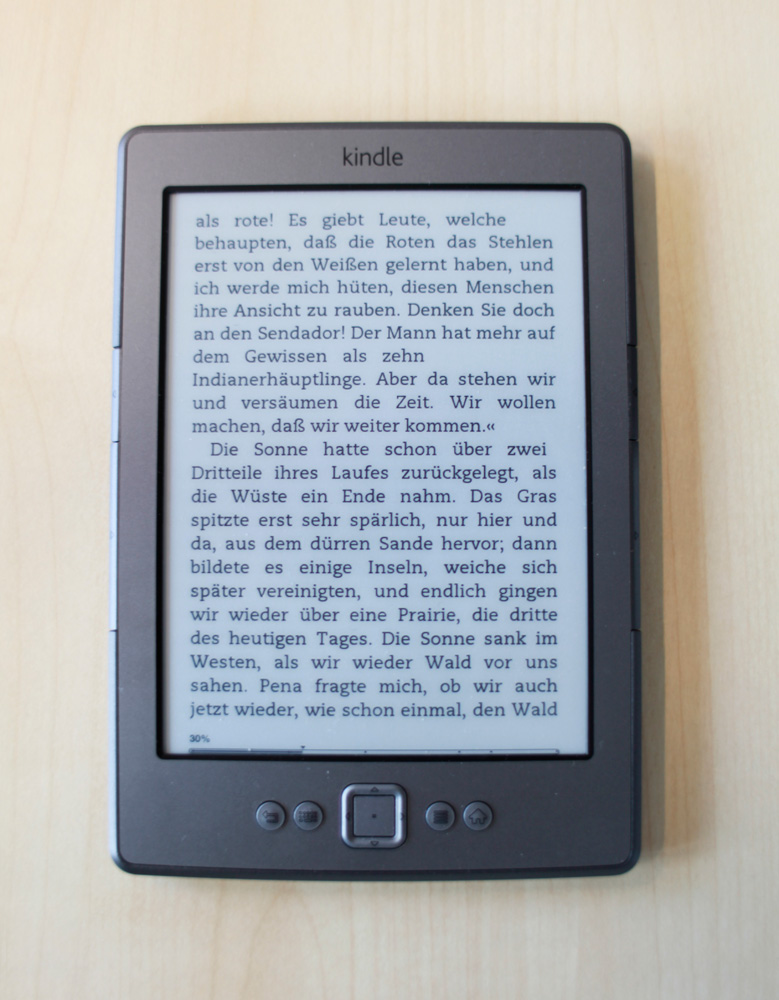 Here it is – my first Kindle. A friend of mine brought it back from the USA for me – at the time, it cost 79 USD instead of the regular 99 USD.
It was the edition that includes adverts. When idle, the “normal” Kindle mostly shows neutral graphics with some reference to script images. With the “advert Kindle”, you mostly get notes about concerts, products, special bargains and the like in the idle state. In a way, this is quite inspiring, because truly American.
Other than this “advertising” there are no unpleasant effects. Should I still at some time in the future be fed up with this affusion, I can have it removed by paying 20 USD to Amazon online. However, that is not what I will do, because as it is, I learn a lot. It is quite fascinating to see how Amazon uses even the Kindle as a “tool for customer maintenance”.
I got it late in November. For Christmas, I gave some members of my family more Kindles. On the March “Blue Friday“, all employees of InterFace AG got one for the “technology advancement program”. And since then, we experiment using it at the enterprise.
And for myself, I can, now in May, say that, since Christmas, I have not read a single paper book. So it only took half a year…
To make up for it, I read many e-books on my Kindle. Wherever possible, I read books only on my Kindle these days, because it is far more comfortable reading than on paper. If the light is poor, I can set the “font” bigger, the letters will always be just right. I can look up words and much more. It simply gives a new quality to reading.
🙂 And I can even read under the blanket – see my P.S.
But my reading on the Kindle is not limited to Amazon books. You can easily also upload “free books”, for instance “Incommunicado” by Michael Reimon. And newspapers and all kinds of magazines, and of course, the IF blog or PDF files (see instruction – Anleitung).
So for me, the world is currently undergoing radical change. This time, I am really into avoiding paper in private life. I cancelled all subscriptions of dailies and magazines. Currently, they are still delivered. But I am already curious to see how matters will be when the stream of paper delivered to our house will have dwindled down.
More likely than not, there will then be a few Kindles and Android-Pads lying on our breakfast table. And I will inform myself about what happens in the world in the very current Zürcher and other dailies. As to the local and regional world, I can get whatever interests me from the many sources already available. Mind you, I can do so in all dimensions and without adverts (if necessary with adblock in all the media).
The stack of old paper that always grew so terribly will no longer exist in my household. And I assume that many of my contemporaries will act just like I.
To be sure, it is a pity to think of all those nice books going to waste – but there is nothing you can do about that. After all, innovation is mostly destruction. Some times, it is probably also creative.
RMD
(Translated by EG)
P.S.
A short time ago, Barbara gave me the original Kindle bag from Amazon. With integrated lighting but without its own battery. The casing takes the energy from the Kindle through two contacts at the underside of the device, thus shortening the long battery running times of the device (easily two weeks) only marginally. Great.
Roland DürreMonday April 16th, 2012
Five Times Informatics
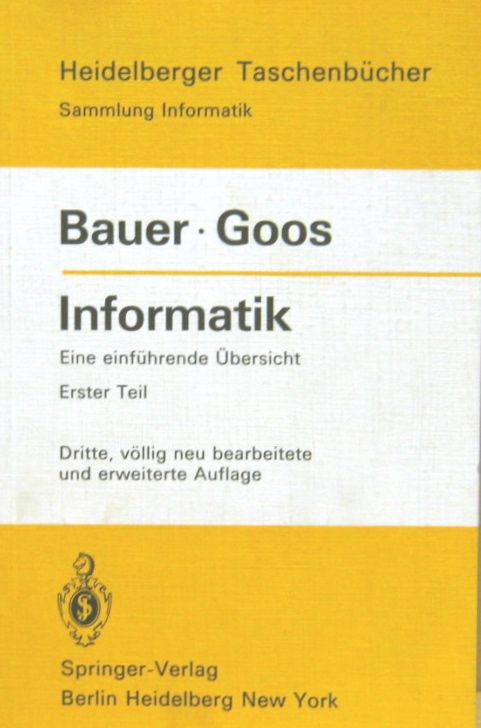 Informatics is the German term for everything concerning communications and information technology, software, hardware, interfaces and – as I see it these days – also controlling complex projects.
The word was originally used at Munich Technical University (TUM) by my much-admired teacher Professor F. L. Bauer, before it became a generally accepted way of referring to the subject matter.
Personally, I was privileged in that I was among the students who listened to the first lecture held by professor Bauer called “informatics” in the winter of 1969/1970. The accompanying book “Bauer-Goos – Informatik 1″ had newly appeared just on time for the lecture!
For much of what was taught at the lecture, I took many years to understand it. And I was able to dig deeper into it during wonderful discussions with F.L. Bauer (Friedrich Ludwig Bauer) not all that long ago. Consequently, informatics became a special word for me.
A few years later, I sat in the executive committee of the GChACM (German Chapter of the ACM) with my friend Wolf-Rüdiger Gawron. Even at the time, Wolf-Rüdiger had the vision of a German informatics portal, where all German ”stakeholders of informatics“ were to be represented. He had the ingenious idea to name the domain for this purpose “informatik.org”.
Until such a time as the informatics portal was to be ready, he allowed the German Chapter to use this “informatik.org” for the then newly introduced society website.
Now I decided to approach the project “Informatics Portal“ with InterFace AG. Of course, our first idea was to use the domain “informatik.de”. Unfortunately, however, I found out that this domain is used by an Austrian marketing enterprise. They mostly seem to do “domain dealing“. Well, they wanted a price of well into the seven-digit Euros for the “informatik.de”.
Naturally, that is not what I was interested in. So I made a reservation for five domain names with informatics:
informatik.cc informatik.co informatik.io informatik.me informatik.mu
Currently, the InterFace design team is working on a very special interface – and IF-Lab develops a totally new technology for personalized websites. It is exclusively for our informatics portal. We plan to present the first version this summer. And then we will start. We will fill our informatics portal with the best links of the computer science world.
Of course, in order to do so, we need the support of the best computer scientist in the world – your support!
RMD
(Translated by EG)
Roland DürreThursday March 29th, 2012
Kindle For All!
Unterhaching, March, 30th, 2012
Press Release
Kindle@InterFace
 During the first ”Blue Friday“ – that is the periodical meeting of all colleagues at Unterhaching – of 2012, the InterFace AG presented all its employees, working students and interns with a new Amazon Kindle 4.
The Kindle technology caused the development of a fascinating system for knowledge distribution with various software tools both within and outside Amazon. Free software is available. Using it, you can convert texts of many formats into the Kindle format and distribute them on Kindle devices.
There is even an alternative operating system for the Kindle. You can use it in addition or instead of the one you already have. This technology literally “smells” like it has to be used in knowledge-based enterprises co-working, collaboration or co-creation. Consequently, we have to support our production processes with the new procedures and tools in the entire enterprise, thus testing where we (and others) can improve.
This is true both for generating knowledge and supporting communication and quality within the enterprise. That – and also me wanting to thank everybody for their active support during the successful year 2011 – was the reason why every InterFace employee, along with all working students, was given a new Kindle 4 for private use last Friday.
InterFace AG chairman Roland Dürre says: ”We assume that this technology – even though it is no longer all that innovative – will play an important role in the future. The paradigms for applying and using IT will continue to change and increase dramatically. By supplying all our employees with a Kindle, we want to introduce all ”InterFace-ers“ to this technology as quickly as possible, thus improving the chances for our enterprise to remain creative, vital and technologically leading.“
Contact: Roland Dürre – Mail: roland@duerre.de Tel: 0171/4850115
P.S.
Feel free to use the picture for publication
(Translated by EG)
Roland DürreTuesday February 21st, 2012
Entrepreneur’s Diary #72 – Unloved Meetings …
We live in the age of meetings. Most of them are unnecessary and just create frustration.
We spend far too much time in meetings. Mind you, this happens regardless of the fact that this is the era of telephone, email, internet, iPad and Kindle, and, last not least, ”social media”, also in enterprises. Shouldn’t we, therefore, be able to collaborate quite well without all those meetings? Well, it can be done!
But, of course, the public calendars (outlook/exchange) and a seemingly democratic company culture open up countless opportunities to fill even the last free time slot of your business friends (and enemies).
Consequently, we are now more into “meetings” than ever before, regardless of the fact that, due to networks in communication, they are less necessary than ever before. You have so many meetings that there is absolutely no way you can still enjoy them! All you do is suffer through the marathon. Well, it has to be done, doesn’t it? And mostly there is not really much you gain by them.
:-)So here are some reasons why some meetings are doomed to be a failure:

- The meeting is arranged for formal reasons, as part of a legal obligation or part of a process.
Basically, you do not need it. After all, its only purpose is controlling. Consequently, you come up with some, mostly questionable, reasoning why you personally have to do it. You actually meet and then you try to, perhaps, give it some purpose. Who wants to admit to oneself that he or she is wasting his or her time with nonsense? Not that there were not something much more sensible (or enjoyable) you could do at the same time. Well, that will have to wait or be cancelled.
So: if a third party or “some anonymous agent” has forced you to arrange a meeting, then this is a perfect emotional requirement for its failure. - The meeting is a jour fixe in your calendar.
It is hard to imagine that a meeting might be necessary on a daily, weekly, monthly or three-month basis. Perhaps the daily meeting in order to know where you stand in a process like SCRUM is an exception. Except that this is usually done standing up, so it will never take long. Because woe to those who sit down… Or else you just start your work if nothing important needs to be discussed, anyway.
The normal “periodic” meetings are mostly board meetings. The very equidistance (Äquidistanz) will inevitably mean that some of these meetings are unnecessary. They are the ones you should cancel.
On the other hand, with these periodic meetings there is also the danger that you sometimes cancel them even though they are necessary. In that case, you must invite the parties concerned to an “extraordinary” meeting.
If, however, for example, you have four yearly meetings and would actually only need two, but on the other hand there is a high chance you will need an extraordinary one, then it is probably more efficient to call a situation meeting. And nobody is allowed to lament that this is not possible because all the parties concerned have a calendar that is too full (with meetings). So what is the problem if there are only five persons attending a meeting, instead of seven? Especially in the internet age?
So: a periodical meeting, perhaps planned in advance for the entire year in regular intervals, is something questionable per se. - The planned time-table is precisely adhered to.
Do you, for example, plan to eat your dinner between 7 p.m. and 10 p.m.? And do you call it a success if it is finished at 10 p.m. on the dot? This criticism is related to the last point. It is hard to imagine that tasks to be discussed will always need the same amount of time. More often than not, you will invent “pseudo problems” in order to try and fill the time. Or else, true problems will not be discussed because there is no time left.
Beware: if you manage to precisely end a meeting when it was supposed to end, then this is not an indicator that the quality of the meeting was high. On the contrary, maybe you should get sceptical about the results when that happens. - There is always the same agenda in a meeting.
This is another good chance for you to ruin a periodical meeting over some time once and for all. It leads to boredom and routine. All you do suffer through a duty. The formal character dominates and the added value is lost. A pity that the time has been wasted.
My advice: always have at least one special item on the agenda. But, please, make it one that is relevant und perhaps even interesting for those who meet. - It is always the same problem that is discussed in a meeting
A problem has to be solved. Afterwards, you no longer talk about it. Or else, it cannot be solved. Then it will do no good at all to have it on the agenda again and again. If you do that thoroughly, there will certainly be few participants left who will not get fed up. Because there is no way some of the participants will not hate it.
If that is your practice, you will find every team member quit inside! - Someone has to write the minutes with a to-do list for the next meetings.
Well, that sounds nice, but it is not a good idea. Because the world changes. And it is basically a fact of life that working on “open issues” has nothing in common with the “open issues” of life. Especially if three months have gone by between the two meetings. Because what seems very important to us today will mostly seem relatively unimportant tomorrow. Among other things, this is because the human brain is so easy to manipulate.
So – mistrust the obvious professionalism of great minutes and action items that sound wise as homework for the participants. Especially if we are talking someone has to fill paper and create numbers!
Here is some more information:
As you all know, I like talking about the old and the new world. In the “old world”, meetings were actually important. They probably worked well even in a strictly hierarchical and mechanical leader, management and enterprise culture. In those days, it was not possible to communicate quickly and be cross-linked – as is common today.
Now, however, times have changed. In the “new world” the opportunities of networking are countless. We have another concept of human nature, society and enterprises. The speed has increased drastically. Decisions have to be made in a flexible and time-critical way.
But meetings turn more and more into ghost conferences. They cost time and keep the people away from important tasks.
In other words:
I consider it absolutely necessary that humans have to meet “face-to-face” in order to exchange ideas, talk about future activities and assign tasks, both in projects and in real life. Meetings along the lines of old patterns, however, are something I consider contra-productive and sometimes even catastrophic. Because they create far too much frustration and will hinder positive momentum.
It is a tempting idea that problems might be solved rationally, well-tracked and with clear “action items”. But, unfortunately, that can only happen in an ideal world. Which is something you do not often get in real life, or maybe never …
RMD
(Translated by EG)
P.S.
Click here Drehscheibe for all the articles of my entrepreneur’s diary. mehr »
Roland DürreFriday February 17th, 2012
myBook, myCloud, myData, myHome, myLife, myWife
Here are some basic considerations on CLOUD & Kindle, data and information protection.
Having been born to an ambitious mother, I learned to read (too?) early. Consequently, I discovered books (too?) early in life.
It was great to read books. I could read quite fast. Consequently, the book was always done, even though nothing had been done to it. So I re-read it.
And then I discovered a library nearby. My first CLOUD!
My mother was afraid I might catch bacteria or viral infections. Because, after all, the books had been touched by so many hands. My father, on the other hand, was afraid I might read the wrong kinds of things and then get the wrong kinds of ideas. He actually blackened the “communist” terms before handing me a GDR thesaurus to learn with. No kidding!
But it did not help. I turned heretic regardless. Consequently, I have a slightly “strange” attitude when it comes to information protection, data security and data protection.
Is information and data not like books you have read or stories you heard? You should hand them down, instead of locking them up! Is it really better if we keep our knowledge and our experience to ourselves? Aren’t they totally useless if that is what we do? Doesn’t it all only gain value through me making it known?
Should I really keep the book of my own life strictly confident? Isn’t it more that what I really want is for as many people as possible to share my life and read the book of my life? Is not that how it gains value and becomes my testimonial?
What is that anyway – personal data?
Don’t we worry about things in a really irrational way? This terrible fear about personal data is just as mad as the fuss they make about Cloud.
I love my Kindle. But its best feature is that I need not remember a password in order to log into it.
RMD
(Translated by EG)
P.S.
The “patriot act” they always mention in the context of Cloud is also nonsense. In fact, it is double nonsense. The act as such, as well as the fuss they make. But that is another totally different story.
P.S.1
🙂 Now imagine Jesus actually lived. But nobody knew about it. Depending on where you stand, you could call this good news or bad. Of course, this is also nonsense.
Or imagine Jesus was a blogger and on facebook?
Open the archives!
And put them into CLOUD
Gastautor(en) Monday January 16th, 2012
Hurrah! I Can Read the IF Blog on my Kindle!
Here is a short instruction (not just for the IF blog)
Being an enthusiastic user of my new Kindle, I find it great that I can now read Süddeutsche, Zeit, Spiegel and much more, as well as browse through the IF blog, while sitting in the S-Bahn train.
🙂 The “installation” is a little tiresome, but afterwards…
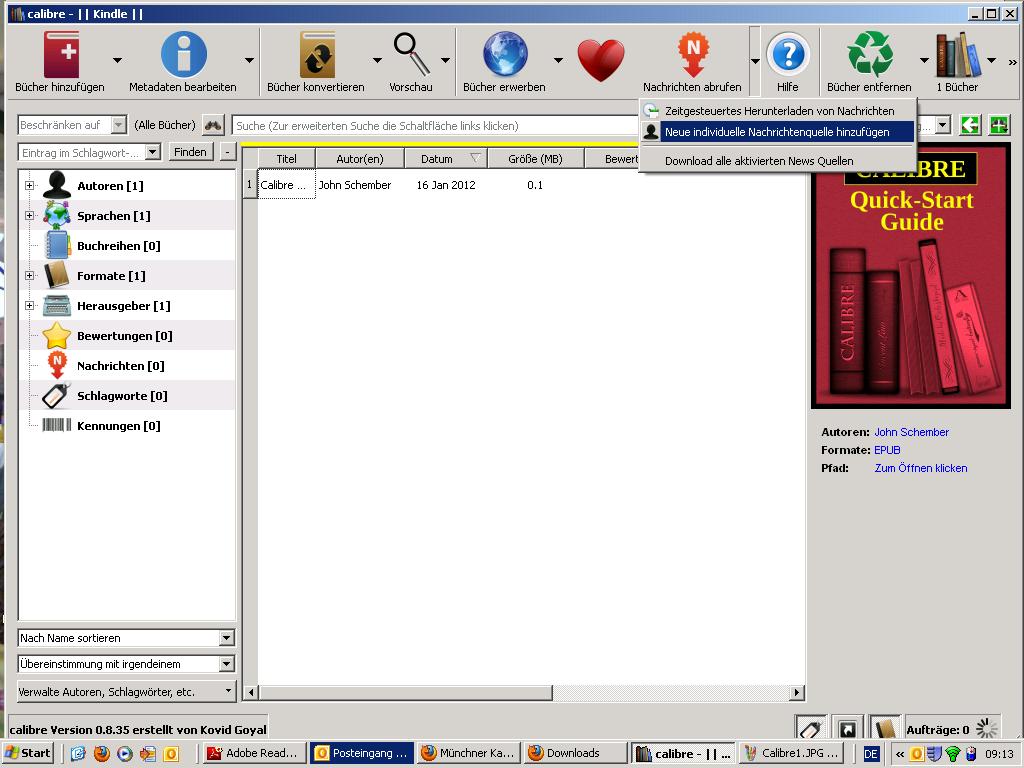
First, I installed the program Calibre on my computer. It is a free Open Source e-book management application. Using it makes it possible to convert books and files into the “Amazon format”. But you can also call up RSS feeds and then transfer them to the Kindle.
For installation, you have the option “call up news”.
You can choose between:
- Time-controlled download of messages:
what you get is countless pre-arranged RSS feeds, among others currently 68 newspapers, some of them free. - Add new individual news source:
that is what I need in order to be able to read the IF blog on my Kindle in the future.
Roland DürreSunday January 15th, 2012
Entrepreneur’s Diary #64 – Project Management goes Brecht
There are many wise songs in the Threepenny Opera
In his blog 23actions, Jens Hoffmann wrote an article titled
Projects have a detrimental effect on the health of your enterprise!
His introduction contained the provocative sentences:
“Projects are a thing of the past. Their days as organisational unit are numbered. Agile Coaches think that projects are not suitable tools for solving current entrepreneurial problems. They undermine customer-oriented value creation and cannot control permanent change effectively. So what gives project the right to even exist?
Instead of the classic line and project organisation Agile Coaches demand the agile Transformation of the entire enterprise. The term agilen project management is also considered unsuitable (Begriff des agilen Projektmanagements wird abgelehnt), because it only further strengthens the idea of a deficient concept being a good concept.”
Well, in my opinion, these sentences deserve three exclamation marks and three question marks? !!! ???
I was truly moved by what he wrote and therefore also took a very active part in the discussion by writing many “comments”.
In order to try an artistic approach, let me write two songs from Threepenny Opera (basically, in this opera, every song is a stamped piece of worldly wisdom!).
Roland DürreWednesday January 4th, 2012
Questioning What Seems To Be Self-Evident? – Very Dangerous – Cars!
What amazes me more and more often are general concepts that we all accept as something that goes without saying. I am talking ideas I was socialized with – and I used to believe them myself.
Mind you, this is regardless of the fact that, if you consider them reasonably, they get more and more doubtful. And you quickly realize that you definitely should question those concepts. Yet more often than not, you will not dare to contradict, because you do not wish to look stupid.
Here are two examples:
- Growth will solve the problems of our economy;
- Global trade will give us global wealth;
I am sure you will easily find more of those “totally-self-evident-concepts that are actually lies”.
Last autumn, I attended a philosophical workshop. It was about “lies made up to look like the truth”. Well, those “totally-self-evident concepts that are actually lies” could not have fitted more perfectly. Consequently, I described them in my presentation ( Vortrag) and also mentioned the problems I have with them.
The discussion about the following “totally-self-evident-concept that is actually a lie” was particularly exciting:
- Cars are something we cannot do without.
It came as quite a surprise to me how my anti-thesis
“It is quite possible to live without a car, in fact, you live better!”
mehr »


