
Roland DürreMonday March 25th, 2013
Get In Shape! – IF-Academy – March, 21st, 2013
“Get in Shape!” held on March, 31st at the IF Academy is now over. It was a truly nice presentation by Johannes Schmidt. As soon as the video recording is finished, we will make it available to you.
After “Get In Shape!”, we will present
“Ubuntu & Android Usage in Business”
The test in practice – what can Windows alternatives really achieve? Features, problems and solutions. An overview.
On May, 16th, 2013, Alexander Jachmann of the IF-Tech AG will update us on the current state of affairs. It will, again, be very well worth watching, so write down the time! And the other scheduled presentations can also already be seen on the poster.

RMD
(Translated by EG)
Roland DürreThursday March 14th, 2013
Presentation by “(Fe)Male Students for (Fe)Male Students”
Since it is our upcoming event, here is the poster announcing the next IF Academy presentations. I am always happy to remind you of “upcoming events”:
Johannes Schmidt (TUM, IF-Lab/InterFace AG, Glassbox Games) will speak on Thursday, March, 21st, 2013, starting at 6 p.m. at the InterFace building in Unterhaching. His Topic
Get Under Way!
How video games and movement control want to get us away from being couch potatoes!

Of course, this invitation is not exclusively for f(e)male students. The event is free for all who want to come. After the event, we will again have a little “happy hour”.
For more information on the series of presentations by “(Fe)Male Computer Scientists for (Fe)Male Computer Scientists” click here. If you want to print the poster in high quality, just send an email to me – I will gladly send you the print PDF version.
RMD
Roland DürreWednesday March 13th, 2013
Hotspot & WLAN and the Future
I often travel and meet many people. Hardly ever, I fly through the air, but I enjoy wireless world-wide communication via “air”. This is especially true when I go places by public transportation, when I sit in rooms, at universities or enterprises, in coffee shops or restaurants, at institutions or associations, or wherever.
Just like my travels and meetings promote “networking”, so I wish to be linked to the rest of the world through networks. Consequently, I always find it rather nice to find a WLAN I can actually access. Since I seem to be a demanding network user, I am not content with UTMS & CO. Personally, I do not have any experience with LTE (Long Term Evolution), because I do not own an LTE –capable device.
But I already looked over the shoulder of people who used LTE. The speed was really amazing. I got the impression that the LTE will, again, trigger a small revolution – after which the mobile world will be even more on the way up than it already is.
Who knows: perhaps soon we will only have LTE and all the many WLAN networks will be removed. That would, again, be progress in the direction of “less waste” if we no longer need all those parallel WLANs many places have.
But we are not yet at that stage. For me, using LTE would mean that I have, yet again, to buy new technology. Well, I prefer to wait a little. When travelling, I use various devices (Smartphone, Pad, Notebooks with Stick). None of them is capable of LTE, and still I am quite content using them. But since I do not wish to buy everything new now, I will wait for a truly new generation of hardware – one which, of course, will be capable of using LTE.
Consequently, I am often on the lookout for free WLANs. And as we all know, WLANs are almost everywhere. For me, however, they are not accessible. I often have a two-digit number of networks showing on my display, but they are all password-protected. Only if I am an invited guest at modern enterprises, institutions, hotels or other locations, I usually have no problem. Because especially “good” companies with a reasonable and modern (entrepreneurial) culture also have WLAN with which they can easily offer their guests access to the internet. It is basically part of their definition of hospitality.
The Telekom and older enterprises, such as the railway in its lounges in some trains – unfortunately only on few of their routes – are doing quite a good job with their internet supply. But there are numerous institutions and enterprises where it is still hard or even impossible to access WLAN. More often than not, these companies are huge and a little complex. Whenever I see this, I am surprised and hope that we may soon get area-wide LTE.
When accessing WLAN as a guest, I am overjoyed if the password is still valid after my last visit. In that case, I get immediate access to the internet. As a guest, I also find it nice if the WLAN password is written on a note and clearly visible for guests somewhere in the guest rooms.
I am just as happy not having to use a password for WLAN access and instead having to fill in a start screen where they want me to put my cross at the question: will you promise to adhere to the business conditions? I am more than willing to do both: put my cross there and adhere to the business conditions. Basically, I believe the latter alternative is the more reasonable way of doing it, because open networks help us to reduce the gigantic waste caused by all those many parallel WLANs all over the world. Isn’t it also about time for “shared economics”?
I would therefore here and now like to explicitly thank all these excellent hosts.
But now I am switching roles. Now I am no longer the guest but the host.
At home, I yielded to the fears of the rest of my family and encoded our WLAN. Mind you, all probabilities of real risk scenarios for our physical well-being and property is many, many times higher than the risk that someone might do damage to us through open WLAN.
Since, however, everything is possible und you want to protect against really everything, we bowed to the public super ego and set a password before our WLAN. But it remained the same ever since we first installed said WLAN. And the “modern segment” of our many guests is happy about this. To be sure, they forgot our password a long time ago, but their devices remember. Consequently, they are instantly back in the network when visiting us and hopefully feel at home.
At the enterprise, this seems to be more difficult. We have the explicit intent of adhering to the law. We therefore take the topics security and data protection just as seriously as quite a few other things our legislation came up with. Even if, more often than not, this does not make life any easier for us.
Consequently, we provide our guests with their own open WLAN called IF-OPEN at InterFace AG, both in the Unterhaching headquarter building and our branch offices. To be sure, said open WLAN is also password protected. But we chose a “promotionally effective” password. It alludes to the capital “F” in “InterFace” and indicates that we are already almost 30 years old.
We give our guests the password in order to make sure they feel at home in our building. In the common rooms, such as the seminar zone and meeting room, a note is pinned to the wall. Our IF-Open is also something I and several other employees like to use, since it gives you direct and proxy-free internet access.
A short time ago, someone raised the question: should we change our guest network password? And if, at what regular intervals should we change it?
If it were up to me, once in fifty years would be enough.
Let me try to explain: a stable, reliable and, above all, easily remembered password for a WLAN which is intended and referred to as open and still protected by a password is a true blessing. If you change it often, this will cause some – if only little, but constantly recurring – extra work for many people. Just because (probably only in theory) there might be someone in or near our building who “pinches” our internet access and even “abuses” it.
I have no idea how realistic this kind of fear is. However, in my estimation, it is rather negligible, considering what “real” risks we might have to face (breaking and entering, theft, …) .
But a few years from now, we will have area-wide LTE, anyway. By then, you will no longer need WLANs and all these considerations will be obsolete
RMD
(Translated by EG)
Werner LorbeerTuesday March 5th, 2013
John von Neumann – Elegant but Overcharged?
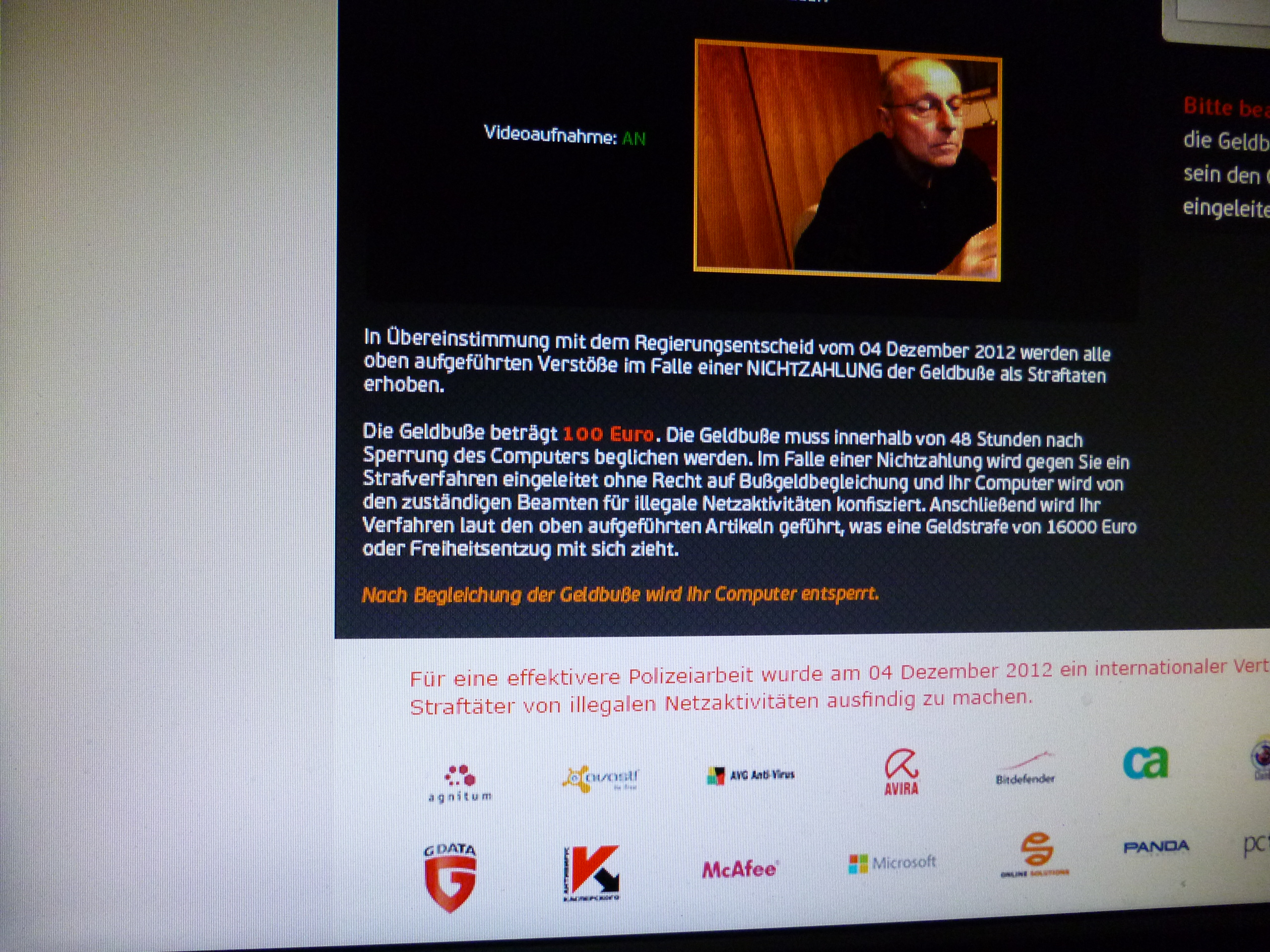
BKA Virus took over. Property has been confiscated.
The data are the program? Really ingenious, truly dangerous.
Here is my experience in a nutshell: while AVIRA professional was running, the BKA virus took command. I experienced live how the windows registry was overwritten and then there was the usual command by the virus… 100 € – or else no more access.
How is that possible?
What is the requirement for a chain of symbols, called virus, to gain the status “executable” on my PC? I will go so far as to come up with the following theory: program and data cannot be distinguished, because they have the same status. I go back and arrive at the Turing links which then became the pattern for the von-Neumann principles for computer construction.
I presume that this is where the errors originated. If every string can be advanced to program code by an interpreter, all doors are open for everything. In particular, the owner will be robbed of the right to property by some network criminals who were given the executive right by some crazy interpreter.
If you take a look at the technology of patches and patchworkers over the last few years, then you have to note they put civilization at risk. But they cannot avoid this, because the machines they have to work with do not permit other solutions – due to their flat data logic.
Assuming I had a free wish, I would wish for Post-Neumann machines that can guarantee the user the ownership of his rights on the PC. These machine principles probably already exist. If not: I have some blue—prints.
wl
(Translated by EG)
Roland DürreFriday February 15th, 2013
Get In Shape! IF Academy – March, 21st, 2013
On March, 31st, 2013, Johannes Schmidt will be our speaker at the IF Academy. He studies Informatics at TU München, minoring in Medicine. “Additionally“, he also works at the InterFace AG IF lab.
 He has also several years of experience as an entrepreneur and started Glassbox Games with a group of friends. The young team programmed all kinds of smaller video games and Apps for various platforms.
In order to try and learn new things, Glassbox Games was founded by the same group. By now, Glassbox Games already won some smaller prizes and developed into a small enterprise. The goals have grown and now include serious entrepreneurial visions. And, of course, the Glassbox Games and InterFace AG are closely connected and on very friendly terms.
In his presentation, Johannes will focus on “movement control”. He will tell us about the historical development of this technology and show in a practical exercise how easily this technically really demanding topic can now be programmed.
Besides, he will introduce an IF lap project that reasonably integrates movement control. The presentation will conclude with a short outlook on what we might expect in this sector in the near future.
As always, the presentation will be held in our seminar zone. I strongly recommend it. Johannes will take us on a trip to a world that is alien to many of us, but it might suddenly become a very relevant part of ”common IT“. You really should have some basic understanding of it.…
We start at 6 p.m. – visitors are welcome from 5.30 p.m. After the presentation, there will again be a happy hour, called “beer and informatics”.
We look forward to welcoming many visitors from all age groups!

- Here is where Glassbox Games had their display in the Olympia-Halle when the Major League Volleyball match Generali Haching – Berlin Recycling was playing.
Of course, Glassbox Games also have their own Website and can be found on Facebook.
If you are interested in the tournament, click here.
RMD
(Translated by EG)
Roland DürreWednesday February 6th, 2013
Entrepreneur’s Diary #87 – It Is Quite Simple …
… and yet so hard!
Today, all you get is a short article: here are just a few citations of remarkable tweets by Nils Pflaeging:
Niels Pflaeging @BetaLeadership
If you want to kill connectedness: create functional division, departmentalize and allow hierarchy to invade the work #stoos
Niels Pflaeging @BetaLeadership
All that planning doesnt earn you any money. Improving the work and fighting waste does. #stoos
Niels Pflaeging @BetaLeadership
Functional division, divisionalization and matrix structures ALWAYS result in a loss of accountability. Period. #stoos
That is exactly how I feel and could have come straight from my heart. Consequently, there is nothing left for me to say.
RMD
(Translated by EG)
P.S.
For more articles in my entrepreneur’s diary, click here: Drehscheibe!
Edwin EderleMonday January 21st, 2013
(Deutsch) Vorsicht vor der Cloud? Erfahrungen, die ich nicht machen wollte!
Roland DürreWednesday January 16th, 2013
Knowledge and Humour for Computer Scientists
On January, 17th, 2013, the IF-Lab and IF Akademie at InterFace will start a new series of presentations (Vortragsreihe) at Unterhaching.
Thomas Baldus of IF Blueprint AG will be the first speaker at 6 p.m. (in the InterFace building, top floor, teaching area). He will speak about:
APPetite Whetted for Microsoft?!
How exactly does the new taste offensive look as it reaches our shores after its trans-Atlantic voyage?
For more information on the series of lectures, click here: IF-OPEN. Very important – this is not just about the lecture, but also very much about “meeting” during a presentation in the modern format with a “Happy Hour” after the event.
I look forward to a huge audience. Also, I am looking for speakers who would like to share their knowledge and fill the slots on other days. Here is our motto:
From practitioners for practitioners.
Or:
Informatics & Beer.

RMD
Gastautor(en) Wednesday December 26th, 2012
Christmas Greetings to all Sysadmins!
Here is an article by a much-loved IF Blog friend whose IF Blog comments we enjoy fairly often. It is Hans Bonfigt. For me, it was a total surprise that he now, for once, accepted the role of guest author. Here come his:
Christmas Greetings to all System Administrators
If we are totally honest, there was always this special way in which “we” IT persons have always been, well, what in our country you would call “wound up”. No, it has nothing to do with Mr. Jobs’ plagiarism. Instead, it is owed to a certain lack of understanding: “You only start working when the lights are turned on”, is what they said about us. Of course, my dear users (we know no worse name to call anybody), how else are we supposed to repair the systems you, once again, managed to damage, if you are still sitting in front of them? Formerly, it was not possible at all, because the typical work place used to be a one-desk system where, naturally, only one person could work. At some point, the machines became ‘capable of multi-tasking’, but that did not mean the users had learned to work with a multi-tasking device. We are a little more demanding – we mostly want the machine exclusively for ourselves.
And while you have been lying on your sofa since at least last Friday, a small minority has been busy since Friday noon trying to bring order back to where you produced rubbish. Their maximum number of hours of sleep is two in 24. After all, we know what outcries we again get to hear tomorrow, on Thursday, if some minor glitch is still discovered: “WE CANNOT WORK …” ! – Well, tell us something that is News to us!
Indeed, every year the Augean Stables you produce in our systems get more annoying and, above all, bigger. And you just do not seem able to learn. Mind you, I never seriously assumed you would stop putting the post-its with your passwords on them underneath the mouse mat. After all, I know what stupid expressions you choose and there must be a place where all those facebook losers originated. Well expecting something like a minimum of responsibility – that would be truly foolish. If that were what I expected, I would have chosen another job.
Yet, over the years, I actually had hoped you might at least form a habit of doing those things that would make life easier for you: but nothing could be farther from the truth!
– Use no spaces and no umlauts in file names – that is what we have been preaching for more than twenty years. And, above all, do not copy the entire text or your document into the file name. You of all people, who you are not even capable of distinguishing between a capital ‘O’ and a zero, should definitely not take for granted that umlauts, or even only upper or lower case are implemented cross-platform and interoperable in file names. Let alone in your so-much-loved windows, which, incidentally, only knows the “8.3″ nomenclature – which stank to high heavens even under DOS.
– For at least as long, we have been preaching that you should “save shared files centrally AND STOP MAILING THEM TO EACH OTHER”. And we also tell you, “USE THE CORRECT CITATION METHOD and stop forwarding all the never-ending exchanges of replies and replies to replies at the bottom of each mail”. So, guys and dolls, I have now been sitting in front of a 24 TERABYTE mail spool since last Friday and am expected to downsize it to 12 TB. And you can bet that this is exactly what I did. And you cannot make an omelette without breaking eggs.
– How often have we told you to empty your rubbish bins? But do not worry, this is also something I did for you. The razor sat as deep as your neck.
– Since we are at it: I also removed all your browser caches. Because I was simply not in the mood to save the huge pornographic collection you designed with all your clicks and to migrate it to the new SAN you claimed was necessary.
The information society definitely no longer has a slim, even face. Instead, it has a bloated visage like Dirk Bach. Thinking of former times makes me nostalgic:
I was among those who actively remember all the punch cards: the maximum source file size of the KIENZLE SLM was 2,780 lines, which just about fitted into a small suitcase. It was truly a nuisance, really heavy and it definitely took time to ‘do a quick copy’. Merging was hell on earth. We all definitely had to be word perfect in the machine language, because an assembly run with a comparable number of cards took 2 1/2 hours. If you were not able to patch manually, you were literally “at the end of your teethers”.
The ECMA-34 – cassette was a blessing. Well, my dear users, you know it as a music cassette, but basically, it had not even been intended for you. Rather, it had been intended for us. An entire suitcase of punching cards was now small enough to fit into a shirt pocket: there was room for 900 groups with 256 symbols per group and you could use both sides. Even better: the 8-inch-floppies. It was no longer even necessary to load the source data. You could process them directly.
The next revolution were the “big” hard disc drives which no longer crashed every other week: basically, you no longer needed to handle data storage media, because everything was on the system, anyway. All there was left to do was save the data. Saving data with the half-inch tapes was somewhat tedious, the maintenance was quite time-consuming: you had to set the “cat’s eyes” which resulted from the printing head signal and the phase-delayed echo by 180 degrees of the reading head correctly when using the oscilloscope (yes: that is really what they were called). The tape machines were devilishly fast and had an almost unlimited capacity.
With the Cartridges, ibs, the QIC Cassette, affordable systems were now available. Our first sweetheart managed to process 20 MB in half an hour.
We are talking about the time when those unappetizing “Commodore” machines were flooding the market. They looked like bread shelves. This was in the late 1980ies.
So what exactly had changed?
Currently, I am supposed to design a complete SAN over the holidays. ALL, and I mean rally all data of a medium-sized enterprise should be stored there. And I have to delete ALL. Of course after having made a copy on tape before and, naturally, redundantly. And because it is important: also dissimilarly redundant.
The Cartridges have become smaller and faster. Currently, more than 140 MB are flying from the tape to the hard disc per second. That means the system manages about seven times as many data as were common in the 1980ies on the QIC 20 cassette. Instead of 3.5 hours, we now need one second.
This equals a production increase of 1,259 %.
But, hey, is that REALLY true?
The enterprise I am currently working for also had a QIC-20 tape station in the 1980ies. It was connected with an IBM /38 which supplied the entire enterprise with the necessary infra-structure.
Basically, this is exactly what the new IT is doing: supplying 200 persons with diverse programs, just like it used to be. Maybe a few more persons are working there today. In the 1980ies, a migration took three days – in the new situation, I have already been at it for five days. And I will not be finished before tomorrow morning at five o’ clock. On the old machine, a well-trained service technician could do the job. The new system is ultra-complex, combining almost all the latest technologies in one box – in particular, it can no longer do without windows and the oh-so-great IBM RUBBISH-TOR – this is a pile of rubbish built from randomly connected JAVA parts that smells to high heavens. No human being can handle it. Luckily, I am not a human being.
Basically, the old machine was never out of order. To be sure, due to the redundancy, the new one is also never at a standstill, but individual components are faulty all the time. And the then necessary repair work makes you perspire with anxiety.
The old machine was really quick. So is the new one, but the JAVA/AJAX/PINGPONG – stupidity interface is extremely slow and the users are just sitting around and twiddling thumbs.
Yes, my dear users – I HAVE NO MERCY! You were the ones who wanted the GUI, now you have it. Low-quality raised eyebrows for low-quality employees. Each to his own.
But where did progress go? Didn’t we have it at some time in the past?
The answer can be found with Bertrand Russell. Let me cite once more:
Every technological growth will cause a corresponding growth in wisdom, provided it also means an increase in human happiness.
Vulgo: the IT landscape changed from being a ‘Tool’ to being a ‘Toy’. With all the unpleasant consequences. A short time ago, a secretary at Northwest AG told me how she had produced a letter ten times as fast using HIT/CLOU, an InterFace AG text program, than she can do it now with the current “Word” version. Mind you, she needed about the thousandth part of the computer capacity, main storage and disc memory.
We have become slow, obese and degenerate.
Well, and some way or other, the spirit is missing. There used to be a time when I actually enjoyed those “night-flights”. I relished the soothing noise of the air conditioning and, above all, I was absolutely certain that the job would be finished by the deadline.
After all, only the fact that I can grasp the design of a system at all will put me in a position to be able to take responsibility.
Today, I can no longer be sure I actually understand the complexity. And if there is anything I failed to notice over the last days, then 200 persons will not be able to work next Thursday. Neither on Friday. Neither the week after. Because we have neither programs nor data. Income and salaries will still be fine, that is done externally, but it is questionable if they can be paid.
And I had better prepare to live under the bridges.
And, YES, there are many persons who, even now, do something that is a lot more important. For instance all of the train drivers: unlike me, who is “haunted by” the idea of 200 persons, they are responsible for 800 persons. Or the stressed-out traffic superintendents who have to act with the highest possible responsibility, although they are given damaged machines to work with. If you take the degree of responsibility into consideration, basically everything becomes relative, even the money you get for it. For instance, what was Mr. Mehdorn “responsible for”?
In many ways, Roland is a model for me. In the years to come, I will start exercising more and downsize the admin job, which is still a third of my work life, until it dwindles to nothingness. Because it is a very tiring job. When I was an adolescent, I heard something Günter Grass said, “powerlessness tested with rubber walls”.
I would like to send greetings to all this world’s administrators who, equipped with Pizza, Cola, Junk-Food and Cigarettes, under high risk and with a relentless deadline and almost unendurable stress still manage to put enterprises back to the network on time for their first day of work.
Hans Bonfigt
I was truly delighted to read this article. Dear Hans, let me thank you very much for writing it.
RMD
(Translated by EG)
Roland DürreFriday November 30th, 2012
The Change in Management (Presentation)
The two presentations I gave last week on “The Change in Management” never got boring. I enjoyed them very much and I got the impression that my audience, too, had fun. Consequently, the feedback I received was also very nice for me
Since the presentations were quite interactive, it is not easy for me to put them in writing. Still, let me write down a few points, even if quite a few things that happened during the presentations will be lost to you.
Change will come – if we want it or not.
My two presentations were about
- Project Management;
- Management;
- Entrepreneurship;
- Leadership;
- Innovation as Creative Destruction;
- Craftmanship;
- The “Co” Era: co-creation, co-programming, co-operation …
- Future is Female
Why do so few women serve time in prisons?
All these are elements both of our private and professional world. In enterprises and institutions, we create future. The following factors play an important role:
- The culture we practice in the social systems and
- how said systems are organized.
Processes of communication, decision and responsibility change.
Who knows the terms:
Barcamp, Jam Session, OpenSpace, Fishbowl?
If not, maybe you should look them up in Wikipedia.
Today, the following is important:
Sharing knowledge, hand on experience. From those who are in the thick of it for those who are in the thick of it. Consumers want to turn producers.
You meet at eye-level. Fear-free rooms make creativity possible.
What was it like in former times?
- Trees grew from the bottom to the top.
- At the top, you had the hierarch, clear command structures, disciplinary bosses.
- And it worked for a long time. It was a simple and well-structured, and, above all, a stable world.
Example: German electronics concern (dealing with everything around electricity) as a hierarchical organization. It was built following the pattern of the German Reichswehr. Build up and procedures are organized, structured into enterprise sectors with up to 10 hierarchical levels, staff divisions for shared tasks, such as F&E, Marketing and all kinds of central functions. - That is how the matrix: organization with full/dotted lines and staff and central units was created.
- Example: electronics concern, business areas motors/generators, small appliances… Shared design, etc., sales, etc., research were central staff units.
- This organizational model originated with the industrial revolution – Taylorism-style and mechanically. And for a long time, all went well with it.
- After a few years, the organization (mostly only parts of it) had to be modified. But that was easy.
Today, this is no longer an option – which is why so many people lament about their enterprises suffering constant re-structuring. Except that this is not enough for following the speed of change. Consequently, “after the re-structuring” more and more often means “before the re-structuring”. Even worse: the next re-structuring will begin before the last one is finished.
And even in nature, trees grow from bottom to top. The first ones who noticed this were a few idealists in the informatics sector. They put the trees upside down.
- But then, it is not an option to turn trees upside down.
- It would make the CEO the one who supports all (big Frederick as the country’s number one servant).
- So you see, trees are not enough.
- New means of communication, too, cause change. Change brings communication.
- This is how the transition from the tree to the network happens in the shape of a ball in the three-dimensional space.
(Note: even in military dimensions and in warlike conflicts, it seems that – when all is said and done – network-like structures are superior to hierarchical command structures, even if the latter have a huge resource superiority).
Well, all of this is not precisely news. As early as in the 1980ies, there was a remarkable development, for example at St. Gallen College. They came up with a “management model” which makes the HSG world famous. Its basic points are the eight theses by Hans Ulrich – “Management – Essays, part 2, 1981 – 1998 On the Change in Management”:
- Accept the uncertainty and unpredictability of the future as normal state of affairs!
Strategy as planning of a future: acceptance that decisions will always have to be made with an uncertainty factor. - Expand the limits of your mental concept!
Against the “but” … and for freedom of ideas. But also: sharing knowledge. - Applying the categories “both-and“, instead of “either-or“!
Black-and-white is out, colorful is in. - Thinking multi-dimensionally!
Balancing of interests in an ethically responsible way. Basically, humans can only deal with three ideas simultaneously. - Self-organization and self-control as the model for your enterprise!
Responsibility, Subsidiarity. - Consider a manager’s job as a meaningful task that makes sense!
New management image. - Focus on what is really important!
Working economically. - Make use of group dynamics!
Cultures, symbols, rites, rituals.
Today, all is about producing knowledge quickly and shaping the future together. Consequently, what we need is creativity in order to find the problems (first creative obligation). After we found them, we have to make use of our knowledge and generate solutions.
Taylorism and “mechanism“ is no longer possible in modern social systems. It is better if we gain the necessary knowledge through the new communication formats.
(Note on private life: the traditional family model, too, was Taylorist and mechanistic. Does anybody still want it?)
Unfortunately, many managers to this day do not understand it and many enterprises still live in the yesterday. This also explains why the “new enterprises” are such a success. It took them only a few years to overtake the “old industry”.
The roots of what happens today and in this country can be found among the (then criticized) prophets of the Bonn republic, such as Adorno and Habermas (Frankfurter School):
Dominion-free/fair discourse as a basis (Habermas)
- No outward restraint must hinder the discussion.
- Having the best argument is the only reason for winning.
- Everyone gets an equal chance to take part in the discussion.
- Everyone must be capable of “self-portrayal without offense“ and make himself transparent for the others.
- Everyone must be prepared to talk about the basic decisions he made in life and be prepared to have them criticized. (There is a clever system of speech and counter-speech, having to prove all you say, experience, authority, etc.).
- Nobody enjoys special privileges because of his age, experience, authority, etc.
- Everyone must be prepared to change behavioral expectations with everybody else. The same is true for switching roles.
- The discussion will continue until a consensus is reached. As soon as the truth is accepted, it will determine the future life and behavior of all the parties concerned.
It all sounds unrealistic and utopian, but it will become more and more reality:
- Through formats such as jam session, barcamp, openspace, fish bowl;
- Pecha Kucha, Ignite;
- Round meeting halls;
- Web 2.0 (interactive Blogs, Twitter)
- Wikipedia and Open Source
- Social Media like Facebook and Google+ as a logical conclusion.
Thesis:
The dominion-free discourse is filled with life. In a hybrid combination with the internet (social web), the new world of shared interests gets stronger and stronger. A new society of communication and “gaining knowledge“ is built. Belonging and sharing get more and more important as values.
And being part of it will make you happier and more successful!
So I tried to give a future-oriented presentation.
RMD
(Translated by EG)


