
Roland DürreMonday September 21st, 2015
IF Forum on October, 29th, 2015 – Dr. Andreas Zeuch – The Democratic Enterprise
ALL POWER TO NOBODY LIVE EXPERIENCE!
Now About:
All Power to Nobody! LIVE!
 All Power to Nobody – that is the motto proclaimed by Dr. Andreas Zeuch. In his new book, which was published on September, 8th of this year, he discusses “entrepreneurial democracy” at great length. And it certainly is not a theoretical pamphlet, but an exciting report full of life. I would call it a courageous and provocative work that is the exodus of quite a few prejudices.
I personally met Andreas at the 2014 Berlin PM Camp. He gave the impulse on the morning of the first day. His topic was “how much intuition can an enterprise stomach?”. This presentation was such an inspiration for me that I spent the entire morning with Andreas. Consequently, I missed all the first sessions of the PM Camp morning.
Here is some of what you can read in the preview:
Entrepreneurial democracy – is that the future of work-life, or the punchline of the week? Can enterprises be a democratic event at all, or will shared decision processes not disable the enterprise and cause bankruptcy? After all, we do not exclusively need captains, but also privates, don’t we?
What happens when a CEO is elected? If a bank abolishes all its hierarchical levels, if employees choose their own tasks or if the cleaning personnel gets a vote when innovations are discussed? Will chaos be the consequence, or will the inner motivation of all start blossoming?
Andreas Zeuch went on a journey and found enterprises that show that entrepreneurial democracy is a living and economically successful alternative of the centralized top-down system.
 As always, you can register for the IF Forum by sending an E-Mail. Again, I will be permitted to moderate and I already look forward to exciting discussions and nice conversations!
RMD
(Translated by EG)
Roland DürreSaturday September 19th, 2015
Preliminary Event for the Barcamp #ActMobCmp with Jörg Schindler (Invitation)
Invitation to a Preliminary Event for the AktMobCmp on October, 14th, 2015 at Unterhaching
 I already told you about our plans on the IF Blog. On January, 4th and 5th next year (2016), just before Epiphany, we want to start a new Barcamp.
It is the AktMobCmp, the first barcamp for “Active Mobility in Everyday Life”. With this barcamp, we want to address the topic “mobility”, which will be truly important for our future.
The preparations are finished: we have a location that is well suited, a nice website, a flyer for sponsors and a general flyer – and even some first interested sponsors.
Now we wish to get people’s attention for the event. Consequently, we invite everybody to attend preliminary events. The first of these events will be on October, 14th at the Agenda 21-Meeting-Hall (Treff) in Unterhaching (Rathausplatz Unterhaching, Hofmarkweg 12) between 18:00 and 20:00 hours. This is the first time we want to inform everybody about our “Barcamp Active Mobility”.
During the event, the following questions will be answered:
Why is “active mobility in everyday life” so important?
and
What exactly is a “Barcamp and why do we organize this as a Barcamp“?
During this evening, Jörg Schindler will tell us all why mobility is such an important topic in the future and why we all need to get more concerned with the so-called remaining traffic beyond the “individual & motorized” and “public transportation” sectors.
I know Jörg as a very competent, but also a very convincing and entertaining speaker. You will also find his very exciting and valuable presentations on YouTube. Here is an example:
Afterwards, I (Roland Dürre) will give you the definition of Barcamp and also tell you why such an “anti-conference” is so much better for sharing knowledge and developing and applying new insights than the common classic formats. And I will use PM-Camp as an example to demonstrate all the things you can achieve if you share knowledge and “communicate with each other”.
After the short presentations by Jörg and yours truly, we will discuss what has been presented. Perhaps in the form of a FishBowl.
This is how we want to advertise our January 2016 AktMobCmp. All colleagues of the “Agenda-21 organizations” in the district of Munich will receive personal invitations. But we also welcome all other persons interested in “Agile Mobility in Everyday Life” and who wish to think of and act towards a future that is worth living in. That means that you, too, are invited. And it would make us especially happy if persons from the media were to find their way to our event.
Participation at the preliminary event for AktMobCmp is free of charge. All participants are welcome and we would appreciate it if you send a short E-Mail confirming that we might expect you. Because if there are not enough seats available at the meeting hall of the “Agenda 21”, we will move to another location. One which can easily be reached on foot from the meeting hall. Naturally, we will notify you in advance if such a change of location has become necessary.
RMD
(Translated by EG)
Roland DürreSunday August 2nd, 2015
#Unschooling: Presentation “Learning in Innovation” by Bruno Gantenbein now available as video.
I am glad to announce that now the video recording of the great presentation by Bruno Gantenbein at the St. Gallen IF Forum of July, 23rd, 2015, is available on youtube and can be watched by all of you:
The presentation ”Learning in Innovation“ held by Bruno Gantenbein at the IF Forum left me deeply impressed. Many of the audience felt the same. But some who also were very impressed by Bruno’s theses came back with the important reply that what he spoke about was not something “normal people” can live in a “normal life” in the “real world”. Because your normal Jim and Jack cannot really manage it. And it simply cannot be done. Once in a while, it sounded really like people were despairing.
To me, it seems the reason is that
“most people cannot really imagine living in another world than the one we are living in“
and that
“we are no longer capable of distinguishing between what is important and what is not important. Consequently, what is unimportant is dominant in our lives.“
To me, this seems to be the major problem both for us and our society. A degree of external control through marketing and lobbyism as we never had it manipulates us in a totally new way. It is totally different from, but certainly no less dangerous than, for instance, religious indoctrination of persons in the Middle Ages or, if we are unlucky, the manipulation as practiced by the Nazis.
The formatting of our lives through a super-powerful but not tangible system took away our autonomy. Now we get nervous and start talking change. Yet we lack all desire to start another life outside our comfort zone. In fact, more often than not, we are not even capable of imagining such a life. For instance, the strength to develop utopias for the future seems to have left us. Looking for values and visions no longer plays a role in our society. In fact, if we do look for visions, it is actually something others are belittling us for. The attempt to re-create a new “social consensus” is smothered in the very first stages. Consequently, we assume that the status quo is true and there is no alternative.
We no longer have the courage for change. We accept our dependence and are happy to be “enslaved”. Be it by technology or as our social concepts of life (our lies of life) determine it. We believe you cannot live without a car, a TV set and electricity all over the place. We believe in the omnipotence of medicine. That the federal administration must and has to guarantee our security and safety. And that the planet will certainly find a way to survive it all.
Except that so many of the things we take for granted can be easily disproved. There is no absolute security. We experience it all the time. The sudden death of an important partner or a surprise illness totally throw us off balance. We can easily fall victim to some mishap.
But then, there are also harmless examples. The stamp collection we inherited
from our grandfather that was so precious, but for which now not even the wastepaper trader is prepared to pay, shows us how difficult it is with security. Many things that used to cost a lot are totally valueless today. I made the same experience when pay day came for my direct insurance. What a discrepancy between the money I received from what I had expected when, decades ago, I first signed the insurance contract. Instead of the imagined free-hold apartment, the only thing I got for it was a medium-size car…
Regardless of all this, the (alleged) security of our modern financial world suggest for some that we actually are in total control of the risk of our material life through retirement money and savings. Except where will the Euro be ten years from now? Will we be able to solve future problems with it? What will money be worth? Have we not learned a long time ago that “you cannot eat” money? Especially if it is just virtual money and perhaps out of the blue will have to be shortened by the occasional digit.
To make up for it, we capitulate for fear of terrorism. And we are prepared to sacrifice our present freedom for these kinds of mind games. Sacrificing freedom for what we believe is an investment in increased future safety! And we are even prepared to start a modern (crusade) war for it.
This is how we follow the stupid and brazen battle cries of politicians and economic leaders who, more often than not, are no longer sane. We swallow pointless laws they serve us with, regardless of the fact that we know those will do more harm than good. And we surrender before the stupidity of our “representatives”. In fact, I actually yearn for a German or European Spring. But I do not mean one triggered by hunger or poverty like the one in Northern Africa – which inevitably dooms it.
Why do we believe them when our politicians tell us that “without the Euro, there would be no Europe” and that the so-called “Grexit” would ruin us all? Why do the politicians tell us such fairy tales? We know as well as the politicians that the Euro is good for those who stand in the light. And it is detrimental for those standing in the shadow. Just as we all know that the exploitation structures, both globally and within Europe and Germany, must fail or cause conflicts, either in the near or not-so-near future.
But we get the impression that we cannot do anything about it and perhaps that is really what happens. Also, we no longer have the courage to oppose the structures of the administrative and economical systems that rule over us. And we no longer stand up against this, even though we know that human beings – which is we! –, and not system interests that have de-personalized and de-humanized themselves, should be the centre of the society, politics and economics. First and foremost, the economy and the state must serve the interests of the people. Just like it is written in the Bavarian Constitution.
The system of the oligarchy of the parties (Oligarchie der Parteien ) – see Jaspers -rules over us and the morals of mercantile metric in economy sharpens the boundary conditions of our behaviour. Thus, the systemic mills will continue to grind, making the restrictive nets of bondage tighter and tighter. It happens in small portions, which means that we often do not even notice it and almost consider it normal.
Consequently, here is what we need to do:
Let us also get back to remembering that we, as “natural beings” are also part of the “natural world”. To be sure, the “cultural world” we created makes some things easier for us, but it also took a lot from us. It made us lazy. And we forgot that the price we are paying is rather high.
As I see it, we should return – and radically so – to thinking about whether, perhaps, we could also live in other worlds and probably even be happier living in other worlds. As you all know, my favourite example is the “away from the car” and turning towards active freedom through “active mobility”. Yet it is just as important to take a close look at the working and living conditions we subjugate ourselves under, be it in social systems such as families or otherwise. We need to question all that seems self-evident and draw conclusions from the answers. Formerly, one would have said: Destroy what destroys you.
Part of this is also to live a “life in harmony with nature” as Seneca formulated it. And he meant more than just the biological nutrition process and the preservation of the environment. He also meant we need to listen to our inner voice.
After all, Seneca was a great teacher who wanted to help his pupils on their way to become successful and happy persons. So let me finish this article with another sentence by Seneca that might perhaps make it a little easier for us to start travelling towards other worlds:
“It is not because things are difficult that we dare not venture. It is because we dare not venture that they are difficult”.
Yet – there is hope. What is currently happening on the internet is actually something I rather delight in.
RMD
(Translated by EG)
Roland DürreSunday June 7th, 2015
PM Camp – Yesterday: Zürich – Tomorrow: Bad Homburg.
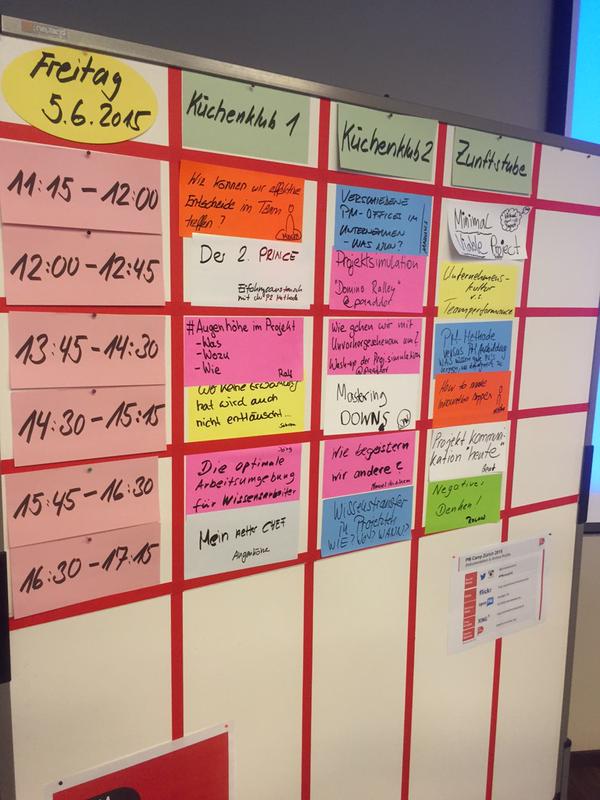 Yesterday evening, I arrived back home from the PM Camp in Zürich #pmcampzue. It was a small but very exquisite PM Camp and gave me two great days.
The first day was opened by Nadja Schnetzler who is also co-chair at word and deed. She bewitched the Camp participants with her wonderful postcards: and she showed us how you can “Embrace Chaos” in a very unobtrusive and serene way.
To me, it seemed that this nice impulse presentation went a long way towards many other sessions considering it important to talk about the situation of humans in their various roles whenever project-typical tasks are concerned.
Consequently, much was about the change in our society and consequently also the change in our projects that progress brings in its wake. It was all about intended and unintended change – and about “Innovation as creative destruction”.
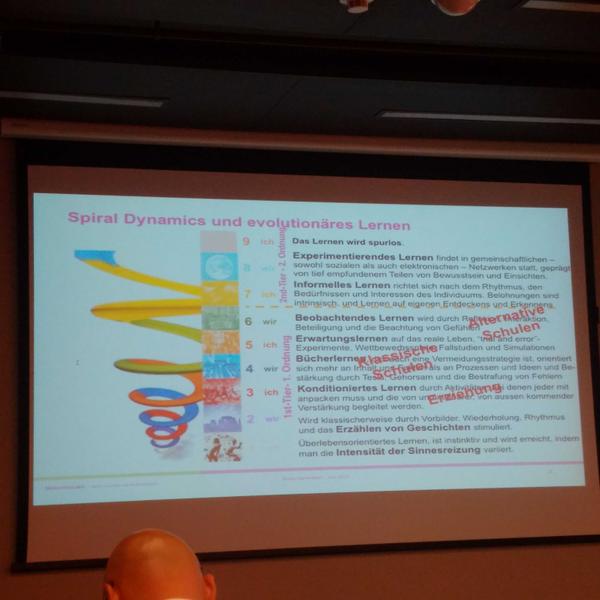 On Saturday, which was the second day, we all started the day with a drumbeat. Bruno Gantenbein, owner of Unschooling.ch, who has been a successful business counsellor for many years, started the day early in the morning with a strong impulse on “learning, too, is part of evolution”.
And his way of doing so was so emotional that some of the audience were moved to tears of emotion and joy.
And then he, too, spanned the bridge between what he had said and project management – asking the for me absolutely central question: “How, where and what do projects managers actually learn?”
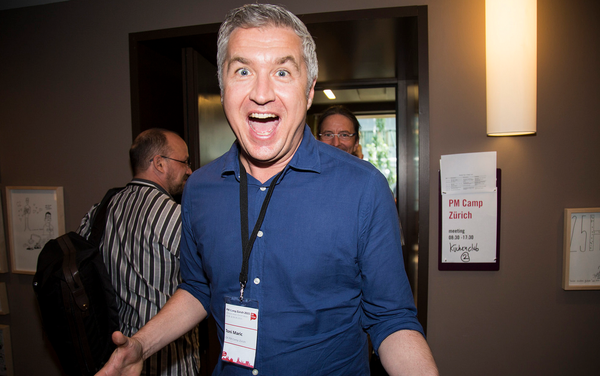
Toni (Anton Maric) in action.
It was no surprise that the second day eventually led to a broad exchange of knowledge about the question how meaningful, efficient and humane learning might, should or must be.
As you can see on the pictures taken at the PM-Camp Zuerich, it was a great event. You can also see the pictures on the Flickr Account of the Zurich PM Camp!
Consequently, I would like to say many thanks to the PM Camp Zürich Orga-Team, namely Dagmar, Bruno, Christian, Matthias, Silvio and Toni, who initiated the Zurich event.
And in less than one month, from July, 2nd to July, 4th, the next PM Camps are waiting. They will be held in Bad Homburg! Then the day will be called #pmcamprm!
I definitely also want to be there and, of course, you will also read my report on it in the IF Blog!
RMD
(Translated by EG)
Roland DürreMonday April 27th, 2015
Project & Product – #PMCampSTR
 The Stuttgart PM-Camp (Hashtag #PMCampSTR) will take place from May, 7th through May, 9th, 2015 at the Stuttgart “Hochschule der Medien” – and I already look forward to being part of it. I bought both the admission and train ticket and made my reservation for the room at the Commundo.
The team in charge of organising the event chose “Project and Product” as their title. This is how the Stuttgart Organizational Team wants to open its PM-Camp for interested persons outside the classical field of project management, for example for IKT (information and communication technologies), as well. Using the term “product”, for instance, they aim at engineers who build high-end products.
What is a project?
Let me cite Wikipedia:
A project is a goal-oriented, one-time proposition consisting of a number of coordinated and controlled activities. It has both a clearly defined beginning and an end and will be realized taking into consideration all necessary restrictions with respect to time, resources (such as money/cost, production and work conditions, employees) and quality in order to attain a goal .[1]
This definition, which in my opinion is a rather simplified view, of “project” means:
- Every project has a beginning (project start).
- Every project has an end (deadline for completion).
- The desired results have been defined as project goals.
- All resources to be used are pre-defined.
- The project goal must be attained on time.
- The planned resources must not be exceeded.
- There is a plan: the project plan.
- The milestones defined in the planning are to be adhered to.
As I see it, projects only deserve the name if they cause a considerable change or if they create something really innovative or new. And that tells you at first glance that something is obviously wrong with the above definition.
Regardless of excellent planning, we witness massive deviations from the goal with the resources often being enormously exceeded, even with simple engineering projects. The reason is probably that even tasks that sound simple have a surprising complexity.
Innovative Change!
The situation gets worse if we are talking projects that are supposed to creatively influence all kinds of social systems and the evolution that happens anyway. If you look at the way a project is described, you will realize that the motto “close your eyes and do is hands-on” is something you are basically forced to apply. In the process, you will not be able to integrate new and better findings into the developing project path at all times.
Even in retrospect, it will be hard to judge the causal connections between measures and their effect (usefulness?). So how is anybody supposed to do so in advance? Basically, innovative change is not something you can just plan linearly. Instead, you have to find a soft and agile way to reconcile change and permanent developments.
Consequently, projects are a contradiction to innovation. Innovation is creative destruction. Which is something that will additionally make the enemies of change interested, especially if they are parties concerned with the intended change. That will make it even harder.
Projects as a part of change?
Hence, I find a definition of project more appealing if it considers a project as one of many integrated parts of a continuing process of change and improvement. Controlled change is supposed to generate useful results. Basically, I consider all well-thought-through activities designed to change or influence developments projects. To me, it does not matter if the project is actually “tangible” or if it renders abstract “virtual” results.
What is a product?
The planning, development, and production of a product, as well as its marketing, sales, support and service are the result of many small and bigger projects. They are all multi-dimensionally linked and thus connected to form a multi-dimensional “mega project”. You will want to remember phrases such as network, dynamics, learning, trial and error, innovation… But then, this is not only true for the tangible product, but also for services.
Box product or service?
So a product might be a tangible object – meaning something you can “touch” – which has been developed by an organisation with engineering competence and in huge quantities. It is also “sold” to either many customers or produced individually and “on demand” in small numbers. As a general rule, such products need to be complemented by a support service if they are supposed to be a market success and generate a “sustainable business”.
However, a product may also be a service rendered at the customer’s place or for the customer by persons who acquired special qualifications and “best practice” with their organisation. Those qualifications are usually the result of decades of personal and collective learning.
Creating a “tangible” product might actually necessitate more projects than creating a “virtual” product.
The difference it makes for an entrepreneur.
Sometimes there is a huge difference for the entrepreneur between designing a “true” product enterprise and an enterprise the product of which is offering a special service.
For instance, whenever selling a “true” product, the entrepreneur should keep in mind that feedback from the customers and from the market usually takes a lot longer than if he offers a service. More often than not, you will invest long-term into a “true” product that still has to prove its value on the market. In that sense, such a product is easier to scale in case of success than a service. But then, it also involves a higher risk.
If you sell a service, you will have your feedback rather quickly, which also means that you can learn from mistakes and perhaps change your strategy.
Well, that is about all I can think of when it comes to product and project. Except that projects, basically, are the small modules of our lives. All conscious decisions for behaviour that makes a relevant difference – for yourself or for the market – are in some way projects.
RMD
(Translated by EG)
Roland DürreTuesday February 3rd, 2015
agile.ruhr Camp 2015
A short time ago, I had a telephone conversation with Dominik Rose. He told me that now the agile.ruhr Camp 2015 he organizes along with Berthold Barth is no longer far away. In less than three weeks, it will actually be upon us!
“Agile” is something I rather like. After all, it is my conviction that you should always approach everything “ALO”. ALO being short for agile, lean and open.

Consequently, I am glad to hear that the organizational team of agile.ruhr Camp for the first time invites people to an “Anti-Conference” for agile procedures in the vicinity of projects and software development this year. On February, 21st and 22nd, the barcamp Unperfekthaus will take place in Essen.
Of course, I find it particularly satisfying that the InterFace AG is part of the event and supports the organizational team as an official sponsor.
The agile.ruhr Camp is for change and convictions. It aims at providing a modern platform for persons, organizations and enterprises where they can exchange experience and knowledge. Because knowledge is the only raw material that increases as you share it.
How to successfully make use of agile methods and tools? What is the potential of agile concepts and behaviour? How can we manage the necessary changes? And not only with software development!
And, of course, the classic pattern for a free anti-conference on agility is the “barcamp”, where, as opposed to a classic conference, you do without a restricting agenda and instead generate above average knowledge gain through honest discourse and open dialogue.
The agenda are decided upon by the attendants. Everyone thee-s and thou-s everyone else, you meet at eye-level and listening is more important than talking. This is the only way how participants can offer “their” sessions (on a topic of their choice) and thus become true participants.
Unfortunately, I cannot attend on February 13th and 14th. I want to visit a totally different “anti-conference” where I have been a regular guest for several years at the same time: the “Biike” in Westerland on Sylt. The “Biike” is just a tradition. Good friends use the time for their anti-conference.
Well, life is a chain of missed opportunities, isn’t it?
But perhaps one of my IF Blog readers can attend the unique agile.ruhr Camp. And then report on his own blog or on twitter?
RMD
(Translated by EG)
P.S.
As soon as I know the hashtag of agile.ruhr Camp 2015, I will give it to you her.
I propose: #AgileRuhrCmp
P.S.1
In this context, you can read something worth reading (Lesenswertes) about InterFace AG.
Roland DürreTuesday November 25th, 2014
Leadership – Values & Principles
“The Three Truths of Management and What the Internet Says About It”
Last Wednesday, I delievered a presentation with this title and sub-title on the DOAG 2014 – Konferenz + Ausstellung in Nuremberg. Here are my abstract and manuscript. During my session, I used parts of the manuscript and added current ideas.
🙂 There were quite many people listening to my presentation and it was my delight to receive a lot of nice feedback.
Abstract:
In the second half of the 19th century, the beginning of industrialization changes our world. We now need trained labourers. However, they are not available. Consequently, the caste of engineers feels they have to act and they invent the method “Taylorism”. The new disciplines “management” and “organization” are created. As a consequence of the industrial revolution, they get more and more powerful. Humans are trained to obey. It works.
Today, perfecting the art of organization and having all the competence in management is no longer enough. Entrepreneurial culture and values, terms such as self-organisation and self-determination get more and more important. The basic beliefs and collective constructs, the definition of people’s own lives and the socialization of humans change civilization and culture. They invented the term: “Generation Y”. Even the “purpose” of an enterprise is not beyond questioning.
Managers and entrepreneurial leaders, in particular, often do not find it easy to follow this change. How to measure these “soft factors”? How to evaluate the quality of “leadership”? Why don’t you ask yourself about the three most important leadership qualities? In my presentation, I will introduce a potpourri of answers given by the important management protagonists and tell you about the change in management.
Manuscript:
In the second half of the 19th century, the beginning industrialization changes our world at huge speed. All of a sudden, an enormous number of labourers is needed. The available persons all grew up in the country. They are poorly educated, if at all -and not used to working by the clock.
This problem is a challenge to the caste of engineers. They invent the method of “Taylorism”. The disciplines “management” and “organization” are developed and get more and more important as the industrial revolution progresses. It works quite well, because the people are trained for obedience.
Now, the industrial era comes to its end. The art of organization and competence in management are no longer sufficient. A new term develops: “leadership”. According to modern understanding, “good leadership” is essential for the success of an enterprise.
Everybody talks self-organization and self-determination, as well as entrepreneurial culture and entrepreneurial values. One question is the purpose of an enterprise.
The engineers get nervous. After all, how is anybody supposed to measure these “soft factors”? Yet, the development continues. The basic beliefs and the collective constructs, along with everyone’s own definition of life and the socialization of humans in civilization and culture continue to change drastically. All of a sudden, the term “Generation Y” is created.
Many people, not just managers and entrepreneurial leaders, find it hard to keep pace with this change. The consequences are massive and often very detrimental situations in the economy and society. But how do the managers and leaders cope with this change?
None of this is precisely news. As early as the 1980ies, there was a remarkable development at the St. Gallen Hochschule. A new “management model” was created. It makes the HSG famous around the world. The culmination of said model are the eight theses by Hans Ulrich – “Management – Essays Part II from 1981 to 1998 – On Change in Management”:
- Accept uncertainty and the unpredictability of the future as the normal state of affairs: strategy means thinking about the future and you accept that decisions will always have to be made under uncertainty.
- Extend your imagination! Oppose “buts” and leave room for ideas. And share knowledge!
- Always think in the categories “both of them/as well as”, rather than “instead of”: black-and-white is out, colourful is in.
- Think multi-dimensionally: always keep in mind that human beings basically cannot handle more than three ideas simultaneously. And: always base the decision between these dimensions on an ethically responsible judgement of properties.
- Use self-organization and self-determination as a formative model for your enterprise: distribute responsibility, demand subsidiarity.
- Consider management a meaningful and instrumental function! Now isn’t that a new concept of management?
- Concentrate on what is really important: this is basically a law of work economy.
- Utilize group dynamics! Just remember all the cultures with their symbols, rites, rituals and heroes.
I discovered the essay early in 2005. It literally struck me like lightning. You have to remember that it was written more than thirty years ago…
Today, everyting is about gaining knowledge quickly in order to shape our common future. Consequently, we need creativity in order to find the right questions for solving our problems (first creative duty). As soon as we have found these, we have to use knowledge in order to generate solutions.
“Taylorisms” and “mechanisms” will no longer work in the social systems of post-modernism. Of necessity, we have to use new communication formats in enterprises and institutions, as well in order to generate additional knowledge from the wisdom of the masses. The motto must be “diversity instead of single-mindedness”.
Today, this happens through the internet.
Here is an example:
Bernd Geropp (he is an entrepreneurial counsellor whose leadership seminars are highly regarded by many persons) is a famous blogger on the topic: management. By now, his medium is the “podcast”, his blog “more leadership, less management” already received a horrendous amount of clicks. He is also doing interviews and at the end of an interview, he likes to ask the question “What are your three relevant leadership principles?”
Since the replies impressed him, he invited other bloggers to participate in a blog parade. In other words, he asked them to write an article on “my three most important leadership principles and/or values” and link those articles to his blog. The result was an exciting series of articles on “the concept of leadership and leadership principles”. Let me present some of the answers in a “potpourri”.
I will start with the principles of the blog parade initiator, Bernd Geropp. He says:
Bernd Geropp
Clear goals, the right values, serenity!
Let me continue with a few ladies who also participated in the blog parade:
Barbara Simonsen
Create meaning, handle complexity, provide learning space!
Franziska Köppe (Madiko)
Think systemic, identify, act together!
Gudrun Happich
Excellent bosses will lead excellent teams, others are permitted to be different, potential will make you successful.
Maria Jaehne
Values, create shared interests, flat hierarchies
Sabine Pfleger
Leadership = motivating people? Leadership ≠ orders and control, leadership = knowledge
And now a few men are permitted to have their say…
Dr. Andreas Zeuch
Self-organization and participation, space for potential, tolerance with mistakes.
Dr. Eberhard Huber
Serenity as the basic concept, the willingness to make decisions, accepting
responsibility
Conny Dethloff
Wisdom, sober-mindedness, courage or brains, gut feeling, heart (after Plato).
Gebhard Borck (Affenmärchen)
Leadership is a temporary state of affairs! Only lead persons who actually wish to be led! Make nomadic leadership possible!
Dr. Heinz Peter Wallner, CMC
Polarity, resonance, structural patterns.
David Kadiri
Unfolding, trust, friendliness
Ivan Blatter
Create clarity, generate optimal surroundings, do not reward busybodies
Dr. Marcus Raitner
Attitude, trust, serenity
Olaf Hinz
Decide what is undecidable, counter uncertainty with serenity, practical prudence.
Dr. Stefan Hagen
Leadership with heart, brains and hand – a sense of belonging, consideration and structure.
I want to leave it at that, although there are many more very nice articles. These fifteen authors have been selected by me from a total of very recommendable 44 relatively randomly. It strikes me that the ladies actually replied a little differently from the men. I find that exciting. But:
Are those all not nice principles?
And you get them for free on the internet – in fact you can even have them as a free e-book. This exchange of ideas happens on a very high level – and I liked it very much, indeed. St. Gallen happened more than thirty years ago. This is where the “scientific” groundwork was laid. However, today, the exchange of experience and the addition of quick knowledge no longer happen primarily at universities. Instead, they happen in practical life and on the internet.
There are hybrid (virtual and physical) activities in and around the “network” – for many, they are often still unknown. For instance, I would recommend openPM as an open and independent platform for project managers, leaders and entrepreneurs.
openPM is linked with PM-Camp (pm-camp.org), the “face2face” movement in project management. PM-Camp is a “grass-root-movement” which developed as a self-organized cooperation with open PM and organizes wonderful barcamps for project managers, leaders and entrepreneurs. It is a meeting point for experienced and young people, women and men, young and old persons who share their experience and knowledge. The movement grows rapidly and already has yearly events held in many towns of Germany, Austria and Switzerland.
I took a stroll through our enterprise and asked our leaders about their leadership principles. And some of the answers were, again, truly innovative! For instance, an answer I liked was:
Paul Schuster
Promote individuality, connect people to a network, isolate the important issues in team-work.
I was surprised to see how few replies actually said the same. And how well almost all of them supplemented each other, regardless of the differences. However, the diversity of ideas also shows that such a thing as exactly three truths on “leadership” does not exist!
Incidentally, I also found some references in literature. In his book
“Nicht mit uns” – Das Leben von Leonie und Walter Frankenstein (Not with Us – The Lives of Leonie and Walter Frankenstein), Walter Frankenstein gives three reasons for himself and his wife and two small children surviving the Holocaust during the last war days:
Walter Frankenstein
Fearless, boldness and good friends
Indeed, this might definitely also qualify as a leader principle for a successful manager.
I was also invited to attend Bernd Beropps blog parade. That is when I asked myself what my own three “leadership principles” are.
🙂 After only a short time for consideration, it was quite clear to me – I am an ALO man – my principles are:
Roland Dürre
Agile, lean, open!
In a nutshell: Managers, too, are only human!
Successful managers are a little better when it comes to judging what is good or bad for the enterprise. Consequently, their decisions are more often the right decisions for the enterprise than not.
I believe that basically all persons who work more constructively than others and whose destructive element is rather an undefined quantity are good managers – both in business and in private areas.
This is especially true when we are also talking persons who not just strive towards (often seemingly) some advantage, but who instead trust that a good decision can also create a significant “collateral benefit”. And if these persons also have a good measure of humanity mixed with an abhorrence of enmity, then everything is just fine.
It might also be a good idea for change in management if enmity could be transformed into humanity!
RMD
About my presentation:
There is a free e-book with the aforementioned blog parade “Sustainable Leadership” by von Bernd Geropp. It was edited by Gudrun Happich. She created the e-book by collecting the blog parade and other sources, separating it following “best practice principle” values and then commenting on it. (www.mehr-fuehren.de/nachhaltige-fuehrung-e-book/)
Roland DürreSaturday August 2nd, 2014
“For Freedom” or “My Post-InterFace Life“
“Minutes and notes on and how I felt and results of my session “project freedom” at the Berlin PM Camp on June, 24th, 2014″
In former times, I was in search of the meaning of life. I tried to find meaning in as many things as possible. When I founded an enterprise, this, too, of course, was to be meaningful. That was more than thirty years ago. At the time, I was totally convinced that all social systems – including the economically-oriented ones – should have meaning.
And today – with every speaker demanding that enterprises must have meaning – I think that this demand is correct and yet wrong. Today, I believe the important thing is not whether life or an enterprise makes sense. Instead, what matters is how a human being or an enterprise affects its or his environment.
When I was a child, I, like many of my friends, was surrounded by a traumatized generation. In the early 1950ies, this generation knew exactly what you do and what you do not do. They felt like they owned the truth – which was often defined through totally irrational categorizations. They had a strange understanding of freedom and peace. And we were victims of their advice.
At school, we were “educated” by traumatized persons. Seemingly purged, they now sublimely tried to pass their dogmata and hatred on to the new generation, which was: us. Mind you, it was not just the teachers. The parents and family were no different. Even strangers who passed us on the street abused us. Because we wore jeans or because our hair was too long – regardless of the parents having threatened us with the worst possible punishments.
But in other respects, too, this generation never appreciated us. They knew exactly what the world should look like and we simply did not fit. Consequently, they made us look small. Being beaten was normal. Both at home and at school. Having to stand in the corner or having to spend a few hours in the coal cellar or locked into the bathroom were the humane forms of punishment.
We suffered and never understood the reasoning behind this kind of education. Instead, we saw it as a revenge model. We had to pay for our non-conformity and undesirable behaviour. And then we opposed and reciprocated with hatred.
We felt particularly ill-treated when we were punished for activities we had felt truly courageous, noble or great about. How it hurt us when we had been doing good things and they made us pay for it! – When we were called traitors.
Even when we had enjoyed doing something too much, we were scolded. Because it definitely would not do to have too much fun and therefore the rulers of our childhood objected to it.
Do not play with the street urchins …
When I was an adolescent, I liberated myself and the question about the meaning of life was never far from my mind. I was totally devastated by the fear of death. What meaning can a life have if it ends with death? To me, eternal life did not seem to be the right answer, either.
And on top of the meaning of life, there was another hope – peace. Big, never-ending peace. Both between humans and with creation.
After all, I and my friends never understood the nonsense about war. John Lennon was one of our heroes. I never experienced war first-hand. But I experienced how US GI’s sobbed in Augsburg, because they were ordered to fly to Vietnam early on the next morning. They certainly knew what to expect and they also knew that many of them would never return.
I can imagine how cruel war always is and will be and how perverse it is when “industrialized”. For me, the concept of an idealized war where clean modern technology is used, the reduction to using weapons as some kind of high-tech game where fighters control the death-spelling drone standing behind the game board is horrifying. Not to mention all those necessities that make all these things mandatory: weapons, soldiers, mines, fighting robots, …
I know no war that changed anything for the better. Also, I doubt that there can ever be a justified war. Perhaps even the Nazi problem could have been solved in a better way. Without WW1, there would probably never have been a WW2.
However, I do not only wish to oppose the big war. The war inside and on a small scale, too, is bad for us. Is it really necessary that humans always integrate so much animosity into their daily communication? Why is it so hard to come to peaceful terms with oneself?
Why do we always tend to make other people look smaller, rather than bigger? Wouldn’t it be an obligation both for our “leaders” and everyone else to make others look bigger? Because this is the only way the social system might work in favour of humans, rather than against them. So why do we fight ourselves and prevent the flourishing of our own life in many possible dimensions?
Isn’t it a great project goal to reach your inner and outer peace? A goal everyone – not just leaders and managers – should work towards? Don’t we all “manage” something or other most of the time in our lives? And no matter what it is we manage, it will always have something to do with people.
Consequently, I wish to dedicate the years remaining in my life to working towards peace.
During the Berlin PM Camp was the first time I tried to contribute by a session on “project peace”. Ulf Brandes had inspired me with his introductory presentation. I wanted to fascinate as many persons as possible for a “project peace”. Regardless of the topic being a little beyond our usual range, quite a few people came to attend my session. What we discovered was both encouraging and discouraging:
- Working for peace is definitely worth the effort.
- There is a lot of scepticism whether the project goal can be reached.
- Peace will definitely not come through religion and dogmata.
- A project goal “peace” commanded “from the top” will not help.
- Peace will not be installed by politicians, functionaries and other system agents.
- Traditional forms of protest for peace, such as Easter Marches, etc. will not have any effect.
- The project peace needs persons whose personality has reached a certain degree of maturity.
- In order to get peace, we need a new social consensus.
- Said consensus can only be obtained through a network supporting the process of forming opinions.
- Only a grass-root movement can make the “project goal peace” a success.
Now we can start.
Many thanks to all those who attended my Berlin PM Camp session on “project goal peace” and helped me a lot. Today, all I want is to really live – both in peace and for peace.
I see myself doing this against the generation I witnessed as a child that is still present in such huge numbers.
RMD
(Translated by EG)
P.S.
Let me note that, almost exactly a hundred years ago, something ultimately unbelievable happened for many people – systemic mechanisms culminated in WW1.
This war was the first media war (see documentations for instance at ARTE) to be started so cunningly. For instance, historical research was convinced for a long time that a majority of the people living in the two empires actually went to war jubilantly.
New historical research reversed this concept. Today, it is generally accepted that the entry of war in 1914 was mostly against the wishes of the people living in Germany and Austria and that, in truth, it was something the then elites and powerful wanted and instigated.
Nobody can seriously doubt the uselessness of WW2. The world was burning and there was an industrial waging of war in many places aiming at the total destruction of the enemy without any consideration for all kinds of loss.
On the scale of atrocities committed during the war that, unfortunately, is open at the top, the trench warfare on the German-French border, as well as the “mountain fights” in the Alps are perhaps the outstanding examples of cruelty and irrationality.
War is no constructive means to solve problems!
Roland DürreFriday July 11th, 2014
Roland Dürre – Hierarchy or Networking
Here is my own presentation given in our technological IF Forum series:
“Self-Organization as a Formative Model for Enterprises”
It was held on June, 27th, 2014 and is now available as video recording (creative commons).
Enjoy!
Now the only presentation still missing is the introduction to the topic by Wolfgang Menauer. You will get it tomorrow.
Thanks a lot, Friedrich (Friedrich Lehn).
RMD
Roland DürreSunday June 29th, 2014
Making all the Difference – PM Camp versus Conference
 This weekend, we had another PM Camp. It was the third one this year. The Rhein-Main PM Camp 2014 took place in Bad Homburg. And judging by what I read on twitter (#PMcampRM), it was another great PM Camp. After all, each one is individual, but they are all special.
And while I celebrated “30-years-InterFace” at Unterhaching with many guests, something very special was created in Bad Homburg quasi as a by-product: a team around Falk Schmid, who is also a member of the organizational team for PM Camp RM, managed to develop an experimental video under the supervision of Torsten Koerting in less than 100 minutes. The video is supposed to help explain the PM Camp idea.
Watch and enjoy!
https://www.youtube.com/v/S1XGY_BEkcw?fs=1&vq=hd720
It took only one hour to make the video! Wow! One could easily imagine some video for totally different purposes, for instance in enterprises. Lots of ideas come to mind…
So, come and register for the first Munich PM Camp #pmcampmuc.
And even better: why don’t you organize your own PM Camp in your hometown?
RMD
(Translated by EG)


