
Roland DürreTuesday June 3rd, 2014
June, 20th, 21st, 22nd – PM Camp in Berlin #pmcamp14ber
”Cooperation in the 21st Century” and „Wisdom and Intuition of the Multitude“
Those are the two focal points of the Berlin PM Camp between June, 20th and June, 22nd, 2014 – which means from Friday evening until Sunday afternoon.
Doesn’t that sound exciting!
Consequently, late in the evening of my birthday, I will board the sleeping compartment of the night-train from Munich to Berlin and leave it to said train to bring me to my destination. And I already look forward to meeting many friends and in particular Heiko (Heiko Bartlog).
Heiko is a member of the organization team of Berlin PM Camp and put enormous energy into preparing for this event. He asked me if I would like to supervise a session about the two exciting topics of the Berlin PM Camp. Isn’t that nice of him?
Well, I would certainly always like to do just that. Consequently, I now start thinking about it. There are certainly a lot of topics. Here is a list of what comes to mind:
- Target Agreements
In 30 years as “The Boss” of InterFace AG (and even before that in my more passive role as employee at Siemens AG and Softlab GmbH) I made a lot of surprising experiences with goals and target agreements. I learned that target agreements are very problematic in many respects. Consequently, I believe it is quite possible that more and more of these “control mechanisms for humans by material rewards” will be abolished in the future.
For instance, I could tell my life story, including paying models and target agreement design as an entrepreneur and in projects.
- The Change in Management
In the early 1980ies, Hans Ulrich, perhaps the founder of the St. Gallen Management Model, wrote a wonderful essay on “8 Theses on Change” in management. By now, we already have the Version V4.0 of the St. Gallen Management Model. We did a review of this model with Professor Dr. Johannes Rüegg-Stürm and many Swiss enterprises. In the process, we discovered how unique and modern Hans Ulrich’s theses are still today.
- Leadership – Principles and Values
Being an active participant in a Blog Parade initiated by Bernd Geropp, I have recently been made aware of how diverse the answers to the simple question: “What are your three relevant leadership principles?” are. I took quite some time thinking about it, and then suddenly, it was very clear to me: I am an ALO man (agile, lean, open). But how does this translate into daily practice? Or why will this often not be possible? And what could we do in order to use this principle more frequently?
- Leadership is Communication!
Another topic is communication. Communication has always been a difficult issue. But here, too, humans and their values, expectations, interests and needs changed. And I mean radically. Similar to “basic beliefs” and “basic behaviour”. Except that some bosses, project managers, managing directors and superiors did not notice. And consequently, many of them communicate like in times long past – which is true in several respects. There is really a lot you could improve – and in fact, you have to improve on these things if you wish to make the “future” a success.
- “The Future Cannot be Predicted”
and all decisions will always have an “uncertainty factor”.Well, this is just how it is. And in managerial circles, the awareness that this is how it is now also is being heard. So this would be another exciting session topic.
I think a team cooperating at eye-level is better equipped to distinguish between “good” and “evil”, for instance when it comes to a project. And this is how, with a shared effort, more “right” than “wrong” decisions can be made than, for instance, if an isolated project manager has to make them.
- Discovering Collective Constructs!
Projects or enterprises are social systems, mostly with a decided goal. Social systems, however, tend to develop collective constructs which increase by themselves in a very special way, often also when those who are normatively and strategically responsible become system agents. Social systems can then easily make themselves independent and de-personalize.
The only way to prevent this phenomenon is to have a culture of civil courage lived by the majority in the enterprise or project, thus making it possible to fight back against a perversion of collective system constructs in constructive disobedience. In other words, an immunity guaranteed by a “Crowd” inhibits the social system.
These are all topics I find extremely fascinating. I also have lots of personal experience with these topics and learned much from my mentors. It is my pleasure to share my experiences. However, this kind of thing always has to be in harmony with the barcamp and consequently, with the PM Camp. That is why I always wish to decide at short notice what exactly I will talk about. For instance after having digested the impulse presentation and the feedback in the discussion. Or maybe after the first PM Camp day.
Besides, I am quite ready to let others do the speaking, only getting active when I notice that there seems to be a shortage of volunteers for session. Except if I find something really incentive :-).
So I look forward to being in Berlin. And as to the rest: let us wait and see. In other words: instead of planning, I just let things develop.
There is no doubt that the Berlin PM Camp will be a first-class event. I can promise!
RMD
(Translated by EG)
P.S.
At this time, I would also like to inform you about the next two PM Camps:
The PM Camp Rhein-Main is all about “project communication” It will be from the evening of June, 26th, until the afternoon of June, 28, in Bad Homburg #pmcamprm and #pmcamp14rm. Unfortunately, I cannot be there, because on June, 27th, we have our big 30-year-party – all PM Camp fans are invited.
In July, Munich will host an event between the 24th and the 26th (again Thursday evening through Saturday afternoon). The motto of the PM-Camp München is: “sharing knowledge – increasing knowledge”. And that certainly also sounds familiar: #pmcampmuc or #pmcamp14muc. Of course, I will again be one of the participants at the PM Camp in my home town!
Roland DürreThursday May 29th, 2014
The Goal is During the Journey …
It happens all the time, both in enterprises and in other social systems. People suffer from something that is wrong or getting worse each day, although, basically, this would not be necessary. Perhaps because processes and/or the supporting technology have outlived their usefulness. But perhaps only because technological debts have accumulated. Because a system that used to be quite useful became totally out-dated as time went by. After all, a system that used to be a good tool can also suffer from old age.
Those enthusiastic people in the enterprise who worked with the system found out about this and are now unhappy with the situation. The same is true for those responsible. Consequently, the old world has to be improved. Everybody desires the same thing, because they know quite well what they need and want.
And then there is the job for the project head. He gets the great task. He is supposed to significantly improve a state of affairs which is making many people unhappy.
Basically, everything seems quite simple: both the users of the system and those responsible for the technology know exactly what they want. The “leaders”, too, back the project. Even the budget is available and actually seems quite generous.
But then come the eggheads with their strange ideas: legal service, worker’s council, data security, quality popes, administrative instances and diverse persons responsible for processes want to be heard. Additionally, quite a few “minor zones of battle” are created for personal reasons.
A complex Requirement Engineerung (RE) is initiated. The most adventurous extra functions are created through bizarre mind games. And all of a sudden, you will find functions on the documents that you will probably never need. To make up for it, the most elemental basics were forgotten.
In doing so, the people pervert a project goal in such a way that it becomes the natural enemy of all parties involved in the project. Naturally, the project will blunder from the outset. And even when the project starts, “wise ones” will already foresee that the entire thing is going to end in disaster.
However, the “wise ones” prefer to keep quiet. After all, they do not want to seem to be the eternal grumblers. Besides, they know that their arguments will not be heard, anyway. Just like they know that the morbidly pleasant anticipation, too, will not help anybody. Instead, it will only harm everybody. So what to do?
Isn’t it really a shame?
Incidentally, what I related here is not something that rarely happens. As I perceive it, it actually happens at least with fifty per cent of all projects. The idle power will climb infinitely. And only because we sometimes find heroes who in the end will see to it that the damaged projects will work out after all, you mostly get some desired results. Even if in a rough-and-ready manner.
Well, this is when I start dreaming of an improvement process which is supported by all parties concerned and where simple improvements are carried out in small, shared steps like pearls strung together pragmatically on different chains. This is when the journey becomes the goal. Very “agile”, “lean” and “open”.
Why not with Mobprogramming and similar innovative methods? But I will write about mob programming and that it might actually be a helpful collaboration model for leadership teams at some other time.
RMD
(Translated by EG)
Roland DürreSaturday May 17th, 2014
Profit, Turnover, You can Measure Profit – Unlike Intangible Value!
An Interview for the DOAG
During the big Nuremberg DOAG conference, Dietmar Neugebauer asked me for an interview on “leadership and management”. DOAG is the German Oracle User’s Association, or simply the German “Oracle-Community”.
Here is the text supplementing the video on the DOAG-Website:
InterFace managing director Roland Dürre thinks managers today are confronted with ever higher expectations. He tells DOAG managing director Dr. Dietmar Neugebauer what he thinks are the criteria for successful management. Among those criteria are ethics, civil courage and empathy. However, as opposed to the material values, such as profit, turnover and advantages, you cannot easily measure them.
And, of course, here is the video:
The video was made by DOAG.TV. Many thanks!
RMD
(Translated by EG)
Roland DürreTuesday May 13th, 2014
27. Juni bei InterFace AG: 30-Jahresfeier mit IF-Forum!
Am Tage unserer 30 Jahresfeier veranstalten wir auch unser viertes fachliches IF-Forum. Hans Ulrich (der “Erfinder” des St. Gallener Management Modells) hat Anfang der 80iger Jahre in einem Aufsatz “Acht Thesen zum Wandel im Management” genannt. Eine der Thesen war:
“Selbstorganisation als Gestaltungsmodell für Unternehmen”
Diese These wollen wir in unserem fachlichen IF-Forum 2014 debattieren.
Das IF-Forum startet am 27. Juni 2014 um 13:00 im Alpenbauer Sortpark in Unterhaching statt. Dort feiern wir anschließend unsere 30-Jahr-Feier. Das IF-Forum findet aber nicht im VIP-Bereich statt sondern im Seminarraum der SpVgg Unterhaching im 1. Stock über der Gaststätte im Sportpark noch außerhalb des Stadions.
Hier die vorläufige Agenda:
Ab 13:00 Unsere Gäste treffen ein …
Eintreffen / Welcome
13:15 Wolfgang Menauer, InterFace AG
Hinführung
13:45 Dr. Eberhard Huber, pentaeder
Resilienz vor Effizienz
14:15 Dominik Rose, InterFace AG
Agil, Lean und Open
Pause
15:00 Bernhard Findeiss, InterFace AG
Kanban und Scrum
15:30 Roger Dannenhauer, Turnaround
Geisteshaltung
16:00 Roland Dürre, InterFace AG
Hierarchie oder Netz
Um 17:00 geht es dann weiter zu unserer 30-Jahr-Feier in und um den VIP-Bereich des Alpenbauer Sportparks.
Wir freuen uns auf Ihr Kommen. Anmeldung ans IF-Forum bitte per E-Mail!
RMD
Roland DürreThursday March 27th, 2014
Entrepreneur’s Diary #94 – Attitude of Mind, Trust, Constructive and Destructive Ideas
And about good & bad/ right & wrong …
To manage means to act. And I learned, both in life and in many expensive seminars and intense discussions with my mentors:
A good manager should distinguish between good and bad a little more often than other people. And he should make more good decisions than bad ones. If he succeeds, then he has achieved quite a bit and you can respect him very much.
Moreover, I learned that the “attitude of mind” has central meaning for everything you do. Attitude of mind is made up of two words: mind and attitude. If you wish to act with responsibility, you should have the “correct” mind-set. Your attitude can be the backbone you need in order to maintain your mind-set even in what you do.
Well, this is not precisely news. Neither is it news that all decisions, along with the subsequent behaviour, by definition have both a constructive and destructive component. I will not go into details, because everyday-life is full of examples.
Also, it is quite trivial that decisions and behaviour will always have both constructive and destructive elements. If a decision is “right” and an action is “good”, then the constructive element should always be stronger than the destructive one.
The same is true for what you say and what messages you send. Basically, the task of a manager is to communicate. Whatever content a manager communicates will always be partly constructive and partly destructive. Therefore a “correct” or “good” statement will always also – apart from the hopefully strong constructive idea – contain a destructive part. You can – often quite easily – find it by “logical negation”.
Some people, however, – and I am afraid we all have a tendency towards this – like pocketing the constructive message and then they get extremely enthusiastic about the destructive part. In doing so, they deprive the sender of the trust that the constructive part is actually the most important part of his message.
I am not the only person who sometimes comes close to despairing when witnessing this. Here I am, wishing to say something positive. The majority of my audience also understands this. But then some people extract the “negative” element. In the worst case, they will hand it on as some kind of “conspiracy theory”. And if I am out of luck, this theory will be taken up by someone or somewhere and a lot of damage will be done.
Consequently, I believe it is also part of a good enterprise culture to not just point out the constructive part of your actions, but also to see the constructive element in everything you receive and evaluate. Rather than minimizing this element through heightening the destructive parts.
Incidentally, what annoys me most about eloquently presented and well-sounding messages is if they contain ZERO information – that is if, after close analysis, you discover that they contain NOTHING. The senders of ZERO messages make use of the advantage that, if you send no content, naturally you cannot send constructive or destructive elements. In this case, nobody can degrade the message through a heightening of the negative. I would not be surprised to see that such people are actually particularly well-loved and successful.
🙂 This is another place where I will refrain from giving examples for persons whose messages have ZERO content.
RMD
(Translated by EG
P.S.
For all articles of my entrepreneurial diary, click here: Drehscheibe!
Roland DürreTuesday March 11th, 2014
Programs and Documents
In former times, we mostly dealt with programs. They were, for instance, written in “c”. They were part of a Source Control System. Initially, this was the “sccs”, then progress came along and “sccs” became “rcs” and later “ClearCase” and such.
Everyone on the team had access to all modules. Because it happened quite frequently that you had to modify something your colleague had written. Otherwise your own module could not work properly. Every modification had to be documented. Not too long and not too short. And it made me even a little proud that I had to modify other peoples’ programs more often than they had to modify mine.
Today, I work with documents. Quite a few of them are shared with or/and worked on by other persons, as well. Usually, my documents are filed on Google Drive. It is beautifully “object-oriented” (another term from former times). The tools are simple and logical. And I can work on my own and my friends’ documents from any device and place.
And I enjoy seeing all the different cursor colours of my “collaborators”. If necessary, I can “chat” with them or confer with them via “hang out”. And, of course, I also can leave comments in a document.
Which brings us back again into the middle of culture: how many comments and notes are a good idea and will make sense? But honestly, these new forms of collaboration are absolutely magnificent (in a very positive sense)!
🙂 As I see it, this is another instance where less is more.
🙁 But then, I still live in old worlds. Actually, I copy the content of my comments and send them via email!
RMD
(Translated by EG)
Roland DürreFriday March 7th, 2014
IF AGORA and the Knowledge Workers
For several years, I have now nourished the IF AGORA as a market place of knowledge. On this market place, I asked speakers who fascinated me with their presentations to publish their “knowledge opportunity” in order to make it possible for other persons to benefit from this knowledge and experience. Depending on the situation, customers either paid for their service, or it was provided free of charge.
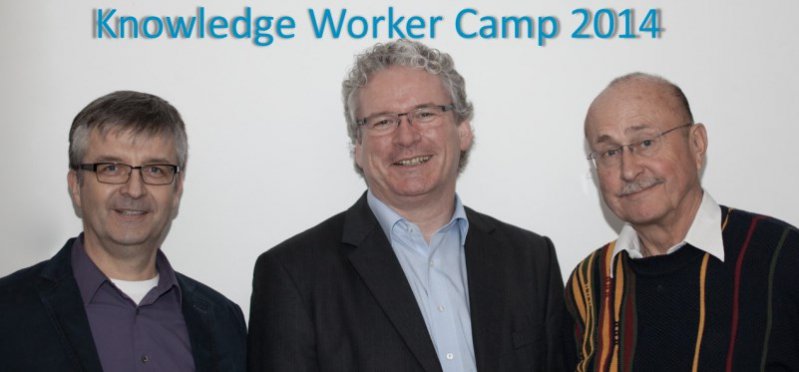 From left to right: Bernd Fiedler, Thorsten Schlaak and yours truly.
I did it all more or less whenever I had nothing more important to do and every few weeks, I added a new “knowledge opportunity”. There simply was not time to do more than that.
Now three of us decided to let IF AGORA also get a real life. First and foremost, we wish to organise a Knowledge Worker Camp, where hopefully many persons offering knowledge will participate, along with many other persons who are prepared to take a little responsibility for the future.
But before starting to plan and organize such an event, we want to find out what actually moves us all today. Consequently, we started a survey – and we are quite excited about the result.
As soon as we have the results, we will plan how to structure the event and when it should take place. And we will invite many, many people. We will assume that those who come will be exactly the people we needed.
RMD
(Translated by EG)
Roland DürreSunday February 2nd, 2014
Between “Agile” and “Planned”, Intuition and Ratio.
A short time ago, another friend of mine told me how great he felt about his participation at a barcamp weekend. He said how much frontier-spirit he had experienced and how much energy he had filled up on. And how he sadly had to confront everyday work-life again on Monday after this ever so enthusiastic weekend and how it felt painful to get propelled back to hard reality.
That is when, again, I started pondering a few questions which keep making me thoughtful:
Acting and planning:
Why is it so hard for us to be “agile” and why are we sticking so persistently with “planning”? Why do we not accept that the future is unpredictable?
Deciding:
Why do we mistrust our intuition and will in the end prefer basing our decisions on ratio, which seems to be the level of reason and where we give ourselves security by the most complex explanations?
Or, to say it in a “populist” way:
Why are persons who think and act intuitively and who sail through life in an agile way and who promote things successfully to the benefit of all constantly thwarted by Apperatschiks (Apperatschik) who manage to destroy what has been laboriously built with their never-ending rules and regulations?
Here are my answers …
My guess is that, on the one hand, we have been taught to do it in this way by our elders and, on the other hand, our fears make us do it this way.
Let me first give you an example for what past generations said:
Everything is under control, we can achieve everything we wish to achieve, all we have to do is plan properly. We have to organize our world like clockwork, then nothing can go amiss. Boys do not cry and emotions are not good counsellors. Consequently, you should free yourself from emotions – they can only do damage. And, above all: do not fear progress! Technology can achieve anything! Wars are there to be won! So, boy, be reasonable! Basta!
The generations of our forefathers believed in this. They fell victim to the explosion-like developments of the 19th and 20th centuries that seemed to promise limitless opportunities for humans. In the brains of the people, the concept of being omnipotent took hold. It was based on the belief in technology and progress. All of a sudden, homo sapiens was almighty, death was suppressed.
The sudden abundance of available energy (in particular from fossil sources), along with the ruthless technological progress seemed to make anything possible. This is how a feasibility and planning mania like the history of homo sapiens had never known was created. Everything was oriented towards progress and modernity.
Words such as “humbleness” and “caution” were frowned upon or else called backwardly. With a degree of ruthlessness, violating nature and life like we never did before, we declared technology and progress the new Messiah. A full-fledged war against nature started. In their abnormal social systems, the planners of the future even wanted to create the “new human”, just like they had built their new cities.
The belief that an exploding technology, paired with limitless availability of energy, the future can be controlled through ratio and that everything can be determined and mechanically developed was supported by the corresponding ever stronger fear of freedom.
Our imagined omnipotence created a chimera of security that we wish for and that relieves us. Even if it is very treacherous. The greater our imagined security, the greater is the fear of losing it and the greater is our fear of taking responsibility and accepting freedom.
Now more and more people realize that all this was just one of many cavorts humans have liked to embrace during their history. The assumption that the future of humans can be planned through ratio, too, proves more and more often to be wrong. We know about the climate catastrophe, yet we do nothing about it. Just like we know about all the many problems of our social and economic world, yet here, too, we do nothing.
But it seems that we are approaching the turn of another era. All of a sudden, everything changes quickly. We have the internet with its new density of information. We feel that something is wrong.
Consequently, more and more among us flee from this imagined security. They realize that contentedness cannot be bought, not to mention “happiness”. They no longer want to bend before the forces of a society controlled by material desires. A society which gives all its members the one format: consumer.
They no longer want to become the slaves of a strangely economized world. Instead, they just want to start living again. They want to live their lives in responsibility and freedom. And they are fed up with the laws of a late-capitalist and globalized world.
I think that the more we humans will manage to regain our autonomy and independence, the more we will be collectively prepared to overcome our fears and go the agile and intuitive way in society, as well. And our willingness to accept the necessary transformation in a proactive way will also increase – regardless of the radical consequences with their many, non-predictable alternatives.
The more, however, we humans base our lives on alleged security and on the ownership of property and the more we pretend that all is under control because everything can be planned since it is deterministically explainable and mechanistically designable, the more we will lack the courage to decide intuitively and to live agilely. And we will have no chance against the confusion created by scenarios which, just like our fears, only happen between our ears. And then we will rather abruptly be confronted with changes we will not like at all.
The war of survival can probably only be won through “agile” and “intuitive”. And the great singer Janis Joplin might actually have been ahead of her time with her song Me & Bobby McGee – where she gave a totally different definition of the term “freedom”:
Freedom’s just another word for nothing left to lose …
RMD
(Translated by EG)
Roland DürreTuesday November 26th, 2013
Entrepreneur’s Diary #91 – Non-Agile or Agile in a Different Way.
In my last entrepreneurial article, I tried to describe what qualities a truly good manager should have. And I demanded that acting and deciding agile is one of those qualities.
But what exactly is the meaning of agile? Let me start by defining the opposite (dogmatic?).
I always witness non-agile decisions where decision makers think they alone own the truth and accordingly copy the world and the constructs of their social system unconditionally and without questions. In other words, these persons have a personal and systemic “structure of prejudices” which has never been subjected to criticism. If this structure of prejudices is what all considerations are based on and if then imperative decisions are developed from it through dominant logic, you mostly get stupid actions with detrimental consequences.
The reason for this is simple: the world ticks differently from what you think. If what is allegedly certain is not questioned, if emotional influences and your own empathic acceptance of other opinions is not permitted and if warnings are considered uncomfortable or being suppressed or ignored, then this is what happens: “ethics of responsibility” become “ethics of duty”, where all behaviour is justified with loyalty towards the system – even if it is detrimental to the people.
As opposed to this, being agile means that you always ask questions such as “how do you know this?” or “how do you know that this is correct?” both of yourself (!) and others – and perhaps not to avoid unpleasant replies. In other words, you have to be immune against “this is what everybody does” and “well, this is how it has always been”; instead, you have to try and compare your own constructs with those of other persons and, where possible, validate them against reality.
As I see it, this is the most important requirement for being an agile manager.
RMD
(Translated by EG)
P.S.
For all the articles of my entrepreneurial diary, click here: Drehscheibe!
Roland DürreMonday October 7th, 2013
Presentation – The Change in Management – October, 24th
 On October, 24th, I will give a presentation titled as you see above at the University of the German Armed Forces. The sub-title of my presentation is:
Why German enterprises, too, must become more agile!
Since what I am going to talk about is very dear to me, I would be particularly happy to see familiar faces among the audience. The presentation is open for all.
Here is what you can read in the invitation by the University of the German Armed Forces about the series of lectures. I can recommend all presentations of the series.
We would like to cordially invite you to our EAA colloquium on: ”Current Developments in Technology and Business“.
This is a series of lectures open for all and held during the coming autumn trimester (October through December) on Thursdays at 18.15 hours at lecture hall/building 33 / 0101 on the premises of the University of the German Armed Forces at Neubiberg. Registration is not necessary. You are welcome to bring colleagues, friends, family.
We attached a description of how to get to our institute to this invitation. From there, you will easily find the way to the lecture hall (and, please, do not forget to carry your passport)
As you can see, it is not altogether trivial to find the lecture hall. Consequently, I will be happy to assist when it comes to reaching the university campus and the way to the lecture room, for instance by sending you the description of how to get there.
Here is an overview of all the presentations of the EAA Colloquium “Current Developments in Technology and Business “ in the autumn trimester of 2013 at the University of the German Armed Forces in lecture room/building 33 / 0101
October, 10th, .2013 18:15 hours
Dirk Hornickel Volkswagen AG – Wolfsburg
From the 1-litre car to the 40-ton truck – driving motor concepts at Volkswagen concern
October, 17th, .2013 18:15 hours:
Dr. Jürgen Friedrich Daimler AG – Kirchheim-Nabern
Fuel-cell electronic cars at Mercedes-Benz – current state of affairs, development and experiences.
October, 24th, 2013 18:15 hours:
Roland Dürre InterFace AG – Unterhaching
The change in management – why German enterprises, too, must become more agile
November, 14th, .2013 18:15 hours:
Dr. Stefan Gillessen – Max-Planck-Institute for extra-terrestrial Physics – Garching
Astronomy and astrology: what is science?
November, 21st, 2013 18:15 hours
Dr. Franz-Josef Bierbrauer UBB Business Consulting Bierbrauer (formerly at Osram München) – Wörthsee
Technological change on the illumination market and its consequences.
November, 28th, .2013 18:15 hours:
Dr. Ralf Geßlein Siemens AG / Large Drives – Nürnberg
Driving motor systems and sales approach for the oil and gas sector
December, 12th, .2013 18:15 hours:
Dr. Werner Zittel LBST Ludwig-Bölkow-Systemtechnik GmbH – Ottobrunn
Peak Oil, Fracking and the energy about-face.
RMD
(Translated by EG)


