
Roland DürreSunday March 6th, 2016
Act!
Let me cite Seneca:

Seneca, part of double-herm in Antikensammlung Berlin (wikipedia)
Philosophy teaches us to act, instead of talking!
or
What we say should not entertain, but have an effect!
or
You want control, not tattle!
Seneca was an important teacher and thinker in ancient Rome. If my understanding of history is correct, then he wanted to help his students to become a bit more successful and happy in life. This is a nice goal. I gladly make it my own, both for myself and other people.
During the last year, I, again, spent much time abroad. I had a few great days when I attended a philosophy colloquium with Klaus-Jürgen Grün (Philkoll) that I found absolutely fascinating. As part of the jury during the business plan contest, I also learned many new things. On several PM camps, I exchanged experience and knowledge with many others. Many peer-to-peer meetings with friends, “mentees“, young persons who had just founded a start-up and many more were a chance for me to experience totally new worlds.
🙂 On the whole, I, again, learned more than ever before. And I am almost overwhelmed by all the things I now know. Mind you, this is regardless of me knowing that I know nothing. Consequently, I also have no idea how to best use my knowledge. That is bad news, because somehow or other I am now fed up with just thinking and talking!
I want to do something!
Together with friends, I would like to be part of a cooperative flow that actually has an effect! And that renders the right kinds of results. With enthusiasm for us and others. I am talking ideas that can actually be realized.
So here is what I propose: In the future, I will do no more philosophy seminars. To be sure, I return home from these seminars with a full heart, but I do not really know with whom to share all these exciting novelties that made such a huge impression on me. No more barcamps either. To be sure, I meet even more extremely nice and wise persons there, but basically, we all go back home happy because we have been reassured by all the others that what we think is the best thing to think and because of the intense feeling of togetherness we experienced. It is less about listening and coaching groups and individual persons.
Instead:
Let us do more and act more aggressively!
But how?
Well, I must admit that, initially, I had no idea. Consequently,I took a closer look at my own field of expertise – remembering all the things we software workers and IT experts already managed to pull off. In the enterprises, we abolished the German formal address “SIE” and the ties. To make up for it, we introduced refrigerators and coffee machines. We invented open source and wrote the agile manifesto. We started extreme programming and mobprogramming, as well as peer-to-peer-reviews. We triggered the agile, lean and open concepts. And we created entrepreneurial cultures based on respect and meeting at eye-level, where “participation” and “error tolerance” are no foreign words.
And we also came up with the Hackathon, where industrious programmers take their laptops and meet on week-ends, build up their WLAN and write, for instance, software for an NGO. And said software will already run on the following Monday, waiting for further development during the next Hackathon.
Incidentally, this is now also something they do outside the IT sector. I know a counselling firm where the gentlemen who usually are the advisors take a sabbatical once a year and meet for a long weekend in order to, for instance, build a kindergarden under professional guidance. I rather like this!
Why not establish a kind of Hackathon in this way where the result is not some software but a great business plan? One that has two components: the business idea and its application? Maybe that would be a contribution promoting, for instance, the solution of some of the problems all these refugee seekers will doubtless bring and turning them into something positive? How about, for example, paving the way for creating “refugee enterprises”?
All you would have to do in advance is define a few important requirements.
- The refugee enterprise must be in the common interest. After all, you want people to realize that something positive is happening – something that helps everybody.
- The refugee enterprise must not be a competition for established structures. Otherwise, you would immediately get a huge and very productive outcry.
- The employees must do something in the enterprise that is in accordance with respecting the dignity of said employees and…
- The refugee enterprise must be self-organized and self-controlled. In other words, there must be no management from the outside. That means the contribution of experienced entrepreneurs and managers cannot be operative. Instead, it must be restricted to helping them to help themselves, i.e. coaching and advising.
So what can we do?
We (between 20 and 30 entrepreneurs, managers and experts) meet for a kind of “hackathon”. But instead of programming, we generate a business plan. We spend two days in isolation. On the first day, we will come up with a business idea. And no later than on the second day, we will work out how to apply it. Let us call this kind of event a StartMaker. All we need is two days – and the right kinds of people. I already know some of them. And I am sure that something great can start from this idea.
So what do you think?
RMD
(Translated by EG)
Roland DürreMonday January 25th, 2016
The Democratic Opinion Building Process
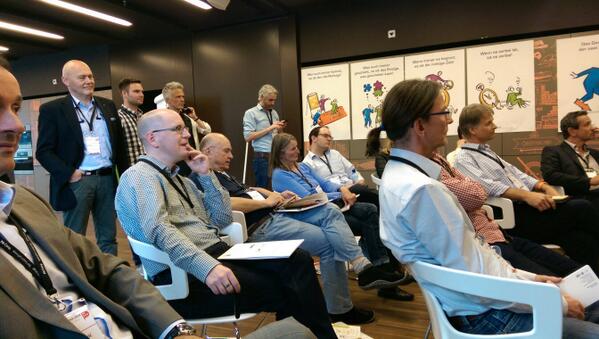
Picture of the wonderful Zürich PM Camp.
Ever since I remember thinking myself, I have been both impressed and confused by my own species. How we love and hate. How we wildly celebrate and mourn together.
How, because of totally irrational constructs, we fight each other to the death and are capable of the most unspeakable cruelty. How we quarrel and have arguments and then make up again. How we contradict ourselves. How, once in a while, we actually make some progress and yet then slide back again. How we believe in constructs we invented ourselves.
The more I learned, the more the twists of human history over time surprised me. For millennia, the course was a zigzag line and in between we went forward and back. Again and again, there was also some small progress. But we never really made the huge step forward. Consequently, humans are still incarcerated, cut up and tortured. And there is endless hypocrisy and lies. Collectively, as always, we murder and pillage in the name of God or in the name of the people or for a cause – or in the name of whatever.
It is quite fascinating to see how, on the one hand, we really made progress (I mean enlightenment and similar achievements), what great toys we developed in technology and yet how absolutely backwards and unwise (stupid) we remained at the same time. And how we find it quite normal that we are in the process of, as a matter of course, destroying our planet (and ourselves). Regardless of the fact that a different life would probably be a much more agreeable life.
To me, it seems that, especially collectively, we are stupid as one person alone could never possibly be. In fact, it is quite legitimate to follow Gunter Dueck and say that there is a very special collective sponge stupidity. Stupidity as in: the opposite of prudence.
Regardless of this threatening reality, I still believe in the utopia of a just society free of punishment, violence and war. But how to get there? If at all, it can only happen through communication and mutual understanding.
Would it not be nice if we were to manage peaceful solutions for all kinds of social challenges through teams and groups by way of consensus? And if, then, we could realize those solutions together? Following the Seneca motto:
Philosophy is not about talking, but about acting?
As we see on a daily basis, meetings are not really an appropriate means for making progress, are they? Perhaps it would be best to have peer-to-peer meetings with a fixed topic to discuss. Because everything begins with two persons meeting. But then you do not have a group or team effect.
This is how, as early as perhaps fifty years ago, Habermas defined the honest discourse. I described it in my presentation on “The Change in Management“ (Der Wandel im Management – see at the bottom of this article). And in fact, we have already come a little closer to it.
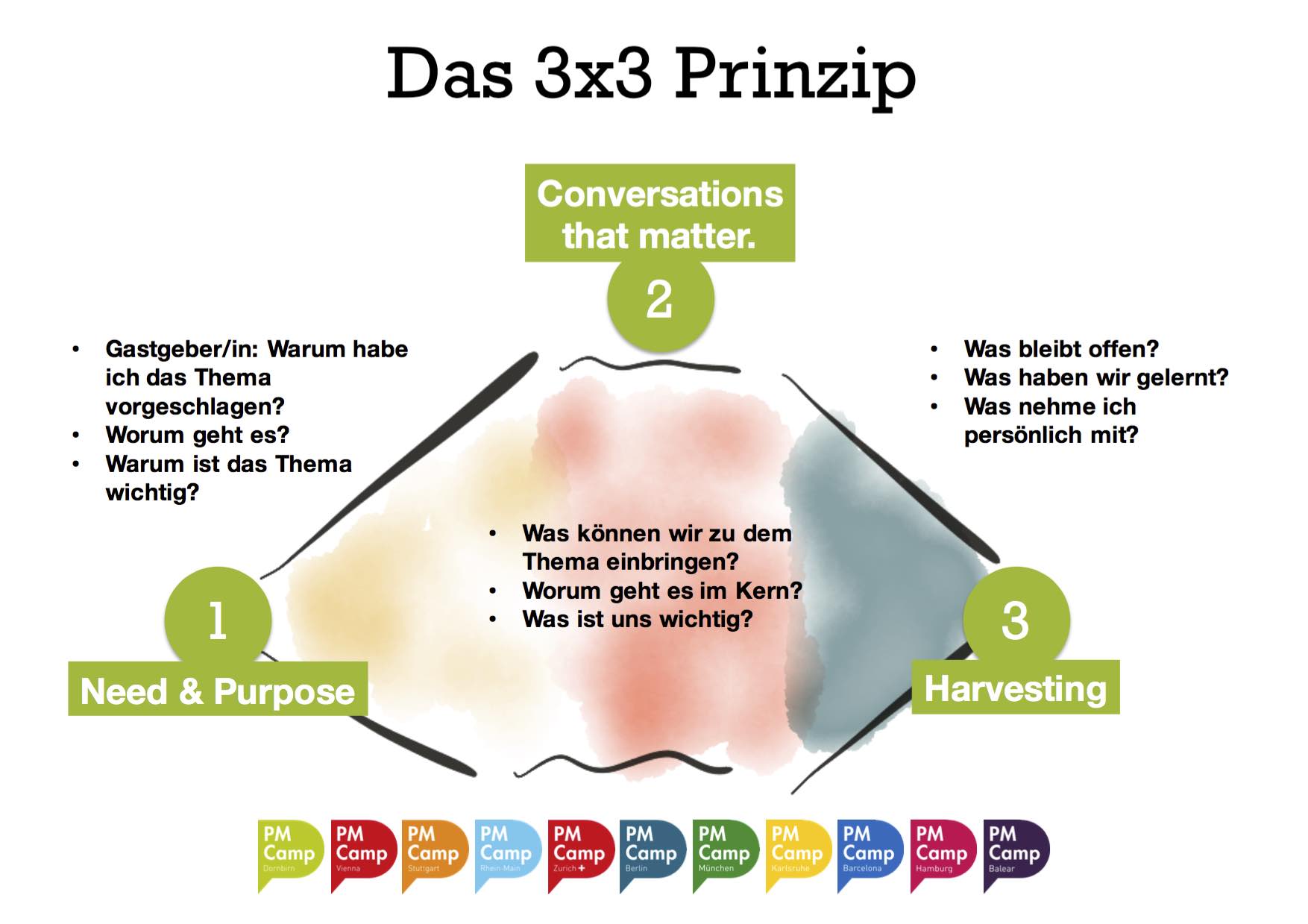 My colleagues of Art of Hosting, too, sound encouraging to me, as do the PM Camps I was able to attend.
Barcamps are very “basic” events. The hosts create a setting in order to make it possible for their guests to have good conversations. The persons who come are those we want and they will be true part-givers. And they decide in which direction we are going. It is an anti-conference, the democratic opposite of a conference.
Barcamps and similar formats like “Open Space“ are precious concepts. In Germany, there are thousands each year. They are about many topics: Sometimes they are about re-activating life in the city or the solution of social challenges. Other topics often discussed in barcamps are the work-life, education, family, research, gender issues, society, health, innovation, life, mobility, entrepreneurship, change, diversity, the future and many, many more.
I often get the impression that there is no important topic today that is not taken up on a barcamp somewhere. And I understand more and more clearly that all these anti-conferences and barcamps are the places where persons can make a difference and have an impact on the future. After all, during these events, people meet in order to share knowledge and experience – and they build networks!
Since all these many barcamps are so important, I am rather glad that, so far, I never heard about a fascist or right-wing radical barcamp. Maybe the methodology of a barcamp is a contradiction to “fascism”, thus making them mutually exclusive? Isn’t that a wonderful idea?
I related those ideas to my friend and partner Eberhard Huber. His reply was:
I think the ideas of fascism and barcamp are, indeed, mutually exclusive. Fascism is always connected with some dogma. Said dogma always claims to possess the absolute truth. Dogmata and claiming to know the absolute truth need prophets you listen to. Given an open discussion such as they happen in a barcamp, the only thing that will inevitably happen to the status of the prophet is loss.
Well, this gives you hope, doesn’t it? And perhaps, some day, we will actually manage to fulfil the requirement formulated by Bertrand Russell. He said:
» All increase in technology, if you want it to promote, rather than lessen human happiness, causes the same increase in wisdom. «
Maybe, with new communication and new formats, we will, at long last, manage to gain the crucially necessary WISDOM. And then we might hope that, by the time our generation is extinct, the future generations will do a better job.
RMD
(Translated by EG)
Roland DürreSunday December 6th, 2015
What Annoys Me #34 – Lobbyism, Marketing and their Associations.
In my last article, I tried to voice my pessimism about Best Practice, methods, processes, standards, certificates, etc.
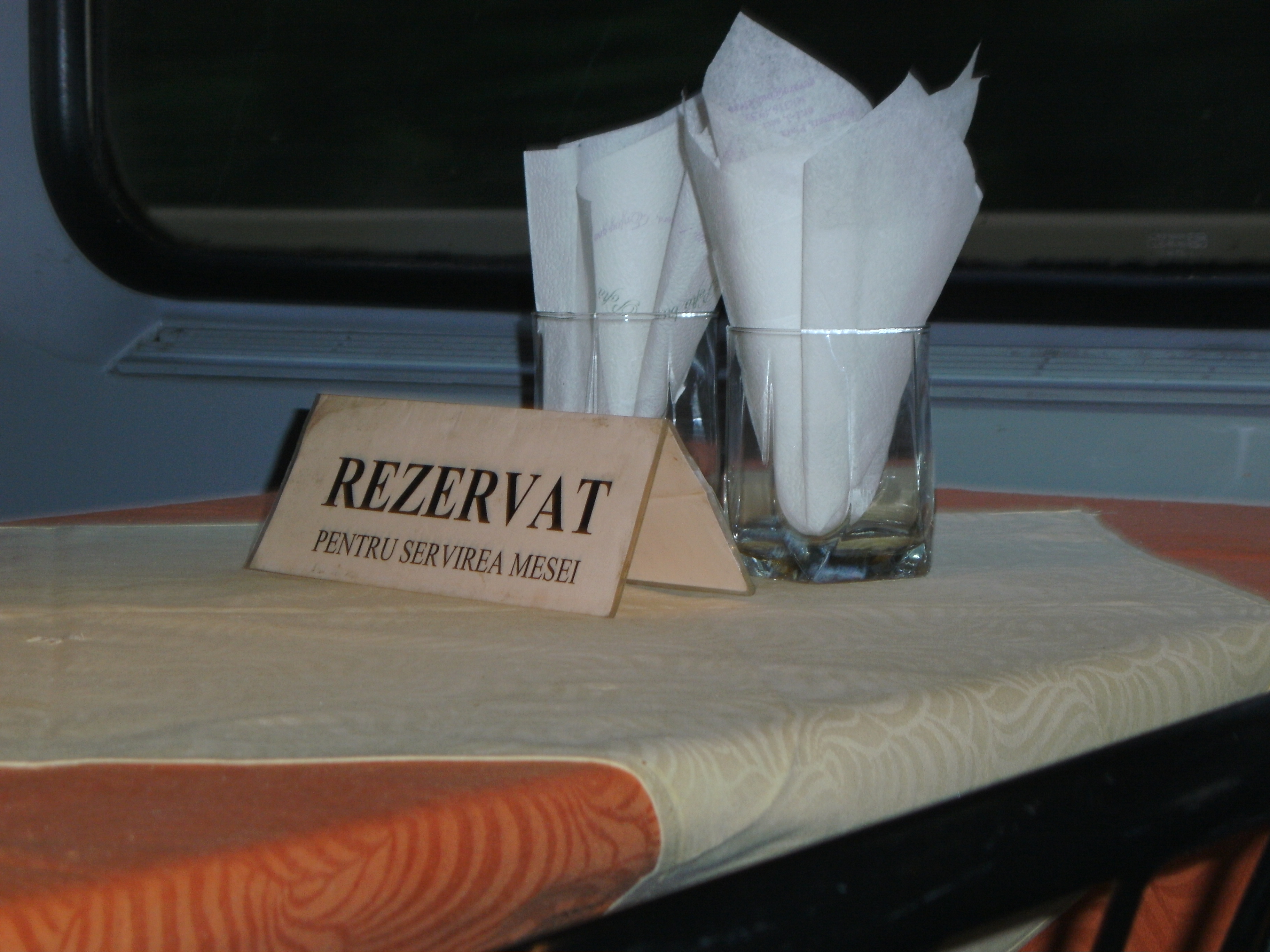 Now I am thinking of it while sitting in the InterCityExpress Train, being hungry and yet avoiding the Spaghetti Bolognese offered at the “Bordbistro”. Mind you, I basically like Spaghetti Bolognese, but not as “convenient food”. This same meal is probably advertised and served in all German ICE trains today. What is worse, I remember well how delicious the meal I took in a Romanian dining car a few years ago tasted.
Now I wonder who I should thank for all this. I am sure the industry is partly to blame. But the consumers with their “stinginess is super” attitude will certainly also be partly responsible. However, I also find it annoying that there are “free” clubs that actually promote this nonsense. It would be better if there were clubs protesting against it. And I am sure there are more serious problems in the world against which to get active.
Clubs have different goals and purposes. Especially in Germany, the number of clubs is horrendous.
There are some “good” NGOs that, in my estimation, prevail like a bastion through the ages. On a world-wide scale, I consider AI (Amnesty International) one of them. Others started well, but then, as time went by, they developed more and more into systems. Regardless, they still make a positive contribution in my opinion, even though there are often quite a few things that smell. I mean the likes of the Red Cross, Green Peace and similar organizations.
There are also some clubs that have been founded for a specific improvement, for instance Greencity or the Urbanauten. Others want to be quite differentiating when it comes to their social enthusiasm. In Germany, sports clubs have a huge tradition. Consequently, the number is endless: from alpine sports to gymnastics and shooting. These clubs were founded because of the common desire to do something new together.
Since all clubs are social systems, they also underlie the normal rules of development. They might well come to have the system maintenance as their only goal (self-goal) or become commercial enterprises (ADAC, enterprises of the entertainment industry “sports”). Regardless, I consider these clubs basically ok. And a sports club for everybody is definitely more to my liking than a fitness studio.
But there are also clubs the foundation of which was nothing other than the wish to gain advantages for its members from the outset. They were founded to break good laws and socialize losses. Their rules are determined according to the wishes of their customers.
I do not like them. I am talking lobbyists. They put enormous pressure on politicians and members of parliament in order to gain advantages for enterprises or sectors. As a general rule, these enterprises only want more profit for their customers, without taking the common good into consideration at all.
Lobbyism is one of the great challenges of democracy. As I see it, democracy can only work if we abolish lobbyism!
RMD
(Translated by EG)
P.S.
The industry of the cat-gold-salespersons and happiness-whisperers (aka marketing) with their motto “buy yourself happiness” are another threat to social market economy. Besides lobbyism, this is the second weapon of late capitalism for suppressing humans. Especially the marketing of today with its filigree methods and techniques is a hindrance to the development of an autonomous life lived in self-responsibility (called freedom) even in its early stage. I will soon write more about this.
Roland DürreSaturday November 28th, 2015
PM Camp Dornbirn – Between Pretension and Reality?
 In retrospective, the Dornbirn PM Camp was rather a success. Most (well, basically all) of the participants felt great and drove home with a feeling of satisfaction. In my opinion, this is great.
Also, many participants filled in our feedback forms. This is how we (the organizational team) received many constructive comments. I am currently working my way through those, along with the twitter “timeline” of our anti-conference. You can read the timeline under the hashtag #PMCampDOR. Incidentally, it is a lot of fun: a retrospective view with many useful links.
Statistically spoken, the feedback was just as positive as the individual comments. This gave the organizational team a boost. Barcamps are something special. They are based on freedom, eyelevel, participation, equal rights. You can also see those factors as “weaknesses”. But then, they are weaknesses I personally find rather attractive. A barcamp lives from the moment. You cannot control them, the sessions rise from the context of what you have just experienced. And that is a good thing!
In other words:
Freedom and diversity can also polarize. You might get focal points and conclusions that not everybody will always like. Well, you have to cope with this, just like freedom is not always something you can easily cope with. It takes tolerance.
Democracy, too, has its problematic side. Even the question how to best organize democracy can be a problem. Just remember the passionate discussion about “direct versus parliamentary democracy” – one of which is considered the solution (for instance in Switzerland) while being considered extremely dangerous (for instance here in Germany, because we believe the people are stupid). On the other hand, many are no longer at all happy with our “parliamentary democracy”.
Anti-conferences are democratic. Their dynamics depend very much on the persons attending. As opposed to conferences, you meet in a rather free room with only little formatting. This might trigger group dynamics that not everybody will welcome. But then, every participant can feel free to counteract.
PM Camps are very pluralistic meetings. Males and females meet, old and young persons, starters and almost-pensioners, successful and not-so-successful persons, persons who studied at university and persons who learned their trade in apprenticeships, no-nonsense types and laughing types, “not so wealthy ones” and “rich ones”, etc. Maybe these barcamps can manage to bridge the gap between ME and WE and thus reduce the tension between “individual” and “collective” needs.
And what is true for projects is also true here: technology and tools are no longer the problem. The existing methods, too, are mostly more or less suitable. Yet most of the projects fail because of the “human factor”. This is also a danger with barcamps. You can never please everybody. Consequently, both the tweets and the feedback forms showed us that some details were highly praised by some, yet criticized by others.
Besides the positive feedback, there was criticism and recommendations for improvement. Wherever the recommendations for improvements do not counteract the barcamp principles, we will take them very seriously. Just as we will take the criticism to heart. But then, you could also say:
If someone criticizes something about a barcamp, he is also criticizing his own behaviour.
Here is a list of feedback with my comment:
Positive Feedback:
The positive feedback is by far the majority. Even though I would enjoy citing all of them, I will restrict myself to a few:
If the PM Camp would not exist, one would have to invent it!!
I will be back!
I was able to learn a lot, make experiences and meet very interesting persons!
Continue in this way, no regulations!
There was a very homely and cosy atmosphere, the discussions were all at eye-level!
I could continue I this way – and very often, there was a
Huge Thanks!
and 100 % of the participants replied to the question:
“Would you recommend the PM Camp to a colleague?“
With a Yes .
Of course, reading this made us truly happy. We in the organizational team will process all the positive feedback with care and diligence. After all, what is true for persons when it comes to “personality development” (often also called management or leadership training) is also true for communities: first and foremost, you should promote your strengths, instead of always trying to work on the weaknesses. Because the latter will never be a success anyway and the former is so much more promising. Consequently, we want to make those things better that are already quite positive.
But I also have examples for
Negative Feedback:
The WLAN on the Camp was a catastrophe …
Yes, that is true. But I know how Stefan, in particular, took pains, both before and during the event, to improve the situation at the university. On the evening before, I also had a dialogue with one of the experts who had explained the problem to me. The specialists at the university, too, tried their best, but again, they did not manage it. Due to highly complicated security aspects, the systems are programmed in such a way that the technicians cannot do it. Naturally, we will try to do better in this respect next year. Yet we should also appreciate how much the Dornbirn Fachhochschule as a sponsor of the event is doing for us. Maybe we can be a little lenient in return.
There was no information about parking!
Yes – we forgot our dear car drivers.
More precise information on the event (start, end) on the website, please.
Yes, that is certainly something we can improve.
Pictures of those who organize a session would help with the orientation.
Unfortunately, “Aebby“ (Eberhard Huber) had to cancel on short notice – consequently, his polaroid camera, too remained in Stuttgart.
Criticism and recommendations on
Ice-Breaking, Moderation and an introduction round,
very diverse. Some wanted a round of introductions, others not. Some wanted more moderation and/or ice-breaking, others less. I would say it was about equally distributed.
Many ideas and recommendations for improvements in the feedback forms were about
“Newbies“ and “class meetings of old PM Camp attendants and how one could, maybe, improve the quality of sessions, for instance by coaching, mentoring or moderation.
A narrow majority wanted an explicit support for Newbies. The others thought it worked quite well automatically. To me, it also seems that this is easier with small PM Camps – such as Barcelona – than with big ones such as Dornbirn. So this was almost indirectly a criticism that Dornbirn is getting too big.
There was also some criticism on individual sessions and how they were offered.
Too much IT in the sessions.
I missed the games.
It would be better if the sessions of the second day were better based on those of the first day.
The principle and variants of sessions should be better explained beforehand, especially for the newbies.
I support whatever improves the session concept. Yet I believe that the organizational team should not meddle with the content of the sessions. They belong to the “part-takers”. The organizational team has the chance to motivate those who are interested in the messages or want a controversial discussion about them by formulating the mottoes and selecting the impulse given before the event. That should be enough.
But there are some challenges for the future. I particularly liked one of them:
It will be THE ONE challenge of the future to maintain the high standards.
That is exactly how I feel!
Incidentally, there is a lot of praise and some criticism of the Dornbirn PM Camp on the official GPM Blog. Reinhard Wagner reported on the Dornbirn PM Camp in a post, actually writing a few rather negative things in his last paragraph (…PM Camp only partially managed to deliver what it had promised. …).
Since I see a number of misunderstandings in this article and also because my name appears in it, I will now discuss Reinhard’s theses “dialectically” and also try to explain a few things.
This is where I start with the text of the last paragraph written by Reinhard in the GPM blog. The sum of all the cursive text elements is the complete last paragraph, copied from his post 1 one 1 (RW). Whenever I use “normal” font directly afterwards, then those are my comments (RMD).
(RW) … The motto of this year’s Dornbirn PM Camp was “breaking with patterns” (What patterns should we break and how can we do it?). This is something the PM Camp managed to deliver only to some extent. As I see it, that is also the dilemma of the entire “PM Camp” movement.
(RMD) Not only PM Camp, but the entire human society has the dilemma that it cannot manage change to a reasonable or at least desired extent. Current history alone is a good proof of this (wars, terrorism, the destruction of the planet…) .
The problem I have with what Reinhard writes is that, for me, the only thing a PM Camp is supposed to deliver is a) to be a good host and b) to find the right participants. That is also what the organization team for “our” Dornbirn PM Camp aimed at. And as I see it, the same is true for the entire “PM Camp Movement”.
Each year, we meet at the PM Forum (our strategic organ for all PM Camps) amd discuss how to best do this. Here, the representatives of the regional organizational teams (the operative event managers who organize the Camps) and the core teams (the normative founders) meet. During this meeting, we exchange ideas on what could be improved in order to make it even easier for you – our guests and visitors – to exchange knowledge, find consensus and gain insights.
The basic role of an organizational team for a PM Camp is that of host. It looks for sponsors and, finances the event where it costs more than the participants’ fees have brought. In addition, we, as a group, try to come up with mental concepts (for instance a motto like the metaphor of “breaking with patterns” before the event) and to promote the success of the entire affair through impulse presentations during the Camp (what?) and ideas about the methods of presentation (how?), without ever jeopardizing the core ideas of a barcamp.
We are very careful about not clandestinely turning our “anti-conference” into a conference or congress.
Please remember:
A PM Camp is nothing other than a barcamp directed towards project managers, entrepreneurs, leaders – basically all those persons who are prepared to take responsibility for our future. It provides them with a platform for the exchange of opinions and ideas and thus supports their networks.
(RW) The “young wild ones” (sorry Roland Dürre) try with all their might to distance themselves from the established big ones in the field, primarily from the GPM, the PMI and the PRINCE2-Community.
(RMD) As to the “young wild ones”: personally, I must say that I do not see myself qualifying for “young”. I meant quite a few young start-ups with this metaphor. They approach things totally differently from what I am used to with the “established enterprises”. And whenever a start-up is a success, then it is definitely not because it thinks in terms of projects.
But back to the text. The very phrase “established big ones in the field” shows how problematically Reinhard is positioned. Personally, I do not see the PM Camp movement as competition of any “established big ones”. Because we are not an association. If anything, we might be an alternative to it, meeting in a free area and exchanging knowledge and experience. During a PM Camp, what you do is motivate each other to start thinking. The “ME”s will meet as part of the “WE”s. That has nothing in common with an association or similar structures. This is also one of the reasons why the organizational team must not and will not give proactive recommendations.
Incidentally, the PM Camp Movement also always coordinates whatever they do with openPM, the open portal that provides a platform for the free exchange for all project managers. openPM is a non-profit-making club that, as I see it, is no competition for the “established big ones” either. Consequently, openPM has nothing to do with those clubs/associations.
My personal reason for shunning clubs and associations is that, to me, they all seem to think they alone possess the “truth”, then they mould their truth into rules and laws and earn their (horrendous sums of) money with it. That is something I do not want to be part of. But I am not trying it with all my might. I am just clearly stating the fact.
(RW) The pattern “agile” versus “traditional” is used far too often. In almost all the discussions, you get the comparison between “industrial age is old and evil” versus “information age is young and good”, the same is true for “waterfall” versus “Scrum”.
(RMD) Here, Reinhard probably misunderstood something. It is quite possible that, years ago, there were such frontiers. In order to stop this nonsense, however, we started a PM Camp in Dornbirn in 2011. Its motto was “building bridges“.
Consequently, I hardly noticed any conflicts between “agile” and “traditional” during the Dornbirn PM Camp. On the contrary: all the persons I heard – including the impulse presenters – made it quite clear that anything can be justified. All you have to do is consider what you want to use when for which purpose.
Incidentally, I believe that all you need to know about “agile” has been written down in the “agile manifesto“. What you find there is a recommendation to use “common sense” in an “honest” way. And I cannot see where this is supposed to be a method. Basically, it should be something that goes without saying. Just like it goes without saying that you can make many mistakes in projects.
(RW) One presenter spoke against all rules and “patterns”, before, a few pages into the presentation slides, saying that you should actually not do any projects (#noprojects).
(RMD) If this is referring to the impulse by Robert Weisgräber, then I have to say that his was one of the best presentations I have watched in a long time. This can also be seen from the feedback statistics. But perhaps the metaphor #noprojects is not all that easily understandable. Yet I did not really hear that you should not do any projects. What I heard is that you should think twice before deciding what to do.
(RW) In a workshop on “organizations as living organisms”, they tried to show how such an organization works. When I asked if we could perhaps exemplify this with the – unfortunately very successful – organization “Islamic State”, my request was rudely denied with the (killer) argument that this is not really the time to discuss that general topic.
(RMD) Naturally, what someone says in a session cannot meet the total approval of all participants. It has something to do with democracy. On the other hand, I would also not think it goal-oriented to discuss the IS as an example. Not just because, to me, the IS looks like a criminal, fascist organization (The Third Reich, too, was fascist. And still the “GröFaZ“ generated fear for all the established generals with agile warfare).
To be sure, Reinhard Wagner could have organized a separate session on the IS, or perhaps, more precisely, a session about “modern guerrilla war of fascist organizations as a successful method for fighting against technologically superior armies”. But I would not have attended such a session (or if, then just to tell everybody that I find it absurd).
(RW) Then, one participant tried to discuss the Cynefin framework. This discussion ended with the categorization of engineers and business economists on the right side (simple or complicated systems) and software developers, those creative wild ones, on the left side of the framework. Well, this does not really help anybody, does it?
(RMD) Again, this is about the content of a session. It has nothing to do with the Dornbirn PM Camp. Personally, however, I see it like Reinhard Wagner, considering the entire discussion about complicated/complex, left/right, blue/red more or less esoteric nonsense. However, I am sure that you can actually conclude right things from wrong assumptions …
(RW) Instead of breaking patterns, they dress old clichés in new clothes.
(RMD) I do not really understand this sentence. But I find it rather over the top to say something like this about the entire Dornbirn PM Camp. To me, this sounds a little like culture pessimism. But I admit that our entire society suffers from us constantly, again and again, using the same patterns. And that fantasy and creativity are things we tend to push away. Perhaps Reinhard and I actually lament the same state of affairs.
(RW) Finally, I have to ask the question what, in practice, the PM Camps actually want to achieve.
(RMD) Once again: PM Camps offer the general framework for meeting, communicating in an atmosphere of trust, sharing knowledge, gaining insights through honest discourse. There is no promise from the side of the Camp. If there is any goal, then it is that the persons who attend make each other look bigger – instead of smaller, as we have known it from many teaching systems. However, I believe it is amore valuable or practical application to “share knowledge” and to learn from the “other party” than to earn certificates or, what is worse, from the “certification of the world”.
(RW) To be sure, my own workshop impulse for “project management for social purposes” instigated a lot of discussion and enthusiastic comments,…
(RMD) Question: “What is an enthusiastic comment?“! 🙂
(RW) … but then my question what we could actually do was rather quickly cut short because everybody disappeared (wanting to have lunch).
(RMD) Well, that makes sense, doesn’t it? This is something the second day – with its actual sessions – could have been used for.
(RW) To be sure, it was also rather hard to make the participants actually put into practice what we had been talking about at the GPM.
(RMD) I cannot imagine why it would be easier at the GPM than in real life.
(RW) Yet this is where they could have been proved that they can do more than “give nice Sunday speeches” , letting “beautiful words” be followed by “actual behaviour”.
(RMD) Even Seneca said: “philosophy is not about talking, it is about acting”. And we can all see that we all talk a lot yet do nothing from the climate change caused by the burning of fossil raw materials. But again, I discovered that I have something in common with Reinhard.
(RW) That is what I would wish for, but perhaps it will just remain wishful thinking at Christmas Time.
(RMD) My hope (I do not know if it is wishful thinking), not only at Christmas Time, is that humans become a little wiser.
Even though there were many objections to what I had done in his article, I would like to explicitly thank Reinhard for writing it. And perhaps this is the beginning of an enthusiastic and wonderful discussion about:
How badly do we really need all those associations and clubs?
Because to me, it seems that many of them are totally unnecessary and I would certainly expect more from grass root movements.
RMD
(Translated by EG)
P.S.
The heading of this post is not my wording. It was directly taken from Reinhard.
Roland DürreMonday November 9th, 2015
Vintage Project Management #4 – My Biggest Project of All Times
CLOU/HIT at InterFace Connection
Or:
How Wolf and I eventually ended up doing it ourselves.
During the Berlin PM Camp, I related the stories of four projects from my vintage time. They were all very important to me. And I told you here that I was going to describe them all in the IF blog.
 Projekt 4
Now comes the story of my fourth project:
Even before 1983, I was fed up with working for others. At the time, I was still a Softlab employee. This is where I learned to extend my one-sided competence – with the exception of a little SNA (IBM), it was mostly Siemens technology – and learn more IBM technologies. In particular, however, I was able to learn about the different systems of the “intermediate data technology”.
I am talking machines which, dependent on their storage unit, consisted of two to three parts and had the size of Bosch refrigerators. That means they were a lot smaller and also a lot simpler than mainframe. At the time, those were especially fashionable. Consequently, there was an enormous amount of European and non-European competition with differing and often very proprietorial technology. Kienzle and Nixdorf were also among those aspiring MDT enterprises. And in those days, even in a city like Munich, the same software was developed synchronously in different enterprises for different technologies.
I am sure that Softlab was one of the most innovative German “software houses”. They, too, had a proprietorial system, the famous PET-Maestro. For me, this was the first system without the permanent frustration of data loss, because the Pet-Maestro already worked in symbols – and every symbol was immediately transferred to the hard drive. Consequently, you had a current warm start with every reset – and nothing was lost! It was such a relief to finally no longer have to fear data loss at all time when working, for example, with EDT or EDOR.
On other fronts, I also learned a lot of new things at Softlab. This is particularly true for the business sector: how to formulate an offer so that it contains the least possible risk, how to talk with the VB-s of the big enterprises (Bull, ICL, IBM, Nixdorf, Siemens – even at that time, nothing was going without the big ones), or how to write studies.
This is how I became a paper tiger (totally unrelated to paper tiger, the famous Chinese theatre movement). And in those days, it was (still) true that you got better pay per hour as a paper tiger than as a programmer. Thus equipped, I wanted to do it myself. Yet I did not dare to start all alone. So I went in search of a partner. I looked for and identified persons in my vicinity who I found nice and competent. And who perhaps also wanted to found a company. There were quite a few. But again and again, nothing came of it.
Until Wolf (Geldmacher) came. Wolf was considerably younger than I. Technologically, he was super. And our view of things was similar. Meaning that our values, expectations, interests and needs complemented each other. I was more the old style programmer – and Wolf had the knowledge about everything that was modern and new in IT. Also, Wolf knew absolutely no compromises when it came to quality. And if anybody had common sense, then it was Wolf. And I guess those are the most important factors: competence, common sense, quality awareness. Then you only need to be a nice guy…
Consequently, we founded the short version of InterFace Connection. We inherited the InterFace from Peter Schnupp, the “Connection” was our own contribution. That is what we wanted to be together with our employees: a “connection” that sticks together and later shares its success. We founded the enterprise in 1983 and started business on April, 1st, 1984.
But then, the enterprise is not the project I want to talk about. The project was about developing a product. And there were two reasons why Wolf and I wanted to have a product: firstly, we were convinced that a product would be something to be proud of. It creates an identity. Secondly, a product is easier to scale than a service.
Besides, in our eyes, the then well-established concept of “body leasing” did not have a future. Basically, we still believed in the law and as founders, it was pretty obvious to us that the common form of body leasing was exactly what, according to the AÜG, was simply illegal.
It did not take us long to become quite convinced that, in those days, Unix was the best basis for future products. Also, we agreed without hesitation that, basically, everything you needed for using computers was still missing in Unix. And in particular, we saw that a text system was sadly missing. And that the first thing you would have to develop rather quickly on Unix with its new data displays (in raw or cooked mode) and especially with the language c was a comfortable typewriter.
Since we had a huge amount of respect for the production and successful marketing of a product, we started the development of the product in cooperation with InterFace Computer. It did not take long before we had a small success in the SINIX (the Siemens Unix) environment. Consequently, the development of the product was moved to us and the InterFace Computer was put in charge of the ports and the sales on the “remaining market”.
And in no time, we also had a two-digit number of team members, all of them very young. In general, they were students. They had to have programming competence and be nice. And they had to cope with the work, regardless of their double burden of studying and working. Nothing else mattered to us.
Since Wolf and I (along with a few young employed computer scientists with academic diplomas whom we got through aforementioned body leasing and whose hours cost between 150 and 120 DM) financed the entire development, the young persons were rather free to come and go as they pleased. The only control was our assistant Heidi (Kaindl). Heidi was quite in charge of all the young persons, taking good care that everybody actually worked. The only times Wolf and I met them was during meetings (soon after our foundation, women, too, were employed).
In those days, Wolf had the role of SCRUM-Master and more (even though the word SCRUM did not yet exist). He told the team about quality. And that, first and foremost, they produced quality not for our customers, not for our sales partners Siemens and not for the InterFace Connection. Instead, being honest programmers, they needed to produce quality in their own interest. And Wolf had rather high standards and was very strict. If someone was not able or willing to deliver quality, he or she had no future at the “Connection”. But Wolf also protected the team, for instance when I tried to limit resources. And he made sure that we invested were necessary.
My task was perhaps that of the Product Owner. At least in the beginning. When I had been a young boy, I had been forced to learn stenography and typing. I used to love stenography, because it is a beautiful way of writing. It does not hurt your hand, as normal writing does. But I hated the typewriter. And I knew exactly how a good editing machine would have to look. I had also written it down in the time of our foundation.
When things got more complicated and, for instance, CLOU with its “embedded sql“ was added to our repertory, I transferred the role of Product Owner to our customers. And that was one of my best decisions ever. Because the customers actually were able to tell us their ideas about an automated chip processing. They showed us how to continue on our way.
One of our rules was that all employees – with the exception of Heidi – were able to program. Heidi was our first and most important customer. As soon as the first HIT version was available, we confiscated “nroff-makros”, her “office vi”, and she had to use HIT – which, incidentally, she did not appreciate at all. After all, the vi solution had not been so bad. Later, however, she learned to love her HIT. Surprise, surprise! After all, she was one of those who built it!
All other colleagues on the HIT team had to work hands-on. In other words, all of them had to be able to program, find errors and, above all, co-work (team work).
We were very early users of tools that would be commonly used a lot later. But this was only true for tools that actually made sense, such as “lint” for the quality control of our code or “sccs” for the source code administration. I am pretty sure that, time and again, we were the first in Munich. We were also earlier than most of the others using a “tracker” and an automatic “built”. But we never used planning software. Just as we always took pains to avoid “bureaucrazy”.
So all of us involved in the project were programmers. And we actually always coordinated in the team who was going to develop what. The personalities of the people involved were very diverse. But then, we also had the magic programmer. It was not entirely in jest that we called him “God”. But the first rule was that we were a team. Everybody helped everybody. Our motto was: “one for all, all for one”. Nobody was ever left in a lurch. And whenever you did not know a way out, you asked your colleague. Pair-programming in the strict sense did not exist, because it went without saying that this was practiced quasi automatically. Consequently, there were always several persons who knew the sources of the others. It was like an overlapping system that worked well some way or other without many words.
Of course, we had a rather complicated system with an awful lot of modules, interfaces, tools, API-s in our development. In total, a huge number of lines of code was produced. There were modules for the virtualization of keyboards, terminals or printers. We had developed the first National Language Support. Later, it became part of the X-Open UNIX implementation. We had complicated modules and modules everybody feared, as well as boring modules. Once in a while, we also had to find errors in the compilers we used.
The team always decided among themselves who was going to take on which task. Everything was part of the project: our value bank, mostly constituting of OpenSource components for source code administration, for the Built and the partly automated test, for the ports to the many end systems the Unix world then offered. Even producing the customer newsletter HITNews, which at the time was printed four times a year and determining the structure of the courses were part of it. Everything was done together, everyone .gave his best.
Naturally, once in a while there were situations when perhaps someone was unable to cope. Because maybe he did not yet have enough experience or perhaps he had underestimated the task. But then a colleague would help. The right person was always available. And when it was really necessary, there was still “God”.
Of course, everybody had his own role in the team. Each of us was a project manager and as such responsible for the appointments he had made. Some had more, others less. Each of us was a quality manager. Some more so, others less. Of course, there was something like a first contact for our customers and our partners. It was always a mutual decision (“who is the best for this job?”), but he remained in the team as a programmer. But, basically, every developer answered the questions of his customers. After all, they simply came into our office. The central bell rang, and whoever was the first to answer the telephone was talking to the customer.
Naturally, some of the colleagues were more concerned with integration, planning, configuration and the built-theme, the manual, … But every one of them was always fully integrated into the team in terms of technology.
But everybody always went back to programming. And everybody was responsible for top quality. For instance because they built automatic test environments simply as a part of the project. The responsibility was totally shared.
With the success came the necessity to have teachers for our product HIT/CLOU. During the first few years, all the developers also taught the courses. This was true for teaching the end users, the special users, the systems engineers, the operators and the programmers. Even the central persons, like Friedrich Lehn, the “father” of CLOU, taught courses where beginners were instructed on how to program CLOU.
There were instances when the developers did not appreciate this. After all, developing is much more important, isn’t it? But the courses were quite popular (because, after all, the colleagues knew what they were talking about, which certainly counterbalances the occasional “didactical” weakness). But the great thing about it was that our colleagues always knew exactly what the customer wanted and needed! This is how the customers as a whole became the Product Owners.
Due to these inter-disciplinary tasks, our colleagues grew both in technological competence and personality at enormous speed – that is also true for sales competence. More often than not, it was unbelievable how young students became experts with a huge self-esteem after a few months.
Without ever saying it out loud, we on our team understood even at that time that it is all about making all the persons in the team and in the enterprise look biggger instead of smaller. And to make them be part of everything and share everything. We knew that we often had to have really steep goals, often even bold goals. Otherwise, we would never have managed our product. But we also knew, especially in this situation, the importance of living a strong error tolerance.
The colleague in the team or the customer must never ever be the enemy or adversary. Instead, the only enemies were the challenge or the detrimental circumstances.
Wolf and I were the “management”. But we were more like visitors in our enterprise. After eight to ten hours with customers every day, we came back to our employees at home in the office for recreation. They were all our friends, it felt good to be near them. And they showed us all the great things they had, again, created. We gave our feedback and then disappeared to our next day of consultancy.
And whenever a nice result was achieved, we all celebrated. It was the best time of my life. We learned so much. We also learned that thinking normal and conservatively is often nonsense. For instance, I always wanted to deliver to our customers on time. And I had to learn that this is utter nonsense.
Because if you want to create something really innovative, you will learn again and again that deadlines do not make any sense at all. It simply will not work. If a deadline can absolutely not be met, then all that matters is a functioning communication and looking for a solution that satisfies the customer. Because when they are all in one boat and want to be a success together, then there is always a solution – and we found out that it can always be done.
I already hear your objection: Well, it might work for a small project. But what about a huge project?
To be sure, we were perhaps less than 50 persons. But the very same projects had failed with more than one huge concern. They had often used five times as many persons as we or even more. Expensive, experienced and highly qualified ones. But it did not work.
I believe it can be done in the same way if you have a huge or even a very huge project if many such great teams are linked and cooperate with good-will.
RMD
(Translated by EG)
Roland DürreSaturday October 31st, 2015
Vintage Project Management #3 – Youth, Consultant and my First Project Manager
Or:
The First Time I Experienced True “Project Management”.
During the Berlin PM Camp, I told the stories of four projects from my vintage timethat were very important for me. And I also announced that I was going to write about all of them in the IF blog.
Project # 3
So here comes my story of the third project:

Fernschreiber (Teletype Machine (Siemens T100 – 1958), the modern successor of T50
After my change of positions inside Siemens away from UB D WS DF 131, I shared the technological responsibility for a relevant and absolutely innovative huge project called DISPOL with a new colleague working with whom soon became my true pleasure.
Siemens had won the bid for replacing the telex network of the Bavarian Police Force by a trans-data network based on modern circuit switching. At the same time, the card index boxes were to be replaced by a database in a central host (mainframe – it was a BS 1000 system). Also, modern display units were to substitute the old teletype machines.
That was roughly between 1979 and 1981. I was still a regular Siemens employee, but I had just fled the “bureaucracy” that had started at the development department of Transdata/PDN, looking to have better luck with sales at UB D V S 3. That was short for “department data processing, sales and special projects 3“.
See also my article on Vintage Projekt #2.
My move from the laboratory to the special projects necessitated that I now had to leave the private environment I had learned to love so much and found so nice at the Ortenburgstrasse (near Siemens Hofmannstrasse) and go to Neuperlach. And it did not take long for me to understand why the new building near the Neuperlach S-Bahn station was spitefully called “data sibirsk” or “Lego City” by many people.
For me, it was even worse: I had to move into a cold skyscraper surrounded by a fenced area that reminded me of barracks. Concrete and cold high-tech were the dominant features. And I also felt billeted. The only thing that looked halfway human in the entire areas was a fruit vendor who offered his goods on a stall inside the compound.
From day one, I felt uncomfortable in the concrete bunker that only looked colourful from the outside but was rather grey inside. Mind you, this was regardless of the fact that you actually could still open the windows and that there were quite a lot of green areas inside the fenced region. Yet, even the green was domesticated in a very prosaic way – it did not look as nice as you would, for instance, imagine it on castle grounds. Instead, it was techno-utilitarian.
But I was lucky. After all, I belonged to “special projects” – and they did not happen in the office. They happened outside, in the world. And since I was quasi equipped with privileged information, I felt like I was my own master and a little king.
Consequently, I preferred to mostly be where the customer resided (Bavarian State Office of Criminal Investigation in the Maillinger Straße) and to hardly ever be available in Neuperlach, except when it was absolutely unavoidable. To me, the rooms at the police station, regardless of all the very strict security regulations looked a lot more human than the new Siemens AG high-tech venue.
My flight from the “laboratory” that had fallen victim to bureaucracy had been a success and now I was allowed to experience real life. And the project DISPOL was a great thing. A total innovation. Together with the excellent partners of the Bavarian Police, we were a wonderful team. We cooperated with a maximum of efficiency and at eye-level. But I have to say that the project was already well under way at the time I became part of it.
And there were a number of birth defects – in all imaginable dimensions of the project. Consequently, the first thing to do was overcome a series of hurdles. We had a totally stupid design which had already been partly implemented (they wanted to realize a fixed system, which was totally against the dynamic connection technology), there were diverse architectonic mistakes with both the hardware and the software that had to be corrected quickly (systems with no local storage for quick reload, inadequate testing environment,…), the total absence of a component that had been promised (one example is the telex port which was quite good at doing the protocols of the postal service, but not for the police, who were “electronically” different) and many other “normal” challenges you meet when you are doing something for the first time.…
And there was also a requirement in the contract that was rather hard to meet. Because the new product DISPOL was supposed to replace a teletype machine network. And these kinds of teletype machines had (at least in Bavaria) an availability of a hundred per cent over years, if not decades. In other words: they NEVER broke down.
And, of course, that is what the customer expected of the new solution, as well. Justly?! Since, (at the time), Siemens was, of course, not stupid, they had negotiated in the contract that the system at least did not have to be a hundred per cent available. Once in a while, it was allowed to break down. Perhaps they had a hunch that electronic data processing had its limits. But then, it said “once in a while”!
Consequently, it had been written in the contract that the product was only considered functioning if the system ran a certain amount of time (I think it was two weeks) without interruption and that the “down-time” during this time had to be only very few hours (I seem to remember it was only one).
The only problem was that re-starting our computers also took a little more than one hour. Which meant that even if one single system shut down, the two weeks started anew and thus all attempts at delivering the product were in vain after a few days, or at the least a few days before the deadline…
(Note: we solved even this problem. If you are interested, I will gladly tell you how).
Basically, there was always a shut-down, because we had a number of sporadic and hard-to-reproduce errors, one of which would always occur shortly before those four weeks were over. Well, we just had to isolate them individually. But then, isolating errors takes time. Because you have to implement traps that catch the error and make it reproducible. And due to the contract, we did not have this sort of time.
Here is a note that might be interesting:
The test was designed in such a way that the normal police procedures ran twice during the acceptance phase. The real run with the real data continued with the old technology of the well-functioning telex network. But then, the original data (punch strips) ran on the new system 1:1 after a little time had elapsed. For testing. To keep up appearances, critical data were made anonymous and less drastic, but this was not always possible. And (of course), nothing happened. We all knew that those were highly sensitive data and that we had a lot of responsibility. Today, the gentlemen of data security would probably make a huge ado about it.
But back to the topic: The stability problem of the system only arose during the end phase of the project (which had already gone on for quite a long time). Due to the aforementioned factors, there had been some problems earlier, as well.
Consequently, our management panicked. That was also the reason why they had made me join the project. Then they understood that there was a lot left to do and we got additional resources: consultants and young persons who had been sitting around somewhere in the concern and had not known what to do with their time. And:
A project manager was installed!
Let me first tell you about my experiences with the consultants and young persons, later about the project manager.
The Consultants
There were several of them. They were supposed to help us, but that was not really what they usually did. I particularly remember two colleagues from the PSE (that is the Austrian Siemens daughter for software development). One of them was from Vienna and the other from Graz. They both held doctorial titles, one of them in psychology, the other in physics.
They were both really nice persons. They were both not happy to be far from home. The one missed beautiful Vienna, the other Graz. To me, they both seemed extremely intelligent, if not ingenious. Both had first names beginning with an M. and both had not much knowledge about the system, and even less an idea what a good code should look like.
Yet I never told them, because I really rather liked them. Consequently, we let them play along, which they both did quite well. Except that they never really made their way to the middle of the project. One of the reasons was that, in this project, they were like mercenaries, “away on a construction job”. Which actually does nothing to increase your motivation and readiness to make a huge effort. Consequently, their added value was not really relevant.
The young people
I remember a young lady and a young gentleman who were added to the group. Both of them were terribly young (early twenties, at the time, I was not yet 30). They both had trained in the IT sector somewhere at Siemens.
They were both highly motivated, listened carefully, did what they were told and thus they quickly understood the technology and their task. I assume that they were also quite cheap – especially compared to the two consultants with their doctorial titles – and they contributed enormously towards the project success. Incidentally, they both went on to become a success story. But not at Siemens.
Now the only thing remaining to talk about is
The Project Manager
The project manager was an earnest person who always wore ties and struck me as extremely nervous from day one. Said nervousness was easy to understand for me: after all, he was supposed to solve a problem he knew basically nothing about. He sat in our room a lot of the time writing reports. The rest of the time, he had meetings in Neuperlach. His role was something like being a translator between the worlds of management and the project that consisted of technology. Since he did not know the language of technology, he never understood the project. I assumed that he did not know the language of management, either. After all, during my time at the laboratory as a supplier for a huge project, I had learned some of it. He was a lonesome wanderer between two worlds.
Our project manager had a strange voice and consequently, he was soon stuck with a nickname (Schnarrie). The idea had come from our two ladies (W. and C.), who did a good job with the coordination and customer service. Perhaps because they were angry about their roles having been cut down.
For us, Schnarrie had a double positive effect. Firstly, we no longer needed to tell management why we did what we did – which had cost Hans and me, and sometimes also our two ladies, quite some time and nerves. And he also had a budget! Which was something totally new for us. Consequently, we managed to celebrate several “victory parties” on the Siemens budget when we had found a sporadic bug or some such.…
So much about this. Incidentally, the project DISPOL was a huge success and ran for decades to the greatest satisfaction of the Bavarian Police Force. And in its wake, it brought quite a few good customers to Siemens AG, as well.
RMD
(Translated by EG)
Roland DürreSunday October 11th, 2015
Vintage Project Management #2 – My First Real Challenge
How I landed my second of many projects.
Project #2
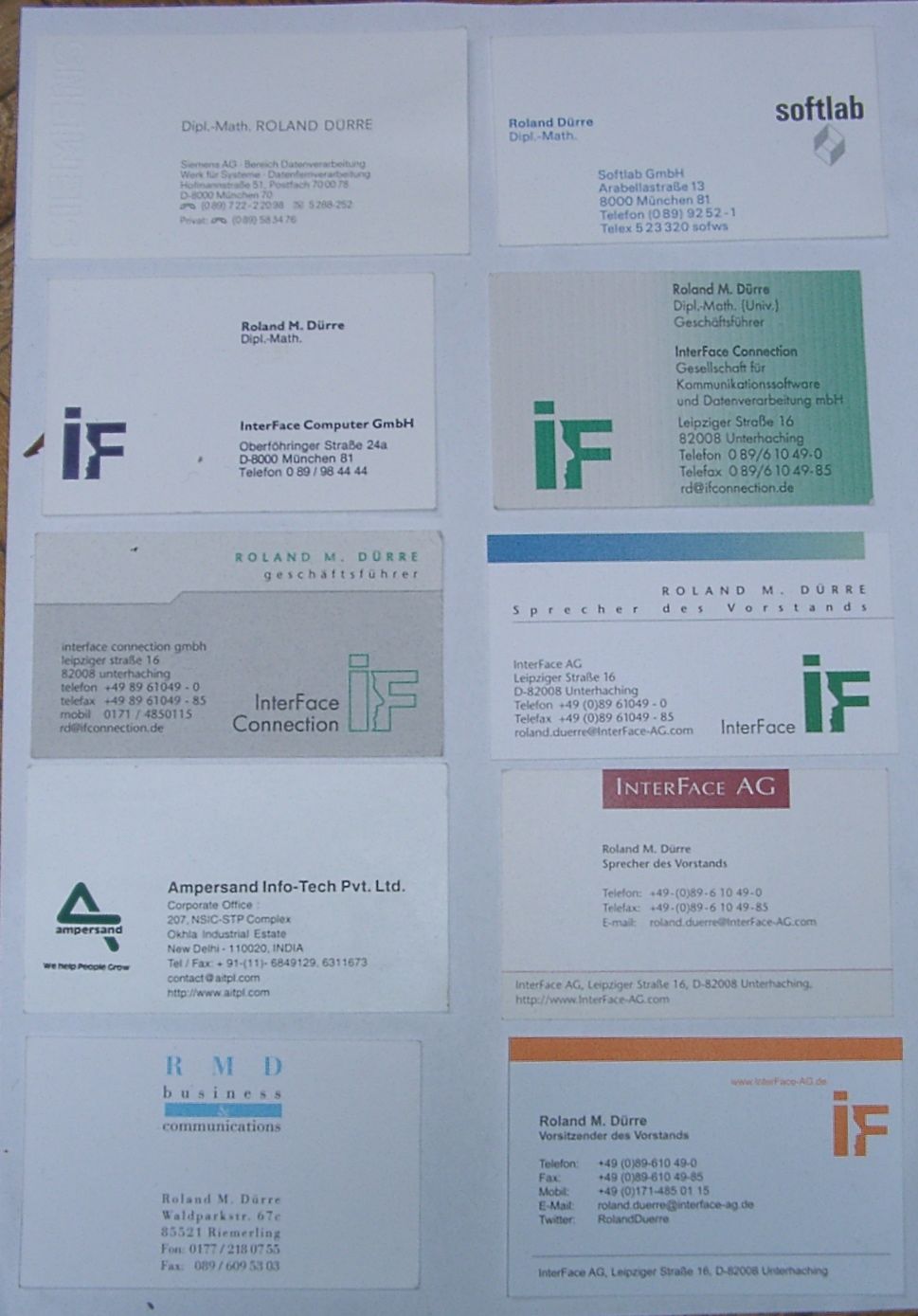
On the upper left hand, you can see my first Siemens visiting card – the first of a collection I am eternally proud of.
After my re-start in October 1971, I continued my university education, the successful finish of which lay in winning my diploma. Here is how it happened:
When I was in the then fourth semester in the summer of 1973, I noticed that it was about time to sit my interim diploma exams. And I noticed that, indeed, there was quite a knowledge gap.
Consequently, weeks of learning lay ahead. The weeks before the four oral examinations would be stressful. I fell victim to knowledge bulimia, a sickness widely spreading these days and actually an epidemic in all the school and university systems I know. After having passed the interim diploma as required (surprisingly even with quite a fair grade; “good”), I was rather worn-out and had to give myself some rest.
Resting was exceptionally great fun while breathing computer air at Siemens. They truly had a lot of hardware: large-capacity computers with BS2000 and BS1000, process computers, office systems, network computers and much more. I was truly over the top. At the TH – which was now called TU, because, after all, a university is something better than a college – the computing times allocated to students was rather scarce. Consequently, you seldom saw me there.
As a logical consequence, I spent more time at Siemens during the following four semesters than at the not very humane (and probably even then asbestos contaminated rooms) of the new southern TUM informatics building. Incidentally, said southern building was torn down several years ago. Just imagine that the building where I studied and which had been built more than 20 years after I was born was outlived by me. Now isn’t that somewhat strange? The old TH building is still prospering.
It was my good luck that my major topic, mathematics, could easily be studied out of books. They are a good substitute for attending and listening to lectures. After eight semesters, I noticed that there was a diploma thesis to be written before admission to the final exams. I found a professor (Dr. Werner Heise) – regardless of having been the youngest mathematics professor of all times at the TUM, he unfortunately died a few years ago – who was willing to hand me a really exciting combinatorics topic for said diploma thesis (it was about the assumption by George Polya which, however, had not yet been proved – which is how the theorem by Dürre came to be).
It was not easy, but it went well and was a truly great experience for me. I also enjoyed actually meeting Mr. Polya from Hungary on a combinatorics congress in Berlin. The trip to Berlin was especially fascinating because at the time Berlin was still a wonderful island in the middle of enemy country.
After the diploma thesis, the final exams lay looming – and again I fell victim to knowledge bulimia. It was even worse than before the interim diploma. But, again, the knowledge bulimia worked well. There came a day when, although totally exhausted, a very happy me held his diploma document in his hand. To be sure, I did not know if that was something to be proud of or not. But I was immensely happy to have finished the sad chapter “university”.
I was not in the mood to write dozens of applications or similar things. A journey around the world or even a vacation were also out of the question, and so I tried to find a job. I applied at Softlab. I found this company really great, because at Siemens, I had once read the hectography of a book by Peter Schnupp (structured programming) and I found said book a beacon in the darkness. And Peter Schnupp, whom I later met and who became a much-loved friend of mine, was one of the Softlab founders (along with the colleagues Neugebauer and Heldmann).
Consequently, I sent my first (four years later, there was a second one) application to Softlab. It seems, however, that at the time Softlab was undergoing minor crisis phase, which is why they sent me a very polite letter of refusal. It said that they actually were quite interested in me, but currently had no tasks appropriate for my skills. They also asked me to try again next year.
Naturally, that was not much help to me. But as matters developed, it turned out that, more than four years later, I landed with Softlab anyway – but that is another story.
“After finishing your university education, you have to work!” – that is what the bourgeois part of my super-ego told me. So I took the same documents I had sent to Softlab and used them to apply for a job at Siemens AG. I was optimistic, because, after all, they already knew me. And, yes, they took me – and they also had a real project waiting for me. It was part of a bigger project, which again was part of a really huge project.
I ended up at UB D WS ST DF 131, which is short for the department data processing, laboratory for systems, system technology, data transfer, 1st company, 3rd train, 1st battalion. The last three terms are my personal interpretation of 131. After all, the founder of the enterprise took the Reichswehr as a model for the organization of his company
The entire DF (which means an entire company of the Siemens army) worked on a hardware and operating system for realizing the data networks called TRANSDATA. Incidentally, I think it is another disgrace for the German IT that this term cannot be found in Wikipedia (I wanted to put a link right here). After all, this was the only and technologically superior competitor of “SNA“ (System Network Architecture) by IBM, who were our biggest and then perhaps only competition.
The Transdata software was called PDN (programmable data network technology) and we generated operating systems necessary for the data station computers, the network node computers and the mainframe model computers. Those two years were probably the most exciting years of my entire professional career. I could easily write several books about the time.
On this picture, you see a Siemens & Halske repair shop in the rear building at Schöneberger Straße, Berlin, on October, 19th, 1846 (Source: Wikipedia)
The official term for our facility was: laboratory. My group, the 131st of DF, developed software and was responsible for APS (short for user’s programming language). The language was supposed to make the “stupid” connecting computes do the (pre) processing as early as at the fringes of the network, for instance when it came to collecting data for a business process in the user’s dialogue. Also, it had a controlling and “intelligent routing” purpose.
Within DF, there were a number of teams, all of them developing new things. Because a computer network needs a lot of modules and, considering what times we are talking, it was rather complex (or highly complicated). And the team cooperated on a high intensity level.
Together with the customers and the partners of our FBZ (technological counselling centres at Siemens AG), we made Transdata the basis for the new big IT projects. And it all happened in a very agile, open and slim way. The minutes of the coordination meetings with the big projects and the technological counselling centres were our specification sheets. There was also a management, but their primary task was to see to it that all humans were happy. And to protect the teams from the Siemens management.
We worked in an enclave, in the Ortenburgstr. It was one of the many Siemens locations outside Hofmannstr. There was an actual bakery on the ground floor, which in itself made the location attractive. No barracks and instead tasty pretzels and rolls.
Some way or other, we all at DF were a good team and made the dice roll. We were all engineers and developed technology for real projects. And Transdata became a success. It made me proud to work on systems that often ran in important and revolutionary projects.
At the time, my job description was:
Synchronously programming on three versions. Version A (for example 4.0), which currently was on the market, was maintenance I had to do. This was about correcting errors and communication with users. For the next version, I developed the functionality as had been agreed upon and decided (version B, aka 4.1). And then, I had to plan version C – which would be 5.0 in our example – with the project partners.
Thus, the time we invested into the future was quite considerable. Because the market was demanding and very dynamical, the competitors were quick and consequently the speed had to be high.
On top of programming three versions simultaneously, I had more tasks, too. Of course, I wrote the manual for our programming language myself. I had to do the technological supervising of our large-scale projects and teach courses for the system engineers who used our system.
On top of this, I also organized the test of our new functions with our pilot users and wrote the product flyers for our marketing. In those days, new employees were recruited all the time. After half a year, I actually was an “oldie” at Siemens because of all those “newbies”. And we also had to continue our education – which was mainly done by reading the ACM or IEEE lecture notes.
As a side-line, we organized a coffee machine and a fridge for our office – which caused quite an earthquake with the Siemens administration. A coffee machine in a Siemens office – that was against all regulations (regardless of the fact that such a machine, allegedly, could be bought at a discount by the employees at “our” shop). But we managed even that.
And then the sad times started. Management grew more and more powerful. They introduced division of labour. It was some kind of development Taylorism in the laboratory. In addition, the administrative processes grew more and more time-consuming. That was in the second half of the 1970ies. We had to kiss our laboratory idyll good-bye.
First they introduced the manual editorial office. We had to teach persons who had not the slightest idea of how IT worked what needed to be written in a programming manual. Then came quality management. Those were people who had to have tested our software before said software was prototypically used by our customers. Except they had no clue about software and testing same.
Then they introduced product management and requirement engineering. All of a sudden, there were mile-stones, such as A20, A30, B20 … B50. The waterfall model came. Even the termination of the product was defined with enormous precision. That was T50 if I remember correctly. It was called project phase model. And we were no longer allowed to do any programming. Instead, we had to think about the level of maturity our work had now achieved.
They started the budget concept and expected us to make (guess) predictions about the expected cost for all discussed functions. Unfortunately, most of the new functions were very innovative and involved a high degree of creative research. Thus, predicting the expected cost soon became more time-consuming than the actual programming. Except that we were no longer permitted to do any programming, anyway, because in order to decide if there was to be any programming, you first needed a tested and approved cost estimation.
And thus it happened that what formerly we could discuss directly and decide with the customers and the FBZ on one afternoon now was discussed at greater and greater length. Weeks turned into months. Strange decisions were the often absurd results. Again, you had to discuss them at great length – or else you were secretly building u-boats. Which is not really without danger in a well-controlled concern. But then, there is nothing you would not do for a successful project, is there?
Additionally, they decreed working times that made it clear to us all that we were not permitted to work as much as the project would have required. As a logical consequence, they later installed time stamp machines in Neuperlach for the engineers. And if you were caught continuing with your work after you had stamped out, you had to be reprimanded by works committee decree.
Even taking work home got harder and harder, because plant protection had come up with a random generator at the company portals. If the generator sounded, you were controlled (shaken down) and it was absolutely forbidden to take documents home with you.
Thus, it got worse and worse. New sessions with three or four letter abbreviations were introduced (I forgot the abbreviations). Persons from new departments you never knew could exist suddenly sat around the table. “Cross section responsible persons” demonstrated how important they were. People who had no inkling of the market and the technology but were great with common phraseology were more and more powerful in product development. This cost a lot of money and much of what was decided was just nonsense which, naturally, never materialized. If decisions were made at all. All these measures caused helplessness and frustration.
In a nutshell – it was about time to leave. Consequently, I moved – inside Siemens AG – to a department where actual projects were still realized (UB D V S 3 – company sector data processing, sales and special projects, department3). After all, you were still supposed to work on true projects and remained free from bureaucracy and management mania – at least for a short time.
I had a nice offer, because at UB D V S 3, (not only) one project that was particularly important for the leadership was suffering from a crisis. And said project was behind schedule by quite a bit. It was called DISPOL and they had to develop it for the Bavarian Government. The task was to make the police fax machines (communication), the data storage cupboard (database and archive) and the typewriter (document processing) obsolete by introducing IT equipment.
This was the project during which I, for the first time in my life, met a true project manager … He was supposed to save the project – and that was my job, too. Together, we actually managed it. Because he left the technology experts to do their thing and did not interfere. But I am not yet going to tell you more about it here, because that is the third story from my series “vintage project management as told at the Berlin PM Camp”.
RMD
(Translated by EG)
P.S.
Today, you have personal managers and service managers. A short time ago, I read “coaching manager” on a BVS.de visiting card. Human resource is about BGM (company health management). The enterprises have their knowledge management and there are certified knowledge managers. If all this does not help, you install an innovation manager and if you need even more than that, you still have the change manager. What a brave new world …
P.S.1
Here a diagramm of Siemens – is it not a wonderful example for vintage project management? Andreas Weber has sent it to me – Thanks – dear Andi!
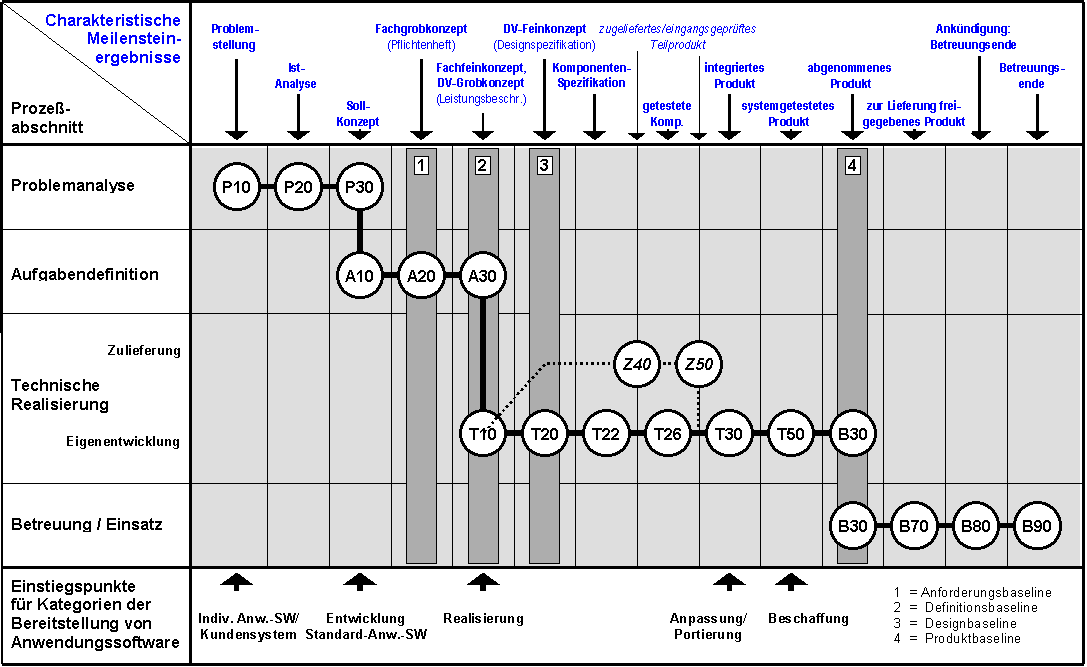
That was the way, we should develop innovative software and new products entwickeln – ridiculous.
Roland DürreThursday October 8th, 2015
Vintage Project Management #1 – My First Project

What you see on this picture did not yet exist – it only came when my project was over. My first project was realized in the Koppstr. (Hofmannstr.)
During the Berlin PM Camp, I told the stories of four projects from vintage times that were very important for me. And I also announced here that I was going to publish all four of them in the IF Blog.
So here I am now, beginning with the first small project:
Project #1
The first project of my life was but a small one. It was scheduled to last six weeks and it was my first professional activity in data processing.
In those days, I was a student of informatics starting for the second time. The first time had been in 1969, when I started studying mathematics and minored in informatics at Technische Hochschule München (THM). The only alternatives for the minor subject would have been physics – which I did not like – and business. However, I was a little sceptical, because I had been attending and graduating from the Jacob Fugger “Business Grammar School” in Augsburg. And at that school, accounting, which I was quite good at, had been an A-level subject. On the other hand, the knowledge taught in business and economics seemed a little questionable to me – which, incidentally, is even more true today. Consequently, the only thing to minor in left was informatics – and that sounded really exciting, too. Professor F.L. Bauer actually succeeded in whetting my appetite in the fall of 1969.
And then, on April, 1st, 1970, dark powers and a mixture of ill luck and ill advice forced me to serve in the Federal Army. That was not at all an April’s Fool Jest, which meant that I had to spend 18 months in rather questionable surroundings as a conscript.
And when, late in September 1971, I regained my freedom, I just started anew. Again in the first semester, again with the same combination of subjects, and again at the same college, which suddenly was called TUM (Technische Universität München).
But there was nothing new except the name. And I knew almost everything because in 1969 I had still been a rather diligent student who had listened attentively and learned with enthusiasm. Consequently, I was doing well and the Olympic Games of 1972 came along. Besides studying, I had a great job with good money at the German Railway (at the time still called Deutsche Bundesbahn) as a customer service person for guests from all over the world. And in some way or other, the entire world was mine for the asking …
In 1974, I finished my intermediate diploma successfully and again needed a little more money than I made as a TUM tutor (teaching Linear Algebra I and II and a programming course). I narrowly missed being eligible for BaföG and my parents – also working at the German Railway – said I could easily continue living at home in my room and commute to Munich like my father always did. But that was not what I wanted. Consequently, I was looking for a summer job – and, naturally, the favourite prospective employer was one of the leading high-tech and computer companies.
In those days, that was what Siemens was! Seen in retrospective, it is hard to believe what immense know-how was present in this company in a huge number of areas. They took me in at Siemens and so I was in the middle of the real high-tech world, first for six weeks in the summer of 1974 and then for the entire duration of my university education. I had direct access to computers, operating systems and programming languages – and I mean I was filled up with them to the brim, which was totally different from what they offered, for instance, at the so-called TUM.
And I got my first project at Siemens on my very first day! My (department) boss was Mr. Bieck. He was a hardware person and later became development head at one of the upcoming German computer manufacturers: Kienzle.
Kienzle was only one of the smaller Siemens competitors – but it was certainly remarkable to see what these enterprises – just like much larger enterprises, such as Nixdorf, or many smaller ones managed to accomplish in those days.
During my six weeks as a summer intern, I had total freedom – provided the actual task I had been assigned got finished. And they also told me that the problem I had been given might not be solvable at all. But that it would indeed be very much appreciated if I managed to solve it. It was actually the same I heard over the last few years from people about google: you give yourself unachievable goals, yet you get a nice tolerance for possible failure, which means you will be truly happy when eventually you actually manage to solve the problem.
The task was easy to formulate: The department wanted the highest possible Mersenne prime numbers. For a hardware prototype.
For non-mathematicians:
A number is a Mersenne prime number if it is a prime number derived from a power of two minus 1. In other words if (2 power n) – 1 or (2 power m) – 1, is a prime number.
That is my spontaneous definition.
Well – and my boss wanted as many n-s and m-s as possible. He was not interested in being shown how I did it – as long as I did it at all.
The background:
In those days, a lot of people were really active doing “research and development”. It was truly great. But it was not some R&D totally remote from practice. No: in almost all cases, your work would serve to promote actual applications and projects. That made it truly cool.
Practically applied R&D needs theoretical background. Business got that from the universities (in those days, there was still something you could get from them). And, naturally, Siemens AG also looked across the borders – particularly across the inter-state borders. Because the GDR universities were not so bad at all. And they gave us lots of great results.
For instance, there was a scientific work sitting on my desk – I think it had been written in Leipzig – in which someone had given the theoretical proof that it is possible to build an accidental generator from a ring connection with n binary switches.
And if you short-circuited the structure at the right place, the system would generate a maximum period of random numbers.
It would happen if and only if the number of used switches n is a Mersenne prime number. And if the short-circle is after the m-th switch – and if m is a Mersenne prime number. (please forgive my clumsy description, I was never much of a hardware person).
I never understood this work. Also those six weeks would probably be far too short. But then, this was totally irrelevant for my job. All I was supposed to do was deliver very high prime numbers of the type 2 power n -1. Even the prime numbers were unimportant. All that mattered were the m and the n.
For my software friends:
In the early 1970ies, it was totally utopian to build such a thing as random generator software. After all, the device was supposed to create the bit patterns rather quickly, because they were supposed to test the maximum flat modules for large-capacity computers. And those were rather fast gadgets, considering the times.
Also, Herr Bieck could not have cared less how I solved the problem – that meant it was up to me if I programmed something for the calculation or if I found the big Mersenne prime numbers somewhere else in the world. All options were open.
Consequently, I spent the next few days in various libraries (Siemens, StaBi, Unis – you have to remember that, in those days, the internet did not exist). And I quickly realized that there was no chance for me finding Mersenne prime numbers in this way, even if someone on this planet had already calculated them.
This is why I forced myself to come to a quick decision. I was going to forget the world around me and try it by myself – by just programming. I still had more than five weeks to go.
This was the first thing I learned about “project management”: Decide quickly, especially if it is a really hard decision and you basically know no way out.
Then I tried to do some traditional programming. I thought in terms of the decimal system, looking into integer and arithmetic calculation systems. And after two weeks, I noticed that I was never ever going to succeed with this strategy.
And this was the second thing I learned for future projects and for life: Whenever you do not know how to continue, you have to try new ways! Kiss old concepts and patterns good-bye, and do not hesitate!
So I decided to no longer look for huge numbers. Instead, I just saw a number as a field of bits. And all of a sudden, all those big numbers became small numbers. For instance, 2-to-the-power-of-256 was now a binary field with the length of 32 bytes. And you can calculate rather elegantly with bit fields each of which has the length of 32 bytes. All you have to do is some shifting. And suddenly, the huge number had lost all its scariness …
I told you this story for two reasons.
Firstly, because all of a sudden it became clear to me that, on top of deciding quickly and courageously, you also have to leave old mental concepts if you want to achieve something special. And I often suffered under this and under the typical “But this is how we always did it …”, because it blocked the way.
And because I am living proof that, more than 40 years ago, Siemens actually worked in the same way as they sometimes say Google does today. And that in those days they achieved really great things and that there was not much competition world-wide, perhaps IBM and Xerox or Hitachi. All the others were just in their initial phases.
In a short time, you will read my next Berlin #PMCampBER story on vintage project management. It is from a time when I had a contract as an employee – at the Siemens laboratory. That was in the late 1970ies. I will relate how Siemens did everything, and I mean really everything, to destroy its greatness.
It happened because they kissed their old virtues good-bye and introduced division of labour (Taylorism) in the creative areas such as product planning (Requirement Management) and quality management, specialized DV/IT teachers in their D-schools, manual copy editors and many more such roles.
And, above all, whenever there were things to decide, the questions they asked were: “What is the profit of this?” and “What is our advantage?”, instead of the question: “Why do we do this?” – as in former times.
At the time of my first project, there were no such things as project managers. The first project manager you will find in the world as I perceived it will come with my third project management vintage story. That was in the early 1980ies.
RMD
Roland DürreSaturday October 3rd, 2015
Angry!
 Once in a while, I get really angry. The last time this happened was during a forum. It was about “un-schooling”. The system of collective (federal) schools was judged to be the only appropriate variant of teaching and “education” for young persons and “un-schooling” was said to be socially inacceptable.
There are other statements I also very much object to. For instance, I see red when I hear
THAT
- We have to produce weapons.
- Lobbyism is a necessary part of our economy.
- A speed-limit would ruin said economy.
- Concerns have to make maximum profit.
- There is no alternative to constant growth.
- Dismissal protection cannot be abolished.
- It is total nonsense to think about a “UBI” (unconditional basic income, instead of all the social subsidies).
- BND and the Federal Office for the Protection of the Constitution are absolutely important and necessary.
- Total transparency and openness in society and software is not possible.
- There is no alternative to patents and copyright.
- The climate catastrophe is just an invention of green nerds.
- You have to tolerate both circumcision
- And the suppression of women
- …
But back to the school discussion: if some people shun classic systems such as the school system, then this is, for me, the last and as I fear eventually unsuccessful attempt of individual persons to flee from a world I actually do not like at all..
I MEAN A WORLD
- Where people, both individually and collectively, act in a way I disapprove of;
- Where stupidity always wins and where I get the impression that it is not possible to be so stupid unless you act as a group (see also Dueck – Schwarmdumm),
- Where few of us actually get far too much warmth and calories, yet others get nothing – which means everything is taken from all of us;
- Where they tell us we are omnipotent, yet de facto there is the permanent attempt at total manipulation;
- Where they try to take away our freedom and to convert us into becoming servants fitting the system;
- Where nobody likes you if you critically ask “why”;
- Where the question “what profit can I make from this?” is the motivating factor for all our actions;
- That tries to make unequal things equal;
- That tries to discourage us from being creative;
- That dissuades us from believing in utopia;
- Where all you hear all the time is “it cannot be done, anyway”, “this is how we always did it” and “yes, but…”;
- Where, from earliest childhood on, we are accused of being “guilty”, regardless of the fact that our brains are not all built to know how to deal with such accusations;
- Where everybody talks about eye-level, sharing, participation, respect, tolerance, civil courage, … but
- Where every attempt at autonomy is first and foremost punished;
- Where invitations to “give more than you take” and to “remain true to yourself” sound like mockery;
- Where, as a matter of course, you make others feel smaller, rather than bigger;
- Where rules from the natural sciences are welcome as long as they are useful, but abhorred when they clash with what we want.
- …
In evolutional theory, they say that matters will only change when the old generation dies out. Consequently, I have all the respect in the world for parents who take responsibility and decide to teach their own children. These days, such a pledge in favour of the family is scarce. And to do so, you have to focus on the important things in life and to forego many luxuries.
Isn’t it a lot easier and more comfortable to put children (incidentally, the same is true for the elderly) into storage? To be sure, sooner or later the parents will bow under the pressure of the school. They will become aliens in the eyes of their own children and eventually even turn into the agents of the system “school” – against the interests and wishes of their own children.
This means that the variants of “un-schooling”, “no-schooling” and “home-schooling” are not arrogant or uppity, but revolutionary. In fact, we need this kind of courage to replace thoughtless following in many other areas of our lives (nutrition, leisure time, life style, …). Just like we need the willingness to make “sacrifices” for our future and to work towards contentedness and happiness, rather than buying it.
For a good “un-schooling”, you have to give your children much. Especially the most precious commodity you have: time. It is scarce. It also takes a lot of time to change your own life. Consequently, time is something we should not waste. And we have to distance ourselves from what they want to sell us as desirable.
Abstinence takes an effort. Yet abstinence is probably the first counter-measure against being controlled by others. You can easily be heading towards disaster if your life is controlled by others. Perhaps it is even harder for lonely persons to find their own lives.
It is well worth trying to flee the formatting of a perverse society. We humans have spent enough time letting others turn us into trained monkeys. It was especially perverse during the long 19th century. Enlightenment can only have been a first step. It brought us peace and freedom, but also war and destruction.
Well, for me this means more than ever that we need a second enlightenment. And we have to continue dreaming our utopian dreams of a soft and violence-free world without “punishment” and “revenge”.
Thank you very much!
RMD
(Translated by EG)
P.S.
Incidentally, in Germany, the “un-schooling” discussion is beside the point. As opposed to other European countries, it is explicitly forbidden by law. Regardless of the EU and all the bureaucracy that comes with it…
Roland DürreWednesday September 30th, 2015
#Breaking with Patterns II – Communication
In preparation of the Dornbirn PM Camp on November, 20th and 21st, we installed a blog parade on #breaking with patterns: here is my second article on this topic:
Teletype Machine (Siemens T100) – introduced in 1958. It was the modern successor of the T50.
So far, it looked to me like I was a #de-cruster. Perhaps I am also a #pattern breaker. After all, I no longer go places by car, using the bike instead. And, especially in winter, this is unbelievable for many of the persons I meet.
And whenever I do not have enough coat hangers, I throw away some of my clothes, instead of buying new coat hangers. Those and many more are the kinds of things I do.
But then, perhaps I am not breaking patterns at all, instead being trendy like everybody else? For instance when it comes to using the telephone. Because I have now come to that stage where I have completely reduced calling people. In fact, I find it impolite to inconvenience other people by calling them. And, of course, it is also because I, myself do not wish to be interrupted all the time by receiving a call.
Here is my personal “telephone history“:
I used to be a true “multi telephone person”. When InterFace connection was still very young, I spent a lot of my time with customers. Consequently, I always spent an hour in the middle of the day calling the company. And since I never use a customer’s telephone for my own purposes, I always had to go downstairs and use the public phone booth.
In those days, I also discovered the C network. However, it was expensive, you needed an extensive installation process and the network itself was as limited in its availability as its quality was poor. Besides, I always wanted to be able to totally focus on the person at the other end when having a telephone conversation. Consequently, I never used a car telephone; later, too, calling someone from the car was only the absolute ”ultima ratio“.
In the times of public phone booths, I always had a sack of change on me. Later, I always had a number of telephone cards in my briefcase. And, as soon as the D network came, I immediately had a cell phone. My fees were extremely high.
Now, I find it harder and harder to come up with good reasons and situations where I absolutely have to use a telephone. For instance after having made an appointment with someone to meet at the central train station and already having found a nice place to sit for me and my travelling companion. Then I will call him. But only if he has no Whats up, BBM or other messenger. When all is said and done, the only time when you actually need it is for the emergency call – when the murderer approaches.…
Consequently, I no longer call people. Because if there is something really important I wish to discuss with someone, then I want to do it in a leisurely fashion. Once in a while, I also want to have five minutes to prepare for a conversation. I want to see his face. If this is even possible across continents, then why should I not make use of the opportunity.
Consequently, I make an appointment with my business partner. As soon as possible and preferably through social media. If no other way is possible, then with an email dialogue. Then I will enter “video conference” in my calendar and all will – at least if it is a hangout – be initiated automatically. If the person at the opposite end does not like google, I take Skype (Microsoft) or FaceTime (Apple). If my partner likes neither Microsoft nor Apple (which is something I can easily identify with), then there are enough other alternatives.
The entire conversation will also be much pleasanter. I comfortably sit on my sofa, my chrome book is lying on my lap and my conversation partner’s friendly and smiling face can be seen on my screen. I need no headphones (and also need not press a telephone against my ear), can simultaneously formulate something with him on shared documents (perhaps for resulting notes – also called minutes), we can look at and process tables together and we can look for and show each other an image, and much more.
🙂 No – teletype machines, fax machines, telephones – those are devices we no longer need…
Doesn’t this also have something to do with “breaking with patterns”?
RMD
(Translated by EG)
P.S.
The pictures shows a teletype machine by Siemens. It is a model T100, the table version. As far as I know there was also the model T100o – but that was it.
This mechanical teletype machine had a modular structure, which means it could be added to. On the left side, you see a tape perforator for generating perforated tape. Underneath, the transparent container for the cut-out material. On the right, you can see the optional perforated tape reader, which made it possible to send pre-written messages with maximum speed. On the basic device, you can see a red note about the update to 75 Baud above the active-hours counter.
After a certain running time, the teletype machines used and rented by the Deutsche Bundespost were completely disassembled at the FZZA Elmshorn and then newly reassembled. The blank key has the switch between letters and digits on the left and right sides, which is necessary because of the Baudot-Code with only five Bit (CCITT5). The paper is an endless roll, perhaps a self-copying paper with a copy since there is a slightly crooked grey intermediate layer.
Source: Wikipedia – you can find the image under the GNU licence for free documentation ,Version 1.2 or a later version. Published by the Free Software Foundation,


