
Roland DürreSaturday December 24th, 2016
(Deutsch) Frohe Weihnacht
Roland DürreThursday December 8th, 2016
Good-Bye Until After Christmas!
And a Happy Christmas to You All!
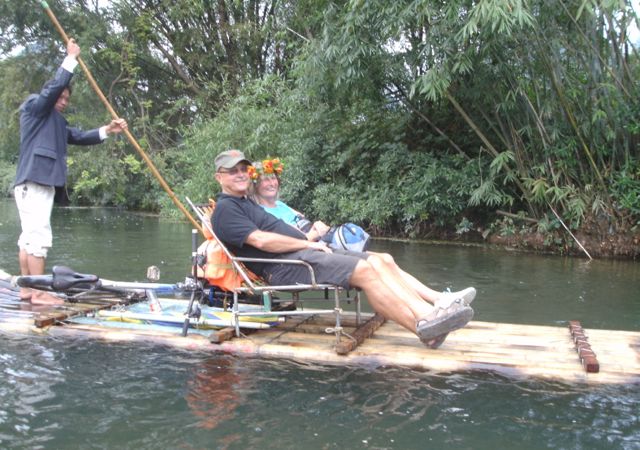
The picture was taken two years ago when we were rafting in China.
Starting tomorrow, we will be in the Caribbean.
To be sure, I do not feel
“that the time is ripe to begin afresh“!!!
But still, I will be gone for some time. On Christmas Eve, I will be back and meet my children and grandchildren – those of them who are in Munich.
It looks a lot like I will not read any emails until then. My many chat dialogues will get a break and I will probably only rarely be on the internet at all.
During the next two weeks, I will try to live only for Barbara and myself. Many thousand miles from “sweet home”, I will simply ignore all messages from the world. And during that time, I will not publish anything on the IF blog, either (if anything is published, it will be by one of my friends or by my bot).
Normal life as I had it will start again on the evening of Christmas Day. As has been my custom for many years now, I will again spend the evening in the Munich Lustspielhaus to watch Willy Michl (It is well worth clicking onto the link). I will also howl “Silent Night, Holy Night”, listen to the eternal ISARFLIMMERN and enjoy the fact that the days will gradually get longer.
It would be a huge delight for me if I were to meet a few of my friends in the Lustspielhaus on December, 25th for Willy and if we could then do some “exchange of ideas” before the concert and during the interval!
RMD
(Translated by EG)
Roland DürreWednesday December 7th, 2016
Cancelled: #AktMobCmp 2017 will not happen!
 #AktMobCmp 2017 – which was scheduled for January, 5th and 6th, 2017, in Unterhaching – has been cancelled. The reasons are:
In 2016, we had almost 30 participants. Regardless of this number being a little on the small side, the last #AktMobCmp was a success. We had hoped to get around 50 participants in 2017.
The reason why we now cancel is simple: so far, the number of registrations is so small that we would have to assume a total of fewer participants than last year. And a two-day barcamp with few participants simply does not justify the rather intense preparatory work.
However, the cancellation for 2017 does not mean that I or we give up or quit. I would really like to try again in 2018. As before, there is the necessity that persons who want to promote a better mobility should network through institutions, clubs and interest groups. And there are so many exciting topics around “future mobility”.
In 2017, we want to discuss these topics, along with “active mobility in everyday life” in evening meetings. We already have good ideas and want to put them into practice with some partners.
Auf viele gute AktMob-Veranstaltungen in 2017
May there be many good ActMob events in 2017!
We will invite to the events through the central “MeetUp“ and also communicate them through other channels. Maybe this is how we will get enough participants for a second try on the 2017 AktMobCmp. After all, it is quite possible that the lack of more interested persons is due to the timing (vacation time and holiday).
All those who would have liked to attend AktMobCmp 2017 in Unterhaching, please accept my apologies. And, please, let it be an extra motivation for you to come and support us during the evening events in 2017.
RMD
(Translated by EG)
Roland DürreTuesday December 6th, 2016
Soon, I will be electing a Federal Chancellor …
Not true, because basically, I only vote for a party …

Yours truly with Klaus Hofeditz during the strategy meeting 2016 at the Berlin PM-Camp.org.
… who then, along with others, will decide about the Federal Chancellors. And maybe then the top candidate of the party that got most of the votes will also become Federal Chancellor. But that is not necessarily a foregone conclusion.
For next year’s federal elections, there is a shimmer of hope for my super-ego #Dumusstwählen. Because my super ego says I, as a person who believes in democracy, have to vote. Yet my conscience forbids me to give my vote to any of the “normal” parties. Consequently, I have a dilemma.
But there is hope: Serdar Somuncu will be a candidate for “die PARTEI”. I looked for information that might tell me if he is a valid alternative. And that gave me the idea of running for the Federal Chancellor candidacy myself.
After all, if I become a candidate, then I will definitely know whom to give my vote. Let me be cynical: it is not all that difficult to become Federal Chancellor. It is probably easier than it has ever been before. After all, Trump, too, managed to become president. And populism is something I am quite good at. Better than some might believe.
But then, at my age (66), I do not at all feel like burdening myself with all the things that a candidacy would involve. And the almost senile candidates, all of whom pretend to be young (not just in the US election campaigns) are really something I abhor.
So:
There will not be a Federal Chancellor Roland Dürre. But perhaps Serdar Somuncu? At least, he likes Woody Allen and Bert Brecht. That means he cannot be all that bad, doesn’t it? Nor do I mind him being Turkish. I rather like people with other cultural backgrounds.
Most likely, he is better qualified for Federal Chancellor than I. After all, I have too much “morbid joy when perverse systems die”.
RMD
Roland DürreThursday December 1st, 2016
Digitalisation Today: “Automated Society” and Other Buzzwords
About stand-by-jobs, facilitation and driverless underground trains. And about Uli.
I short time ago, I was introduced to Ulrich Sendler. Uli is an “Independent technology analyst” and musician. He writes books (that are even translated into Chinese, where they are best-sellers), gives presentations (judging by what I saw of him, I assume his presentations are rather competent and entertaining) and he also works as a counsellor and moderator. When we met, he told me that he will soon be speaking in Gütersloh on the keynote topic: “Automated Society”. You order a service via internet and the delivery or service will be carried out automatically.
For me, “automated society” and “self-service society” are also “buzz words” often used when people characterize our “new digitalized society” in our “post-fact everyday life”.
These expressions immediately triggered a few association and ideas:
Technology is there to make life and work easier for humans. There is a nice and nowadays often used buzz word for this:
Facilitation!
In Wikipedia, you find the definition:
Facilitation is any activity that makes tasks for others easy, or tasks that are assisted.
In everyday life, this is responsible for the fact that work humans used to do is now easier because of technological advances. We might even end up having to do nothing at all.
Just think of Lufthansa pilots. Currently, they are often written about in the press because of their passionate attitude towards strikes. Your average poor pilot will only be allowed to actually become active for ten minutes of a long-distance flight, for instance to the Caribbean: when initiating and realizing the start and landing phases. He spends the rest of the time watching the plane fly. The poor pilot is not allowed to relieve his boredom by playing computer games. Presumably, alcohol is just as forbidden as visiting ladies – like stewardesses – in the cockpit. All that remains is boredom.
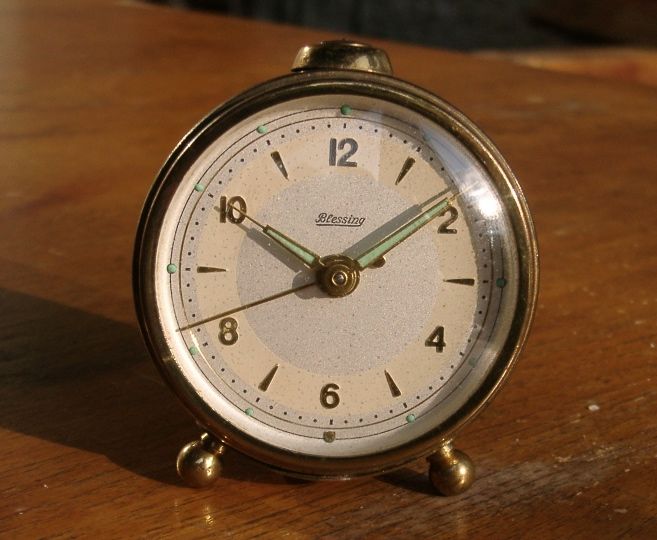 In my vocabulary, these jobs are “stand-by-jobs”. Since I used to be a programmer, this would be like having to watch the computer programming itself and then being allowed five minutes to evaluate if the resulting program is what it should be. To me, such a job description sounds rather cruel. It is quite possible that such a stand-by job will cause depressions.
Two decades ago, there was a phase of about two weeks after I had switched to a new employer during which there was nothing to do for me. I sat in my office from morning to evening, was terribly bored and tried with all my might to do something meaningful. And the digits of the clock seemed to really, really creep.
Never again in my work-life was I as unhappy as then.
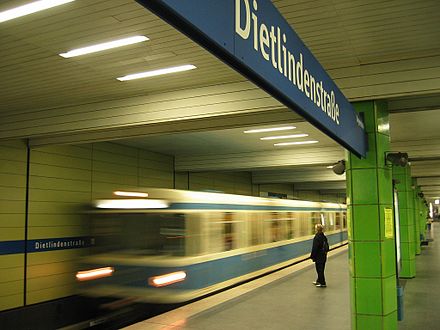
Munich Underground station Dietlindenstraße (U6) – by FloSch, under CC BY 2.5 published in Wikipedia (2005)
One of the systems the Stadtwerke München (SWM) supervise is the Munich Underground Network. The SWM are intelligent employers. They know that humans do not appreciate “stand-by-work”. Underground train drivers, too, have become “stand-by-workers”.
But the Stadtwerke want happy underground train drivers who are motivated to do their jobs. A short time ago, I learned that all underground train drivers have to exit at every station to control how full the train is. And after this has been done successfully, they have to signal that the train can continue. That is an important task.
This activity was introduced to make the platforms safer. Above all, however, it is a measure that serves the driver, because in this way his job gets more responsible and diverse, and he even gets a little exercise. That is good both for the body and the soul.
Except that in Nuremberg, the underground trains have been moving without a driver for many years now. And those in Lyon have been doing so for decades. And in both cases, the model seems to work quite fine, actually even better than with a driver.
May my readers come to their own conclusions.
RMD
(Translated by EG)
P.S.
Yesterday, I used the MVG Bus number 210 from Neuperlach Station to Ottobrunn, Jahnstrasse. The driver sat in his dark cabin and was rather isolated. All contact between vehicle and passengers was automated: the display and announcement of stops. The driver is reduced to being the one behind the wheel. He will stop the bus whenever he can see someone at the bus stop or if someone has pressed the button inside the bus. On this evening, I was lucky, because the driver drove very sensibly. He never accelerated too abruptly or stomped on the breaks with too much force. I found that rather agreeable. But there are also some drivers who really let their hair down. That is when you think a self-driven bus might have its advantages. Technologically speaking, I am sure it is already possible.
Roland DürreMonday November 28th, 2016
A Christmas Oratory that is a Little Different

What would the advent and Christmas time be for music lovers without a Christmas Oratory?
Not only the fans of classical music find that the festive sound is an integral part of the quiet time of each year. And whenever the word “Christmas Oratory” is spoken, everybody knows immediately who is the composer: of course, the Leipzig Thomas cantor Johann Sebastian Bach! And there is definitely no other option. Or is there?
On Monday, December, 5th, 2016, at the Sendling Himmelfahrtskirche, you can find the proof that another baroque master, too, wrote a really great piece when composing his Christmas Oratory. It is absolutely great music that goes straight to the heart of the audience and creates a festive Christmas atmosphere almost by itself: we are talking the Christmas Oratory “Mache dich auf, werde Licht (Go Ahead, Become Light)”, a work written by Carl Heinrich Graun, who was impresario of Frederic the Great. After having sung – and recorded in cooperation with the Bayerischer Rundfunk as a CD – Graun’s Passion Oratorio “Der Tod Jesu/The Death of Jesus” in 2014, the Arcis-Vocalisten have now worked on the Christmas masterpiece composed by the impresario of “Old Frederic”.
For Professor Thomas Gropper, the choir director of the Arcis-Vocalisten, it is the differences between this work and the ever-present Bach Oratorio that make the work on it particularly attractive:
“Even the libretto is structured totally different from how Bach did it in his Christmas Oratorio – Graun took only very few of the original sentences from the Gospel of Luke, instead making heavy use of free contemplation and dialogues”, says Gropper. “And there is much more of the “gallant” concept that will be setting new trend in Graun’s music than in that of the Thomas Cantor. Said concept being the already quite obviously emerging more sensitive style that became generally accepted at the time the work was composed in 1735”.
The masterpiece was only re-discovered in 1999 and is characterized by a skilful change between melodic and challengingly counterpoint-oriented choirs and sensitively voice-caressing arias that have been given an extremely colourful orchestral accompaniment: festive string and trumpet sounds on top of the Christmas Atmosphere. Well, it is a somewhat different Christmas Oratorio…
Source: ARCIS-VOCALISTEN
(Translated by EG)
Roland DürreSaturday November 26th, 2016
Vintage Digitalization: Email and Telephone. Or: No More Email and Telephone Terror!

““Die Winderhitzer der Völklinger Hütte”. Also Vintage”
Regardless of the fact that I consider email vintage technology, I still have some email addresses. Many useless and stupid messages arrive.
It is my task to then delete those emails and ask my communication partners if, please, they could use other ways of communication.
Today, something happened that made me smile. I received an email from a beloved and long-time friend whose technological competence I rather appreciate.
He sent an email to a lot of people ( (all@XYZ.de):
Hi,
Could you please leave us alone with this totally irrational discussion!!!!!
I, too, said what I think about mail distributors and internal mail in the survey about new communication forms.
This is another typical example illustrating the fact that intra-company emails are total nonsense and why email distributors inparticular should be immediately made redundant.
To all, and I really intended to write this!
Incidentally, the “totally irrational discussion” was about the problem with rechargeable i-phone batteries and their exchange.
I replied as follows:
Your email made me smile. 🙂
After all, I totally agree with you – except that I am even more radical. Email is no longer a general communication channel. Instead, it is a totally old-fashioned one which – it goes without saying – should no longer be used in modern enterprises.
Emails to third parties should only be sent in those few instances where in former times you actually wrote a letter, sent a telegram or went to a public phone booth. Everything else should be done with tools that are adequate to the task.
Best wishes and a nice weekend to you!
Yes, I, too, dislike emails. More often than not, they have huge footers made even larger by artificial nonsense and totally uninteresting advertisements or stupid legal disclaimers.
I hate email dialogues that cause a constantly growing series of email incarnations through more and more dialogue steps. With every reply, you create a new email that contains the same as before, with the addition of the last reply. When the internet was first introduced, they made an attempt to make the design of email communication a little more agreeable. For example there was the so-called tofu rule.
Unfortunately, however, “tofu” was only applied by very few users and consequently failed.
As a general rule, communication will be carried out as a “thread“. Ever since we have the perfect chat, email is mostly obsolete. In the “peer2peer“ thread, I can always immediately see what has been recently said. That is also true for persons with whom I rarely communicate – where it is extremely valuable. Threads are also a good tool for more than two persons who wish to communicate. If you use email, you immediately get a catastrophic flood of “cc”-s and “bcc”-s.
Moreover, I enjoy using images, audios or small videos in my daily communication. How cumbersome is this both for the sender and the recipient if you use email? Just look how easily bbm, wechat, whatsapp, the FB “messenger“ or Skype, the twitter “dm“ (direct message) etc, work. Not to mention Snapchat, the system with the most modern and simple of all user interfaces.
Even better for structured communication, even in bigger teams/groups than chat systems are “communities”. There are many communities in the internet, for instance in Google+. They show you how it is done. And how you can communicate well and yet very structured and highly efficient with very simple means within an organization. And how you can do totally without the email nonsense, rather than flooding the non-interested and non-concerned parties with spam all the time!
Note also:
The telephone is also OUT. I only use my telephone after having made an appointment in advance to do so, if there is something important I need to do or if I want to talk with someone and pay full attention. Consequently, I no longer use the telephone in the car or in public places like trains. And even for important issues, I only use the telephone if image telephones (Hangout, Facetime, Skype, Cisco, Citrix …) are not an option because the person at the other end prefers the good old telephone.
In case you forgot: the “telephone” function on the smartphone is also just an app for synchronous spoken communication that enables your connection with addresses made up from telephone numbers (digits) and through “voice-over-IP“.
Consequently:
If someone calls me and I reply with
“Now who interrupts me in my work?“,
then I kindly ask you to forgive me.
I continue to be available on the telephone for all those who need me. Here is my physical telephone address 0049 171 4850115 (unfortunately, the symbol telephones have now been out of fashion for a long time). But, please, only call if it is really important and totally urgent!
In all other instances, please ask yourself if it might not be enough for you to use asynchronous (spoken) messages through one of the chatters I use or, if it is about a specific topic, for you to send a message to the respective community.
RMD
(Translated by EG)
Roland DürreThursday November 24th, 2016
“Digital Change” – About my Presentation – #nostructure !
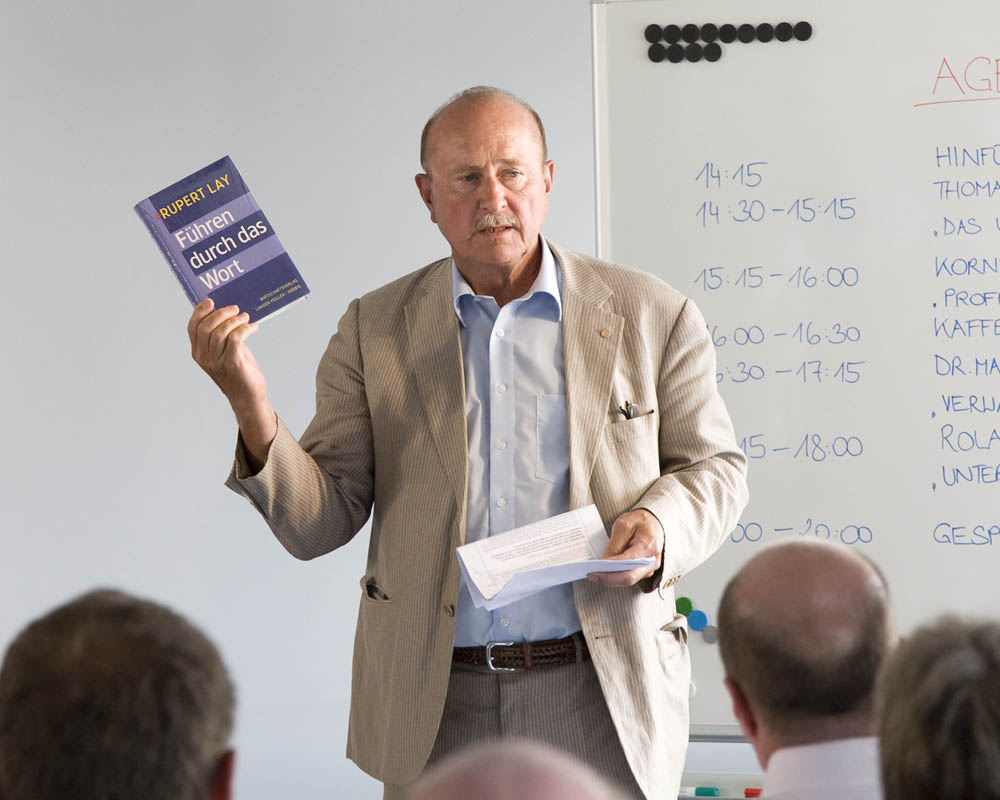
Unfortunately, I have no pictures of the presentations in Nuremberg and Rosenheim.
I always enjoy giving presentations. Most of them are for cherished friends or good causes. I try not to express truths, instead questioning those concepts I myself believe in.
Because I feel the “truth” inside myself that there is no such thing as an absolute truth.
It is a rather difficult topic. Just think of the sentence:
“Tolerance is the most precious commodity. Intolerance can only be tolerated against intolerance. But that is where it has to happen!“
A little pondering will quickly make you understand what the real problem is.
These days, I mostly speak about topics such as “leadership”, “entrepreneurship” and “digitalization”. I always learn most when I give a presentation. The same was true the day before yesterday in Kolbermoor, where I had been invited by Tech-Division, which is an enterprise that gave me a very positive feeling. The Tech-Division’s offices in Kolbermoor are at the “Alte Spinnerei“, which is a beautiful loft building.
This time, the title of my presentation on digital transformation was: What is often forgotten when people talk digitalization!
Since it is my desire to have something of interest for all the audience, I always bring something like a “critical potpourri”. I mostly work with metaphors. I try not to force the presentation into a structure. Consequently, as a matter of principle, I do not use slides (if the lecture hall is huge, I use emotional background images).
I only use the important standards of communication (such as the rule of three and the rule of five, Syllogisms and logic arguments) within my “potpourri”. I used to give many “sales presentations”. The intention was to manipulate or at least to convince the audience of something.
Here is how I did it:
In my presentations, I introduced a (plausible) theory X (which was easily understandable for the audience) and then developed a logical chain: from X follows A, from A follows B … and from Y follows Z. This is how I deduced a message Z from X, wanting to show that from a commonly accepted assumption X a conclusion Z can be justified. Z was my message. I wanted to make the audience believe in Z. Those days are over.
In general, I like working with analogies during my presentations. For instance, I describe a principle or a mechanism that basically has nothing to do with the actual topic, yet it contains a message that can be applied to other principles or scenarios. And, depending on how I see the current moment, I also relate the analogy – or let the audience find it.
Here is an example:
Whenever I talk digitalization, I also talk infra structure. Infra structure is an exciting topic. We live in the Anthropozene (Anthropozän), that is the era of humans. Humans have changed the world, either considerably or totally. They created new infra structure and technologies. In fact, it started with the “humanoids” who were our forefathers.
Initially, a very long time ago, came the upright posture, the (resulting?) development of tools, the ability to think and speak (10,000 years ago?), followed by “written language” (5,000 years ago?). These innovations probably triggered the “information society”, or else they were at least what made it possible.
Building infra structure in mobility was probably started with the development of paths that facilitated “walking on foot”. When the wheel was invented (3,000 years before Christ?), the first forms of “streets” had to be built. Water (the ocean, rivers, lakes,…) has always played an important role when it came to mobility. A network of channels was used. Then came the postal service coach, the railway and mechanized and motorized individual traffic. The traffic network was extended to an unbelievable dimension.
However, not only humans and products must be mobile. The stories of the people also needed mobility. This is why the job of the courier was invented. Letters were sent, transmission by cable or radio communication, networks such as the telefax, telegram or telephone circuits were invented. Today, it is the internet. The first requirement for all these things was electricity. Consequently, they made electricity networks for transporting energy.…
What I like talking about in my presentations on “digitalization” is the road network, which – as I see it – is the biggest infra structure of all times. You can probably get to almost any inhabited place on this planet by car. You will find parking places, streets, gas stations and repair shops for cars everywhere – even on small islands. There is probably nobody who does not get products that have not at some point been transported by a truck or car.
There is probably no other sector where rules and regulations tell us how individual mobility has to look and what we have to do and what characteristics such a vehicle must have. There is a minimum age and you need a driver’s licence if you want to move inside this infra structure with a motorized vehicle.
For me, the question (naturally) is: what benefit did all this bring us if we look at the results. 1,400 million fatalities per year world-wide. Besides no end of health hazards through noise and air pollution. But also indirectly because we no longer exercise and consequently become obese. A landscape that is all concrete. And much more. Isn’t it quite obvious that one might fear something must have gone wrong? And that perhaps you should learn from history?
In my presentations, I take this huge infra structure and the way there as a metaphor for technologic development (after all, digitalization is only a part of technology). Now, being the orator, I have to decide:
Should I explicitly say it? After all, I am talking about “digitalization”. Consequently, everyone in the audience might start thinking about how the road network metaphor might be applied to the “digital network” and the internet.
I might choose to motivate people verbally towards thinking and I might give some impulses.
On the other hand, I might want to expand on facts that will motivate people to think by themselves. That the traffic network reaches almost every human. However, the internet currently only reaches 2 trillion out of 8 trillion persons. Facebook can allegedly reach 1 trillion persons. I say “allegedly” because some sources say the number is “only” 500 billion.
I could ask people what it means to be a “digital” person and internet user. Is it enough to use email and chat, have a Facebook account and occasionally use Wikipedia (which, basically, is just another thesaurus)? Or do I have to actively participate in order to be a digital person? Just think of the not-so-old buzzword Web2.0 that is now forgotten (humans becoming “part-givers”, instead of being “participants“)!?
This is how I intentionally try to give very “chaotic” and “confusing” presentations. I enjoy every single nice feedback. Especially if it is later modified by phrases such as “… but, unfortunately, it did not seem to be very clearly structured… “ or ”… even if occasionally I could not find a real thread… “
Because then I succeeded in doing what I wanted to do!
RMD
(Translated by EG)
P.S.
Here is another piece of advice: if you want to learn something about digitalization – meaning how it works – then I recommend you read Fefe’s Blog, That is the “BILD-Zeitung for Nerds“ (joke!) You can learn under many aspects.
Roland DürreWednesday November 23rd, 2016
(Deutsch) Digitale Transformation und Industrie 4.0 – Trump und die lieben Arbeitsplätze …
Digital Transformation and Industry 4.0 – Trump and our Beloved Jobs …
Yesterday, I received an email from a very beloved and wise friend. The following paragraph contains the gist of the message:
The day before yesterday, Kaeser of Siemens demanded the unconditional income. He is worried about future jobs – our old topic. Since you are a person who likes to think about theories, maybe you would like to question my thesis that Trump, by being a protectionist, is actually unintentionally doing the right thing. Because before the negative influence of protectionism can really have consequences, there will be a massive reduction of jobs through industry 4.0 – and since, by then, the USA will again have more jobs in their own country, there might actually be more jobs available in the end.
I am sure this thesis is not really well-researched, but I can easily imagine that it might happen in this way.
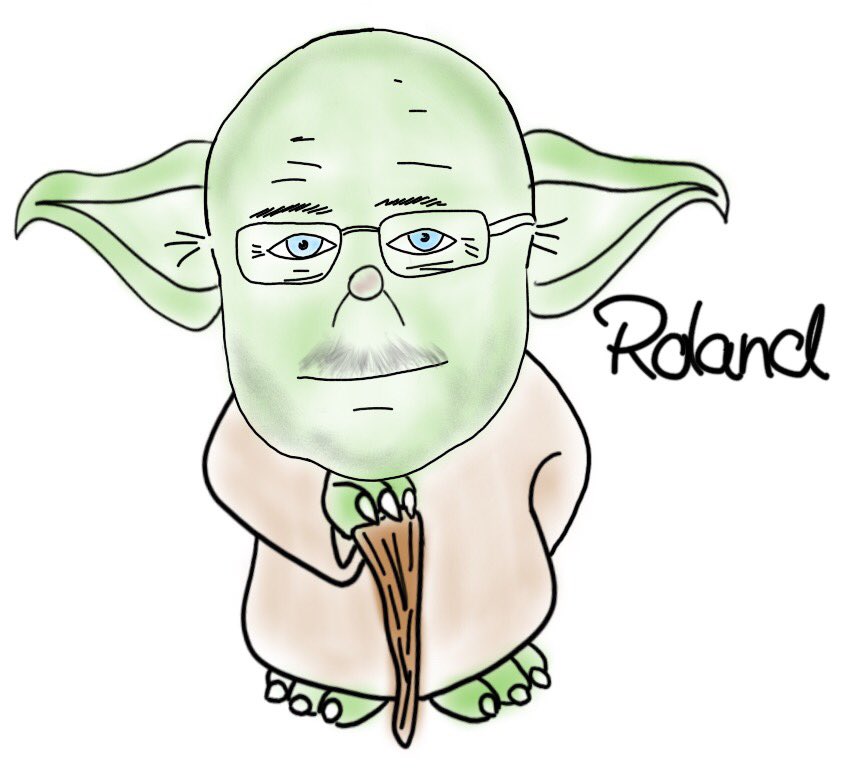
This is how Christian and Daniel (©Visual-Braindump) see me – at least it is how they saw me last week during our nice Dornbirn PM Camp.
I cannot comment on Trump. I do not know if Trump will be good news or bad news for the USA or even for the entire world. All I know is that most politicians, entrepreneurial leaders, union heads and other socially responsible persons have made a whole lot of mistakes and that now the time has come to pay the price. Because people are fed up and will no longer have patience. Basically, that is also true for me.
I rather like the theory that Trump might be doing the right thing if he is putting some restrictions on globalization. The phrases I outlined in “bold lettering” seem to take the assumption for granted that a future reduction of job opportunities will be a consequence of industry 4.0, which seems a little disturbing to me. I often hear it. Just like I often hear that a huge “service proletariat” will grow in times to come. My opinion is that we already have the latter. Just look at how many people earn their living by “driving cars” or “security”, or similar jobs.
I will also concede that a reduction of job opportunities is quite possible in industry. As soon as we no longer have cars, there will no longer be jobs in the car industry. That sounds logical to me. However, I believe that those jobs will then be substituted by other products to be manufactured. Basically, this is an automation process. As it has always been.
But: The future cannot be predicted!
If you believe you should think about the future, then at least you should not think as one-dimensionally as apparently some of the huge enterprises seem to see it when they now suddenly and surprisingly demand the “unconditional income (BGE)“. Basically, I believe they will now copy Trump as “Mr. Success”. That means they just demand something. Perhaps they have the desire to also be at the receiving end of a beating. Well, why not comply. Trump was beaten for every other thing he said – and perhaps that is exactly what he wanted. … After all, he is a sly fox and wanted to win the elections. Following the motto – the more beatings, the more honour.
Consequently, I can also imagine that, in the future, we will perhaps have a lot more jobs, regardless of “industry 4.0” and “digital transformation” (and I am not sure what terminology and mental experiments are behind those buzzwords). Here are a few examples:
- Farming
If we want to return to eating food that deserves the name, then it might well be possible that more persons will be needed for farming … - Forestry The information I have tells me that, even now, more than one million persons work in forestry in the FRG. It is quite possible that forests will become extremely important for our lives in the future …
- Crafts
As I see it, there will be endless opportunities in this sector in the future … - Care
Elderly persons need attention, elderly persons need care. And our average life expectancy continues to grow … - Education
More and more young persons need more and more assistance when it comes to coping with their own lives and finding their place in society … - Infra structure (old)
Be it Munich underground trains, railway trains, streets or bridges – our infra structure is badly in need of maintenance. And soon there will only be two options left to us: either barricade them or repair them. And basically, we cannot really barricade all of them, can we? - Infra structure (new)
I read that public transportation is threatening to collapse even in the small “megacity of Munich”. I hear visions of the “smart city” of the future. All these things will not happen by themselves. - Infra structure (example)
A short time ago, I heard from the “Stadtwerke München” that they think rather intently about “cooling down Munich”. It is assumed that the “Asian Way” of making buildings cold – as many persons will soon demand – cannot be applied in Munich (the reasons are, among others, that it is inefficient). Now they are thinking about remote cooling as the best solution … - Tourism
As far as I know, even today, the hotel and restaurant sector is the strongest of all in Bavaria as far as turnover and employment are concerned. Those who occasionally spend time in Peking or Mumbai will probably appreciate what climate, scenery, sightseeing venues, security and other attractions we have. He or she will probably enjoy vacationing in our country. This might turn into a lucrative business. However: welcoming people will only be possible through humans and service… - Demolition (environment 1)
As of now, we still cover enormous amounts of Bavarian soil with concrete every year. However, this process might easily (have to) be reversed.… - Catastrophe prevention (environment 2)
“We will drown in all this water !“ said astro-physicist Harald Lesch recently about the huge flood catastrophes that seem to happen all over the place. You could read it in todays “Bavaria” sector of the SZ. It is quite possible that, in the future, we will have to tackle not only floods, but also tornadoes, massive periods of dryness and much more. And that means we will need a permanent catastrophe army. … - Integration of refugees
It is quite possible that what we saw in the last two years is just a small prelude to what will come in the future. If we want to socially integrate all the persons who come to us even rudimentarily without heading towards another catastrophe, we need many, many people. Incidentally, this is also true for the German Leitkultur. Someone has to teach it. …
I am sure that you can come up with many more similar things if only you take the time to think about them.
As you can see, I do not really believe that there might come a situation when most of us will not have anything to do and we will consequently need an unconditional income. On the contrary: I am afraid there will be more than enough work for us just to make sure we will survive. And it will not suffice for us to simply melt down some of our wealth reserves.
Regardless, I consider it quite important to try the unconditional income. But this is not because there is no work left to do. It is because otherwise we probably cannot afford our complex system with things like child-care money, BaFöG, unemployment benefit, basic security (more, social subsidies, Hartz4, subsidized rents, …) . Because we cannot play bureaucracy until we die. Instead, we will have to start hands-on.
But as I said: nobody knows what the future will bring. Just like none of us owns all the truth. And when we are talking the future, this is doubly true.
RMD
P.S.
I just remember that the big “Sechziger” sponsor arrived driving a Maybach he rented at a Munich chauffeur centre for the press conference scheduled given after their coach was made redundant . …
Roland DürreSunday November 20th, 2016
Dornbirn PM Camp (now over) – it was more than just a moment of clarity
 Well, I have attended quite a few PM Camps. And in some way or other, every one of them was different from all the others, yet they were always a great experience. Yesterday and the day before yesterday, we had the 6th PM Camp in Dornbirn. My personal perception was that – at least for me – it was even “better” than all the prior PM Camps. And I gained a lot of clarity as far as the model and the aim of PM Camps is concerned.
As I see it, clarity is one of the most important topics for social systems. It might even be the one most important factor for success. This is true for families, clubs, enterprises, communities, political units – in other words: for all kinds of social systems. Wherever you have a clear concept of what the system is and what tasks it wishes to accomplish, you are on a promising path.
Something that can help on the way towards clarity is theory – in particular system theory. Consequently, the “system theory” given by Gerhard Wohland (@GerhardWohland) in Dornbirn was very welcome. He gave two impulse presentations that, to me, seemed extremely important. In one of those, he introduced the term “resistance nest”.
This is how I learned that life, both in original societies and our developed society, is and has always been a huge resistance nest. Actually, you could call a human life an accumulation of resistance nests as they are lived by each of us both similarly and serially.
The term resistance nest is made up of resistance and nest!
“Resistance” as part of resistance nest means that there is a lot of resistance. That hurts and will consume a lot of energy. Once in a while, resistance will make us desperate. It can make us plummet deeply into crises. Which is something that can really make life hard. On the other hand, ideas are only born from crises. Without a crisis, you might have thoughts, but not real ideas.
In the middle of a crisis, it is rather easy to collapse, sometimes in such a way that you cannot get up under your own steam. That is where the term “nest” comes in. It means that fellow humans will help us to get up after we have collapsed. The term “nest” also means recreation and leisure!
In a “session” with Gerhard on exactly this topic, Stefan asked if maybe we should turn PM-Camp into a resistance nest? And how to do it?
This is how Christian and Daniel see me (©Visual-Braindump)!!
That is when I had a moment of clarity. PM Camp is not a resistance nest, nor would I want it to be one. No! What I want is for PM Camp to be a nest where everybody feels comfortable. Since all the participants appreciate and respect each other (and also behave accordingly) and all of them are prepared to open up and share their experiences, we have a wonderful nest of leisure. As far as I am concerned, you can feel free to call it “comfort blanket zone” or some similarly derogatory name. I rather like “comfort blanket zones”!
After all, there are enough resistance nests in my real life. Sometimes there is more resistance than nest. Consequently, I enjoy having a leisurely time at the PM Camp. When I am there, I want to indulge in having my “intellectual and emotional spa”. I do not want to show people how well I can perform or even fight. I go there without any goals and I do not want to compare myself with anybody, let alone compete with others. All I want is enjoy myself and experience and understand new and different things in a very comfortable environment.
Consequently, emotions, too, were not forgotten at the #PMCampDOR. The hour with five times pecha kucha in the morning of the second day brought us “pure feelings” and was the ideal bridge after the – as always – intense party that had concluded the first day. And there were quite a few “sessions” that were real heart openers.
It was great! Many thanks to all those who were there and supported us.
RMD
(Translated by EG)
P.S.
Here is the result of my session “Happiness“, I assume that my report will also follow soon in the IF Blog.

Many thanks to Christian and Daniel who were such great candidates during our happiness session at #pmcampdor 2016 (©Visual-Braindump).


