
Roland DürreTuesday January 10th, 2017
BICYCLE Culture – an Interview with Roland Dürre
 I basically know Franziska Köppe from the EnjoyWorkCamp. It is a very nice barcamp promoting a new understanding of work that is held annually in Stuttgart. Franziska interviewed me about my bicycle enthusiasm. The result is something that is very important in my life – which is why I revised it a little bit and then saved it in my IF blog, as well. However, I tried to leave those parts that came from Franziska as they were in the original version.
Active Mobility – Promotion and Request

January, 3rd, 2017 – Are car drivers the coachman of our times? Mobility is undergoing change. Since the 1950ies, the automobile industry has been strongly promoted – especially by politicians. The sector is said to be “system relevant’”. It is closely linked to many providers, as well as with traffic planning and lobbyism. But is that “system relevant”? Start-ups and the crowd economy, as well as cultural changes with respect to the behaviour of not only our young generation threaten conventional business models. I talked about bicycle culture and his own contribution towards our future mobility with the entrepreneur and mobility activist Roland Dürre.
(introduction by Franziska)
The Interview
Franziska: Hallo Roland, please introduce yourself to our readers. Who are you and what exactly do you do?
Roland: I do not know who I am. It feels to me like I am a human being, an activist, a blogger, a coach, a maker, an entrepreneur. I love life and my family. I try to be courageous and to very much enjoy what I do. After my retirement from the InterFace AG, it is – even more than before – my task to hand down experience and, if possible, to help others – especially younger persons – to become happy and successful. I am grateful for all the beautiful things I experienced in my life and will be happy if this gratefulness will further increase during my remaining years.
Franziska: One of your passions is riding your bicycle. What is the meaning of the word BICYCLE culture for you? What connotations does it have in your life?
Roland: Both culture and RIDING my BICYCLE are beautiful things. They go together well!
But let us look at what car culture brought us. Driving a car, I am totally isolated from everything that is outside my car. Other people become anonymous objects in other cars. I actually know people who, conscious of their own isolation when sitting behind the wheel of their car, use swear words they would never use in their normal environment. That is something I can easily understand.
Riding my bicycle, I am used to greeting cyclists I encounter. When standing at a red traffic light, I often start a conversation with persons riding on the bike next to me. I try to be considerate. As I see it, pedestrians should always have right of way before cyclists. But then, cyclists should also have right of way before cars.
Riding my bike, I see more that is happening around me. That is true both if I am on a bike journey in foreign countries and in Germany. Social contacts are quickly established. Riding my bicycle, however, I also see how many animals, such as toads, cats and dogs are killed by cars. It always makes my heart bleed.
Consequently, I see a correlation between driving a car and being ruthless and inconsiderate. Whatever is in the way of a car will be killed. Carbon dioxide is emitted, fine dust produced – and it all happens just because people want to be comfortable. It is normal to have 1.400,000 million fatalities world-wide, because you cannot do without a car. But the truth is: you can! I experienced it in a self-experiment. And you definitely feel better without a car.
Here is a cultural provocation: Car drivers are the coachmen of our times. Coachmen were not very well-liked, because whenever any of the common citizens were in their way as they drove through the narrow streets of the cities, they used their whips to beat them out of the way. In those days, coachmen were considered “scum and riff-raff?!
BICYCLE culture – a quiet and clean world with happier and healthier people.
Franziska: It is probably true that most of us – especially those living in big cities – consider mobility as something that has to be connected with a car. Mind you, not too long ago, it was a matter of course that people went by bicycle whenever they had to go somewhere that was more than five kilometre away. Let us return to bicycles. What kind of world would come to mind if you were permitted to dream BICYCLE culture?
Roland: A quiet and clean world with happier and healthier people. From a change in mobility concepts, progress in other areas of life would automatically develop. One of the things I like to say is: If someone cannot even get a grip on his or her mobility, how are they supposed to get a grip on their entire lives? After all, you cannot get anywhere without the “desire and ability to live a responsible life”.
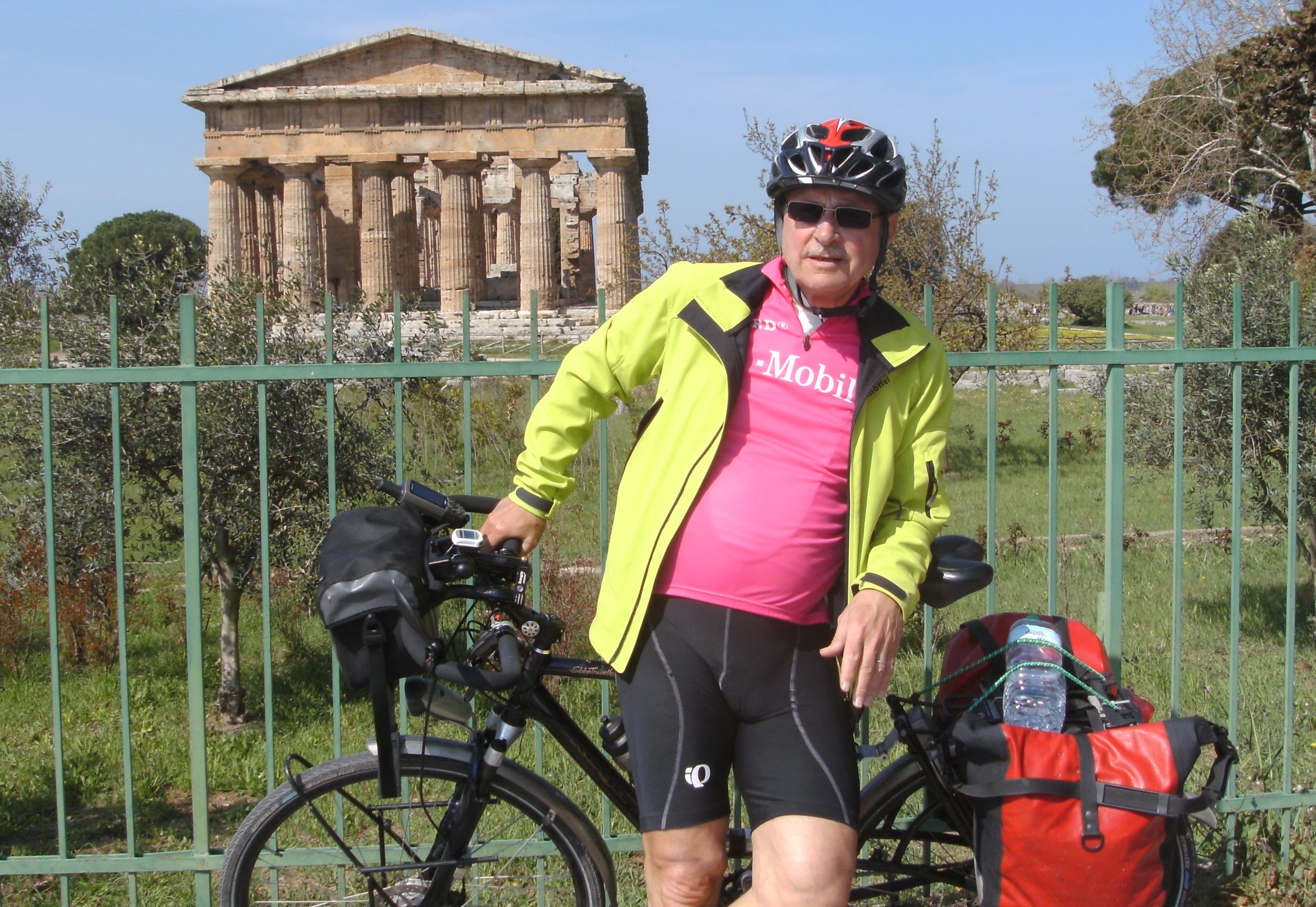
Roland Dürre on his way from Salerno to Pisciotta
Franziska: So far so good. Except that the reality in everyday life does not look quite so blue and rosy. You already said it: That is one of the reasons why you are actively promoting “active motility”– AktMob, as you call it ..
Roland: That is true. I know many streets in Munich where it is no fun at all to ride a bicycle. And on my big tours, it also happens time and again that I have to struggle through a street where I am really afraid I might die.
Mind you, AktMob is not just about riding a bicycle. It is about any sort of mobility that is not horse-drawn carriages, combustion motors or electronic cars. All that matters is that you are moving under your own steam. Be it with roller-blades, skate boards, hiking or using the
Franziska: In the traffic sector, cars as individual means of transportation have been promoted since the 1950ies. It was based on the political concept of the economic boom in Germany. Unfortunately, even this short time was enough to make our cities inhuman. Strange as it may seem, pedestrians and cyclist no longer belong to traffic in the cultural sense. Especially a look at kindergardens and schools every morning shows how absurd this sometimes is: children are driven by car because, due to all that traffic, it would be too dangerous for them to walk. How grotesque is that?
Cars as status symbols in the economic boom world.
Roland: What a good example! Cars were, indeed, not just an object that took you from A to B – especially for men. As soon as you had a driver’s licence and a car, you were at long last grown-up. It is certainly not totally wrong to call a car a phallic symbol. And sitting behind the steering wheel of a vehicle, men in particular feel omnipotent. Can you imagine anybody not liking that feeling?
But even more than that, the car was a status symbol in the economic boom world for Germany and the world where everybody was recuperating. The car is perhaps the best metaphor for bought happiness as a substitute for needs not being met.
When we were still young men and had no cars, we always got the impression that the beautiful young girls clearly preferred the men who owned cars – while they looked down their noses upon us non-car owners.
But the car was also a symbol for freedom – like the cigarette. And it was also a new private space – in the US, for instance, they say that there were several years during which more than half of the children were made on the backseats of cars. Even the Kinsey report said so. And these motorized vehicles certainly also were a nice thing when it came to our laziness. Well, and that such a god-like vehicle – especially when its marketing was also optimal and emotional – won over everything else is rather clear, isn’t it?
The critical mass – riding bicycles together
Franziska: With activities “We Are Traffic”, there are so-called Critical Masses on a monthly basis, both in Germany and world-wide. Cyclists make use of §27 of the StVO, which says that, as soon as they are more than 15 (critical mass), they may drive together. I am quite happy that this movement gets more and more popular in D-A-CH. For instance, it was a peaceful and joyful event for 3,290 cyclists last November in Germany. This year in July, the number had even increased to 13,371 [source: Daniel via itstartedwithafight]. Everybody can join – even if they only want to ride a short part of the way.

© Radlhauptstadt München – cyclists’ night 2016 [picture taken by Andreas Schebesta
Roland: I rather like Critical Mass! In particular, I appreciate the movement because it seems to be truly grass-root. And I am convinced that the only way to cause change is “from the bottom”. Politics and administration are paralyzed by lobbyists and their own rules and have neither a chance nor the desire to try anything. But – without someone trying something, nothing will happen!
Franziska: And yet you can find some bicycle enthusiast among the politicians, too. For instance look at your hometown. The city of Munich aspires to being called bicycle capital. This is also due to the commitment of Wigand von Sassen, who has now been responsible for the city bicycle campaign project since March 2009. Since they started with intense bicycle promotion, there has been a considerable increase in the relative number of cyclists among the total traffic. For instance, there are regular bike checks where you can have small repairs for free. In October, you had the cyclists’ night, in September the RadCouture… This is a lot of commitment in favour of BICYCLE culture. It shows a lot of courage and stamina.
But let us think in more modest terms. What can every one of us do? You do not always need grand gestures.
Driving a car – nothing but a bad habit?
Roland: It is definitely time for something to happen. However, I do not think the higher percentage of bicycles is due to an “intense” promotion of bicycles. In fact, I think that more and more persons discover that there are better ways of being mobile than using a car and also that a car eats up a lot of money. I see all those many cars as a prosperity reserve for the future where many of us will feel more “tightness”.
Driving a car is nothing but a bad habit. Basically, it is necessary for us to be willing and able to change our habits. Smoking is a good metaphor for the process. It is not easy and for many smokers unthinkable to become a non-smoker. And then you can do it against all the odds – and you will quickly feel a lot better.
Currently, I myself am a good example for how hard it is to change patterns you were used to and actually liked. On regional trips up to thirty kilometres, I only go by bike. But unfortunately also for short distances. So my personal mobility program is now “get off your bike and back to walking”. I want to do more hiking. And it is very hard for me to give up the old habit and not automatically mount my bicycle, even if I only have to go a short distance.
Franziska: It is certainly not easy to change behavioural patterns. When I was still an employee, I found it easy to mount my bicycle every morning and ride to the firm. To this day, it is not a problem for me to take the bike when I have business meetings (except if they are too far away, then I use public transportation).
It was easy for me because I knew I had to be there no matter what. But ever since I work in my home office, I find it very hard to mount the bicycle every day – just because I want the exercise. The requirement of having to go from A to B is missing. That makes it more natural for me to do my hiking round through the vineyards in the evening. It gives me peace to ponder and structure the day’s ideas.
Now I integrate this exercise into my working day. On the one hand, I offer public network meetings. We call it Walk to Talk. We meet at a green place and see what topics everybody brought. And then we run through urban greenery for 90 to 120 minutes.

I particularly delight in the fact that the people I coach, my mentees and my supervision partners appreciate this way of talking just like I do. That means that I can enjoy this exciting discourse surrounded by greenery (“Gehsprächs” im Grünen) between four and six times each month. But I would not object to it becoming more.
Incidentally, I would recommend this format to everybody – especially as a welcome deviation from meetings that far too often happen in closed rooms and sitting down. Which brings us to the topic work world = life world.
You have been an entrepreneur for a long time. What can a boss do in order to promote a BICYCLE culture? What are the important factors?
BICYCLE culture in the mobility and health management of enterprises – not an easy task for the boss
Roland (laughs): That is not at all easy. I am sure the most important factor is that you do not offer business cars as an allegedly attractive part of the salary. Unfortunately, I did it up from 1984. The InterFace AG has far too many so-called “business cars”. And it is not at all easy to take away acquired rights.
Services such as bicycle racks with roofs and/or showers in the basement are to be recommended. And you have to be a good example yourself. You have to infect people with your own enthusiasm for bicycles and for riding bikes.
Franziska: Riding bicycles is, indeed, catching. The last time I made that experience was when, in the company I last worked for, we founded an everyday cycling group. It worked like a bus line. The experienced cyclists offered to ride alongside the beginners. In no time, we had an ad-hoc bicycle repair shop and organized (after work) bike tours. Through joining in, I learned about shortcuts and secure routes to work, as well as all kinds of bike tricks.
It filled me with pride to notice how much I already knew after some time and how I could advise others. That was a huge motivation boost towards also surviving the wet-cold rain days with temperatures around the freezing point. There are considerably more dry days than rainy days. And as soon as you are on your way and have ample rain protective gear – the rain does not matter anyway. That is also something I only found out through riding my bike on a daily basis. Mind you, this is still not considering all the many natural panoramas and the intense experience of the seasons of the year.
In your experience, what is it that makes active mobility in everyday life hard or impossible? What – perhaps small – helpful advice can you give to overcome those obstacles?
Roland: Many things come to mind. There is, for instance, the wrong belief that children and heavy objects can only be transported by car. That is not true. Children are happier on the bicycle than in a car. Shopping is a lot easier if you take a bike trailer or a cargo bike instead of a car. Even two bike panniers will go quite some way.
Regularly taking a look at your mirror and your weight, perhaps even at your blood pressure, will soon convince you that it makes sense to exercise more often.
Franziska (laughs): Correct!
Let us get back to entrepreneurial thinking. Since many employees are determined by numbers, data and facts, I am often expected to ask about it. What advantages do you see for the boss to consider “active mobility”?
Roland: Well – it has been proved that persons who exercise regularly in fresh air have considerably fewer sick days. Isn’t that something to convince you? They will also arrive at work in a better mood and more emotionally balanced. And riding a bike also gives them an enormous amount of creativity.
Strong together – AktMob promotes active mobility in everyday life.
Franziska: Early in 2016, you had the AktMobCmp in Unterhaching in order to bring active persons around “active mobility in everyday life” together. In 2017, you will organize evening events and the next AktMobCmp is also currently being organized. What are the topics you will discuss there? Who were – and who are – the participants?
Roland: The invitation addresses everyone who thinks in terms of taking responsibility for our future. The way we think about mobility directly reflects on our way of life. AktMobCmp is a BarCamp – which means we do not know the topics and sessions in advance. This openness, however, makes it possible to get many nice and tangible results on the personal level.
AktMobCmp 2016 — BarCamp for active mobility in everyday life.
Franziska: In other words, you organize and moderate the ActMobCmp as a BarCamp in order to provide space for everybody’s topics. What is special about this particular event format?
Roland: The Barcamp format is characterized by the persons who come organizing their meeting and their sessions according to their individual needs. There are no invited presentations that have been selected by a committee. Everyone is allowed and supposed to contribute. The organizing team only has the role of host who makes it possible to meet at all. The social control is with the participants. I already experienced several times how a session that was abused for marketing purposes was empty in no time.
Franziska: And then there are sessions where humans are made to work intensely and productively in order to solve a shared problem. That is what I like about BarCamps. Especially if the organizers believe in the self-organization and self-control of the participants practiced in those anti-conferences.
For you, this belief grew over the last few years because you experienced it yourself. Because this AktMobCmp is not the first BarCamp you have organized. You are one of the fathers of the PM Camp movement that brings together people all over Europe who exchange ideas on project work. What fascinates you about the BarCamp idea?
Roland: The great thing about BarCamps is that you discover many new things. After all, all the participants are willing to open up and share their knowledge. As a general rule, all participants will go home happy and richer. What you experience will continue to have an effect on you. You have made new friends with whom you remain in contact. This is how, on BarCamps, humans and movements are linked and thus gaining more and more strength.
Franziska: I know exactly what you mean! Since some of my readers are BarCamp newcomers, can you give a few examples?
Roland: Well, there are movements such as eye-level (Augenhöhe), intrinsify.me, EnjoyWork with EnjoyWorkCamp, entrepreneurial democrats (Unternehmensdemokraten), common good economists (Gemeinwohlökonomie) and many more, all of whom I met at BarCamps. Along with those who support and promote them. This is how I made new friends at BarCamps, for instance Nadja Petranovskaja, Dr. Andreas Zeuch, Dr. Eberhard Huber, Gebhard Borck, Dr. Jens Hoffmann, Maik Pfingsten, Dr. Marcus Rainer, Dr. Niels Pflaeging, Roger Dannenhauer, Dr. Stefan Hagen and many, many more.
We, too, first met at a BarCamp (EnjoyWorkCamp?) didn’t we? You will find posts, podcasts and videos of all these persons online. Reading those will automatically make you understand why you need to connect yourself with others and do things together.
Franziska: I think the first time we met was at the Dornbirn PM Camp. But our first really intense discussion was during the “EnjoyWork” initiative. Consequently, I find it even more exciting to have gone into more detail about a few topics we share. Many thanks, Roland, for the exchange of experience.
I wish you well and for your ACtMob to be a huge success – and a good bike-chain at all times.
Roland: Many thanks – it was a true pleasure!
RMD
(Translated by EG)
Some more links:
- Roland Dürre [Profil via Lebens- & Arbeitswelten mit Zukunft]
- AktMobCamp [BarCamp für aktive Mobilität]
- Radlhauptstadt München [Initiative der Stadt München zur Förderung der Fahrradkultur seit 2009]
- Critical Mass [Fahrradkultur-Bewegung mit dem Motto “Wir sind Verkehr”]
Roland DürreMonday January 9th, 2017
PEACE
PEACE must not become a religion, because then we will quickly become un-peaceful.
That is also the reason why there must be no project PEACE.

Seems to be a powerful symbol für peace. May be to powerful.
As you all know, I was going to start a project PEACE. Well, more than ever, I am in favour of PEACE. But no longer as a project.
In the last few months, I have had many dialogues with wise and peaceful persons. Like me, they are convinced that peace is the most precious commodity for us humans. And I learned a lot from them and thought a lot about what I can do for PEACE.
Here is what the current state of affairs regarding my ideas is:
I no longer believe that peace can be brought about by organizations and projects.
A short time ago, a strong lady came to me and said:
“Roland, I am now retired, I have lots of time and I would like to support you in your project PEACE”.
I had to tell her that, according to my understanding of PEACE, there cannot be a successful PEACE project:
The only possible project is to live for PEACE yourself.
Very individually and initially only in private. So I asked her to start her own “project” and simply live for (and work towards) her own und all our PEACE. Consequently, I believe there have to be many small peace projects. Everyone first and foremost works on them for himself or herself and individually.
And that you have to deliberately refrain from coordination and mutual agreements. That would be dangerous and quickly cause manipulation and ideology. And it would probably do more harm than good.
So it is my idea that we all should not organize anything. Instead, we should open our sensors wide and be considerate and free – perhaps as a swarm with others who want PEACE. That sounds religious. I do not like religious patterns.
But perhaps PEACE can work if peaceful persons live their beliefs exclusively for themselves and if the convictions they have are based on their own ethically responsible judgement and on the values of humanity (such as the Golden Rule, the Biophilie principle, human dignity being unalienable …).
I think even “peace-loving” people must NOT actively try to convince others towards being PEACEFUL or act as missionaries. All humans have to come to their own conclusion about PEACE being the requirement for everything else. Otherwise it will not work.
And, above all, nobody should be willing and able to sacrifice themselves for what they believe and thus become martyrs! Because this is not how PEACE can work. Consequently, no organization and no project for PEACE can be a success and actually bring PEACE. In fact, perhaps even the symbol for PEACE I chose and inserted at the beginning of this article is questionable and might be criticized.
It is not easy for me to formulate my complex ideas. If I succeeded in making a little clearer what moves me, then that will make me happy.
And I will continue to strive towards my own PEACE..
RMD
(Translated by EG)
P.S.
Perhaps this is a process – can we call it evolution?
Roland DürreFriday January 6th, 2017
Are Car Drivers the Coachmen of the Future? Or is it better to GO BY BIKE?
Or is that already true for the present?
On January, 3rd, Franziska Köppe interviewed me for her blog FAHRRADkultur.
Here is the result:
Franziska’s message is “bike-riders will live longer lives”. Consequently, I certainly hope that she is right and that our life will not be terminated ahead of time by some motorized vehicle. And that it will not happen that, to make up for it, one more white bicycle will be sitting on a street or crossroad.
I hold Franziska in very high esteem. Consequently, I was a little cautious during the interview. My worst provocation was perhaps (citation from the interview):
“Car drivers are the coachmen of our times. Coachmen were not very well-liked, because whenever any of the common citizens were in their way as they drove through the narrow streets of the cities, they used their whips to beat them out of the way. In those days, coachmen were considered “scum and riff-raff“?!
I abide by all I said in the interview. Let me add that the more I live (and I mean “live” in the truest sense of the word) without a car, the more I am aware of how stupid and irrational it is to drive a car.
And that is true for many dimensions:
- For the lie behind the image and reputation you subconsciously want to gain through owning a car.
- For the challenging work you have to do as you sit behind a steering wheel, although you have grown used to it and thus ignore how strenuous it is. More than this: you actually lie to yourself and claim that you “enjoy the experience of driving” or “relax behind the steering wheel”. Your car is perceived as your “best friend” and a place where you “feel at home”.
- For the horrendous deprivation of exercise and fresh air you subject yourself to as a car driver. That is also true for the physical damage caused by constantly sitting and the negative consequences, including spinal problems.
- For senselessly wasting time, especially if you drive a car. Using public transportation, you could take far better advantage of that time.
- For the physical (considerably more than one million fatalities and far more seriously and not so seriously wounded persons) damage world-wide every year, as well as the psychological risk (double stress for instance when using the telephone while driving a car).
- For how unfree a car makes you – it is the millstone around your neck – because you always have to go back to where it is parked.
- For how you depend on the car: whenever there is a problem and it does not work, your personal world is under threat of destruction.
- For how much of a burden a car is: How often do I hear people say – I have no time because my car needs to be picked up from the service/taken to the service. And the weekend is spent polishing it because you love it so much.
- For how ruthless car drivers treat their environment and society. Neither pollution nor waste of energy are considered, the external additional costs of mobility are considerably higher if you drive a car than if you go by any other means of transportation. And we all pay the price.
- For the fact that you accept the risk that you might kill or injure people, doing enormous damage to yourself in the process.…
- … and for a lot more …
For me, driving a car thus gets more and more synonymous for living your life the wrong way. But:
Life is too short to live it the wrong way!
I know from personal experience that people who consider their car part of their own body like a wheelchair that has become essential to their life will under no circumstances agree with many of the points on this list. I can also relate from personal experience that it was very similar with smoking for me … you only really understand how bad it was when you no longer do it. But you know how hard it was to break with the habit.
RMD
(Translated by EG)
Roland DürreWednesday January 4th, 2017
Travelling through Central America in December – Summary & Notes
Here is the last part of my report with some information, comments and advice, giving you the gist of the trip.
The Caribbean
The ocean and the sun, a wonderful climate, warm water from above and below, an exotic world – all these things have been a dream of mine, especially in December – and that was the most important reason for making the trip.
Travelling by ship
Going by ship is ideal for the Caribbean. MeinSchiff 4 is a hotel that covers distances at night and mostly lies in the harbour in the day. This is how we were able to leisurely visit eight countries and ten harbour cities. We did not need a single visa. The only passport controls were when we entered and exited Germany and when we departed from the R.D. (Dominican Republic). All you need for mainland visits is the ship identification. Our passports remained in the strongbox of our suite.
The ship
Mein Schiff 4 is a German speaking ship. It is modern and well organized. The crew emanates a positive atmosphere. However, it also seems to be a product of convenience, following strict processes that are probably the same on all cruisers. You probably cannot do it any other way with 2,000 guests. The safety drill is good, but the question arises if it would actually work in case of an emergency.
The suites are spacy and functional and make a good impression. Most of the suites have a balcony. In former times, cruise ships were built in a more horizontal style. The lower decks were, for instance, reserved for the huge communal areas, such as restaurants, theatres and shops, along with the crew cabins and utility rooms like kitchen, laundry and much more. The upper decks used to belong to the passengers. Since the ships were rather broad, there were several corridors with outside and inside cabins for the passengers.
With ships now becoming broader and broader, this concept is changing. On the vertical level of modern ships, there are now the crew and service areas in the inner part of the ship at almost all central levels. That is a separate area with its own staircases and lifts. This makes it possible to have even larger community halls in the lower decks. Now the passenger area is exclusively at the outside, quasi built around the crew tower.
Consequently, almost all the suites now have balconies. We very much enjoyed ours. Whenever we stayed in our room, fresh air from the ocean drifted through the open balcony door. That was especially appreciated at night, when we were able to taste the air of and listen to the sound of the ocean without having switched on the air conditioning.
MeinSchiff 4 has two swimming pools. They are both on deck number 14 (there is no deck number 13). One of them is external and surprisingly large with 25 metres. Unfortunately, they are both operated with sweet water, rather than with ocean water. Naturally, the water used on board is won through osmose and/or distillation from ocean water. Consequently, it is not very good for the mucous membrane and the rest of the skin. That is why I hardly ever used it.
The gigantic reclining chair deposits on the diverse sundecks and inner decks are quite impressive. They almost reminded me of refugee camps. Having to service more than 2,000 passengers, you probably cannot do it any other way. Regardless of the multitude of reclining chairs, however, the German towel syndrome was ever-present. Even early in the morning, most of the reclining chairs held towels and other small supplements such as books, sun-blockers, caps or similar things to signal that they were taken. Apparently, nobody was bothered at all by the fact that the on-board instructions clearly said you should not do this kind of thing.
“Welcome back in Germany“
After a long day on the mainland, it feels good to be back on board. The crew will then say: “welcome back in Germany”. On the ship, it is also very much the same as in Germany: at least at first sight, everything seems to be well-ordered and clean – and that is probably true for normal circumstances. All the advertisements clearly follow the “German mainstream”.
But even more than in Germany, the service is provided by people from all over the world. For instance, I meet many service persons from Eastern and Southern Europe, but also from Asia. But you can look wherever you want: room service, restaurant or bar – you will never meet a German employee.
The persons working on the ship mostly do not have a German employer, either. Mostly, they are employed by agencies, for instance in Switzerland (officers), in in Cyprus (service) or in Manila (nautical). As on Meinschiff, they will then be body-leased by the holders. Naturally, this procedure is not TUI specific. The entire sector is doing it in the same way.
The work schedule, too, can only be considered in accordance with German work law if you interpret it very lavishly. They work ten hours a day and seven days a week. If necessary, extra hours are a matter of course. They only have a few days off. If someone’s work was exceptional, they get a special day off – which then, as a rule, is used for mainland visits.
The employees are happy with their jobs and their salaries. There are no deductions for social security. The countries where they are employed have very tax-friendly conditions for seafaring men. Additionally, they offer a surprisingly cheap health insurance for the mostly young persons, even if it only covers the absolutely necessary medical costs. Incidentally, this is the reason why there is no other European country that employs more seafaring men than Switzerland.
Basically, everyone who is employed on the ship is a seafaring person, regardless of where exactly they work: in the nautical, hotel or tourist sector. Consequently, they enjoy a fair net income, even though the pre-tax income is not really high. The cost of living is low, they also get tips, and they see the world. What more could you want?
All inclusive
For cruises, the TUI has an all-inclusive business model. There are both advantages and disadvantages to this concept. You often consume more than you wanted to (or should?). To make up for it, the procedure is rather simple and you really save money if you consume much. On the MeinSchiff 4 , the “all-inclusive” is actually honest. (Almost) Everything is included in the price. Even at the bar. Be it the excellent quality cocktails, the long drink, lots of beer and wine, there is a huge selection of market products, all of which is included in the price.
Only few things cost extra, for instance the specialties in three restaurants. At the bar, only very few and particularly famous spirits and wines are not included. It is true for freshly pressed orange juice and champagne.
Of the food, caviar and spiny lobsters are not included. But then, you can get caviar every week as part of your normal breakfast. Freshly pressed orange juice and the water on bottles labelled “Mein Schiff” cost extra. In the restaurants, however, both sparkling and non-sparkling water are included. There are water fountains on all decks where you can fill the carafes that will be found in your suite.
Food
The food was good quality. It is the same level as in good German cafeterias. More like Münchner Rück (MR) or Allianz than like Siemens AG.
In the (also included) “fine restaurants”, such as the big main restaurant, a several course meal is served on “posh” dishes. The food is the same (good) quality but made up to look good, too.
Self-service and service are well balanced. In several restaurants you can have both in neighbouring or secluded areas. The service does not cost extra, which means it is included in the total price, which is also true for GOSCH at the rear of deck 12. We liked staying there, especially because they had a huge open-air section. The grill bar, one deck up on deck 14, exclusively open-air, was our second favourite place. Along with the two bars nearer to the bow on the swimming pool and one deck up with their really exquisite cocktails, also all open-air.
Exercise
If you want to have enough exercise on the ship, there is a simple trick: only use the stairs and never use the lift. If you stick to that rule, you will, due to the 14 decks, the reception area on level 3 and the exit at water level on deck 2, remain in shape.…
Entertainment
The on-board entertainment is like everything else. Well organized, of acceptable quality, German mainstream like Helene Fischer. To be sure, this is not necessary my favourite, but most of the people on board seemed to like it. The same is true for the band – all of whom were certainly good musicians, but they did not seem to enjoy their own music very much – at least that was my impression. Local music – and also local food –, however, is not something you will get on such a German ship. I am sure it would not have been too hard to, for instance, take a reggae band on board between the two Jamaican harbours.
I must not forget the German Soccer League. They have public viewing on a huge screen with English comments in the open-air arena as well us under deck. Consequently, we had between one and two German Soccer League matches on Fridays, Saturdays and Sundays, which actually makes sense on days at sea. Of course, you get beer along with it – in huge bowls, the iced three-stripes beers from Jamaica is sitting there for you to take. The rule is: get one and drink it. If you do not like the three-stripes beer, you can also get Korona (from Mexico – my personal favourite) or one of the InBev brands (Becks, Franziskaner …). All free thanks to “all inclusive”.
For me, however, the most cherished entertainment on the ship was the great view from the top. Especially when we lay in the harbour or driove into or out of it, I was able to really collect my “great views” and spend hours just looking.
This is not what you saw from the big ship, but from the ferry after crossing the Panama Channel from the Pacific Ocean to Panama City.

Hier der Blick nicht vom großen Schiff sondern nur von der Fähre nach Durchfahrt des Panama-Kanals vom Pazifik auf Panama City.
Internet
From past experience, I know that, on board a ship, the internet access is usually via satellite and consequently not acceptable for an intense user like me. I never tried it on MeinSchiff, which means I have no idea if it was good or bad. But it was definitely rather expensive.
Consequently, I recharged my mobile phone whenever I was on the mainland. One possible way of using it are hotspots near the harbour that take a few USD for hour passes. However, I would recommend you go into the towns and either use public free hotspots or look for a coffee house where you get WLAN as part of the deal.
Digital
MeinSchiff 4 is a rather digital ship. You will find huge touch screens all over the ship. They inform you about the ship, the restaurants and the current program. The pictures showing the crew are displayed digitally and only printed after you order them. It is easy to use the ship App. Using it, I can also book trips and see how much money is on my on-board account.
Bicycle
There are no bicycles you can rent for mainland trips on MeinSchiff 4 . That was a special MS Europa service I very much appreciated. On MeinSchiff 4, you only get bicycles for specially organized tours. But you can have those both as normal trekking bikes and e-bikes. They even had e-rollers on board. But then you have a huge number of persons riding in single file on those trips, which is not an idea I am in favour of.
Renting a bicycle was possible only once at the harbours we arrived at. It seems like in Central America this is not a very popular thing to do.
Mainland trips
Everything is on offer – hiking tours, bicycle tours, bus tours, tours with boats of different sizes. You can book a jeep tour and a monster truck tour, even plane tours. In Cartageno I noticed that there was a city tour on MeinSchiff with simple electronic scooters on three tyres.
The focus is on getting to know the country and the people, as well as cultural, historic, geographic and geological sightseeing. Many trips include the visit of an adventure or amusement park.
The trips are well organized – which, of course, always depends on local agencies. They also explicitly state this in the terms of business. The tour guides speak German or English. More often than not, the linguistic competence of the local guides is less than satisfactory. The tours are not cheap, but then the countries you visit are not cheap, either.
During our private tours, we often had nice and very positive contacts with the local population.
Day and night
Due to the time of year, the sun is in the south in December. Since the Caribbean is north of the equator, we had eleven hours of sunshine and thirteen hours of darkness. However, that is not a problem, because ten hours of sun every day are absolutely sufficient.
The guests
We probably had a good average make-up of passengers, which means we saw a representation of our society. Basically, we are talking those persons who can afford to go on a long-distance vacation. In that category, MeinSchiff is actually quite an economical option. Regardless, I got the impression that some of the vacationers must have been saving money for quite some time in order to treat themselves to this trip, or perhaps some of them even had to borrow money for it.
Barbara said she saw a lot more tattoos than in the Unterhaching swimming pool. For me, that is not a problem, even though, personally, my attitude towards tattoos is a little on the sceptical side. Consequently, there is no tattoo displayed on my body, not even the beautiful IF logo.
Most of the persons we came in contact with were very agreeable. It only happened once that I had to suffer through a few AfD slogans during a meal …
Miscellaneous
- Sun blocker:
Always a good idea, although the many cloudy hours made it easier to avoid sunburn. - Protection against mosquitoes:
Not necessary. - Diamonds:
Can be bought all over the place, even in blue, with money returned. But they also cost a fair penny. I do not have the know-how to judge if buying jewellery would be profitable. - Cigars:
Smell nice, but are also quite expensive – but I no longer smoke (except once in a while, unfortunately). - Coffee:
Can be bought all over the place – but it is always rather strongly roasted and consequently not necessarily the right thing for the German mainstream taste. - Rum
Can be bought all over the place – plenty of it. And it tastes rather nice.
This is it as far as IF blog.de in the Caribbean by ship is concerned until my next trip comes up.
RMD
(Translated by EG)
Roland DürreMonday January 2nd, 2017
Travelling in Central America between December, 17th and December, 23rd (Second Week).
In this article, I will tell you about the second week of our cruise through the northern Caribbean on the MeinSchiff 4. In an earlier IF Blog Post, I wrote about my adventures from the first week of this trip, between December, 9th and 16th. Those first seven days were over on December, 16th with our arrival at Roatán in Honduras. We had explored the area on our own and had taken a long and beautiful walk along the Westbays.
From Roatán, we started the second week in the evening with a day at sea on December, 17th. Puerto Limón in Costa Rica was our first destination.
December, 18th – Puerto Limón – Costa Rica – – BOAT, BUS, ON FOOT
Arrival time 7:00 /departure time 22:00; organized trip
Today is the fourth Advent Sunday and we arrived in the beautiful and warm Costa Rica. We booked a one-day trip.
The first leg is by boat to the Tortuguero Channels and then up to the Varagua Rainforest by bus. We are lucky, because our guide is from Germany and her name is Susanne. As a young girl, Susanne got stuck in Costa Rica in 1981, where she married a Costa Rican. Consequently, she has spent 35 intense years in this special country. And there are quite some stories she can tell.
Today, she is a grandmother and lives in Costa Rica with her family. It is her true pleasure and happiness to feed the hens with her grandchildren.
Apart from that, she is active in organizations that promote environment protection and trying to make tourism beneficial for the local population. And she works as a guide for ship tourists.
I said we were lucky because there were three groups doing the same tour. The second one was listed as English-speaking – which meant it was only for people who actually understood English. Unfortunately, however, the guide of that group hardly spoke any English (and, of course, no German). The third group was “German speaking”. However, their guide hardly spoke any German (and no English at all).
Bad news for nature …

This is a sad trip to the Tortuguero Channels, because what you see will soon no longer be …
The things Susanne told us about the Tortuguero Channels makes me rather sad. Costa Rica has a unique richness in species – perhaps due to its geographical position. Even from the boat, we can really appreciate it. You can see sloths with two or three toes, special water birds, crocodiles and much more, all of which we see at the riverbank. We admire the Mangrove Forests (Mangroven-Wälder) and understand how important they are for the eco system.
And then she tells us that this entire idyllic scenery will soon be no more, because at exactly this spot a new gigantic container terminal for the new and rather big industrial harbour will be built. And that the houses along the riverbanks are so dilapidated because the inhabitants have left the area a long time ago.
Apparently, the Costa Rican administration believes that such a gigantic infrastructure will be necessary in the future. Nobody really knows why. But that is irrelevant. And now, the big project will be realized after many years of protests, which means many hopes are shattered. It happens regardless of intense and international protest with many good arguments.
It was my general impression on this trip that most of the cranes in the harbours of Central America I saw seem to sleep an eternal “Big Sleep”. Even later, in Panama, which, as we know, is an important business and reloading point for merchandize, most of the cranes were idle.
But this seems how matters are on this world. Politics – pushed by lobbyists and industrial corporations – believe they can boost the local economy with huge infrastructure investments. And as soon as the things are built, they usually experience the great hang-over.
Intel produced many chips in Costa Rica. Now the Asians produce them. Who else? When all is said and done, countries such Costa Rica need tourism to survive. And tourism needs nature (incidentally, even in Panama, tourism does more for the economy than the cash cow Channel).
Regardless, the Costa Ricans are quite upbeat. They greet people with “Pura Vida“, which means something like “pure life”. Whenever people meet in Costa Rica, they tell each other “Pura Vida” and are happy. That is what I, too, will do in the future.
After the boat trip, we continue by bus to the Varagua rain forest. Even the trip by bus is an adventure. Through extremely bad and narrow streets with many sharp corners, the bus fights its extremely slow way up the hills. The bus driver exudes a serenity that is absolutely imperturbable. He gives no indication of impatience, regardless of the fact that, occasionally, this trip really makes you breathless.
As soon as we arrive at the top, our mood improves. Not only are we served a fair local meal, but it is also a beautiful place. The sheer nature experience of seeing the rainforest leaves us stunned.
We have a very diverse program. Night animals such as the red-eyed frog can be seen in a building where it is night in the daytime. There is a wonderful voliere for many colourful butterflies and a small zoo with all kinds of reptiles. We learn a lot about the colours of butterflies, the poison of frogs and snakes, life in the rain forest and much more.
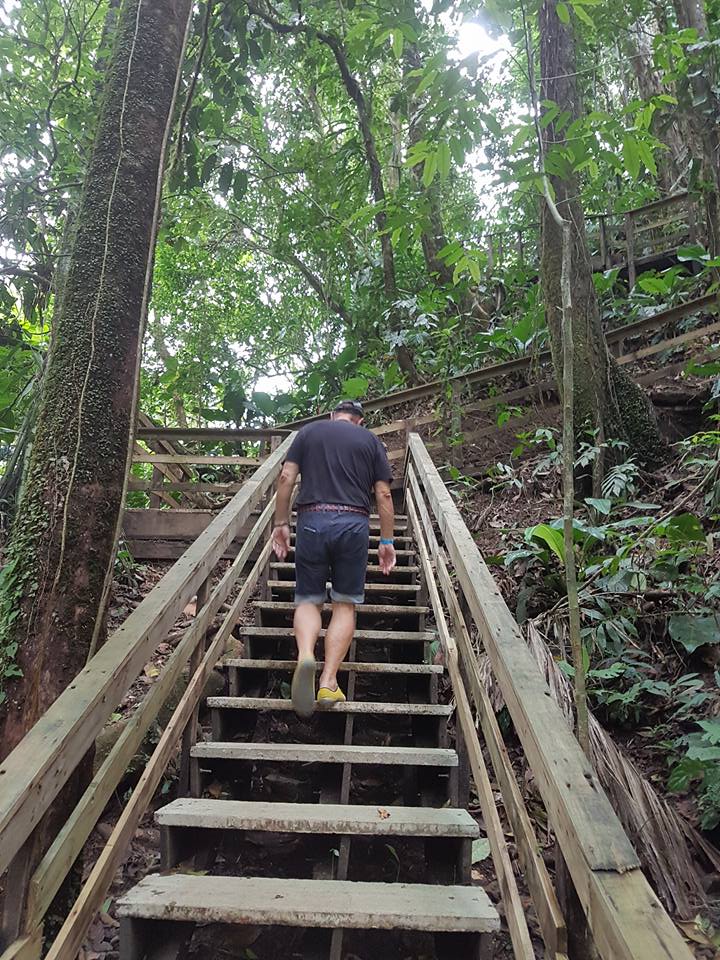
I am a little thoughtful as I climb the 350 steps up from the Puma waterfall to the cable car station.
One of the highlights of this tour is the presentation given by a young gentleman. He tells us what he as a scientist and his institute do to ensure the survival of, for instance, frog species that are threatening to die out. He explains his Spanish slides in Spanish. Susanne gives us excellent translations of what he says, just like all her explanations are always valuable and entertaining.
Another highlight is the way down into the valley by cable car that goes down steeply to the Puma waterfalls through the rain forest. Among other things, we see numerous monkeys doing gymnastics on the trees at eye-level with us. It is the “pura vida“ – even if it makes me a little thoughtful that we no longer can experience the beauty of the original rainforest with its gigantic trees. Instead, all we see is the secondary or tertiary rain forests. Because the huge tree giants of the original rain forest were removed by homo sapiens a long time ago through overexploitation.
As an alternative to this trip, we could have booked a journey with an old-timer train. That is also one of the things Costa Rica has to offer. Apparently, the railways were destroyed during the great earthquake in the early 1990ies. The company that did the calculations about whether or not re-building would be profitable was the biggest coach owner in Costa Rica. Consequently, the only small stretch that was rebuilt for tourist purposes was in Puerto Limón. The rest was abandoned.
December, 19th – Colón – Panama – – BUS, BOAT
Departure time 7:00 /arrival time 17:00; organized trip;
Taking nine hours, the journey from Puerto Limón to Colón was on the short side. And we had booked another organized trip in Colón. After all, Barbara and yours truly wanted to be on the Pacific Ocean again – even if only for a short time – and see the skyline of Panama City. More than anything, we also wanted the experience of sailing on a segment of the Panama Channel.
Apparently, we were not the only ones who wanted that. The trip was rather overbooked. Sixteen busses were waiting in front of our ship exclusively for the ship passengers. The passengers were assigned to busses in an almost military-style way in the ship theatre. Everybody wants to ride on the Panama Channel (or at least on some of it). And, as I see it, the trip was well worth the money.
From Colón it is about one hour’s drive to Gamboa. We have a wonderful guide. She exudes pure life. To be sure, her English is a little limited, but you can easily understand what she says. Her presentation is great, once in a while she even shows considerable cabaret talent. It is a true pleasure to listen to her and time flies during the bus ride.
We pass Manuel Noriega’s jail. To me, the building looks like something between a castle and a stronghold. Gamboa is almost exactly the midway point of the 82 kilometres of length that the Panama Channel measures between the Atlantic and Pacific Oceans. In Gamboa, we were transferred to two huge ferries (at least they are considerably bigger than the tour boats we were used to). They are to bring us to the Pacific Ocean. These are simple ships with open decks on two levels. Since the day is warm and the ships are rather crowded, the seats under the shadow are very sought after and quickly become a rare luxury.
Unfortunately, the guide on the ship is nowhere near as good as the guide on the bus was. The loudspeakers have been set too loud and the journey is rather tedious. They cannot exactly predict how long the ride will take, because it depends on the traffic. If a water giant comes along, she will be given right of way. After all, these huge ships also pay enormous amounts of money for the transfer. For the really huge ships that, due to recent construction projects, can now also pass on this part of the way, the toll fee is allegedly up to one million USD.
The duration is an estimated four to five hours. Passing the water-gates on the way to Panama City, even though they allow us to overcome a difference in altitude of around thirty metres, does not really fascinate us. After all, we are quite experienced with the house boat and consequently know about water-gates. Besides, we have often experienced the quiet Rhein-Main-Donau Channel and, a short time ago, we visited the Oder Ship’s Lift during our bike tour from Penemünde to Berlin. Consequently, the sluices are less impressive in our eyes than the artificially created lake scenery.
The narrowest part of the channel, the Gaillard Cut, is part of our way. The two peaks – at least one of them has been cut – are really worth seeing. Near the sluices, we pass rather crowded channel observation points. There is plenty of activity.
As we are on the way into the Miraflores Lake there is an announcement that comes as rather a surprise: today, passing the channel was very quick and we will be at our destination in 45 minutes. That would mean only 3.5 hours total traveling time. But before we pass the Puente de las Américas the channel administration stops our ferry.
We have to wait for a gigantic container ship. We wait almost two hours for her to pass, then we continue on our way. This is how, eventually, the trip is almost five hours, after all.
As we exit the Miraflores Lake we are on the Pacific Ocean until we come to Balboa, which is the most remote of a small series of islands that are connected with the mainland through a dam. We are standing at the stern and see the Puente de las Américas get smaller and smaller. On the larboard side, the silhouette of Panama City slides past. It is all rather impressive.
In Balbao we leave our ferry and again board our bus. Our super guide is there to welcome us and makes the time on board the bus pass quickly. The bus runs on the motorway all the way from the Pacific Ocean to the Atlantic Ocean until we are back at the ship – on time for our departure at 6 p.m. Said departure is particularly enjoyable, because at 18.00 hours local time you can still see quite a bit of Panama in the light of the setting sun.
December, 20th – Cartagena – Columbia – – ON FOOT / TAXI
Arrival time 9:00 /departure time 20:00; private tour;
The last two days were spent doing two one-day trips that actually were quite exhausting. Consequently, we want to be a little leisurely today and thus set out on our own.
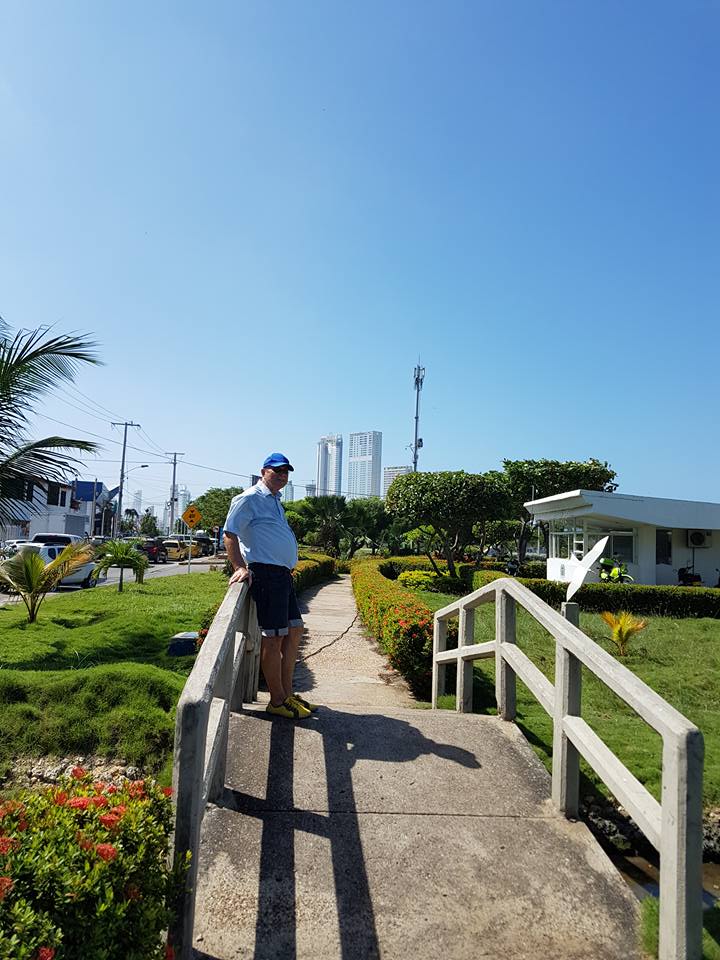
Shortly before the old city after a longish hike from the container harbour. One more bridge – and then we will have reached our destination.
With more than one million inhabitants, Cartagena is a truly huge city. The silhouette of the city contains many skyscrapers and is no less impressive than that of Panama City. However, there is also a comfortable old city – partly still enclosed in the original, well preserved city walls – that beckons with many museums and other attractions.
Our ship lies in the container harbour. The city map at the harbour information centre lets us conclude that the way to the old city is almost ten kilometres. However, the way looks pretty straightforward, so we start walking. And again, many taxi drivers try to tell us that the way is far too long on foot. By now, however, we have quite a bit of experience when it comes to resisting the calls of the sirens …
The traffic is dense on the two-lane one-way road. The pedestrian’s paths, too, are rather full. More often than not, we walk faster than the cars can drive. We feel relieved when we pass a bus with an “organized trip” from our MeinSchiff 4.
Many small yellow taxis are also stuck. In this country, they are considered public transportation. But there are also many public busses. I discover that quite a few of the yellow taxis are electronically powered. They are the KIA brand.
It is a very impressive hike to the old harbour. We pass the entrance and see a huge portal in the city wall. Here it is: the old city. It is rather tempting: there are museums, bars, pubs and shops.
We take a lot of time strolling around and window-shopping. Afterwards, we are really tired. So we want to go back to the ship to enjoy the time and look for a taxi. We quickly find it and later spend a wonderful late afternoon on board the ship.
Now our journey will soon come to an end. We have to go back from Columbia to the Dominican Republic. Our next to last destination before the return flight from La Romana is Santo Domingo. It is quite a way to go there, which is why we start our last day at sea, on December, 21st, at 8 p.m..
It is a wonderful exit. We can see the lights of Cartagena and Columbia for a long time and slowly take our leave from Central America. Even though we are no longer in Panama, I buy myself a Panama hat for the German and Greek summer of 2017.
Barbara also weakens and gets a wonderful lady’s hat – also for the hot summer of 2017. After short but determined haggling with the flying hat merchant, we get both hats for the total sum of 14 USD. At the airport, my hat is 20 USD – the ladies’ hats are a lot more expensive.
December. 22nd – Santo Domingo – Dominican Republic – – ON FOOT
Arrival time 8:00 /departure time 20:00; private tour;

Two days left until Christmas Eve.
The end of our journey nears. There is one full day on the Caribbean left, along with one night on board our ship – and then we go back, away from this warm weather. We want to arrive in Munich on Christmas Eve and then celebrate with our children and their partners.
Today, we take another walk. This time around, the way from the harbour to the city seems rather short. So this is our last stroll in Central America. Not at all far from where our ship lies, a swimming bridge spans the arm of the sea that leads to the harbour. And then we arrive.
Regardless of Santo Domingo being a huge city – with many people living around the city – it also has a really charming old city. It really invited us to do some strolling. It is not very extensive and has only flat buildings and a few parks.
In one of the parks, they are recording a film. Parts of the street are kept empty, which takes a huge effort by the filming crew. There is a lot to see for us. Again and again, we meet a group from our ship with the guide walking at the front and holding his sign over his head.
Bars and pubs with “free WLAN” can also be found. Consequently, we go and drink a coffee, at the same time giving our cell-phones some nourishment. The invoice comes in local currency and also in USD and EURO. What a small place the world has become!
Incidentally, the abbreviation for the Dominican Republic is R.D. – my initials. I see baseball caps, t-shirts and other products to remember the place by all over the place. They all carry my initials. Consequently, I succumb and buy an R.D. baseball cap. It will be a Christmas present for my son Rupert Dürre (another R.D.)
As for the rest of the day, we enjoy being together and look forward to Christmas.
December, 23rd – La Romana – Dominican Republic– – BOAT
Arrival time 8:00 / Transfer to the airport 14:45; organized trip;
This is our last day. A few days ago, we booked an organized trip for this morning. It is a boat trip including snorkelling and visiting the beach. It is scheduled to be finished at 2 p.m., which should give us enough time for the direct transfer to our plane.
We already packed yesterday evening. The luggage had to be in front of our doors by midnight and has already been picked up. I also added my backpack with the warm clothes. Consequently, we are all set and all we have to do at the airport is identify our luggage and then hand the two suitcases over at the check-in counter.
Again, the trip is well organized. Our boat is already waiting for us at the stern of MeinSchiff 4. We have a crew of three, a lady from Switzerland and two locals. Everybody is really in high spirits. On the way, we get cola, sprite … and lots of rum. Cuba libre! For food, they took Pastelitos, that is some kind of filled pastry.
Our first stop is for snorkelling, then we drive to the beach. The area with the blue reclining chairs is for us. It costs 2 USD to use the reclining chair, lying at the beach on your own towel and swimming in the ocean are included in the price. A “Costa“ cruiser is sitting on the beach and busily “tendering” guests to the mainland who apparently are mostly Italian. The place is as busy as the Munich Marienplatz
This is the day before Christmas Eve. It is all about eating, drinking, sunshine and enjoying the water, along with “being at leisure”. We particularly enjoy this last time of the tropic atmosphere on the ocean and go into the water more often than on the entire trip. Then the boat takes us back to the ship – adieu Caribbean!
The boat gets us back to the ship on time. On the 12th deck of MeinSchiff4, we eat our last hamburger at the grill bar and wash the remainders down with Corona. Then we go to our bus that takes us to the plane. After all, we want to celebrate Christmas at home under a green tree tomorrow.
At Christmas Eve, we are at the airport S-Bahn train platform at 8.30 a.m., waiting for the line 8 to Munich East. There is no problem with changing to line 7, all trains are on time. Around 10 a.m., we arrive in Neubiberg. My first activity is riding my bike to Butcher Schlammerl in Ottobrunn and buying some Weißwürste. Then I ride to Baker Schlank in Putzbrunn to buy Brezeln to go with them. Lunch is on – and – Christmas Eve can come!
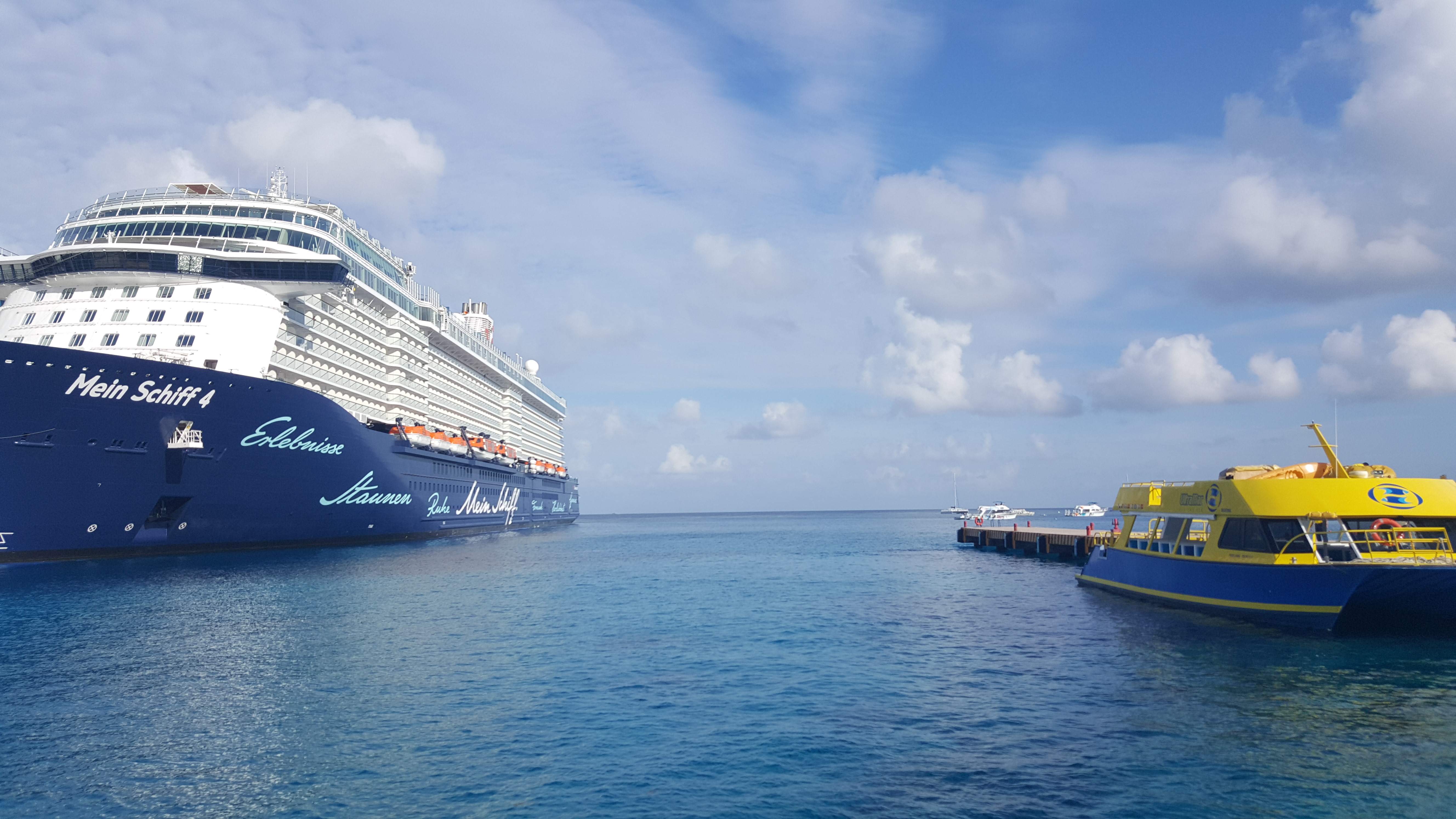
The hotel that was our abode for 14 nights and drove us through the Caribbean.
This is all! I will write another article and give some advice on the cruise ship – and then I will get back to other topics.
For instance what is basically the system-theoretical problem in our society.
RMD
(Translated by EG)
Roland DürreSaturday December 31st, 2016
May everything you try turn out fine in 2017. And may you do everything in love and respect, always considerate and thankful!
My Personal Wish for 2017:
Gratitude and Considerateness, both for You and Others.
Many years ago, I already noticed how important it is to be considerate, both towards yourself and other persons, in what you do, but also towards the entire creation. I also started realizing quite some time ago that appreciation is the basis for peace and that appreciating yourself is the first requirement if you want to be able to appreciate other people.
But it took me almost 66 years to discover that the ability to be grateful is probably the most important requirement for a happy life. Today, I am infinitely grateful for all the things I was allowed to experience and learn in my life.
Consequently, it is my personal wish for 2017 that the degree to which I am thankful will and can continue to grow. And that is exactly what I also wish all my friends, and especially the IF blog readers!
So:
For 2017, I wish you loads of beautiful things so that the degree to which you can be thankful will grow at your heart’s desire. And I wish us all the ability to be very grateful!
Health is also a very important commodity. So I also wish you all very much health!
As opposed to this, the small piglet is just supposed to bring a little luck. May the portion of luck that gives us the extra joy always accompany us all!
Best wishes for the start of the New Year and the same for the entire 2017!
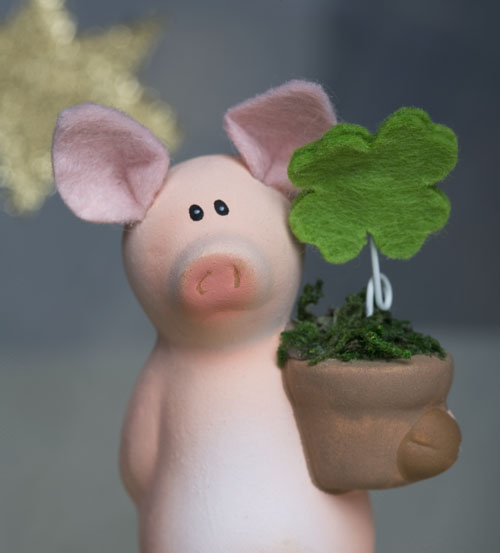 Einen guten Rutsch und ein gelingendes Jahr 2017!
RMD
P.S
I use this beautiful picture every year as an illustration of my new year wishes. It was originally designed by my dear friend, the photographer Rolo Zollner. It is listed as “common licence“, which means that you all can use it, provided you tell all your readers where you found it and who designed it.
May it bring as much happiness as possible to as many persons as possible, and in particular to Rolo!
Roland DürreFriday December 30th, 2016
Mobile in Central America Between December, 9th and December, 16th (First Week).
Generally speaking, cars dominate the “mobile life” in Central America, too. I was well aware of it. And yet I was surprised when I saw the number and frequency of congestions in the big and small cities. The same is true for the (probably only imagined) dependency on all kinds of combustion motors.
Let me first say something about cruises:
Well, we did an entire round through the Caribbean on the huge TUI ship “MeinSchiff 4“ – with four days at sea and ten days on shore. This ship does the same route several times between December and February, another “MeinSchiff“ does another round in the same area with other destinations. Then they go to new waters and cruise those. Cruises have become a sort of “regular service”, which certainly facilitates the logistics. But it also makes the travelling experience a little more “convenient”. And, of course, there are ships from many shipping companies doing business in the Caribbean.
World tours individually designed, for instance from Hamburg back to Hamburg stretching over a time frame of nine months with new routes, have become scarce. That is true for all the shipping companies I know, such as Costa, Celebrity or MeinSchiff (TUI) – and the same is true for the small ones.
However, this is not bad news, because travelling on a ship has a huge advantage. Throughout the day, you will see many places in various countries and you can actually structure your day quite intensely and individually. The often inconvenient transport happens at night and is very comfortable. That means a ship is basically a mobile hotel where you wake up at a new location every morning.
I am well aware of the problem of cruises (and far-away vacations in general). As a general rule, only flying long distance will take you there – and a ship is definitely a strong “environmental sinner”. That means one cruise every year will destroy all the efforts I make towards getting a more environment-friendly carbon dioxide footprint. Even the fact that I no longer drive a car or go by bike or public transport in Germany is little help.
Let me explain step by step:
During our two-week cruise through Central America, the people check in and out of the ship at one of two harbours: La Romana and Montego Bay, both of which have a harbour and an airport in Jamaica.
As a general rule, you leave the ship where you boarded it. That means that these convenient cruises expect you to return to the place where you originally arrived. Consequently, you will not need an open jaw ticket. We boarded our ship in La Romana in the Dominican Republic (R.D.), where we also left the ship. Luckily, that meant the shortest flight from Munich to the Caribbean.
We wanted to see as much as possible of the country, rather than just collect impressions through car and bus windows. What we wanted was get into contact with “the country and the people”. And that is what we also accomplished. We often went places on foot and – unfortunately – only once rode bikes. We used cars (taxis) three times. We took four organized tours, for which purpose we often used a bus and various-sized boats. Once, a cable car was our means of transportation.
How it started:
On December, 9th, around 4 p.m. and after more than ten hours on board, our plane landed at the airport of La Romana in the Dominican Republic. From the landing strip, the bus took us to the harbour, which was about ten minutes for the few kilometres. The luggage was delivered directly from the plane to the ship cabin – which means that, in terms of logistics, the transfer from home to the ship was really optimal.
However, the check-in at the ship took rather long. On this route, the ship only has two “change days” (they used to call them arrival and departure days) and that means that around 1,000 new passengers will arrive from their own charter flights in a short time interval. We were just about the last. That means it took some time before we were on board, even though the check-in, too, was rather well organized with many desks. But, as I said before: the good news was that the luggage was sitting right in front of our cabin.
The voyage starts!
We arrived on December , 9th. The 10th of December was a day at sea en route to Jamaica. That was quite well, because it was a needed day of leisure after the long flight. We arrived at Ocho Rios harbour in the morning of December, 11th.
December, 11th – Ocho Rios – Jamaica – – ON FOOT
Departure time around 7:00 / arrival time 20:00
This is the first mainland day on our trip and my first time in Jamaica, the country of Bob Marley!
One of Ocho Rios’ attractions is the Dunn’s River Falls. They are “waterfalls” where the water flows down on a plateau-like descent. You can climb up through the flood of water from down on the ocean for around fifty metres. It looks spectacular – in fact it looks a lot more dangerous than it actually is. .The sweet water is pleasantly warm, which makes the entire adventure a nice joke. Finding the shallow places is no problem, which means you can easily do it without a guide.
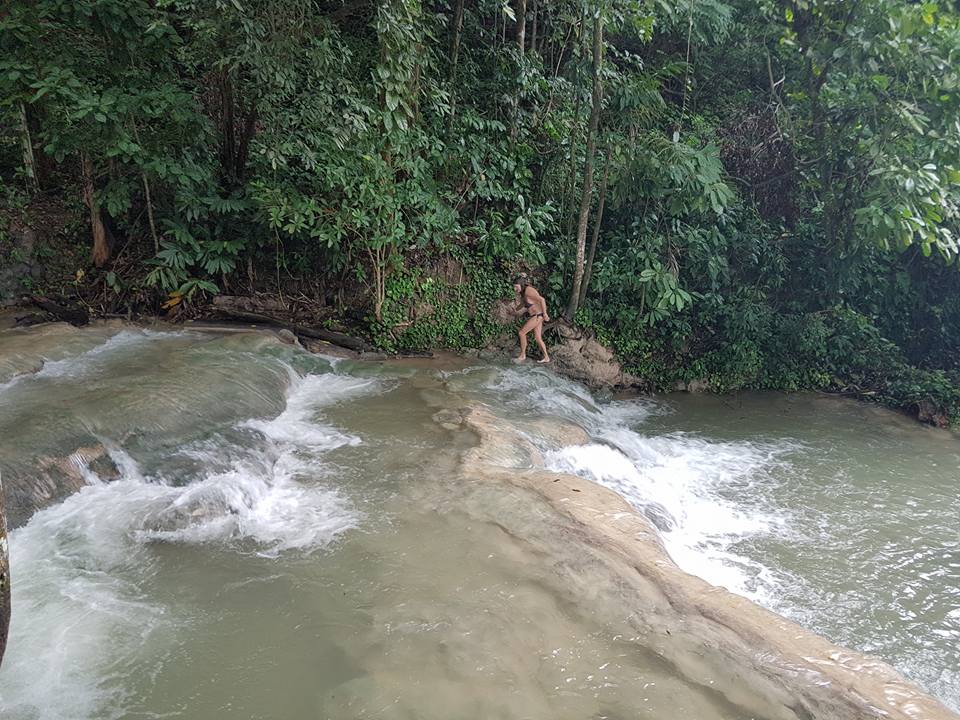
Barbara at the Dunn’s River Waterfalls on her way up!
On board the ship, there is a “day’s itinerary” for each day (printed in paper, too) and, with the exception of days at sea, there is also “harbour information”. It contains useful information and a map of the harbour. On the map, we can see that, apparently, it is not too far from where our ship is docked in Ocho Rios to the Dunn’s River Falls. Our estimation is that it might be between five and ten kilometres.
Consequently, we set out to hike the way. It is a little cloudy, which is naturally good news for our December paleness. Again and again, it rains. But that is not a problem for us, because the rain is warm. In fact, we consider it nice refreshment. Once in a while, we seek shelter and thus have our first chance to get in touch with the local population.
For us tourists, the admission fee for the Dunn’s River Falls is 20 USD per person. There is no discount for retired persons. Many families who live in the country with their numerous offspring are also standing in the queue. In their faces, you can see how they are looking forward to the experience. They pay half. The organized trip from the ship to the waterfalls would have cost us around 50 USD, but that would not have been hiking. Instead, we would have had a bus and a guide.
Early in the afternoon, we are back on board. On the whole, we hiked perhaps around 15 kilometres, which is not bad, is it? Later in the afternoon, we go to the “village”. Most of the shops are closed. After all, it is the Third Advent Sunday. I would like to buy a Bob Marley T-shirt. Actually, due to the Sunday, many shops are closed, but there are still enough open.
Bob Marley is truly worshipped here. He is the national hero of Jamaica. In general, T-shirts are cheap, only buying Bob Marley comes at a higher price. After having looked in several shops, we find an official T-shirt I rather like. However, depending on the shop, it costs between 20 and 36 USD. As opposed to this, a “normal” T-shirt can be bought for five or even (considerably) fewer US dollars. The salespersons strictly refuse to sell the Bob Marley shirt for less than 18 USD. It seems to me that selling the national hero for little money is definitely sacrilegious.
Our ship takes off after darkness has fallen and continues to drive along the coast of Jamaica to Montego Bay (Mo Bay). And a nice red original Bob Marley t-shirt is sitting in my “suite”. I will wear it on Silvester Eve at home.
December, 12th – Montego Bay – Jamaica – – ON FOOT, Taxi
Departure time 7:00 / arrival time 22:00; doing our own tour

This is how a Christmas Tree looks in Jamaica. The one you see here is being erected in the centre of Montega Bay.
Incidentally, the second change day of this route was in Montego Bay. This means that around 1,000 persons leave the ship and 1,000 new arrivals board. However, this does not concern us. After all, we want to go back to the mainland.
The “harbour information” map shows us that the way to the centre should be around seven kilometres, which means that it is definitely possible to hike.
So we start: first along the Southern Cros Blvd, then turning left onto Howard Cooke Hwy. This time, there are hardly any clouds and practically no shadow. Regardless, we arrive at Montega Bay Market after little more than an hour.
Our Mo Bay amusement tour is rather long. The return trip seems to be longer than the way out when we are half way. Perhaps it is a good idea to take a taxi? At this very moment, a taxi driver sitting at the kerb asks us if he can take us to the ship. He will drive us for free, because then he can enter the harbour taxi area. If you are parked there, you can earn real good money. Later, we will learn that going by taxi from the ship at the harbour to diverse destinations will always be several times as much as is normally charged. We are a little exhausted and gladly accept the generous offer.
Late in the evening, the journey continues to Mexico. Between Mo Bay and Cozumel, however, there is the second day at sea on December, 13th.
December, 14th – San Miguel/Cozumel – Mexico – – RIDING OUR BIKES
Departure time 6:30 / arrival time 20:00; doing our own tour
Cozumel is an island sitting before the eastern coast of the Mexican peninsula Yucatán. We leave the ship rather early and first stroll towards the centre of the small village San Miguel. On the harbour information map, the way looks considerably shorter than the one to Montega Bay (and that turns out to be true). Regardless, the number of taxi drivers who tell us that it is too far to walk feels like a hundred.
However, we do not manage to get to the centre, because we discover a bike rental next to a motorbike rental (exclusively letting Harley-Davidson machines) on the right side as you walk into the town. The bike rental will close at 4 p.m. (after all, darkness falls early), but since this is early afternoon, there is enough time left.
They offer very simple bikes for 10 USD – only equipped with a brake and lacking both gear shifts and an additional hand brake. For 15 USD, you can get some sort of trekking bike, which has a gear shift and free-wheeling. And then there are some electronically supported “fat boys”. You can hire them for 20 USD. Prices are for one bike and one day.
Well, I rather like the idea of trying an electrical fat boy. However, the salesperson warns us that the batteries are just in the process of being loaded and that this will take some time. Since I feel a little “unfamiliar” with only a pedal brake, we take two “trekking bikes” for 30 USD.

A nice long bike trip brings us to the northern beaches of Cozumel Island on the coast of Mexico.
The bikes are well-oiled, the tyres have enough air. The bottom bracket of my bike seems to have a problem, since it makes strange noises. Regardless, we very much enjoy riding the bikes.
First, we continue on our way to the centre of San Miguel. We look at a few shop windows. As everywhere, there are many jewellery shops, specializing in diamonds. They will continue to haunt us throughout the entire trip.
Then we go back in a northerly direction, passing the bike rental and the ship and then onto a street going north along the eastern coast. We ride along exquisite hotels that look quite expensive and seem to stand sentinel on the way like pearls, except that the distance between two of them is mostly a few hundred metres, occasionally also one or two kilometres. We ride quite a far way along the ocean and we really enjoy it – then we get hungry and thirsty. We turn around, again pass the ship and go to the bike rental, where we hand back our bikes. Then we walk a little more than one kilometre back to the ship. It was a great day. In the evening, we depart for Belize.
I almost forgot:
In Cozumel, shortly before the bike rental, we visit a small bar on a minor road, where we have “free WLAN”. In return for drinking two cups of coffee and one bottle of water for three times three USD, we can use the internet and read and send emails. Answer chats. Download the SZ and do whatever else has accumulated.
December, 15th -– Belize City – Belize – – BUS, BOAT, ON FOOT
Departure time 9:00 / arrival time 20:00; organized trip.
It seems that Belize City does not have a harbour that can be accessed by ships as huge as the MeinSchiff 4. On this one visit of the mainland, the ship does not enter the harbour as usual. Instead, it lies at anchor far out. Consequently, it has to tender. Normally, that is a procedure where the ship’s own lifeboats are launched, and then they have to commute between the ship and the mainland. In Belize, they provide a regular tender service for this. Since we booked an early organized trip that departs early, we can use the second tender to the mainland.
Our trip seems to look quite attractive to many passengers. We need two busses. Everybody wants to see the Maya heritage. We are early, the busses have not yet arrived. Consequently, we wait in the harbour building. It feels a little like when I was in primary school – we stand in rows of two and wait. Then our bus arrives and we are transferred to Tower Hill. This is where, at long last, we get “local treats” – chicken with inlaid onions and delicious vegetables. Along with it, we get the standard “wedding” – that is rice on black beans. I know the “wedding” from our Cuba bike tour two years ago. Since I do not like rice, I pass on it. However, all the other dishes are really tasty – simple and delicious.
Now we are full and content, and thus move into small but very fast boats that are supposed to take us to Laimanai. We are the last to board and consequently sit at the very rear. The boats hurry to Laimanai at tremendous speed. All we can see to the right and left are the water fountains. On or way back, we will apply a different strategy.

At long last: the Lamanai Maya Temples.
This is what we do. On the return trip, our seats are at the front of the ship. And the view is spectacular. Also, the boat no longer seems to go quite so incredibly fast
The Maya city of Laimanai was truly very impressive. On the way back, however, there are some small problems. First, our captain has to help a boat that cannot move on. And then our bus gets stuck in a mega congestion.
This is how the end of the shore trip is as late as 7.30 p.m. .There is no time left for a stroll through Belize City.The only things we can report are those we saw from the bus. To us, Belize looked very British, not just because you drive on the left-hand side. That was something we already knew from Jamaica.
As soon as we arrive back on the ship, it sets out. To be sure, it is not quite as punctual as usual. It is a little after 8 p.m. We had to wait for another tour group that was a little late. Now we set out for Honduras.
December, 16th – Roatán – Honduras – – ON FOOT, Taxi
Arrival time 9:00 / departure time 20:00; by ourselves
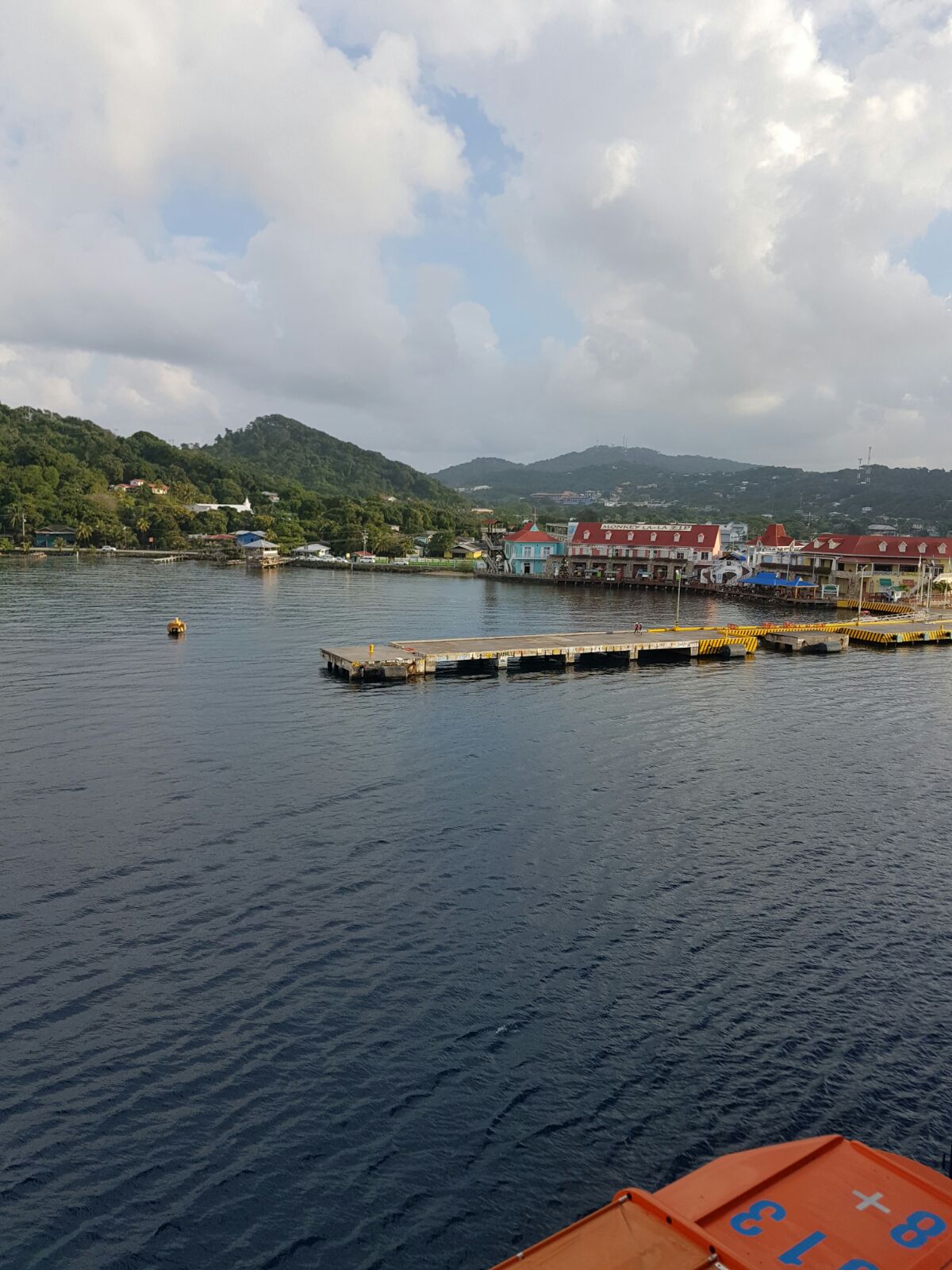
View from the ship – looking towards West Bays, which is where we are headed.
Roatán is an island situated half an hour by ship from the mainland of Honduras. Today, we want to go to the “Westbays“. Because they say the beach is particularly nice there. And, if possible, we would also like to ride bikes again.
First we enter the small town east of the harbour and ask the local population where we might rent a bike. The answer is: not on this side, but perhaps on the northern side of the island, that is behind the mountains. That is where you might find a bike rental. We can go there by taxi.
But that would not make sense, would it? Then we try to find out how far it is to the “Westbays“ . We get different answers and eventually agree on the number seven. But we are talking miles. So we start out. And before we leave the town, we discover a very special place. It is a small park area with benches that seem to be dedicated to friends of Honduras from Taiwan. There is pretty good public WLAN. We are online for the second time on this trip and download all we need.
Then we start out on foot. Back to the ship, passing the ship and going towards the “Westbays“. Time and again, it rains. Initially, we take shelter under palms that line the streets. Since that is not much use, we eventually continue hiking even when it rains. After all, the rain is nice and warm.
All the time, taxis stop next to us and offer their service. And they warn us that the way to the “Westbays“ is quite far and also rather arduous. Then we are beyond the half-way point. We take a break and enter a bar. And we drink several bottles of Salva Vida, which is one of the local Honduras beers. And we enjoy the sun of Central America on the pedestrian overpass. If paradise is half as nice …
So far, the street had no inclines and went straight along the southern coast. It was a nice path. Now we will have to turn inland. We wonder if it would be a good idea to turn around. Or should we go to our destination and then let a taxi transfer us home?
Again, it rains. Rather heavily. So far, we were always dry again by the time the next shower came. Now this no longer works. The rain finally drenched all our clothes. Now the path leads into the mountains. The view gets nicer and nicer – the path steeper and steeper. Initially, it is only up, then suddenly first down and then up. Extremely often. And as soon as, after a steep decline, we think that now the way must go down to the ocean, the next incline waits.
On our way, we see many tourist attractions. Several “Flying Dogs“, “Cool Runnings“, a Monkey-Park and similar things are supposed to lure the hiker. However, all those places seem to be closed – perhaps due to the rain.
Finally, we manage to arrive on the beautiful Westbays beaches. They certainly look nice, but they are also full of reclining chairs. On the water, the boats are sitting nose to nose. This is a little sobering. But then, we managed to get here and reach our destination, didn’t we?
It was a strenuous hike. Now we are really soaking wet. We find a taxi. For 10 USD, it takes us home to our ship. We are cold in the taxi. So the air conditioning is out and the windows are open. This is better. What a great day!
Wet to the bones, a little exhausted but very happy: our arrival at the West Bays Beach in Roatán/Honduras.
This was the first week! In my next post, I will tell you about the second week, which was from December, 17th to December, 23rd. It will start with a day at sea.
RMD
(Translated by EG)
Roland DürreTuesday December 27th, 2016
Cyber Christmas.
 Klaus Hnilica (KH), who created
“Carl & Gerlinde”
regularly writes IF Blog articles.
I received special greetings from him while staying in the Caribbean.
Then I asked him if I may publish his poem.
And Klaus said yes.
Here comes (Translated by EG)!
Our first Cyber Christmas ?!?
Moritz, Stella and Agathe,
even Granny says: I’ll wait,
until Sonja shows us all:
the tree is beamed against our wall
as hologram in 3-D space
where real trees sat in former days,
it even has some sparklers on,
which means that Granny’s fears are gone!
It was our Grandpa’s strange desire
that we wear cyber glasses with frames of wire,
But Simon put no glasses on:
he navigates the Christ-Child drone,
which – and Granny wins the bet –
is naturally a little late.
That means we all will see and hear
with “real augmented“ coming near,
how “virtual“ is now rather old
and our dinner gets quite cold.
The cyber angels are not able
to blow some warmth towards the table.
When finally we hear next door
“hallelujah”, we yearn for more.
For Simon this is no big deal
his smartphone makes it all quite real!
A drone is doing all the singing
with tyres quite still and rotors swinging.
And when our Grandpa rings the bell
it says: I come from heaven, not from hell,
I bring the presents right from there,
old Santa Claus knows where they were!
The heap grows into quite a tower
a virtual presentation shower,
that makes our Markus yell quite loud,
and Anne falls from her chair of cloud,
when small Agathe squeaks with pleasure
and yells like crazy for good measure,
just as the goose is much enjoyed
by all the guests today employed.
The drone alone remains aloof,
it will land on another roof.
(Translated by EG)
Happy season’s greetings from
Brigitte, Klaus and all the family!
P.S.
I’d like to thank so much Eveyln (EG) for the translation. What a great work! She has all my adoration.
Roland Dürre
#NoArmy – Belize, Costa Rica, Panama
In my last post, I started telling you about my last trip through the Caribbean under the title Travelling in Central America (Unterwegs in Mittelamerika). One of the surprises that made me happiest was that I found three countries that have no federal destruction machinery, also known as army or military system.

A short trip through the Panama Channel in a pleasure boat. On the horizon, only just visible, you can see the Puente de las Américas, which was opened on October, 12th, 1962. Having an open height of 61 metres, it is still not high enough for some ocean giants.
Actually, one of my dreams is to live in a country that decides not to have an army and consequently will also do without the elements that go with an army, such as weapons industry, compulsory service and/or mercenary armies, etc. That would be a country that has no ministry of war or defence and no soldiers who work machines the sole purpose of which it is to kill humans and destroy cities.
I still find it regrettable that, immediately after WW-2, the Adenauer administration purposefully and secretly worked towards a re-armament, regardless of the fact that the German Parliament had refused a national re-armament in its first state debate on November, 24th and 25th, 1949. See also the article on the Himmeroder Denkschrift (and especially the part about the Himmeroder Expertengruppe).
Let me cite Wikipedia:
In May 1950, keeping it top secret, Adenauer had instituted an office under his military advisor, General Gerhard Graf von Schwerin. Its official name was Zentrale für Heimatdienst (ZfH) and its task was to select former officers, generals and admirals of the three military sectors who were “unblemished” and some of whom could be counted among the military resistance against Hitler in the broadest sense of the word. From this group, a team of German experts for military expert exchange with the allied forces was to be established. They were also to represent Germany in negotiations with allied partners. Regardless, some of them were subjected to intense criticism.
As early as April, 25th, 1953, Adenauer had reached his goal and the re-armament of the FRG was a foregone conclusion. It was probably in reaction to this that the Nationale Volksarmee (NVA) was established on January, 18th, 1956.
Back to Central America:

In Belize among the Mayas 🙂
I had already known that Belize was a country without an army. However, I was surprised to learn that the same was true for Costa Rica and Panama. During discussions, I had long been in the habit of mentioning Belize as an example for a country without army. At the time, my argument in the discussion was always countered by others saying that, basically, Belize was just a (hidden) colony of the USA.
That is why I intended to talk to the people living there about the topics #NoArmy and the US dominance. And I was surprised to see how all the people I talked with in these three countries felt not having an army was really something very positive.
Regardless, I can well imagine that the CIA controls these countries. However, the people living there I talked to denied this. To me, they all seemed to be very independent and democratic. They pointed out that their country lives in peace with all other countries of Central America and the rest of the world.
Neither could I detect a US dominance as far as business is concerned. As everywhere, the cars, busses and trucks were from Asia and the EURO was just as welcome as the USD.
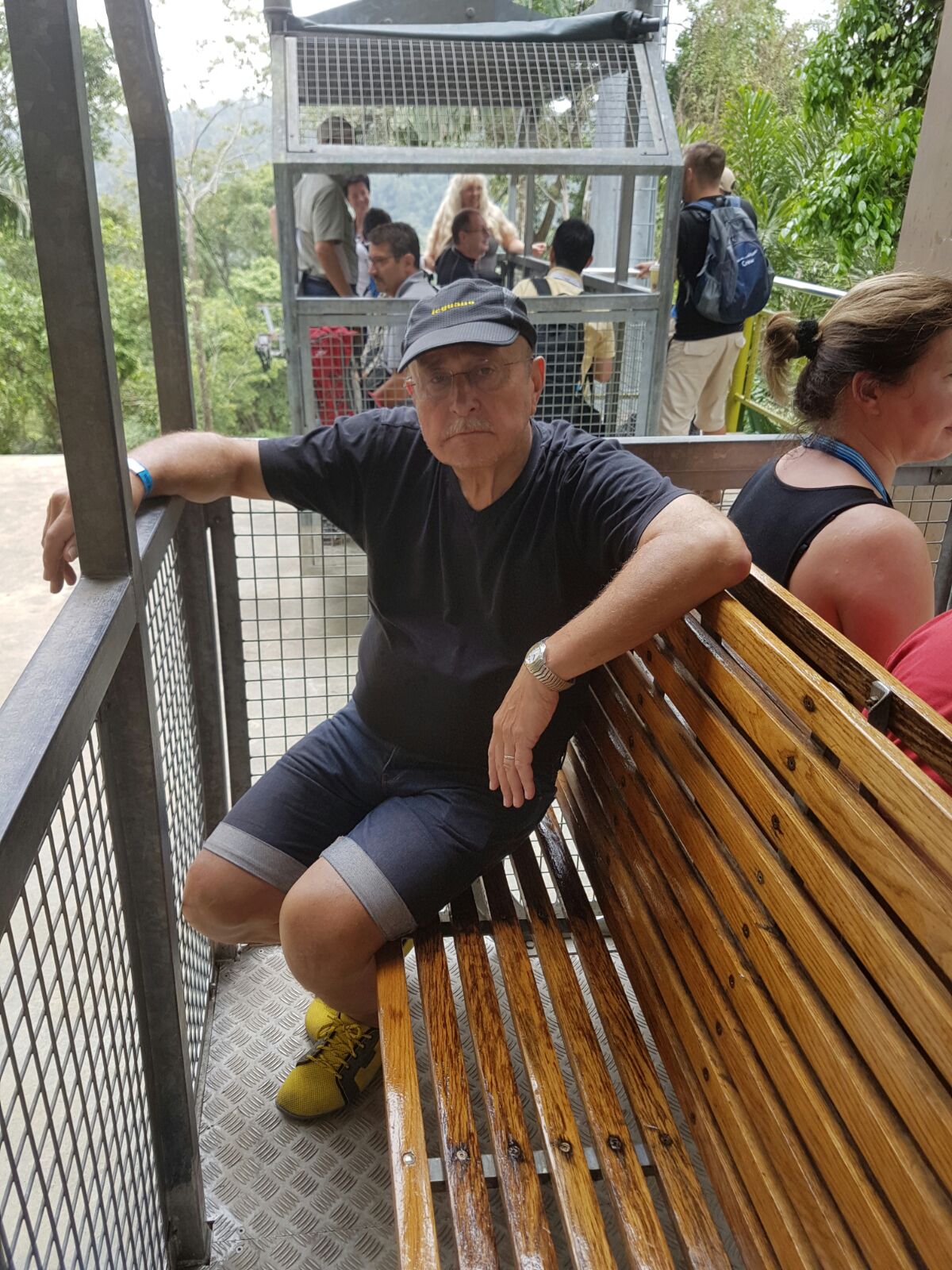
This picture was taken at our departure to the Puma waterfall scientific centre at Costa Rica when we started an organized and wonderful trip to the Veragua rainforest.
Our female guide in Costa Rica who accompanied us during a trip starting from the Puerto Limón was able to describe the situation very precisely. She remained in Costa Rica after having been on vacation there. Today, she is a young grandmother, living with her big family and working in charitable projects that want to support soft tourism that will eventually channel the money into the right hands.
But our time in Belize also quite exciting. This is where I noticed that there is still a lot of British colonialism. Belize was also the only country on our trip where the cars were driving on the left side. In Panama, I saw a truly healthy national pride. At least judging by what I felt, the people and the country were not at all controlled by the USA.
But even if this were not true: I personally would prefer being a little under US colonialism to having an army.
This is how the three countries have again become real valid examples for the fact that it is possible to do without an army and probably even to do better without. And this is how, for me, the Puente de las Américas became a symbol of hope and for a peaceful future without weapons.
RMD
(Translated by EG)
Roland DürreMonday December 26th, 2016
Touring Central America
An “Alien” on a Huge Ship.
We returned from our ocean trip on Christmas Eve and already spent two wonderful days in our “home sweet home”. The repercussions of the trip are still with me – now I reflect all those many adventures that happened during fourteen very intense days.
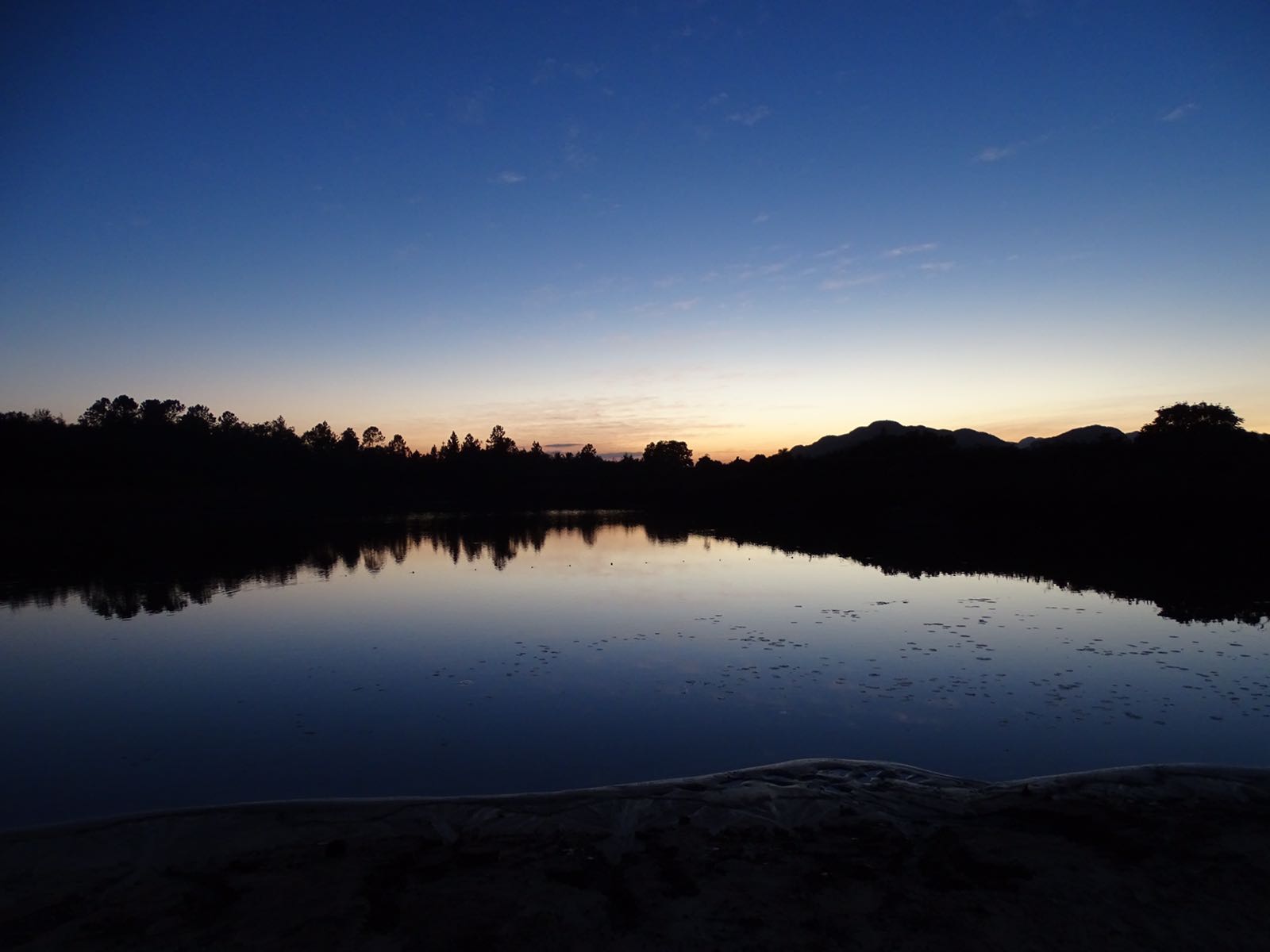 In the last two weeks, we visited eight countries. From La Romana in the Dominican Republic, we went to Jamaica, then Mexico, Belize, Honduras, Costa Rica, Panama, Columbia and back to La Romana via Santo Domingo.
Just as we had hoped and anticipated, it was pleasantly warm in the Caribbean. Whenever clouds showed up, they were welcome, because the prevented us from getting sunburn, regardless of us basically always staying outside and enjoying the fresh air. The rest of the time, sun and rain switched places frequently, with advantages in favour of the sun. Once in a while, there was quite some wind.
It was night for almost thirteen hours, and I mean a rather dark kind of night. That meant there was always enough time to really get enough sleep. Keeping our balcony door open, we enjoyed the sound of the water at night. More than eleven hours of the day, the sun shone really bright – which was enough time fill with intense adventures.
To be sure, it was a typical “all included” trip on a huge ship with more than 2,000 passengers. There were plenty of animations on diverse big and small stages. As often on cruisers, they tried to make the passengers feel that theirs was a glamorous world of luxury.
As far as we were concerned, we defined the boat trip a little differently and did not organize it in the same way as the majority of passengers. Consequently, we always stayed outdoors and did not eat in the big or small restaurants inside the ship a single time.
Instead, we always ate in one of the two small beer-garden-like open-air restaurants. And it almost went without saying that we never attended one of those many shows that actually fascinated many of our fellow travellers. This is how it became a very simple vacation, just for Barbara and me.

A private “crusader” in Roatán (Honduras).
In the daytime, we spent each day in one of six countries and two days in various places in Jamaica and the Dominican Republic. Dependent on the situation, we spent six out of ten days away from others, hiking privately and once riding rented bikes. We took up offered trips twice. At night, we were always on the ocean. The same is true for the four ocean days during which we let our souls relax and digested what we had experienced.

Two gigantic ships meeting in Cozumel (Mexico).
During the next few days, I will relate what went through my head in all those days. For instance that we actually visited three countries that do not have their own armies and how we saw that the majority of people living in those countries were very happy and proud of this fact.
RMD
(Translated by EG)


