
Roland DürreTuesday February 7th, 2017
Hacked By XwoLfTn …
Logo of the Chaos Computer Club, the most influential association of hackers in the German-speaking world. Security questions are their main field of interest.
Now it happened:
IF-Blog has been hacked. For the second time. Here is what happened each time: The headline is overwritten – and so is the text. The last time, it was my article America Firs that got under attack.
The headline was replaced by
Hacked By XwoLfTn
and the entire content was overwritten by
Hacked By XwoLfTn – Tunisian Hacker.
Before that, it was my EURO story (EURO-Geschichte). With the same result. The headline and the content were the same as this time.
I was able to reconstruct both articles, which means I am glad that nothing worse happened. But you can see they actually exist: evil guys on the internet. The Chaos Computer Club (CCC) – which I hold in high esteem – is again correct. And so is my friend Hans Bonfigt.
Unfortunately, I do not yet know if we are talking an individual person who wants to annoy me or another Bot doing damage. Looking at google and realizing how many blogs are affected by the same effect, I rather fear the latter.
As soon as possible, I will now install the latest wordpress version. And I hope that helps. And if any of you are wordpress experts – or even better: if any of you know what exactly happened, I would be grateful for any advice you can give me!
Many thanks in advance!
RMD
(Translated by EG)
Roland DürreMonday February 6th, 2017
AMERICA FIRST
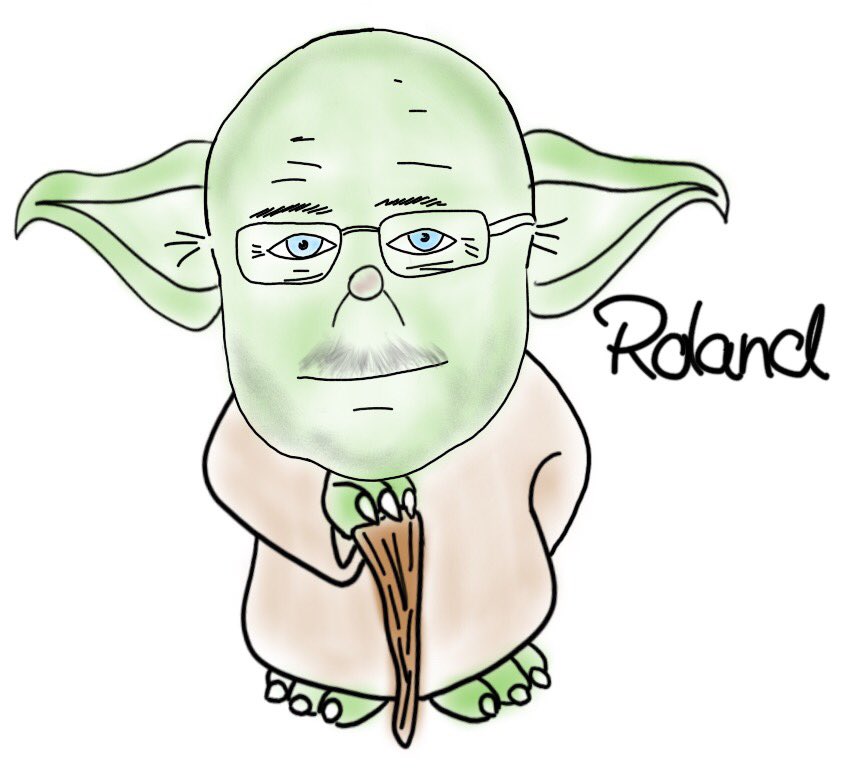
Roland at PMCampDOR (© Visual-Braindump).
The current US president said it again and again. As I see it, he said it a little too often, because for a US president, “America FIRST” should go without saying. Of course, the USA must come first for a US president. And nobody would criticize “America FIRST” if the man who keeps saying it were not Mr. Donald Trump who, even to my way of thinking, acts slightly irrational.
Even for humans, it is true that you first have to care about yourself, before you can think of others. How can anybody who does not value his or her own self appreciate others? That is why masses of persons in the sense of a social system, too, first have to think of their own well-being.
Consequently, I like the slogan “America FIRST“ as a behaviour-oriented value much more than a USA that considers itself a boorish world policeman and also acts accordingly. For instance, I do not understand why Trump’s predecessor, Obama, who won the Nobel Prize for Peace, ordered his soldiers to drop a total of 26,171 bombs in seven countries in the year 2016 alone (as the US expert for foreign policy and national security, Micah Zenko, says on the website of the think tank “Council on Foreign Relations“). And I do not understand why nobody in this country protests against it. Maybe it is because we are the third biggest weapons exporting country of the world – and because in this country everything that creates jobs is per se a “good thing”.
I am not a powerful president. I am only a simple private and retired person who likes to blog. Consequently, I am thinking about what is “FIRST“ in my life.
I live in Neubiberg, which means one would assume that I say “Neubiberg FIRST“. But somehow or other, I still feel more at home in Unterhaching, Riemerling and even Ottobrunn than in Neubiberg. All these locations are situated in the south-eastern affluent suburbs of Munich.
Consequently what I say is: ”Upper Bavaria South-East FIRST“
I often ride my bike and like using public transportation. Consequently, I yell
“New Mobility and as few combustion motors as possible FIRST!”.
I want a maximum quality of life. And since Munich is so near, I also yell:
“FIRST less traffic noise and pure air in and around Munich!“.
I also wish to live healthy and not have more plastic on this planet. Consequently, I say:
“exercise and health FIRST!“.
and
“healthy food and no plastic FIRST”.
Now I leave my micro-cosmos. I live in Upper Bavaria, but I grew up in Swabia. So now comes a softly spoken “upper Bavaria and Swabia FIRST”.
However, “Bavaria FIRST” gets stuck in my throat. One of the reasons is that a large part of the weapons exports come from Bavaria, which, for me, is a total no-go.
I definitely have no breath left for “Germany FIRST”.
For me, the gigantic government buildings in Berlin are first and foremost a gigantic symbol of power. Everything smells of reign and bourgeoisie. This also includes the parliament with its many luxury limousines that sit in front of the building with their motors running so the chauffeurs will not get cold.
The Chancellor’s Centre with its wide rear expanse is not my world, either (the same is true for the Bavarian Government Central Building in Munich). There are more things in Berlin that I do not understand. For instance the new German Secret Service building. It will be the biggest governmental building ever built in Germany. All those things are not what I would feel comfortable with. So, naturally, there is no “Berlin FIRST“.
In my perception, Europe is even farther removed than Germany. So you will never hear me say “Europe FIRST“.
If there is anything I would wish to say in a really loud voice, then it would be
“Peace and Humanity FIRST
and
“Humanity and Tolerance FIRST!“
If, one day, there is a peaceful and free Europe of regions as part of one world where a common-good economy is practiced and where we have no wars, then I will yell “ONE WORLD !“ and “Europe FIRST!“
But only if politics and the economy make the people and the common good as their first priority.
RMD
(Translated by EG)
Roland DürreSunday February 5th, 2017
Democracy & System
Not Democracy is the Problem, but the Underlying System.
A short time ago, I had a facebook discussion with my esteemed friend Detlev about this topic. Because I believe in democracy. But I think the underlying system it no longer any good. What we badly need is a structural reform.
After all, times have changed. What was considered “normal” at the time of the industrial era is no longer normal now. That is true for your workplace (#newwork), for enterprises and also for politics.
We no longer need winners. Emperors, “bog bosses” and centrally established officers (CEOs) are “out“. The same is true for a party “taking over the power” or a system that “gains power”! Because the power must remain with the sovereign: the people of a nation. And it cannot be taken by anybody else.
But first: our dialogue. Detlev is a master of the word, he had posted a great theory:
Detlev:
The liberal democracy is the most sensitive creature of the world. Nurture the baby!
 Roland:
The problem does not lie with democracy but with the underlying system. I no longer want to vote for parties. Instead, I would like to decide between two options of how to deal with important topics that have been prepared in responsibility and following the idea of social consensus. Without any influence by lobbyists. I want to elect people who then actually work towards the reform. As responsible “coordinators”.
In former “democratic systems”, we had to elect a person who then had to decide what happens. This was true both for a chancellor (FRG) and the president (USA).
But now we no longer need “leaders”! The time of the “centrally established officer (CEO) is at its end in business, and we also should kiss it good-bye when it comes to the organization of our nation (politics).
 Detlev:
“France, liberate yourself of persons.“
Those were the words of Anarchsis Cloots in his “call for the human species“
Then Jules Michelet instructed them to establish the government:
“Everything is done by the masses, the great men contribute little. Those who are allegedly gods, giants, titans just deceive us through their greatness, because they maliciously step onto the shoulders of the docile giant: the people“.
That was after the Napoleonic catastrophe. In its wake came a government characterized by a constitutional body that met regularly. And today? Again, France has a presidential system. Roland, why do you believe that it might work out this time? Just because we now have the internet? Or do you believe human nature has changed? I wish it were so.
Roland:
I coach a number of young persons and start-ups. And I notice all the time that they have actually made progress compared to former times. Yes, people change!
Detlev:
Very well, then let us try to prevent presidential systems from happening, especially those with a strictly authoritarian concept. Where shall we begin?
Roland:
First and foremost, I am going to write an article where I will integrate what you said. Your formulation and demand “prevent presidential systems from happening!“ alone is already a remarkable mental progress.
My conclusion:
To nourish something also means to reform it. For instance, I can easily imagine that it is no longer the purpose of democratic elections to bring a person or/and a party into power. Instead, its purpose is to distribute tasks.
For instance, you could elect persons who get the mandate to work towards possible solutions that might be acceptable for all if a social problem needs to be solved (with problem being defined as a state of affairs that cannot be left as it is). Maybe such a body could be the new parliament. It should work following the rules of the “Art of Hosting”, the “honest discourse “ (see: Habermas) and similar concepts. And then it should present the people the solutions they found.
We – the people of the nation – decide which of the solutions they presented us is the best. And if we like none of them, then the gentlemen in the parliament will just have to come up with something better.
It goes without saying that all and any influence through third powers of any kind (aka lobbyists) must be forbidden. Naturally, that also includes religious and similar.
I will no longer need a government in the traditional sense of the word with earls and knights. A well-trained administration is far more important. It must do exactly what the parliament has offered as solutions to problems and what the people have decided. And it must also execute all other important decisions that draw their legitimation from a democratic vote.
Dear Friends:
Prevent Presidential Systems from Happening!
RMD
(Translated by EG)
P.S.
I would wish to have plebiscites in a very direct democracy. Switzerland is a good and very successful example for a “better democracy”. To be sure, even here there is still potential for optimization.
The often heard argument against plebiscites that they sometimes also end in irrational results is easy to counter. If you have ten traditional decisions, you will probably mostly have five poor ones. If you have ten plebiscites, then the number is maybe one in ten.
Well, even the best system will not work totally without mistakes. Only when omniscient machines rule us can we come to that state of affairs.
Roland DürreFriday February 3rd, 2017
A Story About the EURO History.
Europe is More Than the EU (and the EURO).
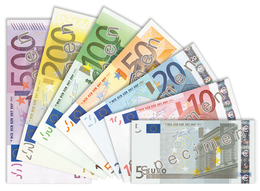
After all, we no longer have the five-hundred Euro bill – regardless of the fact that the currency is losing value.
Last Tuesday, I went to the Café Luitpold where I attended an event the title of which had been advertised with the sentence you can read in the heading of this article (up to the brackets; what is in there is mine).
Harald Lesch had been invited as the star of the evening, but unfortunately he had to cancel at short notice. His replacements were two “Europe experts”.
Regardless of Harald Lesch not being there (in fact, he had been the reason I registered for the event), it was an interesting evening, especially because the nonsense they all talked was very refined. Mind you, we are talking people who in our country are considered the elite in science. To be sure, it is sometimes annoying if you have to listen, but for me it is also a morbid joy to listen to refined nonsense.
The two gentlemen on the podium started with Ancient Rome and some of their theories were really rather absurd. For instance, when someone in the audience asked if the downfall of Europe perhaps had something to do with losing our spirituality and religion, the answer was that the true danger for Europe was not from atheists but from agnostics. The offered explanation was that a fanatic atheist finds it easier to understand a strict Islamic faith than an agnostic.
Which makes integration easier.
That was my “Oh-my-God” moment.
My friend Sigi was also at this event in the nice coffee shop in the noblest part of Munich. After the presentation and discussion, Sigi told me a story that sounded quite familiar. Because I had often told it similarly – but never to Sigi.
To make up for it, let me tell you that Rudi Jansche told me the story as early as twenty years ago, albeit in the future form at the time. It was before the EURO was introduced and Rudi was one of the top managers of a relevant English concern in Germany that had a lot of power in the rest of Europe and also in the FRG. And I often wondered where my mentor Rudi had gained all this foresightedness.
I will now tell you the EURO story (Sigi’s and mine) as I myself experienced it:
 In the early 1960s, I was in France as an exchange student. They still had the French Franc. My French was not yet very advanced and I was a little confused to see that a sports jacket, for instance, cost 100 (cent) Francs. And my host said that he had payed ten thousand (“dix milles“) Francs or “dix milles balles“.
The riddle was soon solved. They had had a currency reform in France shortly before my visit. The “nouvel franc“ had been introduced. It equalled 100 old Francs. People could continue to use the old “francs“ as “centimes“. Basically, all they did was drop two digits. Many people, however, still spoke and had the mental concept of the old Franc, regardless of the products now being priced in the shops in new Francs.
For more information about the French “currency reform”, Wikipedia – here is an excerpt:
On December, 27th, 1958, the introduction of the Nouveau Franc (NF) as of January, 1st, 1960 was ordered. One NF, since 1963 officially only termed Franc (F), equalled 100 old Francs (anciens francs). The old Franc coins could still be used as Centimes. In everyday life, the old Francs continued to be part of the language for decades.
This Wikipedia article is absolutely worth reading. It gives you a good idea about the French inflation.
I have a vague memory that there was a time when one Deutsche Mark (DM) bought you more or less one nouvel franc (NF) – or vice versa. However, that time was soon over. It only took a few years for one Deutsche Mark to buy you three Francs. And matters continued in this way.
It was quite a surprise for me to see how with every visit in France the baguette got less expensive (for me). After all, its maximum price was regulated by law and apparently the state paid to subsidize it. Just like it surprised me that, even after several visits in France, I remained “le boche“ for some French people. Some of the families that had formerly been friends with my host family actually started to avoid them because they had opened their homes to a “boche“ and also – which was even worse – had sent their son to Germany, where the arch enemy lived. The good news is that, regardless, I soon found many young friends in France.
 Our family (with my parents and my sister) mostly went to Austria on vacations. I still fondly remember the Schilling. It was truly an adventure to have the turnpike opened for us at the border and to drive through and then use a foreign currency. We were in a foreign country!
The Schillings – both the 1-Schilling coin and the 5-Schilling coin – looked beautiful. I remember that one DM equalled roughly seven Schillinge. This never really changed very much.
Both the vacations with my parents in Austria and my French exchanges were soon a thing of the past. Having escaped the parental home, I more and more often chose countries like Italy or Greece.
 This is how I learned about Lira and Drachmens. Those were totally different kinds of currencies. The bills were greasy, the coins reminded you of GDR money and they were worth practically nothing.
In Italy, I was surprised to notice that the pizza got cheaper by the year for me, regardless of the fact that, nominally, it got more and more expensive in Lira. It was similar in Greece. For the owner of DMs, it was paradise. Unfortunately, those times are now long gone.
From the perspective of the Italians and Greek, it was not so great. For instance if they wanted to buy a Mercedes. Except that, as soon as they had the bank agreement for the credit to buy the car, said Mercedes was already more expensive. And that meant they would then buy a 2CV, R4 or Lada instead.
And then the EURO came. And everybody was happy. The German industry and the international concerns were enthusiastic, because now they all could sell a lot more. After all, now there was a shared domestic market with a shared currency. So you could really get under way and either destroy or take over the remaining local competition, depending on what seemed most advantageous for your own business.
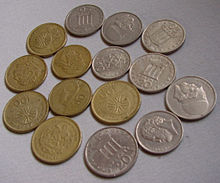 Initially, the Italians and Greeks were also quite happy. After all, the prices for the nice German automobiles remained stable. Now you could afford them, just like you could afford so many more of the beautiful things the German and international concerns flooded the country with.
I was the only one who was not happy, because now, the Pizza and the Gyros was more expensive than before in Italy and Greece. Formerly, whenever we rode our bicycles over the Alps to the Mediterranean Sea, the general rule was that staying overnight got less and less expensive the further north you travelled. That is no longer true today. Now the least expensive places to stay overnight are in Bavaria. It gets more expensive in Austria and continues in the same direction in Italy.
Naturally, there was a downside to the EURO. The beautiful cars from Germany, like many other things, had been bought on credit. And while the German industry was all fascinated and sold record numbers, some countries were destroyed by their debt. It was no longer possible to “heal” through devaluation. The only things that remained of the nice Euro straw fire were inflation and less income.
The creditors wanted high interest rates from these weak countries and got them, too – and that caused additional pain. Just like it is always painful if you are already bankrupt and have to pay a lot of money without getting anything in return.
However, the EZB, the EU and the International Monetary Fund saw reason. They lowered the interest rates and bought the trash bonds in order to avoid the great “catastrophe” of state bankruptcy of one or several member states.
That seemed to save many European countries, not only in the south. But it was especially beneficial for the biggest of all debtors in Europe: Germany, i.e. us. Our reward for agreeing to it was that we no longer had to pay any interest. We would not otherwise have let it happen, because, naturally, our motto is “Germany first“!
This is how we won twice over: first our industry took total advantage of the shared market thanks to a shared currency – and then we no longer had to pay any interest for our national debt. All of a sudden and in a wonderful and smart way, we suddenly had a balanced national budget.
My friend Rudi foresaw all these things. But the responsible government under the great Chancellor of the re-unification did not.
Even if that government had not wanted the EURO, that would not have helped. After all, even at the time, the government, along with the entire EU, did whatever the industry said. And the industry wanted the EURO. Incidentally, that was also true for the other EU countries. Or, to be more precise: they wanted to do away with the DM, because the dominant role of the strong DM had been a constant annoyance for them for a long time. And the only way to get rid of the DM was the introduction of the EURO.
And now we have a problem. I very much look forward to hearing what the new miracle candidate of the SPD has to say about it. After all, he supported this line in the EU parliament, didn’t he?
Now he must and will again talk German: Germany first. After all, there is no second German politician (with the possible exception of the Great Bavarian) who learned better from Trump how to “popularize” the people.
He, too, will have nothing to fight the current system of party and lobbyist oligarchy with, nor will he want to. But I am sure that he will manage to promote his own so unbelievable career. And now he dreams of becoming Federal Chancellor.
Well, that is fine by me. It probably will not make the slightest difference who reigns in the Berlin of megalomania. Merkel alongside Schulz or Schulz alongside Merkel. The only certainty is that Mr. Gabriel will remain Federal Minister of State (due to secret understandings – the main tool of current policy).
Consequently, nothing will change about my story. It will end like so many fairy tales: and if they did not die, they will continue to govern.
Supplementary comment: From EURO fans, I hear all the time that it is so much nicer to travel these days. The disadvantage of having to change money is a thing of the past.
That is an argument I do not understand at all. In the also not so good old days, I always had travellers’ cheques on me. I had to change them in the country of destination. It was probably total nonsense, but my super-ego ordered me to do it.
Today, however, money is only an accounting unit and the conversion from one currency to another is one of the easiest tasks for our “digital world”.
But then, the EURO happened and now we have it. I would really have liked to ask the two Europe experts if they considered the introduction of the EURO useful for the idea of a new shared Europe or if it was detrimental. I never got the chance to ask that question. I cannot answer the question, but I assume it was more detrimental than beneficial.
Now, we not only have the EURO, but also the zero interest rate. And there is a continuing rise in national debt for European countries that is still covered by the EZB and the International Monetary Fund. That is a situation about which nobody can predict how long it will work out well.
During our last PM Camp, Gerhard Wohland said that a problem is a state of affairs that cannot continue. Nobody has a solution to our problem. Perhaps there is no solution. Consequently, those responsible in Europe will just continue in the same way as before. What other choices do they have?
For me, however, Europe is so much more than the EURO. And I believe it is totally irrelevant when and how it will explode. After all, it is only an accounting unit that will then be replaced by new and just as virtual accounting units. A good administration will be quite capable of doing that.
To be sure, this will be yet another situation where you will get winners and losers. Most likely, the rich ones will again be the winners and the poor ones will be the losers. But that is something we are more than used to and so we will continue until there is the next bomb.
And that sounds like logics of history to me. Perhaps the bang will come soon, because the world has far greater challenges to master than your average currency crisis.
RMD
(Translated by EG)
Roland DürreSunday January 29th, 2017
Painful Experience as a Democrat.
One of the reasons is probably the “oligarchy of the parties” (according to Karl Jaspers) that has taken (almost) all Europe into custody. More and more, we now “enjoy” the results of this development that has been getting stronger and stronger over the last few decades.
Besides, it really annoys me that the powers that are generally called lobbyists now have an overwhelming influence in society and politics. Lobbyism has become part of the system and rules and harms the common interest – often quite apparently at will. I witness all the time that the thus generated real (and often non-transparent) power structures ruthlessly sweep away the efforts and success of groups and individuals. The damage done to both humans and our future is willingly ignored, because more often than not, the only thing that counts for the powerful is money and power.
In addition, there is a historic (birth) defect. In most of the democracies I know, they (almost) always – directly or indirectly – vote for a boss. The elections determine who will be in power. It might be a caste or an individual. But I do not wish to hand power to a system or even to individual persons. Because it is not what modern times call for.
A short time ago, Niels Pflaeging twittered a question:
“All #leadership must be shared!“
Or
“
Is #leadership a collective and social phenomenon that is always present in social groups?“
In these sentences, I would probably have replaced the word #power by the word #leadership. But regardless: I rather like the first sentence and believe that the second sentence is outdated. Maybe it was true in former times, but such an image is not fitting for a world where sympathy, considerateness, democracy, freedom, equality, friendliness (towards fellow humans) reign instead of enmity, respect, participation, appreciation …
Enterprises and all other social systems do not need strong leaders. And this opinion of mine is older than the election of Trump for president. I do not like powerful persons, no matter if you call them president or chancellor. In my opinion, centres of power and power fights are less than optimal. They are something I personally find offensive, I am fed up with them. But on the other hand, behavioural patterns such as the “Mother Theresa” concept (total sacrifice for others) look suspicious to me. The same is true for persons who sacrifice themselves as martyrs for social, political or other goals.
Not only in political systems, I would wish to see coordinators who organize and build networks at the top. Social consensus about central topics must be worked out together and we (as the rulers – Souverän) must be given the opportunity to finally vote on alternatives and decisions that have been well prepared.
This might be our future. Today, however, I remain in the still unpleasant present in this respect and will describe the “pain I feel as a democrat” that actually even increased over the last few weeks. I was going to write a few satires in the “first person”, introducing some politicians. The first was going to be the SPD top politician Sigmar Gabriel. It was to read more or less like this:
“My name is Sigmar Gabriel. I am 57 years old and, until recently, I was Federal Minister for Economic Affairs. To this day, I do not know how I ever managed to get that job. After all, the only thing I did through all my life was teaching adults in union-loving enterprises and, above all, be a political functionary. And this CV made me Minister of Economic Affairs of the powerful FRG! And Vice-Chancellor! Well, it is surprising, but then, apparently, the success speaks in my favour, doesn’t it? Now they say I cannot lead the SPD into the electoral campaign as their top candidate. In fact, my party, those ungrateful villains, downgraded me because, allegedly, the people in Germany do not perceive me too positively. Regardless of the fact that I was a huge success and the German economy is booming as never before. And, basically, we have no unemployment, either. But then, I know about intrigues and power play. And everybody knows you cannot win them all. However, that is fine by me – Germany has become too small for me, anyway. Besides, you have better chances of a career in Europe, just look at comrade Schulz, the rogue. Consequently, I am now going to save the world and do a stunt as Minister of State of the FRG. After all, that is a nice job for a thorough-bred politician like me. Besides, I have wished for some time now to work a little less – after all, I am again going to be a father (which is no small achievement at my age). Being Minister of State is something I can do with one hand bound behind my back and I always wanted to do a little world-travelling, anyway. I am sure it will be a good experience for my baby if it cries and I can be away from home… “
This is where I will terminate my satiric remarks, because I feel it is not nice and rather cruel to write these kinds of things in the name of another person, even if, in cabaret, it is a commonly used form of satire. Writing like this will not alleviate my pain, because there are many reasons for those. Today, I will only tell you about my SPD pains. They are only a small part of my democratic ache. Basically, I understand less and less what happens at the SPD.
Let us start with the Federal President. When I was in grammar school, they taught us that the fathers of our constitution wanted the Federal President to come from among the people and that he/she should ideally not be a politician. It seems that – as so often at school – I misunderstood something. Article 55 of our constitution says:
(1) The Federal President may not be a member of the government or of a legislative body of the Federation or of a Land.
(2) The Federal President may not hold any other salaried office, or engage in any trade or profession, or belong to the management or supervisory board of any enterprise conducted for profit.
Well, those sentences are written in the present, aren’t they? That means my teacher was wrong and Mr. Frank-Walter Steinmeier can actually transfer directly from being a minister to Schloss Bellevue and Villa Hammerschmidt.
I have never met Walter Steinmeier. Regardless, primarily due to how he conducts himself and acts, I hold him in high respect. But he, too, spent his working life in the ivory tower of politics and that was also where his career was. He was very successful and as a reward, he got the ministerial posting to a high political office. It is quite possible that many persons considered him the last famous SPD person to have been highly regarded by all.
Now, they just go ahead and make him Federal President through (secret) party agreements. They continue to pull the strings. The post of Minister of State that thus becomes vacant is simply given to the not so well-loved Minister of Economic Affairs. His prodecessor – Brigitte Zypries – is an interim candidate and even calls herself interim minister (Übergangskandidatin). All these things happen in times that cannot really be called politically easy. Is this in the best interest of the German population?
Because the people do not love him, the new Minister of State Sigmar Gabriel was no longer accepted as head of the party and also not made candidate for chancellor. In other words: he had to go. In front of the microphones, he says that, becoming a father, he wants to work a little less in the future. And on the very day after his inauguration, he flies to Paris where he meets obsolescent persons. No matter if you are well-loved or not, standing in the political limelight is even nicer if it is abroad.
But that is not all. The new SPD hope is a man who came to my attention mainly because he is politically unremarkable, but also because he is a very active “master at pulling strings”. He has been living the good life in the European Parliament ever since 1994. Before that time and partly also during that time, he was the major of Würselen (Nordrhein-Westfalen). In 2012, thanks to proportionality and secret agreements, he managed to become the Präsident des Europäischen Parlaments.
Since he seemed so unremarkable to me, I looked him up in Wikipedia. Now I would kindly ask all those who think about voting for SPD to look up the curriculum vitae (Lebenslauf) of Martin Schulz in Wikipedia. You can learn how, simply by being party member and representing their policy, you can make a career with just a few small tricks. It is a good example for the fact that in the SPD internal policy is more important for a career than being active in favour of social democracy.
For me Herr Schulz is a “Gabriel square“. Again, it gets painful: for me, Europe is so much more than just the EURO and the EU. To me, the new SPD top man looks like a symbol and metaphor for the poor state of the EU. An EU that is dominated by nations and economic interests and boycotted by small countries. There is no consensus about values, it is politically disrupted, mega bureaucratic and over-regulated. Basically, all nations want out, but they lack the courage. The EU that many see as something we cannot do without is a threat to a humane and democratic Europe of regions. But perhaps the EU and the SPD have something in common: they both seem to have forgotten the people of Europe.
Now they want Martin Schulz to save the SPD. A party we would badly need as general hope for a new democracy. I personally doubt that he, with his methods, can save the SPD. However, I am fairly convinced that he will not give new life to the idea of social democracy.
Neither is it any help for me that the USA now have Trump, which gives them totally different problems. Which means that my pain will not get any less acute.
RMD
(Translated by EG)
Roland DürreMonday January 23rd, 2017
Inflation in Local Traffic
I did not pay too much attention to the latest Deutsche Bahn price increase at the time when the schedule changed from summer to winter. I just had made a mental note that the “Deutsche Bahn increases its prices for long-distance travelling by 1.3 per cent on average”. That is what the SZ, too, had written.
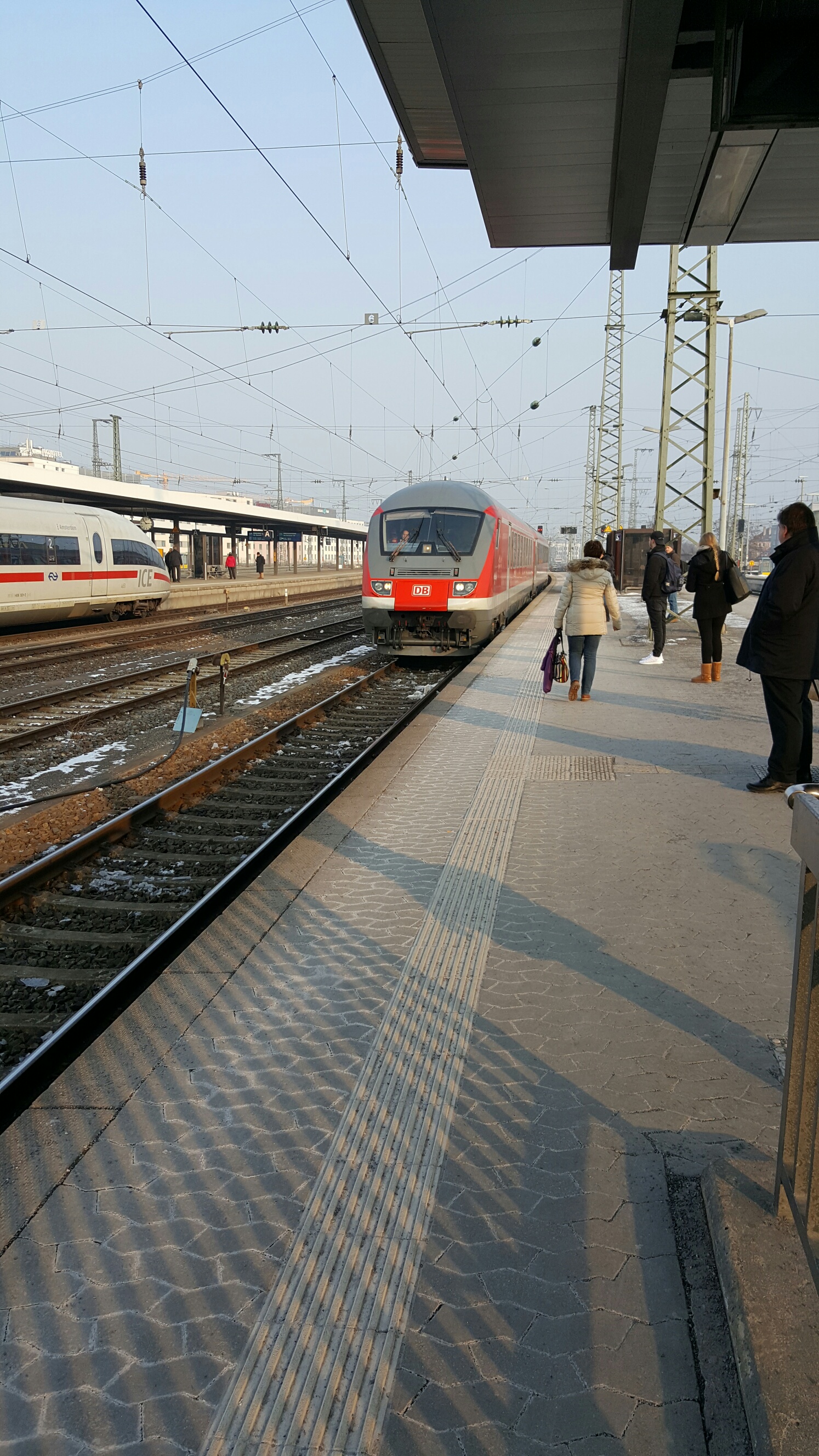
The Shuttle Munich-Nuremberg Today on Arrival at Nuremberg.
But it turns out that was a myth!
On Saturday, I wanted to go to Augsburg with three other persons. So I ordered a Bayern-Ticket on the internet. My eyes almost pop out: it now costs 25 €. A very short time ago, it was 23 €. That means it is more expensive by 2 €, which is an increase of around 9 %.
Well, I can survive that, can’t I? But then comes the other surprise: all travellers sharing my ticket (up to four are possible) used to cost 5 € per person. Now they cost 6 € per person. That is 20 % more.
Consequently, the Bayern Ticket for our small group is now 25 € plus three persons à 6 €, which is 25 € plus 18 €, in sum 43 €. Well, that is no less than the price I occasionally pay for two long-distance DB tickets to Sylt (for instance in February).
Formerly, I paid 23 € plus 3 persons times 5 €, which was 38 €. Consequently, the price for the four of us increased from 38 € to 43 €. Well that is 5 € more, which means an increase of 13 %.
I also admire the “rounded prices” they so easily come up with. To be sure, cents are inconvenient and more and more shops simply round the sum when you purchase products. But simply obscuring the first digit after the comma – after all, we are talking 10 cents, that used to be 20 Pfennige – is a little strange to my way of thinking.
Incidentally, there is also an inflation on special tickets for all kinds of things: with and without local traffic in transport associations, for special regions, between cities or for a maximum distance. This is how they make everything more complicated. And if you include the basic moon prices and the similarly introduced low prices (special offers in long-distance travel), then the price policy of Deutsche Bank gets more and more bizarre.
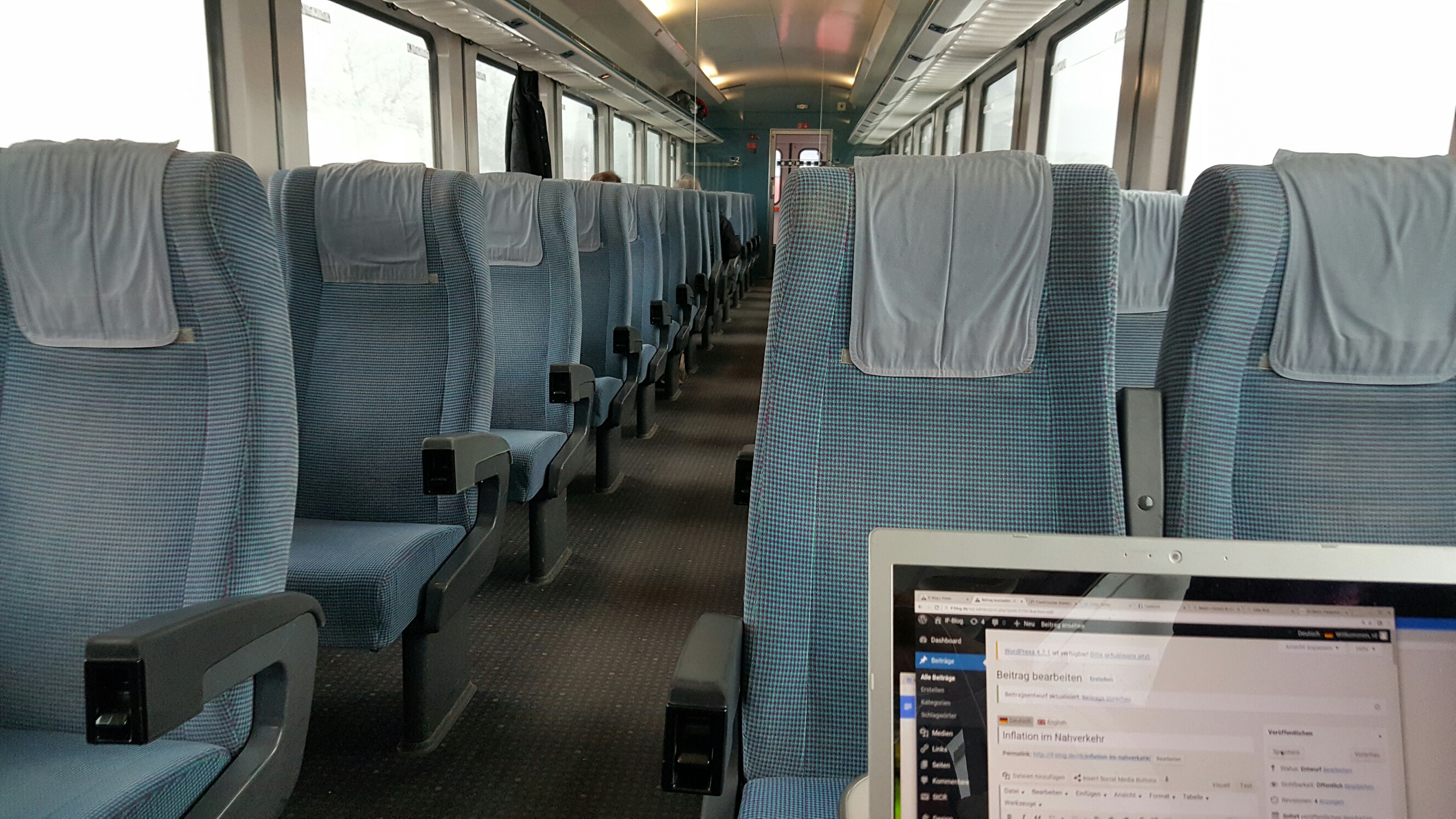
This is how empty the shuttle looks at 4 p.m. – I always carry my chrome book.
However, I only get annoyed once in a while and later continue going places by train, because, for me, there is simply no alternative to railways. Consequently, I am also going to Nuremberg and back with the Bayern Ticket today after having paid my 25 €. After all, the train is a good place to sit and answer all your emails and write all your articles. That is something you cannot do when driving a car.
Basically, driving a car is out of the question for me these days. According to social research, the majority of our people are embittered. I, too, would be bitter if I had to spend one or more hours behind the wheel of car each day. I prefer going by train and enjoy seeing how google waits in front of the A9 traffic jam. It is my morbid delight in the failure of a stupid system.
Going by bus would be an alternative to going by train. But that is not my idea of travelling. I am a little spoiled because of the mostly rather empty DB region trains and do not enjoy being squeezed into narrow busses that are often forced over the streets of this republic in self-suicidal mode by their drivers. Besides, meinBus and flixBus had to cut their networks considerably and drop quite a few connections from their list of destinations, because the venture capitalists who own the companies no longer felt like permanently making up for the deficit.
So here is what I will do: I will continue to go by train and hope that the density of train services with the resulting mostly empty trains will remain the normal state of affairs. …
Incidentally, the German railway is not the only company where these enormous price increases can be observed. You can also find it in public institutions and quality food, as well as with some everyday articles. And in real estate.
Yet now I hear that, allegedly, the inflation rate is still less than 2 %. Basically, I do not believe they lie to us on purpose. But I certainly do not believe the 1,X % – and I think they are not really interested in telling us that our savings dwindle. Which also means that the chasm between the rich and the poor continues to grow. We already have ample opportunity to see the consequences and can speculate on more of them to come.
RMD
(Translated by EG)
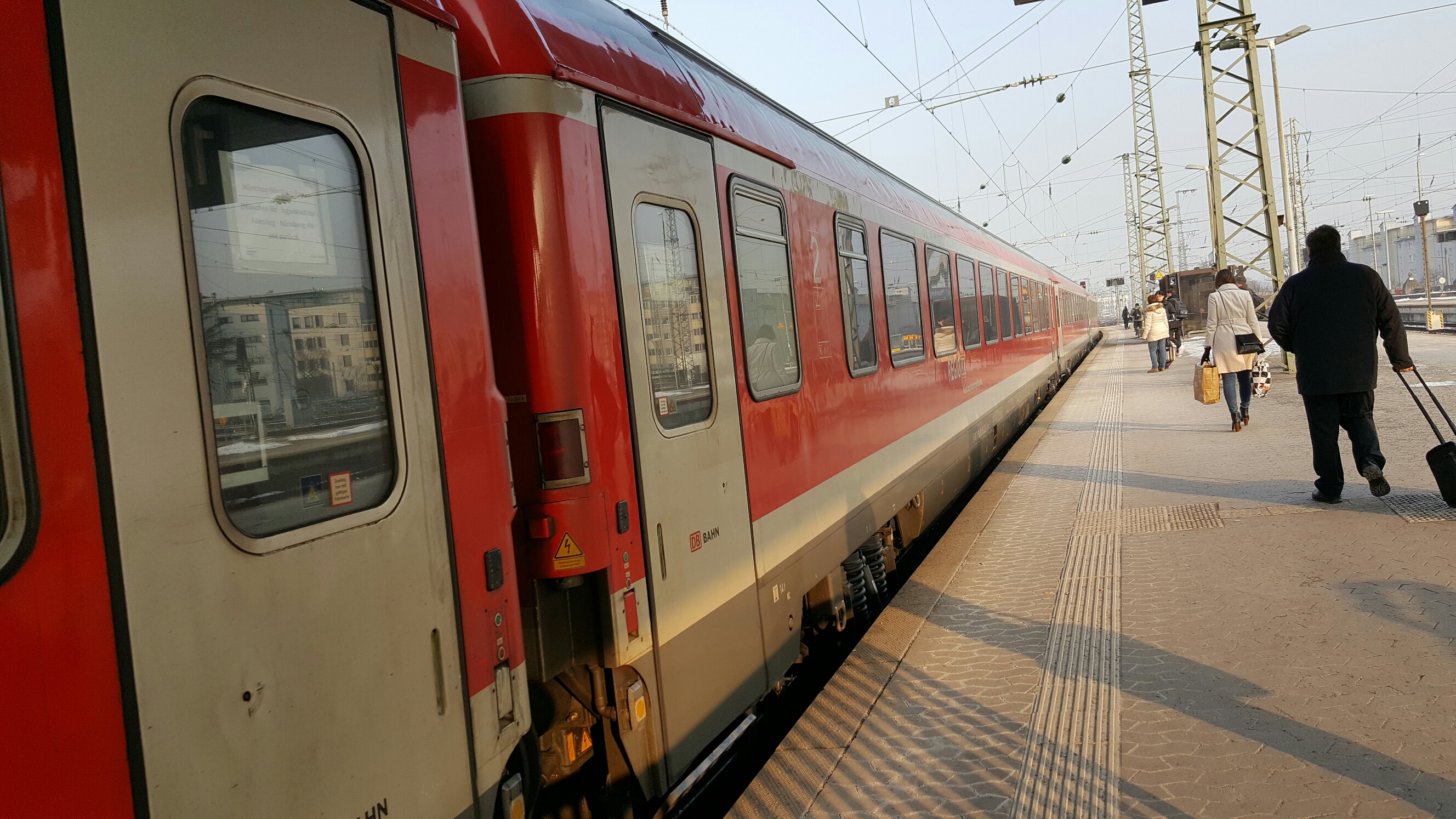
The shuttle to Munich on January, 23rd, 2017 at Nuremberg Central Station, platform 12.
Roland DürreFriday January 20th, 2017
Media in my Life – Impulse and Inspiration ”brand eins“ and „enorm“ :-)
Two Magazines I Like – Or: Paper that Deserves to be Read.
brand eins & enorm!
I started “blogging” and publishing my experiences and ideas in the IF blog in 2008. It was a true delight for me to primarily do this for myself. Then I enjoyed noticing how many readers I have and also liked the many events and contacts that developed from it. Then I looked for and found a few co-authors, not many of whom actually remain to this day.
IF-Blog.de was also responsible for me finding brand eins. But more on this later in this article.
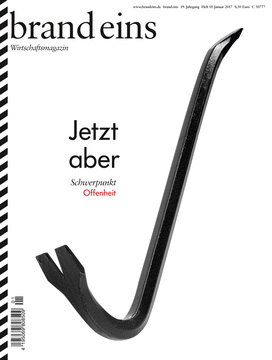
The January 2017 Edition
The history (Geschichte) of brand eins officially starts in August, 1999. In 2008, brand eins was already in its ninth year. In fact, the early stages of its history were even three years before that, in 1996. And yet, like many of my friends, I did not yet know anything about brand eins.
The beginning of the brand eins story was probably with an interview by Jost Stollmann (1996). At the time, Jost was the boss of Compunet; the InterFace Connection GmbH was twelve years old at the time. My personal connection with Jost Stollmann is not only that we are both IT enterprises. No: he was also one of Rupert Lay’s students.
At the time, Rupert drove a red Series-Three-BMW (including a 2.0-litre machine), which was rather extraordinary for a Jesuit pastor. In fact, his car looked a lot like my red Series-Three-BMW (including 2.3-litre machine). That was something we enjoyed very much. Rupert’s BMW, however, was not a business car, but a gift (or item on loan) from Jost. And Rupert very much delighted in his fast red BMW and especially in its origin.
Incidentally, Jost Stollmann remained faithful to brand eins – he gave more interviews with them (in 2009 and in 2012).
(Unfortunately, I could not find the 1996 interview anywhere. I would really like to read it. If any of you has a link or a pdf for it, you could make me happy by sending it).
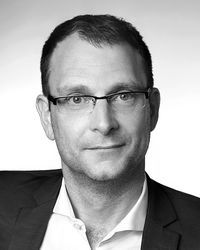
Florian Prange, Entrepreneur and Treasurer of FÖS.
brand eins is something I first came upon through Florian. At the time, Dr. Florian Prange had just started working for InterFace as a senior consultant. He was a very refined, young and socially active type of person. Today, he has his own enterprise and is treasurer in the board of directors of FÖS (Forum Ökologisch-Soziale Marktwirtschaft), which is also a very interesting address.
Florian liked my articles and consequently pointed me towards brand eins. In his opinion, my articles deserved a few more readers – and he thought that maybe this could be achieved through brand eins.
In fact, I did not know about brand eins at the time, regardless of the fact that it had already been on the market for nine years. For managers, the “must” magazines were the Manager Magazin or the Wirtschaftswoche. Both are anathema to me – and I saw that brand eins was totally different and much better.
Consequently, I was fascinated by brand eins and quite a few friends and business partners were given a copy or two of the magazine over time. Giving it to them was always a huge success – many had never heard about it and were surprised. They were happy to get totally new impulses.
It was even beneficial in terms of business. One of my friends (If-blog author Edwin Ederle) managed to be mentioned in one of their editions with his enterprise data2impact (Feine Klitsche). And the reviews (Rezensionen) on brand eins I wrote in IF-blog for quite a few years were also often read.
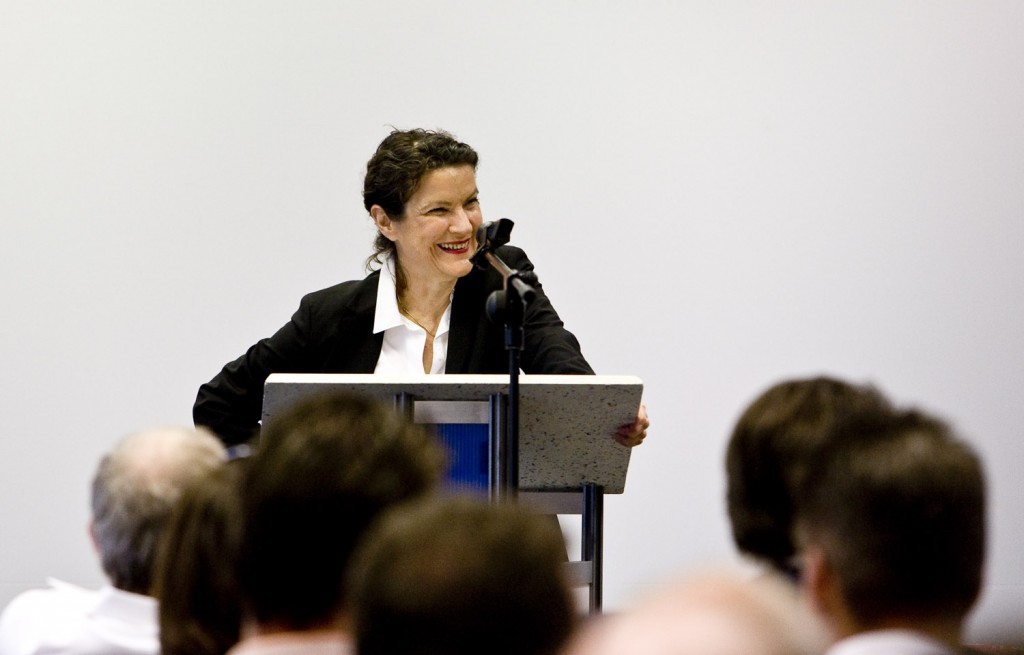
Frau Gabriele Fischer Giving a Presentation for InterFace (2009)
This is also how I first met Gabriele Fischer, the founder of brand eins. My contact with her led to a great presentation by Frau Fischer at the IF-Forum.
Unfortunately, Frau Fischer did not want to become a “Youtube-Toussie“ (this is how she herself formulated it), which means we cannot offer you a video documentation of her excellent presentation.
And this is how posterity will really miss something very important.
brand eins still exists today – and it is now the established business magazine, not only for managers! And it is still the only paper I deem worthy of reading. …
Wrong!
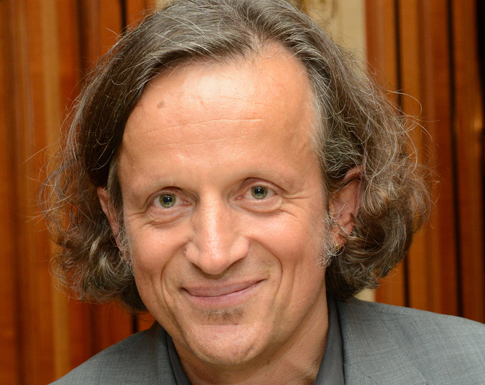 I should have written: Was. Because now I found enorm . That is a magazine dealing more with life than with business.
Here is how it happened. On Friday one week ago, I was introduced to Peter Felixberger (who, incidentally, is good friends with Gabriele Fischer). Among other things, Peter was also the founder of changeX.
Today, he is programming manager of Murmann Publishers. He is the editor and responsible for the edition of kursbuch.edition and of the magazine enorm, as well as publisher of »Kursbuch auf Weltreise« (Goethe-Institut). And there are many other things he does on top of that. My friend Andreas Zeuch also published his latest book at Murmann.
On that Friday, I had a wonderful conversation with Peter Felixberger. I noticed that there are many similarities between our ideas of value, interests and needs. Consequently, it was very nice for me to listen to him. He really made me quite enthusiastic about his publishing company and his products.
He also showed me enorm, which is a magazine directed at the age group between 20 and 40, but in my estimation it will find and has already found many followers among the younger and older readers.
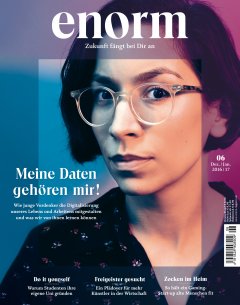 I can easily imagine enorm in less than ten years being as much of a success as brand eins is today. Consequently, I will now give you a short mini review of the current edition 06 (December/January 2016/2017).
What is it that fascinates me about enorm?
There are two elements that fascinate me: the basic concept of the magazine and the topics.
I would say the basic concept is one of fairness and considerateness.
I rather like the topics because everything I find in the magazine is of high relevance for me. The structure is GET-UNDER-WAY, BECOME-ACTIVE and LIVE.. Under the subsection “Against All Odds”, I find a beautiful collection of topics that I consider extremely important today. After all, enorm has been available since January 2010. You will find all the editions since 2010 in the archive archive on their website. Also full of important topics. Many articles, however, are “not yet set public” – dependent on the edition. I find that reasonable, because especially if you write about important topics, you should also be able to earn money with what you write. Besides, there is still enough to read.
Now I wonder if it is perhaps a good idea to make some enorm editions gifts to my friends and business partners – as I formerly did with brand eins. Especially in the departments with the impossible name “Human Resource“ (HR), enorm might perhaps be extremely helpful in small and big German enterprises when it comes to better understanding the values, expectations, interests and needs of the employees. And there is probably no enterprise that could not potentially benefit from such understanding.
Withbrand eins, it was possible to read all archived articles for free. That seems to be a thing of the past. But I find many brand eins articles on the internet – see also the two Jost Stollmann interviews. And the Inspiration section on the brand eins website also looks very attractive to me.
Incidentally, it is also very rewarding to follow both magazines on twitter. Here are the “accounts“:
@brandeins and @enorm_magazin. So: #FF!
Buy and Pay!
I think it is a matter of fairness to, once in a while, also buy paper articles. If you do not wish to read it yourself, you can make a gift of it. And that will inspire other persons.
So here is what you want to do: walk to the kiosk on February, 24th and buy the next enorm edition.
RMD
(Translated by EG)
Roland DürreWednesday January 18th, 2017
Making Tools with Tools that Again Make Tools that Make Tools … Computer Vintage
or:
If production nd development chains become too complex, they might easily break (down).
I got the ideas for this article during a short discussion about whether or not our developed society might – technologically – regress into the pre-electrical era. The person I discussed it with thinks such a thing is not possible. This firm believe made me thoughtful.

A small brother and a very small brother of the flat package I describe. The telephone shows how small the individual parts are 🙂
In the early 1970ies, I studied mathematics and computer science at Munich Technical University. I was also a student working for Siemens. After all, they had great computers and students could really make good money, considering the times.
My working place was in the “Koppstrasse” camp buildings. Our tests were conducted in the Feurich-Building – which was in the Siemens AG central building at Hofmann-Straße. Life in the camp was great, it was truly an F&E atmosphere, just like you would wish to find it today with a good start-up.
I already described my first project in the IF-Blog. It was about calculating the biggest possible Mersenne prime numbers. The task was one for people who liked working by themselves.
Then I became more and more part of the team and almost intoxicated by the challenges of our task. Together with other colleagues, I developed the PALOG-A- and PALOG-B systems.
PALOG is short for “PrüfAutomat für LOGik”. A PALOG-A device was supposed to test the function of “maxi flat modules” that were built serially. These modules had various functionalities in big computers. The functionality and correctness of the underlying logic had already been tested.
All we had to do was check if the serial production was error-free and if the manufactured components rendered the desired results reliably. I will explain the extended function of PALOG-B later in this text.
A maxi flat module is a huge board; it is rather broad and thick, but not very high. The boards you see on the picture are from a later time and were a lot smaller.
On one side, a maxi flat module had 128 pegs that had to be pressed into the rear wall of the big computer. The computer fed the board with digital patterns following the number of pegs, then the board returned a result and further processed it.
(I might be wrong and the number of pegs was only 64, but I seem to clearly remember 128.)
On the surface, the board was full of electronic modules that had a few larger or many smaller feet. These feet were pressed into the pre-arranged holes of the board. The entire construction was then brazed and soldered from underneath. In case of serial production, it was done by a dipping solder bath.
Sometimes, the building modules on the board we used had been developed and produced by Siemens. Some of them had to be bought. I particularly remember chips by Motorola that sometimes cost up to 1,000 DM.
If some of what I said here is not correct, please forgive me. I never specialized in hardware, instead always developing software.
The placement and soldering processes were far from trivial. Consequently, it was absolutely possible – and it happened quite frequently – that these maxi flat board modules rendered no or erroneous post-manufacturing results. Sometimes the individual parts delivered along with the products were also faulty.
But how can you find out about this? How can you test such a maxi flat board module?
Our method was quite simple. We sent bit patterns into the objects to be evaluated and then checked if the answer was the right (expected) one. Naturally, for reasons of efficiency, you cannot conduct such a test for all kinds of input patterns. It was the task of our software to generate relevant patterns that made it possible to prove with as few test steps as possible that the logic of the maxi flat board module worked correctly.

Back to the younger and smaller brothers of the maxi flat board module.
To this end, it was mounted in the PALOG-A machine and sent over the 128 pegs according to their functionality. The answers were compared with the desired results. If the actual test patterns were identical to the desired ones for all test patterns, then it was validated that the maxi flat board module worked without a glitch.
Seeking and finding the relevant test patterns was not at all easy and we developed it from the functionality following a rather “mathematical” procedure. The programming was a “cross” procedure on BS1000 and soon also on BS2000.
The actual patterns, along with the correct answers, were generated on process computers of the 300 series. Incidentally, they had a 6-bit assembler with two accumulators beautifully named PROSA. The “three-hundred-computers” were reputed to be incredibly fast.
The 306 was the top model. But even this Siemens machine that, at the time, was considered the fastest ever, easily took a week or more for calculating the necessary patterns.
In those days, the computer rarely ran for an entire week without breaking down. Mostly, it would break down within such a long time period at least once. Consequently, the software had challenges besides the algorithmic one, such as the reloading of the program in case of a system breakdown. At the time, this was not at all a matter of course.
Well, so far so good. At least, PALOG-A allowed a reliable validation about whether or not a maxi flat board module was free of errors. But quite frequently, we had poor product quality. What to do with that? The very fact that the construction elements were so expensive was a discouragement against destroying or dismantling them. Not much would have been won by this, anyway. Consequently, it was desired that all of them can be repaired.
If you wish to repair an error in a complicated flat board module, you will first have to find out where exactly on the board it is. In our case, you cannot simply solve the problem by logical thinking or code reading as in a program. Neither did we have a debugger. After all, the question is which individual part of the module is faulty, which soldering does not work, or similar problems …
This is where our system PALOG-B came in. Whenever a PALOG-A maxi flat board module was discovered to be faulty, it was transferred to the PALOG-B system. As soon as it arrived there, it was subjected a (so-called) PFAD procedure, i.e., it was processed with totally different test patterns. The returned data made it possible to circle the error on the board. This is how we managed to correct all possible mistakes by multiple circling. Afterwards, the board was again tested with PALOG-A – and if it worked, we celebrated.
I am sure you can easily imagine why the procedure was called PFAD. It is German for PATH and all the different input patterns had to run through the various paths. And as soon as you determined which of the many possible paths does not function, you are a lot closer to finding the bug.
I tried to describe the procedure as simple and comprehensible as possible. In reality, it was a lot more complicated and based on know-how that had been developed and handed down over many years.
Our software was only a small part of the design and construction software necessary for the efficient development and production of IT systems. At Siemens AG, they continued to work in huge steps. A few years later, the Siemens AG had an extensive work bench consisting of many software systems for the development of their chips. It was probably far superior to all the competition.
Unfortunately, I forgot the abbreviation, but I do remember that the application allegedly was the world’s most complicated software solution and contained the most lines of code of all the known programming systems.
And then the downward spiral for the data processing area started and all the know-how disappeared.
But then who cares about the “delights of yesterday”?
Let gone-byes be gone-byes!
I can easily imagine that the know-how and toll chain you need to develop and produce an Intel processor or an IBM Power today are by far more of a challenge than the rather limited flat board modules.
And it is quite possible that, today, not only a high tech processor, but also a “simple” electric motor or power generator simply cannot be produced without a similarly complex machinery. And what happens if – for whatever reasons – such a machinery breaks down?
This is where the circle closes and I return to where this article started. The total immersion of these tool and production chains in all technologies and sectors – chemistry, energy, farming, mechanics, pharmacy, physics,… – I can easily imagine that our system might collapse and we will have to start at ZERO. And that may not be easy.
RMD
(Translated by EG)
P.S.
I wrote the technological issues totally without checking back in any documents, only relying on my memory. Unfortunately, Wikipedia is not really much help with such exciting computer science topics. I find it a pity that, especially when it comes to the very technology that made Wikipedia possible, there is mostly no sufficient description of said technology to be found on its pages.
So please accept my apologies if I occasionally did not remember the correct abbreviations or made similar mistakes. There was nowhere I could look up anything that could have helped my memory. So much the more would I be grateful for any corrections and notes on the technology I described.
Roland DürreTuesday January 17th, 2017
Prognoses are Difficult, Especially if they Concern the Future.
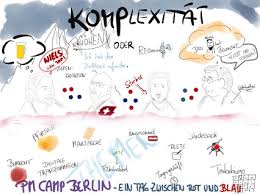
Complexity made by Visual-Braindump.de.
This sentence is not only said to have been spoken by Karl Valentin , but also by Mark Twain, Winston Churchill, Niels Bohr, Kurt Tucholsky (they all were rather intelligent persons). It clarifies a lot: prognoses are not at all easy – and the same is true for planning ahead. After all, planning is the little sister of the prognosis.
On Friday (February, 10th), I will give a presentation at high noon during the FORUM AGILE ADMINISTRATION 2017 in Stuttgart. The amusing title is:
“The inevitable unpredictability of the future“
Naturally, such a title was not something humble me came up with. Still, I find it suitable. After all, it sounds like the intellectual formulation of the simple truth that the future is not predictable. Just as they teach and write in the academic sociology and/or politics circles in their overblown way.
How am I supposed to plan for the future if I cannot even see the future? I will show you with a few examples how very seldom this will work.
I also would like to tell you how private enterprises will always make themselves scarce when matters get a little problematic. They are particularly keen on making themselves scarce if they managed to privatize good profit over many years and if then, as their life cycle nears its end, big deficits are on the horizon. Of course, deficits are something they want to burden society with, rather than face them themselves.
Whenever we are talking public agencies, this is not quite so easy. They have to survive disruptive situations, even in situations when a private enterprise would simply give up. Because life has to go on. Consequently, they need to maintain resilience, or do all they can in order to develop “anti-fragility”.
To be sure, resilience and anti-fragility are also just two additional buzzwords. They are supposed to make it clear that agile and flexible structures offer a huge advantage in times of change. And that strict processes can then easily kill a system.
I already have many ideas for my presentation. Now I am in the structuring and refining stage. I look forward to my presentation and my audience and would be delighted if I could welcome a few familiar faces in Stuttgart.
So here is all the information on the event. On the front page, you will find the program:

And details for the booking process can be found at the back of the page:
So I look forward to seeing you in Stuttgart.
RMD
(Translated by EG)
Roland DürreSunday January 15th, 2017
PM Camp Meeting 2017 – #pmcamp – Jan, 20th, 2017
 It is certainly not breaking news, but next Friday, we will have our 2017 PM Camp meeting.
Once a year, the representatives of all organizational teams for PM Camps meet. This year, the organizational team Dornbirn (Eberhard, Marcus, Stefan, Roland), are the hosts. InterFace AG supports them logistically.
Consequently, representatives of the organizational teams for the PM Camps at Barcelona, Berlin, Dornbirn, Hamburg, Karlsruhe, München, Rhein-Main, Stuttgart and Zürich will meet on Friday, January, 20th, 2017 between 8 a.m. and 4 p.m. in the Unterhaching InterFace AG building.
The PM Camp meeting is traditionally where strategic questions concerning the future of the PM Camp movement are discussed. Consequently, the goals of the meeting are:
- Looking back:
What was the development of PM Camps over the last year? Reports about format experiments in 2016. - Status Quo:
Where are we now? What is CURRENTLY important for us? - Looking towards the future:
What do we have to be careful about and what do we need to actively promote to make sure that the PM Camp movement continues to give relevant impulses for the PM scene on the whole?
I am telling you the date because I want to enable all friends of the PM Camp movement and visitors of PM Camps to voice their opinions and ideas during the PM Camp Meeting.
If you have suggestions that might impact the future of PM Camps, please do not hesitate to send me an email. I will collect all emails and introduce the ideas during our meeting.
I look forward to many impulses by and inspiration from you!
RMD
(Translated by EG)
P.S.
On the evening before (Thursday, January, 19th, 2017), those who arrived early will meet for dinner at 7 p.m. at the Unterhaching Althaching restaurant. If you feel like meeting old friends, please come and join us.


