
Roland DürreFriday February 24th, 2017
APHORISMS: CEO or COORDINATOR, MANAGER or COACH …
Many thanks to Christian&Daniel (© Visual-Braindump)
I love the agile manifesto. It always says that A has priority over B.
Here is an example:
“Individuals and interactions have priority over processes and tools“
In other words:
Perhaps the values on the right side (B) are useful, but those on the left side (A) are more important.
I will now apply this diction to my “favourite terms” and formulate the opposite (as a trigger for discussion).
- Co-ordinate the decentralized things beats central execution
(–> The CEO – Central Executive Officer becomes company coordinator) - Coaching beats Managing
(–> Abolish hierarchies, replace managers by coaches) - Agile beats inflexible
(–> follow common sense, instead of a plan) - Competence beats power
(–> the future is no longer determined by a hierarchy) - Lean beats waste
(–> less bureaucracy, administration and departments) - Common good economy beats Shareholder Value
(–> Customers and employees are stakeholders and more important than shareholders) - Self-organization beats command structures
(–> Teams, rather than the manager caste, determine how to do the job), - Open beats secret
(–> free communication instead of systemic) - “Entrepreneurial Clarity“ beats “strategic ideologies“
(–> traceability) - Social beats asocial
(–> an end to privatizing profit and socializing loss) - Digital & electric beats mechanical & analogue
(–> new work concept) - Informal communication beats systemic reports
(–> knowledge is liberated and shared) - “Shared economy“ beats “individual property “
(–> #newlife, “property is a burden“) - “Business must serve the people” beats “humans serve business“
(–> #newwork) - ….
At school, I learned that everything that ends with “ism” should be handled with care. Consequently, I am glad that I never came across the word agilism. Yet I can easily imagine that some enterprises I know behave in a way that might be correctly described by the term.
I would simply say “change is the goal”.
RMD
(Translated by EG)
Roland DürreThursday February 23rd, 2017
Aphorism: HUMANS & LEADERSHIP
Many thanks to Christian&Daniel (© Visual-Braindump)
Two theses
(I)
If “hierarchical structures” dominate an enterprise, then a culture of “agile, digital, lean, open, social“ is not possible. There might be a few exceptions for start-ups founded by a private person, but they only prove that the rule is in general correct.
(II)
Human beings feel comfortable in social systems like enterprises if they experience, respect and appreciation and if they can take responsibility in a spirit of courage and joy. The counter argument that this cannot be true for persons who have been trained in obedience and dependence is not in accordance with my concept of humanity and consequently not valid for me.
I defend these two theses vehemently.
Two ideas
(I)
A good rule for entrepreneurs is
“Only employ persons of whom you believe they have at least the potential to do the job better than you yourself would be able to do it!“
I (almost) always stuck to this rule at “InterFace Connection”. And my experiences were very good. It is also true at Google and probably one of the factors that made this enterprise so tremendously successful.
(II)
If you have employees who, following (I) are “better” than their bosses, then how can a system and its agents come up with the idea that control “from the top”, central ideas, set rules, division of labour, set and structured processes and a formal systematized communication might be better for the enterprise and its stakeholders (employees, customers, shareholders, ..) than an agile self-organization of the teams and informal networks. Especially in times of rapid change!
Incidentally, there is also a method (or rather: a procedure or culture) called: “Kanban”. I believe that both theses and ideas are true for all areas where humans work together, be in as a software engineer or as an elderly care nurse.
RMD
(Translated by EG)
Roland DürreTuesday February 21st, 2017
MORE MONEY FOR ARMAMENT …
Says the USA as they look towards EUROPE …

I find it terrible
- After all, up to now I believed it is the world-wide goal of everybody to wage fewer wars, kill fewer people, produce less misery and build fewer weapons.
- And that weapons always will only be useful for business in the weapons industry.
- In the last fifty years, I myself never knew a war that solved any problems. On the contrary.
- Side effect: now I know that Greece (relative to its gross national product) is the EU country that spends most money on armament (2,4 %) and Germany (thanks to the strict rules formulated by the “federation partners” when we were “re-united”), least (1,2 %).
- Just like I always also hear that, among all the EU countries, Greece is worst off and Germany best off.
🙂 Honi soit qui mal y pense!
And here are some questions.
- Why does not EUROPE counter by asking the USA to spend more money on climate protection?
- How does EUROPE expect to become more independent if they do not vehemently oppose the amoral request of the USA, rather than agreeing like an obedient sheep?
- What exactly are the shared values of the USA and Europe that need to be defended?
(Would you like me to guess? I cannot think of very much.) - Does the NATO really have to manoeuvre in the Baltic States and already plan the next manoeuvres in Poland?
In particular, I do not understand it because EUROPE, just like the USA (and the same is true for the enemy RUSSIA) are bankrupt with permanently increasing debts. And besides, these nations, just like the entire world, have totally different concerns that they really should get worried about. It is the “fear that eats up the soul” and truly fills the heads of some old men from a world long gone. That makes me sad.
RMD
(Translated by EG)
Mobility of the Future – #agile #digital #lean #open #social
 Future mobility will have to be totally different from today. Because it is quite obvious that we cannot continue in this way. Everybody more or less knows it.
Other countries, such as the Netherlands, seem to be on a promising path. We, however, do not seem to be able to incorporate the necessary change. After all, in the future, mobility should again be there for the people, instead of vice versa. We want to make a mental and active contribution.
Our Goal
We want to give new impetus to the #AktMobCmp (Barcamp for active mobility in everyday life) tradition with a series of evening events. We will start on Tuesday, April, 11th, 2017 at 7 p.m. A young and very exciting enterprise, the
accu:rate GmbH | Institute for Crowd Simulation | Rosental 5 | D-80331 München
invited us. For registration, click here: MeetUp or send an email to me.
On this day, we plan to have a moderated “lean coffee“ with a time-box following the 3×3 principle: (1) be precise, (2) negotiate in cooperation and (3) reap what you have sown. As an inspiration, there will be a few impulses given by Dr. Jessica Le Bris (GreenCity), Florian Sesser (Gründer accu:rate GmbH) and yours truly (Initiator #AktMobCmp) before the Lean Coffee.
Here are a few theories and questions to inspire you.
Theories
- Agility and mobility are human needs.
- The industrial revolution replaced agility with planning and Taylorism.
- The belief in the omnipotence of humans due to technological progress starts to dwindle.
- The era of hierarchies and Taylorism is at its end.
- The individual and motorized mobility as we have it today is only allegedly agile.
- The mobility of the future will be more rational, instead of emotional.
- The motility of the future, too, must become “agile”.
- It cannot be done without a considerable percentage of “active mobility” (moving under your own steam on foot, on your bike or with other supportive devices).
- Active mobility is good for your body
(we only have this one body and consequently should treat it in the best possible way)
and - it makes it possible to make better use of our precious commodity: time.
(our time is limited, it will not return after it is over). - ….
Questions:
- Why do people prefer to stand in the congestion, rather than move in fresh air?
- Why are parking spaces in public places so strongly state-subsidized?
- Should two-stroke Otto engines be abolished altogether?
- Do we all really need a car?
- What should the smart city look like?
- Is it really necessary that, every year, more than one million people have to die in traffic accidents, with even more being severely wounded and ending up crippled?
- Did you know that half of all the head traumas happen to people sitting in cars
and - yet those who drive a car need not wear helmets?
What can we all do to make mobility softer?
We appreciate all input. We also want results. Here is how it could happen.
- Share our knowledge;
- Experience and realize things;
- Gain new insights;
- Formulate our ideas clearly;
- Develop ideas
and - start to shape a fresh world of ours.
Target Group
AktMobCmp wants to reach mostly those who feel dissatisfied with the current mobility situation and its consequences.
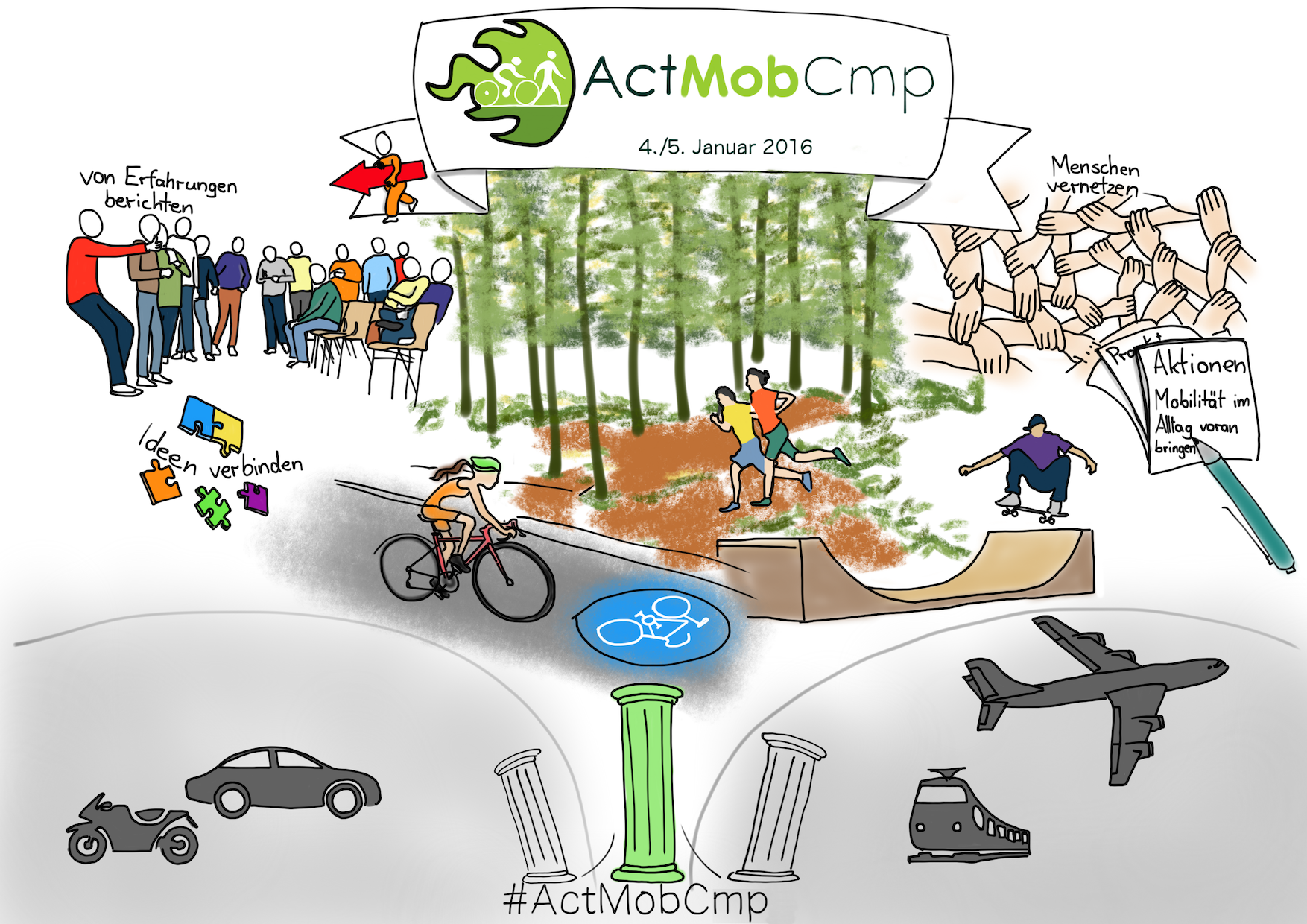
Xlick on the picture to enlarge. Donated by Visual-Brainddump. We would like to thank Christian Botta and Daniel Reinold.
RMD
(Translated by EG)
Roland DürreSunday February 19th, 2017
THE CAUSA BÖHMERMANN
About Alternative Facts, Fake News and False Logic.
 My last article POST-FACTUAL TIMES reminds me of the “issue” Böhmermann. At one time, he made a (probably poor – but that is not the point!) joke in lyrical form in which, not following logical rules, he intentionally came to wrong conclusions.
For instance, he assumed that people who used to work in jobs that gave them the opportunity to do so – for instance shepherds – had sex with their animals.
I can imagine that this assumption may well in some cases be correct – after all, I learned in religious education that sodomy was a particularly evil and unfortunately much practiced variety of whoring. And consequently, it is totally just that it will be punished as a deathly sin before God on the day of judgement. And you will only write down such strict laws if you have reasons to do so!
Then he wrote a poem that suggested that a well-known Turkish politician might well also have done it at a time.
In other words, Böhmermann constructed a joke by implicitly and intentionally in an exaggerated way coming to false conclusions that everybody knew were false but that were still intended to be hilarious. Perhaps he should have taken cigarette adverts as a model and added the following note as a sub-text.
Attention! False Logic!
Just because all humans, that includes us, somehow had forefathers that were involved with farming or raising animals and because some of them might perhaps have been sodomites, this does not necessarily mean that we all have to be “animal abusers”.
Nothing more. Regardless, the “cabaret performer” had to pay a rather high price.
On the other hand, if he had described something that can be proved (or even something that was based on wrong information) …
RMD
(Translated by EG)
Roland Dürre
POST-FACTUAL TIMES
A short time ago, a friend of mine told me
“that he no longer listens to the BR news and also no longer watches the official news of the state-subsidized stations ARD and ZDF. He also no longer likes the classic newspapers such as SZ or FAZ (he never mentioned BILD) and consequently feels comfortable without them. To make up for it, he now likes watching programs such as Heute-Show and the Anstalt (both of them on ZDF, but that is pure coincidence).
Advertising!
 Reading IF-Blog – it’s a must!!!
In addition, he reads a few blogs such as IF-Blog or FEFE. Along with reading the Postillon, that – supplemented with the occasional visit of the cabaret with programs such as Markus Barwasser (Pelzig) – is absolutely sufficient for him to be well informed, also in the sense of democratic responsibility.
My first reaction was to smile. But then I understood that some truth is hidden behind that statement. I even found an explanation:
If a cabaret performer or blogger relates theses or facts, he is well advised to do some serious research and groundwork before publishing them. Otherwise, he might easily be heading towards problems in our post-factual world. The “normal press”, however, never seems to have had that problem.
RMD
(Translated by EG)
Roland DürreSaturday February 18th, 2017
Farewell to a Good Friend.
Eulogy for Werner Lorbeer.
On April, 25th, 2016, my friend Werner Lorbeer died. Unfortunately, I only heard about his death after he was buried on May, 2nd, which means I was not there. It still hurts. I will never forget Werner.
For almost one year, I have now tried to find the right words to say good-bye to Werner in my IF Blog. I could not find them. My memory of Werner is still as fresh as on the first day.
Over the last few years before his death, Werner, Josef and I met every few months in Munich. We talked about “God and the World”. But in particular, we talked about the future. And about what we could do to make the future better. We were no longer very young, but still full of plans and ideas. These meetings were always beautiful occasions with a strong feeling of togetherness.

Werner (in the middle) with me and Josef drinking our Frühschoppen at the Weißbräu im Tal (2012) – the picture was taken by a nice waitress.
Werner was a person who enjoyed life. He also took a lot of responsibility. He was sick for many years, but fought his illness and was active for many good causes.
And he also regularly wrote IF Blog articles. For me, this was truly a lucky strike. If you wish to read all his articles, click here.
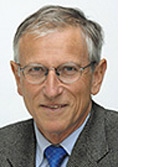 Like me, Werner Lorbeer had attended the Jakob Fugger Grammar School. Soon after I started there in 1960, I registered for the school chess team and met him there. He was a little older than I and one level above me both at school and in chess for eight years.
Even in grammar school, he played an important role and soon became “students’ representative”. He was equally respected by teachers and students and supported by all. Later on, we – together with other friends – did quite a few things in the school magazine “Brücke”.
In those days – and that never changed – he struck me as a truly nice person. He was a shining figure who, in a very special way, always acted exemplarily and in a surprisingly wise manner. He always lived his values, which were always very close to mine, with consistency. In short: he was an enormously wise person full of empathy and he had tremendous charisma.
I witnessed how he always respected and appreciated other people in an exemplary manner. For me, he was a quiet haven who always was sympathetic towards our mistakes. That is something that stood in total contrast to me: I always saw myself as a hothead who made many mistakes.
Werner helped me to overcome the desperation I was often consumed by when I was young. I believe he was also my friend. My relationship with him was definitely full of friendship, love and warmth. I have reason to believe that these feelings were reciprocated, which makes me very happy.
Consequently, I would now like to formulate a few ideas about Werner and our friendship. Because I do not really know how to define friendship and love. Once in a while, I think I feel it, but I really cannot understand it. Just like I also do not know what really is the “meaning of life”.
During our youth, Werner and I often had discussions about this and similar questions. I always felt that Werner had understood all the questions that seemed to bring me to desperation. For me, his help was essential.
A friend of mine once wrote:
In my definition, friendship is something one human being on this planet cannot have room to experience with twenty-thousand people (in the intensity I would demand) on this planet with all its biological restrictions (sleep, day-night, bio-rhythm, winter, summer, mental capacity,…). Not even for one thousand.
As I see it, this is a nice metaphor for friendship. I, too, believe you cannot have zillions of friends in one life. And that friendship is a rarity. But that is not really an answer, either, is it? Love is probably something other than friendship? Perhaps there is a close connection between the two?
Metaphors such as “being prepared to die for someone”, too, make me rather sceptical. Also “similar souls” or “a lot of sympathy and a high degree of similarity when it comes to values, expectations, interests and needs” does not really help. “Blind understanding over time and space” also seems nothing more but a nice metaphor. Rupert Lay, from whom – similar to Werner – I learned many important things, once said:
Tolerance is if you accept that someone else is different from you. Love, however, is if “you want the other person to be different from you”.
I find that metaphor great. I think it is also true for friendship. For me, following it means that Werner was a true friend, because I not only accepted but wanted his “being different from me” both for him and for me.
🙂 So I continue looking for the meaning of friendship and love and still do not know what it really is. The philosophers are not really much help, either. 🙂
And I am and remain sad about my friend Werner having left us.
 Here are two small articles about Werner’s life from the Augsburger Allgemeine and a report by “Pro Augsburg“ written after his death. He was always very intense and successful when It came to the well-being of our home-town. And he achieved quite a few things the Augsburg people are happy about today.
RMD
(Translated by EG)
P.S.
For many years, Werner’s illness had not longer been a secret to me. When I heard about it, I was very depressed and described my feelings it in the IF Blog in a very personal post.
Roland DürreThursday February 16th, 2017
In 1985: object-oriented – Today: agile, digital, lean, open, social.
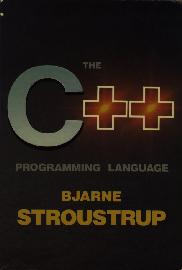
In the autumn of 1985, I was the first to bring this book to Munich after having bought it at the Uniforum fresh from the printing machine.
A short time ago, I retrieved it. It reminded me of having been at Uniforum conferences with friends of mine in February 1985 (Dallas, Texas) and in 1986 (Anaheim, California). It was great. In those days, the Uniforum was the one and only UNIX conference in the USA. We were thousands of enthusiastic visitors from all over the world. I experienced a huge atmosphere of dawn at the time.
There was also a small sensation. Copies of the very new book on C++ by Bjarne Stroustrup (see left on the picture) right from the printing machine were delivered in the middle of the conference and sold directly from the palette. I bought a few of them and took them home. They were probably the first C++ books to ever reach Munich.
This brings to mind: in the 1980s, I constantly gave presentations on software development. At the time, the change in programming was the central topic, and the catchword used most often was OBJECT-ORIENTED.
I also wrote quite a few presentations on “OBJECT-ORIENTED” for IT managers. Among them was a “high-up” at Siemens AG in UB D at D AP (or was it already SNI at the time?). He was asked to tell his “team of leaders” what exactly OBJECT-ORIENTED meant. Afterwards, he said the presentation had been well liked – but it certainly did not really make a difference.
Today, everybody programs object-oriented. In fact, it is even a little too much for my taste.
Later, I gave up my “programming career” and became something like an “entrepreneur”.
 Now I was no longer preaching the gospel of technology. Instead, I spoke about leadership and management. And in particular, I talked about the “smart” pentagram that consists of the terms “agile”, “digital”, “lean”, “open”, “social” and how they interact.
For instance, I related why courage and joy in those working for an enterprise is also a central requirement for economic success. And I also told the people how necessary mutual respect and appreciation of each other are (not only) in an enterprise. Why meeting at eye-level and shared participation and responsibility are the basic requirements for innovation. And why humans are not resources. And how change can only happen in an agile environment.

“Pro Agile“on the DOAG Podium /Yearly Conference in 2013.
I explained why processes, rules and bureaucracy are obstacles to the necessary change. I also explained what a huge damage Taylorist developments cause in an organization and how much waste (as opposed to “lean”) is created by an overwhelming administration and the rising bureaucracy in an enterprise as a consequence of those developments. And that it is totally useless to have endless meetings.
And that departments such as “human resource”, “customer relationship management”, “marketing”, “legal service” etc., basically do not guarantee the success of an enterprise. In fact, they come closer to endangering it.
And that the young and well-educated persons of today prefer working in an enterprise the central element of the culture of which is trust.
I can easily give you good reasons for all I said. After all, I myself was part of the scenario when we software developers made a (as I see it: central contribution) towards a new understanding of work that now spreads more and more to other sectors (#newwork). And this is how it helped to change the world.
I wonder if my call for “agile, digital, lean, open, social” as a “smart” pentagram will do any good? I am not sure.
I also got the impression that my audience mostly saw it in the same way. In fact, it would make me happy if we in the German Industry were to talk less about industry 4.0 and more about entrepreneurial culture. Be it 2.0 or 5.0.
Even the big bosses must understand that our enterprises and we ourselves can only survive well if we are prepared to question what we used to consider certainties and to change what we were used to.
Of course, I understand that it hurts to question hierarchies, cherished sinecures and structures you have become used to. Especially if you are the boss. But please keep in mind: we no longer live in the times of Henry Ford’s conveyor belts and even the prime time of the Chicago slaughterhouses is coming to an end.
RMD
(Translated by EG)
P.S.
I took the star from the central media archive Wikimedia Commons.
Roland DürreWednesday February 15th, 2017
Entrepreneur’s Diary #119 – Your Personnel Records
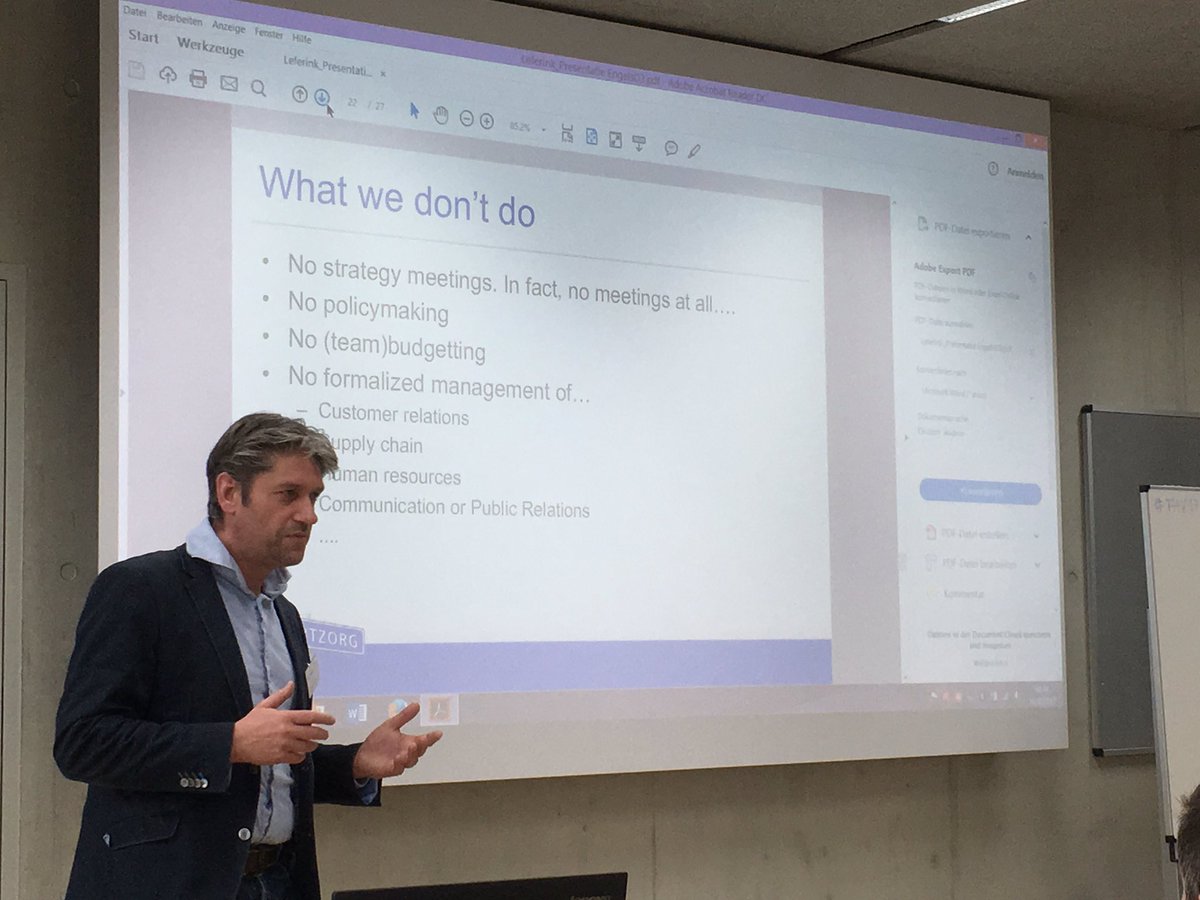
Ard Leferink for buurtzorg in Stuttgart at #fav17 (agile)..
Last week, on the Forum Agile Administration #fav17 in Stuttgart, Ard Leferink of buurtzorg was the Key Note speaker.
On the evening before, he had told me that buurtzorg has no HR-Department (human resource), just like they have no marketing department, no sales department, and, naturally, also no CRM System (Customer Relationship Management).
Well, I actually know a few companies that have no human resource department. As a general rule, however, those are small enterprises with a number of employees that does not exceed the two-digit scope. In the Netherlands alone, more than 10,000 people work for buurtzorg. Well, I guess that can be considered a little bigger, can’t it?
Yesterday, I discussed this with an entrepreneur I am good friends with. He immediately replied by asking: “So what do they do with their personnel records?“ To which my reply was the question: “What do you need personnel records for?“
I actually believed – and have believed for some time – that in an enterprise that is agile and based on trust, personnel records are as unnecessary as a personnel department, not so speak of a “director personnel”. For the administrative processes (paying the salaries, …), a list of employees with very little information would absolutely suffice. Everything else is unnecessary “overhead”.
But before I give you reasons for my opinion, I will describe for you all the things a personnel record consists of.
- As a general rule, the personnel record is started when an employee is hired. That is old knowledge as it has been handed down over the centuries.
- When a new employee is hired, a master data list is made. It contains all the data about the employee necessary for realizing the working procedure, such as his/her birthday, sex, social security and retirement number, religious belief, etc. The work contract is added and sometimes the (successful) application letter with the CV and diverse diploma (school, education, academic grade). And, of course, the protocols of one or more job interviews is filed here as well.
- Then the personnel record is updated all the time by adding:
- All extensions of the work contract;
- All goal-oriented agreements;
- Organisational changes,
- Gratifications and social support (costs for child-care);
- All documentation pertaining continuing education; (the many “private educational measures” that, for instance, a software developer is doing all the time are not part of this);
- Documentation of sickness and health insurance; In Germany, all employees who have been sick for more than three work-days have to bring a doctor’s testimony. To me, this looks like a method for creating work and money for doctors – I never knew a doctor who did not write such a testimony when asked by the patient,
- Special events (change of marital status…) and activities (presentation, …) will also be written down.
- Protocols of yearly evaluation interviews and all other relevant discussions;
- Interim job references;
- All “disciplinary” things such as misbehaviour and/or written warnings;
- In former times, positive letters were also kept in the personnel record. For instance if a colleague received a special tax-free payment because of a jubilee (company employee) or the birth of a child. However, now that these are no longer tax-free, there is less motivation for the employers to pay any special gratifications.
- Today, less agreeable data are also part of the personnel record. They suggest a strange concept of humanity. Because humans, too, are now considered a measured object. For instance, we find the results of strange tests (Score-Cards as results, for example, of the Reiss-Methode), as well as “psychological” reports about the employee’s personality and numbers that indicate his performance for the enterprise. I do not know if this is legal, but I know it is done.
(In some companies, they have agreements that state what may be added to the personnel records and what may not be therein. And the works committee controls in regular intervals).
If someone has been an employee for many years, then this report folder can become quite extensive. It might weigh a few kilograms. If you have a hundred employees, you need quite a bit of storage space. That is why you have to have a digital HR application. And, incidentally, you will also get quite some problems with “privacy protection“.
Because, by definition, IT systems are not secure. To be sure, the drawers with the personnel files in locked rooms were not very secure, either. I actually remember some creative employees who managed to get the keys. And I also remember a personnel file lying around on the desk of a “boss” overnight. But in those days that was not a problem.
In IT, you have to introduce processes that define who can read what under what conditions. It has to be documented. And again, you have one of those coffin nails that will do damage to an agile and slim enterprise and give you yet a little more bureaucracy and administration.
In other words – everything you do not really need is something you better avoid!
Incidentally, the dialogue with my friend continued. His reply to my question why you need personnel records was (after some hesitation):
“For writing references?“
Indeed. As we all know, in Germany the employer has to write a reference for an employee when he leaves (or whenever he wishes one). That reminded me of when and how I used to write letters of reference. Here is what I did:
First and foremost, I asked the employee to write down everything he did for the company and mark which of those things were important to him. Then I took this input and added my own knowledge and estimation, before finishing with one of those famous phrases taken from a book that lists all the relevant phraseology.
But I only ever took a look at the personnel folder when I needed a birthday for wishing someone many happy returns.
RMD
P.S.
For more articles of my entrepreneurial diary, click here: Drehscheibe!
Roland DürreSunday February 12th, 2017
The Unavoidable Unpredictability of the Future!
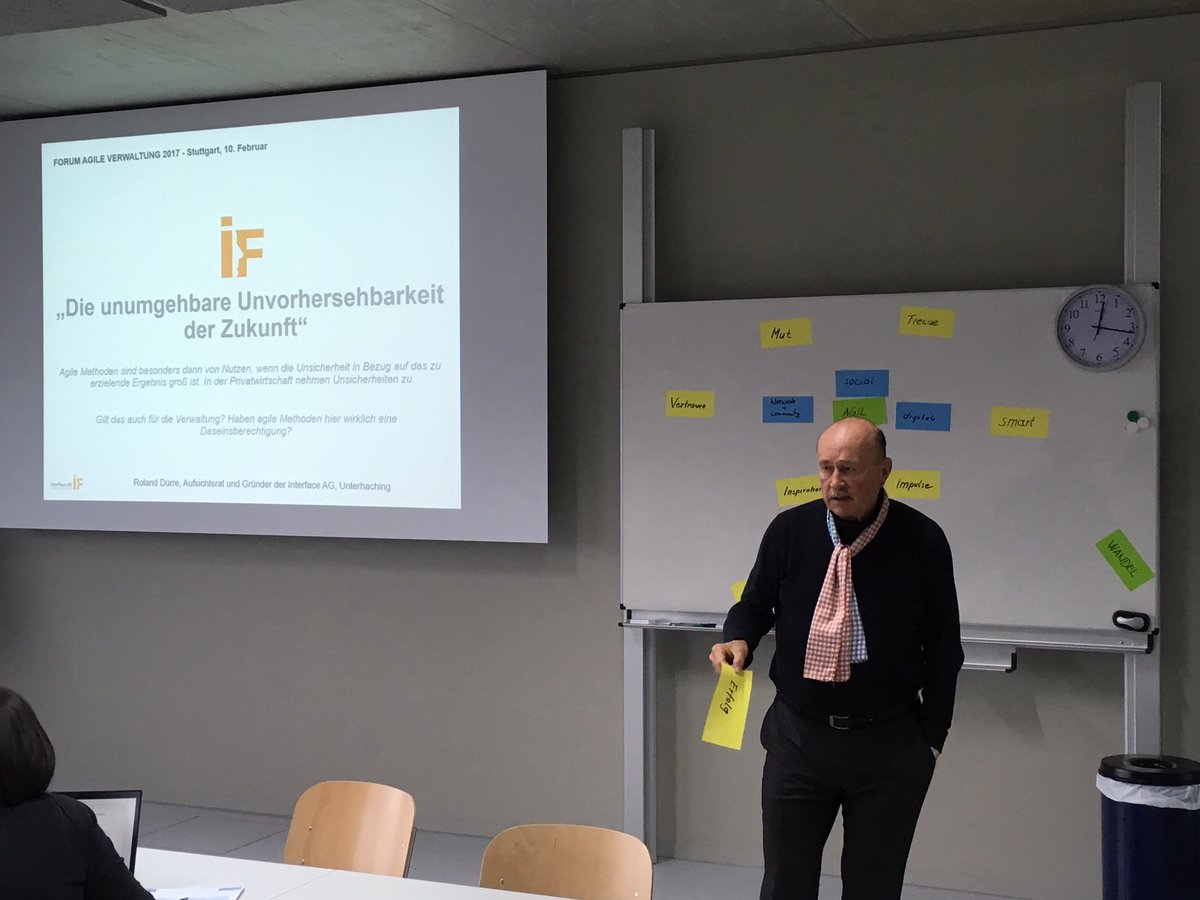
Many thanks to Jan Fischbach, master of agility and my photographer.
On February, 10th, I gave a presentation for the FAV (Forum agile administration) at the Stuttgart Hochschule der Medien. The audience was terrific and I would like to take this opportunity to express my special gratitude. The twitter tag was #fav17 – it is a convenient way to find more information about the workshop.
My presentation was about the “unavoidable unpredictability of the future”. The title is not originally from me – and the same is true for the following sub-title. Nonetheless, I tried to stick to the pre-defined ideas:
Agile methods are especially useful if the uncertainty about the desired goal is huge. In private businesses, uncertainties increase. Is that also true for public administration? Do agile methods really make sense in this sector?
As a service for those who watched and those who were not there: a summary of my presentation. It is a little shortened and sometimes just in catch-phrases.
I started the presentation with an outlook and by explaining terms that seemed important to me. So the first thing I did was pin a cross with five words to the white-board: in its centre stood “agile“, flanked by “digital“, “social“, “newwork“ and “network/community“. I defined the terms and explained how, in my understanding, they belong together.
Note:
When I give a presentation, I am always a little nervous initially. In Stuttgart, I forgot the important terms lean and open. The next time I talk about “agile“ I will start with the central “smart“ cube “agile“, “digital“, “lean“ and “open“. And I will add “social“ to build a pentagram.
For instance, in #newwork I collect all the efforts we make towards giving work a more humane appearance that help us “not to suffer from burnout” even in our modern working world. It is all about consideration, cooperation, appreciation and participation. These are all values that movements such as “Augenhöhe“ (the Film), common good economy, intrinsify.me, “democratic enterprise”, “EnjoyWork“ and others demand. For me, “smart” includes the combination of “digital“ and “social“, with digital being the basis for “network/community“ and “agility“ doubtless only having been re-invented in the “digital world“.
However, the digital change (digital) is only the logic continuation of the Industrial Revolution and consequently the ever more accelerating technological progress. The acceleration of the development is no surprise, because thanks to digitalization, we have more and more powerful tools; what follows is that digitalization is the basic cause for the very fast drastic social change.
I supplemented this image by adding the two terms “courage“ and “joy“ – as a prerequisite for a successful (work) life –, along with the two terms “give impulse“ and “inspire“ as the two central agile means of leading (see below). And then I evened it all out by adding “trust“ (left) and “change“ (right). Finally, I wrote “happiness“ and “success“. After all, it is my goal to make other people – be it audience or mentees – at least a little happier and more successful
After that, my presentation had six steps. Here is a description in catch-words.
- AGILITY
I introduced the “Agile Manifesto” as it has been written by software developers and talked about the influence of IT on technology and our society. It was important that it became very clear how agility is not just a method, but a “philosophy” or “way of living”.
There is no ideological discourse about, for instance, whether “scrum” or “the waterfall method” (V model) are better. Agility is such a natural, basic and so very human concept that both methods can be useful, depending on the individual task.- The medieval cathedrals, as well as the Rome Colosseum were built in an “agile” way: Builder, master and craftsmen met (networking).
- Not agile: Daimler Museum (only new computer speed made it possible to build it, otherwise the static could not have been calculated. But then fire regulations intervened).
- How agility got lost: The industrial revolution changed our view of the world. After having seen the Chicago slaughterhouse, Henry Ford got the idea to produce cars, too, in the assembly line. His huge plants had a great need of workers that were not available. At the same time, many farm workers lost their jobs due to more machines in farming. However, they were “stupid”, not even familiar with the concept of “time”. Consequently, the caste of engineers had to regulate everything. This is how the “caste of engineers” developed. They had to do the mental work for their slaves in all respects. A hierarchical system, paired with extreme division of work (Taylorism) became the formative organizational structure for enterprises.
- Example: Werner von Siemens, born 1817: he organized his enterprise (Siemens) following the model of the German Army.
- Another factor: time is a special commodity. As soon as it is over, it is gone. Now, all of a sudden, it is measured. In units, like kilograms! Note: sailors knew no schedules. They were only introduced for postal coaches. Only steam ships and the railway made schedules possible. This is how people came up with requiring “shared time” in common areas.
- Before the industrial revolution, clocks were mostly used for navigation on the ocean. Now begins the time when they dominate (rule over) life.
- In the plants, there was a common time. To make sure the rhythm was not interfered with, you had to leave your watch at the gate. If someone retired, his farewell present was a watch. “They returned the time to the people”.
- Before the industrial revolution, nobody had a feeling for time. As early as 1900, there were only few countries with a shared time. For planning, the parameter “time” is extremely important.
- In an agile world, communities take the place of organizations Example: movements such as #newwork versus unions.
- In an agile world, the needs of the customers have priority over the contract: Example S21 – the plebiscite was positive because the people had understood that facts had been set – simply because contractual obligations had been caused by those who had signed the commissioning.
- Fake agility A good example for this is the car as master of all individualized traffic. Having a car without a driver will not make you free. What happens if all automobile drivers realize this and want to become “agile”? They say that, if that happens, the economy will collapse. However, this is nonsense, because innovation is creative destruction.
- AGILE LIFE
As a general rule, agile persons are less fearful. Because fear happens between your ears. Usually, agile persons know the moment when they have to stop weighing arguments and instead should start and try things. Agile persons know that all they have is certainties, rather than truths. They are prepared to first give trust (“first give, then take”).
Agile persons enjoy their work more and are more modest and happier. Perhaps they are also more humble and grateful. There is a rule: the more fear, the less agility and vice versa. A superior serenity is the pre-requirement for agility. It grows if you live an agile life. Consequently, agile persons are usually happier and more successful. - FUTURE
In the last two decades of the last century, people and managers believed you could predict the future. All you have to have is enough information and then process it in a precise way. That would make it possible to develop valid scenarios for the future, too (for instance through think-tanks).
And then you could come up with the right solutions and decisions in a totally rational way. This is how they believed an enterprise (and a public office) could become a determining system that gets input and gives output – and how the management could be controlled optimally through simply adjusting the right screws.
What an antiquated point of view! The future cannot be predicted. But then, how are you supposed to plan and control the future if you cannot see it?- In his 1982 “Theses on Change in Management”, Hans Ulrich (the founder of the St. Gallener Management Model) states in his first thesis: “The future cannot be predicted!“
- In St. Gallen, business scientists ask themselves how managers can ever make the right decisions à priori if it is often not possible to determine à posterio if a decision was right or wrong (Definition of decision: its consequences are serious and it is made under uncertainty).
- Vuca (volatility, uncertainty, complexity, ambiguity) All of a sudden these terms appear as abbreviations for the “real world”. But has the world not always been like this?
- Futurology: I, too, am guilty of having believed analysts (Diebold, Gardner), especially when they confirmed my own assumptions (prejudices). Almost in all cases, the predictions were wrong: Here are two examples that were detrimental for me, as well: Bildschirmtext (BTX) and Print on Demand (PoD). In those days, the market predictions were totally wrong. Entrepreneurs who believed in them made the wrong investments.
- There are two personal friends of mine who are worth listening to: Klaus Burmester (@foresight_lab) and Lars Thomsen (future-matters.com/lars-thomsen/). They are both probably among the world leaders in research about the future. Klaus is a twitter recommendation. (#FF). Matthias Horx (www.horx.com/) is rather famous, but I do not personally know him.
- On Lars and predictions about electro mobility: Several years ago, during a bike meeting in Sylt with entrepreneurs, managers, counsellors. It was about innovation and change, also e-mobility. Lars fascinates us all with his presentation on e-mobility. Two years later, almost 20 % of all the participants are proud owners of a Tesla, but all his prognoses were totally wrong.
- Incidentally, the definition of futurology, according to Lars, is the extension of trend research. Based on this, futurology becomes the search for the Tipping Point (https://de.wikipedia.org/wiki/Tipping-Point) in technologies.
- My conclusion is: futurologists are not much help when it comes to predicting the future.
- The innovation as advertised by everybody can best be described as “creative destruction”.
- The reform that is so often called for is nothing other than “non-violent change“.
- And more and more buzz words are making their rounds:
Transition, Transformation, Revolution, Disruptive Changes, Anti-Fragility, VUCA … However, none of those are really new and agility is the only concept that can help.
- The DIFFERENCE between ENTERPRISES and ADMINISTRATION
Enterprises will die if they cannot cope with change. Especially in IT, there are many examples. Some enterprises “only” go bankrupt. Others leave behind them – even if for many years they privatized their profits very successfully – huge damage that will then elegantly be socialized (see EVUs – for many years they had been the DAX heroes – now they try to move the remaining problems, such as nuclear plants, to the public sector).
Public office and administration cannot melt away either after having failed to adapt to change. After all, life in the community will continue. Consequently, the public offices – also due to their political and social mandate – have to cope with all change.
But then, how is the survival of public administration supposed to work without an agile concept as its underlying idea? A concept that has an agile philosophy as its value orientation and that develops and lives an agile culture… - DRIVERS of CHANGE
The understanding that future and change are not predictable grows. Even today, planning fails more and more often, in surprising dimensions. (many big IT projects, S21, BER). You are probably correct if you assume that change will be more frequent and more intense in the future. The trend seems to confirm it. In many areas, we see an enormous acceleration, the speed increases all the time and will continue to do so.
Some drivers of change could be:- What is demanded of politics/society; Trump, “laws” that have to be immediately put into action …;
- Economic Change; Car industry, export downfall, excise tax …;
- Infrastructure & our habits; Mobility consumer behaviour, …;
- Determining factors; Rising interest rates, more poverty, …;
- Disruptive events; Refugees, the climate (warming and cold, water and droughts,…) epidemics, war (terror)???
- Technology; smart solutions, virtualization, electrification, passports as app;
- And much more.
- DIGITAL and CHANGE
Digitalization as the high-speed continuation of the “technological progress” has only just begun – and the same is true for the social change caused by it. Cultural technologies, such as “being able to do calculations (by heart or on paper)” disappear. Machines are now “intelligent”.
Using “intelligent machines”, we can build machines that otherwise could not be built – and they can themselves build yet more intelligent machines. Thus, the technological acceleration caused by digital progress will continue to grow. “Pandora’s box” is probably a nice metaphor for digital technology. The box is on the table. The table starts vibrating, the box begins to wobble. Before you know it, the lid will be askance and something crawls out of the box. Because there is plenty brewing inside the box. Soon, the lid will fall from the box and the box will topple over. Its content will spill all over the table. We do not yet know if all the things that spill out are caterpillars that will become beautiful butterflies. Or if they are evil worms that Medusa sent us?
Well, my hopes are on beautiful butterflies.
That was my presentation. Since the audience seemed to like it, I will probably give the same presentation a few more times, perhaps a little modified with the focal points “agile mobility” or “agile enterprise”.
RMD
(Translated by EG)


