
Roland DürreSaturday November 12th, 2016
Interview for the DOAG-TV on “Digitalization”
 Between November, 15th and November, 18th, 2016, the DOAG Conference and Exhibition will be for the 29th time in Nuremburg. I was there and was permitted to give a presentation – and I was also interviewed by DOAG-TV. Here are the questions and my answers:
When and where, as you see it, did digitalization basically begin?
For me, digitalization started with the “written language”. A few thousand years – maybe 5,000 years – after language had evolved, they found a way to write it down. Then came the information carriers for written language , such as papyrus, paper and IT, along with machines such as the printing press, the lead set and eventually the internet.
Incidentally, written texts were first used for business purposes (merchandize). Business is the inventor of all things – not war. If anything, war is just an extreme sort of business – and, as I see it, a totally questionable and perverted one.
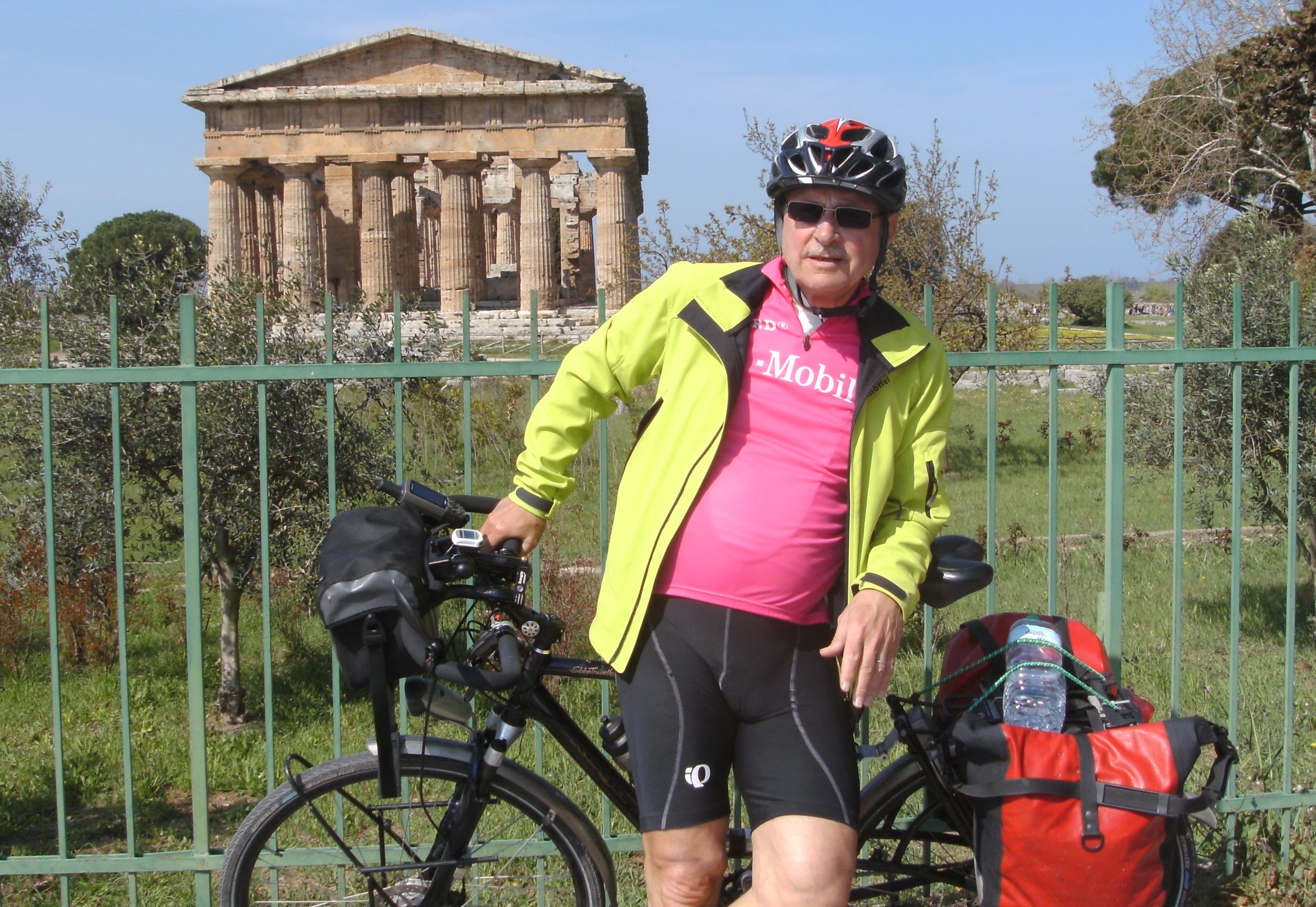
In those days, times were already “digital”.
Where are we today, and what does digitalization mean for the “analogous” creature “homo sapiens”?
Humans are and will always remain analogous creatures. Through the “cultural techniques” such as reading and writing, humans became a little digital. But never quite fully. After all, to this day humans cannot really manage to translate digital experiences into their analogous concepts of mind. Just think of the secret of the big number. Linear is hard enough, geometrical is quite difficult, logarithmic is impossible. Can you imagine how much money 200 quadrillion Euros is (it is the sum by which the EU countries indebt themselves anew each year)?
We lost the competence to calculate mentally or on paper as soon as the pocket calculator was invented. Who of us can still do it? Who can still extract a root or do a logarithmic value by hand?
Looking ahead: what will digitalization bring us?
Strangely enough, digitalization might actually make our lives analogue again. In former times, we translated digital data into analogous signals by modem (modulating and demodulating) before sending them on through a cable. And at the opposite end of the cable, the modem again re-translated them into digital data. Today, we translate analoous signals (noise and images) into digital data for transportation, split them into small data packages, send them through a package network, collect them and then re-arrange them in order to reconstruct the analogous signal from digital data (which is why we no longer have any static).
What will we have in the future?
- In communications: facilitation gets more and more important. We will have more images and less written words. We will talk more and draw and write less. Audio will become more and more relevant – also as part of asynchronous communication. Podcasts and video recordings will continue to grow.
- A “rudimentary illiteracy” will spread more and more. Language will benefit. Strong metaphors will become important, along with the awareness of “restricted code” and “elaborated code”.
- Control of language and gestures will become dominant.
Well, this is what the future might be like. Or maybe not. After all, we cannot predict the future.
So much about my interview! I will give a presentation at the DOAG Conference on Wednesday about “Digitalization – A Huge Error”. I already collected so much exciting material that I do not know what to tell people. That makes me nervous. But then, I will first be interviewed on Tuesday. As soon as my interview is online, I will, of course, set a link to it on the IF Blog. And I am quite curious what it will be in the end that I am going to talk about.
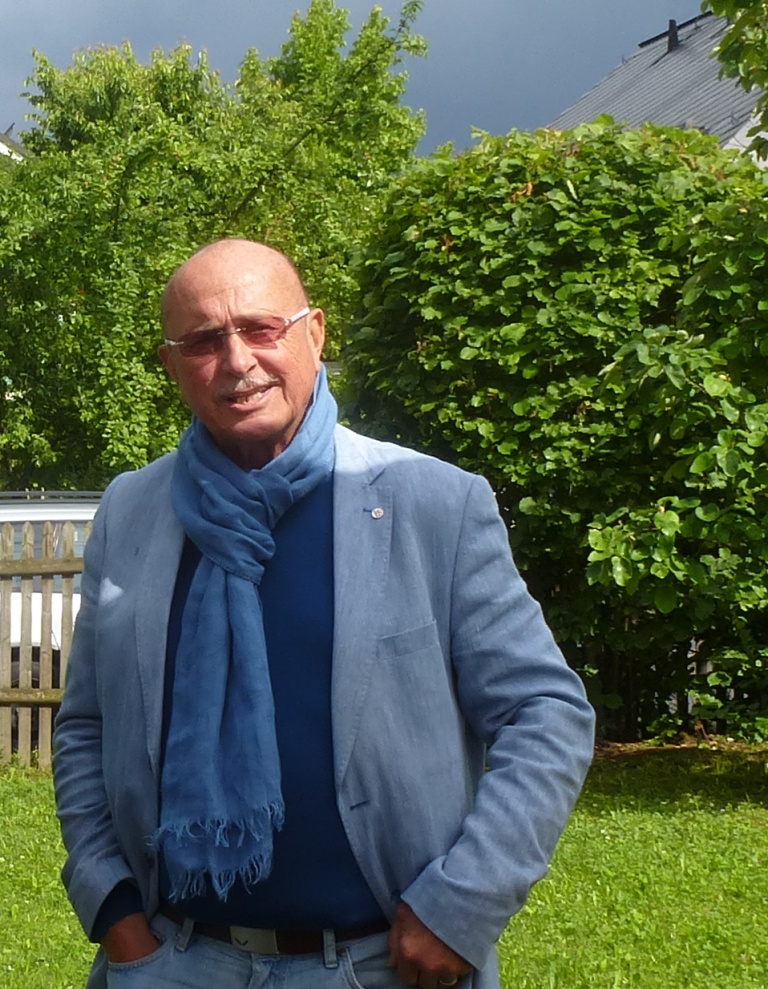
The picture was taken during my last presentation on the GOAG Conference of 2015.

“Commemoration of my Presentation of 2015 (created by Christian Botta)“.
RMD
(Translated by EG)
Roland DürreTuesday November 8th, 2016
Anecdote on Autonomous Vehicles (if it Were not so Absurd, it Would Make me Cry)
 or:
How the Chauffeured Gentleman Imagines the Autonomous Car.
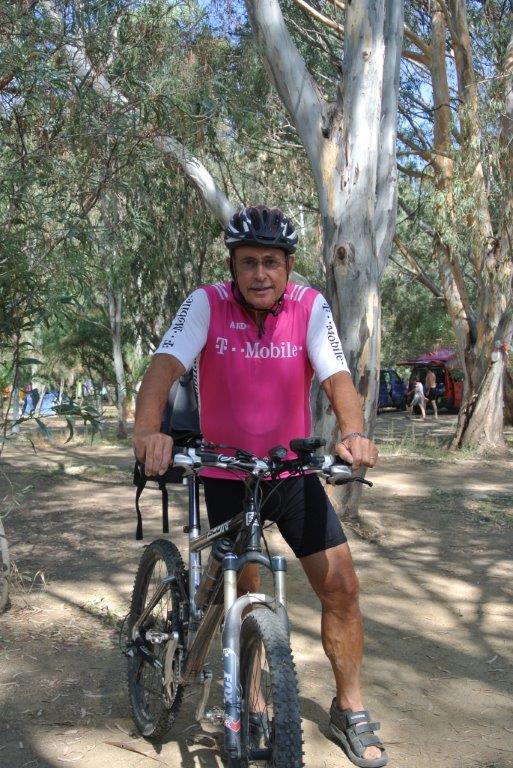
ADFC – that is the lobby club for us bike riders. Many bike riders think this club is a little stuffy and consider it just the equivalent of the ADAC. Consequently, they prefer free grass root movements, such as “Critical Mass“ and the like. Regardless, it is a pleasure for me to be an ADFC member and I also support the association with lobby work wherever possible. And I also very much recommend the membership.
The ADFC also organizes many excellent events. One of them is the lunch discussion group in Munich. At those lunches, I already witnessed many interesting presentations, for instance by Herrn Ude (when he was still mayor of Munich), Herrn Ramsauer (when he was Federal Minister of Transport), Toni Hofreiter (as mobility expert of the Green Party), but also by persons who are less publicly well-known, as for example the DB-Regio .managing director. The discussions were always very interesting and important.
Yesterday, we had another ADFC lunch discussion in Munich. The speaker was Peter Driessen , who is general manager of the IHK Munich and Upper Bavaria. For those who do not know what IHK is: it means Industrie- und Handelskammer (Chamber for Industry and Commerce). It is an organisation you have to be a member of if you own an enterprise, just as you have to pay their membership fees.
As an entrepreneur, you do not know why you have to be a member, but in return, you get a high-gloss magazine at regular intervals that is rather lacking in content and not very interesting either – and that will immediately end up In the rubbish bin. The IHK is generally quite present in people’s minds, because more often than not it has many managing directors – and those managing directors earn quite good money. After all, they are also responsible for many enterprises (see Official List of IHK on incomes of the GF team, not included other advantages such as business car and chauffeur, etc. – Offizielle Liste der IHK zur Einkünfte der GF-Teams ohne weitere Vorteile wie Geschäftsauto mit Fahrer etc.).
And then, Peter D. (without having intended to) explained with a personal true example how all the different traffic systems might be integrated in the future, at the same time disclosing his personal vision of a “driver-less car”:
“On the way to a presentation, his chauffeur-driven car got stuck in the traffic jam at Donnersberger Brücke. And since there was no chance for him to reach his destination in time using the private vehicle, he just left his car and continued on his way by S-Bahn train. And he managed to be on time. This would not have been possible without a chauffeur, since he could not have left the car standing in the middle of the Donnersberger Brücke, could he?”.
He then completed this example using his personal vision of a self-driving car:
“This is how, in such situations, you could continue by using public transportation in order to reach your destiny on time and the driver-less car could then do a leisurely turn through the congested streets and eventually retrieve its owner”.
He sounded rather serious when he said this. Perhaps he meant it as a joke? Except that such a concept of mobile future is all but hilarious. Especially if it comes from an important representative of a business association, at least one who considers himself extremely important.
RMD
(Translated by EG)
Roland DürreMonday November 7th, 2016
Entrepreneur’s Diary #118 – Employee Involvement
A short time ago, I received an email from a young man who is also an entrepreneur and a friend of mine:
During the last two years, a lot has happened and our small IT company now has seven employees. For next year, we are again seeking new employees. We are also wondering how to improve salaries in general without threatening our financial situation – in case matters will at some time not be so rosy.
Now I would like to ask you if you have experience with employee involvement or if there is somebody you could refer me to. Since we do not specialize in one product, generate a lot of cash flow with custom-made goods and also do not wish to sell our company, the question might be a little more complicated than it initially looks.
Would there be a chance for you to feel like and have time for coaching us in this matter in the near future?
Naturally, my answer was YES. But it was not because I wanted to coach them. That is something I refuse to do as a matter of principle. I also do not like to give advice. After all, advice can turn vice. Instead, I share my knowledge and ask questions.
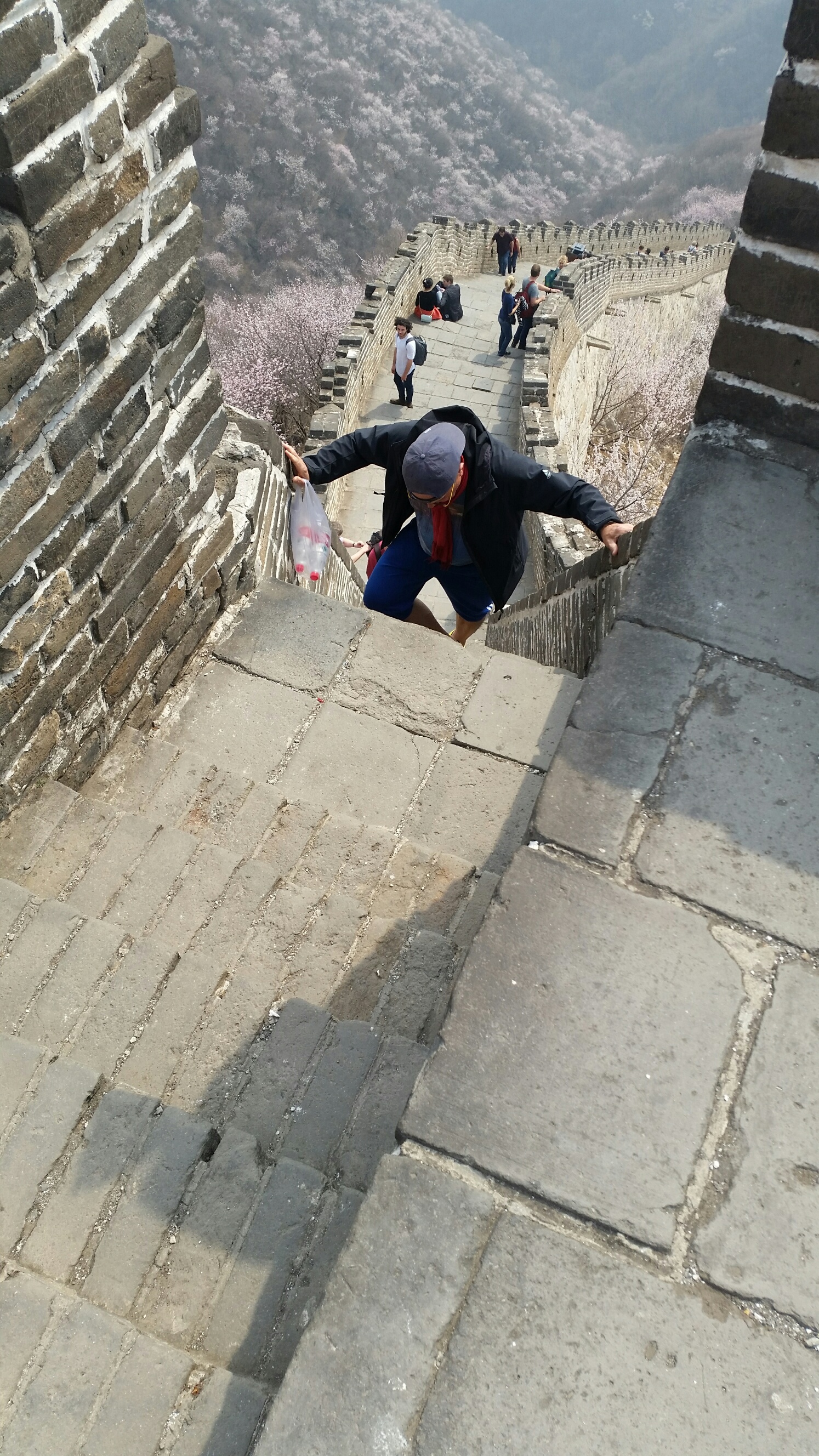
Once in a while, being an entrepreneur is like climbing the GREAT WALL.
First and foremost, I checked If I had ever before written anything about employee involvement in my entrepreneur’s diary (Unternehmertagebuch). Since the answer is no, I will relate the results of my discussion here in the blog.
Let me start with my own experiences:
As a matter of facts, fairly shortly after the foundation of the InterFace Connection GmbH (for us, the name Connection was more than just a name, it was programmatic) in 1984, Wolf Geldmacher and yours truly decided that we wanted to offer all employees (and even in 1986, we are talking around twenty) shares of the enterprise.
At the time, we were four partners in the firm. The “active” ones were Wolf and I. We were both employees of the Connection as managers and both owned 30% of the capital. The two “passive” partners in the firm were Dr. Peter Schnupp (a man who had written IT history) and the InterFace Computer, represented by Claus M. Müller. They had 20% each. At the time, our capital was as much as 100,000.- DM and our legal status was limited liability company.
Dr. von Hase was “our” counsellor-at-law. He accompanied our enterprise during many years. In retrospect, I can certainly say that his advice was always very good advice for the company. It did not take long for him to convince us that the limited liability company status was not the best possible for an enterprise with several partners. Especially if some of them are also employees. Conflicts that, for example, might arise from the enterprise-employee relation might easily have a negative effect on the partnership level.
Consequently, 17 employees of the IF AG founded a share association that took 10% of the capital (10,000 DM) out of the entire sum (100,000).
The sales price for the 10% was 60,000 DM (10,000 DM for the shares plus an extra rate of 1:5 , i.e. 50,000 DM). At the time, our enterprise was easily worth 600,000 DM. The money remained in the company as backup, which improved the capital situation (from 100,000 to 160,000 DM). The total shares situation changed as follows: Wolf and I now held 27% instead of the 30% we held before the transfer. InterFace Computer and Peter Schnupp now had 18% each instead of the 20% they had had before. And 10% were now owned by the shareholder association of employees who then mathematically held a share of 1/170 each of the enterprise. It was a good example for a successful employee involvement.
For the employees, one disadvantage was that they could not directly own shares of the enterprise, instead “only” indirectly holding shares as an association. This limited the fungibility of the shares. When, in the late 1990ies, the InterFace Connection GmbH became the InterFace AG, the shares of the employee association became stock of the InterFace AG, which meant this limitation was no longer active. Whenever I meet InterFace AG employees today on general meetings, they tell me that the employee involvement was the best investment of their lives.
In the 1980ies and especially in the 1990ies, many persons worked with option models in Germany that were rather dubious affairs as far as tax was concerned. The procedure was particularly attractive for young and quickly growing enterprises that wanted a speedy entry into the stock market. I have a few scattered friends who actually – to their own surprise – became millionaires because of these models. Mostly, however, the persons I know who did it tended to lose money, rather than profit.
Today, I believe cooperatives are probably something to keep in mind when this is your purpose – especially if you want to think sustainable and long-term. Even though originally the cooperative model was not intended to be beneficial for employees. Initially, they wanted to share the use of production machinery and buy said machinery. But it will also work if you want to make it possible for employees to share the success.
To me, partner models such as those used for entrepreneurial counselling look rather innovative. Especially the varieties where you can buy shares upon entering the firm and have to hand them on as you leave sound exciting, With them, you will profit from the success and growth of the shared enterprise in all the time you are part of it. If I were ever to found a new company, I would probably try the BGB company partner model.
During our discussion, we also looked beyond the “pure earnings”. To be sure, a market-oriented income plays an important role when it comes to the employees’ motivation. In fact, salaries and continued education are the most important costs in service companies. It goes without saying that enterprises find it easier if they only need to pay part of these costs if they are actually successful.
However, money is only one (even if an important) part of what constitutes the relationship between the enterprise and its employees. The entrepreneurial culture and the values lived in the firm are just as important. Catchwords are openness and transparency, the possibility to participate, as well as respect and appreciation of all the persons in the firm being a foregone conclusion.
In an enterprise, you should feel that all the employees share the courage for the future and find pleasure in doing what they are doing. “Strategy” should be something like a shared feeling, rather than just words. The enterprise should not just create value for the shareholders, but also for all the stakeholders. That includes the families of the employees. For partners and children of colleagues, the enterprise should be something they can “touch”.
And also – this is very important:
Success should (as often as possible) be celebrated together!
RMD
(Translated by EG)
P.S.
For more articles of my entrepreneurial diary, click here: Drehscheibe!
Roland DürreSunday November 6th, 2016
Digitalization: Once Again “Ethics” and “Autonomous Vehicles”.
Guido Bruch commented on my article
#Digitalization – The “Ethics” of IT and “Artificial Intelligence“
(#Digitalisierung – Die „Ethik“ von IT und „Künstlicher Intelligenz“)
Here it is:
In the book “Silicon Germany”, the ethical dimension is discussed. Here is an example: a child runs onto the street from the right side. On the left, an elderly person is walking with a walking frame. Humans behind a wheel would decide either at random or consciously whom to run down if they cannot stop their car in time. But then, what to tell a machine to do? Should we always protect the child and thus select (and this with Germany’s past?) or should there be a random generator? I think this is what it is all about.
But I am sure these are all just theoretical questions, since the number of potential accidents is probably small. The topic would probably solve itself. Have there ever been these kinds of accidents?
Another question is what the car manufacturers will do if the request changes from country to country? For instance if some Golf countries say they want to protect the natives at all costs and instead sacrifice foreign labour?
Many thanks to Guido. His article gave me many associated and emotional ideas:
The problem is that a program that is supposed to follow a balancing ethics has to have an evaluation matrix with calculable rules that can evaluate the value of human life through a well-defined systematics, covering all cases in several dimensions.
In other words, you would suddenly have to evaluate and classify the age and gender, but also the education, function and social responsibility of a person and much more. And thus you would have to reach a “personal value number” that makes it possible to calculate the relation between an individual and the set of all humans. Similar to the mathematical value “bigger than“ for whole numbers.
(In theory, you will then not have room for “equal” or “equal-same”, because that would probably mean you need a random generator, after all.)
If you continue in this way, then you will also have to think about such a relation as “bigger” in terms of a set of humans at any time and decide about one of them being the most important and one the least important.
Totally mathematically. To me, this entire discussion seems absolutely useless, even if you will find it in the book Silicon Germany.
Incidentally, this has been regulated for persons living in the FRG a long time ago. We have a constitution that clearly states that all men are equal. Consequently, an absurd metric that would algorithmically determine the “value of a person” is not permissible.
So what “ethical” definitions should a machine follow?
Here is an example:
Guido writes – and immediately doubts – that one might come up with the idea of always saving the child. Then the first question would, of course, be: what to do if you have to decide between two children?
Quite apart from the fact that this would define a two-class society: children versus the rest of society. But then, how do we define “child”? By age, size, weight, maturity? And what about a mother as part of the “rest” if she is nine months pregnant? Perhaps she is two persons – one child and one rest? I also think the “rest” would vehemently oppose this kind of regulation.
Incidentally, the dilemma is very old. What to do if, shortly before the birth, they discover that the mother would die giving birth to a baby that might live? And that the mother can only be saved by killing the baby? This is a mental experiment that actually happens in real life. And, of course, you can extend it by telling people, for instance, that the mother has two more small children (and a husband…). Can this kind of thing be forced into a series of rules that a machine could work with? Of course, the answer is: no!
Here are a few examples with which I would like to show the absurdity:
Who is worth more?
- The Federal Chancellor or the leader of the German Soccer Team?
- A CSU county representative or an SPD federal representative?
- An entrepreneur or a politician?
- A German or a Frenchman (depending on where)?
- An integrated citizen with white skin or a dark-skinned asylum seeker?
- A young man or an elderly lady?
- The person sitting in one car controlled by a robot or the person sitting in the car controlled by another robot coming from the opposite side?
- Or, to be cynical: robot A has been installed by BMW. Potential accident cars are another BMW and a Mercedes. Should he ram the BMW or the Mercedes?
- …
You can produce these examples in huge quantities. But to what end? Except in order to demonstrate how it does not make sense at all?
Let me give you a few seemingly harmless examples: cat against dog, which is of higher value? The strangling dog or the pedigree animal owned by the opera star? Or – just to top all absurdity: what should the car roll over if there is a choice between the “common German toad on its way” and a “run-away Greek tortoise”?
(Please note: when I ride my bike, it always hurts me to see all those run-over toads and in Greece all those run-over tortoises).
Most persons propose you could use a random generator for these decisions. After all, it would not really be activated very often, would it? This sounds rather pragmatic. Why not?
Incidentally, the great Isaac Asimov solves the problem quite easily in his SF work: as soon as a robot threatens to do damage to a human, the system will block itself following the three robotics rules, thereby being destroyed once and for all. But he, too, soon discovers that his proposal has a glitch (incidentally, it is from the 1940ies).
The glitch is:
What are the characteristics by which a computer identifies the human being? At one time, this seems to be the dialect of the Solaris “spacers“. Aurora “spacers” seem to have huge problem with it. And the same is true for the “settlers“. And consequently, the Solaris robots start killing intruders – even if those intruders are humans.
🙂 Here is what I propose: why don’t we take the Bavarian dialect as a determining factor whether or not someone is human? Even the big Bavarian party might want to make this idea part of its program…
However, when it comes to autonomous cars, the “laws of robotics” will not help either. It can only work if the car is driving empty :-).
No, the ethics commission for autonomous driving is nonsense – just like most ethics commissions and discussions.
To be sure, I would wish for an ethics commission for drones and war robots. However, the result of those commissions seems as clear as the fact that those who have all the power would ignore it anyway.
Another ethics commission I could easily imagine is one that answers the question if it should be allowed for private institutions (concerns such as google, amazon …, but also lobbyism as practiced in many sectors, up to private armies employed by some enterprises) to get such power as has never existed in society, in extreme cases even including psychological and even physical violence. In some cases, there should probably be a discussion about a violation of the “federal monopoly of violence”.
Except that it is absolutely clear to me that the result of such a commission could only be a clear “NO”, which would, however, be likewise ignored.
Ethics will not help when we try to solve our problems. Especially not if it is supposed to be generated by a commission. What we need is human wisdom. I always like citations by Bertrand Russell:
» All technological growth, provided said growth causes an increase, rather than a decrease of human happiness, will give us growth in wisdom.«
And, unfortunately, ethics will not at all help us to become wiser. On the contrary: it is more conducive to distracting us from wisdom.
In particular, ethics will not at all help with “autonomous systems”. It is my personal consolation that, as far as I know, there has not been a single event with track-bound traffic where “mental experiments” such as the trolley dilemma, ever happened. Consequently, there is no need to worry too much.
Perhaps the following ideas will help:
Railway tracks are made of iron. In the iron age, they were used in order to transport persons and products from A to B. The autonomous car is a result of IT. Consequently, it is a little more modern, quasi running on “tracks made of software and computers”.
And in doing so it makes use of an infra structure that was the only one to have established itself on a world-wide scale: flattened ways in concrete, also known as street network. That is why it can not only transport humans and goods on tracks along the line between A and B (A and B being fixed stations), but also between X and Y (X and Y are now variable end points that can be reached via street).
And in former times, the railway was twice redundant. First, it had to set a recovery for a “basically impossible” error. For cases when this failed, a second level was generated in order to avoid the maximum accident even for a twice “impossible” error.
Consequently, it is our task as engineers to guarantee the highest possible degree of error free roads. We should create a first “redundancy” that covers the “impossible error”. And then we should create an extra safety level, as the railway used to have it.
This is how you make errors as unlikely as possible. That is the mission!
The ethics discussion is intellectual onanism. It seems to me that politics try to deflect our attention from relevant and very uncomfortable questions about digitalization (incidentally, I ask those questions in my presentations). This is how it is abused as election campaign instrument. Politics want to make the citizen believe he has a high competence and responsibility. The goal is to win as many points in the electoral campaign.
RMD
(Translated by EG)
P.S.
There is only one instance when I remember an ethics commission coming up with a reasonable result. A few decades ago, there was a lot of discussion about the §217 (abortion). At the time, the ethics commission had the idea that abortion should continue to be illegal, but that there should be no punishment. As I see it, this was not a bad idea. After all, it also became the basis of the new abortion law.
But do you really need an ethics commission for this kind of thing? In his “Dreigroschenoper”, Bert Brecht says:
You must not punish too severely those who acted illegally!
This will help the persons concerned, because there is no punishment. But it will not help with the decision making process. Because it will always happen in the hearts and heads of the parties concerned.
Roland DürreFriday November 4th, 2016
#Digitalisation – The “Ethics” of IT and “Artificial Intelligence”.
The Federal Minister of Transportation and Traffic, Alexander Dobrindt followed the mandate of the Federal Cabinet and his Chancellor and constituted an Ethics Commission . Among other things, it is supposed to clarify whose liability it is if an autonomous vehicle causes an accident – the driver’s or the manufacturer’s.
After all, it is quite possible that one of those crazy autonomous computers will cause an accident because they made the car speed! Who will then get the ticket – or even the complaint?
However, the ethics commission is also supposed to find out if there are ethical norms which the autonomous vehicle has to adhere to in conflict situations. The former Federal Constitutional judge Udo di Fabio will preside over the commission. The minister gave the “Wirtschaftswoche” an interview about it.
 Ever since my first seminar with Rupert Lay in the early 1980ies, ethics has been something that interested me very much. As I understand it, ethics is also concerned with moral dilemmas. One of the fundamental examples is the Trolley-Problem (Trolley-Problem).
Let me cite a Wikipedia Article:
Due to a wrong switch stand, a freight train is threatening to collide with a stationary train full of passengers. A worker discovers the threat and moves the switch in such a way that the freight train will end up on an auxiliary track where it runs into a group of maintenance workers, all of whom die. How accountable is the person who moved the switch?
Welzel is said to have asked this question in 1951. In the following years, up until today, many “mental experiments” of this or a similar nature were formulated. One of the most acute, at least one of those that impressed me most, is the following:
A doctor has ten patient waiting in his medical practice. Every one of them is at death’s door because one of his inner organs (a different one for each patient) is completely destroyed. In order to get well, they all need an “organ donation” immediately. But there is no chance that any organs will be available.
By chance, a healthy person enters the practice. He has all the organs the doctor would need in order to save all his patients. Should the doctor kill the man in order to save all the other ten?
Well, the example brings the topic to a culmination. Regardless of it ethically being absolutely within the scope of consideration to kill one person in order to save ten, most people will consider this solution completely inacceptable. Why? Perhaps because then nobody would ever again dare to go and “see the doctor”.
To me, this seems the real purpose of moral: we want to make things we are afraid of impossible. Things that we want to avoid at all costs. Consequently, those are the things where you have to say: this is a no-go! The very idea is a taboo.
For me, this “mental experiment” is so valuable because perhaps it teaches us what lies behind morals (You do not do this!).
The public television channels, too, are now concerned with ethics. On October, 17th, 2016, the ARD broadcast the TV experiment “Terror – Your Verdict“. And then they asked the audience to decide how the film ends (guilty or not guilty for the pilot with the ethical dilemma). However, the critical voices I read afterwards were not really enthusiastic about the experiment.
Incidentally, I find the doctor example a lot more realistic than the one with the trolley. I imagine that doctors will actually once in a while be faced with this sort of dilemma, for instance if, after a catastrophe such as the Bad Aibling train crash, they have to decide what patients to help first. Even if this, too, is a lame example.
Let us go back to all those mental experiments with trolleys, trams, freight trains, etc. They are all rather exciting material for an intellectual discussion. But for practical application, it all seems extremely useless to me.
All those constructs originate in examples with traffic that is bound by tracks. However, I never heard of a single event where something like this happened in reality. Which means that no worker in transportation world-wide ever was confronted with this kind of situation. So we actually discuss and work intellectually and ethically with pure mind games.
In week-end SZ edition, you can find a well-written “digital” article about the Bad Aibling train accident. Twelve persons were killed and 89 wounded on the morning of February, 9th. The digital article is titled
Chronologie eines vermeidbaren Unglücks
(Chronology of an accident that could have been avoided).
I strongly recommend that you read the article by clicking on the link.
This shows that reality looks totally different. Especially if you have an accident situation. We learn that:
- With those electronic signal-boxes that are technologically up-to-date as far as DB standards are concerned, the station inspector would have been notified of his first ok-signal a lot more sternly: at least by a thick, red, sparkling arrow. However, there is no such display at the Bad Aibling signal-box, because the technology was older. This was a safety risk the Deutsche Bahn had long been aware of. An internal guideline would have recommended as early as in the 1980ies that the relay signal-box should be updated. If the signal-box had been “digitalized” to meet the “current state of technology”, there might have been a good chance that the accident would not have happened. A complete digitalization would probably have prevented the entire accident. Maybe we should discuss if that is ethical?
What else do we learn?
- Shift work is not a good thing! The station inspector had started work at 5 a.m. The way from his family residence on a farm to his place of work at Bad Aibling – ten kilometres west of Rosenheim – is forty-five minutes. Due to a storm the German Weather Service had announced during the night, the station inspector had probably left home even earlier than usual. This makes me assume that his alarm clock will have rung around 3.00 a.m. In other words: he cannot have had a very long night. Shift work is always a problem. It is detrimental for your health. There are many studies that prove this fact. And whenever I sit in an S-Bahn train early in the morning (with which I mean before 6.00 a.m.), I only see grey faces (except those of the young girls and boys who enter at Ostbahnhof on their way home from the “Kunstpark Ost”). And all those people are not really at their best at this time of day. At least I am not. But here the good news: Computers (digital systems) do not mind night shifts!
We also learn that you should not play computer games when working.
- Computer games are dangerous! At 5.11 a.m., the station inspector starts the video game “Dungeon Hunter 5“ on his smartphone. In the virtual role play, he is hunting monsters and villains as reward hunter. It says in the railway service regulations that station inspectors may use their smartphones at work when it is necessary for their job. Games are explicitly forbidden. And everybody will immediately say that, of course, computer games are not allowed at work. But is that realistic? Who abides by the rule? After all, we get more and more standby work places. The best example is the extremely well-paid job of the pilot. They are top earners and their job is tough. Shifting work schedules, night shifts, climate changes, etc. Except that they told me that the average pilot of a long-distance flight of around eight hours only has two five-minute intervals during which he actually has to work hard. So what to do during all the other hours? Drink? Well, that is something you are not allowed to do. So the only thing you can do is play. I also remember well all the fairs I attended where the bored personnel enjoyed playing solitaire on their PCs – and I freely admit that I, too, had a time when I was solitaire addicted. Mind you, this is not because of the game addiction. Anybody can get game addicted. Instead, it is because this game was probably the reason why Windows ever became great. The good news is again: Computers (digital systems) do not play! They focus on their work!
That is why I believe we should – first and foremost – get digitalization well under way in order to make life healthier and safer.
Except – the cars of the future are now supposed to solve these problems by using programs – at least that is what the ethics commission thinks. And they have to decide which cyclist is to be victimized if in a situation (mental experiment!) there is a choice between killing one or the other cyclist. Let us assume the one cyclist is a man riding without a helmet. The other cyclist is a woman wearing a helmet. Should the system decide that the woman will be overrun because – due to her helmet – she has the better chance at survival? Or the man as punishment for not wearing his helmet? Or should they base the decision on gender or age? Or on what social responsibility the man or the woman has …
To me, this all looks like nonsense. Consequently, I do not appreciate the Dobrindt ethics commission. As likely as not, it is just another small piece in the mosaic for the next election race with which the Big Coalition wants to show what important topics it – as the only administration world-wide, just like with data security – has been tackling so courageously and prudently, thus having a particularly responsible position in digitalization. Even if such a position is actually far from reality in current times.
Someone once said: all politicians talk digital change and throw terms such as block chain and big data around. Yet they have no idea what those terms mean! Just like they want reforms but no change (reform is violence-free change). And innovation is promoted, but nobody promotes destruction. Except: innovation is basically nothing other than creative destruction. I always get the impression that politicians who hear stories of bloggers and blogs always secretly contact the block warden in order to prevent things from happening.
If at all, I would wish for an ethics commission in the ministry of Frau van der Leyen. Such a commission could relate how ethically desirable the use of fighting drones and robots is, for instance, for freely killing humans. The problem that the internet runs following the motto “the winner takes it all” and the question if it is ethical that some day a concern like google might determine the world alphabet are perhaps useful commission topics. Why not for the Ministry of Trade and Social Relations?
RMD
(Translated by EG)
Roland DürreThursday October 27th, 2016
#Digitalisation – The Filter Bubble“.
 We live in times of irresponsible blabber. I feel it with special intensity whenever I hear how even self-appointed prophets speculate about digitalization. How much nonsense we have to read. Then, I also notice how many persons jump the bandwagon, uncritically repeating what they have heard or read. Thus they promote fear at places that will only deflect from the real dangers.
For me personally, the “digital change” is just the continuation of the change that has been caused by technology in the age of the complete electrification of our planet (or something similar). Since I myself experienced said change and was even part of it, I often try to contradict all the nonsense I often hear repeated by individual persons.
For me, for instance, a “driverless” car, be it a truck, bus or car, is nothing other than technological progress where iron is replaced by IT. Basically, the new vehicles simply do without tracks, instead using IT in order to reach their destination without a driver. That is far from witchcraft – it is simply engineering.
A harmless example of how panic is created is, at least so I see it, the much-cited “filter bubble”. In their Sunday speeches, more and more people state that a huge danger is looming because of it and that we are manipulated by algorithms. Here is a text I copied from a Wikipedia article (version of October, 27th, 2016, german)
The filter bubble or informational bubble is a term used by the internet activist Eli Pariser in his book of the same title. According to Pariser, the filter bubble is generated because websites try to predict what information a user wishes to find by using algorithms – based on available information about the user (for instance about his location, history of searches and click behaviour). The consequence is an isolation from information that does not match the position of the user.
So – tell me what is new about this!
I, for instance, have been living my filter bubble since I was a small child. As soon as I was able to read, I went to the library (first the catholic library, later the public library) and borrowed exactly those books that matched my VEIN (values, expectations, interests and needs).
As a reader of newspapers, I soon preferred the SZ over the Münchner Merkur. Later, I learned that newspapers try to write exactly what their readers want to read…
When I was an adolescent, I went to the “Republican Club” meetings, rather than the “Young Christian Party” and fraternities.
This is how, due to my limitations, I maneuvered myself into my private “bubble”. At the time, the radio got me out of it. At Silvester Evening, for instance, there was the Lach&Schieß, coming up with totally new ideas and unheard concepts and thereby drawing my mind towards completely different issues.
What used to be the radio in the form of “public broadcasting” is now the internet. I communicate with other persons, read their blogs and, once in a while, even listen to their PodCasts. In that respect, I am a little old-fashioned, because I actually still do some reading, not wishing to run around with headphones all the time. But even my behaviour will not have an influence on the future. Consequently, audio will win against the written word when it comes to knowledge transfer and exchange of opinions.
This is how I see and do many new things on the internet. Because, basically, the internet is not just google and facebook. Above all, it is about persons who blog and podcast their evaluations and their lives and who provide me with many ideas that, indeed, counter my prejudices and remind me to be tolerant. And this is how I learn to respect and appreciate opinions and persons that and who I just used to dismiss without any good reason.
My friends are like me in that respect. I feel rather well living in that bubble. I could not care less about the algorithms. Nor do I see a great danger in them. More often than not, I get the impression that the internet is made to be the big culprit just in order to camouflage how massively we are controlled by manipulation and lobbyism. Because it actually makes you more free and autonomous, thus being a danger to prevailing structures and systems. Consequently, they also do not like the idea of freedom of the internet and see to it that online freedom is torpedoed with all possible arguments – no matter how stupid.
RMD
(Translated by EG)
Roland DürreTuesday October 25th, 2016
Winter Time & Summer Time – As Useless as Cancerous Growth
 Now you will read my personal opinion!
On October, 30th, the day will again have come: all clocks will stand still for one hour at 2 a.m.. After that one hour, they can continue ticking away. Or else you just turn them back one hour in the morning. So if it was eight o’clock a minute ago, it will now suddenly be seven o’clock. In the evening it is suddenly dark far too soon…
For me, that will again mean between three and five days of not really being myself. Somehow or other, this “homeopathic” time change by one hour is worse for my system than a proper jet lag of several hours.
The accident statistics, too – both for traffic and household accidents – peaks around the time of the change. Occasionally, people probably die because of the time change. And on March, 26th, 2017, the reverse process comes again.
They originally said this manoeuvre was introduced to save energy. Except that I have no idea how that is supposed to work. If at all, the only energy that, in theory, could be saved is electric energy for illumination. But how? After all, all activities of humans are just pushed back by one hour? If you turn off the light one hour earlier and then turn it on one hour later, this sounds a lot like a pure zero sum game to me…
As most people I know, I think this entire time change theatre is total nonsense. For me, it is another example for our hopeless political situation: a Bavarian solo would probably cause serious conflict in Berlin. A German solo is not possible because of EU laws. And it sounds more and more unlikely to me that the EU will ever decide something that makes sense.
Consequently, we will probably have to continue living with this nonsense for many years to come. Until this EU will finally break up.
RMD
(Translated by EG)
P.S.
I almost cannot mention that Putin actually ended this nonsense in Russia. After all, he is an autocratic dictator who was never elected by his people. Incidentally, he decided to have winter time all the year round, while I would recommend summer time all the year round. Because this is a better fit for us.
This is where I would like to thank all the Wallonians for countering the growth and efficiency mania of a lobby structure that is totally dominated by late capitalism.
Whenever humaneness and solidarity are discussed, I like thinking globally. But when they try to give huge concerns total freedom, I prefer the local approach. And that means I wish for regional protective mechanisms, rather than a declaration of bankruptcy and the abandonment of all self-determination.
Even if there is a risk of being seen as the evil guy if you have this opinion. Especially by all those people in this world who are named Gabriel and Schulz.
Roland DürreSunday October 23rd, 2016
The second Barcamp for “Active Mobility in Everyday Life” will be on January, 5th and 5th, 2017 in Unterhaching.
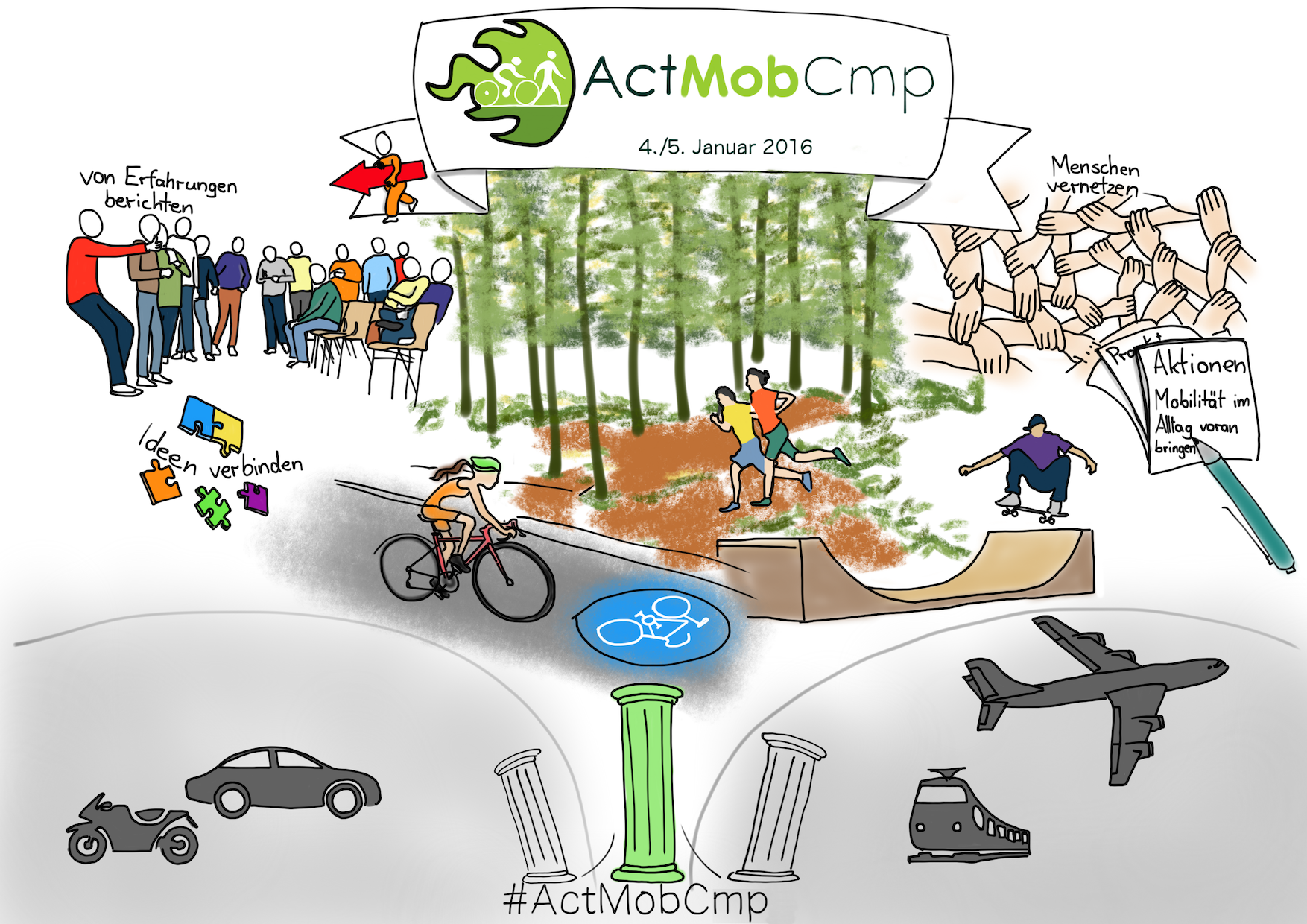
 The first “Barcamp for Active Mobility in Everyday Life” was on January, 4th and 5th, 2016 in Unterhaching. We want to make a contribution to how mobility could and/or should look in a future worth living in. We would also like to make some headway towards a social consensus about the traffic of the future. We see this as a requirement for improving the current situation. After all, there are several reasons why matters cannot continue as they are today.
So last year, around 30 persons met at the Unterhaching Barcamp under the excellent directorship of Dr. Eberhard Huber – and they all went back home very satisfied and impressed by what they had achieved after the second afternoon. Here is the Video recording by Friedrich Lehn of the event of early in 2016.
The event managers are all my friends or acquaintances. We were and are a team of persons who have been critically and in a goal-oriented way thinking about the future of mobility. We take it for granted that today’s mobility will not and cannot have a future in smart cities and in the coming digital society. We would like to see how moving under your own steam and using your own muscles is no longer dismissed as “the remaining traffic”. And we ask how this kind of mobility – why not along with public transportation? – can become an equal and better alternative to individual traffic.
Consequently, we wish to build a network of as many persons as possible who want to promote active mobility in everyday life, exchange opinions and relate experiences, develop new ideas together with others and advertise those ideas in the public domain and in politics.
Since all the parties who were involved in the first AktMobCmp early in 2016 agreed that the event should be continued, we started our second round on May, 21, 2016 in the Augsburg Zeughaus. It was organized by ünter Schütz. Now we are into round number three, which will be on January, 5th and 6th, 2017 – this time back in the Unterhaching KUBIZ. Again, we will have two days – Thursday and Friday (Twelfth Day). As before, we also plan to have a nice evening event on Thursday
 As last year, we offer three ticket price categories:
- 25 € for students and craftsmen in training,
- 50 € for all others and
- 75 € for those who would like to make a generous contribution that will ease the burden of organization.
If you want to register, all you need to do is send an email to anmeldung@actmobcmp.org. We will reply immediately. Alternatively, you can fill in the registration form (Anmeldeformular) on our AktMobCmp page. Again, your data will be transmitted to us via email and not stored on any other systems.
We are now looking for comrades in arms, partners and sponsors. Because we have great plans: perhaps we can manage to organize an exhibition of modern mobility products. We absolutely want more participants than we had last year.
You can find us at meetup, on Twitter with tag #AktMobCmp and on FaceBook. And if you have any questions or want to be part of the team, just contact me. Thanks a lot!
RMD
(Translated by EG)
Roland DürreThursday October 20th, 2016
DISTINGUISH WITHOUT SEPARATING #PMCampDOR 2016 – November, 18th and 19th, 2016
 Six years ago, the PM Camp movement started in Dornbirn. Since then, many PM Camps have been organized in many cities in Germany, Austria and Switzerland. They were all very successful, the participants were always very happy with the results and went back home knowing that they had learned to understand many new things. They also always knew that they had made new friends!
The various organizational teams of all those many PM CMs always created great topics as impulses. In Dornbirn, I remember “Humans are not Resources”, “Breaking Patterns”, in Berlin, for example “Complex versus Complicated” or “Digital in Projects”, in Stuttgart, among others: “Product as Project” and much more.
This year, the organizational team (which I am part of) of the PM-Camp Dornbirn decided to formulate:
DIFFERENTIATE WITHOUT SEPARATING!
as in impulse for the upcoming Barcamp on November, 18th and 19th, 2016. It was Stefan’s idea and I rather liked it. As I see it, this one sentence contains an important message in as little as three words. However, those three words will first need to be de-coded. Here is my attempt at doing so.
Let me first take a closer look at the term “differentiate“ and list the synonyms. Here is what you can find in thesaurus.com:
analyse · categorize · characterize · determine · differentiate · discriminate · divide · figure out · identify · know · qualify · recognize · separate · ascertain · classify· collate · decide · demarcate · diagnose · estimate · extricate · finger · individualize · judge · label · mark · name · part · pinpoint · place · select · sift · signalize · specify · spot · tag · determinate · diagnosticate · make out · mark off · set apart · set off · single out · sort out · tell apart · tell between · tell from
“Separate” is not precisely easy to define, either. Here are the synonyms you get from the same thesaurus:
break · detach · disconnect · divide · divorce · severe · come between · split up· uncombine · split · cleave · dichotomize · disentangle · disjoin · disjoint· dissect · dissever · distribute · intersect · part · rupture · sunder · uncouple · undo · break off · come apart · come away
In the thesaurus, you will also find exciting associations with both terms. I chose not to mention them, because they would have made the list even longer.
In communication, terms have a central role. As I perceive it, the synonyms of “distinguish” mostly sound positive. They often have something to do with “humanity”. As opposed to this, the synonyms of “separate” sound more negative to me, they are functional and cold at best. In a nutshell: what is meant by “distinguish” just sounds a lot better to me than “separate“.
Can it be that simple? Distinguish without separating, just because the synonyms of “distinguish” sound better than those of “separate”? For me, this fits, because I prefer thinking positive to thinking negative. And I also practice the actual achievement of living this positive way of thinking. After all, I want to be a positive person, not a negative person. If I am positive myself, I will find it much easier to be positive towards other persons. And if I have something negative inside, I get frustrated. Which will want to get out of my system. Which means others get to suffer from it.
So basically, it is very easy: you want to distinguish, rather than separate. Because we want to work together, rather than against each other. It is the only way to promote your own happiness and your own success. And only if I respect and appreciate myself, I will also be able to respect and appreciate others. Consequently, the only way to make others happier and more successful is by doing the same for myself. And then, the happiness and success of others will again feel good to me. Because we are all individualists, yet as such always “PARTS OF THE WHOLE“.
I think:
We are all different from each other. We should take this in account and appreciate it. It is nice but still it should not be a reason for moralizing, evaluating and separating. And it should certainly not be a reason to develop enmity, which can easily become destructive.
That is exactly what we want to avoid at all costs on our #PMCampDOR! As we distinguish without separating, it will turn into a really great and humane Camp! So why don’t you register and then come? I look forward to seeing you all again!
RMD
(Translated by EG)
P.S.
For more articles on “DISTINGUISHING WITHOUT SEPARATING”, see the Blog-Parade zu #PMCampDOR 2016. I truly believe it is worth browsing through.
Roland DürreWednesday October 12th, 2016
Would you like a presentation :-) ?

Together with Prof. Dr. Kathrin Möslein giving a talk in the IF-Forum.
It is one of my goals in life to share my experience and the knowledge I accumulated and that sometimes took me a huge effort acquiring with others – especially with young persons. Consequently, I often let myself be invited to present speeches and be part of dialogues – both in the classic surrounding and in the form of sessions at barcamps and similar events.
Currently, you can book me for the following topics.
On “leadership“:
What exactly is – leadership in an enterprise?
Sub-title: “People in the enterprise – it is all about culture“
A short time ago, this was presented at AMOS (Allianz) in front of more than 50 internal project managers.
On “digitalization and/or digital change“:
What is often forgotten when people talk digitalization.
Sub-title: “Potential effects on society and humans“
Or alternatively:
Digital Transformation – Paradise or Hell?
Sub-title: “The brave new world from the perspective of the entrepreneur, IT pioneer, blogger, father and biker“
I will give this presentation at the DOAG yearly conference in Nuremberg in November, as well as for an SW agency I know well during a “meet-up”.
On “SW development“:
“How we followed the principle of SCRUM in 1984 – even though at the time SCRUM did not even exist.
Sub-title: “How to lead a software team – answer: you do not lead a software team”
Given for a few smaller SW enterprises/start-ups.
On “payment“:
“We do not want to work, we want to make money!“
Sub-title: “How to be courageous and reap joy and success“.
Presentation for start-ups and freelancer. Delivered a few days ago at the PMCAMP BERLIN (a true pleasure).
These presentations are just a snapshot – as of October, 12th, 2016. Of course, the content undergoes change all the time, because matters, too, change all the time these days.
Feel free to pick one.
RMD
P.S.
My presentations are for free wherever they serve a good purpose (students, universities, non-profit associations and the like). Whenever I speak for a system that hopes for an added value through my presentation, I ask for remuneration that correlates with the expected added value.


