
Roland DürreSunday July 21st, 2013
Is There Still Hope For Us … ?
Or will we drown in stupidity …?
Due to the current state of affairs, I remembered a theatre play Norbert Weinberger and yours truly drafted and then wrote during a flight to India late in the last millennium. At the time, the two of us were going to New-Delhi flying Swiss Air from Munich via Zürich in order to visit our subsidiary enterprise. The business class seats were almost all unoccupied and several charming Swiss ladies were really interested in making us feel comfortable.
There was more than enough champagne and Norbert and I thought it might make sense to use the time in a constructive way and write a small sketch on the stupidity of late capitalism.
During that night, a short theatre play was created. It introduces simple pictures and messages, told by our fairy tale story teller (Muschka):
Two free-lance workers (Norbert and yours truly) are in a tight situation. Consequently, they sit on a draughty park bench drinking their beer. By chance, a business student (Markus) passes them. They tell him their dilemma and start a company with him. Soon, they are overjoyed by the nice yearly balance, but their financial auditor (Christian) quickly brings them back to earth. He recommends a business angel to them (Hans) whom he personally knows. Said angel immediately solves all their problems and takes them to the stock market with golden wings (on his back). The director’s personal assistant (Claudia) also rather likes the idea and serves champagne. Now the motto is to grow, which means “hire & buy”. All of a sudden, all the euphoria is gone and bad things start to happen. Mr. Buy becomes Mr. Sell (Alfred). And at the end of the story, the two friends will again sit on their park bench and drink their beer.
So much on what goes on in this very sentimental satire on New Economy by Norbert Weinberger and Roland Dürre. The play was first on stage with the managing directors and directors of the medium-sized IT companies cooperating in the IT-Treff. It was on June, 29th, 1999 in front of an audience of almost 550 at the München Schlachthof – all of whom laughed until they nearly collapsed. So this is now almost 15 years ago. But it is as explosive as it was then.
Here is the text if you wish to read it or play it yourself.
[download#11]
There is also a video tape of the play, but the quality is sub-standard. I would be glad if a group (amateurs or professionals) were to play the piece again and make a new video recording. In fact, I am prepared to support such a project and pay 1,000 € for this first staging of the play in a nice environment. Since it is short and easy to produce, it might well also serve as “preliminary” piece. Like a pre-band. Isn’t that an innovative idea?
RMD
(Translated by EG)
Roland DürreSaturday July 20th, 2013
DATA SECURITY
 Richard Gutjahr (in Twitter: @gutjahr) calls himself a journalist and blogger who is often ahead of the times.
I discovered him “online” rather early. (Unfortunately,) He often says what I feel.
The current post at gutjahrs blog is titled:
Why don’t you cypher? (Verschlüssel’ doch!)
This article motivated me to write a comment. For reasons of laziness, however, I only posted it at facebook, which basically was a bad idea. So here you get my ideas once more, including some revised notes:
We delegated the right to exercise legislative power to the state. Consequently it is the state that has a power monopoly. That is wise, but also dangerous. It gives the state immense power. If the state turns “evil” or “bad”, (which can happen any time and happens all the time), it will become our worst threat. Consequently, the “state” must be transparent and subjected to control by the citizens at all times in all (!) dimensions!
The same must be also demanded of data security. Because if the state is not a hundred per cent transparent for the citizens, doors for abuse are wide open. I cannot think of any (!) area where a federal transparency might be detrimental for the common good in a transparent society. This includes reservations with respect to safety and other often construed aspects. Paranoia will always cause more harm than good!
Consequently, the transparent society is a necessary condition for a successful “digital” society. Because a state can only be truly transparent in a transparent society. That means that “FRONTIER LAND” will need transparency as a central value on top of tolerance and respect. So we must work towards a social consensus where we call for a free, open and transparent society! That is actually what our political powers should aim at.
It is just ridiculous to call for better data security. Laws protecting data have ZERO use, but they cause a huge amount of blind work.
And you should never forget: the state holds the legislative power. And we are just witnessing how even a “still good” nation will create or change its laws as it likes or as it is useful. Not to mention an evil nation.
Let me also add that I warmly recommend you reading the gutjahrs blog!
RMD
(Translated by EG)
Roland DürreThursday July 18th, 2013
Beer & Informatics – July, 18th, 2013 -– Felix Köbler – “Crowdsourcing & RailScout”
Thursday, InterFace Event at TUM:
Technological Presentations for Computer Scientists
July, 18th, 2013 – earlier than usual: 4 p.m. at TUM!
The next presentation in our series IF Academy – Technological Presentations 2013 will be on July, 18th – as usual on a Thursday. This time, however, we will not remain in the Unterhaching InterFace building. Instead, we will go on tour with our circus and the event and Happy Hour afterwards will be at TU München in Garching. The TUM has reserved the lecture hall “Konrad Zuse” for us.
 The speaker if Felix Köbler. Felix spent a huge part of his computer science training and research at TUM.
He will tell us what totally new ways of thinking and opportunities have already been realized through the internet and the corresponding technologies – and also how it might go on from there. His topic will be:
Crowdsourcing & RailScout
An introduction and selected delicacies and crowdsourcing solutions for safe and clean railway stations.
Abstract provided by Felix:
The first part of my presentation will give you an outline of the current technological and socio-technological developments. For example the adoption and use of ubiquitous and mobile technologies which not only are immersed in our daily lives but also make totally new applications possible.
One promising and totally new application is crowdsourcing. It means the outsourcing of tasks or value-creating activities to an un-defined group of voluntary users by an enterprise or institution.
I will discuss the potential and problems of these innovative concepts using various examples beyond the widely known applications and initiatives such as Wikipedia and OpenStreetMap. One of the specialties of crowdsourcing is the extension of existing job-sharing models by the factor motivation, which is often used for applying gamification – that is the use of game elements in non-game contexts – in its socio-technological application.
The second part of my presentation will be about an actual solution and application: “RailScout”, which belongs to the area of the so-called “Mobile Crowdsourcing” as made possible by the technological development in the field of mobile end devices. “RailScout” is a smartphone application for passengers and gives them the chance to call in problems, like technological or maintenance damage and littering at railway stations and infra-structure buildings, directly to the responsible administration.
My presentation is meant to give you both the current results gained from the experiment still under way and diverse insights in to the craftsman-like process (Participatory Design/User-centered Design) and conceptual challenges in the field of gamification during the problem solution development phase.
The Speaker
Felix Köbler is a doctorial candidate at the chair for Business Informatics of Munich Technical University. He holds a B.Sc. and an M.Sc. in Information Systems/Business Informatics of Munich Technical University and studied, among other places, at Shanghai Jiao Tong University, Shanghai, China and Technical University of Tampere, Finland and University Tampere, Finland.
His research is mainly on distributed software engineering, social networking, gamification, persuasive technologies and ubiquitous and mobile computing with a strong focus on human-computer interaction. The results of his research has been published in international technological journals, such as AIS Transactions on Human-Computer Interaction and International Journal of Human-Computer Interaction (IJHCI), as well as presented on international conferences, such as the International Conference on Information Systems, European Conference on Information Systems and ACM SIGCHI Conference on Human Factors in Computing Systems.
Besides having established RailScout, he is also active in the fields of User Experience Design and strategic advice, as well as in Business Development at “FELD M” , which is a counselling company for digital marketing. Also, he works as a freelance counsellor.
Here is some information on the event series
At two-month intervals, we invite people to listen to a presentation with some technological, leader-specific or entrepreneurial topic. Our invitations go out to all interested computer scientists living in the area and, of course, especially to all our colleagues at InterFace AG.
The presentations are meant to hand on innovative knowledge and special experience from practice for practice, following the idea of craftsmanship. Our focal point and content is in the fields of programming as a German engineering feat, modern basic know-how, future-oriented technologies, insider knowledge, changes in established technologies, experience from project such as management and leadership and much more.
Usually our speakers take 30 minutes for their presentation, then you have 60 minutes for discussion. And afterwards, there will always be a “Happy Hour”.
The events take place on every third Thursday of the uneven months of the year.
RMD
(Translated by EG)
Roland Dürre
Tweets on Twittering and Blogging #176
Here are my tweets of last week on:
Blogging and Twittering, Wisdoms and Rules:
130725 What do you expect of dirt except that is smells bad? – Be careful, twitterers and bloggers! #Twitter #Blogging #Wisdom
130726 What use is the whetstone without water? – Also true for twittering and blogging? #Twitter #Blogging #Wisdom
130727 If something was costly, you will love it – also true for blogging and twittering! #Twitter #Blogging #Wisdom
130728 If something is dead, it will no longer bite – not even when blogging and twittering? #Twitter #Blogging #Wisdom
130729 What drops over the neighbour’s fence belongs to him – also true for twittering and blogging. #Twitter #Blogging #Wisdom
130730 If something comes from a dog, it is likely to bark – also true for twittering and blogging! #Twitter #Blogging #Wisdom
130731 If something comes from the hen, it will cackle – not to forget, twitterers and bloggers! #Twitter #Blogging #Wisdom
There is a new tweet each day. See twitter.com and “follow” RolandDuerre!
Enjoy!
RMD
(Translated by EG)
P.S.
I took the proverbs from Alle deutsche Sprichwörter.
Roland DürreSaturday July 13th, 2013
brand eins in July
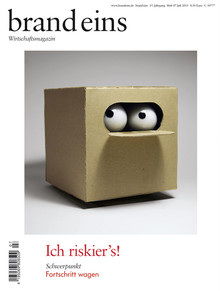
Browsing through the daily headings in newspapers and magazines, I sometimes get the unpleasant feeling that all this effort of mine is rather pointless.
Reading “braind eins”, however, is different – again. So let me say this up front: the July issue is again exceptionally innovative. In this magazine, they write about the future and it really gives you courage!
The title is “I will take the risk!“ Following this, the focal point is simply “Risking Progress”.
Then I look at what day it is today and I think what a poor soul Roland (me) is. After all, the “brand eins” has been sitting on his desk for more than two weeks and he also gave a copy to two friends already.
But still he never found time to write his “brand eins” blog article. Now isn’t that a signal that something innovative should happen? Because time is my most valuable commodity. And currently, it is a truly rare commodity.
So I will immediately start reading the magazine and only give a few short comments. As early as page 31, I find the first crack. According to a study by BDI and the Deutschen Telekom Stiftung, Switzerland is by far the most innovative country of this world!
That is easy for me to believe. After all, I attended some very nice entrepreneurial workshops at RISE (HSG) in Basel, Zürich and St. Gallen, where I made the acquaintance of a whole lot of great enterprises and entrepreneurs from Switzerland. They were all innovative and modern in a sense that made me respect them very much, indeed.
“Self-organization and self-determination in organizations and enterprises”: that is what Hans Ulrich, the founder of the St. Gallener Management Model, demanded in the 1980ies as an important requirement for a change in management.
And this is precisely what you essentially need for becoming innovative. And I ask myself: isn’t a basic democracy not at least a reasonable attempt at letting all the people of a nation organize themselves and determine their fate? If you look at it in this way, basic democracy is the catalyser for innovation, also of a nation!
As far as I am concerned, Switzerland has a very positive connotation as the country of entrepreneurs. As they say: from nothing nothing comes. I learned to appreciate both the HSG (Hochschule St. Gallen) and the ETH in Zürich. And I really salute them for the dynamics they practice. And since I believe that the quality of a university or college in one country correlates absolutely with the success of said country, good colleges are a good explanation.
At a festive event of TU München with a guest from ETH, the president of TU München, Herr Dr. Herrmann, informed us that the average amount of money spent for one student at ETH is several times as much as at TUM. I seem to recall it was a two-digit number with a 1 as the first digit. Of course, a good education and consequently good universities are fundamentally important for successful progress. But for universities, the same is true as everywhere: ”nothing goes without the funny stuff”.
I also find it good that the ETH had enough courage to remain Technische Hochschule and retain its “H” in the official name. I started studying at THM (Technische Hochschule München) in 1969 – and I was appalled when they later insisted on calling themselves Technische Universität. It would have been better if they had kept the “H” – and in exchange they could have become a little more innovative. If a façade looks nice, this does not necessarily mean the interior is also nice. Instead, it happens more and more often that all is show and no substance.
I appreciate the TUM because, by German standards, it keeps producing rather well-trained computer scientists. Also, they do give themselves a nice appearance. But who knows if it is a truly innovative university? Personally, I can think of quite a few questions to ask, because to me it looks rather bureaucratic and over-administered. Consequently, when all is said and done, most of the professors, just like at most of the German universities I know, have too little time for research and teaching and for the people affected by the change.
But then, what can you expect of a Germany where the internet is called “frontier land” by the nation’s highest and mightiest. The universities are structured like schools, the academic freedom is restricted and then everybody is surprised when even small Switzerland outruns us. On the other hand, they tell us and the entire world that we are an island of the blessed in a Europe full of misery! So is it true about all being show and no substance? How fortunate that “brand eins” exists.
I found many more positive things in the July brand eins edition. Here is another example: I was truly delighted to find my friend Günther Bonin on page 56. There is even a picture of him. The article is about how he and other persons want to free this planet’s oceans from plastic waste.
And I find it just great that something like this is written in brand eins.
Many thanks – Frau Fischer!
RMD
(Translated by EG)
P.S.
I wrote about myself as a poor soul. This reminds me of a twitter friendship with someone who called himself @ArmerKater in twitter. Later, I met him at several PM-Camps and we became friends in real life, as well.
He called himself @ArmerKater because he often despaired during his time as an employed project manager.
Now he is an entrepreneur and no longer a poor tom. And he also changed his twitter name. It would have made quite a story for the June brand eins. I am sure you remember that the title was “Mondays make me sick” …
Roland DürreThursday July 11th, 2013
Parties, Pirates and Party Programmes – Help! (II)
It still annoys me that the pirates had to drown so unnecessarily. Let me try and explain it with the following example:
In the Pirates’ Wiki, you will find a Simple Manifesto.
On January, 21st, 2013, the document looked like this:
- We Pirates take the German Constitution very seriously and want everybody to strictly abide by it (that includes the judgements of the BVerfG).
- All power in the state comes from the people. We are talking our state where we elect representatives and which we finance. We want to be extra alert when it comes to looking what they do with our money.
- Representatives represent the entire population and have to answer only to their conscience.
- Digital technology and the internet have caused a massive cultural change. The only thing it can be compared to is the invention of the printing press. We want to accompany our country, our EU, our world on its way towards this change with a critical and creative eye.
- 0 and 1, along with all data composed with them, belong to the entire humanity.
- We want to make a secure existence and social participation legally possible for all people.
- We Pirates want a sustainable treatment of our environment.
- Drug Politics: the Pirates follow a drug prevention policy that is based on scientific facts.
Basically, all of this sounds quite well. And it is certainly a lot better than all those long-winded “programs” the other parties have written.
The sad news, however, is that until today (July, 11th, 2013) nothing whatsoever was modified in this text. Even though the author posted it on the Pirate Wiki for discussion. And even though modifications would have been highly advisable on all points…
Because if you read with a focus on precision, the formulations actually hurt. Regardless of the fact that quite a lot of good stuff could have come from them. In fact, you could have discussed every individual item and then developed a clear statement.
Here is an example:
Representatives represent the entire population and have to answer only to their conscience.
That sounds great – but it is a total catastrophe. Dialectically spoken, it is nonsense. How can a representative represent the entire population? And: not the people have to answer to their conscience, but their behaviour.
Now my criticism might sound extra pedantic to some. But that is not what it is. Because treating language with the highest possible diligence is a necessary requirement for finding a social consensus – i.e. god political work – in a morally acceptable way.
Stating that representatives are “answerable only to their conscience” makes it a lot worse. People like Hitler and Stalin followed their conscience when they committed all those atrocities. The terrorists who are such a threat to us follow their conscience when they commit their atrocities. A father who beats his child because he believes beating a child is necessary, even though it hurts him more than the child, follows his conscience. A mother who makes her children look small very often follows her conscience.
Consequently, all these people would be good representatives in this sense. After all, they followed their conscience. It is just tough luck that their conscience ignored the shared values of humanity.
I believe I can guess at what message the sentence is meant to convey and what the Pirates (or the one Pirate) wanted to say. Maybe you could say it as follows:
Representatives should follow their behaviourally motivated values autonomously and steadfastly! Because they are elected for what they said in this context. Consequently, they have to be autonomous and refuse squad belief. They must be immune to lobbyism and all kinds of temptations. And the values behind their behaviour must be compatible with the “social consensus” of all humanity.
This is how the Pirates might, for instance, have improved on their manifesto in every topic through an upright and domination-free discourse. And in doing so, they would have had a chance to rub against each other to their liking and goal-oriented while discussing not always trivial content. In this way, they could have found out what is right or wrong, good or bad.
What a great chance that would have been! But no – the Pirates followed the stupidity of other parties and gave themselves a program! And, of course, they get their reward – when it comes to election time. Because in our new world, emancipated citizens want values underlying your behaviour, along with people who remain true to their values. Instead of programs! Because nobody wants dogmatic programs (probably with good reason). After all, decisions will always depend on the context of the time. Consequently, it is unpredictable what future decisions will be right and good. How, then, is anybody supposed to write a reasonable program?
But you can get to the roots of your values and make them your behavioural maxime. And then you can ask questions about your own convictions. And I feel definitely more at home among people who try to gain insight in an ethical and enlightened way than among politicians who dogmatize through their own life program.
The Pirates have missed their historical chance. And, politically spoken, we regressed several decades and will have to start all over again. What a pity!
RMD
(Translated by EG)
Roland Dürre
Tweets on Twittering and Blogging #175
Here are my tweets of last week on:
Blogging and Twittering, Wisdoms and Rules:
130718 If something is rubbish, even paying nothing for it is paying too much – a rule also for twittering and blogging! #Twitter #Blogging #Wisdom
130719 If something is good, everybody will like it – also when twittering and blogging? #Twitter #Blogging #Wisdom
130720 If a deed is evil, it is not nice to talk about it, either – also true for blogging and twittering! #Twitter #Blogging #Wisdom
130721 Something that comes in quickly will also leave quickly – also true for blogging and twittering? #Twitter #Blogging #Wisdom
130722 Lovers like to tease each other – it also happens among twitterers and bloggers. #Twitter #Blogging #Wisdom
130723 If you want a solution without torment, first wait for things to ferment – also true for twittering and blogging! #Twitter #Blogging #Wisdom
130724 What good is a mirror for the blind? – not to forget, twitterers and bloggers! #Twitter #Blogging #Wisdom
There is a new tweet each day. See twitter.com and “follow” RolandDuerre!
Enjoy!
RMD
(Translated by EG)
P.S.
I took the proverbs from Alle deutsche Sprichwörter.
Roland DürreTuesday July 9th, 2013
Art and InterFace …
A software solution provided by InterFace was rather helpful for the media artist Wolf Nkole Helzle when he did his project “Homo universalis”. Wolf Helzle first tested said software during our technological IF Forum “Craftsmanship” on June, 13th. If you want to see the results, including a brief introduction, just click on Video. Now the software made its first big appearance in Münsingen. And our system worked just fine!
Here is the press release written by the artist after his project was finished:
P R E S S R E L E A S E
HOMO UNIVERSALIS – the face of the bio-spherical area is available!
Media artist Wolf Nkole Helzle used the portraits of 1,000 visitors for his project „Homo universalis“ during the INTERIM Biennale at the Altes Lager Münsingen.
The artistic event right in the middle of the bio-spherical area “Schwäbische Alb” lasted 16 days and the temporary studio of Wolf Nkole Helzle was open daily from 11.00 to 18.00 hours. Every evening, he did the computing with software specially designed for the purpose in order to find out what the current state of affairs with the portrait was.
Those 16 days were filled with exciting discussions about human nature between individuality and collectivism, between individual image and the total concept. There were many questions and assumptions about how the final picture was to be generated, about the prevailing significant characteristics, about the face and age of this bio-spherical creature, about the percentage of those wearing spectacles and why people were so open and friendly with him.
First and foremost, Helzle took individual photographic portraits of 1,000 visitors. They were all directly printed. After having been signed and numbered, the portraits were given to the persons shown on the pictures. They were of all age groups. Copies of all photos were also pinned to the wall of the interim studio, which filled up as time went by, giving an overview both of the visitors and the parties involved with the final portrait at equal parts.
The software specially designed for this project by InterFace AG of Unterhaching near Munich will now make it possible for the internationally active artist to unite entire regions with hundreds or thousands of persons in one face.
You can buy the face of the bio-spherical area in various formats (www.helzle.com).
Münsingen, July, 8th, 2013
Social Media Art Wolf Nkole Helzle
Schloßberg 1 D-72525 Münsingen
fon_+49 7384 959 72 89
mobil_+49 170-188 71 40
mail@helzle.com
www.helzle.com
www.interactive-image.org

On this picture, you see the installation of the Homo universalis in building BT23 of the Altes Lager with the individual portraits and projected final portrait (photo by Luca Siermann)

Helzle´s interim studio during the Biennale (photo by Claudio Hils)

“Homo universalis – we give a face to the bio-spherical area”
by Wolf Nkole Helzle, 2013
RMD
Roland DürreSunday July 7th, 2013
(Deutsch) Industrie 4.0
Roland DürreSaturday July 6th, 2013
If You Do Not Cooperate, You Will Be Given Notice. Is that Easier Said than Done?
Here is another one of those dialogues that made me thoughtful… And, again, Stefan created waves by throwing a pebble into the water. Said waves eventually also reached me, which caused this dialogue and article. It all started with:
Everything is dependent on cooperation: how to organize cooperation! › Hagen Management GmbH, Dornbirn
(Auf die Kooperation kommt es an: Zusammenarbeit organisieren! › Hagen Management GmbH, Dornbirn)
Stefan wrote:
In his latest book “leading radically”, top author Reinhard K. Sprenger says that leaders should use all means to make sure the “cooperation priority” is realized. …
(maybe you want to read the entire article?).
I replied – perhaps a little rashly:
If someone formulates an ultimatum “if you do not cooperate, you will be given notice”, then this virtually tells you he is unfit to do the job …
You could just as well write: “we know what is right and what is wrong and those who cannot agree will be given notice!”
And that is when you can kiss civil courage good-bye!
Of course, Stefan replied:
To be sure, the sentence is provocatively formulated. In order to avoid misunderstandings, however, let me add a few ideas:
a) It does NOT mean that we need people who say “yes” to everything in an organization.
b) Instead, it means that we need a constructive argumentative culture in organizations.
c) It does NOT mean that controversial opinions will be fought against.
d) Instead, it means that people who are apparently neither capable nor willing to cooperate have no business remaining in an organization.
After all, if you are a radical solo-player, you are welcome to practice your potential as an individual entrepreneur. On the other hand, organizations depend on competent persons who are willing to learn and to offer their competence in the interest of a common cause. This is the only way how TEAM work can succeed. And that is actually what matters, both now and in the future.
Roland, do you disagree? If so, then I am very much looking forward to your next comment …
Of course, I did not disagree. But still, I had to reply:
Hi Stefan, I totally agree with what you said in a) to d). The same is true for the rest. I am certainly one of the people who acted rigorously in these kinds of situations by removing people from a team or giving them notice. Some of my decisions in this context were definitely “isolated” and not at all easy. And – luckily mostly only initially – these decisions also caused irritations and were met with little understanding, even among the other team members.
However, I also had or saw negative developments in teams. Consequently, my worries are situated in the border area which probably will always exist when you have lateral thinkers and “people who object”.
Ironically, it only got clear to me through the conservative politician Klaus Töpfer how important the community of “people who object” and the “culture of objection” are! Personally, I was far too quick to condemn all those people who opposed or actively fought against windmills or electricity grids. Basically, I always assumed they were acting according to the Saint-Florian principle (dear saint, spare my house, ignite that of someone else).
Now, however, I think I understand the huge if not irreplaceable value this “culture of opposition” and particularly the lateral thinkers can have.
One of the reasons is that there will always be a latent tendency of organizations and systems towards fascist structures. And it happened frequently that those who “objected” and were lateral thinkers were quickly defamed as being those who – as you yourself write – were “apparently not capable or willing to cooperate” and were “not pulling at the same string”, thus jeopardizing the great national (or entrepreneurial) goal.
As I see it, the danger to fall victim to this is particularly strong if you work with great enthusiasm for something you personally consider extremely important and can also easily justify, which makes it look totally legitimate. I very much appreciate it if someone is enthusiastic in everything he or she does. But it opens the path towards getting angry with inconvenient disturbances, which will make you irrational and you might start defaming others.
Conclusion:
Basically, I wholeheartedly back the demand you formulated; the only reservations I have are that one should be aware of the ever-present danger of a creeping appearance of – well, I will write the evil word: – fascist tendencies in organizations/social systems. Using that concept, even “good” people who disagree and lateral thinkers can be silenced in the interest of “the higher goal” or even “the bigger interest”. And I recommend that declarations using these kinds of terms should always be questioned with an extra critical eye …
When all is said and done, it is probably always a question of who decides what exactly our “shared, higher goals” are. And this is when, as I see it, even good democratic structures fall far short.
Perhaps this is the problem with trying to find the synthesis between individuality and collectivism we as humans are constantly facing.
Sorry for my long answer …
Here is something to make you smile:
When I was young, I frequently heard:
“If you do not like it here, why don’t you go and live in the Soviet Zone?”
And in retrospect, I have to say that exactly the things I and my friends found disagreeable at the time are those things that make me realize today that we were absolutely correct in disagreeing.
“You had to wait a mere half century, and already you can see the consequences …”
Since the topic will not let me rest.
Here are a few more ideas!
Probably the weak link is the “collective goal”. For me, team work has a very positive connotation. I like working in a team and I believe it matches our needs. We humans are social creatures. And in order to have “good team work”, you doubtless sometimes have to decide and realize “hard steps”.
Still, the “collective higher goal” remains a problem. If we are talking a good goal, there are basically no objections. But what happens if the goal turns into an end in itself? Or if it gets so important that all means seem to justify the end? Or if a good goal suddenly turns into a bad goal, for whatever reason?
A “healthy goal” can also become an “unhealthy goal” without itself undergoing change. Just because the entire world undergoes a change (in values) or because the frame conditions are differently perceived.
And if then the team is “trained too well”, the “inner immune system” – which might have functioned if precisely those “scaremongers and defeatists” were still on board – can be missing.
Because then the team “crowd” will have to save the situation – and woe if now the “evil ones” are absent.
Maybe I will try and dedicate an entire article or a barcamp session to this topic. Regardless of the fact that I failed with these kinds of ideas in discussions with certainly very wise and good persons in the past. I remember my comment against a strongly goal-oriented project organisation free from a strong and critical reflection of the project goal that from my point of view seemed harmless but very important causing dismay in my discussion partner. Eventually, it led to him believing I was personally accusing him of something nasty.
Basically, I was just trying to make it clear that collective goals might easily turn foul. And I mean in little slices and in a way that makes it hard (or impossible) for the “agents” to realize what is happening. And if such a situation arises and you removed the (perhaps only so-called) “consequent lone warriors” before, keeping only the perhaps equally so-called “competent persons who are willing to learn and prepared to dedicate their competence to a shared and higher goal”, then it might happen that the inner immune system of such a team against abusive requirements or even fascist developments weakens.
So:
I believe that the pariahs of a team as described above might well be quite important for the team, even if they are perceived as “a-social stinky sourpusses” who are nothing but a burden to the team.
But perhaps I am suffering from some paranoia when it comes to over-harmonious teams and fascist systems because inside me, the individualist part is very scared of the collective force.
But this would lead towards the topic “healthy autonomy”, which is an extra chapter. Well, all those were my complex reasons for criticizing a basically totally correct idea.
RMD
(Translated by EG)


