
Roland DürreThursday September 18th, 2014
Start-up (9) – Making Use of the Wisdom of the Masses?
I would like to encourage start-ups to open up, but at the same time I would like to warn against small-mindedness and insular thinking. So here is what I would like to say:
Diversity beats simple-mindedness!
Be careful not to become isolated, because it is quite easy to go down a wrong path following an idea and then turn dogmatic idealist. And then you can easily earn the reputation of being a nutcase.
Be open!
Establish a founders’ blog and twitter about your enterprise! Share your experience with many. In return, you will receive lots of precious knowledge and a whole treasure of experiences.
Put trust before secrecy!
Mostly, your ideas will not be all that unique. There are many out there who have similar ideas and would like to share their knowledge with you.
No patents!
It is better to lay open your discoveries early on. Then others cannot have them patented and many potential enemies will no longer be interested. In fact, patents will often cause you a lot of trouble and when all is said and done they do not really help, because the powerful will ignore them, anyway.
Crowd-Funding
Might well be the best way to get hold of some money (and important insight).
Association
Legally, you do not always have to be an incorporated company or a limited liability company. There are other models, too, which can be quite goal-oriented.
Common Welfare
Start early thinking about whether your product might answer to the requirements of a Common Welfare Business . If it does, you might gain sympathizers and comrades-in-arms.
It is all about understanding the future. That is a difficult task, and it is easier if you combine forces.
RMD
(Translated by EG)
Roland DürreTuesday September 16th, 2014
Beyond (Project) Management
In his blog “führung-erfahren”, Marcus Raitner officially invites everybody to participate in a blog parade on “Beyond Project Management”.
The orga team of the Dornbirn PM Camp made “Beyond Project Management” their motto for the 2014 Dornbirn PM Camp. Incidentally, the orga team of the Dornbirn PM Camp is identical with the PM camp core team that started the entire PM Camp movement. We in the team thought it was a good idea to initiate such a blog parade, quasi as a preparation for the PM Camp. And thanks to Marcus, someone did all the work involved.
First and foremost, I wish to point out that our motto is not meant to be some catch phrase and consequently it is not supposed to have advertising value. A grass root movement such as PM Camp does not need advertising. After all, it is supported by persons who come voluntarily.
And the typical “PM Camp attendant” is an autonomous person who will not easily let himself or herself be influenced by buzzwords and marketing promises.
Consequently, we ask all the “participants” to view the three words “beyond project management” in a very objective and matter-of-fact way. They are supposed to remind us that we can and must look beyond our own horizons and to invite us to also “take a look at the insides of the brains of others” once in a while. As a general rule, this is something I would find more than desirable. In fact, I feel it might help to develop a little more tolerance, thus counteracting the intolerance as it is lived in our society and, as I see it, in all social systems due to collective constructs.
{Before I start with my actual article on the blog parade, here comes my first deviation from the topic}
I rather liked this motto. After all, it reminded me of a very big event organized by the very big US ACM (Association for Computing Machinery) in March of 1997. At the time, the association celebrated its fiftieth birthday, which means it was founded in 1947.
Said birthday was celebrated with a gigantic event. The motto was:
Beyond Calculation:
The Next Fifty Years of Computing
Here is what it says in the book with the same, which contains the presentations of the conference:
In March 1997, the Association for Computing Machinery celebrated the fiftieth anniversary of the electronic computer. To understand what an extraordinary fifty years the computer has had, you need only look around you–probably no farther than your desk. Computers are everywhere: in our cars, our homes, our supermarkets, at the phone company office, and at your local hospital. But as the contributors to this volume make clear, the scientific, social and economic impact of computers is only beginning to be felt. These sixteen invited essays on the future of computing take on a dazzling variety of topics, with opinions from such experts as Gordon Bell, Sherry Turkle, Edsger W. Dijkstra, Paul Abraham, Donald Norman, Franz Alt, and David Gelernter. This brilliantly eclectic collection, commissioned to celebrate a major milestone in an ongoing technological revolution, and now in its second printing, will fascinate anybody with an interest in computers and where they’re taking us.
Remarkable:
Among the invited speakers of the ACM event were the “most elevated and famous computer scientists alive tody”. But along with the computer scientists, they also had invited famous authors from the science fiction genre!
For me, this calls for a mental extension of our #pmcampdor motto by following the ACM and saying:
Beyond Project Managing:
The Next Fifty Years of Managing
{End of the first deviation from the topic and beginning of the second deviation, this time about terminology}
Before contemplating “Beyond Project Management”, I want to take a closer look at the term itself. As to the words Project and Management, you will know that I already wrote several articles about those in the IF Blog Entrepreneur’s Diary (Unternehmertagebuch).
Consequently, it is about time for us to look at the word “beyond”. Let me just insert a copy from “dict.cc” at this place:
| beyond {adv} {prep} |
2626
|
  |
|
|
beyond {prep} [outside] |
933
|
|
|
beyond {adv} |
529
|
|
|
beyond {adv} |
436
|
|
|
beyond {prep} [above] |
223
|
|
|
beyond {adv} | darüber hinaus | |
|
beyond {adv} | in Übersee | |
|
beyond {adv} | auf der anderen Seite | |
|
beyond {prep} [in addition to] | zusätzlich zu | |
|
beyond sth. | über etw. hinaus |
As you can see, translating these kinds of words from German into English gives you a wide range of potential meanings and associations.
{End of second deviation from the topic and start of the actual article about the blog parade. Now we are really into it!}
Beyond Project Managing:
The Next Fifty Years of Managing
I choose the meaning of “beyond” as in “on the other side of today”. So my article is meant to be a contribution to the discussion about what the future may look like – for instance in fifty years.
And looking at our suffering and tormented planet, it seems like fifty years might be a very long time, indeed. Much has to happen, because fifty years from now, matters might look rather bad, both here on this planet and for all of us individually.
For instance, I have a clear opinion about the collective and individual future of projects and the people involved therein:
The future of our society (collectively)!
First and foremost:
I no longer believe in projects that follow the “old” rules of the industrial era.
Just name me one non-trivial project anywhere on the world during the last few years which actually finished within the given time and cost limits. This goes for both the technological and social sectors. Even if you find “successful” projects by this definition, you will soon discover that they only were a success due to a huge amount of coincidence and/or due to a development that could not have been predicted in the way it happened and that led to the surprising success. They were simply lucky. Except that you cannot organize (and plan) good luck in a project.
When I say failed projects, I do not just mean the often mentioned big ones such as the Berlin Airport, the European Galileo or S21. No: I see so many small projects that are not doing any better either.
And I conclude that the ancient concepts and methods our fathers (and grandfathers) used will no longer work. They fail on a small scale and, of course, also on a huge scale.The challenges, however, which we are confronted with on this planet increase all the time.
How are we supposed to minimize the increased carbon dioxide production?
How are we supposed to reduce plastic waste or even to get it out of our oceans?
How are we supposed to create peace in this world?
All these are examples for challenges which cannot be solved by a project approach – which means they cannot be solved by project management.
How is a system and a “team” born from the system, such as for instance the EU commissars, supposed to even find an approximation for the “right project goals”? Can we expect prudent “management” as early as when the initial questions start to be asked?
Do not forget that, in the old project world, there are always also just a few persons (or often only one person with a “rod”) who determine the projects and give the orders.
Both collectively and in our social systems (enterprises, too, are social systems – they have the economic purpose of producing goods or offering service), projects defined from “above” and then controlled by project technocrats will not help us through the next few years. Consequently, we will need other solution strategies for the future – beyond the world of projects.
And, of course, it would be untruthful for me to write down the solution here and now. After all, I cannot know it, can I? Today, nobody can probably know how it might work and how it will be. All I seem to see is how it will definitely not work – which is why I dare to predict:
In the future, the classic project concept will no longer be a promising model for successfully realizing important enterprises. Relevant and constructive change will only work through evolution based on the “inter-connected wisdom of many” (and it probably already does so today):
For instance, how can you establish a consensus about where you all together want to and have to go in a large group? How can you come to a mutual decision about what you want to achieve in a widespread group? How to manage lived and intended unity? How can you make all “participants” willingly contribute towards the “shared goal” in a concentrated way or/and how can you make them do without things they thought were important in the past?
Perhaps our PM Camp can show a way towards finding first answers for an “about face”?
In the future, classic project management, both on a huge and a small scale, will be more and more about initiating legislation, proclaiming regulations, state sanctions and perhaps re-distribute resources. We cannot expect it to do more than that.
Yet we “passively” need to change our lifestyles and “actively” our shared activities in collaboration with many.
It is about time that we threw the idea (which was conceived during the industrial revolution, then established during the last century and is no longer justifiable) that the future is predictable and can be controlled over board as fast as possible. And hence we should do the same with projects in the classical sense.
The alternative to a common “about face” is probably some sort of (world) government which assigns us all to its huge projects (welcome NSA) reasoning that this is how they are saving us. Such a system would probably become independent of its own original purpose and develop fascist tendencies while the system agents would justify this development with “honourable” motives (saving the environment) or necessity (human survival or whatever).
This is not a scenario we – and in particular I – would be in favour of. Consequently, we have to solve the problems of the future in a new way – and project studies are probably the least appropriate of all possible means towards that end.
Incidentally, we are no longer even capable of defining the necessary “projects”. How to define social projects? How should a project look if it is meant to create social consensus? How to realize social consensus in a classic project?
And what is worse: even the structures and coordinates which are the requirements of the project concept disappear more and more often. And I am not just talking the big wide world, but also enterprises and social systems of all dimensions.
Consequently, we have to find something new. And we have to try it out both on a small and a large scale. And we have to improve on it all the time – by practice and learning. And maybe, for starters, we should think beyond the fringe of our own hat of collective system constructs!
The future of a person (individually)!
Let us assume that we and our descendants will continue to live in a developed society as it is today assumed to be a matter of course (although that is not what it is). But as of now (?), this is still the case, at least in Central Europe. Let us assume that our descendants, too, along with us, will remain untouched by the threats of hunger, thirst, poverty and, above all, that we can continue to live in peace.
Let us also assume that we will manage to support the lives of our children and grandchildren by an enlightened, violence-free and understanding education, “upbringing” and supervision in the future.
Then it might and should just be possible that most of the people in the next generation are willing and capable of leading their own lives as autonomous persons and thus can act self-responsibly and in ethic responsibility for their neighbours and their social systems.
Then these persons will be fed up with living and working in a Taylorist, deterministically controlled and hierarchically organized world. They will also refuse to single-handedly take responsibility for others and then be responsible (!). Also, they will not feel like working in a hierarchical team of “project leaders” (project functionaries).
Instead, it will be very important for them to have all important decisions originate with the aforementioned “wisdom of many” and thus also in the responsibility of and supported by all parties concerned.
Especially with young people, I witness this more and more often. Even today, respect, honour, appreciation, trust, symmetry and eye-level are extremely important for them. They no longer feel like spending their precious time (the currency of the future in developed societies) outside such worlds. And consequently, they will no longer be prepared to enter into the classical project world. Because they will prefer to work self-determinedly and at eye-level with other persons – for a goal they mutually agreed upon to be important and right.
As you can see, the “future of projects” depends on which concept of humanity we base it on for future generations.
It is my personal concept of humanity that our descendants wish to be “free” in the sense of self-responsibility.
Projects would only have a future if people were to reject this kind of freedom. And that is something I would find fatal.
RMD
(Translated by EG)
Roland DürreSunday September 14th, 2014
brand eins in August and September
In August, I worked too much – unfortunately, it was totally controlled from the outside. And then I went on a long and nice vacation. My “brand eins” travelled with me, but it did not have a very high priority, because enjoying the day, swimming, riding my bike, eating well – in short: to love and live – was more important.
Currently, I am still looking at too much work. Consequently, I intend to go on another vacation in September. Still, you simply have to read the September “brand eins” edition. Regardless of all the other burdens and stress you have. As usual, I also already let some other people, whose trips by public transport were made more attractive by it, have it. These persons, too, were thrilled
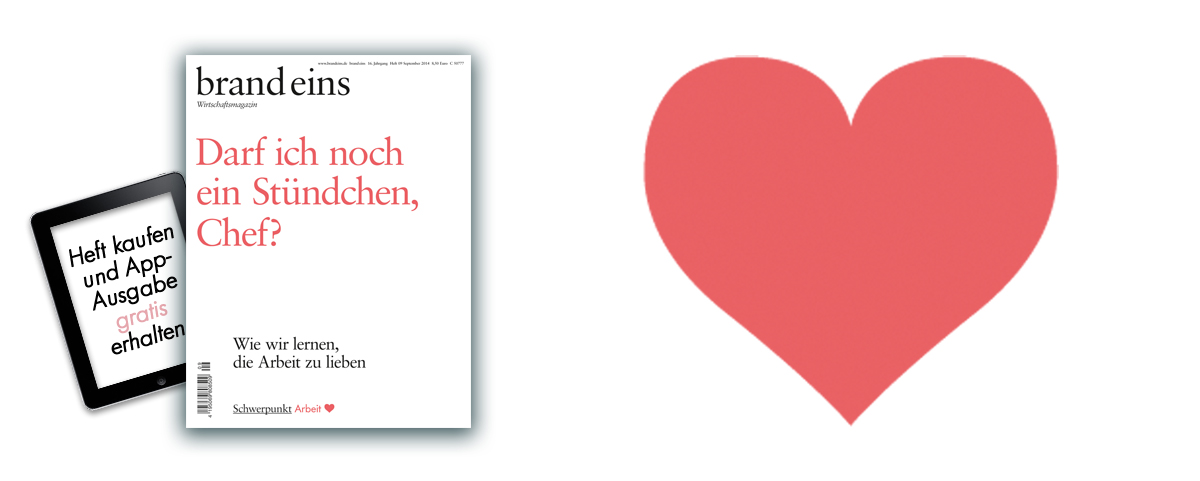
May I Stay Another Hour, Boss?
Underneath, you will read: how we learn to love our work and the focal point in red with the heart says:
Work♥
About the magazine: it is an edition with heart. On the white September “brand eins”, you will find a sentence in huge lettering.
Well, basically, it is almost embarrassing for me to praise the “brand eins”. Consequently, I hereby admit that the August edition did not really make me jump in the air with enthusiasm. The September edition, however, is back with all the virtues I so much like about the “brand eins” – and which, regardless of all the high gloss and other publications on and around the topic of business, I actually more than miss.
The important and right themes on the topic of work and cooperation are hit and several inconsistencies are pointed out. I keep finding heretical and revolutionary ideas which clearly question the “established opinions” and the bourgeois self-perception of “this is how you want to do it”.
And it is totally authentic and far from the common (more or less outdated) gossip and chit-chat. Well, this definitely feels nice.
Late in November, I will be in Stuttgart to attend the EnjoyWorkCamp. And I would recommend to Franziska (she organizes the whole event) to send all the attendants the current “brand eins” edition as a preparatory reader.
May I Stay Another Hour, Boss – brand eins online
RMD
(Translated by EG)
Roland DürreSaturday September 13th, 2014
Start Up (8) – Learning About the Market!
If you start in a market you do not know anything about, you must have really strong reasons. Especially if you selected a market where many contestants have already established their positions or if the market is generally perceived as basically dead.
Unfortunately, this is exactly what many founders do. Sometimes the reason is probably their inexperience and because they do not know how complex such a market is. Perhaps they also do it because they want to emulate famous idols, like Steve Jobs. He shattered the market of classic mobile phones with his i-phone.
At the time, the “other Steve” (Mr. Ballmer of Microsoft) provocatively said something cynical that did not at all sound so very unreasonable to me: “What does Apple want with a device on the cell-phone market that does not even have keys and with which you cannot even call someone?”. Well, Steve Jobs simply ignored this and was proved correct.
I think this is not the common business rule. In fact, it is a rather special case. Consequently, if you are a “normal founder”, you should take a really close look at the market. It is just too daring to start on a market you, as a young university graduate, cannot really know. You should at least know it a little bit.
This means you have to learn and work towards understanding your target market. Regardless of all enthusiasm and euphoria, you usually cannot be a success unless you learned the market in your target segment and understand its workings. There is no other way of being able to judge if your own idea actually has a chance of survival. More often than not, it is still rather unfinished and, like a rock in the river as it makes its way down the stream, receives its final polish before it will become one or several nice round pebbles.
The best solution when it comes to “learning about the market” is trying it yourself! But this will cost time and energy. There can be setbacks and disappointments, all of which you will have to be able to tolerate.
Learning, too, is expensive and costs energy! You can often learn more comfortably “sponsored by others”, for instance as an employee. And unfortunately, the proverb about “learning years not being master years” is also true when you found a company and learn a market.
Consequently, my recommendation to founders of a start-up enterprise might be “Spend some time as employees in your target area. And when the moment comes and you feel you have learned enough, get under way!”
In retrospective, I must say that I, too, did exactly this. I learned all the technology and competence about projects at Siemens – and I learned how to do business at Softlab.
RMD
(Translated by EG)
Detlev Six
Are We All Sea Squirts?
A sea squirt is an ocean dweller which, as soon as it has found a suitable location for ageing, will no longer move for its entire life. And since brains are only in your way if you stay in one place, it simply eats its brains.
Is the IS fighter a sea squirt?
Can any brains be more superfluous than those that have not changed in 1,400 years?
Is Putin a sea squirt?
Well, perhaps not. To be sure, he firmly believes in one people, one nation and power, but at the same time, he moves rather successfully in our brains and manipulates our moral lines.
Are we in the west sea squirts?
Unfortunately, yes. We cemented our universal values into human rights and now we are surprised that we remain sitting on them all by ourselves because they are not in demand.
The others do not even consider thinking in the same way we do. And we, too, have not always thought in this way. For instance during the thirty years war or under the Nazis who, less than 70 years ago, did exactly what the IS is doing now – including the rituals and power play.
Universal thinking might well be provincial – if those who practice it think they are unique. We should immediately stop lamenting about the brutality of the others not at all being in accordance with our own values. Instead, we should deal with the values of the others.
And how we could break them.
Without constantly citing our bible, the human rights bill. We have to confront the fact that some use words as a basis for arguments while others use rifles.
In short:
We have to learn how to deal with the fact that we do not have a value monopole. If you want to study strategic morals, you have to enter the brains of the others. Yet you should not make the mistake of confusing the empathy of like-minded persons with the dispute among those who think differently.
So here is what you should do tonight: leave your own brains for ten minutes and enter the brains of a strange, inimical person.
Otherwise, you will get a smack on the brains from me.
SIX
(Translated by EG)
Roland DürreSaturday September 6th, 2014
Start Up (7) – Business Decisions – Betting on the Future!?
Well – if you are perfectly honest, you must admit that business decisions, in particular, are always betting on the future!
After all: all decisions have a factor of uncertainty. And they must be relevant. This is the very definition of a decision. Consequently, every business decision, including the founding of an enterprise, is a bet. Basically, the founder of an enterprise bets on how his development will be judged on a huge market.
True entrepreneurs will bet with their own money. They put their own work, their own capital and their own knowledge into the scale. Once in a while, they will also bet for their existence – and occasionally they lose the bet.
For managers who have been employed (such as the directors of DAX enterprises), it is a bit easier – they bet with other people’s money. This might well work – as long as they remain “upright merchants”. Except that is what they forget too often. Would you like me to give you a few names?
Why don’t we start a brain game and bet on a beautiful business: soccer? Who is going to be German Champion in 2014/2015. We will probably win if we say FC Bayern.
Now let us make it harder. Let us bet on what the statistics will say at the end of the season. Or maybe the results of individual match days, the goal shooters, how the actual matches will be played…
🙂 And I bet that almost all bets will be wrong.
Now you will protest: stop, because we spectators cannot do anything about it. Whereas an entrepreneur can influence procedures and shape his company.
OK, so let us do the same betting again. Now you are no longer just spectators, but players. Imagine you as a team of founders are both the players and coaches of a league team. And I will leave it simple: You will only have to bet on your own matches, that is: those where your own players are active. Well, that should work, shouldn’t it? Except…?
How much influence do you actually have – both in life and in soccer? Can you really influence the bets and along with them the decisions? As you can see, this stupid betting on the future is all but a guarantee for success.
Consequently, here is what I recommend:
If you are a start-up, don’t start with the very big bets. Instead, start small. As I always repeat: totally agile. In this way, you will develop a chain of small “dynamic bets” and will always just bet on the next step ahead.
Now you might reply: but there are the huge successes we get to read about every day. Did not someone bet well there?
Actually: one will always bet correctly. He is the winner.
Like in the SpVgg Unterhaching “VIP Lounge”. I have been watching the lottery there for years. The guests, and I gladly count myself one of them, bet on the results of the day.
And although there are nowhere near as many participants as probably with the FC Bayern, I remember only once that the betting contest had no winner. That was years ago in the second league – and at the time the SpVgg won 7:0 against Saarbrücken. Yet, the poor Hachingers still had to leave the league at the end of the season.
As I said: one will always be the winner. And “The winner takes it all”. But how many play and how many win!?
RMD
(Translated by EG)
Roland DürreFriday September 5th, 2014
Another Barcamp – EnjoyWorkCamp!
I like Barcamps. In particular, of course, I like the PM Camp. After all, I was part of those who first initiated it. However, there are others, too – for example the OpenUpCamp. At one time, I also attended one of those. Now I found a very special Barcamp – and I will also attend it. It is the EnjoyWorkCamp.
Franziska Köppe is the founder of the EnjoyWorkCamp. This year, it will be held between November, 14th and 15th in Stuttgart. Here is what Franziska writes about it:
Where you find joy, enthusiasm and conviction, you will almost automatically get success. We all long to do something meaningful. As entrepreneurs, we strive at being economically successful, socially responsible and honourable. We want to preserve both our environment and nature. In our daily work, there are always small and big changes which sometimes have immense consequences for us and our surroundings. It is all not quite as easy as it looks. After all, there are many questions:
- How high is our own value and how can we build value-oriented offers on it?
- What will self-responsibility of our employees gain us and how to manage good team work?
- Isn’t every company and every employment a rat race?
- How to design an environment where people enjoy working?
- What tools, architecture, infra-structure, mobility, processes, culture… would be suitable?
- How can I promote common well-being in my personal surroundings?
- How to create space for myself (time and money) in order to be able to actively shape the future?
How often did we attend a conference in order to get answers to just those questions, and then the answers were found during the coffee break discussions?
So far Franziska. I will go there because I assume that the EnjoyWorkCamp – just like the PM Camp – will offer a chance to exchange of experience at eye-level. I look forward to discussing solutions around social, economic and ecologic aspects of future-oriented business models with entrepreneurs and leaders of small, medium-sized and also big enterprises.
For me, it is important that the program will be shaped by the participants themselves – which means that I can also take care of my own needs. And, in particular, I look forward to again meeting some very good friends who have already registered. Together, we want to start getting active and support each other.
Here is more information: Unkonferenz and News und Presse.
The vision of EnjoyWorkCamp is:
Common welfare, the quality of life and how to enjoy your work!
Well, this is another reason for me to attend.
RMD
(Translated by EG)
Roland DürreSunday August 31st, 2014
Start-up (6) – Founders Need Goals?
Columbus had a goal. And some modern knowledge. He decided to assume the earth was a ball. Consequently, he reasoned that there must be a way to India sailing west on water. That would definitely have been a huge advantage, because it would have saved all ships the unpleasant and time-consuming way around Africa.
🙂 Well, as we all know, the Suez Canal did not yet exist at the time.
But then he discovered America and – in accordance with his idea – called the people he found Indians.
🙂 However, the Panama Canal did not exist either, which means that the way to India via the new America would have been even longer.
Basically, we can say that Columbus was way off his mark …
And yet he became a famous man. Some say he changed the world. This is not what I believe: I am sure another sailor would have had the same idea a few years later, which would then have led to the discovery of the new continent. But perhaps such a different sailor would have realized a little earlier that his assumption was wrong and then the Indians would not be called Indians.
It must be the goal of an enterprise to develop business. But then, this is a rather weak goal. After all, it is more like something that goes without saying. To me, this sounds a lot like “every human being should have the goal of getting enough to eat!”.
I think you should take a closer look at the word “goal”, instead of determining your goals too easily. You will find a polemic article about this topic in my entrepreneur’s diary (Unternehmertagebuch eine Polemik ). It is about “strong” and “healthy” goals. Also, you have to differentiate between the term “goal” and other terms, such as “intention” or “success”.
For instance, if I define as my “goal” to work until 8 p.m. instead of 6 p.m. in order to catch up on all the work that has accumulated, then this is not a goal. It is a (perhaps laudable) intention.
And especially in businesses, I keep discovering goals such as “next year, we want to increase our turnover by one million Euros”. As I see it, these are intentions, rather than goals. And there is a huge difference, even linguistically, between “intending to do something” and “setting a goal”. Perhaps this note will make you a little more sober with respect to (often very rhetorically) expressed goals.
”We want to be a success!” – might well sound nice as a goal. But, naturally, this, too, is not a goal. And I do not mean because it is so banal. Instead, you want to remember that “success” is a very individual thing. Consequently, the first thing you have to clarify is what exactly your own and very individual success criteria are. And why they are so important for you. And how you can come to a mutual agreement in your team. Then you could formulate as your goal – both individually and as a team – that none of the formulated success criteria must be neglected and that you wish to finally live up to the criteria as a team by, maybe, 80 %.
Now I will write about the profane goals. A much-loved goal often formulated by business leaders is: “We want to become the leaders of the market (if possible world-wide)”. Or. “We will manage to come up with a USP (unique selling preposition)”. Because we assume that said USP will carry us through the market on wings.
Except that now the market is constantly changing at high speed. And how am I supposed to create a static USP that can be of long duration in a highly dynamic system? How is anybody supposed to describe a goal and set criteria along which to define one’s destination if the coordinates of the market are constantly fluctuating? And besides, my product and enterprise should always take this permanent change as a mark of orientation. If you see it under this light, goals can easily turn against yourself and become a massive liability.
”Healthy goals” will inevitably always be “flexible goals”. But how to explain this to an old-fashioned manager whose only definition of reality is facts, plans and numeric input?
Please do not misunderstand:
I am actually very much in favour of such extreme goals as “becoming the market leader” or “developing a USP”. Except that both the markets and the USB-s are very dynamic. Consequently, the right and constructive goals must constantly change with the surroundings. We arrive at the so-called “moving targets”.
This means that a goal can only look constructive if the goal – along with the assumptions the goal is based on – are constantly under scrutiny and permanently adapted to the never-ending changes in our world. To me, it seems extremely difficult to get a grip on these challenges with instruments and tools. You will easily end up in the situation of the poor hare of the fairy tale: “The Hare and the Hedgehog”.
Perhaps it is time to again remember “entrepreneurial intuition”? I am sure this is also a dangerous path, but perhaps it is no worse than the alternatives.
And you should always keep in mind that, even if you reach your goal exactly like planned, this is still far from a guarantee for your success. The results you achieved through reaching your goal will probably not be as optimal as they looked when you first defined the goal. Consequently, reaching your goal will have far less value than you had initially assumed.
The worst case is that reaching your goals actually is detrimental or even fatal. Because your surroundings have changed completely. There are many examples for enterprises where the great goal was achieved and shortly afterwards they had to liquidate. You only have to think hard!
Let me finish this article, too, with one of my very attackable comparisons:
”Entrepreneurial Life” is something you can understand like a Sailing Trip (Segeltörn). Together with many others, you steer a ship. It crosses in the winds, survives many calamities and eventually reaches the harbour, regardless of all the challenges. A true entrepreneur should be very careful not to fall victim to “thinking in terms of the Titanic” and then end like the Titanic.
RMD
(Translated by EG)
Roland DürreWednesday August 27th, 2014
Start-up (5) – Coincidence as a Founder
As a third type of foundations, after the “pragmatic” and “mass-produced” ones, you could name the “founding through coincidence” or at least “with the assistance of some coincidence”. Just like, if you have a detective story, the culprit is often found by “superintendent coincidence”, the founding of a company is also often fathered by a coincidence, or at least it determines success or failure.
For instance a chemist discovers a new paste with particularly much power and develops a very special glue based on it. An innkeeper fills one of his barrels with something that should go elsewhere and you get a new drink. A computer scientist creates a new app in order to make his own life easier. He shows it to his pals and they say: “Wow, we also want this”. Another computer scientist develops some software to better communicate with his friends about girls. …
What would have become of Microsoft if IBM had not been sent by coincidence?
🙂 small and soft?
What would have become of google? The founders had written a “crawler” in order to download interesting internet pages overnight and store them, because at the time, “www” was short for “wait, wait, wait“. However, nobody was interested in this new function, because, after all, “surfing” is a dynamic process. Consequently, the two guys thought about what they could do with their “crawler”. And then they used it to build a fantastic search engine which, thanks to its simple “page rank”, can even weigh and structure the pages. People (including Wolf and me) liked this – except that the Google founders did not earn any money with it, either. Which is why we all asked how long the nice google will live.
And then the google people came up with the idea to offer “adverts” on their search engine. As far as I know, the two founders had never intended to do that. But in times of crisis, the “ultima ratio” sometimes forces you to actually try something you were not going to try. And then the turnover through marketing adverts grew in dinensions they had never dreamed of and lo and behold: they became a real success.
What would have happened if I had never met Wolf Geldmacher? Would I have started early retirement as a frustrated Siemens employee five years ago?
As I see it, a successful founding always has three sources:
- The pragmatic behaviour with the clear business goal.
- Once in a while special measures in order to promote business.
- And coincidence, which, when all is said and done, will decide whether you are a success, both on a small and huge scale.
And coincidence, which, when all is said and done, will decide whether you are a success, both on a small and huge scale.
🙂 Consequently, every founder also needs a little luck. And you can certainly enter endless dispute about whether fortune really favours the brave.
RMD
(Translated by EG)
Roland DürreMonday August 25th, 2014
Third IF Forum 2014 on Thursday, October, 23rd, with Thomas de Padova
 At InterFace AG, 2014 is dedicated to Galileo Galilei.
The three IF Forum presentations all have the motto:
“Cosmos, Humans and The Turn of an Era”.
We will invite Galilei Galileo to “visit us in the present”.
In the first IF Forum, on February, 27th, Jörg Schindler told us about the “Third Turn of an Era”. On July, 17th, we welcomed Dr. Stefan Gillessen as our guest. He talked about the cosmos with “Big, Bigger, Sharpest”, where we also heard how he and his colleagues do research in this field. Incidentally, many of the presentations are available on the InterFace AG youtube channel.
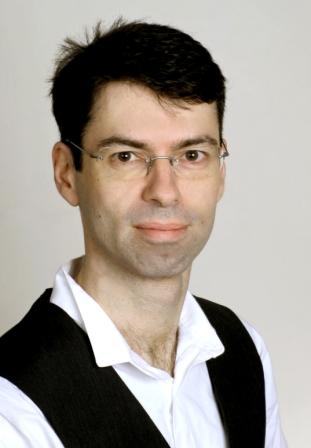
On October, 23rd, we will have Thomas De Padova with us. His topic is
 “The Secret of the World”.
Four hundred years ago, two totally different scientists cross the borders of the then known world. Galileo Galilei takes a good look through his telescope in Venice and discovers the Jupiter moons.
He publishes his spectacular findings in »Der Sternenbote«. In Prague, Johannes Kepler cannot stop reading about Galilei’s observations until the end of the small book, because the observations therein fit perfectly with his theory of planetary laws. An exchange of letters between Kepler and Galilei about the new cosmos develops. This is an exciting expedition of human intellectual ideas – and simultaneously it is the Turn Towards Modern Times.
Thomas de Padova (* 1965 in Neuwied on the river Rhine) is a German scientific publicist.
De Padova studied physics and astronomy in Bonn and Bologna. Between 1997 and 2005, he was a scientific writer for the “Tagesspiegel”. After 2005, he started working as a freelance scientific author. De Padova lives in Berlin and has been a member of the “Kuratorium of the Magnus-Haus of the Germany Physicists Association” and a member of the program the Program Committee of Urania since 2006. In January and February 2014, he was the “Journalist in Residence” at the Berlin Max-Planck-Institute for Science History. [Text: from Wikipedia]
Thomas De Padova is also the author of the science book of the year “The Secret of the World – Kepler, Galilei and How the Heavens were Measured”, which was selected best science book in the category natural sciences/technology by 20,000 readers in 2010.
The presentation will be on Thursday, October, 23rd, 2014 at 6.30 p.m. – we will welcome guests from 6 p.m. in the seminar zone of our Unterhaching InterFace AG building.
As usual, you can register by sending an E-Mail. As always, we already look forward to exciting discussions and nice conversation!
RMD
(Translated by EG)


