
Roland DürreFriday October 17th, 2014
Morals & Ethics over Values & Virtue ???
There are many people in my limited world who I appreciate and like a lot. Some of them think the meaning of morals is “behave in such a way that you always follow the shared values and virtues as a good person”. Personally, I do not really see morals as something all that positive. Consequently, here is what I reply when I hear them talk:
So what exactly are morals and ethics? What exactly are values and virtues?
And then I come up with examples and ask them what is “morally” the correct thing to do:
- “Being in favour of order and peace” or “openly demonstrating for freedom by marching on the streets”?
- “Progress and change are a good thing and come at a price” or “Progress or change must never be an end upon itself”?
- “You have to go and vote!” or “You can refuse to vote if this is how you voice your protest”?
- “It is a human right to drive your car as a matter of course!” or “It is a basic human obligation to do without a car altogether, because too many resources have been destroyed already.”?
- “Let everybody feel free to fly as much as they desire!” or “Going by plane can only be the Ultima Ratio.”?
- “In sexuality, freedom need have no limits” or “You only should do it with one partner and your sexual practices should be limited”?
- “Women have the right to dress loosely” or “Women have to cover everything that is not supposed to be seen in public”?
- “Prostitution must be forbidden” or “Demanding fairness for those who prostitute themselves.”?
- “Women must have long hair, men must have short hair” or “Everybody may wear their hair as they wish to!”?
- “Removing body hair is hygienic and beautiful” or “Removing body hair is amoral(!)”?
- “Shorts are a normal thing to wear, even in business” or “Wearing a suit and tie is obligatory in business!”?
- “Strike is a NOGO when public interest is violated” or “Going on strike is a social obligation.”?
- “You have to have a fence around your property” or “You should not fence in your property.”?
- “Everybody must be willing to die for his fatherland” or “You have to become a deserter when war is threatening!”??
I could easily come up with many more examples.
But then: WHO can, should, must, may decide what is wrong and right?
Ethics try. They want to find a compromise between various positions by seeking a consensus that matches both the society and the times and try to legitimize said consensus. But ethics, too, always fail.
There are even “ethics commissions” which want to and are supposed to answer the difficult questions of life. Instead of consensus, however, all they ever come up with is compromises – which are just as flat as their attempts at justification. Yet those compromises are then heightened to become “new” morals.
Morals almost always will turn out to be (either consciously or subconsciously) “know-it-all” behaviour driven by interests.
“You” simply know what is right and wrong. “You” basically own the “truth” and can tell others what they should do. “You” can therefore assume you are better than your fellow citizens.
As I see it, “morals” will mainly generate enemies and frustration – and it will also cause defiance. All too often, the “moral rules” are nourished by questionable sources, such as religion and its equivalences. The collective constructs of systems that put themselves beyond and above human beings with their dogmata decide what is “morally correct” and what is not.
The consequences are hatred, arguments, conflicts, fear, intolerance – and war! Both on a small and a large scale.
Well, those are my arguments against the firm belief in morals by some people. Yet I can well understand those who are in favour of morals. Because if you no longer believe in morals, then this is like someone took away the carpet of life you have been walking on. After all, we all have been “morally educated” and have become more or less victims of our own moralism.
As soon as we leave the protective gear of morals, we must go and look for a meaning in our personal lives and behaviour. And it is not always easy to find a balance between what you found and what you perceive as social reality (and its morals).
RMD
P.S.
I wrote this article for the community “Strategische Moral” in Google+.
Roland DürreThursday October 16th, 2014
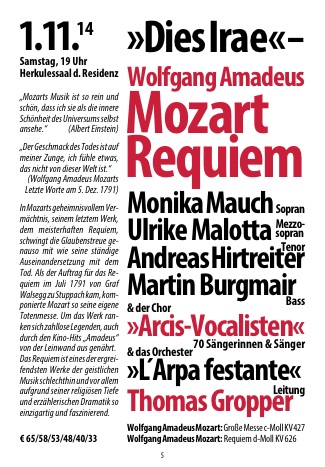
The Arcis-Vocalisten will sing Mozart – the “Requiem”.
A short time ago, I watched the Arcis-Vocalisten perform. It was in the Loisach-Halle in Wolfratshausen.
Along with numerous soloists (among them “Stofferl” of the Well-Brothers), the wonderful orchestra “Ensemble Nymphenburg” and the great Irschenhausener Brass Band, they staged an enchanting performance of Johann Strauß’s “The Bat” under Thomas Gropper. I was truly thrilled – not just because Evelyn (EG) was one of the choir singers.
 Yet the “Arcis-Vocalisten” will not sit down and rest. Because only a rolling stone gathers no moss.
Consequently, the Arcis-Vocalisten will sing Mozart’s Requiem on November, 1st at 7 p.m. in the Herkules-Saal of the Munich Residence. They will be accompanied by the L´Arpa festante Orchestra and the soloists are Monika Mauch (Soprano), Ulrike Malotta (Mezzosoprano), Andreas Hirtreiter (Tenor) and Martin Burgmair (Basso). Again, the conductor will be Thomas Gropper.
»Mozart’s music is so pure and beautiful that I consider it the inner beauty of the universe.« (Albert Einstein)
In Mozart’s mysterious legacy, his last work and masterpiece “Requiem”, both his firm belief in God and his constant attempt at coming to terms with death are always present. Consequently, when Graf Walsegg of Stuppach commissioned the Requiem in July 1791, Mozart wrote his own requiem.
Numerous legends surround the work. You will also find them in the “Amadeus” film. The Requiem is one of the most stirring works of religious music ever written and generally considered unique and fascinating mostly because of its religious depth and narrative drama.
»I smell the taste of death on my tongue. I feel something that is not of this world.« (Wolfgang Amadeus Mozarts – his last words on Dec, 5th, 1791)
RMD
(Translated by EG)
Roland DürreTuesday October 14th, 2014
Against all Kinds of Circumcision! Or: Does Disgust Have Priority Over Morals?
Not too long ago, there was a huge uproar. A leading decision that said circumcision is unlawful had been handed down. Consequently, circumcisions were now violations of the law. However, this could not be made official policy, because, after all, you had to consider “religious rites” and “religious freedom”. Thus, they quickly made a new circumcision law where circumcisions for religious reasons are again legal in Germany.
And now, nobody says anything. As I see it, too little is said. To be perfectly honest, I do not even know if the new law was actually passed or if now they are only permitted to do what it says in there because everybody thinks it has been passed. One of the reasons is that so many new laws have been introduced and that our “big coalition”, as well as the EU, passes law after law.
For me, however, what matters is not laws. What matters is humanity. Meaning: common sense, philosophy and psychology. They deal with taboos which, as we all know, play an important role in our lives as rules. For instance, sexual activities committed by a father with his own daughter are taboo. Nature did well in this respect. In this case, the taboo is very useful in order to avoid an undesirable sort of reproduction (inbreeding).
Cannibalism is another taboo. The very idea of eating human flesh will usually cause disgust, both individually and collectively. I presume this taboo is because probably none of us would appreciate being eaten.
If I remember correctly, then the new “circumcision bill” was passed at high speed. The reason was: “We all want religious freedom, don’t we?”. I am sure it was another one of those situations where no alternatives existed. The question comes to mind why we still need parliaments and politicians when there is no alternative for social decisions?
Thinking back to the discussion of the time, I can find lots of arguments against this law. It is not in accordance with a developed society and cannot be reconciled with a constitutional democracy. It means a huge regression in terms of enlightenment and humanity. Unfortunately, it seems that most people in our country do not really seem to care. After all, it does not directly concern them. Besides, the archaic rites of religious communities are not something most people are even slightly interested in.
Matters would probably be totally different if circumcision violated a true taboo, rather than just damaging life.
Consequently, I will now come up with an artificial situation. In order to illustrate both the absurdity of our social mentality and of religious circumcision, I will extend the religious circumcision ceremony a little in my mental concept.
Let us assume that there is a totally newly discovered African tribe where all children – both boys and girls – are circumcised. For boys, this means the “totally normal” ceremony as practiced in several religions and cultural circles. Let us take the harmless variant for the girls – in order to minimize brutality (where only the outer labium is removed). Basically, the procedure as such is quite cruel and unreasonable.
Now I will construct my mental concept further and assume that this African tribe takes all the flesh from these circumcisions as ingredients for a celebration soup – which later is consumed by the tribesmen as part of the festival. This is just some superstitiousness they believe in.
And all of a sudden we are disgusted. We would witness an outcry of indignation throughout the entire country. Mind you, this would not be because of the circumcision, because nobody is interested in it. Instead, it would be because of something that everybody considers absolutely “disgusting” and “abnormal”. Totally amoral…
And everybody would be in favour of telling this small African tribe in no uncertain terms that they just cannot do this kind of thing and have to stop it immediately. Even if it is a habit they have been practicing for millennia.
Well, I simply chose this example – which some readers might find tasteless – in order to point out the following:
It is not the cruelty of circumcision practiced on children and the life-long damage for the parties concerned that will activate persons. Disgust, however, would immediately make all the people protest.
And that is something that gives me pause.
And I find it even more appalling if eventually “circumcision” is called moral. Currently, we have almost reached that state of affairs.
Besides:
The “circumcision law” I mentioned before could easily also have been formulated differently. As they used to do formerly with abortion laws. For instance by continuing to consider circumcision illegal, yet not punishing it in religious cases if certain requirements are met. That would have been a clear prohibition with exceptions when it comes to prosecution. At least, it would have guaranteed that the behaviour as such is considered illegal.
RMD
(Translated by EG)
Here are some more comments on the subject:
P.S. 1
In Egypt, every other woman between 16 and 30 has been circumcised. What do the “keepers of freedom” in the West do about it?
P.S. 2
As far as I know, the disposal of the results of circumcisions is not explicitly regulated in Germany. It is probably considered medical waste.
P.S.3
Eating human flesh is a taboo. Regardless, persons who ate the corpses of their comrades in an emergency situation (plane crash) in order to safe their own lives are sometimes described as heroes.
P.S. 4
When I was staying in Peking, I ate duck. Duck brain is considered a big specialty and the prerogative of the oldest person sitting around the table. That was me. Thanks to the friendship of my hosts, it was tolerated that I did not eat the brains.
Roland DürreTuesday October 7th, 2014
Ethics and Morals: Two Evil Sisters…
I used the last long weekend – it started with the German Re-Unification Day – for philosophising: along with a not very small group of very young students and experienced entrepreneurs and leaders, I went to the Grashof – a small conference hotel about 25 kilometres west of Fulda. My friend Klaus-Jürgen Grün held a “philosophical colloquium” supported by the “Ethikverband der Deutschen Wirtschaft e. V. (EVW)”.
For me, those three days were extremely important. Let me give you a short account of what I learned.
Morals and Ethics
I understand more and more clearly that morals and ethics are two evil sisters. To be sure, the younger of them, “ethics”, tries to dampen the detrimental effect of her older sister “morals”. Yet far too often, all she does is make matters even worse.
What I am saying is that morals are the cause of much that is evil and the concept of ethics doing better does not work.
Morals and Decisions
Up to now, my view of the world made me see decisions basically as the solution of the conflict between ratio (facts, evaluation, consequence, brain) and intuition (emotions, sensation, gut feeling). During this colloquium, however, I suddenly understood that there is a third – often extremely powerful – factor: morals!
The more I listen as persons find a consensus, the more I discover that the arguments they exchange are of a moral nature, rather than rational (common sense) or intuitive (heuristics). I find this a terrible thing.
Morals and Regularisation
Thirdly, I am now aware of how often we moralize even in simple speeches or when we talk, think and discuss things, and how much we are determined by morals. The systems we live in build massive collective constructs which further influence us morally.
The consequence of unimpeded morals is over-regulation. This is something we secretly demand (in order to have the others at long last do the right things), yet we do not really want it. Such a process will be detrimental for freedom: in the extreme case, we will lose said freedom. That is a scenario I do not like.
I would like to live in freedom in a developed and enlightened society. There is nothing wrong with reasonable rules. More and more often, however, I get the impression that, especially in our hemisphere, this development does no longer take place. What is worse: we are regressing and unnecessarily relinquishing our hard-earned freedom step by step. And this is something that must not happen.
RMD
(Translated by EG)
Roland DürreTuesday September 30th, 2014
Entrepreneur’s Diary #101 – Make or Buy!?
How to find the right kinds of people – and why recruitment is an anti-phrase!This is a question I often had to answer during my entrepreneurial career. And it was never easy to reply to.
You often need some tool in order to better organize affairs in your enterprise. It might be a small software solution, a new process in the infra-structure, a tool providing a particularly ingenious service, or a special marketing or sales activity.
More often than not, what you will need are software solutions. Those were the times when we, as an IT enterprise, had to decide:
Should we produce it ourselves or buy it? Make or Buy?
This is not only true for software. Processes, too, are something you might either define yourself or find a counsellor to assist you. For instance, you can also design simple tools for administrative tasks – and they work surprisingly well. For our second Christmas Party in 1985 in the Villa Stuck, we even made our own snack sandwiches under the supervision of a master cook. We also bought our champagne from the wholesale. Incidentally, that was one of our best Christmas parties ever.
One positive factor about doing it yourself is that it is authentic and traditional. In fact, you gather new know-how in your enterprise. It might also be considered a positive effect that a tool you designed yourself will help you to define your own distinctive line on the market. And it can be considerably cheaper than the mega-functional market product many of the functions of which you do not need, anyway.
However, doing it yourself might also have negative side-effects. The result might look amateurish. In the long run, it might well be more expensive than buying it in the first place. Using idle resources (“resources that lie unused”) which basically were meant for other use is dangerous, because developing your own tools might cause those tools to get a life of their own.
New functions that take a long time to maintain are suddenly sought after and you will have to live with the fatal obligation to further develop tools – which might sometimes cause exploding additional costs.
On the other hand, if I buy the desired solution or service, I will probably get a professional system, and possibly even at a cheaper price? I can focus on my central business and will not use up future resources by perhaps relying on sometimes very precarious island solutions.
As you can see, there are many rational reasons pro and contra “make” and “buy”. You have to take many things into consideration. One of the most important, perhaps the most important, questions about “make or buy” might be:
What will the persons employed inside the enterprise accept better: the self-made product or the bought product?
After all, what good will the best and most professional marketing (and expensive) agency do if your own organisation does not accept it? What positive effects will the best Leads from a presale activity with external partners have if your own sales department is not interested? Sometimes you get the “not invented here” syndrome.
What good will the best process software do if the simple self-made one is lived by the users? What use is the best social media system you ever bought if the people working in your company prefer the simple, internally designed Wiki?
This brings us to a simple conclusion:
Whenever I am interested in something totally new, the question: “make or buy” is not really relevant. It is a lot more important whether or not your employees will accept it. And this is the criterion following which you can then decide if you want to make it or order it elsewhere.
However, when we are talking software, there might be another best way: Use an open source solution and be part of the community.
RMD
(Translated by EB)
P.S.
For more articles of my entrepreneur’s diary, click here: Drehscheibe!
Roland DürreMonday September 29th, 2014
Why do we have to Import the Walnut from California?
 My Barbara fed the piglets her apples. Now they can again live off the land.
That is exactly what we, too, did on our bike trip. When we saw the next walnut tree, we stopped and ate a few nuts. There were enough of them left to serve us as dessert after dinner. And I remembered how, many years ago when we were children, we collected all kinds of things. Many varieties of berries, beechnuts, all kinds of fruit, chestnuts, mushrooms, …
But then Aldi came along and the walnuts we ate came from California. Some way or other, I found this a great idea when I was younger – I mean: walnuts from California, wow! Today, I am in favour of regionalization and feel that walnuts from California are a negative example for global nonsense.
And a little later – what a coincidence! –, we watched the “Weltspiegel” on the German TV channel ARD in our Isidor hotel.
In this program, a US “walnut farmer” laments how the government of California is not capable of supplying enough water for him to grow his walnuts, because his trees are all shrivelling to nothingness due to a “century’s drought”.
He also says how he prays to God every day, asking him to send rain. Except he never mentions the “climate change” and the “American Way of Life”.
RMD
(Translated by EG)
Roland DürreSunday September 28th, 2014
More on Project Management
“I always get a little grumpy on hearing someone say project”
Marcus Raitner currently invites interested parties to join the blog parade on “Beyond Project Management” in his blog “führung-erfahren”.
“Beyond Project Management” is also the motto the orga team of the Dornbirn PM Camp agreed on for the 2014 PM Camp. As I see it, this is a great motto.
Now I am reading my way through the blog parade “beyond project management” and discovering that I find plenty of correct and reasonable ideas in all the articles. And I am truly enthusiastic and would recommend for all of you to read the nice blog parade contributions.
🙂 The more I read, however, the more thoughtful I get. In fact, I already wrote two blog parade articles – and here comes the third one.
In fact, I already wrote two blog parade articles – and here comes the third one.
In one blog parade article, you will, for instance, find that project management is basically about practice, simplicity, people, leadership and, above all about making sense.
I find that truly great!
Except:
What exactly do practice, simplicity, people, leadership and making sense have to do with project management in particular and management in general?
Also, I read a wonderful story in the blog parade. It shows how absurd project management in the private sector can be. And I ask myself how something that does not work in real life is supposed to be a success in an enterprise? After all, we are always dealing with human beings, aren’t we?
- Projektarbeit bedeutet Ergebnisse unter Unsicherheit zu liefern und
- Projekte werden nicht genehmigt, sondern finanziert.
In another article, I find important sentences, such as
- project work means delivering results under uncertainty and
- projects are not authorized, they are financed.
Well, this is certainly true. But what does it really mean when all is said and done? Here is how I understand it:
The results of (project) work that made sense must – at the latest – “work constructively” from the time the customer uses them for his enterprise. How is that supposed to work out if you realize something that has been planned a long time ago and is then still used at the planned (and then probably unsuitable) time?
Here is my personal experience:
In my (IT) projects, it never ever happened that I delivered the project result as specified at the beginning of same project. The final result was always something that differed considerably from what we had expected to get at the outset. Sometimes it was reduced or massively changed even before the original deadline. Fortunately (?), the result was always something the customer actually desired and consequently, it was always appreciated. This was very important, since you should not forget that the customer is usually the one who pays a lot for the final product. Besides, we also wanted our customers to come back later with more orders.
This is how I learned that both the time of delivery and the solution have to be what the customer wants if you want him to be happy. If I had delivered exactly what was originally agreed upon at the desired time even once, the customer’s goodwill towards me would soon have dwindled to nothingness.
Consequently, we have to deliver a true added value to the customer if we want him to gladly pay us and return later with new orders. And usually, this will not be precisely what he used to believe he needed and ordered several months or even longer ago.
Of course, this also means that you have to decide together with the customer why you deliver something other than was originally desired. Such a process is not easy and costs more than just strength. It actually calls for many talents.
As I see it, happy customers cannot be gained through the currently still valid meaning of the word project:
A project is a planned process which starts at a determined time, has a precise goal, fixed parameters (cost, time) and a non-negotiable end.
To be sure, this definition sounds nice. But it originated at the time of Taylorism and industrialization.
Here is what I believe:
A project is not a project with a clearly defined goal. Instead, it has an open ending. And those who are “responsible for the project” must be a team of entrepreneurs who are competent in many roles, among them “understanding” and “persuasion”.
I never knew a “project” that ended up with exactly what had been planned at the beginning. Even the best “requirement engineering” never managed to do that. There were always huge modifications in the functionality, costs and delivery date. Especially with huge projects, I often witnessed differences that sooner or later became gigantic.
Following these ideas, one might well substitute the word “enterprise” for “project”. That would give us a definition looking more like:
An enterprise tries to shape the future attempting to match yesterday’s assumptions with today’s reality and tomorrow’s requirements. And the process is a continuous task, with neither beginning nor end.
The reason is that, basically, you will always imagine things totally different from what they will later turn out to be. And you will always learn in the process.
RMD
(Translated by EG)
Roland DürreSaturday September 27th, 2014
Another Project Polemic
If you do politics as a project
…
or
I always get grumpy on hearing the word “project”!
I know a proud nation. It considers itself “God’s own Country”. Consequently, the people of said country feel responsible for preserving “the Western Values”. Meaning exactly those values it considers Western Values. Due to its power, it feels the obligation to play the role of “world police”. The people play this role with a high degree of professionalism in three steps:
Step I:
They collect data.
No exception is made for secret data. If someone holds something secret, then we have to assume that it is important, don’t we? And how is anybody supposed to understand a situation without knowledge of what is important? Consequently, they spend a lot of money in that country on the CIA, NSA and other “agencies”. And they listen in on the entire world.
Step II:
Data are processed.
They use numerous experts and think-tanks. In order to create security, danger scenarios are designed along the lines of all these data. This is how they totally logically and reasonably generate certainties – in a professional way and using their best brains.
Step III:
Decisions are made and activities are initiated.
After all, you have to counteract against the threats you found. Based on artificial data, you deforest one country with Agent Orange and burn it down with Napalm. Tyrants are murdered and dictators and their countries are declared war on. The army is sent into the desert and all around the world. Armed drones are sent on their way to kill particularly dangerous persons. Special teams destroy the current public enemy number one. Sanctions against insubordinate behaviour are organized. “Partners” are reminded of their contractual obligation and alliances are formed. For instance now in order to bomb the IS. The plan is to have destroyed it exactly four years from now.
Doesn’t this kind of procedure sound exactly like very rational, fact-based project management?
Except what are the consequences of such behaviour? The USA have now spent years trying to achieve their goals in this way, yet all they ever achieved was the opposite of what they had intended. And I have a growing suspicion that the main mistake is that the US policy is based on superbly professional project planning, rather than value-oriented.
I get the impression that this mistake is not restricted to politics, either. And that projects sell irrationality as proved ratio!
RMD
(Translated by EG)
P.S.
This article was inspired by me reading several articles from the blog parade “Beyond Project Management”. Marcus Raitner currently invites people to participate in his blog “führung-erfahren”.
The blog parade is intended as some kind of warming-up for the Dornbirn PM-Camp 2014. The motto will be “Beyond Project Management”.
Roland DürreFriday September 26th, 2014
”Project: Without War” or “My Project #nowar!”
I started this article on my way back home from the 2014 Berlin PM Camp (#pmcamp14ber) in the train. It was meant to document my sessions on the Camp between June, 20th and June, 22nd, 2014. And tonight, on the second day of my bike trip from Toblach to Maribor along the river Drau, I finally manage to finish it.
On the 2014 Berlin PM Camp (#pmcamp14ber) I “disburdened my heart”, proposing and conducting a session on the “Project Peace!“. For me personally, this session meant new frontiers. Consequently, I was grateful that the participants were not too critical and tolerated my weaknesses during the session. After all, this is what is so nice about many barcamps and also about the PM Camp: people listen carefully, yet they are tolerant.
I came up with a few theses during the session, offered some personal ideas and tried to create awareness for this world’s main dilemma: war. Above all, I asked many questions. This was because I wanted us all to find answers and to discover how we all and each of us individually can act towards peace. In all kinds of projects – every day and very individually.
Here is the short report of my session on “peace” from the Berlin PM Camp, followed by my first thesis of the session:
If we want to live in a world of peace, we all – individually and collectively, locally and globally – have to behave friendly and act in the interest of peace.
So here is my first question:
Is a world and society in peace really such an unimaginable utopia?
Let me remind you of a sentence I already found fascinating when I was quite young:
Imagine they declare war and nobody goes there!
The opinions of the participants on how high the chances for peace were differed hugely. As I see it, a slim majority shared my opinion: it is imaginable to have a society where life in peace is possible both internally and externally. Others believed that human nature and war are simply inseparable. When I heard this argument, my reply was that in that case “human nature” would have to change, just like individual persons and the society as a collective mass of persons will have to change.
I personally believe this is possible. More questions of mine were:
Why do we frivolously subordinate our behaviour to unimportant goals? Why do we always have to be right? Why do you always find this “self-righteousness of the just ones”? Why do we so often fight for unimportant things, at the same time forgetting what is really important to us? Why do we demand “punishment” when in reality we almost always mean “revenge”? Why do we always plunder our resources in such a ruthless way and later try to steal what we no longer have from others?
After all, it is exactly this kind of thinking and behaviour which – so it seems to me – directly or indirectly causes “war”.
This, too, was a statement that triggered off totally different reactions among the participants. Especially the topic of “punishment and revenge” was discussed at great length. One of the questions was also if and to what extent punishment should be an indispensable part of “education”, also why/if force has to be the “ultima ratio” in politics? Maybe most of this world’s societies are actually “archaic force systems”? And maybe even our “developed” and “enlightened society” still is guilty in this sense in some areas?
My next theory was that, even if total peace is a utopia, we must still work towards it at all times. There are many rational reasons for this. And since the dangers humanity is facing are so immense, we simply cannot afford to waste our strength in wars. Basically, this is a rather reasonable approach, isn’t it?
Besides, some utopias in the past actually became reality. Just think of women’s rights. Not too long ago, they were not permitted to study at university – and the right to vote was truly utopian for women. The French Revolution, too, was just for men. And the first woman to demand exactly those rights for women was beheaded – by the revolutionaries!
During the session, I finally came up with the following statement:
As I see it, we need (to give) a purpose for social systems such as enterprises to be a success. And this is also necessary if we want our personal lives to be a success. How can anybody become a happy person without a purpose? Through all my life, this was what I believed. Consequently, I always tried to find a purpose in my life and my enterprises. Today, I see it a little differently. In fact, now I believe that, both in life and always, what matters is not having a purpose. What actually matters is the effect!
Let me re-formulate this:
Effect has priority over purpose.
(Perhaps the effect will then automatically show you the purpose).
Today, I believe that, basically, there is only one true purpose to life. And that is to work towards peace. Simply because there is nothing more important. Consequently, I believe: We all have to take part in working towards peace!
Well, obviously, this is also true for me, which is why I initiated the session. In fact, I believe I should have done so a long time ago. Now I wish to catch up by as much as possible and fight my ignorance. Consequently, I am looking for comrades in arms who might be able and willing to help me. I would like to strongly rely on the young generation, the so-called “generation y”. This generation gives me hope, because it believes in the following values:
Consideration, acceptance, appreciation, eye-level, honour, enlightenment, joy, shared experiences, harmony, individualism, life, love, courage, purpose, respect, sharing, wealth, understanding, contentedness.
And all these values do not go with war.
Except: life is full of conflicts (I wonder why). Consequently, we need the competence to deal with conflicts. So we found a few rules during our session:
First rule:
Serenity: never join a conflict that is not worthy of it.
Second Rule:
Stop hating! You simply need to remember the “paradox of hatred”: Those who hate want to destroy someone else, yet they always only destroy themselves.
So what do we need in order to gain peace?
Education, learning, experience, joy, courage, responsibility, knowledge.
How can we gain this?
During the session, we came up with the following results:
Let us never forget that there is no absolute truth, only certainty!
Let us always question “collective constructs” and the “absolute truth”!
Let us replace enmity by philanthropy!
Let us work towards social consensus.
Let us teach the people to behave “ethically responsible”.
We can succeed through civil courage and constructive disobedience. Let us all fight against “moral flippancy”. And let us always remember ourselves and our personal happiness. We can all learn and practice happiness.But it will not happen while we win over others or constantly increase our consumer habits.
However, we also talked about “being able to afford working towards peace”! Subsequently, we discusses if it is possible to modify our projects in this sense. And perhaps if we even could start peace projects.
The general agreement was that only a true grass root movement can bring peace. And that it will definitely not do any good to just join some Easter Peace March. Instead, we need persons who are seriously willing to work towards peace. Like John Lennon did. However, we also said that you have to be able to afford working towards peace. And that this is nowhere near as easy as it looks.
- Minimize damage! Avoid collateral damage! Break the vicious circle of force..
- Do good! You will find that collateral benefit follows suit!
- Respect other persons and their opinions!
- Never practice vengeance!
- Honour and appreciate yourself – because only those who value themselves will also appreciate (like, love, accept,…) others. And those who manage to do so will not start or like war.
- Contribute as far as possible towards the increase, rather than decrease, in many dimensions of your own and other person’s personal lives.
- Always treat others at eye-level and with respect..
- Always make other persons look bigger, rather than smaller.
(Making others small might well mean you turn others into beggars).
Here is my personal summary of the session:
I believe:
All these things must work both on a small and on a huge scale. If we can manage peace individually, then we will also succeed in bringing it to the systems we support.
The real challenge lies in our daily behaviour. Every one of us can and must contribute. The longer your lever because you are a manager, an entrepreneur or otherwise in a position where your ideas multiply, the more effect you can have! And the greater is your obligation to work towards peace.
Consequently, my vision for what should always motivate us is: All our projects promote peace. Both interior and exterior peace. And if some projects do not do so, let us re-define them! Let us make them peace projects.
Why should this not work out? How can we get there? Aren’t those some good questions for the next PM Camp?
RMD
(Translated by EG)
P.S.
I see quite a few encouraging factors. For instance the history of WW-1 (yesterday evening, I browsed through a program which illustrated battlefields of WW-1. Again, I felt how all this carnage is quite pointless).
The generally accepted tale about WW-1 is that the people in Germany and Austria actually wanted war. That is what I learned at school and never understood as a young boy.
Today, current historical research teaches me that this statement is simply wrong. The proof was manipulated at the time and later on simply taken at face value. Perhaps WW-1 was also history’s first media war. And the media were controlled by the powerful ruling “elite”. Consequently, the media did everything to boost and then document the war enthusiasm.
However, the majority of “simple” citizens never wanted war. Only some of them allowed themselves to be manipulated and went onto the streets to join the cries for war. And later, all of them had to pay a bitter price.
Roland DürreSaturday September 20th, 2014
Start up (10) – The Conciliatory Ending.
But, please, do not forget: not everybody must become an entrepreneur! There are lots of other ways towards happiness
.
If you wish to live your life in self-responsibility, it is not necessary for you to become an entrepreneur. Just like in “real life”, an entrepreneur, too, will be subjected to plenty of control from outside, perhaps only in a different form. Perhaps it is even harder to bear.
”Be willing and able to live your life in a self-responsible way” as an important definition of “living freedom” is quite possible in other ways, as well. All it means is to “do your own thing”, start exciting enterprises (not necessarily companies), or simply live your own life in a very intense and autonomous way. In other words: you want to make your life “your own project”.
It might be something as banal as starting your own family. In fact, I admire the decision of a woman to have a baby as true entrepreneurship. A life led in a very conscious way is already entrepreneurship at a huge scale. Developing your own opinion consciously is entrepreneurship…
Yet there are many more sensible things you can do that are entrepreneurial. It might be the support of an NGO or taking responsibility in all kinds of social systems – be it at the “Tafel” or in one of the often accused political parties. In fact, they are exactly the places where some good and autonomously emancipated-thinking persons would be badly needed.
Basically, it is always about taking responsibility. Consequently, I consider the school crossing guard just as much an entrepreneur as the retired manager who accompanies a dying person on his final journey in the hospice.
Writing a blog or being part of an internet community is a form of courageous entrepreneurship. Just as being part of a barcamp is also already entrepreneurship on a small scale.
And this is where, of course, I warmly recommend the PM-Camp – the next one will take place in Dornbirn between November 20th and 22nd, 2014!!!
RMD
(Translated by EG)


