
Roland DürreSunday September 20th, 2015
I almost forgot: Karlsruhe PM Camp on September, 25th and 26th!
 I am angry with myself. I almost forgot the Karlsruhe PM Camp. And it would not have been advertised. This is not tolerable!
Dear organizational team in Karlsruhe: please accept my apologies. I feel truly contrite. And I promise to do better in the future.
In Karlsruhe, the motto will be:
Projects with enthusiasm – where does the magic come from?
Unfortunately, I cannot attend next Friday and Saturday. Which I find a true pity. Because the Karlsruhe organizational team did a fabulous job. And they would certainly have deserved a few more participants.
So here is my appeal to you: if you live near Karlsruhe and are at leisure this Friday and Saturday – and if you are at all interested in project management, management in general, leadership, entrepreneurship and such, you should definitely attend the PM camp at the Karlsruhe Hochschule für Technik.
As always, the program is exciting. It will be well worth the trip and, as always, all PM Camp participants will return home content, wiser and happier.
And, in absentia, I will follow the timeline of the tag #PMCampKA and be happy about many, many twitters from the camp by the participants!
And here is a special request by me:
If, to give Karlsruhe extra advertisement, you twitter this article more often than usual, you would also make me very happy!
RMD
(Translated by EG)
Roland Dürre
Conference versus Anti-Conference
Why I no longer like conferences, yet love barcamps?
OR:
All the things that can happen during a barcamp!
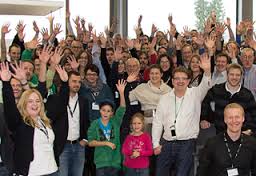
Enjoying ourselves at the Dornbirn PM Campp
I no longer like to attend conferences. Consequently, I only agree to be a speaker on such events in exceptional cases. For instance in the near future at the NurembergDOAG-Konferenz.
🙂 Or else if they pay me really well.
Because how do they choose speakers on conferences? Potential speakers must submit their articles at least six months before the conference, more often even earlier than that. Including a topic, a summary and an abstract. Mostly with a pre-defined number of words and following some stupid kind of word template.
But how am I supposed to know in January what will move me late in the year? How to know the development of affairs during the months until the actual presentation takes place?
After the deadline, the conference committee will meet. They are supposed to select the suitable articles. The jurors in the committee have to consider the event sponsors, countless representatives of interests and industry, diverse amigos, political influence and much more. They will not personally be acquainted with most of the persons who sent articles, which is why they cannot know about the competence of them as speakers. More often than not, they do not even have technological competence.
Young speakers who actually might have something important to contribute have no chance – and this is apparent if you look at the conference program.
Those who were lucky enough to have been selected must submit a manuscript. Again, it has to have a certain length, the word-template is usually even worse than before. The manuscript, too, has to be submitted quite a long time before the actual conference takes place. After all, the proceedings have to be printed.
Well, this is when I think: Why should I present something all the persons in the room have before them in writing? I always talk freely, without power-point or the like. Whenever I speak in a big lecture hall, I ask my graphics expert to design a few slides to emotionally underline what I am going to say. That is it. After all, the exact content of what I am going to say will only be determined on the day of the event – and it will even change during the presentations, because I follow the feedback I receive from my audience.
And then the great day will come. Mostly, a conference will start with a huge introductory affair, including welcoming all and sundry. The ability to remain awake and sitting on your bottom is put to a severe test among the audience. And then, the intense “one-way” noise machines will be turned on.
The speakers will dutifully read their manuscripts as typed in the proceedings. Some will do better, others worse. Interruptions are mostly not encouraged, so there is never a discourse. Someone up front will say something that has been previously prepared and the audience down below are supposed to consume it.
A short time ago, I attended an academic meeting with a dear friend of mine (no less than a rather highly respected professor). It was more or less the same as always. When I told her that the contributions had been surprisingly low-standard, she consoled me with the information that the presentations were actually just of minor importance. The important thing, so she said, is that you meet and exchange ideas with people. And that the evening event, in particular, is the true value of the meeting.
And it is basically true – if we wish to advance ourselves, we have to share our knowledge and communicate amongst each other. But then, why should I listen to presentations all day long if nobody is interested in those? Perhaps it is only so we can tell the tax office something official took place and that we had a legitimate reason to travel and talk over food and wine in the evening…
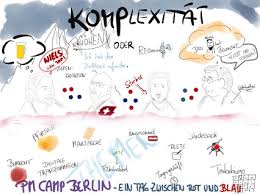
Berlin PMCamp 2015 about: Complexity by VisualBrainDump.
At a barcamp, it is totally different. And as I see it, it is better!
So, what is a barcamp? Of course, you will find an excellent description in Wikipedia. Let me try and approach the definition under a totally different light.
Imagine between fifty and a hundred persons meeting. For instance bloggers, entrepreneurs or experts. Or persons who are prepared to take a special social responsibility, or simply persons who share an interest in something.
Ideally, we are talking persons who enjoy sharing their experience, their competence and also their problems. Persons who communicate at eye-level and who want to participate when it comes to discussing important topics. Persons who want autonomous enlightenment, who dream of honest discourse as professor Habermas used to define it (perhaps persons who are not even aware of him having defined it), all of them thou-ing and thee-ing each other and never interrupting others while they speak. Even if all these factors are true, you still – so is the current state of the art – have to organize this kind of event.
With barcamps, it is very simple. You provide enough lecture halls for the sessions to be held in. A lecture hall has to be big enough for all participants. Inside those lecture halls, you develop the sessions together. Consequently, you have a big board in the middle of the lecture hall. It contains a matrix with the lines marking the time scheduled for the sessions (for instance one line for each hour). The columns mark the lecture halls A, B, C …
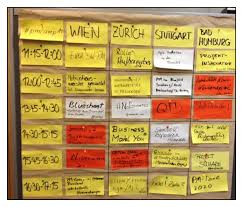
Example for a session planning at a PM Camp.
And whoever has a problem he feels desperate about will march to the board, pin a card with his topic to the board and makes a room and time reservation for his or her session. Then he introduces himself and gives a short description of what and in which form he wishes to propose the session. And as soon as there are enough cards on the board or when the board is full, you start.
If, on top of this, you also have a nice coffee lounge where food and drinks are always available, success is almost a foregone conclusion. Because there is another rule:
Everybody is free during a barcamp.
Like a bee gathering honey, you can attend as many sessions as possible. On the other hand, you can also float through the rooms like a butterfly (bees and butterflies are the classic metaphors for barcamp behaviour) and remain wherever you feel most comfortable.
As soon as a participant realizes that he is in the wrong session, he should leave it. In a barcamp, this is not impolite. On the contrary, it is your duty if you want the system to work. Consequently, the doors to all lecture halls should be open at all times.
The rule also says: whatever happens is exactly what we wanted to happen. If only a few people attend a session then this is just as good as if all participants attend one session. In the end, there will be a balance.
A new development is that the barcamp organizers try to offer a frame where the sessions can be documented. There is a special barcamp variant, the OpenSpace, where documentation is obligatory and supported, collected and summarized by a so-called OpenSpace-Office.
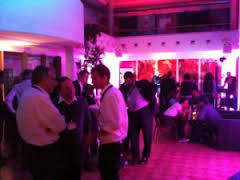
Party time at the Dornbirn PM-Camp.
Barcamp is this easy. As a general rule, it will be two days. The party at the end of the first day is always a very good thing. During the second day, there are often extremely good spontaneous sessions.
A barcamp is considered a success if all the participants – we also call them share-holders – start their return journey home happy and withe a full heart and spirit.
Even though you should never expect results from a barcamp, surprising things often happen. I know movements and enterprises that grew from an idea during a session. Surprisingly many friendships and beautiful networks are generated. There are always lots of incitements. Barcamps have such a huge impact: they help people to start thinking, judge things differently and become more successful both in private and “professional” or “entrepreneurial” life.
I attended camps such as OpenStartUp or WorkLifeBalance. On those, as well as during five years of PM Camps, I experienced what I described above. PM Camps were about project management, leadership and entrepreneurship. By now, I know that there are more important things. For instance the way how we shape our mobility will be profoundly important for our future. That is why I gladly founded the new barcamp for “Active Motility in Everyday Life” #AktMobCmp .
We will start on January, 4th and 5th, 2016 in Unterhaching.
RMD
(Translated by EG)
Roland DürreSaturday September 19th, 2015
Preliminary Event for the Barcamp #ActMobCmp with Jörg Schindler (Invitation)
Invitation to a Preliminary Event for the AktMobCmp on October, 14th, 2015 at Unterhaching
 I already told you about our plans on the IF Blog. On January, 4th and 5th next year (2016), just before Epiphany, we want to start a new Barcamp.
It is the AktMobCmp, the first barcamp for “Active Mobility in Everyday Life”. With this barcamp, we want to address the topic “mobility”, which will be truly important for our future.
The preparations are finished: we have a location that is well suited, a nice website, a flyer for sponsors and a general flyer – and even some first interested sponsors.
Now we wish to get people’s attention for the event. Consequently, we invite everybody to attend preliminary events. The first of these events will be on October, 14th at the Agenda 21-Meeting-Hall (Treff) in Unterhaching (Rathausplatz Unterhaching, Hofmarkweg 12) between 18:00 and 20:00 hours. This is the first time we want to inform everybody about our “Barcamp Active Mobility”.
During the event, the following questions will be answered:
Why is “active mobility in everyday life” so important?
and
What exactly is a “Barcamp and why do we organize this as a Barcamp“?
During this evening, Jörg Schindler will tell us all why mobility is such an important topic in the future and why we all need to get more concerned with the so-called remaining traffic beyond the “individual & motorized” and “public transportation” sectors.
I know Jörg as a very competent, but also a very convincing and entertaining speaker. You will also find his very exciting and valuable presentations on YouTube. Here is an example:
Afterwards, I (Roland Dürre) will give you the definition of Barcamp and also tell you why such an “anti-conference” is so much better for sharing knowledge and developing and applying new insights than the common classic formats. And I will use PM-Camp as an example to demonstrate all the things you can achieve if you share knowledge and “communicate with each other”.
After the short presentations by Jörg and yours truly, we will discuss what has been presented. Perhaps in the form of a FishBowl.
This is how we want to advertise our January 2016 AktMobCmp. All colleagues of the “Agenda-21 organizations” in the district of Munich will receive personal invitations. But we also welcome all other persons interested in “Agile Mobility in Everyday Life” and who wish to think of and act towards a future that is worth living in. That means that you, too, are invited. And it would make us especially happy if persons from the media were to find their way to our event.
Participation at the preliminary event for AktMobCmp is free of charge. All participants are welcome and we would appreciate it if you send a short E-Mail confirming that we might expect you. Because if there are not enough seats available at the meeting hall of the “Agenda 21”, we will move to another location. One which can easily be reached on foot from the meeting hall. Naturally, we will notify you in advance if such a change of location has become necessary.
RMD
(Translated by EG)
Roland DürreFriday September 18th, 2015
”Living/Loving Complexity” – Session at #PMCampBER
Here is my report on the session I triggered off with Maik (Maik Pfingsten) on Saturday, the second day – which was practically the end – of the Berlin PM Camp #PPMCampBER.
It had been our intention to relate and discuss a few ideas to show how, even in a complex environment, you can manage to live content and successfully, both in your private and professional (business) life.
In order to show this, we developed a few theses:
Truth
As we see it, there is no absolute truth. To be sure, there are more “correct” and more “incorrect” ideas. But you should not use correct and incorrect as terms. Instead, you should see them metaphorical, meaning “goal-oriented”. Other than that, it seems to us that people often discuss certainties and totally forget that much they believe in is just a construct of their brains.
Complicated versus complex
I used to believe that all that is determined is also complicated. And that complexity starts where “determinedness” ends. Whenever the end was not predictable or describable as an algorithm, I used the term complexity. Others used the metaphors “dead” for the “complicated” and “alive” for “complex”. This means that organic chemistry can only always be complicated, whereas inorganic chemistry might well become complex.
Maik provided us with a very nice description of “complex” – from the viewpoint of a system engineer. He draws an axis of coordinates. The x-axis represents the complicatedness, the y-axis the change and dynamics. And the system will change more and more from complicated to complex as complicatedness and dynamics increase.
I find it quite easy to come to terms with this pragmatic definition. Here, too, the decision whether something is complex or complicated is in the eye of the beholder. Incidentally, this is something Nico Banz gave a very nice session about at the #MCampBER – just before us and in the same lecture hall. Using an example, he showed us that judging whether something is complex or complicated is, indeed, a very subjective process.
By now, I have come to believe that the academic discussion about complex versus complicated is not very useful. What actually counts is right decisions and projects.
Decision
The definition of the term “decision” is based on two requirements: it has to happen under uncertainty and it must have relevant consequences. Otherwise, it is not really a decision.
In the context of decisions, it is also exciting that neural science keeps proving that decisions only seem to be made by ratio (cerebral cortex). The truth is that they are made by our subconscious, which means involuntarily.
Incidentally, they found out at St. Gallen college that the huge majority of management decisions are wrong decisions.
Mind you, the distinction between “right and wrong” decisions is not at all easy. In fact, it gets even harder: if you analyse an enterprise or a project in retrospective, it often becomes “story telling”. Even if there is no doubt that the stories might be useful, precise scientific research (studying the protocols, etc.) will show that it is not at all easy to judge “à posterio“ what decision caused which event.
I always wanted to be a “good” manager and entrepreneur. And I wanted to make the right decisions. And today, I ask myself how any manager can decide correctly “à priori“ if, even in retrospect, he cannot say with certainty how the causality was.
Projects
As I see it, it is not a good idea for us to distinguish between our professional and private lives. Living a life is more joy if you live it integrated. That means I have to act in the same way in my private life as I would act in my professional life. There is no difference.
I like asking third parties the question: what do you think is my most important project? They are often surprised by my reply – but for me, it is absolutely clear: my life.
There is no doubt that my life is a project. It has a beginning and an end. I have a multi-dimensional budget – which consists of time, talent, knowledge, experience and much more. The goal of my life project is my path of life. Part of it is my death. I would like to have made my peace with everybody I ever met when I die.
My life consists of many projects. Some are mostly private, others mostly business. Consequently, I need to act in the right way.
Acting Right
So this is the central question: how to learn to act right?
After all, I know that there is no absolute truth. Also, I know that the future cannot be predicted. I also know that I live inside the constructs of my subconscious and that the competence to act according to reason and ratio is a mere chimera!
As I see it, the only thing that will help us is finding behaviour-oriented values and live according to them.
Recommendations:
I no longer believe in best practice, methods and complex tools. I do not like tips (tipping me on the shoulder is beating me on the shoulder). These days, all I believe in is simplicity and reducing life to the essentials. And I believe in craftsmanship. Practice. On my way towards mastering things, I need support by a master. In my life, mentors and wise persons helped me a lot both interactively and as an ideal.
Consequently, I gave a short description of what Hans Ulrich and John Izzo recommend during our Berlin session.
Hans Ulrich
Hans Ulrich died several years ago. He was the father of the St. Gallen Management Model and wrote a wonderful and short essay about change in management in 1982. I read this article on December, 8th, 2011, sitting in the train and preparing for a workshop in St. Gallen. And I was totally electrified by it. I regretted not having read it earlier.
Here is the concise form of the “8 theses on the change in management” by Hans Ulrich, along with short comments:
- Accept the uncertainty and unpredictability of the future as the normal state of affairs!
Well, the future simply cannot be predicted.… - Set a broader horizon for your limits of thinking!
Against the “but”… and for freedom of ideas. Share knowledge. - Apply the categories “both”, instead of “either-or”!
Black-and-white is out, colourful is in. - Think multi-dimensional!
Ethically responsible balance of values. Basically, humans can only deal with three ideas simultaneously. - Use self-organization and self-control as formative models for all your enterprises!
Responsibility, principle of subsidiarity. - Consider managing things a meaningful and important function!
New management image. - Focus on what is really important!
Work economy. - Make use of group dynamic!
Cultures, symbols, rites, rituals …
Of course, the theses developed by Hans Ulrich were intended primarily for modern management. Yet they are also very useful for your private life.
For more information on leadership and Hans Ulrich, see the IF Blog underWandel im Management and under another Session Report, as well as, of course, my “Enterpreneur’s Diary“.
John Izzo
The second wise counsellor I mentioned is John Izzo. He did some research on values shared by elderly persons conceived as successful, happy and prudent. And he discovered a common characteristic among those people, which he summarized as the “five secrets”
First Secret Remain true to yourself! This is about “destina”, a term originally from South America. Mind you, it does not mean destiny or even kismet, but your own call and vocation in life.
Second Secret
Live in such a way that you will have nothing to regret later!
Also try new things! Have courage to start something that, at first sight, seems rather unusual. This might actually help you when you have to make a decision.
Third Secret
Love yourself and enjoy it!
First and foremost, you must learn to love yourself! Because only those who love themselves can also love others. Ban enmity from your life. Choose humanity as your life’s principle. Make persons you are surrounded by bigger, instead of smaller.
Fourth Secret
Carpe Diem!
Enjoy, instead of thinking too much. Remove “yes, but” from your active vocabulary. Replace them by “yes, and”. Do not capitulate before “that is not what you want to do!“
Fifth Secret
Give more than you take!
Those who give get a lot more in return. Give trust. Open yourself up and show others something of yourself.
I discussed the book by John Izzo at great length in a separate article. I think it is well worth reading and you should certainly think about those recommendations for life. And perhaps you would like to adapt them for your own life.
If these recommendations do not reach far enough for you, then why don’t you read the Agile Manifesto? Or maybe you want to become theALO-man (see also my article leadership-values-principles) who is only agile, lean and open? And when you come to “lean”, you want to remember the importance of the “Why?“-question in Kanban.
If you do this, you will find the path through the world even easier, regardless of it being complicated or complex. And it will not matter if you are talking your private or your business life, either.
RMD
(Translated by EG)
Roland DürreThursday September 17th, 2015
Morals and the Opposite
Here are a few ideas that might well constitute the essential substance of my philosophical learning:
Assumptions:
I.
The currently valid paradigm of neuronal research seems to support the fact that the human brain rewards “good acts”. The “evil conscience” you often experience after an “evil deed” that will then trouble and torture you, on the other hand, is not originally caused by the brain. Instead, it has been “practiced” through socialization.
II.
A “moralising person” will think in the categories “good and evil”. An “amoral person” (= a free person) will think in the categories “right and wrong”. He knows that there is no absolute truth and that fear, like many other things, is a mere mind game. If asked about the opposite of “good”, he will reply “bad”, instead of “evil”.
III.
Our subconscious dominates our consciousness (i.e. ratio). It has both the power and the speed to determine our decisions and our lives. The assumption we had for perhaps thousand years that this happens through our ratio (consciousness) is wrong.
IV.
Consequently, there is no explicit free will. Our ratio plays a trick with us, trying to tell us a lie. If there is such a thing as human free will, then it takes place in the subconscious. This is how the consciousness follows the subconscious.
V.
We have to kiss the idea that we can freely and consciously decide to “do good” good-bye. Thus, you cannot justify punishment with “amoral behaviour”. Punishment due to “culpability” is nonsense. It might be possible that, following this insight, punishment will be justified because we want to avoid “activities detrimental to all”.
End of my “philosophical discourse”.
More comments:
My utopia is a society that is free of punishment as a matter of principle. Naturally, it would have the right to fight detrimental activities.
Moreover, the wonder-world of animals, be it mammals (including humans), insects, fish,… clearly shows the enormous potential of the sub-conscious.
The part of our brains responsible for our ratio, our conscious activities and our “thinking process” would have to develop considerably in order to compete with our subconscious.
But then, who is to know if this is ever going to happen and how the evolution will change humans? Or perhaps the species homo sapiens sapiens will soon die out, anyway?
RMD
(Translated by EG)
Werner LorbeerWednesday September 16th, 2015
OECD Survey Disproves District Administrator
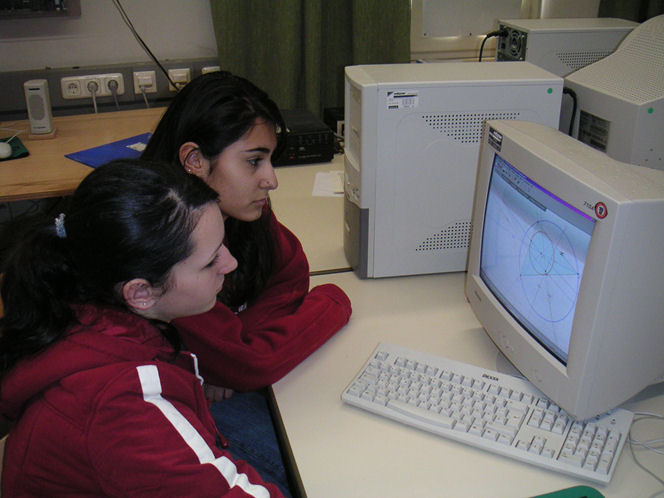 ““96 per cent of the students we asked have a computer at home, 72 per cent use this technology at school. In Germany, pupils from upper-class households use the internet more for information gathering than socially disadvantaged young persons. In those social classes, computers are used for watching videos, playing online games or chatting.“
Well, it is not like this comes as a surprise, is it? But it underlines some pedagogic hypotheses, at the same time destroying others. On the picture, you see children in a bi-lingual situation solving a geometry problem. The result is true gain in competence: in mental concentration, problem solving, emphatic listening and once in a while by testing the characteristics of a geometrical object or of a geometric operation. They did not talk very much while they were working. But: it was all in the category “communication” if you love competence-oriented formulation.
Here are the pedagogic hypotheses:
- – Buying computers for schools will neither improve learning for the pupils, nor bring better success. That is a pity if you were the district administrator from the more prosperous district. It has been disproved.
- Working with the computer and the networks will not give students the desired competence in the scientific-technological area. This is sour wine for all those who want to sell life in the social networks as a goal of teaching. And for those who want to raise searching processes into the heaven of pedagogics, rather than understanding what you found.
- The educational standard of children with equal talent will not change through using a computer or software (tendency towards improvement). Instead, the two things that give this chance are industriousness and frustration tolerance.
It would be wise to use the end of technological illusions for truly experience-based learning. You could actually teach the children and adolescents with the actual objects, for instance beekeeping, cooking, gardening, robotics,… ,
I think this would give many people joy..
wl
(Translated by EG)
Roland DürreMonday September 14th, 2015
PM-Camp Berlin (Report)
 Last week, on Friday and Saturday, Berlin hosted its already third PM Camp. If you wish to find it ion twitter: the hashtag is #PMCampBER.
Weeks before the event, the Camp was sold out. Everything was fine. This time, the “anti-conference” took place at the Alexander von Humboldt University, where the impressive halls gave the PM Camp a wonderful glamour and beautiful patina. I was there and, again, it was just great.
This time, I was a little less active than usual, only in charge of two sessions. The first of them was early on Friday afternoon. I called it “PM Vintage” (project management vintage). Having prepared four stories about projects in my life between 1973 and 1985, I presented them to the audience. It was “story telling” with a little background information. I started with a small project I had been put in charge of all by myself when I was a student worker, then came more complex ones…
Here is an overview of my four projects:
- We need high Mersenne Prime Numbers for developing a random generator on HW basis (winter semester 1973 – WS at Siemens)!
This is where I learned the importance of decisions. Even at a time when there was no internet, etc. And that you can achieve nothing without courage. - Responsibility for a language in one of the teams that – in cooperation with many other teams – achieved great things (APS, Transdata, PDN – 1977 – 1978 – employee at Siemens).
This is where I made the experience how fast creativity and success can go down the drain if there is an excess of processes and Taylorism. - Technological responsibility for a huge project at Siemens for the Bavarian Police (DISPOL – 1979 – 1982 – originally as a Siemens employee, later as a Softlab employee)
This was the first time in my life I came to know a “true” project manager. He had to appease the overhead, which was not a very nice job. However, he could not contribute to the project success. - Foundation of a company and generation of our own product, the HIT/CLOU (starting 1984 – at InterFace Connection GmbH – today InterFace AG).
This was where my partner Wolf Geldmacher and yours truly were lucky in that there were many things we did right. Consequently, we had a really great team.
As soon as the opportunity arises, I will write down the story of those four projects and publish them here on the blog (including the links).
The second session was a spontaneous one on Friday evening during the great PM Camp Party at the Microsoft “Digital Eatery“ not far from the university. I met Maik Pfingsten during one of those many “after-the-pm-camp-conversations” of the evening event. And we decided to initiate a session together on the very next day.
We truly got into complexity. The title of the session was “Living/Loving Complexity”. I was going to recommend that all those confusing discussions about complexity and complicatedness should simply be forgotten or ignored. Because you always get all those complicated (complex?) mind games. And consequently, I was going to recommend that you should not spend a lot of time thinking about whether or not a project is complicated or even complex. Instead of talking, I was going to recommend you should act. And in preparation, I formulated some simple, behavioural theses which will make us successful and happy – regardless of the world being complicated or complex.
I guess Maik and I succeeded – and I was truly happy with the positive feedback I received after our presentation. The next thing I will do is write the article about this session “Living/Loving Complexity”. I hope to finish it by the day after tomorrow. Then you can read it in the IF blog. Of course, there will be a link.
It was a great PM Camp in Berlin and, for me, those were two happy days in Berlin. Consequently, I would like to thank the fantastic organizational team: Ralf Eicher, Christian Vogel, Fabian Fier and last not least Heiko Bartlog!
RMD
(Translated by EG)
P.S.
After the event, they gave me a book because I had been the first to register. So here is what you want to do: register extremely early for the then fourth Berlin PM Camp. It is well worth the effort.
Roland DürreTuesday September 8th, 2015
Dear Governments: Why Don’t You Think Harder – Before Coming Up With New Legislation?
§ § § § § § § § § § § …. … …
As I see it, ever more doubtful bills are passed quicker and quicker and with less and less diligence. This is true on the Bavarian, German, and European level.
Let me illustrate it using some harmless examples – harmless because probably nobody has ever been truly or severely punished or suffered from any of those bills. And they probably never caused any serious misery.
Among other things, I am talking the Culturally Valuable Goods Law, which they want to reform and make stricter, the Tele-Media-Law with its Disrupter Accountability (which is about accountability when using WLAN) and, last not least, the very controversial Tariff-Unity-Law.
The first of these three bills has been passed on August, 10th, 1955. It was supposed to prevent the total sell-out of German sacrosanct objects of historical and artistic value. It was probably a reaction to measures taken by countries such as Egypt who wanted to make it harder for foreign countries to steel their historic objects of art.
Now they want to modernize it – and even in this phase, they started a debate that, basically, makes clear what nonsense the bill is. For me, the question comes to mind: why do we not take a closer look at these laws before modernizing them? And why do we not ask ourselves what benefit and what damage these laws caused? Basically, we all know that all laws that have no use are detrimental by their very existence. And why are we not courageous enough to just abolish a law that has no use, anyway?
But no: instead of sweeping through, they come up with new useless laws all the time. Because they feel it would be a little too courageous to just abolish laws. But why?
In the same way, the issue of “disrupter accountability” as part of the Tele-Media-Law only causes misery. On my travels, I am often fascinated to see how unproblematic access to the internet is in many countries. But woe to the person who enters Germany …
To me, it also seems that disrupter accountability is one of those topics that particularly appeals to the outcry for security and the distrust culture of our civilized world, but also to the German mentality (German “angst”?). Who of us would want strangers to be given a right to trespass through our property?
The Tariff Unity Law is another example. Another nonstarter. Let me cite from Wikipedia:
Starting with July, 10th, 2015, we have the Tariff Unity Law in Germany. It says that, if labour agreements collide in one enterprise, only the tariff agreement of the union which had most members when the last agreement was signed can be applied. The law was subjected to strong criticism both from unions and the opposition and has been made the object of several constitutional complaints.
There was no chance to see if this law is doing any good. Because, sadly, it will probably never be installed. After all, even the first case it was used on turned out a failure. I am talking the argument between the GDL (Gewerkschaft der Lokomotivführer) and the Bahn AG. Well, basically this tariff argument was why the law had been instituted.
So what happened? The only reason why the opposing parties could agree during the mediation talks (incidentally, the mediator was a county governor from “the Leftist Party”) was that they both agreed that the law was never going to be put into practice. This is how the road was paved for the agreement.
For me, this sounds a lot like:
I write a program for a customer. And the first thing he does is agree to never use it. Well, would that not be a reason to start having doubts about the performance of my program …
Incidentally, there are other bills that have never been applied in practice. One of them is the Employee Involvement Law. In the spring of 2010, the Great Coalition decided to make it very attractive tax-wise if employees get more encouragement to invest in the enterprise. It is a rather complex law – and as far as I know, it has never been applied.
Both this and the aforementioned topics are hardly ever mentioned these days. The same is true for the Road Charge Law – the discussion of which was not that long ago either.
In fact, I believe that legislation is one of the areas where the simple wisdom “less is more” should be applied. But what we do is the opposite. Both the European and the national clouds let one law after the other rain on us. And quite a few announcements will give us pause like thunder and lightning. For instance, Frau Nahles wants a new regulation for “Fake Self-Employment”. She declared that the goal is to make sure everyone in our society actually pays into the social security insurance.
Well, I am absolutely sure that nothing good can come of this. I already look forward to seeing the results.
RMD
(Translated by EG)
Roland DürreMonday September 7th, 2015
The Second Enlightenment – New Book by Rupert Lay!
My mentor Rupert Lay is already quite advanced in years. Yet, he wrote a new book. It was published by Monsenstein and Vannerdat on July, 29th, 2015. The title is:
The Second Enlightenment:
An Introduction to Constructivism
I have not yet read it, but will still write about it, because I know that many friends of Rupert read the IF Blog. And I certainly would not wish to keep this beautiful item of news secret from you.
On September, 7th, Rupert Lay gave a long presentation for the Ronneburger Kreis and friends, where he summarized his life’s work. This presentation also contained parts of his idea as written down in the book.
Here is some information you can find in the jacket text and the Amazon book review:
The First Enlightenment (1650 to 1800) had a formative effect on how Europe and North America think and behave. It reformed what had been undisputable facts in terms of politics, economy and religion. Yet, without noticing it, it also created new undisputable facts – and those fall rather short of meeting the requirements of a humane society and its structures. Both in those days and today, philosophy takes the justification of its existence from critically asking questions about what is considered undisputable, thus initiating a second enlightenment.
Since what we want has its origins in what we know and what we do has its origins in what we want, the roots of our knowledge and thereby the justification of our behaviour must undergo scrutiny. This book is about the reasons why the First Enlightenment was never put into practice. It will bring the broad horizon of a Second Enlightenment, which will hopefully create the groundwork for a better communication between humans. We wish to give tolerance a new basis and thus, at long last, reach a humane practice of enlightenment.
RMD
(Translated by EG)
Roland DürreFriday September 4th, 2015
Staying Abroad
 I very much enjoyed our wonderful vacation in Greece.
Some of the misery the Greeks are currently cursed with was actually quite noticeable. Also, some people living there apparently can no longer understand how Germany treats the debtor Greece who is beyond help. Regardless, I was feeling great – as always when I stay abroad, I had no problems getting friendly with the people.
😉
After all, I myself feel “Partly Greek”.
I learned this trick in 1964. In that year, I spent the entire month of August in France as an exchange student. It was a railroad-worker exchange. The program was one of the many extra social services the erstwhile Bundesbahn let its many employees benefit from.
 Consequently, I was sent to a railroad-worker’s family named Pigneret in Lyon at the age of 14. The couple had two children: Pascal (14 like myself) and Chantal (perhaps 9).
My host family were smokers, which meant that even Pascal had his own pipe. And in order to not have to stand there and look stupid while they smoked, I got my own pipe. How I enjoyed smoking a pipe with everybody after meals. Once in a while, there was also the accompanying small glass of red wine.
That was my first stay abroad. Earlier vacations had been spent on farms in Schladming and Haus in the Enns Valley (both in Austria). Unfortunately, this was not something I considered abroad – regardless of the exciting alien currency (Schilling) and the even then better food.
 However, in Lyon, there were quite a few people who did not like seeing me. After all, I was one of those hated “les boches“. The second world war had ended less than 20 years earlier. That was also true for the boys of my age group.
For instance, I often painfully felt the opposition against the Germans when we played soccer with French boys my own age. Since schools were closed in August, and since the French children in those days were a lot more liberated than today, they played in great numbers on the many backyards and courts.
The family Pigneret, too, had to accept that hosting a “boche” in the family is not a bonus for neighbourly relationships. Actually, I was the reason why friendships between families were destroyed.
In those days, I adapted a trick: I told the people that, basically, I was only half German and the other half French, and that I also felt French. This came easy to me, because the life-style, climate, language and much more in France had fascinated me so much that it was not even a lie any more.
 At the age of 16, I, once again, was “truly” abroad. It was the only vacation at the seaside my parents ever took us to. We went to Terschelling, a beautiful tideland island that belongs to the Netherlands. And there, too, I was not very welcome as a German. It turned out that, again, my small lie was helpful. Regardless of the fact that I spoke no Dutch. But the confession alone was probably paying off. Consequently, I made this trick my strategy.
Whenever I travel to India today, I feel partly Indian – and I also try to behave accordingly. In China, I am half Chinese. My bike tours took me to many countries. I was always partly Italian, Corse, Croatian, Moroccan, Romanian, Serbian, Slovenian, Slovak, Czech, Hungarian, or whatever.
 And in Switzerland, I am partly Swiss, which is a role I very much enjoy. And in black Africa, I am partly negro.
🙂 I hope that I will then be a “wonderful negro“.
Even in the USA, I am partly American, even if this role is not one I always relish. To make up for it, I very much enjoy being partly Australian, Canadian or New Zealander. As you see, I, too, have my prejudices.…
Incidentally, it was a little difficult in Latvia, because every other Latvian is in fact Russian and the Russians do not like the Latvians – and vice versa. Which means that telling people you are partly Latvian can mean you just told this to the wrong person.
In actual fact, I am partly Prussian, because my father comes from a family that had lived in Berlin for many generations. But being partly Prussian is something I absolutely would not want. In fact, I would prefer being partly Austrian.
RMD
(Translated by EG)


