
Roland DürreMonday October 5th, 2015
Meeting to Give Our Future Chance.
Isn’t this great?
Only the colleagues at Visual Braindump
– Christian Botta and Daniel Reinold –
can come up with this kind of idea for saying it in a nutshell in graphic form – our ActMobCmp:
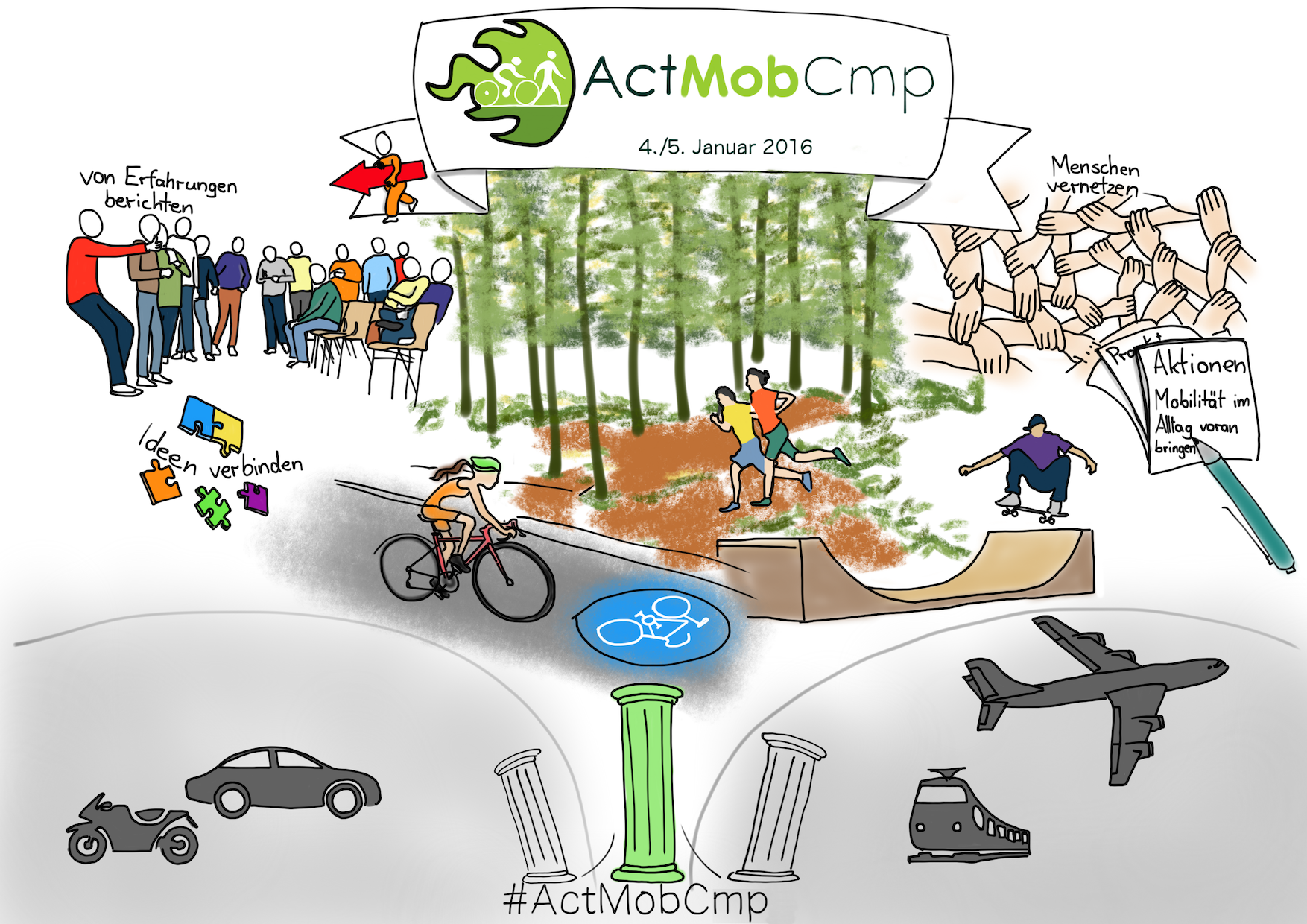
Click to scale up.
“Active Mobility in everyday life” is the third column of mobility, besides individual motorized traffic and public transportation. Unfortunately, it is often considered no more than the leftovers, both in society and politics.
We promise:
AktMobCmp will be a great barcamp that takes place at a rather uncontested time! We will experience two special days in the company of people we like to meet between January, 4th and 5th, 2016 at Unterhaching.That hurts, and we have to change it. Because we have to rationalize our mobility in order to preserve our future resources!
Many thanks to Christian and Daniel for their huge support!
RMD
(In the name of the AktMobCmp team/translated by EG)
P.S.
Here are two IF Blog links for articles on AktMob and AktMobCmp. And since it is such an important topic, I would invite you to share and re-tweet!
Roland DürreSunday October 4th, 2015
I am not a hero.
After my Angry article, there is the question:
So what is my contribution?
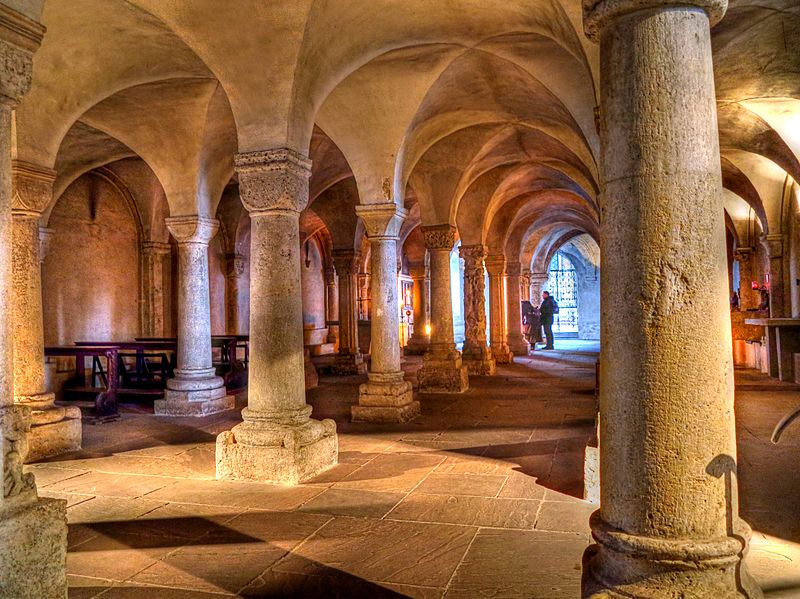
Crypt of the Freising Cathedral
For me, philosophy is something like the science of living. I think of Seneca. A long time ago, he said to his students:
Philosophy teaches you to act, not to talk.
Consequently, the angry person, too, should see if his actions speak the same language as his words. And I must admit that I am not satisfied with the outcome of my self-analysis.
To be sure, I try to leave the social norms and patterns I so criticize. And, where possible, I also try to initiate change. But is that enough?
Far too often, I realize how I am trapped in my bourgeoisie. My trainers, among others, were my parents and my teachers. Numbers of system agents tried to form me according to what they thought I should become and tell me where to go and what to do. Morals and an extremely capitalist consumption-oriented society already influence me massively on a daily basis.
Regardless, I hope I am one of those persons who basically to not consider our “trained lives” unavoidable. At least, I always tried to flee the reins of the aforementioned animal tamers. And already I feel better. But what I do is not enough. To be sure, I no longer go places by car. But then, that is something you could almost call egoism. After all, I am now suddenly a lot more mobile and free than I ever was before. And through this change and (allegedly) these restrictions, my life has become a better life. That certainly helps when it comes to thinking new thoughts.
Looking upon my own generation, it truly gives me pause to see how many of my companions never knew anything other than being trapped in their emotional jails. I know people who, in their entire lives, obediently believed all nonsense that was ever dished out to them. They actually relinquished their autonomy in small portions for the sake of being comfortable.
Others never once in their lives, when at a point of bifurcation in their lives, followed the motto “love it, change it or leave it“ . As a consequence, they were made to feel smaller and smaller. Regardless, today they think they are the most important thing in the universe, live their status and drown in their anxiety. The constant fear of losing what they own makes them inhuman. They seem to have forgotten that they, too, are just mortal beings.
I am fed up with following the nonsense of this society. In the coming years, I want to do more. So I was looking for models. I already found one: Carl Amery. I find his life and work impressive. I think he was a true hero.
Unfortunately, I am not a hero. But who knows, perhaps in the future…
RMD
(Translated by EG)
P.S.
I took the picture from Wikipedia. It is the illustration of the article on Carl Amery (real name: Christian Anton Mayer), originally by Richard Huber.
Roland DürreSaturday October 3rd, 2015
Angry!
 Once in a while, I get really angry. The last time this happened was during a forum. It was about “un-schooling”. The system of collective (federal) schools was judged to be the only appropriate variant of teaching and “education” for young persons and “un-schooling” was said to be socially inacceptable.
There are other statements I also very much object to. For instance, I see red when I hear
THAT
- We have to produce weapons.
- Lobbyism is a necessary part of our economy.
- A speed-limit would ruin said economy.
- Concerns have to make maximum profit.
- There is no alternative to constant growth.
- Dismissal protection cannot be abolished.
- It is total nonsense to think about a “UBI” (unconditional basic income, instead of all the social subsidies).
- BND and the Federal Office for the Protection of the Constitution are absolutely important and necessary.
- Total transparency and openness in society and software is not possible.
- There is no alternative to patents and copyright.
- The climate catastrophe is just an invention of green nerds.
- You have to tolerate both circumcision
- And the suppression of women
- …
But back to the school discussion: if some people shun classic systems such as the school system, then this is, for me, the last and as I fear eventually unsuccessful attempt of individual persons to flee from a world I actually do not like at all..
I MEAN A WORLD
- Where people, both individually and collectively, act in a way I disapprove of;
- Where stupidity always wins and where I get the impression that it is not possible to be so stupid unless you act as a group (see also Dueck – Schwarmdumm),
- Where few of us actually get far too much warmth and calories, yet others get nothing – which means everything is taken from all of us;
- Where they tell us we are omnipotent, yet de facto there is the permanent attempt at total manipulation;
- Where they try to take away our freedom and to convert us into becoming servants fitting the system;
- Where nobody likes you if you critically ask “why”;
- Where the question “what profit can I make from this?” is the motivating factor for all our actions;
- That tries to make unequal things equal;
- That tries to discourage us from being creative;
- That dissuades us from believing in utopia;
- Where all you hear all the time is “it cannot be done, anyway”, “this is how we always did it” and “yes, but…”;
- Where, from earliest childhood on, we are accused of being “guilty”, regardless of the fact that our brains are not all built to know how to deal with such accusations;
- Where everybody talks about eye-level, sharing, participation, respect, tolerance, civil courage, … but
- Where every attempt at autonomy is first and foremost punished;
- Where invitations to “give more than you take” and to “remain true to yourself” sound like mockery;
- Where, as a matter of course, you make others feel smaller, rather than bigger;
- Where rules from the natural sciences are welcome as long as they are useful, but abhorred when they clash with what we want.
- …
In evolutional theory, they say that matters will only change when the old generation dies out. Consequently, I have all the respect in the world for parents who take responsibility and decide to teach their own children. These days, such a pledge in favour of the family is scarce. And to do so, you have to focus on the important things in life and to forego many luxuries.
Isn’t it a lot easier and more comfortable to put children (incidentally, the same is true for the elderly) into storage? To be sure, sooner or later the parents will bow under the pressure of the school. They will become aliens in the eyes of their own children and eventually even turn into the agents of the system “school” – against the interests and wishes of their own children.
This means that the variants of “un-schooling”, “no-schooling” and “home-schooling” are not arrogant or uppity, but revolutionary. In fact, we need this kind of courage to replace thoughtless following in many other areas of our lives (nutrition, leisure time, life style, …). Just like we need the willingness to make “sacrifices” for our future and to work towards contentedness and happiness, rather than buying it.
For a good “un-schooling”, you have to give your children much. Especially the most precious commodity you have: time. It is scarce. It also takes a lot of time to change your own life. Consequently, time is something we should not waste. And we have to distance ourselves from what they want to sell us as desirable.
Abstinence takes an effort. Yet abstinence is probably the first counter-measure against being controlled by others. You can easily be heading towards disaster if your life is controlled by others. Perhaps it is even harder for lonely persons to find their own lives.
It is well worth trying to flee the formatting of a perverse society. We humans have spent enough time letting others turn us into trained monkeys. It was especially perverse during the long 19th century. Enlightenment can only have been a first step. It brought us peace and freedom, but also war and destruction.
Well, for me this means more than ever that we need a second enlightenment. And we have to continue dreaming our utopian dreams of a soft and violence-free world without “punishment” and “revenge”.
Thank you very much!
RMD
(Translated by EG)
P.S.
Incidentally, in Germany, the “un-schooling” discussion is beside the point. As opposed to other European countries, it is explicitly forbidden by law. Regardless of the EU and all the bureaucracy that comes with it…
Roland DürreWednesday September 30th, 2015
#Breaking with Patterns II – Communication
In preparation of the Dornbirn PM Camp on November, 20th and 21st, we installed a blog parade on #breaking with patterns: here is my second article on this topic:

Teletype Machine (Siemens T100) – introduced in 1958. It was the modern successor of the T50.
So far, it looked to me like I was a #de-cruster. Perhaps I am also a #pattern breaker. After all, I no longer go places by car, using the bike instead. And, especially in winter, this is unbelievable for many of the persons I meet.
And whenever I do not have enough coat hangers, I throw away some of my clothes, instead of buying new coat hangers. Those and many more are the kinds of things I do.
But then, perhaps I am not breaking patterns at all, instead being trendy like everybody else? For instance when it comes to using the telephone. Because I have now come to that stage where I have completely reduced calling people. In fact, I find it impolite to inconvenience other people by calling them. And, of course, it is also because I, myself do not wish to be interrupted all the time by receiving a call.
Here is my personal “telephone history“:
I used to be a true “multi telephone person”. When InterFace connection was still very young, I spent a lot of my time with customers. Consequently, I always spent an hour in the middle of the day calling the company. And since I never use a customer’s telephone for my own purposes, I always had to go downstairs and use the public phone booth.
In those days, I also discovered the C network. However, it was expensive, you needed an extensive installation process and the network itself was as limited in its availability as its quality was poor. Besides, I always wanted to be able to totally focus on the person at the other end when having a telephone conversation. Consequently, I never used a car telephone; later, too, calling someone from the car was only the absolute ”ultima ratio“.
In the times of public phone booths, I always had a sack of change on me. Later, I always had a number of telephone cards in my briefcase. And, as soon as the D network came, I immediately had a cell phone. My fees were extremely high.
Now, I find it harder and harder to come up with good reasons and situations where I absolutely have to use a telephone. For instance after having made an appointment with someone to meet at the central train station and already having found a nice place to sit for me and my travelling companion. Then I will call him. But only if he has no Whats up, BBM or other messenger. When all is said and done, the only time when you actually need it is for the emergency call – when the murderer approaches.…
Consequently, I no longer call people. Because if there is something really important I wish to discuss with someone, then I want to do it in a leisurely fashion. Once in a while, I also want to have five minutes to prepare for a conversation. I want to see his face. If this is even possible across continents, then why should I not make use of the opportunity.
Consequently, I make an appointment with my business partner. As soon as possible and preferably through social media. If no other way is possible, then with an email dialogue. Then I will enter “video conference” in my calendar and all will – at least if it is a hangout – be initiated automatically. If the person at the opposite end does not like google, I take Skype (Microsoft) or FaceTime (Apple). If my partner likes neither Microsoft nor Apple (which is something I can easily identify with), then there are enough other alternatives.
The entire conversation will also be much pleasanter. I comfortably sit on my sofa, my chrome book is lying on my lap and my conversation partner’s friendly and smiling face can be seen on my screen. I need no headphones (and also need not press a telephone against my ear), can simultaneously formulate something with him on shared documents (perhaps for resulting notes – also called minutes), we can look at and process tables together and we can look for and show each other an image, and much more.
🙂 No – teletype machines, fax machines, telephones – those are devices we no longer need…
Doesn’t this also have something to do with “breaking with patterns”?
RMD
(Translated by EG)
P.S.
The pictures shows a teletype machine by Siemens. It is a model T100, the table version. As far as I know there was also the model T100o – but that was it.
This mechanical teletype machine had a modular structure, which means it could be added to. On the left side, you see a tape perforator for generating perforated tape. Underneath, the transparent container for the cut-out material. On the right, you can see the optional perforated tape reader, which made it possible to send pre-written messages with maximum speed. On the basic device, you can see a red note about the update to 75 Baud above the active-hours counter.
After a certain running time, the teletype machines used and rented by the Deutsche Bundespost were completely disassembled at the FZZA Elmshorn and then newly reassembled. The blank key has the switch between letters and digits on the left and right sides, which is necessary because of the Baudot-Code with only five Bit (CCITT5). The paper is an endless roll, perhaps a self-copying paper with a copy since there is a slightly crooked grey intermediate layer.
Source: Wikipedia – you can find the image under the GNU licence for free documentation ,Version 1.2 or a later version. Published by the Free Software Foundation,
Roland DürreSunday September 27th, 2015
“Breaking with Patterns” at Dornbirn PM Camp #PMCampDOR
 Now there are less than two months to go until the DornbirnPM-Camp on November, 20th and 21st. I already look forward to the meeting on the eve of the camp and the Camp itself.
This is already the
5th PM Camp in Dornbirn, PM-Camp celebrates an anniversary!
How fast time goes by! With Dornbirn, we close a great PM Camp year 2015. This year, we had wonderful PM camps – in Stuttgart, Zürich, Bad Homburg, München, Berlin, Karlsruhe, Barcelona and Vienna. I hope I did not forget any.
Again, the Dornbirn organizational team wants to host a very special PM Camp. In fact, the standards are extremely high this year. As a metaphor for Dornbirn, we chose “BREAKING WITH PATTERNS”. Since, to me, it seems a very good idea to change and rethink, I voted in favour of this motto.
During the last few days, I had to learn that “BREAKING WITH PATTERNS” has become accepted. In fact, it has even become hype. I found it in the program of workshops of Bavarian school directors, came upon it on story-telling exercises and it winds its way through the media like a hurricane. There is a nice Blog-Parade on the PM Camp with an anchor to the beautiful blog Experiencing Leadership (Führung-Erfahren) by Marcus.
Consequently, I now already heard and read a lot of wise things about it. Yet I am still not able to form my own opinion. Because in order to break with patterns, you probably will first have to see them. Also, it is quite possible that collectively valid patterns will generate individual habits. And it is always hard to change what you have come to love. More often than not, you hear and read: “We always did it in this way”. Well, after all, this is how we always did it, isn’t it? And now someone expects us to do it differently? That is hard.
But perhaps it is quite easy. Perhaps what you should do first and foremost is “turn things upside down”?
Here is an example:
There is an unwritten law in our “free-economy-society” that something gets less expensive the more of it is bought. This is even true for material that will become scarce in the foreseeable future and will eventually no longer be available, such as crude oil. The same is true for electricity or food. If you buy ten cars (or bicycles), you will get a better price than if you only buy one. It is called quantity discount, quantity rabat or quantity bonus.
Now let us look at the connection between the “climate” and “flying”. There is no doubt that air traffic generates an immense amount of greenhouse gas. Even in higher altitudes – where their detrimental effect is even higher than on the ground – huge amounts are ejected.
It is the goal of the airline industry to bring as many persons as possible into the plane by offering low prices. On the other hand, the models and calculations of various scientific disciplines agree in that they say global warming with the resulting change in living conditions for all of us will hugely depend on how we behave (in terms of burning fossil energy).
Consequently, it is clear for everybody – at least all those who do not believe in superstition – that, among other things, we have to fly less if we wish to cushion the downfall into the (climate) catastrophe at least a little bit. We have a discrepancy. We want to fly more because we need growth (which would actually be a second pattern to break with). Everywhere. And we should fly less. For our future.
So how to solve this dilemma?
A common and total ban of flying cannot be realized. In fact, for persons in special situations, it would actually not be just and reasonable. But then, the question is if the consequences of the climate catastrophe will be just and reasonable, isn’t it?
A common increase in flight prices would perhaps be asocial. Here is what a simple solution could look like: We turn the law of quantity rabat around and introduce a new law: the quantity malus. That would mean all citizens can fly a few thousand miles each year at prices similar to those we are now used to. As soon as the “flight buyer” has reached this limit, every extra mile will be more expensive. Maybe even geometrically more expensive. This would enable us to, on the one hand, maintain a realistic mobility, yet put the lid on at least the worst excess. And the extra money could be invested in reasonable progress.
The same pattern would, for instance, also make sense with electrical energy. Why should a company producing aluminium tins for beer and using up astronomically high amounts of electrical energy get it for a much lower price than the small one-family household that uses up almost no electric energy?
It would be better if this industrial waste were more expensive than the little used up in a household, wouldn’t it? This would not only lower the consumption cost pressure, but also cause human creativity to tackle (possible) solutions to such central problems. More often than not, better technology is already available, except that it is not used because the raw material is so much less expensive.
Why don’t we start by “putting things upside down”? I can imagine that “breaking with patterns” means a lot more than this, too. We are lucky to still have a bit of time to think about it until the PM Camp starts.
RMD
(Translated by EG)
Roland DürreThursday September 24th, 2015
Visit the Arcis-Vocalisten! Dates.
 I already advertised a few of the Arcis-Vocalisten concerts. Evelyn, who always helps me so much, sings in this choir with great enthusiasm. And she keeps telling me about all those nice concerts. And when I myself heard them sing, I was also truly impressed!
This is also why, here in the IF Blog, I so readily advertise this great choir under Professor Thomas Gropper, without whom the group definitely would neither exist nor continue to exist. And since this kind of enthusiasm is exactly what makes life worth living, I would like to take this opportunity and thank both the conductor and all singers of the Arcis-Vocalisten for everything they do just because they so much enjoy singing.
Here is a list of the next concerts this remarkable ensemble will sing:
Summary:
The new season will start with Giuseppe Verdi’s dramatic Requiem. Other highlights of the season are the Christmas Oratorio by Bach and St. John’s Passion by the same composer, both in the Munich Herkulessaal. Next spring, they will, again under the direction of Dieter Reuscher show a scenic performance Belshazzar by Händel. Besides, the choir will give concerts with an a-cappella program in Stuttgart and Tübingen, before traditionally closing the season with a Brunnenhof Munich concert: this time you can hear Haydn’s “Creation”.
The Concerts:
G. Verdi
Messa da Requiem
Thomas Gropper, director.
Sunday, November, 15th, 2015, 19:00 hours, Herkulessaal der Münchner Residenz
(Organizer: Bell’Arte Konzertdirektion GmbH)
J. S. Bach
Christmas Oratorio I-III, VI
Baroque Orchestra L’Arpa Festante
Thomas Gropper, director.
Tuesday, December, 22nd, 2015, 20:00 hours, Herkulessaal der Münchner Residenz
(Organizer: Bell’Arte Konzertdirektion GmbH)
H. Schütz, St. John’s Passion
J. Bahms, Warum ist das Licht gegeben den Mühseligen
Thomas Gropper, director
Sunday, March, 6th, 2016, 19:00 hours, Wallfahrtskirche St. Rasso, Grafrath
(Organizer: Kulturverein St. Rasso e.V.)
J. S. Bach
St. John’s Passion
Baroque Orchestra L’Arpa Festante
Thomas Gropper, director
Good Friday, March, 25th, 2016, 18:00 hours, Herkulessaal der Münchner Residenz
(Organizer: Bell’Arte Konzertdirektion GmbH)
G. F. Händel
Belshazzar (scenic performance)
Baroque Orchestra L’Arpa Festante
Thomas Gropper, director
Dieter Reuscher, stage director
Saturday, May, 7th, 2016, Himmelfahrtskirche München-Sendling
Sunday, May, 8th, 2016, Himmelfahrtskirche München-Sendling
J. G. Rheinberger, Missa in F-Major, op. 117
J. Brahms, Motets op.74
M. Fritz, De tranquillitate animi (June, 24th, 2016., debut performance)
Thomas Gropper, director
Friday, June, 17th, 2016, 19:00 hours, “Stunde der Kirchenmusik“, Stiftskirche Stuttgart
(Organizer: Stiftsmusik Stuttgart)
Saturday, June, 18th, 2016, 20:00 hours, ”Tübinger Motette“, Stiftskirche Tübingen
(Organizer: Stiftskirche Tübingen)
Friday, June, 24th, 2016, 20:00 hours, Himmelfahrtskirche München-Sendling
J. Haydn
The Creation
Baroque Orchestra L`Arpa Festante
Thomas Gropper, director
Saturday, August, 6th, 2016, 20:00 hours, Brunnenhof der Residenz, München
(Organizer: Bell’Arte Konzertdirektion GmbH)
What a remarkable program! I am sure there is something in here for everybody. So why don’t you mark a few dates in your calendar?
RMD
For the concert data, see also the Arcis-Vocalisten website.
Roland DürreWednesday September 23rd, 2015
DIESEL-GATE
 The mountain was in labour and brought to life a new word: DIESELGATE!
The German stock plummets, a managing director who was considered sacrosanct fell. In all magazines and media, you can read about it. You get the impression that something really bad must have happened to the German economy.
As I see it, this is true. Except that, so far, I read nowhere about the aspect I mean. Consequently, I will write about Diesel-Gate, because it seems to me that, again, a barrier was pulled down.
Mind you, it is not like I would not have put it beyond the automobile sector that they are capable of this kind of fraud. In fact, I no longer trust any sector. We know what banks do. In the pharmaceutical industry, you constantly get medicine that, at the time it is officially permitted onto the market, is certified to have a great healing effect and no side-effects to speak of. And later you find out that the exact opposite is true.
It is well-known that oil enterprises have very dirty hands. We also know that the food industry is no better. And even I know that my own sector, the IT, is not clean, either. Just remember with how much love spams and viruses are protected, just in order to sell servers and other hardware that is used for total nonsense.
No, the fact that the industry in general not only controls and misuses politics through lobbyism, that it manipulates through advertising and that it also is fraudulent once in a while is something everyone knows. For me, that would not be a reason to write this article.
However, as I see this case of “manipulation” with the software, a threshold was crossed in this case. I put the term “manipulation” between quotes because it actually was no manipulation. Instead, it was a very goal-oriented development – I am sure it was specified in the to-do-list and they also determined test methods for the “V-Model” or similiar.
No. What we are talking here is fraud functions voluntarily implemented into the professional control software. With the goal of deceiving another technology in order to fake something that is technologically not possible at this time.
Some way or other, I used to believe that there is a digital extension of analogous honesty. I trusted that control software of mechatronic (analogous-digital) systems will not be used for fraud. Now this trust has been categorically abused.
Consequently, the new dishonesty has now reached a dimension I had so far not registered, even in the software industry. And now my – perhaps naïve – trust in technologic-digital technology is gone.
RMD
(Translated by EG)
P.S.
Incidentally, this event is also an additional reason why one should massively demand the laying-open of all software.
Roland Dürre
Stories-Meal – Very Old and Totally Modern.
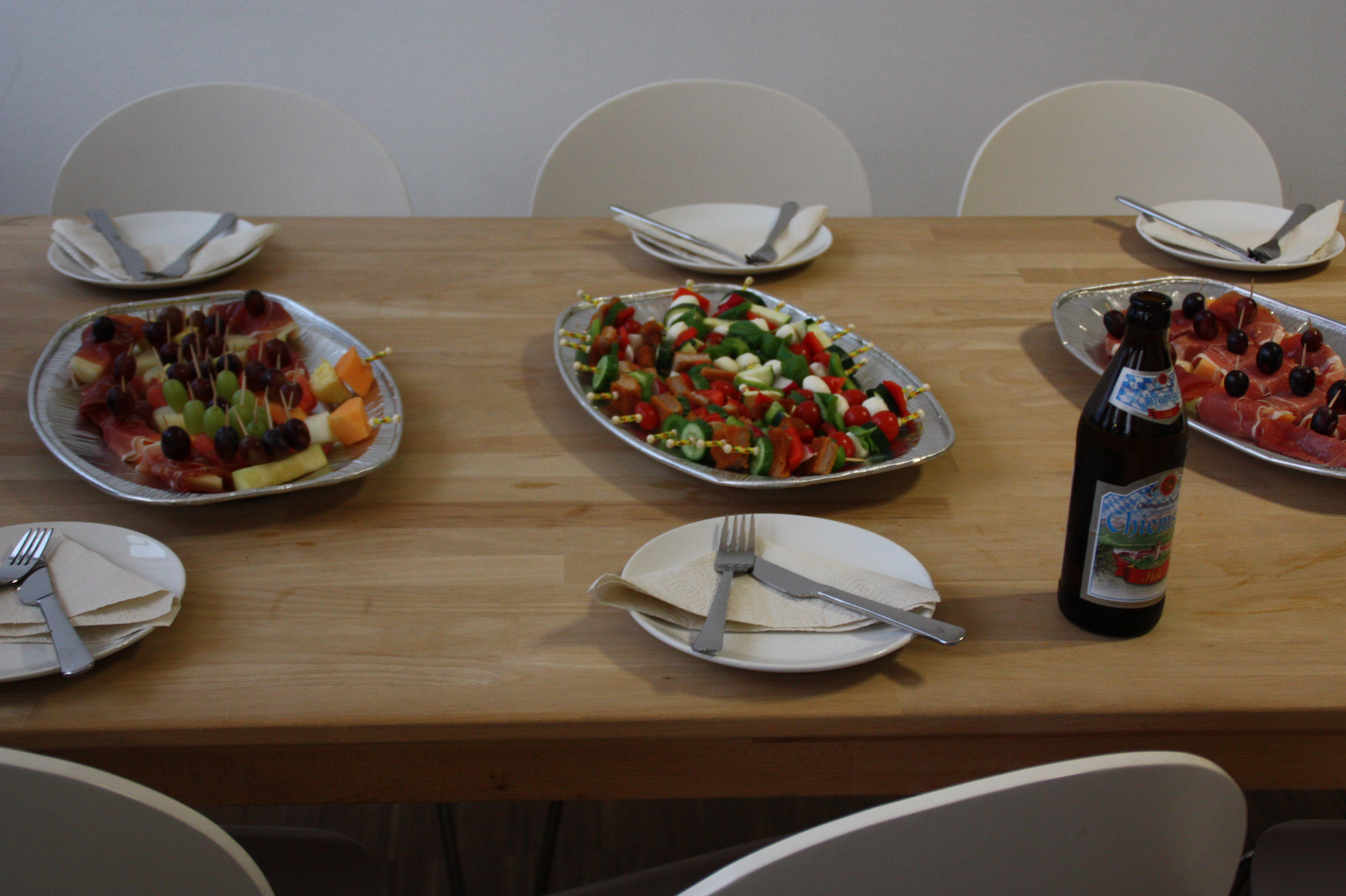
Very simple, but extremely delicious – the food at “Stories-Meal”.
Katrin Frische and Sacha Storz had invited us to a “Stories-Meal“ (Erzähl-Mahl) in the offices of TechDivision. I like both, so I gladly went.
Another reason to go was that the TechDivision is well-known for regularly nice events happening in their offices – sometimes the background of these events is more on the technological side, sometimes more on the social side. The last time I was there was during a “Munich Web-Week” on an agile topic.
A “stories-meal” is a little like an ancient Greek symposium where everybody is busy “comfortably and socially drinking”. Even the ancient Greeks enjoyed mental pleasures of discourse and debate, and perhaps even a little more of the good wine, both during and after the meal. In other words: at a symposium, you were eating and drinking well and enjoying life. And at the same time, you were being philosophical and seeking wisdom.
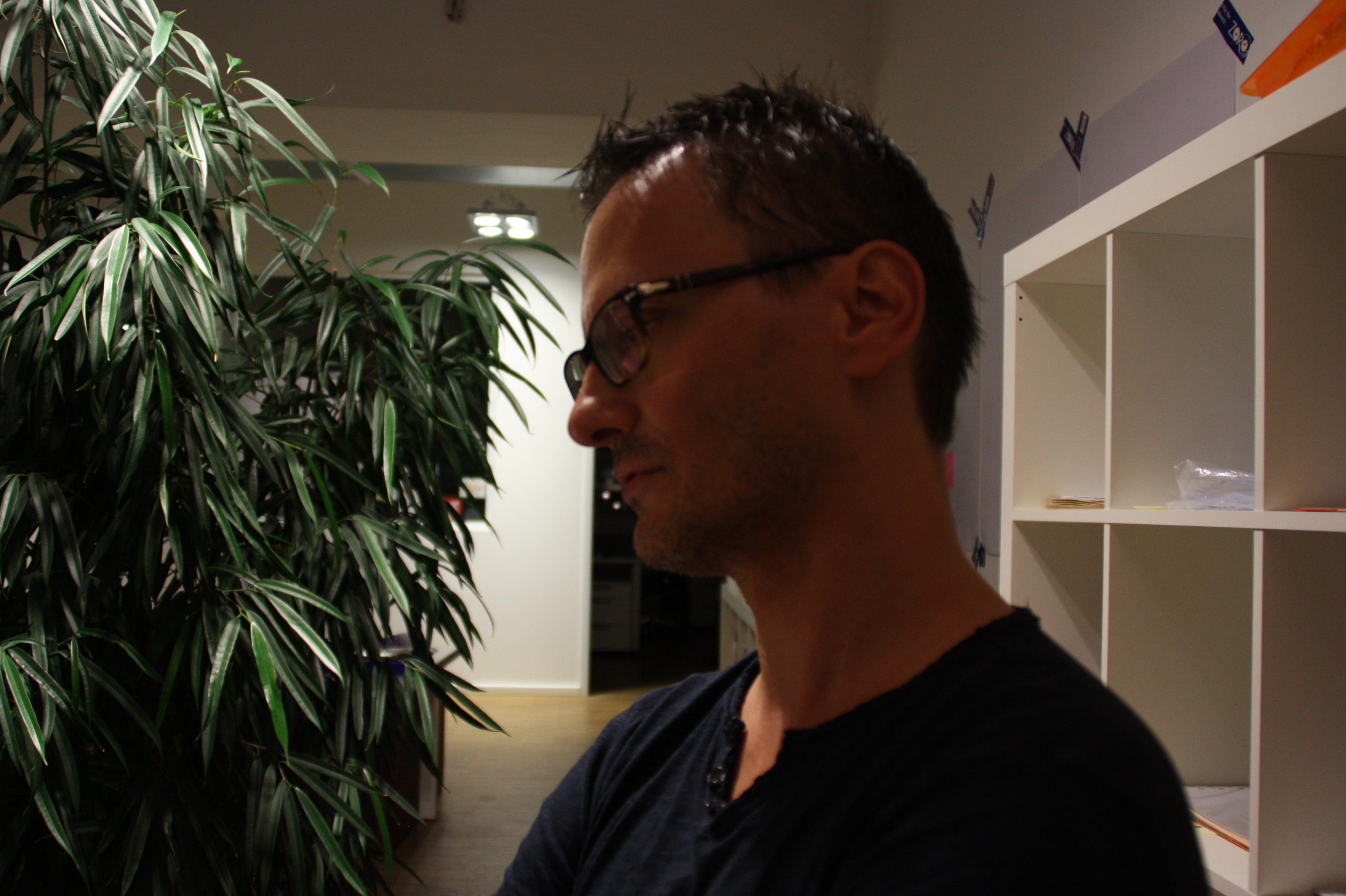
Sacha – our host in the beautiful TechDivision house on the Balan Strasse.
The “Stories-Meal” is a lot more sedate than a symposium and promotes an ancient culture of communication that goes as far back as the times of hunters and gatherers. Like in those ancient days around the camp-fire, the people tell each other stories. And according to our moderator Katrin, it is actually not about debating and discussing things. Instead, it is about listening and relating.
Our “stories-meal”, too, was only full of nice things. The delicious food prepared by Katrin was supplemented by a huge variety of soft drinks and a number of beer brands from the TechDivision refrigerator. It was like paradise.
We were only seven, because three of the guests who had already registered could not flee from their everyday-stress, after all, and had to cancel. If only they knew what they missed! For the remaining participants, it was so much the nicer and more exciting.
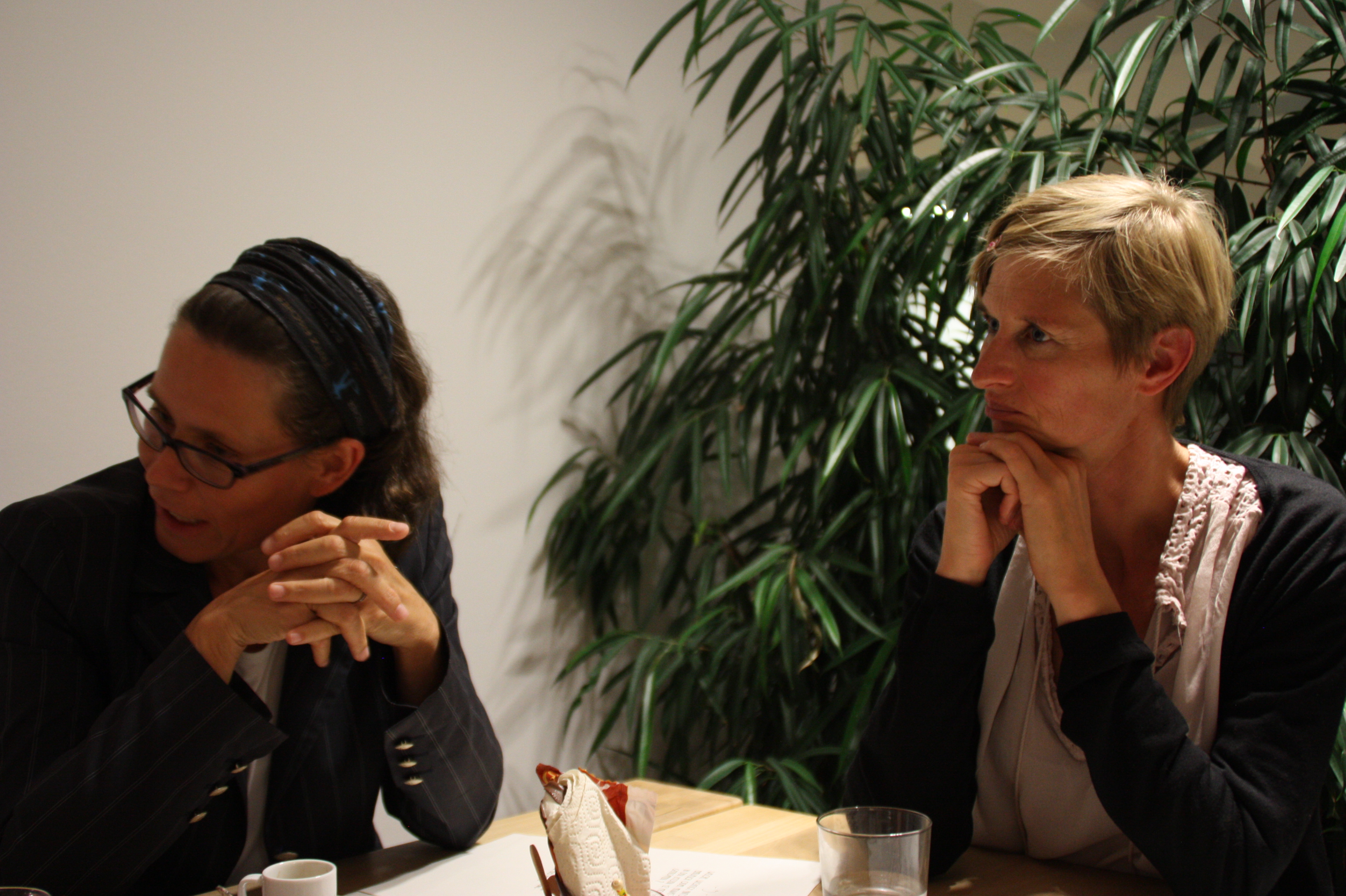
On the right, you can see Katrin listening, moderating and actively participating.
Katrin had prepared six wise questions on three sheets of paper. You could almost say she composed them. Two questions per sheet constituted a couple, so you got a triangle of topics. There were three to six catchwords with hyphens for each question, all of which was to make us thoughtful.
Let me tell you one of the pairs of questions – questions three and four, along with the catchwords:
Question #3:
WHAT IMPORTANT DECISIONS – PROFESSIONAL OR PRIVATE – DID YOU MAKE IN THE LAST TWELVE MONTHS?
Think about:
VALUES UNDERLYING THIS DECISION – CONSEQUENCES – INFLUENCE ON OTHER PERSONS
or
Question #4
WHAT IS THERE STILL IN YOUR LIFE YOU WOULD LIKE TO DO?
Think about:
YOUR VALUES – YOUR RED THREAD – IMPACT – DOING THE RIGHT THING – VOCATION – MEANING OF YOUR LIFE
I will not tell you more than this. After all, we want to keep up a little of the suspense. But it can be concluded:
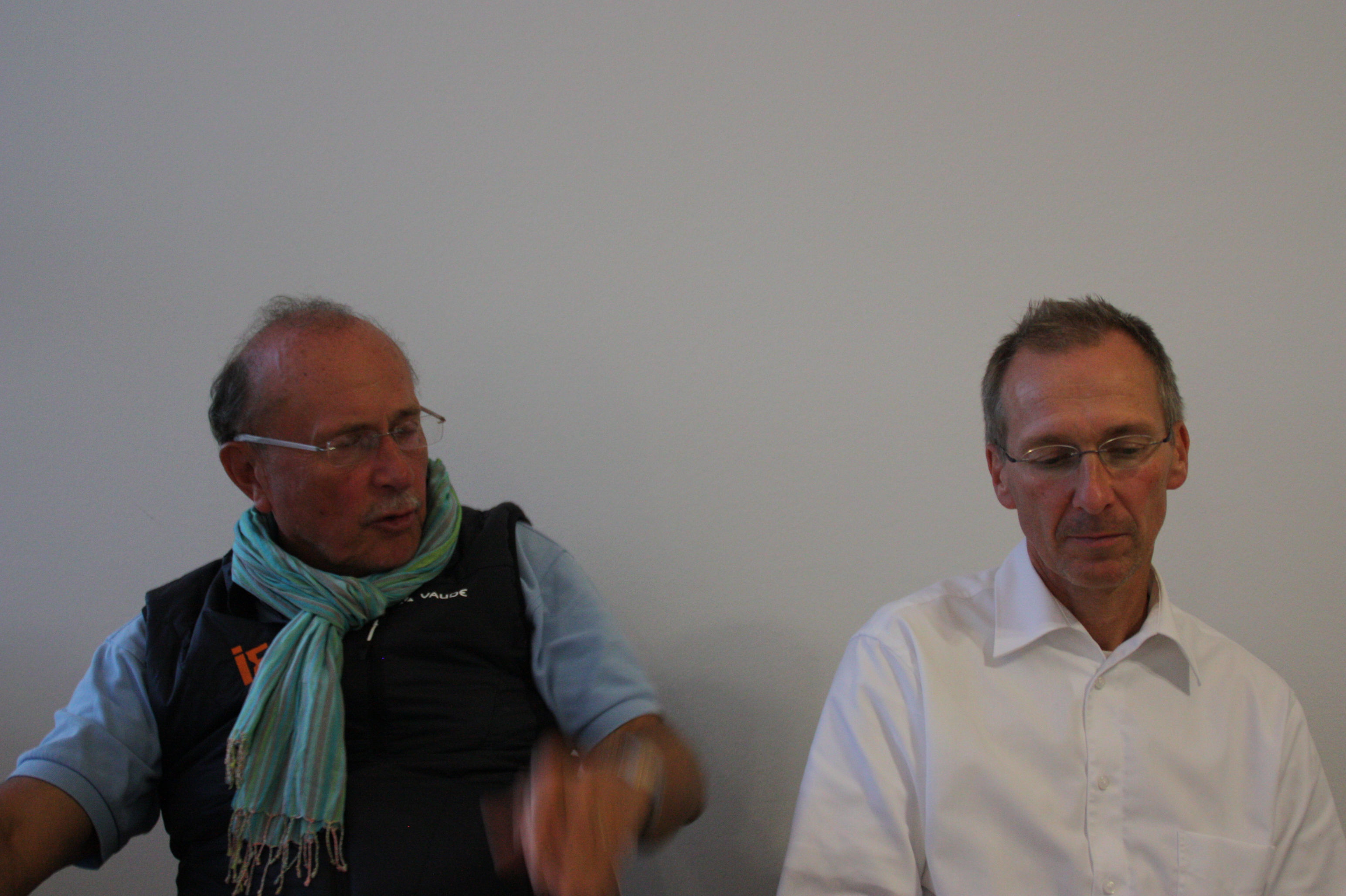
Carsten, my neighbour, too, is listening attentively.
It was a very successful evening. Inside me, it moved a lot. I would like to thank all the participants who, during this evening, gave me so much with their stories.
For me, the “Stories-Meal” turned into a “Think-Meal”. Because the many stimulating reports told from a different perspective really made me thoughtful. Consequently, I also told a lot about myself – and learned to understand more about myself in the process.
It was a very private evening. It was dominated by a huge amount of sympathy and – I would almost say a special development of empathy.
Und I am quite sure that this will not have been the last time I attended a “Story-Meal” at Katrin’s.
RMD
(Translated by EG9
Klaus HnilicaTuesday September 22nd, 2015
Is ‘Social Justice‘ just a Misunderstanding?
Yes – if we continue to hold onto what we have been considering the definition so far! /1/
According to this definition, everybody, strangely, thinks him- or herself socially just yet at the same time laments about the growing injustice in this world.
It seems that this discrepancy is insurmountable.
 We are simply too much in love with our unclear terminologies. In fact, we actually wallow in the concept that ‘social justice‘ has to be some kind of ‘moral, egg-laying wool-milk-sow‘, rather than just a minimum standard for human behaviour consisting just a few rules even evil persons have to stick by!
If, however, we accept this definition, we soon find out that ‘social justice‘ tends to have little in common with ‘romantic equality‘. Instead, it has a lot to do with not-so romantic ‘voluntariness‘. And that this is why politics in general have an inherent structural problem when it comes to generating ‘social justice‘, even if it very industriously tries to find and remove ‘legal loopholes‘. It is easy to show this in three steps. All you have to point out is:
A) the common principle of ‘exchange justice‘,
B) the principle of ‘equal treatment and equality of results‘ and
C) the particularly apparent ‘distribution justice‘.
Let us take a closer look at all three of them:
A) After all, we basically have a very special form of ‘exchange justice’ when, in the name of ‘social justice‘, people demand fair prices and fair incomes!
For instance when it comes to: here the aromatic Alp Butter, there the ridiculous one-euro-eighty; or here the super manuscript and there the low fee. If we were to demand ‘equality of values‘, then we would need the general ‘principle of exchange justice‘! But how to objectively determine this ‘equality of values‘ for every individual exchange process?
For instance: would one ounce of gold be too much for a bucket of water in the Sahara if it means the difference between life and death? And are 50 cents too much for two litres of milk if someone has a lactose incompatibility? Or what is the adequate fee for a manuscript which, later, will only be pushed underneath the one too short table leg?
Doesn’t this mean that the ‘evaluation‘ of an exchange object is by nature a very subjective thing and that this value has nothing to do with equality? Especially since said exchange only takes place because all the parties concerned see the object of exchange differently, which is why each considers his own deal profitable.
Naturally, this ‘exchange profit‘ is just as unprovable as the ‘exchange value‘; but it is also clear that any profit can only exist and be proved if the exchange has been voluntary! Which means that an exchange is always ‘socially just‘ if none of the parties concerned has been forced to accept it!
Of course, this voluntariness in an ‘exchange‘ does not guarantee that both parties can get what they hoped to achieve. Neither is it a protection against erroneous decisions, such as for instance the imprudent purchase of low-price milk regardless of lactose incompatibility. But this is not necessary, either. Because the evaluation of the ‘exchange profit‘ is subjective, which means that it cannot later be forced into a wrong equality measurement just because someone had erroneously and intuitively assumed that this ‘equality‘ in an ‘exchange profit‘ is closely related to ‘social justice‘!
Consequently, we can conclude that prices and incomes are always socially just when they can be accepted without one of the parties having been forced to accept!
B) Now let us discuss the allegedly socially just ‘equal treatment and equality of results‘!
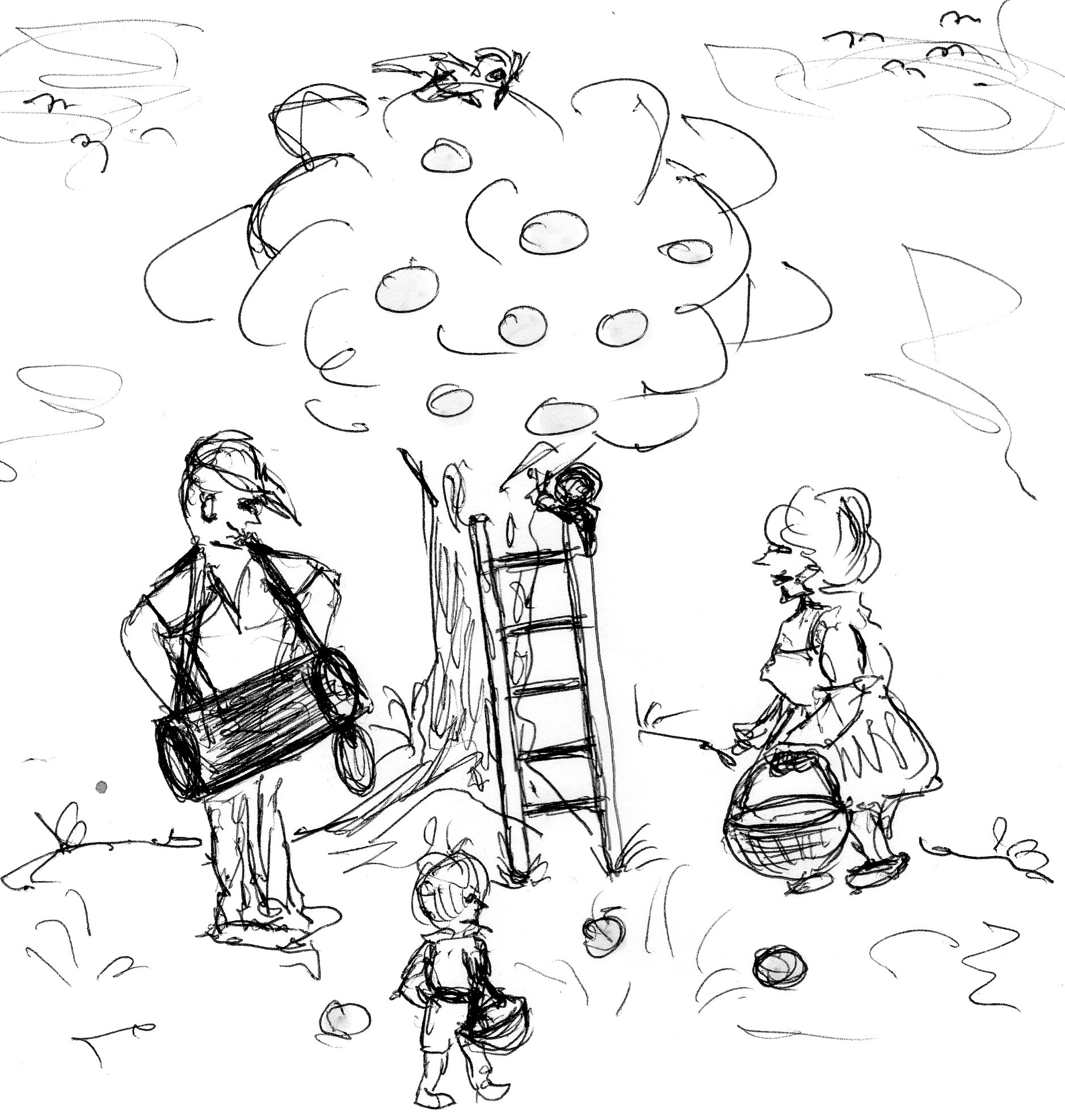
Again, our equality mania brings us into a similar logical one-way road, as can be easily shown with a simple example: If, under the aspect of equality, you ask a retired lady, a sportsman and a six-year old boy to pluck apples from a four metre high apple tree with a ladder standing at its trunk, you will get considerably different results; the help you will have to give will, indeed, be rather diverse, before all three candidates will have plucked the same amount of apples – which means they have equal results.
Since, however, there are no two identical individuals on this earth, you will never get equal results if you treat them equally, and vice versa!
And regardless of this fact being absolutely obvious, we keep demanding equality along with social justice. But if equality were really socially just, then the state of affairs where all persons are poorly off would, according to justice theory, be the best that could happen, wouldn’t it?
Luckily, nobody believes this! But still we insist that the logical consequence cannot be to stop seeing equality as a manifestation of social justice.
C) The tendency towards equalization is particularly apparent when it comes to discussions about ‘fair distribution’!
To distribute something means to hand out from a supply. Fair distribution demands that this has to done following certain rules. However, the fairness is most obvious when the owner does the distributing him- or herself, because then it is his or her will alone that counts. To be sure, it might be reasonable to consider the expectations of third parties, but that is not demanded by social justice! Social justice is served by the protection of ownership rights.
But it gets truly difficult when you cannot clearly define ownership, as it is the case with all political systems because the spheres of interests of the distributors and the recipients will often be identical. Conflicts are unavoidable and the ‘just solution‘ of said conflicts are not just a theoretical challenge, but mostly no more than a noble goal!
Compared to this, private persons and enterprises have a rather easy life, don’t’ they? All they have to do is not cheat, not steal, not use violence and not break contracts – and already they are just. They need not abide by more rules than that!
When all is said and done, this consideration not only generates a theory of justice, but also a surprising solution for economic and social politics: why not move as many decisions as possible to the private sector – since this is where you have clear and, according to what has been stated above, ‘socially just‘ circumstances?
Well, I assume this will remain wishful thinking, because many will still refuse to abandon the inacceptable ‘equality saturated‘ definition of justice! And they will be even less willing to forego the potential increase in power derived from this ‘usurpatory definition of equality‘!
KH
/1/ Dagmar Schulze Heuling; „Was Gerechtigkeit nicht ist“; Nomos – Verlag Baden – Baden
Roland DürreMonday September 21st, 2015
IF Forum on October, 29th, 2015 – Dr. Andreas Zeuch – The Democratic Enterprise
ALL POWER TO NOBODY LIVE EXPERIENCE!
Now About:
All Power to Nobody! LIVE!
 All Power to Nobody – that is the motto proclaimed by Dr. Andreas Zeuch. In his new book, which was published on September, 8th of this year, he discusses “entrepreneurial democracy” at great length. And it certainly is not a theoretical pamphlet, but an exciting report full of life. I would call it a courageous and provocative work that is the exodus of quite a few prejudices.
I personally met Andreas at the 2014 Berlin PM Camp. He gave the impulse on the morning of the first day. His topic was “how much intuition can an enterprise stomach?”. This presentation was such an inspiration for me that I spent the entire morning with Andreas. Consequently, I missed all the first sessions of the PM Camp morning.
Here is some of what you can read in the preview:
Entrepreneurial democracy – is that the future of work-life, or the punchline of the week? Can enterprises be a democratic event at all, or will shared decision processes not disable the enterprise and cause bankruptcy? After all, we do not exclusively need captains, but also privates, don’t we?
What happens when a CEO is elected? If a bank abolishes all its hierarchical levels, if employees choose their own tasks or if the cleaning personnel gets a vote when innovations are discussed? Will chaos be the consequence, or will the inner motivation of all start blossoming?
Andreas Zeuch went on a journey and found enterprises that show that entrepreneurial democracy is a living and economically successful alternative of the centralized top-down system.
 As always, you can register for the IF Forum by sending an E-Mail. Again, I will be permitted to moderate and I already look forward to exciting discussions and nice conversations!
RMD
(Translated by EG)


