
Roland DürreSunday November 15th, 2015
The Day After The Paris Terror Attacks – At the Bakery in the Morning!

Our Putzbrunn bakery
On weekends, we enjoy the day and start it with a special breakfast. That is why I always ride my bike to the bakery, where you still get homemade pretzels.
I only know two bakeries in the south-east of Munich where this is still true. One of them is in Taufkirchen, the other in Putzbrunn. To get from my home in Neubiberg to the Schlank Bakery, I have to ride almost three kilometres. The Götz Bakery in Taufkirchen is around seven kilometres from home.
Both ways have nice cyclist’s paths. Especially if the weather is fine, riding to the bakery is a good way to begin the day. I pass baking houses. They warm up pretzels and other stuff. But that stuff is not tasty. Consequently, the shops are mostly empty. Using my two bakeries, on the other hand, I have to stand in the queue for quite some time (especially on weekends). Mostly, around thirty persons are ahead of me in the queue. And you can easily imagine how long it takes until they all have said what they want.
There is always quite a traffic chaos on the street in front of those two bakeries, caused by cars competing for parking places
Especially the elderly gentlemen and young ladies in their SUV-s know no mercy for humans and nature, just rolling over everything. You have to be careful where you park your bike. …
Yesterday (November, 14th, 2015) was the day after the Paris assaults and attacks. Again, I went to ride to the bakery. And I arrived around 9 a.m. – which is usually the worst time. And I was already prepared to have a long queue standing in front of me.
But no! No SUV-s! No cars on the parking places! Total quiet inside the shop. Everything looked deserted. And I was served immediately.
I spent the entire way back wondering what might have been the reason for this. But I could not come up with an explanation. Somehow or other, I never seem to think of what is most obvious!
Later, I called my friend Christian of VisualBrainDump. And I told him about this strange phenomenon. He knew the answer immediately:
Naturally, everybody is sitting in front of their TV sets today.
Well, that sounds absolutely plausible to me. Except I would never have thought of it. It is crass, isn’t it? Something happens in the world. And what do my dear fellow compatriots do? They leave their SUV-s in the garage and eagerly watch the sensational events on the nearest TV set.
This morning, Sunday, everything was back to normal and I was standing in the queue as always.
RMD
(Translated by EG)
Roland DürreThursday November 12th, 2015
The World’s Biggest Project?
Today (November, 12th, 2015), there was an SZ article about a mega project in the “knowledge” category. It was titled: “India links its rivers” and written by Robert Gast. Let me cite:
India links its rivers
In order to distribute the water reserves of the country more evenly, they plan to build 30 channels and 3,000 water reservoirs. It would necessitate moving half a million people.
As early as December, the Indian Government wants to promote the realization of a gigantic infra structure project. Over the next years, they plan to build 3,000 water reservoirs and 30 channels with a total length of 15,000 kilometres. For instance, they want to connect 37 rivers on the sub-continent. The project, which is assumed to cost more than 150 billion Euros, is a reaction to the fact that there is extremely much rain in some regions of India while other regions have extreme aridity. The west and north of the country regularly fight against floods, while the districts in the east and south of the sub-continent again and again suffer under the drought.
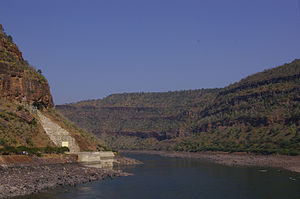 Consequently, India started as early as ten years ago making plans to connect the great rivers of the country. Also, they want to pond rivers, especially in the Himalaya region. This is how engineers want to store excess water and then transfer it to dry parts of the country. They plan to re-route 174 billion litres of water each year. Farmers could then work their fields in times of drought, as well, says the Indian Authority for Water Development – who promote the channel building project. On top of this, they also plan to install water-driven power stations with a total capacity of 34 gigawatts.
However, the project meets resistance among the citizens. According to a study done by Upali Amarasinghe of the International Water Management Institute of 2008, more than half a million persons would probably have to be relocated. Environmentalists think the project intervenes too strongly with nature. For instance in the tiger reservation of Panna. After all, they plan to pool the river Ken and re-route it to merge with the Betwa river through a 230 kilometre channel as part of the channel project. Yet this would cause the flooding of parts of the national park and 1,600 families would have to move. Additionally, the 32 tigers living in the reservation would become totally isolated from other preserved areas. Regardless, the Indian government is determined to run the project. In September, they already inaugurated a new waterway between the rivers Krishna and Godavari in the south-west of India.
For me, this article was interesting for several reasons. Firstly, this project might well be the world’s biggest project. Secondly, there are many similar projects all over the world. They all want to facilitate access to water, initiating huge geographical changes. Because water gets more and more dear. And perhaps India does not really have a choice if they want to cope with the expected climate changes like long droughts and extreme amounts of rain.
Except that, to me, this all does not really sound sustainable in terms of our planet. Perhaps India and all these many other countries planning similar projects can postpone their collapse by a few decades. But in the end, it reminds me a little of the “thinking in terms of the next three months” as practiced by the concerns. Except that, in politics, the three months are a little longer and perhaps closer to a five-year period.
Perhaps we should, along with these projects that might well be necessary, try to heal the worst destructions we subjected our planet to during the last hundred years?
RMD
(Translated by EG)
P.S.
About the author:
Robert Gast, born in 1984, is editor in the science sector of the Süddeutsche Zeitung. He studied physics and wrote his diploma thesis about Gamma Radiation in Space. Afterwards, he worked on a nine-months grant of the „Initiative Scientific Journalism “. This initiative gave scientists a journalistic training. Before signing up with SZ, he had worked for some time editing the “Zeit”, as well as the “Frankfurter Allgemeinen Sonntagszeitung”, the “Stuttgarter Zeitung”, the “Deutschen Presse-Agentur dpa” and the “Spektrum der Wissenschaft”. In 2013, he was awarded the Georg von Holtzbrinck Preis für Wissenschaftsjournalismus (category: young academics).
About the photo:
Krishna River Gorge by Srisailam, Andhra Pradesh, India, 13 January 2008, own work of Zeman, the file is licensed under the Creative Commons Attribution-Share Alike 3.0 Unported license.
Roland DürreTuesday November 10th, 2015
“Unjustified Wealth” and “Protection of Acquired Possession”… Two Unfortunate Siblings!
On November, 8th, Sina Trinkwalder wrote on Facebook.

You simply have to sit down and realize; what currently happens in Germany is not “like 1933”.
In those days, the people followed a rat-catcher, because there was mass unemployment. They went onto the streets hoping for a better life.
Today, the people follow a rat-catcher, regardless of the fact that, officially, with 2.6 million unemployed, we have full employment. They populate the streets because they fear they might have to share even a slight morsel of their unjustified wealth.
That is the difference. Both are comprehensible. Both are condemnable. And the social community must oppose both
I found it impossible to resist, so I commented:
I rather like the term “unjustified wealth”. And I would find it a good idea for us to, at long last, step by step reduce our “reserves in wealth”. Incidentally, I find going places by car a good metaphor for unjustified affluent behaviour.
Wouldn’t that be a good place to start renouncement? – See also #aktmobcmp.org
The reply was:
Do I understand correctly: if you work in car production, that makes you an “unjustified affluence profiteer”?
Again, I could not resist and replied somewhat polemically:
Well, naturally the conclusion “if you work in car production” is wrong in many logical/dialectical ways. For me, everyone who takes more from the world than his due is an “unjustified affluence profiteer”. And I am afraid we all who write so wisely belong in that category. As to cars: I actually do believe that it is possible today to use your competence, creativity and intelligence for more important things than for building cars. After all, cars kill more than 1.3 million persons world-wide and, for example in Bavaria, the motorised individual traffic (cars) generates more carbon dioxide per capita than would be allowed even if you even wanted to preserve the current situation.
But I truly believe that the term “unjustified wealth“ as entered into the discussion by Sina is a very central term. So far, I never used it. It gave me pause.
I believe you should extend it to read “unjustified collective wealth”. And we should never forget that, basically, whatever we do is oriented towards the goals of “protecting our acquired possession” and “preserving habits that are often nonsense (and sometimes even detrimental)”.
If, however, we continue as before, a world that was once worth living in for me will probably be lost very few generations from now. And that is not an attractive idea in my book, because in some way or other, I see myself as part of an entity – and that also includes the dimension of time. Maybe we already lost our nice world …
RMD
(Translated by EG)
Roland Dürre
Now Online: Presentation by Dr. Andreas Zeuch.
Dr. Andreas Zeuch came to speak. On the IF Forum of October, 29th, he gave a presentation:
ALL POWER TO NOBODY
Experience him
LIVE
For those who could not come, here is his presentation on the “DEMOCRATIC ENTERPRISE”:
Enjoy!
RMD
P.S.
Andreas Zeuch is also the author of several books, for instance Alle Macht für Niemand – Aufbruch der Unternehmensdemokraten
Roland DürreMonday November 9th, 2015
Vintage Project Management #4 – My Biggest Project of All Times
CLOU/HIT at InterFace Connection
Or:
How Wolf and I eventually ended up doing it ourselves.
During the Berlin PM Camp, I related the stories of four projects from my vintage time. They were all very important to me. And I told you here that I was going to describe them all in the IF blog.
 Projekt 4
Now comes the story of my fourth project:
Even before 1983, I was fed up with working for others. At the time, I was still a Softlab employee. This is where I learned to extend my one-sided competence – with the exception of a little SNA (IBM), it was mostly Siemens technology – and learn more IBM technologies. In particular, however, I was able to learn about the different systems of the “intermediate data technology”.
I am talking machines which, dependent on their storage unit, consisted of two to three parts and had the size of Bosch refrigerators. That means they were a lot smaller and also a lot simpler than mainframe. At the time, those were especially fashionable. Consequently, there was an enormous amount of European and non-European competition with differing and often very proprietorial technology. Kienzle and Nixdorf were also among those aspiring MDT enterprises. And in those days, even in a city like Munich, the same software was developed synchronously in different enterprises for different technologies.
I am sure that Softlab was one of the most innovative German “software houses”. They, too, had a proprietorial system, the famous PET-Maestro. For me, this was the first system without the permanent frustration of data loss, because the Pet-Maestro already worked in symbols – and every symbol was immediately transferred to the hard drive. Consequently, you had a current warm start with every reset – and nothing was lost! It was such a relief to finally no longer have to fear data loss at all time when working, for example, with EDT or EDOR.
On other fronts, I also learned a lot of new things at Softlab. This is particularly true for the business sector: how to formulate an offer so that it contains the least possible risk, how to talk with the VB-s of the big enterprises (Bull, ICL, IBM, Nixdorf, Siemens – even at that time, nothing was going without the big ones), or how to write studies.
This is how I became a paper tiger (totally unrelated to paper tiger, the famous Chinese theatre movement). And in those days, it was (still) true that you got better pay per hour as a paper tiger than as a programmer. Thus equipped, I wanted to do it myself. Yet I did not dare to start all alone. So I went in search of a partner. I looked for and identified persons in my vicinity who I found nice and competent. And who perhaps also wanted to found a company. There were quite a few. But again and again, nothing came of it.
Until Wolf (Geldmacher) came. Wolf was considerably younger than I. Technologically, he was super. And our view of things was similar. Meaning that our values, expectations, interests and needs complemented each other. I was more the old style programmer – and Wolf had the knowledge about everything that was modern and new in IT. Also, Wolf knew absolutely no compromises when it came to quality. And if anybody had common sense, then it was Wolf. And I guess those are the most important factors: competence, common sense, quality awareness. Then you only need to be a nice guy…
Consequently, we founded the short version of InterFace Connection. We inherited the InterFace from Peter Schnupp, the “Connection” was our own contribution. That is what we wanted to be together with our employees: a “connection” that sticks together and later shares its success. We founded the enterprise in 1983 and started business on April, 1st, 1984.
But then, the enterprise is not the project I want to talk about. The project was about developing a product. And there were two reasons why Wolf and I wanted to have a product: firstly, we were convinced that a product would be something to be proud of. It creates an identity. Secondly, a product is easier to scale than a service.
Besides, in our eyes, the then well-established concept of “body leasing” did not have a future. Basically, we still believed in the law and as founders, it was pretty obvious to us that the common form of body leasing was exactly what, according to the AÜG, was simply illegal.
It did not take us long to become quite convinced that, in those days, Unix was the best basis for future products. Also, we agreed without hesitation that, basically, everything you needed for using computers was still missing in Unix. And in particular, we saw that a text system was sadly missing. And that the first thing you would have to develop rather quickly on Unix with its new data displays (in raw or cooked mode) and especially with the language c was a comfortable typewriter.
Since we had a huge amount of respect for the production and successful marketing of a product, we started the development of the product in cooperation with InterFace Computer. It did not take long before we had a small success in the SINIX (the Siemens Unix) environment. Consequently, the development of the product was moved to us and the InterFace Computer was put in charge of the ports and the sales on the “remaining market”.
And in no time, we also had a two-digit number of team members, all of them very young. In general, they were students. They had to have programming competence and be nice. And they had to cope with the work, regardless of their double burden of studying and working. Nothing else mattered to us.
Since Wolf and I (along with a few young employed computer scientists with academic diplomas whom we got through aforementioned body leasing and whose hours cost between 150 and 120 DM) financed the entire development, the young persons were rather free to come and go as they pleased. The only control was our assistant Heidi (Kaindl). Heidi was quite in charge of all the young persons, taking good care that everybody actually worked. The only times Wolf and I met them was during meetings (soon after our foundation, women, too, were employed).
In those days, Wolf had the role of SCRUM-Master and more (even though the word SCRUM did not yet exist). He told the team about quality. And that, first and foremost, they produced quality not for our customers, not for our sales partners Siemens and not for the InterFace Connection. Instead, being honest programmers, they needed to produce quality in their own interest. And Wolf had rather high standards and was very strict. If someone was not able or willing to deliver quality, he or she had no future at the “Connection”. But Wolf also protected the team, for instance when I tried to limit resources. And he made sure that we invested were necessary.
My task was perhaps that of the Product Owner. At least in the beginning. When I had been a young boy, I had been forced to learn stenography and typing. I used to love stenography, because it is a beautiful way of writing. It does not hurt your hand, as normal writing does. But I hated the typewriter. And I knew exactly how a good editing machine would have to look. I had also written it down in the time of our foundation.
When things got more complicated and, for instance, CLOU with its “embedded sql“ was added to our repertory, I transferred the role of Product Owner to our customers. And that was one of my best decisions ever. Because the customers actually were able to tell us their ideas about an automated chip processing. They showed us how to continue on our way.
One of our rules was that all employees – with the exception of Heidi – were able to program. Heidi was our first and most important customer. As soon as the first HIT version was available, we confiscated “nroff-makros”, her “office vi”, and she had to use HIT – which, incidentally, she did not appreciate at all. After all, the vi solution had not been so bad. Later, however, she learned to love her HIT. Surprise, surprise! After all, she was one of those who built it!
All other colleagues on the HIT team had to work hands-on. In other words, all of them had to be able to program, find errors and, above all, co-work (team work).
We were very early users of tools that would be commonly used a lot later. But this was only true for tools that actually made sense, such as “lint” for the quality control of our code or “sccs” for the source code administration. I am pretty sure that, time and again, we were the first in Munich. We were also earlier than most of the others using a “tracker” and an automatic “built”. But we never used planning software. Just as we always took pains to avoid “bureaucrazy”.
So all of us involved in the project were programmers. And we actually always coordinated in the team who was going to develop what. The personalities of the people involved were very diverse. But then, we also had the magic programmer. It was not entirely in jest that we called him “God”. But the first rule was that we were a team. Everybody helped everybody. Our motto was: “one for all, all for one”. Nobody was ever left in a lurch. And whenever you did not know a way out, you asked your colleague. Pair-programming in the strict sense did not exist, because it went without saying that this was practiced quasi automatically. Consequently, there were always several persons who knew the sources of the others. It was like an overlapping system that worked well some way or other without many words.
Of course, we had a rather complicated system with an awful lot of modules, interfaces, tools, API-s in our development. In total, a huge number of lines of code was produced. There were modules for the virtualization of keyboards, terminals or printers. We had developed the first National Language Support. Later, it became part of the X-Open UNIX implementation. We had complicated modules and modules everybody feared, as well as boring modules. Once in a while, we also had to find errors in the compilers we used.
The team always decided among themselves who was going to take on which task. Everything was part of the project: our value bank, mostly constituting of OpenSource components for source code administration, for the Built and the partly automated test, for the ports to the many end systems the Unix world then offered. Even producing the customer newsletter HITNews, which at the time was printed four times a year and determining the structure of the courses were part of it. Everything was done together, everyone .gave his best.
Naturally, once in a while there were situations when perhaps someone was unable to cope. Because maybe he did not yet have enough experience or perhaps he had underestimated the task. But then a colleague would help. The right person was always available. And when it was really necessary, there was still “God”.
Of course, everybody had his own role in the team. Each of us was a project manager and as such responsible for the appointments he had made. Some had more, others less. Each of us was a quality manager. Some more so, others less. Of course, there was something like a first contact for our customers and our partners. It was always a mutual decision (“who is the best for this job?”), but he remained in the team as a programmer. But, basically, every developer answered the questions of his customers. After all, they simply came into our office. The central bell rang, and whoever was the first to answer the telephone was talking to the customer.
Naturally, some of the colleagues were more concerned with integration, planning, configuration and the built-theme, the manual, … But every one of them was always fully integrated into the team in terms of technology.
But everybody always went back to programming. And everybody was responsible for top quality. For instance because they built automatic test environments simply as a part of the project. The responsibility was totally shared.
With the success came the necessity to have teachers for our product HIT/CLOU. During the first few years, all the developers also taught the courses. This was true for teaching the end users, the special users, the systems engineers, the operators and the programmers. Even the central persons, like Friedrich Lehn, the “father” of CLOU, taught courses where beginners were instructed on how to program CLOU.
There were instances when the developers did not appreciate this. After all, developing is much more important, isn’t it? But the courses were quite popular (because, after all, the colleagues knew what they were talking about, which certainly counterbalances the occasional “didactical” weakness). But the great thing about it was that our colleagues always knew exactly what the customer wanted and needed! This is how the customers as a whole became the Product Owners.
Due to these inter-disciplinary tasks, our colleagues grew both in technological competence and personality at enormous speed – that is also true for sales competence. More often than not, it was unbelievable how young students became experts with a huge self-esteem after a few months.
Without ever saying it out loud, we on our team understood even at that time that it is all about making all the persons in the team and in the enterprise look biggger instead of smaller. And to make them be part of everything and share everything. We knew that we often had to have really steep goals, often even bold goals. Otherwise, we would never have managed our product. But we also knew, especially in this situation, the importance of living a strong error tolerance.
The colleague in the team or the customer must never ever be the enemy or adversary. Instead, the only enemies were the challenge or the detrimental circumstances.
Wolf and I were the “management”. But we were more like visitors in our enterprise. After eight to ten hours with customers every day, we came back to our employees at home in the office for recreation. They were all our friends, it felt good to be near them. And they showed us all the great things they had, again, created. We gave our feedback and then disappeared to our next day of consultancy.
And whenever a nice result was achieved, we all celebrated. It was the best time of my life. We learned so much. We also learned that thinking normal and conservatively is often nonsense. For instance, I always wanted to deliver to our customers on time. And I had to learn that this is utter nonsense.
Because if you want to create something really innovative, you will learn again and again that deadlines do not make any sense at all. It simply will not work. If a deadline can absolutely not be met, then all that matters is a functioning communication and looking for a solution that satisfies the customer. Because when they are all in one boat and want to be a success together, then there is always a solution – and we found out that it can always be done.
I already hear your objection: Well, it might work for a small project. But what about a huge project?
To be sure, we were perhaps less than 50 persons. But the very same projects had failed with more than one huge concern. They had often used five times as many persons as we or even more. Expensive, experienced and highly qualified ones. But it did not work.
I believe it can be done in the same way if you have a huge or even a very huge project if many such great teams are linked and cooperate with good-will.
RMD
(Translated by EG)
Roland DürreSaturday November 7th, 2015
Founding my Own Company in 1983 – A Retrospective Analysis
 Looking for a HIT logo, I found this article. It is based on an interview I gave in August 2014. It was perhaps during one of those (totally confusing) many state-sponsored contests for founders of medium-sized firms. Well, one of those many sponsoring opportunities. I no longer know the name of the person who interviewed me at the time.
The article was published in:

The basic message of the article is:
My own company founding process went well because many necessary requirements were met. Yet we had not planned them a-priori and rationally. Instead, we only found out about them a-posteriori.
It is a personal report on how InterFace was founded. I will modify it a little for publication in if-blog.de, because it is part of my personal life story. With this report, I would like to encourage young founders and also prepare you for the almost finished fourth instalment of my series “vintage project management”, which is soon to come. Here is the text:
Ever since the early 1980ies, I was tempted to become self-employed. One of the reasons was that I (like many founders of today I know) wanted to take responsibility for an enterprise and decide its future, thus also enjoying my work more. Another reason was that I wanted to earn more money. Strangely enough, this is a motive that does not seem to be so important to many founders of today I know – perhaps because today the restrictions at the work-place are a lot more than they used to be and many people are no longer prepared to sacrifice their private life for their career.
For starters, I set out looking for the “ideal partner” as early as 1982 (I did not look for the “ideal business idea”, because even then I firmly believed that there is no such thing as an ideal business plan). Mind you, it was not easy to find the “ideal partner”, either, but after a little more than a year, I was lucky enough to find Wolf Geldmacher.
He brought enormous entrepreneurial power and was down-to-earth, just like I was. With Wolf, founding the “InterFace Connection Gesellschaft für Datenfern-verarbeitung und Entwicklung von Software mbH“, which was the predecessor of InterFace AG, did not take long. Our topics were IT and Unix. On the then new Unix platform, we wanted to create a successful product. It was important for us to actually have a product, because we assumed it was harder to scale a service. Besides, in 1983 (before the foundation in 1984), we were not sure if body-leasing was going to be a business that would endure. Even then, we believed that Body Leasing (“Letting of Workers” AÜG) would be a sector that, from the legal point of view, occupies a grey zone at the least.
Consequently, it was clear that we wanted to build a product. After various ideas (data base, networking,…), we decided in favour of an office-compatible typing system on Unix. As a name, we chose what we wanted it to become: a HIT: Seen in retrospective, we actually succeeded with something rather risky. It took us only a few years to become the most successful text system by far on Unix in Europe. It was like a dream!
Thinking about it later, I identified persons and important requirements or events without which it would never have worked. We simply were moving in the right time and had enormous luck that made so much just right.
The duo “Wolf & Roland“
Even in the early 1980ies, the two of us firmly believed in agile, lean and open. We were in favour of self-organization and self-determination, formulated our ideas and our requirements and then let our teams do the job. It was all done in a profound sense of belonging together.
Necessary “skills“
In 1960, my parents had managed to get me a place at the Augsburg “wirtschafts-wissenschaftliche Oberrealschule Jakob Fugger” after the four years of primary school at Wittelsbacher Volksschule. This had by no means been an easy task. Later, this school was re-named “„wirtschaftswissenschaftlichen Gymnasium“ (until 1960, it had still been a business school). Book-keeping and business administration, both of which I was taught at the “wirtschaftswissenschaftlichen Gymnasium”, were certainly useful skills when it came to founding a company, but they were not an absolute necessity. The things I had learned at TUM in computer science were basically also not much use. I had learned programming as a student at Siemens. In the Siemens Laboratory, I had learned team work, in the sales department communication, and at Softlab: business.
“The method“
We had developed and lived our own private method of software development. It was a little like what they call SCRUM today. Wolf was the “SCRUM-Master“ (and more than that). He was responsible for the technology and the people. He pointed the colleagues towards quality and made it clear to them that they had to live and give quality, first and foremost for themselves. And I was something like the “product owner” and business director.
There are a few persons who hugely contributed to our success. I would like to give my special thanks to them:
Anton Böck
Stenography and typing had been obligatory at the Jacob Fugger school until 1960, and later, during my time, elective courses. My father forced me to learn both, because he considered these two techniques important advantages when it came to fighting for your professional position.
Anton Böck was my teacher of these two elective courses. I always did quite well in stenography. Whenever I was forced to learn at home, I spent hours drawing stenographic symbols. For me, this was just like calligraphy. Beautiful. And my parents thought I was learning. In reality, I fled into some kind of “meditative drawing”, thus finding solace in my dreams.
Mr. Böck was a strict teacher and he rather liked me because I was an excellent stenographer. But he also forced me to sit behind the typewriter. I hated the typewriter and even when I was sixteen, I dreamed of what a “nice” and “beautiful” typewriter would have to look like. It may sound a little ridiculous, but I am sure that, without this early negative experience of mine with the generation of text, the InterFace Connection would never have developed a text processing system. Which means it would never have become the rather successful product enterprise it was.
Hans Strack-Zimmermann
Hans was my mentor and the person who had made Unix big, both in Europe and at Siemens (here under the brand name Sinix). He awoke my enthusiasm for his vision and believed in our team. And he helped us a lot. This is how, in the end, our success proved him right.
Dr. Peter Schnupp
Peter was a second generation IT pioneer (I see the generation Zuse as the first and myself as part of the third). IT expert, column writer in the Computer-Woche and also quite famous for many other activities. He had an excellent reputation as an expert.
Peter managed to convince the strategic decision-maker of a huge agency that the future of IT lies in Unix and that there is a great local product for text on the market.
Without this stroke of luck, the project CLOU/HIT would never have been a success.
My projects
Even as a young software developer for Siemens AG in the mid-1970ies, I had worked on a great task. In the course of the development of Transdata, I had developed the “Connection Handling“ and also been part of the team that developed “APS“ (user programming language). “Connection Handling“ has a central importance for “Remote Data Transfer”, as it was then called. With APS, it was possible to decentralize computing power to local “data station computers” (operating system PDN) and thus to be the first to break the centralized main frame principle.
With this “superior knowledge”, it was easy for me to shine during big projects and as a logical consequence of this, I was able to change into the department “special projects sales” at Siemens AG. In this department, my most important project was DISPOL, a central project of the Bavarian Police Force – which, early in the 1980ies had given itself the task of changing from paper filing (data), typewriters (documents) and teletext machines (communication!) to electronic data processing.
I accompanied this project until I founded my own company and in the process, I understood how market, customers and in particular authorities work.
Without this personal history of mine, HIT/CLOU would never have become a successful product.
The people at InterFace We employed very young persons for production. More often than not, they were still students when they first came to work for us. And in (almost) all cases, they were the right persons to hire. The speed with which these people became overachievers and took upon them a high responsibility was truly amazing.
The right principles
Along with product development, almost as an accidental by-product, a high-quality counselling and co-operation with Siemens in the field of “Unix Operating Systems” developed. Technologically, we were at the source and we learned many extremely helpful things from our operation systems partner. For instance, we were among the first who started using tools that were not at all common in Europe. And we created many novelties, such as for instance the “National Language Support (NSL)”, which later even made it into XOPEN, becoming the basis for all Unix systems.
We used methods (or rather, we invented them intuitively) such as the four-eye-principle of programming, peer2peer-reviews, “extreme programming“, developer rotation and much more. Those methods did not even exist at the time, or else were not known to us. But it just made sense to do it in this way. In fact, it brought us more than fundamental advantages when it came to developing speed, user-orientedness and quality.
Our developers were always in direct contact with the customers. For instance, they taught the HIT courses for our customers themselves and thus understood what the customers wanted. All these factors contributed hugely towards the quality of our product.
Finances
We were well aware of the difficulties. Consequently, we shared the IF computers during our initial founding phase. For the second phase, the marketing, we had planned to share tasks. The InterFace Connection developed the product and looked after our big customer Siemens. InterFace Computer did the porting to the many other Unix systems and the sales for more hardware producers and partners. Until, later, the InterFace Connection took over the entire affair.
Developing a product necessitates a huge “man power”. And men cost money. In 1984 and the year after that, we solved this problem in a very simple way. Wolf Geldmacher and yours truly worked as consultants. Evenings and sometimes also Saturdays were used to look after the product and the team.
As consultants, we charged 150.- DM per hour. That was a terrific rate and the only reason we got away with it was that US consultants with equal know-how were a lot more expensive.
Now you can do a simple calculation: A good month will bring you 200 man hours (we were rather industrious). Multiplied with 150.- DM, that would earn us 30,000 DM in a good month. Subtracting our salary of 5,000 DM each, after taxes, which makes around 6,000 before taxes, this left us with 18,000 for hardware, Heidi (our assistant, who worked for us right from the start) and our students, the product developers.
As early as a few months after our foundation on April, 1st, 1984, we were able to recruit, and immediately use as consultants, some young computer scientists. They brought us similar money to dispose of. Money we used exclusively for product development. And from late in 1985, the product itself saw to it that we quickly had increasing marginal returns.
Events
Moreover, there were some rather lucky circumstances that helped us very much.
For instance, Siemens had started a very huge project, wishing to develop their own text system for BS 2000 and Unix. Regardless of the fact that these projects had several times more people working for them than our development team, and also regardless of the fact that the Siemens project developers were all grown software developers, none of these projects seemed to get anywhere. They all turned out more or less complete failures.
Yet the concern Siemens needed such software in order to achieve what they wanted to achieve. Consequently, they had to buy licences from two providers – we were one of them. This is how we became the provider and licenced producer of the then market leader in Germany on Linux.
The “technological time frame” worked in our favour: At the time, Unix replaced the numerous varying computer systems of the “medium-sized data technology” MDT. Our product HIT could not have come at a better time.
Those were also the times when using databases became more and more common. As a brand new definition, you had SQL as a “query language“ based on natural language. There even was a German SQL version! So what better than to extent CLOU, the 4GL (programming language of the fourth generation) that enabled HIT to program text elements, to also include an “embedded SQL“ which would suddenly make it possible to send dynamically generated queries to a database during the running of an element program and to then automatically use the received data for creating a document? That was really sensational, and it also came at exactly the right moment.
Lots of luck and just a little ill luck
It was certainly something special that a federal agency was courageous enough to base its future technology on a totally new technology created by a very small provider. A wonderful market development favouring UNIX. Then there were many more courageous and, for us, lucky customer decisions. And a super team…
There were also some problems
Buying the hardware for the development was extremely expensive. As early as 1985, we had to buy MX500 – which at the time was listed at more than 300,000 DM. For us, this was an unbelievable sum. But it was clear that, without this system, we would never be able to manage the necessary speed of development. Two years later, the machine was already totally outdated. We worked on SUN computers and quasi overnight, new fast PC-s with diverse Unix variants that were considerably less expensive came onto the market.
InterFace Computer backed out, the strategic cooperation was no longer working. Consequently, we were forced to buy the rights to the product. This was a huge investment and a hard decision, yet, in retrospect, it was a decision that paid off.
Other necessary requirements
I am sure there are several more causes and incidents without which the enterprise HIT/CLOU would never have become a success. Some of these might be things I no longer even remember or things I am not really consciously aware of. But without all the aforementioned factors, the InterFace Connection as the producer of HIT/CLOU would never have existed. Many special circumstances and coinciding events taken together caused our huge success.
With this article, I wanted to use my own example to show that many requirements must be met if you want to succeed. And that there are things you cannot plan. I also wrote this to encourage you towards having a (reasonable) readiness towards leaving things undone. Yet I also want to show you that it is not all that easy to found a company and that a pragmatic approach is fundamentally important.
RMD
(Translated by EG)
Roland DürreSaturday October 31st, 2015
Vintage Project Management #3 – Youth, Consultant and my First Project Manager
Or:
The First Time I Experienced True “Project Management”.
During the Berlin PM Camp, I told the stories of four projects from my vintage timethat were very important for me. And I also announced that I was going to write about all of them in the IF blog.
Project # 3
So here comes my story of the third project:

Fernschreiber (Teletype Machine (Siemens T100 – 1958), the modern successor of T50
After my change of positions inside Siemens away from UB D WS DF 131, I shared the technological responsibility for a relevant and absolutely innovative huge project called DISPOL with a new colleague working with whom soon became my true pleasure.
Siemens had won the bid for replacing the telex network of the Bavarian Police Force by a trans-data network based on modern circuit switching. At the same time, the card index boxes were to be replaced by a database in a central host (mainframe – it was a BS 1000 system). Also, modern display units were to substitute the old teletype machines.
That was roughly between 1979 and 1981. I was still a regular Siemens employee, but I had just fled the “bureaucracy” that had started at the development department of Transdata/PDN, looking to have better luck with sales at UB D V S 3. That was short for “department data processing, sales and special projects 3“.
See also my article on Vintage Projekt #2.
My move from the laboratory to the special projects necessitated that I now had to leave the private environment I had learned to love so much and found so nice at the Ortenburgstrasse (near Siemens Hofmannstrasse) and go to Neuperlach. And it did not take long for me to understand why the new building near the Neuperlach S-Bahn station was spitefully called “data sibirsk” or “Lego City” by many people.
For me, it was even worse: I had to move into a cold skyscraper surrounded by a fenced area that reminded me of barracks. Concrete and cold high-tech were the dominant features. And I also felt billeted. The only thing that looked halfway human in the entire areas was a fruit vendor who offered his goods on a stall inside the compound.
From day one, I felt uncomfortable in the concrete bunker that only looked colourful from the outside but was rather grey inside. Mind you, this was regardless of the fact that you actually could still open the windows and that there were quite a lot of green areas inside the fenced region. Yet, even the green was domesticated in a very prosaic way – it did not look as nice as you would, for instance, imagine it on castle grounds. Instead, it was techno-utilitarian.
But I was lucky. After all, I belonged to “special projects” – and they did not happen in the office. They happened outside, in the world. And since I was quasi equipped with privileged information, I felt like I was my own master and a little king.
Consequently, I preferred to mostly be where the customer resided (Bavarian State Office of Criminal Investigation in the Maillinger Straße) and to hardly ever be available in Neuperlach, except when it was absolutely unavoidable. To me, the rooms at the police station, regardless of all the very strict security regulations looked a lot more human than the new Siemens AG high-tech venue.
My flight from the “laboratory” that had fallen victim to bureaucracy had been a success and now I was allowed to experience real life. And the project DISPOL was a great thing. A total innovation. Together with the excellent partners of the Bavarian Police, we were a wonderful team. We cooperated with a maximum of efficiency and at eye-level. But I have to say that the project was already well under way at the time I became part of it.
And there were a number of birth defects – in all imaginable dimensions of the project. Consequently, the first thing to do was overcome a series of hurdles. We had a totally stupid design which had already been partly implemented (they wanted to realize a fixed system, which was totally against the dynamic connection technology), there were diverse architectonic mistakes with both the hardware and the software that had to be corrected quickly (systems with no local storage for quick reload, inadequate testing environment,…), the total absence of a component that had been promised (one example is the telex port which was quite good at doing the protocols of the postal service, but not for the police, who were “electronically” different) and many other “normal” challenges you meet when you are doing something for the first time.…
And there was also a requirement in the contract that was rather hard to meet. Because the new product DISPOL was supposed to replace a teletype machine network. And these kinds of teletype machines had (at least in Bavaria) an availability of a hundred per cent over years, if not decades. In other words: they NEVER broke down.
And, of course, that is what the customer expected of the new solution, as well. Justly?! Since, (at the time), Siemens was, of course, not stupid, they had negotiated in the contract that the system at least did not have to be a hundred per cent available. Once in a while, it was allowed to break down. Perhaps they had a hunch that electronic data processing had its limits. But then, it said “once in a while”!
Consequently, it had been written in the contract that the product was only considered functioning if the system ran a certain amount of time (I think it was two weeks) without interruption and that the “down-time” during this time had to be only very few hours (I seem to remember it was only one).
The only problem was that re-starting our computers also took a little more than one hour. Which meant that even if one single system shut down, the two weeks started anew and thus all attempts at delivering the product were in vain after a few days, or at the least a few days before the deadline…
(Note: we solved even this problem. If you are interested, I will gladly tell you how).
Basically, there was always a shut-down, because we had a number of sporadic and hard-to-reproduce errors, one of which would always occur shortly before those four weeks were over. Well, we just had to isolate them individually. But then, isolating errors takes time. Because you have to implement traps that catch the error and make it reproducible. And due to the contract, we did not have this sort of time.
Here is a note that might be interesting:
The test was designed in such a way that the normal police procedures ran twice during the acceptance phase. The real run with the real data continued with the old technology of the well-functioning telex network. But then, the original data (punch strips) ran on the new system 1:1 after a little time had elapsed. For testing. To keep up appearances, critical data were made anonymous and less drastic, but this was not always possible. And (of course), nothing happened. We all knew that those were highly sensitive data and that we had a lot of responsibility. Today, the gentlemen of data security would probably make a huge ado about it.
But back to the topic: The stability problem of the system only arose during the end phase of the project (which had already gone on for quite a long time). Due to the aforementioned factors, there had been some problems earlier, as well.
Consequently, our management panicked. That was also the reason why they had made me join the project. Then they understood that there was a lot left to do and we got additional resources: consultants and young persons who had been sitting around somewhere in the concern and had not known what to do with their time. And:
A project manager was installed!
Let me first tell you about my experiences with the consultants and young persons, later about the project manager.
The Consultants
There were several of them. They were supposed to help us, but that was not really what they usually did. I particularly remember two colleagues from the PSE (that is the Austrian Siemens daughter for software development). One of them was from Vienna and the other from Graz. They both held doctorial titles, one of them in psychology, the other in physics.
They were both really nice persons. They were both not happy to be far from home. The one missed beautiful Vienna, the other Graz. To me, they both seemed extremely intelligent, if not ingenious. Both had first names beginning with an M. and both had not much knowledge about the system, and even less an idea what a good code should look like.
Yet I never told them, because I really rather liked them. Consequently, we let them play along, which they both did quite well. Except that they never really made their way to the middle of the project. One of the reasons was that, in this project, they were like mercenaries, “away on a construction job”. Which actually does nothing to increase your motivation and readiness to make a huge effort. Consequently, their added value was not really relevant.
The young people
I remember a young lady and a young gentleman who were added to the group. Both of them were terribly young (early twenties, at the time, I was not yet 30). They both had trained in the IT sector somewhere at Siemens.
They were both highly motivated, listened carefully, did what they were told and thus they quickly understood the technology and their task. I assume that they were also quite cheap – especially compared to the two consultants with their doctorial titles – and they contributed enormously towards the project success. Incidentally, they both went on to become a success story. But not at Siemens.
Now the only thing remaining to talk about is
The Project Manager
The project manager was an earnest person who always wore ties and struck me as extremely nervous from day one. Said nervousness was easy to understand for me: after all, he was supposed to solve a problem he knew basically nothing about. He sat in our room a lot of the time writing reports. The rest of the time, he had meetings in Neuperlach. His role was something like being a translator between the worlds of management and the project that consisted of technology. Since he did not know the language of technology, he never understood the project. I assumed that he did not know the language of management, either. After all, during my time at the laboratory as a supplier for a huge project, I had learned some of it. He was a lonesome wanderer between two worlds.
Our project manager had a strange voice and consequently, he was soon stuck with a nickname (Schnarrie). The idea had come from our two ladies (W. and C.), who did a good job with the coordination and customer service. Perhaps because they were angry about their roles having been cut down.
For us, Schnarrie had a double positive effect. Firstly, we no longer needed to tell management why we did what we did – which had cost Hans and me, and sometimes also our two ladies, quite some time and nerves. And he also had a budget! Which was something totally new for us. Consequently, we managed to celebrate several “victory parties” on the Siemens budget when we had found a sporadic bug or some such.…
So much about this. Incidentally, the project DISPOL was a huge success and ran for decades to the greatest satisfaction of the Bavarian Police Force. And in its wake, it brought quite a few good customers to Siemens AG, as well.
RMD
(Translated by EG)
Gastautor(en) Thursday October 29th, 2015
From Fossil Vehicle Movement to Post-Fossil Mobility. What is the Potential Positive Effect of Electric Cars?

The terror of the fossil world after a transfer from Patras to Venice on a very smelly Greek ferry.
In this article, Jörg Schindler wrote down a few ideas on the question that sprang to mind recently.
He talks about pure battery cars (E-cars) that get their energy through re-loading the battery from the common energy outlets.
Basically, there is only one possible conclusion – not just after reading this article. We have to drastically re-think and change our mobility. However, in our society, change can only be done from the bottom, for instance through grass root movements.
On January, 4th and 5th, 2016, we start our first barcamp for “Active Mobility in Everyday Life“ in Unterhaching – AktMobCmp.
So here is the article by Jörg Schindler:
What e-cars contribute towards reducing emission and making us less dependent upon crude oil.
A change of course in the propulsion technology and the fuels of the automobile industry is inevitable for various reasons:
- The cities literally suffocate under the exhaust fumes of car traffic, not just in China.
- In the long run, kissing oil good-bye – and consequently kissing the combustion motor good-bye – is inevitable, because less and less fuel will be available.
- For reasons of climate protection, this farewell should happen pretty soon. Consequently, a change of technology from the combustion motor to electrically powered vehicles is necessary and makes sense.
There is no doubt that it must be our goal to drastically reduce the number (and/or the use) of cars powered by oil quickly and considerably. E.-cars will emit no harmful substances locally, thereby making a contribution towards improving the air quality at the place of their use. Yet the global emissions are not zero.
Instead, they depend on how the electric energy has been produced. In Germany, electricity is still produced with an enormous fossil percentage (hard coal, brown coal and natural gasoline), which causes an enormous locally effective pollution in the power station, as well as globally effective emissions of greenhouse gas. With the current mixture of energy production in Germany, e-cars are “emission elsewhere vehicles”. Currently, the greenhouse emission is not reduced.
With respect to availability of resources and greenhouse gas emission, e-cars only make sense if they come with a profound change of primary electric energy sources from fossil to renewable.
The positive effect of e-cars when it comes to the quality of life in the urban environment
Apart from less emission at the place of utilization: no positive effect. In the public domain, motorized individual traffic is still domineering, regardless of the e-cars. And its political priority continues. The plan to open bus lanes for e-cars even exacerbates this tendency. As before, cars dominate the public domain. Self-induced chances of mobility for children and persons who do not own a car do not improve. There is no promotion – let alone priority – of active mobility.
The social and industry-political aspects
For persons who do not own a car, the transition to e-cars is not an improvement in their chances of mobility. The discussion about promoting the sale of battery cars is motivated by industry-political aspects – it is desired that said transition should not hurt the industry. It is more likely that the goal is reached if you calculate taxes according to carbon dioxide emission.
Additionally, it is obvious that tax reductions for Diesel fuel should be abolished (as they now plan to do in France by 2020). A radical banishment of cars with health-hazardous emissions in inner cities is also necessary.
The list of necessary measures can be added to almost at random (for instance: speed limit). Besides, we already have relatively clean small conventional cars (for instance those that emit less than 95 g of carbon dioxide per 100 km). But they say it cannot be expected from those who drive business cars, from the average car driver and from the German automobile industry to use them.
The proposed 5,000 Euros in subsidies for those who buy an e-car would suffice to give three Hartz-IV recipients a Pedelec, which would considerably improve the mobility chances for deprived groups. (It might be worth thinking about why these kinds of alternatives for spending public money are not even considered).
Promoting e-cars more and more aggressively (since said promotion apparently is a failure on the market), those solutions already possible and currently much more effective are concealed through the one-sided propagation of tomorrow’s solution. In doing so, these currently possible solutions are ignored and kept from influencing the current political debate. Consequently, things that could and should be done immediately and would have a far more positive effect are left undone.
Trapped in the paradigm of fossil traffic
As before, the general agreement is: it is better to be motorized than not. It is desired that the structures remain unchanged, only the technology has to improve. Sustainability as an add-on (just like whipped cream on the cake).
You will always see the same pattern: there are no explicit political alternatives. Instead, technological problems are re-defined and a solution has to be found for them: e-cars as the solution for all urban environmental traffic problems.
Another example for repressing political solutions: a possible (re-)structuring of the public (street) domain is not made the topic of any discussions – except when it can absolutely no longer be avoided, like on the Munich Rosenheimer Strasse.
The necessary transition to the post-fossil mobility is a lot more all-encompassing.
Clean power production and the transition to renewable energy sources for motorized traffic are a matter of necessity. But it is not sufficient to solve all the problems of modern traffic.
Reduced availability of crude oil and energy that will be more expensive in the long run will increase the local resistance, i.e. the economic, time and emotional effort necessary for getting from location A to location B with motorized means of transportation on the street, on water and in the air. Through the increased local resistance, what is nearer will become closer and what is farther away will become more remote. Consequently, reaching places in the vicinity will become more important than reaching remote places.
There is no doubt that efficient ways of travelling are a necessity in this context. But it is just as important to have efficient spatial patterns and urban structures that minimize the realization of human mobility needs. This structural change is made possible and promoted by active mobility. To the same extent as this happens, the necessity of motorized individual traffic will decrease.
Why active mobility is our topic and why it is the right topic
Short-range mobility in urban structures with short distances is the solution of many traffic and environmental problems if the distance can be and is covered on food or by bike. That is what we mean when we say active mobility.
It will increase the quality of your stay and the safety in the public domain. It creates equal mobility chances for all groups in society. And it will promote the physical and psychological health of all humans.
Neubiberg, October, 28th, 2015
About the author:
For many years, Jörg Schindler was managing director of LBST (Ludwig-Bölkow-Systemtechnik) and now he is director of ASPO Deutschland e.V.. He has spent many years discussing future relevant topics in the energy sector. For instance, he is also well-known for his numerous publications and as co-author of a series of technological books.
Many thanks to our guest author Jörg Schindler.
RMD
(Translated by EG)
P.S.
Do come to the barcamp Active Mobility in Everyday Life !
P.S.1
The picture is my own work. I hereby authorize everybody to use it under common licence following the rules therein.
Klaus Hnilica
Halloween in Vienna or the Vampire Hardware Problem …
A conversation with those beyond …
 Of course, Gottlieb Bissinger is touring Vienna on Halloween Night, too! However, at three in the morning, he is rather confused when arriving at a totally dilapidated suburb railway station. Strange figures are about. He is not even sure yet if he will be able to catch a train to St. Pölten at this time of night. So far, he was neither able to see the platforms, nor any of the ticket sales booths. As usual when he knows no advice, he dials Mother’s number – and the connection to beyond actually works:
• Hello, Mum! It is me, Gottlieb! I am glad to catch you so late. But then, they do not sleep where you are, do they?
• ……………………………………….
• Well – you know what it is like with my sleeping habits? Three in the morning is the time when I usually call it a day! It always annoys Elfi if I want to nibble at her until three in the morning. …
• ……………………………………….
• Elfi? Who is Elfi? It is my new St. Pölten Girl!
• ……………………………………….
• No – Mama, Elfi is not one of our kind.
• ……………………………………….
• Elfi’s parents are true “No Vamp People”, totally boring salad eaters with no spirit to do anything hilarious – and sitting in front of the TV set every night, too. And, of course, at midnight, they lie in their beds, instead of, like our kind, still roaming around looking for a snack of blood …
• ……………………………………….
• Exactly, Mum – instead of a few nice drops of blood, her old man constantly drinks beer when sitting in front of the TV set – ’Schwechater’!
• ……………………………………….
• No, Mum, there is certainly no reason for you in the beyond to worry about me. These are very decent people! Just like you know them – the ’No Vamp People’: friendly, clean, without fantasy – and terribly industrious. Actually, they are really busy from dawn to dusk…
• ……………………………………….
• What? Well – you can say that again, Mum! Since those ’No Vamps’ sleep all night through, they certainly do not know what to do with all their energy in the daytime. So they ’busy themselves’ like crazy! Not like our kind, who are a little slow in the daytime. Especially after, again, you chose such a ’bloody moron’ with a poor cholesterol level.
• ……………………………………….
• Mum! This LDL cholesterol is really bad news! You would not believe how your head will just explode on the day after such an ’LDL bomb’. It really makes you want to screw off your head, put it in the next corner and leave! Really! These young over-eaten ’girlies ’ have no idea what they are inflicting on us vampires with their stupid ’fast food’ and the resulting crazy cholesterol levels…
• ……………………………………….
• Yes – you are absolutely correct, Mum! Basically, what they are doing at McDonalds with all this fast food on a daily basis is a threat to vampire health! You really should talk to the authorities about sending control brigades!
• ……………………………………….
• But Mum, that is ridiculous! I am sure you can still remember what happens with this kind of attempt at uproar in Austria? It will instantly be controlled by those ’up ahead’. Who in Vienna is ever interested in a bunch of blood suckers? If we wished those ’up ahead’ to wake up, we would probably have to sail the Neusiedler See on a rusty skiff and throw ourselves overboard. …
• ……………………………………….
• Sorry, Mama – you are right, that was truly over the top! I admit it and state the opposite! But you see, I am currently terrible tensed up…
• ……………………………………….
• Why tensed up? Well – as a vampire of today, you have all sorts of problems far worse than those stupid cholesterol levels! What do you think, Mum, how inconvenient, for instance, are all those shitty cable hanging from young person’s ears practically day and night, just because they have to spend all the time gallivanting on some App with their smartphones or damaging their brains with pop music …
• ……………………………………….
• No! Mum, you cannot know about those cables at all! A few years ago, they were not even invented …
• ……………………………………….
• You are asking why those cables are bad news, Mum? Well, it is clear, isn’t it? You basically can no longer bite into any neck without getting a cable between your teeth!
• ……………………………………….
• Exactly, Mum – with our long fangs, we get stuck all the time! And then, if those nervous creatures keep moving all the time while you bite them, then those cables will wind themselves around our canines like a lasso and you are practically imprisoned! Can you imagine how stupid that is?
• ……………………………………….
• No – Mum, but if you run, you will almost always pull the earphones from the ears of the ’girlie’ you have been biting, and the smartphone from her hand …
• ……………………………………….
• Mum, now you are being ’topnotch ’. You cannot imagine how loud those young ’materials’ yell. It sounds like they are being butchered! Even after you have sucked an entire litre of blood from them! Mum, they simply never get exhausted! They are filled with ’Red Bull’ to the brim!
• ……………………………………….
• No – the girlies do not mind so much being bitten! Except if you spoil their t-shirt! But the true catastrophe is when they are no longer online. That is when your problems begin!
• ……………………………………….
• Exactly – but if, whenever you bite, you get more cable than blood into your mouth, it is hardly a surprise if something like this happens, is it?
• ……………………………………….
• Mum! You in the beyond really have no idea what happens down here! Unless I watch like a hawk, these bold cunts will start filming me as soon as I so much as touch their skin. And then I will find myself on YOUTUBE before even having finished the meal and wiped my mouth! It is really weird, Mum …
• ……………………………………….
• Yes! And I am sure you can easily imagine how Elfie gets ballistic on seeing me on YOUTUBE sucking someone else’s blood! In almost all cases, she gets the heart piercer and then I am dead for the remainder of the week …
• ………………………………….
• No – it is definitely not nice, Mum, really not nice…
• ……………………………………….
• But please do not again go on about how I should have stayed at home in Natternbach and restricted myself to exclusively feed on Annerose …
• ……………………………………….
• Mum! – I told you a hundred times that a farm girl is not the right thing for me! I definitely would not wish to bite into a sweaty neck smelling of cow dung all the time – Mum, this is not what I want. In fact, it repels me. …
• ……………………………………….
• But Mum, what do you think how – compared to this – superhuman all those foreigners dancing around the Vienna Kärntnerstrasse at night in droves smell!
• ……………………………………….
• Yes – well, the aroma is of all nations you can imagine. …
• ……………………………………….
• And when one of those Japanese or Chinese girls is standing in front of the newly whitewashed St. Stephen’s Cathedral looking up, taking a picture and offering her white neck, then this is true paradise! If you manage to snap away at that moment!
• ……………………………………….
• Mum – what do you mean not to commit a sin? It is true paradise!
• ……………………………………….
• Well, you are right about that, Mum – naturally, Elfi is also paradise – but in a totally different way!
• ……………………………………….
• Why? Well, of late, Elfi seems to be creeping around like a heavenly ghost!
• ……………………………………….
• Well, you know my healthy blood appetite, don’t you? Just like Papa, but not everybody is up to it for a really long time – in fact, my next to last one, Herta, had the same problem!
• ……………………………………….
• Yes, truly a pity! Elfi is really a nice girl. Bloodless but nice!!
• ……………………………………….
• Well, Mum, it is quite possible that you will meet her today. After all, I have a terrible ’blood lust’ right now – and who can say if she survives it!
• ……………………………………….
• Well, now I really have to go! In this strange waiting room, some people already start giving me strange sideways glances! I am afraid if I keep talking, they will want my blood! But be not afraid. I am certainly fine! Bye, Mum – and treat Elfi nicely, she really deserves it. Bye!
KH
(Translated EG)
PS:
I took the picture from Google
Roland DürreMonday October 26th, 2015
“Change Management“

Contemporary Ganesha Statue
Also one of those modern anti-words. In a nutshell, it means the struggle against the concept or principle:
“This is how we always did it!“
Because you assume that, in order to “improve” something, you have to change it. Yet you do not want to leave change to the evolutionary process or to “the masses”. Since there is no trust that employees or the citizens really know how to do “change” (basically, citizens and employees are mostly considered more stupid than they actually are), you suppress “grass-root movements”. Instead, you want change “from the top”, forced by managers and controlled or somehow manipulated.
This idea makes me shudder. Because in my understanding, the term manager more and more refers to an at least slightly insane priest who thinks he has supernatural powers and can make miracles happen through witchcraft.
The miracle expected by “Change Management” is innovation. Even though nobody really knows what innovation is and how it is done. It goes without saying that the magician and his witchcraft, too, will not work. If, by accident (or through other influences) something actually happens, then the magician, naturally, willingly takes the credit and the “cash”.
I often was frustrated because of the “this is how we always did it”. Regardless, I never saw it totally negative. After all, it contains some kind of conservative warning that reminds you of the fact that innovation will always have a negative destruction in its wake, even if said destruction is creative. Consequently, the often criticized sentence admonishes us to also see and answer for the consequences, regardless of the cry for necessary change. If you see the positive side of it, you get the appeal to see a challenge with all its consequences.
A short time ago, I remembered some other sentences I also often get to hear, for instance:
“Where would we end up if everybody did this?“
or
“What does he think he is doing …?“
More often than not, these sentences are uttered without much reflection. I sadly miss any positive connotation. Even more, I discover a “moral” judgement. I also heard this sentence quite a few times in my own enterprise, for instance when young employees spontaneously integrated rules that were quite questionable. The first reaction of the administrative department whose job it was to see to it that everybody sticks by the rules was doubt. Of course, mostly they did not first answer the important question: “WHY was all this done?“
Even though, basically, nobody can say why in the “social systems” created by people rules and regulations always exponentially multiply and develop lives of their own as a matter of course. Until they control the system. I like calling this effect “bureaucrazy”.
And when “bureacrazy” has us by the neck it is really high time to “break with patterns”. Even if it takes a lot of courage and you might actually get frightened. But still, it is important that, whenever we #break_with_patterns, we can answer the question: WHY!
A short time after his inauguration, our former Federal President, Mr. Roman Herzog allegedly said that the first thing one should do is abolish all laws with uneven numbers. And then look and see which laws you actually miss. You could easily re-introduce them. And then you should do the same thing with the laws that have even numbers.
Some way or other, that is also a good metaphor for #breaking_with_rules.
RMD
(Translated by EG)
About the picture:
I took the picture from a Wikipedia article on Ganesha. It is a work in its own right by onoikobangali.


