
Roland DürreMonday December 14th, 2015
More on Barcamp and Open Space
The Difference between “Traditional Conferences” and “Anti-Conferences”.
 I understand more and more clearly that learning is a social activity. Formerly, I believed that I had learned a lot from individual persons and teachers. Now I notice that this is only partly true. Mostly, my teaches – even though I certainly learned a lot from them, too – were only the catalytic converters, initiating the contact between me and others, as well as communication.
If you see it under this light, then my life and learning was a continuing meeting with many people. Sometimes the meetings were rather intense, sometimes superfluous. But I always received some knowledge and experience, and probably also gave some in return. In all instances, we learned from each other and “impressed” something on the other party. Once in a while, we also rubbed against each other using different constructs. That, too, was helpful.
Experience, competence, knowledge, wisdom and prudence are often considered individual achievements. But this is not true. In fact, they are always the result of communication and collective socializing.
Seen under this light, anti-conferences are nothing but a tool for socialization. They enable you to promote intense and symmetrical communication through participation and thus to make the learning process considerably more dynamic. As opposed to traditional conferences that, to me, seem so much more strict and one-sided. Where the majority of attendants are forced to remain passive and consequently do not have as much fun.
A barcamp or an OpenSpace must under no circumstances become a conference, not even anything near it. Consequently, when organizing a barcamp, you should not overdo it by planning and preparing too much.
Two factors define an anti-conference: the session planning and the sessions. The planning of sessions is done together. It must consider the here and now and cannot come as a matter of routine. The same is true for the sessions: they must remain open. Yet they can be upgraded if all those wonderful formats like debate, Honest Consensus (Art of Hosting), Fish Bowl, Story Telling, Games, “prototyping” and much more are used more often.
Impulse presentations can be useful if they give mental incentive on the topic/motto, provided there is a topic or motto. Basically, this is not necessary. It is just as well if there is a good introduction making the people open up and thus creating the awareness for the requirements to be met if you want good communication, such as considerateness, respect, esteem, appreciation – that is: they make communication at eye-level possible.
About the Danger of Generating Bubbles.
Once in a while, people talk about the danger – also in the wake of the Dornbirn PM Camp – that “bubbles” might develop during a barcamp. The participants might get isolated from the rest of the world or become inbreeding.
To me, this seems quite possible. Because whenever humans meet in intense communication, they can easily lose their objective view of reality. Thus, a bubble can develop and, due to all those shared ideas, a group can establish itself (see: class reunion) or technological inbreeding (see: exclusion) can happen.
This is quite logical, because, naturally, similar-minded persons will tend to maintain their prejudices, rather than talk each other out of same prejudices. To be sure, I see only a minimum danger that is not a threat to good results. But here, too, you can try and counteract by trying to promote the desired pluralism through newbies. Because if the new recruits have the same mental concepts as the old ones, then change will be hard to achieve.
However, I think there is an easy way to counteract the development of “bubbles” in open movements. It is openness as such, which must be demanded and supported. And you should always take care that the participants have different sex and age, as well as social and technological background and also that otherwise a huge variety is promoted. This is only possible if your invitations are simple and transparent, thus appealing to all groups and classes.
RMD
(Translated by EG)
Roland DürreSaturday December 12th, 2015
Climate Conference
Today, the climate conference (I almost wrote: climate catastrophe) comes to an end. Allegedly, it was a success. Listening to the news, however, I do not understand what is supposed to make it a success, or even what will change in the future.
 Consequently, I will now comment and write what I, personally, consider absolutely necessary. I will limit my suggestions to us here in Germany, because you should always start with your own front door, shouldn’t you? As I see it, it is basically quite simple, about the climate. All you need is a little courage and then you would have to act.
Let me start with the oil lamp. It is the best example for a product that needs fossil energy. It is made of iron. So you need raw materials and energy for its production. As soon as you use it, you will constantly consume oil.
Consequently, the early producers soon understood that the best thing you can do with a lamp is give it away for free and then earn through the supply. It is a wonderful business model that, to this day, has proved its efficiency in many sectors.
The reason why an oil lamp is such a bad idea is that it is perhaps one of the most expensive technologies for making the nights shine a little brighter. And because the poorest of the poor use exactly this method in order to produce their light.
This is where I also see a problem. Because light is particularly important. After all, it makes it possible to read and continue with your education when it is dark, after you have finished all the day’s work.
So you need energy both for creating and maintaining the system. Consequently, what you want with many products is a way to avoid fossil energy both in the production and processing stages of a product.
As a logical consequence, we need to look at what the systems use up while running in the same way as at what energy you need to invest initially for the production. Let us first look at the running consumption:
- The first rule:
As of now, the consumption of all fossil energy must become subject to considerable and equal taxation. It is important to include all fossil energy, which means that kerosene must be taxed just as much as gas or diesel gas. This will also necessitate another equality process, namely a higher tax on diesel gas. And if the EU complains because, due to the low oil prices, a detrimental recession comes, then there is an easy way out: taxation on the cheap oil. Remember: Energy must become more expensive, because otherwise it does not pay to save energy through technology and to economize by doing without! And I am sure that those countries that start the process will have a technological advantage. - The second rule:
All subsidies supporting the purchase and use of systems that need fossil energy for their production or processing must be terminated. The best example is the immense added value tax subsidy for so-called “business cars”. But I also mean the enormous subsidies for the entire automobile traffic, where, among other things, all consequential costs are socialized. - First additional measure:
In order to promote awareness for the changes, we need an immediate and drastic speed limit. I am in favour of the model 200 (motorways: 100 km/h, highways: 70 km/h and inner cities: 30 km/h). This measure would immediately drastically reduce the fatalities due to motorized individual traffic, as well as cause a considerable reduction of fine dust pollution. - Second additional measure:
Along with this, the people must be made aware of how beer out of cans and yoghurt out of plastic containers (and such) are the opposite of improving your quality of life. That “active mobility” is more likely to make you happy than the weekend in London or the short trip to New York or to the DomRep. That it is certainly nice to go to Australia, but that there are wonderful regional alternatives.
Perhaps the medicine against the poison of cat-gold salespersons and happiness whistlers (also known as the marketing industry) is to campaign in favour of making people understand that there is no simple “buy happiness!“. Even if this is constantly suggested through exquisite methods and techniques of manipulation and the use of billions of euros. - We also must again remember that a long-term use of products also saves fossil energy. Especially with infrastructure objects, it is often forgotten that a long-term use is more efficient than building something new. For instance, Munich rejoices about its new concert hall that is to be built opposite of the Munich East Railway Station. Yet they totally forget that this means another cost and energy intense huge project – one that will probably again cost a lot more than predicted. Just like they totally forgot that the discussion about the concert hall basically started with the question how to continue with the Gasteig. If it now is to be demolished (because Munich, after all, does not need two music halls for big concerts), then this would be the economic nonsense par excellence. And it would also be anything but good for saving fossil energy. But then, the continuing use of the Olympic Stadium – which, incidentally, also needs renovation – is something that does not interest anybody, either. With the possible exception of the city treasurer. Perhaps it is enough if, a few years from now, these buildings will serve as monuments commemorating the times when we in Germany still believed in the unifying power of Olympic Games and everybody was in favour of them.
- Investments promoting the use of fossil energy will, of course, also have to be stopped immediately. There must be no Third Runway at Munich, just like the plans for Memmingen Airport are nonsense for more than just ecological reasons.
- First note: I often hear that the problems can be solved by electric mobility. Naturally, that is also nonsense. In production, electric cars are far from sustainable. When running, they need an inefficient amount of electricity that will still be produced by burning coal for many years all over the world. To be sure, electric drive might well be a good chance for supporting active mobility and in infra-structure, for instance when it comes to organizing delivery on the last mile. But it is certainly very stupid “bullshit” if you wish to exchange individual mobility with combustion motors for battery vehicles at a ratio of 1:1. Neither will the fine dust caused by the tyres on the roads or the noise caused by the friction disappear if the car is powered with electricity.
- Second note: Other arguments, too, are well known to me. The situation of the citizens living in the country, the detrimental effect on the automobile industry, the loss of jobs, etc. Here, too, I say: this is all nonsense. There has to be and there will be change anyway, and mostly those who adapt to it earlier are better off. To be sure, it seems to me that lowering our standards of living is inescapable, but we still have quite some reserves in that sector. And we should be more concerned about the destruction of the rest of the world, with the detrimental consequences for us. Or about the strong polarization of our society into poor and rich that is accompanied by a reduction of the middle class and a movement into the poor sections for many. And we should think about how to fight concerns in all sectors that have become independent and manipulate and ignore a cowardly federation of states through lobbyism and other measures.
- Third note: Now I see yet another argument on the horizon: what good will it do if we do all those things and others do not follow suit? For instance the evil Americans, Chinese and Indians? They continue to pollute the air with carbon dioxide. Well, I think someone needs to start. And the others will later see what it gains them. And as I see it, they will all follow suit quite quickly and we can profit enormously through the business.
Well, it is the same as always. It might be a nice gesture to sign the Paris Treaty. Except – we must not forget to actually do something and we have to START NOW. And I mean every one of us individually!
RMD
(Translated by EG)
Roland DürreFriday December 11th, 2015
For (even) Better Barcamps!
There is still potential for improvement for Barcamps such as #AktMobCmp or #pmcamp. After all, also anti-conferences – like everything in life – can be worked on.
The first rule might well be:
A small barcamp is better than a big one!
Following the motto “small but powerful”.
Because:
The most important thing is not that as many persons as possible come!
Even though we rather like it if many people come. After all, we have all been brought up to appreciate more and more growth, which means everything has to be as big as possible. But that is not what is best.
Note: Big barcamps will probably not be a problem. You would have to organize them as an n-tuple of many small ones.
Instead:
What we really want is that people as a social unit have a lot of fun together during two days!
And additionally, we want them to understand, comprehend and discover many things that were new to them.
And those are things you will accomplish more easily in a small group.
Except – how to go about it?
I am sure that those who organize the event will have to come up with ideas in their invitation letters. You will want to precisely describe what the barcamp is about – i.e. you will clearly define the topic. Yet you must not restrict it, but instead keep it as open as possible. And you will want to choose a clear motto. That is exactly what we tried to do with AktMobCmp.
This is not about the right or wrong persons attending. It is about female and male, young and old. It is about sharing experiences, opinions and knowledge during the barcamp while accepting that you are part of a social unit and prepared to communicate at eye-level, respecting and appreciating each other. You should bring heart, competence, interest, enthusiasm, criticism, technological competence, tolerance … in a provocative and constructive way, considerately and openly, tentatively and courageously, optimistically and pessimistically, curiously and boldly, transparently and in a simple way.
The organizers are also in a particularly challenging position. Because the barcamp is the host and “only” provides the frame that makes it possible for many ME-s to become one WE. The two days commonly set aside for a barcamp are a short time and you want to use them optimally. The environment and atmosphere must be just right and the initial phase must be a success.
However, the organizers are not responsible for the selection of topics. The topics will be provided by the participants. That is why we also call them “part-givers”. This is how what really matters is the shared work during the “sessions“. It has to be done individually for each day. Within a day, something may also change dynamically. But you have to be careful not to violate the interests of individual participants.
The better a session is (pre)qualified, the better it will turn out. Especially the format of the sessions is something you should definitely discus and decide in advance.
So the most important session is the one where all the sessions of the entire day are discussed and decided upon. This includes determining what actually is the problem, how we want to work on it together and what you want to harvest at the end of the day.
The potential session formats are:
- Debate
Also known as “battle”. It is a dialogue between two groups – totally in the sense of the classical dialectics – where both parties always try to respond to exactly the arguments of the other party in their replies. This means there are two opposing parties and a “referee” who takes the time. There is also the audience voting on who won which step. The specialty is that the dice are thrown in advance to decide what side you have to be on – this is how you also have to practice negative thinking. - Honest discourse
There is a simple rule by Habermas: Everybody gives his opinion, it is all exclusively about arguments, regardless of what a reputation or position a person has. - Fishbowl
You will also find the term in Wikipedia. If you asked me, then I would say the “fishbowl” is the normal discussion, moderating itself in a creative way. - Modern consensus finding
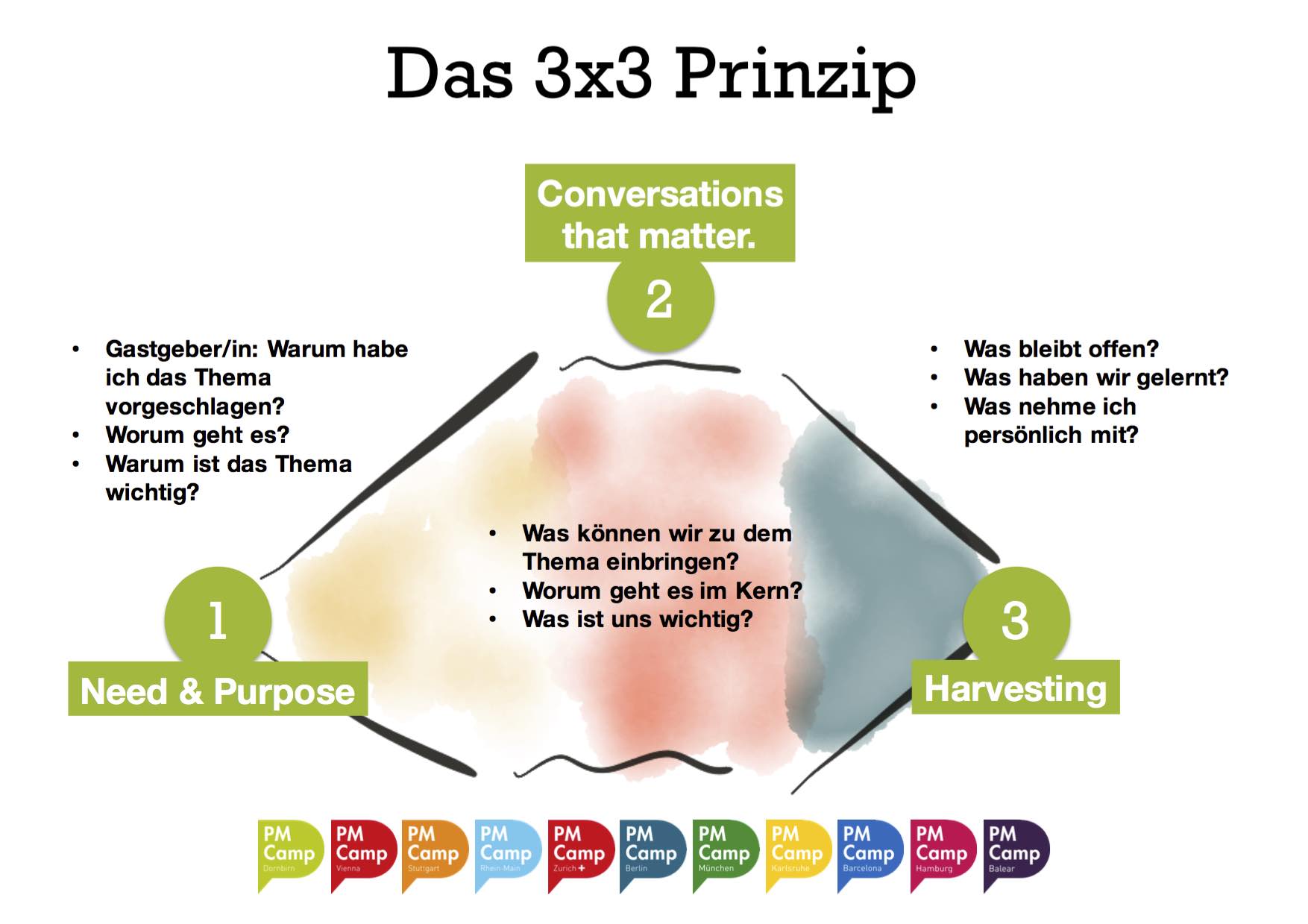
There are numerous methods. If I wanted to name them all, the available space would not be enough. Let the example of the “Art of Hosting Method” as we used it rather successfully at the 2015 Dornbirn PM Camp suffice.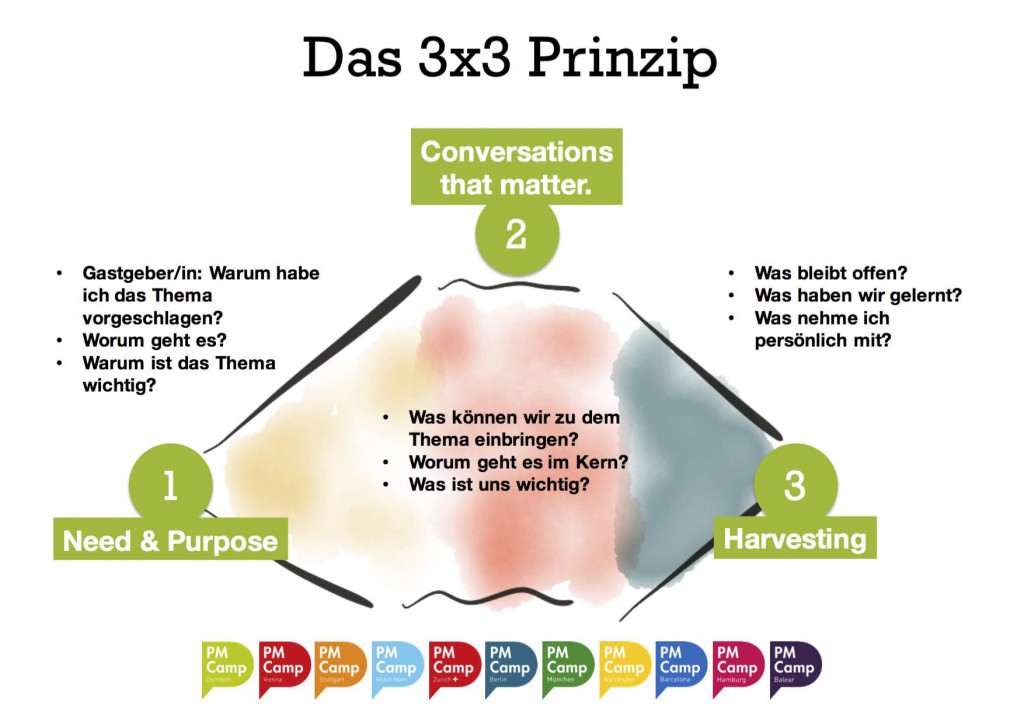
- Creative Space
It is always nice to see something being created that actually lasts. It might be a workshop of the design session where, for example, you create a cartoon or a video film. With a good team, this is often done at surprising speed and quite well. - Story-Telling
A few nice questions, a quiet room and then the stories will pour out. The important thing is that you do not discuss or debate anything. Instead, someone tells a story and the others listen. Here is a report of one event of this kind I was part of. - Games and prototyping
As we all know, there are all varieties of approaches, starting from the famous SeriousPlay with Lego bricks.
There are probably others – one of them, of course, is the normal presentation.
Naturally, the topics are provided by the participants. If they already come with topics, then they can choose in which form they wish to present or interactively process said topics. Of course, it is best if matters develop during the event.
Using such methods consciously is meant to increase the value for the participants, because they can experience new things, but there will also be new results and insights.
All I can say is: I promise that you will find quite a few things to talk about during the ActMobCmp or AktMobCmp (both spellings are correct).
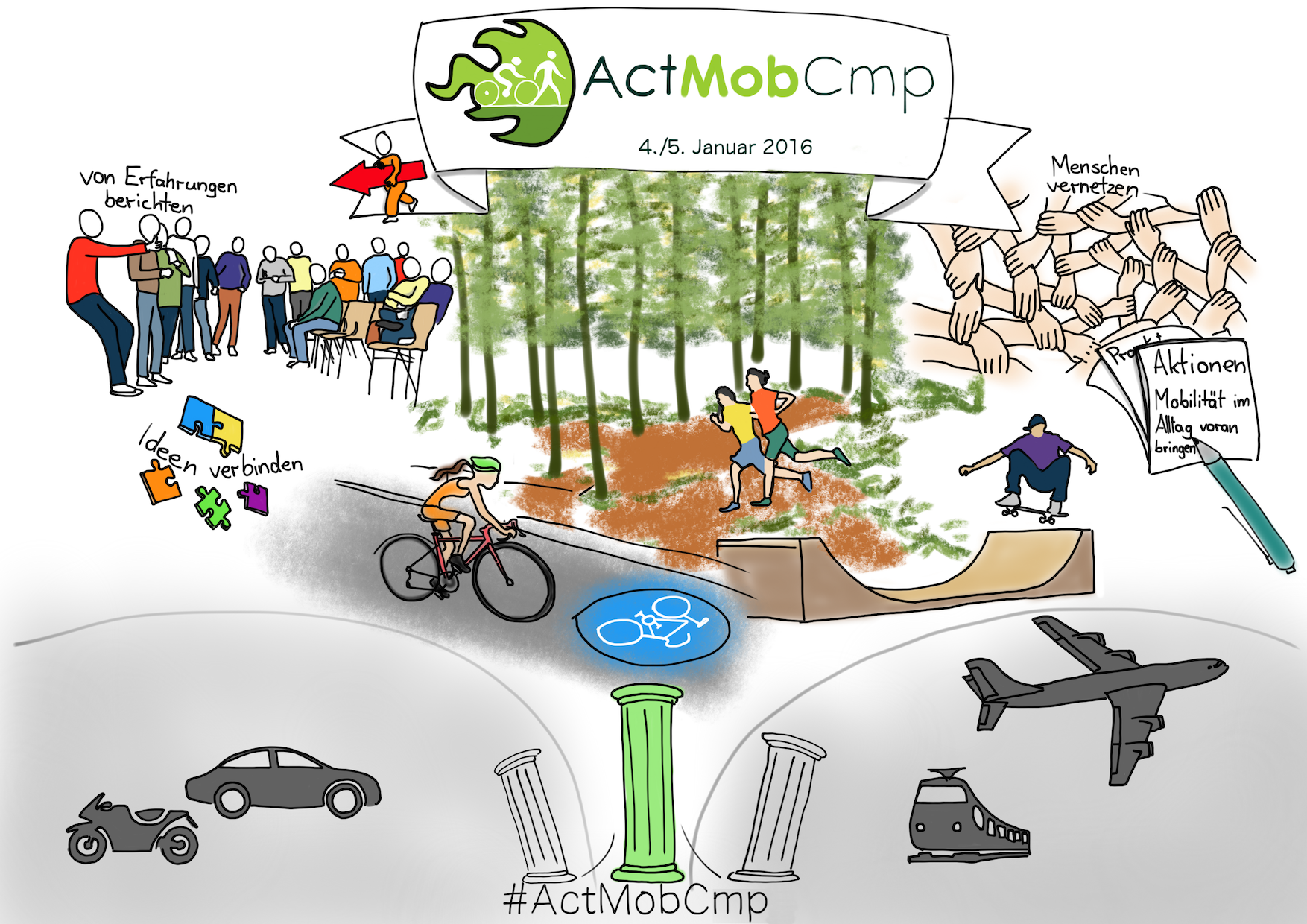
To enlarge the image, please press on it.
RMD
(Translated by EG)
Roland DürreSunday December 6th, 2015
What Annoys Me #34 – Lobbyism, Marketing and their Associations.
In my last article, I tried to voice my pessimism about Best Practice, methods, processes, standards, certificates, etc.
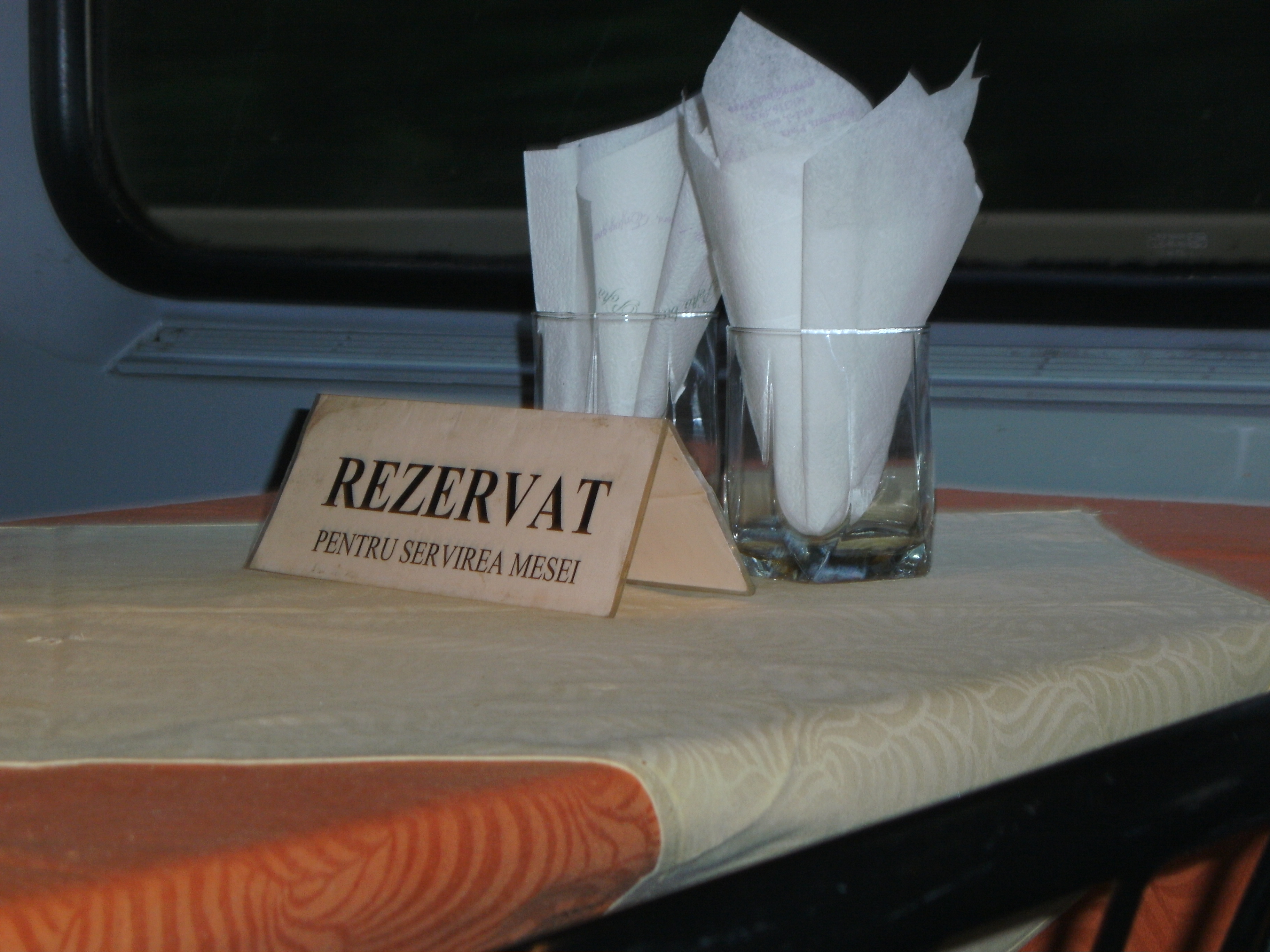 Now I am thinking of it while sitting in the InterCityExpress Train, being hungry and yet avoiding the Spaghetti Bolognese offered at the “Bordbistro”. Mind you, I basically like Spaghetti Bolognese, but not as “convenient food”. This same meal is probably advertised and served in all German ICE trains today. What is worse, I remember well how delicious the meal I took in a Romanian dining car a few years ago tasted.
Now I wonder who I should thank for all this. I am sure the industry is partly to blame. But the consumers with their “stinginess is super” attitude will certainly also be partly responsible. However, I also find it annoying that there are “free” clubs that actually promote this nonsense. It would be better if there were clubs protesting against it. And I am sure there are more serious problems in the world against which to get active.
Clubs have different goals and purposes. Especially in Germany, the number of clubs is horrendous.
There are some “good” NGOs that, in my estimation, prevail like a bastion through the ages. On a world-wide scale, I consider AI (Amnesty International) one of them. Others started well, but then, as time went by, they developed more and more into systems. Regardless, they still make a positive contribution in my opinion, even though there are often quite a few things that smell. I mean the likes of the Red Cross, Green Peace and similar organizations.
There are also some clubs that have been founded for a specific improvement, for instance Greencity or the Urbanauten. Others want to be quite differentiating when it comes to their social enthusiasm. In Germany, sports clubs have a huge tradition. Consequently, the number is endless: from alpine sports to gymnastics and shooting. These clubs were founded because of the common desire to do something new together.
Since all clubs are social systems, they also underlie the normal rules of development. They might well come to have the system maintenance as their only goal (self-goal) or become commercial enterprises (ADAC, enterprises of the entertainment industry “sports”). Regardless, I consider these clubs basically ok. And a sports club for everybody is definitely more to my liking than a fitness studio.
But there are also clubs the foundation of which was nothing other than the wish to gain advantages for its members from the outset. They were founded to break good laws and socialize losses. Their rules are determined according to the wishes of their customers.
I do not like them. I am talking lobbyists. They put enormous pressure on politicians and members of parliament in order to gain advantages for enterprises or sectors. As a general rule, these enterprises only want more profit for their customers, without taking the common good into consideration at all.
Lobbyism is one of the great challenges of democracy. As I see it, democracy can only work if we abolish lobbyism!
RMD
(Translated by EG)
P.S.
The industry of the cat-gold-salespersons and happiness-whisperers (aka marketing) with their motto “buy yourself happiness” are another threat to social market economy. Besides lobbyism, this is the second weapon of late capitalism for suppressing humans. Especially the marketing of today with its filigree methods and techniques is a hindrance to the development of an autonomous life lived in self-responsibility (called freedom) even in its early stage. I will soon write more about this.
Roland DürreThursday December 3rd, 2015
First a Norm, then a Certificate.
Or:
Why I believe that “certifying things” is often nonsense.
Created by Barbara Dürre, a certified certificate producer 🙂
In order to make life easier, people scale the world. They make certificates (Zertifikate) that prove how objects of this world follow or have been generated according to a certain standard.
The DIN is certainly a positive example (initially: Deutsche Industrie Norm). It was started by a club/association of industry partners. This standardization of technological items certainly brought considerable progress.
I am sure this made a lot of sense. The same is true for a common “metrics” in Europe or even world-wide for characteristics of objects (distance, weight, size, volume, etc.). or states (pressure, speed, temperature, time, etc.).
After the “standardization” comes the “certificate”. Stating a reliable and tested actual measure for an object is the simplest form of certificate. You can say:
There can only be a certificate if a standardization has been done before.
Wherever people are successful in a field, the underlying method will also be applied to other areas. Even if, perhaps, it does not make sense. For instance because everything that is alive cannot be reasonably standardized like a dead mass.
Brussels (the EU), for instance, now not only certifies plants and fruit. No, there are many areas – and I mean areas where it cannot be done – where they standardize and certify endlessly. For example, we have a cucumber norm and sustainability (including the certificates). Institutions and associations of all sorts also take part in the “standardizing”, using all imaginable areas for any purpose at all.
Mostly, they start with writing down collections of (allegedly) best practice. You will have won if you managed to introduce an obligatory ISO norm or some such. And then they start teaching the auditors and doing audits.
But do we really want to standardize humans, their interactions and their lives? During the last few decades and centuries, metrication and measurements have been applied to humans, nature and social systems.
Now enterprises have to have certifications saying that they function “correctly”, even though they consist of human beings. “Correct” is defined as something that follows the logic of an often very complicated and contradictory standard. And everything else is “wrong”. And more often than not, people totally forget what was intended or what was initially the problem.
They even wanted to extend the concept and include families. In the 1960ies, they discussed if people should be allowed to marry without a marriage licence. They also demanded a father or mother licence if you wanted to become parents.
(Incidentally, driver’s licences, too, are just certificates). To be sure, the intent was well-meant: they wanted to improve the situation of children.
At the time, I cynically thought how it would perhaps be desirable to also certify sons and daughters, since fathers and mothers were under consideration. After all, children should behave according to standards, shouldn’t they? Well, today, this concept became a little bit true: schools, for instance, generate their curricula following the standard child image – without ever considering how different children are.
I am glad that, in the end, the parent licence did not come after all. Regardless of many children, unfortunately, still living in rather sad conditions. However, the “parent licence” is an excellent example for the limits of standardization and certificates.
So roles in the family are not yet certified. Yet in other social bodies, they try to standardize away – for instance in enterprises when it comes to management. Just think of project, knowledge, quality management, etc. And I am sure that, sooner or later, the BGM (business health management), the common good economy and the CSR (Coporate Social Responsibity) will be certified. And, of course, before they certify them, they have to standardize them.
In my book, social systems with humans acting therein are something that nobody should try to standardize. Standardized social systems give me pause. Also, I do not believe that leadership and management can be standardized. But how can you certify something that cannot be standardized?
But let us stick to project management: It will not be possible to standardize PM in a rational way. So how to certify it in a rational way?
Basically, it is a pity, isn’t it? After all, they say that project managers too, (like, for instance programmers) should again learn from their masters and from practicing a lot in order to become experts – just like craftsmen.
You can get titles with money, through finishing an expensive course and by learning a lot by heart. But you will only become a master through sweat and industriousness. And it is quite possible that, in the future, only the masters will be wanted.
RMD
(Translated by EG)
P.S.
Incidentally, it is quite well worth the effort doing an internet certificate search. I was literally beaten by the multitude – also by how absurd many of them are. I will refrain from giving examples, there is no end.
Roland DürreSaturday November 28th, 2015
PM Camp Dornbirn – Between Pretension and Reality?
In retrospective, the Dornbirn PM Camp was rather a success. Most (well, basically all) of the participants felt great and drove home with a feeling of satisfaction. In my opinion, this is great.
Also, many participants filled in our feedback forms. This is how we (the organizational team) received many constructive comments. I am currently working my way through those, along with the twitter “timeline” of our anti-conference. You can read the timeline under the hashtag #PMCampDOR. Incidentally, it is a lot of fun: a retrospective view with many useful links.
Statistically spoken, the feedback was just as positive as the individual comments. This gave the organizational team a boost. Barcamps are something special. They are based on freedom, eyelevel, participation, equal rights. You can also see those factors as “weaknesses”. But then, they are weaknesses I personally find rather attractive. A barcamp lives from the moment. You cannot control them, the sessions rise from the context of what you have just experienced. And that is a good thing!
In other words:
Freedom and diversity can also polarize. You might get focal points and conclusions that not everybody will always like. Well, you have to cope with this, just like freedom is not always something you can easily cope with. It takes tolerance.
Democracy, too, has its problematic side. Even the question how to best organize democracy can be a problem. Just remember the passionate discussion about “direct versus parliamentary democracy” – one of which is considered the solution (for instance in Switzerland) while being considered extremely dangerous (for instance here in Germany, because we believe the people are stupid). On the other hand, many are no longer at all happy with our “parliamentary democracy”.
Anti-conferences are democratic. Their dynamics depend very much on the persons attending. As opposed to conferences, you meet in a rather free room with only little formatting. This might trigger group dynamics that not everybody will welcome. But then, every participant can feel free to counteract.
PM Camps are very pluralistic meetings. Males and females meet, old and young persons, starters and almost-pensioners, successful and not-so-successful persons, persons who studied at university and persons who learned their trade in apprenticeships, no-nonsense types and laughing types, “not so wealthy ones” and “rich ones”, etc. Maybe these barcamps can manage to bridge the gap between ME and WE and thus reduce the tension between “individual” and “collective” needs.
And what is true for projects is also true here: technology and tools are no longer the problem. The existing methods, too, are mostly more or less suitable. Yet most of the projects fail because of the “human factor”. This is also a danger with barcamps. You can never please everybody. Consequently, both the tweets and the feedback forms showed us that some details were highly praised by some, yet criticized by others.
Besides the positive feedback, there was criticism and recommendations for improvement. Wherever the recommendations for improvements do not counteract the barcamp principles, we will take them very seriously. Just as we will take the criticism to heart. But then, you could also say:
If someone criticizes something about a barcamp, he is also criticizing his own behaviour.
Here is a list of feedback with my comment:
Positive Feedback:
The positive feedback is by far the majority. Even though I would enjoy citing all of them, I will restrict myself to a few:
If the PM Camp would not exist, one would have to invent it!!
I will be back!
I was able to learn a lot, make experiences and meet very interesting persons!
Continue in this way, no regulations!
There was a very homely and cosy atmosphere, the discussions were all at eye-level!
I could continue I this way – and very often, there was a
Huge Thanks!
and 100 % of the participants replied to the question:
“Would you recommend the PM Camp to a colleague?“
With a Yes .
Of course, reading this made us truly happy. We in the organizational team will process all the positive feedback with care and diligence. After all, what is true for persons when it comes to “personality development” (often also called management or leadership training) is also true for communities: first and foremost, you should promote your strengths, instead of always trying to work on the weaknesses. Because the latter will never be a success anyway and the former is so much more promising. Consequently, we want to make those things better that are already quite positive.
But I also have examples for
Negative Feedback:
The WLAN on the Camp was a catastrophe …
Yes, that is true. But I know how Stefan, in particular, took pains, both before and during the event, to improve the situation at the university. On the evening before, I also had a dialogue with one of the experts who had explained the problem to me. The specialists at the university, too, tried their best, but again, they did not manage it. Due to highly complicated security aspects, the systems are programmed in such a way that the technicians cannot do it. Naturally, we will try to do better in this respect next year. Yet we should also appreciate how much the Dornbirn Fachhochschule as a sponsor of the event is doing for us. Maybe we can be a little lenient in return.
There was no information about parking!
Yes – we forgot our dear car drivers.
More precise information on the event (start, end) on the website, please.
Yes, that is certainly something we can improve.
Pictures of those who organize a session would help with the orientation.
Unfortunately, “Aebby“ (Eberhard Huber) had to cancel on short notice – consequently, his polaroid camera, too remained in Stuttgart.
Criticism and recommendations on
Ice-Breaking, Moderation and an introduction round,
very diverse. Some wanted a round of introductions, others not. Some wanted more moderation and/or ice-breaking, others less. I would say it was about equally distributed.
Many ideas and recommendations for improvements in the feedback forms were about
“Newbies“ and “class meetings of old PM Camp attendants and how one could, maybe, improve the quality of sessions, for instance by coaching, mentoring or moderation.
A narrow majority wanted an explicit support for Newbies. The others thought it worked quite well automatically. To me, it also seems that this is easier with small PM Camps – such as Barcelona – than with big ones such as Dornbirn. So this was almost indirectly a criticism that Dornbirn is getting too big.
There was also some criticism on individual sessions and how they were offered.
Too much IT in the sessions.
I missed the games.
It would be better if the sessions of the second day were better based on those of the first day.
The principle and variants of sessions should be better explained beforehand, especially for the newbies.
I support whatever improves the session concept. Yet I believe that the organizational team should not meddle with the content of the sessions. They belong to the “part-takers”. The organizational team has the chance to motivate those who are interested in the messages or want a controversial discussion about them by formulating the mottoes and selecting the impulse given before the event. That should be enough.
But there are some challenges for the future. I particularly liked one of them:
It will be THE ONE challenge of the future to maintain the high standards.
That is exactly how I feel!
Incidentally, there is a lot of praise and some criticism of the Dornbirn PM Camp on the official GPM Blog. Reinhard Wagner reported on the Dornbirn PM Camp in a post, actually writing a few rather negative things in his last paragraph (…PM Camp only partially managed to deliver what it had promised. …).
Since I see a number of misunderstandings in this article and also because my name appears in it, I will now discuss Reinhard’s theses “dialectically” and also try to explain a few things.
This is where I start with the text of the last paragraph written by Reinhard in the GPM blog. The sum of all the cursive text elements is the complete last paragraph, copied from his post 1 one 1 (RW). Whenever I use “normal” font directly afterwards, then those are my comments (RMD).
(RW) … The motto of this year’s Dornbirn PM Camp was “breaking with patterns” (What patterns should we break and how can we do it?). This is something the PM Camp managed to deliver only to some extent. As I see it, that is also the dilemma of the entire “PM Camp” movement.
(RMD) Not only PM Camp, but the entire human society has the dilemma that it cannot manage change to a reasonable or at least desired extent. Current history alone is a good proof of this (wars, terrorism, the destruction of the planet…) .
The problem I have with what Reinhard writes is that, for me, the only thing a PM Camp is supposed to deliver is a) to be a good host and b) to find the right participants. That is also what the organization team for “our” Dornbirn PM Camp aimed at. And as I see it, the same is true for the entire “PM Camp Movement”.
Each year, we meet at the PM Forum (our strategic organ for all PM Camps) amd discuss how to best do this. Here, the representatives of the regional organizational teams (the operative event managers who organize the Camps) and the core teams (the normative founders) meet. During this meeting, we exchange ideas on what could be improved in order to make it even easier for you – our guests and visitors – to exchange knowledge, find consensus and gain insights.
The basic role of an organizational team for a PM Camp is that of host. It looks for sponsors and, finances the event where it costs more than the participants’ fees have brought. In addition, we, as a group, try to come up with mental concepts (for instance a motto like the metaphor of “breaking with patterns” before the event) and to promote the success of the entire affair through impulse presentations during the Camp (what?) and ideas about the methods of presentation (how?), without ever jeopardizing the core ideas of a barcamp.
We are very careful about not clandestinely turning our “anti-conference” into a conference or congress.
Please remember:
A PM Camp is nothing other than a barcamp directed towards project managers, entrepreneurs, leaders – basically all those persons who are prepared to take responsibility for our future. It provides them with a platform for the exchange of opinions and ideas and thus supports their networks.
(RW) The “young wild ones” (sorry Roland Dürre) try with all their might to distance themselves from the established big ones in the field, primarily from the GPM, the PMI and the PRINCE2-Community.
(RMD) As to the “young wild ones”: personally, I must say that I do not see myself qualifying for “young”. I meant quite a few young start-ups with this metaphor. They approach things totally differently from what I am used to with the “established enterprises”. And whenever a start-up is a success, then it is definitely not because it thinks in terms of projects.
But back to the text. The very phrase “established big ones in the field” shows how problematically Reinhard is positioned. Personally, I do not see the PM Camp movement as competition of any “established big ones”. Because we are not an association. If anything, we might be an alternative to it, meeting in a free area and exchanging knowledge and experience. During a PM Camp, what you do is motivate each other to start thinking. The “ME”s will meet as part of the “WE”s. That has nothing in common with an association or similar structures. This is also one of the reasons why the organizational team must not and will not give proactive recommendations.
Incidentally, the PM Camp Movement also always coordinates whatever they do with openPM, the open portal that provides a platform for the free exchange for all project managers. openPM is a non-profit-making club that, as I see it, is no competition for the “established big ones” either. Consequently, openPM has nothing to do with those clubs/associations.
My personal reason for shunning clubs and associations is that, to me, they all seem to think they alone possess the “truth”, then they mould their truth into rules and laws and earn their (horrendous sums of) money with it. That is something I do not want to be part of. But I am not trying it with all my might. I am just clearly stating the fact.
(RW) The pattern “agile” versus “traditional” is used far too often. In almost all the discussions, you get the comparison between “industrial age is old and evil” versus “information age is young and good”, the same is true for “waterfall” versus “Scrum”.
(RMD) Here, Reinhard probably misunderstood something. It is quite possible that, years ago, there were such frontiers. In order to stop this nonsense, however, we started a PM Camp in Dornbirn in 2011. Its motto was “building bridges“.
Consequently, I hardly noticed any conflicts between “agile” and “traditional” during the Dornbirn PM Camp. On the contrary: all the persons I heard – including the impulse presenters – made it quite clear that anything can be justified. All you have to do is consider what you want to use when for which purpose.
Incidentally, I believe that all you need to know about “agile” has been written down in the “agile manifesto“. What you find there is a recommendation to use “common sense” in an “honest” way. And I cannot see where this is supposed to be a method. Basically, it should be something that goes without saying. Just like it goes without saying that you can make many mistakes in projects.
(RW) One presenter spoke against all rules and “patterns”, before, a few pages into the presentation slides, saying that you should actually not do any projects (#noprojects).
(RMD) If this is referring to the impulse by Robert Weisgräber, then I have to say that his was one of the best presentations I have watched in a long time. This can also be seen from the feedback statistics. But perhaps the metaphor #noprojects is not all that easily understandable. Yet I did not really hear that you should not do any projects. What I heard is that you should think twice before deciding what to do.
(RW) In a workshop on “organizations as living organisms”, they tried to show how such an organization works. When I asked if we could perhaps exemplify this with the – unfortunately very successful – organization “Islamic State”, my request was rudely denied with the (killer) argument that this is not really the time to discuss that general topic.
(RMD) Naturally, what someone says in a session cannot meet the total approval of all participants. It has something to do with democracy. On the other hand, I would also not think it goal-oriented to discuss the IS as an example. Not just because, to me, the IS looks like a criminal, fascist organization (The Third Reich, too, was fascist. And still the “GröFaZ“ generated fear for all the established generals with agile warfare).
To be sure, Reinhard Wagner could have organized a separate session on the IS, or perhaps, more precisely, a session about “modern guerrilla war of fascist organizations as a successful method for fighting against technologically superior armies”. But I would not have attended such a session (or if, then just to tell everybody that I find it absurd).
(RW) Then, one participant tried to discuss the Cynefin framework. This discussion ended with the categorization of engineers and business economists on the right side (simple or complicated systems) and software developers, those creative wild ones, on the left side of the framework. Well, this does not really help anybody, does it?
(RMD) Again, this is about the content of a session. It has nothing to do with the Dornbirn PM Camp. Personally, however, I see it like Reinhard Wagner, considering the entire discussion about complicated/complex, left/right, blue/red more or less esoteric nonsense. However, I am sure that you can actually conclude right things from wrong assumptions …
(RW) Instead of breaking patterns, they dress old clichés in new clothes.
(RMD) I do not really understand this sentence. But I find it rather over the top to say something like this about the entire Dornbirn PM Camp. To me, this sounds a little like culture pessimism. But I admit that our entire society suffers from us constantly, again and again, using the same patterns. And that fantasy and creativity are things we tend to push away. Perhaps Reinhard and I actually lament the same state of affairs.
(RW) Finally, I have to ask the question what, in practice, the PM Camps actually want to achieve.
(RMD) Once again: PM Camps offer the general framework for meeting, communicating in an atmosphere of trust, sharing knowledge, gaining insights through honest discourse. There is no promise from the side of the Camp. If there is any goal, then it is that the persons who attend make each other look bigger – instead of smaller, as we have known it from many teaching systems. However, I believe it is amore valuable or practical application to “share knowledge” and to learn from the “other party” than to earn certificates or, what is worse, from the “certification of the world”.
(RW) To be sure, my own workshop impulse for “project management for social purposes” instigated a lot of discussion and enthusiastic comments,…
(RMD) Question: “What is an enthusiastic comment?“! 🙂
(RW) … but then my question what we could actually do was rather quickly cut short because everybody disappeared (wanting to have lunch).
(RMD) Well, that makes sense, doesn’t it? This is something the second day – with its actual sessions – could have been used for.
(RW) To be sure, it was also rather hard to make the participants actually put into practice what we had been talking about at the GPM.
(RMD) I cannot imagine why it would be easier at the GPM than in real life.
(RW) Yet this is where they could have been proved that they can do more than “give nice Sunday speeches” , letting “beautiful words” be followed by “actual behaviour”.
(RMD) Even Seneca said: “philosophy is not about talking, it is about acting”. And we can all see that we all talk a lot yet do nothing from the climate change caused by the burning of fossil raw materials. But again, I discovered that I have something in common with Reinhard.
(RW) That is what I would wish for, but perhaps it will just remain wishful thinking at Christmas Time.
(RMD) My hope (I do not know if it is wishful thinking), not only at Christmas Time, is that humans become a little wiser.
Even though there were many objections to what I had done in his article, I would like to explicitly thank Reinhard for writing it. And perhaps this is the beginning of an enthusiastic and wonderful discussion about:
How badly do we really need all those associations and clubs?
Because to me, it seems that many of them are totally unnecessary and I would certainly expect more from grass root movements.
RMD
(Translated by EG)
P.S.
The heading of this post is not my wording. It was directly taken from Reinhard.
Klaus HnilicaThursday November 26th, 2015
The Avalanche – or: An Inappropriate Good-Bye to Hydraulics.
Carl and Gerlinde (Instalment #46)
It was typical! Whenever Carl really needed some sympathy, nobody was home. Consequently, he gruffly pulled the front door closed after an expectant “Hello”.
 The only thing he found on the ledge in the hallway was a note saying:
’Am in the municipal office sorting winter clothes. Why don’t you come, too? It might get late. Kisses, Gerlinde’.
Hmm – Shit! Instead of a friendly face lighting up in welcome, all that drifted through the garden into the living room was the usual November blackness. The last bit of red heaven seemed to be embarrassed as it gracelessly disappeared behind the yellow tamarisk. Well, neither was it necessary for Carl to have any more heaven at the moment. Purgatory or hell would have been more like it…
He was still standing in the hallway when his bag flew out of his hand. His trench-coat and shoes were grumpily thrown in the direction of the clothes-stand. What a shitty day! – he said for the third time, automatically gripping the Brandy bottle! ’Carlos I’! In disgust, he fished for a glass on top of the house bar and threw himself onto the living room sofa with a moan. Listlessly, he stared at his reflection in the patio door pane that was darkened by the night outside. For his first ’Carlos’ he still toasted himself.
As he drank his second one, he was already in the phase of being annoyed with his stupid cerebellum for still circling around the nonsense the concern leaders had offered at today’s meeting. Not to mention all this reassurance drivel of our ’Ruling Fairy-Tale Auntie’, who, through her persistent ’We can do it – We can do it’ tried to preserve the long sleep of her nation that has been going on for ten years without any interruption.
Yes – who knew, perhaps she herself was ’Sleeping Beauty‘!
However, it seems that this was not even known to the overambitious Prince Seehofer in his overflowing-with-asylum-seekers Bavaria: otherwise he would never have been so disappointed about her not being prepared to wake up from that sorry state where she obviously did not know what happened in her realm.
Mind you, he had taken such pains, hadn’t he? Keeping her standing no less than twenty minutes next to him in front of the entire Bavarian Royal Household, just to show that she was well capable of sitting it out when he took command, just continuing to sleep standing up – as always.…
And Carl would probably have gone to sleep after his fourth ’Carlos’ if he had not accidentally activated the remote control of his TV. All of a sudden, he saw a rather excited TV moderator who foulmouthed an absent Schäuble in no uncertain terms, because said minister had totally unbecomingly broken the rules of how to describe the asylum seeker problem by not using the German ’hydraulic collective symbolic language’.
During an event the moderator briefly showed, he actually had – what a scandal! – compared the overwhelming influx of asylum seekers to Germany with an ’avalanche’ a careless skier might have triggered by moving the snow a little thoughtlessly: an avalanche of which at the moment nobody knew if it was already in the valley or still in the upper third of the mountain. This, so the moderator, was really disgusting! Such a totally wrong image is nothing short of inhuman and a catastrophe, said the moderator who had clearly been brainwashed to be mainstream! And this comparison was totally lopsided! After all, as opposed to the one-time alpinist Schäuble, our Federal Chancellor had never ever gone downhill skiing. In fact, she only ever went cross-country skiing, and even then only in the lowlands!
This totally unexpected avalanche-like deviation from the ’hydraulic collective symbolic language’ used by all the parties and media by the Federal Minister of Finances, so the moderator, was really evil!
And he asked what it might mean that Schäuble did such a thing at the very time when the Federal Chancellor was already clearly getting less and less backing both among the citizens and within the party? Is that how someone was massively rattling her guideline competence? Did this not show only the deep rips between CSU and CDU, but even within the CDU? Even in the Great Coalition?
What is the meaning of all this? The moderator apparently was not only asking himself, but also in the direction of Carl who, instead of replying, countered with a question of his own: the question if he, the extra wise Mister Moderator, knew how many glasses of Brandy he, Carl, had already drunk: four, five, six or seven? Because he himself certainly no longer knew After all, for him, so Carl told the moderator on the screen, the answer to that question was far more important than all this avalanche show! Because the answer was basically decisive when it came to the question if he, Carl, could still dare going to the municipal office and appear before the strict eyes of his ’winter-clothes sorting Gerlinde’, thus at long last actually doing something productive for the asylum seekers.
Or else if it was wiser to save face and stay at home, doing nothing practical? To make up for it, as before, he could start trumpeting one smart-assy solution after another into the world tomorrow, as soon as he was again sober. It was all about this difficult hydraulic asylum seeker topic which suddenly was also discussed like an avalanche…
Hm – it was truly a difficult decision, Carl told himself. And as such, it certainly should not be decided before the next ’Carlos ’, or should it?
KH
(Translated by EG)
Roland DürreTuesday November 24th, 2015
World-War III

Flag of the Islamic State of Iraq and the Levant
There is a lot one could say about terrorism. But in my personal opinion, people mostly write the wrong kinds of things. For instance, much of what I heard and read in connection with the Paris assaults is incomprehensible to me. Many things annoy me, because they seem so flat and un-thought-through.
Also, I am not happy with the reaction to and the treatment of the events and the current situation by our “elite”.
I find it sad that the reasons for this development are forgotten and not asked about either. After all, we have had a strongly developed colonial situation in this world for centuries. The rich countries rule over the poor countries, they exploit and literally abuse them.
Starting during the “long 19th century”, continuing in modern times and still being the state of affairs today, this never changed. The so-called independence of the suppressed did not really improve matters significantly. True, in the 21st century, the methods perhaps look a little more subtle than they were in the 19th and 20th centuries. But this only means they are no longer as obvious as they used to be. However, they lost nothing in efficiency when it comes to the degree of exploitation. On the contrary.
This caused a lot of explosive energy in the world. The politics of the last few decades – incidentally, I am not only talking the West, neither only the USA – served to enrich said explosive energy with fire accelerators. And the time when everything was set on fire with matches was certainly no later than the reaction of the “western world” to 9/11.
But what are the French doing now? Making the same mistakes the West has been making all the time. They throw their bombs with gusto. And probably they will also (and maybe even primarily) bomb civil buildings and hospitals. And consequently also children, women and innocent citizens. As this is always the case with these kinds of attacks. This is how you give extra air to the fire and guarantee new recruits for terrorists.
I also find it annoying to see how different standards are used. Not long before the Paris assaults, the IS bombarded a Russian airplane. More than 200 persons died. Yet, the human fatalities in the Russian airplane were treated with quite a bit of serenity. Where were the shock and the minutes of mourning – and the Russian flags in Europe? To be perfectly honest, until then I had not even known Russia’s colours. After all, I grew up west of the Iron Curtain.
Other attacks, for instance in Beirut, are not even noticed. Because the only reason why we would be interested in those is our yearning for sensational news and catastrophe.
But the attacks in France were totally different. Why? There were huge numbers of solidarity addresses. Silent minutes of mourning were happening all over the place, the avatars on the internet were illustrated in the French colours. Because we are afraid that the same could happen in Berlin or in Munich?
Even as early as on the morning after the attacks, the newspapers boosted it. They talked about World-War-III now being on our doorsteps. When I went to the bakery on Saturday morning, I read a number of these headlines. And the day before yesterday, I read that “the world is now uniting against terrorist“ (SZ of November, 22nd).
In my life, there were many people I knew well and liked who died. Some died of old age and illness. Others remained in the Alps, one never returned from a flight trip.
Ever since my childhood, however, people dying on the streets keep accumulating. They were the largest number and losing some of them really moved me deeply. For instance, I remember a young woman full of life who had spent a very short time at InterFace Computer. No longer than one week into her employment with us, her workplace remained empty on a Monday morning. She had spent the weekend in her home in the Saarland and on the way back, she had suffered a car breakdown. When she exited her car, she was simply overrun on the motorway exit. Just like this. Like an animal.
Are traffic fatalities less painful than war fatalities? Isn’t it strange how we forget traffic fatalities? Why don’t we mourn for the deaths in traffic on a daily basis?
You certainly cannot calculate or balance the pain you feel when a person close to you dies. But I do not think there is such a huge difference between a beloved member of the family being overrun on his way home and the same person being killed in a terrorist attack in a coffee bar.
Consequently, I feel that, indeed, we do have a “World War III“. In fact, we have been having it for many decades. All traffic areas are the current battlefields. Because on the streets of this planet, between 1.3 and 1.4 million people die every year. They come from all social classes and nations. In addition, we have many times as many seriously wounded and wounded. Now if that is not a war, then what is?
In Germany, we still have more than 3,000 traffic fatalities every year. When I was young, there were some years when we had more than 20,000 – in West Germany alone. That means that we in Germany actually made some progress in this war. But we are still far from peace. 3,000, too, are too many. And the number is now again increasing.
If you want to understand what a huge number this is, just go and watch a soccer game with 3,000 spectators. And then imagine all of them lying dead in cars on the streets!
It is quite likely that, in Europe, both fans and players die on the way to the soccer match on each soccer weekend. But who is interested? A few weeks ago, there was at least a minute of mourning at the Augsburg WWK Arena for those FCA fans who had been injured in a car accident on their way to the stadium.
But why do we not have a minute of mourning for our traffic fatalities and those world-wide? Because nobody is interested in the carnage on the streets. And because business has priority. Which, incidentally, is also true for terrorism.
Consequently, there is no international outcry and no important speeches are made by politicians for a more humane traffic. As opposed to the fight against terror, “no world is now uniting” against all the people who died in traffic accidents. And the national governments could not care less, which is totally incomprehensible to me.
There is one exception: the small country Sweden actually takes it seriously and started a Vision Zero, with which they want to definitely reduce the number of traffic fatalities to zero – I bow before them!
The IS, on the other hand, consists of madmen who want to conquer first the Near East and then the world. They built up a terror regime that reminds me of the Nazis. However, regardless of them currently probably being the strongest terror formation, they are quite weak. It would be quite easy to dry them up.
But what do we do?
We buy their crude oil. Because it is less expensive. Thus, every filling of our cars metaphorically contains some IS fuel. They also get their weapons and equipment from us. This is how we get our “oil money” back. And we also provide those criminals with recruits from all over the world. Isn’t that a scandal?
But we block the realistically existing third World War out and also trivialize the climate change. Which actually might easily trigger the fourth World War!
As I see it, there are good reasons to believe the scientists. Especially if varieties of disciplines and schools come up with identical results. It looks like the detrimental effects caused by the climate change will be even more fundamental than the perhaps 75 million traffic fatalities since the end of WW-II.
The resulting environment war would probably be WW-IV. It will probably bring deprivation on two levels. The sacrifices nature demands from us through ever increasing numbers of catastrophes on various levels. And the others, those who will fall in the war between the “early losers” and the “not yet losers”.
And, of course, yet again we hope that we will not be among “early losers“. After all, we are luckily living in a rather “fortunate climate zone”. Now isn’t that rather reproachable? And are you sure that this is not perhaps a misconception?
Yet here, too, there is no chance for shared programs and mutual agreements. Nowhere. Neither nationwide, nor world-wide. Mind you, the environment conference starting in Paris in a few weeks is probably the very last chance to avoid the worst case scenario.
But we ignore the really existing third world-war on our streets as we also ignore the threatening fourth world-war caused by the climate change. To make up for it, we wet our pants with fear of terrorism from an IS that, basically, is actually quite ridiculous. Instead of simply drying them up and dealing with the really important issues.
RMD
(Translated by EG)
P.S.
I took the picture of the flag from Wikipedia. It is black, the colour of death. The picture was entered on October, 15, 2006 and downloaded by Russavia.
As I see it, we should beware of black flags. Incidentally, I do not like any kinds of flags. But if you absolutely insist on a flag, then I would prefer the lively, multi-coloured ones!
Roland DürreMonday November 23rd, 2015
The Arcis-Vocalisten – December, 22nd, 2015 !!!
Here it comes again in the IF Blog: Advertising – for the unique choir Arcis-Vocalisten!
Why?
Because their music is inimitable and because I rather like Evelyn – who sings there with heart and soul.

For us, Bach is like having been present when God created the world (Friedrich Nietzsche).
Johann Sebastian Bach is a must during the Christmas season like the Christmas tree, almond biscuits and butter sweets. Even as early as with the first alto-aria “Bereite Dich Zion” and the Choral “Wie soll ich Dich empfangen?”, Bach’s great music fills us with great joy every year. Intense drumbeats, roaring trumpets, brilliant flutes and oboes, the murmuring bassoons, the satin sound of the violins, violas, violoncellos and contrabasses, all welcome the new-born child Christ.
You definitely want to be there!
RMD
(Translated by EG)
P.S.
For IF Blog readers who want to visit the concert, we have a special discount…
Just send me an email titled “Bach-Christmas Oratorio”.
Roland DürreSunday November 22nd, 2015
A Beautiful Week – DOAG with Presentation, PM Camp with Many Friends …
Now I returned home from Dornbirn and it is the weekend. It was a truly strong week. First, I spent two nights in Nuremberg with a long day on the #DOAG2015 and then, between Thursday and Saturday, I enjoyed a very intense PM-Camp in Dornbirn #PMCampDOR. Incidentally, the two hashtags will link you to the tweets for the two events. It is well worth taking a look.
Last Wednesday, on the DOAG 2015, I was again permitted to speak. I talked about:
“Creative Room – Healthy Room!“
Here are the picture by Christian I used and the short outline of my presentation.

“created by Christian Botta“
Today: More often than not, the work situation in enterprises seems to be insufferable. There are (many) employees who mentally already have given notice. The salary is considered compensation for personal suffering. But then, they have neither the courage nor the strength to say: “Love it, change it, or leave it“.
Useless meetings, feeling powerless and the burnout syndrome are the consequences. Now they want to do something about it, see also: BGM (company health management).
Consequently, we find change all around us. Conferences are replaced by anti-conferences. I prefer attending barcamps…
And I will now present the story of my presentation. I had to hand in a short version. Then the documents for the presentation. Also the transparencies. But I had none. Because I always speak without.
Christian Botta of VisualBraindump made a picture protocol of my presentation. Thanks a lot!
Today, I give my presentation. Perhaps I will call it “Complexity, Innovation and Burnout in Enterprises”. In fact, that would have been a better title than the one in the proceedings. Or perhaps “How to Keep Humans Species-Appropriate”. Because, basically, I was talking about the same principle as the “key speaker” Gunter Dueck.
I started with the impressions for the presentation from early this year. That was when Dietmar Neugebauer (President of the DOAG) asked me if I would again like to speak in November on his conference. I certainly gladly accepted. Then there were the thought-provoking impulses. One of them was OpenInnovation at InterFace AG , realized with the Nuremberg FAU, chair of Prof. Möslein. During the final event of this project, there was a presentation by Dora on “creative rooms”. After this, it became pretty clear to me how rooms (and organisations) should “look” if you want them to provide innovative inspiration – both physically and virtually.
Apparently, they have something to do with participation, respect, eye-level, culture, breaking patterns, joy and happiness.
A few weeks ago, I heard an interview with Dr. Marius Poersch. Marius is a psychologist, head doctor in a hospital with many patents who have suffered from burnout. He wants to be more than just a “repair shop”, so he also does some scientific research on what humans and organisations can do in order to minimize the burnout risks. After his presentation, I have a good idea what a “burnout-free” room should look like.
Surprisingly, but basically also logically, the result is: the rooms are exactly the same. The “room” as described by Dora for promoting innovation looks exactly like the one presented by Marius for keeping us healthy.
So what are the reasons for all this frustration we suffer from? We assume it is the complexity that gives us fear and the bureaucracy that is generated in our society as its consequence, trying to give us some dubious sense of security.
Insertion:
As an example: my own frustration as an entrepreneur (because at oracle in Nuremberg), the story of DocuMaker and the Federal Agency for Employment.
Failure due to stupid rules, the Oracle middleware product manager does not know the product, prediction about the future of Oracle by Larry Ellision … lots of frustration, immense loss for all. Thank God no Distress for us, because the success would have been Oystress.
Assumption:
A complex world with quick change gives us problems. And then there are the processes, rules, protocols, processes that are supposed to help with the complexity but all they do is make life harder for us.
Insertion:
About the Berlin PM Camp (complex versus complicated).
There were also many abstract discussions about the difference between complex and complicated. According to Niels Pflaeging, it is quite simple: as long as it is just complicated, the classic methods of project management and problem solving can help us. But this is no longer true when it gets complex.
I think it is not as easy as that. I did a session with Maik Pfingsten (Blogger, PoD-Cast) and rather enjoyed Maik’s definition of complexity (from the perspective of the system engineer)
x – axis: degree of complicatedness;
y – axis: speed of change;
The more you get of both, the more “complex” it is;
I extended this to also include the
z – axis: “human factor” degree in the project.
This means: the more complicated and dynamic and the more of a human factor you have, the more complex it is …
But:
Seneca said: Philosophy does not mean talking, it means acting.
Consequently:
What can we do? Whenever it gets more and more complicated, when matters change ever faster and when the human factor becomes more and more apparent?
There are no cooking recipes or Best Practice, neither are there any methods or technologies. All I can offer are a few ideas to think about.
As an engineer, software person and technologist.
Let me refer you to the: Agile Manifesto (2001)As an entrepreneur, manager and leader:
Hans Ulrich – Eight Theses on Change in Management (1982)Insertion:
Here are his “Eight Theses on Change in Management” in a nutshell with a few additional notes:
- Accept not knowing and not being able to predict the future as a normal state of affairs!
Well, you simply cannot predict the future … - Broader horizons for your thinking!
Oppose “You cannot do this” or “This is how we always did it”. Do not suppress the freedom of ideas. Share knowledge. - Move in the category “both”, instead of “either-or”!
Black-and-white is out, colourful is in. - Think multi-dimensionally! Your balancing of values must be ethically responsible. Basically, humans can only deal with three ideas at one time.
- Use self-organization and self- control as your basic formative model for your enterprise!
Responsibility, subsidiarity - Consider management as a function that gives and promotes meaning!
New management image. - Focus on what is really important!
Work economy. - Make use of group dynamics!
Cultures, symbols, rites, rituals …
As a human being:
John Izzo – five things you should consider before you die!
I strongly recommend the Review of the book.
Or the experiences made by Bonnie Ware:
Here are the five things he found out people wanted:
- “I wish I had had the courage to live my own life“
- “I wish I had not worked so much”
- “I wish I had had the courage to show my emotions“
- “I wish I had remained in contact with my friends“
- “I wish I had permitted myself more happiness“
Those are the five insights Bonnie Ware collected when he accompanied dying persons. As I see it, there is a lot to be learned for life from these statements …
Yet none of all these things will help you if you are not prepared to actually live. Something is still missing.
Insertion:
One of my mentees works for Osram: They are already in a permanent crisis, anyway. Additionally, their move from near the 1860 stadium to Garching looked a little stupid to me. My mentee lives in Unterhaching. His daily way to work is now four times as long as it used to be. He feels how his mood gets worse and worse. .
He arrives at work in a bad mood and returns home in a bad mood. Dialogue: How is your boss? – He is in a good mood! – What is he doing differently from you? – He rides his bike every morning from Trudering to Garching! – So why don’t you, too ride your bike! – Cannot! – Cannot is not defined!
He then bought an e-bike and went to work riding it every day. And ever since then, he arrives at the office in a good mood, and the same is true for when he arrives at home. And he feels so much better …
In simple terms:
Our body needs exercise and fresh air. And time with nature. And you can have it so easily – with active mobility in everyday life. See also AktMobCmp.
Seneca, too, taught us:
Follow the laws of nature.
(Seneca was a teacher who wanted to make his students successful and happy. Unfortunately, this has never been the first goal of my teachers).
How is anybody supposed to come to terms with his own life if he cannot even come to terms with his own mobility? And driving a car is definitely not something that makes you free, nor will it bring you fulfilment in life … (Even if that is what a seemingly overpowering industry tells us in a gigantic brainwashing process).
So: what we need is nice and regular exercise!
But not the kind of exercise I experienced after the Eldorado cinema in the Sonnenstrasse. I had tears in my eyes when I exited after having watched the great “Die Kinder der Mme Ann“. And just imagine, right across the street, there is a fitness studio on the first floor. It has huge windows … And you can see in the light of the windows how the persons do their “work-out”. According to the motto Work Hard, Play Hard, WORK OUT …
For me, this is a horror vision. Planning fitness like an entire life. So why not change your life! You will see it can be done. Because, as Seneca said:
The reason why we do not start doing something is not that it is hard. Instead: Things are hard because we do not do them.
RMD
(Translated by EG)
P.S.:
During my presentation, I made two more insertions: about terrorism and about the asylum seeker situation. And I gave a short summary of what caused both. But most importantly, I described why I am not at all happy with how we react to both problems. However, I will write two separate articles about how I feel about these issues in the near future.


