
Roland DürreThursday July 26th, 2012
Tweets on Twittering and Blogging #127
Here are my tweets of last week on:
blogging and twittering, wisdoms and rules:
120809 A red apple might well taste bitter – also true for blogging and twittering? #Twitter #Blogging #Wisdom
120810 Beautiful flowers will not remain un-plucked very long – not to forget, twitterers and bloggers! #Twitter #Blogging #Wisdom
120811 There is huge power in a beautiful figure – also true for twittering and blogging? #Twitter #Blogging #Wisdom
120812 A beautiful figure will not last long – also true for twittering and blogging! #Twitter #Blogging #Wisdom
120813 Nice huts, evil habits – beware, twitterers and bloggers! #Twitter #Blogging#Wisdom
120814 Two beautiful souls will eventually find each other – also true for twitterers and bloggers! #Twitter #Blogging #Wisdom
120815 Finding the right words is already half the sale – also true for twittering and blogging! #Twitter #Blogging #Wisdom
There is a new tweet each day. See twitter.com and “follow” RolandDuerre!
Enjoy!
RMD
(Translated by EG)
P.S.
I took the proverbs from Alle deutsche Sprichwörter .
Roland DürreWednesday July 25th, 2012
So What Exactly Is: Project Management, Management, Leadership, Entrepreneurship …?
Here are my 2 cents, quasi as additional insight gained from the nice discussion in Stefan’s (Dr. Hagen’s) pm blog that is very well worth reading on “Emergence in Project Management “ (Emergenz bei Projekt Management):
You should quickly forget the term “project management“(best delete it without replacement), or at least you should remove the word project from the phrase. “Management” covers quite well what is discussed in the article and what we want to do. But then, it does not.
At first sight, “leadership ” sounds a little better. But even with this phrase, I am skeptical, because as a general rule, people who see themselves as “leaders“ have a singular “self-made concept” and suffer from “detachment from reality”.
Consequently, I would call what moves us and what we like to discuss “influencing social systems and their organizations“. Incidentally, this standard is all but modest. Only the most exquisite and particularly skilled persons can meet it.
Maybe this would be a way of starting anew the “theoretic teaching and science” on management, strategy and entrepreneurship. After all, it already exists in reality.
I wish you all lots of success as a result of shared knowledge, personal courage, received happiness and actively shown respect!
RMD
(Translated by EG)
Roland DürreMonday July 23rd, 2012
(Deutsch) Teach Me and I will forget, involve Me and I will learn!
Teach Me and I will forget, involve Me and I will learn!
This message was a tweet written by Dr. Hartmut Feucht (@DrHartmutFeucht) as a comment on the article by Stefan Hagen in his pm-blog.com on Emergence and Project Management (Emergenz und Projektmanagement).
What can I say? The sentence says exactly what I feel. And what I have been feeling all my life.
 At school, when I had to listen to teachers trying to teach us, my eyes wandered towards the windows where I saw the great outdoors. A little of what the teachers said remained in my memory – if it was interesting. Much of it got lost. Learning for an exam meant preparing in such a way that there was a chance to pass with a halfway acceptable grade.
It was a little better whenever I was permitted to solve a halfway interesting problem. This was often the case in mathematics. But I really only enjoyed it when I was a part of it. Those were the times when I really learned a lot, understood it and, in the truest sense of the word “got a grip on it”.
Here is what Stefan wrote in his article:
Basically, teaching at school, graduate school and university should leave far more room for students to come up with their own designs. The classical concept of a “reading” is, basically, antiquated.
I could not agree more. Except that I would leave the word “basically” out in both sentences.
The current problem, both at school and university – along with what I see as often rather devastating consequences for education and society – is probably that this is not (I hope: yet) understood.
RMD
(Translated by EG)
Roland DürreSunday July 22nd, 2012
A Highway Code for the Internet?
» Every technological improvement, if it is supposed to improve human happiness, will also be an improvement in wisdom. « (Bertrand Russell)
A short time ago, I heard the following statement at an Informatics&Sustainability (Informatik&Nachhaltigkeit) event:
As more and more automobiles appeared in the public domain early in the last century, a highway code became necessary.
And then someone asked:
Do we want/need something like it for the internet?
At first sight, it sounds quite reasonable, doesn’t it? At least I would spontaneously answer: yes. Communication, too, must be regulated sensibly. On various levels, as, for example, the ISO-7 layer model outlines quite nicely. In former times, the national postal services had introduced and successfully realized communication models in the CCITT. That was in the good old times when we still had letters, postcards, parcels, telephone an telex. And it worked quite well, didn’t it?
🙂 To be sure, even at the time, there were such negative things as spams. But it was rather tedious to send someone a spam – you had to walk up to their letter box. Or else you had to buy a “bulk mail service”. It did cover a hundred per cent of the postal code area, but at least it was rather expensive!
Only when radio and TV technology made it possible to transport spams directly into the households without much of an effort, the dam was broken. And CCITT could not do anything about it. After all, this was about economic interests. And traditionally, economic interests have always justified everything.
Consequently, the call for some sort of “highway code“ on the internet seems to make sense to me.
But then comes the “but”:
The development of individual mobility, including a highway code, should, first and foremost, be a warning for us. Because, as I see it, it is an extremely good example for how, regardless of – or due to (?) – the extreme regulation mania displayed by the legislative body, technological progress (in this case individual mobility) was improved, but at the same time the common good was severely injured. Mind you, it all happened even though we have a compulsory driving licence, a complex system of punishments and penalties, including a system of minus-points and similar things.
And the damage that was done was not really noticed at all, because we “got used to it” in typical human fashion. Although said damage is massive and concerns many dimensions of our lives:
- Just think of the massive soil sealing cars brought in their wake. How many square metres of ground were filled with concrete for streets and parking places? In modern semi-detached housing areas, we often find more ground covered by garages and car parking than for greenery. All in all, the landscape was destroyed.
- Individual mobility, especially as we live it today, gave us extreme resource exploitation, gigantically wasteful habits and a massive amount of rubbish. It is the best example for a non-sustainable life-style.
- Noise disturbance has reached unimaginable dimensions. There is hardly any place left where it is really quiet. Even in the “upscale housing areas”, there is still noise from motorways.
- This development of public traffic cost us time. Many people spend several hours every day behind the wheels or their cars. Although they have a good job, they spend a lot of their time doing something otherwise only done by people in an extremely low income group. And they say they enjoy it and are prepared to give “their last shirt” for the car and even indebt themselves for the car.
- But the worst of it is that this development costs us an immense bloodlet. In Germany alone, there were years with more than 20,000 fatal traffic accidents. Today, we still have more than 5,000 fatal traffic accidents – and the numbers increase again.
World-wide, we have between 1 and 1.2 million estimated deaths caused by individual traffic each year (source). That is more than the victims of illness, wars and hunger. If you add up the last 60 years, you easily get a number higher than 50 million. That is about as many victims as WW-II cost. I will not even think about the really astronomical number you get when you count the people injured in traffic accidents.
Now the question is if a wise legislative body could have done better a hundred years ago and then during all those years?
I do not know. I do not even know if, in retrospect, we can say what should have been done differently all those years ago.
But I have a few ideas:
For example, I am sure it was a mistake to permit and even support the industry when it promoted the introduction and, above all, the sale of automobiles through sports. Motor sports and also the race courses, such as the Nürburgring were goal-oriented cooperative projects initiated by state and industry in order to promote the acceptance of the then still little-loved new technological product “car”. Thus, we were (almost genetically) pointed towards driving cars as an athletic activity where it is important to be faster than others.
Perhaps we should not have let it happen that the users of the competing means of transportation bike were publicly degraded as early as the first years of the economic miracle. I myself witnessed how my father, against his wishes, changed from using his bike to using his car for the less than two kilometers he had to go between our flat at Rosenaustr. 18 in Augsburg to the General Railway Office Building at Prinzregentenstr. near Augsburg Central Station. Simply because both the neighbors and his own wife thought it no longer appropriate to go by bike in his position.
In those days, going by bike was synonymous for “being poor”. To make matters worse, there was an overflow of cheap bikes from the stores. They all sparkled rather nicely, but unfortunately were not very reliable. And who wanted to be poor and additionally have to get annoyed all the time? But could or should we have resisted against the judgment “if you ride a bike, you belong to the poor” and the avalanche of cheap products at the time?
Perhaps we should have promoted the general welfare in individualized traffic by installing reasonable car-sharing regulations? Or maybe we could have made stricter laws and restrictions?
But how to limit the number of fatal traffic accidents? No law was sufficient (and that is still true today) to put a stop to all the ruthlessness and readiness to assume risk. It probably comes automatically as soon as you sit behind the wheel of an automobile.
Perhaps introducing an archaic mechanism, such as an obligatory blood-feud against “traffic killers“ might have diminished the number of deaths? But, of course, this kind of idea is polemics. I do not mean is seriously. And, naturally, “the end can never justify the means“.
Or maybe humans are just not fit to cope with the (imagined) omnipotence they have behind the wheel of their machines. We are talking humans for whom the (imagined) freedom and independence others cunningly made them believe they really want and for which they are actually prepared to jeopardize both their own and – which is worse – other person’s physical health. Neither do these humans care if they have to pay taxes, compulsory insurance and penalties. For their car, these humans made many sacrifices and sometimes even indebted themselves. And now they want to enjoy the intoxication and even accepts the potential death and injury of third parties.
In fact, to me it seems that this genetics of omnipotence is so deeply rooted that even cyclists sometimes act it out as soon as they mount their bikes. Nowadays – as I witness every day – even the female biker does it!
I am not sure if we would have been a success if we had tried to give the development of individualized traffic with all its terrible consequences other rules and laws a hundred years ago.
We might have avoided some of the damage if we had collectively developed a different attitude! Regulations, however, will certainly not make a difference.
Our present position is what it is. The damage has been done and the coming generations will either put things right or not. Evolution will put things right or not. It will go its way. What will come will be the right thing. No matter what. Even if it seems more like it works without purpose and in a chaotic way.
So what is my consequence with respect to the internet? Can we learn anything from the history of individualized mobility for internet data and knowledge networks?
As I see it, regulations will not help. Maybe developing an “ethical” awareness would be a better way. But how?
RMD
(Translated by EG)
Roland DürreSaturday July 21st, 2012
Remaining on Course and Project Management – A Compass for Eventful Times
During weekends, I enjoy reading the blogs my friends write. For example, Dr. Stefan Hagen (Stefan) informs you about the Nürnberg PM Forum 2012 by GPM in his PM-Blog. He also wants to attend it, because he thinks it is time for him to remember what a traditional conference feels like.
I already look forward to hearing what Stefan is going to tell me about the GPM PM Forum, both from reading it in his blog and meeting him in person. And I can already predict to some extent what he will probably tell me.
Personally, I no longer like traditional conferences. Still, once in a while, I attend them. Depending on the actual event, I usually end up more or less disappointed (or rather, my prejudices turn out to be correct). Once in a while, you will see some brilliant speakers. You also meet people you would like to see again, but that is usually about it.
What I find remarkable about the PM forum is its title:
“Remaining on Course with Project Management – A Compass for Eventful Times”
Now that already causes the first disagreement in me:
I am actually fed up with hearing catch-words such as “Eventful Times” or “Crisis”. Today, we are all better off than ever before. If this is what you call crisis, then crisis must be a beautiful thing. In fact, it is a pretty nice life-style – if you ask me, I would say let us remain there!
As opposed to common sentiment, I think we live in a time of luxury. Unfortunately, however, this luxury made us collectively (and probably also individually) obese and inactive. We live beyond our means – and on borrowed money to boot.
The only movement I can discover is society trembling with fear of losing prosperity and our desperately clinging to what we own. Is that what you call “eventful times” or “crisis”?
And then here comes the association preaching:
“Remaining on Course with Project Management – A Compass for Eventful Times”
To me, this sentence sounds strange, both linguistically and with respect to its content. Maybe people should think a little harder before creating and publishing these kinds of slogans.
So what exactly is the meaning of “remaining on course”?
Doesn’t a reasonable and courageous “remaining on course“ necessitate a lot more than project management? First and foremost, you would have to know where you want to go, wouldn’t you? You want to know which business model you aim at. We are talking culture and values, responsibility, knowledge, courage, pleasure, respect, tolerance, civil courage…
I could just as well come up with the motto:
“Remaining on Course with Requirement“.
Or, even better: Let us install an association for course finding that certifies course finding. The motto might be: finding your course through dominance-free and upright discourse. (Adorno, Habermas).
Of course, this is not entirely meant seriously. But give me a break: “Remaining on course with project management“ might sound nice, but all it is is a complex and confusing shell of words. First and foremost, you have to find the path you want to tread on. Or at least you have to find your direction. And this is certainly a very difficult project. You cannot sell project management as the trivial solution for the problem.
Suggesting that “project management is the compass in eventful times“ sounds adventurous to me. Or at least very simple (or a technocratic concept?). Why don’t you go on to say:
“With PM, we will solve all our problems!”?
But so what. As I see it, the slogan is more like advertising a milky bar. And that is probably all it is – simple advertising nonsense as we will find it all over the place. Except I do not know if, maybe, the association is harming itself by this method, rather than promoting its interest. Even if, being the powerful system “association”, you already think (and perhaps that is what you have to think) you own the certified truth cut up into standards.
I would find it truly outrageous if, for example, the PM Camp, for which I feel partly responsible, would advertise itself with such a primitive slogan. Among my own friends, I would fight such a slogan.
If you want something that brings a smile to your face, here is the original introduction from the PM Forum program brochure 2012 Programmheft PM Forum 2012 (pdf):
Internationally spoken, the weather is still inclement and the general outlook will remain stormy. To be sure, in Germany, the economic outlook is positive enough, but here, too, the entrepreneurs will have to be prepared to fight rough seas. During this stormy up and down of the economy, we now need to remain on course. It is a good thing that the enterprises invested in project management, thereby improving their position among the competitors. Through project management, you can achieve convincing results, both in time and in budget. For German enterprises, professional project management becomes more and more the success guarantee. It turns into being the compass and provides orientation, it levels out minor disruptions and keeps the enterprise flexible and agile, even in volatile times.
Words, words, words! Why don’t you go and get me a philosopher? And, please, do not ever let an owner of a medium-sized enterprise read this. Are there any buzzwords you have not read in this paragraph? Who would ever write this kind of thing? Or, even better, who will ever believe this kind of thing? What nonsense! But at least, now we know how an enterprise can be saved from collapsing. Isn’t that some achievement?
Mind you, the event costs 1,150.00 Euros for non-members at GPM. Members pay 200 Euros less. Some of the things you get in return are that you can, for example, hear our eternal German-French journalist and author Prof. Dr. Peter Scholl-Latour talk about “International problem areas and the challenge they pose for German policy“, or the self-promoting extreme mountaineering expert Hans Kammerlander about “Hanging on the satin thread. From Southern Tyrolia to Jasemba (7,350 m): 40 years on course!”.
I know both speakers and wish you all a good time!
RMD
(Translated by EG)
Jörg RothermelFriday July 20th, 2012
Report from Melbourne
Two months ago, I ended up in Australia (or, to be precise: Melbourne). After a scientific career in heavy ion physics at the Garching Maier-Leibnitz Laboratory and 30 years of work in various IT functions, I started the time-off phase of my old-age part-time in March 2012. Late in 2011, my wife had received an interesting job offer for Melbourne. After an intense discussion – where the fact that our daughter lives in New Zealand played a considerable role – we decided (so far on a tentative basis) to emigrate to Australia.
Here is some information up front: by now, we managed to do the most important tasks (rent a house, gas, electricity, water, cable TV, telephone, internet…). In a few days, the container will arrive with all our stuff. Then we can start furnishing our house.
Let me start describing some of my(totally subjective) impressions of Australia.
The Weather
Of course, the first thing you notice on a trip to the Southern Hemisphere is the weather: the astronomical winter on the southern hemisphere lasts from June, 21st to September, 23rd. Since Australia is situated between 10 and 44 degrees latitude south-east, this does not say a lot about the entire continent, does it? As far as Melbourne is concerned, we can say: in the daytime, the temperatures are between 17 and 11 degrees Celsius (dependent on how long the sun shines). At night, you might well get 6 degrees Celsius. There is comparatively little rain, but when it rains, it really rains.
Sunrise is currently around 7:30, sun-down at 17:20. Fewer than half of the trees have shed their leaves, some plants already start blossoming – so it does not really look like winter at all.
There is a famous proverb: ‘If you don’t like Melbourne’s weather, wait five minutes and it will change’!
That is totally correct. Here is what it means: as far as clothes are concerned, you have to be prepared for everything at all times. In extreme cases, you can experience all the four seasons on a single day.
In short: winter is roughly what you would see in Germany late in April or early in May, but dryer.
Due to the short period of cold weather, central heating is almost unknown. In our house, the only heating is air conditioning in the living room. It can be switched to heat pump. Since our house, like almost all houses, is made of Rigips, wood and corrugated iron, it gets rather cold in the morning.
Apparently, the Melbournians try to ignore the winter. For me, this seems the only explanation why girls going to school wear mini-skirts and boys shorts. Cool young people like to wear t-shirts – even in inclement weather.
I wonder if such a thing as season-jetlag exists. Some way or other, I miss the summer I was cheated out of (let us wait and see how I will feel about it five months from now)….

Here is a picture of Downtown Melbourne seen from Williamstown Marina

Pelicans near our house
The city of Melbourne
In many sectors of the city, Melbourne seems very European (no surprise, after all, there were many immigrants from Europe – according to a well-known joke, Melbourne is the second biggest Greek city after Athens). That is also the reason why they have suburbs like Altona, Brunswick, Coburg and Heidelberg.
Melbourne can boast a huge number of excellent museums and art galleries (for example the National Gallery of Victoria).
It is truly enjoyable to walk through the city centre and look at the thousands of shops – especially in the beautiful historical pedestrians’ arcades. Now is a time when you can buy high-quality clothes at reasonable prices. As a general rule, however, you will always want to be careful with prices (I will tell you more about it in another article).
Comparison with Sydney: Melbourne cannot quite compete with Sydney’s spectacular location. The Sydney skyline with the opera house and the Harbour Bridge is unique in the world. And the beach not far from our house, too, is not quite as wonderful as Bondi Beach. Regardless, Melbourne has some charm of its own, in particular through its lively downtown, which seems European.
Willamstown Beach
We live in Williamstown, a suburb around 13 kilometres from the city centre. Here is where the first harbour for sea ships used to be at the Port Phillip Bay. The place is older than Melbourne. We do not yet have a car of our own. That is why this place is ideal for us: if you take the metro, you will reach the city centre (Central Business District – CBD) in 25 minutes. We have a good infra-structure and all necessary shops (and the beach) are within walking distance. Near the beach, you will find the Jawbone Marine Sanctuary. With a multitude of oceanic birds – mostly pelican, cormorant, booby and ibis.
Eating out and food
Melbourne (and most of the rest of Australia, as well) is very prosperous – and you will notice it instantly from what things cost: if you want a good dinner for two at CBD, you will have to pay 500 $[1]. Two weeks ago, I went there for a hamburger and a glass of beer and paid 31 $ (incidentally, the beer tastes rather well – they have a number of small, creative breweries).
We often eat Vietnamese or Chinese – where you mostly get excellent quality for reasonable prices.
Locally produced vegetables, meat and fish are often considerably less expensive than in Munich. For me, it came as a surprise to find that there is a huge variety of locally produced, high-quality meat specialties, for instance Salami (you can even get high-quality Bavarian collared pork).
Wine:
In Australia, they grow excellent wine, but, as everywhere, quality has its price. The first time we went into a Vinothek, I asked the salesperson to offer me a bottled wine under 30$; well, that is what he brought – but he looked at me like I had ordered canned wine.
If you go and drink directly at the vintners’, you will also find excellent wines. But even there, you will hardly get a bottle for less than 25$.
The People
Mostly, the people are friendly and helpful. Unfortunately, this is not always true for young persons: the first experiences my wife made with young Australian co-workers were not exclusively positive. Many young employees are egoistical, pampered and basically have not enjoyed a good upbringing. Moreover, the training of Australian IT professionals mostly cannot hold a torch to that in other countries (for instance India). Demanding technological problems are almost always tackled by Indians or Asians.
The people are disarmingly honest if something does not work as it should (and there are quite a few things that don’t). Here is an example: on weekends, metro-trains often change their routes. At those times, friendly metro-link employees will walk all the way through the trains and apologize to the passengers, asking them to listen to the announcements. Unfortunately, they cannot do anything about it, but the train is doing a different route this time ”no worries mate“…
As far as language goes, I still have a few problems trying to understand some of the people around this place. To be sure, I knew from earlier vacations in Australia and New Zealand that the people here speak English in a way that sounds like they have a hot potato between their teeth. The problems start when I communicate with immigrants from Asia (practically everything physically demanding is done by Asian immigrants). Those are the times when I can only guess what the speaker means (incidentally, this is not true for young Chinese. Their English is excellent).
So this was the first of my highlights – more to follow.
No Worries
JRO
(Translated by EG)
Roland DürreThursday July 19th, 2012
Tweets on Twittering and Blogging #126
Here are my tweets of last week on:
blogging and twittering, wisdoms and rules:
120802 Flatterer, shammer – also true for bloggers and twitterers? #Twitter #Blogging #Wisdom
120803 Pain will stick to your heart – not to forget, twitterers and bloggers! #Twitter #Blogging #Wisdom
120804 Quick luck, quick misery – also true for twittering and blogging? #Twitter #Blogging #Wisdom
120805 Quick jumps will seldom be successful – also true for twittering and blogging! #Twitter #Blogging #Wisdom
120806 It is hard to prevent flies from attacking nice meat – warning for twitterers and bloggers! #Twitter #Blogging #Wisdom
120807 Pretty is what pretty does – not to forget, twitterers and bloggers! #Twitter #Blogging #Wisdom
120808 You will seldom find virtue where you find beauty – also true for twittering and blogging? #Twitter #Blogging #Wisdom
There is a new tweet each day. See twitter.com and “follow” RolandDuerre!
Enjoy!
RMD
(Translated by EG)
P.S.
I took the proverbs from Alle deutsche Sprichwörter.
Roland DürreWednesday July 18th, 2012
Entrepreneur’s Diary #82 – So What Exactly is the Meaning of the Word: Strategy?
Well, now I have been an “entrepreneur” for quite a few years, haven’t I? And during all this time, I was “at war with“ the term “strategy“ and what is usually expected from an entrepreneur in terms of “strategic thinking“.
During the numerous strategic meetings I attended (and partly initiated myself), we wanted and were supposed to get a firm grip on the future. Looking ahead, we wanted to find out what the market was going to demand in the future. Which technologies would establish themselves. For instance the internet, which totally surprised me. Incidentally, nobody ever predicted its future.
And all the time, we were looking for new ideas, even visions. In order to make the enterprise a success, even in the future. Mind you, we knew well enough that a vision is something not too far removed from an illusion or a hallucination.
My entrepreneur’s super ego kept expecting a “good strategy” from me. And I felt I had to do something I was not at all qualified to do:
Make assumptions with respect to the future and then come to the right conclusions based on these assumptions.
🙂 But, basically, the future is something that lies ahead, and it is rather difficult (impossible) to predict developments, especially if said developments are in the future. You will not even need disruptive events.
Assumptions about the future are more often wrong than correct. To be sure, I know from logics that it is quite possible to come to correct conclusions even if your assumptions have been wrong. In particular if both an assumption and the conclusion thereof are wrong, something correct can be the result. With luck, you might even win a bet on the future. Except that this is by no means a certainty and, to me, this procedure always seemed lacking in respectability.
Consequently, I always felt rather uncomfortable during strategic meetings. Regardless, we often had quite reasonable results. Those reasonable results, however, were not because we had achieved our goals and developed a vision. They rather happened because we had discovered problems during intense discussions. It actually helped that we solved them.
During the last Zürich RISE meeting, I was introduced to another, for me new, definition and interpretation of the word strategy by Dr. Simon Grand. I immediately listened:
“How an organization moves forward”.
It seems that this definition is by Richard Rumelt and was given a few decades ago.
I rather like this definition, because it contains three important elements:
- Organization:
Organization is something “collective”. - Moves:
Movement suggests processes that take place and can or even must undergo change. - Forward:
Forward shows that there are uncertainties, because it is about the future.
Following this definition, the word strategy acquires a totally new meaning. It is all about routines, rituals, symbols and behavioral patterns in an enterprise. We have to re-evaluate them. Are they still fitting? Or are they, perhaps, antiquated?
How can I change them without harming the enterprise? How can I change them and strengthen the enterprise?
Now this is all about changing the “entrepreneurial world“ and the tools and methods used therein. About behavioral patterns with respect to how things are done in the enterprise. About the success formulae our employees use internally and externally.
And here I am, discovering a method to “develop my own strategy”!
I look for problems that might linger inside the organization of the “social system enterprise“. That alone is already quite a creative challenge. And as soon as I found the real problems, I am well under way towards developing an “actual strategy“, deciding what I can try to change in my entrepreneurial world.
The definition, however, also implies that “leadership has to be collectively supported”. Now I understand young and bold entrepreneurs who are “proud to have no strategy”. Mind you, their enterprises are literally brimming with innovation. Innovation might well be invention plus realization – and do you really need a strategy for that?
Strategy is no witchcraft designed by lonely heroes in their quiet laboratories that afterwards has to be introduced to the world. Strategy is collective change in an enterprise that preserves and increases the chances of survival for said enterprise.
RMD
(Translated by EG)
P.S.
Click here for more articles of my entrepreneur’s diary Drehscheibe.
Klaus HnilicaMonday July 16th, 2012
The Divine Particle – and Other Heavenly Problems
Absolutely impossible. There is no way this could be true!
I mean the news about the ’divine particle’ that, allegedly, has been found in Switzerland: in Switzerland of all places, which, after all, is paved with dirty money, they now say they found the ’divine particle’? Now this is hard to believe, isn’t it? …
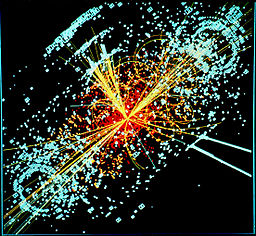 Well, let us just – purely hypothetically – assume that the ’Higgs – Boson’ they claim to have separated early in July at the CERN (the European Centre for Particle Physics) is actually the ’divine particle“ the media say it is. Would it not, according to the ’Susy-Rule’ – that is the super symmetry rule – at least as said ’Susy ’ is commonly understood and if all is above board (which, incidentally, can be expected when we are talking ’divine particles’ can’t it?) – be reasonable to expect an ’Higgs – Böson’, as well? The logical conclusion, of course, being that said ’Böson ’ can only be a ’satanic particle’! What else could it be? Such a ’Böson ’ can only come straight from hell!
And, naturally, the fact that said ’divine particle’ was found first in the Geneva ’Large Hadron Collider’ (LHC) – thus beating said ’satanic particle’’Böson’, – must also be considered a heavenly symbol! That is pretty clear, isn’t it? And with the exception of some communist or Islamic fundamentalist, nobody will be particularly surprised. After all, this expensive technological miracle, this LHC, can be found not in North Korea or in some Mosque in Iran, but in the middle of the Christian Occident, namely in Switzerland. Which, despite its neutrality and beneficial cornucopia of dirty money accounts, is a country still closely connected with the Christian – Jewish cultural area!
On the other hand, it is admittedly a little upsetting that this alleged ’divine particle“, according to the ’standard model theory’ , is perhaps the smallest of all the ‚Higgs – Bosons’ , which might be the reason why those guys at LHC found it before the hypothetical ’satanic particle’ , the ’Higgs – Böson’! And they probably paid no more for the necessary electricity than a ridiculous 16 million Euros! For a ’divine particle“, that is certainly a ridiculously small price. After all, a ’Ronaldo’ alone, who is only the ’eleventh part of Royalty’ costs easily ten times that much! You really have to come to terms with those facts, you know. Something is definitely a little rotten, isn’t it?
But it actually gets worse! What will happen if, perhaps in three or four months, perhaps at the price of 20 million Euros or more for electricity, suddenly one of those evil ’satanic particles’ will get stuck in the Atlas and CMS detectors of the LHC? Then what? Is something as unfathomable as this conceivable at all? Can it be permitted to happen at all inside our Christian-Occidental value system that a ’divine particle’ is less expensive than a ’satanic particle”? Would such a thing not make everything we ever believed in tumble down on us? And, mind you, on top of this we are talking something that was financed by our unsullied tax money?
Can we really allow this to happen – that after three years of modification that cost more than three billion Euros a machine that has a diameter of 27 kilometres found a Boson called ’Higgs’ after a hundred and fifty trillion proton collisions and for an electricity bill of a ridiculous 16 million Euros? I mean ’Higgs’ of all names – not ’Gottschalk’ or ’Benedikt’ or, well, even, God willing, ’Schavan’? There is no doubt that Germany, again, paid most for the ’Boson’, is there?
But no, they must name it ’Higgs’, this ’Boson’! Higgs – like you are burping in a state of alcoholic stupor! And this is what they call a ’divine particle’? No – absolutely not! Well, now that they fucked up the naming of this ’Boson’, all that is left for us to hope for is that, maybe, the CERN people will, by the time they will eventually find the ’satanic particle’ – with the ’Higgs – Böson’, they will delete the ’Higgs’ and instead put a nice satanic, German name before the ’Böson’? I could give them quite a list of candidates…
KH
(Translated by EG)
PS:
The wonderful picture was taken from Wikipedia!
Roland DürreSunday July 15th, 2012
Standardization And Certification For Power Preservation
Because today is Sunday …
🙂 As I advance in years, I start realizing what religion is all about.
Religion is supposed to standardize belief. With the aid of stories, rituals and symbols. Rituals have to be practiced. They serve such purposes as clearing you from sins. The processes describe how you can create mysticism and spirituality.
The “system church” uses religion systemically in order to preserve the “right”, or, even worse, the “only true” belief. In order to achieve this, said belief is standardized.
“Certified believers” are generated. They must submit to the system. This process gives and multiplies the power of the system. And, like all social systems that have de-personalized themselves, churches work towards one final goal: strengthening their own power and securing their own survival.
And, incidentally, they are quite successful, aren’t they? After all, some religions have a “life cycle” of several millennia. Enterprises seen as social systems with a business purpose and usefulness often only survive for a few decades, in rare cases centuries.
But the more such a system de-personalizes, the less it will be taken seriously by enlightened persons. The “system church” counters this by using elements designed to stir basic emotions in humans: beautiful ceremonies, mysticism, spirituality and, where necessary, magic.
Criticism from outside is met with the killer argument: tradition. And they also pull at your heartstrings: what we basically want is some respect for all those countless generations who lived and believed similarly. And who even died for their belief. What a sentimental wolf camouflaged as sheep!
It so happens that I think belief is something very personal. And that there are no two people in the world who actually believe exactly the same thing.
To be sure, there might be similar values, expectations, interests and needs between two individuals or in groups. Sometimes there are probably moments of immense shared empathy, during which people actually feel united. Which can cause happiness and give you a feeling of security and comfort. Perhaps such a thing as ecstasy through “being united in your belief” exists.
But still every human will have to answer the question of the meaning of his or her own life alone. Just like we all, in the end, have to walk the final path unto death alone.
After having written this article, I understand a little better why I am often not feeling very well when I think of our society trying to plan, standardize and certify EVERYTHING.
RMD
(Translated by EG)


