
Roland DürreTuesday August 7th, 2012
Certifications – Mania or Reasonable? – III
Here is the third and last article of mine on the common addiction to standardizing everything and certifying humans.
A short time ago, my “small” daughter (aged 16) proudly showed me a certificate. She earned it, along with others, last year at school. I was taken aback. Her annual report did not look very good, but to make up for it, she earned a few certificates.
I used to believe that you get taught some general knowledge at school, thus earning your “general qualification for university entrance”. And that said “qualification“ is documented by these reports. Now it seems reports are no longer good enough. Schools, too, now follow the general trend and issue certificates.
But does this make sense? Do “schools”, too, now think they can no longer ignore the speed that seems to prevail in this world? Do they want to prepare the children for their future role as experts in order to later turn them into one of those small links in the world of adults? Because, after all the cheating they started with products, they now also have to certify knowledge and competence?
Isn’t education and gaining new competence something personal and private? First and foremost, you learn and practice for yourself, don’t you? The basis is always your own interests and values. And then you look for experienced teachers who take you by your hand and make it possible for you to learn even more. In order to then look upon your own competence and experience self-consciously and critically, instead of looking at a collection of certificates.
Equipped with your own competence, you can enter the market. Not as a “small functioning executing system”, but as a human being who delights in his or her work. And this is also the only way to further develop your own personality step by step. Without fear of the future.
RMD
(Translated by EG)
Roland DürreMonday August 6th, 2012
Entrepreneur’s Diary #84 – Dismissal Protection
Several times each year, I meet entrepreneurs from Switzerland in St. Gallen or Zurich. It is a meeting with a circle of persons whom I hold in very high esteem, indeed.
And, of course, being the only German national in the group, I am often subjected to jokes. Or sometimes they pity me. For instance when we are talking German dismissal protection and the extremely high financial settlements for employees of long standing habitually paid in our country. Those are the times when they start consoling me without me ever even having to ask for it. And I meet with surprise: how can such a system actually work?
I inform them that, thanks to thirty years of practice as entrepreneurs, we can actually now deal with our dismissal protection quite well. And that, basically, it is all a question of entrepreneurial culture.
Still, the Swiss do not understand our dismissal protection. In fact, they keep telling me that people living in Switzerland do not even want it. It is easy to explain:
If people in Switzerland wished to have this kind of dismissal protection, all they would have to do is vote for it in a plebiscite.
Those are the moments when I find no further arguments to support another point of view, so I choose to keep quiet – or else change the subject.
Secretly, however, I think my Swiss colleagues are right. In a fair relationship between entrepreneurs and his employees (I intentionally refrain from calling them “supplier of a job” and “jobholder”), the asymmetrical dismissal protection is an unfair ingredient. The employee can give notice at any time, mostly after having found a more lucrative job. If, however, the enterprise wishes to or has to make him redundant, it might easily cost a 6-digit number of Euros if the employee has been working for the company long enough.
And what is worse: the dismissal protection is not only detrimental for the “evil” employers; it is also and particularly detrimental for the “employees”. How many people do you know who, as time went by and for whatever reason, distanced themselves more and more from the company. Still, there was no reason for them to look for alternatives or further education, since, basically, they were secure and could trust in the dismissal protection.
Over the years, “distance” becomes “inner notice“. The hope that a positive change might come dies and the employee develops a mentality of “let them come”. In the worst case, there will be a huge compensation the company has to pay. After all, you earned it, didn’t you? Later, you can still see what the future will bring. Mostly, there are not that many years left before you get your pension. Remembering the past will be a substitute for investing energy into the future.
There might be quite some money in store for leaving. But then, leaving itself will not give you a new task or work. Looking forward to a compensation often destroyed the motivation to further educate yourself and remain agile. And to look for alternatives early. This will promote sullying behaviour, according to the motto: “I can sit this out“. Which, as we all know, will not make you any more willing to change or accept progression.
If things do not go too well, the money may be gone earlier than you thought. You will not get another job without accepting considerably less pay. And living without a job is often not easy to digest.
Unfortunately, I know quite a few people who eventually have nothing to show for their labour. On the other hand, I know a number of enterprises that still have quite large sums burdening them from earlier years – both phenomena were caused by decades of inertia promoted by dismissal protection.
RMD
(Translated by EG)
P.S.
It was particularly bad at the enterprise where I used to work. They had a company pension. If you gave notice before you had reached the 10th year, you were not entitled to it. With the 11th year, however, this compensation – for security-oriented people – was already quite substantial – and it increased with every added year. Some of my friends gave notice on the dot after 10 years. A few did so some years later, because they had taken extra time for new orientation. But many stayed. Until the end. Consequently, huge numbers went the way of “release with compensation“. Over the years, their creeping discontent grew all the time. They had been manipulated and corrupted by the breath-taking compensation. And, with the exception of a few winners, most of them did not do well with this compensation. In retrospect, I am quite happy that I gave notice after a little more than four years, even though it cost me two thirds of my company pension.
P.S.1
“Swiss Conditions”
Dismissal Regulations
In Switzerland, the notice period is as follows:
Time you have worked for the company |
Notice Period |
Notice Date |
| During qualifying period | 7 days | Any day |
| 0 to 1 year | 1 month | At the end of a month unless it says something else in your contract |
| 2 to 9 years | 2 months | At the end of a month unless it says something else in your contract |
| 10 and longer | 3 months | At the end of a month unless it says something else in your contract |
There is dismissal protection if you have been ill or pregnant:
Dismissal Protection
After the end of the qualifying period, the employer may not give notice if the employee has been fully or partly unable to work without his own fault, for instance because of illness or accident, during the following periods:
Time you have worked for the company |
Dismissal protection in case of illness |
| 0 to 1 year | 30 days |
| 2 to 5 years | 90 days |
| 6 years and more | 180 days |
If an employer gives notice during this time, it is invalid.
If illness starts after the employer has given notice, the dismissal protection period will be extended by the time off caused by the illness; the notice will, however, remain valid.
During pregnancy and during the first 16 weeks after a woman has given birth, the employer cannot give notice.
Besides, the Swiss law knows the term improper notice. This is, for example, if the notice happened because of a personal characteristic that has nothing to do with the work.
Source: http://www.gaav.de/arbeitsrecht-kuendigungsfristen.php
P.S.2
Click here: Drehscheibe for all the articles of my entrepreneur’s diary.
Roland DürreSunday August 5th, 2012
Walk Your Talk
Basically, this should be the special Sunday phrase. It is a beautiful sentence.
It sounds easy, doesn’t it? But it is quite hard to live up to. To me, this seems to be the main problem. We all know how it could be done and what we should do, don’t we?
Except that we do not do it.
I was again made aware of it yesterday during Manfred’s nice hall party at Schierling. What great conversations I had with wonderful people. They were all persons who know a lot, do a lot of thinking and (as I see it) have a rather reasonable idea about everything.
If only – it were not so difficult to actually live what you believe in. And that is different from talking. Although it would be quite possible to behave according to your words. And also, it would probably be better for everyone if they walked what they talked. Even if this is a little more strenuous.
That is probably what is most tragic about humans. Consequently, I would like to assure all those people who actually live up to what they talk about that they have my greatest respect. I know a few.
Hats Off!
Unfortunately, I, too, am one of those who do not manage to “walk their talk” as often as I would like to. However, since I am an optimist, I know it is quite good enough if I improve a little every day.
RMD
(Translated by EG)
Roland DürreSaturday August 4th, 2012
We Are Informatics.
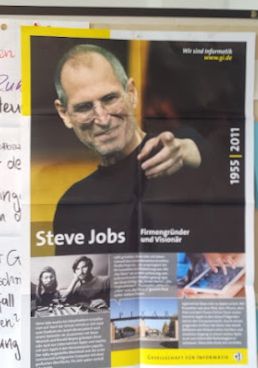 This poster in DIN A2 format was included in some of the GI Informatik Spektrum Volume 35/4 editions of August 2012.
Of course, the first thing I did was hang it on a Metaplan board in my office. Now I am eye-to-eye with Steve Jobs whenever I look up from my desk. And he always points toward me in a friendly manner as I sit at my big Apple Pro.
For all those of you who do not know it: the GI is the Gesellschaft für Informatik e.V.. Their slogan is “We Are Informatics“ and the Informatik Spektrum is the official organ of this association and their associated organizations.
I do not know what exactly the GI is. As I understand it, it is the association of German computer scientists. To me, its purpose is not conclusive. It does not seem to be an association of professionals or interests. Wanting to develop some social relevance, it still does not do any lobbying. Perhaps they see themselves more like an academic circle that wants to publish computer science topics and organize events on a regional and national level.
At least, the GI has the domain gi.de. That is doubtless some achievement, since two-letter domains were really hard to come by until recently.
Besides the GI, we also have the GChACM (German Chapter of the ACM) in Germany. That is the regional association of the big (American) ACM (Association for Computing Machinery) with the slogan Advancing Computing as Science & Profession. As it happens, the GChACM has the domain informatik.org.
In their charter, the German Chapter makes it their obligation to promote informatics by translating English articles into German.
Then there is the Bitkom – Federal Association of Information Business, Telecommunications and New Media e.V. It calls itself “Hightech Association” and is perhaps an interest association of enterprises of the IKT industry (IKT = information and communication association). Perhaps it is the lobbyist of informatics enterprises.
I do not know. But that is irrelevant. After all, I am skeptical as a matter of principle when it comes to associations, because I doubt that these institutions can still contribute significantly to either the well-being of their members or the general public.
But back to the poster:
Why does the GI now pay homage to Steve Jobs with a poster saying “We Are Informatics“? To be sure, Steve Jobs was a relevant person. Of course, he, too, had dark spots.
His first product was a device you could use in order to make free calls, because it created a signal that simulated the “service call“ at the telephone company Bell, thus making it possible to call for free. So you see: it was a device the use of which was definitely a crime. As a businessman, it was not a good joke to be working at Pixar at the time. And if you want to believe his biography, his first relationships with women were not something to be proud of, either. When all is said and done, Steve Job was only human, after all. You have to respect him and might either love or hate him.
But was he a computer scientist? And on top of this, was he one who actually fits the bill of the highly academic GI with its attempted social relevance and standards? Or is this poster just elegantly camouflaged advertising of a sponsor named Apple?
But I do not wish to foul-mouth the GI. After all, I am quite happy that the GI, a few decades ago, did not recognize the ideal moment and jump on the bandwagon of “certifications”. Because if they had done that, we would now have a GI that became really prosperous and powerful through standardizing and norming the numerous technologies of the IuK.
In this light, let us happily join in when they cheer: “We Are Informatics“! This is certainly better than the alternative: “We Certify Informatics”
RMD
(Translated EG)
Roland DürreFriday August 3rd, 2012
On Values and Such – Or: The Meaning and Purpose of My Life
Ever since I started thinking my own thoughts, I have always done a lot of pondering. I used to be the (too?) small, introverted boy. Today, I am the (too?) old, extroverted gentleman. But I still do as much thinking as ever. About this and that. And perhaps too much.
As each year of my life goes by, I also think more and more about how to use my time “meaningfully”. How I can make “successful” use of it. And what exactly it is I want from life.
With time, the ideas change. As do the priorities. And the formulations. Currently, the following things are important in my life. Or rather: currently, I would formulate what is most important for me as follows.
Knowledge
Knowledge is the basis for everything. I understand the term in the sense of enlightenment. You want to question things. You want to be critical. You want to break taboos. You want to prove dogmatism wrong. You want to see that what you know is in harmony with what you experienced yourself. You want to add to your own experience.
Courage
You have to apply your knowledge with courage. In former times, I liked calling it civil courage and/or constructive disobedience. Today, I prefer the word courage. It is a rather clear term.
Delight
In order to apply knowledge courageously, you need to delight in it. You will find pleasure if you meet others at eye-level and treat them fairly. If we take ourselves and others seriously and are taken seriously by others.
Honour and Respect
Only if we honour and accept other people can we respect them. Then we will also be respected by them. Respect, however, is not limited to humans. It should include the entire creation, or whatever this is where I live.
If I manage to become a little more knowledgeable all the time (both about myself and others) and then, based on this, to act courageously and thus experience as many happy hours as possible in delight; if, along with this, I honour my fellow humans and preserve respect of the world in all my behaviour, then I could imagine calling myself “successful” and “living life meaningfully”.
RMD
(Translated by EG)
Roland DürreThursday August 2nd, 2012
Tweets on Twittering and Blogging #128
Here are my tweets of last week on:
blogging and twittering, wisdoms and rules:
120816 You cannot eat beauty – also true for blogging and twittering? #Twitter #Blogging #Wisdom
120817 Beauty fades, virtue stays – not to forget, twitterers and bloggers! #Twitter #Blogging #Wisdom
120818 You cannot heap guilt upon guilt – also true for twittering and blogging? #Twitter #Blogging #Wisdom
120819 Cobbler, stick to thy last – also when twittering and blogging! #Twitter #Blogging #Wisdom
120820 If you cannot say something that is better than keeping quiet, don’t say anything – that means twitter and blog! #Twitter #Blogging #Wisdom
120821 Sometimes silence is answer enough – sometimes also true for twitterers and bloggers! #Twitter #Blogging #Wisdom
120822 Keeping quiet can make for quite some unhappiness – so better twitter and blog! #Twitter #Blogging #Wisdom
There is a new tweet each day. See twitter.com and “follow” RolandDuerre!
Enjoy!
RMD
(Translated by EG)
P.S.
I took the proverbs from Alle deutsche Sprichwörter.
Roland DürreWednesday August 1st, 2012
Certifications – Mania or Reasonable? – II
Here is a little cynicism on the certifying mania. But who knows – maybe you can actually make a lot of money by this nonsense? After all, in this strange world of ours everything is possible. But first and foremost: here is the basic question.
What is the most important quality needed if you want to work and lead people in social systems with responsibility?
As I see it, candidate number one for “higher tasks” is the attribute “being human”. Along with many special qualities.
If you see it under this aspect, the first criterion for selecting someone for a demanding job is human quality. Now would it not be handy to have a certificate that proves such a competence without any doubt? Just imagine how much time could be saved when you have to interview candidates!
So why not certify “being human”? Dependent on the standard I need for any open position, I could define what level of humanity I need. Does it have to be class A? Or maybe class B or C will suffice for a particular job?
Consequently, we should now constitute an “Association for Being Human” (ABH). And then we can certify humans. With multiple-choice tests. For the higher levels, we have to add some intensive questioning. The person to be certified will have to write an essay with pen or pencil. On values or some such thing. And for the really high level, the entire affair will also contain an assessment! Because it definitely has to cost something for a person to become a certified human. And if someone pays, they are entitled to get something in return!
The current lamentable situation in politics and management can also be solved by using certified humans. Because we will demand level A for the key positions in our administration and society! If you want to be Federal Chancellor, you will definitely have to be an A+ or AAA!
And the system can be extended to our heart’s content. Only people with a valid mother/father certificate can have children. And since we are at it, why not develop a “grand-parental” certificate, as well?
In order to get a grip on the volatility of modern marriages, we use a “partnership certificate”. It will evaluate your potential to deal with conflict and also issue a “health and marriage licence“. For those with lower qualifications, the only alternative is the temporary marriage. It includes a fee coupon. Now wouldn’t that solve so many problems? And after five years, you have to renew the certificate – if you proved a success, you can have an extension of the marriage.
If, however, you want to found a company, you have to get an entrepreneur’s licence in advance. Dependent on the goals of the business plan, there will be all varieties of certification levels.
Maybe you could even certify “being Christian”? Or perhaps, even better, create a new religion – of course it would have to have strictly certified members who were recruited in different castes?
Brave new world.
I think modern certification habits are a mania without making any sense at all – in other words, they are madness.
RMD
(Translated by EG)
Roland DürreMonday July 30th, 2012
Certifications – Mania or Reasonable? – I
More and more technological disciplines now force people to spend more and more time certifying things, even in areas where social competence and responsible behaviour are extremely important. Mind you, we are not just talking well-organized supervision by experienced coaches, either. What we are talking here is systemic formalisms based on a mixture of “multiple choice tests” and “credit points”. This is all about putting your cross somewhere and playing “Payback” for the career.
The ingenious business started with technology concerns that created dominant knowledge with super-complicated products, wishing to profit twice by selling them. Associations and clubs followed this egomaniac example.
Having initially been founded as a professional institution or as a platform for shared interests and for exchanging knowledge and experience, they now – on their way to power – become institutions that define “reality“. Using approaches of “best practice”, standards that are supposed to simplify complexity are developed. Since this does not work, the standards are then further developed theoretically and based on speculation, until they are totally detached from reality.
The entire affair grows more and more out of hand. Complex tools are created and often extended by absurd functions. To be sure, nobody likes them, but at least they constitute the basis for yet more certificates.
As soon as an institution has acquired a certain amount of power, its certificates will be compulsory and have to be bought at a high price. Since everything is moving fast these days, the time of validity is limited. You get an extension through “credit points”. More often than not, the association supports its own interests when issuing certificates. You have to attend the right kinds of events, pay a mostly quite significant fee and then you get a new licence.
Many are glad to participate in this game. A certificate is the easiest way to prove your knowledge and competence without actually having said knowledge and competence.
However, certification primarily helps those who issue the certificates. These enterprises and institutions will become rich and powerful. They determine what is right and wrong. Even for very abstract activities that actually require a lot of experience, courage and responsibility. They, too, are simplified, standardized and certified. Of course, it is mostly not a success.
Consequently, the “certified party” usually has nothing but one advantage on his side: he gets a licence. That has a soothing effect on potential customers. So the service provider has a certificate. Consequently, we can assume that he has the required qualities. It makes for sleeping soundly at night – before you are totally surprised at how many projects fail.
Basically, all the certificate tells you is that the owner of said certificate attended some course or other and accumulated enough points. And that he is capable of filling in a multiple choice test and sometimes a little more than that successfully.
It used to be different.
Machines (like cars) were certified. Initially, only the TÜV was permitted to issue the certificates.
Humans were not certified. For them, we had education and professional training. At school and university, in dual educational systems.
Humans had to learn and practice. They gained experience. After the apprenticeship, they were made craftsmen. They learned with a master craftsman and later became master craftsmen themselves. By writing a final thesis or manufacturing a master-piece, they proved their competence and skill.
Then they had the responsibility to constantly keep their craftsmanship up to the latest standard by experience, additional learning and openness. For those craftsmen, the pride in their own work and the desire to remain competitive were motivation enough to never stop learning.
But what happens today?
Schools and universities fail more and more often. Our traditional and by no means worse educational systems suffer greatly. The doctorial title is nothing but a humorous title. As soon as you are passing the Australian “immigration desk”, you will see an “immigration officer” smile benignly. The black belt worn by the project manager is worth twice as much as your doctorial title.
Certification is a way of privatizing education and training – with the logical consequences. Standards will see to it that we have uniformity and commercialization. Education will become “convenient” and “fast food”.
The consequence is that people will be satisfied with just functioning in a closed system. If you “obey”, you will be rewarded. Generative and creative aspects will be pushed aside.
This suggests that you can simplify existing complexity. Like you can make up for knowledge and experience with a simple “cooking recipy” and replace it with a little “best practice”. Problems are no longer found and looked into – they are just solved. Except I have no idea how that is supposed to work.
All you have to do is get a licence. In the same way as you acquire a driver’s licence, a hunter’s licence or a fisherman’s licence. And then you are what it says on the licence. Except – even with simple things like driving a car, it does not really work, does it?
So how is it supposed to work with complex leadership responsibilities?
Maybe it is more mania than reasonable?
RMD
(Translated by EG)
Roland DürreSunday July 29th, 2012
brand eins in August
 As early as in the middle of last week, it already sat in my letter box. In fact, it accompanied me to Nuremberg last Thursday, remained by my side all the time – and yet only really arrived today.
It is blue, a beautiful blue. Somehow or other, it is already quite an achievement to select a nice colour each month. A colour that is actually suitable for the theme and content. I am quite serious!
The magazine is titled
Doing Nothing.
I rather like this. After all, I dream of the “Lazy Manager“ and “Relaxed Entrepreneur”. Well, I certainly know that many problems will solve themselves. For instance the very important email I never got around to answering late last night. On the next morning, after I woke up, it turned out said email was no longer necessary.
Mind you, you must not confuse doing nothing with “sitting something out“.
Politicians like to do this – and I would prefer them “doing nothing” instead of “sitting things out”. There certainly is a significant difference.
Then you find the sub-title:
And how it can be put to good use.
I do not (yet) understand. Who said I wanted to put doing nothing to good use? So now I open the magazine and start reading the editorial by Frau Fischer. Her heading is “heaven and hell”. And I immediately understand what she means. For some people “doing nothing” is heaven, for others it is “hell”.
Mind you, I am sure you should not see it in terms of black-and-white. Personally, I would think my preference is “doing nothing is heaven”. And I believe “doing nothing is hell” tends a little towards “psychic disorder”. There they go again, my prejudices…
Regardless of the invitation to do nothing, I already read some of the articles. It strikes me that this brand eins edition is mostly about humans and their fate. I find that nice. If you see it under this light, the April brand eins is quite suitable for reading and relaxing during your vacation.
À propos: at the end of Frau Fischer’s editorial, you can also read the words “vacation” and “stress” in a single sentence. Well, if that is how things work, I think I might do without vacation and instead prefer “doing nothing”.
RMD
(Translated by EG)
Roland DürreFriday July 27th, 2012
Entrepreneur’s Diary #83 – So What Exactly Is An Enterprise?
Up until now, I defined an enterprise as a social system. This is still true. But now I learned more. Or rather:
🙂 I am bold enough to believe I learned more.
Firstly, an enterprise consists of many people. Once, when I gave a presentation in a grammar school, one of the young students said it is a heap of humans. So we are talking an assembly of people. They develop a social life. You get common concepts and a feeling of belonging together.
The “heap of humans” is represented by a juristic person or corporate body, the enterprise and its “structural parts“– the managers and directors. It owns various kinds of things, such as office equipment, machines or buildings. But also patents and special knowledge. It develops a culture and “basic beliefs”, a value system, routines and rituals. Symbols are created and a “brand” is developed.
As opposed to other social systems, such as churches, associations or countries, an enterprise has an economic goal.
It might be – as it says in the Bavarian Constitution – to produce goods and provide services needed by humans at home (and abroad), thereby making a fair profit. But it might also happen that the only interest of an enterprise lies in making profit and it is totally irrelevant if what it produces is sensible or if it produces anything at all. Over the last few years, the latter case increased drastically, not only in the financial sector.
So this was how I used to define enterprises. During the last few years, however, I got more and more aware that something is missing in this definition.
It is the organization of an enterprise. Now that is indeed something hard to describe. Yet in many ways it plays a central role and has profound significance. Organization can work in all varieties of ways.
For instance, it might be democratic or non-democratic. Hierarchical or cooperative. Intensely regulated or chaotic. With a system of punishment or rewards. Creating fear or helping to develop life in various dimensions. There can be internal rivalry or the promotion of collaboration. The system might let people meet at eye-level, or else let them feel who is boss. The organization can influence the enterprise. It certainly has a huge impact on and relevance for the enterprise.
So now here are a few questions:
What exactly is an organization? Even if an enterprise has “no” organization at all, would that again be a form of organization?
Can you change an organization, and if: how??
Will an organization automatically evolve from the routines and rituals lived in an enterprise? Is an organization the sum of all the processes trained and realized in an enterprise?
What is the influence of the symbols an enterprise gave itself? What is the relationship between the culture and organization of an enterprise?
And the more I think and read about it, the more I realize what a complex thing even a small enterprise is. And how it is perhaps impossible to control the change that is always necessary “from the top”.
And how antiquated the understanding of management and leadership you get at universities still is. We are talking an understanding on which (mostly unsuccessful) enterprises are founded and which many enterprises still live on a huge scale.
All I conclude from this is that my firm intention to do a little better should be even stronger.
RMD
(Translated by EG)
P.S.
For all articles of my entrepreneur’s diary, click here: Drehscheibe!


