
Roland DürreSaturday October 13th, 2012
Who is Scared of the Boogey Man?
Everybody is scared of the “Cloud”. Because the Boogey Men inside the Cloud eat our data and/or use them in an illegal way. Our precious personal data!
It is particularly bad if the Cloud is outside our country. After all, there is no control possible. The US secret service might well read our data. However, matters are not really improved if the Cloud sits (hovers over) Germany. Perhaps the US secret service cannot read our data in that case, but the German secret service certainly will. And, basically, I do not care which secret service reads my data.
Why are we feeling so protective of our data? I cannot understand it. Nothing has as little importance in my life as my data. If there is anything you wish to know about me, just go ahead and ask! It will be my pleasure to answer – even publicly. Most of the things about me will be found at duerre.de or if-blog.de, anyway.
If I were the anxious type, I would certainly be scared of Clouds. But I mean totally different Clouds. Those I am actually dependent on. Those that are the basis for all I truly need in order to survive.
Water
Water comes through the tap. It gives me access to the water Cloud. It is rather insecure, isn’t it? Evil-doers could pour poison in it at many places. To be sure, we only know the poison terror at the water station from the cinema – but it could easily become reality. An evil terrorist would be all it takes to kill us all.
Bottled water from the supermarket will not help, either. This Cloud, too, has too many weak points. An evil-doer would easily find ways in. Today, hardly anybody still has his or her own well. Incidentally, it would not help, because the Cloud of dioxins or radioactivity is already on its way to poison it, anyway.
Nor is it a brilliant idea to drink beer instead. Too often, it comes from the InBev Cloud. And on a rather risky way at that. Until finally it ends up in the safe haven of my refrigerator.
Food
All food, be it deep-frozen, corn, all kinds of basic nourishment, vegetables and fruit, fish or meat, canteen food: all comes from the Cloud. And once in a while, something unfortunate happens there. Sometimes the Cloud produces chicken that contains a little dioxin, sometimes it is the deep-frozen strawberries. They come from China and make our children sick. I certainly cannot understand why we in Germany would need to eat deep-frozen strawberries from China. After all, there are enough apples, pears, plumes… right here in the country. But the Cloud makes it possible. And certainly not from the neighborhood.
But we trust in the Cloud. It will certainly feed the entire world and continue to do so tomorrow, as well …
Energy
Electrical energy comes from the electrical socket. It is the interface to the Cloud. The fuel comes from the pump at the gas station. When the Cloud will no longer supply us with electrical energy, the lights go out. When the pump at the gas station provides only drops, the cars will just stand around and be useless.
We do not know where the electrical energy or the fuel originated. Neither do we want to know. The Cloud will certainly provide. With or without an about-face in energy politics. Besides, energy is, after all, not quite as important as water or food. Nothing serious is happening if the electrical energy is sometimes polluted.
Money
You cannot eat money. For life, it is even less important than energy. Most of us have too much, anyway. Which is why we buy all kinds of useless things we do not really need. Whatever is left of our money will be stored at the bank. That is how we learned it! For too many years, we have been instructed that the only person hiding her money in her socks or underneath the sofa is the stupid grandmother. No! Apparently, we think the money Cloud is very nice and even system relevant. And consequently, we hand our entire money over to it. Because we want the Cloud to let our money work for us. And when we do not have enough money, we go and get it there.
Water, food, energy, money and much more comes from the Cloud. Basically, I cannot imagine anything today not coming from the Cloud. And still we have no problems sleeping soundly …
Only when our data are inside the Cloud, we cannot sleep any more. Why is that so? Are we scared of our data? Why are we so afraid that others might get to know who we really are? Do our data remind us of our evil deeds? Quasi like a modern bad conscience?
I must confess that I generally fail to understand the sometimes collective sometimes individual hysterical reaction when it comes to personal data. And, to me, it does not matter if these data are in the Cloud or somewhere else. I still have quite a few plans for my life. But I would never, ever agree to do the job of data protection commissioner.
RMD
(Translated by EG)
P.S.
In my book passphrases and passwords for internet pages such as Ebay or for the bank are not data, but keys. And, of course, you should always be careful with keys. Even though I must admit that I am actually quite careless with my house keys.
Roland DürreFriday October 12th, 2012
Data _Theft
This morning, there was an extremely unsettling item of news (Nachricht) on the radio (as always, I listened to Bayern2 – Radio):
In probably two hospitals, data were stolen. We are talking of the hospitals at Rastatt and Mittelbaden in Baden-Württemberg. The objects stolen are patients’ data, diagnoses, letters by doctors and internal hospital communication. These data were probably stolen on September, 19th. According to the hospital, they filed a complaint against an unknown person. It says that the Rastatt hospital noticed the violation on September, 27th – eight days after the alleged theft.
Today, on October, 12th, this item of news makes the current headline!
Basically, I assume that, of course, some “secret” data of German hospitals will end up where they do not belong on a daily basis. It is probably unavoidable. But this case seems to be particularly important. After all, it made the current news of October, 12th, 2012!
Well, why don’t we savor this topic? There was a data theft. Theft – which means some property was stolen. But then, the property – that is the data – would have to be gone after the violation of the law happened. Consequently, the thief would have had to copy the data and then delete the file at the place of theft. Otherwise, all you get is “half a theft”.
Yet I presume this was not what happened – it is probably not even possible. All those intended copies (backups) and unintended “data in work” make it basically impossible to completely delete anything. Except if the thief practiced total vandalism and destroyed everything. Or else if he was a perfectionist who also destroyed all the backups. But only a genius can do that – and even he can only do it if he has internal knowledge.
But let us look at the person who probably committed the theft. I write “probably” because, de facto, the “theft” is only an assumption. They assume that an unknown person copied certified data from the system. So what will the thief now do with them?
Is there a personal interest, because he wants to know more about a procedure that actually concerns him? Is it simply revenge? Does he only want to look important? Is this espionage, maybe by the press? Someone who wants to detect unethical behavior on the part of the hospitals (I assume that can be found everywhere)? Or was it, maybe, even a Federal Agency working clandestinely (and rather clumsily)?
Or is it a (minor) culprit who wants to win money by using data, for example by blackmail? And in that case: who would be the recipient of blackmail? Who is the owner of the data? If it is a diagnosis, is it the hospital or the patient? If it is communication between doctors: the hospital or the doctors? The sender or the recipient of the letter?
More and more question. I am sure I could continue in this fashion for a long time. But that is not what I want. I assume that this is again one of the instances where no damage will be done by the “data abuse”. And if damage is done, it will be quite small and short-lived. A trifle. But in the land where people get hysterical about data security, this is the kind of news you can use for painting the most demonic pictures.
I file the article among “storms in the water glass”.
RMD
(Translated by EG)
P.S.
I would find it a lot more interesting to read about the number of malpractices or the many cases of operations or other therapeutic actions where business considerations and optimization, such as capacity utilization and strategic billing were the determining factors.
Roland DürreThursday October 11th, 2012
Tweets on Twittering and Blogging #136
Here are my tweets of last week on:
Blogging and Twittering, Wisdoms and Rules:
121018 Standstill does not mean peace – a warning for twitterers and bloggers. #Twitter #Blogging #Wisdom
121019 Strictly insisting on justice often means the greatest injustice – so expose it when twittering and blogging! #Twitter #Blogging #Wisdom
121020 If you search, you will find – so please do not give up when twittering and blogging! #Twitter #Blogging #Wisdom
121021 Defending sinners means sinning yourself – also true for blogging and twittering? #Twitter #Blogging #Wisdom
121022 Sweet songs have tricked many a bird – also true for twittering and? #Twitter #Blogging #Wisdom
121023 Sweet wine will turn into sour vinegar – just like when you are a twitterer and blogger? #Twitter #Blogging #Wisdom
121024 Dance when your luck is the piper – twitterers and bloggers #Twitter #Blogging #Wisdom
There is a new tweet each day. See twitter.com and “follow” RolandDuerre!
Enjoy!
RMD
(Translated by EG)
P.S.
I took the proverbs from Alle deutsche Sprichwörter.
Roland DürreWednesday October 10th, 2012
News of the Day – the Price of Electrical Energy
In the morning, I often enjoy listening to Bayern 2 on the radio: die Radiowelt. Today, everybody seems to be upset about the price of electrical energy. I see that a little more diverse:
As I perceive it, a quite substantial “Inflation” is taking place. No matter if I go eating out or go places by underground train, everything gets more expensive. Even electronics products, such as mobile phones and laptops do not seem to get less expensive if you take the “State of the Art” into consideration. Not to mention realty. Salaries and incomes, too, are on the way up, at least nominally (wage agreements, doctors). To make up for it, the small number of poor persons grows.
This inflationary situation – even if statistics cheat to make it look lower – is quite easily explained. Just look at the money policy of the EU administration. Or the development in other currency zones, such as the dollar, the RMB (Chinese yuan), or other economies with whatever small currency you choose to look at. All over the place, prices climb. Be it in China, the USA, or elsewhere. And, after all, we are part of a globalized world, aren’t we?
If, in an environment of inflation, a product kept its price stable, it would in fact get less expensive. The only way I could say something got more expensive would be if the increase in price were considerably above the inflation rate. Under this light, all you should be able to say is you have a relative price increase, one that remains after you have considered the “true” inflation rate.
Looking at the increase in prices for oil, you notice that the price for electrical energy is actually far behind. As I see it, it is a good idea to have the price of electrical energy climb as long as most of it is still produced from fossil materials. When, at long last, the moment arrives when we can produce electrical energy exclusively in an environment-friendly way, it should be cheaper.
For me, however, it seems doubtful that this will ever be possible to the extent we allegedly need it. That means it is still absolutely obligatory for us to treat energy in a responsible and efficient way. And that is an area where regulations and laws are mostly not really helpful. Sad as it may be, it is a fact that rational thinking mostly only happens through the purse (like a man’s heart is won through the stomach).
What is really annoying, however, is the fact that we now have a modified co-called electrical network regulation (StromNEV). It says that those enterprises that use up more than ten Gigawatts of electricity each year and need the full capacity for a minimum of 7,000 hours each year will no longer have to pay the network organizations for the transport of electrical energy, which, basically, is an additional subsidy. And the number of these big subsidies has increased drastically.
This caused Germany to become an expensive country in terms of electricity for those who need small amounts. Yet, for those who need huge amounts, it is rather attractive.
Naturally, those who use up small amounts are now worse of in terms of money, while we are counter-acting the goal of using energy more efficiently on a huge scale. Incidentally, this has nothing at all in common with an about-face in the energy sector. All it means is another subsidy for dedicated interest groups.
It sounded like a confirmation to me when, this very morning, I heard a CSU politician say on the radio that even Norwegian enterprises now started transferring their electricity-intense production parts to Germany.…
Incidentally, the author assumes – and I am sure this is totally unprofessional – that most of the enterprises that use up huge amounts of electricity need it for such “reasonable” things as the production of beer and drinks cans. That alone makes me furious. Because beer is definitely one of those things that you must never drink out of cans. Mind you, our throw-away society is something I detest, anyway.
RMD
(Translated by EG)
Roland DürreMonday October 8th, 2012
There is no True Life in Wrong Life.
A very simple sentence. Only eight words. A friend of mine heard it as the motto of an event. She considered this sentence important enough to use in one of her own presentations:
There is no True Life in Wrong Life.
That is how the sentence found its way to me. It seemed to be special to me. Consequently, I looked up where it originated. And, surprise, surprise, I found out it is from Jürgen Habermas. Well, I remember the “Non-Hierarchical Discourse” (“Herrschaftsfreie Diskurs“) and many more concepts I find important.
I spent quite some time thinking about this sentence. Both in a resigned and positive way. And I found numerous interpretations. And then I came up with a variation:
In False Life, Too, True Life is Possible!
Logically, this sounds like a contradiction. But that is not how I feel about it. Rather, I think my sentence might well complement the sentence by Habermas.
My sentence makes it clear what a huge challenge it is to lead a true life.
But: is that not also true to the same extent for freedom? Don’t you need a strong will and immense effort in order to “live in freedom”?
Consequently, I found a new definition of freedom for myself:
A person is free if he or she manages to live a true life even in a wrong life.
I will add this definition to my “Freedoms”.
RMD
(Translated by EG)
Roland DürreSunday October 7th, 2012
Free Rides for Free Retirees
Yesterday, another one of those persons older than 80 wanted to strike down the cyclist (me) with her big limousine. Yes, as opposed to what normally happens, this time it was a lady!
I am happy she did not succeed. But I must say I am truly annoyed (as happens frequently) when witnessing what kinds of persons still believe they can master the running of these powerful and dangerous machines called cars. Consequently, I am writing this spontaneously as a silent protest.
As I perceive it, many elderly persons define themselves through property and appearances, even at the end of their lives. And in doing so, they – more often than not in vain – chase their dream of happiness and inner freedom. Ceaseless activity will prevent critical reasoning. The car has become a life fetish.
Consequently, we still have a phenomenon in Germany that is probably unique in the world: the motto “Free Rides for Free Citizens” is considered a self-evident basic right. Which means that more than 5,000 persons still die the mobile hero’s death on our streets. More and more often, elderly persons are concerned – also as those who cause the tragedy.
Because even if the doter already forgot many things in his senile dementia, he or she is still well aware of his or her rights on the roads. Behind a steering wheel, he is the giant he would so very much have loved to be in true life. And, of course, he or she is the only person in the country who can actually drive a car. If, additionally, he or she has neither children nor grandchildren (nor a shepherd’s dog), then all that is left for him or her – except a sometimes rather strange political orientation – is his or her car. Driving a car is the last thing left you can be proud of. Until the bitter end.
And the car will be the vehicle he will use even at a very high age for strolling through the land. In order to give the car some experience, he goes to Garmisch, drives to the bakery in the morning and to the cemetery at the opposite end of town in the afternoon. At a speed he himself has decided he wants. Because, after all, he is pressed for time, isn’t he? He could easily have taken public transportation, but that is far too complicated and takes far too much time…
The motto is “Free Ride for Free Retirees“. Until the next accident happens. It might be on the parking lot, into the display window of a toy shop or as a wrong-way driver on the motorway. The “Right of the Free Ride” is something the old retirees are entitled to. A life without a car is unimaginable for them. That is what they fight for and that is what they vote for. Tin is the highest property that needs to be preserved. They worked all their lives for their cars.
Every speed limit is a violation of their personal rights. Mind you, the limitless individual mobility (especially if based on the combustion motor) has become a parable for egoism and ruthlessness. I witness the aggressions of drivers in their tin boxes when they are stuck in traffic jams or in front of traffic lights on a daily basis. Luckily, I am mostly just the spectator passing them on the cyclist’s path.
Like many other things in our society I would like to criticize, the right to unlimited mobility is based on an often strange definition of freedom. Many people seem to believe freedom means you can do whatever you feel like doing at all times. Along with a radical and extreme definition of ownership in our AEC (American European Culture), this turns our social culture of sharing into one of competitiveness. For some people, it happens in a rather unpleasant way.
For me, it is easy to explain: we humans tend to define ourselves through what we own, what we consume and what we define as mostly imagined idols. And during the last century, idol number one was and is the car. Consequently, it seems only logical that especially older people have parked their idols in their garage.
Well, I used to hope people get wiser as they grow older.
RMD
(Translated by EG)
Roland DürreThursday October 4th, 2012
The Last 24 Hours…
 Nadja (in Twitter @lazyNadja) gave a wonderful presentation on “the meaning of life“ at the technological IF-Forum “Project Coaching”. Here is a nice short version (9) on six slides.
In her presentation, Nadja gave us a task. We were asked to imagine we had only 24 hours left to live.
And then we were to think about how we would make use of those last hours. The answer “say good-bye” was not permitted. No. We were supposed to find out what it was we really would like to do – and also ask ourselves why we are not already doing all those things.
The question was part of her plea to think of ourselves a little more, even if, as responsible project managers, we suffer from (often imagined) day-to-day stress. And to do more of the sort of things we really enjoy. Because only people who are happy, successful, content… can also contribute towards other people becoming happy, successful, content… And if we spend more time doing what we really want to do, we will be more successful with our tasks as project persons. Also, we will increase the probability that our life is a success and we can work towards a positive future for everybody.
For me, the answer to Nadja’s question was not at all easy. At least, I spontaneously could not come up with any elementary needs I do not let myself fulfill “in normal life”. Except maybe that I sometimes feel like punishing one or other of the persons around me with a punch for his or her evilness, impertinence or stupidity. But that is something that would not agree with my personal utopia of a penalty-free society. And since I am also well aware that this kind of vengeance or crime would neither satisfy me nor make me happy, I will not commit it.
Well, and how about the “enemy” hitting back? Luckily, these kinds of ideas rarely come to surface with me – and they disappear quickly, too.
So let us return to the initial question:
Assuming I had 24 hours left to live. What would I do?
Well, I tend to approach important questions systematically and strategically. Consequently, the first thing I think about is: would I wish to spend the remaining time by myself or along with others. Would I like to give away many things during those last hours, or would I prefer receiving things. Would I wish to just enjoy or would I wish to make one last impact? Should I shout my frustration – as “The Stranger“ does in the novel with the same title by the great Albert Camus? What is nicer (or more goal-oriented)? Being sober during the last hours on earth or drunk?
These and similar – in my opinion totally rational, almost scientific questions – come to my mind first. Then I think that it is all a lot easier.
In the morning of my last 24 hours, I would first ride my bike to the “real bakery”. Then I would enjoy a delicious breakfast with home-made jam, a three-minute egg (of the sort the EU is currently trying to talk Europe’s hotel owners out of) and salted (real) butter. As I otherwise only get on weekends.
But then how to continue? Go for a swim? Or meditate? Nadja’s question is really hard to answer for me. And I think this is a good sign. Because if I were now able to come up with the big wish I always used to dream of and never fulfill, it would mean that I made a mistake.
But no matter what: during the last 24 hours of my life, I would definitely write an IF Blog article.
RMD
(Translated by EG)
Roland Dürre
Tweets on Twittering and Blogging #135
Here are my tweets of last week on:
Blogging and Twittering, Wisdoms and Rules:
121011 Nobody can avoid being exposed to ridicule – so beware, twitterers and bloggers. #Twitter #Blogging #Wisdom
121012 There is truth in proverbs – also true for twittering and blogging. #Twitter #Blogging #Wisdom
121013 Instead of thanks, you often get ingratitude – something twitterers and bloggers know quite well! #Twitter #Blogging #Wisdom
121014 You will grow strong by learning to be patient – also if you are a blogger or twitterer? #Twitter #Blogging #Wisdom
121015 If you do not climb too high, you cannot fall too far down – a warning when twittering and blogging? #Twitter #Blogging #Wisdom
121016 Constant dripping wears away the stone – also a good strategy for twitterers and bloggers. #Twitter #Blogging #Wisdom
121017 Still waters run deep – also when twittering and blogging. #Twitter #Blogging #Wisdom
There is a new tweet each day. See twitter.com and “follow” RolandDuerre!
Enjoy!
RMD
(Translated by EG)
P.S.
I took the proverbs from Alle deutsche Sprichwörter.
Roland DürreWednesday October 3rd, 2012
Still Fresh News That Seem To Stick With Me …
Regardless of all the information flood from the media (paper and internet), via social media (Twitter, Facebook, Google+) and radio and TV, some of the recent news linger in my memory. To be sure, they are also more important than those news I forgot. But some way or other, they also scratched at a surface inside me. Consequently, I wish to write down a few ideas on them …
Our Federal Chancellor and Gorleben
(Zeit and SZ)
They installed another one of those committees of enquiry. Even our Federal Chancellor was asked questions. Because, at the time, she was the minister in charge. It was about the desperate situation at Gorleben. Except that, so far, nobody really takes notice. Of course, the committee cannot really present any results.
Because back then nobody could know that things might not go as well as planned. Regardless of the fact that everybody with even an inkling of scientific knowledge and a little common sense had to have known that the combination of nuclear waste and salt mine could not work. Now we see the result. Taking the waste out would cost more than anybody could pay – and probably it could not be done anyway at this late time. At some time, there will be radio-active alarm and the potable water in the region will be a thing of the past.
To be sure, our Federal Chancellor conceded that the situation was not really solved to perfection at the time (or something like this). Instead of just admitting that she made a huge mistake when she was still environmental minister. After all, we all make mistakes, don’t we?
Lawsuit against Church Tax
(Spiegel)
I was surprised to see that a judicial theatre as absurd as this is actually worth making the news. Some wisecrack had the idea that he should not be asked to pay club fees, because the club is something like common property. Because it is the Church of Jesus Christ. What a strange idea. Like if I were to play in the chess club tournament of a small town without being a member of the chess club. Because, after all, chess is common property, isn’t it?
Such an idea can only originate with someone who is both a lawyer and Christian. Mind you, the church does not even charge entrance fees for its events, such as the mass service.
Speaking of church, it comes to mind that there might be a few more lamentable/offensive facts to write about. For instance that many church officials and dignitaries are still paid by the state, that churches still enjoy special dispensations from taxes, that we still have compensation payments for the church by the state for dispossessions that happened during the second half of the last millennium, and much more of similar kind. But it seems nobody is interested in these kinds of things.
Offended Religious Communities
(Welt and 20min)
Much has been written on this. The range is from absurd arguments about numbers (when it comes to the consequences of circumcision) to illogical legislative proposals. It seems that religious communities need their special treatment and thus have to get it. Some need it in order to mutilate their toddlers without violating the law. Others need it in order to “protect” their feelings. And our Federal Chancellor is wondering whether she should banish a not very impressive video recording, because it might just be a danger to public safety.
Stale Air in the Airbus 380
(dw)
This is also one of the things the media will make good use of. But why? Lufthansa does not only fight part of their employees (and UFO), but also stale air. Mind you, isn’t it logical that it must be smelly in such a huge airplane? After all, an Airbus 380 is a new and complicated system. It is not yet fully mature and consequently still has (must have) its flaws. I could imagine worse than stale air. It sounds like an error that can be found and corrected.
Stress Test for the European Nuclear Power Plants
(Focus)
The “stress test“ for nuclear power stations (note the martial choice of words) is finished. We can now read the report and it tells us that there are scandalous safety risks in more or less all the European nuclear power plants. However, the stress test only tells you half of the truth. Important criteria have been left out.
Mind you, not that it matters. Because, according to the report, the repair of all the discovered defects would (once again) cost the unimaginable sum of 10 to 25 billion Euros. This kind of money is not available; or rather, nobody is prepared to spend it on safety. Neither can the EU put pressure on anybody in this important instance. Consequently, nothing is going to happen. There is no such thing as safe nuclear power. Period. All you can do is hope nothing serious will happen. Well, it is what the Japanese did, isn’t it? Except that they were not lucky.
To make up for it, the EU comes up with a few more new regulations and laws. Yet no reasonably minded European will ever stick by them. And, as a side-effect, Europe is divided in order to “safe“ banks with sums that make those aforesaid 10-25 billion look ridiculous.
But the banks, again, need some extra money – and the Euro rescue fund gets larger.
(SZ)
Of course, the money for the banks will not be enough for Spain and the proud nation will have to seek shelter underneath this strange Euro rescue fund.
NSU and the Protection of the Constitution
(Handelsblatt)
The things I keep hearing on this make me speechless. “Civil servants” and politicians lie shamelessly. It can almost be assumed that V-persons working as civil servants were not only the culprits, but also the agitators. Nobody seems to be interested in finding out where the real persons behind the scenes sit.
To make up for it, the telecommunication of the citizens is recorded and data stockpiling secretly makes progress.
IRAN blocks Gmail
(ARD)
Again, I am reminded of data security. And then I ask myself what I fear more: enterprises using my data in order to sell something to me (ha, ha), or the state confiscating my means of communication? Or – what is worse – the state working espionage against me at random. Because in this country, the administration is permitted to do exactly what they want to protect us against from Facebook&Co.
Consequently, we fear data abuse “in the cloud“ as the devil fears holy water. And we fight the devil with Satan. Because there is no data security when it comes to the state and its executive organs. The many terrorists alone make it impossible. But perhaps the short-term blocking of Gmail by the Iranian authorities was just a means of fighting world-wide terrorism?
BND building will cost 100 billion more than planned
(Welt)
This, too, is nothing special, is it? Except that the biggest building the state ever planned is for the BND. But it is certainly no surprise that it is (so far) the biggest miscalculation. Basically, huge projects will always end up costing a lot more than planned. This is true for philharmonic houses (Hamburg), airports (Berlin-Brandenburg), railway stations (S21) and also buildings where the “Federal Investigation” is done and the constitution is supposed to be protected.
As a general rule, there are probably two reasons for this: firstly, the cost has been voluntarily kept low in the planning phase in order to make them politically acceptable. Secondly, they certainly do know that the number of errors will not increase linearly with the degree of complexity. It can probably even be calculated. Except that nobody can tell in advance what kinds of errors will occur and how much they will cost.
And finally, again our Federal Chancellor – with a pleading in favour of the e-car.
(Bild)
This is particularly delightful. By the year 2020, we are supposed to have one million battery powered cars. To be sure, they will look more like Pedelecs, instead of cars in the modern sense.
Physical laws (such as energy density) are opposed to it. If we want to compete against vehicles powered by fossil material with e-mobiles, we will first have to make individual traffic e-mobile adaptable.
Light and slow e-mobility can only be attractive if you adapt the traffic. You will have to make it softer and slower. Consequently, the best promotion for e-mobility would be a clear speed limit, for instance 30 km/h inside cities, perhaps 50 km/h in rural areas and 90 km/h on motorways. This, however, would mean a de-emotionalisation of the false God car. Something most Germans, including their boss Merkel, cannot imagine…
Economy and Sport
I find it particularly easy to remember the economy sector. Here, the story is quite simple: there is more than enough money available, the banks almost drown in it. Fuel prices climb (which I find good), property gets more expensive (I cannot judge this) and the stock prices climb (I could not care less). Officially, we have as good as no inflation. Only the prices do not know that. Consequently, everything gets more expensive all the time.
Here is more news from the economy (FTD): dpad and Neckermann (according to Quelle) are now definitely bankrupt. dpad used to be DPA, which, along with API was perhaps the world’s most renown press agency. There came a time when it merged with the “Deutschen Depeschendienst”.
As I see it, all these bankruptcies were more or less a matter of course. And, naturally, there was no rescue umbrella for them. As opposed to the financial institutes – most of which definitely are also now well into their dotage.
In Europe, the spiral goes downwards all the time. Only Germany goes up. This cannot be a good sign and it makes me wonder.
And with sports, matters are even simpler: the FC Bayern will always win. Except in Belarus.
Now the article I was going to write on our day of jubilee is a lot longer than I had intended. All I wanted to do was remind you of the fact that not all is gold that glitters in our highly-praised black-red-golden country. National intoxication will not help us. We have to sit down and do our homework for a Europe that is unified in freedom. If I were asked my opinion, I would quickly abandon the Third of October as a national holiday. Instead, I would come up with a common European Holiday. And now I will go to the forest pub by bike and celebrate October, 3rd among Jazz music and a litre of Oktoberfest beer. And tonight, we are going to eat a “truly authentic” Chinese dinner.
RMD
(Translated by EG)
Roland DürreTuesday October 2nd, 2012
Soccer in Haching – The Spielvereinigung!
 II am a soccer player (Fußballer) who is quite serious about his hobby, both actively and passively. In my life, the football ground is of fundamental importance, just like the Rosenau Stadium used to be. And even today, I am very happy to join my friends for a game or two.
When I was a child, the worst that could happen to me was not being able to see a home-game of the BCA (Ballspiel Club Augsburg). In 1969, the BCA and the Schwaben (TSV 1847 Schwaben Augsburg) merged. The result was the “retort club”: FCA. That was when a great tradition ceased to exist for me. Additionally, I left my home town, thus becoming homeless as far as soccer was concerned.
It took years before I discovered the SpVgg Unterhaching, which is quite close to the InterFace AG headquarters. A new soccer-love developed. Ever since then, I have been taking regular trips to the Grünau and later to the Sports Park with my small and big children.
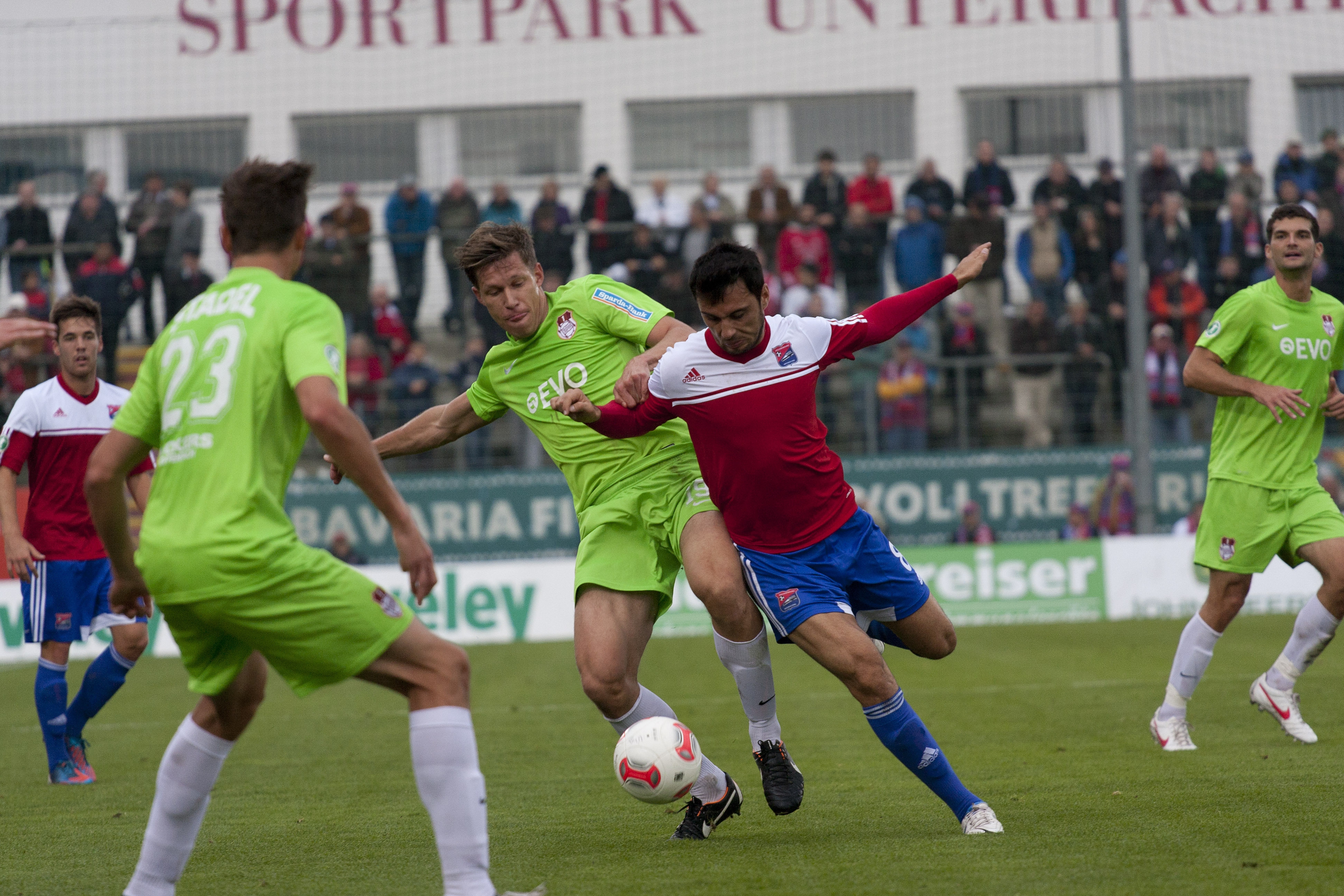 Here is a current picture of last Sunday’s game “SpVgg Unterhaching – Kickers Offenbach”. Unfortunately, we lost 0:3; the bad luck literally stuck with the Haching soccer boots. Of course, I was there and suffered with them.
In the Sports Park, we already experienced many great matches and numerous rises. In 1999/2000, we suddenly found ourselves in the Federal League. And, like many of my friends, I still very well remember that legendary own goal in the 21st minute on May, 20th, 2000. The then still “Leverkusener” Ballack scored it with his heel, thereby helping Haching to win the match and Bayern München to win the German Championship.
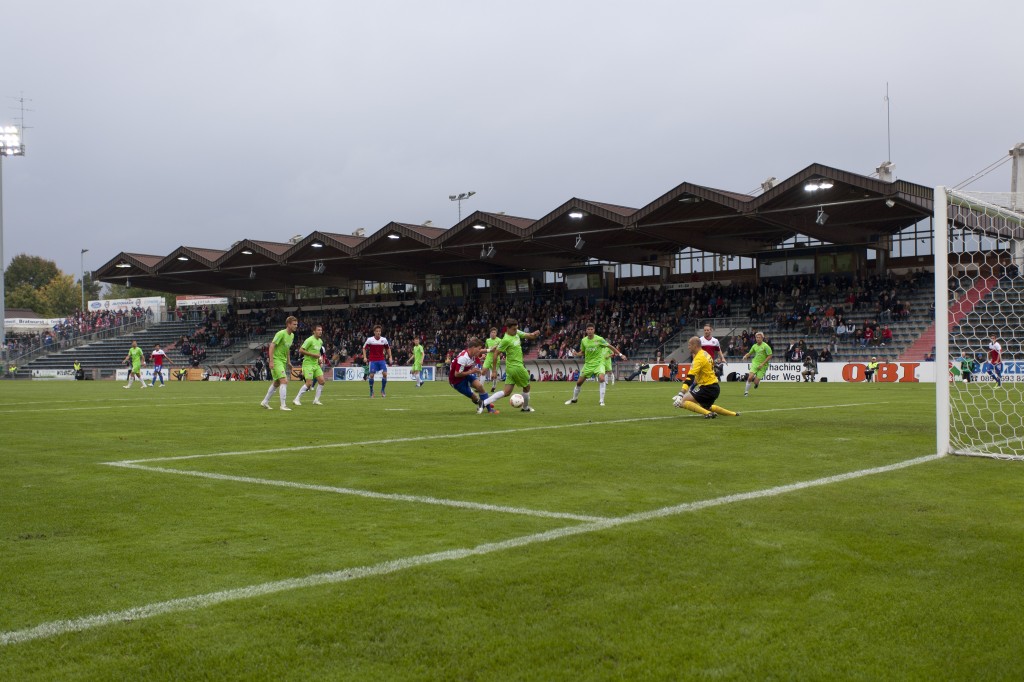
Here are the stands where I sit and watch every home game if possible at all. And, of course, mostly I can cheer, because at home, the SpVgg is a power that almost always wins!
Since the year 2000, many things have happened. There were ups and downs. In between, we Haching fans suffered quite a bit. But since last year, we are really on the way up. Before the season 2011/2012 started, the old board of presidents initiated a radical change. The new team around Manfred (Manni) Schwabl rigorously executed the changes and even improved on them.
Together with the new managing directors Markus Sieger and Florian Rensch, the new president gave the club a totally new look. Chapeaux! They built a young team with players exclusively from our region. The team of coaches around Claus Schromm and Manuel Baum and supported by Florian Ernst made this group into a team that plays truly young, fresh magic soccer. Just like Borussia Dortmund does in the Federal League.
Besides the technical competence, the character of the players was an important criterion for being selected to play in the team when it was recruiting time. And now you can see immediately how they move up. Now, all of a sudden, the SpVgg Unterhaching – with the by far lowest budget of all – plays at the top of the Third League. Still, we will remain humble, knowing full well that all that matters this year is to consolidate our place in the Third League.
But we look forward to the future. Sticking to the three “Success-C’s“ as formulated by the famous sports professor and counsellor Dr. Alfons Madeja, ours seems a good course: thanks to the high competence of the active and responsible team around Manni Schwabl and a clear, humble and well-thought-out concept, the necessary capital will also soon arrive.
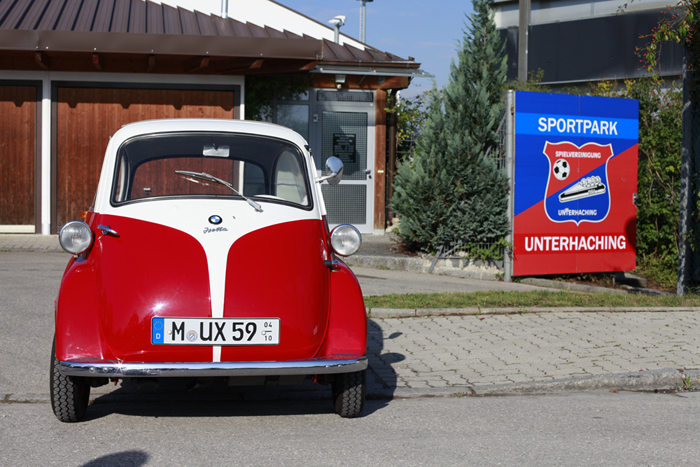
Incidentally, my small Isetta also likes its trips to the Sports Park for watching soccer. Consequently, I would like to ask you to do the same and come and watch our home games at the Sports Park! You will see dream soccer. And both the team and the management really deserve more spectators!
RMD
(Translated by EG)
P.S.
Both soccer pictures were taken by Stefan Kukral (Eventfotografie Kukral, Ringstrasse 163, 82041 Oberhaching). The Isetta sitting in front of the Sports Park was photographed by Johannes Nauman of InterFace AG.


