
Roland DürreTuesday October 23rd, 2012
Waste of Time(s)
During Nadja’s prasentation on “The Meaning of Life” at the last IF Forum, I was reminded of all those many wasted hours in my life. The first thing that sprang to mind was the time I spent watching TV and driving a car. There were a few decades in my life when I actually spent a daily average of five hours in front of the TV set and behind the wheel of a car.
If you do the simple calculations, you get 1,825 hours each year if you take five hours every day. With just two decades, the result is that I spent 26,500 hours sitting in a car or in front of a TV set. Mind you, these are rather conservative numbers. Somehow, I find these results frustrating.
And then I remember that, at least after 1977, I also spent more and more time of my professional life in meetings. Many of them were rather unnecessary and unproductive. More often than not, I would have preferred using the time for the projects I was working on at the time.
Neither did matters improve as time went by. In many enterprises, there is still a pathological tendency towards meetings. Far too many of them, taking up far too much time. And since that causes too much working time to be filled with meetings, you will have to make up for it by staying late into the night.
Why do people make so many appointments that last longer than 20 minutes? Competent persons can and must exchange a lot of information in 20 minutes, as well as come up with wise decisions.
Except in practice, it is different. Basically, a meeting should always have been prepared well. Consequently, it has an agenda. Said agenda has to be worked through. And each of the topics usually takes a lot more time than necessary.
Here is how it is often done: four TOP’s (items of the agenda) are to be discussed and decided. Since the issues are difficult, the organizers plan two hours total. Thirty minutes per issue. It was quite hard to agree on a meeting time, because, after all, all participants are constantly on some meeting or other and therefore have a full calendar. Consequently, the meeting will not be before two weeks from now. By the time the meeting takes place, two of the four TOP’s are already obsolete.
Well, now you could think that those TOP’s that are by now obsolete can be deleted from the list. That would leave you with only half the number of issues to discuss. Which means you could reduce the time for the discussion by half. That would be only one hour instead of two – and then you could go back to your work. But, no! In all my time as a participant of meetings, it seldom happened.
No. Mostly, they spontaneously come up with new issues to discuss. After all, we are here now, aren’t we? So now they start speculating and philosophizing. Arguments are brought forth all over the place, but they are seldom well-structured. Some of the participants enjoy rhetorical games, others often suffer when they have to listen to all those verbal arias.
Still others hide under some kind of camouflaged office nap, dreaming of better times and nicer places. It will only get embarrassing when you start snoring. Consequently, all the time that was originally planned to get used up will actually be used up in the end. Mostly, it takes even longer than planned. But why?
Yes, I definitely spent too much time in my life before a TV set and in a car, as well as in meetings. But I will not look back. Instead, I will look towards the future.
So here is what I will do in the future: switch off the TV, cut off driving cars, avoid meetings.
RMD
(Translated by EG)
Roland DürreSunday October 21st, 2012
Ownership – Personal Data – Copyright – Ownership – The Law– Content …
Even with actual objects, no matter if mobile or not, ownership is all but a simple issue. From the ethical, moral, rational viewpoint, etc. …
It gets even harder when we are talking ownership of non-material, abstract, content or even “mental“ things. For life and survival, the latter basically is of no consequence – as opposed to a warm meal, clothes and a place to stay. And a little love. But there I remember: love, too, is something abstract, non-material. Can you own love? The phrase itself shows you how stupid the concept would be.
Debates about ownership of data and content are rather confusing. What exactly is this: data and content? And how can you own them? Who owns the date of birth of a human being? Does it belong to the mother (or the father), or to the child, or to the authorities where the child lives? Is it important who owns those data? Is the date of birth important at all? Does it exist at all in the course of the universe?
Who does a story belong to? Does it belong to the one who tells it or to the audience? What exactly is this: an idea, a concept, an invention, a story? What is its value? You cannot eat or drink it. So can it be something similar to money? A commodity of exchange?
Or is this about how something abstract can be made into money? Does such a thing as a unique story exist at all? Or is not everything based on something you experienced or learned? What can one individual person claim to be his own and what belongs to us all? Is the idea already the achievement, or is the value only created after it has been edited? Does something like justice exist?
Copyright and patents can be interpreted as the result of cunning businessmen’s work. They demanded that their interests be protected and then they put it into practice through good lobbying. Their – certainly understandable – goal was to gain a maximum of riches with a minimum of effort. Just like a Russian neo-oligarch who can become a billionaire in 10 years.
But is this goal (which actually was achieved) legitimate? Should you be allowed to “earn money” with the help of rights that have been scaled beyond all proportion – as otherwise is only possible if you are backed by capital? The motto would be: “here I am sitting at the beach and enjoying life while my money is working hard and very successfully for me”.
Except in this case it is the rights that work hard for those who own them. Historically, the entire copyright is simply another attempt at separating income from work and increase profit geometrically or even on a logarithmical scale, instead of linearly. Probably (and of course), it is all detrimental for the common good, i.e. for the people living on this planet and the planet itself.
So it is just a new method for increasing profit infinitely. Infinitely? Yes! We are talking billions – and for average citizens, one billion Euros feels like an infinite amount of money.
Thus, the interest group “intellectual property“ managed to initiate strange regulations and make them pass as law. The result is the current situation in the patent and copyright areas. These regulations have been promoted with arguments such as: otherwise there will be no progress. Mind you, those arguments were probably never true, but now, in the internet age, they have been definitely proved wrong. By now, “progress“ happens through a free sharing of knowledge. Even slogans such as “protection of intellectual property” will not make the slightest difference.
This is how knowledge and stories were confiscated (bought?) and privatized. The producers of content and illusions, in particular, claimed special rights in our cultural circle during the primitive times of media and start-up periods – and then they politically pushed those rights through with a strong lobby. Isn’t it remarkable that those laws are called “Micky-Mouse-Legislation”?
Many violations against laws thus passed, such as illegal copying, could be called self-defense. All you have to do is claim that the free sharing of knowledge is a necessary requirement for an innovative collaboration as part of the evolutionary development of humans.
Since my trip to China, I often feel Chinese. Chinese persons look upon themselves as one big family with no secrets. Regardless of the fact that there is no doubt they live in a dictatorship.
You have to share knowledge voluntarily in an open and free manner, simply in order to advance together! Isn’t the entire human race one family for which, basically, there may soon be nothing left but the struggle for survival?
RMD
(Translated by EG)
P.S.
P.S.
Two lines out of the wonderful song “Imagine” (John Lennon):
…
Imagine all the people
Sharing all the world … (yuhuuuh)
…
Roland DürreSaturday October 20th, 2012
Video: Dr. Eberhard Huber at the IF Forum “Project Coaching”
Our last speaker at the technological IF Forum on September, 25th was Dr. Eberhard Huber. He managed to summarize all the results and information gathered during this wonderful afternoon in an excellent manner before we finished with a discussion in the “Fish Bowl”.
Now – “at last but not at least” – the recording of his presentation is also available on Youtube.
The Third Technological IF Forum was about “Project Coaching“, with the motto “best of PM-Camp“. So now we have made all the videos from this event available.
Many thanks once again to Eberhard for his presentation. It contributed hugely towards the success of our IF Forum.
Eberhard’s motto is “project“ in a team – here is the link to his blog “projekt (B)LOG“.
RMD
(Translated by EG)
Roland DürreFriday October 19th, 2012
Video: Nadja Schröer-Petranovskaja at the IF Forum “Project Coaching”
After the “fish bowl” of the first section and a short break, we continued with our technological IF Forum “Project Coaching” on September, 25th, 2012 here in Unterhaching. Our only female speaker, Nadja Schröer-Petranovskaja, spoke after Jens as the second of three speakers. She sensitized us with her stories on “purpose, non-meaning and chances in life“. And she motivated quite a few among us to start a little project management for our own lives.
The Third Technological IF Forum was about “Project Coaching“, part of which was “Best of PM-Camp“.
Nadja, too came all the way from Hamburg to Unterhaching for her presentation. That is not the only reason I wish to specially thank her very much for her rather unusual contribution on projects and coaching. I recommend you visit her website henneei.
RMD
(Translated by EG)
Edwin EderleThursday October 18th, 2012
(Deutsch) Sicherheit im Amtsgericht
Jörg Rothermel
Report from Melbourne #2
Immigration
Since I myself am now also an immigrant, I made myself knowledgeable on the subject.
For information about Australia as an immigration country, you might wish to start with the Victorian Immigration Museum. Up until the 1960ies, the government encouraged Australian citizens to talk to friends or relatives in Europe about immigrating to Australia.
Without the immigration waves between the 19th and the middle of the 20th centuries, the conquest of this huge country would not have been possible. (It is a separate story how the rich Aborigine culture was almost totally destroyed in the process).
By now, much has changed. To be sure, in absolute numbers, Australians with origins in Europe and the USA are still the majority. But immigration from India and, above all, China, increases considerably.
A few days ago, there was a long article in the local newspaper „The Age“, announcing that apartments in a new building in the district of Glen Waverly were open for inspection on the weekend (that is standard procedure if someone wants to sell or rent out property: a certain day for inspection of the objects is set, and then they are sold according to the principle „first come first serve“). For the agent, it came as a total surprise that the interested parties were almost exclusively Chinese. Some of them were actually prepared to pay up to 40,000 $ above the asked price for a certain apartment. The fact that 16 apartments were sold for a total of 40 million dollars on that day shows how solvent the interested parties were.
By now, the ratio of Australians with Chinese origins (who have a permanent permit to stay) in those 15 districts of Melbourne where Chinese like to live is between 27% and 16%. According to a survey, these districts are chosen because they have good schools, good public transport and an active Chinese community. For the Melbournians of Caucasian descent, this situation is a challenge, because they witness how – right under their noses and quite obviously for everybody – Melbourne is changing. Unfortunately, it also causes numerous racist escapades.
The name of the first Chinese school in Melbourne is quite remarkable: „Xin Jin Shan Chinese Language and Culture School“. Xin Jin Shan roughly translates into ”New Golden Mountain“. Incidentally, that is the name the Chinese gave the Australian gold mines in 1850 to distinguish them from the Californian gold mines that were running dry at the time. Those were called Jiu Jin Shan (”Old Golden Mountain“).
Mind you, today the majority of modern Chinese who immigrate to Australia are no longer looking for their one chance in life; they are already a success and wish to secure and maintain their prosperity.
Downtown Melbourne
Here is a totally different issue: to be sure, we live quite nicely in the outskirts of Melbourne at Williamstown, but downtown Melbourne (also known as CBD “Central Business District”) has an inimitable flair. In fact, it can even hold a torch to Paris.
Traffic is more or less what you would expect to find in a city with 4.5 million car enthusiastic citizens. Even a reasonable public transportation system, along with the fact that one hour parking at the garage is 16 $ and a parking ticket costs a minimum of 180 $ do not seem to make any difference. In between the densely packed cars, you will frequently find bike couriers maneuvering their way through the traffic. They must either have finished all they ever wanted from life and are thus ready to die, or else are practicing for the next Tour-de-France.
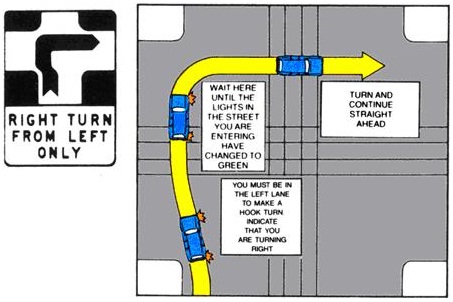
Information for all car drivers: in the city centre, you will find so-called Safety Zones where you will have to use the left (!) lane if you want to turn right – it is the notorious Melbourne ”hook-turn“. It is supposed to make it possible for those on the right lane to go ahead unimpeded; however, it will only work if the first driver who wishes to make a turn starts in Formel-1 fashion; if he fails to do that, there will be an ear-splitting signal-horn concert, because, naturally, nobody behind him wants to remain sitting in the middle of the crossing.
Many houses in the city centre were built in the middle of the 19th century, when Melbourne was the world’s richest city. Of course, this was due to the gold rush – at the time, around 1/3 of all the world’s gold was mined in Australia, with the most yielding gold fields in Victoria, not far from Melbourne. To this day, this prosperity is obvious if you look at all those noble bourgeois and business houses.
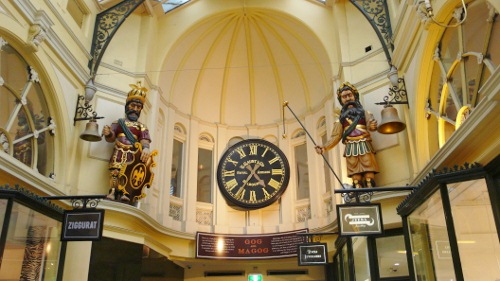
The special flair of the city centre is also due to the arcades and lanes, the creative (sometimes also endearingly scurrilous) shops and the thousands of bars, coffee shops and restaurants. The most beautiful and elaborately decorated one of them is the Royal Arcade.
The Royal Arcade is guarded by the biblical giants Gog and Magog.
Apparently, some of the arcades in a side lane simply came into being because the owners of the restaurants and bars joined forces and had some protection against rain spun over the street; all you need after that is a few chairs and (in winter) an electric heater and the place will quickly be so crowded at lunch and in the early evening hours that you can no longer pass.
The place is particularly full on Fridays after 4.30 p.m. – because that is when almost all employees working in the CBD offices go to the pub for a pre-weekend drink. Now, in spring, you can hear street musicians playing at almost all corners. To me, it seems that the quality of the music is considerably better than, for instance, in Munich. In Australia, Blues and Country are particularly popular.
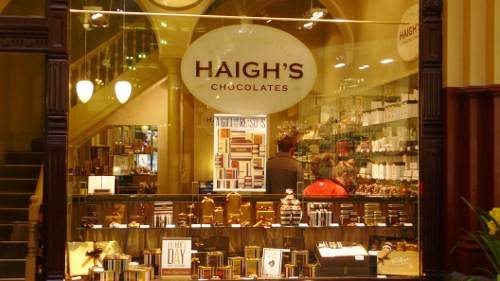
Chocolatiers and candies shops are currently very much loved in Melbourne. In fact, the Melbournian love of sweets sometimes borders on the bizarre. For instance, there is an Italian restaurant in Carlton where you can get “Chocolate Pizza“.
In the CBD, there are excellent restaurants serving Mediterranean cuisine (Spanish, French, Italian, Greek, Turkish, Lebanese, Moroccan,…). Melbournians are enthusiastic about European cuisine – if you want to eat out for dinner, you have to make a reservation no matter where you are going.
For the critical immigrant from Munich, it remains to be noted that the price-performance ratio cannot always come up to Munch standards. To make up for it, many restaurants and bars have the sitting-room atmosphere of first-class English pubs.
I will be back with my next report – No Worries
JRO
(Translated by EG)
Roland Dürre
Tweets on Twittering and Blogging #137
Here are my tweets of last week on:
Blogging and Twittering, Wisdoms and Rules:
121025 A prostitute’s finance is dance – careful, twitterers and bloggers. #Twitter #Blogging #Wisdom
121026 An oldie dancing means lots of dust – also true for twittering and blogging? #Twitter #Blogging #Wisdom
121027 A brave attack is half the way to winning the fight – also when twittering and blogging! #Twitter #Blogging #Wisdom
121028 A courageous horse will ignore the dogs’ barking – as will the courageous blogger and twitterer! #Twitter #Blogging #Wisdom
121029 If you can suppress your anger, you are showing true courage – also true for twittering and blogging! #Twitter #Blogging #Wisdom
121030 Activity will automatically lead to advice – also true for twittering and blogging. #Twitter #Blogging #Wisdom
121031 Exchange is no robbery – also true for twittering and blogging #Twitter #Blogging #Wisdom
There is a new tweet each day. See twitter.com and “follow” RolandDuerre!
Enjoy!
RMD
(Translated by EG)
P.S.
I took the proverbs from Alle deutsche Sprichwörter.
Roland DürreWednesday October 17th, 2012
Video: Jens Hoffmann at the IF Forum “Project Coaching”
After the “fish bowl” of the first section and a short break, Jens Hoffmann opened the second part of our technological IF Forum. The second part consisted of three presentations. Jens started with an appeal for “systematical creativity“ or “creativity with systems“.
I hold Jens in very high esteem. In my perception, he has an exceptionally precise way of thinking things through and is a critical listener. Regardless of being rather critical (or perhaps because of it), he always has an open ear for fantastical and creative ideas. He is someone you can wonderfully make plans with. As a sparring partner, he is irreplaceable. Here is his presentation:
The Third Technological IF Forum was about “Project Coaching“ and the speakers were from “The best of PM-Camp“.
Jens came all the way from Hamburg just for his presentation – of course he came by train. I am particularly delighted about that. So here I am, thanking Jens for his contribution, which truly enirched our IF Forum.
RMD
(Translated by EG)
Roland DürreTuesday October 16th, 2012
Video: Dr. Marcus Raitner at the IF Forum “Project Coaching”
After the introductory presentation by Dr. Stefan Hagen at our technological IF Forum, Dr. Marcus Raitner (Esc Solutions) saw to the second part of the first section. It was quite exciting and very impressive to watch how the arguments and explanations of the two speakers complemented each other. The presentation by Dr. Marcus Raitner, too, is now available on Youtube.
The Third Technological IF Forum is about “Project Coaching“, which included “Best of PM-Camp“.
I would also like to, again, thank Marcus very much for his presentation. He contributed hugely towards our IF Forum becoming a success. Marcus is also the author of what is, in my opinion, the most beautiful blog for project management world-wide – misc.raitner.de.
RMD
(Translated by EG)
Roland DürreMonday October 15th, 2012
Video: Dr. Stefan Hagen at the IF Forum “Project Coaching”
You can now watch the opening presentation of our technological IF Forum by Dr. Stefan Hagen from Lustenau on Youtube. It is a true pleasure to watch.
The Third Technological IF Forum was about “Project Coaching“, the motto was “best of PM-Camp“.
Again, many thanks to Stefan for his presentation. He was responsible to a huge extent for making our IF Forum a success. Stefan is also the author of the most frequently read German language blog on Project Management – pm-blog.com.
RMD
(Translated by EG)


