
Roland DürreSaturday September 6th, 2014
Start Up (7) – Business Decisions – Betting on the Future!?
Well – if you are perfectly honest, you must admit that business decisions, in particular, are always betting on the future!
After all: all decisions have a factor of uncertainty. And they must be relevant. This is the very definition of a decision. Consequently, every business decision, including the founding of an enterprise, is a bet. Basically, the founder of an enterprise bets on how his development will be judged on a huge market.
True entrepreneurs will bet with their own money. They put their own work, their own capital and their own knowledge into the scale. Once in a while, they will also bet for their existence – and occasionally they lose the bet.
For managers who have been employed (such as the directors of DAX enterprises), it is a bit easier – they bet with other people’s money. This might well work – as long as they remain “upright merchants”. Except that is what they forget too often. Would you like me to give you a few names?
Why don’t we start a brain game and bet on a beautiful business: soccer? Who is going to be German Champion in 2014/2015. We will probably win if we say FC Bayern.
Now let us make it harder. Let us bet on what the statistics will say at the end of the season. Or maybe the results of individual match days, the goal shooters, how the actual matches will be played…
🙂 And I bet that almost all bets will be wrong.
Now you will protest: stop, because we spectators cannot do anything about it. Whereas an entrepreneur can influence procedures and shape his company.
OK, so let us do the same betting again. Now you are no longer just spectators, but players. Imagine you as a team of founders are both the players and coaches of a league team. And I will leave it simple: You will only have to bet on your own matches, that is: those where your own players are active. Well, that should work, shouldn’t it? Except…?
How much influence do you actually have – both in life and in soccer? Can you really influence the bets and along with them the decisions? As you can see, this stupid betting on the future is all but a guarantee for success.
Consequently, here is what I recommend:
If you are a start-up, don’t start with the very big bets. Instead, start small. As I always repeat: totally agile. In this way, you will develop a chain of small “dynamic bets” and will always just bet on the next step ahead.
Now you might reply: but there are the huge successes we get to read about every day. Did not someone bet well there?
Actually: one will always bet correctly. He is the winner.
Like in the SpVgg Unterhaching “VIP Lounge”. I have been watching the lottery there for years. The guests, and I gladly count myself one of them, bet on the results of the day.
And although there are nowhere near as many participants as probably with the FC Bayern, I remember only once that the betting contest had no winner. That was years ago in the second league – and at the time the SpVgg won 7:0 against Saarbrücken. Yet, the poor Hachingers still had to leave the league at the end of the season.
As I said: one will always be the winner. And “The winner takes it all”. But how many play and how many win!?
RMD
(Translated by EG)
Roland DürreSunday August 31st, 2014
Start-up (6) – Founders Need Goals?
Columbus had a goal. And some modern knowledge. He decided to assume the earth was a ball. Consequently, he reasoned that there must be a way to India sailing west on water. That would definitely have been a huge advantage, because it would have saved all ships the unpleasant and time-consuming way around Africa.
🙂 Well, as we all know, the Suez Canal did not yet exist at the time.
But then he discovered America and – in accordance with his idea – called the people he found Indians.
🙂 However, the Panama Canal did not exist either, which means that the way to India via the new America would have been even longer.
Basically, we can say that Columbus was way off his mark …
And yet he became a famous man. Some say he changed the world. This is not what I believe: I am sure another sailor would have had the same idea a few years later, which would then have led to the discovery of the new continent. But perhaps such a different sailor would have realized a little earlier that his assumption was wrong and then the Indians would not be called Indians.
It must be the goal of an enterprise to develop business. But then, this is a rather weak goal. After all, it is more like something that goes without saying. To me, this sounds a lot like “every human being should have the goal of getting enough to eat!”.
I think you should take a closer look at the word “goal”, instead of determining your goals too easily. You will find a polemic article about this topic in my entrepreneur’s diary (Unternehmertagebuch eine Polemik ). It is about “strong” and “healthy” goals. Also, you have to differentiate between the term “goal” and other terms, such as “intention” or “success”.
For instance, if I define as my “goal” to work until 8 p.m. instead of 6 p.m. in order to catch up on all the work that has accumulated, then this is not a goal. It is a (perhaps laudable) intention.
And especially in businesses, I keep discovering goals such as “next year, we want to increase our turnover by one million Euros”. As I see it, these are intentions, rather than goals. And there is a huge difference, even linguistically, between “intending to do something” and “setting a goal”. Perhaps this note will make you a little more sober with respect to (often very rhetorically) expressed goals.
”We want to be a success!” – might well sound nice as a goal. But, naturally, this, too, is not a goal. And I do not mean because it is so banal. Instead, you want to remember that “success” is a very individual thing. Consequently, the first thing you have to clarify is what exactly your own and very individual success criteria are. And why they are so important for you. And how you can come to a mutual agreement in your team. Then you could formulate as your goal – both individually and as a team – that none of the formulated success criteria must be neglected and that you wish to finally live up to the criteria as a team by, maybe, 80 %.
Now I will write about the profane goals. A much-loved goal often formulated by business leaders is: “We want to become the leaders of the market (if possible world-wide)”. Or. “We will manage to come up with a USP (unique selling preposition)”. Because we assume that said USP will carry us through the market on wings.
Except that now the market is constantly changing at high speed. And how am I supposed to create a static USP that can be of long duration in a highly dynamic system? How is anybody supposed to describe a goal and set criteria along which to define one’s destination if the coordinates of the market are constantly fluctuating? And besides, my product and enterprise should always take this permanent change as a mark of orientation. If you see it under this light, goals can easily turn against yourself and become a massive liability.
”Healthy goals” will inevitably always be “flexible goals”. But how to explain this to an old-fashioned manager whose only definition of reality is facts, plans and numeric input?
Please do not misunderstand:
I am actually very much in favour of such extreme goals as “becoming the market leader” or “developing a USP”. Except that both the markets and the USB-s are very dynamic. Consequently, the right and constructive goals must constantly change with the surroundings. We arrive at the so-called “moving targets”.
This means that a goal can only look constructive if the goal – along with the assumptions the goal is based on – are constantly under scrutiny and permanently adapted to the never-ending changes in our world. To me, it seems extremely difficult to get a grip on these challenges with instruments and tools. You will easily end up in the situation of the poor hare of the fairy tale: “The Hare and the Hedgehog”.
Perhaps it is time to again remember “entrepreneurial intuition”? I am sure this is also a dangerous path, but perhaps it is no worse than the alternatives.
And you should always keep in mind that, even if you reach your goal exactly like planned, this is still far from a guarantee for your success. The results you achieved through reaching your goal will probably not be as optimal as they looked when you first defined the goal. Consequently, reaching your goal will have far less value than you had initially assumed.
The worst case is that reaching your goals actually is detrimental or even fatal. Because your surroundings have changed completely. There are many examples for enterprises where the great goal was achieved and shortly afterwards they had to liquidate. You only have to think hard!
Let me finish this article, too, with one of my very attackable comparisons:
”Entrepreneurial Life” is something you can understand like a Sailing Trip (Segeltörn). Together with many others, you steer a ship. It crosses in the winds, survives many calamities and eventually reaches the harbour, regardless of all the challenges. A true entrepreneur should be very careful not to fall victim to “thinking in terms of the Titanic” and then end like the Titanic.
RMD
(Translated by EG)
Roland DürreFriday June 20th, 2014
You Have to Make Your Own Miracles Happen.
You Have to Make Your Own Miracles Happen.
Or:
You can do differently!
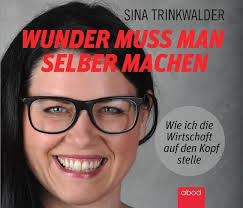
I spent years following her on twitter – Sina Trinkwalder alias @manomama. And in all the time, I was positively impressed by what she did. Not just because she comes from Augsburg – which is my native town.
A short time ago, a friend of mine gave me her book to read. And I was fascinated. There are quite a few good reasons for said fascination.
Firstly, I discovered that we have many things in common. Be it the attitude towards life in general or the best school for your children: everything sounded very familiar to me.
Another reason is that this book contains many things which simply happen to be as described. No matter if we are talking banks or politics, (almost) all the experiences the author writes down in her book are similar to my own experiences.
Also, it feels good to read her radically abandoning many excuses, references to inherent necessities and collective constructs why such and such has to be like this and unfortunately cannot be helped.
The best about this book is its honesty. As the reader, I perceived every experience described as absolutely authentic and believable.
And what is even better: the book is as exciting as a who-done-it – and once in a while it actually gives you goose-flesh. Which is something really extraordinary for such a radical “business book”.
In a nutshell: it is a book which truly fascinated me and for which I would wish that as many persons as possible read it.
RMD
(Translated by EG)
Roland DürreFriday May 2nd, 2014
Starting a Business Today!
Nowadays, whenever I attend business contests and/or read business plans, I get the impression that……
… there is no Bavarian Constitution making it mandatory for a businessman that his business must be useful for the entire society.
… the only purpose all founders of a new company have is money and power (and, if they are male, women).
… the opinion of the shareholder value is still the only goal of an enterprise..
… even the tiniest bit of meaningfulness in an enterprise is very often missing.
Because, mostly, all I read and hear is numbers. The turnover and results are the focal issues. And the product, as well as the enterprise to be founded, are just means to an end. Said end is “making money”. Absolutely exclusively. And if there is no other way, then you get it by selling the new enterprise after a short time with enormous profit.
Those are the moment when I think:
Something is wrong.
I also read very often that you need a lot of money (… several millions of Euros … ) in order to build up a strong marketing sector and an ever-present market. Because this is the main problem.
And then I think: Why does nobody invent something we humans actually need?
RMD
(Translated by EG)
Roland DürreTuesday April 29th, 2014
brand eins in May
On the way back to Munich from the wonderful Zurich PM Camp in the slow EC train with the two smelly diesel locomotives, I had plenty of time.
Among the things I had taken along was the new “brand eins” edition of May. Here is my calculation: 1 + 1 is 2 – this time around, I had the magazine with me in the train before the month of its official publication and I read it in one go.

The title is “How did you like me?” – it is about the interface between the company and the customer. That means: customers want more – and consequently, the focal point is: In the customer’s interest.
I found a number of interesting articles in the new “brand eins” edition. This time around, they made it a thoughtful magazine, rather than a “revolutionary” one. Also, I feel it is an attempt at encouraging various forms of trade. Even if they probably no longer have a chance of success.
For instance, it contains many interesting examples and stories about the relation between enterprises and trade on the one hand and customers on the other hand. And when I read it, my thoughts are:
What a pity that some of the ideas are now dead weights (Globetrotter).
What a pity that much of the transformation realized in trade is probably just cheating on the customer.
What a pity that many feel better when they get a chance to believe in theories which may sound prudent, but will not be helpful in the long run.
What a pity that much sounds like “cheating on the customer”. They say and want to make the customer believe that they sell a new spirit wrapped in new paper, but when all is said and done, everything will remain the same.
What a pity that the wrapping mostly does not say what is actually inside.
What a pity that they try to raise expectations which are definitely not sustainable.
These were my ideas while I read the articles. And then I associated a number of thoughts with what I had read:
What good will it do me if the friendly sign on the defunct escalator says that the owner will try and repair the damage as fast as possible while I know perfectly well that what he actually means is:
“The damage has been registered and the process will be followed according to its rules. The time of repair depends on many factors and, consequently, cannot be predicted.”
What good will it do me if I have a faulty product with a good label. However, the central store selling the label will only help me by referring me to the web address.
What good will it do me if I want to buy the techno-shoes for bikers in the specialized shop and am even prepared to pay a higher price. Yet if I ask the salesperson how best to get access to the kickies, he or she cannot answer my question – even though I know that I can buy the shoes for half the price on the internet.
What good will it do me if I cannot pay with paypal or other modern means of payment, yet will only get free delivery up from a certain price – and then it takes longer than if I buy from Amazon?
But I am also worried about other things:
So how am I, as a customer, supposed to find something that is not wrapped in plastic?
How will I get the desired quality of food if it is no longer offered?
Where can I get simple service, for instance for my bike close enough from home to reach on food?
Consequently, I can easily imagine that there will only be two kinds of trade left in the future:
Internet trade and very regional trade based on trust.
And I can easily imagine then spending most of my money with local businessmen and service providers.
But have I not written often enough:
The future is not something you can predict – and this “brand eins” edition is again a wonderful reason to discuss the future at length.
RMD
(Translated by EG)
Roland DürreMonday April 7th, 2014
Entrepreneur’s Diary #96 – Yet Again: Strategy!
Well, I already wrote several articles about strategy in my entrepreneur’s diary. Because, in my entrepreneurial life, strategy has been a painful topic for a long time. Again and again, I tried to plan the future. I attempted to develop theories about the market and the competition, to judge technologies, to foresee market developments and to draw conclusions that might allow me to formulate plans and then realize them.
And I felt I was not up to the task. Yet my “entrepreneurial super-ego” kept forcing me to come up with a strategy. And it also compelled me to tell it to others. This is how I came to believe I should do and commumicate things I myself did not believe in.
In retrospect, I must say: the strategy concept never really worked!
The things that were eventually a success where those that had not been planned. With predictable regularity, the plans that had been logically and rationally formed failed, regardless of the fact that at least some of them had been really well validated, researched and secured in all possible directions.
Today, I believe strategy is what promotes the organization of an enterprise. It is the miracle responsible for the survival of an enterprise as a fluctuating construction in the flow of time. Enterprises are social systems. They are directed towards a business and mercantile goal. These kinds of social systems are more like human beings than machines. Just like humans develop constructs, enterprises will also develop collective constructs. You cannot control them. Consequently, the organization of the social system “enterprise” is something very special.
I rather like comparing it to this:
Let us assume an enterprise were a human body. The organization contains all that controls and moves the body, as well as lets it function properly. We might be talking the nervous system, the blood circulation, the muscles, the lymphatic vessels, and much more.
In order for all of these elements to work, you need a healthy body. Consequently, I have to preserve the health of this body – in this comparison the enterprise and its organization. So it is the job of the strategy to keep the enterprise healthy.
Naturally, this comparison, too, is a little lopsided. But at least it gives you a vague idea about the complexity and difficulty of enterprise organization. Because an enterprise is a living thing.
What strategy should achieve:
It is the normative power helping the enterprise to define itself against all others. It determines the attitude of mind, the decision making process and the values on which all behaviour is based. It will guarantee that more and more decisions made are the “correct” decisions, instead of the “wrong” ones. It helps those who have to act when they need to determine what is good and bad for the enterprise.
This is a definition of strategy I like. It is also helpful. Because now everyone who wants to work strategically knows what to do: determine what is good and bad and do the right thing more often than the wrong thing.
And this is something you can only do through comrades in arms, both in an enterprise and in all other social systems. And those comrades in arms are persons in the enterprise, rather than an often lonely management caste thinking they should develop visions and control people when it comes to realizing those visions. The strengths of a good strategy are its density in and nearness to reality, rather than logically founded mind games.
The best kind of strategy is if all stakeholders and parties concerned in an enterprise feel the same way about where the enterprise should be headed. Just like all the cells of a body must “act in concert” if the body is supposed to live.
RMD
(Translated by EG)
P.S.
For more articles of my entrepreneur’s diary, click here:Drehscheibe!
Roland DürreSaturday March 1st, 2014
The Single Entry Bookkeeping System – Maybe Not Such a Bad Concept After All?
Projects gets bigger and bigger, big projects get more and more gigantic. And more and more often, more and more things go wrong. And even if things do not go wrong, the usefulness is often very limited and the price is high. What if what they say is true and actually small but refined is better?
In the public domain, they used to do their accounting with the single entry bookkeeping system. In other words, they did a simple input-output calculation. There were no assets to be considered and to be used for justifying debts. Debt-free fiscal accounting means that you can only spend as much money in a certain time interval (usually one year) as you actually received.
This means that if you build an opera building or a bridge, you have to receive the money you spend for this project during the same year. And you cannot activate these investments as assets and thus justify your debt.
The communities that remained loyal to this method have been criticized all over the place. Consequently, the single entry bookkeeping system was mostly abolished in the public sector.
In retrospect, however, I think the principle was not such a stupid idea. Because, naturally, it will initially make huge investments with doubtful “returns of invest” hard.
And perhaps the principle of single entry bookkeeping could give us a little more moderation when it comes to mega financial and gigantic projects which, when thought through, often basically only render a questionable added value.
Consequently, I will, once more, play the role of the heretic and demand our return to single entry bookkeeping.
RMD
(Translated by EG)
P.S.
Here is the term in Wikipedia.
Roland DürreSunday January 19th, 2014
As Time Goes By …
 Around the turn of the years from 1983 to 1984, Wolf Geldmacher and yours truly were rather courageous when deciding to found the InterFace Connection Association for Data Processing and Communication Software mbH together with Dr. Peter Schnupp (InterFace GmbH) and Claus M. Müller (via InterFace Computer GmbH).
And to this day, we have had much joy with what we had done. Wolf and I were the active associates. Initially, we each held a share of 30 %. Exactly 30 years ago, on April, 1st, 1984, the day had come! The InterFace Connection (today InterFace AG) officially started its work.
It was not an “April Fool’s Joke”. After all, we now can look back on 30 exciting and successful years in business. On March, 31st, the Interface will have existed thirty years on this planet. We will celebrate this birthday appropriately on June, 27th, 2014 with many, many friends.
Maybe you want to mark the late afternoon of that day in your calendar, and then the night, as well? Here on the IF Blog, I will also report at length about the event. We will also inform and invite our friends through many other channels.
After thirty years at InterFace AG, I am now in the position of holding the majority of the shares and of being the managing director. My roles at InterFace were diverse. We started out as a rather successful production firm and then developed into a service and counselling company. And we assume that the future of InterFace AG will also be a good one.
This year is my last as managing director at InterFace AG – which is certainly a reason to look back. There is no “Today” without “Yesterday” and no “Tomorrow” without “Today”. So we need to do some remembering. Well, quite a few things come to mind and also seem remarkable.
I have to think of all the many comrades who accompanied me through those 30 years or through parts of the way. I have to think of the many enterprises that came and went. I enjoy thinking of our great customers, for whom we always enjoyed working. And how it always made us happy to see that our software and services contributed to our customers’ success. In fact, there are some customers of ours we served from day one and still serve today!
Many famous and powerful enterprises appreciated us as their supplier. There is quite an illustrious sound to some of the addresses. Some of them have even disappeared by now. For instance the Kirch-Gruppe and the WestLB. But also quite recently the Weltbild publishing company. What marvellous projects we worked with these enterprises! Luckily, however, most of our big customers survived.
30 years of InterFace also means we saw many partners and competing enterprises come and go. Here, too, I have to say that there were famous names among them. We respected them greatly. And then they were gone.
As I think back in this way, I notice that we are something like a “Surviver”. And that probably not too many of those exist. And that we are actually doing quite well. So what more is there to desire?
Except a few more years of good living.
In order to make sure this will continue to be so, we plan a huge party on June, 27th, 2014. We want to celebrate our survival. We will invite as many friends as possible who accompanied us, still accompany us today and hopefully will still accompany us in the future.
RMD
(Translated by EG)
P.S.
For more information about our party, click here: IF-Open!
Roland DürreMonday January 6th, 2014
The Deutsche Bahn and the Döner in Lindau
I spent Friday night and Saturday in Switzerland, staying with my partner Wolf. He lives in Goldach on the lake Bodensee. As usual, I went by train.
My favourite route is through Lindau. You go from Munich via Buchloe, Kaufbeuern, Kempten, Immenstadt, Oberstaufen and see the entire beautiful Allgäu. I always enjoy it very much. And while I travel, I can read a little bit and prepare for various topics.
Unfortunately, it is not possible for me to buy a ticket all the way to Goldach in Munich. You can neither do it on the internet, nor at the counter. To be sure, you can buy a ticket to St. Margrethen, but not to the small villages such Rorschach or – well – Goldach. The same was again true last week.
Mind your, I can easily print the time schedule to Goldach via Lindau in Germany. First, you take the Alex to Lindau. Consequently, I buy a “Bayern Ticket”. It is valid as far as Lindau, where I have to change anyway.
Normally, the change of trains to the Bregenz S-Bahn or even directly to St. Margrethen takes a little more than 20 minutes. That means I usually have enough time to purchase my ticket for the way from Lindau to Goldach in Lindau.
This time, however, my schedule says I only have five minutes. And since a German train is never on time, this will be tight. Of course, I was right. Although my Alex was on time all the rest of the way, it had to sit in front of a red signal for five minutes just before Lindau Central Station.
And (of course) we arrive late in Lindau. The connecting train to Bregenz/St. Magrethen is waiting, but the voice coming through the loudspeaker advises us to hurry. However, I have no ticket for continuing my travel. Nor can you buy a ticket in Austrian trains.
Consequently, I must make up my mind real quick.
Alternative 1: board without valid ticket.
The risk of being caught is not very high. The train ticket is about 10 Euros, as far as I know, the penalty is 40 Euros. The risk of getting caught is actually even lower than 10 %. Following game theory, a lot can be said in favour of riding without a valid ticket.
Alternative 2: buy ticket.
If I buy a ticket, I will arrive forty minutes later. And additional inconveniences will follow: I have to inform my friend about my delayed arrival, because he told me he is going to meet me. Also, I have to change more often. And the stay in Lindau is rather long.
Decision: Döner-Man
.
I remember the Döner Man at Lindau Railway Station. The Döner he sells is really tasty. Consequently, what I do is not go towards the Bregenz S-Bahn to St. Margrethen. Instead, I turn towards the Lindau Station concourse.
The first thing I do is buy my ticket to Goldach. I have to use an Austrian ticket machine. Because the German ticket machine cannot deliver. I pay 10.50 Euros for the short way from Lindau to Goldach.
For those of you who never go by train: Lindau, just like Salzburg used to be (Germany/Austria) or St. Margrethen (Austria/Switzerland) is a Border Station ; you will find the ticket machines for two railway companies.
Afterwards, I go to the Döner Man, wishing to buy a Döner. Since I now have plenty of time, I take a closer look at the prices. In Lindau, you get the “normal” Döner for 4 Euros. The tasty one with cheese is 4.50 Euros and the Dürüm Döner is five Euros!
Some way or other, I seem to remember totally different Döner prices. Even without thinking way back to times when we paid with the Deutsche Mark.
Now I offer a bet: five years from now, the normal Döner at Lindau Central Station will be 7.50 Euros or more. And the ticket from Lindau to Goldach will be at least twice the price of the Döner.
Who wants to bet against me?
RMD
(Translated by EG)
P.S.
In the evening, we meet Barbara in St. Margarethen. All the Swiss trains on the display are on time. Only one train – the EC from Germany – is expected to be late. The loudspeaker just says: “Due to something that happened abroad, the train will be 10 minutes late”.
On the way back, something similar happened. We departed Switzerland and Lindau (!) on time, then had to wait for the second part of the train in Immenstadt. We changed trains in Buchloe – fortunately, the connection to Munich was also late. …
Roland DürreThursday November 28th, 2013
Entrepreneur’s Diary #30 – “Rotary Disc, An Overview of All Articles”
 During my summer vacation of 2009 in Greece, I wrote no vacation diary. Instead, I wrote an „entrepreneur’s diary“. Well, as I lay on the beach under the Greek sun, I wrote down what moves me about enterprises and entrepreneurs.
In September of the same year, I started structuring all those comments – calling them Rotary Disc. And I kept adding more and more articles to my entrepreneur’s diary.
Perhaps today is a Sunday when the sun does not shine so brightly, which might motivate some of you to do some reading?
I would be delighted to know you do and would very much welcome all comments! Here are all my articles in chronological order:
#1 – der USP – Fall 1: CocaCola
#2 – der USP – Fall 2: Red Adair
#3 – der USP – Fall 3: Die Siemens AG
#4 – der USP – Fall 4: Metallbearbeitung im Mittelstand
#5 – der USP Fall 5: InterFace AG
#6 – der USP: “Summary” oder “Der Weg ist das Ziel”
#7 – “Elevator Pitch ” oder “Alles Müll”
#8 – Das ethische Unternehmen – Ausblick
#9 – Das ethische Unternehmen – 1. Notwendige Bedingungen für Sinngebung, Mission und Leitbild
#10 – Das ethische Unternehmen – 2. Notwendige Bedingung für den Umgang mit Gewinnen
#11 – Das ethische Unternehmen – 3. Notwendige Bedingungen für Produkt und Dienstleistungen
#12 – Das ethische Unternehmen – 4. Notwendige Bedingungen für Mitarbeiter
#13 – Das ethische Unternehmen – 5. Notwendige Bedingungen für den Umgang mit Kunden
#14 – Das ethische Unternehmen – 6. Notwendige Bedingungen für den Umgang mit Lieferanten
#15 – Das ethische Unternehmen – 7. Notwendige Bedingungen für die Unternehmenskultur
#16 – Das ethische Unternehmen – 8. Notwendige Bedingungen für die Führungskultur
#17 – Das ethische Unternehmen – Einschub – Zahlen – Pro Führungskraft – Pro Unternehmen 2.0!
#18 – Das ethische Unternehmen – 9. Notwendige Bedingungen für die Entscheidungskultur
#19 – Das ethische Unternehmen – 10. Notwendige Bedingungen für den Umgang mit Ressourcen
#20 – Das ethische Unternehmen – 11. Notwendige Bedingungen für den Umgang mit allen Stakeholdern
#21 – Das ethische Unternehmen – 12. Die trivialen Gebote des redlichen Kaufmanns
#22 – Das Ethisches Unternehmen – 13. Summary: “Ein biophiles Unternehmen”
#23 – Wir alle sind Unternehmer!
#24 – Die eigene Gründung – Motivation
#25 – Die eigene Gründung – Partnersuche
#26 – Die eigene Gründung – Planung
#27 – Die eigene Gründung – Start
#28 – “Eine kleine Geschichte” oder “Alles hängt von den Menschen ab”
#29 – “Das Tandem” oder “Eurasia”
#30 – Drehscheibe (hier befinden Sie sich)
#31 – Warum braucht man überhaupt Unternehmer?
#32 – “Prozessgläubig?” oder “Die Menschheit zerfällt in 2 Teile!”
#33 – “Prozesse über alles!” oder “Alles ISO?”
#34 – “Risk Management?” oder “Die Stärken sind wichtiger!”
#35 – “Die drei Erfolgskriterien!” oder “Unternehmenskultur oder Management?”
#36 – “Unternehmer: Jäger oder Sammler”
#37 – “Unternehmer: Hobbygärtner oder Modelleisenbahner”
#38 –”Das Joch des Unternehmers …”
#39 – “Das Risiko des Unternehmers …”
#40 – “Sind wir unser Geld wert?”
#41 – “Wie konnte Queen Victoria das britische Empire nur regieren?” ♫
#42 – “Die Entscheidungsinsel”
#43 – “Persönliche Haftung – ja gerne”
#44 – “Ungesunde Ziele – ungesunde Strategie”
#45 – “Planen&Ehrgeiz” oder “Was hat eine Radtour mit einem Unternehmen gemein?”
#46 – “Unternehmensforschung” versus “Operation Research”
#47 – Erfolgsrezept für Unternehmer – Reflektieren und Leben!
#49 – “Love it …” oder “Die Basics von Unternehmertum”
#50 – “Treiben oder getrieben werden” oder “Erfolg und Mittelmaß”
#51 – “Der Topmanager und die Menschen”
#53 – “Von Ego- und Alterozentrierten”
#54 – “Drei mal drei Buchstaben”
#56 – “Die Starken fördern, die Schwachen ignorieren”
#62 – Zahlen lesen, Zahlen folgen!?
#63 – Die Skills des “Führenden”
#64 – Project Management goes Brecht
#65 – Was ist das eigentlich – Projekt Management? (Definitionsversuch I)
#66 – Was ist das eigentlich – Projekt Management? (Definitionsversuch II)
#67 – Was ist das eigentlich – Projekt Management? (Definitionsversuch III)
#68 – Wie entstehen eigentlich Projekte?
#69 – Projekte sind schädlich für die Gesundheit Ihres Unternehmens!
#70 – Reporting – für wen berichte ich denn eigentlich?
#71 – Über die Notwendigkeit von unvernünftigen Entscheidungen
#73 – Die Rolle des AR in der kleinen AG
#74 – Konkurrenzfreie Gemeinschaftsunternehmen in der Nachfolge staatlicher Monopole?
#77 – Eigene unvernünftige Entscheidungen …
#78 – Ich stell mir mal vor, ich wär ein Professor …
#79 – “Boutique-Parabel” (Vertrieb&Marketing 2.0)
#80 – Mein Leben, Project Coaching und die InterFace
#81 – Projekt, Management und Projekt Management
#82 – Was ist das eigentlich, Strategie?
#83 – Was ist das eigentlich, ein Unternehmen?
#89 – Wissen und Organisation, Führen und Managen, Unternehmer sein
#90 – Das magische Dreieck des Managements.
#91 – Nicht agil oder agil mal anders.
#92 – Guter Rat / Schlechter Rat – Episoden
#93 – Effizienz versus Resilienz
#94 – Geisteshaltung, Vertrauen, Konstruktives & Destruktives
#95 – Entrepreneurship, Start ups, Unternehmertum – irgendwie überhöht?
#97 – Heute mal wieder zum Vertrieb
#98 – Die Ökonomisierung des Lebens
#99 – Goldene Regel für Unternehmen
#102 – Basics compact – Geschäftsmodell
#103 Basics kompakt – heute “Kategorische Bewertung von Geschäft”
#104 Basics kompakt – heute ”Kriterien des Erfolgs”
#106 – Umorganisation & Teamgröße
#107 – Jede Woche 20 Stunden Weiterbildung in der Freizeit?
#109 – Wie hoch soll die Rendite eines Unternehmens sein?
#111 – Risse im Führungsteam – Was tun?
#112 – Von sinnlosen Besprechungen.
#113 – Der Flow und die Wertegemeinschaft
#114 – Inspiration and Impulses
#116 – Social Media: Corporate Twittern
#117 – Warum können Erfolg und Misserfolg im gleichen Unternehmen so eng zusammen sein?
#121 – Kochrezept für Unternehmens-Gründer
#122 – Fahnenbildung mit Anleitung
#124 – INNOVATION – Nur so geht es!
I will write some articles more …
RMD
(Translated by EG)


