
Roland DürreThursday July 2nd, 2015
Entrepreneur’s Diary #110 – Manus Agere.
A short time ago, I had an experience that, again, showed me why I so dislike the terms “manager and managing”. Nor does it matter if they are combined with 2.0, 3.0 or 5.0. In fact, one of the reasons that made me me hesitant about ever using the term was that there are so many translations for “to manage” from English to German. Basically, you might well use it for “all and nothing”.
During the WebWeek, I attended an event by Techdivision in Munich that had been organized by my friend Sacha Storz (Sacha is not a typo ). The topic was 3.0 – as we all know, there is a lot of well-known, even famous, literature on the matter.
When we discussed it, Gerrit Mauch – whose contributions I very much appreciated – told us what the term “to manage” means to him. He said he thought that the original meaning of the word probably lies in the Latin: “manus agere” (’take by the hand’). It was mostly used when horses were trained.
That would mean that, as time went by, horse schools turned into “managing”.
Following this train of thought, you have to conclude that it was the ancient Roman’s BGM to care for the physical health of their horses. After all, they were important and ever so precious production animals.
And seeing humans under this light is simply the wrong concept in my eyes. Some way or other, it does not fit in our times at all. At least the developed societies should not be based on this kind of concept of humanity. And we all want to be a developed society, don’t we …
RMD
(Translated by EG)
P.S.
For more articles of my entrepreneur’s diary, click here: Drehscheibe!
Roland DürreSunday June 7th, 2015
PM Camp – Yesterday: Zürich – Tomorrow: Bad Homburg.
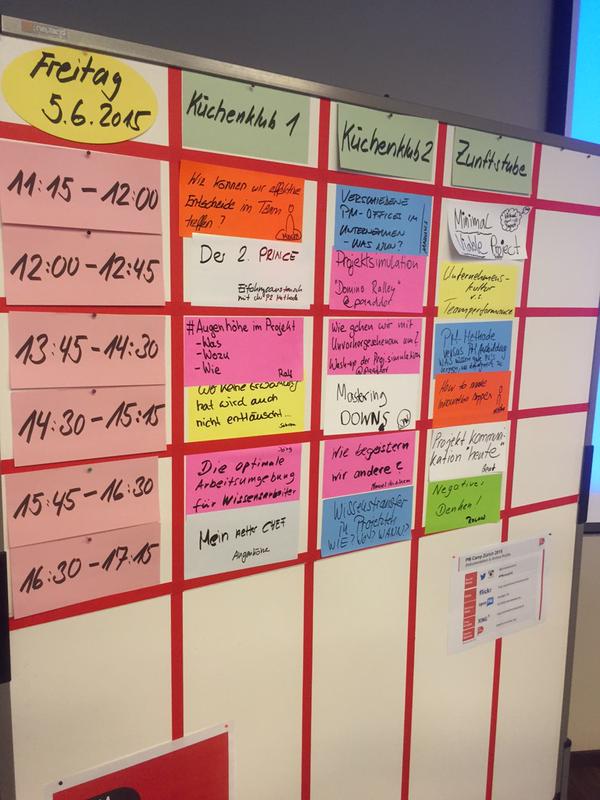 Yesterday evening, I arrived back home from the PM Camp in Zürich #pmcampzue. It was a small but very exquisite PM Camp and gave me two great days.
The first day was opened by Nadja Schnetzler who is also co-chair at word and deed. She bewitched the Camp participants with her wonderful postcards: and she showed us how you can “Embrace Chaos” in a very unobtrusive and serene way.
To me, it seemed that this nice impulse presentation went a long way towards many other sessions considering it important to talk about the situation of humans in their various roles whenever project-typical tasks are concerned.
Consequently, much was about the change in our society and consequently also the change in our projects that progress brings in its wake. It was all about intended and unintended change – and about “Innovation as creative destruction”.
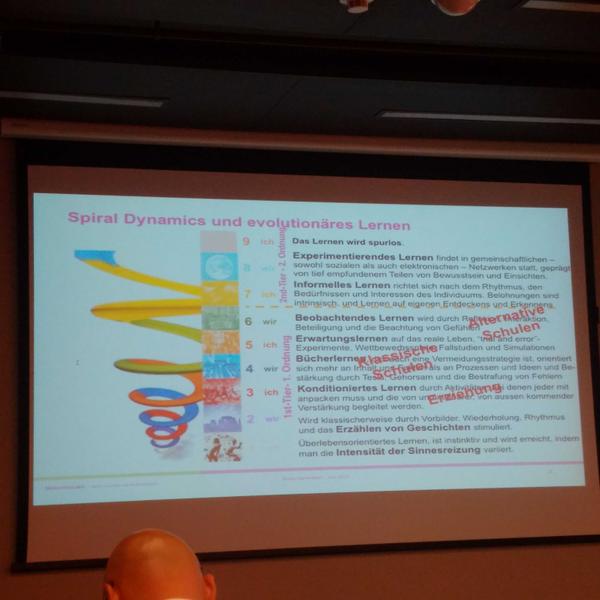 On Saturday, which was the second day, we all started the day with a drumbeat. Bruno Gantenbein, owner of Unschooling.ch, who has been a successful business counsellor for many years, started the day early in the morning with a strong impulse on “learning, too, is part of evolution”.
And his way of doing so was so emotional that some of the audience were moved to tears of emotion and joy.
And then he, too, spanned the bridge between what he had said and project management – asking the for me absolutely central question: “How, where and what do projects managers actually learn?”
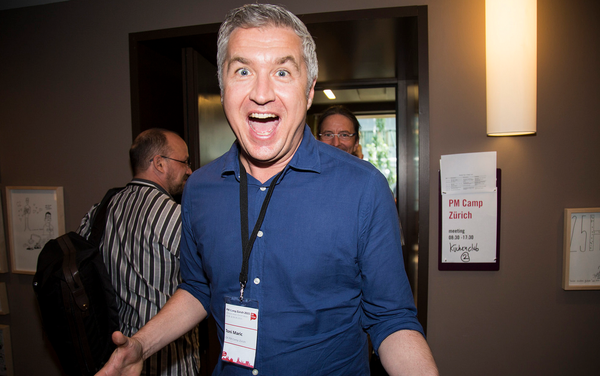
Toni (Anton Maric) in action.
It was no surprise that the second day eventually led to a broad exchange of knowledge about the question how meaningful, efficient and humane learning might, should or must be.
As you can see on the pictures taken at the PM-Camp Zuerich, it was a great event. You can also see the pictures on the Flickr Account of the Zurich PM Camp!
Consequently, I would like to say many thanks to the PM Camp Zürich Orga-Team, namely Dagmar, Bruno, Christian, Matthias, Silvio and Toni, who initiated the Zurich event.
And in less than one month, from July, 2nd to July, 4th, the next PM Camps are waiting. They will be held in Bad Homburg! Then the day will be called #pmcamprm!
I definitely also want to be there and, of course, you will also read my report on it in the IF Blog!
RMD
(Translated by EG)
Roland DürreMonday June 1st, 2015
Entrepreneur’s Diary #109 – How High Should a Company’s Return Be?
 This is also one of the questions with no easy answer. The answer depends on far too many parameters and influence values. And one of those factors are certainly also the entrepreneurial goals, such as sustainability and common good economy (Gemeinwohl-Ökonomie).
It is frequently discussed and I am frequently asked: What is the “right” return for an enterprise with a certain concept and in a certain area? I also keep seeing absurd numbers set as obligatory values. For many enterprises, those numbers are utopia. Consequently, I want to use this article to try and give some reasonable advice.
If, on reading this now or on starting to read what follows, you get bored, then I would recommend you continue with the next paragraph written in bold letters, which is under the heading “All Bullshit?”.
First and foremost, let me again define the term “return”. We distinguish between return on sales and return on capital. They both tell you in per cent how high the proportion of the return is profit, or how much of the capital you gain from. That sounds fairly easy, doesn’t it?
One piece of information:
People often totally forget the trivial fact that even a small sales return might well mean a huge capital return. After all, the return is supposed to be many times the capital. And if I have a return of, for example, fifty times the used capital, then this means I get a capital return of 100 % for only 2% sales return! In the 1950ies and 1960ies, for instance, the German economy mainly focussed on the capital return – and it is surprising what low numbers (sometimes even in the low one-digit per cent range) were considered good results in trustworthy companies, such as Siemens and VW.
Second piece of information:
Well, basically, it is difficult to determine the “correct” absolute number for the profit (what exactly is the profit and how high is it?), since it is the profit per sale. More often than not, both the term and the reference are not clearly defined. Consequently, you usually take the EBIT (earnings before interest and taxes) for calculating the sales profit.
Third piece of information:
But the last profit contribution from the business statement, too, is a valid and yet not easily calculated basis. If you use it, the employee and/or director bonuses are already part of the salary and as such have been subtracted. Yet those were only due because the “profit strength” of the enterprise was very high, better than the EBIT, which has been reduced by the success premiums paid to the colleagues. The question arises if one should not, at least mentally, add them to the result.
Fourth piece of information:
“Investments“, into products (which, when we are talking software development, must be considered costs for services, rather than investments in the bookkeeping sense) reduce the EBIT in the bookkeeping sense. After all, the software that has been developed may/need not appear on the balance sheet in our company. The same is true for some other investments into the future you cannot put on your balance sheet, for instance training programs and the reputation of the enterprise. They minimize the profit, yet they are important “investments” into the future of the enterprise.
Fifth piece of Information:
I, however, propose that you should see this as your duty that goes without saying as an entrepreneur and that you first consider the profit as “return power of the enterprise”.as seen in the last contribution margin. The rest (all the measures taken with a view of the future or all the things that probably would not have happened if you had had less return, such as extensive trainee programs, team building, success parties, luxury and also investments in your own tools and the like) will be stored “mentally” for further reference.
Sixth piece of information:
When judging the situation of the enterprise, I can certainly virtually add to the return. On the other hand, I will subtract hidden costs and risks of the enterprise. Being the entrepreneur myself, I will know best what these are. Apart from and on top of the actual numbers, this is the best way to judge where the enterprise is standing.
Seventh piece of Information:
As far as the actual numbers for the profit (the return) are concerned, many factors play a role. The size of the enterprise may need to be considered. There might be critical numbers below optimum. Small firms, in particular, can be organized in such a lean way that they can render a high profit. Because you have a high awareness of costs and only little infrastructure and administration, everybody assigns to the account, much is just done in passing and what remains is done by the boss, anyway.
Eighth piece of information:
Of course, your sector is also a determining factor. If you sell mass products wholesale, an extremely small turnover return means a huge profit. And if you are into services or niches, your profit might well break away, with the result that you have not enough to make a living.
Ninth piece of information:
Usually, growth will cost money and therefore decrease your return. Consequently, you can never regard the return isolated from the growth. Growth is not a value per se, but a sensible organic growth is probably something natural and necessary for all enterprises.
Tenth piece of Information:
If you are into services, growth will happen either by working more hours or through adding persons, i.e. more employees. It gets harder and harder to increase the hours. So you will need more employees. It is rather costly and time consuming to find new employees. Young employees, such as graduates from universities, often need long adjustment phases and training on the job. A head hunter (which is something I usually would not recommend) who provides you with “finished” new employees, too, costs a lot of money and therefore minimizes the returns. But finished employees, too, will initially make the degree of capacity smaller.
Eleventh piece of information:
As you can see, return and growth belong together. And growth will cost money. Consequently, it seems rather logical that there is an inverse correlation between sales return and sales growth. And a “healthy” firm can probably only get its old profit through growth breaks.
Mind you, sometimes it might make sense to have a negative growth or a negative return. For instance if changes in your environment make it necessary.
Twelfth piece of information:
So, talking actual numbers, you could actually put x per cent growth in relation to a return change y (which is often negative with a strong growth). A very rough rule of thumb (formula) might be that the growth should always be considerably higher than the decrease in return.
If, compared to the previous year, the growth of a service providing firm was 10% while the sales return remained stable, then this is a rather good sign. If the growth increased by 10 %, you might well get a decrease in returns of y %, for instance 2 %. This might well be quite acceptable.
And it is the talent of the entrepreneur to see to it that the gradient of the sales growth is higher than the negative gradient of the sales return, i.e. that x > y remains or gets valid.
Mind you, all this is only true for a pre-defined “sustainable development” in the enterprise, for instance in the sense of “common good economy“ (Gemeinwohl-Ökonomie). Of course, if you are interested in short-term results, you can sometimes make a huge profit through depletion. But you should be careful not to damage too much of the substance.
Thirteenth piece of information:
Another formula, especially for start-ups, has been developed in the USA: 40%-Rule. The advice is:
Your annual revenue growth rate + your operating margin should equal 40%!
In other words, the sum of growth and operating margin should always be critical. See also the following comment:
This means you can build the sum of growth and return. So if I have 10% return, I should have 30% growth. And for 5%, I get 35%? That sounds logical, doesn’t it? And you can even apply it for negative numbers: If I have a negative return, (-10 %), I will have to have 50% growth. Perhaps in order to build up a particularly strong market position and thus attract the attention of an investor.
All bullshit about the return?
Regardless of the fact that I believe my ideas are quite reasonable, or else that they are backed by quite good sources, I believe that the “return question” is the totally wrong approach in terms of entrepreneurship. The question: How good is my return if compared to other enterprises? Is more like a game – if everything is running so smoothly that there is nothing better or more urgent you need to do.
What is truly important is the entrepreneurial culture. To what extent does it create a “sphere” for teamwork that is innovative, instead of making people ill? Does the enterprise give people a chance to actually participate? Is there a meaningful purpose that is not polluted by bureaucracy? How do the employees see themselves? (Everybody is a champion)? How to recruit the right persons for your enterprise?
Those are the important questions you permanently need to find answers to. They also call for never ending work. And that can only function if you have the right kinds of persons by your side. And if you employ the good ones.
That is what has absolute priority. It goes without saying that those considerations do not absolve the entrepreneur from taking the “business component” seriously and to always carefully and skilfully keep in mind what the connection between “the numbers” and “the development of the enterprise” signifies.
But if you take good care of this, the high “return” will be a natural result. And more likely than not, you will then gladly notice that, as a general rule, your results are better than those of the competition on the market.
And then you have to answer a totally different question:
How to distribute the good results:
- How much do you need to keep as reserves?
- What share do the people in the enterprise get?
- What remains for the shareholders?
But this is a totally different matter. And, as I see it, it is a very enjoyable task.
RMD
(Translated by EG)
P.S.
Many of the ideas in this article were motivated by Elmar Jürgens. Many thanks to Elmar.
P.S.1
For more articles of my entrepreneur’s diary, click here: Drehscheibe!
Roland DürreWednesday April 22nd, 2015
Entrepreneur’s Diary #107 – Twenty Hours of Continuing Education During your Leisure Time?
 In 2013,we at InterFace AG had a beautiful “Technological IF Forum”. It was about “Software Craftsmanship”. We had great guests and competent speakers. The discussions were about questions such as: So how do you become a champion? How to get the necessary experience? How can you get motivated towards perfection? How to best achieve optimality and quality in a team?
One comment in this workshop, in particular, remains unforgotten: at the time, Bernhard Findeiss related (perhaps he also meant it a little provocatively) that a good “craftsman” who wants to become a real champion in his field will have to invest up to 20 hours for his continuing education. And that usually this will not be possible during working hours. Instead, a significant part of your leisure time will have to be sacrificed for it.
Initially, I was surprised to hear the number. I had to think of how many people strictly divide their time between leisure and work. And I remembered quite a few discussions I had with my colleagues. For instance about how much of the time you spend on your continuing education program can be considered official work time. Consequently, I did a lot of thinking on the topic during the last two years. On the one hand, you certainly need twenty hours each week for practicing and learning if you strive towards championship.
I totally agree. On the other hand, you still need plenty of time in order to work towards success. And then, you also want enough time for your family and private affairs. And I think it can be done. Many of my friends – experts, managers and entrepreneurs, both male and female – live and love their jobs. They are true “champions” and basically spend all their time tackling topics they consider important. And still they are good spouses and mothers/fathers.
I am now a “retiree”. And still, I learn and practice twenty hours each week. Except, I doubt if I am a champion. But I will continue practicing …
RMD
(Translated by EG)
P.S.
For video recordings of the IF Forum, click here: “Craftsmanship“.
P.S.1
For all articles of my entrepreneurial diary, click here: Drehscheibe!
Roland DürreMonday March 30th, 2015
Laws. Sports. Meaning.
“The FC Bayern is one of the world’s most successful soccer clubs.”
What a beautiful superlative.
But if you look really closely, then this statement is rather imprecise, isn’t it? FC Bayern München is a registered club with many members. Additionally, there is an enterprise in the entertainment business also named FC Bayern München AG. As an incorporated company, the FC Bayern München AG is a subsidiary of the soccer club.
Other shareholders are the concerns Audi, Adidas and Allianz SE. So, basically, the FC Bayern München AG is first and foremost a very normal business enterprise with turnover and profit and consequently it has to do a balance sheet at the end of each year. And for this enterprise, the same legal rules apply as for all others.

Andreas Voglsammer during the 2012 match against Chemnitz
And like all enterprises, the FC Bayern AG also has and needs employees with varieties of tasks in varieties of roles. Among others, the FCB needs persons who kick a ball – the soccer players.
If an enterprise is looking to employ new people, German law gives them only limited freedom for shaping the contract. Either their new recruits are salaried, then they are employees (long-term or temporary) or they are paid a fee, quasi as service providers. Then they would be freelancers.
Due to our laws, the freelancer concept is an absolute no-go. Even if you would interpret the respective legislation very broad-mindedly, you would have to assume that the soccer players employed as freelancers would be fake self-employed (taking orders, being dependent, etc.).
Consequently, the only alternative is to make the same sort of salaried contract with the soccer players as with all other employees. Actually, the FC Bayern does the same as all other soccer clubs. Consequently, the professional soccer players are employed like all other employees. For many decades, the soccer clubs have been drawing up temporary contracts with their soccer players. Those contracts will then be extended according to need and situation, sometimes to cover more time, sometimes less.
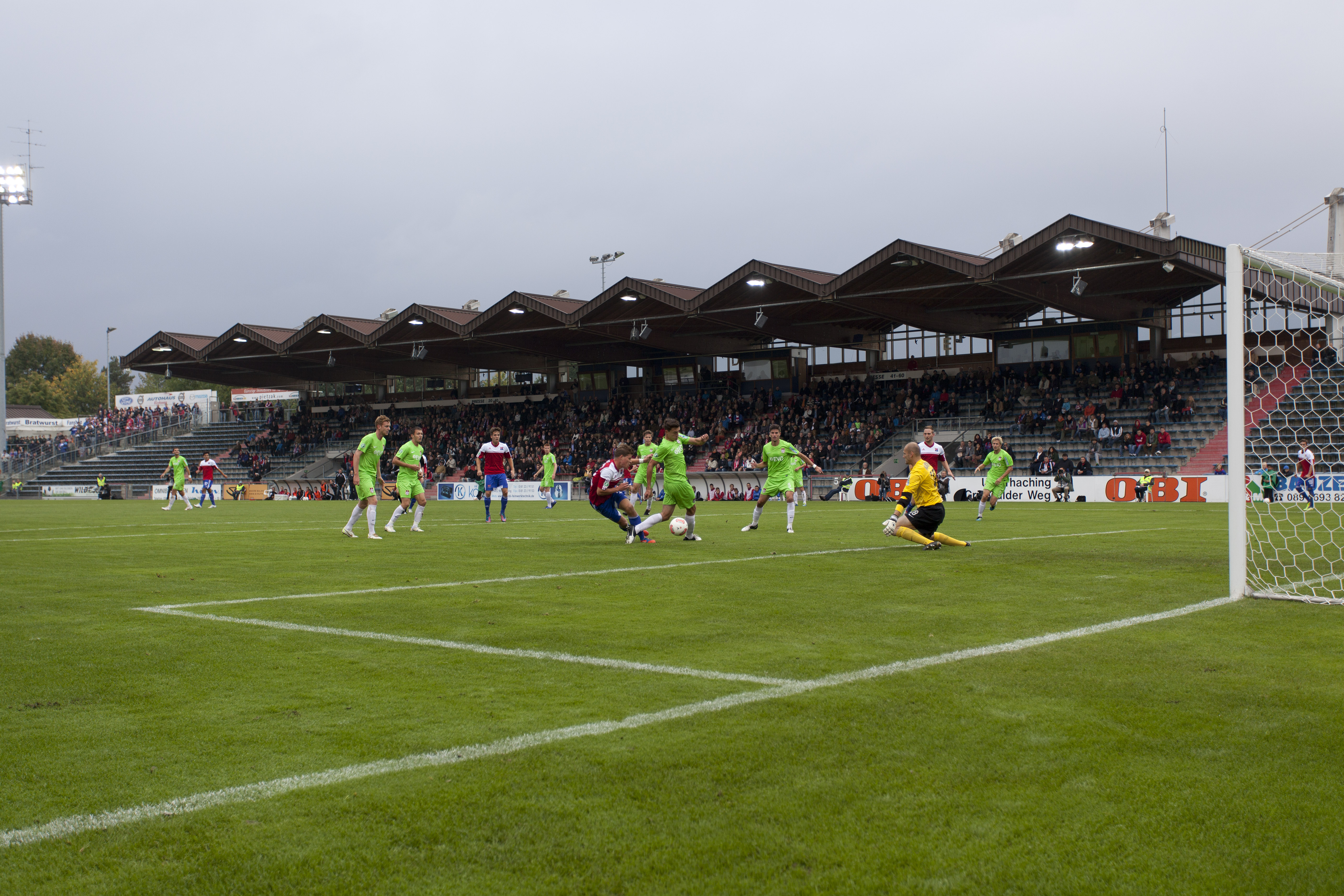
View of the grandstand – from where I watch all home matches.
And this is where the problem lies. Because temporary contracts are employee’s contracts with a fixed end! And those underlie strict legal rules as written down in the “part-time and temporary employment act”. It covers all employees, be it craftsmen, engineers, programmers or soccer players. Consequently, the law could not care less about the actual income or the kind of work involved. For temporary contracts, you have laws and those have to be adhered to. NO TWO WAYS ABOUT IT! Those rules used to be a lot more restricting than they are today, which means that violations of the law were rather more obvious than they are now!
In fact, this concept in sports contracts already stroke me as illegal and unjust when I founded the InterFace Connection GmbH in 1983. I never understood why something that is forbidden for normal enterprises should be fine in professional sports. Just like one of the reasons why Wolf and yours truly, when we founded the company in 1984, chose to develop a product because we were not sure how long the system would continue to tolerate the practice of “body leasing”, which clearly violates the AÜG law (fake self-employment).
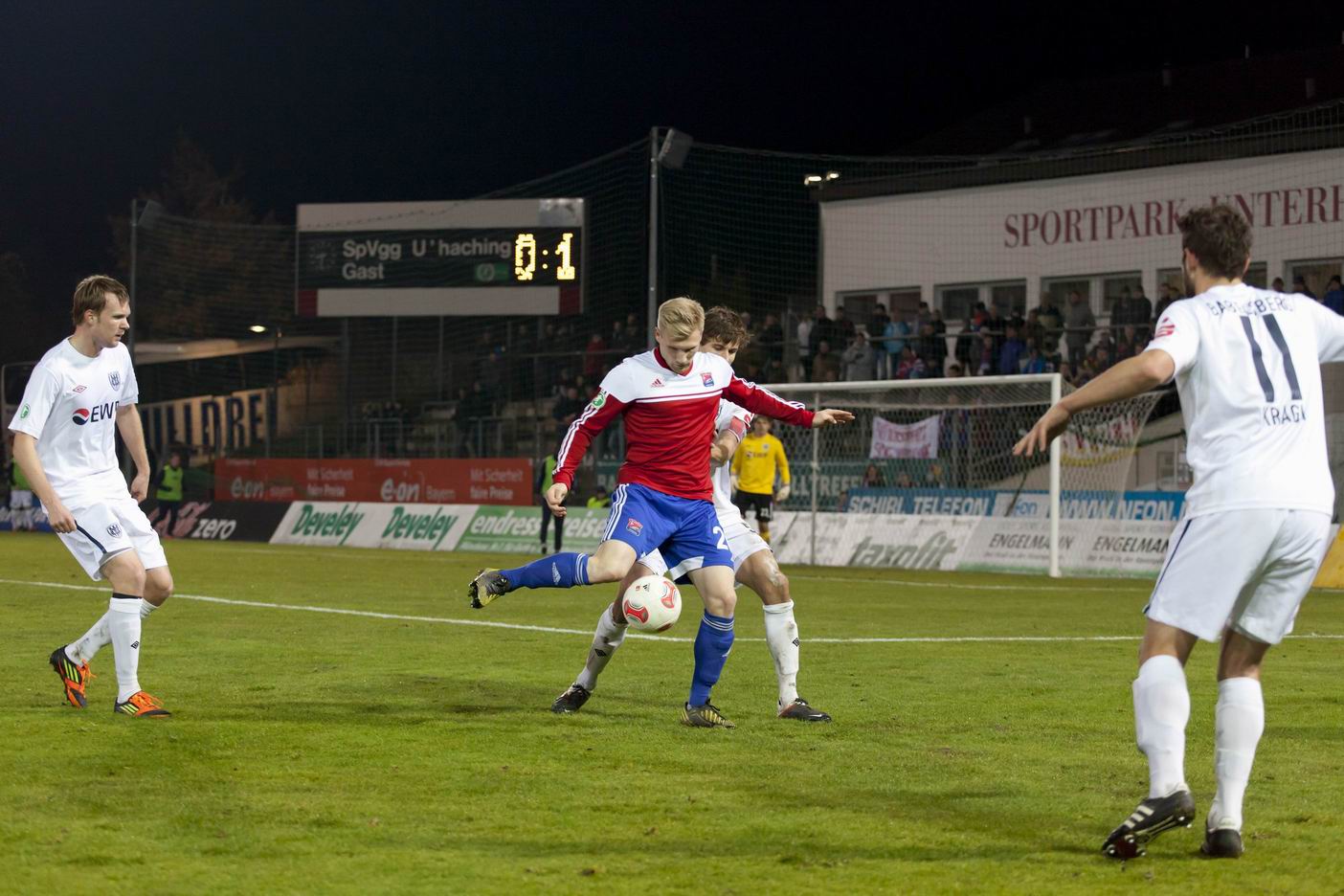
And again Andreas, who is now playing for the FC Heidenheim.
Now we are more than 30 years down the road – and suddenly something happens in the area of “fake self-employment”. Because now, the legal service departments of the huge DAX enterprises (as we know, some of them are shareholders at the FC Bayern AG) have found out that what has been common practice over decades was not always in accordance with the law of employee rental. Now they are looking to protect themselves.
And now, a soccer player actually found out that the contracts of employed soccer players often violate the “part-time and temporary employment act”. It is true that this law is mostly ignored in professional sports. The former major league goal-keeper Heinz Müller – or perhaps some of his cunning counsellors – now had the idea to sue the club at the Mainz Labour Court. The Mainz Labour Court – simply following the clearly written law – allowed the procedure and came down with a favourable judgement. This judgement rules that the prevalent practice of temporary contracts in professional soccer is clearly a violation of the law.
Because the goal-keeper had had a three-year-contract with Mainz between 2009 and 2012. The contract was prolonged by two more years in summer 2012. And that is clearly against the law. After the first contract, Heinz Müller sued for “stating that the temporary contract is now automatically a non-temporary contract” and, naturally, the judgement was in his favour.
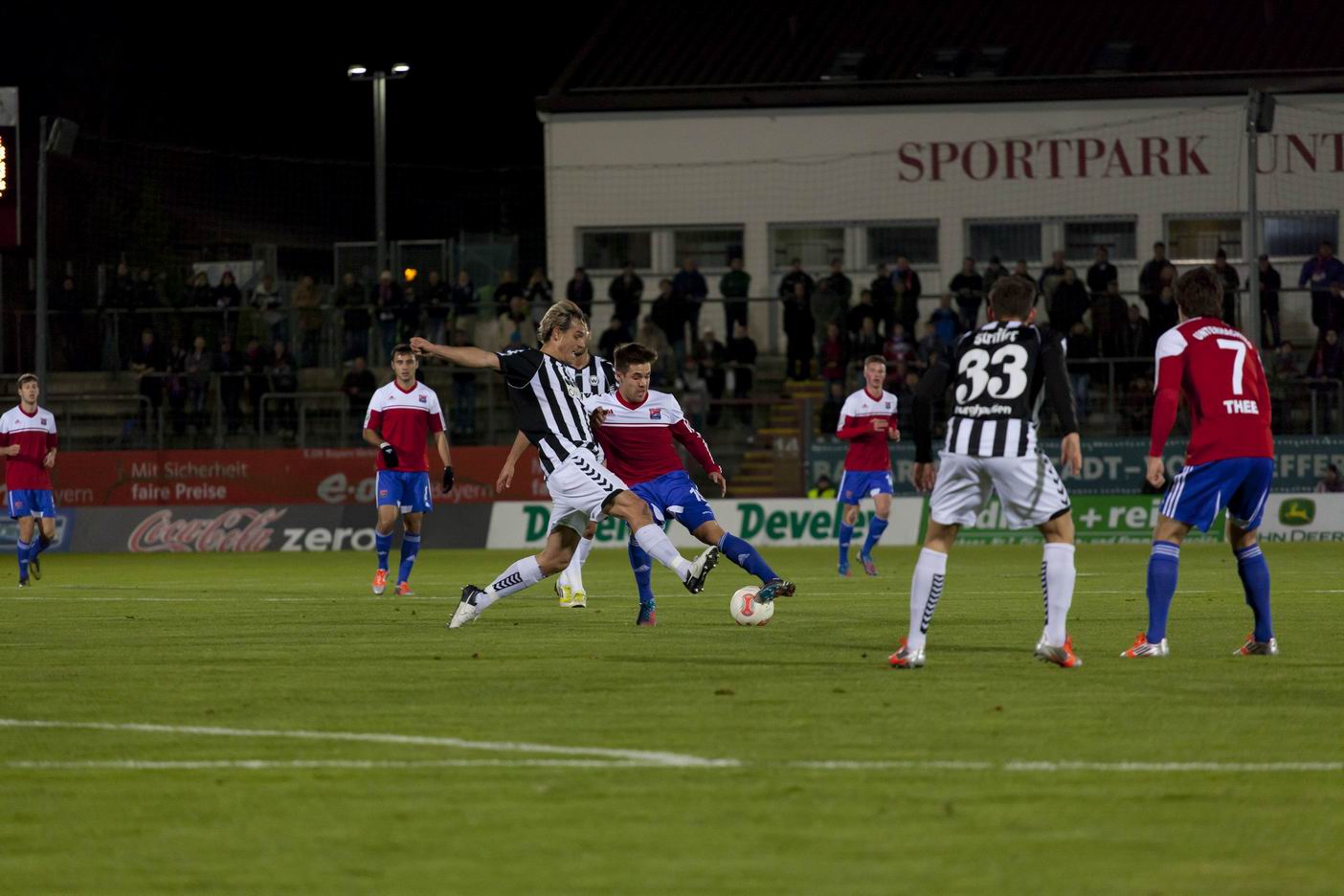
Fighting for the ball in the Sportpark
Mind you, with this article, I do not wish to annoy professional soccer playing or even the great FC Bayern München. Basically, we all know that such an unimportant person as Roland Dürre cannot do so, anyway. But I would like to show what nonsense some laws are. Because they simply no longer meet social reality.
These kinds of laws are then ignored and circumvented by “reasonable contract parties” (like here professional clubs and professional soccer players). Until someone like here Herr Müller violates the secret codes by suing for what is legally possible. And those are situations that, naturally, you do not only get in professional sports, but also in many other sectors.
Being a cunny entrepreneur, I am offering three different ways how to solve the problem. In applying them, you can both meet and circumvent the current legal requirements.
Leased Labour:
In order to satisfy German law, you could solve the problem by calling the phenomenon leased labour. The soccer players would have to be employed as regular employees by an enterprise, for instance the FCB, the German Soccer League (for example BFV). And then they could be leased by the clubs following the leased labour rules.
Legally, this would be a very simple procedure – however, the dismissal protection might cause a future problem for the DFB.
A special labour agreement:
Just like in normal business, they could come up with a special labour agreement between an employees’ organization and an employers’ organization, both of which would have to be created.
If something like this would be practicable in a system reigned by the FIFA, UEFA and DFB is another question.
Soccer players become managing directors:
If the employer, such as the FC Bayern AG, is an incorporated company, then the problem can be avoided elegantly. All you have to do is make the players managing directors. For them, temporary contracts up to five years are permitted. And on top of this, you would avoid having to pay the social insurance for the placers. This might not be what the law actually intended, but it would be perfectly legal.
After all, Thomas Müller is certainly qualified to become managing director, isn’t he?
The last three proposals are correct; however, they are not really meant seriously. Yet you can see what absurd ideas a sub-optimal legal situation can give you.
There will be another new law which will affect professional sports – the minimum wages. If you measure the working time correctly, quite a few youngsters among the professionals will end up working more than fifty hours each week (with all the practice, matches, travel times, additional training, coaching, homework).
Incidentally, I know quite a few pupils and students who spend a lot more than fifty hours each week working for their education and future. Yet for them, the minimum wages and working time legislations is not relevant.
But only fifty hours per week makes more than 200 hours each month. That would mean an income of 200 times 8.50 €, which is at least 1,700 €. And I assume that quite a few clubs cannot or do not wish to spend this kind of money. But then, the education of young soccer players or other athletes is already a profound violation of various laws, anyway.
RMD
(Translated by EG)
P.S.
The first picture was taken during a home match of SpVgg Unterhaching against Chemnitz on November, 23th, 2013. The picture was taken by Stefan Kukral in the Sportpark. The other pictures, too, were taken by Stefan. The SpVgg gave permission to publish them in the IF Blog.
With these pictures, I want to remind you that the SpVgg is my club. I also wish to ask as many friends and readers as possible to come and watch the last three home matches of this third-league season in the Sportpark. We need to support the team in its struggle against relegation.
Roland DürreSaturday March 28th, 2015
Leadership Wisdom …

Once in a while, I also give presentations – here at the IF 2014 Christmas Party.
During quite a few years of my life, I liked listening to the famous and successful “Motivation Speakers”. I was fascinated with how they can describe and explain the world in such easy terms. And, above all, how convincingly they show their audience the way towards success.
Their way of speaking and their charisma enraptured me. The top experts I am referring to are people who literally seem to be surrounded by a special aura. They elude a natural charisma that puts a spell on many persons, me included.
As the years went by, I made the personal acquaintance of some of these people. I saw how easy it is for them to formulate their vision. But I also saw that it is not always quite as easy for them to actually live up to their own standards. Once in a while, it did not look quite as glamorous behind the scenes as it had been looking on the podium. Because it is mostly easier to “teach something” well than to actually do it well yourself.
A short time ago, I met the key-note speaker Carsten Rath. Or, to be more precise: a friend pointed me in his direction. Because he had heard an interview Carsten Rath had given the Bayerischen Rundfunk. And he was so fascinated that he immediately sent it to me.
I do not know Carsten Rath personally, but the BR podcast is definitely worth listening to:
My friend believes this interview with Carsten Rath made it clear to him how a good managers differs from a poor manager. And that he only wanted to work in companies where work-life and work as such is practiced as Carsten Rath demands.
In fact, in this interview, Carsten Rath actually introduces many theses on leadership and management which no rational manager and person can seriously dispute. And his reasoning is both very competent and smooth. He also supports his theories with many small stories. In fact, it is convincing as a whole.
If I were asked to summarize what he says, it would read as follows:
- “The customer always has to be the focus of what we think and how we act.”
- “You cannot do a good job without being totally enthusiastic about it.”
- “Every job is about everything, so you always have to give all your best.”
And then he cites his (created by him) “4Ms” as an abbreviation for:
- “Man muss Menschen mögen!” (You Need to Like Humans)
The “4MS” are also something I can only approve of. The same is true for his postulating “the central virtue of a leader must be truthfulness”. That fits. Except that I call it “transparency, openness and authenticity”. But Carsten Rath also says that
- ”consolidation lies in repetition” and “true top achievement usually means a lot of pain”..
Well, I have an easier term for the former: “Practice Makes Perfect”.
I am not quite so sure about the latter. I understand the statement because Mister Rath originated in the hotel business. Except that, for me, for instance “nursing homes for the elderly” are also some kind of hotel. And this is an area where I would think it is more important that all persons in the company consciously bear and share the responsibility for all those elderly persons. I would always wish to reduce the “pain” to what is absolutely necessary.
In order to give more weight to my ideas, I looked for another example from the circle of famous “Management Speakers”. During the Nuremberg 2013 DOAG Conference, I heard the great Peter Kreuz . Later, I made his personal acquaintance at the speaker’s table (well, I am sometimes at it myself ).
His presentation was perfect. On an inter-human level, we understood each other perfectly. “You” (women and men) were left with no alternative but to nod approval. All was great, all was right. He sounded convincing in all points. The only and very reserved criticism I heard was that, perhaps, the show was a little too perfect. Apparently, he and his wife are the perfect couple and enterprise.
These aforementioned speakers and several more can be said to play in a “different league”. Except, although I certainly would never begrudge them their high fees and the usually nice and long applause, I seem to have learned over the years that good leadership is a little more than that. And I do not even have the means to make this understood.
Well, let me try:
It is the many daily small things that might make a “leader” out of a person. There is the mostly constructive brain, an upright mind-set, practiced humanity and the ability to help towards your own and other person’s life getting a chance to flourish in many dimensions. Whenever you manage to make the people you meet look greater, instead of smaller, you might perhaps be a good “leader”. One indicator that you are a good leader might be that people you met feel better after having met you than before and they are also aware of it.
And all those beautiful theses that our top speakers brilliantly present could essentially just be the basic requirements that go without saying for a good enterprise climate. But there is no question that they, too, are terribly important.
But still, even if a “leader” has both the knowledge and competence to do all these things, even if he means ever so well in his job and does everything right, there will occasionally be instances when something goes wrong. Simply because the “leader” is also a human being like everybody else. Be it because he himself made a mistake or because once in a while strange developments make things happen that you simply could not mend – and perhaps you could not have foreseen them, either. Because we are all only human.
And that is something not even the most expensive and best management seminars and presentations will protect you from.
RMD
(Translated by EG)
Roland DürreSunday February 22nd, 2015
At Eye-Level – A Film about Work-Life in the 21st Century.
 A team of five started an exciting project – and eventually it turned into a film: “At Eye-Level “ (Augenhöhe).
Here is the story: During a session of the 12th intrinsify!me “wevent” in Berlin about the work-life value of the 21st century, the idea grew that you should not only describe everything in words at all times. Instead, you should show it to people – in a film.
Five session attendants remained together and got active. They made the film “At Eye-Level”. I first heard of this project on the Berlin 2015 PM Camp during a great impulse presentation by Ulf Brandes. Later, I saw parts of the film during the Munich 2014 PM Camp. Two of the protagonists playing in “At Eye-Level” are personal acquaintances of mine through PM-Camps.
Thanks to enormously well-used “social media”, the project quickly earned great acclaim, even beyond the internet. The successful crowdfunding for its financing, too, had enjoyed a huge amount of public awareness and was accordingly very successful. The opening night on January, 30th, in Hamburg, too, had a huge audience. More than 400 (!) persons came to watch the film at the Hamburg Museum der Arbeit.
The film is about good topics. Perhaps its professional quality cannot hold a torch to documentaries with similar topics, such as by Geyrhalter, Wagenhofer (among other things the trilogy We Feed the World, Let’s Make Money and Alphabet) or Carmen Losmann (Work Hard – Play Hard). But neither does it need to – it is more a refreshing production on the level of TV reports by the ARD or ZDF, for instance about shipping electric waste to Africa.
The film is about persons acting different roles in their work-lives: entrepreneurs, managers, founders. But above all, it shows employees happy to be working for “good” employers. Because they can, for example, due to innovative working hours models, dispose of their own free time more freely than is common and therefore organize their own lives as they wish.
Unfortunately, though, the highly praised project “At Eye-Level” is also one where not all is gold that glitters. Shortly before the film was finished, two articles about Adidas and Unilever were added to it.
Adidas
Suddenly, you see Christian Kuhna in the film. I first met him at the open-up Camp in Nuremburg. His job with the sports giant is about social media, Moocs and the like and he has a small but very efficient team at his disposal
I am sure that the work-life attitude in Christian’s team is good and modern. Also, I am always impressed by the competence and positive attitude of all the salespersons in Adidas shops. But I am sure this is not true for the huge majority of persons producing for the concern.
Consequently, including Adidas in the film was a source of controversy among “crowd funders”.
Unilever
At the very end of the shooting, Unilever, too, was added. Even as early as the meeting in Munich, I was surprised to find the food giant presented as a positive example. There, Sven Franke – one of the protagonists – told us that Unilever had contacted “At Eye-Level” because they had established contact during the film “WORK HARD PLAY HARD” by Carmen Losmann. In that film, they had not made a particularly good impression and consequently, they wanted to make up for it. Well, no matter what, Unilever definitely is not the best material for this kind of film.
Sven’s reasoning was as follows: they wanted to show that even a huge enterprise can have a few niches where work-life might happen at eye-level.
Well, this might be a matter of taste. To be sure, every huge enterprise also has a few “islands of blessedness”. Even if it is only the team of directors.
However, it is also possible that Adidas and Unilever were included because they are “big names”. Which might have made the producers think makes the film more attractive. This is certainly also an acceptable decision. But if so, you should also communicate it as such.
When talking “big names” and these kinds of ideas, Tomas Sattelberger, too, comes to mind. He, too – just like he also currently seems to be publicly visible all the time – appears in the film. After all, everybody wants to hear and see a repetition of the Saul-Paul story. I do not know Tomas Sattelberger personally, but only from what I read about him in the press. Consequently, I cannot give a valid estimation. But in his roles as director of famous DAX concerns, he did not look like the typical representative for “eye-level” to me.
Well, so much about the small stains on the otherwise clean slate.
Mind you, please not to misunderstand me: I find the topic “eye-level” as formulated by Sven Franke or Ulf Brandes an excellent idea. The same is true for the activity and the result. Also, the enterprises concerned are welcome to the gain in reputation they got from it and I would be happy if those who initiated the project were also reimbursed in a material sense for the huge amount of energy they put behind it.
It is a true delight to discuss the individual film scenes under the “entrepreneurial” light. Especially the founder’s enterprises shown in the film might suggest that a proper firm is only possible where you have the “good tyrant”. The question I ask is: how can the entrepreneurial culture shown in the film also be structurally included in our social system – for instance in the sense of a “democratic enterprise”.
RMD
(Translated by EG)
P.S.
The picture is not from the film “Augenhöhe – At Eye-Level”. I took it from “WORK HARD PLAY HARD” by Carmen Losmann.
Roland DürreSaturday February 21st, 2015
METAPHOR.

Triptychon of the Burning Thornbush, Middle Table
How often do I lack the words to really say something precisely? In the way I want to say it. In those instances, the power of a good picture would help. After all, we all know the following example of a metaphor:
“One picture can say more than a thousand words”
At least two of my friends have a special talent. They quickly understand complicated relations during a shared discussion and then can draw a graph of those connections on a piece of paper or into the pad in no time.
All of a sudden, the topic gets easy to understand, the valuable and beautiful visualization is a great help when it comes to literally get a grip through your eyes on often very complicated mental concepts, projects, plans, intentions, future developments and much more.
Unfortunately, being able to draw beautiful images is not one of my talents. Instead, I learned something else. Not too long ago, I participated in a philosophical colloquium organized by my friend Klaus-Jürgen Grün in Munich. It was about the value and meaning of words and metaphors (Metapher).
During this event, I understood that there is a huge power in metaphors, just like there is in images. And that metaphors are ideal for transporting a message in such a way that others will get convinced. Now I make use of this understanding – and consequently, I feel better when I have to formulate sentences. As before, I use slightly meaningless symbols drawn on a board or paper to support what I am saying.
I wanted to test my newly-acquired competence with a friend. I told him about the great film Alphabet by Erwin Wagenhofer and used a metaphor from this film:
“When we are children, we are 98% genius, after our training, only 2% remain”.
This is how I wanted to show him how sceptical I am when it comes to our educational system. However, it seems like I had not chosen an ideal example. After all, the term “genius” can be interpreted in various ways. This fact was a source of distraction from the statement I had intended to make and thus took away some of the strength of my metaphor.
My partner in this discussion immediately noticed this and the first thing he did was ask me for a precise definition of the term “genius”. Well, this actually put me in a tight spot and the only thing I managed to mumble was something like “thinking against the mainstream”.
The second time, I tried a different metaphor. It actually worked. It underlines a message I hold to be important for all your life:
“Do not preach water while you drink wine!“
We all know quite well that “water” and “wine” are. And the same is true for “preach” and “drink”.
Consequently, this is certainly a nice metaphor when it comes to pointing out your “model function”. And that is a function relevant not only for entrepreneurs.
RMD
(Translated by EG)
Roland DürreWednesday February 18th, 2015
ANNOYING PEOPLE.
This, too, is a result of my meeting with Ardalan, which I wrote about in my last article. Among other things, he told me that he likes to “annoy others”.
Well, I was moved by his desire to “annoy others”. I thought about what exactly it means to “annoy others“! And what you could achieve by doing so.
The following Ideas popped up:
Many (probably all) persons constantly believe they own the truth…
Yet we assume that there can be no absolute truth. If at all, then what we hold to be true are our own personal certainties. These “certainties”, however, can differ hugely from person to person. In fact, they might even be opposites.
Especially dangerous are those certainties which have not originated with personal experiences but with future experiences (and consequently with things you so far only imagine). So if persons believe that they know something they have not yet experienced and then even continue by generalizing it and wishing to superimpose it on others, then matters can easily turn dangerous.
Such certainties might also be called “dogmata”. Here is my example:
Some people know exactly that there will be an after-life after death – even though they have never died. Or they know that asylum seekers are bad for Germany. Even though they never so much as knew one.
How better to annoy someone than by managing to disrupt his truths a little bit? By helping to question his certainties? And, above all, by stealing some of his security, which mostly is based on very simple and stupid dogmata?
If then I could do this with the person concerned not immediately noticing and instead him only slowly – but then so much more profoundly – realizing what happened as he ponders upon our discussion, this would be a masterpiece, wouldn’t it? It might actually be a very special way of “coaching”?
In the future, I am quite determined to “annoy people” like Ardalan does. And I will start today.
And you, dear readers, are my first victims!
RMD
(Translated byEG)
P.S.
Now I ask you all: would you like to join me when I am “annoying people“?
Roland DürreWednesday January 7th, 2015
Entrepreneur’s Diary #106 – Re-Structuring & Number of Team Members.

“Beyond Leading”
A young computer scientist who works in the subsidiary company of a huge US IT concern told me a short time ago:
”My work is far less demanding that I would wish. The problem is that, in a little more than one year, there were three different superiors of mine. Consequently, the current boss does not even know me. Nobody really knows my true competence. It annoys me to be so misjudged and I am going to look for another job where my competence is appreciated.“
Huge enterprises and concerns organise themselves anew in ever shorter time intervals. They want to show that they are capable of and willing to react to changes. This is to increase efficiency and decrease costs. The intention is to make it clear that they understand the market and initiate new concepts. More often than not, the re-structuring is not really a consequence of some acute tragedy, but you will always find a reason.
Once in a while, a mere change of managing directors will suffice. After all, the newcomer has to show that he brings change. In the wake of such re-structuring it can easily happen that two thirds or even more of the employees suddenly have a new superior. One they did not know at all or just from a distance before.
I am rather sceptical about this tendency towards re-structuring in ever shorter time intervals. An “introductory phase” that deserves the name requires that you trust each other. And the first requirement of trust is getting to know each other. How else should you have at least some knowledge about the values, expectations, interests and needs of the persons you are working with, as well as their competence and special talents?
Today, leaders are responsible in a “disciplinary sense” for many more people than formerly. In times gone, a “boss” was directly responsible for perhaps seven employees. Today, it is often many times that number. Leadership did not get any easier through this, since, basically, there is just not enough time for the individual person. It is hardly a surprise that in surveys most of the employees say they would like to have more time with their boss.
The HR Department (“Human Resource”), relying on a sophisticated HR software, is supposed to compensate for the loss of time with your immediate superior. Said software also contains very detailed employee evaluations. The leadership work is pressed into artificial personnel processes. External support for leaders is used with counsellors from outside the company. They subject internal employees to a “profiling” and then have “professional” feedback discussions with them.
I very much doubt that this will ever work. On the contrary: if a stranger, for instance, “evaluates” an employee who has been in the company for a long time and then tells him what type of person he thinks said employee is, this will often cause bizarre or ghost-like situations. More often than not, those situations will cause frustration or at least “inner resignation”.
To sum it up, I would say all re-structuring in huge concerns, as well as in small enterprises, should be executed with a lot of sensitivity. Forming (too) big teams with only one leader should also be well-thought-out. In such a context, frivolous and radical measurements usually do more harm than good.
Change as it happens today will certainly call for a permanent change in your own organization, too (both in structure and processes), yet it should happen as a continuous process and after long consideration.
RMD
(Translated by EG)
P.S.
For more articles of my entrepreneur’s diary, click here: Drehscheibe!


