
Roland DürreTuesday May 13th, 2014
27. Juni bei InterFace AG: 30-Jahresfeier mit IF-Forum!
Am Tage unserer 30 Jahresfeier veranstalten wir auch unser viertes fachliches IF-Forum. Hans Ulrich (der “Erfinder” des St. Gallener Management Modells) hat Anfang der 80iger Jahre in einem Aufsatz “Acht Thesen zum Wandel im Management” genannt. Eine der Thesen war:
“Selbstorganisation als Gestaltungsmodell für Unternehmen”
Diese These wollen wir in unserem fachlichen IF-Forum 2014 debattieren.
Das IF-Forum startet am 27. Juni 2014 um 13:00 im Alpenbauer Sortpark in Unterhaching statt. Dort feiern wir anschließend unsere 30-Jahr-Feier. Das IF-Forum findet aber nicht im VIP-Bereich statt sondern im Seminarraum der SpVgg Unterhaching im 1. Stock über der Gaststätte im Sportpark noch außerhalb des Stadions.
Hier die vorläufige Agenda:
Ab 13:00 Unsere Gäste treffen ein …
Eintreffen / Welcome
13:15 Wolfgang Menauer, InterFace AG
Hinführung
13:45 Dr. Eberhard Huber, pentaeder
Resilienz vor Effizienz
14:15 Dominik Rose, InterFace AG
Agil, Lean und Open
Pause
15:00 Bernhard Findeiss, InterFace AG
Kanban und Scrum
15:30 Roger Dannenhauer, Turnaround
Geisteshaltung
16:00 Roland Dürre, InterFace AG
Hierarchie oder Netz
Um 17:00 geht es dann weiter zu unserer 30-Jahr-Feier in und um den VIP-Bereich des Alpenbauer Sportparks.
Wir freuen uns auf Ihr Kommen. Anmeldung ans IF-Forum bitte per E-Mail!
RMD
Roland DürreTuesday May 6th, 2014
The Future of the InterFace AG
At the end of 2014, I will leave the InterFace AG in my role as active board member. My family has the majority of shares at InterFace AG. In order to guarantee continuity and stability, this should not change.
That is one reason why I wish to accompany the InterFace AG as a member of the supervisory board for some time. Here is my current analysis.
The InterFace AG is in a transformation phase. There are several reasons for this:
- Currently, the enterprise is growing immensely.
Naturally, two million Euros more turnover in one year also mean more employees, customers and partners. It looks like we will also grow in 2014. This means more contracts, more customer service, more responsibility for turnover, more administration and organization. Growth generally costs energy and money and means change.
- The enterprise turns regional.
Our regions Darmstadt, Nürnberg, Stuttgart and Rhein.Ruhr are fairly successful. Each of them develops its own culture and individual collective construct. We are now starting to open the door in other regions. The regionalisation also has an effect on the structural and procedural organization (structures and processes)..
- The market changes.
For several years, we established our service model for government agencies, (big) enterprises and IT providers.
These three market sectors currently undergo huge change.
The bidding process in government agencies gets more and more rigid for all parties concerned. On the whole, it is certainly not an advantage for medium-sized companies. Biddding concerns change their attitude towards their providers. More often than not, reducing costs will have priority over delivering quality. IT budgets dwindle, the specialized sectors get more and more relevant. It seems like “business administration” and “legal service” get more and more dominant – just like in society. Our traditional partners are the classic IT providers. New players, like Google or Amazon get more and more ever-present on the IT markets. I look forward to witnessing which providers will deliver IT technology and services in the future..
It seems clear that we have to acquire more and more new customers. Medium-sized companies and the IT suppliers of the future might become interesting material for the InterFace.. - More and more IT services become commodity.
It is hard or impossible to earn money with services that have turned commodities. Three years from now, we will probably earn a huge majority of our turnover with totally new services and products. This means that much has to be courageously tried and prudently developed..
- The business mode and rules of the game change.
It seems that the times of “Body / Expert leasing” slowly come to an end – also due to social and legislative changes. As alternatives, there might come service models, assembly sections or a “true” counselling service..
- The founder leaves the enterprise.
🙂 And to top it all in this situation, the founder ups and leaves the enterprise….
Mind you, the future is always unpredictable. But it is easy to see that the InterFace AG (like perhaps our society and many other enterprises, as well) are currently in a phase of strong transformation. Consequently, I see my next task in accompanying the firm as this takes place.
My personal observations of what happened in other firms show that this kind of change might not be totally unproblematic. Some enterprises I personally know quite well actually failed or at least suffered considerable damage when trying to do a positive transition in this kind of situation. But I also know a few firms that successfully coped with a similar scenario.
In life, you have to accept that you need to learn. Consequently, I believe there is a lot to be learned from these other enterprises and that experiences of others are helpful. The most important insight I won from observing these kinds of processes is trivial:
Everything will always depend on the people involved.
An enterprise is a social system which must not be allowed to acquire a life of its own. Instead, it must understand and consider the needs of the people concerned. It has to support humans in their development and make them bigger, rather than smaller.
Humans are prone to anxieties and will often develop fear, be it justified or unnecessary. This is how detrimental constructs can quickly get lives of their own and cause all kinds of misunderstanding and frustration. That is when the positive things, too, will easily be forgotten. Shared experiences and goals that should be important for all can easily become minor trivialities.
In my future role, I would like to counteract all unnecessary fears and mind games. And I want to use my role on the supervisory board to integrate all the colleagues in the enterprise, in the “extended management” and on the board of directors. I also see myself as a link between the employees, the works committee, the enterprise and the supervisory board.
We at InterFace must continue to develop our shared understanding and feeling. What do we want and where are we headed together? A living and practiced consensus is half of the way towards a successful future of the enterprise and its employees. Because it is and must remain our main goal to survive on a high level, even in hard times and to remain true to ourselves.
This is where I would like to say “Thank You” to all my fellow workers and companions on the way!
RMD
(Translated by EG)
Roland DürreSunday March 2nd, 2014
IF Forum 2014 – Starting With Jörg Schindler – TURN OF AN ERA
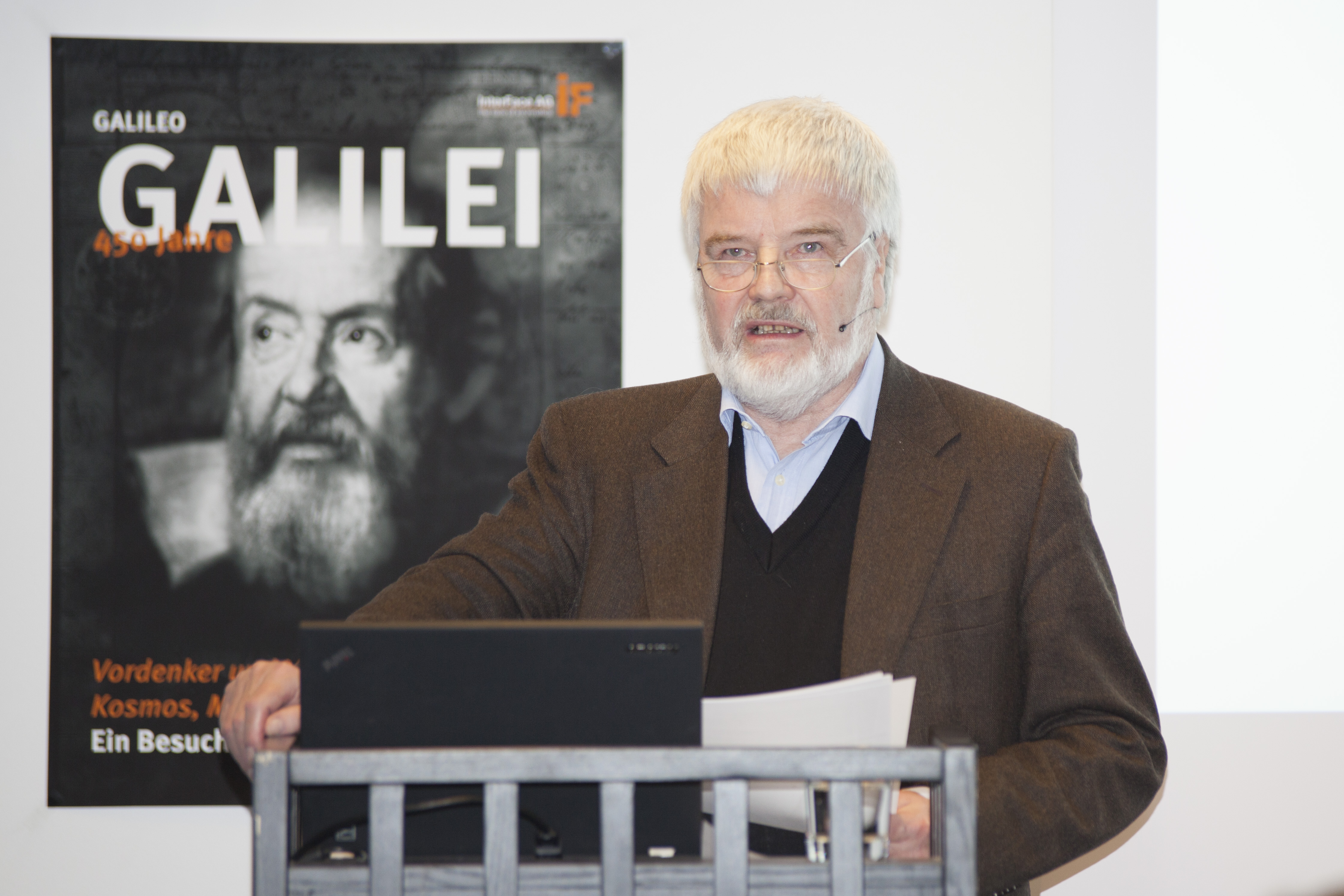 The start-up of the 2014 IF Forum “Galileo Galilei” at InterFace AG was a huge success. Under the heading TURN OF AN ERA, Jörg Schindler delivered a strong appeal in favour of “the future” on February, 27th, at Unterhaching.
With his facts about “The Beginning of the End of the Fossil Era” and the subsequent “Great Transformation of Our World”, he made is pretty clear that, even though we can perceive how the world changes, we actually cannot predict the exact consequences.
Because we are already in the middle of an absolute transformation. It will continue to take place, no matter if this is what we desire or not. Besides, we cannot come up with a master plan, because the transformation cannot be planned. All we can do is refrain from acting in ways that we perceive as non-sustainable.
As often before with other presentations, Friedrich Lehn recorded the presentation held by Jörg Schindler. I will publish the film soon on our YouTube Channel “RolandDuerre”.
There will be two more IF Forum presentations on Galilei Galileo in the 2014 IF Forum:
COSMOS
On Thursday, July, 17th, we will welcome Dr. Stefan Gillessen as our guest speaker. He will talk about:
Big, Bigger, Sharpest
Where is the development of telescopes headed? From Galilei (37 mm lens) to the European Extremely Large Telescope (39 m mirror). What could be more exciting than witnessing how material falls into a Black Hole? Insights into current research.
Stefan is one of the leading scientists at the Max-Planck-Institute for Extra-Terrestrial Physics (MPE)
HUMANS
On Thursday, October, 23rd, 2014, Thomas de Padova will give a presentation. He will talk about the
Secret of the World
400 years ago, two totally different scientists went beyond the limits of the known world. In Venice, Galileo Galilei looked through his telescope and discovered the Jupiter moons. An exciting expedition of human thinking begins – and along with it the turn of the era towards modernity.
Thomas de Padova is a physicist, journalist and historian of science.
RMD
(Translated by EG)
Roland DürreWednesday February 26th, 2014
Tomorrow: Live Stream at InterFace – IF Forum with Jörg Schindler
Thursday, February, 27th, 2014 – tomorrow – the first 2014 IF-Forum is taking place:
In 2014, we chose Galileo Galilei (1564-1642) as our InterFace person. Since his ideas are very modern, this choice allows us to open new perspectives for the here and now. The topics of the 2014 IF Forum will be cosmos, humans and the turn of an era.
 We look forward to exciting insights into the past and the future and will start tomorrow with Jörg Schindler.
He will talk about the turn of an era. His presentation is titled:
The Beginning and End of the Fossil Era
“The great transformation of our world” and “resilience will follow efficiency”
As always, the event will take place in the seminar zone of the InterFace AG building at Unterhaching. We welcome our guests from 6 p.m. and the presentation will start at 18:30 hours prompt.
 A few seats are still available. For all those who cannot come, the presentation will be broadcasted live on the internet: http://www.ustream.tv/channel/IF-Forum.
From around 18.15 hours, you can see the video stream on http://www.ustream.tv/channel/IF-Forum .
In addition, we will do a video recording which will be accessible on youtube (Kanal InterFace AG).
We look forward to welcoming you – both live and online.
RMD
(Translated by EG)
Roland DürreSunday January 26th, 2014
Interview for the DOAG
„What We Are Looking at is An Evolutionary Process Which is Hard to Predict …”
Progress in information technology is faster than ever. Dr. Dietmar Neugebauer, Managing Director of DOAG, and Wolfgang Taschner, Chief Editor of DOAG News, talked about it with Roland M. Dürre, Managing Director of Interface AG, – well, that is me truly.
You founded Interface AG. What is the business model?
We started in 1984 as a product enterprise and – through our professional text processing software HIT/CLOU – became the European Market Leader on UNIX systems for all manufacturers within a few years. Around the turn of the millennium, we changed to become an IT based, sector-neutral service and counselling enterprise. HIT was the UNIX text system, CLOU was the corresponding 4GL machine for text generation. Even the first CLOU versions offered the option to embed SQL scripts, which meant that the text machine could do a qualified reading of the assigned database and, where necessary, also write it. In many instances, this was the Oracle database.
Besides the Interface AG, there are other enterprises under the IF group roof. What do they do?
Our subsidiaries specialize on services around special manufacturer’s technologies, such as Mircosoft, or IT technologies in general, such as virtualization. One enterprise is an exception: the IF Localization. It organizes translations into all languages and realizes adaptions.
To what extend do you use Oracle products for your customers?
Almost all our customers use the Oracle databases for business critical processes. These databases are the basis for all kinds of IT applications.
Where do you see the strengths of the Oracle products, what are its weaknesses?
In my perception, the oracle products usually do quite well if compared with their competition. As I see it, it is regrettable that, especially in middleware, there is no overview showing the entire variety of products. This is where Oracle has plenty of potential for improvement.
What do you think about the product strategy of Oracle in general?
It is certainly not my place to judge the Oracle product strategy. Especially since I am not even qualified to totally even have an understanding of the diversity. Perhaps a product map might make sense – where you get a description of all the products and their possible use.
Would you recommend to your customers that they use a complete system from hardware through to applications from a single manufacturer, such as Oracle?
Why not? After all, I have always been in favour of SUN systems. But seriously: an integrated and synchronized architecture has many advantages – which probably also pay off. After all, you will always be dependent on the manufacturer, no matter if we are talking Microsoft, IBM, SAP or Oracle or whoever.
What was it that impressed you about SUN at the time?
Well, we were a UNIX firm at the time and I was (wrongly) rather sure that Windows was never going to have a chance for professional use. It turns out that I was rather wrong. At the time, Sun was fairly new and modern – I saw a great future for the graphic interface of the Sun workstations. Besides, I found the then Sun employees very nice when I met them at their events.
What came to mind when Oracle swallowed Sun?
On the one hand, I was horrified, on the other hand, I hoped that this acquisition might be a great chance. The great performance of the Oracle Engineered Systems are a good example.
The Interface AG puts great stock in social media. What is your experience with them?
Personally, I find them truly great. However it is not always easy to persuade persons and also central departments to join. Strangely, I mostly find out through Facebook, Google+ or Twitter what our employees do, even professionally.
What advantages do you see in using social media in an enterprise?
In my opinion, it is an absolute MUST today. Over the years, the understanding of management has changed: now, instead of a hierarchical system, we have a network structure. Consequently, bigger groups that co-operate now need modern tools in order to, for instance, avoid countless meetings. It is, however, essential to convince all the team members that social media have their advantages.
What is the direction IT will take in the coming years?
🙂 If I knew that, I would not be sitting here, would I? Instead, I would be sitting on a beautiful yacht in the Caribbean with a glass of champagne in my hand. But honestly: I assume that IT will find its way and quickly, too. What we see is an evolutionary process which is hard to predict, let alone define. However, I assume that the massive impulses will no longer originate in Europe and not as much as we are used to in the USA either, but in Asia. In the Unix pioneer days, the disadvantage of German companies was that the German market was so much smaller than the English-speaking market. Today, China, and more and more also India, tell you where we the music plays.
What do you expect of an IT enterprise such as Oracle during this process?
It would be a true achievement to find the right mixture and/or balance between “open” and “proprietary”. The IT market changes quickly and can no longer be controlled by a single enterprise. Consequently, technological openness and strategic transparency are to be desired, as well as certainly useful in the long run for IT enterprises.
How do you see the position of a user group such as the DOAG?
Well, I have Siemens experience, both as employee and supplier. At Siemens, we had the Siemens User Association. It always made a huge impression on me how this was formative for very constructive relationships, especially with big customers and suppliers and how beneficial it was for both parties concerned.
What experience from your long professional life can you hand on to other entrepreneurs?
The most important is perhaps: always come up with your own judgement. And remain agile and avoid dogmatic decisions and behaviour on all accounts. Other than that, I try to live up to the rules for modern management as set by Hans Ulrich, the founder of the St. Gallen Management Model. They are: accept the unpredictability of the future as a normal state of affairs, extend the borders of your thinking, be more driven by “as well as” than “either-or”, think multi-dimensionally, understand self-organisation and self-control as a formative model, consider managing a meaningful and meaning-transporting function, focus on what is important and make use of group dynamics. Isn’t it remarkable that these rules have been first written down in the 1980ies?
By now, the interview has been published by the DOAG – so here is my post of same.
RMD
(Translated by EG)
Roland DürreSunday January 19th, 2014
As Time Goes By …
Around the turn of the years from 1983 to 1984, Wolf Geldmacher and yours truly were rather courageous when deciding to found the InterFace Connection Association for Data Processing and Communication Software mbH together with Dr. Peter Schnupp (InterFace GmbH) and Claus M. Müller (via InterFace Computer GmbH).
And to this day, we have had much joy with what we had done. Wolf and I were the active associates. Initially, we each held a share of 30 %. Exactly 30 years ago, on April, 1st, 1984, the day had come! The InterFace Connection (today InterFace AG) officially started its work.
It was not an “April Fool’s Joke”. After all, we now can look back on 30 exciting and successful years in business. On March, 31st, the Interface will have existed thirty years on this planet. We will celebrate this birthday appropriately on June, 27th, 2014 with many, many friends.
Maybe you want to mark the late afternoon of that day in your calendar, and then the night, as well? Here on the IF Blog, I will also report at length about the event. We will also inform and invite our friends through many other channels.
After thirty years at InterFace AG, I am now in the position of holding the majority of the shares and of being the managing director. My roles at InterFace were diverse. We started out as a rather successful production firm and then developed into a service and counselling company. And we assume that the future of InterFace AG will also be a good one.
This year is my last as managing director at InterFace AG – which is certainly a reason to look back. There is no “Today” without “Yesterday” and no “Tomorrow” without “Today”. So we need to do some remembering. Well, quite a few things come to mind and also seem remarkable.
I have to think of all the many comrades who accompanied me through those 30 years or through parts of the way. I have to think of the many enterprises that came and went. I enjoy thinking of our great customers, for whom we always enjoyed working. And how it always made us happy to see that our software and services contributed to our customers’ success. In fact, there are some customers of ours we served from day one and still serve today!
Many famous and powerful enterprises appreciated us as their supplier. There is quite an illustrious sound to some of the addresses. Some of them have even disappeared by now. For instance the Kirch-Gruppe and the WestLB. But also quite recently the Weltbild publishing company. What marvellous projects we worked with these enterprises! Luckily, however, most of our big customers survived.
30 years of InterFace also means we saw many partners and competing enterprises come and go. Here, too, I have to say that there were famous names among them. We respected them greatly. And then they were gone.
As I think back in this way, I notice that we are something like a “Surviver”. And that probably not too many of those exist. And that we are actually doing quite well. So what more is there to desire?
Except a few more years of good living.
In order to make sure this will continue to be so, we plan a huge party on June, 27th, 2014. We want to celebrate our survival. We will invite as many friends as possible who accompanied us, still accompany us today and hopefully will still accompany us in the future.
RMD
(Translated by EG)
P.S.
For more information about our party, click here: IF-Open!
Roland DürreThursday January 16th, 2014
IF Forum on Thursday, February, 27th, with Jörg Schindler
Since April, 1st, 1984, the InterFace AG has now had thirty successful business years. Our thirtieth birthday is on the first of April and we want to celebrate it in the summer of 2014.
In 2014, however, there are many other birthdays you could also celebrate. Among others, there is the 450th birthday of Galileo Galilei (1564-1642). For several reasons, our decision whose face to make the 2014 InterFace AG face was made in favour of his.
Consequently, we now invite Galileo Galilei to “visit us in the present” at our IFForum. The topics of the three presentations in 2014 will be cosmos, humans and the turn of an era.
On Thursday, February, 27th, we will start with a presentation by Jörg Schindler on the turn of an era. He will speak about
The Beginning of the End of the Fossil Age.
“The big Transformation of Our World” and “Resilience will Follow Efficiency”
Jörg Schindler was born in Augsburg in 1943 and now lives near Munich.
In the 1960ies, he studied business at LMU München. During the 1970ies, he worked on the development of traffic control systems in various companies around Munich.
1984 – that was the year we founded InterFace AG – he changed to Ludwig-Bölkow-Systemtechnik GmbH (LBST) at Ottobrunn, where he was managing director from 1992 until the end of 2008. After that, he started his (non-) retirement.
Apart from this, he is active in many areas:
From 2000 to 2003, he was a member of the Enquête Commission of the Bavarian Senate: “Into the New Millennium with New Energy”.
Board member at ASPO Deutschland e.V. (www.aspo-deutschland.org) and managing director of the Solarinitiative München-Land e.V.
- Co-author of numerous studies and books on the future availability of fossil energy, for example diverse studies for Energy Watch Group (www.energywatchgroup.de) on coal, crude oil and uranium, the books „Ölwechsel” (München, 2002), ”Geht uns das Erdöl aus?” (Freiburg, 2009), ”Aufbruch, Unser Energiesystem im Wandel” (München, 2011), ”Postfossile Mobilität – Wegweiser für die Zeit nach dem Peak Oil“ (Bad Homburg, 2009) and last not least “Öldämmerung – Deepwater Horizon und das Ende des Ölzeitalters” (München, 2011).
Here are some of Mr. Schindler’s theories
- BAU (Business as usual) is “now” at its end.
- In actual fact, this means: with Peak Oil, the short era of abundant and cheap energy has reached its end. It had started with the “great acceleration” in the 1950ies due to the more and more and ever cheaper oil from the Middle East (the historian Christian Pfister called this development the “1950ies syndrome”). The consequence was that the industrial nations started mass motorization and developed consumer society habits following the American model. This phase started losing its momentum in the developed countries in the mid- 1970ies and came to a world-wide stop in the middle of the 2010 decade – regardless of the still prevailing development in the emerging economies of Brazil, China and India where some catching-up is under way.
- This means that the world is at a revolutionary turning point, i.e. the transition from a fossil-sponsored capitalism to a post-fossil society – the Great Transformation. (The end of capitalism as we now know it).
- Cheap and more than enough energy as a business requirement: following Karl Valentin, you could call this an “erroneous error”.
- Now we need to make the inevitable transformation as tolerable as possible. This is, in particular, also a task for the enterprises. Internally, it is a question of survival, externally one of contributing to the solution.
- There is no master plan for this transformation (nor can there ever be one).
- Since you do not know what the future will bring, it must be the goal of all enterprises to cope with as many scenarios as possible (incidentally, this is also the principle of nature).
- What does this mean for our enterprises? Above all, it means that efficiency as the highest maxim is no longer useful. You can only be efficient in a well-defined context. Instead, our new goal must be resilience.
- Mind you, we know that efficiency and resilience oppose each other …
- But resilience, too, needs management. Externally, you need a critical view of the world and you need to know the non-sustainable elements of your own world. Internally, you need a maximum of qualifications gained through flexible organizational structures and self-organization.
Registration:
This IF Forum, too, will be held in the seminar zone on the top floor of our Unterhaching InterFace AG building. We welcome you from 18.00 hours, the introduction will start at 18.15 hours. After the short presentation, there will be plenty of time for communication in a comfortable atmosphere.
As always, you can register for this IF Forum by simply sending an E-Mail. We look forward to the same kinds of interesting discussions and beautiful chats we are used to!
RMD
(Translated by EG)
P.S.
Mr. Schindler is someone I know rather well and I am always impressed by how many things he knows. Having been the head of a “Think Tank”, his professional life gave him the unique chance to do practice-oriented research for many years. I feel particularly comfortable with how rational he informs about often very emotional topics. Again, I am sure we will have an extremely nice IF Forum.
Roland DürreFriday December 20th, 2013
Merry Christmas
Jolly Kunjappu
»Jumbo‘s first birthday. Celebrate your life.«
Acryl and wax crayon on canvas

This beautiful picture drawn by my friend Jolly was what is printed on the front side of the InterFace AG 2013-Christmas Card. We selected it because it is colourful, exudes a message of courage, joy and freedom and because it is a symbol for “Merry Christmas” totally neutral in terms of religion and culture.
Jolly was born in Madras (Chennai) in Southern India in 1950. I was born in the same year in Augsburg/Bavaria. Jolly is a philosopher, composer and musician, painter, keynote speaker and performance artist. In his spare time, he also owns a very special Indian restaurant in the Zweibrückenstr. (Indian Mango – quite close to the Deutsches Museeum). He has been living in Munich since 1970 and he works all around the world.
I am a day labourer, free spirit, entrepreneur, father of a family and much more. I particularly like eating out at the Indian Mango. For instance today.
Jolly and I are brothers in spirit. With his picture, we wish you and all those you love, as well as the entire world, a very peaceful, happy Christmas in harmony. And may philanthropy dominate in your lives in 2014 and may your world be free of enmity.
RMD
(Translated by EG)
Roland DürreMonday December 9th, 2013
Pro Amiability/Philantropy, Contra Hostility
Christmas 2013
Over the last thirty years, I always gave a speech at the annual InterFace AG Christmas Party. In 2012, I talked about a good education being an excellent preparation but also a necessary requirement for designing both your own future and that of your neighbours more attractively and more successfully through courage in life and joyful behaviour.
Today, I know that “life-long learning” is necessary for “a good education”. However, what I mean is not “life-long” immersion in books. This is not about being a student all the time. Instead, it is about “opening up” towards the world and people. You have to leave your own snail shell and face life. This is how you collect life’s experience, which you might perhaps also call experience – and which is so important for a content and successful life.
Consequently, I started my small speech on this year’s Christmas Party with this idea and tried to describe more factors, all of which can make us all successful. In my book those factors are philanthropy and tolerance.
I also mentioned the opposites that, almost unavoidably, cause failure: fear and, in particular, hostility. Both terms were topics of “philosophical seminars” I attended several years ago (“fear” with Baldur Kirchner, “hostility” with Klaus-Jürgen Grün), which affected me very much.
So what is the origin of hostility?
Even brain research seems to prove that hostility is not something inborn. Instead, it appears that our brains reward “doing well” with an outpouring of “happiness hormones”, which makes us quasi construction-based social creatures.
Regardless, I witness small and also big attacks of hostility from almost all people and all social systems on a daily basis.
Like weeds, hostility creeps up out of even the smallest crack. And it happens for all varieties of reasons. More often than not, it is fear that governs humans and makes them hostile. Both carelessness and the urge to know things better, or also the tendency to grumble, can be the reasons. All these and much more of the same kinds of things might be sources of hostility. You are overworked, you are “fed up”, new ideas are refused and intolerance towards all that is alien or different is nurtured.
This is how frustration and dissatisfaction accumulate, before going off in the form of more or less superficial or intense hostility. I often perceive “moralizing” as hostile and do not feel well at all if, for instance, someone says “this is how it is done” or “we always did it this way” as a reason for behaviour that looks strange to me.
What does hostility trigger in me?
Whenever I am at the receiving end of hostility, I first and foremost feel small and uncertain. I ask myself if and how I am the reason for the other person’s hostility? Did I do something evil that might have caused it? However, this sentiment soon turns into something else. I get defiant and will turn away. Until my attitude becomes one of “kiss my a…”. Being confronted with personal hostility makes me insecure. If the hostility seems systemic to me, I retreat into inner resignation and refuse to cooperate.
Hostility is often perceived as an accusation. It will create fear and is detrimental for building up trust. And my problem is that I will answer hostility with hostility (of my own). Now isn’t that a stupid vicious circle?
How to reduce your own hostility?
The only thing that works with me is: minimizing my own fear. But this is certainly one of those things that are easier said than done. Also, I try to minimize the personal distance between myself and those that are important to me. I try to accept and give empathy. And I make myself develop more serenity as days go by – and always to find my inner freedom.
Only with philanthropy can I be a success.
Wherever I am met with kindliness, I feel well. Which gives me a good feeling and makes me bigger and stronger. My fear will vanish. I like the sender of friendliness, I receive it with pleasure and am prepared to invest in it. I am surrounded by people who also feel the same. If I am “philanthropic”, I will quickly have many friends and allies. People will take me seriously, believe me and will also be prepared to do something for me. My environment is no longer against me; instead, it is for me. I am no longer surrounded by enemies, but by friends.
Basically, it is quite simple, isn’t it? Hostility is detrimental for your success, friendliness will make you a success. Consequently, it is stupid to be hostile and prudent to be philanthropic.
Well, this is roughly what my InterFace-Christmas-2013-speech should be.
RMD
(Translated by EG)
Roland DürreTuesday November 19th, 2013
Videos of Dr. Roberto Simanowski at the IF Forum: Now Online!
On October, 25th, 2013, professor Dr. Roberto Simanowski spoke at the IF Forum, first about “Jean Paul: witticism, postmodernism and the new media” and then about “Big Data and transparent society – NSA, Self-Tracking and the internet of objects”. Now you can look at these presentations on Youtube.
Big Data
Jean Paul
Enjoy!
RMD
(Translated by EG)


