
Roland DürreTuesday September 7th, 2010
Privacy #2: The ME
Detlev wrote an article: The End of Me (Das Ende vom Ich).
He hit the nail on the hat. The ME is disappearing. Since “privacy” is part of ME, it might easily vanish next.
Privacy happens between the ears. And losing privacy is also a matter of the brains. If we wish to remain “private”, we have to resist many temptations all the time. Our modern artificial world offers so many (seemingly) desirable and comfortable things. More often than not, however, there is dependency and external control behind promises of benefactions made to wet our appetites.
We are all too willing to “live our lives second-hand”. It is not much of an effort. This is not only true for physical labour, but also for our psyche. Emotions transported to us through the television or internet serve their purpose and seem to provide us with emotional abundance. That is how we perceive it. They are, however, synthetically constructed and therefore less painful than those we experience directly.
For instance, we cry when we watch a love story in the cinema. Yet we often can no longer cry when our beloved one says farewell. It is just like with food: the decadent meal tastes better to us than the natural.
Here is what our environment makes us believe in a very soft voice:
Roland DürreMonday August 23rd, 2010
“My Generation” or “UPZZDA and Rondism” ♫
These are the kinds of ideas I have when on vacation, while thinking back upon my life a little:
I was born in 1950. We were a generation on the move, wishing to get rid of the post-war ballast. But each day was a day of financial improvement for us.
We were idealists and loved utopias. Some of our parents’ values and opinions were incomprehensible for us. Consequently, we sought refuge in smoky cafeterias and pubs. Drinking red wine and beer, we discussed God and the world, often in circles. Rothändle and Gauloises were a matter of honour, Sartre and Camus were our favourite authors. We had little or no inclination towards baroque or romanticism, or lost cultures.
Even in those days, we were fed up with the established parties. And when, early in the 1960ies, Karl Jaspars wrote about the oligarchy of the parties as a threat to democracy, he echoed our sentiments.
The irrationality of war – not just in Vietnam – was an abomination for us. We considered the overkill of the long-range missiles with their nuclear bombs the highest possible absurdity imaginable. We were pacifists. Compulsory service and irrational demands were anathema for us and we wanted to avoid being drafted for military service at all costs.
Roland DürreWednesday August 11th, 2010
Nürburgring
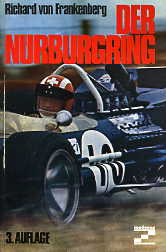 My neighbour was going to throw the book a picture of which you see here into the bulky waste. At our home in Riemerling, such a thing still exists: in intervals of eight weeks, the “bulky waste” is collected. In many households, the attics are cleared out and many nice items lie on the streets waiting to be collected. Several trucks with Eastern number plates will then circulate through the beautiful town of Riemerling and load up.
When I saw the book I considered it too precious for bulky waste. Consequently, I asked my neighbour if he minded me taking it and he gave it to me.
It is the kind of book I like reading for entertainment once in a while. And it also contains plenty of historical pictures. After all, the first edition is of 1965, so you could say it is vintage material. On the picture, you see the third (and last) edition of 1970.
Roland DürreThursday June 10th, 2010
Masses of People
When doing an OpenSpeech (see my presentation at Ottobrunn Grammar School on May, 20th, about “community – people – society”), I started by asking my audience to just think about the term community. I told them to take a moment and let the brain associate it with other terms and then to tell us all what terms might be grouped around it.
I was literally bombarded with replies. And one young man among the senior high school students simply said:
There can only be a community where there are “masses of people”!
Isn’t that a stroke of genius? Indeed, a feeling of belonging in social systems, a society and all it means can only grow where there is one or several masses of people. Do these masses of people constantly change and constitute themselves anew, too?
The term “masses of people” suggests that society can only work if there is such a thing as wisdom of the mass or swarm intelligence. Actually, the concept of “masses of people” explains why there must be social systems and why society can change all the time.
And we are only part of a mass of people. We love or hate our mass, and once in a while, we desert it and join a new one. The concept makes things a lot easier. I would like to thank the student I do not know and inventor of the term “masses of people”.
RMD
(Translated by EG)
Roland DürreWednesday June 2nd, 2010
Isetta
The following very interesting text is part of the manual I was given when I bought my Isetta in 1957. I will just present it to you without further comment:
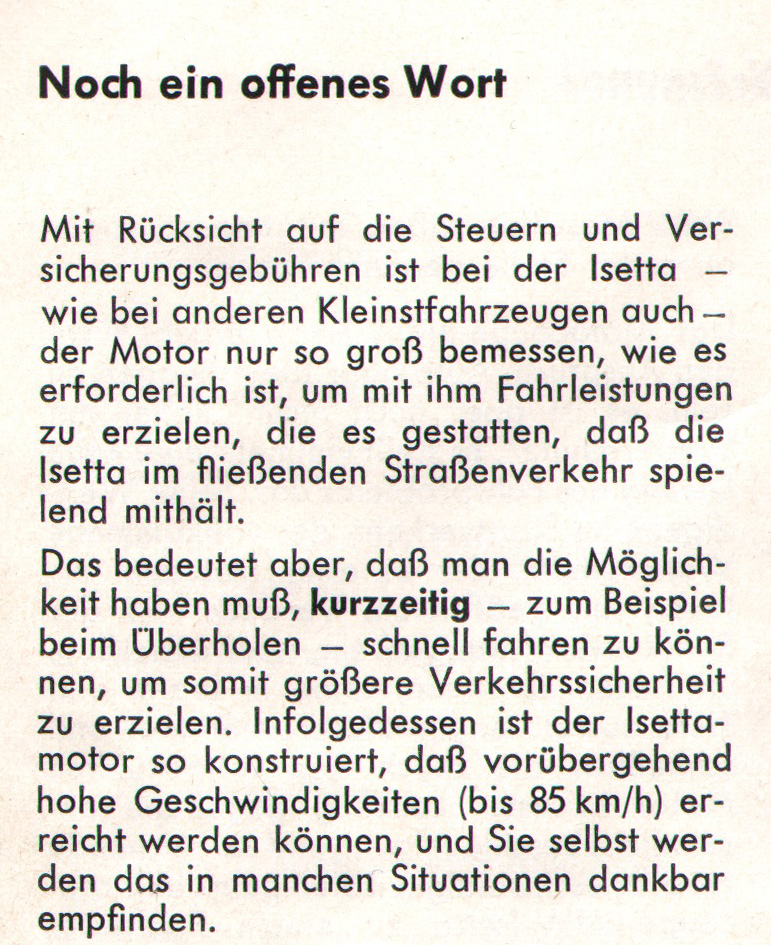
Here the translation:
Let us be frank with you
In order to limit the insurance policy and tax money you will have to pay when driving your Isetta, we – like all other designers of micro-mobiles – only installed a motor with the capacity to go just fast enough for normal moving traffic.
However, this also means that you have to be able to accelerate for a short span of time – for instance when overtaking another car. This will also increase the general safety on the roads.
Consequently, your Isetta motor has been designed to temporarily achieve a high speed (up to 85 km/h). We are sure you will appreciate this very much in certain certain situations.
That was yesterday, so what will be tomorrow?
Detlev SixSaturday May 22nd, 2010
Boredom Breeds Anxiety.
Anxiety has had quite a career. So far, the culminating point was the “German Angst”. Initially, it started as fear and meant the life-threatening feeling our forefathers experienced when they stood eye to eye with a sabre-toothed tiger.
For a long time, anxiety was coupled with an actual, directly threatening object.
And today?
The workers on the drilling platform on the Gulf of Mexico, too, experience this actual threat. For the inhabitants of the nearest oceanic bordering countries, it is already less threatening. They are not directly in danger of dying. If at all, then they might fear it in the long run. But why are, for instance, the inhabitants of Munich – Neuperlach scared? Will the oil spill over their garden ponds?
Roland DürreSunday May 16th, 2010
Crisis

Churchill in Quebec 1944
Today, we face the worst crisis in a long time. We defend our currency and fight for the stability of the Euro.
That is what our Federal Chancellor says.
Trichet, the boss of the European Central Bank, even goes so far as to say:
Europe is in the middle of the worst crisis since WW2.
The talk is about currency war. It sounds a lot like blood, sweat and tears and reminds me of Winston Churchill.
And you hear that the Euro fighters allegedly fight fiercely on various frontlines in the Euro country. Without rest, they are busy all the time stabilizing our currency. Against the evil gamblers.
They mobilize the last reserves and throw them at the Euro frontline. Using 500 virtual billions, they fight a virtual thread of 3,500 billion rotating on the world market. Incidentally, 1,000 billion are swapped – sorry, I mean traded – between Euros and Dollars each day.
Detlev SixFriday May 14th, 2010
War of Numbers
Whenever I open the IF blog, I find lots of numbers. To be sure, the If blog is not the only place. Numbers as such are at the forefront when it comes to explaining the world. As I see it, there are three types of numbers.
Decision numbers.
Displeasure numbers.
Distancing numbers.
mehr »
Roland DürreMonday May 3rd, 2010
The Euro
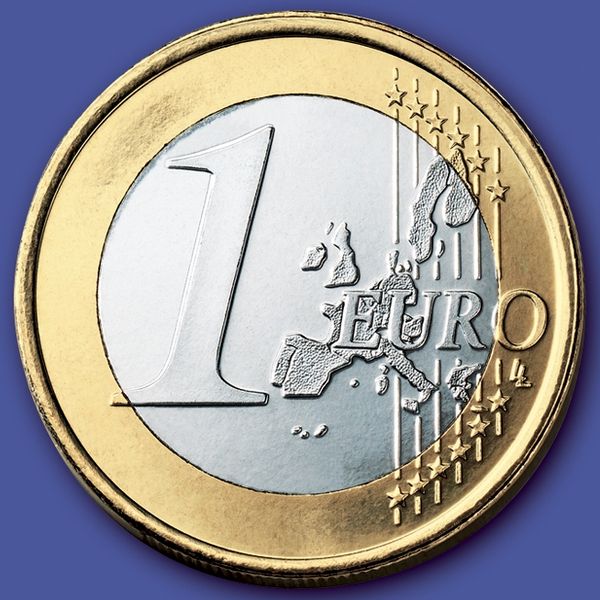 The status of Germany as a privileged business country we enjoyed over the last 50 years is dwindling. However, I think that is not solely due to us. We in Germany are still just as adept, creative, and full of ideas, competent, industrious and competent as we have been before.
The general structure has changed. Our economical power is on a world-wide decline. To be sure, the prosperity we achieved during the years of the economic miracle and the high standard of living we have grown used to did not happen exclusively because of our industriousness. We also benefited from cheap raw material and labour from abroad. And we also enjoyed a super reputation through the D-mark being a stable currency.
Roland DürreSunday May 2nd, 2010
Brandeins in May – This Magazine Makes You Look Sexy!
This magazine makes you look sexy – true! That, however, is not my personal comment. Instead, it is actually the title of the May edition of Brandeins. Of course, I want to be sexy (even better: I want to be very sexy 🙂 ).
Consequently, I feel that the title is directed at me.
What gets my attention even more is the sub-title:
The Victory of Irrationality!
 That is grist for my mill. After all, I witness on a daily basis how hard-won, minutely planned and beautifully constructed plans go up in smoke, even though they have been based on complicated and rational requirements. Conversely, the nicest things in life and the best projects often originate in the most obscure corners where you would never have thought anything might develop from. In some way of other, it is always like this.
For many years of my life, I believed that rationality was my most precious companion. Now I have learned that in reality the old common knowledge is true: “Man proposes, God disposes” (however or whatever this “God” is supposed to be). Consequently, I am now convinced that:
We must act wisely instead of thinking too much and in a too complicated way.


