
Klaus HnilicaThursday August 6th, 2015
Revenge Makes You Strong!
 When, a short time ago, I wrote my brief essay on ’Only Forgiving Makes you Free’, I related how, if possible, we should always forgive, even if we have been hurt both inside and outside. In fact, I told you that, in our own interest, we should learn and practice said forgiveness. Yet I was quite aware that the opposing end of ’forgiveness’, namely ’revenge’ must exude enormous attraction. How else would it be possible that is has such a strong impact on human society?
However, I did not have a to-the-point formulation for the phenomenon!
Hence, it surprised me so much the more when, a few days ago, I found exactly the term I had been looking for. It was in the latest novel by Siri Hustvedts “The Glittering World“.
Siri Hustvedt lets her protagonist Harry say:
Revenge ideas will always have their origin in agonizing helplessness. “I am suffering” turns into “you must suffer”! And do not let us mince words: revenge will make you strong! It gives you focus and fire, and it suppresses misery, because it transfers the emotions to the outside. In misery, we dissolve. In revenge, we concentrate all our energy and turn it into one single weapon directed at one individual goal. No matter how destructive said weapon will be in the end, it serves a useful purpose for some time!
As I see it, Siri Hustvedt got it exactly right with this statement of hers about what is so attractive about revenge, which pulls at us like a suction. But, naturally, she also knows how destructive revenge will always be in the end. And unfortunately, the current news from the Arabian World tell us on a daily basis that cultures based on revenge and retaliation can never find peace .…
KH
(Translated by EG)
Roland DürreSunday August 2nd, 2015
#Unschooling: Presentation “Learning in Innovation” by Bruno Gantenbein now available as video.
I am glad to announce that now the video recording of the great presentation by Bruno Gantenbein at the St. Gallen IF Forum of July, 23rd, 2015, is available on youtube and can be watched by all of you:
The presentation ”Learning in Innovation“ held by Bruno Gantenbein at the IF Forum left me deeply impressed. Many of the audience felt the same. But some who also were very impressed by Bruno’s theses came back with the important reply that what he spoke about was not something “normal people” can live in a “normal life” in the “real world”. Because your normal Jim and Jack cannot really manage it. And it simply cannot be done. Once in a while, it sounded really like people were despairing.
To me, it seems the reason is that
“most people cannot really imagine living in another world than the one we are living in“
and that
“we are no longer capable of distinguishing between what is important and what is not important. Consequently, what is unimportant is dominant in our lives.“
To me, this seems to be the major problem both for us and our society. A degree of external control through marketing and lobbyism as we never had it manipulates us in a totally new way. It is totally different from, but certainly no less dangerous than, for instance, religious indoctrination of persons in the Middle Ages or, if we are unlucky, the manipulation as practiced by the Nazis.
The formatting of our lives through a super-powerful but not tangible system took away our autonomy. Now we get nervous and start talking change. Yet we lack all desire to start another life outside our comfort zone. In fact, more often than not, we are not even capable of imagining such a life. For instance, the strength to develop utopias for the future seems to have left us. Looking for values and visions no longer plays a role in our society. In fact, if we do look for visions, it is actually something others are belittling us for. The attempt to re-create a new “social consensus” is smothered in the very first stages. Consequently, we assume that the status quo is true and there is no alternative.
We no longer have the courage for change. We accept our dependence and are happy to be “enslaved”. Be it by technology or as our social concepts of life (our lies of life) determine it. We believe you cannot live without a car, a TV set and electricity all over the place. We believe in the omnipotence of medicine. That the federal administration must and has to guarantee our security and safety. And that the planet will certainly find a way to survive it all.
Except that so many of the things we take for granted can be easily disproved. There is no absolute security. We experience it all the time. The sudden death of an important partner or a surprise illness totally throw us off balance. We can easily fall victim to some mishap.
But then, there are also harmless examples. The stamp collection we inherited
from our grandfather that was so precious, but for which now not even the wastepaper trader is prepared to pay, shows us how difficult it is with security. Many things that used to cost a lot are totally valueless today. I made the same experience when pay day came for my direct insurance. What a discrepancy between the money I received from what I had expected when, decades ago, I first signed the insurance contract. Instead of the imagined free-hold apartment, the only thing I got for it was a medium-size car…
Regardless of all this, the (alleged) security of our modern financial world suggest for some that we actually are in total control of the risk of our material life through retirement money and savings. Except where will the Euro be ten years from now? Will we be able to solve future problems with it? What will money be worth? Have we not learned a long time ago that “you cannot eat” money? Especially if it is just virtual money and perhaps out of the blue will have to be shortened by the occasional digit.
To make up for it, we capitulate for fear of terrorism. And we are prepared to sacrifice our present freedom for these kinds of mind games. Sacrificing freedom for what we believe is an investment in increased future safety! And we are even prepared to start a modern (crusade) war for it.
This is how we follow the stupid and brazen battle cries of politicians and economic leaders who, more often than not, are no longer sane. We swallow pointless laws they serve us with, regardless of the fact that we know those will do more harm than good. And we surrender before the stupidity of our “representatives”. In fact, I actually yearn for a German or European Spring. But I do not mean one triggered by hunger or poverty like the one in Northern Africa – which inevitably dooms it.
Why do we believe them when our politicians tell us that “without the Euro, there would be no Europe” and that the so-called “Grexit” would ruin us all? Why do the politicians tell us such fairy tales? We know as well as the politicians that the Euro is good for those who stand in the light. And it is detrimental for those standing in the shadow. Just as we all know that the exploitation structures, both globally and within Europe and Germany, must fail or cause conflicts, either in the near or not-so-near future.
But we get the impression that we cannot do anything about it and perhaps that is really what happens. Also, we no longer have the courage to oppose the structures of the administrative and economical systems that rule over us. And we no longer stand up against this, even though we know that human beings – which is we! –, and not system interests that have de-personalized and de-humanized themselves, should be the centre of the society, politics and economics. First and foremost, the economy and the state must serve the interests of the people. Just like it is written in the Bavarian Constitution.
The system of the oligarchy of the parties (Oligarchie der Parteien ) – see Jaspers -rules over us and the morals of mercantile metric in economy sharpens the boundary conditions of our behaviour. Thus, the systemic mills will continue to grind, making the restrictive nets of bondage tighter and tighter. It happens in small portions, which means that we often do not even notice it and almost consider it normal.
Consequently, here is what we need to do:
Let us also get back to remembering that we, as “natural beings” are also part of the “natural world”. To be sure, the “cultural world” we created makes some things easier for us, but it also took a lot from us. It made us lazy. And we forgot that the price we are paying is rather high.
As I see it, we should return – and radically so – to thinking about whether, perhaps, we could also live in other worlds and probably even be happier living in other worlds. As you all know, my favourite example is the “away from the car” and turning towards active freedom through “active mobility”. Yet it is just as important to take a close look at the working and living conditions we subjugate ourselves under, be it in social systems such as families or otherwise. We need to question all that seems self-evident and draw conclusions from the answers. Formerly, one would have said: Destroy what destroys you.
Part of this is also to live a “life in harmony with nature” as Seneca formulated it. And he meant more than just the biological nutrition process and the preservation of the environment. He also meant we need to listen to our inner voice.
After all, Seneca was a great teacher who wanted to help his pupils on their way to become successful and happy persons. So let me finish this article with another sentence by Seneca that might perhaps make it a little easier for us to start travelling towards other worlds:
“It is not because things are difficult that we dare not venture. It is because we dare not venture that they are difficult”.
Yet – there is hope. What is currently happening on the internet is actually something I rather delight in.
RMD
(Translated by EG)
Klaus HnilicaWednesday July 15th, 2015
Trapped on the Balcony
Carl and Gerlinde (XLIV)
Oh God – what a heat! Absolutely beyond endurance! And today of all days, Hannelore and Kurt had planned to invite them, because, at long last, they had managed to finish the renovation work on their house. It had taken them two never-ending years during which everybody had been sure that there was never going to be a happy ending!
 After all, when Carl had read about the sixty documented façade fires in the City of Frankfurt mentioned in the ’Frankfurter Allgemeine’ where the insulation had been quite an effective fire accelerator and shown this analysis with all due superiority to Kurt, the latter had lost all enthusiasm about minimizing heating costs. But then, his persistent ’climate preservation activist Hannelore’ eventually prevailed and forced him to install said insulation anyway! And since she had already gathered steam nagging him, she made him renovate the rolling shutters, too: ever since last Tuesday, all the fifteen rolling shutters on the windows and doors of their one-storey semi-detached house now moved up and down without the slightest sound, sun-sensor controlled and fully automated.…
And this is what he and Hannelore wanted to toast with their friends today, Kurt had stammered. Mind you, the families Renner and Gutmann had to send in a last-minute cancellation, because Kerstin had suffered from a heatstroke, Anne had been stung by a bee yesterday and reacted allergic and her husband was still busy dancing around his office without being able to say when he would be back.
But then, sitting on the north-facing balcony of the first floor, Kurt continued after having yet once again related the entire renovation adventure and while still gripping his Aperol Spritz – now minus the ice cubes – one could just about tolerate even temperatures of 32 degrees Celsius! This wonderfully refreshing breeze coming from all sides was also what had eventually made Hannelore agree to serve her delicious buffet on the balcony, after all. …
”Kurt, if you continue your monologue holding this full glass in your hand”, Hannelore suddenly aggressively interrupted him, “the only guests remaining with us will have died from thirst and turned skeletons before having so much as smelled all those delicacies we prepared for them. Please let us, at long last, push the now tepid Aperol Spritz through our throats and then turn to the cold beer sitting in the ice buckets! And my appetizers would also definitely appreciate being devoured and pushed into our empty stomachs as fast as possible, before the basil is totally dry and the wasps have eaten your savoury sardine bread spread…“!
“God be praised”, Carl moaned with relief, touching Hannelore’s naked arm while Gerlinde tried to console the so harshly interrupted Kurt with a few whispered niceties.
Carl was also the first to, after the short and embarrassing pause, grab his small bottle of beer from the ice-bucket and, without a single break, use it for removing the lukewarm Aperol Spritz taste from his throat!
All the others followed suit, and since they actually did enjoy the nice breeze on the balcony, their chewing mouths soon started resuming their lively gossip.
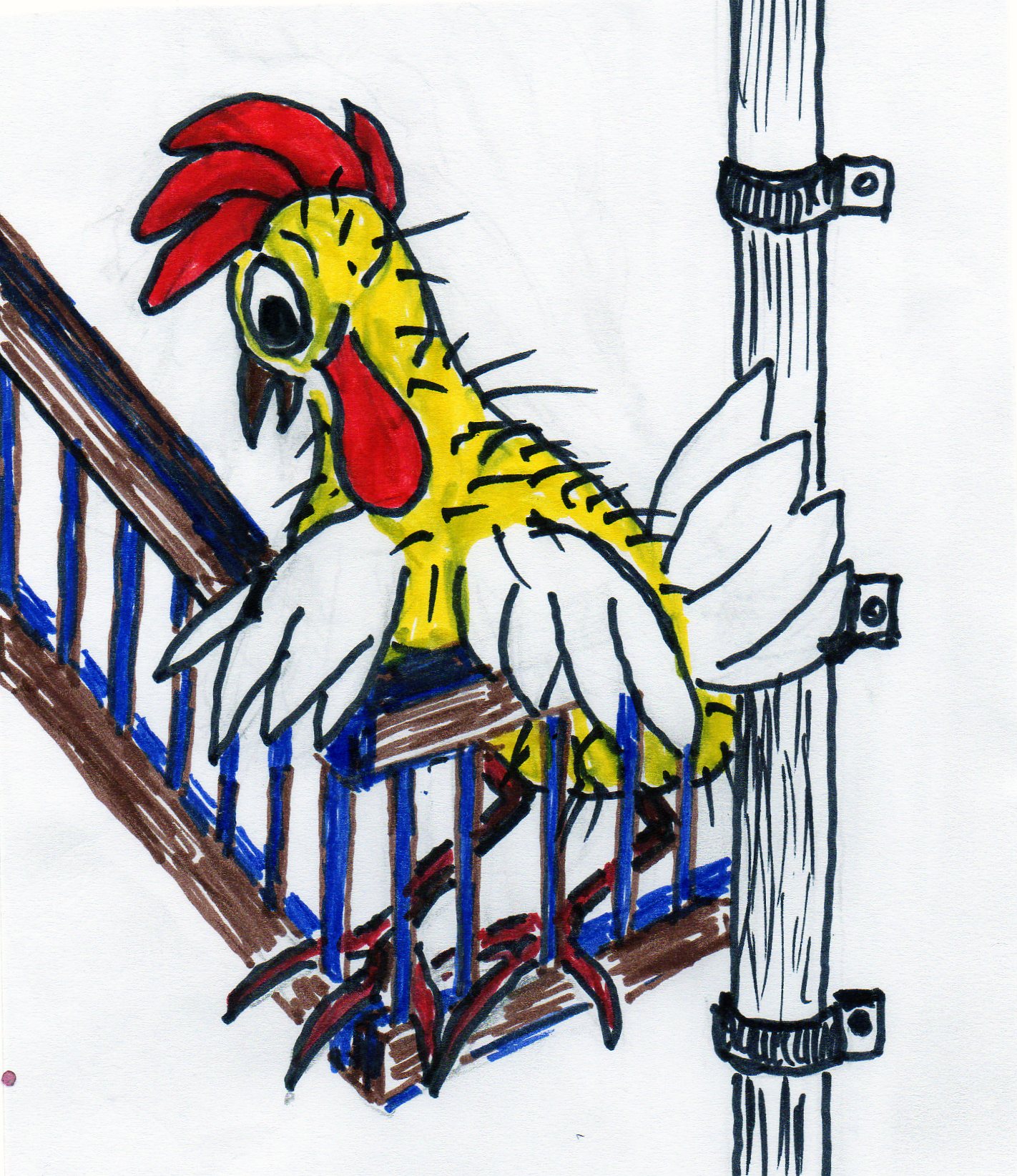
It took this bone-shattering “NO! Damned!” for another interruption of their chattering to happen: all three of them gazed at Kurt who, highly excited, stood in front of the closed balcony door with an ice-bucket full of empty beer bottles: nobody had noticed anything, because it had all happened so noiselessly.
And now they were closed! The balcony door shutters!
And, of course, the control device was inside and nobody had their cell-phone with them. Well, where should anybody have kept it, wearing their light summer outfits; even Carl had no suitable pocket in his Pumpkin Shorts!
“So what now, my golden programming genius?”, Hannelore attacked her totally flabbergasted Kurt. “If I remember correctly, you told me more than twenty times last week that this is something that absolutely can never happen, because you programmed the shutters for all the balcony doors to always remain half open. Or am I mistaken, my super-wise Kurti?”.
“Dear Hannelore, you are not mistaken. You see me facing a mystery …“
”My dear Kurt, this is not just a mystery, but a totally closed balcony door”, Carl added with a grin.
“So – and what now, my dear folks?”, Gerlinde had turned a little acidic.
“I do not know – I truly and really do not know …!” Kurt stammered.
“Maybe we should yell!”, Hannelore suddenly shouted, “yes, let us all together give such a loud yell that is sounds like cowbells ringing; somebody is bound to hear us …“
“Ha, ha – who would hear us?”, Kurt moaned. “The neighbour on the right is hard of hearing and sitting in front of the TV set and the neighbours on the left are on vacation…“
“And the ones back there are having a garden party, so they will not hear anything because of all the noise they make themselves”, Gerlinde added with frustration.
“But Hilde, on the opposite side, still has her lights on! Look at the upper storey!”
“And all the windows are also open”, Kurt suddenly sounded quite triumphant…
And he immediately started yelling loudly for his beloved – who, incidentally, at the age of 82, also was only of limited hearing. This was not something Kurt let himself be deterred by: he yelled “Hilde” until – well, until he no longer had any breath left!
Of course, the occasional car also drove by! But they took no notice at all of the ’incarcerated four on the balcony’. And even if they had noticed, they would surely have thought those guys up there well equipped, since they were so strangely yelling and full of joy, also waving all the time…
And, of course, Blanka, Hilde’s Polish nurse, was also not available – but then, she would not have understood anything, anyway, because the ’Deitsche Language’ was not precisely her strong suit!
When finally Carl had managed to tune his powerful organ in harmony with the ’help ’- cries by Kurt, the one who had been so much wanted actually appeared in one of the illuminated windows, enthusiastically waving towards the merry balcony round. …
She also noticed how hot it was and how she was totally in the nude underneath her light shirt!
Kurt’s desperate yell, however, that he absolutely needed the house keys deposited with her again only brought the reply:
“I am in the nude …“!
And when asked where Blanka could be found, the answer, of course, was again “I am in the nude… “!
But since, regardless of Hilde’s fortuitous nudity, the time approached midnight and not only the Aperol bottle, but also the three bottles of champagne were empty, Carl manfully took the initiative: powered by quite a bit of alcohol, he suddenly – without any advance warning – catapulted himself over the balcony railing like Tarzan for all to see, awkwardly gripped the downward leading rain pipe and – even before Gerlinde could give an anxious outcry – landed on the ground with some kind of primal yell!
At least that was what it seemed to be, considering the muffled sound of his impact and this animal-like “Ouch – Shit!“.
And after fearful questions from above and tension-laden silence from below, finally came an all-salving moan and the spooky comment:
“Now, I, too, am in the nude …!“
Which was when everybody gave a yell of liberation, noticing that Carl’s beautiful new summer outfit hung from the rain pipe in tatters and he, Tarzan himself, apparently had survived the entire episode without breaking any bones; he was still wearing his undamaged TRIGA boxer shorts…
Since the automatic movement lights on the patio had turned themselves on, he even stood in the limelight, looking very spectacular with blood smeared all over him! So it was hardly a surprise that Hilde enthusiastically joined in with the applauding audience, constantly saying that Kurt was not in the nude, after all…
However, since it was not Kurt but Carl – whom she took for Kurt – who knocked at her door, it only took a few minutes before the sought-after spare keys were in his hands. …
What a triumph for the ever so robust TRIGA boxer shorts! Because without them, Carl could never have run to Hilde’s so quickly …
KH
(Translated by EG)
Roland DürreThursday July 2nd, 2015
Entrepreneur’s Diary #110 – Manus Agere.
A short time ago, I had an experience that, again, showed me why I so dislike the terms “manager and managing”. Nor does it matter if they are combined with 2.0, 3.0 or 5.0. In fact, one of the reasons that made me me hesitant about ever using the term was that there are so many translations for “to manage” from English to German. Basically, you might well use it for “all and nothing”.
During the WebWeek, I attended an event by Techdivision in Munich that had been organized by my friend Sacha Storz (Sacha is not a typo ). The topic was 3.0 – as we all know, there is a lot of well-known, even famous, literature on the matter.
When we discussed it, Gerrit Mauch – whose contributions I very much appreciated – told us what the term “to manage” means to him. He said he thought that the original meaning of the word probably lies in the Latin: “manus agere” (’take by the hand’). It was mostly used when horses were trained.
That would mean that, as time went by, horse schools turned into “managing”.
Following this train of thought, you have to conclude that it was the ancient Roman’s BGM to care for the physical health of their horses. After all, they were important and ever so precious production animals.
And seeing humans under this light is simply the wrong concept in my eyes. Some way or other, it does not fit in our times at all. At least the developed societies should not be based on this kind of concept of humanity. And we all want to be a developed society, don’t we …
RMD
(Translated by EG)
P.S.
For more articles of my entrepreneur’s diary, click here: Drehscheibe!
Klaus-Jürgen GrünTuesday March 24th, 2015
The Moral Bookkeeper Living Inside Us All.

He is not my favourite concept of self.
How we all would like to see ourselves.
Self-confident, humorous, tolerant, spontaneous.
No: he is industrious, stubborn, accurate.
Just what we all want bookkeepers to be like.
Our moral judgement takes the characteristics of the bookkeeper. It compares words and behaviour of others with our values and then assigns consequences. In doing so, we weigh things against each other like in a debit and credit account that have nothing to do with each other. In the book “Christie Malrys Double Bookkeeping”, the author asks how we deal with all the small instances of meanness we are subjected to by others on a daily basis.
This is a question that concerns all of us. He comes up with the idea of starting a life bookkeeping in the form of double accounting. The protagonist, Christie Malrys, writes down everything he experiences under “debit” and “credit”. The slights are debits and must be made up for by corresponding credits, meaning experiences that were nice (for him). For instance, Malrys comes up with the idea of paying back a neighbour who never gives him the time of day by making a scratch mark on his car. A house that he finds offensive gets a thick painted line on its façade.
You think this is over the top? Sure. Pure Fiction? No. Our double accounting wants justice and will not hesitate to apply small or embarrassing ideas. After all, our values, which have been underscored by our sense of justice, are not officially calculable or exchangeable like Euros or Dollars. They exist exclusively in our very personal exchange rate mode. The correct exchange rate lies in our eyes or perhaps in that of our reference group.
So what is the right, appropriate, just “credit” for an Islamist who sees his God exposed to ridicule? What is it for us when we see the Greek Minister of Finances show the finger at Günter Jauch’s show? Public “beheading” by TV? Higher interest and credit rates? Appealing to the public to not spend their next vacation in Greece? As it is, the slights, that is the “debits”, are at a majority in real life, and a balance sheet that is constantly in the red numbers will easily tempt us to become more and more ingenious when it comes to looking for a balance. From the perspective of the others, we get more and more spiteful and unjust. Those who spend all their time looking to balance “old accounts” will miss a lot of life looking for suitable measures.
Wherever the moral bookkeeping is especially conservative, it will not see the accounts balanced. Practicing its balancing justice, it will also demand harsher punishment. Soft or moderate punishment would debase some behaviour. Those who believe in this system think that evil deeds cannot be paid for dearly enough. Conversely, those who criticize conservative bookkeeping look upon those strategies as upvaluation of a misdeed to turn it into a rare commodity. Not everybody is supposed to be able to afford it.
There is a general disagreement about how a balancing between good and evil should be accomplished. But there is agreement that there should be some redress. Either by revenge or by mercy, but justice must be done. You have to pay back if you overbalanced on your account.
While in financial bookkeeping we have strategies for minimizing double accounting, we get an overflow when it comes to moral bookkeeping with double standards. A moralist will certainly deny ever being calculating. This would weaken his moral position. He will not even admit that human behaviour and moral values can be measured at all.
And instead of laying open the criteria for his measuring and retribution, he simply will deny having any such strategy. Behind the moral judgement is a mental concept which transports a calculation of weighing good against evil. Yet at the same time it camouflages this background concept. Moral bookkeeping will camouflage that it is bookkeeping at all.
What humans say instead was stated by George Lakoff in his disarming book “Auf leisen Sohlen ins Gehirn“ (voyage into the brain on soft shoes) like this: “I am totally aware of what I think. It is exclusively my own decision what I think and which conclusions I draw. All persons can think in the same way. And in thinking, I understand objective truths as they are found in the world. All things have a basic meaning and can thus be mentally followed as they exist. This is why I, like all other persons, can think and speak objectively.”
Well, I wish that were how it is.
kjg
(Translated by EG)
Roland DürreSunday February 22nd, 2015
At Eye-Level – A Film about Work-Life in the 21st Century.
 A team of five started an exciting project – and eventually it turned into a film: “At Eye-Level “ (Augenhöhe).
Here is the story: During a session of the 12th intrinsify!me “wevent” in Berlin about the work-life value of the 21st century, the idea grew that you should not only describe everything in words at all times. Instead, you should show it to people – in a film.
Five session attendants remained together and got active. They made the film “At Eye-Level”. I first heard of this project on the Berlin 2015 PM Camp during a great impulse presentation by Ulf Brandes. Later, I saw parts of the film during the Munich 2014 PM Camp. Two of the protagonists playing in “At Eye-Level” are personal acquaintances of mine through PM-Camps.
Thanks to enormously well-used “social media”, the project quickly earned great acclaim, even beyond the internet. The successful crowdfunding for its financing, too, had enjoyed a huge amount of public awareness and was accordingly very successful. The opening night on January, 30th, in Hamburg, too, had a huge audience. More than 400 (!) persons came to watch the film at the Hamburg Museum der Arbeit.
The film is about good topics. Perhaps its professional quality cannot hold a torch to documentaries with similar topics, such as by Geyrhalter, Wagenhofer (among other things the trilogy We Feed the World, Let’s Make Money and Alphabet) or Carmen Losmann (Work Hard – Play Hard). But neither does it need to – it is more a refreshing production on the level of TV reports by the ARD or ZDF, for instance about shipping electric waste to Africa.
The film is about persons acting different roles in their work-lives: entrepreneurs, managers, founders. But above all, it shows employees happy to be working for “good” employers. Because they can, for example, due to innovative working hours models, dispose of their own free time more freely than is common and therefore organize their own lives as they wish.
Unfortunately, though, the highly praised project “At Eye-Level” is also one where not all is gold that glitters. Shortly before the film was finished, two articles about Adidas and Unilever were added to it.
Adidas
Suddenly, you see Christian Kuhna in the film. I first met him at the open-up Camp in Nuremburg. His job with the sports giant is about social media, Moocs and the like and he has a small but very efficient team at his disposal
I am sure that the work-life attitude in Christian’s team is good and modern. Also, I am always impressed by the competence and positive attitude of all the salespersons in Adidas shops. But I am sure this is not true for the huge majority of persons producing for the concern.
Consequently, including Adidas in the film was a source of controversy among “crowd funders”.
Unilever
At the very end of the shooting, Unilever, too, was added. Even as early as the meeting in Munich, I was surprised to find the food giant presented as a positive example. There, Sven Franke – one of the protagonists – told us that Unilever had contacted “At Eye-Level” because they had established contact during the film “WORK HARD PLAY HARD” by Carmen Losmann. In that film, they had not made a particularly good impression and consequently, they wanted to make up for it. Well, no matter what, Unilever definitely is not the best material for this kind of film.
Sven’s reasoning was as follows: they wanted to show that even a huge enterprise can have a few niches where work-life might happen at eye-level.
Well, this might be a matter of taste. To be sure, every huge enterprise also has a few “islands of blessedness”. Even if it is only the team of directors.
However, it is also possible that Adidas and Unilever were included because they are “big names”. Which might have made the producers think makes the film more attractive. This is certainly also an acceptable decision. But if so, you should also communicate it as such.
When talking “big names” and these kinds of ideas, Tomas Sattelberger, too, comes to mind. He, too – just like he also currently seems to be publicly visible all the time – appears in the film. After all, everybody wants to hear and see a repetition of the Saul-Paul story. I do not know Tomas Sattelberger personally, but only from what I read about him in the press. Consequently, I cannot give a valid estimation. But in his roles as director of famous DAX concerns, he did not look like the typical representative for “eye-level” to me.
Well, so much about the small stains on the otherwise clean slate.
Mind you, please not to misunderstand me: I find the topic “eye-level” as formulated by Sven Franke or Ulf Brandes an excellent idea. The same is true for the activity and the result. Also, the enterprises concerned are welcome to the gain in reputation they got from it and I would be happy if those who initiated the project were also reimbursed in a material sense for the huge amount of energy they put behind it.
It is a true delight to discuss the individual film scenes under the “entrepreneurial” light. Especially the founder’s enterprises shown in the film might suggest that a proper firm is only possible where you have the “good tyrant”. The question I ask is: how can the entrepreneurial culture shown in the film also be structurally included in our social system – for instance in the sense of a “democratic enterprise”.
RMD
(Translated by EG)
P.S.
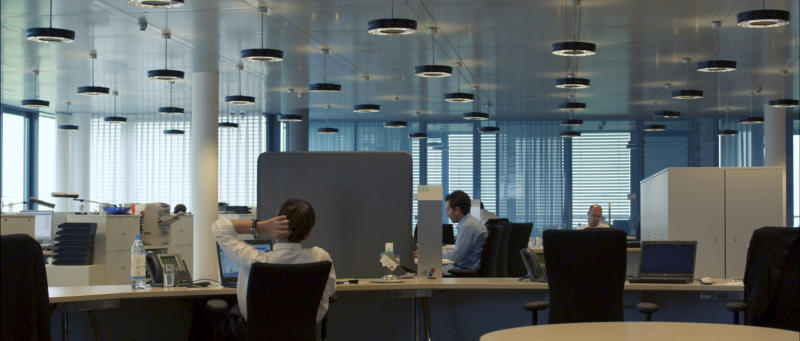
The picture is not from the film “Augenhöhe – At Eye-Level”. I took it from “WORK HARD PLAY HARD” by Carmen Losmann.
Roland DürreSaturday February 14th, 2015
Changing Your Life-Style – But How?
The art of living as propagated by Rupert Lay, Hermann Schmitz and Wilhelm Schmid
Rupert Lay was my most important mentor. Even before I founded the InterFace AG, I first attended one of his seminars in Frankfurt early in the 1980ies. This is now more than 30 years ago. The meeting was the start of a long cooperation, leading to an intense friendship I am very happy with.
Carsten Lange (also a friend I met in the network created through Rupert) of Lange Communication pointed me towards a dissertational thesis. I contacted the author Stephan Thiele and we had a very nice discussion.
Here is the dissertational thesis by Stephan Thiele, also about Rupert Lay, for your download:
[download#112]
Written at and with a certificate from the Hochschule für Bildende Künste Braunschweig in order to earn the title of “Doctor of Philosophy” – Dr. phil. – by Stephan Thiele, born July, 3, 1966 in Zeven.
For me, it is very important to make material about or on Rupert Lay available for as many persons as possible. Especially also for all the friends I first met through Rupert. This is a reason why you will find many videos and presentations by Rupert Lay on my Youtube-Channel (Roland Dürre), some of them from the times of the “Ronneburg Circle”.
It seems to me that this dissertational thesis is an important contribution worth reading for all those persons who are willing to think about their personal concept of life. And you are always permitted to disagree. Even the author himself told me that he would formulate some theses and topics differently if he had to write them today.
Many thanks to Carsten Lange (who pointed me in the right direction) and Stephan Thiele (the author).
RMD
(Translated by EG)
P.S.
Since today the state of affairs for all humans is more critical than ever, it is absolutely imperative: ”You Must Change your Life” (after Rilke)
(by Peter Sloterdijk)
Jörg RothermelMonday February 2nd, 2015
(Deutsch) Ist da was faul – in Australien?
Roland DürreSunday November 23rd, 2014
The End of Collaboration
Today, I am writing a fictional story which in fact could have happened.
 The story is about two important and famous protagonists working in the same field. They both work on the same topic. It is an innovative idea with which you can earn money. Let us call the two persons Mr. Je and Mr. Hy.
Both of them write about their ideas in their blogs and develop new ideas in the sense of “sharing knowledge” and “improving wisdom by sharing it”, both by themselves and together.
Mr. Je finds some ideas in one of Mr. Hy’s posts exciting. Consequently, a dialogue between the two gets under way. The dialogue is happening in Mr. Hy’s blog in the form of comments on this post.
The result is a significant extra insight, including a valuable basis for a business model. In fact, the constructive, critical and supplementary comments by Mr. Je are to a huge extent responsible for the making said model seem realistic.
Mr. Hy utilizes the thus gained insight for his business, thereby successfully promoting his business model. However, he never tells Mr. Je any of this.
Instead, he removes the dialogue between himself and Mr. Je from his blog.
Mr. Je has no problem with the fact that Mr. Hy benefited from the shared dialogue for his business. This is quite ok. After all, it is why “sharing knowledge” and “open collaboration” have been invented. However, he would have found it nice to hear from Mry. Hy and perhaps receive a cooperation offer.
As a matter of facts, he is really annoyed about the removal of the dialogue!
Of course, the story is totally fictional. Any similarities between actual events or living or even dead persons – if they can be found – are totally coincidental
RMD
(Translated by EG)
P.S.
I took the picture from Wikipedia:
en:Henry Van der Weyde (1838-1924; London, England) – http://www.photography-museum.com/jekyll.html / Originally from en.wikipedia;
Roland DürreSunday November 2nd, 2014
Wasn’t the Last Millennium Totally Crazy?
In the last century, before the turn of the millennium, everything was different.
In those days, managers still believed in the predictability of the future. What is more: they were convinced that growth is something that can continue endlessly.
People living at the time had the impression that everything can be done and that, thanks to technology and progress, all problems can be solved. After all, humans as the crown of creation felt they were omnipotent – far above the animals. And they believed everything can be controlled.
The motto was: faster, higher, bigger, further and more comfortable.
Engineers and technocrats were in charge. A life without cars was unthinkable. Individual traffic with heavy vehicles and a combustion motor, also for individual persons, was a self-evident human right for everyone – just like the short vacation in the “DomRep” or in Thailand. A society was considered “developed” if the poor, too, could afford to buy a car!
Weekend trips to London or Madrid, just like short vacations to New York or Abu Dhabi helped the people to overcome their boredom in a mundane fashion. Consumption was the method you chose in order to give yourself importance and buy happiness. Regardless, stinginess was considered cool and money was the new religion. Using this concept, it was quite easy to destroy the world.
Professors at university taught us that good managers will never have to react. Instead, they will always act. Because the good ones will see into the future. Just like, in 1968, the chain-smoking and therefore constantly coughing driving instructor, who, due to his looks, was nicknamed “Old Death” had taught me that a good (German) driver will always foresee what will happen in the next second.
The universities also taught us that a manager always has to be free of emotions and personal feelings. Decision making science recommended that, first and foremost, we always collect enough information. Afterwards, you had to evaluate and analyse them absolutely objectively. Only after this step, you would then have to decide in a very rational and logical way, without all emotion. And while doing so, you have to ignore intuition and heuristics as deceptive factors.
This was also the reason they gave why a “normal woman” had no business in management. Because women – with very few exceptions – are just too much driven by their emotions. Obviously, women in “high” management positions were the exception from the rule. And those who were actually looked like men.
Textbooks also said that an organization is good if and only if the highest manager is able to control the entire system as he desires by “adjusting just a few screws”.
Consequently, the companies oriented themselves at military ideals when forming their organizational structures. Hierarchy was the standard, only very few ultra-modern enterprises were bold enough to try a matrix cooperation and even fewer were courageous enough to try “cooperative leadership”. Terms such as self and network organization were out of the question, just like transparency and agility were feared. Everything was dominated by “simple-mindedness instead of diversity”, rather than the “wisdom of the masses”.
Taylorism, moralizing processes and globalization were held to be the success recipe for the economy and to guarantee prosperity for the entire world. All the big enterprises aimed at world market leadership at all times. At the same time, the exploitation of humans and all kinds of resources grew geometrically.
On the other hand, the mass was considered a primitive mob. Citizens were said to be stupid and taken for fools. Marketing manipulated the masses, lobbyism removed their interests. Those who voted in a democracy were considered election-booth fodder. Their wish for peace was overruled with invented and hugely propagated anxieties.
Those who reigned, along with the governments knew a lot better what is good for everybody. They even drew up laws which ignored existing judicial practice and constitutional rights. This is how the citizens were spied on and made fun of in masses. More often than not, this happened in order to satisfy interests and demands of foreign power or powerful concerns.
In extreme cases, even courts of justice were declared no longer responsible. In their place, obscure arbitral courts were instituted. Citizens who had violated tax legislation were severely punished. At the same time, the exact same countries created “tax oases” for concerns.
And worst of all was: the governments believed they could shape order in the world with wars and create peace with weapons.
Well, I am happy that those times are now over.
RMD
(June, 20th, 2030)


