
Roland DürreSunday June 29th, 2014
Making all the Difference – PM Camp versus Conference
 This weekend, we had another PM Camp. It was the third one this year. The Rhein-Main PM Camp 2014 took place in Bad Homburg. And judging by what I read on twitter (#PMcampRM), it was another great PM Camp. After all, each one is individual, but they are all special.
And while I celebrated “30-years-InterFace” at Unterhaching with many guests, something very special was created in Bad Homburg quasi as a by-product: a team around Falk Schmid, who is also a member of the organizational team for PM Camp RM, managed to develop an experimental video under the supervision of Torsten Koerting in less than 100 minutes. The video is supposed to help explain the PM Camp idea.
Watch and enjoy!
https://www.youtube.com/v/S1XGY_BEkcw?fs=1&vq=hd720
It took only one hour to make the video! Wow! One could easily imagine some video for totally different purposes, for instance in enterprises. Lots of ideas come to mind…
So, come and register for the first Munich PM Camp #pmcampmuc.
And even better: why don’t you organize your own PM Camp in your hometown?
RMD
(Translated by EG)
Roland DürreSunday June 15th, 2014
PM Camp, Munich and InterFace AG
In the internal InterFace AG Social Media System, one highly appreciated colleague of mine asked why there is not more about the PM Camp in Munich available at InterFace AG. And why, so far, so few persons have registered. Here is what I replied.
Thank you for your note about the PM-Camp 2014 in Munich – #pmcamp14muc – between July, 24th and 26th at LMU, which starts on Thursday evening. So far, I had little time for writing a lot about the PM Camp – also due to the rather time-consuming preparations now under way because of our “30ieth anniversary party”. This will, however, change with the end of June.
Participants:
There is no need to be worried about the Munich PM Camp. The organizational team are seven extremely well connected persons (Barbara Bucksch, Helene Neugebauer (who I cooperate with very closely at PM Camp Munich), Jolanta Czagin, Melania Melitopoulos, Martin Aigner, Michael Cramer and Sacha Storz). They will definitely manage to make it a great PM Camp, especially in the IT Capitol Munich. Currently, the marketing is just getting under way. As soon as our “30-Year-Anniversary-Party” is over – if not earlier – I will also get more active supporting the campaign. On our party, I also want to do some promotion work for the Munich PM Camp.
For the PM Camp, however, we actually look for persons who wish to “actively participate”. Which means that the active part begins as early as finding information about the PM Camp. Consequently, we do not wish to persuade anybody to attend. The best approach would be for participants to find us because they have been looking for this kind of modern “anti-conference” in barcamp format for project managers, all kinds of managers, entrepreneurs or persons who wish to shape the future actively and in a positive way.
Sponsors:
Naturally, both among those in the PM Camp core team – the normative level – and the PM Camp strategic level (this is where the regional organisational team representatives meet), there are some who view sponsoring rather critically. The same is true for the organizational teams themselves (the operative level). Sponsor money helps to make the event less expensive and offer more to the attendants (catering, party). However, PM Camp is an independent “grass root movement” and does not wish to make a profit. With this in mind, we are always extremely careful when it comes to sponsors, because PM Camp must not be damaged by the interest of any third party. Also, PM Camp cannot and does not wish to fulfil the requirements of “normal” sponsors (“What is in it for me?”). This means that a sponsor who “shanghai-s” PM Camp is not something we desire. InterFace, for instance, only sponsors if there is a special reason or if the PM Camp cannot take place otherwise.
About the individual PM Camps:
This year, we have only had two PM Camps so far: in Zurich and in Stuttgart. Both in Zurich and Stuttgart, we (the InterFace AG) were present. Thanks to our Stuttgart branch office, we were rather well represented there. The next PM Camp is in Berlin between June, 20th and 22nd. Incidentally, it is the only one scheduled for a Saturday and Sunday. Normally, Fridays and Saturdays are the main days. But the freelancers living in Berlin cannot/do not want to afford the lack of income on a weekday. I particularly look forward to Berlin. After Berlin, there will be the Rhein-Main PM Camp in Bad Homburg, which coincides with our “30-year-party”. At the July Camp in Munich, I definitely plan to attend. Later this year, we also plan another one in Dornbirn and other places. Dornbirn was where everything started in November 2011. Consequently, Dornbirn as a PM Camp for DACH is the very special baby of Stefan (Dr. Stefan Hagen) and yours truly.
Additional note:
After my tenure as managing director of InterFace AG ends on December, 31st, 2014, I plan to get even more active promoting the PM Camp movement.
RMD
(Translated by EG)
Roland DürreFriday March 7th, 2014
IF AGORA and the Knowledge Workers
For several years, I have now nourished the IF AGORA as a market place of knowledge. On this market place, I asked speakers who fascinated me with their presentations to publish their “knowledge opportunity” in order to make it possible for other persons to benefit from this knowledge and experience. Depending on the situation, customers either paid for their service, or it was provided free of charge.
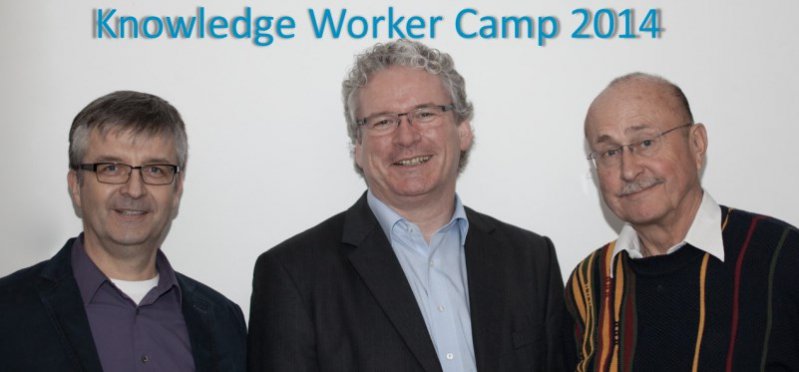 From left to right: Bernd Fiedler, Thorsten Schlaak and yours truly.
I did it all more or less whenever I had nothing more important to do and every few weeks, I added a new “knowledge opportunity”. There simply was not time to do more than that.
Now three of us decided to let IF AGORA also get a real life. First and foremost, we wish to organise a Knowledge Worker Camp, where hopefully many persons offering knowledge will participate, along with many other persons who are prepared to take a little responsibility for the future.
But before starting to plan and organize such an event, we want to find out what actually moves us all today. Consequently, we started a survey – and we are quite excited about the result.
As soon as we have the results, we will plan how to structure the event and when it should take place. And we will invite many, many people. We will assume that those who come will be exactly the people we needed.
RMD
(Translated by EG)
Roland DürreTuesday February 25th, 2014
PM Camp: Now Also in Zürich (April, 25th to 26th)
I am delighted!
In 2011, we (Kornelia Hietmann, Dr. Eberhard Huber, Jens Hoffmann, Dr. Marcus Raitner, Dr. Stefan Hagen and yours truly) initiated the first barcamp for Project Management in Dornbirn.
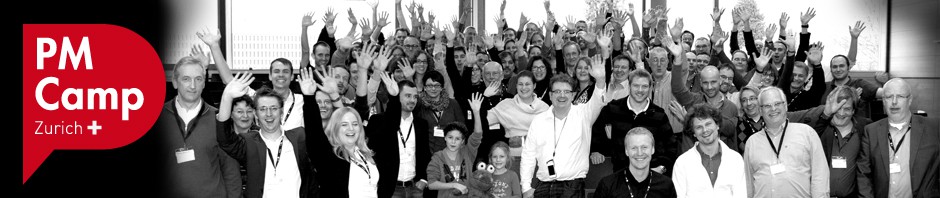
In 2012, we had PM Camps in Dornbirn and in Vienna.
And in 2013, we had PM Camps in
Bad Homburg, Berlin, Dornbirn, Stuttgart and Vienna!
And now matters continue to improve, because in 2014, there will also be such events in Munich and Zürich! The time for Zürich has already been determined: the first 2014 PM Camp of the year will be held there between 26. April 25th and April, 26th, 2014! Tickets are already available – to buy them, just click here: Ticket-Kauf.
For those of you who do not yet know what a PM Camp is, here is some information:
PM Camp is a high-quality barcamp for project managers. Persons who are prepared to share their knowledge and who wish to learn from others will meet there. And, as a general rule, we are talking persons who are prepared to accept entrepreneurial and social responsibility.
PM Camp is neither a club nor an institution. There is a core team which currently consists of the following persons: Eileen Hörtreiter, Dr. Eberhard Huber, Dr. Marcus Raitner, Dr. Stefan Hagen and myself. You could say that we accept the “normative responsibility”. The local events are organized by “organizational teams”. Their representatives meet once a year for the PM Camp closed meeting. During this meeting, strategy, future and operative agenda for the PM Camp are coordinated.
PM Camp closely cooperates with openPM. openPM is an open platform for project managers and all those who work in projects. You could say that PM Camp is the “face2face” partner of openPM. PM Camp creates a free environment to make it possible for project managers to meet face to face and exchange ideas. During a PM Camp, the “normal” barcamp procedures are usually supplemented by impulse presentations.
For lots of interesting information, such as a review of past events, general principles and values of PM Camp, publicly voiced opinions and much more, click here: PM-Camp Dornbirn.
My friend Toni Maric, who is one of the initiators and member of the Zürich organizational team, looks forward to many registrations. I, too, very much intend to go to Zürich.

RMD
(Translated by EG)
Roland DürreSunday November 17th, 2013
Uncertain and Unpredictable
In Google+, I am a member of several communities where problems that really move me are discussed. One of them is called Uncertainties and Unpredictables (Ungewissheit und Unvorhergesehenes). My Swiss friend Peter Addor founded this community – and he is also very diligent about nourishing it.
During the PM Camp of yesterday and the day before yesterday in Zürich, Peter initiated a great session on this topic, presenting a beautiful decision tree on risks. In doing so, he made a very clear distinction between the risks that can be planned, e.g. accepted – incidentally, the “MCA”, the Maximum Credible Accident, is one of them – and those that cannot be planned.
For me, this led to the understanding that a distinction between predictable and unpredictable (!) risks is basically only dependent on the fantasy of the beholder. And in retrospect, it mostly turns out that all risks might have been foreseen in some way or other.
The ultimate consequence of this is my idea that, actually, I should not waste energy planning against risks that might do damage to me. Instead, I should concentrate on being prepared for the imponderable. Wouldn’t it be a lot better for me if I managed to be flexible enough to cope with unpredictable risks just as well as with those that result from uncertainties?
After all, the risks I perceive in my concepts just follow the fear I likewise build up in my concepts. And, basically, they only constitute a small part of the huge number of risks I have to cope with eventually. This means that, in reality, I have to put up with many more risks than I can imagine. So why should I fear those I know, thus making my own life miserable?
Consequently, there is a conviction growing inside me that all this planning and balancing costs more than it gains me. A good piece of work will just need as much as it needs. No more and no less. And I can only do as much as I can afford to do.
Perhaps a free life is nothing other than doing without concepts of planning and balancing?
RMD
(Translated by EG)
Roland DürreSaturday October 26th, 2013
A History of and Manual for PM Camp
(and barcamps in general)
Life-long learning and development are important for everybody. As an addition to “auto-didactical studies” and working alongside a master (in the sense of craftsmanship), barcamps are the best opportunity to enrich your own learning curve through the experience of third parties.
In traditional teaching-learning situations, you probably learn 90 % from the “teacher” and 10 % from members of the group. As the situation progresses, this proportion changes in favour of the other group members. In the best seminars, you can get a ratio of up to 30:70%. On barcamps, 90% and more of the learning happens through the knowledge and experience of other participants! Persons open up and share what they experienced, saw and learned.
This is face-to-face lived “Open Source” on an open event. Communication is experienced at eye-level, based on the empathy of persons you have either known for a long time or just met for the first time. Trust is built up from scratch. You learn a lot, not just in the technological sense, but also in the “personality promotion” department.
In 2011, Kornelia Hietmann, Eberhard Huber, Jens Hofmann, Dr. Marcus Raitner, Dr. Stefan Hagen and yours truly (Roland Dürre) thought that it was about time to introduce a barcamp for project managers, entrepreneurs, leaders and managers. The first PM Camp was at Dornbirn in 2011. This year, we already had four of them – in Vienna, Stuttgart, Bad Homburg (Rhein/Main) and Berlin. And now we will see each other at the third Dornbirn PM Camp.
Why are barcamps such a success?
A barcamp depends on the persons who attend it. The actual realization and the success, the joy and delight, the quality of discussions and results, the degree of added knowledge, agreeing upon a consensus, the experience of meeting and the development of new contacts and relationships: all those and much more is caused by the people who participate, bring their experience and share their knowledge.
This is how all participants take responsibility for the “camp” becoming a success.
The same is true for the PM-Camp. We call our barcamp for Project Management (PM) PM Camp. “Project Management” is meant as a metaphor for leadership, management and entrepreneurship. PM Camp wants to reach persons who are prepared to take responsibility and shape our future together and in social harmony with other persons.
Each PM Camp is organized by a local “Orga-Team”, usually 3 to 5 people doing it on an honorary basis. They plan, communicate and prepare the event, at the same time trying to organize everything in the best possible way together with the PM protagonists and the friends of openPM .
Ideally, there should be between fifty and a hundred participants, otherwise the Camp would probably no longer have its human character. In order to avoid collisions, the date is coordinated with other PM Camps. Thanks to sponsors, the participants pay a rather low attendance fee. Still, we are careful to not violate the independence of PM Camps. As a general rule, the organization team will only invite a very limited number of impulse speakers.
PM Camp is the supplement Face2Face movement accompanying openPM. Besides the virtual platform openPM, PM Camp deals with the organization of “face-to-face” meetings.
As a general rule, a PM Camp will last two days. During the day, the motto is “work hard” and in the evening of the first day, the motto is “party hard”. More often than not, some participants already meet for a comfortable get-together or walk&talk on the preceding evening – simply in order to meet old friends and prepare mentally a little bit for the coming PM Camp.
Then the time comes – and the actual PM Camp starts. The participants meet at the appointed time and place. There might be a little “ice-breaking”, the organization team reminds everybody of the central barcamp rules (“whatever will happen is the right thing to happen”, “what is over is over”, “the law of feet”, “freedom”,…). And then we start! Consumers become producers and a wonderful session plan will be drawn up in no time.
In a nutshell:
PM Camps and barcamps are such a success because they actually function on the basis of self-organization and self-determination, not only with respect to content!
barcamps and PM Camp (3) – “Typology of Sessions”
The sessions are the core of every PM Camp. It might be a good idea for the participants to prepare mentally and think about what topics are important to them in advance. If you do that, you might be able to head your own session as early as during your first PM Camp.
Basically, there are three models for sessions:
Type 1 – Sharing Knowledge!
The initiator of such a session thinks he knows something important and wishes to share it!
Let us assume someone made a very special experience, was introduced to something totally new, understood some basic concept… And he assumes that others, too, might be interested. Consequently, he announces a session and tells people in advance what he would like to speak about. Of course, he will not bore his audience with a lengthy oratory. He might only come up with a few theses or give a short description of what he experienced. And then everybody starts debating and discussing.
Type 2 – Make use of other persons’ experience!
The initiator finds himself in a new situation and needs assistance!
Someone might have a question he has been labouring on for quite some time already. Or perhaps something happened to him and he does not know how to deal with it. He might even have a huge problem and need people to talk to.
And then he will also announce a session and look and see who arrives and wants to help him.
With this type of session, of course, you need particularly “good” listeners. You need listeners who try to listen extra carefully and who can mirror what they understood with the least possible degree of distortion.
The important thing is that the participants are capable of empathy, instead of being persons who immediately “want to know better” and shine with “unwanted advice”.
If you can get this, then the result of this type of session will often be truly great. And, again and again, I am surprised to see what excellent “participants” you usually get with these PM Camp sessions. And how many problems we were already able to solve, at least rudimentarily!
Type 3 – New experiences!
The initiator wants to actively do, play or try something!
In this area, there is countless potential for successful sessions! Every PM Camp will give you a surprise. It might be something about physical activity or something that made people thoughtful. New experience is collected actively and relevant things are playfully acted out. You try new things and test them against the standard of established strategies. More often than not, you get a shared experience of “frontier exploration”. And if during this kind of session you try something new and it does not work out as planned, then this is no problem on a PM Camp.
All you need is the courage to take part and also to jump over your own shadow. And something surprising will immediately happen. There might be a regression which will suddenly trigger a lot of creative and wise things.
More session types…
Of course, these three types are far from all. They are merely three “patterns” for sessions you will often remember in detail and with pleasure!
social web
During a PM Camp, you are not only permitted to, but actually encouraged (forced) to twitter. Basically, playing on your mobile telephone is just as much allowed (and even encouraged) as leaving the room and attending another session.
As a general rule, you will find a “twitter wall” on a PM Camp. Tweets written in twitter and marked with the event tag (for instance #pmcamp13ber for the PM-Camp in Berlin) will run through it in real time. In this way, you will get a thread which might already serve as a first documentation of and comment on the event. You will know what is currently happening on the PM Camp, what other persons experience or feel and how they think.
Naturally, every participant can also look at the twitter wall with his or her own device. When doing so, you will often notice that many persons participate in “real time”, even though they are not actually physically present. All the tweets taken together are a beautiful retro-perspective of the event. You will enjoy looking through them and mentally re-living the Camp later.
There is no “official” documentation of a PM Camp, such as proceedings or the like. This is absolutely intentional! Because the documentation, too, is voluntary. It, too, is organized and determined by the participants. As a matter of facts, the model works well and consequently you get a thorough, and – above all – well-balanced multi-media documentation in no time at all which contains texts, pictures and videos. All the important things are included and everything is centrally available on openPM and beautifully connected.
To be sure, in this article, I only mentioned “twittering”. But, of course, Facebook or google+ are also potential tools for you to use during a Camp. Or you might wish to initiate a community. Basically, you should choose a medium where as many people as possible can participate.
Culture and values
What is true in real life is also true during a barcamp: nobody should be made to feel inadequate or even hurt. Personal attacks are to be avoided at all costs, even if you might be hugely disappointed. And if you really misbehaved, you have to apologize.
The only thing you cannot tolerate on a PM Camp is intolerance. But intolerance is the one thing you should always approach directly and in person, rather than circumspectly.
Where special care is needed
It is not much. To be sure, good manners will not do any harm at a barcamp. In fact, it is usually a matter of course during a PC Camp. The rule you know from the old meta plan: “Everybody is everybody’s butler” is also one you can never go wrong with. Other than that, barcamps, as well as the PM Camp, are free events. Nobody has to do anything they do not feel comfortable with.
As always in life, helpful behaviour is more helpful than buddying. Every participant determines by himself to what degree he wants to integrate himself. There is no obligation to have your own session. Many participants remain rather passive and quiet during their first PM Camp – until the spell breaks and they suddenly make the transition “from consuming to producing”.
If you are a first-timer or someone who likes remaining in the periphery, I would recommend that you try your first own session as early as possible, even if, by your own estimation, the topic is still half-baked. Usually, being courageous early on is rewarded. And I would ask the “oldies” to wait as long as possible when it comes to volunteering for session chairperson, before they finally fill the last empty spaces. Some participants need a little more time before they get courageous enough. And it is always a pity if new contributions will not happen because someone else was needlessly impatient.
Communication is all
As a general rule, the organization team of a PM Camp will recommend to the participants to “thou and thee” each other. Thou-ing and thee-ing each other will bring you closer together and facilitates the communication. It makes sense in a community where everybody has the same goal and everybody is prepared to share their most precious commodity – experience and knowledge – openly and fairly.
If a participant prefers to be addressed formally, this is, of course, accepted. But no matter how you address each other, the central issue to always keep in mind is that you have to respect each other. Even in the middle of a battle, violation of honour must not happen. And if it does, it has to be corrected immediately.
PM Camp demands from and promotes in the visitors a little empathy and “altero-centrism”. It means that you put your own ego to the background and open yourself up for the values, expectations, interests and needs, as well as emotions of “the others”.
So here is what I recommend:
Participate! Be courageous! Bring joy! Accept delight, maximize all these things and hand them on! No need to “wear a mask”! It is not necessary on a PM Camp!
Respect and appreciate others as much as yourself. Give and take knowledge and experience. And then nothing can go wrong at all!
RMD
(Translated by EG)
P.S.
Many thanks to Eileen who helped a lot with this summary.
Roland DürreSaturday October 12th, 2013
PM Camp DACH in Dornbirn, November, 14th to 16th #pmcamp13
SPONSOREN WANTED!
The picture was taken almost two years ago. Stefan Hagen and yours truly as co-founders of PM-Camp are absolutely delighted. During the evening party of the very first PM Camp in 2011, we realize that the event is a great success.
In a little more than four weeks, we will meet again. At the third Dornbirn PM CAMP. And much has happened in the time in between. We now have yearly PM Camps at Bad Homburg (Rhein-Main), Berlin, Stuttgart and Vienna. And we are positive that there will be even more of them in 2014.
The next Dornbirn PM Camp on November 14th to 16th has been well organized. The seminar rooms at Fachhochschule Vorarlberg are ideal for us. Again, the motto is “Work hard, party hard!”. There is no shortage of work. Fabulous participants with important topics already promised to come.
Just for the party, we could do with another sponsor or two. Because some of the sponsors who used to support Dornbirn do now support one of the many regional Barcamps. Consequently, there is an opening for new sponsors who wish to show by their contribution that they share a modern concept for the 21st century which I would formulate as follows:
 Share experience and knowledge openly and transparently, co-operate at eye-level and in respect with courage and joy and thus take care of a future in shared responsibility.
RMD
(Translated by)
Roland DürreThursday October 3rd, 2013
My Next Presentations…
I will soon again give some presentations; for instance at the University of the German Armed Forces in Neubiberg on October, 24th during a colloquium, or at the DOAG Conference in Nuremberg in November. Regardless of the fact that the “frontal exposure to sonic waves” usually happening on conferences are no longer my favourite, I still enjoy giving these presentations. Inter-active events, such as barcamps, are much more to my liking, because those are the occasions where “many” learn “so much more from many others” than during a workshop or conference. Apart from that, it also gives you a lot of joy and delight, on top of providing all parties concerned with knowledge and experience.
In my current presentations, I will, on the one hand, deal with the “Change in Management” which is so necessary in order to make the “enterprises and social systems in Germany more agile”. On the other hand, I wish to discuss the widespread “marketization” of our society.
As I see it, it is based on a short-sighted human concept of “homo oeconomicus”.
For me, it is important to make sure that I am not being a “presenter”, “speaker” or even “key note speaker” (keynote speaker” – see comment) . I give my presentations because I enjoy the matter I am speaking about and I do not see myself as a paid duty performer. Instead, I would like to be considered a human being who welcomes the opportunity to share his life experience, especially when I get the chance to do so with friends and young persons to whom the future belongs.
Consequently, I will not bring a set of slides that have been only marginally modified as time went by, except that the date and place of each presentation has been updated. I avoid using the often-applied tricks in presentations from “kitchen psychology”, or else building in suggestive diagrams/sketches or other special effects. In my presentations, I try not to take advantage of populist sentiments. Instead, I simply present my experience.
All this means that I prepare for the current situation and expected audience with each presentation, before presenting my ideas more or less extemporaneously.
Here is the content of my next presentations:
This time around, I aim at showing how well-off we Middle-Europeans are, at least as far as the economy is concerned. I keep reading about crises – and then I often think that if this is what they call “crisis”, then I wish for a permanent crisis. I could easily imagine that many in this country suffer from a value or purpose crisis and I actually believe that we partly live “decadently”. Because we have become victims of a radical marketization which rules all our areas of our life. And, of course, we ourselves, too, are to blame for it.
We might actually be able to flee from this trap if agile humans (and managers) are prepared to take responsibility, to make prudent decisions and to act wisely. Consequently, my presentation will tell you my definition of an agile manager.
And I also want to show the importance of distinguishing between ethics and morals. As I see it, this is very important, because enterprises, too, have their “morals”. And those will often lead to schematic but poor decisions. I believe we will only be able to decide well instead of poorly if we are aware of the difference between morals and ethics.
So what I want to show with the example of the type “dogmatic manager” – which dominates many of our enterprises – is how using “dominant logics” gained through set opinions our enterprises (social systems with economic goals) and their worlds produce no end of wrong decisions.
RMD
(Translated by EG)
P.S.
Of course, I will be very happy if many of my friends come, for instance, to watch my presentation on Thursday, October, 24th at 18.00 hours in the Neubiberg University of the German Armed Forces. For more information just send me an Email .
Roland DürreSaturday September 28th, 2013
Still Wanted: Sponsor for PM Camp!
Three years ago, we had the first PM Camp in Dornbirn. It was initially intended for DACH (Germany, Austria, Switzerland). Many people liked it so much that this year more PM Camps have taken place in Vienna, Stuttgart, Bad Homburg (Rhein-Main) and Berlin.
However, this great development motivated some of the sponsors to support local Bar Camps close to their own home, rather than the far-off one on the lake Bodensee. Well, this is certainly an understandable development. Yet now its consequence is that we are still looking for some sponsors to support our Dornbirn PM Camp. After all, we want to maintain the high standards of this perhaps best-frequented PM Camp of all.
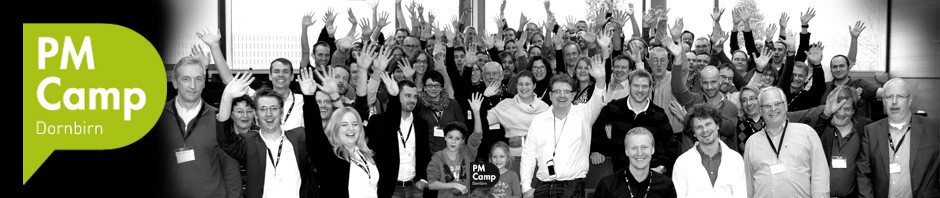 Here is the invitation for potential sponsors by the Dornbirn organization team:
As all other PM Camps, the one in Dornbirn is also a non-profit event. The entry fees are kept low on purpose (99 Euros plus added value tax for two days including all meals). They do not cover the actual costs of the event.
Consequently, we need sponsors who share the PM Camp vision and are prepared to contribute. As a sponsor, you will leave no doubts about your own innovative and future-oriented position. You can introduce your own topics during the open space sessions and gain many new impulses. Last not least, you can meet interesting people, either as potential future customers or employees.
Be part of the PM Camp movement which started three years ago in Dornbirn and now has been extended to also reach to Vienna, Berlin, Stuttgart and Bad Homburg! Show your potential employees and customers that you are prepared to leave the antiquated paths of established conferences and to think in new terms of project management. You can actively support the most important and (in-)famous anti-conference on project management in the German-speaking area!
For details of our sponsoring arrangement, click here. Do not wait too long, because sponsor opportunities, too, are limited.
Incidentally, sponsors do not pay a very high sum. I look forward to your questions!
RMD
(Translated by EG)
Roland DürreSunday September 15th, 2013
Before the #pmcamp is after the #pmcamp … (1)
My Contribution to #pmcamp13ber
I am sitting in the Berlin DB lounge, waiting for my train to Munich. The PM camp and sessions I attended yesterday and today is still on my mind. And since I received so much positive criticism, here is a concise version of today’s presentation by yours truly.
It is a description of what a modern manager who wants to be both successful and ethically responsible might (or should?) look like. From other sessions before my own presentation, I got the impression that it might be a good idea to start with a definition of “moral conduct” and “ethics”. So this is how my presentation started:
Moral Conduct and Ethics
As I understand it, moral conduct is characterized by rules and laws. Some of them have been written down, some of them are valid without the written form. It is generally assumed that moral conduct is a requirement for the common good (bonum commune) in social systems, or at least that it will be very useful in this sense.
If you violate the rules of moral conduct, this will have consequences: you will suffer either punishment – if you broke the law – or social ostracism or something similar. The fact that moral conduct can also cause damage is accepted. And this kind of damage is often done because, basically, laws cannot foresee all “morally problematic” situations in life, no matter how you amend or add to them.
Ideally, the citizens agree to adhere to the rules, since they understand how beneficial this is for the entire society. Unfortunately, however, this is not what usually happens.
Problems with moral conduct:
If you insist on moral conduct as being normative for your behaviour, this will cause lots of problems. More often than not, the accepted damage is too much. The world changes, yet moral conduct is more or less static, which makes it a contradiction to new developments. Different groups of society (age, sex, socialization, religion, …) might well have totally different opinions on some relevant topics.
Ethics, give you a rule. Behaving ethically means you make this rule the maxim for your own decisions and behaviour in a responsible way. In order to do so, you have to be able to decide and act according to an ethical balance of values following the rule. Consequently, “ethical behaviour”, too, will usually be in the interest of the “bonum commune”. It is an important goal of ethical behaviour to minimize damage.
Examples for ethics:
- Happiness-Ethics (Eudämonismus) Its roots are in Greek philosophy. It aims at maximizing lust yet avoiding pain
- The Golden Rule It means “treat others the way you would like to be treated“
- Duty Ethics Duty ethics simply tell you to follow the law (and the orders of your boss).
- Conscience Ethics “follow your conscience”
- The principle of biophile behaviour.
I do not think the Happiness Ethics and the Golden Rule can be practiced. Management is not the only sector where it probably will not be very helpful. Moreover, these two ethics only seem to be applicable to humans. Today, however, there is a broad consensus that ethics far exceeds human affairs.
The duty ethics are something I mistrust as a matter of principle. Too many atrocities and crimes have been committed “just doing your duty”.
“Follow your conscience” is not really conceivable to me, because as a general rule, conscience will always come after the decision and the act.
My next two articles will discuss the image of the “new manager” and the “biophile principle”.
RMD
(Translated by EG)


