
Roland DürreMonday October 5th, 2015
Meeting to Give Our Future Chance.
Isn’t this great?
Only the colleagues at Visual Braindump
– Christian Botta and Daniel Reinold –
can come up with this kind of idea for saying it in a nutshell in graphic form – our ActMobCmp:
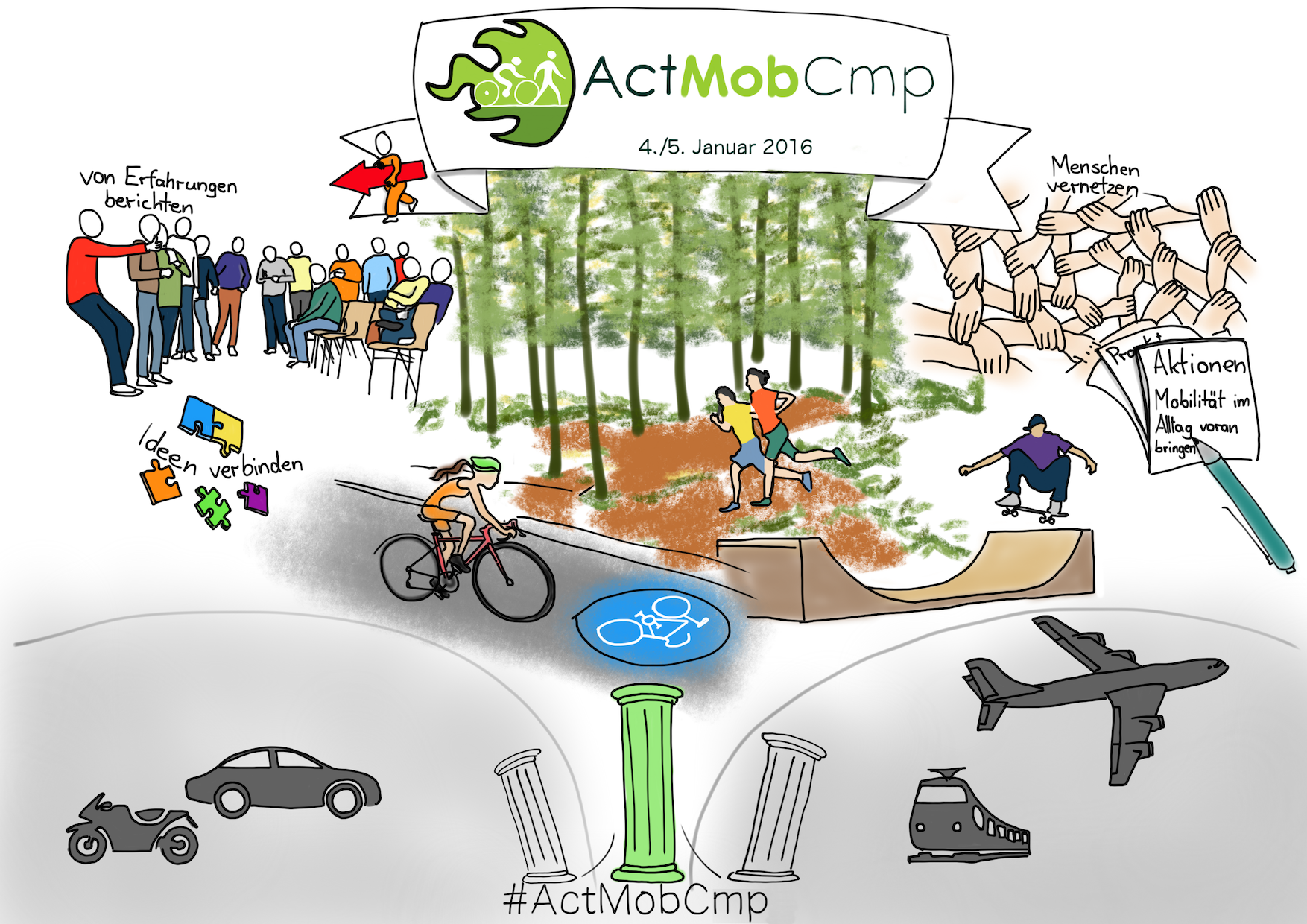
Click to scale up.
“Active Mobility in everyday life” is the third column of mobility, besides individual motorized traffic and public transportation. Unfortunately, it is often considered no more than the leftovers, both in society and politics.
We promise:
AktMobCmp will be a great barcamp that takes place at a rather uncontested time! We will experience two special days in the company of people we like to meet between January, 4th and 5th, 2016 at Unterhaching.That hurts, and we have to change it. Because we have to rationalize our mobility in order to preserve our future resources!
Many thanks to Christian and Daniel for their huge support!
RMD
(In the name of the AktMobCmp team/translated by EG)
P.S.
Here are two IF Blog links for articles on AktMob and AktMobCmp. And since it is such an important topic, I would invite you to share and re-tweet!
Roland DürreSunday September 20th, 2015
Conference versus Anti-Conference
Why I no longer like conferences, yet love barcamps?
OR:
All the things that can happen during a barcamp!
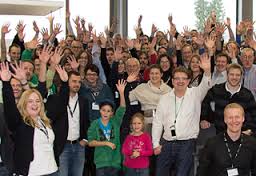
Enjoying ourselves at the Dornbirn PM Campp
I no longer like to attend conferences. Consequently, I only agree to be a speaker on such events in exceptional cases. For instance in the near future at the NurembergDOAG-Konferenz.
🙂 Or else if they pay me really well.
Because how do they choose speakers on conferences? Potential speakers must submit their articles at least six months before the conference, more often even earlier than that. Including a topic, a summary and an abstract. Mostly with a pre-defined number of words and following some stupid kind of word template.
But how am I supposed to know in January what will move me late in the year? How to know the development of affairs during the months until the actual presentation takes place?
After the deadline, the conference committee will meet. They are supposed to select the suitable articles. The jurors in the committee have to consider the event sponsors, countless representatives of interests and industry, diverse amigos, political influence and much more. They will not personally be acquainted with most of the persons who sent articles, which is why they cannot know about the competence of them as speakers. More often than not, they do not even have technological competence.
Young speakers who actually might have something important to contribute have no chance – and this is apparent if you look at the conference program.
Those who were lucky enough to have been selected must submit a manuscript. Again, it has to have a certain length, the word-template is usually even worse than before. The manuscript, too, has to be submitted quite a long time before the actual conference takes place. After all, the proceedings have to be printed.
Well, this is when I think: Why should I present something all the persons in the room have before them in writing? I always talk freely, without power-point or the like. Whenever I speak in a big lecture hall, I ask my graphics expert to design a few slides to emotionally underline what I am going to say. That is it. After all, the exact content of what I am going to say will only be determined on the day of the event – and it will even change during the presentations, because I follow the feedback I receive from my audience.
And then the great day will come. Mostly, a conference will start with a huge introductory affair, including welcoming all and sundry. The ability to remain awake and sitting on your bottom is put to a severe test among the audience. And then, the intense “one-way” noise machines will be turned on.
The speakers will dutifully read their manuscripts as typed in the proceedings. Some will do better, others worse. Interruptions are mostly not encouraged, so there is never a discourse. Someone up front will say something that has been previously prepared and the audience down below are supposed to consume it.
A short time ago, I attended an academic meeting with a dear friend of mine (no less than a rather highly respected professor). It was more or less the same as always. When I told her that the contributions had been surprisingly low-standard, she consoled me with the information that the presentations were actually just of minor importance. The important thing, so she said, is that you meet and exchange ideas with people. And that the evening event, in particular, is the true value of the meeting.
And it is basically true – if we wish to advance ourselves, we have to share our knowledge and communicate amongst each other. But then, why should I listen to presentations all day long if nobody is interested in those? Perhaps it is only so we can tell the tax office something official took place and that we had a legitimate reason to travel and talk over food and wine in the evening…
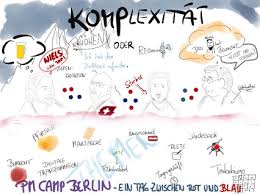
Berlin PMCamp 2015 about: Complexity by VisualBrainDump.
At a barcamp, it is totally different. And as I see it, it is better!
So, what is a barcamp? Of course, you will find an excellent description in Wikipedia. Let me try and approach the definition under a totally different light.
Imagine between fifty and a hundred persons meeting. For instance bloggers, entrepreneurs or experts. Or persons who are prepared to take a special social responsibility, or simply persons who share an interest in something.
Ideally, we are talking persons who enjoy sharing their experience, their competence and also their problems. Persons who communicate at eye-level and who want to participate when it comes to discussing important topics. Persons who want autonomous enlightenment, who dream of honest discourse as professor Habermas used to define it (perhaps persons who are not even aware of him having defined it), all of them thou-ing and thee-ing each other and never interrupting others while they speak. Even if all these factors are true, you still – so is the current state of the art – have to organize this kind of event.
With barcamps, it is very simple. You provide enough lecture halls for the sessions to be held in. A lecture hall has to be big enough for all participants. Inside those lecture halls, you develop the sessions together. Consequently, you have a big board in the middle of the lecture hall. It contains a matrix with the lines marking the time scheduled for the sessions (for instance one line for each hour). The columns mark the lecture halls A, B, C …
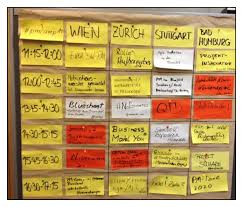
Example for a session planning at a PM Camp.
And whoever has a problem he feels desperate about will march to the board, pin a card with his topic to the board and makes a room and time reservation for his or her session. Then he introduces himself and gives a short description of what and in which form he wishes to propose the session. And as soon as there are enough cards on the board or when the board is full, you start.
If, on top of this, you also have a nice coffee lounge where food and drinks are always available, success is almost a foregone conclusion. Because there is another rule:
Everybody is free during a barcamp.
Like a bee gathering honey, you can attend as many sessions as possible. On the other hand, you can also float through the rooms like a butterfly (bees and butterflies are the classic metaphors for barcamp behaviour) and remain wherever you feel most comfortable.
As soon as a participant realizes that he is in the wrong session, he should leave it. In a barcamp, this is not impolite. On the contrary, it is your duty if you want the system to work. Consequently, the doors to all lecture halls should be open at all times.
The rule also says: whatever happens is exactly what we wanted to happen. If only a few people attend a session then this is just as good as if all participants attend one session. In the end, there will be a balance.
A new development is that the barcamp organizers try to offer a frame where the sessions can be documented. There is a special barcamp variant, the OpenSpace, where documentation is obligatory and supported, collected and summarized by a so-called OpenSpace-Office.
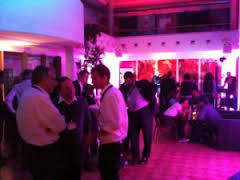
Party time at the Dornbirn PM-Camp.
Barcamp is this easy. As a general rule, it will be two days. The party at the end of the first day is always a very good thing. During the second day, there are often extremely good spontaneous sessions.
A barcamp is considered a success if all the participants – we also call them share-holders – start their return journey home happy and withe a full heart and spirit.
Even though you should never expect results from a barcamp, surprising things often happen. I know movements and enterprises that grew from an idea during a session. Surprisingly many friendships and beautiful networks are generated. There are always lots of incitements. Barcamps have such a huge impact: they help people to start thinking, judge things differently and become more successful both in private and “professional” or “entrepreneurial” life.
I attended camps such as OpenStartUp or WorkLifeBalance. On those, as well as during five years of PM Camps, I experienced what I described above. PM Camps were about project management, leadership and entrepreneurship. By now, I know that there are more important things. For instance the way how we shape our mobility will be profoundly important for our future. That is why I gladly founded the new barcamp for “Active Motility in Everyday Life” #AktMobCmp .
We will start on January, 4th and 5th, 2016 in Unterhaching.
RMD
(Translated by EG)
Roland DürreFriday September 18th, 2015
”Living/Loving Complexity” – Session at #PMCampBER
Here is my report on the session I triggered off with Maik (Maik Pfingsten) on Saturday, the second day – which was practically the end – of the Berlin PM Camp #PPMCampBER.
It had been our intention to relate and discuss a few ideas to show how, even in a complex environment, you can manage to live content and successfully, both in your private and professional (business) life.
In order to show this, we developed a few theses:
Truth
As we see it, there is no absolute truth. To be sure, there are more “correct” and more “incorrect” ideas. But you should not use correct and incorrect as terms. Instead, you should see them metaphorical, meaning “goal-oriented”. Other than that, it seems to us that people often discuss certainties and totally forget that much they believe in is just a construct of their brains.
Complicated versus complex
I used to believe that all that is determined is also complicated. And that complexity starts where “determinedness” ends. Whenever the end was not predictable or describable as an algorithm, I used the term complexity. Others used the metaphors “dead” for the “complicated” and “alive” for “complex”. This means that organic chemistry can only always be complicated, whereas inorganic chemistry might well become complex.
Maik provided us with a very nice description of “complex” – from the viewpoint of a system engineer. He draws an axis of coordinates. The x-axis represents the complicatedness, the y-axis the change and dynamics. And the system will change more and more from complicated to complex as complicatedness and dynamics increase.
I find it quite easy to come to terms with this pragmatic definition. Here, too, the decision whether something is complex or complicated is in the eye of the beholder. Incidentally, this is something Nico Banz gave a very nice session about at the #MCampBER – just before us and in the same lecture hall. Using an example, he showed us that judging whether something is complex or complicated is, indeed, a very subjective process.
By now, I have come to believe that the academic discussion about complex versus complicated is not very useful. What actually counts is right decisions and projects.
Decision
The definition of the term “decision” is based on two requirements: it has to happen under uncertainty and it must have relevant consequences. Otherwise, it is not really a decision.
In the context of decisions, it is also exciting that neural science keeps proving that decisions only seem to be made by ratio (cerebral cortex). The truth is that they are made by our subconscious, which means involuntarily.
Incidentally, they found out at St. Gallen college that the huge majority of management decisions are wrong decisions.
Mind you, the distinction between “right and wrong” decisions is not at all easy. In fact, it gets even harder: if you analyse an enterprise or a project in retrospective, it often becomes “story telling”. Even if there is no doubt that the stories might be useful, precise scientific research (studying the protocols, etc.) will show that it is not at all easy to judge “à posterio“ what decision caused which event.
I always wanted to be a “good” manager and entrepreneur. And I wanted to make the right decisions. And today, I ask myself how any manager can decide correctly “à priori“ if, even in retrospect, he cannot say with certainty how the causality was.
Projects
As I see it, it is not a good idea for us to distinguish between our professional and private lives. Living a life is more joy if you live it integrated. That means I have to act in the same way in my private life as I would act in my professional life. There is no difference.
I like asking third parties the question: what do you think is my most important project? They are often surprised by my reply – but for me, it is absolutely clear: my life.
There is no doubt that my life is a project. It has a beginning and an end. I have a multi-dimensional budget – which consists of time, talent, knowledge, experience and much more. The goal of my life project is my path of life. Part of it is my death. I would like to have made my peace with everybody I ever met when I die.
My life consists of many projects. Some are mostly private, others mostly business. Consequently, I need to act in the right way.
Acting Right
So this is the central question: how to learn to act right?
After all, I know that there is no absolute truth. Also, I know that the future cannot be predicted. I also know that I live inside the constructs of my subconscious and that the competence to act according to reason and ratio is a mere chimera!
As I see it, the only thing that will help us is finding behaviour-oriented values and live according to them.
Recommendations:
I no longer believe in best practice, methods and complex tools. I do not like tips (tipping me on the shoulder is beating me on the shoulder). These days, all I believe in is simplicity and reducing life to the essentials. And I believe in craftsmanship. Practice. On my way towards mastering things, I need support by a master. In my life, mentors and wise persons helped me a lot both interactively and as an ideal.
Consequently, I gave a short description of what Hans Ulrich and John Izzo recommend during our Berlin session.
Hans Ulrich
Hans Ulrich died several years ago. He was the father of the St. Gallen Management Model and wrote a wonderful and short essay about change in management in 1982. I read this article on December, 8th, 2011, sitting in the train and preparing for a workshop in St. Gallen. And I was totally electrified by it. I regretted not having read it earlier.
Here is the concise form of the “8 theses on the change in management” by Hans Ulrich, along with short comments:
- Accept the uncertainty and unpredictability of the future as the normal state of affairs!
Well, the future simply cannot be predicted.… - Set a broader horizon for your limits of thinking!
Against the “but”… and for freedom of ideas. Share knowledge. - Apply the categories “both”, instead of “either-or”!
Black-and-white is out, colourful is in. - Think multi-dimensional!
Ethically responsible balance of values. Basically, humans can only deal with three ideas simultaneously. - Use self-organization and self-control as formative models for all your enterprises!
Responsibility, principle of subsidiarity. - Consider managing things a meaningful and important function!
New management image. - Focus on what is really important!
Work economy. - Make use of group dynamic!
Cultures, symbols, rites, rituals …
Of course, the theses developed by Hans Ulrich were intended primarily for modern management. Yet they are also very useful for your private life.
For more information on leadership and Hans Ulrich, see the IF Blog underWandel im Management and under another Session Report, as well as, of course, my “Enterpreneur’s Diary“.
John Izzo
The second wise counsellor I mentioned is John Izzo. He did some research on values shared by elderly persons conceived as successful, happy and prudent. And he discovered a common characteristic among those people, which he summarized as the “five secrets”
First Secret Remain true to yourself! This is about “destina”, a term originally from South America. Mind you, it does not mean destiny or even kismet, but your own call and vocation in life.
Second Secret
Live in such a way that you will have nothing to regret later!
Also try new things! Have courage to start something that, at first sight, seems rather unusual. This might actually help you when you have to make a decision.
Third Secret
Love yourself and enjoy it!
First and foremost, you must learn to love yourself! Because only those who love themselves can also love others. Ban enmity from your life. Choose humanity as your life’s principle. Make persons you are surrounded by bigger, instead of smaller.
Fourth Secret
Carpe Diem!
Enjoy, instead of thinking too much. Remove “yes, but” from your active vocabulary. Replace them by “yes, and”. Do not capitulate before “that is not what you want to do!“
Fifth Secret
Give more than you take!
Those who give get a lot more in return. Give trust. Open yourself up and show others something of yourself.
I discussed the book by John Izzo at great length in a separate article. I think it is well worth reading and you should certainly think about those recommendations for life. And perhaps you would like to adapt them for your own life.
If these recommendations do not reach far enough for you, then why don’t you read the Agile Manifesto? Or maybe you want to become theALO-man (see also my article leadership-values-principles) who is only agile, lean and open? And when you come to “lean”, you want to remember the importance of the “Why?“-question in Kanban.
If you do this, you will find the path through the world even easier, regardless of it being complicated or complex. And it will not matter if you are talking your private or your business life, either.
RMD
(Translated by EG)
Roland DürreWednesday July 22nd, 2015
What does Ada Lovelace have in common with Galileo Galilei and what is their connection to Unschooling?
Tomorrow’s (July, 23rd, 2015, at 6 p.m.)IF-Forum (guests are still welcome, here is the invitation) in our Unterhaching office building will be about “Learning in Innovation”. Taking the metaphor of “Unschooling”, Bruno Gantenbein will show how children can and want to learn. He will also show parallels between this concept and the experiences made by famous project managers and grown-up leaders.
At InterFace, the year 2015 is dedicated to Ada Lovelace. Consequently, Florian Specht asked me to give an introduction and answer the question:
What is the connection between Ada Lovelace and “unschooling“?
🙂 Here is an introduction I will not present tomorrow. Still, I can publish it here, can’t I? The proper introduction is for you all to hear live tomorrow.
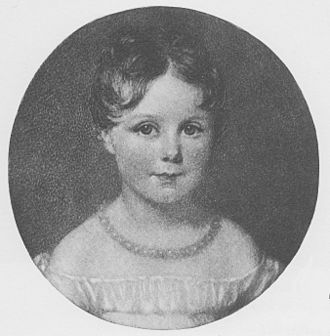
Ada at the age of four
What is the connection between Ada Lovelace and other persons, such as for instance Galileo Galilei (the InterFace face of 2014), Blaise Pascal, Leonardo da Vinci or “the Ancient Greeks”, such as Archimedes or Socrates – as well as other outstanding personalities in science and “unschooling”?
When preparing for this presentation, the first thing I did was read the Wikipedia article on compulsory school education. We learn that
- There was a time when it was not compulsory.
- It was introduced rather late and put to practice even a lot later.
- There were places where only part of the population was affected, and often only the male part
- But the learning process was always associated with life and persons, rather than schools.
Then I took a closer look at the life of Ada Lovelace. In Wikipedia, the first sentence you find on “Ada Lovelace“ (article) is:
“Augusta Ada Byron King, Countess of Lovelace, commonly known as Ada Lovelace (nee Augusta Ada Byron;[1] * 10th of December 1815 in London; † 27th of November 1852 also in London), was a British Mathematician.”
The article is well worth reading. There is no doubt that she was a genius.
However, all the other persons I named never really seem to have attended any school:
Blaise Pascal (* 19th of June 1623 in Clermont-Ferrand; † 19th of August 1662 in Paris) was a French Mathematician, Physicist and Literary person, as well as a christian Philosopher.
Galileo Galilei (* 15th of February 1564 in Pisa; † 29th of December 1641jul./8th of January 1642greg. in Arcetri near Florence) was an Italian philosopher, mathematician and astronomer whose discoveries in several fields of natural science were breakthroughs.
Well, this is hardly a surprise, because when the last two lived, such a thing as schools in the modern sense did not exist.
When I was a child, I used to adore the “ancient Greeks”. Imagine what enormous and revolutionary discoveries they made with the most primitive means and a little calculation. Some of them were due only to observation, thinking and simple experiments. And, surprise, surprise: in those days, they did not have a formal school system as we have it today.
Consequently, the suspicion inside me grows that quite a few innovations would not have been possible during the history of mankind if humans in those days had been indoctrinated from early on as it is common in a normal school today.
But the light inside me was really turned on when I saw the film “Alphabet”.ALPHABET, the film was produced by Erwin Wagenhofer in 2013. After WE FEED THE WORLD and LETS MAKE MONEY, ALPHABET was the last and final part of his famous trilogy. ALPHABET is a film that describes in a very soft way what situation the children world-wide are in during their education.
I particularly liked one citation in the film. It seems to be the result of scientific research:
98 % of all babies are born as a genius. After their education, the ratio is 2 %.
The only question that remains is how Mrs. Lovelace could preserve her genius. After all, 200 years ago we already had the first stages of compulsory school education. Maybe it was because in those days there were some regions where only boys went to school? Boys who always had to be brave and never were allowed to cry?
RMD
(Translated by EG)
P.S.
Now I need to do a little more work on my introduction (version 2.0). Incidentally, I took the picture from Wikipedia.
Roland DürreMonday April 27th, 2015
Project & Product – #PMCampSTR
 The Stuttgart PM-Camp (Hashtag #PMCampSTR) will take place from May, 7th through May, 9th, 2015 at the Stuttgart “Hochschule der Medien” – and I already look forward to being part of it. I bought both the admission and train ticket and made my reservation for the room at the Commundo.
The team in charge of organising the event chose “Project and Product” as their title. This is how the Stuttgart Organizational Team wants to open its PM-Camp for interested persons outside the classical field of project management, for example for IKT (information and communication technologies), as well. Using the term “product”, for instance, they aim at engineers who build high-end products.
What is a project?
Let me cite Wikipedia:
A project is a goal-oriented, one-time proposition consisting of a number of coordinated and controlled activities. It has both a clearly defined beginning and an end and will be realized taking into consideration all necessary restrictions with respect to time, resources (such as money/cost, production and work conditions, employees) and quality in order to attain a goal .[1]
This definition, which in my opinion is a rather simplified view, of “project” means:
- Every project has a beginning (project start).
- Every project has an end (deadline for completion).
- The desired results have been defined as project goals.
- All resources to be used are pre-defined.
- The project goal must be attained on time.
- The planned resources must not be exceeded.
- There is a plan: the project plan.
- The milestones defined in the planning are to be adhered to.
As I see it, projects only deserve the name if they cause a considerable change or if they create something really innovative or new. And that tells you at first glance that something is obviously wrong with the above definition.
Regardless of excellent planning, we witness massive deviations from the goal with the resources often being enormously exceeded, even with simple engineering projects. The reason is probably that even tasks that sound simple have a surprising complexity.
Innovative Change!
The situation gets worse if we are talking projects that are supposed to creatively influence all kinds of social systems and the evolution that happens anyway. If you look at the way a project is described, you will realize that the motto “close your eyes and do is hands-on” is something you are basically forced to apply. In the process, you will not be able to integrate new and better findings into the developing project path at all times.
Even in retrospect, it will be hard to judge the causal connections between measures and their effect (usefulness?). So how is anybody supposed to do so in advance? Basically, innovative change is not something you can just plan linearly. Instead, you have to find a soft and agile way to reconcile change and permanent developments.
Consequently, projects are a contradiction to innovation. Innovation is creative destruction. Which is something that will additionally make the enemies of change interested, especially if they are parties concerned with the intended change. That will make it even harder.
Projects as a part of change?
Hence, I find a definition of project more appealing if it considers a project as one of many integrated parts of a continuing process of change and improvement. Controlled change is supposed to generate useful results. Basically, I consider all well-thought-through activities designed to change or influence developments projects. To me, it does not matter if the project is actually “tangible” or if it renders abstract “virtual” results.
What is a product?
The planning, development, and production of a product, as well as its marketing, sales, support and service are the result of many small and bigger projects. They are all multi-dimensionally linked and thus connected to form a multi-dimensional “mega project”. You will want to remember phrases such as network, dynamics, learning, trial and error, innovation… But then, this is not only true for the tangible product, but also for services.
Box product or service?
So a product might be a tangible object – meaning something you can “touch” – which has been developed by an organisation with engineering competence and in huge quantities. It is also “sold” to either many customers or produced individually and “on demand” in small numbers. As a general rule, such products need to be complemented by a support service if they are supposed to be a market success and generate a “sustainable business”.
However, a product may also be a service rendered at the customer’s place or for the customer by persons who acquired special qualifications and “best practice” with their organisation. Those qualifications are usually the result of decades of personal and collective learning.
Creating a “tangible” product might actually necessitate more projects than creating a “virtual” product.
The difference it makes for an entrepreneur.
Sometimes there is a huge difference for the entrepreneur between designing a “true” product enterprise and an enterprise the product of which is offering a special service.
For instance, whenever selling a “true” product, the entrepreneur should keep in mind that feedback from the customers and from the market usually takes a lot longer than if he offers a service. More often than not, you will invest long-term into a “true” product that still has to prove its value on the market. In that sense, such a product is easier to scale in case of success than a service. But then, it also involves a higher risk.
If you sell a service, you will have your feedback rather quickly, which also means that you can learn from mistakes and perhaps change your strategy.
Well, that is about all I can think of when it comes to product and project. Except that projects, basically, are the small modules of our lives. All conscious decisions for behaviour that makes a relevant difference – for yourself or for the market – are in some way projects.
RMD
(Translated by EG)
Roland DürreSaturday November 29th, 2014
Now Also Part of IF AGORA: Gebhard Borck
Follow-Up on the Dornbirn PM Camp – #PMCampDOR
For me, Gebhard was the positive sensation on the last PM-Camp and openPM.
His impulse presentation was the best I ever heard on organization and entrepreneurship. He used only the blackboard and some chalk to outline in very simple steps where and how the future enterprises should find their orientation. And to top it all, he even presented it all in an extremely humorous and exciting way.
Above all, he also made it clear how well an enterprise can function if only it takes good and proper care of the basically banal needs of people working in the enterprise.
Yes – and now Gebhard is also part of me and my IF AGORA! Isn’t that just great?
Here is what knowledge he offers (Wissensangebot)! I recommend his current textbook on the subject – which you can also read online: Affenmärchen (Monkey Tales)
The impulse speaker of our second #PMCampDOR day, Dr. Melanie Kaiser, fascinated us just as much. Melanie not only related how poor managers actually get ill due to their wrong decisions. No, she also managed to make it quite clear to us how important intuition and ratio are also for credible communication.
Here is what she offers: Burnout.
And I am sure she will gladly give her PM Camp presentation for you, too!
RMD
(Translated by EG)
Roland DürreWednesday November 12th, 2014
Soon to Take Place: Dornbirn PM Camp!
This year, the InterFace AG is again sponsoring the Dornbirn PM-Camp. It takes place between November, 20th and 22nd.
Being a sponsor, I was permitted to answer three questions on the #PMcampDOR website. I was also asked to say why InterFace AG does the sponsoring. Here is what I wrote:
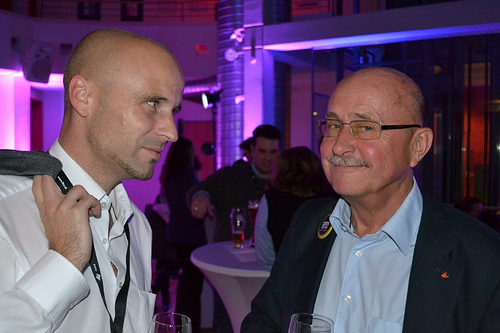
Yours truly at the PM-Camp with Dr. Marcus Raitner (left).
InterFace AG – why we support the PM Camp!
PM Camp is less boring than your common conference and gives you many insights. It is a free event, not controlled by ulterior interests. The “participants/partners” generate their own conference. Knowledge and experiences are shared at eye-level. PM Camp is a network for humans!
The more often a PM Camp takes place, the more intense it usually gets. We want PM Camp to be something everybody can afford. The costs must not be a barrier, because we want PM Camp to be accessible to all – young and old, female and male, poor and rich. That is why InterFace AG also supports some of the PM Camps financially. We want to help people to develop courage and joy and we want to give them a nice setting for a beautiful party. It makes us happy to see participants going back home from the Camp with a lot of newly gained knowledge, experience and adventures. If that happens, our investment was worth it.
Three questions and my answers on PM:
What is wrong with project management today?
- Project management is often considered deterministic “engineers work”, instead of value-based leadership.
- Project management is seen as a “taylorist” affair for experts.
- The use of tools is overrated.
- Hierarchical thinking patterns hardly allow an “organization as a network”.
What are the future challenges?
- Both in projects and enterprises, resilience will beat efficiency.
- People must learn to deal with uncertainty, because the future cannot be planned.
- We must think in terms of results, not in terms of goals.
- A project team must be seen as a biological being, not as a determined machine.
From your point of view, how can the PM possibly contribute?
- Bring the right kinds of people together.
- Provide a living supplement to the world of learning abstract knowledge by heart.
- Establish lasting networks between human beings.
- Train project managers for “Industry 4.0”.
About Me:

On the PM Camp with Dr. Stefan Hagen (right).
After “years of apprenticeship” at (6 years) and Sofllab (3 years), he founded the InterFace AG in 1984. He remained head of the company for more than 30 years. With the end of this year, he will stop being managing director of the IT enterprise. He will then be a member of the board of governors. Starting in 2015, he will work on important social topics.
RMD
(Translated by EG)
P.S.
The pictures have been taken at the 2012 Dornbirn PM Camp. In the first picture, you can see me with Dr. Marcus Raitner, on the second with Dr. Stefan Hagen. They are both very important PM Camp protagonists. In fact, PM Camp would not exist without them.
Roland DürreFriday September 5th, 2014
Another Barcamp – EnjoyWorkCamp!
I like Barcamps. In particular, of course, I like the PM Camp. After all, I was part of those who first initiated it. However, there are others, too – for example the OpenUpCamp. At one time, I also attended one of those. Now I found a very special Barcamp – and I will also attend it. It is the EnjoyWorkCamp.
Franziska Köppe is the founder of the EnjoyWorkCamp. This year, it will be held between November, 14th and 15th in Stuttgart. Here is what Franziska writes about it:
Where you find joy, enthusiasm and conviction, you will almost automatically get success. We all long to do something meaningful. As entrepreneurs, we strive at being economically successful, socially responsible and honourable. We want to preserve both our environment and nature. In our daily work, there are always small and big changes which sometimes have immense consequences for us and our surroundings. It is all not quite as easy as it looks. After all, there are many questions:
- How high is our own value and how can we build value-oriented offers on it?
- What will self-responsibility of our employees gain us and how to manage good team work?
- Isn’t every company and every employment a rat race?
- How to design an environment where people enjoy working?
- What tools, architecture, infra-structure, mobility, processes, culture… would be suitable?
- How can I promote common well-being in my personal surroundings?
- How to create space for myself (time and money) in order to be able to actively shape the future?
How often did we attend a conference in order to get answers to just those questions, and then the answers were found during the coffee break discussions?
So far Franziska. I will go there because I assume that the EnjoyWorkCamp – just like the PM Camp – will offer a chance to exchange of experience at eye-level. I look forward to discussing solutions around social, economic and ecologic aspects of future-oriented business models with entrepreneurs and leaders of small, medium-sized and also big enterprises.
For me, it is important that the program will be shaped by the participants themselves – which means that I can also take care of my own needs. And, in particular, I look forward to again meeting some very good friends who have already registered. Together, we want to start getting active and support each other.
Here is more information: Unkonferenz and News und Presse.
The vision of EnjoyWorkCamp is:
Common welfare, the quality of life and how to enjoy your work!
Well, this is another reason for me to attend.
RMD
(Translated by EG)
Roland DürreFriday August 15th, 2014
Start-up (1) – Failure
As during many summers before, I am currently camping at Porto Ageranos. The campground is situated on the Peloponnesus, on the middle finger, about 10 kilometres south of Gythio, shortly before the mild climate of Mani. From our tent, you have only 10 metres to go before you reach the ocean. The first night was truly great. And since we know the region quite well, we have been feeling really at home from the outset!
I take advantage of the time I spand at this place for relaxing, contemplation and, not least, for making plans. And, of course, I also do a lot of swimming and bike-riding, I eat well and simply spend quality time with my beloved family and friends. And, naturally, I also write some articles (for the IF Blog).
This time around, my main topic is start ups.
I know many people. With some of them, I am good friends. Among them are also quite a few young colleagues. It seems to me that I am actually doing quite well when it comes to getting along with the young generation.
A few years ago, I started getting interested in the foundation of new enterprises. For instance, I am constantly asked to sit in the jury for a business plan contest. As a mentor, I counsel persons and enterprises, sometimes intensely, sometimes sporadically. Consequently, I know a little about what is going on.
Most of the teams I know and acompany are truly great teams. They are industrious and creative and they try to lead their lives independently and to build up an enterprise, investing the utmost personal enthusiasm on many levels based on an exciting idea.
And then they fail.
Some of them fail at the very outset, others as soon as promotion programs, such as EXIST are over, or else after the first financing. More often than not, the period of suffering will continue for some time. Once in a while, they find an “emergency exit”. And only very few of them will be a success – and those mostly in a totally different way than they had originally planned.
Most of those who fail leave behind a huge amount of strength and also money. The only consolation for them is that they learned a lot, in other words: they “failed successfully”. Yet this is not much of a consolation, is it? After all, if they had taken up an alternative life line, for instance through a good job with a medium-sized company, they could probably have learned a lot more for their personal future.
As I see it, this is a gigantic waste of capital, creativity and industriousness (“waste” in the sense of Kaizen). Also, the frustration and disappointment many of the young persons concerned suffer is painful. And I often think that this frequent failure might have been avoidable in many cases.
Because the mass-failures are easily explained. Mostly, the founders work just like the expertise of a past epoch tells them to. And this pattern never really worked very well. Today, it generally does not pan out at all. How are the success patterns of yesterday supposed to work in the world of tomorrow, anyway?
And the very few exceptions – incidentally, they are all due to the accumulation of particularly lucky circumstances – only prove this rule.
Why is failure normal?
The answer is simple: for instance, big concerns, too, constantly try to throw new products onto the market. These concerns have everything you need for a new product idea: capital in masses, a well-known brand, excellent marketing, strong marketing organizations, world-wide access to the markets, great engineers and providers, and much more. And above all: they know their market, because more often than not they have been “learning” and “working towards it” for decades.
And still their new product inventions often fail. If they are lucky, as few as 10 % of such new inventions will become more or less a success on the market. Make your criteria for the definition of “success” a little stricter, and you get an even lower number.
Except how is a young team that has none of these things supposed to compete? Just with their young light-heartedness and creativity? This is nonsense!
One conclusion might be that young founders will only have a real chance on totally new markets. That would mean young founders should shirk (almost) all business ideas around existing technologies and solutions. The current development seems to justify this argument. Well, perhaps I can give a first tentative piece of advice to start-ups:
Be careful if you wish to enter into markets where others already have their standing.
To be sure, great concerns with their organization and processes are their own stumbling block when it comes to creative topics. Their success has the negative side that they will always think in old patterns. They know this and consequently look for innovation outside their own walls. The foundation of “acceleration“ departments and their looking for cooperation with start-ups is their way out of it. After all, this is also the latest idea of “UnternehmerTUM” of Munich Technical University. The same is true for the new first mayor of our state capital Munich, Mr. Reiter.
The magic word “cooperation between concerns and start-ups”, however, will not work, either. Firstly, the old enterprises intensely live the rejection from outside as in: “not invented here“. I witnessed this quite frequently and also made the experience myself in strategic cooperation with big firms – more than once. And I could also name quite a few examples where the results of XXX acceleration or XXX invest failed.
But the “old methods”, too, are only successful in few exceptional cases. Let me exemplify this with almost all “tax-saving models”. For many years now, we have witnessed this not only in sectors such as “film”, “realty”, “shipping”, or “alternative energy”. The huge losses suffered by investors in projects around railway and canal building are also good examples.
Mostly, their failure was not because they fell victim to fraud or untrustworthy businessmen. To be sure, those also happened. But mostly the reason was that the underlying business models and plans were just wrong. Regardless of the fact that they had been made by experts in a “professional” way. Experts who really knew their markets. And regardless of having been controlled critically by other experts, for instance in banking. Mind you, those banking experts were really serious, because, after all, they had a share. Here, too, I could write about very personal experiences: in one case, the Sparkasse München, which I hold in high esteem, lost a few million Euros – in my own case, we are, luckily, only talking something in the middle five-digit range.
But if even projects written by experts and validated by many other experts do not work, how can you then expect a young team of founders without any experience and knowledge of the market to steer their enterprise successfully into a non-predictable future?
Seen under this light, founding a new company is basically a hopeless or at least very courageous adventure. An adventure no sane person should by any rights let himself be drawn into.
However, I think that it is possible to improve the chance of success for a start-up from what feels like 1 : 100 to something that perhaps even comes close to 1 : 1 (success versus failure ratio)..
I know that this is a rather courageous announcement of mine. Consequently, I plan to use my two weeks on a campground at the southernmost end of the Peloponnesus on Mani for writing a few articles about “start-ups” here in my IF Blog. This is both for the start-ups I myself counsel and all others.
RMD (Translated by EG)
P.S.
I will start with my own experiences as a young entrepreneur in the next instalment. As I see it, you can already learn quite a bit from it.
Roland DürreSaturday August 2nd, 2014
“For Freedom” or “My Post-InterFace Life“
“Minutes and notes on and how I felt and results of my session “project freedom” at the Berlin PM Camp on June, 24th, 2014″
In former times, I was in search of the meaning of life. I tried to find meaning in as many things as possible. When I founded an enterprise, this, too, of course, was to be meaningful. That was more than thirty years ago. At the time, I was totally convinced that all social systems – including the economically-oriented ones – should have meaning.
And today – with every speaker demanding that enterprises must have meaning – I think that this demand is correct and yet wrong. Today, I believe the important thing is not whether life or an enterprise makes sense. Instead, what matters is how a human being or an enterprise affects its or his environment.
When I was a child, I, like many of my friends, was surrounded by a traumatized generation. In the early 1950ies, this generation knew exactly what you do and what you do not do. They felt like they owned the truth – which was often defined through totally irrational categorizations. They had a strange understanding of freedom and peace. And we were victims of their advice.
At school, we were “educated” by traumatized persons. Seemingly purged, they now sublimely tried to pass their dogmata and hatred on to the new generation, which was: us. Mind you, it was not just the teachers. The parents and family were no different. Even strangers who passed us on the street abused us. Because we wore jeans or because our hair was too long – regardless of the parents having threatened us with the worst possible punishments.
But in other respects, too, this generation never appreciated us. They knew exactly what the world should look like and we simply did not fit. Consequently, they made us look small. Being beaten was normal. Both at home and at school. Having to stand in the corner or having to spend a few hours in the coal cellar or locked into the bathroom were the humane forms of punishment.
We suffered and never understood the reasoning behind this kind of education. Instead, we saw it as a revenge model. We had to pay for our non-conformity and undesirable behaviour. And then we opposed and reciprocated with hatred.
We felt particularly ill-treated when we were punished for activities we had felt truly courageous, noble or great about. How it hurt us when we had been doing good things and they made us pay for it! – When we were called traitors.
Even when we had enjoyed doing something too much, we were scolded. Because it definitely would not do to have too much fun and therefore the rulers of our childhood objected to it.
Do not play with the street urchins …
When I was an adolescent, I liberated myself and the question about the meaning of life was never far from my mind. I was totally devastated by the fear of death. What meaning can a life have if it ends with death? To me, eternal life did not seem to be the right answer, either.
And on top of the meaning of life, there was another hope – peace. Big, never-ending peace. Both between humans and with creation.
After all, I and my friends never understood the nonsense about war. John Lennon was one of our heroes. I never experienced war first-hand. But I experienced how US GI’s sobbed in Augsburg, because they were ordered to fly to Vietnam early on the next morning. They certainly knew what to expect and they also knew that many of them would never return.
I can imagine how cruel war always is and will be and how perverse it is when “industrialized”. For me, the concept of an idealized war where clean modern technology is used, the reduction to using weapons as some kind of high-tech game where fighters control the death-spelling drone standing behind the game board is horrifying. Not to mention all those necessities that make all these things mandatory: weapons, soldiers, mines, fighting robots, …
I know no war that changed anything for the better. Also, I doubt that there can ever be a justified war. Perhaps even the Nazi problem could have been solved in a better way. Without WW1, there would probably never have been a WW2.
However, I do not only wish to oppose the big war. The war inside and on a small scale, too, is bad for us. Is it really necessary that humans always integrate so much animosity into their daily communication? Why is it so hard to come to peaceful terms with oneself?
Why do we always tend to make other people look smaller, rather than bigger? Wouldn’t it be an obligation both for our “leaders” and everyone else to make others look bigger? Because this is the only way the social system might work in favour of humans, rather than against them. So why do we fight ourselves and prevent the flourishing of our own life in many possible dimensions?
Isn’t it a great project goal to reach your inner and outer peace? A goal everyone – not just leaders and managers – should work towards? Don’t we all “manage” something or other most of the time in our lives? And no matter what it is we manage, it will always have something to do with people.
Consequently, I wish to dedicate the years remaining in my life to working towards peace.
During the Berlin PM Camp was the first time I tried to contribute by a session on “project peace”. Ulf Brandes had inspired me with his introductory presentation. I wanted to fascinate as many persons as possible for a “project peace”. Regardless of the topic being a little beyond our usual range, quite a few people came to attend my session. What we discovered was both encouraging and discouraging:
- Working for peace is definitely worth the effort.
- There is a lot of scepticism whether the project goal can be reached.
- Peace will definitely not come through religion and dogmata.
- A project goal “peace” commanded “from the top” will not help.
- Peace will not be installed by politicians, functionaries and other system agents.
- Traditional forms of protest for peace, such as Easter Marches, etc. will not have any effect.
- The project peace needs persons whose personality has reached a certain degree of maturity.
- In order to get peace, we need a new social consensus.
- Said consensus can only be obtained through a network supporting the process of forming opinions.
- Only a grass-root movement can make the “project goal peace” a success.
Now we can start.
Many thanks to all those who attended my Berlin PM Camp session on “project goal peace” and helped me a lot. Today, all I want is to really live – both in peace and for peace.
I see myself doing this against the generation I witnessed as a child that is still present in such huge numbers.
RMD
(Translated by EG)
P.S.
Let me note that, almost exactly a hundred years ago, something ultimately unbelievable happened for many people – systemic mechanisms culminated in WW1.
This war was the first media war (see documentations for instance at ARTE) to be started so cunningly. For instance, historical research was convinced for a long time that a majority of the people living in the two empires actually went to war jubilantly.
New historical research reversed this concept. Today, it is generally accepted that the entry of war in 1914 was mostly against the wishes of the people living in Germany and Austria and that, in truth, it was something the then elites and powerful wanted and instigated.
Nobody can seriously doubt the uselessness of WW2. The world was burning and there was an industrial waging of war in many places aiming at the total destruction of the enemy without any consideration for all kinds of loss.
On the scale of atrocities committed during the war that, unfortunately, is open at the top, the trench warfare on the German-French border, as well as the “mountain fights” in the Alps are perhaps the outstanding examples of cruelty and irrationality.
War is no constructive means to solve problems!


