
Roland DürreMonday November 26th, 2012
Now On Youtube: Video Recording of Our Latest IF Forum.
On Tuesday, November, 13th, starting at 6 p.m., we welcomed Wilfried Bommert of the WDR at our Unterhaching InterFace Building. He was the third and last speaker in our series “Living (and Surviving) in a Sustainable Way”:
Making Good on Arable Soil!
How we can avoid the crisis of deeding the world.
Here it is – the recording of Herrn Bommert’s presentation!
Enjoy!
RMD
(Translated by EG)
Roland DürreSunday November 25th, 2012
Parties, Pirates and Party Programs – Help!
It was always held against the Pirate Party that they have no program. So what are they doing? They are coming up with one.
In my opinion, they are making a mistake!
If a truly different party comes up with a program, then the program should be: “we have no program!”
Such a party should be capable of deciding upon values (as shared by all members) based on ethical responsibility and agreed upon as a consensus. And then they could “make these values their own”. One would assume that is enough work.
Why do we need values instead of programs?
Give people a program and they will assume they are right and possess the truth. That is a dangerous assumption, because there is no absolute truth. And if someone or a group of people claim they possess the truth, your inner red light of warning should immediately start blaring full throttle.
So – do not give us programs!
I would very much prefer a commitment in favour of values – and in addition to this a statement or, even better, a promise, for example:
All our decisions will be based on a responsible, ethical balancing of interests. We will, to the best of our ability and using our common sense, always strive for neutral technological competence and feel bound to act according to those aforesaid values!
Now that would be a nice commitment, wouldn’t it? If I were a party member, I would propose a “five-point manifesto”. It might, perhaps, be something like:
- We will – on purpose – dispense with a program.
- We trust in the values found by enlightenment, its knowledge, reason and honesty (transparency).
- We respect the German Constitution (or even better: The Bavarian Constitution) and the UN Charta .
- We will follow common sense and use the “Golden Rule “.
- Our decisions will always be based on a responsible balance of interests, our behavior will always follow our values.
That would be it!
But I do not think it makes any sense at all to establish a new party. Still, I certainly could list a few values to guide a new party:
- demanding the freedom to live by the rule of: “living self-responsibly and being able to do so“,
- managing to have a violence-free society with fear-free areas, with a minimum of punishment/vengeance and without wars,
- at long last make men and women “equal“,
- make all relevant levels, and in particular the public area, as transparent as possible
- and
- promote a social climate with a relative right to property and freedom of trade.
Incidentally, many of these issues have been wonderfully formulated and written down in the Bavarian Constitution . Unfortunately, it has become a little utopian . Neither is it valid any longer, because the German Constitution has precedence. Still, it is and will always be a truly beautiful piece of text.
But back to parties. If now the Pirate Party also come up with a program, then I truly no longer know whom to give my vote to. So the only remaining option for me is to join the majority of non-voters.
Because I definitely do not wish to give my vote somewhere between mechanical function and measure catalogues and dogmatic statements of belief. Both are cunningly served in a camouflage packet. I call them camouflage programs, because – as we now again see with the Pirate Party – the really hard-core topics have to be excluded, anyway. Otherwise, a compromise is not possible. A social consensus cannot be made out, just like there is not the slightest hint of a social outline.
This is not about demanding that “everybody must unconditionally be provided with the means to survive“ or “that all nuclear power plants be closed down in three years”. Neither is it about parental money or educational money. Or “A Free Ride For Free Citizens“, depending on what you believe in either for car drivers or those who go by train.
Not to mention meaningless declarations that you intend to solve conflicts without using violence. And whenever it gets difficult, you want the masses to decide. Without before having generated the necessary transparency.
No, this is about having a reasonable concept in management and still make more good decisions than bad ones. And in that respect, programs will not be any help. This seems pretty clear, because change comes at such enormous speed. How can I decide today what I will do in two years’ time if by then the facts will be totally altered? I am fed up with seeing people speculating about an unpredictable future, also in politics.
Consequently, what I want when I vote is a decision in favor of values. And I would like to trust that my representatives and the politicians want to and can and will act according to their values.
Mind you, I, too, am not in the possession of absolute truth. Still: I believe these ideas are worth being discussed. On the other hand, let me say:
Dear Pirates!
Maybe that is why you get these poor results in the current polls? Because you are now turning into a “normal party“. And we certainly have enough of those already. I do not think we need yet another one. Consequently, the word might soon be: easy come, easy go.
RMD
(Translated by EG)
Roland DürreSaturday November 24th, 2012
brand eins in December
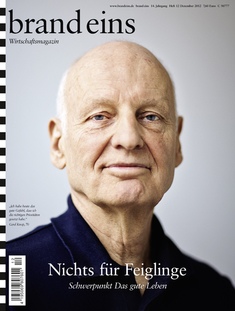 On Friday, it was already sitting in my letter box. And at first sight, it actually looked like a folder with spiral binging. We at InterFace have a few brochures of this kind. One of them is called flatland.
It tells you what sort of entrepreneurial culture we would wish to practice. Well, it is a little utopian. But I believe in it. It is very exciting. The new bran
eins reminded me of “flatland“. But I will write about “flatland“ some other time.
As always, the first thing I do is let the outside appearance of the new brand eins sink in. A friendly gentleman looks at me from the cover page. He is probably older than I.
That is something I enjoy, because it means that, after all, I might still have a chance of some day landing on the cover page of a magazine. The gentleman emanates piece and dignity. Well, that is good news, isn’t it?
Then I see the heading: Not For Cowards Olla! What might be the meaning of this?
I still do not know if I am a coward. Or am I (what)? What is the opposite of a coward?
A courageous person? A fear-free person? At the moment, I am too lazy to look it up. I will do so tonight. Incidentally, being lazy is an important virtue. It brings a lot of happiness. All you have to do is dare to be lazy. In a way, being lazy is not for cowards.
I read on and get to the focal thesis The Good Life. Again, something comes to mind. Do I have a good life? My spontaneous answer is – doubtless, I do! But then I also read the small print on page one: “Today, I have the nice feeling of having decided in favour of the right priorities” Gerd Knop, 70. Well, once in a while, it pays to read the small print. It is the solution to the riddle. The gentleman looking at me in this content way is Herr Knop and he is 70 years old.
So I plunge into the magazine – as always, the first thing I read is the editorial by Frau Fischer. It says “Not a Matter of Luck” and I think to myself: “it is probably not a matter of luck whether or not you set the right priorities“? Well, this is nowhere near as easy as it looks. I do not know. But it is certainly exciting.
To me, it seems like the magazine is quite bulky. It has 170 pages. Well, that is a lot, isn’t it? Again, the first thing I have to do is hold it up and give it a shake so that a lot of adverts can fall out. I am sure you remember me writing about this the last time around. So I get the wastepaper basket and dump all the adverts in it. I feel like Mother Hulda. You can expect it to snow soon on our planet. And the result is – the magazine is now a lot less bulky.
So am I now the kind or the unkind girl? Basically, I know: I must be the kind girl. After all, I did a lot of shaking out material. And I also have the nice feeling of having my priorities just right. And I enjoy life as long as I can still learn and experience new things.
It only takes a few pages for me to see that, again, there is a lot of precious stuff I can learn from this magazine. With other high-gloss magazines, this never happens. Not even with “Playboy”. Neither with business weeklies or manager magazines or periodical journals with the same words on their cover pages (just like there are many parties with words such as “Christian” or “Social” in their name). No matter how I turn them upside down, nothing useful for me will ever fall out.
So here it is in a nutshell: again, they wrote a beautiful magazine with a great title. I will let a few other people read it and then take it with me on my travels. And here is what I say: if you read brand eins, you will not become the unkind girl.
So here are the kind girl’s best wishes for your weekend.
RMD
(Translated by EG)
Roland DürreThursday November 22nd, 2012
Tweets on Twittering and Blogging #142
Here are my tweets of last week on:
Blogging and Twittering, Wisdoms and Rules:
121129 Drunk is for jump – also true for twittering and blogging? #Twitter #Blogging #Wisdom
121130 Sinning drunk means paying the price when sober – a warning for twitterers and bloggers. #Twitter #Blogging #Wisdom
121201 Wise when drunk, a fool when sober – also something that happens when twittering and blogging! #Twitter #Blogging #Wisdom
121202 Happy when drunk, sad when sober – something that also often happens when blogging and twittering! #Twitter #Blogging #Wisdom
121203 Drunken mouth is truthful mouth – is that also true for twittering and blogging? #Twitter #Blogging #Wisdom
121204 Work slowly with a smile and you will win everything you desire – also true for twittering and blogging? #Twitter #Blogging #Wisdom
121205 If I don’t do it, someone else will – is that also true for twittering and blogging? #Twitter #Blogging #Wisdom
There is a new tweet each day. See twitter.com and “follow” RolandDuerre!
Enjoy!
RMD
Translated by EG)
P.S.
I took the proverbs from Alle deutsche Sprichwörter.
Roland DürreTuesday November 20th, 2012
Data Security and Industrial Espionage …
When discussing data protection and security, you often hear the term “industrial espionage”. Federal agencies or our oh-so-important business associations keep warning us:
Over the last few years, industrial espionage increased dramatically!
And, of course, the focus of said espionage is on German enterprises and their know-how.
The same sentences can also be read in a survey done by “CORPORATE TRUST – Business Risk & Crisis Management GmbH”.
You can access it through the following link . It is rather worth reading, especially with respect to how you can make people fearful?
You will find the warning that “cyber war has become reality a long time ago” and that it “has arrived in the middle of our society”. Neither can the “computer worm Stuxnet“ be ignored. After all, it was “probably developed especially in order to sabotage the control mechanism Simatic S7 – which controlled the frequency converter of the motors in Iranian nuclear programs.”
(Note the word “probably”).
To be sure, the exact goals of the customers were unknown, but the complexity of the attack shows that we went from an era of script kiddies and crackers towards a new dimension of danger – etc.
 Mind you, these are all original sentences taken from the study. The very choice of words in its martial character already makes me sceptical.
Regardless of this, I take the subject of data theft a lot more seriously than, for example, the fear of personal data being abused. I also believe that “stolen” data will help you to reach your goal faster than having to develop “something new”.
I have a vivid memory of a project we did a little less than 30 years ago. We were asked to develop something totally new. Except that we did not have the slightest idea how the “new” could be done. In those days, studying the sources the competition used was quite helpful. And to this day, I do not know if we made use of said sources legally or, maybe, in a certain shady area.
Still, I do not think industrial espionage is quite as menacing as it is projected – and not only in the internet. One of the reasons I give for this is that these fear-inspiring studies originate with firms which want to sell special counter-espionage services and products. And, of course, federal agencies and business associations are quite ready to chase the pig through the village. After all, there is nothing else they are busy with. What a nice idea to employ James Bond! Isn’t it a beautiful shiver you feel whenever you hear how evil the world is and how you yourself are absolutely powerless?
But let us remember what it used to be like!
 When I worked for Siemens, we were absolutely prohibited to take any secret documents with us when we left the building complex. And almost everything was secret. Consequently, there was a random generator at the portal. Occasionally, it lit up. When it did so, you had to open your briefcase and show what was inside. It went without saying that taking pictures on the factory premises was not allowed.
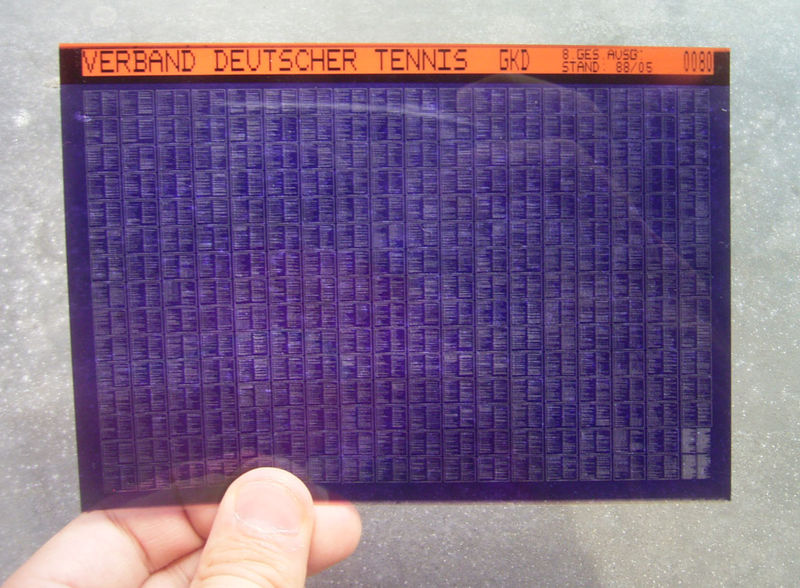
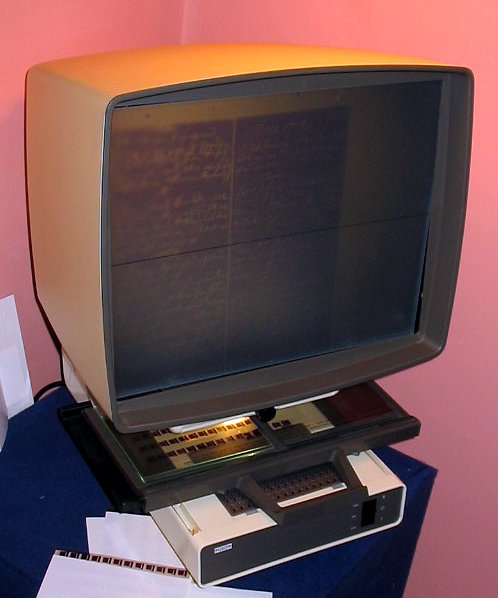
Those were also the times when we used those blue “Micro-Fiche-Films”, along with the reading devices that went with them. Micro-Fiche, or rather microform is the first technology I know which you could use for storing many data on little material. For us, it was usually sources of complete operating systems that were stored on a small square of film so we could carry it around with us in our briefcases.
Of course, it was not realistic that the secret papers were never leaving the factory premises. For one thing, our firm was quite distributed. Some data were needed when you went to see a customer. And once in a while, you also wanted to do some work at home. Consequently, we had permission papers. If you had this paper, you were permitted to take any secret paper you needed. The higher echelons – I do not remember up from which AB or GB level you qualified – were also permitted to take secret documents without the permission paper. I also do not remember if AB truly was short for “departmentally authorized“ and GB for “generally authorized“.
But then what a strange (and totally stupid) kind of firewall was that? It was certainly no more secure than the modern firewalls offered by IT?
Incidentally, the first two colleagues from the former GDR we employed directly after the re-unification confirmed this opinion. They came directly from Robotron Dresden. And they told us that, naturally, at Robotron, they always had the latest plans of the Siemens chip developers on their desks the moment they were made. Except they were not able to put them to any use. The necessary raw material (purest Silicium) could not be obtained in the GDR. Neither did they have the necessary tools to even produce the prototypes.
To be sure, I do not know if our ex-GDR engineers were just after spinning us a good yarn, but I can easily imagine that this is actually how it happened. Basically, I believe data will always end up where they should not be. But mostly it makes not the slightest difference, even if, perhaps, you get quite annoyed, and justly so.
But I also believe the methods changed. And the new methods are a lot more efficient, even though they have nothing at all to do with IT. Let us take a look a China, where, allegedly, the enterprises want to spy on Western firms. Do they really need to do that? Or are there, perhaps, far easier methods?
Here is what you can read in “invest in Bavaria” at “China in Bayern”
Currently, more than 130 Chinese enterprises, for instance Huawei Technologies, Pearl River Piano, ZTE, Yingli Solar, ET Solar and a little under 11,000 Chinese citizens reside in Bavaria. About a third of them live around Munich. Approximately 3,000 Chinese students at Bavarian universities further attest to how attractive the Bavarian universities are.
I also know that there are Chinese branches in the “regions with weak infra-structure“ in Bavaria that have such lovely scenery. Those Chinese branches specialize on R&D (research and development). Actually, these enterprises are quite heavily subsidized by the Bavarian authorities – and accordingly, their moving here is celebrated quite bombastically. Because, as a general rule, F&E is a clean sector. It does not damage the environment and attracts intelligent engineers.
And what is the first thing a Chinese F&E enterprise will do? No question! They lure away the German engineers formerly employed by their German competition. And the best ones at that! Those with exactly the kind of know-how most urgently needed in China. And the German engineers are happy to come. They are quite attracted to live cheaply in a nice place, do some F&E in a modern laboratory and mostly even be paid better than before. This is how the Chinese can choose from the best persons with the right knowledge. Now isn’t that a lot more efficient than having to crack networks and servers?
Neither can I find any fault with it. After all, we live in a globalized world and I rather like the Chinese with their friendliness and tasty cuisine… And I seem to remember “knowledge is the only raw material that grows as you share it“!
After all these ideas, I read the aforementioned “study” with totally different eyes. “Installing fear“, is, after all, a very successful marketing strategy…
RMD
(Translated by EG)
P.S.
I took the pictures from the central media archive Wikimedia Commons. They were taken by Nichtich and Tomasz Sienicki [user: tsca, mail: tomasz.sienicki at gmail.com]
Roland DürreSunday November 18th, 2012
How I Prepare for the Presentation “The Change in Management”.
In November, I will be talking to various groups about the “Change in Management“. The following text grew as I prepared the material for my presentations. It is a description of the environment and is supposed to help the audience as an introduction – or maybe as an accompanying “reader“.
Over the last few years, modifications, in modern German called “change” gained in speed in geometric dimensions. The internet changes the world in a way never experienced since the “industrialization”. Post-modern times are at an end, we are quickly entering the “information times” (if that is what they are going to call it a hundred years from now).
A large part of said change is about business. The way we work undergoes change. Young enterprises – offering totally new business models, entrepreneurial cultures and unheard-of products and services – rise and dominate the world in the shortest possible time. Just think of Apple, Dell, Facebook, Google, HP, Microsoft, Oracle, SAP and many, many more. And all that remains for Siemens & Co is to look on with growing envy.
Neither is this the end. Highly qualified persons no longer wish to work under a binding employee contract. Some of them merge and work on an honorary basis, sharing their special expertise and knowledge for common goals. For instance, experts from a totally new field, the software industry, first started getting together and building small associations in the USA with ”free“ and ”open“ products in the GNU time. And this is how huge movements grew. Today, the world is unimaginable without them.
Initially, it was typically “simple“ software tools, such as the (GNU) compilers of the 1980ies. But soon enough, the show really started to get under way. The famous “lamp” software was generated: Linux, Apache, MySql and Php. Yet this is only the tip of the iceberg. Today, we have a huge “Open Source” movement consisting of many small and big communities. And this is where the most wonderful things are developed on an unbelievable scale. And all of a sudden, products that were generated in someone’s leisure time and on an honorary basis actually displace the commercial ones. Now these products are the accepted standard all around the world.
Naturally, less complicated technological parts, too, can be linked as huge software systems, such as automobiles. They can be developed openly in an “engineering” way and assembled locally. And it will only be a question of time before the first open e-mobile will cruise the streets in huge quantities.
This development is supplemented by non-IT open source movements. The most famous one is probably Wikipedia. But Wikipedia, too, is just the tip of the iceberg. You can hear the battle-cry everywhere:
“Knowledge is the only commodity that grows as you share it!”
Simultaneously, many NGOs (Non Government Organizations) are started. Among many peoples, they already enjoy a better reputation than the local government. New catchwords are: community, belonging, collaboration. The prefix “co” in particular, as found in co-operation, has become a favoured part of words. Terms such as co-creation, co-working, co-programming start having lives of their own.
New strategies such as “crowd sourcing” develop, trying to make use of the ”intelligence of the masses“. In doing so, they create a true mega trend. The internet dominates the world. Pads, smartphones and laptops are “in”. The market for apps is exploding.
A short time ago, I read that more Germans can imagine life without a car than without Facebook. Even the “Golden Calf ” (Goldene Kalb) of the last century, the car, seems to be on its last leg.
The same happens in business. Enterprises with a totally different philosophy suddenly push the traditional ones to the side. In private life, functions, career, ties, status and titles get less and less important. To make up for it, the need to live your own life as you yourself want it grows. Using the words of Old Frederik: the people want to “be happy in their own façon”, kissing late capitalism and marketing economy good-bye. As I see it, this is a very nice understanding of freedom.
But how could this have happened?
Very simple – we are living an evolution. And said evolution will not leave persons and their forms of living and group-forming out of the equation. Some people have many antennae and therefore witness quite much of the social development. Using their special training and knowledge, they think about and write down the developments of “yesterday, today and tomorrow”. As a general rule, we are talking philosophers and people trained in similar sciences doing their jobs as “observers of evolution“.
Philosophers also formulate contemporary thinking and describe the predominating values of the last thousand years. And those have changed considerably as the centuries went by.
In Medieval Times they said:
“Whatever God wants is good!”
Basically this is a rather simple rule, except you have to know what “is God’s wish”. Then came Utilarism with Thomas Hobbes (Leviathan) stating
“Whatever is good for humans is good!”
Well, basically, this does not sound bad, does it? Especially if you are a human. But then, Kant did not like it. He felt it was not as easy as this. What you need is something like moral standards. So he came up with a very categorical formulation:
The Categorical Imperative (Kategorischen Imperativ):
“All finite and rationally gifted creatures, and therefore all humans, should judge their actions according to the question if said actions can at all times and without any exception follow a prevailing maxim, thereby respecting the rights of all parties concerned, also if only as an end in itself!”
With his evolutionary theory, Darwin provoked the precise Victorian data and Nietzsche was in a hurry about enlightenment (Aufklärung). And we already knew that humans are just ordinary creatures that developed from ape-like ancestors and that they should ideally strive to abolish all uncertainties, answer questions and correct errors through knowledge acquisition.
During the postmodern era, enlightenment became a radical concept and now it can probably no longer be neglected. But the process continued.
After the war, for instance, came Habermas. He said something about the dominance-free (ethical) discourse (Diskurs) as a basis for communication and knowledge acquisition and came up with the following fantastical rules:
- No outward constraint must ever hinder a discussion.
- The best argument will prevail.
- Every participant gets the same chance to take part in the discussion.
- Every participant must be capable of “self-presentation without affront“ and make himself transparent for the others.
- Every participant must verbalize the basic decisions of his or her life and be prepared to accept criticism. (There is a highly sophisticated system of thesis and anti-thesis, the duty to give reasons for all statements, etc).
- Nobody enjoys privileges because of his or her age, experience, authority, etc.
- Every participant must be willing to exchange behavioral expectations with all others. Every participant must be prepared to switch roles with all others.
- The discussion will continue until a consensus is reached. As soon as the new truth has been accepted, it will dominate the life and behavior of all participants.
As I see it, the most important issue for our current development is the term “dominance-free discourse“. It probably originated with Habermas. To be sure, the primary literature is a little clumsy, but still nice reading. If you want to read more, I recommend this small speech (Rede). It contains a few nice suggestions.
And then, there was also an Adorno. Here is a citation:
“If the opponent will not give in, he is disqualified and accused of not possessing exactly those characteristics that were stated as the basic requirements for the discussion. These requirements will be twisted in such a clever way that the other party cannot help but be persuaded; thus, the discussion turns into a farce. Behind this tactics, there is an authoritarian principle: the dissenting person must accept the general opinion of the group. Untouchables project their own untouchability to the one who does not want to let himself be terrorized. Using all these methods, actionism becomes part of the trend it believes and professes to oppose: bourgeois instrumentalism that fetishes the means, because its practical ways cannot bear the reflection on the ends.“ (pp. 180-181).
The citation was taken from the essay: „Marginalien zu Theorie und Praxis“ (1969) and was published by Suhrkamp in the small book: “Kritische Modell 2″ by Adorno. Other than that, you will find plenty of material if you read “Strukturwandel der Öffentlichkeit” by Habermas, written in 1962.
In my opinion, Adorno and Habermas described quite well what happens today. And today, web 2.0 also helps a lot. And interactive bloggers and twitter, as well as social media like facebook and persons linked in the net are just a logical consequence. But this is only the beginning.
In economics, Hans Ulrich, “devisor of the St. Gallen Management Model“, described the coming change particularly well. I find his eight theses on “new ways of thinking in management” particularly worth reading (you will find them in: Hans Ulrich “Management – Aufsätze 2. Teil von 1981 – 1998″) :
- Accept uncertainty and the unpredictability of the future as a normal state of affairs!
- Extend the borders of your mental horizon!
- Use the categories “both”, instead of “either-or”!
- Think multi-dimensional!
- Use self-organization and self-control as future models for enterprises!
- Consider managing as a meaningful function!
- Focus on what is really important!
- Make use of group dynamics!
Today, it is all about producing more knowledge in order to shape a common future. Consequently, in order to find the right questions, we need and have new communication formats. That is our first creative responsibility, because only after we actually know our problems, we can start looking for solutions.
There was a time when requirements like the “dominance-free discourse” were considered utopian and unsatisfiable. Today, they have become reality and are lived in the internet, as well as in the non-inter-world. New formats, such as jam session, barcamp, open space, fish bowl, Pecha Kucha, Ignite and many more spread all over the place at high speed. They replace many meetings, conferences and in the end even institutions, thereby leading towards a hybrid culture that combines real and virtual life.
These were a few ideas as a pre-view for my presentation (Vortrag) to be held, among other places, at Munich University of the Armed Forces this Thursdays.
RMD
(Translated by EG)
Roland DürreSaturday November 17th, 2012
Looking Back – Wilfried Bommert at the IF Forum
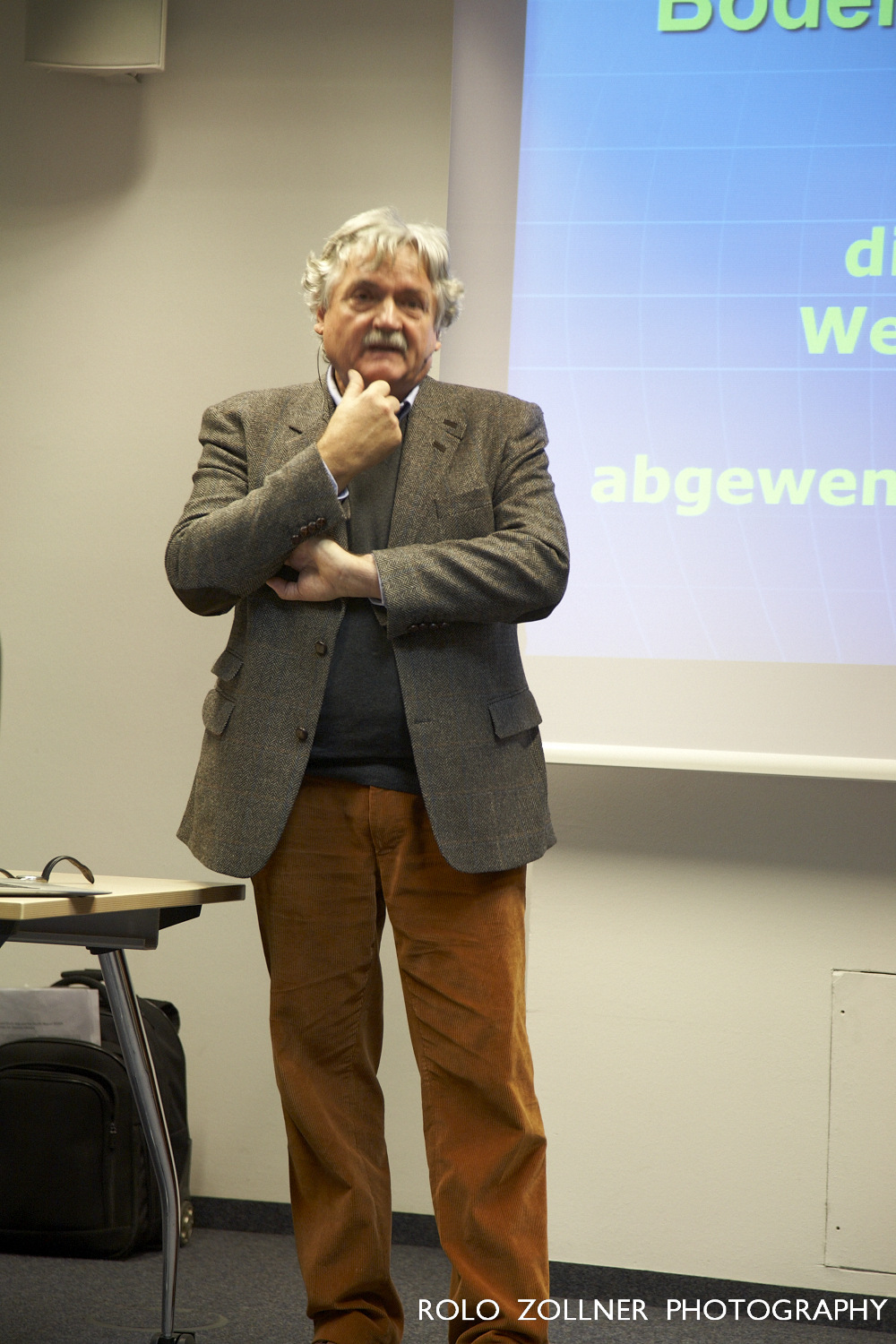
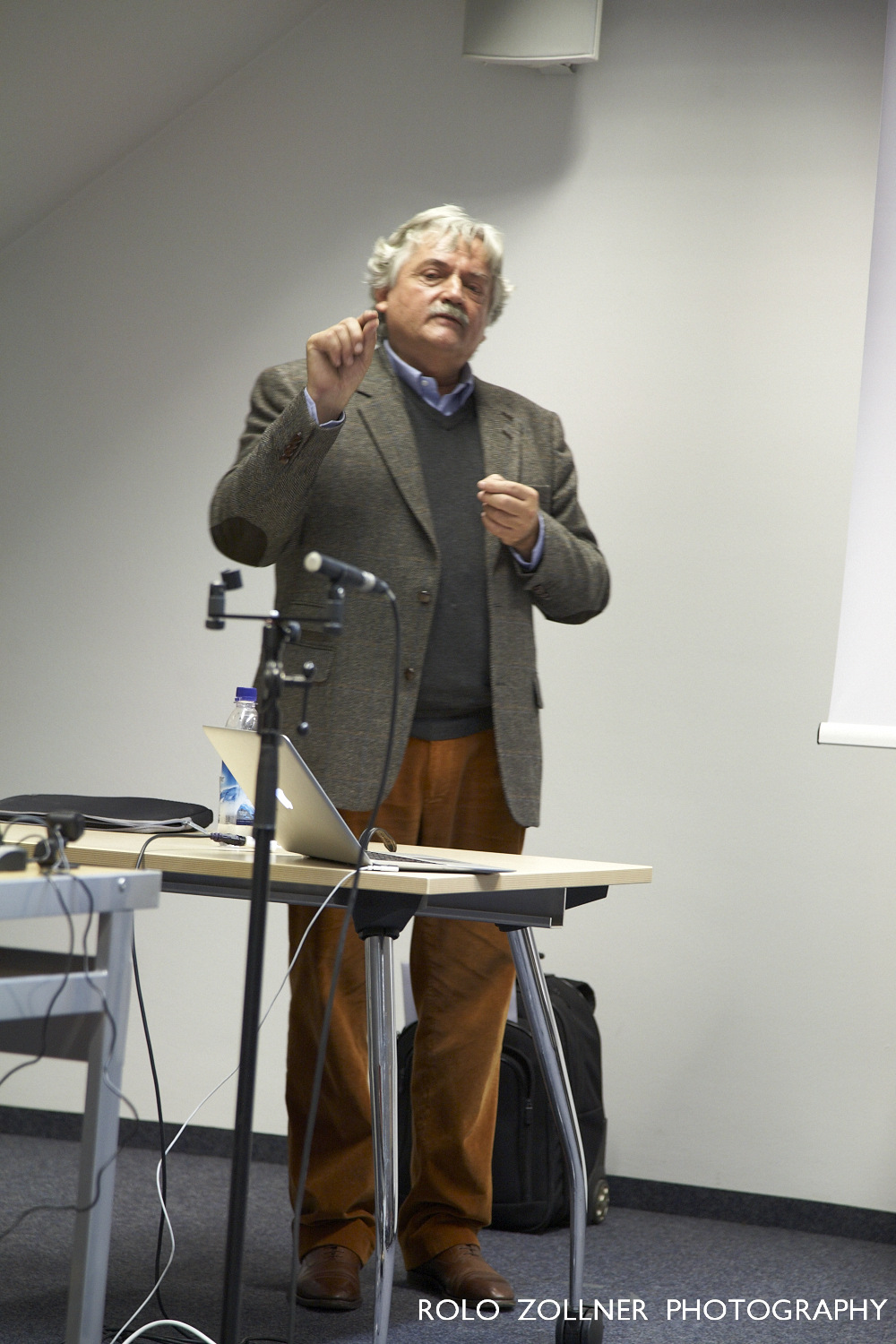 Last Tuesday, Wilfried Bommert of the WDR was our guest at Unterhaching. Wildfried Bommert is a well-known expert when it comes to “feeding the world”. He also published several books on the subject. Currently, he and a few partners are establishing the Berlin “Institut für Welternährung”.
Our last presentation in the series “living and surviving in a sustainable way” was yet again another highlight of the 2012 IF Forum. Herr Bommert deliberately kept his presentation very short and concise. We had planned this, because, after all, we wanted to produce an attractive video recording for Youtube as an extra value.
I think we succeeded. Every single sentence uttered by Herrn Bommert was right on target. Without employing unnecessary emotions and questionable judgements, he reported facts in a very objective way and came up with simple, logical conclusions.
Consequently, there was a long discussion after the presentation. It was extremely constructive and passionate. And we agreed: the messages sent by Herrn Bommert are important. He demonstrated in a very simple and rational way how feeding the world dangles on a thin string. And how easily this string could and perhaps will break.
 However, Herr Bommert also showed us ways to change matters. And he also showed us that it is, indeed, possible for us to prepare for the time after our stupid and eventually fatal economic habits will have caused a collapse. Consequently, his finishing lines after a very thought-inspiring list of facts and judgements were rather nice and optimistic.
With Vienna sausages and meatloaf (of course from the butcher Schlammerl of Ottobrunn), we spent quite some more time discussing things in small rounds. And finally, when the hot spiced wine and ginger bread were served – also from a local bakery: Götz of Taufkirchen – the general atmosphere was one of courage in view of a possible future and joy about all the interesting information and the culinary delicacies.
I already look forward to watching the video recording by Friedrich Lehn. As soon as it is finished, we will make it available for you on all our diverse Youtube channels.
RMD
Here are a few pictures to refresh your memory and maybe arouse your appetite for the video.
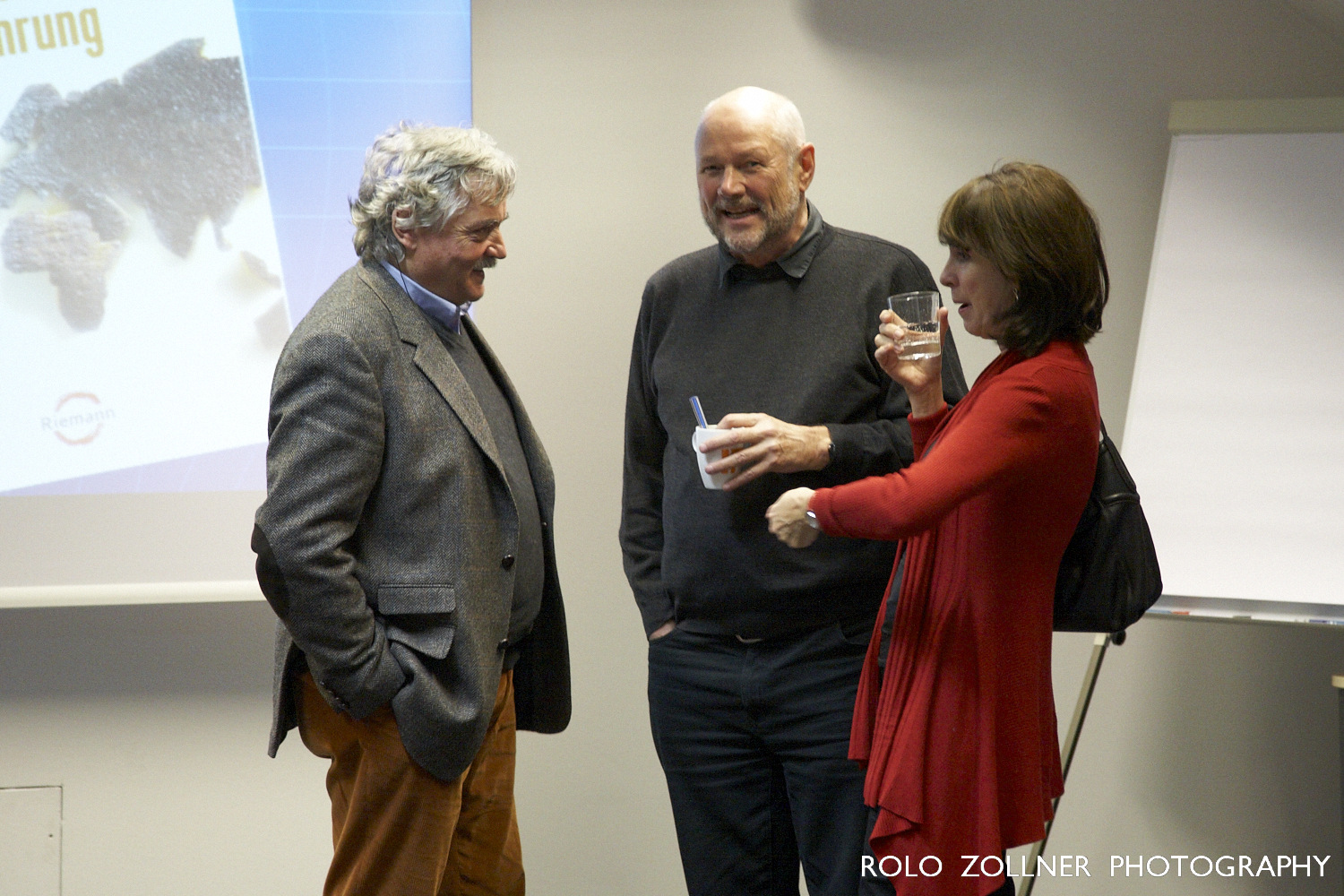
Wilfried Bommert talking to Mr. and Mrs. Gerlach. Thomas Gerlach works for the Bayerischer Rundfunk. He was the one who first introduced Herrn Bommert to me.
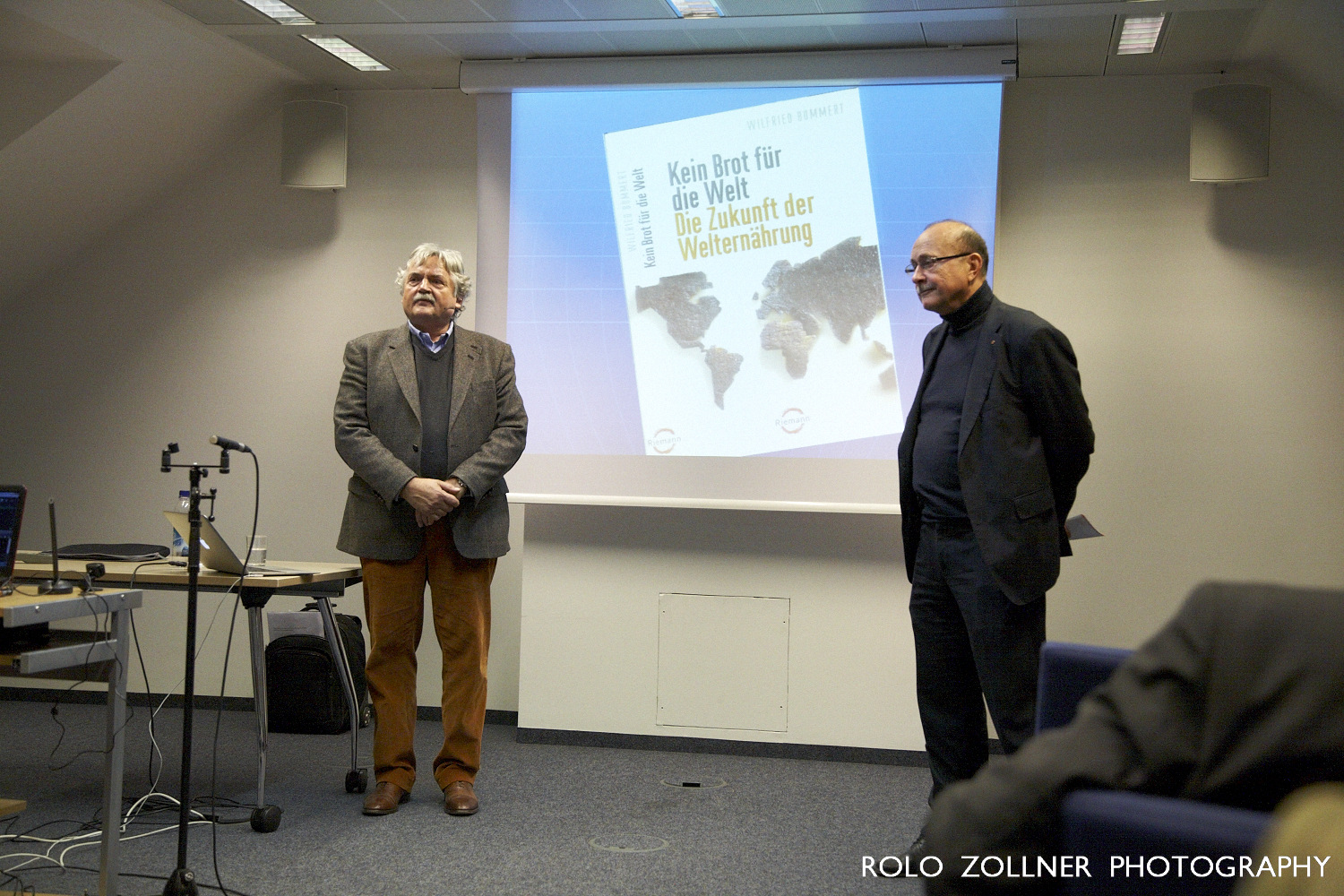
The introduction to the presentation. It will start right away …
As so often, all pictures were taken by our Rolo Zollner.
Roland DürreFriday November 16th, 2012
Presentation “Change in Management” – November, 22nd, 2012 – Universität der Bundeswehr München
As part of the EAA colloqium “Current Developments in Technology and Business“, I will give an autumn-trimester-2012 presentation at the University of the Armed Forces at Munich. I will talk about:
The Change in Management
How change will not stop before enterprises.
My presentation will introduce the world of leadership, innovation as a form of creative destruction, management, project management, organization, social systems, entrepreneurship and entrepreneurial culture.
In their organization, enterprises often follow a paradigm that belongs in the last century. To this day, hierarchical tree structures are prevalent. Since those are not terribly flexible, these enterprises are forced to execute so-called “re-structurings“ in short intervals. As a general rule, those are doing more harm than good to the enterprises.
We all should start thinking in new ways. The organization must become a dynamic network where humans in the enterprise live their relationships at eye-level. I will introduce the “Eight Theses for Management Change” as first written down by Hans Ulrich, the founder of the St. Gallen Management Model.
And I will describe how communication must function in a modern enterprise if it wants to have an impact on our future. Part of the concept is the use and utilization of innovative conference and communication formats and – last not least – the internet, including the “Social Web”.
My presentation will be held at the lecture hall 33/0101 and start on the dot at 18:15 hours. It is an open event, so guests are welcome. Of course, I would be delighted to have a big audience – just send an email to me if you are interested.
I will give a more or less similar presentation at the Bavarian Ministry of Culture in November. Said presentation, however, will be part of a non-public event. Consequently, I can only invite interested persons to the University of the Armed Forces.
Here is the full schedule of the EEA Colloquium (3) at the University of the Armed Forces in 2012. Some of the topics sound really great, so I strongly recommend you take a look at the list.
RMD
(Translated by EG)
P.S.
EAA is short for Electrical Drives and Actuators. Univ.-Prof. Dr.-Ing. Dieter Gerling
Roland DürreThursday November 15th, 2012
Tweets on Twittering and Blogging #141
Here are my tweets of last week on:
Blogging and Twittering, Wisdoms and Rules:
121122 Faithfulness is scarce game – also true for twitterers and bloggers? #Twitter #Blogging #Wisdom
121123 Faithfulness is a rare guest, keep it close if thou it hast – important advice for twitterers and bloggers. #Twitter #Blogging #Wisdom
121124 Faithfulness is bought with faithsulness – also true for twittering and blogging! #Twitter #Blogging #Wisdom
121125 Drink when you are near the fountain – especially when blogging and twittering! #Twitter #Blogging #Wisdom
121126 Dry cough is fatal for a trumpet player – also true for twittering and blogging! #Twitter #Blogging #Wisdom
121127 Better eat dry bread and be happy than meat and be unhappy – also true for twittering and blogging. #Twitter #Blogging #Wisdom
121128 Dark clouds are likely to bring rain – also true for twittering and blogging #Twitter #Blogging #Wisdom
There is a new tweet each day. See twitter.com and “follow” RolandDuerre!
Enjoy!
RMD
(Translated by EG)
P.S.
I took the proverbs from Alle deutsche Sprichwörter.
Roland DürreWednesday November 14th, 2012
Time is My Most Precious Commodity …
Currently, I actually realize how true this is. After all, I am flying from appointment to appointment. Some way or other, I seem to have no space left for dealing with private things and taking care of myself. Occasionally, I do not even know any more if perhaps a little dys-stress comes creeping along with the eu-stress. This is also why there are currently so few IF blog articles. Mind you, this is regardless of the fact that I love writing and enjoy using every free minute for the IF blog.
This was the bad news. But the good news is coming up now:
I am travelling a lot, experiencing many different things and learning plenty of new things. Consequently, I receive many impulses. All of them are taken down and I already look forward to the quiet days when I can again generate small articles out of all those ideas.
RMD
(Translated by EG)


