
Roland DürreMonday November 12th, 2012
(Deutsch) 2-Wochen-News #31: Für Kurz-Entschlossene: Morgen – 13. November – IF-Forum
Roland DürreSunday November 11th, 2012
VDE, VDI, GI, GChACM, GPM, GfWM, BITKOM …
The Dornbirn PM Camp made me thoughtful in various ways. For instance, I remembered something I experienced early in November.
Felix Köbler, a young and highly motivated computer scientist who is also doing research but will probably soon “take the plunge and become an entrepreneur“, gave a presentation for the VDE (Electrical Engineering Association) on “Crowd Sourcing”. It was a well-advertised contribution on an exciting future-oriented topic.
The presentation was held at TUM. I was interested in watching the presentation for various reasons and consequently rode my bike to the old and dignified TU building at Arcisstrasse 21 on the evening of November, 5th.
It was a truly great presentation. He gave a very nice description of the diverse and substantial potential for change by future tools, applications, as well as interface and user strategies. Consequences on the social level were described using an example, before the potential for the use of modern technologies offered by Web 2.0 was outlined. And he also told the audience all the things you can do with “Apps” and “Gamification” using “Mobility and Cloud Applications”.
So here is the bad news: there was hardly an audience! I knew most of them personally and therefore could safely assume that they mostly came because they wanted to hear the speaker. Those few among the audience who had come on the instigation of the VDE university section were few and far between. Moreover, this (small) group of visitors were rather over the top in terms of demographic development.
Mind you, this is Munich. We are not precisely talking the smallest German city, are we? Besides, Munich very much wants to be High-Tech oriented. Considering this, the attendance was rather a disappointment.
In Munich, you can also find many great things. Young engineers and entrepreneurs of the IT sector actually like coming to Munich. For instance, a short time ago there was a Barcamp for “Games”. Allegedly, it went quite well and a surprisingly high number of (happy) visitors were there.
Which means that the lack of enthusiasm for the presentation was not due to the fact that our “global” Munich has now suddenly turned bourgeois and saturated. The real reason is that the associations that at one time were so great and strong get less and less accepted in the age of the web.
Yesterday, at our Dornbirn PM Camp 2012, I met a “true” engineer. He told me he still held a membership at the VDI (Association of German Engineers). A short time ago, they sent him a letter offering the badge of honour for his 25 years of membership. So he decided it was about time to attend one of the VDI events. He returned with the feeling “never again – this is not what I can identify with”.
To be sure, associations like the VDE and VDI have attractive websites. They look quite nice. Nevertheless, these associations are on a downward spiral. One indicator is the high average age. The events have a low attendance and the publications are rather dry. The members are usually passive and only remain members because they are so used to it or because they are sentimental about it – after all, the “good old times” want to be remembered.
But then, this is something we (older) computer scientists know quite well from our associations: GI and GChACM. Those, too, can make as many efforts as they want. They are on the downward spiral. And whenever I ask my young students, they either do not even know what the GI is, or else raise their eyebrows. Neither does anybody read the GI Informatik Spektrum. Even if they try to artificially improve it by using strange posters that show persons like Steve Jobs.
Apparently, Steve is a great German computer scientist.
Basically, all that remains to be asked is which way the new associations will go, since they are dealing with current topics such as knowledge or project management. The GfWM (Society for Knowledge Management) or the GPM (German Association for Project Management), for instance, are absolutely “in” at this time. The GPM even managed to install itself as a “standardising and normative institution for project management”. Thanks to its certifying power, it seems to have an almost market-dominating position.
Incidentally, I believe that this, too, will not last long. They will get the funny stuff for a few more years, and then the downfall will come, along with the slow process of misery. Just like the other associations have already experienced it.
I only hope those associations the only purpose of which is lobbyism will meet the same destiny.
For us computer scientists, there is, for example the BITKOM (Federal Association for Information Business, Tele-Communications and New Media, e.V.). Just look at the term “Information Business”. Nomen est Omen. BITKOM is “our” lobbyist. Above all, they want to promote the IKT (Information and Communication Technology). In other words, they want to convince the politicians to spend a lot of money on IT infra-structure. However, to me it seems that BITKOM is not particularly successful. Just compare it with the nuclear and airplane industry in former times.
Even though Bitkom calls itself “The One And Only Hightech Association“, we do not really need them.
RMD
(Translated by EG)
P.S.
If you are among those who are looking for alternatives, here is some advice.
P.S.
The first is a Barcamp, Open Space or some such. Having the right kinds of seminar rooms is a necessary requirement. One of my next articles will be about seminar rooms and rooms in general.
Roland DürreFriday November 9th, 2012
PM-Camp12
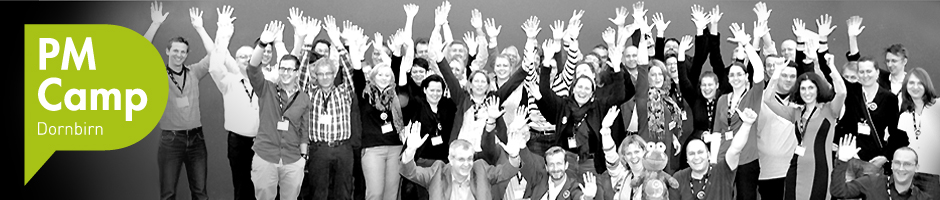 I was definitely a little nervous about my role as co-organizer of the PM-Camp 2012 when the core team (yours truly along with Eberhard, Jens, Marcus, Stefan, so far without Eileen who, unfortunately, was still travelling) met for the last organisational meeting shortly before the evening event started.
Would everything go well? Maybe there are too many participants, after all? Will everything go as smoothly as it did last year? Will we manage the spontaneous building of trust between the participants? Will the catering be as we hope? Will the atmosphere be as good as it was in 2011?
And then, this morning, it started. And everything was great. Just like last year. Now the first day is behind us. And after many super “sessions“ with much that was new for me, I am truly tired. It was absolutely worth the effort – and now we look forward to the great evening party!
If you feel like it, here are some live pictures and video recordings of the PM Camp on the Website .
Incidentally, the twitter tag of the PM Camp 2012 is #pmcamp12. On this site, you can experience live a little of what make PM Camp so special. Of course, today and tomorrow, there will be quite some activity.
RMD
(Translated by EG)
Roland DürreThursday November 8th, 2012
German Essays
For me, the one subject at school that made me most miserable was German.
Basically, my self-assessment in German was not so bad. After all, my orthography was – in my opinion – a lot better than that of many classmates. And I also found that I could express what I wanted no worse than the average students in the class.
Except that, far too often, my ideas were the “wrong ideas”.
😉 At least that is what my German teachers thought.
The main problem was the German essay. Even the way our teachers set our tasks and the given titles were strange. Incidentally, I found it strange if a young and creative person was forced to write something under a special title. Isn’t that outrageous? I would have preferred to write my opinion on some topic or other and then creatively find a title that fits with what I wrote.
But no. Teachers asked 24 students to artificially generate essays on the same and often questionable and very unrealistic title, before marking them. Once in a while, we also had to write interpretations about texts that looked very alien to us – both by famous and less famous authors. However, we were not allowed to write down what moved us personally about a text or what we might have found disgusting. Instead, we had to write what the current doctrine said. Of course, that was not really what I felt most enthusiastic about.
In my opinion, the stories told by the great narrators were sometimes abominations. I can remember masterpieces by Kleist I really found sick. But at school, the great master was beyond all reproach in German lessons. And whenever I criticized about his writings what, to me, looked rather grotesque and stagy language, all I got in return was lack of understanding – with the consequence of being graded poorly.
It got even worse when the topic of a German essay had something to do with values, moral, ethics or the like. How often I realized that the German teacher had a value system that was totally different from my own! Differentiated, abstract terms had totally other meanings for the teacher (him) than for the student (me). When it came to judging what was “good” or “evil”, “right” or “wrong”, miles lay between our opinions.
And when finally the German essay was graded, the time had come for the concept of the teacher’s and the student’s world to clash. Sometimes it happened consciously – the teacher could not or was not willing to understand what he had read. Often, the rejection was subconscious, because the student’s ideas were so incompatible with the teacher’s concept of the world. If I was lucky, the teacher would shake his head in incomprehension when reading my work – before, from his point of view, tempering justice with mercy. All of this was not very beneficial for my grades in German.
Consequently, German became the one subject for me which is most suitable for outlining all the old-fashioned and outdated things about our school and learning processes. All we ever do is make students learn things without being convinced of them and then again forget them. You have to adapt to the teachers‘ prejudices and be prepared to make pre-fabricated opinions your own. But woe to him who shows civil courage or creativity, or – this is the worst case – both. As a general rule, this will be your downfall. And your grades in German will deteriorate. It is certainly a lot better to just keep quiet.
And here is another cheekiness: our German essays remained the property of the teacher or the school! At one time, I wanted to publish one of my essays in the school magazine. We are talking one of the essays that had been graded poorly. I got in real trouble for it.
Neither was I allowed to keep my masterpiece: the graduation essay in German. At the time, the best you could hope for was that you took legal action, which might have given you the right to see the corrected essay. A huge bureaucratic effort was necessary – and in the end it made not the slightest difference to the fact that my “intellectual property” had been confiscated by the Free State of Bavaria. And not just temporarily, either!
Well, so much on intellectual property.
RMD
(Translated by EG)
Roland Dürre
Tweets on Twittering and Blogging #140
Here are my tweets of last week on:
Blogging and Twittering, Wisdoms and Rules:
121115 Dreams are ten a penny – actually, this is not just true for twitterers and bloggers “in the crowd”. #Twitter #Blogging #Wisdom
121116 Not trusting everyone is a good way to avoid being cheated – also important for twitterers and bloggers. #Twitter #Blogging #Wisdom
121117 It is a good thing to do what you are good at – also true for twittering and blogging! #Twitter #Blogging #Wisdom
121118 Let everybody use his talents – just like the courageous bloggers and twitterers! #Twitter #Blogging #Wisdom
121119 Good faith is better than cash – especially true for twittering and blogging! #Twitter #Blogging #Wisdom
121120 A faithful hand will see you through the entire land – good advice for twittering and blogging. #Twitter #Blogging #Wisdom
121121 Trust will give you bread, betrayel will give you misery – that is what it should be like when twittering and blogging #Twitter #Blogging #Wisdom
There is a new tweet each day. See twitter.com and “follow” RolandDuerre!
Enjoy!
RMD
(Translated by EG)
P.S.
I took the proverbs from Alle deutsche Sprichwörter.
Roland DürreMonday November 5th, 2012
Next IF-Forum 2012 – November, 13th
By now, we have also agreed on the day for the 3rd 2012 IF Forum of our series “Living (and Surviving) Sustainably”.
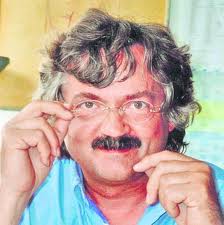 Herr Wilfried Bommert will speak on Tuesday, November, 13th, 2012.
His presentation will be about “How to Feed the World“. For a title, he selected:
Catching Up On Good Soil!
How we might avoid the world food crisis.
Here are a few preliminary ideas by Herrn Bommert:
Ever since 2008, the price for food world-wide only knows one direction: up. The global financial crisis and the dwindling oil reserves further push the price spiral up. Concerns selling energy, raw materials and money reach for the fields of the world. They buy or rent huge areas in Africa, Asia, Eastern Europe and South America, thereby again causing massive price increases for food. Consequently, we get famines, revolts in more and more countries that cause political instability and a collapse of world food affairs.
This vicious wheel would not turn if we did not actively contribute by our consumption habits. Our longing for biological fuel and our hunger for products from industrial farming, our money invested in farm and soil stock, they all support the global hunt for the fields of this world. It is up to us to put a stop to this mania currently prevalent in food and soil markets.
Dr. Wilfried Bommert has been working as a WDR journalist since 1979. He is head of the environmental sector at the WDR-radio station and also wrote the book: “Kein Brot für die Welt – Die Zukunft der Welternährung”, 352 pages on paper, first edition published on October, 5th, 2009 at Riemann Verlag (QUERDENKEN) .
RMD
(Translated by EG)
Roland DürreSunday November 4th, 2012
School and I
I and school, we were not the best of friends.
From our flat at Rosenaustrasse 18, primary school, situated next to the parish church of St. Antony, was on the opposite side of the Augsburg Wittelsbacher Park. As I recollect, the four years I spent there were rather unpleasant.
Because to me, the “Volksschule“ felt like a cruel place of suppression. And I think that is what it actually was. Later, when I attended the “business-oriented” Jakob Fugger Grammar School, I had a better time. We were definitely treated in a more humane fashion there, especially by the younger teachers. And with each grade up, I enjoyed more freedom and leisure time.
My annual reports were poor. When I was twelve years old, I started playing chess, which increased my concentration. After that, I won against the teachers more and more often if I played against them. My reports got better, which, however, did not necessarily mean that my “achievement” had improved.
I got more and more proficient having quite some success with rather minimum effort. My friends and I became “lazy students”. That gave us a lot of leisure time. We used it very intensely and creatively for all kinds of activities. And in our leisure time, we definitely learned more and understood more than at school. At school, we often restricted our activity to “knowledge bulimia“– as it would be called today.
My grades at school differed with the subjects. Meticulous bookkeeping and ingenious mathematics were definitely my highlights. I found them rather easy to do and also enjoyed them very much. The skills I acquired in both subjects were very useful in my later life – but on totally different levels.
In the learning-intensive subjects biology, geography and history, the marks oscillated very much. They depended completely on my current interest situation and sometimes also on the type of teacher we had.
Business and economy were two areas I felt quite comfortable with. However, my (absurd) theories were not really compatible with the (absurd) theories introduced by the curriculum or teachers, which meant that I was graded C – which I found unjust.
I did not do too bad in chemistry and physics, but found both subjects a little boring.
My poor results in English (seven years of learning) and French (also seven years of learning) were justly given. In French, matters soon changed, because I spent a lot of time in France after I was 14 years old. Communicating decently in English, however, was something I only learned later, in my computer science and project life.
My poor results in religious education were totally justified; in fact, I was rather proud of them!
There were also subjects you learned voluntarily, such s stenography (successfully) and typing (not so successfully, but at least good enough to type with ten fingers). I terminated my Latin education after two lessons. The study group photography was something I truly enjoyed – regardless of the fact that the analogous technology often caused frustration.
I wrote this list in order to show that young persons are pressed into tackling far too many topics at school. Mind you, the worst of all subjects is still not on the list: German!
My problem was the German essay. And this “subject“ in general. It is the one subject that stands unrivalled when it comes to showing you the problems and disadvantages of our educational system.
I will do so in my next article: “German essays“!
RMD
(Translated by EG)
Roland DürreSaturday November 3rd, 2012
Seven Utopian Ideas – Seven Theses for the Future.
Since so much I do not understand is happening all the time, I will now write down a few utopian ideas I like very much, indeed. And I am determined to develop a few ideas on each of those utopian concepts that justify and explain why I, personally, do not consider them all that unrealistic.
- Penalty-Free Society
It would be nice if there were (almost) no jails. If we could organize living together without having to punish. If we refrained from revenge and instead were to try and prudently minimize the social damage. - Violence-Free Society
What about a society free of physical violence against each other, where regions and peoples can live side by side without wars? It would be nice to treat animals and nature in a reasonable way. It would be nice to have a community where opposing ideas could be dealt with at eye-level in a “domination-free and fair discourse”. - Democratic, Tolerant and Transparent Society without Fundamentalism, Dogmas and Taboos
Education and enlightenment will counter fundamentalism, dogmas and taboos. It is the only way to find and further develop a shared, humane concept of society. Transparency is the requirement for a common way of thinking and deciding, for achieving new insights through consensus. And tolerance is the Ultima Ratio. Intolerance should only be permitted against intolerance, and even there it should be used with extreme caution. - A Society of Sharing and Belonging
I would wish to have a free society. I society where ownership is reasonably distributed and private property is regulated in a responsible and differentiated way. Which includes a particularly sensitive view of “intellectual property”. As far as possible, it should be shared as general knowledge. - Humane Economy
I would wish to have an economy that is not powered by the great financial mechanisms and where all activities and behavior is not determined by profit. An economy that is free from lobbyism and the main purpose of which is to provide humans with products and services that make sense (like, for example, it says in the Bavarian Constitution). I would wish to see an economy where enterprises the goal of which is less profit optimization and more an increase of the common good are appreciated. - Media Free of Marketing
Why are the media always dominated by marketing? Why do I get two units of brainwashing along with one unit of information? Why do some elements think I am so incapable and take me for someone who cannot make up his own mind about his needs? Why does all the world want to manipulate me for their own advantage and my own disadvantage? - Soft and Rational Mobility
How nice would it be to have a mobility without constantly being in a rush and having to fight? Without evil smells and noise? A mobility that serves a purpose, instead of providing us with an emotional arena for ego-boost and self-portrayal? Without burning fossil raw materials? Slower and yet more efficient.
You will say I am a dreamer – but I counter with citing John Lennon in the last paragraph of his “Imagine”:
You may say I am a dreamer
But I’m not the only one
I hope someday you’ll join us
And the world will be as one
And let me remind you of all those utopian ideas that used to be considered totally unrealistic, yet today are a matter of course: women’s vote, violence-free education of children and much more.
RMD
(Translated by EG)
Roland DürreThursday November 1st, 2012
Human Dignity
An extremely difficult topic. Consequently, this is a rather difficult article.
The older I get, the more important human dignity gets for me. As I see it, it absolutely has to be protected. And in my opinion, the definition I am familiar with is not good enough:
No human being must be exclusively made a means to an end!
Unfortunately, I know no better definition.
I believe human dignity does have a common denominator, but I also think a differentiation according to culture and age is possible. Basically, I know little about the cultures of this world. Consequently, I would not wish to tell other cultural groups what their understanding of human dignity should be.
🙂 On the other hand, I already have quite some experience with various age groups. Fortunately, I have not yet covered all age groups – the elderly phase is still to come.
But I definitely think that babies, toddlers, children, adolescents, grown-ups in the first and second half of their lives, senior citizens and elderly people have rather diverse needs. And that the dignity of a human being also has something to do with fair treatment of needs.
So I believe the preservation of dignity is dependent on the time and situation in your life. Let me describe from the layman’s point of view how I imagine it might be. Mind you, this is all just to make you thoughtful. I am well aware that none of it can be considered strict facts:
Babies need basic trust.
They need the steady and reliable relationship to (at least) one person – their mother. I am assuming that this includes a lot of physical contact and human love. A baby’s dignity is probably guaranteed to a huge extent by the mother.
Children need a feeling of security and love.
They have to be protected against psychological and physical violence. The right impulses must be given in all varieties. You can find them both in nature and culture (civilization). Environmental elements that include a reduction will have a detrimental effect on the child’s dignity. Children need a chance to socialize and live values. Both families and institutions violate children’s dignity far too often.
An adolescent person has other needs.
The child’s wisdom will diminish. It will be replaced by insurrection and actions that have not been thought through in advance. Regardless, humans, especially in this phase of their lives, have a right to be taken seriously. They need the chance to rub others at the wrong end. To see a mirror image of themselves. It is part of the human dignity of adolescents that we promote their autonomy.
Grown-ups need to be respected.
Basically, they must never be considered just a means to an end. Neither other humans, nor institutions should ever subdue them. Their personal dignity also lives in their work and their partnership – these are probable the social values (systems) determining the lives of most of us.
Senior citizens need tolerance.
Being old might have its good and bad sides. The wisdom should be made use of, the stubbornness of old age should be ignored or, if possible, tolerated. Indulgance, too, will mean dignity.
Old persons must not be put under tutelage.
The circle is complete. You are again as helpless as you were as a baby. Some of you might need someone to accompany you until death comes. It is your human dignity to still be able to determine to some extent what you want to do with your life.
Everyone needs love, perhaps even those who are dead?
RMD
(Translated by EG)
P.S.
This was my contribution to All-Saints-Day. I wrote it to make up for not visiting graves. Because I do not like this All-Saints-Day cult. And now I did my duty and will ride my bike to the bake-shop (the real baker is closed today) and get a delicious Bavarian Veal Sausage for our guest from Riga. And then I will truly enjoy this free autumn day.
P.S.1
When on vacation, I like taking pictures of graves. This article, however, has been kept “picture-free” on purpose.
Roland Dürre
Tweets on Twittering and Blogging #139
Here are my tweets of last week on:
Blogging and Twittering, Wisdoms and Rules:
121108 Choosing the right time for jesting is the biggest wisdom of all – also true for twitterers and bloggers “in the crowd”. #Twitter #Blogging #Wisdom
121109 Dead dogs will not bite – once in a while, this is good news for twitterers and bloggers. #Twitter #Blogging #Wisdom
121110 A dead man will not wage war – also true for twittering and blogging? #Twitter #Blogging #Wisdom
121111 Everyone should carry his own sack to the mill – like the courageous blogger and twitterer! #Twitter #Blogging #Wisdom
121112 Tears will not bring the dead back from the grave – also true for twittering and blogging! #Twitter #Blogging #Wisdom
121113 Do not trust the nation at peace – good advice for twittering and blogging. #Twitter #Blogging #Wisdom
121114 Trust people, but not too much – especially true for twittering and blogging . #Twitter #Blogging #Wisdom
There is a new tweet each day. See twitter.com and “follow” RolandDuerre!
Enjoy!
RMD
(Translated by EG)
P.S.
I took the proverbs from Alle deutsche Sprichwörter.


