
Roland DürreSunday March 29th, 2015
LOCKED IN THE TIME CAGE.

Iron Cage (here: Florence, late 27th century) as a torture tool.
A short time ago, I wrote the article “Golden Wire” (Goldener Stacheldraht), where I described how enterprises take total control of their employees, thus making those persons totally dependent over the years. And it happens in a totally comfortable, even agreeable way.
This article triggered a number of exciting discussions. The time cage in which most of us – be it as employees or as freelancers – are locked in is another issue worth discussing. After all, we measure everything in terms of time: work, mobility, leisure time. And it robs us of our live time.
How absurd is the concept that you have to provide a certain amount of hours each week, no matter what needs to be done? In a “Tayloristic System”, this might make sense. You stand at the conveyor belt, execute certain motions and get some money for each unit you worked on. But shouldn’t Taylorism be a thing of the past for many of us?
The alternative of this system, which by now seems like a matter of course to us, was the system of task-work, which followed the achievement principle and was certainly not easy to work in, either. In this system, you are not paid according to time, but according to the number of items you produced. In structures based on Kaizen, you find the group task-work system. It has a positive side (team work) and a negative side (group pressure). I cannot really think of any more alternatives.
The so-called brain workers, too (formerly known for their white collars and ties and now by the fact that they prefer turtleneck pullovers) are paid by time. They get a fixed income for which they “work away” a number of hours, which means that they have to spend the time either in or for the enterprise. In addition, they get a variable income which is determined in the target agreement (a modern sort of task-work).
This “concept of working time” is so deeply rooted in our brains that we consider it absolutely normal. In my role as InterFace AG managing director, I made the same experience. On some weekdays, I only spent very few hours in my office. Yet sometimes I achieved something really important during those few hours. On returning home to my children early in the afternoon on days like these, my super-ego kicked in and gave me a bad conscience.
In my new life (neuen Leben) I discover what nonsense that is. I try to shape plans according to my priorities. And I use as much time as I need for successfully finishing the tasks. And I feel a lot freer than I used to.
I know many freelancers who feel absolutely autonomous, yet they are locked in the time cage as a matter of course. Why don’t you try to calculate your income as what you earn per hour or per day?
During one of the aforementioned twitter discussions, one person was wondering why the “freelancers” hate to call themselves by that name. In the internet, they often introduce themselves as senior consultant, expert for something or managing director (of their own one-person company). One of the answers to this question was that maybe “freelance” is often considered synonymous or “potentially jobless”. Which definitely did not have a nice sound to it, did it?
In my opinion, a freelancer is a day labourer – and as I see it, this is a rather honourable and not at all a bad word. Even if it sounds a little like “slave”. But then, aren’t we all slaves when all is said and done? Aren’t we all serving a master, a system or a mania?
But then, one might also imagine other (more modern?) systems for income determination. Gebhard Borck, for instance, in his book Dein Preis proposes a value contract as an alternative. This is not at all stupid and I rather like the concept. Due to many time cages installed all around us, however, these and similar ideas are (still?) utopia or at least hard to realize for freelancers.
RMD
(Translated by EG)
P.S.
I took the picture from Wikipedia. It is of an iron cage (Florentine, late 17th century) on display at the Freiburg im Breisgau Torture Museum (Foltermuseum). The copyright is with Flominator. P.S.
Das Bild ist aus Wikipedia, es stellt einen Eisenkäfig (florentinisch, ausgehendes 17. Jahrhundert), der sich im in befindet. Der Urheber ist Flominator.
Roland DürreSaturday March 28th, 2015
Leadership Wisdom …

Once in a while, I also give presentations – here at the IF 2014 Christmas Party.
During quite a few years of my life, I liked listening to the famous and successful “Motivation Speakers”. I was fascinated with how they can describe and explain the world in such easy terms. And, above all, how convincingly they show their audience the way towards success.
Their way of speaking and their charisma enraptured me. The top experts I am referring to are people who literally seem to be surrounded by a special aura. They elude a natural charisma that puts a spell on many persons, me included.
As the years went by, I made the personal acquaintance of some of these people. I saw how easy it is for them to formulate their vision. But I also saw that it is not always quite as easy for them to actually live up to their own standards. Once in a while, it did not look quite as glamorous behind the scenes as it had been looking on the podium. Because it is mostly easier to “teach something” well than to actually do it well yourself.
A short time ago, I met the key-note speaker Carsten Rath. Or, to be more precise: a friend pointed me in his direction. Because he had heard an interview Carsten Rath had given the Bayerischen Rundfunk. And he was so fascinated that he immediately sent it to me.
I do not know Carsten Rath personally, but the BR podcast is definitely worth listening to:
My friend believes this interview with Carsten Rath made it clear to him how a good managers differs from a poor manager. And that he only wanted to work in companies where work-life and work as such is practiced as Carsten Rath demands.
In fact, in this interview, Carsten Rath actually introduces many theses on leadership and management which no rational manager and person can seriously dispute. And his reasoning is both very competent and smooth. He also supports his theories with many small stories. In fact, it is convincing as a whole.
If I were asked to summarize what he says, it would read as follows:
- “The customer always has to be the focus of what we think and how we act.”
- “You cannot do a good job without being totally enthusiastic about it.”
- “Every job is about everything, so you always have to give all your best.”
And then he cites his (created by him) “4Ms” as an abbreviation for:
- “Man muss Menschen mögen!” (You Need to Like Humans)
The “4MS” are also something I can only approve of. The same is true for his postulating “the central virtue of a leader must be truthfulness”. That fits. Except that I call it “transparency, openness and authenticity”. But Carsten Rath also says that
- ”consolidation lies in repetition” and “true top achievement usually means a lot of pain”..
Well, I have an easier term for the former: “Practice Makes Perfect”.
I am not quite so sure about the latter. I understand the statement because Mister Rath originated in the hotel business. Except that, for me, for instance “nursing homes for the elderly” are also some kind of hotel. And this is an area where I would think it is more important that all persons in the company consciously bear and share the responsibility for all those elderly persons. I would always wish to reduce the “pain” to what is absolutely necessary.
In order to give more weight to my ideas, I looked for another example from the circle of famous “Management Speakers”. During the Nuremberg 2013 DOAG Conference, I heard the great Peter Kreuz . Later, I made his personal acquaintance at the speaker’s table (well, I am sometimes at it myself ).
His presentation was perfect. On an inter-human level, we understood each other perfectly. “You” (women and men) were left with no alternative but to nod approval. All was great, all was right. He sounded convincing in all points. The only and very reserved criticism I heard was that, perhaps, the show was a little too perfect. Apparently, he and his wife are the perfect couple and enterprise.
These aforementioned speakers and several more can be said to play in a “different league”. Except, although I certainly would never begrudge them their high fees and the usually nice and long applause, I seem to have learned over the years that good leadership is a little more than that. And I do not even have the means to make this understood.
Well, let me try:
It is the many daily small things that might make a “leader” out of a person. There is the mostly constructive brain, an upright mind-set, practiced humanity and the ability to help towards your own and other person’s life getting a chance to flourish in many dimensions. Whenever you manage to make the people you meet look greater, instead of smaller, you might perhaps be a good “leader”. One indicator that you are a good leader might be that people you met feel better after having met you than before and they are also aware of it.
And all those beautiful theses that our top speakers brilliantly present could essentially just be the basic requirements that go without saying for a good enterprise climate. But there is no question that they, too, are terribly important.
But still, even if a “leader” has both the knowledge and competence to do all these things, even if he means ever so well in his job and does everything right, there will occasionally be instances when something goes wrong. Simply because the “leader” is also a human being like everybody else. Be it because he himself made a mistake or because once in a while strange developments make things happen that you simply could not mend – and perhaps you could not have foreseen them, either. Because we are all only human.
And that is something not even the most expensive and best management seminars and presentations will protect you from.
RMD
(Translated by EG)
Roland DürreFriday March 27th, 2015
Breaking News: Arcis-Vocalisten to Sing in the Herkulessaal on April, 3rd! Special Bargain for IF Blog Readers.
The Munich Arcis-Vocalisten are again at it: on Friday, April, 3rd, 2015, they will sing in the Herkulessaal der Residenz München at 6 p.m. Along with the Children’s Choir of the Munich Pestalozzi Grammar School and the Baroque Orchestra »La Banda« and under Thomas Gropper, they will perform the:

»Great Passion after St. Matthew by Johann Sebastian Bach«
 When Johann Sebastian Bach first gave his “St. Matthew’s Passion” in the Leipzig Thomaskirche in 1729, the congregation was overwhelmed. The huge ensemble with soloists, divided chorus and orchestra, the moving power of expressiveness surpassed all that had hitherto been imaginable.
Bach gives a striking narrative of the passion of Jesus Christ. It is one of the heights in our musical history which forms the drama of the passion story as a musical-theological entity.
»Between sentimentally sung arias and drooling turbae choirs: humanity versus injustice and death. With his “Arcis-Vocalisten”, Thomas Gropper wins plastic expressiveness, yet he avoids martial and blaring confessions. The chorals are permitted to stream with beautiful sensuality – this is a way to declare the secret of believing far more effectively.« (”clear and lyrical “– SZ 4/13)
The soloists are:
Judith Spiesser – Soprano
Diana Schmid – Alto
Christian Zenker – Tenor
Virgil Mischok – Words of Christ
Peter Schöne – Basso
The piece:
Johann Sebastian Bach: St. Matthew’s Passion – Oratorio for soloists, double-choir and orchestra BWV 244
Ticket prices 65 | 58 | 53 | 48 | 40 | 33 Euro
IF Blog can offer its readers a few tickets at a discount (20% for advance bookers in all categories). If you are interested, send an email to me!
Enjoy the concert!.
RMD
(Translated by EG)
Roland DürreTuesday March 24th, 2015
Cars and Motorways – Above Everything.
 This morning, I read in the SZ under “rural district” that the costs of an individual motorway project – the necessity of which, incidentally, I also cannot understand – will rise by 19 million Euros from the originally planned to 44.3 Million Euros.
In the end, it will probably be even more than that.
Let me cite from the SZ, district of Munich, of March, 24th, 2015:
Cost Explosion at A 99
The re-positioning of the exit Aschheim/Ismaning on the motorway A99 from Highway B 471 to District Road M3 will cost significantly more than has been estimated so far. This is what district chief executive Christoph Göbel (CSU) told the audience during a district council meeting in the Pullach Bürgerhaus on Monday afternoon. It is said that the Motorway Administrative Board South Bavaria informed the district administration that the construction works will cost a total of 44.3 million Euros. Initially, it had been assumed that the cost would be more than 25 million Euros. When the construction work started in summer 2013, they already talked 29 million Euros. The new exit on the crossroads of motorway A99 and District Road M 3 will be built as a full four-leaf clover. The old exit of M 3 onto Highway B 471 will become a circuit with an underpass for the passing traffic.
I am particularly impressed by the second citation in this article. District Chief Executive Göbel just states:
“We have to assume an additional increase of general costs by 15 per cent.”
I can easily imagine that. Except that I keep hearing we have too little inflation.
RMD
(Translated by EG)
P.S.
I took the picture „AK-Detail“ from Wikoli at deutschsprachige Wikipedia. It is licenced under CC BY-SA 3.0 through Wikimedia Commons.
Roland DürreSaturday March 21st, 2015
Kickoff of AktMob and AktMobCmp

On Tuesday, March, 24th, 2015, the organizational team of AktMobCmp (the first Active Mobility barcamp in Germany) will meet. Some persons sympathetic to the idea who support AktMob will also be present.
We will meet at 5.30 p.m. as guests of the InterFace AG at Unterhaching in a nice circle – and then we will convene for about two hours.
It is a kind of “constitutional meeting”, regardless of the fact that we certainly do not aim at becoming an institution. Instead, we wish to remain a free movement…
We are well ahead of schedule, because the first AktMobCmp is to take place during the first two weekdays before January, 6th, 2016. For more information on the meeting, click here:
I look forward to meeting all those great people who promised to come and become part of the movement. If there are more persons out there who are interested in becoming part of the movement but so far have not had any contact, do not hesitate to send an email.
RMD
(Translated by EG)
Roland DürreThursday March 19th, 2015
Debut Performance in Sommerhausen – Rehearsed at Unterhaching!
Theater & InterFace AG
 The team of TORTURMTHEATER SOMMERHAUSEN were again the guests of InterFace AG at Unterhaching until Tuesday, March, 17th. They rehearsed a new work in the “KreatIF” (that is the brainstorming room in the basement of our building).
On Wednesday, they moved to Sommerhausen. Until the debut performance on Wednesday, March, 25th, at 8 p.m., they will work on the final subtleties. Because that is when the debut performance of the piece written for the Turturmtheater by Fitzgerald Kusz
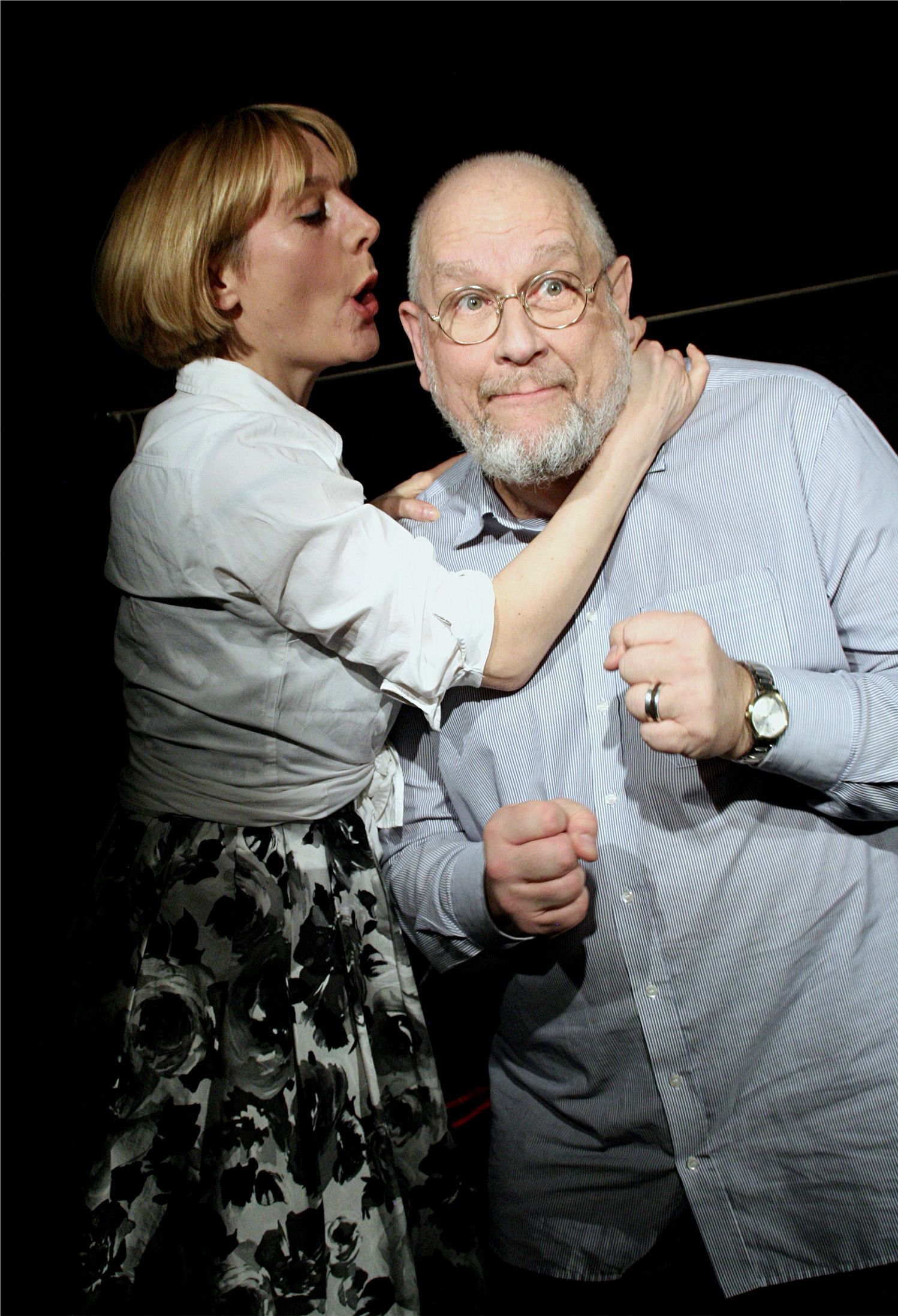 Sag nix! – Liebesdialoge is scheduled.
There is no need to introduce Fitzgerald Kusz. After all, he is often called the “poet of the Franconians”. He became famous through his work Schweig Bub!
Let me cite from the announcement:
“The love dialogues start – you would not expect anything else, would you? – with pure tenderness. Quasi in alphabetical order the fantasy of endearments pours out with words like: angel, eye-catcher, lovey, piggy and sugar-pie. Later on, you get other dialogues, such as:
Woman: sometimes I get the impression that I am air for you.
Man: you know – you cannot live without air.
In between, you get cosy assurances of love and well-meant lies, unscrupulous discussions and endless hatred tirades, evil silence and melancholy memories.
With “say nought”, Fitzgerald Kusz may not describe the dialect, but still he describes a common day in married life from A to Z through a wonderful, inimitable language melody, with tight-lipped Franconian briefness and acid comic. You get all the stages between pining and ending the affair. Perhaps just like you find it behind many doors. A delightful persiflage, dazzlingly comic and yet subtle and melancholic!”
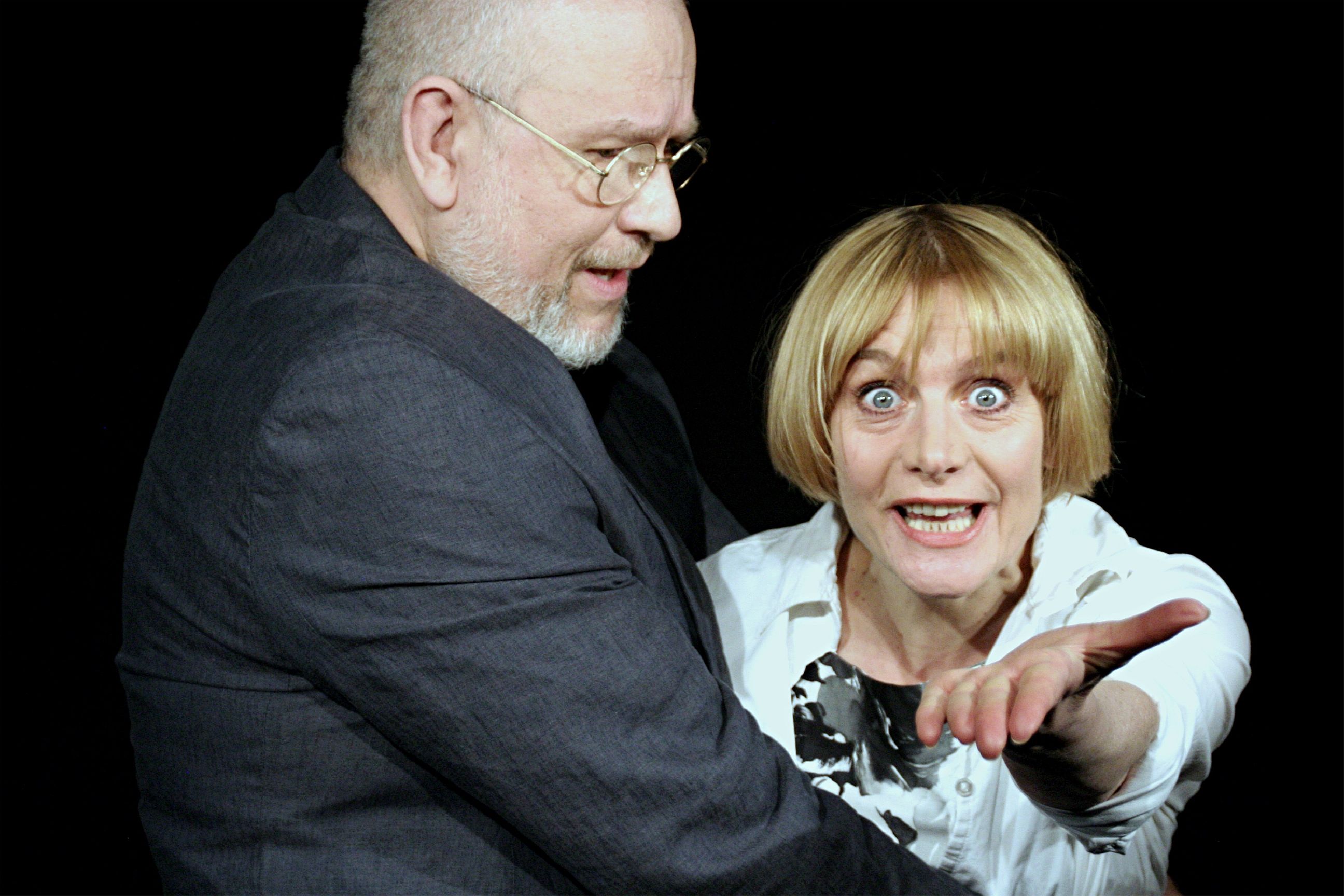
The actors are Dorina Pascu and Konrad Adams, Oliver Zimmer is the producer. You can watch Sag nix between March, 25th and May, 30th, 2015 on all Tuesdays and Fridays at 8 p.m. On Saturdays, performances are at 4.30 p.m. and 7 p.m.
For tickets and information, dial 09333-268 on performance days after 4 p.m., or send an email to kartenbestellung@torturmtheater.de
Barbara and I will go and watch the show on April, 1st. That is the Wednesday before Maundy Thursday. I already look forward to the nice trip to Sommerhausen – including a delicious dinner at the “Ritter” and a nice overnight stay, for instance at the “Sonnenhöfle”.
And I would be very delighted to see a few familiar faces in the theatre. Sommerhausen is a beautiful place – ideal for a little honeymooning! And the wine, too, will make it worth the trip. So why don’t you come?
And here is another piece of advice for getting there: You will want to take the DB Regio to Winterhausen – and then you hike a little less than one kilometre over the river Main until you reach Sommerhausen on the opposite shore!
RMD
(Translated by EG)
Roland Dürre
Not Uncertain Times but Stupid Times
Security and Data Storage
Now I have been back from Cuba for a few days and also started “Audio” listening again. I came across a Man who has an arch-angel’s name. One of those politicians/functionaries who never worked anywhere except education, unions, party, politics, schools or universities – if you discount his time as SaZ2 in an airborne unit of the German Armed Forces and a secondary job as a night porter in a hotel in Göttingen when he was a student.
I heard him saying:
“And as I see it, we are currently experiencing that the world has become a rather dangerous place and that the threats are imported to us from other parts of the world.”
 This annoyed me, because it is utter nonsense. All you have to do is take a history book, such as Die Verwandlung der Zeit by Osterhammel and do a little reading. And then you will know how dangerous life was in former times.
Or you can make it even less complicated – by just thinking. The most dangerous hazard in Germany and world-wide (with the exception of household and work-place accidents) is perhaps our participation in individualized traffic. For instance, the World Health Organization (WHO) estimates around 1.2 million fatal traffic accidents round the globe. In Germany, the fatal accidents were drastically reduced in the last decades. We “only” have about ten each day.
Deceases, too, did not really get more dangerous in Germany and the world. Regardless of bird flu, Ebola and currently again the measles.
😉 I also cannot see what hazards we import. Actually, to me it seems more like we (the FRG) are exporting dangerous material.
 On the other hand, it is also possible that this sentence was just something thoughtlessly uttered. This would be even more annoying, because the politician takes this thoughtless blabbering as a justification for demanding data storage!
He does this regardless of the fact that the experts I know all believe that data storage will take us another step closer to total control (totalen Überwachung). Incidentally, this is also what Sascha Lobo, writes in the Spiegel. And he is no less than the person speaking on the IT summit organized by our Federal Chancellor.
Incidentally, the man I mean is Sigmar Gabriel. He is the Federal Minister for Economy and Energy, the designated substitute for our Federal Chancellor and SPD party director (!).
Shortly after demanding data storage, he started his Trip to Moscow (Reise ins gefährliche Moskau), where he is meeting old friends. And what friends.
So who is surprised at hearing that the wise German voters no longer want to give their vote to the SPD and that the just as wise young German voters no longer go to the elections at all?
And those are the times when I wish I had stayed in Cuba.
RMD
(Translated by EG)
P.S.
The picture is from “Stoppt die Vorratsdatenspeicherung!“.
Roland DürreSunday March 15th, 2015
Two Weeks of Riding Our Bikes in Cuba.
A personal travel journal.
Here are the private notes I took during our bike trip through parts of Cuba from February, 26th to March, 12th, 2015. First and foremost, they were written down for myself. In order to make them available to my friends, I am now publishing them on the IF blog.
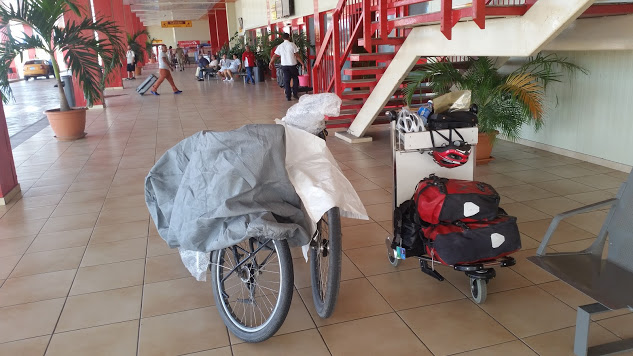
This is the end of the trip at Varadero Airport.
And since, yet again, we collected lots of impressions, I will gladly share them. So if you have any questions about our Cuba trip, do not hesitate to contact us.
Barbara also took many beautiful pictures (some of them you can see Facebook sehen). We will also publish those. As soon as the time has come, you will read about it on these very pages.
So here we go – with my private notes taken down during our bike trip through parts of Cuba from February, 25th, to March, 13th, 2015.
February, 25, 2015 – Wednesday – late-night check-in at Munich Airport.
On Wednesday evening, around 5 p.m., it is ti e for the late night check-in at Munich Airport. We arrive around 6 p.m. There are some problems, for instance our bikes being booked onto a different flight. The immigration forms for Cuba have been filled in little less than diligently – which means people at the check-in fear that the Cuban authorities might not accept them. Consequently, we buy a pair of spare forms for 50 € (not yet filled-in).
After some more discussions and (against plans) poorer by 50 €, we eventually get rid of the bikes and the luggage. At 8 p.m. we are back home. The flight will be tomorrow.
February, 26th, 2015 – Thursday – a long flight.
At 7.31 hours, we board the S-Bahn train at Neubiberg, headed for Munich Airport. After passport and security controls, we are at the departure gate on time. The scheduled departure time is 10.10 hours. However, boarding time is postponed because the airplane is not yet ready. We start late and are supposed to arrive at 15.15 hours (local time) after more than 10 hours in the air. The time zone variance is six hours.
On board the plane, we get the usual two meals and a film. Other than that, I relax and try to do some “meditation”. Time seems to pass well. We arrive at 15.35 hours (a little late). At 5 p.m., we are sitting on the saddles of our bikes.
The Silbermöwe – Barbara’s bike – survived the flight without any damage. My Roadster has a slightly crooked fender support – but this is not really a problem. So all is well!
Initially, we are lodging at the Sol Sirena. The hotel is about 30 kilometres from Varadero Airport. Varadero is situated on a long and thin peninsula. According to the tourists’ guide, it is exclusively for tourists. Yet this is not true. Besides the old town, the city is divided into various districts. Our hotel is in the Quartiere Las Americanos.
From the airport, this is the wrong direction (away from Havanna, instead of towards Havanna). And we want to go to Havanna.
After the long flight, we really look forward to beautiful 32 kilometres on Cuban streets. Regardless of a slight head wind, we arrive fairly quickly. We are riding on the motorway all the way. At this time, riding our bikes in Cuba is something we still enjoy.
All those many old-timer cars are a dream come true. At a later time, when we will notice more and more of those thick layers of soot they produce, they will become more like a nightmare. Also, a time will come when we will notice how much most of those mobile dreams come true have been tampered with.
This is our first time in Cuba. It is not really easy to find the hotel. Actually, these are two hotels in one. Initially, we use the wrong entrance. The one entry is for cheap rooms, the other for expensive rooms. We tried the cheap version.
However, the service behind both versions is not only the same, but identical. It is a set with two entrances and perhaps also two standards of rooms. Yet you can use everything with your wristband. It all looks a bit like a third-world scenario.
But then, the friendliness of the people more than makes up for those minor inconveniences. Also, they speak fairly good English.
Yet the friendly people, too, take their time. At reception, every employee processes several customers simultaneously, which once in a while will cause a few small problems. Those problems are then dealt with by using an interesting interrupt and stack technique.
We get a red ribbon tied around our wrists and thanks to this we are completely set. Well, this is an “all inclusive” hotel. Basically I am not in favour of the concept. But I will certainly enjoy all those free cocktails.
Our room is big but not yet ready to accommodate us (in fact, the linen would be a little scarce …). It arrives immediately and we are comfortable. The bikes have found a nice place to stay. The sack containing the wrapping for the bikes during the flight is deposited in the hotel. We will also spend our last night before departure in this hotel. Consequently, we want to leave all unnecessary ballast in the hotel.
Even though this is “normally” not possible, we manage to convince the authorities. The sack is deposited for us. I certainly wonder whether it will still be waiting for us two weeks from now. (Of course, the answer turns out to be: yes).
Then we have dinner. You could certainly find a few things to complain about, but that is not what we do. Especially the cooking stations with fresh preparation of fish and meat more than make up for the occasional cuisine weakness. For me, there are vegetables, salads and fish. I would say the quality is “Cuban Standard”. In other words: good enough, because it tastes fine and is sufficient.
In the evening, we indulge in an hour on the beach, lie down on a sun lounger and enjoy the stars of a Cuban night. The hour turns into an hour out of dreamland. Behind us, the security officer is keeping a watchful eye. He is rather nice and enjoys talking with us. Yet he keeps his respectful distance, too. The same will be true for many other persons we are going to meet on this trip.
So now it is time to attack the bars. There are cocktails until you are ready to quit – and rum, rum… and very nice music – four ladies and a gentleman. They play diverse styles of music. Between Frankie Boy, Copacabana and great Jazz, you get to hear a lot. Then we go to sleep. This is our first night in Cuba. We sleep long and well – the jetlag is already a thing of the past.
February, 27th, 2015 – Friday – the first leg.
We eat breakfast in our hotel and then we are on our way. The coffee served in the “all included” package tastes horrible. It will be better at all other places during our trip. Other than that, they serve delicious eggs and pancakes. The honey really tastes like honey. And it has a very tropical aroma.
We also make the first interesting observations. For instance, the boy sitting at the next table gets two spoons of sugar poured into his already too sweet orange juice by his father. This might well explain why we see so many people in this country who are overweight. But this is not something I want to be concerned with. The first Cuban bike day is about to begin.
Our plan is to get as far as Jibacoa . That is about 80 kilometres. The roads have steep inclines with wonderful views from the top. A great tailwind pushes us, making the “motorway biking” at least tolerable.
I have no idea about altitude. After all, I do not carry a GPS system – because I read somewhere that they had all been confiscated in December 2014. Now I guess this was another one of those pieces of misinformation I received. During our trip, I will often notice that much nonsense is told about “2015 Cuba” in Germany.
We pause twice. During the first break, all I need is a bottle of beer. For the second break, I add chips with onion aroma. Luckily, there are many clouds providing shadow. Thanks to those, the tropical sun is not quite so hot – which is a good thing for our skin. In between, there is a little rain. All the way, we ride on the motorway. Among other things, we also ride some of the way on a stretch that is forbidden for cyclists. Later, we will find out that this is a rare thing on the island.
Towards the end of the forbidden way, we meet someone: another biker coming from the opposite direction. He is young and charming. On his bike, he flies the German colours. He speaks a charming German dialect with an accent I cannot identify. It seems to be a southern dialect. Like we, he comes from Munich – he lives in the Nymphenburger Strasse. In his opinion, he pays too much rent.
His bike is Aldi type. He will sell it on Cuba. With profit. And then he will fly back to Madrid for 300 Cuban Pesos (convertible). On his way out, he had flown Condor – and had to pay 100 € extra for the bike. It annoyed him, because he had to wait for three days in Havanna before his bike arrived. Which again cost some money. He is surprised to hear us tell him that we want to take our bikes back home with us.
All is well. We continue biking on the motorway. This is the first time we have to look for accommodation in the evening. The first hotel we find in Jibacoa is “state-owned”. At least that is what the lady at reception tells us. Regardless of the fact that you actually seem to feel that it is not fully booked. But apparently, nobody is fit to deal with something as complicated as two bikers just arriving and hoping for a direct booking.
Suddenly, it starts raining cats and dogs. Out of nowhere. We are lucky and quickly find private accommodation. It has the special blue sign telling everybody that is has been “certified by the state”. There is a super meal and a fridge full of beer. And all our clothes dry pretty quickly. What more can you wish for?
And on the table, we find the obligatory bottle of rum for the “Cuba libre”!
The room is full of mirrors, the decoration totally red and strange-looking. Then I understand: our room is a “love room“. I also find the rate on the nightstand: three hours cost 5 Pesos (convertible). Well, this is not something we want to let us worry. We sleep very well. On the whole, it was a somewhat strange but yet nice first day.
February, 28th, 2015 – Saturday – La Habana.
The next morning dawns with sunshine. A nice breakfast is waiting for us, and then on we go … to (H)abana (you cannot hear the “H” and the “v” sounds like a “b”). We continue riding our bikes on the motorway. First, we ride through beautiful scenery – unfortunately on a highly frequented, very noisy and very smelly motorway.
The nice landscapes, too, are soon a thing of the past. The closer we get to Havanna, the worse it gets. More and more small oil production plants and big refineries pollute the air. Then there are the refineries smelling of sulphur (and other things). It reminds me of a bike tour in Sardinia, where we also once had about 50 really bad kilometres.
Whatever comes out of the earth in Cuba is too poor quality to sell on the market. The highly sulphurous crude oil is only used for generating electricity. At least that is what they tell us. I wonder if this is true, because all those black clouds I see all these old-timers – cars, busses, trucks – emitting suggest that whatever their motors burn must be quite evil. But it is cheap to import from the friendly neighbour Venezuela.
I almost dream about windmills. How about a German-Cuban electro-mobility cooperation? Cuba has all you need: an educational system, a fair health-care system, many great people. All you need is some “German business and technology” and industriousness and you could really achieve something in this country. Although, basically, it is too hot in Cuba to work.
For us, there are again two breaks. The first is with Piña Colada and coffee, the second during the hot midday time again with beer and onion chips.
We already know that all bikers who wish to go to Havanna from where we are have to pass through the tunnel under the harbour. However, you cannot simply ride your bike through the tunnel. Consequently, they offer public transportation which allegedly is also available for bikers every minute. Someone told us that the service costs one (convertible) Peso per person and bike (that equals 25 national Pesos). And they also say that it is easy to find the station.
Yet we cannot find the station. But that is no problem. We get closer and closer to the tunnel. Friendly people gesticulate towards us, meaning to tell us that passing is forbidden. They all point towards a bus station. There is a young gentleman who seems to be organizing the private transportation service for tourists who do not know their way.
And then we pay 10 Kuks (convertible Pesos, equalling 250 national Pesus) and end up sitting in one of those typical trucks that normally transport numerous Cubans all over the place with our two bikes (including the corresponding persons). The open truck quickly passes through the tunnel. It is hell. I can easily understand why you are not permitted to ride your bike through this tunnel. It would come close to committing suicide.
In Havanna, we meet Karl. Privately, I call him “Carlos the Master of the Art of Living”. Because, apart from just enjoying our time, we are also taking the role of money ambassadors, handing over an envelope. The content is for orphans in Cuba.
Karl is five years my senior and originally from Oldenburg. He studied theology and taught in a public school for several years. In his mid-forties, he decided that living normal was now over for him and re-married: a young Cuban girl. At the time, she was seventeen and he was one and a half times that age. They settled down in Spain and had children together.
In his life, he also spent a lot of time in South America. And he had all kinds of businesses. This is how he was able to live rather well for many years. Now he is in Cuba, living off what is left. He lives in a very nice house which is currently being renovated in the diplomats’ district. We get a cold beer as a welcome.
Actually, we are a little tired after more than seventy kilometres that, although being impressive, were not totally trivial. Karl tells us a lot about Cuba. He organizes a nice private lodging (again with the blue symbol). Under the shower, all the perspiration and soot from riding on the motorway finally gets washed off, before we have our shared dinner.
Karl tells us more about Cuba. Especially about the beautiful Cuban ladies. All men who think highly of themselves in this country have a lover besides their wife. She has to be very young. And he also tells us how easy it is in this country to come by a girl. How nice and uncomplicated they are, and how enthusiastic.
This is how he tells us about all his many adventures with Cuban ladies. How they think and feel. He also explains about the other couples in the pub. All those parvenu gentlemen with the young ladies. And it all sounds basically normal. In some way or other, this is a world totally different from what I am familiar with.
The meal is great. We invite Karl. He is very delighted. So this is another ok night. However, on the next morning, there is no water in our beautiful apartment, which is a little inconvenient, since, after such a long night, you enjoy your shower, don’t you? A day later, our landlady apologizes: she had to turn off the water supply because of a defunct water pipe.
March, 1st, 2015 – Sunday – the luxury hotel in the mountains.
Today is Sunday. Our plans are to go to Las Terrazas. Still in Havanna, we find a small café. Above all, they serve water. And then there is the failure devil. Barbara’s back tyre is losing air. First and foremost, we see that the number fifteen cannot reach the bolt. Consequently, we have to find the puncture in the inner tube with the tyre sitting in the frame: loose the breaks, take the inner tube out. We try to encircle the possible position of damage with patience. Through touching and feeling. It takes quite some time, then I find it. We apply a repair strip and continue on our way. Basically a routine procedure.
But no. A short time later, the tyre is again flat. So: same procedure again. It is the same puncture. The repair strip failed to stick. And then we continue. And then again the same procedure. We stop near a small café shortly before Bauta. This time around, I take my time. And this time, it seems to work.
The owner of the café also has a number fifteen which actually fits. He does not want to sell or swap it. Instead, he tells us to take it along with us and then return it on our way back. Well, we will certainly do that… Originally, we were going to continue riding on the secondary road (CC). However, our landlord recommends that we take the motorway instead. He says the secondary rounds are too hilly. Later on, we will have learned our lesson and always take the CC and CN roads as a matter of principle. In fact, it is best to only ride on the “small streets marked red” on the map.
Since we missed quite a bit of time because of the puncture, we accept his idea. And lo and behold: the six-lane motorway is relatively empty. So now we ride through another impressive scenery with a little speed. The wind remains our faithful comrade and keeps pushing us. I see a bleak future: on the way back this will all be different.
The weather is pleasant. Again and again, clouds in the sky give us some shadow. Once, there is a short, gentle and warm rain. However, the motorway seems to continue endlessly. After a little more than three hours, we leave the motorway to ride up to Las Terrazas. This is rather a steep incline.
Sometimes we have to ride uphill for 15 kilometres. We are lucky: in the hotel Moka, there is a vacancy. And it is rather nice, too. In the evening, two bands are playing. One of them is really classy. There are three of them, doing Buena Vista Social Club and similar great numbers. I wrote down the addresses of the musicians. Perhaps I will invite them to play at my summer party.
The drinks, too, are the best. The Hotel Moka is definitely a place where you can live well.
March, 2nd, 2015 – Monday – Spa Day.
Our next destination is San Diego de Los Baños. Early in the morning, we ride down to Autopista. The natives recommend that we do not take the direct route through the mountains. This is going to be a really hot day. On the motorway, our experience is the same as yesterday. Six lanes, few cars. Our faithful tailwind. Then we leave the motorway and ride on a small road. It has a few inclines and is wonderful to ride. But there are no clouds today. After about seventy kilometres, we arrive in San Diego.
Riding my bike, I wear an old jersey with the German Soccer National Colours. Everybody is charmed, congratulating me for the World Championship. It feels good … . And you easily establish contact with the people.
In this city, it is easy to find accommodations. Even as we enter the city, someone asks us if we need a room. There is true competition. Again, we take private lodgings. By now, this is something we really love.
You can clearly see that the place has known better times. At least, San Diego has a thermal spa which welcomed many celebrities in the thermal baths built in 1952. But that was definitely a few years ago.
We meet some interesting people. A Cuban English and Sports teacher is responsible for us. This seems to be his third job – besides teaching at the local school and giving courses at the university, he helps tourists. He shows us the school and his office. You get a good idea how a Cuban teacher works. We leave a small “donation” for footballs and I am fairly certain that the money will end up where it is supposed to end up.
We buy cigars for specially selected friends (Christian, Gottfried, Klaus Jürgen …) and are permitted to enter the thermal baths after official hours (during normal opening hours – between 8 a.m. and 5 p.m. , only Cubans may visit. We are almost by ourselves using the huge, almost monumental, but rather decrepit facility. The tepid sulphurous water is a balm for the overexerted joints and for my back.
Dinner at our Casa is ok. As last time, we can choose between “Chicken“,”Fish“ and “Langoustino“. We take number three.
In the evening, we go to the Hotel Mirador and listen to music. Here, too, many rooms are vacant, although a US group of university teachers trying to improve the US-Cuban relations lives there. But other than that, nothing is going.
A little music, a few Cuba Libre and then early bed, because tomorrow we will have breakfast at 7.30 a.m. And then we will continue to Viñales. And we have been told that this is an extremely arduous route.
March, 3rd, 2015 – Tuesday – A really bad road!
We set out for Viñales. And this is going to be the hardest stretch so far. Initially, all looks great. We enter the natural preservation park through a gate. On the whole, we have to ride a little more than 60 kilometres – probably with a total of more than 1,500 metres in altitude (in the guidebook, it says 1,750). In between, we get streets with inclines and declines the condition of which is really a disgrace. It is not easy to ride a bike on these roads and it costs me a tachometer. At least it was only one of those cheap ALDI models. Yet now I can no longer read our progress and speed.
My consolation is that certainly most of the cars on Cuba do not have anything like a tachometer, either. So neither do I need one. To make up for it, this is the most beautiful scenery so far. In the midday sun, we find a small sales booth with iced pineapple juice. This is just great.
The scenery changes. The Cuban mountains jutting from the flat country remind me of China. Except that there is nothing to drink (except the water we carry).
And in the afternoon, we eventually manage to find a small bar. I had already given up hope. Again, we have beer and chips. Besides us, there are two German couples and a Cuban-Swiss one (?). They are all surprised to see us bikers riding through Cuba. We have to tell stories of our trip and a young lady asks us: “So when are you going to go on vacation?”
Finding accommodations in Viñales is not a problem. Again, we end up in a private Casa. Viñales is truly a tourist place. We find many places where they play music. And musicians carrying their instruments can be seen hurrying all over the place. Everyone speaks of the Salsa. And here they are again: the young gentlemen and ladies who take care of the older European ladies and gentlemen. Very considerate.
For us, the next leg is on the north-eastern coast – now already heading back to Havanna. Then there will be a stop, a day in Havanna – and then perhaps two days to relax near the ocean. Now isn’t that a wonderful prospect? And after that, we will already be returning to Munich.
During the night (at four a.m.), I get a call from the Bank of China in Munich. They want to invite me to the opening of their new Munich office. Well, not bad, is it? After all, back home, I always try to create a little technology transfer between Bavaria and China and provide financially solvent partners from China for start-ups. And this is where the Bank of China plays an important role.
But first and foremost, we continue riding through a great country for a few more days.
March, 4th, 2015 – Wednesday – Going Back.
This morning, we set out for Bahía Honda. Allegedly, you can find a few places to stay the night there, too. The temperature is almost higher than normal. We have 85 kilometres to go through the north-west of Cuba. And now the headwind starts.
Regardless, it is a dream come true. Perhaps too much sun. We look like a pair of sailors after they have crossed the Atlantic Ocean. But we have no dead spots. Nature pure, many horse-drawn wagons and yokes of oxen pulling carts, as well as pairs of oxen just pulling a sleigh or a burden, such as a huge rusty iron ton. We have two nice breaks. Just short of the centre of Bahia Honda, we find accommodations. This time around, it is a particularly nice place. Again, everything is fine.
There is a civilized dinner and we make friends with a French couple who lodge two doors away. They travel with a rented car and huge suitcases. A totally different world.
We decide in favour of a short evening stroll through the village – which is just in the process of going to sleep. The early Cuban night quickly covers up the scenery, dogs bark and we know they will continue to bark until tomorrow, around one a.m., the cock will start to crow. Consequently, we, too, go to sleep. And tomorrow evening, we would like to find a hotel in a small place on the west coast before La Havana. The guide book gives us two pieces of advice: the Hotel “Cocomar“ and, a few kilometres on, a place near the ocean called Playa Baracoa.
March, 5th, 2015 – Thursday – And Another Mishap.
We continue towards Havanna. Today, it is my turn – less and less pressure on the back tyre of my Roadster. Not much, but still noticeable. The subconscious heuristic knows the experience and immediately reports: “puncture”. Yet the brains are not yet ready to accept it. This day is just too hot. Consequently, I use the air-pump and continue. Twice – until the subconscious wins. And, of course, it is right. The puncture is soon found and mended.
We had planned to reach a beach in the east, at a suitable distance from La Havana. First and foremost, we direct our bikes towards Cocomar. All we find there is the ruin of a hotel, so we pass. Five kilometres on, in Playa Baracoa, they allegedly have private accommodations. That means we continue a little longer through the heat.
It is already a little late – and there are probably not all that many places to stay in this area. A young girl is working as a waitress in the central bar leading to the Playa Baracoa. I ask her to help me with finding a room. She asks her colleague to pitch in for her, borrows a bike and shows us a first lodging. However, this place is already full. We are told to go on and, thanks to our leader, again find a nice residence.
Now we are sitting on the roof terrace and looking at the ocean. A dream come true. And we drink our well-earned rum. In Cuba, nothing goes without rum. The day was rather exhausting, not just because of the mishap. On the 80 kilometres we rode, we always had a strong headwind. Just like yesterday. All the energy we saved on the way out needs to be invested now. And, of course, this is another day when we keep riding inclines and declines.
Tomorrow, we will do a small detour, eventually going to Havanna. We wonder if we should add a city-day to our itinerary. Or is it better to spend an extra day on the ocean?
After all, we will soon be back in our first hotel near the beach – one week from now, we will already board our plane back to Munich. …
March, 6th, 2015 – Friday – Back to Havanna.
It is a leisurely stroll to Las Havana. The headwind is no longer a problem. We take a small detour through Bauta to hand back the number fifteen spanner. Then we choose a different route for coming into the city of a million inhabitants. Again, we have thousands of impressions. At 12 o’clock, we arrive at Karl’s place, who welcomes us with cold beer. The lodgings where we stayed on our way out have a vacancy. So we check in, refresh and relax a little, before we set out – this time not on our bikes, but with the shared taxi into the centre of this really lively Capital of Cuba.
It is a wonderful afternoon. We see the trains at the station, the ferry crossing the harbour and a lot of historic Havanna. Naturally, we also listen to music – and drink great beer and much more.
The way back with the shared taxi – again, it is a US old-timer – runs smoothly, too. This is truly a good traffic system. Why don’t we introduce it at home? – Such a system might help drastically reduce the kilometres driven. In Cuba, they have no problems at all with it. To me, it looks like a pragmatic predecessor of “UBER“.
On our way back to our lodgings, around ten persons board and exit. Accordingly, the entire trip is only 40 Cuban Pesos for us – less than 2 Euros (which would be around 50 Pesos). I tip the driver with another 20 Pesos because I liked it so much. Now we have five days left in Cuba. On Wednesday, we have to be back at the Hotel Sol Serena Varadero, where the entire journey began.
March, 7th, 2015 – Saturday – Bye Bye La Havana
Saying good-bye to Havanna and Karl (“Carlos the German”) is not easy. We meet him for breakfast at his home and take it very easily. Consequently, it is rather late when we depart. Now we have enough time to comfortably roll into Varadero during the next few days. Besides, we already know that there will be quite a bit of headwind. The same wind that pushed us so nicely on the way out to Havanna will now be a considerable hindrance. In other words: the good average distance we managed to ride then will now be impossible.
Our expectations come true. And how true! Consequently, we do not plan too much. Allegedly, there is a nice beach near Guanabo. And it is not very far from here.
As we depart, we meet an organized bike-tour in Havanna. Two groups from Belgium and France. They also have an accompanying vehicle, bikes for rent, luggage transport, etc. A guide flying the national colours of the group is always at the head and at the rear, there is always another guide flying the Cuban colours. I am glad that we decided to do it “self-organized”. I think this made us a lot happier.
We talk to a nice Cuban guide. He gives us some advice. Again, the harbour lies between us and our destination, cutting the way in two. We have three options. We can take the ferry across the harbour. Or the bus through the tunnel. Or else, we can ride a huge circle south around the harbour. Yesterday, we took a look at the ferry. Since, a long time ago, a ferry was kidnaped (destination: USA), they now have very strict security checks, e.g. luggage control. This is not something we want to put our saddle bags through. In order to use the bus for the tunnel, you need to find the bus station. Sine it is not all that far to Guanao, we decide to take the southern circle.
As we soon find out, this was a huge mistake. I would not recommend it to anybody. We hardly ever experienced more smelly and dense traffic than on this route. Maybe in Belgrade and Naples. But here, it is worse, because almost every car creates a strong cloud of soot. The strong headwind makes matters even worse. We fight every metre towards our destination through noise and smell. Even Barbara, who is usually extremely resilient, starts complaining. Mind you, this is not because of the headwind, but because of the noise and soot.
We pause on the same rest stop as on the way out and look at the traffic on the motorway. You could say we are caught between speechlessness and fascination. Old-timer after old-timer, Lada after Lada, trucks and busses pass us. They all produce their smoke and soot. And they make all the noise in the world. In some way or other, it is like hell in the middle of paradise. To me, it all looks like someone is out to prove that combustion motors really belong in the museum, rather than on the streets.
A lot later than expected, we arrive in Guanabo around 4 p.m. and look for lodgings. Again, we are relatively lucky: we find private accommodation directly near the beach. This is what I had hoped would happen. And even though it is rather late, the beach is crowded and the sun is still more than hot.
This is the first time on this trip that I delve into the Atlantic Ocean. It is a fantastic experience – especially after the German winter. Afterwards, we stroll through the village, eat a few national specialties in a Cuban restaurant which has a strange organization – this time, the meal is the least expensive of the entire trip. We indulge in some ice-cream before retreating to our beautiful private lodgings.
Tomorrow, they turn the clocks to summer time in Cuba. I find it interesting that a country like Cuba, too, joins in this nonsense. Well, we are not concerned with it. After all, we are free and can simply ignore it.
The same is true for me not having logged into the internet for almost ten days. I read no emails and do not know the results of the soccer national league (except Haching, because thanks to Maresa at home, I always get the updates via SMS).
Also, I know nothing of what is happening in the world – because I have not been listening to or reading any news reports, either. Except from a Frenchman who asked me how I feel about Germany’s attitude towards Greece. I did not know Germany’s attitude, but since I could easily imagine it, I simply said “nothing”.
We got along quite well, because we both felt that the excess in regulations by the Brussels Commission can only harm the people and Europe. Also, we quickly agreed that we actually do love our Europe. But that we want a Europe where the individual regions cooperate at eye-level and where each can preserve and nurture its specialty and diversity. Instead of a Europe dominated by bureaucracy and big nation states. And that it might have been better to do without the Euro, because for us, shared values are more important than a shared currency.
Tomorrow is Sunday! We will have a bike-free day, because we will stay on the beach of Guanabo for two nights. Doing nothing at the beach. And on Monday, we will continue on our way with the last and a little longer stretch to Matanza.
March, 8th, 2015 – Sunday – A Day of Leisure Near the Ocean.
We are lazy. First and foremost, we reset the clock to show one hour earlier. Now we are only five hours behind Europe.
Then we have breakfast on the main road: eggs with onions and toast, a plate of fruit, coffee and two “local soft drinks”. It tastes delicious.
To me, this feels a little like France. Actually, in this country you feel the French influence everywhere. This is because the area around Guanabo has been the final destination of people coming from Tahiti as refugees and immigrants who spoke French and found a new home in this country.
Among other things, I notice the special locks on the doors which I remember well from my time on the Ile-de-Ré in the mid-1960ies. It is easy to lock yourself out of the house by one wrong push of a button. And in front of our lodgings, a Panhard is parked. This was the car my exchange family in France drove in 1964 – and even at the time, it was quite an old car to drive. After the war, Panhard had been a very innovative French vehicle producer, but then it was taken over by Citroen in the late 1950ies. And the Panhard sitting before the door is still functional – like so many old-timers on the Cuban island.
Today, we hardly see any clouds in the sky. Consequently, we are cautious when we go to the beach, postponing it until the late afternoon. It turns out to become a very long and beautiful barefoot stroll on the sandy beach. Just like on the bike on our way out, the tailwind gives us extra wings. The way back takes more than twice as long as the way out.
Consequently, it is rather late when we arrive. We enjoy the “night-life” and look on as a round of old Frenchmen try to attract the attention of a few young girls in the bar. Occasionally, one or the other of them will disappear with a Cuban Beauty. In the evening, there is another wonderful round of “camerones with ola“ – and a great day has come to an end.
March, 9th, 2015 – Monday – The Last Leg Before Varadero.
This was the first time on this trip that we stayed in one place for two nights. In fact, we really came to love our “casa”. We feel totally at home in the small village of Guanabo. Consequently, this feels a little like farewell.
Our next destination is Mantaza. It is more than 70 kilometres away. We wish to ride them, regardless of the headwind. Also, we do not want to take the highly frequented street, because we are fed up with riding our bikes on the motorway.
On the map, we find a few promising, yet very thin, red lines. They suggest it might be possible to get through to the other end across the countryside. We discuss it with the innkeeper where we eat our breakfast. A nice German helps us. He used to have an inn in Bavaria, south of Munich, in the Chiemgau. Now, he builds a “German Butchery” in Cuba. He will go back to Germany one more time in order to liquidate everything. Then he will stay in Cuba until the end of his life.
The innkeeper is rather strict about not recommending the red lines. He says no sane person would ever drive there. After all, the street along the ocean is so beautiful, isn’t it? Yet we dare – and win:
We follow the thin red lines that go right through the countryside. And we have a super day – almost totally noise-free. The permanent headwind presses us back in such a way that any attempt to ride fast is rather useless. Consequently, we stroll through the great scenery. Again, we have a “day of thousand impressions”.
On the entire way, there is hardly any traffic. On more than 70 kilometres, we come across a handful of busses and trucks and very few cars. To make up for it, there are many horse-drawn wagons and coaches. Once in a while, the street looks so narrow and bad that we fear it might soon end. But it always continues – now we know that we would have been well advised to ride a few more kilometres on narrow roads, rather than on the motorway.
It takes us a long time to ride the basically short distance. However, we do not mind, because we pass through several small villages and always find small shops selling cold soft-drinks and beer.
For the first time on this trip, we eat lunch – two hamburgers. After all, we have had quite a strenuous morning. Away from the motorway, prices are extremely low. For less than 50 pesos (national pesos, which means less than two Euros), we get two hamburgers, along with beer and tasty sugar pastries for dessert.
Several times, we ride along railway tracks. They are even electrified. With the exception of the main route to Matanze, all the tracks are shut down. Even on the main route, there seem to be but few trains. We see none.
Shortly before Matanza, there is a steep incline. The road is over a rather high mountain. Still, the wind blows from the front. We do not like this at all. Basically, we do not feel like another incline. Then Barbara finds a circuitous route on her openstreet app. It is worth the detour and we finally arrive at our destination. Except that it is almost 6 p.m. by now.
Matanza is a huge city with far more than 100,000 inhabitants. Now all we need is accommodations. In the guidebook, it says that there are no hotels in this city, only private lodging houses. We quickly find a dark-skinned young man who knows his way around town and speaks English. He takes us from one lodging house to the next. They are all full.
A short distance behind the “parque libertad“ – which, according to the guidebook, with its theatre velazco and a historic museum pharmacy, is the most famous venue in Matanza, we find what we are looking for. It is a great place to stay. We are delighted with how nice the day turned out.
The evening is going to be even better. First and foremost, we change some money and notice the that Euro and the “Convertible Peso” get closer and closer. Next to the theatre Velazco, we discover a luxury hotel with the same name. We enjoy a Piña Colada at the bar of the “Velazco” and notice that there would have been enough rooms available in the hotel, too. At this season, they cost 62 €, which is also only slightly more than twice than the 25 € we pay at the Casa. If we had known this, we might well have gone directly to the Hotel Valazco.
The money we saved is just enough for a super dinner with a bottle of Chilean Chardonnay in the Hotel Valazco. We can only recommend it. This was a really long Monday – and we sleep like marmots.
March, 10th, 2015 – Tuesdasy – Back to Varadero.
From Mantaza, it is only a short way to Varadero, where we will have two nights left. We breakfast at eight, then we are on our way. First through Matanza. I absolutely wanted to see the Matanza railway station. Then we head for the motorway. There is no alternative.
Starting out is not as easy as we had hoped. We are already packed when Barbara notices that her tyre has no pressure. This time along, it is the front tyre. So we have to unpack and repair the bike. After an unproblematic repair, we can start. We have a nice exit from Matanza, but the streets are littered with glass splinters.
And the headwind, too, has returned. Even more violent than during the last few days. You know: riding on the motorway with headwind is no fun at all.
Consequently, we are not riding the stretch of the motorway that is forbidden for cyclists. Instead, we follow the marked cyclist’s detours. Mind you, this is not because we are so law-abiding, but because we are fed up with all this traffic (in the true sense of the word).
The detour means perhaps four extra kilometres. But it is a beautiful beach road, covering some sort of peninsula – away from the motorway and directly through the countryside. In blessed solitude, we ride along the ocean towards a lighthouse and pass a camp-ground which is perhaps reserved for Cubans in the summer. It looks like it is beyond its prime. Everything is empty – and rather in disrepair. With the exception of the headwind, however, this is a fairly relaxed and nice stretch.
Then, a number of tourist-jeeps overtake us. We are talking at least fifty, there seems to be no end. They drive bumper to bumper, one after the other. I am sure a bus would have sufficed, but I supposed this is all about the special experience of driving the jeep.
We meet the jeeps again at a truly touristified place (Coral Place), even before we go back to the motorway. Coral Place is one of those “Tourist-Rip-Off” places. They take the people there in jeeps. The trip was probably extremely expensive. The beer costs two convertible Pesos. You can rent equipment for scuba diving. We see a strange mixture of all-in-one vacationers from many nations – most of them are typical club tourists wearing the all-inclusive wristband. We see exceptionally much sunburn.
People buy without end, even though, basically, everything you can buy on these many beaches is rubbish.
Then we continue on the motorway towards Vardero. Although today’s leg is only forty kilometres, it is one of the most strenuous. The headwind is so strong that, even on a flat road, you hardly move. All inclines make it extremely hard going. But this, too, is something we have behind us by early afternoon.
Again, we find a Casa. This time, the landlord and landlady are from Canada. They rented the Casa for half a year and now they sub-let. They recommend an excellent restaurant. It is full, so we share a table with another couple, also from Canada.
March, 11th, 2015 – Wednesday – Back to the Tourist Ghetto.
In the morning, we first go to the beach. So far, there are few people, the waves are not too strong, so I can even swim a little. Then we get a tasty Canadian breakfast. It strikes me that, over the last three days, we have had more contact with Canadians than ever before in our lives (except when we were visiting our son Maximilian in Canada). Besides, in Cuba we dealt both with English-speaking and French-speaking Canadians. And they all were fascinated by Cuba.
We depart late in the morning. After all, we wish to arrive in the hotel early. From here, we only have five kilometres to ride. And we arrive on the dot at twelve o’ clock. That is check-in time. Again, we get our wristbands and make good use of the “all inclusive” Hotel package after noon. We choose the best food, lie at the beach and simply do nothing.
The black sack with the wrapping material for the bikes is also still there. All is well, Leisure at the hotel, food, beach, drink, etc. – this is certainly one way to spend a long afternoon and evening, isn’t it? And the long Cuban night also makes us sleep very well. No travel fever.
March, 12th, 2015 – Thursday – Bye bye Cuba.
Packing takes hardly any time. We enjoy the morning in the hotel and leave around noon. Now the last leg is before us. We have to ride about thirty kilometres to the airport. At long last, we again have tailwind! Consequently, these last kilometres are again quickly ove.
At the airport, we are told that the Air Berlin plane from Munich is two hours late. As soon as we arrive at the check-in, an SMS from Air Berlin arrives telling us about it. Well, they could have informed us a little earlier. Then we could have made more enjoyable use of the time. As it is, we just hang around at the Varadero Juan Gualberto Gómez Airport (Aeropuerto Internacional Juan Gualberto Gómez). We eat a small snack in the airport cafeteria and then, after twenty minutes, we fly back to Munich.
March, 13th, 2015 – Friday – Back in Munich.
We land at 10.30 a.m. The bikes arrive in fair condition. We re-arrange our luggage and pack our bikes. The S-Bahn train will take us to Ostbahnhof. We change trains at Isartor and are back in our small Neubiberg house before 2 p.m. The temperature is below 5 degrees Celsius. But at least you get an occasional glimpse of the sun through the clouds.
Well, this was it. I was fascinated. Perhaps we can explore a few other areas of Cuba by bike in 2016. This time around, we spent two wonderful weeks covering around 800 kilometres and collecting 100,000 and more impressions. It was a great experience.
If you are also keen on riding a bike in Cuba, feel free to contact me. I learned a lot about the country and its people and now know much that is useful for bikers in Cuba. I believe there is no other tropical country on this world where you can better ride a bike than in Cuba.
On the whole, all I can say is that the words by Seneca are as true as ever:
“The reason why we do not dare trying something is not because it is difficult. On the contrary: it seems difficult because we never try”.
So – here we go …
RMD
(Translated by EG)
Roland DürreMonday February 23rd, 2015
Gone to the Island … #noweb
No Internet between February, 26th and March, 14th, 2015
 On Thursday, (February, 26th), I will fly to Cuba. We are taking the Air Berlin direct connection from Munich to Varadero. And our two Utopias, Silbermöwe and Roadster, will travel with us.
Barbara and yours truly will spend exactly two weeks riding our bikes as far as possible through the long island. During our preparations, we learned that, in Cuba, the internet is not yet very common. Apparently, the only way to get internet access is from special tourist hotels.
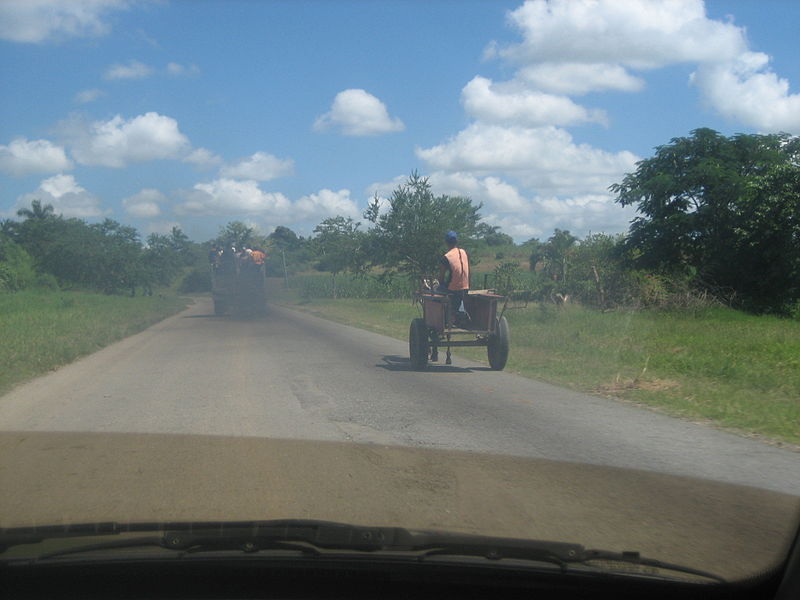
Typical traffic scene on a secondary road between Santiago de Cuba and Holguín (2008)
I plan to turn misery into a virtue and live without the internet for two weeks. It will be a first since many, many years ago in my life.
So: #nointernet and #noweb. #noTwitter and #noFacebook. Away from the virtual world. Into the real world.
Also, I will not plan anything, neither will I have an agenda. No itinerary. Just living in the here and now and enjoy life. Simply strolling through Cuba on our bikes – with wide open eyes and ears and, above all, with an open heart. Enjoying the sun and the warm air. And of an evening, I will just have to see where destiny takes us and where we can find a place to stay.
It also means that, during those two weeks, I will write/publish no IF blog articles. So: also #noIFBlog!
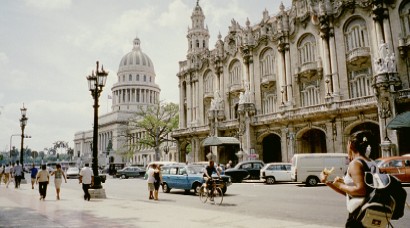
Havanna –the capitoll
I might write down a few impressions and take a few pictures of the travels. You will get to read them afterwards.
Other than that, I want to totally liberate my brains from everyday concerns. And leave everything back in Munich that belongs there. And live in Cuby one hundred per cent.
Neither will I write my memoirs, regardless of the fact that there might be some rather interesting things to tell, especially about the last few years. …
RMD
(Translated by EG)
P.S.
I took all the pictures from Wikipedia.
“Flag of Cuba“
“Havanna Capitol” – Author: Breogan67
“Traffic scene on a secondary road” – Author: Escla
All licenced under common property in Wikimedia Commons
P.S.1
Well, it would certainly be awesome – twittering from Cuba, wouldn’t it?
Roland DürreSunday February 22nd, 2015
At Eye-Level – A Film about Work-Life in the 21st Century.
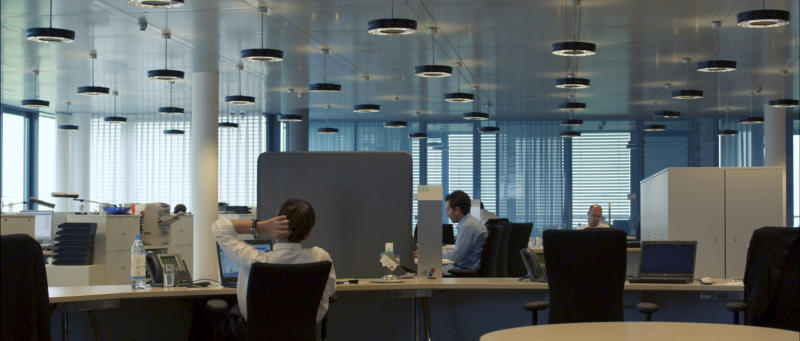 A team of five started an exciting project – and eventually it turned into a film: “At Eye-Level “ (Augenhöhe).
Here is the story: During a session of the 12th intrinsify!me “wevent” in Berlin about the work-life value of the 21st century, the idea grew that you should not only describe everything in words at all times. Instead, you should show it to people – in a film.
Five session attendants remained together and got active. They made the film “At Eye-Level”. I first heard of this project on the Berlin 2015 PM Camp during a great impulse presentation by Ulf Brandes. Later, I saw parts of the film during the Munich 2014 PM Camp. Two of the protagonists playing in “At Eye-Level” are personal acquaintances of mine through PM-Camps.
Thanks to enormously well-used “social media”, the project quickly earned great acclaim, even beyond the internet. The successful crowdfunding for its financing, too, had enjoyed a huge amount of public awareness and was accordingly very successful. The opening night on January, 30th, in Hamburg, too, had a huge audience. More than 400 (!) persons came to watch the film at the Hamburg Museum der Arbeit.
The film is about good topics. Perhaps its professional quality cannot hold a torch to documentaries with similar topics, such as by Geyrhalter, Wagenhofer (among other things the trilogy We Feed the World, Let’s Make Money and Alphabet) or Carmen Losmann (Work Hard – Play Hard). But neither does it need to – it is more a refreshing production on the level of TV reports by the ARD or ZDF, for instance about shipping electric waste to Africa.
The film is about persons acting different roles in their work-lives: entrepreneurs, managers, founders. But above all, it shows employees happy to be working for “good” employers. Because they can, for example, due to innovative working hours models, dispose of their own free time more freely than is common and therefore organize their own lives as they wish.
Unfortunately, though, the highly praised project “At Eye-Level” is also one where not all is gold that glitters. Shortly before the film was finished, two articles about Adidas and Unilever were added to it.
Adidas
Suddenly, you see Christian Kuhna in the film. I first met him at the open-up Camp in Nuremburg. His job with the sports giant is about social media, Moocs and the like and he has a small but very efficient team at his disposal
I am sure that the work-life attitude in Christian’s team is good and modern. Also, I am always impressed by the competence and positive attitude of all the salespersons in Adidas shops. But I am sure this is not true for the huge majority of persons producing for the concern.
Consequently, including Adidas in the film was a source of controversy among “crowd funders”.
Unilever
At the very end of the shooting, Unilever, too, was added. Even as early as the meeting in Munich, I was surprised to find the food giant presented as a positive example. There, Sven Franke – one of the protagonists – told us that Unilever had contacted “At Eye-Level” because they had established contact during the film “WORK HARD PLAY HARD” by Carmen Losmann. In that film, they had not made a particularly good impression and consequently, they wanted to make up for it. Well, no matter what, Unilever definitely is not the best material for this kind of film.
Sven’s reasoning was as follows: they wanted to show that even a huge enterprise can have a few niches where work-life might happen at eye-level.
Well, this might be a matter of taste. To be sure, every huge enterprise also has a few “islands of blessedness”. Even if it is only the team of directors.
However, it is also possible that Adidas and Unilever were included because they are “big names”. Which might have made the producers think makes the film more attractive. This is certainly also an acceptable decision. But if so, you should also communicate it as such.
When talking “big names” and these kinds of ideas, Tomas Sattelberger, too, comes to mind. He, too – just like he also currently seems to be publicly visible all the time – appears in the film. After all, everybody wants to hear and see a repetition of the Saul-Paul story. I do not know Tomas Sattelberger personally, but only from what I read about him in the press. Consequently, I cannot give a valid estimation. But in his roles as director of famous DAX concerns, he did not look like the typical representative for “eye-level” to me.
Well, so much about the small stains on the otherwise clean slate.
Mind you, please not to misunderstand me: I find the topic “eye-level” as formulated by Sven Franke or Ulf Brandes an excellent idea. The same is true for the activity and the result. Also, the enterprises concerned are welcome to the gain in reputation they got from it and I would be happy if those who initiated the project were also reimbursed in a material sense for the huge amount of energy they put behind it.
It is a true delight to discuss the individual film scenes under the “entrepreneurial” light. Especially the founder’s enterprises shown in the film might suggest that a proper firm is only possible where you have the “good tyrant”. The question I ask is: how can the entrepreneurial culture shown in the film also be structurally included in our social system – for instance in the sense of a “democratic enterprise”.
RMD
(Translated by EG)
P.S.
The picture is not from the film “Augenhöhe – At Eye-Level”. I took it from “WORK HARD PLAY HARD” by Carmen Losmann.


