
Roland DürreThursday October 8th, 2015
Vintage Project Management #1 – My First Project

What you see on this picture did not yet exist – it only came when my project was over. My first project was realized in the Koppstr. (Hofmannstr.)
During the Berlin PM Camp, I told the stories of four projects from vintage times that were very important for me. And I also announced here that I was going to publish all four of them in the IF Blog.
So here I am now, beginning with the first small project:
Project #1
The first project of my life was but a small one. It was scheduled to last six weeks and it was my first professional activity in data processing.
In those days, I was a student of informatics starting for the second time. The first time had been in 1969, when I started studying mathematics and minored in informatics at Technische Hochschule München (THM). The only alternatives for the minor subject would have been physics – which I did not like – and business. However, I was a little sceptical, because I had been attending and graduating from the Jacob Fugger “Business Grammar School” in Augsburg. And at that school, accounting, which I was quite good at, had been an A-level subject. On the other hand, the knowledge taught in business and economics seemed a little questionable to me – which, incidentally, is even more true today. Consequently, the only thing to minor in left was informatics – and that sounded really exciting, too. Professor F.L. Bauer actually succeeded in whetting my appetite in the fall of 1969.
And then, on April, 1st, 1970, dark powers and a mixture of ill luck and ill advice forced me to serve in the Federal Army. That was not at all an April’s Fool Jest, which meant that I had to spend 18 months in rather questionable surroundings as a conscript.
And when, late in September 1971, I regained my freedom, I just started anew. Again in the first semester, again with the same combination of subjects, and again at the same college, which suddenly was called TUM (Technische Universität München).
But there was nothing new except the name. And I knew almost everything because in 1969 I had still been a rather diligent student who had listened attentively and learned with enthusiasm. Consequently, I was doing well and the Olympic Games of 1972 came along. Besides studying, I had a great job with good money at the German Railway (at the time still called Deutsche Bundesbahn) as a customer service person for guests from all over the world. And in some way or other, the entire world was mine for the asking …
In 1974, I finished my intermediate diploma successfully and again needed a little more money than I made as a TUM tutor (teaching Linear Algebra I and II and a programming course). I narrowly missed being eligible for BaföG and my parents – also working at the German Railway – said I could easily continue living at home in my room and commute to Munich like my father always did. But that was not what I wanted. Consequently, I was looking for a summer job – and, naturally, the favourite prospective employer was one of the leading high-tech and computer companies.
In those days, that was what Siemens was! Seen in retrospective, it is hard to believe what immense know-how was present in this company in a huge number of areas. They took me in at Siemens and so I was in the middle of the real high-tech world, first for six weeks in the summer of 1974 and then for the entire duration of my university education. I had direct access to computers, operating systems and programming languages – and I mean I was filled up with them to the brim, which was totally different from what they offered, for instance, at the so-called TUM.
And I got my first project at Siemens on my very first day! My (department) boss was Mr. Bieck. He was a hardware person and later became development head at one of the upcoming German computer manufacturers: Kienzle.
Kienzle was only one of the smaller Siemens competitors – but it was certainly remarkable to see what these enterprises – just like much larger enterprises, such as Nixdorf, or many smaller ones managed to accomplish in those days.
During my six weeks as a summer intern, I had total freedom – provided the actual task I had been assigned got finished. And they also told me that the problem I had been given might not be solvable at all. But that it would indeed be very much appreciated if I managed to solve it. It was actually the same I heard over the last few years from people about google: you give yourself unachievable goals, yet you get a nice tolerance for possible failure, which means you will be truly happy when eventually you actually manage to solve the problem.
The task was easy to formulate: The department wanted the highest possible Mersenne prime numbers. For a hardware prototype.
For non-mathematicians:
A number is a Mersenne prime number if it is a prime number derived from a power of two minus 1. In other words if (2 power n) – 1 or (2 power m) – 1, is a prime number.
That is my spontaneous definition.
Well – and my boss wanted as many n-s and m-s as possible. He was not interested in being shown how I did it – as long as I did it at all.
The background:
In those days, a lot of people were really active doing “research and development”. It was truly great. But it was not some R&D totally remote from practice. No: in almost all cases, your work would serve to promote actual applications and projects. That made it truly cool.
Practically applied R&D needs theoretical background. Business got that from the universities (in those days, there was still something you could get from them). And, naturally, Siemens AG also looked across the borders – particularly across the inter-state borders. Because the GDR universities were not so bad at all. And they gave us lots of great results.
For instance, there was a scientific work sitting on my desk – I think it had been written in Leipzig – in which someone had given the theoretical proof that it is possible to build an accidental generator from a ring connection with n binary switches.
And if you short-circuited the structure at the right place, the system would generate a maximum period of random numbers.
It would happen if and only if the number of used switches n is a Mersenne prime number. And if the short-circle is after the m-th switch – and if m is a Mersenne prime number. (please forgive my clumsy description, I was never much of a hardware person).
I never understood this work. Also those six weeks would probably be far too short. But then, this was totally irrelevant for my job. All I was supposed to do was deliver very high prime numbers of the type 2 power n -1. Even the prime numbers were unimportant. All that mattered were the m and the n.
For my software friends:
In the early 1970ies, it was totally utopian to build such a thing as random generator software. After all, the device was supposed to create the bit patterns rather quickly, because they were supposed to test the maximum flat modules for large-capacity computers. And those were rather fast gadgets, considering the times.
Also, Herr Bieck could not have cared less how I solved the problem – that meant it was up to me if I programmed something for the calculation or if I found the big Mersenne prime numbers somewhere else in the world. All options were open.
Consequently, I spent the next few days in various libraries (Siemens, StaBi, Unis – you have to remember that, in those days, the internet did not exist). And I quickly realized that there was no chance for me finding Mersenne prime numbers in this way, even if someone on this planet had already calculated them.
This is why I forced myself to come to a quick decision. I was going to forget the world around me and try it by myself – by just programming. I still had more than five weeks to go.
This was the first thing I learned about “project management”: Decide quickly, especially if it is a really hard decision and you basically know no way out.
Then I tried to do some traditional programming. I thought in terms of the decimal system, looking into integer and arithmetic calculation systems. And after two weeks, I noticed that I was never ever going to succeed with this strategy.
And this was the second thing I learned for future projects and for life: Whenever you do not know how to continue, you have to try new ways! Kiss old concepts and patterns good-bye, and do not hesitate!
So I decided to no longer look for huge numbers. Instead, I just saw a number as a field of bits. And all of a sudden, all those big numbers became small numbers. For instance, 2-to-the-power-of-256 was now a binary field with the length of 32 bytes. And you can calculate rather elegantly with bit fields each of which has the length of 32 bytes. All you have to do is some shifting. And suddenly, the huge number had lost all its scariness …
I told you this story for two reasons.
Firstly, because all of a sudden it became clear to me that, on top of deciding quickly and courageously, you also have to leave old mental concepts if you want to achieve something special. And I often suffered under this and under the typical “But this is how we always did it …”, because it blocked the way.
And because I am living proof that, more than 40 years ago, Siemens actually worked in the same way as they sometimes say Google does today. And that in those days they achieved really great things and that there was not much competition world-wide, perhaps IBM and Xerox or Hitachi. All the others were just in their initial phases.
In a short time, you will read my next Berlin #PMCampBER story on vintage project management. It is from a time when I had a contract as an employee – at the Siemens laboratory. That was in the late 1970ies. I will relate how Siemens did everything, and I mean really everything, to destroy its greatness.
It happened because they kissed their old virtues good-bye and introduced division of labour (Taylorism) in the creative areas such as product planning (Requirement Management) and quality management, specialized DV/IT teachers in their D-schools, manual copy editors and many more such roles.
And, above all, whenever there were things to decide, the questions they asked were: “What is the profit of this?” and “What is our advantage?”, instead of the question: “Why do we do this?” – as in former times.
At the time of my first project, there were no such things as project managers. The first project manager you will find in the world as I perceived it will come with my third project management vintage story. That was in the early 1980ies.
RMD
Roland DürreMonday October 5th, 2015
Meeting to Give Our Future Chance.
Isn’t this great?
Only the colleagues at Visual Braindump
– Christian Botta and Daniel Reinold –
can come up with this kind of idea for saying it in a nutshell in graphic form – our ActMobCmp:
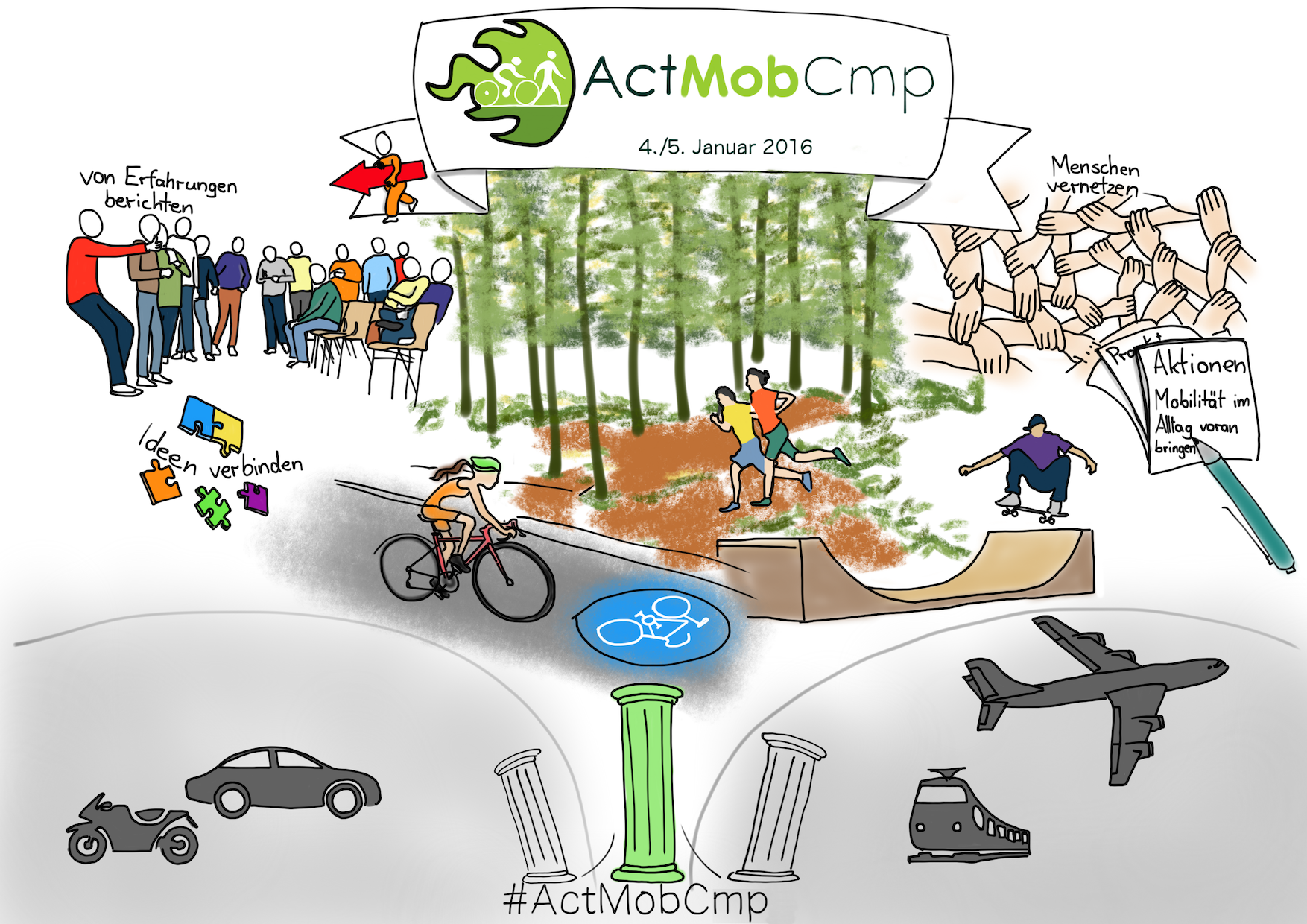
Click to scale up.
“Active Mobility in everyday life” is the third column of mobility, besides individual motorized traffic and public transportation. Unfortunately, it is often considered no more than the leftovers, both in society and politics.
We promise:
AktMobCmp will be a great barcamp that takes place at a rather uncontested time! We will experience two special days in the company of people we like to meet between January, 4th and 5th, 2016 at Unterhaching.That hurts, and we have to change it. Because we have to rationalize our mobility in order to preserve our future resources!
Many thanks to Christian and Daniel for their huge support!
RMD
(In the name of the AktMobCmp team/translated by EG)
P.S.
Here are two IF Blog links for articles on AktMob and AktMobCmp. And since it is such an important topic, I would invite you to share and re-tweet!
Roland DürreSunday October 4th, 2015
I am not a hero.
After my Angry article, there is the question:
So what is my contribution?
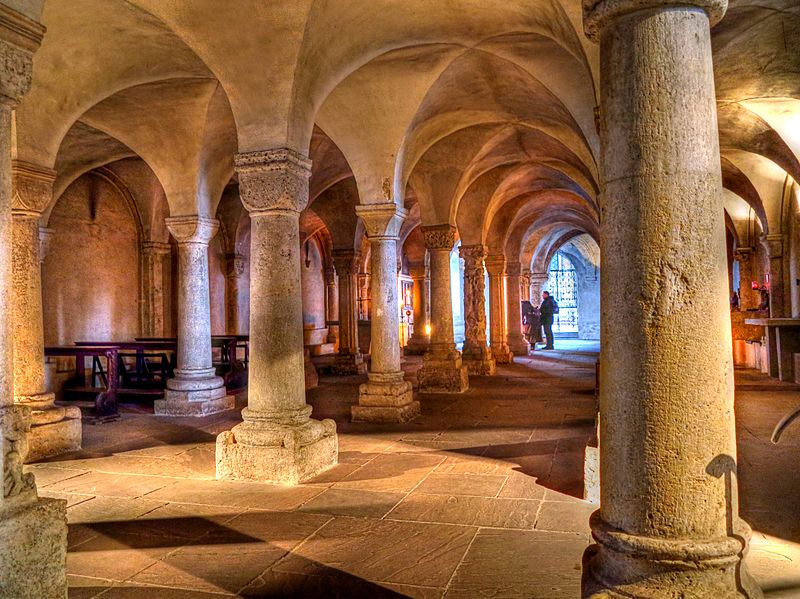
Crypt of the Freising Cathedral
For me, philosophy is something like the science of living. I think of Seneca. A long time ago, he said to his students:
Philosophy teaches you to act, not to talk.
Consequently, the angry person, too, should see if his actions speak the same language as his words. And I must admit that I am not satisfied with the outcome of my self-analysis.
To be sure, I try to leave the social norms and patterns I so criticize. And, where possible, I also try to initiate change. But is that enough?
Far too often, I realize how I am trapped in my bourgeoisie. My trainers, among others, were my parents and my teachers. Numbers of system agents tried to form me according to what they thought I should become and tell me where to go and what to do. Morals and an extremely capitalist consumption-oriented society already influence me massively on a daily basis.
Regardless, I hope I am one of those persons who basically to not consider our “trained lives” unavoidable. At least, I always tried to flee the reins of the aforementioned animal tamers. And already I feel better. But what I do is not enough. To be sure, I no longer go places by car. But then, that is something you could almost call egoism. After all, I am now suddenly a lot more mobile and free than I ever was before. And through this change and (allegedly) these restrictions, my life has become a better life. That certainly helps when it comes to thinking new thoughts.
Looking upon my own generation, it truly gives me pause to see how many of my companions never knew anything other than being trapped in their emotional jails. I know people who, in their entire lives, obediently believed all nonsense that was ever dished out to them. They actually relinquished their autonomy in small portions for the sake of being comfortable.
Others never once in their lives, when at a point of bifurcation in their lives, followed the motto “love it, change it or leave it“ . As a consequence, they were made to feel smaller and smaller. Regardless, today they think they are the most important thing in the universe, live their status and drown in their anxiety. The constant fear of losing what they own makes them inhuman. They seem to have forgotten that they, too, are just mortal beings.
I am fed up with following the nonsense of this society. In the coming years, I want to do more. So I was looking for models. I already found one: Carl Amery. I find his life and work impressive. I think he was a true hero.
Unfortunately, I am not a hero. But who knows, perhaps in the future…
RMD
(Translated by EG)
P.S.
I took the picture from Wikipedia. It is the illustration of the article on Carl Amery (real name: Christian Anton Mayer), originally by Richard Huber.
Roland DürreSaturday October 3rd, 2015
Angry!
 Once in a while, I get really angry. The last time this happened was during a forum. It was about “un-schooling”. The system of collective (federal) schools was judged to be the only appropriate variant of teaching and “education” for young persons and “un-schooling” was said to be socially inacceptable.
There are other statements I also very much object to. For instance, I see red when I hear
THAT
- We have to produce weapons.
- Lobbyism is a necessary part of our economy.
- A speed-limit would ruin said economy.
- Concerns have to make maximum profit.
- There is no alternative to constant growth.
- Dismissal protection cannot be abolished.
- It is total nonsense to think about a “UBI” (unconditional basic income, instead of all the social subsidies).
- BND and the Federal Office for the Protection of the Constitution are absolutely important and necessary.
- Total transparency and openness in society and software is not possible.
- There is no alternative to patents and copyright.
- The climate catastrophe is just an invention of green nerds.
- You have to tolerate both circumcision
- And the suppression of women
- …
But back to the school discussion: if some people shun classic systems such as the school system, then this is, for me, the last and as I fear eventually unsuccessful attempt of individual persons to flee from a world I actually do not like at all..
I MEAN A WORLD
- Where people, both individually and collectively, act in a way I disapprove of;
- Where stupidity always wins and where I get the impression that it is not possible to be so stupid unless you act as a group (see also Dueck – Schwarmdumm),
- Where few of us actually get far too much warmth and calories, yet others get nothing – which means everything is taken from all of us;
- Where they tell us we are omnipotent, yet de facto there is the permanent attempt at total manipulation;
- Where they try to take away our freedom and to convert us into becoming servants fitting the system;
- Where nobody likes you if you critically ask “why”;
- Where the question “what profit can I make from this?” is the motivating factor for all our actions;
- That tries to make unequal things equal;
- That tries to discourage us from being creative;
- That dissuades us from believing in utopia;
- Where all you hear all the time is “it cannot be done, anyway”, “this is how we always did it” and “yes, but…”;
- Where, from earliest childhood on, we are accused of being “guilty”, regardless of the fact that our brains are not all built to know how to deal with such accusations;
- Where everybody talks about eye-level, sharing, participation, respect, tolerance, civil courage, … but
- Where every attempt at autonomy is first and foremost punished;
- Where invitations to “give more than you take” and to “remain true to yourself” sound like mockery;
- Where, as a matter of course, you make others feel smaller, rather than bigger;
- Where rules from the natural sciences are welcome as long as they are useful, but abhorred when they clash with what we want.
- …
In evolutional theory, they say that matters will only change when the old generation dies out. Consequently, I have all the respect in the world for parents who take responsibility and decide to teach their own children. These days, such a pledge in favour of the family is scarce. And to do so, you have to focus on the important things in life and to forego many luxuries.
Isn’t it a lot easier and more comfortable to put children (incidentally, the same is true for the elderly) into storage? To be sure, sooner or later the parents will bow under the pressure of the school. They will become aliens in the eyes of their own children and eventually even turn into the agents of the system “school” – against the interests and wishes of their own children.
This means that the variants of “un-schooling”, “no-schooling” and “home-schooling” are not arrogant or uppity, but revolutionary. In fact, we need this kind of courage to replace thoughtless following in many other areas of our lives (nutrition, leisure time, life style, …). Just like we need the willingness to make “sacrifices” for our future and to work towards contentedness and happiness, rather than buying it.
For a good “un-schooling”, you have to give your children much. Especially the most precious commodity you have: time. It is scarce. It also takes a lot of time to change your own life. Consequently, time is something we should not waste. And we have to distance ourselves from what they want to sell us as desirable.
Abstinence takes an effort. Yet abstinence is probably the first counter-measure against being controlled by others. You can easily be heading towards disaster if your life is controlled by others. Perhaps it is even harder for lonely persons to find their own lives.
It is well worth trying to flee the formatting of a perverse society. We humans have spent enough time letting others turn us into trained monkeys. It was especially perverse during the long 19th century. Enlightenment can only have been a first step. It brought us peace and freedom, but also war and destruction.
Well, for me this means more than ever that we need a second enlightenment. And we have to continue dreaming our utopian dreams of a soft and violence-free world without “punishment” and “revenge”.
Thank you very much!
RMD
(Translated by EG)
P.S.
Incidentally, in Germany, the “un-schooling” discussion is beside the point. As opposed to other European countries, it is explicitly forbidden by law. Regardless of the EU and all the bureaucracy that comes with it…
Roland DürreWednesday September 30th, 2015
#Breaking with Patterns II – Communication
In preparation of the Dornbirn PM Camp on November, 20th and 21st, we installed a blog parade on #breaking with patterns: here is my second article on this topic:

Teletype Machine (Siemens T100) – introduced in 1958. It was the modern successor of the T50.
So far, it looked to me like I was a #de-cruster. Perhaps I am also a #pattern breaker. After all, I no longer go places by car, using the bike instead. And, especially in winter, this is unbelievable for many of the persons I meet.
And whenever I do not have enough coat hangers, I throw away some of my clothes, instead of buying new coat hangers. Those and many more are the kinds of things I do.
But then, perhaps I am not breaking patterns at all, instead being trendy like everybody else? For instance when it comes to using the telephone. Because I have now come to that stage where I have completely reduced calling people. In fact, I find it impolite to inconvenience other people by calling them. And, of course, it is also because I, myself do not wish to be interrupted all the time by receiving a call.
Here is my personal “telephone history“:
I used to be a true “multi telephone person”. When InterFace connection was still very young, I spent a lot of my time with customers. Consequently, I always spent an hour in the middle of the day calling the company. And since I never use a customer’s telephone for my own purposes, I always had to go downstairs and use the public phone booth.
In those days, I also discovered the C network. However, it was expensive, you needed an extensive installation process and the network itself was as limited in its availability as its quality was poor. Besides, I always wanted to be able to totally focus on the person at the other end when having a telephone conversation. Consequently, I never used a car telephone; later, too, calling someone from the car was only the absolute ”ultima ratio“.
In the times of public phone booths, I always had a sack of change on me. Later, I always had a number of telephone cards in my briefcase. And, as soon as the D network came, I immediately had a cell phone. My fees were extremely high.
Now, I find it harder and harder to come up with good reasons and situations where I absolutely have to use a telephone. For instance after having made an appointment with someone to meet at the central train station and already having found a nice place to sit for me and my travelling companion. Then I will call him. But only if he has no Whats up, BBM or other messenger. When all is said and done, the only time when you actually need it is for the emergency call – when the murderer approaches.…
Consequently, I no longer call people. Because if there is something really important I wish to discuss with someone, then I want to do it in a leisurely fashion. Once in a while, I also want to have five minutes to prepare for a conversation. I want to see his face. If this is even possible across continents, then why should I not make use of the opportunity.
Consequently, I make an appointment with my business partner. As soon as possible and preferably through social media. If no other way is possible, then with an email dialogue. Then I will enter “video conference” in my calendar and all will – at least if it is a hangout – be initiated automatically. If the person at the opposite end does not like google, I take Skype (Microsoft) or FaceTime (Apple). If my partner likes neither Microsoft nor Apple (which is something I can easily identify with), then there are enough other alternatives.
The entire conversation will also be much pleasanter. I comfortably sit on my sofa, my chrome book is lying on my lap and my conversation partner’s friendly and smiling face can be seen on my screen. I need no headphones (and also need not press a telephone against my ear), can simultaneously formulate something with him on shared documents (perhaps for resulting notes – also called minutes), we can look at and process tables together and we can look for and show each other an image, and much more.
🙂 No – teletype machines, fax machines, telephones – those are devices we no longer need…
Doesn’t this also have something to do with “breaking with patterns”?
RMD
(Translated by EG)
P.S.
The pictures shows a teletype machine by Siemens. It is a model T100, the table version. As far as I know there was also the model T100o – but that was it.
This mechanical teletype machine had a modular structure, which means it could be added to. On the left side, you see a tape perforator for generating perforated tape. Underneath, the transparent container for the cut-out material. On the right, you can see the optional perforated tape reader, which made it possible to send pre-written messages with maximum speed. On the basic device, you can see a red note about the update to 75 Baud above the active-hours counter.
After a certain running time, the teletype machines used and rented by the Deutsche Bundespost were completely disassembled at the FZZA Elmshorn and then newly reassembled. The blank key has the switch between letters and digits on the left and right sides, which is necessary because of the Baudot-Code with only five Bit (CCITT5). The paper is an endless roll, perhaps a self-copying paper with a copy since there is a slightly crooked grey intermediate layer.
Source: Wikipedia – you can find the image under the GNU licence for free documentation ,Version 1.2 or a later version. Published by the Free Software Foundation,
Roland DürreSunday September 27th, 2015
“Breaking with Patterns” at Dornbirn PM Camp #PMCampDOR
 Now there are less than two months to go until the DornbirnPM-Camp on November, 20th and 21st. I already look forward to the meeting on the eve of the camp and the Camp itself.
This is already the
5th PM Camp in Dornbirn, PM-Camp celebrates an anniversary!
How fast time goes by! With Dornbirn, we close a great PM Camp year 2015. This year, we had wonderful PM camps – in Stuttgart, Zürich, Bad Homburg, München, Berlin, Karlsruhe, Barcelona and Vienna. I hope I did not forget any.
Again, the Dornbirn organizational team wants to host a very special PM Camp. In fact, the standards are extremely high this year. As a metaphor for Dornbirn, we chose “BREAKING WITH PATTERNS”. Since, to me, it seems a very good idea to change and rethink, I voted in favour of this motto.
During the last few days, I had to learn that “BREAKING WITH PATTERNS” has become accepted. In fact, it has even become hype. I found it in the program of workshops of Bavarian school directors, came upon it on story-telling exercises and it winds its way through the media like a hurricane. There is a nice Blog-Parade on the PM Camp with an anchor to the beautiful blog Experiencing Leadership (Führung-Erfahren) by Marcus.
Consequently, I now already heard and read a lot of wise things about it. Yet I am still not able to form my own opinion. Because in order to break with patterns, you probably will first have to see them. Also, it is quite possible that collectively valid patterns will generate individual habits. And it is always hard to change what you have come to love. More often than not, you hear and read: “We always did it in this way”. Well, after all, this is how we always did it, isn’t it? And now someone expects us to do it differently? That is hard.
But perhaps it is quite easy. Perhaps what you should do first and foremost is “turn things upside down”?
Here is an example:
There is an unwritten law in our “free-economy-society” that something gets less expensive the more of it is bought. This is even true for material that will become scarce in the foreseeable future and will eventually no longer be available, such as crude oil. The same is true for electricity or food. If you buy ten cars (or bicycles), you will get a better price than if you only buy one. It is called quantity discount, quantity rabat or quantity bonus.
Now let us look at the connection between the “climate” and “flying”. There is no doubt that air traffic generates an immense amount of greenhouse gas. Even in higher altitudes – where their detrimental effect is even higher than on the ground – huge amounts are ejected.
It is the goal of the airline industry to bring as many persons as possible into the plane by offering low prices. On the other hand, the models and calculations of various scientific disciplines agree in that they say global warming with the resulting change in living conditions for all of us will hugely depend on how we behave (in terms of burning fossil energy).
Consequently, it is clear for everybody – at least all those who do not believe in superstition – that, among other things, we have to fly less if we wish to cushion the downfall into the (climate) catastrophe at least a little bit. We have a discrepancy. We want to fly more because we need growth (which would actually be a second pattern to break with). Everywhere. And we should fly less. For our future.
So how to solve this dilemma?
A common and total ban of flying cannot be realized. In fact, for persons in special situations, it would actually not be just and reasonable. But then, the question is if the consequences of the climate catastrophe will be just and reasonable, isn’t it?
A common increase in flight prices would perhaps be asocial. Here is what a simple solution could look like: We turn the law of quantity rabat around and introduce a new law: the quantity malus. That would mean all citizens can fly a few thousand miles each year at prices similar to those we are now used to. As soon as the “flight buyer” has reached this limit, every extra mile will be more expensive. Maybe even geometrically more expensive. This would enable us to, on the one hand, maintain a realistic mobility, yet put the lid on at least the worst excess. And the extra money could be invested in reasonable progress.
The same pattern would, for instance, also make sense with electrical energy. Why should a company producing aluminium tins for beer and using up astronomically high amounts of electrical energy get it for a much lower price than the small one-family household that uses up almost no electric energy?
It would be better if this industrial waste were more expensive than the little used up in a household, wouldn’t it? This would not only lower the consumption cost pressure, but also cause human creativity to tackle (possible) solutions to such central problems. More often than not, better technology is already available, except that it is not used because the raw material is so much less expensive.
Why don’t we start by “putting things upside down”? I can imagine that “breaking with patterns” means a lot more than this, too. We are lucky to still have a bit of time to think about it until the PM Camp starts.
RMD
(Translated by EG)
Roland DürreThursday September 24th, 2015
Visit the Arcis-Vocalisten! Dates.
 I already advertised a few of the Arcis-Vocalisten concerts. Evelyn, who always helps me so much, sings in this choir with great enthusiasm. And she keeps telling me about all those nice concerts. And when I myself heard them sing, I was also truly impressed!
This is also why, here in the IF Blog, I so readily advertise this great choir under Professor Thomas Gropper, without whom the group definitely would neither exist nor continue to exist. And since this kind of enthusiasm is exactly what makes life worth living, I would like to take this opportunity and thank both the conductor and all singers of the Arcis-Vocalisten for everything they do just because they so much enjoy singing.
Here is a list of the next concerts this remarkable ensemble will sing:
Summary:
The new season will start with Giuseppe Verdi’s dramatic Requiem. Other highlights of the season are the Christmas Oratorio by Bach and St. John’s Passion by the same composer, both in the Munich Herkulessaal. Next spring, they will, again under the direction of Dieter Reuscher show a scenic performance Belshazzar by Händel. Besides, the choir will give concerts with an a-cappella program in Stuttgart and Tübingen, before traditionally closing the season with a Brunnenhof Munich concert: this time you can hear Haydn’s “Creation”.
The Concerts:
G. Verdi
Messa da Requiem
Thomas Gropper, director.
Sunday, November, 15th, 2015, 19:00 hours, Herkulessaal der Münchner Residenz
(Organizer: Bell’Arte Konzertdirektion GmbH)
J. S. Bach
Christmas Oratorio I-III, VI
Baroque Orchestra L’Arpa Festante
Thomas Gropper, director.
Tuesday, December, 22nd, 2015, 20:00 hours, Herkulessaal der Münchner Residenz
(Organizer: Bell’Arte Konzertdirektion GmbH)
H. Schütz, St. John’s Passion
J. Bahms, Warum ist das Licht gegeben den Mühseligen
Thomas Gropper, director
Sunday, March, 6th, 2016, 19:00 hours, Wallfahrtskirche St. Rasso, Grafrath
(Organizer: Kulturverein St. Rasso e.V.)
J. S. Bach
St. John’s Passion
Baroque Orchestra L’Arpa Festante
Thomas Gropper, director
Good Friday, March, 25th, 2016, 18:00 hours, Herkulessaal der Münchner Residenz
(Organizer: Bell’Arte Konzertdirektion GmbH)
G. F. Händel
Belshazzar (scenic performance)
Baroque Orchestra L’Arpa Festante
Thomas Gropper, director
Dieter Reuscher, stage director
Saturday, May, 7th, 2016, Himmelfahrtskirche München-Sendling
Sunday, May, 8th, 2016, Himmelfahrtskirche München-Sendling
J. G. Rheinberger, Missa in F-Major, op. 117
J. Brahms, Motets op.74
M. Fritz, De tranquillitate animi (June, 24th, 2016., debut performance)
Thomas Gropper, director
Friday, June, 17th, 2016, 19:00 hours, “Stunde der Kirchenmusik“, Stiftskirche Stuttgart
(Organizer: Stiftsmusik Stuttgart)
Saturday, June, 18th, 2016, 20:00 hours, ”Tübinger Motette“, Stiftskirche Tübingen
(Organizer: Stiftskirche Tübingen)
Friday, June, 24th, 2016, 20:00 hours, Himmelfahrtskirche München-Sendling
J. Haydn
The Creation
Baroque Orchestra L`Arpa Festante
Thomas Gropper, director
Saturday, August, 6th, 2016, 20:00 hours, Brunnenhof der Residenz, München
(Organizer: Bell’Arte Konzertdirektion GmbH)
What a remarkable program! I am sure there is something in here for everybody. So why don’t you mark a few dates in your calendar?
RMD
For the concert data, see also the Arcis-Vocalisten website.
Roland DürreWednesday September 23rd, 2015
DIESEL-GATE
 The mountain was in labour and brought to life a new word: DIESELGATE!
The German stock plummets, a managing director who was considered sacrosanct fell. In all magazines and media, you can read about it. You get the impression that something really bad must have happened to the German economy.
As I see it, this is true. Except that, so far, I read nowhere about the aspect I mean. Consequently, I will write about Diesel-Gate, because it seems to me that, again, a barrier was pulled down.
Mind you, it is not like I would not have put it beyond the automobile sector that they are capable of this kind of fraud. In fact, I no longer trust any sector. We know what banks do. In the pharmaceutical industry, you constantly get medicine that, at the time it is officially permitted onto the market, is certified to have a great healing effect and no side-effects to speak of. And later you find out that the exact opposite is true.
It is well-known that oil enterprises have very dirty hands. We also know that the food industry is no better. And even I know that my own sector, the IT, is not clean, either. Just remember with how much love spams and viruses are protected, just in order to sell servers and other hardware that is used for total nonsense.
No, the fact that the industry in general not only controls and misuses politics through lobbyism, that it manipulates through advertising and that it also is fraudulent once in a while is something everyone knows. For me, that would not be a reason to write this article.
However, as I see this case of “manipulation” with the software, a threshold was crossed in this case. I put the term “manipulation” between quotes because it actually was no manipulation. Instead, it was a very goal-oriented development – I am sure it was specified in the to-do-list and they also determined test methods for the “V-Model” or similiar.
No. What we are talking here is fraud functions voluntarily implemented into the professional control software. With the goal of deceiving another technology in order to fake something that is technologically not possible at this time.
Some way or other, I used to believe that there is a digital extension of analogous honesty. I trusted that control software of mechatronic (analogous-digital) systems will not be used for fraud. Now this trust has been categorically abused.
Consequently, the new dishonesty has now reached a dimension I had so far not registered, even in the software industry. And now my – perhaps naïve – trust in technologic-digital technology is gone.
RMD
(Translated by EG)
P.S.
Incidentally, this event is also an additional reason why one should massively demand the laying-open of all software.
Roland Dürre
Stories-Meal – Very Old and Totally Modern.
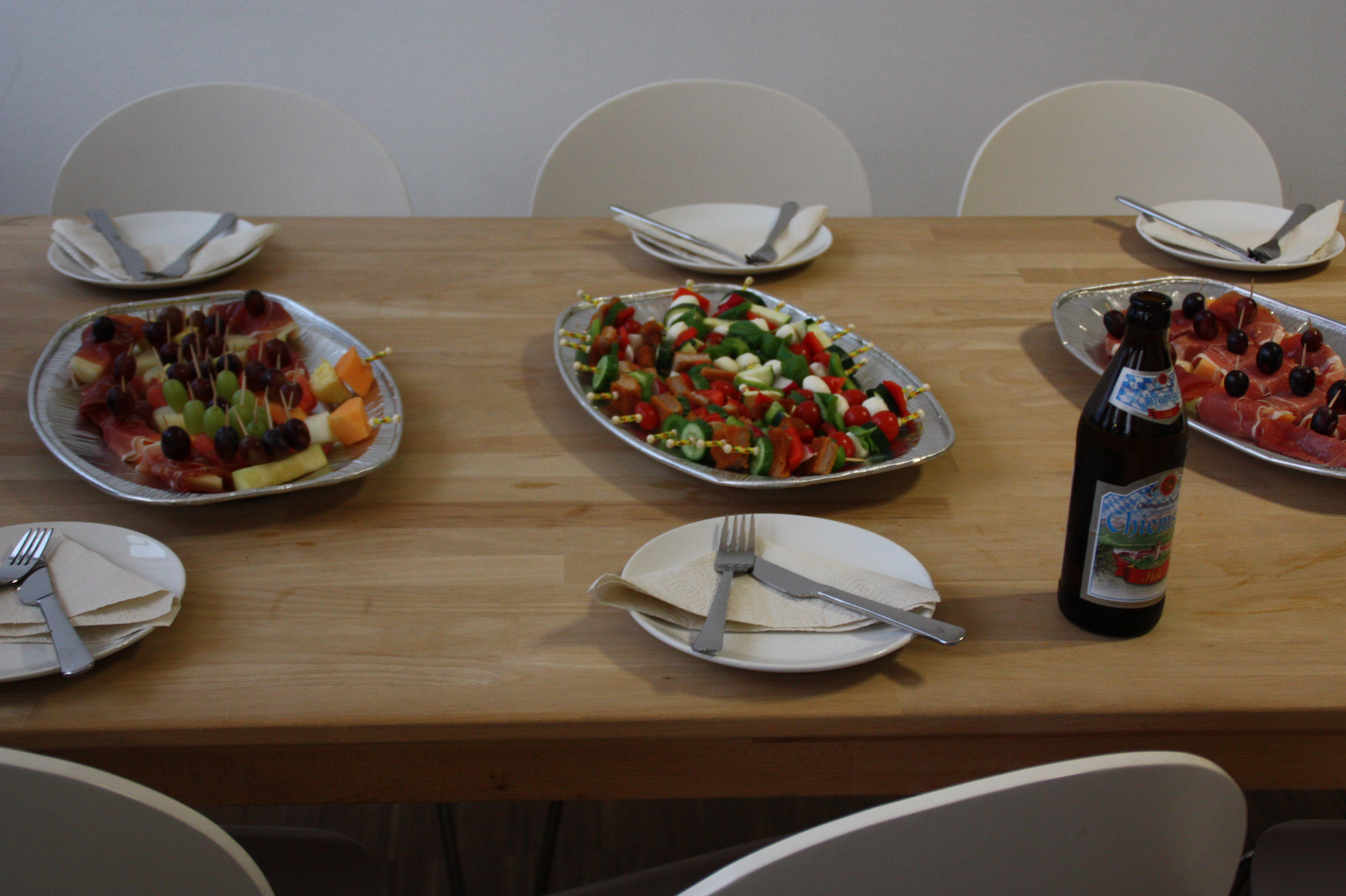
Very simple, but extremely delicious – the food at “Stories-Meal”.
Katrin Frische and Sacha Storz had invited us to a “Stories-Meal“ (Erzähl-Mahl) in the offices of TechDivision. I like both, so I gladly went.
Another reason to go was that the TechDivision is well-known for regularly nice events happening in their offices – sometimes the background of these events is more on the technological side, sometimes more on the social side. The last time I was there was during a “Munich Web-Week” on an agile topic.
A “stories-meal” is a little like an ancient Greek symposium where everybody is busy “comfortably and socially drinking”. Even the ancient Greeks enjoyed mental pleasures of discourse and debate, and perhaps even a little more of the good wine, both during and after the meal. In other words: at a symposium, you were eating and drinking well and enjoying life. And at the same time, you were being philosophical and seeking wisdom.
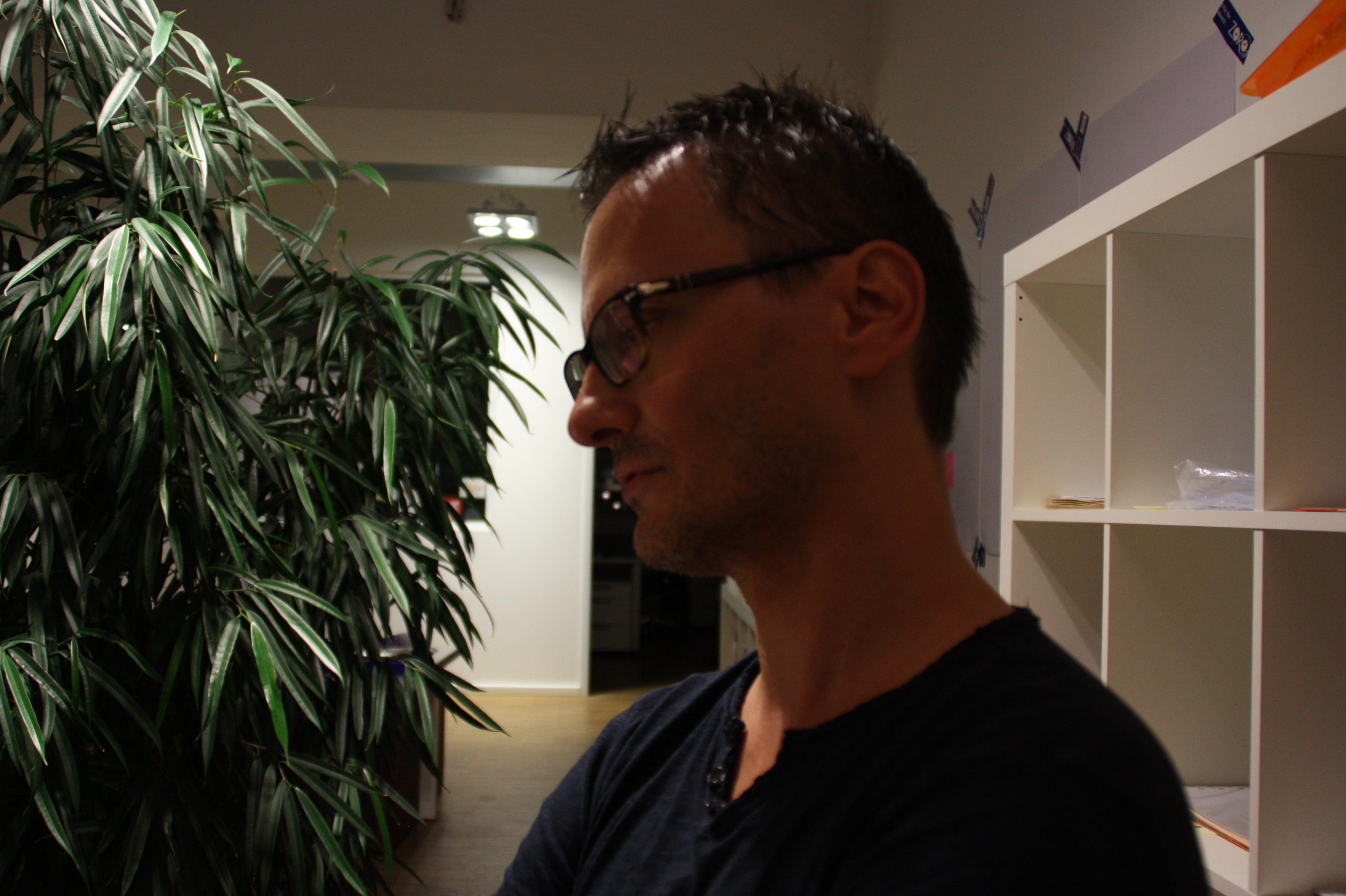
Sacha – our host in the beautiful TechDivision house on the Balan Strasse.
The “Stories-Meal” is a lot more sedate than a symposium and promotes an ancient culture of communication that goes as far back as the times of hunters and gatherers. Like in those ancient days around the camp-fire, the people tell each other stories. And according to our moderator Katrin, it is actually not about debating and discussing things. Instead, it is about listening and relating.
Our “stories-meal”, too, was only full of nice things. The delicious food prepared by Katrin was supplemented by a huge variety of soft drinks and a number of beer brands from the TechDivision refrigerator. It was like paradise.
We were only seven, because three of the guests who had already registered could not flee from their everyday-stress, after all, and had to cancel. If only they knew what they missed! For the remaining participants, it was so much the nicer and more exciting.
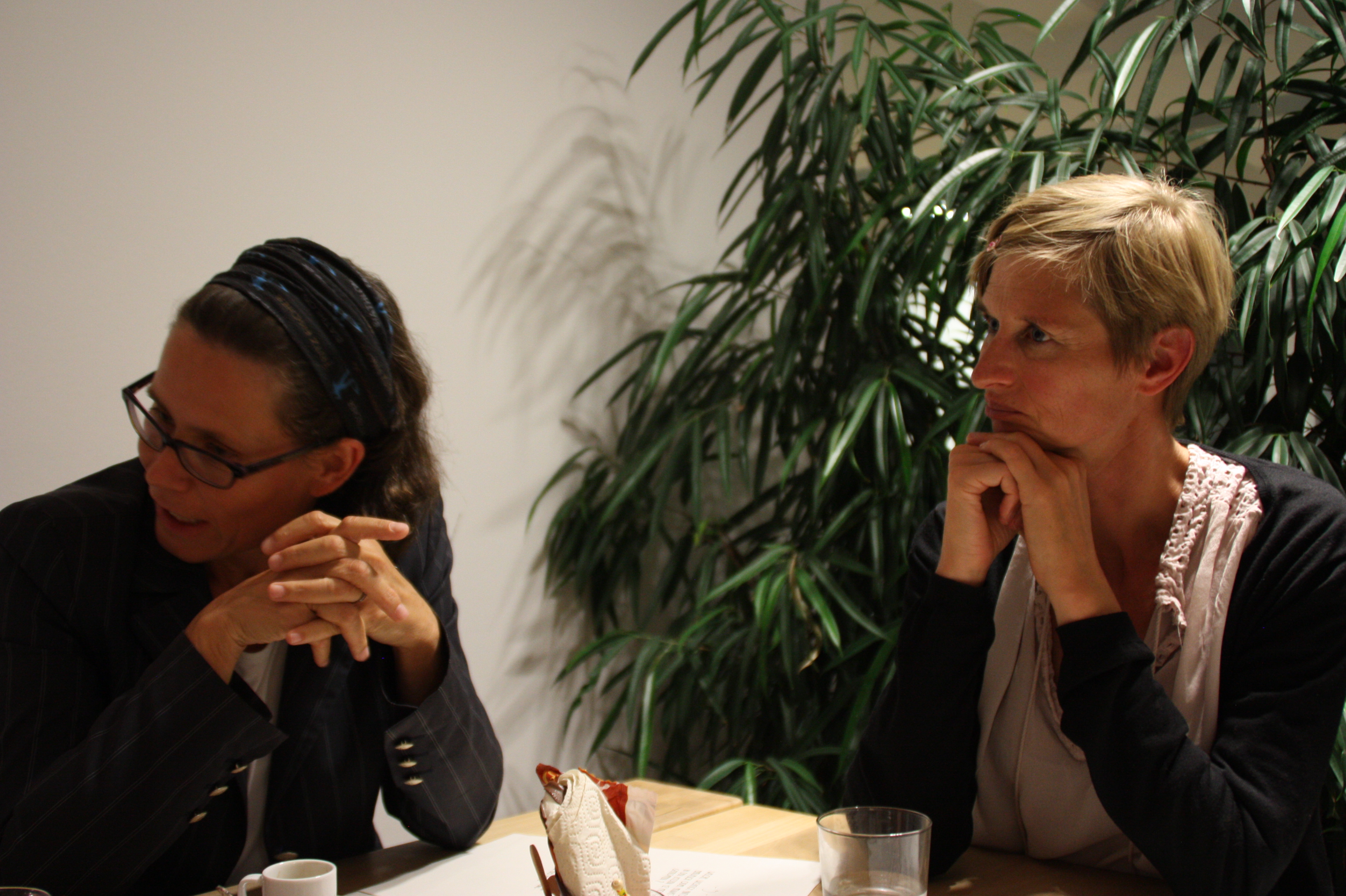
On the right, you can see Katrin listening, moderating and actively participating.
Katrin had prepared six wise questions on three sheets of paper. You could almost say she composed them. Two questions per sheet constituted a couple, so you got a triangle of topics. There were three to six catchwords with hyphens for each question, all of which was to make us thoughtful.
Let me tell you one of the pairs of questions – questions three and four, along with the catchwords:
Question #3:
WHAT IMPORTANT DECISIONS – PROFESSIONAL OR PRIVATE – DID YOU MAKE IN THE LAST TWELVE MONTHS?
Think about:
VALUES UNDERLYING THIS DECISION – CONSEQUENCES – INFLUENCE ON OTHER PERSONS
or
Question #4
WHAT IS THERE STILL IN YOUR LIFE YOU WOULD LIKE TO DO?
Think about:
YOUR VALUES – YOUR RED THREAD – IMPACT – DOING THE RIGHT THING – VOCATION – MEANING OF YOUR LIFE
I will not tell you more than this. After all, we want to keep up a little of the suspense. But it can be concluded:
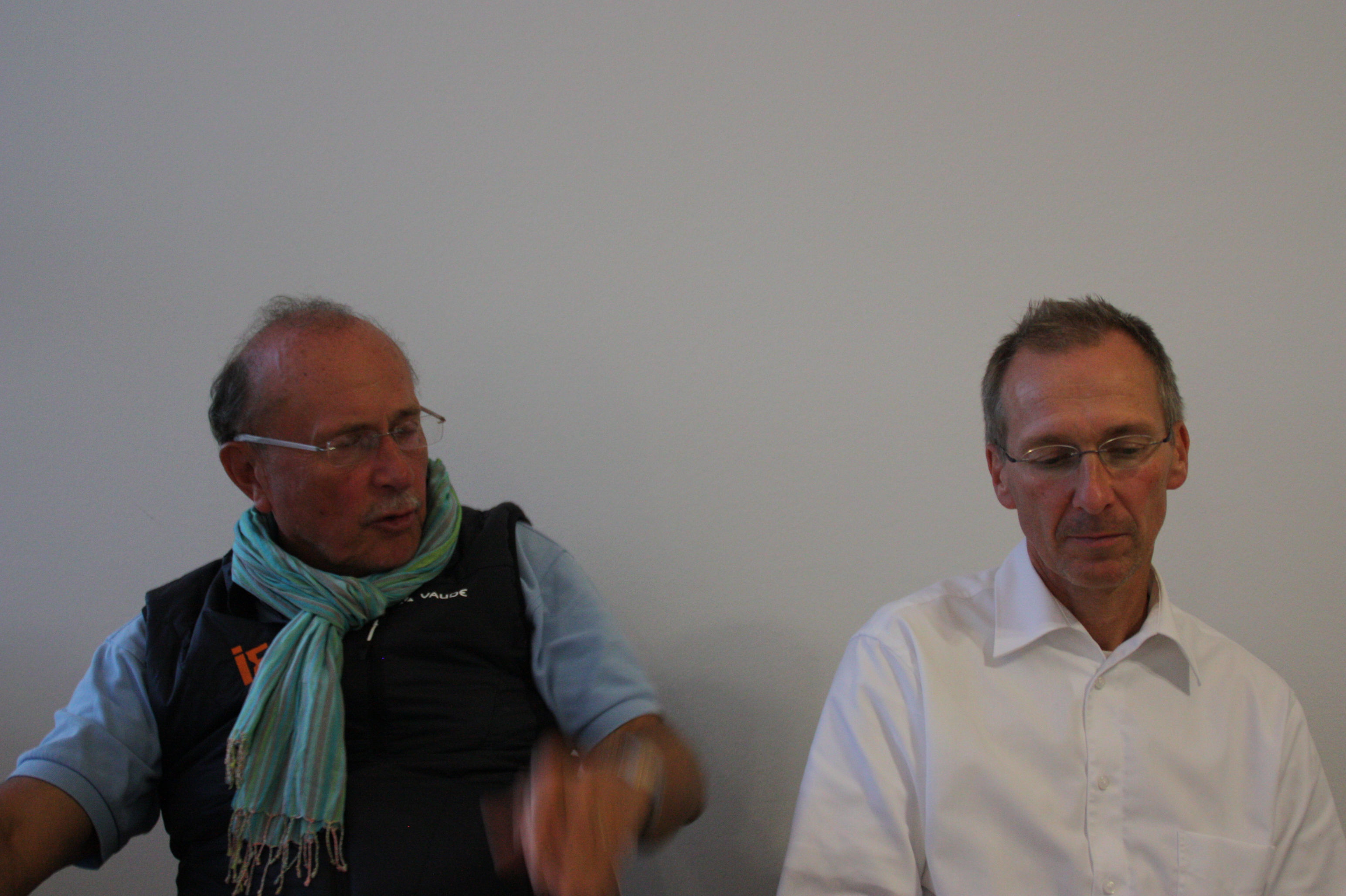
Carsten, my neighbour, too, is listening attentively.
It was a very successful evening. Inside me, it moved a lot. I would like to thank all the participants who, during this evening, gave me so much with their stories.
For me, the “Stories-Meal” turned into a “Think-Meal”. Because the many stimulating reports told from a different perspective really made me thoughtful. Consequently, I also told a lot about myself – and learned to understand more about myself in the process.
It was a very private evening. It was dominated by a huge amount of sympathy and – I would almost say a special development of empathy.
Und I am quite sure that this will not have been the last time I attended a “Story-Meal” at Katrin’s.
RMD
(Translated by EG9
Roland DürreMonday September 21st, 2015
IF Forum on October, 29th, 2015 – Dr. Andreas Zeuch – The Democratic Enterprise
ALL POWER TO NOBODY LIVE EXPERIENCE!
Now About:
All Power to Nobody! LIVE!
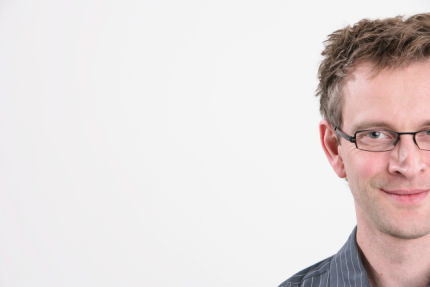 All Power to Nobody – that is the motto proclaimed by Dr. Andreas Zeuch. In his new book, which was published on September, 8th of this year, he discusses “entrepreneurial democracy” at great length. And it certainly is not a theoretical pamphlet, but an exciting report full of life. I would call it a courageous and provocative work that is the exodus of quite a few prejudices.
I personally met Andreas at the 2014 Berlin PM Camp. He gave the impulse on the morning of the first day. His topic was “how much intuition can an enterprise stomach?”. This presentation was such an inspiration for me that I spent the entire morning with Andreas. Consequently, I missed all the first sessions of the PM Camp morning.
Here is some of what you can read in the preview:
Entrepreneurial democracy – is that the future of work-life, or the punchline of the week? Can enterprises be a democratic event at all, or will shared decision processes not disable the enterprise and cause bankruptcy? After all, we do not exclusively need captains, but also privates, don’t we?
What happens when a CEO is elected? If a bank abolishes all its hierarchical levels, if employees choose their own tasks or if the cleaning personnel gets a vote when innovations are discussed? Will chaos be the consequence, or will the inner motivation of all start blossoming?
Andreas Zeuch went on a journey and found enterprises that show that entrepreneurial democracy is a living and economically successful alternative of the centralized top-down system.
 As always, you can register for the IF Forum by sending an E-Mail. Again, I will be permitted to moderate and I already look forward to exciting discussions and nice conversations!
RMD
(Translated by EG)


