
Roland DürreSaturday November 7th, 2015
Founding my Own Company in 1983 – A Retrospective Analysis
 Looking for a HIT logo, I found this article. It is based on an interview I gave in August 2014. It was perhaps during one of those (totally confusing) many state-sponsored contests for founders of medium-sized firms. Well, one of those many sponsoring opportunities. I no longer know the name of the person who interviewed me at the time.
The article was published in:

The basic message of the article is:
My own company founding process went well because many necessary requirements were met. Yet we had not planned them a-priori and rationally. Instead, we only found out about them a-posteriori.
It is a personal report on how InterFace was founded. I will modify it a little for publication in if-blog.de, because it is part of my personal life story. With this report, I would like to encourage young founders and also prepare you for the almost finished fourth instalment of my series “vintage project management”, which is soon to come. Here is the text:
Ever since the early 1980ies, I was tempted to become self-employed. One of the reasons was that I (like many founders of today I know) wanted to take responsibility for an enterprise and decide its future, thus also enjoying my work more. Another reason was that I wanted to earn more money. Strangely enough, this is a motive that does not seem to be so important to many founders of today I know – perhaps because today the restrictions at the work-place are a lot more than they used to be and many people are no longer prepared to sacrifice their private life for their career.
For starters, I set out looking for the “ideal partner” as early as 1982 (I did not look for the “ideal business idea”, because even then I firmly believed that there is no such thing as an ideal business plan). Mind you, it was not easy to find the “ideal partner”, either, but after a little more than a year, I was lucky enough to find Wolf Geldmacher.
He brought enormous entrepreneurial power and was down-to-earth, just like I was. With Wolf, founding the “InterFace Connection Gesellschaft für Datenfern-verarbeitung und Entwicklung von Software mbH“, which was the predecessor of InterFace AG, did not take long. Our topics were IT and Unix. On the then new Unix platform, we wanted to create a successful product. It was important for us to actually have a product, because we assumed it was harder to scale a service. Besides, in 1983 (before the foundation in 1984), we were not sure if body-leasing was going to be a business that would endure. Even then, we believed that Body Leasing (“Letting of Workers” AÜG) would be a sector that, from the legal point of view, occupies a grey zone at the least.
Consequently, it was clear that we wanted to build a product. After various ideas (data base, networking,…), we decided in favour of an office-compatible typing system on Unix. As a name, we chose what we wanted it to become: a HIT: Seen in retrospective, we actually succeeded with something rather risky. It took us only a few years to become the most successful text system by far on Unix in Europe. It was like a dream!
Thinking about it later, I identified persons and important requirements or events without which it would never have worked. We simply were moving in the right time and had enormous luck that made so much just right.
The duo “Wolf & Roland“
Even in the early 1980ies, the two of us firmly believed in agile, lean and open. We were in favour of self-organization and self-determination, formulated our ideas and our requirements and then let our teams do the job. It was all done in a profound sense of belonging together.
Necessary “skills“
In 1960, my parents had managed to get me a place at the Augsburg “wirtschafts-wissenschaftliche Oberrealschule Jakob Fugger” after the four years of primary school at Wittelsbacher Volksschule. This had by no means been an easy task. Later, this school was re-named “„wirtschaftswissenschaftlichen Gymnasium“ (until 1960, it had still been a business school). Book-keeping and business administration, both of which I was taught at the “wirtschaftswissenschaftlichen Gymnasium”, were certainly useful skills when it came to founding a company, but they were not an absolute necessity. The things I had learned at TUM in computer science were basically also not much use. I had learned programming as a student at Siemens. In the Siemens Laboratory, I had learned team work, in the sales department communication, and at Softlab: business.
“The method“
We had developed and lived our own private method of software development. It was a little like what they call SCRUM today. Wolf was the “SCRUM-Master“ (and more than that). He was responsible for the technology and the people. He pointed the colleagues towards quality and made it clear to them that they had to live and give quality, first and foremost for themselves. And I was something like the “product owner” and business director.
There are a few persons who hugely contributed to our success. I would like to give my special thanks to them:
Anton Böck
Stenography and typing had been obligatory at the Jacob Fugger school until 1960, and later, during my time, elective courses. My father forced me to learn both, because he considered these two techniques important advantages when it came to fighting for your professional position.
Anton Böck was my teacher of these two elective courses. I always did quite well in stenography. Whenever I was forced to learn at home, I spent hours drawing stenographic symbols. For me, this was just like calligraphy. Beautiful. And my parents thought I was learning. In reality, I fled into some kind of “meditative drawing”, thus finding solace in my dreams.
Mr. Böck was a strict teacher and he rather liked me because I was an excellent stenographer. But he also forced me to sit behind the typewriter. I hated the typewriter and even when I was sixteen, I dreamed of what a “nice” and “beautiful” typewriter would have to look like. It may sound a little ridiculous, but I am sure that, without this early negative experience of mine with the generation of text, the InterFace Connection would never have developed a text processing system. Which means it would never have become the rather successful product enterprise it was.
Hans Strack-Zimmermann
Hans was my mentor and the person who had made Unix big, both in Europe and at Siemens (here under the brand name Sinix). He awoke my enthusiasm for his vision and believed in our team. And he helped us a lot. This is how, in the end, our success proved him right.
Dr. Peter Schnupp
Peter was a second generation IT pioneer (I see the generation Zuse as the first and myself as part of the third). IT expert, column writer in the Computer-Woche and also quite famous for many other activities. He had an excellent reputation as an expert.
Peter managed to convince the strategic decision-maker of a huge agency that the future of IT lies in Unix and that there is a great local product for text on the market.
Without this stroke of luck, the project CLOU/HIT would never have been a success.
My projects
Even as a young software developer for Siemens AG in the mid-1970ies, I had worked on a great task. In the course of the development of Transdata, I had developed the “Connection Handling“ and also been part of the team that developed “APS“ (user programming language). “Connection Handling“ has a central importance for “Remote Data Transfer”, as it was then called. With APS, it was possible to decentralize computing power to local “data station computers” (operating system PDN) and thus to be the first to break the centralized main frame principle.
With this “superior knowledge”, it was easy for me to shine during big projects and as a logical consequence of this, I was able to change into the department “special projects sales” at Siemens AG. In this department, my most important project was DISPOL, a central project of the Bavarian Police Force – which, early in the 1980ies had given itself the task of changing from paper filing (data), typewriters (documents) and teletext machines (communication!) to electronic data processing.
I accompanied this project until I founded my own company and in the process, I understood how market, customers and in particular authorities work.
Without this personal history of mine, HIT/CLOU would never have become a successful product.
The people at InterFace We employed very young persons for production. More often than not, they were still students when they first came to work for us. And in (almost) all cases, they were the right persons to hire. The speed with which these people became overachievers and took upon them a high responsibility was truly amazing.
The right principles
Along with product development, almost as an accidental by-product, a high-quality counselling and co-operation with Siemens in the field of “Unix Operating Systems” developed. Technologically, we were at the source and we learned many extremely helpful things from our operation systems partner. For instance, we were among the first who started using tools that were not at all common in Europe. And we created many novelties, such as for instance the “National Language Support (NSL)”, which later even made it into XOPEN, becoming the basis for all Unix systems.
We used methods (or rather, we invented them intuitively) such as the four-eye-principle of programming, peer2peer-reviews, “extreme programming“, developer rotation and much more. Those methods did not even exist at the time, or else were not known to us. But it just made sense to do it in this way. In fact, it brought us more than fundamental advantages when it came to developing speed, user-orientedness and quality.
Our developers were always in direct contact with the customers. For instance, they taught the HIT courses for our customers themselves and thus understood what the customers wanted. All these factors contributed hugely towards the quality of our product.
Finances
We were well aware of the difficulties. Consequently, we shared the IF computers during our initial founding phase. For the second phase, the marketing, we had planned to share tasks. The InterFace Connection developed the product and looked after our big customer Siemens. InterFace Computer did the porting to the many other Unix systems and the sales for more hardware producers and partners. Until, later, the InterFace Connection took over the entire affair.
Developing a product necessitates a huge “man power”. And men cost money. In 1984 and the year after that, we solved this problem in a very simple way. Wolf Geldmacher and yours truly worked as consultants. Evenings and sometimes also Saturdays were used to look after the product and the team.
As consultants, we charged 150.- DM per hour. That was a terrific rate and the only reason we got away with it was that US consultants with equal know-how were a lot more expensive.
Now you can do a simple calculation: A good month will bring you 200 man hours (we were rather industrious). Multiplied with 150.- DM, that would earn us 30,000 DM in a good month. Subtracting our salary of 5,000 DM each, after taxes, which makes around 6,000 before taxes, this left us with 18,000 for hardware, Heidi (our assistant, who worked for us right from the start) and our students, the product developers.
As early as a few months after our foundation on April, 1st, 1984, we were able to recruit, and immediately use as consultants, some young computer scientists. They brought us similar money to dispose of. Money we used exclusively for product development. And from late in 1985, the product itself saw to it that we quickly had increasing marginal returns.
Events
Moreover, there were some rather lucky circumstances that helped us very much.
For instance, Siemens had started a very huge project, wishing to develop their own text system for BS 2000 and Unix. Regardless of the fact that these projects had several times more people working for them than our development team, and also regardless of the fact that the Siemens project developers were all grown software developers, none of these projects seemed to get anywhere. They all turned out more or less complete failures.
Yet the concern Siemens needed such software in order to achieve what they wanted to achieve. Consequently, they had to buy licences from two providers – we were one of them. This is how we became the provider and licenced producer of the then market leader in Germany on Linux.
The “technological time frame” worked in our favour: At the time, Unix replaced the numerous varying computer systems of the “medium-sized data technology” MDT. Our product HIT could not have come at a better time.
Those were also the times when using databases became more and more common. As a brand new definition, you had SQL as a “query language“ based on natural language. There even was a German SQL version! So what better than to extent CLOU, the 4GL (programming language of the fourth generation) that enabled HIT to program text elements, to also include an “embedded SQL“ which would suddenly make it possible to send dynamically generated queries to a database during the running of an element program and to then automatically use the received data for creating a document? That was really sensational, and it also came at exactly the right moment.
Lots of luck and just a little ill luck
It was certainly something special that a federal agency was courageous enough to base its future technology on a totally new technology created by a very small provider. A wonderful market development favouring UNIX. Then there were many more courageous and, for us, lucky customer decisions. And a super team…
There were also some problems
Buying the hardware for the development was extremely expensive. As early as 1985, we had to buy MX500 – which at the time was listed at more than 300,000 DM. For us, this was an unbelievable sum. But it was clear that, without this system, we would never be able to manage the necessary speed of development. Two years later, the machine was already totally outdated. We worked on SUN computers and quasi overnight, new fast PC-s with diverse Unix variants that were considerably less expensive came onto the market.
InterFace Computer backed out, the strategic cooperation was no longer working. Consequently, we were forced to buy the rights to the product. This was a huge investment and a hard decision, yet, in retrospect, it was a decision that paid off.
Other necessary requirements
I am sure there are several more causes and incidents without which the enterprise HIT/CLOU would never have become a success. Some of these might be things I no longer even remember or things I am not really consciously aware of. But without all the aforementioned factors, the InterFace Connection as the producer of HIT/CLOU would never have existed. Many special circumstances and coinciding events taken together caused our huge success.
With this article, I wanted to use my own example to show that many requirements must be met if you want to succeed. And that there are things you cannot plan. I also wrote this to encourage you towards having a (reasonable) readiness towards leaving things undone. Yet I also want to show you that it is not all that easy to found a company and that a pragmatic approach is fundamentally important.
RMD
(Translated by EG)
Roland DürreSaturday October 31st, 2015
Vintage Project Management #3 – Youth, Consultant and my First Project Manager
Or:
The First Time I Experienced True “Project Management”.
During the Berlin PM Camp, I told the stories of four projects from my vintage timethat were very important for me. And I also announced that I was going to write about all of them in the IF blog.
Project # 3
So here comes my story of the third project:

Fernschreiber (Teletype Machine (Siemens T100 – 1958), the modern successor of T50
After my change of positions inside Siemens away from UB D WS DF 131, I shared the technological responsibility for a relevant and absolutely innovative huge project called DISPOL with a new colleague working with whom soon became my true pleasure.
Siemens had won the bid for replacing the telex network of the Bavarian Police Force by a trans-data network based on modern circuit switching. At the same time, the card index boxes were to be replaced by a database in a central host (mainframe – it was a BS 1000 system). Also, modern display units were to substitute the old teletype machines.
That was roughly between 1979 and 1981. I was still a regular Siemens employee, but I had just fled the “bureaucracy” that had started at the development department of Transdata/PDN, looking to have better luck with sales at UB D V S 3. That was short for “department data processing, sales and special projects 3“.
See also my article on Vintage Projekt #2.
My move from the laboratory to the special projects necessitated that I now had to leave the private environment I had learned to love so much and found so nice at the Ortenburgstrasse (near Siemens Hofmannstrasse) and go to Neuperlach. And it did not take long for me to understand why the new building near the Neuperlach S-Bahn station was spitefully called “data sibirsk” or “Lego City” by many people.
For me, it was even worse: I had to move into a cold skyscraper surrounded by a fenced area that reminded me of barracks. Concrete and cold high-tech were the dominant features. And I also felt billeted. The only thing that looked halfway human in the entire areas was a fruit vendor who offered his goods on a stall inside the compound.
From day one, I felt uncomfortable in the concrete bunker that only looked colourful from the outside but was rather grey inside. Mind you, this was regardless of the fact that you actually could still open the windows and that there were quite a lot of green areas inside the fenced region. Yet, even the green was domesticated in a very prosaic way – it did not look as nice as you would, for instance, imagine it on castle grounds. Instead, it was techno-utilitarian.
But I was lucky. After all, I belonged to “special projects” – and they did not happen in the office. They happened outside, in the world. And since I was quasi equipped with privileged information, I felt like I was my own master and a little king.
Consequently, I preferred to mostly be where the customer resided (Bavarian State Office of Criminal Investigation in the Maillinger Straße) and to hardly ever be available in Neuperlach, except when it was absolutely unavoidable. To me, the rooms at the police station, regardless of all the very strict security regulations looked a lot more human than the new Siemens AG high-tech venue.
My flight from the “laboratory” that had fallen victim to bureaucracy had been a success and now I was allowed to experience real life. And the project DISPOL was a great thing. A total innovation. Together with the excellent partners of the Bavarian Police, we were a wonderful team. We cooperated with a maximum of efficiency and at eye-level. But I have to say that the project was already well under way at the time I became part of it.
And there were a number of birth defects – in all imaginable dimensions of the project. Consequently, the first thing to do was overcome a series of hurdles. We had a totally stupid design which had already been partly implemented (they wanted to realize a fixed system, which was totally against the dynamic connection technology), there were diverse architectonic mistakes with both the hardware and the software that had to be corrected quickly (systems with no local storage for quick reload, inadequate testing environment,…), the total absence of a component that had been promised (one example is the telex port which was quite good at doing the protocols of the postal service, but not for the police, who were “electronically” different) and many other “normal” challenges you meet when you are doing something for the first time.…
And there was also a requirement in the contract that was rather hard to meet. Because the new product DISPOL was supposed to replace a teletype machine network. And these kinds of teletype machines had (at least in Bavaria) an availability of a hundred per cent over years, if not decades. In other words: they NEVER broke down.
And, of course, that is what the customer expected of the new solution, as well. Justly?! Since, (at the time), Siemens was, of course, not stupid, they had negotiated in the contract that the system at least did not have to be a hundred per cent available. Once in a while, it was allowed to break down. Perhaps they had a hunch that electronic data processing had its limits. But then, it said “once in a while”!
Consequently, it had been written in the contract that the product was only considered functioning if the system ran a certain amount of time (I think it was two weeks) without interruption and that the “down-time” during this time had to be only very few hours (I seem to remember it was only one).
The only problem was that re-starting our computers also took a little more than one hour. Which meant that even if one single system shut down, the two weeks started anew and thus all attempts at delivering the product were in vain after a few days, or at the least a few days before the deadline…
(Note: we solved even this problem. If you are interested, I will gladly tell you how).
Basically, there was always a shut-down, because we had a number of sporadic and hard-to-reproduce errors, one of which would always occur shortly before those four weeks were over. Well, we just had to isolate them individually. But then, isolating errors takes time. Because you have to implement traps that catch the error and make it reproducible. And due to the contract, we did not have this sort of time.
Here is a note that might be interesting:
The test was designed in such a way that the normal police procedures ran twice during the acceptance phase. The real run with the real data continued with the old technology of the well-functioning telex network. But then, the original data (punch strips) ran on the new system 1:1 after a little time had elapsed. For testing. To keep up appearances, critical data were made anonymous and less drastic, but this was not always possible. And (of course), nothing happened. We all knew that those were highly sensitive data and that we had a lot of responsibility. Today, the gentlemen of data security would probably make a huge ado about it.
But back to the topic: The stability problem of the system only arose during the end phase of the project (which had already gone on for quite a long time). Due to the aforementioned factors, there had been some problems earlier, as well.
Consequently, our management panicked. That was also the reason why they had made me join the project. Then they understood that there was a lot left to do and we got additional resources: consultants and young persons who had been sitting around somewhere in the concern and had not known what to do with their time. And:
A project manager was installed!
Let me first tell you about my experiences with the consultants and young persons, later about the project manager.
The Consultants
There were several of them. They were supposed to help us, but that was not really what they usually did. I particularly remember two colleagues from the PSE (that is the Austrian Siemens daughter for software development). One of them was from Vienna and the other from Graz. They both held doctorial titles, one of them in psychology, the other in physics.
They were both really nice persons. They were both not happy to be far from home. The one missed beautiful Vienna, the other Graz. To me, they both seemed extremely intelligent, if not ingenious. Both had first names beginning with an M. and both had not much knowledge about the system, and even less an idea what a good code should look like.
Yet I never told them, because I really rather liked them. Consequently, we let them play along, which they both did quite well. Except that they never really made their way to the middle of the project. One of the reasons was that, in this project, they were like mercenaries, “away on a construction job”. Which actually does nothing to increase your motivation and readiness to make a huge effort. Consequently, their added value was not really relevant.
The young people
I remember a young lady and a young gentleman who were added to the group. Both of them were terribly young (early twenties, at the time, I was not yet 30). They both had trained in the IT sector somewhere at Siemens.
They were both highly motivated, listened carefully, did what they were told and thus they quickly understood the technology and their task. I assume that they were also quite cheap – especially compared to the two consultants with their doctorial titles – and they contributed enormously towards the project success. Incidentally, they both went on to become a success story. But not at Siemens.
Now the only thing remaining to talk about is
The Project Manager
The project manager was an earnest person who always wore ties and struck me as extremely nervous from day one. Said nervousness was easy to understand for me: after all, he was supposed to solve a problem he knew basically nothing about. He sat in our room a lot of the time writing reports. The rest of the time, he had meetings in Neuperlach. His role was something like being a translator between the worlds of management and the project that consisted of technology. Since he did not know the language of technology, he never understood the project. I assumed that he did not know the language of management, either. After all, during my time at the laboratory as a supplier for a huge project, I had learned some of it. He was a lonesome wanderer between two worlds.
Our project manager had a strange voice and consequently, he was soon stuck with a nickname (Schnarrie). The idea had come from our two ladies (W. and C.), who did a good job with the coordination and customer service. Perhaps because they were angry about their roles having been cut down.
For us, Schnarrie had a double positive effect. Firstly, we no longer needed to tell management why we did what we did – which had cost Hans and me, and sometimes also our two ladies, quite some time and nerves. And he also had a budget! Which was something totally new for us. Consequently, we managed to celebrate several “victory parties” on the Siemens budget when we had found a sporadic bug or some such.…
So much about this. Incidentally, the project DISPOL was a huge success and ran for decades to the greatest satisfaction of the Bavarian Police Force. And in its wake, it brought quite a few good customers to Siemens AG, as well.
RMD
(Translated by EG)
Roland DürreMonday October 26th, 2015
“Change Management“

Contemporary Ganesha Statue
Also one of those modern anti-words. In a nutshell, it means the struggle against the concept or principle:
“This is how we always did it!“
Because you assume that, in order to “improve” something, you have to change it. Yet you do not want to leave change to the evolutionary process or to “the masses”. Since there is no trust that employees or the citizens really know how to do “change” (basically, citizens and employees are mostly considered more stupid than they actually are), you suppress “grass-root movements”. Instead, you want change “from the top”, forced by managers and controlled or somehow manipulated.
This idea makes me shudder. Because in my understanding, the term manager more and more refers to an at least slightly insane priest who thinks he has supernatural powers and can make miracles happen through witchcraft.
The miracle expected by “Change Management” is innovation. Even though nobody really knows what innovation is and how it is done. It goes without saying that the magician and his witchcraft, too, will not work. If, by accident (or through other influences) something actually happens, then the magician, naturally, willingly takes the credit and the “cash”.
I often was frustrated because of the “this is how we always did it”. Regardless, I never saw it totally negative. After all, it contains some kind of conservative warning that reminds you of the fact that innovation will always have a negative destruction in its wake, even if said destruction is creative. Consequently, the often criticized sentence admonishes us to also see and answer for the consequences, regardless of the cry for necessary change. If you see the positive side of it, you get the appeal to see a challenge with all its consequences.
A short time ago, I remembered some other sentences I also often get to hear, for instance:
“Where would we end up if everybody did this?“
or
“What does he think he is doing …?“
More often than not, these sentences are uttered without much reflection. I sadly miss any positive connotation. Even more, I discover a “moral” judgement. I also heard this sentence quite a few times in my own enterprise, for instance when young employees spontaneously integrated rules that were quite questionable. The first reaction of the administrative department whose job it was to see to it that everybody sticks by the rules was doubt. Of course, mostly they did not first answer the important question: “WHY was all this done?“
Even though, basically, nobody can say why in the “social systems” created by people rules and regulations always exponentially multiply and develop lives of their own as a matter of course. Until they control the system. I like calling this effect “bureaucrazy”.
And when “bureacrazy” has us by the neck it is really high time to “break with patterns”. Even if it takes a lot of courage and you might actually get frightened. But still, it is important that, whenever we #break_with_patterns, we can answer the question: WHY!
A short time after his inauguration, our former Federal President, Mr. Roman Herzog allegedly said that the first thing one should do is abolish all laws with uneven numbers. And then look and see which laws you actually miss. You could easily re-introduce them. And then you should do the same thing with the laws that have even numbers.
Some way or other, that is also a good metaphor for #breaking_with_rules.
RMD
(Translated by EG)
About the picture:
I took the picture from a Wikipedia article on Ganesha. It is a work in its own right by onoikobangali.
Roland DürreTuesday October 20th, 2015
If Blog Explosion
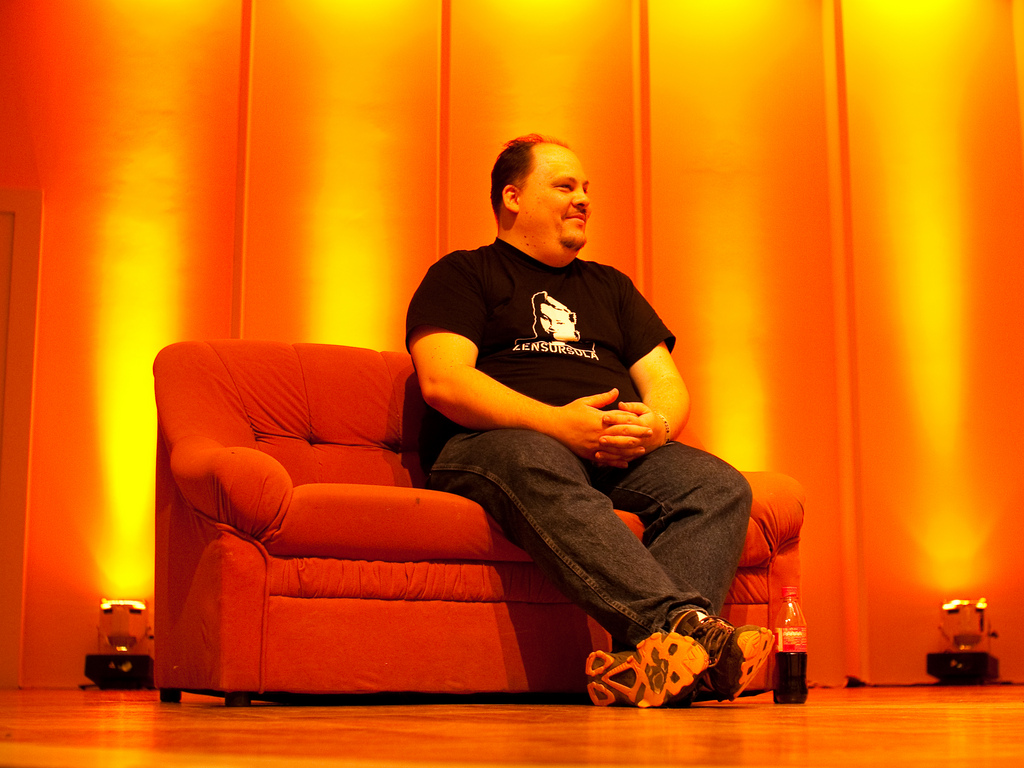
Felix von Leitner sitting on the podium during the 2009 Chaos Communication Congress.
This is how it might have happened:
Our guest author Hans Bonfigt and fefe have known each other for a long time. In former times, they crossed swords quite frequently in Usenet. And a good enmity binds you just as much as a nice friendship. Enmity and friendship probably are not too far apart, anyway, as long as you respect the other party.
By some, blog.fefe.de is called the “Boulevard Press for Nerds“. This is quite a remarkable comparison. Because there are similarities, such as a very striking use of language (more like a “restricted code”) and a one-sided tendency – even if said tendency is very much to my liking, no (few) taboos.…
To summarize it all, I would say both are mouthpieces that are extremely good at proving prejudices. . But there are also quite a few differences between the two:
The Bild-Zeitung is a business empire. With many editors and employees, no end of capital behind the scenes, a refined logistics and sales concept, in short: a huge Journaille machine. And it also has considerable political influence, because quite a few politicians probably determine what to say with already more or less an eye on the BILD- Zeitung.
Felix von Leitner is basically all working by himself. No printing press rotates for him. At most, there might be the occasional small server. His is always offering his opinions for “free”. As a general rule, the BILD costs money, except if you pinch it. You only get a free copy on very special days, such as October, 1st, when it is distributed to almost all German households. On those days, it will deliver two- or one-page free adverts of the huge German business elite, such as VW or Allianz, which make at least me run away.
But to make up for it, fefe has a “crowd of nerds” (I count myself upon them) backing him who provide him with exciting links. All that is left for him to do is a little judgement, combination and comments. And then his “newspaper” is ready for publication.
The BILD-Zeitung used to be the dominating German print medium. I cannot really make an estimate about the influence of the institution BILD on our society and politics, but I think it is still relevant today. BILD might well also have determined the result of quite a few elections in this country. There is no doubt that it influenced a number of decisions.
I assume that this might change in the future. It will be exciting to observe – BILD or blog? For all my friends, I recommend reading Fefe’s Blog. It is definitely preferable to BILD.
RMD
P.S.
I took the picture from Wikipedia. It was originally uploaded by Flickr.com and transferred to here through Flickr upload bot by Tullius (disucussion). At that time – 16:10, August, 5th, 2011 (UTC) – it was set free by Flickr under the Creative-Commons Licence „Namensnennung – Weitergabe unter gleichen Bedingungen 2.0 generisch“. „Fefe“ is licenced by melle. Lizenziert under CC BY-SA 2.0 through Wikimedia Commons –
https://commons.wikimedia.org/wiki/File:Fefe.jpg#/media/File:Fefe.jpg
Roland DürreSunday October 18th, 2015
Our Women – Torturmtheater – Sommerhausen – until Christmas!
Today, I do a little advertising for the Torturmtheater in Sommerhausen.
Between October, 8th and December, 20th, 2015, they perform a wonderful play – always between Tuesdays and Fridays at 8 p.m., on Saturdays at 4.30 p.m. and 7 p.m. and additionally on the advent Sundays, also at 4.30 p.m. and 7 p.m..
The name of the play is:
Our Woman
and it is by
Eric Assous
Directed by Christine Neuberger, the cast are Joachim Bauer, Alexander Diepold and Armin Hägele.
“Our Women” is a piece with not a single women playing in it. And yet, women are (more than) omnipresent.
The head of the Torturmtheater is Angelika Relin. Again and again, she manages to bring great plays onto the small stage. I was lucky enough to be present at the premiere performance on October, 8th – and it was again wonderful. Consequently, I can only recommend the short overnight vacation to the theatre, if you spend the night at Sommerhausen. And here is a secret for you: the best way to get there is by train to Winterhausen. From there, you only have to walk 800 metres across the river Main bridge until you reach the small Sommerhausen theatre.
Here are a few pictures that show the immense dynamics of the play.

The round of card players starts quite poorly – one of them is late and confesses to having committed murder.

A long night with many stories and alcohol take their toll.

The solidarity among friends will get the upper hand.

But then, something happens to bring everything off balance again.
If you need any advice about your theatre trip to Sommerhausen (travelling there, accommodations, food, sightseeing,…), you are welcome to ask me. And here is there you can order tickets.
RMD
(Translated by EG)
Roland DürreFriday October 16th, 2015
Five Weeks to Go until #PMCampDOR
 Late in 2010, a small group of entrepreneurs, nearly all of whom incidentally were also bloggers, met. They shared an idea and wanted to try organizing a project management barcamp. They called it PM-Camp (PM short for project management). The persons involved were: Kornelia, Eberhard, Jens, Marcus, Stefan and yours truly.
It was our intention to host a free meeting of persons, entrepreneurs, leaders and all kinds of “managers” in order to exchange experience and knowledge beyond conferences and workshops. Totally democratic and at eye-level. With a good mixture of female and male, young and old. In 2011, also in November, we had the first PM Camp world-wide in Dornbirn.
Time went by in a hurry. In exactly five weeks, the fifth Dornbirn PM-Camp will start. That means we celebrate a jubilee! In fact, we are a little proud of it. We are also proud about a movement having sprung from the first PM Camp. It is now thriving in many European places with local PM Camps.
For all of you, it is now about time to order tickets. Otherwise you might end up empty-handed. Because PMCampDOR is definitely something like the mother of all PM Camps – where many wish to attend.
This time around, we chose the metaphor “breaking with patterns” as our impulse. Consequently, the hashtags are #PMCampDOR and #musterbrechen.
🙂 Maybe #musterbrechen will become #mu5terbr3chen and #fuenf will turn into #drei … Because you never know what is going to happen on a PM Camp.
Naturally, the Dornbirn organizational team wants to celebrate the jubilee with a particularly nice and successful PM Camp. Consequently, we want to make it especially easy for our “newbies”, meaning those guests attending their first PM Camp or even their first barcamp to really get under way. So I now point out to you a series of articles I wrote as early as 2013/2014 – but it is certainly still up-to-date. In these articles, I am telling you what happens during a PM Camp.
Here are the links for the five articles:
My continuing education story – personality promotion, seminars, workshops barcamps
(how I first was introduced to the barcamp idea.)
barcamps und PM-Camp (2) – why they are such a success.
(because they are great fun and all participants are happy when they go home.)
barcamps und PM-Camp (3) – typology and sessionsbarcamps and PM-Camp (3) –
(what kinds of sessions are there?)
barcamps and PM-Camp (4) – Twittering is part of it .
(why PM Camps and social media complement each other so well.)
barcamps und PM-Camp (5) – rules
(on a barcmp, you can have freedom, because people behave socially responsible.)
Another article is a general one:
The Story of and guideline for a PM Camp
(and barcamps in general)
And for all of you – not just for the newbies – I would once again wish to point out our values as we summarized them in our guidelines. You will also find them in document.
I am sure it will be useful for you to take a second look at these materials. And perhaps you have a few recommendations for change, modification, improvement? The #PMCampDOR will definitely be the right stage to discuss all those things.
And here is a short Video on PM-Camp.
RMD
- also in the name of the Dornbirn organizational team
(Translated by EG)
Roland DürreThursday October 15th, 2015
(Deutsch) Mein letzter Tweet für heute – Reklame für PMCampDor 2015
Roland Dürre
New Concerns is What the World Needs.
When I wrote this heading, I thought of the wonderful song by Ina Deter. It fits quite well, because, after all, most of the concern heads, especially in Germany, are (still) men. So here is her song:
I dedicate this article to my friend Hans Bonfigt. His last article as a guest author brought an immense number of new IF Blog readers in its wake. This is how it happened: Hans has a “historic enemy“, Felix von Leitner. Even in the good old usenet times, they often “crossed swords”. Felix writes the much-read blog.fefe.de and set a link from there to the guest article by Hans in the IF Blog. And then the show started: more than 20,000 readers clicked on this article within a few days. And many other articles, too, benefited hugely from the effect.
Back to Hans. Sometimes he has a tendency towards brutal language. Once in a while, it will deflect you from his basically good ideas. If he does not like an enterprise, he affronts it. Some consider this defamation. That is not nice. I, too, believe that his absolutely valid ideas would perhaps be better accepted if his condemnations were not so all-inclusive.
I respect this. Because, in his harsh way, he is probably correct. Basically, most of what he writes is actually quite harmless if compared with the naked truth.
Just take a close look at the concerns that dominate the world. In Germany, you usually have enterprises with a good reputation, a precious brand, lots of prestige and history. They have a well-trained work force, lots of knowledge, good sales channels and a high degree of publicity. Through their processes and build-up, they seem to be equipped to cope with all kinds of potential mishaps. Mostly, the employees – due to well-worked-out wage agreements – earn more than persons working in the social sector or freelance. Due to an excessive job protection legislation, their jobs are also a lot more secure than those of the rest of the working population in this country.
However, if you look behind the glittering façade, you will see that the patina crumbles. More often than not, their classic business models fail and classic turnover areas are endangered. Far too often, they employ persons who are paid far too well and are no longer needed in the scenarios of the future. Inherited liability weighs heavy on them and the market changes to their disadvantage. New competition threatens them.
There are huge inner weaknesses hidden from the outward appearance. Much that glitters is not gold at all. It is truly fear-inspiring. If I then continue by analysing the behaviour-controlling values of business that controls the world, it makes me dizzy. I am talking world-wide, for all concerns in all sectors.
Because we have desolate conditions in the global economy. Strangely, we tolerate them. There is not the slightest bit left of the common-good economy idea – as for instance laid down in the Bavarian Constitution. Nobody accepts the duty given to the industrialists with the right – which I personally consider of high value – to do business.
The good reputation of an enterprise, too, has become means to an end. If you have it, it is easier to make a profit. Ethics is wrapped into CSR – Corporate Social Responsibilty and used only to camouflage reality. Because all concerns and enterprises in business follow three unwritten laws:
The three commandments of current capitalism:
First Commandment
Do not develop products for what humans and the market needs. Instead, control the market in such a way that it will buy those products that give you the highest profit! In order to achieve this, manipulate the people permanently through a collective brain-washing, also called “marketing”.
Second Commandment
Set the rules and regulations for your business dealings in such a way that they will exclusively be beneficial for you! In order to do this, use the superweapon “lobbyism”! It must be your highest priority to control politicians through your lobbyists in such a way that all legislation is to your benefit!
Third Commandment
It must be the absolute goal of all your entrepreneurial activities to maximise the profits and the shareholder value! Profit thus gained must be privatised as fast as possible, losses have to be socialized immediately!
These commandments of modern capitalism have priority over all else, be it employees, customers, suppliers or other stakeholders. World-wide and without exception. Because in Asia, China, India, Japan, Korea, South-America, the USA or wherever, the one and only important factor is: profit.
In Europe, the situation is no better. Just look at the former EG or the Comecon countries. I cannot imagine that it is different in Switzerland. Nor do the Scandinavian concerns give reason for hope: just look at the stories around, for instance, IKEA.
To sum it up, you can say that, for all concerns and many more business enterprises, gaining and maximizing profit and consolidating your position on the market always has absolute priority. This is how the concern business has come to a point where all that matters is survival. The preservation and constant strengthening of the own system have become the exclusive goals as determined by the system itself. And the end justifies the means. In theory, such systems are called “de-personalized”. And making self-preservation your exclusive goal makes you inhuman and is the first step towards a fascist system.
An enterprise should aim at: supplying the people in the country with goods that promote their well-being. This is opposed to the current direction of business. The needs of the people are no longer served. Instead, the goals are formed along the lines of business. Of course, if you do this, there is no room left for a “common—good economy” as the Bavarian Constitution demands it. For me, this borders on “criminal behaviour“.
Now I will take a close look at all sectors. I wonder if I will find one that is not criminal?
It cannot be the food industry (why do you no longer call it victuals or nutrition industry?). In this sector, even the smallest customers are manipulated towards eating unhealthy through lies. One (not only food) scandal follows on the heels of the last, fraud and blackmail are common practice. Lower quality and extortion are accepted for economic reasons, the same is true for environmental destruction, not only in the Third World countries. In this respect, I only mention particularly dire cases like the seeds situation as a side-line.
Nor is it necessary for me to write about those industries that supply humanity with raw materials. We all know what traces those robber barons have left on our planet. The same is true for their sub-division, the oil and petro industry. Allegedly, enterprises such as Gasprom even have their own para-military organisations, which is equipped like a private army with heavy weapons. Why? Well, it is clear, isn’t it? If necessary, they can use force to give weight to their interests.
But the EVU’s do not fare any better, either. Neither does the chemical or pharmaceutic industry. You read all the time that medicine is licenced after the best of tests have been executed (exceptional healing capacity, negligible side-effects) and thus is now on the market. And after many users – often children and teenagers – consumed the medicine for a long time, you suddenly hear that the positive effect was ZERO and the side-effects were considerable. But that is nothing. You continue with “business as usual”.
Trade, too, probably has no clean slate. What harsh measures do the discounters use both against their competition and their suppliers! And the customers, too, are constantly cheated. They dominate the field with a long-term, ruinous cut-throat competition. The only thing left in the end will be the ruins of many no longer needed chain stores and a destroyed infra structure.
I will not even mention the traffic enterprises and finance services, the speculation, world and gambling companies, the media enterprises, the weapons industry, the logistics sector, let alone the luxury food industry.
My own sector, the IT industry, too, is not one I trust. For instance, I can well imagine that many producers are quite happy about all those virusses and spams appearing. And about the eavesdropping and much more. I assume that only a small part of the hardware and software systems actually are still made for processing and communicating data.
No. Most of the server and storage systems are probably sold for spam and virus defence, as well as for eavesdropping and such. It would be quite easy to de-activate the spam flood in emails with a suitable protocol (even the old telefax machines had a code provider) – but nobody wants it. Probably because it would be a shame to let all this nice business go.
Here is something else I notice:
No matter how high a profit. The higher the better. Even if it looks rather amoral.
I once read that, at Reemtsma (sector: luxury food industry – tobacco) the EBIT of a good year can well be as much as half of the entire turnover. Let us assume that, in this sector, the turnover is only one twentieth of the capital. Then the capital return rate is 1,000%. Well, there were times when 4% were considered a reasonable turnover return rate (in the 1950ies at VW – those were also the times when you still could get a low one-digit interest on your conventional bank account). If you take 200 as the factor turnover/capital, you get a turnover rate of 10,000%. Well, not everybody can achieve this!
And what do I read on the Reemtsma Website as a reprimand?
Illegal cigarette trade is among the most lucrative crimes…
I wonder why!
Today, there is no upper limit to what marketing may cost. And manipulation need stop nowhere at all.
The only thing that matters is that it does what it is supposed to do. Especially in the sector of “digital marketing”, you hear of enormous progress. The most modern scientific results in neurology and psychology are utilized. Thus, the cost of marketing and sales grow all the time. In some enterprises, they are already as high as half the turnover. In other words: the customer who buys the product pays half of what he pays for measures executed in order to make him buy the product.
Is that OK?
This is even true for enterprises, for example, in the pharmacy sector. One would assume that, basically, medicine does not need advertising. After all, it is badly needed, isn’t it? But nothing could be further from the truth – here, too, the advertising costs is easily 40% of the total turnover and more. And for enterprises promoting internet “services” such as for instance booking hotel rooms, the per cent ratio of marketing might well be more than half of the total cost.
Even politics manipulate us through marketing. Not just when it comes to lobbyism. Normally, the party that has most of the money at their disposal will eventually become the reigning government. Because they can employ the better marketing companies and campaign better. In almost all cases, there is a correlation between the number of votes and the money used in the electoral campaign. But where do they get the money? Of course, from the institutions that have a) money and b) important interests. So who are we talking? Well, those enterprises that would wish to make the rules for their business the rules of our society. I see a huge threat to our democracy! In fact, thinking of the elections for the next president of the USA – who call themselves “God’s own country” – gives me pause.
This is why I cannot really do anything other than say Hans Bonfigt is somehow right when he says things rather bluntly.
RMD
(Translated by EG)
Roland DürreTuesday October 13th, 2015
Will all those Regulations and Sentences Weaken our Constitutional Democracy?
There is a constant flow of new legislation. From the EU, the Federal Government, the State. They have become a flood. Many of them do not seem to make sense at all. More often than not, you cannot see what effect exactly they are supposed to have or why they have been passed. Neither is it clear why you should actually abide by them.
Simultaneously, courts of law come up with sentences. For instance one week ago on safe harbor. This may well be a good idea in some way, yet there is no direct positive effect. Because it simply is not practicable.
And it has almost been forgotten already, regardless of the great ado that has been made about it not too long ago. Consequently, I am sure that, soon, nobody will be interested at all to hear what the “safe harbour judgement” was all about. And why should anybody? You want to bet?
One might start assuming that people in this country will take laws less and less seriously in the future, which would mean there is an end to our constitutional democracy. Which, indeed, might be a huge threat to our democracy.
I do not happen to share this fear. To be sure, as I perceive it, law and order are no longer taken as seriously as they used to be. But it seems to me that this is only true for all those many administrative regulations.
Let me call it the “extrinsic morals“ as given from the outside. And that is something that gets more and more absurd, which means you actually cannot really take it seriously.
To make up for it, it seems to me that the “intrinsic morals” develop more and more into something most people agree upon. It is about what you do and what you do not do, which I find rather appealing.
Said intrinsic morals come from inside a person, regardless of the nonsense the legislative and judicative conveyor belts of the EU, as well as its countries and states pour over us.
I do not wish to sound the warning bells that letting the “extrinsic morals” dwindle might threaten our constitutional democracy. After all, the “intrinsic morals” might actually be more important for survival than the “extrinsic morals”.
We saw quite frequently that countries with rule of justice toppled and became rules of injustice, yet they were all based on “justice”. Just like the Third Reich, too, made laws and installed courts of law that brutally executed the verdicts. Which means that this unholy system actually was based on law and order, except that the assumptions it was based on were truly something to give me pause.
RMD
(Translated by EG)
Roland DürreSunday October 11th, 2015
Vintage Project Management #2 – My First Real Challenge
How I landed my second of many projects.
Project #2
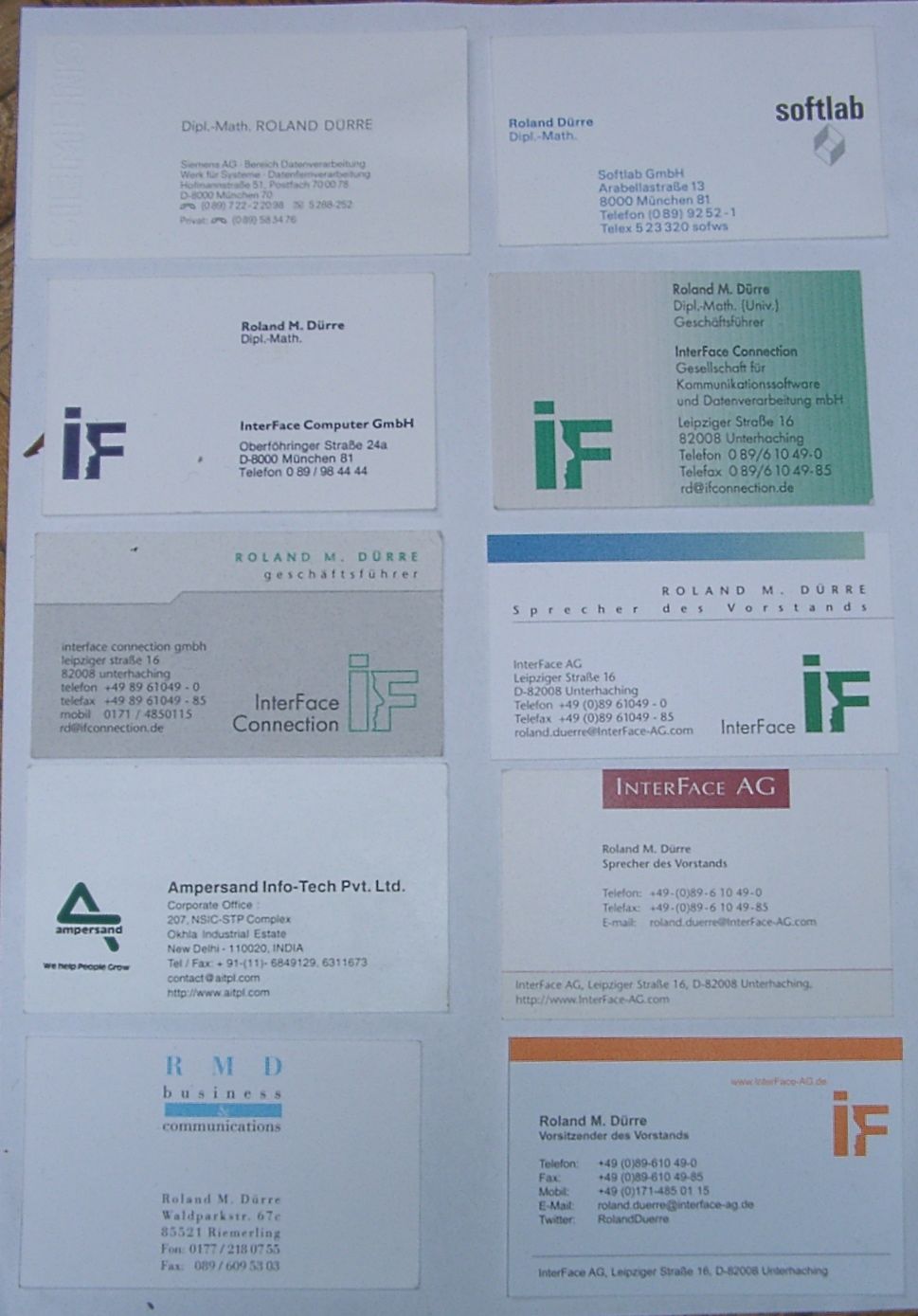
On the upper left hand, you can see my first Siemens visiting card – the first of a collection I am eternally proud of.
After my re-start in October 1971, I continued my university education, the successful finish of which lay in winning my diploma. Here is how it happened:
When I was in the then fourth semester in the summer of 1973, I noticed that it was about time to sit my interim diploma exams. And I noticed that, indeed, there was quite a knowledge gap.
Consequently, weeks of learning lay ahead. The weeks before the four oral examinations would be stressful. I fell victim to knowledge bulimia, a sickness widely spreading these days and actually an epidemic in all the school and university systems I know. After having passed the interim diploma as required (surprisingly even with quite a fair grade; “good”), I was rather worn-out and had to give myself some rest.
Resting was exceptionally great fun while breathing computer air at Siemens. They truly had a lot of hardware: large-capacity computers with BS2000 and BS1000, process computers, office systems, network computers and much more. I was truly over the top. At the TH – which was now called TU, because, after all, a university is something better than a college – the computing times allocated to students was rather scarce. Consequently, you seldom saw me there.
As a logical consequence, I spent more time at Siemens during the following four semesters than at the not very humane (and probably even then asbestos contaminated rooms) of the new southern TUM informatics building. Incidentally, said southern building was torn down several years ago. Just imagine that the building where I studied and which had been built more than 20 years after I was born was outlived by me. Now isn’t that somewhat strange? The old TH building is still prospering.
It was my good luck that my major topic, mathematics, could easily be studied out of books. They are a good substitute for attending and listening to lectures. After eight semesters, I noticed that there was a diploma thesis to be written before admission to the final exams. I found a professor (Dr. Werner Heise) – regardless of having been the youngest mathematics professor of all times at the TUM, he unfortunately died a few years ago – who was willing to hand me a really exciting combinatorics topic for said diploma thesis (it was about the assumption by George Polya which, however, had not yet been proved – which is how the theorem by Dürre came to be).
It was not easy, but it went well and was a truly great experience for me. I also enjoyed actually meeting Mr. Polya from Hungary on a combinatorics congress in Berlin. The trip to Berlin was especially fascinating because at the time Berlin was still a wonderful island in the middle of enemy country.
After the diploma thesis, the final exams lay looming – and again I fell victim to knowledge bulimia. It was even worse than before the interim diploma. But, again, the knowledge bulimia worked well. There came a day when, although totally exhausted, a very happy me held his diploma document in his hand. To be sure, I did not know if that was something to be proud of or not. But I was immensely happy to have finished the sad chapter “university”.
I was not in the mood to write dozens of applications or similar things. A journey around the world or even a vacation were also out of the question, and so I tried to find a job. I applied at Softlab. I found this company really great, because at Siemens, I had once read the hectography of a book by Peter Schnupp (structured programming) and I found said book a beacon in the darkness. And Peter Schnupp, whom I later met and who became a much-loved friend of mine, was one of the Softlab founders (along with the colleagues Neugebauer and Heldmann).
Consequently, I sent my first (four years later, there was a second one) application to Softlab. It seems, however, that at the time Softlab was undergoing minor crisis phase, which is why they sent me a very polite letter of refusal. It said that they actually were quite interested in me, but currently had no tasks appropriate for my skills. They also asked me to try again next year.
Naturally, that was not much help to me. But as matters developed, it turned out that, more than four years later, I landed with Softlab anyway – but that is another story.
“After finishing your university education, you have to work!” – that is what the bourgeois part of my super-ego told me. So I took the same documents I had sent to Softlab and used them to apply for a job at Siemens AG. I was optimistic, because, after all, they already knew me. And, yes, they took me – and they also had a real project waiting for me. It was part of a bigger project, which again was part of a really huge project.
I ended up at UB D WS ST DF 131, which is short for the department data processing, laboratory for systems, system technology, data transfer, 1st company, 3rd train, 1st battalion. The last three terms are my personal interpretation of 131. After all, the founder of the enterprise took the Reichswehr as a model for the organization of his company
The entire DF (which means an entire company of the Siemens army) worked on a hardware and operating system for realizing the data networks called TRANSDATA. Incidentally, I think it is another disgrace for the German IT that this term cannot be found in Wikipedia (I wanted to put a link right here). After all, this was the only and technologically superior competitor of “SNA“ (System Network Architecture) by IBM, who were our biggest and then perhaps only competition.
The Transdata software was called PDN (programmable data network technology) and we generated operating systems necessary for the data station computers, the network node computers and the mainframe model computers. Those two years were probably the most exciting years of my entire professional career. I could easily write several books about the time.
On this picture, you see a Siemens & Halske repair shop in the rear building at Schöneberger Straße, Berlin, on October, 19th, 1846 (Source: Wikipedia)
The official term for our facility was: laboratory. My group, the 131st of DF, developed software and was responsible for APS (short for user’s programming language). The language was supposed to make the “stupid” connecting computes do the (pre) processing as early as at the fringes of the network, for instance when it came to collecting data for a business process in the user’s dialogue. Also, it had a controlling and “intelligent routing” purpose.
Within DF, there were a number of teams, all of them developing new things. Because a computer network needs a lot of modules and, considering what times we are talking, it was rather complex (or highly complicated). And the team cooperated on a high intensity level.
Together with the customers and the partners of our FBZ (technological counselling centres at Siemens AG), we made Transdata the basis for the new big IT projects. And it all happened in a very agile, open and slim way. The minutes of the coordination meetings with the big projects and the technological counselling centres were our specification sheets. There was also a management, but their primary task was to see to it that all humans were happy. And to protect the teams from the Siemens management.
We worked in an enclave, in the Ortenburgstr. It was one of the many Siemens locations outside Hofmannstr. There was an actual bakery on the ground floor, which in itself made the location attractive. No barracks and instead tasty pretzels and rolls.
Some way or other, we all at DF were a good team and made the dice roll. We were all engineers and developed technology for real projects. And Transdata became a success. It made me proud to work on systems that often ran in important and revolutionary projects.
At the time, my job description was:
Synchronously programming on three versions. Version A (for example 4.0), which currently was on the market, was maintenance I had to do. This was about correcting errors and communication with users. For the next version, I developed the functionality as had been agreed upon and decided (version B, aka 4.1). And then, I had to plan version C – which would be 5.0 in our example – with the project partners.
Thus, the time we invested into the future was quite considerable. Because the market was demanding and very dynamical, the competitors were quick and consequently the speed had to be high.
On top of programming three versions simultaneously, I had more tasks, too. Of course, I wrote the manual for our programming language myself. I had to do the technological supervising of our large-scale projects and teach courses for the system engineers who used our system.
On top of this, I also organized the test of our new functions with our pilot users and wrote the product flyers for our marketing. In those days, new employees were recruited all the time. After half a year, I actually was an “oldie” at Siemens because of all those “newbies”. And we also had to continue our education – which was mainly done by reading the ACM or IEEE lecture notes.
As a side-line, we organized a coffee machine and a fridge for our office – which caused quite an earthquake with the Siemens administration. A coffee machine in a Siemens office – that was against all regulations (regardless of the fact that such a machine, allegedly, could be bought at a discount by the employees at “our” shop). But we managed even that.
And then the sad times started. Management grew more and more powerful. They introduced division of labour. It was some kind of development Taylorism in the laboratory. In addition, the administrative processes grew more and more time-consuming. That was in the second half of the 1970ies. We had to kiss our laboratory idyll good-bye.
First they introduced the manual editorial office. We had to teach persons who had not the slightest idea of how IT worked what needed to be written in a programming manual. Then came quality management. Those were people who had to have tested our software before said software was prototypically used by our customers. Except they had no clue about software and testing same.
Then they introduced product management and requirement engineering. All of a sudden, there were mile-stones, such as A20, A30, B20 … B50. The waterfall model came. Even the termination of the product was defined with enormous precision. That was T50 if I remember correctly. It was called project phase model. And we were no longer allowed to do any programming. Instead, we had to think about the level of maturity our work had now achieved.
They started the budget concept and expected us to make (guess) predictions about the expected cost for all discussed functions. Unfortunately, most of the new functions were very innovative and involved a high degree of creative research. Thus, predicting the expected cost soon became more time-consuming than the actual programming. Except that we were no longer permitted to do any programming, anyway, because in order to decide if there was to be any programming, you first needed a tested and approved cost estimation.
And thus it happened that what formerly we could discuss directly and decide with the customers and the FBZ on one afternoon now was discussed at greater and greater length. Weeks turned into months. Strange decisions were the often absurd results. Again, you had to discuss them at great length – or else you were secretly building u-boats. Which is not really without danger in a well-controlled concern. But then, there is nothing you would not do for a successful project, is there?
Additionally, they decreed working times that made it clear to us all that we were not permitted to work as much as the project would have required. As a logical consequence, they later installed time stamp machines in Neuperlach for the engineers. And if you were caught continuing with your work after you had stamped out, you had to be reprimanded by works committee decree.
Even taking work home got harder and harder, because plant protection had come up with a random generator at the company portals. If the generator sounded, you were controlled (shaken down) and it was absolutely forbidden to take documents home with you.
Thus, it got worse and worse. New sessions with three or four letter abbreviations were introduced (I forgot the abbreviations). Persons from new departments you never knew could exist suddenly sat around the table. “Cross section responsible persons” demonstrated how important they were. People who had no inkling of the market and the technology but were great with common phraseology were more and more powerful in product development. This cost a lot of money and much of what was decided was just nonsense which, naturally, never materialized. If decisions were made at all. All these measures caused helplessness and frustration.
In a nutshell – it was about time to leave. Consequently, I moved – inside Siemens AG – to a department where actual projects were still realized (UB D V S 3 – company sector data processing, sales and special projects, department3). After all, you were still supposed to work on true projects and remained free from bureaucracy and management mania – at least for a short time.
I had a nice offer, because at UB D V S 3, (not only) one project that was particularly important for the leadership was suffering from a crisis. And said project was behind schedule by quite a bit. It was called DISPOL and they had to develop it for the Bavarian Government. The task was to make the police fax machines (communication), the data storage cupboard (database and archive) and the typewriter (document processing) obsolete by introducing IT equipment.
This was the project during which I, for the first time in my life, met a true project manager … He was supposed to save the project – and that was my job, too. Together, we actually managed it. Because he left the technology experts to do their thing and did not interfere. But I am not yet going to tell you more about it here, because that is the third story from my series “vintage project management as told at the Berlin PM Camp”.
RMD
(Translated by EG)
P.S.
Today, you have personal managers and service managers. A short time ago, I read “coaching manager” on a BVS.de visiting card. Human resource is about BGM (company health management). The enterprises have their knowledge management and there are certified knowledge managers. If all this does not help, you install an innovation manager and if you need even more than that, you still have the change manager. What a brave new world …
P.S.1
Here a diagramm of Siemens – is it not a wonderful example for vintage project management? Andreas Weber has sent it to me – Thanks – dear Andi!
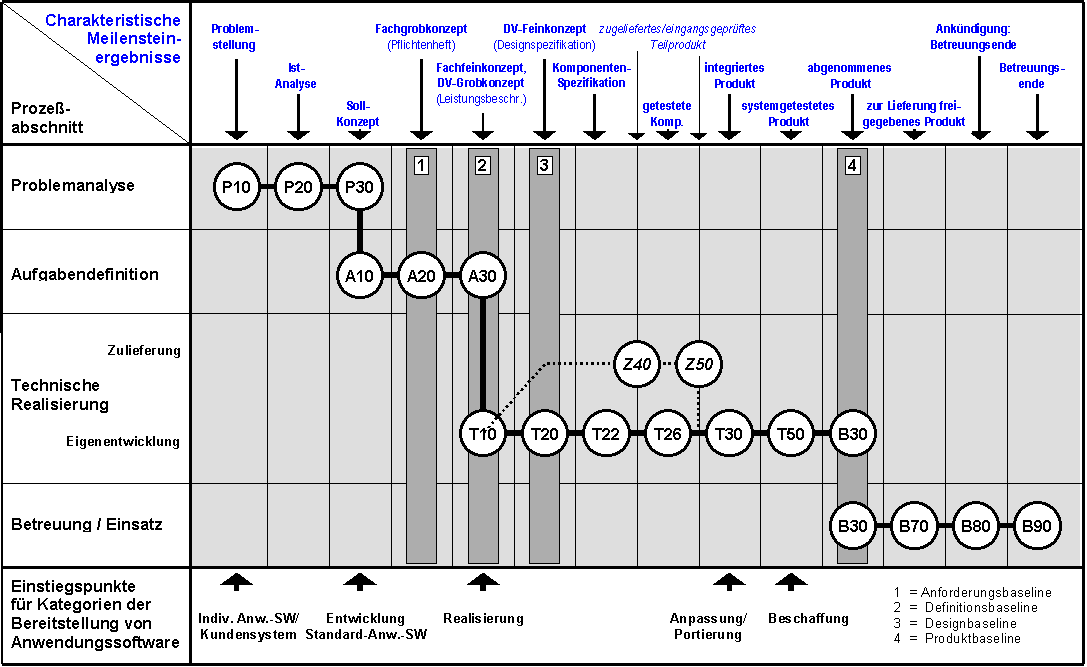
That was the way, we should develop innovative software and new products entwickeln – ridiculous.


