
Roland DürreThursday April 21st, 2016
Letterbox Companies, Corruption and More… (Series) #2
Today: Bribery & Secret Accounts
When I was still generating application software, I always had to do requirement engineering. Well, the term had at least the advantage that the word “management” was not part of it. Today, one would probably call it “requirement management”. Now, however, I prefer the more agile approach of a system outline with “user stories” and “use cases”.
Regardless of how you name it, you will always find something like Entity-Relationship-Models (ERM). Objects, or rather classes of objects, are described along with the qualitative relationship between said objects or classes of objects.
For me, the best example of an ER model is love. You have the lover (entity E1), love (relationship L->) and the beloved (entity E2), also E1 L-> E2. Of course, it is true for both sexes.
And as soon as the relationship is symmetrical (<-L->), you get a “Happy End“.
Even the doubtless very clever Jesuits as the best thinkers of the Catholic Church used exactly this same metaphor in order to make the incomprehensible and often doubted Trinity Dogma look humane. They simply made God the Father the lover, the Holy Spirit love and Jesus the beloved one.

🙂 Was waren das noch für Zeiten, als wir diesen tristen Schein sauber gefaltet und tief versteckt als eiserne Reserve in der Tiefe unseres Geldbeutel hatten.
Bribery can also be defined as an entity relationship model. There is a briber, the bribery and the bribed person. As early as a few decades ago, we had a controversial discussion and debate during a Rupert Lay – at the time he was considered the doyen in business and society – seminar.
All managers present agreed that bribery, at least if a German civil servant is concerned, is an absolute “no-go”, because it is definitely forbidden by law. However, bribing a buyer in a society that is definitely corrupt – for example in order to preserve jobs – might well be ethically acceptable. After all, someone else might otherwise do the bribing. And besides, our tax offices accept a declaration where “special expenses” are permissible up to a certain amount of money without giving the name of the recipient.
So much on the management concept of the 1980ies. Personally, I saw – and still see – matters a little differently. One reason is that such reasoning would make any behaviour acceptable, even using other unethical means – for instance violence. Another reason is that this kind of bribery would just make the wheels of corruption turn even faster.
How does bribery look in (real) life?
As a general rule, corruption consists of a system of illegal accounts. After all, it can only work if the briber (E1) and the bribed person (E2) remain unknown. Consequently, you have to take the money out of the enterprise circle as early as possible and transfer it into the shadow realm of illegal money.
In this realm, there are no rules – or rather, individual persons make the rules. As we all know, individual persons are weak and can easily be tempted. Especially if their social background is a corrupt system like the illegal account system showing them how to do it.
Humans love themselves most. And their sense of justice will protest if a corrupt person from an alien world is to get such a huge amount of money on top of everything. Consequently, they take a considerable sum out of the bribery money for themselves – which, in my opinion, is easy to understand. Any other behaviour would be more than stupid.
I assume that (more than) half of the bribery moneys paid never reach the bribed persons. Instead, it remains with the bribers. That is what makes bribery so problematic. Because all of a sudden, the ERM becomes symmetrical. The briber wants the bribery as much as the bribed person, because they have become accomplices. The lie “you have to bribe because it is the general rule” becomes even weaker than it already was.
It goes without saying that the money that has been paid to both parties must end up somewhere – and, again, it gets clear why so many fake companies exist. This is how we get back to my first article of this small series. In my next two articles, I will describe in detail how I was to be bribed.
RMD
(Translated by EG)
P.S.
I took the picture of the 1,000 – Euro bill fromWikipedia.
Roland DürreWednesday April 20th, 2016
Entrepreneur’s Diary #116 – Social Media: Corporate Twittering
Modern enterprises want their employees to “actively participate” in the company. The participation of the employees when things are developed and their actively being part of decisions is considered a positive asset and a necessary requirement for a secure future. Terms such as “democratic enterprise” are en vogue. Some even get enthusiastic about holocracy (Holokratie), which is a term I like to intentionally misspell as “holocrazy”.
Yet I have all the respect in the world for the underlying intensions. Just as I also very much appreciate the ideas about “Common Good Economy” (“Gemeinwohlökonomie” – for instance as initiated by Christian Felber). But how is an enterprise supposed to manage the necessary change?

My Twitter Windows.
As I see it, social media play an important role when it comes to trying to establish the culture of an enterprise – both internally and externally.
For change and modifications, communication at eye-level and an internal intranet that works a little like the well-known social media systems à la Facebook are an important requirement. Today, we also call these concepts “Corporate Social Media (CSM)“. Perhaps we will soon have an “SMO” on top of the SEO (search engine officer who is responsible for the search engine optimization) – with the SM, naturally, not being short for sado-maso, but for Social Media (Social Media Officer).
I am a little sceptic about a CSM who has been appointed from the top. The employees should initiate the transformation. The same is true for the very popular term CSR (Corporate Social Responsibility). It is about how an enterprise can live up to “ethical expectations”. This is also one of the tings the basis must want and work towards.
You will immediately understand my scepticism about CSR initiated by leaders after, for instance, having read the books by Mr. Otfried Höffe. His books have become standard literature at universities in the ethics faculties. I have no idea why this is so, because, as I see it, the books contain poor material all the business students have to learn. They do not satisfy any philosophical requirements.
But then, I am an evil sceptic who even considers the valuable term BGM (company health management) ridiculous, regardless of it not even beginning with a “C”. Incidentally, I distrust abbreviations that start with a C as a matter of principle. This is not only in politics and not only when the C is for “Christian” or “Corporate”. I am also very cautious when it comes to all combinations and abbreviations that contain terms such as management, manager or officer.
But now let me write the constructive part of this article. I would like to show with the example of twitter how you can actually manage to make people inside an enterprise really enjoy the meaningful use of corporate social media addressing the world outside the firm. The motivation of the employees is joy and intrinsic, without any special incentives or such.
How to make an entire enterprise twitter and thus authentically demonstrate its strength in the network, at the same time showing its nice collection of great individualists and presenting them to the market?
As you can easily imagine, this cannot be done through centrally controlled marketing strategies that follow ancient concepts. The role of marketing is among the things that need to undergo drastic change. Virtues – and I do not mean new virtues – such as the subsidiarity principle that is based on trust and error tolerance must also be re-established.
Before I elaborate on the details, I would like to point out the difference between “collective enterprise twittering” and the “functional twittering” as it is done by the National Railway (Die Bahn@bahn) or the Telekom with their twitter accounts (“Telekom hilft” @Telekom_hilft – I tried it myself when I was in an emergency situation and it helped me a lot). It makes a lot of sense and is often a good way to get the attention of these enterprises when you have problems. And it is also often the only chance a user has of being heard when the hotline or other “normal” channels that should connect you with the enterprise fail.
For the enterprises, the use of these social media channels is quite beneficial, because it helps to release the burden of the expensive hotlines that by their constantly being busy already annoy the customers. And, as a general rule, good social media services can be offered much cheaper than the classic help desk.
But this has nothing to do with “corporate social media” as in “here, the employees twitter”.
In order to twitter collectively as an enterprise, the first thing you need is a shared twitter account that is used by many, ideally all, employees. Initially, a defined team should do the exemplary twittering for the enterprise on this account and maintain the account. In the long run, it is, of course, desirable that all the parties concerned share the maintenance work and responsibility for the account.
Perhaps such a team should also help with some advice and organizational assistance as to what sort of communication is supportive of the enterprise and what is not. But then, most employees have quite a good instinct when it comes to this issue.
Also, all office buildings should have a screen installed in rooms such as the entrée, meeting halls and kitchens. On these screens, a twitter wall (here is the example of the ActMobCmp-Twitter-Wall) with current tweets is running at all times. Because reading the tweets your friends and colleagues have written will whet your appetite and encourage you to do some twittering of your own. This is how activity and shared directing will start happening by itself.
In this article, I used “twittering” as a kind of metaphor (pars pro toto) for social media in general. With Facebook, Google+ or also a Corporate Blog, it is not much different. Thus, Corporate Twittering is a good way to start more social media activities. As soon as (almost) everybody is enthusiastic, you can also try “Corporate Blogging”.
RMD
(Translated by EG)
P.S.
For more articles of my entrepreneur’s diary, click here: Drehscheibe!
Roland DürreThursday April 14th, 2016
Everything Smart, or What? Smart Cities!
Or: Why I like “Friendly Persons” better than the “Angry Citizens”!
On April, 5th, there was another big event in Munich:
The “Forum UnternehmerTUM“ at BMW Welt.
Here is the original text announcing the event as published by UnternehmerTUM:
The Forum UnternehmerTUM is the biggest and most important network event organized by UnternehmerTUM, hosting guests from politics, business, science and the founders’ scene. This year, the motto of the forum is: “Smart Cities“.
This is quite true and consequently, I always like being part of it. Every time I go there, I meet many old acquaintances from “academia”, as well as from the enterprise scene. The young start-ups I counsel or used to counsel are present. So it is always a great “hello-again” with old friends. Consequently, I went there on April, 5th, 2016 and I gladly point you towards the report on the event. You can find it at MUNICH STARTUP.
 The event started with a nice and short “keynote”. Julian Petrin opened the meeting with a short and precise impulse. His words made a huge impression on me. Julian is often called an “urbanist” and “city visionary”. He is probably one of the founders, probably the one founder of Nexthamburg. His presentation was about:
Smart City or The City of the Future that Deserves to be Loved.
Well, the term “smart” is basically a little ambivalent, isn’t it? And, if you first hear it, “Smart City” does not really strike you as something you would immediately feel comfortable with, does it? MBW director Peter Schwarzenbauer said as much during the – quite exciting – podium discussion.
However, Julian Petrin made the term clearer for us with the following positive explanation. For him, the “smart” part of “smart city” is made up from the sum of the terms “digital” and “social” (smart = digital + social). It is about the “friendly persons” themselves taking care of things and starting to develop concepts. This “doing yourself” must not be confused with “self-service” as often offered to customers by the government and all sorts of enterprises. Instead, the term means that you are willing to take matters into your own hands that used to be left to third parties from politics and administration. Part of this scenario are, for example, “hacking” the public urban area and “friendly squatting“.
I found the term “the friendly persons” especially attractive. In all my projects, I also always look for solidarity and cooperation with exactly those “friendly persons” – for instance also at barcamps for project management #PM-Camp and for “active mobility in everyday life“#AktMobCmp or with my PROJEKT FRIEDEN.
Also, I only support start-ups if I get the impression that they are “friendly persons”. I no longer wish to deal with “angry citizens”. They always do huge social damage, which is why I avoid them. Besides, as a general rule, “friendly persons” who work with joy and courage on their projects are usually a lot more successful.
At the BMW-Welt, I only met “friendly persons” and consequently, felt very much at home.
RMD
(Translated by EG)
Roland DürreSaturday April 9th, 2016
Arcis Vocalisten will sing BELSHAZZAR !!!
On May, 7th and 8th, at 7 p.m., the Arcis Vocalisten will sing and act the the choir part of the scenic performance of BELSHAZZAR by Georg Friedrich Händel, in the Sendlinger Himmelfahrtskirche. All parts are sung in the original English version, although there will be some comments in German!
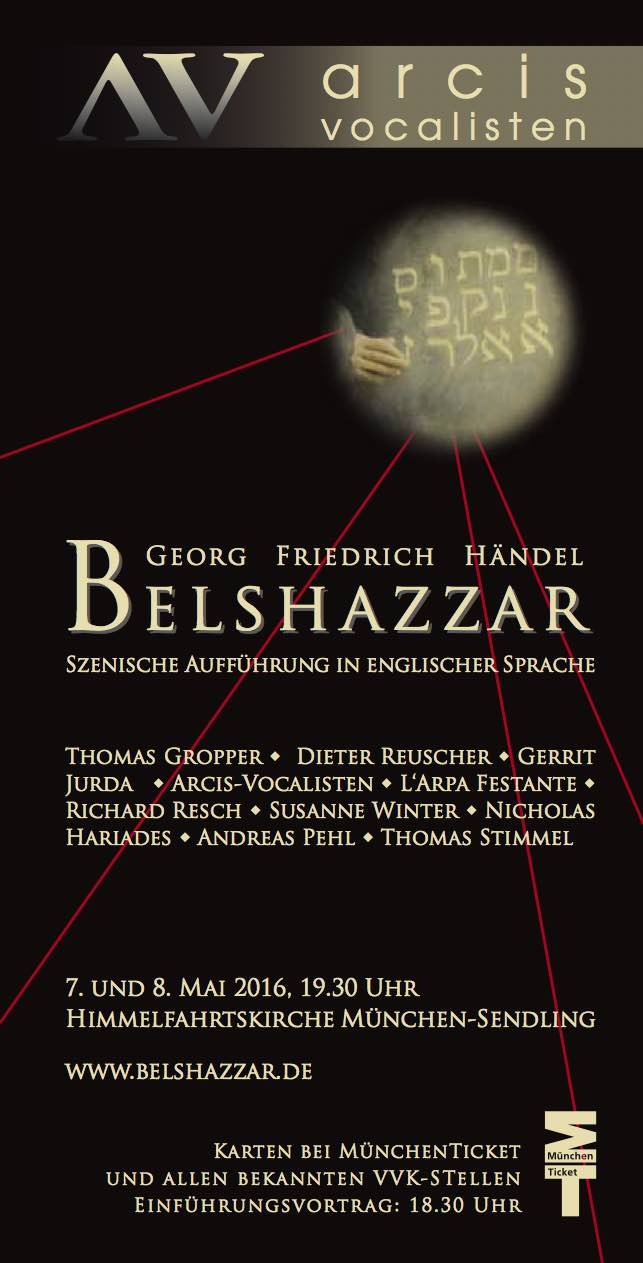 Of course, Evelyn is again part of the choir. Here is what she wrote me:
For me, the Belshazzar will certainly be the absolute highlight of the year: it is a scenic performance and in English. Incidentally – because you are always so enthusiastically fighting for peace – we sing texts such as “sweet liberty, beautific peace“ and ”let war and slavery be no more“ … all of which, if you look at the current situation world-wide, are highly up-to-date.
Here is the official information on the play (source: arcis vocalisten):
The oratorio Belshazzar by Georg Friedrich Händel, first performed in 1745, unites an exciting dramaturgy with a rich musical use of forms and typically “Händel-esque” richness of ideas in the composition. Regardless of initially having been meant for concert singing only, the piece has such a dramatic content that it basically calls for a scenic performance.
This is what the Arcis-Vocalisten will realize on Mai, 7th and 9th, 2016 in the Sendlinger Himmelfahrtskirche. Great soloists and the baroque orchestra L‘Arpa Festante will be singing and playing under Thomas Gropper and directed by our well-proven Dieter Reuscher.
Thomas Gropper (Leitung)
Dieter Reuscher (Regie)
Gerrit Jurda (Licht)
Arcis-Vocalisten München
Barockorchester L‘Arpa Festante
Solisten
Richard Resch (Belshazzar)
Susanne Winter (Nitocris)
Nicholas Hariades (Cyrus)
Andreas Pehl (Daniel)
Thomas Stimmel (Gobryas)
The Belshazzar is an extraordinary project for all the artists involved. It is guaranteed to be this year’s number one concert and a huge party both for those on stage the audience. I very much regret that I cannot be there, because I will be in Italy during the first 14 days of the merry month of May.
RMD
(Translated by EG)
Roland DürreFriday April 8th, 2016
Letterbox Companies, Corruption and Whatever Else Belongs in the Same Category … (Series ) #1

Agrippina minor with Diadem representing Justitia on a coin of Nero. The often rather blind goddess Justitia.
Well, a lawyer’s office (one of many) offering the founding and installation of special enterprises in rather dubious countries is (has been) “hacked” – and many people are surprised at what kinds of things happen if a part of the truth becomes public knowledge.
Naturally, the media, again, immediately published the data leak in their special and rather sensation-lusty way.
Except that we are talking about things that have been public knowledge for a long, long time. Consequently, I will now tell you a few things I personally know about corruption, letterbox companies, the methods behind them and everything else belonging in the same context.
Here are four corruption stories I myself was directly involved with
Story # 1:
How to make illegal money and invest it in a letterbox company.
Imagine yourself being a methodical counsellor and having a counselling company named “GAMMA” – a rather “normal” and more or less successful enterprise in Germany. You have an idea how to support your business and do some Excel programming on said idea over the weekend. You get a tool that supports your method, making your counselling service more efficient and setting you apart from the competition. Your employees like using the tool, your customers appreciate it and perhaps they are even prepared to pay an extra price or licence fee for it. But that is not strictly necessary.
So now you have a perfect starting point from which you can do a great job generating illegal money and transferring it into a letterbox company.
You do the following things – and it is all (almost?) totally legal.
You found a company “ALPHA“ in one of those letterbox company countries (“tax oasis”). You transfer your idea (your Intellectual Property / Geistiges Eigentum or IP) to this company. It is officially the job of the enterprise “ALPHA“ to do the world-wide marketing for your intellectual property. This is totally legal as far as prevailing law is concerned.
Only the location of the enterprise might be a little unusual; it is situated in a very exotic country that nobody really knows and that is commonly associated with the term “tax oasis”. As a general rule, the director of “ALPHA“ will be a frontman. He does not have a lot of work and also gets only a small salary.
In another (a little more trustworthy) country, for instance Ireland, you found a very small software house and name it “BETA”. It has one employee who, in his leisure time, does some functional improvement and maintenance work on your spreadsheet and is paid a little bit for his work. That, too, is probably quite legal.
Company “BETA“ will write a substantial invoice addressed to “GAMMA“ for every registered(!) use of the method and the tool. A small part of the money is used for paying the part-time employee. The bulk of the money is transferred to “ALPHA“ as IP licence fees. The money remaining with “BETA“ is down to the absolute necessities. That, too, is probably not illegal.
In this manner, you will increase the cost and decrease the profit of “GAMMA“ (and you will pay less taxes). This is how you habitually transfer quite nice sums (illegally?) from “GAMMA“ via “BETA” to “ALPHA”, your off-shore enterprise, which you own and which administers and sells your intellectual property (IP).
This method can be used for all kinds of rights, both a in small and a huge dimension.
The remaining question is:
what will enterprise “ALPHA“ do with all the money?
“ALPHA“ will invest in a house in the Ticino or on Mallorca – or in a yacht, or whatever you desire. You can let them and thus increase your capital. And, of course, you can also use both the yacht and the house if that is your desire. For instance if you wish to invite beautiful ladies and offer nice pastimes to your business partners – of course for free.
If, at some time, you want to liquidate your letterbox company “ALPHA“ , then you can do that, too. Again, the legal office that was such a great help when you founded the company will do the job for you. All moneys will be brought “back home” with as little tax paid as possible.
It is quite simple, isn’t it? However, Goddess Justitia can see it and still, as a general rule, can do nothing about it.
In my next instalment of this series, I will tell you who actually profits from the business with “secret cash” – and what role letterbox companies can play here. And afterwards, I will out myself by telling you how they wanted to bribe me, both as a customer and as a supplier (!).
RMD
(Translated by EG)
P.S.
Now I hope that there is no company called “Gamma” that actually does this kind of business.
P.S.1
I took the picture from Wikipedia – it is owned by Classical Numismatic Group, Inc.
Roland DürreSaturday April 2nd, 2016
Walls !?
I am currently in China. And I am looking at how things are going there. And I must say, in China, matters are sometimes totally different from Germany. The things I see put huge question marks behind some of the things I took for granted. Some of my belief patterns, too, were radically shattered. In fact, I cannot even formulate it as quickly as it hit me.
I feel that the time when our “defining culture” as given by the USA – – God’s own country – ruled is over. What was it they said twenty years ago? We were in the USA and knew that what we experienced there would be similar in Germany ten years down the road.
However, the US dominance is about the end – for me, the only question is if the “Prussian China” will replace the USA or if the “chaotic India” will have a word to say about it. After my personal experiences in Mumbai early last spring and now in Peking, Pengyao, Xi-an and other cities, I currently tend towards China.
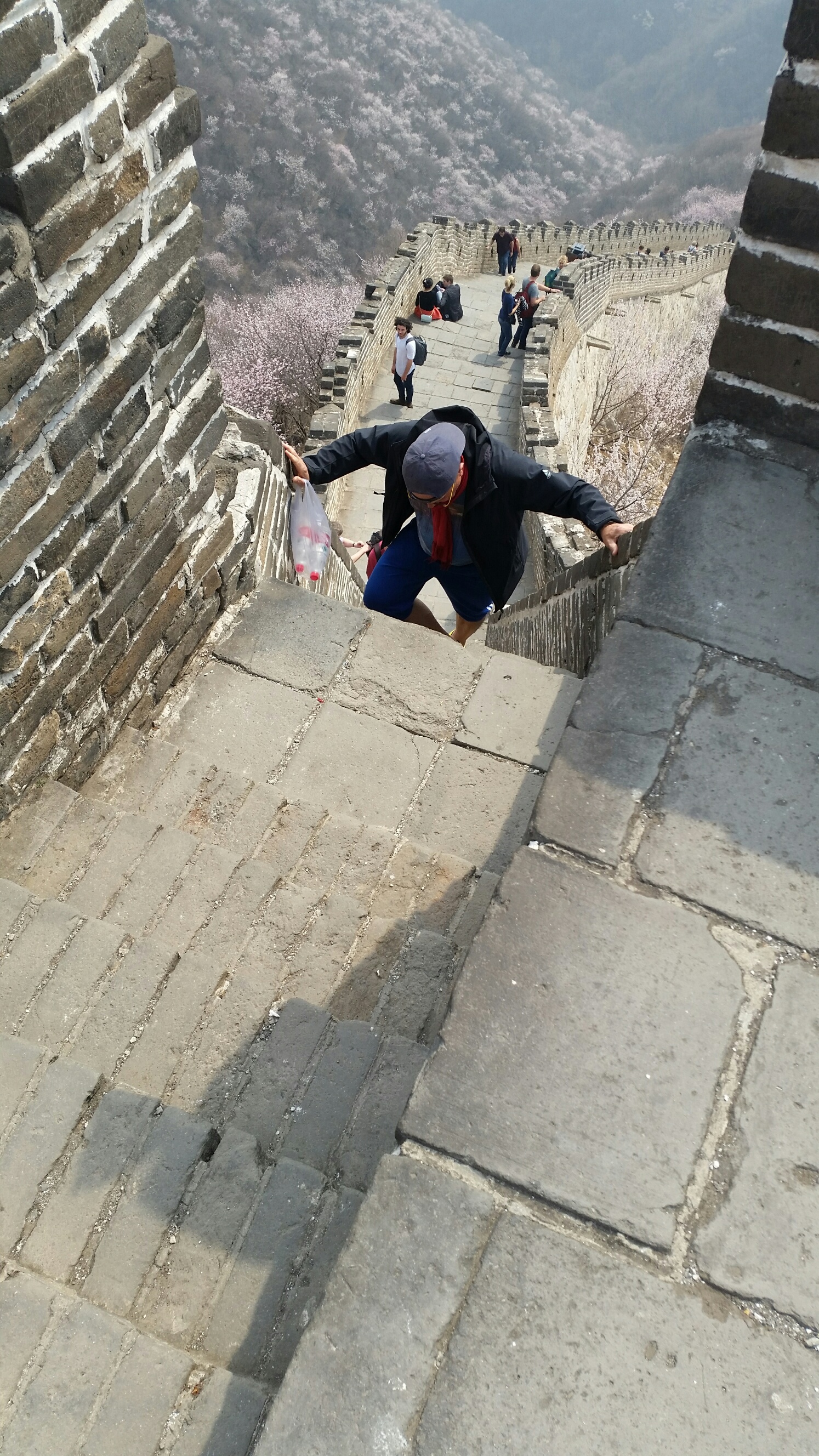
Up the GREAT WALL wearing baseball cap reversed.
But be that as is may: China is definitely the country of walls. Both historically and today in the internet – where they actually show the Russian and other regimes how to build digital walls.
Allegedly, China spends more money on its censorship activities and also uses more employees for maintaining it than for its army. As unbelievable as this sounds, I can still imagine it quite well. The very concept has something special to its name and censorship is definitely something that consumes resources.
So this is another time I am going to visit and see the Big Wall. And I will climb some of it. And my personal explanation of the GREAT WALL is:
There is a huge Chinese Community (nation, empire, people, however you wish to call it). It took a long time to organize itself and find its own order. Over the centuries, it became huge and powerful. Around the middle of the second millennium, they noticed that the systems around their own dominion differed from their own system. The change happening all around them was considered a threat. Consequently, they built a wall.
Isn’t it the same today?
When all is said and done, the purpose of a wall is that your own system is protected. And China probably succeeded in this respect with their GREAT WALL. Now it is quite a moot point to ask whether building this great wall was useful for China in the short run or in the long run or anywhere in between. You can ask if the wall succeeded in preserving the values worth preserving. Basically, the answer to this question, along with its usefulness, is the most important argument in favour of such decisions as building a gigantic wall with all its monumental consequences.
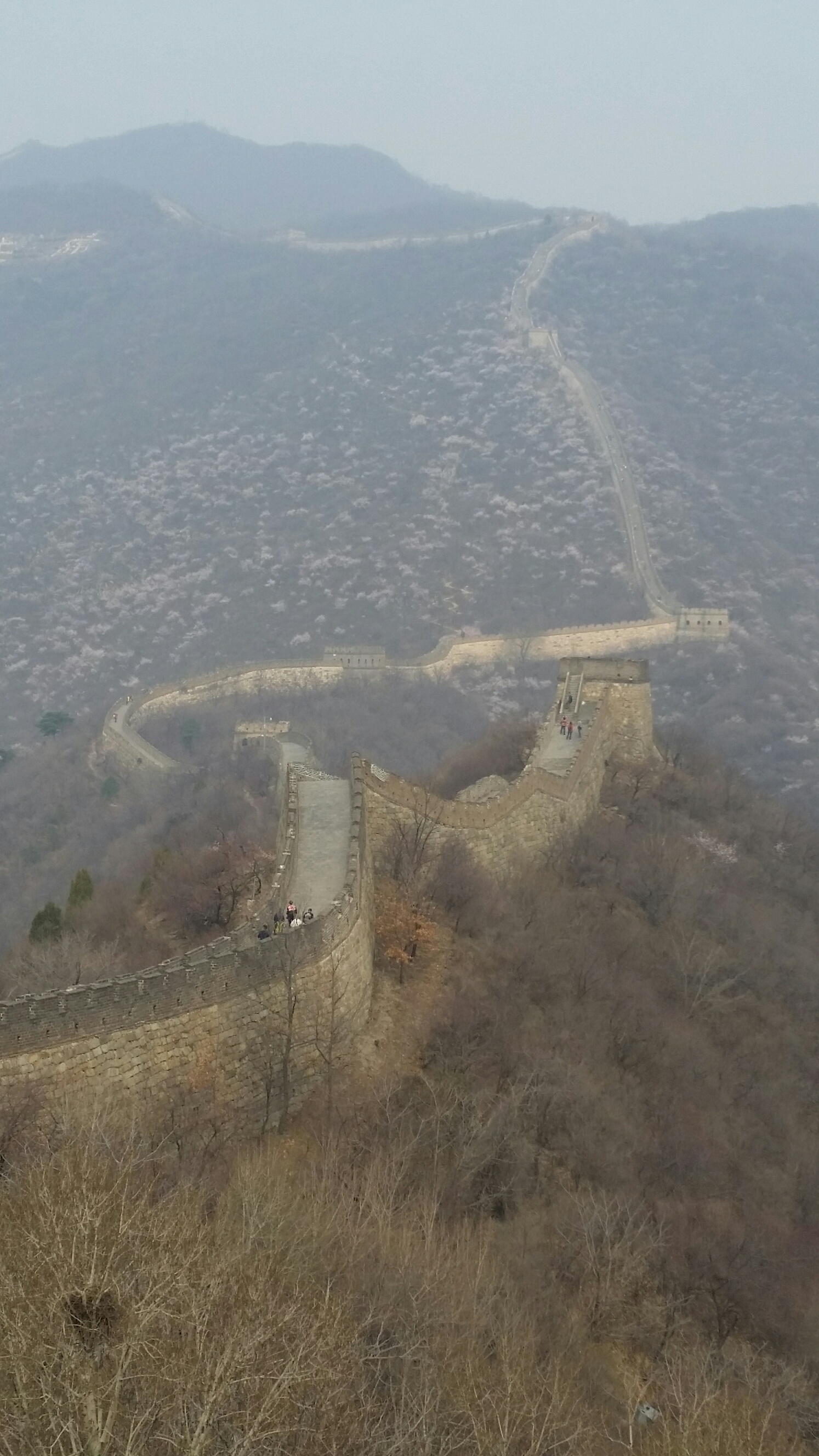
Chinas Smog does not stop in front of the GREAT WALL.
I guess the great wall was quite useful for China in the short run. It conserved the stability of the huge empire and made it even more powerful and richer.
But I doubt that the usefulness of the wall was sustainable. Perhaps, in the long run, the wall actually brought considerable disadvantages? To be sure, it helped to preserve an old order, but as time went by, the consequence was that the country grew weaker and weaker? Because there were no dynamics left. And thus China lost the strength necessary for a meaningful future.
And perhaps, without the GREAT WALL, China would not, centuries later, have dived into this unfathomable phase of weakness from which it only knew how to liberate itself through a bloody and cruel revolution instigated by Mao-tse-Tung, a revolution that went on very complex and painful paths?
And perhaps, without the wall, there would never have been a radical cultural revolution as a late consequence. A revolution that actually led straight to an excessive and seemingly perverse turbo capitalism.
We are talking a success metric the desires and activities of which follow only one principle: the greed for money and the hunt for riches!
And the same will probably happen with all the Chinese (and Russian and other) internet walls: they will have special effects of their own we cannot even begin to understand today. And perhaps they will be most detrimental for those who today think they benefit from them?
These ideas about walls, fears and xenophobia are not restricted to dictatorships. European and EU- countries that, so far, still consider themselves democracies might be well advised to ask themselves if, in the long run, walls will really make sense. And they might all re-establish my idea that transparency and openness are usually the better maxims.
These kinds of ideas particularly move me in the upcoming era of natural catastrophes and the subsequent conflicts and migration waves.
RMD
(Translated by EG)
Roland DürreFriday April 1st, 2016
Elephant Wedding: ADAC and DAV to Merge!
In business, elephant weddings are something we have been familiar with for a long time. One brewery will take over another. Big banks will swallow each other. In trade, one chain will always be found to buy an uncomfortable competitor.
In IT, too, there is a long history of mergers. Just think of enterprises such as Compac or Digital, who were swallowed rather quickly. Or what about the merge of EMC and Dill last year? Or the proud Munich Softlab GmbH that became NTT (Nippon Telcom) via Circuit (BMW). Just like the elitist SDM today bears the name of Cap Gemini …

 Now the fusion fever also reaches the German mega associations. Today around noon, at 1 p.m., the merge of the Allgemeinen Deutschen Automobil-Club e. V. (ADAC) and the Deutschen Alpenverein (DAV) will be officially announced during a public champagne reception at the Bayerische Staatskanzlei (!).
Since this remarkable event is something they want to share with the “people of Bavaria”, all friends of cars and of the Alps are cordially invited to share a few glasses of champagne with the bridal pair. And, basically, being a “Mobility in Everyday Life Activist”, I should by rights also attend. However, this is not possible, because today I am going to climb onto and hike on the “GREAT WALL“.
One must under no circumstances underestimate the impact and meaning of this event. The Deutsche Alpenverein e. V. (DAV) is the world’s biggest association of mountaineers and ranks on number eight of the biggest sports clubs in Germany. The Allgemeine Deutsche Automobil-Club e. V., short ADAC, is Germany’s biggest automobile club and situated in the car-capital of Munich!
And who initiated such a historic event? Well, the person who brought the parties together and thus saved the two associations is – how could it have been anyone else – the Father of our Bavarian State, Horst he First of Seehofer! He was the marriage broker who brought the two sickly favourite associations of the Germans that were internally quarrelling and in a permanent state of inner crisis together. In particular, he saved them from certain downfall.
Tirelessly, he, again, used his great political acumen for Bavarian Basic Values and The German Way of Life, fighting for the true interests of the people in this country, who basically do not love their laptop and lederhosen but first and foremost their cars and the mountains, with maximum enthusiasm.
The merger is a true love marriage. After all, both associations have for a long time believed in the formula:
Mountain Sports = Motor Sports
because mountains and motors belong together!
What would a mountaineering person be without his or her Diesel, be it by Toyota or VW? After all, when travelling to the mountains, he will usually spend more time sitting in his lifelong tin box (tin companion for life) than later climbing the mountain with his human companion.
And where, other than the mountains, could a car owner drive his soot coach on a weekend? It certainly would not be worth the trouble to just drive to the bakery in the morning and fetch cigarettes in the evening, would it?
Isn’t the combination between mountaineers and Diesel cars the perfect duo? Robust, reliable, persevering and frugal! And aren’t they both very much at home on the race courses? And as soon as it gets hard, they both will switch to Quattro.
The publications and magazines of the two associations, too – the ADAC Motorwelt and the Alpinwelt and Panorama of the Alpenverein – not only sound somewhat similar, they are also built up following the same patterns. Marketing is all.
The decently green edelweiß will have a positive influence on the martially heroic-yellow ADAC logo. The sooty vest worn by the motorsport hero is badly in need of the mountaineer’s underwear which, although often wet with perspiration, is otherwise clean, in order to at least regain some grey tone. Consequently, this is how the ADAC will re-establish its moral integrity through the leather panty lap of the Alpine lovers. The DAV, on the other hand, can improve its rather boring image with glamour, chromium and cars. As you see, this fusion is just the perfect match from the emotional point of view: what belongs together is finally growing together.
But the liaison also follows the logic of a marriage of reason. Even now, the synergies are obvious. With the strong ADAC sales department for tourist products, the DAV found a strong market channel for its products in the mountain and mountain shelter sector. Globetrotter – sales partner of the Alpine association – can then also give shelter to the ADAC departmental offices and provide the nature lovers with some advertising for driving their beautiful SUVs by Porsche or Toyota and more through the landscape. Let me just mention the magic word: “Cross-Selling“!
And more fantasies for totally new cooperation models actually come to mind easily. How about, for instance, a shared hyper accident and breakdown cover that guarantees the quick transport of victims via helicopter both from the street and from the mountains or skiing slopes?
Basically, both associations also cover totally different worlds of criminalization – sorry, commercialization. Well, the special relations between the ADAC and the German automobile industry are well known. The Alpine association has been a sympathetic and successful sales partner of Toyota for a long time. Thus, the new fusion will also build a new bridge for international understanding between car producers in Japan and Germany! And this will doubtless help both of them when it comes to strengthening their world-market position that is now threatened by Korean and Chinese manufacturers.
But then, there are also some questions and problematic issues: What are the remaining sports and interest associations going to do? How, for instance, is the DSV supposed to survive against the new super association? How will the DLV react? What will happen with VCD and ADFC?
Can the imperial DFB as mafia – pardon – market leader really stand by and look upon such a power concentration with serenity, or will it eventually take over?
RMD
(Translated by EG)
Roland DürreSunday March 27th, 2016
Another Debut Performance in the Torturmtheater!
And the piece was rehearsed at Unterhaching in the InterFace building!
 This year, the Torturmtheater will be forty years old. The very first performance they give in this jubilee-season is going to be one that was rehearsed in Unterhaching. It makes me very happy to say so. The Torturmtheater has now finished some of its productions after intense work at the Unterhaching InterFace AG building for some years. The reason is obvious: most of the active members of the drama group often reside in the Munich area and it is quite hard to find appropriate rooms for rehearsals in Munich. The performances are always in the traditional Sommerhausen Torturm.
If you remember: in 1976, after the death of Luigi Malipiero, Veit Relin re-opened this very small and yet so wonderful theatre in Sommerhausen (very close to Würzburg), establishing its reputation beyond the region through premiere and first performances of a high standard and with exceptional playlists.
The 2016 season at the Torturmtheater will be a German debut performance:
A pornographic relationship by Philippe Blasband. The German debut will be on Wednesday, March, 30th, at 8 p.m. Under the directorship of the inimitable Eos Schopohl, the characters will be played by Zhanna Kalantay and Murali Perumal. As always, the responsibility for the choice of play, the accessories and much more is with Angelika Relin.
Love is a strange game. Yes, they loved each other. Regardless of the fact that, initially, they only wanted the fulfilment of their lust and preferences – she had put the advertisement in the classified section. They know nothing about each other; nameless, they are protected by anonymity. That is also true for protection against each other. The uncomfortable everyday-life details are absent, which gives them freedom. But soon they find out that they love each other. In fact, it might turn out to be the love of their lives …
At the decisive moment, however, they lack the courage. Eventually, all that is left to them is the bitter-sweet memory of a chance gone by and, above all, the memory of a passionate love.
With this story of a couple who did not want to be a couple, Philippe Blasband successfully created a wise and erotic intimate play full of sensitive comic elements.
Here is what Angelika Relin writes in her pre-view of the year 2016:
We will start in the spring, on March, 30th, with a German debut performance – A Pornographic Relationship! It is a melancholic love story, not devoid of comic elements, certainly intense … (See what I wrote above).
Later, we will try to fathom the very normal mania of our consumer society today and put it in a nutshell. The very title: If I did it in another way I would probably not always think of the money involved is so highly scurrile that you absolutely have to become curious. It is an evening you do not wish to miss under any circumstances – shrill, bizarre and endlessly comical, even if the strange everyday-life truths themselves basically create sad clowns.
The summer can actually be said to point directly to the Achilles Heel of our democracy that puts a rift through the middle of our society – and the same is true for our protagonists on stage: those two couples representing the middle classes and getting closer to each other as neighbours in jealous cordiality. When, one night, Barbara gives asylum to a refugee, the prosperity anxieties and the fascination with the unknown clash unhindered in this bitter-evil farce. All the parties concerned drown in the ups and downs of faked humanity with raven-black humour. We are not barbarians is the message they have to accept, even if their laughter gets stuck in their throats.
In the autumn, The Farewell Dinner will upset your diaphragm by trying to set the idea of friendship ad absurdum with its perfidious morals. But, as so often in life, everything will turn out differently …
Well, so far the message of the year 2016 by Angelika Relin. Click here for the playing schedule (Spielplan)!
As has been my habit for many years, I will go and see all the four performances in 2016 whenever possible. This is not only because it is very great theatre, but also because it is a chance for Barbara and me to make very nice trips to Sommerhausen. Unfortunately, I cannot see the premiere performance of “the pornographic relationship”, because I will still be in China at the time. But I already bought two tickets for the performance on April, 16th. And it would make me happy to see some faces I know!
RMD
(Translated by EG)
P.S.
If you want to go to Sommerhausen, the best thing to do is take the regional express train to Winterhausen, which is right on the opposite side of the river Main. From the Winterhausen railway station, you walk across the Main Bridge to the theatre, which is about one kilometre. You will want to exit the train at the rear end if it is headed towards Würzburg.
Roland DürreThursday March 24th, 2016
Entrepreneur’s Diary #115 – A Personal Interview.
A short time ago, someone asked me to answer a few questions in writing as a preparation for an event. Here are my answers (in cursive letters):
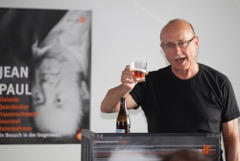
During the IF Forum “Jean Paul“ (2013)(2013)
We would be interested in who you are and what exactly is your interest when talking the conflict between leadership and cooperation?
I see myself as an entrepreneur, activist, impulse giver and inspiring counsellor.
For us, your motivation is particularly important: where do you get the energy for what you do?
From all the people I meet on a daily basis and from the cooperation with many other persons.
What are your current projects/initiatives?
I coach and support enterprises (including the ones I am myself part of), help start-ups and mentees, am involved in (almost) anything that pertains to “digital transformation” – it used to be called information and communication technology – and I try to promote social topics such as “active mobility in everyday life” (as our future mobility) and “peace” (as my life’s goal).
What are the topics you would wish to discuss and exchange opinions on?
How to make enterprises more successful and humans happier.
What are the topics you can tell us something about from your own personal experience?
In fact, many things come to mind.
What would your statement on leadership and cooperation be?
Leading is an enterprise, an enterprise means inspiration, giving impulses and making it possible that everyone can be part of the team – and that this is what actually happens. Courage and enjoying what you do will guarantee your success.
As you see it, what should be the formative factors in leadership and cooperation today?
Humility in the face of the task and respecting the people.
Can you give a personal story or an example from your practical experience?
One of the nicest stories in my professional life (for me) was the foundation of InterFace Connection GmbH with the development of the product Hit/Clou.
Where do you see the future of work-life?
Giving up working against each other and instead working together.
What is your dream/vision when it comes to innovative working models?
Networks and participation, instead of hierarchy.
What is necessary in order to achieve this?
It is important that an enterprise is agile, open (transparent) and lean, both in concept and actual realization.
What do we already have that makes you enthusiastic?
Especially in “young” and medium-sized enterprises, you will more and more often find “dialogue at eye-level”. But in big enterprises, you constantly get (successful) biotopes that live just as well.
Where do you see the special challenge for an enterprise if they want “dialogue at eye-level”?
The ability to listen and the willingness to accept that other persons are different should be a self-evident part of the entrepreneurial culture.
If you imagine an enterprise where cooperation happens at eye-level, what emotions does that stir inside you?
The feeling of shared responsibility, trust into the future, enjoying my work. I am very happy that, in my professional life, I mostly enjoyed this kind of atmosphere.
Can you define: dialogue?
Listening is more important than talking.
What is “at eye-level”?
Appreciating each other and actively respecting each other.
What challenges do big concerns face?
That all employees should identify with the system they are part of in a “healthy” way and that they can all be part of the decisions in a “meaningful’” way. This should happen voluntarily and without indoctrination and centrally controlled manipulation.
What questions arise in connection with this issue?
I wonder if this is even possible after a company has reached a certain size. Are mega-concerns at all capable of realizing such a concept? Can growth actually be the absolute standard? But then: can an enterprise be successful at all if it does not grow? I am not sure if it is possible to do the balancing act between growth being necessary and growth being potentially detrimental in a sustainable way!
Have you already found answers or are you still looking for them?
Sometimes I believe that enterprises should have an upper limit to the number of employees. And as soon as they reach this number, they should split into smaller units wherever this can reasonably be done.
What are your successful concepts for the future?
It might make sense to consider enterprises more like “living organisms” with very individual values and their own individual culture, rather than “machine-like” systems you can control by “pulling a lever”.
What are the ideas/methods you are trying to find?
Here is what I could imagine:
- In general: realize even (mega) big tasks and projects through networks comprised of small systems.
- Less and – above all – shorter meetings in the organizations.
- A lot of peer2peer work (truth begins with two).
- Anti-conferences will generate more results than, for instance, strategic kick-off meetings or workshops.
- Barcamps and OpenSpace are strong regular formats for sharing knowledge/experience and gaining insight.
- Using more haptic (serious play) and visualization techniques (one picture will tell more than a thousand words).
- And much more …
For me, a barcamp was a success if…
… all participants go home with a sense of achievement because a new common denominator, along with added insight, was created through trust and sharing.
What is special about a barcamp?
As opposed to a classical conference, a barcamp is self-organized and has no hierarchies. There are no presentations that have been prepared beforehand and all participants are responsible for the topics. This is how the discussions can be kept up-to-date and very dynamic.
Why have you registered?
Because I received such a nice invitation.
Is this the first time for you to attend a barcamp, or are you returning?
I first experienced anti-conferences, such as barcamps, a long time ago and then I founded my own barcamp movements (for instance PM-Camp for entrepreneurship and project management or AktMobCmp for “active mobility in everyday life“. But at InterFace AG, too, we organized barcamps and OpenSpace with all the colleagues at frequent intervals. And they were always rather a success, both for the enterprise and the employees.
What do you like about barcamps (in general)?
The fact that it is based on democratic ideas and the usually quick development of a great openness and familiarity between all the participants.
What topics are you concerned with?
Entrepreneurship, leadership, project management, the future of mobility, peace.
If you are asked such nice questions, it is really a pleasure answering them!
RMD
(Translated by EG)
P.S.
For more articles of my entrepreneurial diary, click here: Drehscheibe!
Roland Dürre
Why Project Peace?

White dove with blue background – this is one version of the peace dove: it has been the commonly used symbol of the western European, and especially the German, Peace Movement since the 1980ies.
Initially, it had been designed in the context of resistance against the NATO Double Track Decision.
Let me describe my view of why we urgently need to do something for peace. And I mean for the big, all-encompassing inner and outer peace.
We have to come to terms both with ourselves and our environment. And there also has to be peace between humans and nations. Both get more and more necessary in order to make a future possible at all.
In order to achieve this, we need a strong change in both our mental concepts and our awareness.
After all, it cannot be accepted that the “mental supremacy” is under the rule of persons who, for instance, believe that:
An evil man carrying a weapon can only be stopped by a good man carrying a weapon.
(NRA Vice President Wayne LaPierre 2012)
If you apply this to countries, it means that
“An evil country with an army can only be stopped by a good country with an army!“
You can easily see that the concept of moral categories, such as “good” and “evil” will not help and that it is better to continue on the way of enlightenment and democracy.
Among other things, this means that we leave the monopoly on power and weapons with the society (nation) we live in. After all, we already ceded quite a bit of it to the country as part of our civilized progress.
In order to make this system work, society must be enabled to avoid a state a rule of injustice – or even dictatorship – by public control mechanisms: among other things by a clear separation of power. And it also has to repress lobby structures, because they can easily turn into a dictatorship of the capital or, even worse, a militaristic business complex.
The requirement for such peace in a country and between countries and nations (including problematic regions) is that we develop an awareness of the fact that this can only succeed if we all win our very individual inner peace.
Consequently, if you want collective peace, you need the inner peace of all the individual persons inside the collective system. In other words, we have to come to terms with our own selves. This might be quite hard, but it is probably our only chance to develop a new understanding of punishment and justice. An understanding that truly makes us bigger as a society.
Does anybody really believe prisons are the only way to achieve a peaceful society inside a country? Or is it not more like they cause the opposite? How can a society gain social peace if poverty and wealth are due to an undue polarization?
Consequently, one of the things we need to achieve is disproving some impossible philosophers, as for instance Ayn Rand (one of the important masterminds of the US Republican Party) and start a “new” enlightenment 2.0. For a start, we have to counteract any sort of indoctrination, because that is the worst enemy of an enlightened society.
This is why, through our project peace and together with Jolly Kunjappu, I try to make a tiny contribution towards stabilizing the fragile balancing act between peace and relinquishing some of said peace in favour of an alleged sense of security.
On a personal level, I also want to remind people that, wherever there is conflict, the solution without murder and death, torture and rape, is always the better way out. In fact, it is usually the only way to get stable and sustainable solutions. And I also wish to strengthen confidence and the belief that this is absolutely possible and realistic.
In other words: I would prefer to follow the metaphor of “Ghandy”, rather than the one of a tyrant.
(Written in Peking)
RMD
(Translated by EG)
P.S.
Again in a nutshell:
Being “honest to yourself” is the first requirement for “inner peace”, which again is the requirement for the “great peace”. This is why we need inspiration and impulses for “inner honesty” – which is one reason why Jolly and yours truly invite you to attend the PEACE kick-off meeting on April, 28th, at the IF Forum.


