
Roland DürreTuesday May 10th, 2016
Future, Evolution, Transformation & Digital!
One week ago on Saturday evening, we started on our way to Italy, leaving the train on the next morning in Orvieto. It took us three days to get to the congress venue at Castel Gandolfo by bike. Riding our bikes to the Albanian Ocean in the south-west of Rome was a great preparation for the international
“10th NETWORK MEETING OF THE PETER PRIBILLA FOUNDATION (MAY, 4th – MAY, 6th 2016, ROME)” I was lucky enough to be part of.
The workshop was intense and challenging. Consequently, we spent the day afterwards being truly at leisure and indulging in luxury in Labico. Subsequently, we rode our bikes through Italy for three days. The first leg was from Labico to Terracina (around 80 km). Then we continued to Nettuno (about 75 km). From there, only about 50 kilometres were left to ride to Ostia, which meant that we arrived there early in the afternoon and had plenty of time to see the ancient Ostia by bike and generally enjoy Ostia.
During the three days riding through the provinces of Roma and Latina during the wonderful Italian early summer, I had a lot of time for contemplation. It was a truly special meeting.
Tomorrow, our voyage will be at its end. We are going to Rome. There, the night train that is supposed to take us back to Munich by Thursday morning is already waiting for us. Let me write down a few memories of today’s meeting.
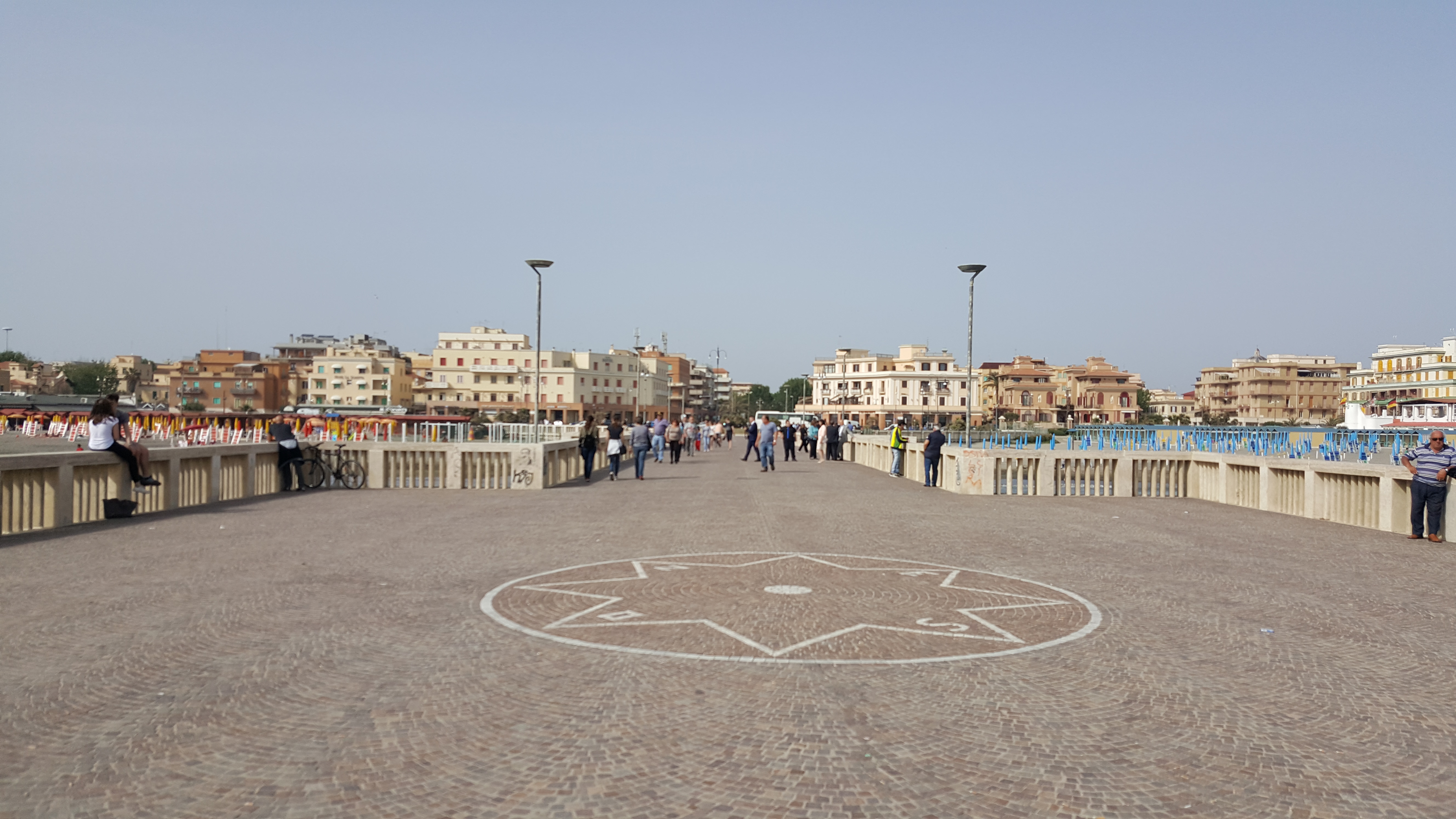
Lido di Ostia, picture taken and scenery admired from the central ocean bridge :-).
The meeting was sponsored by the “Pribilla-Foundation“ and about “Digital Transformation“: After all, this is a transformation that concerns all of us ever more, making us aware of change that is happening and growing at rapid speed.
The workshop was opened with an impulse presentation by Manfred Broy, who is the director of the Bavarian Digital Centre (Digitales Zentrum.Bayern). He gave a precise “sweeping swipe” on “digitalization”. Based on exciting facts, he pointed out to us what is currently happening. I was allowed to give one of the three (3-minute) short responses to the presentation. Here is a short version of what I said (with a few additions, because three minutes is actually quite a short time):
“The digital transformation will probably have a massive influence on the evolution and our future. It might even help on the way towards finding the necessary great transformation humanity needs badly.”
I came up with a theory on all the terms marked in this sentence – that is: I formulated my “basic beliefs”. Here they are:
- Future
As I see it, the future cannot be predicted!
That is also the first theory formulated by the great and unfortunately already dead management scientist Hans Ulrich from St. Gallen who revolutionized the theory of management in the 1980ies with his essay “Eight Theories on Change in Management”..
It may well be possible to predict the future correctly once in a wile if you use the tools of science and your common sense. That is: you might receive a “message from the future”. Yet you will never manage to correctly interpret said message.
To me, the future of humanity can be described using the metaphor of a boat on a river. The river is in the “white area”. The boat moves down the river.
You can measure the speed at which the river flows and also, for instance, the stream gradient and other data. But still, all those data will only give you limited information on what is going to happen. Using a spy glass to look into the distance will also only be of little help. It is not predictable how the river will continue on its way (will it become broader or will it find its way through a narrow gorge and become a torrential river, will there be a bend or a waterfall or will it suddenly disappear totally underground?).
And in this metaphor, we do not even know if humanity is the boat or the river (or maybe just a swarm of fish?). - Evolution
Evolution is useless. Perhaps it tries to make sure there will always be life, but we do not know why and for what purpose.
As I see it, evolution cannot be controlled – just like the future is not predictable. Basically, we cannot install a “steering committee” and tell them ”Please control evolution!”. It simply will not work (just like, incidentally, it does not work with huge enterprises and social systems). - Transformation
I think in a next step, evolution will have to and will undergo another huge transformation. This is necessary if humanity wants to survive. It will come, disregarding the question of whether humanity will continue to live or not. We know nothing about this transformation, except that it will bring basic change and come as a huge surprise. The time for this transformation is ever nearer. It will probably happen within the next few generations. - Digital Transformation
It would be nice if digital transformation could become a positive driver for this great transformation. I see quite a good chance. Even now, the world changes through digitalization – and in my opinion said change is for the better.
The friendly persons build networks, the combination of digital + social makes it possible to cooperate constructively in a way that was hardly possible in former times. Thanks to the “digital” world, something like “enlightenment 2.0” develops. To me, this looks to be more important than the “buzzword” of “industry 4.0” which, after all, is only “normal” technological progress.
What remains is the question: how can we contribute towards digitalization changing the world in a positive way?
Of course, I do not know the answer. It is my belief that we should not talk too much but instead act. Every one of us should act in his own specific way, following his personal inclination. And we all should do it together and connect with all the ”friendly persons” in our society – for instance those persons I actually met in huge numbers at the nice meeting in wonderful surroundings!
RMD
(Translated by EG)
P.S.
During the meeting, I mentioned a book that might actually help you a little to understand how totally different even our “small” children think – and how helpless the ancient concepts of thinking and teaching and education have become.
(Re-Invent Yourself! A Declaration of Love for the Network Generation by Michel Serres).
Roland DürreMonday May 9th, 2016
A Pity!
May, 8th, 2016, 18:47 hours
Defense Minister:
Armed Forces to Grow Again

White dove on blue background, one variant for the dove of peace; has been the much-accepted symbol of the Western European and in particular the German peace movement since the 1980ies; originally designed in the context of uproar against the NATO double track decision.
On arrival in the peaceful town of Terracina, we were welcomed by a soft Mediterranean evening. However, as soon as I started reading the SZ-online version, my good mood was gone.
The doctor of medicine who reigns over us, Ursula von der Leyen, wants to expand the armed forces. In April, she had announced that now the Armed Forces have a new Cyber Regiment (Cyber-Truppe). It was not an April fool’s jest and Frau von der Leyen is now feverishly looking for nerds.
In May, there were again news from the Ministry for War and Peace: according to the Süddeutsche Zeitung, the military planners decided that 14,300 additional military officers will be needed until 2023.
Currently, the upper limit of Bundeswehr personnel is allegedly around 185,000 soldiers, 177,000 of whom are currently in active service. This would mean that even the upper limit would have to be increased.
Now you could ask the stupid question why a medical doctor of all people wanted to be “Minister of Defence”. After all, as a doctor of medicine, she should have sworn the Hippocratic Oath (Eid des Hippokrates). Even the modern form of said oath should still mean that a doctor of medicine should not cause misery for humans.
Also, it is certainly about time that we realize growth is not categorically a good thing. As I see it, this is particularly true for the military and war. They also say that there is a new arms race between the USA and Russia, which basically is the heir of the USSR. The next US president might well be a person who gives more fuel to that race. Except – do we really want to and have to be part of such a race?
What ails me most about this news is that the “west-allied” Germany manifested the re-establishment of Armed Forces in 1955 by the FRG re-armament decision, regardless of the fact that the German Parliament had refused the national re-armament of Germany in its first state debate on November 24th and 25th, 1949.
As a consequence of the growing East-West-Conflict (Ost-West-Konflikt) during the Korean War (Koreakrieg), the Federal Government of Germany joined (or had to join because of the west-allied super-ego?) the European Defence Alliance (EVG –Europäischen Verteidigungsgemeinschaft) (1952) and theNATO (1955).
To be sure, the former general Gerhard Graf von Schwerin had been appointed as early as May, 24th, 1950 to be the technological advisor in questions of security for the secret establishment of German armed forces by Konrad Adenauer.
I was born in Germany in 1950. At the time, I was a small child. I think children are wise and will certainly oppose armament and war. Today, I would be happy if the German Parliament would have been wiser and more courageous in the 1950ies. To me, it seems that the German population was wiser. They did not want another army such a short time after the Second World War.
If the people’s will had prevailed, we would have no armed forces in Germany and no armament industry. And that would be a good thing for our country and probably for the rest of the world, as well.
This is what I believed 50 years ago and it is what I still believe.
RMD
May, 9th, 2016, 08:47 hours
(Translated by EG)
P.S.
Dear nerds – please do not wear a uniform.
Roland DürreFriday May 6th, 2016
Tips
Currently, I am again travelling. I ride my bike in Italy. Almost a week ago, on Sunday morning, we exited the night train with the endearing name LUPUS from Munich to Rome in Orvieto. Starting from there, we rounded the beautiful Rome on our way to a congress in the south-east of Rome in three days. Our first overnight stop was in Viterbo, the next night we slept in Tragliatella.
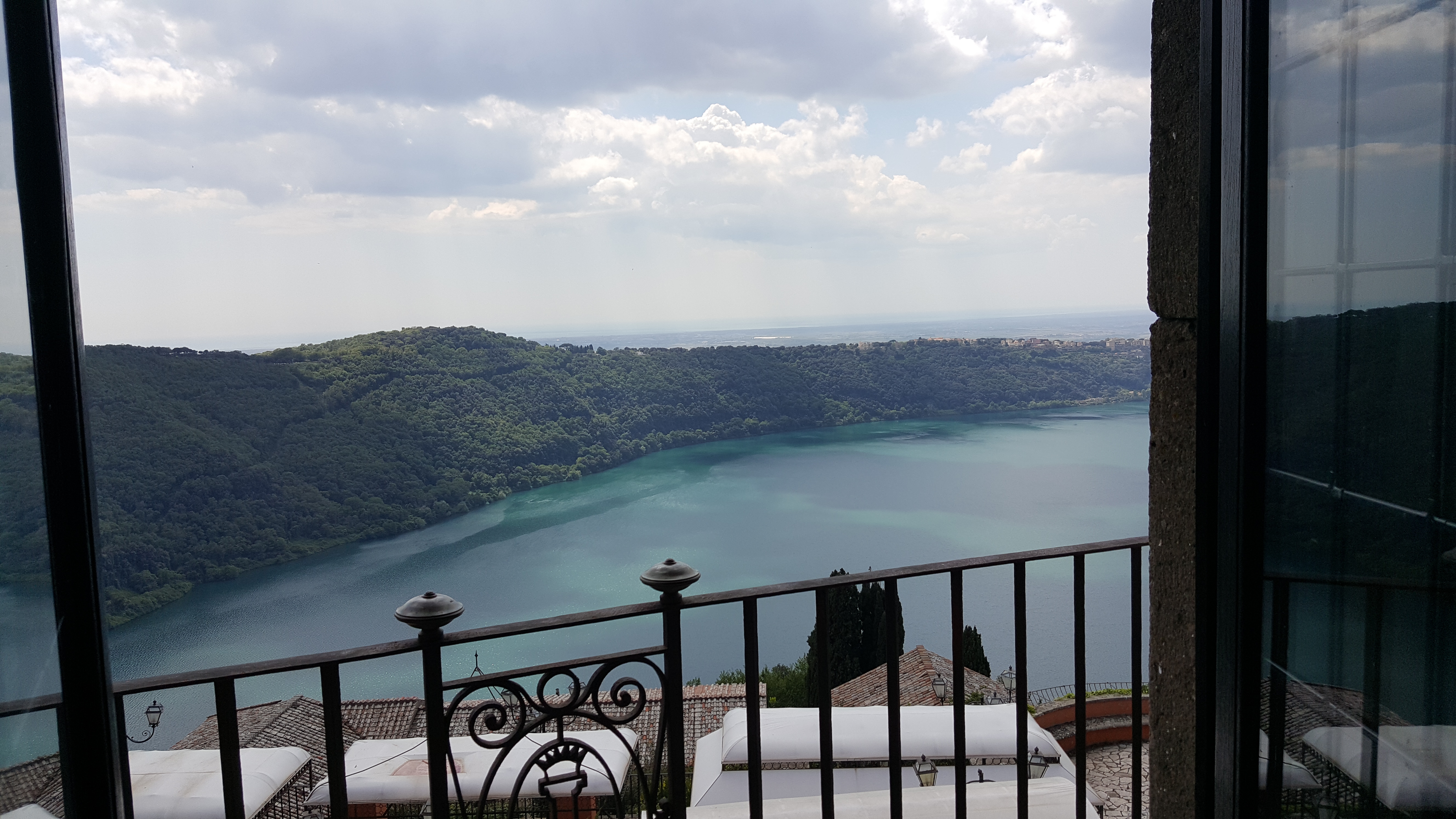 The congress was in a wonderful congress hotel Castel Cardinale high above the Albanian Ocean, facing Castel Gandolfo. Now we spend two more days vacationing with friends before another nice round trip is to get us back to Rome. From there, we will go back to Munich – again in the night train – on Wednesday.
Well, the typical question is again to be asked:
Do you tip the sleeping compartment conductor?
Whenever I go abroad, what about tips? Who knows all the customs about tips in Great Britain, France, Italy, Spain, Poland, The Czech Republic, Slovakia, Romania, Albania, Bulgaria or even North Africa, Turkey and many other countries?
Do some countries know a difference between, for instance, eating out and staying in privately led quarters? I am often unsure: what is the custom? Will I perhaps even hurt someone’s proud feelings if I leave a tip, even though I certainly meant well? Or am I behaving shabbily if I refrain from leaving a tip?
As we all know, there are some countries where leaving a tip is an absolute “must do”. Among those countries is the USA, where the tip is part of the actual salary and you cannot leave without having given something. Well, that makes it pretty clear what to do and what not to do. But even in Germany, I am not always sure. How is it possible that leaving a tip is not obligatory and yet there is a generalized tax rate for the restaurants?
Now I am riding my bike through Italy. As far as I know, it is totally unusual to leave a tip in this country. Consequently, I do not have a problem.
But what to do about the conductor in the night train from Germany to Italy?
My solution was: I leave a tip that is a little more than just symbolic. On the way out, it was 5 Euros for the two of us (i.e. for the compartment). And I told him that this was supposed to tell him how I appreciated his work. Later, I heard that, basically, night train conductors used to receive tips as a matter of course. Only it got less and less fashionable.
As I see it, leaving a tip makes sense if a) it is in accordance with the rules of the country and b) the “gift” is also clearly communicated as a symbol of your appreciation. And I am quite glad whenever my thoughtfulness gives me such clear results that make life look a little more joyful to me.
RMD
(Translated by EG)
Roland DürreFriday April 29th, 2016
PEACE

Thinker, artist, and, above all: human being.
It seems that yesterday’s kick-off for the project peace was a success. I think we, and in particular Jolly, reached the people. We also produced nice video material and will soon discuss what and how to best process all this material.
 Newly invigorated, we will now continue on our way. We are looking for allies and collecting crazy ideas. And we will all think about it all and then start new activities.
I would like to thank all those who came for being there and supporting us.
In my presentation of a little more than 30 minutes, I introduced Jolly, related why I, from now on, will focus more and more on the project PEACE, told you why I am optimistic and tried to make you understand that it is time to act.
We will make Jolly’s and my presentations available online. Here is mine in a nutshell, along with a few links for video recordings:
Introduction: Jolly (we are project partners)
- First met at the Munich Chess Academy;
- Immediately understood that we are “brothers in spirit”;
- He is an artist and philosopher and a
- Modern Robin Hood;
Through his life philosophy he convinces the rich to share their wealth with the poor. - He lives what he talks about and engages himself for more togetherness and peace.
Why do I do this (motivation)?
- Grateful for so many good things life gave me, wanting to give something in return;
- Private reasons (marriage, family, children);
- Always having enough to eat and never going cold;
- Wonderful teachers, circles and communities;
- Learned endlessly;
- Successful in business and social life;
- Adventures
- War and early home – 1950ies;
(inner peace) - Tschernobyl – 1980ies;
We have to join; - Cuba crisis – 1960ies;
(a still traumatized society is afraid of the great war) - Vietnam
(My experiences with young GI-s in the 1960ies);
And many more wars!
(peace among humans, nations and all sorts of societies) - Annoyed about not having done things better, regardless of having known better.
- Continue with the task that generations before me started (forefathers – models).
(Carl Amery, John Lennon, Konstantin Wecker, Willy Michl, Ghandi or Martin Luther King) - The engineering knowledge that we need a great transformation, and that we need it rather quickly and perhaps on a radical scale – otherwise we will be finished in a few generations.
- Soon 66 years old – and I feel more and more that Peace is the only thing that really counts in my life
- War and early home – 1950ies;
Why I am hopeful (optimism)?
- War gets more and more absurd!
- 13,500 cyber soldiers (13500 Cyber-Soldaten)
(harmless model – the concept of a permanent cyber war give me pause) - Body leasing of soldiers as a new quality of mercenaries
(they used to sell individual persons as mercenaries, today this habit becomes the normal entrepreneurial profit concept of capital companies). Examples: Academi (between 1997 and 2007 Blackwater USA, until 2009 Blackwater Worldwide, until 2011 Xe Services LLC, since 2014 part of Constellis Holdings) is the biggest US security and military enterprise. - War robots
Atlas is a Boston Dynamics project for the US Defence Advanced Research Projects Agency and as far as I know, Boston Dynamics used to be Alphabet (Google), now sold, because it is military-oriented and On new ways of warfare, an overview (Übersicht). - New knowledge from neurology and philosophy
- We totally misunderstood issues such as personal criminal responsibility and free will;
- Ratio is only a very small part of the human being;
- We are not those free thinkers and controllers. Instead, we are all trapped in our socialization that is formative for our subconscious. This might be another reason why, when all is said and done, we are all very much social creatures. After all, our subconscious has been generated by socialization, i.e. by other people.
- The internet changes the world.
The digital and social networks of “friendly persons” with their readiness to act together increases. - Success stories:
(NextHamburg, Urbanauten, PMCamp.org self-made, Open Source Communities, NGOs but also enterprises)
Installing these “free communities” by yourself will become the main means by which to solve actual problems in the future (infra-structure topics and smart cities). Among other things, this is because it would be asking too much of the fatherland to do it.
So how to go about it? (strategies)
- Instead of talking, we have to act! Get up! Do something!
- We have to begin with ourselves;
- No indoctrination, only impulses and inspiration;
- Peace and liberty;
- Living in love;
- Connecting with art and artists?
- Snow-ball principle?
- Plenty of ideas.
- …
And then came: Jolly …
RMD
Finished late in the evening in the train from Stuttgart to Munich, going to a good weekend and already a little on the way to Rome on Saturday.
(Translated by EG)
P.S.
JOERG ROTHERMEL wrote a beautiful facebook comment:
“Instead of talking, we should act! Get up”! Do something!“
well, here is an feminist article:
https://franziskaschutzbach.wordpress.com/…/ich-denke…/
I find it especially nice to read the question if “Macker“ is derived from “Macher“!
Well, this really hits home. Because my formulations were very masculine. Except: I think this is how men and women are. This is totally free of judgement. And since I am a man, I consider women beautiful goddesses. Incidentally, the post behind the link is worth reading.
Yet, I do not see it as a contradiction. It looks more like a huge supplement to me.
Because in my concept, you will find: “Instead of talking, we have to act! Get up” Do something!“ NOT to mean: COCK-FIGHTS, WARS, DEMONSTRATIONS, PROPAGANDA and MISSIONARIES: It almost annoys me that I called our enterprise “PEACE” project PEACE. After all, in my personal radical concept, the common understanding of project is already typically chauvinistic behaviour. And I consider it important that teams of men and women basically NEED NO project managers.
For me, it is the METAPHER for:
FOR: “Not letting us be suppressed by YOU CANNOT DO THAT, not letting us be manipulated by MARKETING, or influenced by INDOCTRINATION.
“
FOR: “Listening to the MESSAGES FROM THE FUTURE, living AUTONOMOUSLY AND IN FREEDOM and not swallowing ANY KIND OF RUBBISH.
“
FOR: “Stopping to swallow all the RUBBISH POLITICIANS try to tell us and instead COURAGEOUSLY reacting with CIVIL COURAGE.
“
FOR: “APPRECIATING ourselves and ALL HUMAN AROUND US, winning back the CREATION and our ENVIRONMENT, and living with mutual respect and LOVE as a formative maxim and ELEMENT of OUR EVERYDAY LIVES.
“
FOR: “Quickly forming alliances with FRIENDLY PERSONS (rather than angry citizens) and actually changing the world for the better through COURAGE and happiness”
FOR: “first and foremost: changing your own habits and finding JOY and LOVE inside!“
AND MUCH MORE OF THE SAME!
Why should not the sexes meet on that basis!?
Roland DürreThursday April 28th, 2016
Letterbox Companies, Corruption and More of the Same … (Series) #3
In the country of horse-trading …
After previously having written in my last two articles (1 and 2) about what generally happens, I will now continue this small series on corruption by relating to you two things that actually happened to me. Here is one example of what I experienced.
As most of you know, I founded an enterprise more than thirty years ago and was its managing director and board member.
Even as early as in the 1980ies, cars were highly subsidized in the FDR as business vehicles. Since in those days it was a matter of course that everybody went places by car, we offered our employees to get a so-called business car as part of their salary if that was what they wished. If you buy a “business car”, you save the entire added value tax, you can deduce all (!) costs, such as the purchase of the car, repair parts, tyres, additional gadgets, insurance, maintenance and repairs, service and the entire cost of gas as normal business expenses. This is how you can economize on the entire added value tax and more company taxes (income, trade).
Calculated over the entire life of a vehicle, you can save an enormous amount of money in taxes, even with a medium-size car. The sum is considerably higher than the money the employee has to pay in taxes for “money-worth advantages”. Especially if the employee has only a short way to go from his home to his work place. And “prudent” employees usually have a short way from their home to the work place, even if sometimes only on paper.
The subsidized profit (difference between the added value tax you saved and the tax the employee has to pay for “money-worth advantages”) can easily be divided between the employee and the enterprise, which means both sides will profit from the car-industry subsidy. And since in those days I was still rather naïve when it came to driving cars, I used the incentive “you will get a business car” frequently when looking for new employees.
Thus, the number of business cars grew as massively as the number of employees in our firm. After a short time, the term “small fleet” was actually adequate when we talked IF cars. And it kept growing in size (10, 20, 30 …). If you have a fleet, the car salesperson will come and talk you into a fleet contract, pointing out the many advantages of same. So I also signed said contract.

The opposite side of this bill, too, has delighted many
Well, now I believed that, since we had a fleet contract, we would get the cars cheaper than private buyers. But as it turned out, this was not the case. Again and again, I heard from friends who had “privately” bought a car, that they had been granted a higher individual discount – after long and intense negotiations, but still – than I got for the fleet. This annoyed me.
Additionally, the fleet contract salesperson made all kinds of promises, but the service was abominably poor. Consequently, I sometimes changed suppliers, once even the brand. The negotiations were always a disgrace, because the salespersons always used their entire sales repertory in an offensive way, which, to me, was very disagreeable.
And when I absolutely refused to continue, the super salesperson came to see me. He entreated me to remain with him as a supplier and with his brand. Everything was going to get better. And he also offered me a special extra treat, one he only offered to his very best customers:
He offered to pay 5% of the value of every car I would buy in the course of the fleet contract into an account of my personal choice!
I was shocked and replied that I had no account for this kind of purpose. His reply was that he could help me when it came to starting such an account – preferably abroad. Did he mean a letter-box company?
This was a time when InterFace had high growth rates. We always renewed our car fleet early and consequently ordered 10 cars for the year. I am sure that the total value was more than 250,000 DM. Consequently, the 5 % he had offered would have easily equalled 12,500 DM. Well, that was 12.5 times the bill you see on the picture – and in those days you actually got quite some material for this kind of money. And it was all tax free and would have had a tendency towards growing in the future. …
I declined, because for me such behaviour would not only have been bribery, but also fraud against my partners and employees. Today, I am very happy to have refused the then very seriously made offer. I will not tell you the brand and the supplier, because I assume that this was not usual business behaviour but the individual activity of one person. But then: who knows?
RMD
(Translated by EG)
P.S.
I took the picture from Wikipedia.
Roland DürreWednesday April 27th, 2016
Stupid (?) Questions?
Here are a few current events that I find questionable:
Negative interest
Once upon a time, they actually paid you interest on what you had in your savings account. However, then came the tax at source and made the interest dwindle.
If now we get negative interest rates, how about taxes? Will I automatically get a tax bonus (Quellensteuer)?
Plastic bags
Now we have a voluntary obligation by trade that they will take money for plastic bags. I doubt that it will help very much.
Why don’t they do something about all the other considerable plastic rubbish (plastic sacks for dog shit, all the products for sale wrapped in plastic)?
Luxemburg-Leaks.
At long last, someone is facing trial.
But why are the whistle blowers those who face trial, instead of those who committed the bribery?
Higher pensions.
The government is rather proud to announce that, for a change, the retired persons got a considerably portion of the cake.
But why do they not tell us that the money some retired persons get will be less, because now some of the retirees have to pay income tax?
Subsidies.
They announced it today: starting now, the purchase of e-cars will be subsidized. The same is true for hybrid cars. I understand the latter even less than the former. If at all, e-cars are a small part of the solution at best. Their total environment balance is nowhere near good (Rentner jetzt Einkommens-steuerpflichtig).
If they want to give subsidies, why not to the carrier bikes? They are actually beneficial!
Continue: on many topics. Perhaps I will do it. But I would also like to publish all your “stupid questions”. Feel free to send them to me. This will make the blog a little more interactive.
RMD
(Translated by EG)
Roland DürreMonday April 25th, 2016
The Masters of Reforms.
Here is what happened before I wrote this article:
Currently, I have much-loved visitors from China. Yesterday, Sunday (April, 24th), our visitor wanted to see the Federal Talk Show “Anne Will“.
Well, there is nothing you will not do for your guests, is there? So we watch “Anne Will” together. The show is about the current EU politics and its relationship with the partner Turkey. Particular attention is given to Erdoğan, the twelfth president of the Turkish Republc (whom I personally see more as a dictator). The guests are mostly the usual candidates … (here is the link to the Show).

Recep Tayyip Erdoğan 015
A Great Reformer?
Initially, it is quite boring. Then Recep Tayyip Erdoğan is praised by one of the guests as a great reformer.
What annoys me about this statement is that all the other guests not only agree, but that this also gives the dictator a better reputation in the assembled circle. As a counter-argument, you get the question why he now “abolishes all his (good) reforms”?
Before talking reforms, maybe you should think about the definition (Begriffserklärung) of “reforming”. So I first look up the term reform in Wikipedia.
The first item given in the listing says that reform is:
“The planned and violence-free change of prevailing circumstances“.
To me, this looks like a halfway valid definition. And alas – it is totally unbiased. It does not say anything about being “positive” or “good”.
Neither does the definition ask about the purpose of change. Consequently, a reform is still a reform, even if, for example, it introduces a (good or bad) dictatorship or a (perhaps just as good or bad) democracy.
The actual Wikipedia article on reform does not look very convincing to me. All it does is give examples for reforms out of history; political reforms in current Germany and church reforms. It also suggests that a reform only deserves the name if it causes a modification that brings considerable change.
It seems that the only way of realizing reforms in a democracy is legislation. Reform means introducing a new law. So where does the constant cry for new reforms come from? Since we do not have the strength to remove old legislation, it means we demand new legislation all the time. And that is exactly what happens both in the counties, on state level and in the EU at an inflationary rate.
For me, the history of the German Railway is a good example for studying reforms and the consequences thereof. Initially, they merged all the county railways to become the Deutsche Reichsbahn (DR). This generated one of the world’s biggest enterprises and the biggest job provider world-wide. The advantages were easy to see: now they could build “standardized parts” in huge amounts. This “reform” probably also made the organization rather capable. Allegedly, the German Reichsbahn actually was more punctual during the first years of WW-II than the DB AG and its competition are today.
After WW-II, the Deutsche Bundesbahn (DB) in West Germany succeeded the DR. In addition to the GDR taking over the Deutsche Reichsbahn, the Deutsche Bundesbahn was privatized and converted into the DB AG, along with it being divided into many small railway societies and an extension by “private” competition.
One could easily have a long discussion about the purpose of these reforms.
But back to the Anne Will Talk Show.
Initially, when the Erdoğan reforms were mentioned, I had to think of Adolf Hitler. After all, he was not only the greatest warrior of all times (GröFaZ), but also the greatest reformer of all times (GröRaZ)? After all, many reforms and the resulting legislation that is still valid today have been initiated during the Third Reich (labour, maternity protection, relationship between church and state – including the church tax, protection of cultural goods and much more).
Here is Turkish history as I learned it:
When I was a child, I learned at school and during my socialization as a citizen of the FRG that Turkey and the Turks are very friendly-minded towards us Germans. In military terms, Turkey has always been a good partner. The fear of the Turks as we had it in medieval times is no longer appropriate. To be sure, Turkish internal policies are a sensitive issue, because the separation of church and state is never an easy thing with Islamic countries. Luckily, however, the secular heritage of Atatürk (Mustafa Kemal Atatürk), who was the father of all Turks, was protected by the generals of the strong armed forces, which in doing so also guaranteed the Turkish democracy. And, of course, they also taught us that Turkish labour was also an important factor for the German economy. This was about it when it came to information about the NATO country and then still soon-to-be member of the European Community.
Well, perhaps Erdoğan and his reforms did bring some change.
RMD
(Translated by EG)
I took the picture from Wikipedia .
Встреча Президента России Владимира Путина с Президентом Турции Реджепом Тайипом Эрдоганом в Баку
Roland DürreSunday April 24th, 2016
Project PEACE – Thursday, April, 28, 2016 – IF Forum
On Thursday (April, 28) at 18:00 hours, yours truly and Jolly Kunjappu will start our project PEACE. We look forward to welcoming our guests.

»Jolly Kunjappu – »Jumbo‘s first birthday. Celebrate your life.«
Acryl and wax crayon on canvas
On this day, we will “let the ideas flow freely”, give impulses and try to inspire “the nice persons” we like so much. We want to stir your desire to question all those things that go without
We want to promote your willingness to constructively work towards the necessary big changes in our society and way of life and in doing so make the initial situation a little better for a future that we can actively be a part of.
Because:
It is more important to act than to talk!
On this evening, Jolly and I want to bring something into motion and then, together with you, develop ideas as well as think about what we could do.
🙂 (Perhaps initiate a snowball system for peace and transformation?)
This is how we want to learn from our friends. We want to win insight and work towards our own enlightenment 2.0.
🙂 Indoctrination and religious wars are things we neither like nor wish to practice, because we are not missionaries!
Basically, PEACE is simply our central metaphor for a necessary change, because peace has a three-fold impact: on every one of us personally; in our connections with the world we live in and consequently our environment; and, of course, also in our relations between individuals and collectively between nations and all kinds of societies of our wonderful world.
And without PEACE, a happy and content life is not imaginable.
For me personally, the project PEACE is extremely important. As of now, it has highest priority. It is to become the last big project of my life, which is why, in years to come, I want it to become my central topic. In order to make this happen, it is important for me to have the support of you all, my friends.
But regardless: first and foremost, we want Thursday evening to be a meeting of aforesaid “friendly persons” of our world who meet with great JOY and give us lots of courage and trust! Jolly und I are sure that, together with you, we will manage to do just that. And there will also be a few surprises…
Here is a link where you will find three IF blog articles on the topic, including the invitation the event. I would kindly ask you to tell me if you come, because we want to have enough food and beverages. Feel free to either register through a blog comment or send E-Mail to the InterFace AG or to me.
RMD
(Translated by EG)
Roland DürreSaturday April 23rd, 2016
New Barcamps is What the Country Needs!
Now I know why my enthusiasm about barcamps is dwindling …
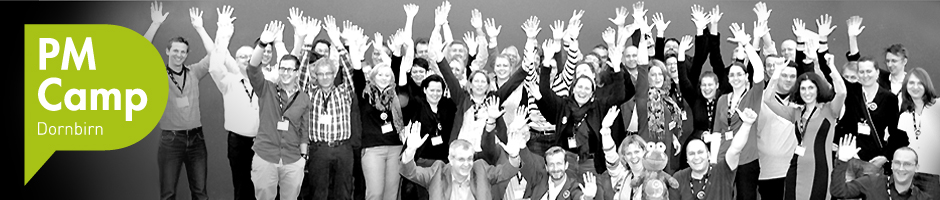 Diese Woche war This week, I was invited to attend the first (!) barcamp organized by one of the really huge German world concerns in their enterprise building. The “anti-conference” was announced as an experiment and was about “modern leadership principles“.
They wanted to try something new and invited around 50 internal employees and a few external persons (one of whom was me). Almost all of the concern employees were young “high potentials”, among them many personal assistants of directors or persons responsible for a sector of product.
With respect to the degree of freedom, the barcamp was a little restricted. For instance, the “feet principle” and the roles of “butterflies and bees” were intentionally not formulated. When I asked about those, the organizers told me they had been afraid that this would have been a little too much innovation – a fear that I do not happen to
But: the event was an extremely good experience.
To me, it seemed that, after a short phase of scepticism, all participants were really enthusiastic and active. And that it was a great thing for all parties concerned. Not one of the participants had actively prepared for the event by writing a presentation or some such! Consequently, all session givers formulated their problems, anxieties and experiences spontaneously after having spent only a short time pondering. And that really found its target – in the sessions, we always worked on topics that seemed really important and very exciting.
I, too, again, learned a lot and was truly glad to have been there. In particular, I now understand far better how huge concerned work today when it comes to leadership and management. As an extra knowledge increase, I also realized that, today, it is actually no longer the rule that new products need to be found useful by the customer.
In fact, first and foremost, it is all about evaluating where and if there are under-provided sectors on the market (product-free spaces), yet where the majority of persons who have been asked think they might need it.
As soon as this requirement is met, all you have to do is come up with a good marketing strategy and a concept that will make a basic scaling and good profit (production costs / price acceptable for the buyer) possible. I was actually a little taken aback when I heard that the usefulness of a product no longer plays any role when it comes to creative planning.
However, one (indirect and), for me, very important realization was (and this is why I write this article) that this “concern barcamp” made me aware of why I get more and more tired of barcamps:
The longer you have had a barcamp, the more people come with topics they prepared at home. They no longer formulate what is on their minds spontaneously and/or in the context of what actually happens.
 Unfortunately, this is a tendency I see more and more often in the once so much-loved PM-Camps that, so far, I have always remained true to. And when I am there, I mostly stay in the coffee room and talk to the many great persons present. Also, it seems to me that, as the years go by, other barcamps have more and more “ready-made” session, which causes the anti-conference to slightly differ only in one respect from the good old classical conference: its format-based freedom.
Here is a possible solution to the problem:
a) communicate in no uncertain terms that it is better to let the moment determine what happens on a barcamp and have sessions develop from the individual and shared situation and
b) make the planning phases more iterative and “shared” (i.e. just fix the sessions for the morning after breakfast, then reflect in the forum for a short time what is going to happen and what should be continued).
To be sure, the constant tightrope walk between individually (alone) and collectively (together) and between agile and planned in advance is certainly not something easily done. But that does not mean we should not keep trying.
RMD
(Translated by EG)
Roland DürreThursday April 21st, 2016
Basic Knowledge: Traffic Ecology –
Basics, Areas of Interest and Measures to be Taken for a Change in Transportation
That is the sub-title of the book Grundwissen Verkehrsökologie by Udo J. Becker. It was published by the oekom-Verlag, which also published the book Die digitale Mobilitätsrevolution by Canzler/Knie I already discussed here some time ago.
 If the oekom-Verlag did not exist already, you would have to invent it. I keep finding great titles among the books they publish, all of which inspire me. The publisher specialises in expert literature – and as I see it, said expert literature is rather useful and reasonable, dealing with what really matters in this world and what is really important in our lives. To prove this thesis, I added a few new publications of May, 4th, 2016, along with a list of recently published books under the PS of this article.
For example, a short time ago, I found and ordered the book “Besser leben ohne Plastik“ by Anneliese Bunk & Nadine Schubert from the oekom-Verlag. Incidentally , although I have already practiced using as little plastic in life as possible for a long time, I still found a few useful ideas. The two co-authors absolutely live up to their high standards and expectations of “showing how you can do it differently”.
Consequently, I will include the book as part of my new list of “what to give others on special occasions”. But here comes: “Grundwissen Verkehrsökologie“/Basic Knowledge: Traffic Ecology”. I often have discussions with people about life-styles and topics like “Active Mobility in Everyday Life” or “The Future of Mobility” and am shocked at hearing the theories I get in reply. And then I realize how little even wise and well-educated persons understand about the problem.
The book I am discussing might be of some help. It is exceptionally rational. All facts have been under precise scrutiny, a long list of literature makes it possible to dig deeper. To me, it all looks quite complete. At least I found answers to all the questions that currently move me. Since it is a very long work, you need not read it all in one go. I enjoy reading the occasional chapter every now and then. I also like reading a chapter once in a while and then putting the book back on the shelf for some time. Until the next time.
The book is an absolute MUST for all those who want to get a valid idea about the real traffic situation – and even more so for those who think themselves competent to speak about our traffic situation. For city planners and politicians, as well as experts in our administrative offices, it should be made mandatory reading material. Personally, I would also be in favour of adding it to the reading list when the elective subject “Our Future” is taught during the final years before graduation in our educational institutions.
I was also a little frustrated when reading the book: basically, we know all that is written therein, especially, we are aware of all the mistakes we make. We also know what is beneficial for us and what is detrimental for us. Except that whenever we do something, we do not really follow this knowledge of ours.
RMD
(Translated by EG)
P.S.
Zum 4. Mai gibt es auch wieder sehr interessante Neuerscheinungen im oekom-Verlag!
Rudolf Buntzel, Francisco Mari, Brot für die Welt – Evangelischer Entwicklungsdienst, Evangelisches Werk für Diakonie und Entwicklung e.V. (Hrsg.)
» Gutes Essen – arme Erzeuger. Wie die Agrarwirtschaft mit Standards die Nahrungsmärkte beherrscht «
Ca. 368 Seiten, ISBN 978-3-86581-797-6, 29,95 Euro / 30,80 Euro (A). Auch als E-Book erhältlich.
Peter Berg
» Endliche Welt, unendliches Geld. Das wahre Dilemma der Nachhaltigkeit «
190 Seiten, 978-3-86581-803-4, 19,95 / 20,60 (A). Auch als E-Book erhältlich.
Angela Franz-Balsen, Lenelis Kruse (Ed.)
» Human Ecology Studies and Higher Education for Sustainable Development. European Experiences and Examples «
168 Seiten, 978-3-86581-299-5, 29,95 / 30,80 (A). Auch als E-Book erhältlich.
Alrun Vogt
» Wirtschaft anders denken. Vom Freigeld bis zum Grundeinkommen «
200 Seiten, 978-3-86581-805-8, 16,95 / 17,50 (A). Auch als E-Book erhältlich.
Und hier noch der Hinweis auf vor kurzem erschienene und schon verfügbare Fachbücher aus dem oekom verlag:
Ute Dechantsreiter (Hrsg.)
» Bauteile wiederverwenden – Werte entdecken Ein Handbuch für die Praxis «
224 Seiten, ISBN 978-3-86581-786-0, 29,95 Euro / 30,80 Euro (A). Auch als E-Book erhältlich.
Christian Blasge
» Idealtheorie und bedingungsloses Grundeinkommen. Konzept, Kritik und Entwicklung einer revolutionären Idee «
252 Seiten, ISBN 978-3-86581-800-3, 29,95 Euro / 30,80 Euro (A). Auch als E-Book erhältlich.
Günther Reifer, Hans-Ulrich Streit, Evelyn Oberleiter
» Sustainable Companies. Wie Sie den Aufbruch zum Unternehmen der Zukunft wirksam gestalten. Ein Leitfaden «
252 Seiten, ISBN 978-3-86581-795-2, 19,95 Euro / 20,60 Euro (A). Auch als E-Book erhältlich.
Hans Holzinger
» Von nichts zu viel – für alle genug. Perspektiven eines neuen Wohlstands «
232 Seiten, ISBN 978-3-86581-794-5, 18,95 Euro / 19,60 Euro (A). Auch als E-Book erhältlich.
Kirsten Radermacher
» Ökologisch-ökonomische Entscheidungen in Unternehmen. Auswirkungen auf die Produktqualität am Beispiel der Druck- und Verpackungsindustrie «
350 Seiten, ISBN 978-3-86581-793-8, 18,95 Euro / 19,60 Euro (A). Auch als E-Book erhältlich.
Frank Stolze, Anna Petrlic
» Nachhaltigkeit für Einsteiger. Geschichte, Konzepte und Praxis «
116 Seiten, ISBN 978-3-86581-788-4, 12,95 Euro / 13,40 Euro (A). Auch als E-Book erhältlich.
Melanie Groß
» Und plötzlich gärtnern alle. Theoretische, konzeptionelle und methodische Perspektiven für Gardening und Commons in der Jugendarbeit «
122 Seiten, ISBN 978-3-86581-758-7, 19,95 Euro / 20,60 Euro (A). Auch als E-Book erhältlich.
Thomas Hammer, Ingo Mose, Dominik Siegrist, Norbert Weixlbaumer (Hrsg.)
» Parks of the Future. Protected Areas in Europe Challenging Regional and Global Change «
280 Seiten, ISBN 978-3-86581-765-5, 29,95 Euro / 30,80 Euro (A). Auch als E-Book erhältlich.
Markus Große Ophoff (Hrsg.)
» Nachhaltiges Veranstaltungsmanagement. Green Meetings als Zukunftsprojekt für die Veranstaltungsbranche «
274 Seiten, ISBN 978-3-86581-783-9, 39,95 Euro / 41,10 Euro (A). Auch als E-Book erhältlich.
Sylvia Wölfel
» Weiße Ware zwischen Ökologie und Ökonomie. Umweltfreundliche Produktentwicklung für den Haushalt in der Bundesrepublik Deutschland und der DDR «
356 Seiten, ISBN 978-3-86581-789-1, 34,95 Euro / 36,00 Euro (A). Auch als E-Book erhältlich.
Holger Petersen, Stefan Schaltegger, Centre for Sustainability Management (CSM) (Hrsg.)
» Nachhaltige Unternehmensentwicklung im Mittelstand. Mit Innovationskraft zukunftsfähig wirtschaften «
224 Seiten, ISBN 978-3-86581-776-1, 29,95 Euro / 30,80 Euro (A). Auch als E-Book erhältlich.
Fred Luks (Hrsg.)
» Rethink Economy. Perspektivenvielfalt in der Nachhaltigkeitsforschung – Beispiele aus der Wirtschaftsuniversität Wien «
186 Seiten, ISBN 978-3-86581-737-2, 29,95 Euro / 30,80 Euro (A). Auch als E-Book erhältlich.
Carsten Kaven
» Transformation des Kapitalismus oder grüne Marktwirtschaft? Pfade zur Nachhaltigkeit bei Altvater, Jänicke, Nair und Rifkin «
210 Seiten, ISBN 978-3-86581-750-1, 22,95 Euro / 23,60 Euro (A). Auch als E-Book erhältlich.
Ernst Weeber
» Weiter gegen den Untergang – Eine Auffrischung. Die Fortschrittskritik des Astrophysikers und Systemtheoretikers Peter Kafka «
176 Seiten, ISBN 978-3-86581-744-0, 19,95 Euro / 20,60 Euro (A). Auch als E-Book erhältlich.
Alle Bücher erschienen im
oekom verlag GmbH
Presse- und Öffentlichkeitsarbeit
Waltherstraße 29
80337 München
Fon 089/54 41 84-34
Fax 089/54 41 84-49
Email reinemann@oekom.de


