
Roland DürreTuesday July 14th, 2009
Sustainability of Our Soil!
In order to survive, we need air and soil. That is why reading the following sentences is especially painful for me:
Every day, the equivalent of 125 soccer fields of fertile soil disappear underneath streets and construction sites, 1.2 hectare of them alone in Bavaria. The soil gets planed, asphalted and built over. Grass will not grow over ground that has been pressurized by tar, asphalt and concrete. We all have to live with the consequences. Will there be floods of the century every other year in the future?
The paragraph is from an SZ article of September, 27th, 2005.
Roland Dürre
“Blogger Stories” or “The Power of Google”
Dr. Stefan Hagen is one of the people I especially enjoy exchanging ideas with. Stefan is a passionate project manager. In the German-speaking countries, he is the relevant blogger on the subject. He also wrote a Buch on project management in civil offices. I will soon write a review on it in this blog (and, of course, also in Amazon).
Due to his books being read by so many people, his PM-Blog soon ranged among the top positions in google. Until recently, if you entered “project management” in Google, his pm blog would invariably appear on the first page of hits.
But the day came when this was no longer true and his blog was reduced to the ranks in Google!
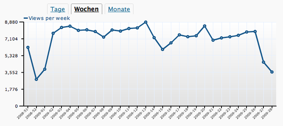
On this figure, you can see what happens if – for whatever reason – you are no longer among the top ten in Google. The number of visitors declines drastically. That makes me a little thoughtful. It really seems that the power of Google is enormous.
Stefan Hagen will remain a success even without Google. But imagine a middle-sized enterprise the survival of which depends on visitors to its site. For a long time, the site rendered clicks, clients and business. And then all of a sudden, this is gone! This kind of downfall can cause the ruin of an enterprise.
Roland Dürre
Sustainability in Enterprises
In an enterprise, sustainable economics has many facettes and dimensions. It starts with capitalization.
In our company (InterFace AG), there is a tradition we have now stuck to for 25 years. A considerable part of each year’s surplus – usually half – is fed into the reserves. That is why we now have a capitalization (capital and reserves) of significantly more than two million Euros, even though, back in the year 1984, we started with no more than 100,000 DM (that is the equivalent of 50,000 Euros).
Over the last 25 years, our capital grew by a factor of fifty. That was only possible, because (almost) all shares are held by people who feel strongly for the company. Therefore, they always renounced most of the dividend that would have been their due. Of course, that is not something you can take for granted.
mehr »
Chris WoodMonday July 13th, 2009
Insurance Ethics
I have started to read a book, “Die Methode des Gedankenexperiments” by my friend Dr. Uli Kuehne on “thought experiments” in physics. He quickly despatches the idea that these can prove facts of nature, but goes on to discuss their use in forming theories. He mentions that such methods are also used in ethics, (and so too in deriving laws).
Ethics result from evolution. We can see that many living beings have ethics; (consider ants and bees). Thinking processes, at least in humans, change the way that ethics evolve. Please vote on this and other postings, so I can decide whether I am completely wasting my time. Three cases involving myself and insurance laws and one involving fatherhood come to mind:
mehr »
Roland DürreSunday July 12th, 2009
Sustainability – Firstly: On Sustainability in General.
I just heard an interesting Podcast in Bayern 2 – Ethik als Erfolgsfaktor – Führungsethik in Zeiten der Rezession (Ethics as a Factor of Success – Leadership Ethics in Times of Recession) of July, 12th, 2009 (it was broadcast this morning at 8.30). It contained a lot of interesting statements and evaluations. One of them was:
“Not thinking of catastrophes as a possible scenario is neither economically sensible, nor ethically acceptable”
To me, this sounds plausible. I rather like that statement. It complements with sustainability. And sustainability as a value is very important for me. “Nachhaltigkeit”, however, is a term that includes many facettes and is hard to define.
I wrote this article some time ago. Now the new law on retirement pay has passed the second house and was subjected to massive criticism. In my opinion, this criticism is justified, which is why I am now publishing my article:
After Blüm came Scholz. Instead of “your retirement pay is in no danger”, we now have a “law for retirement pay security”. And now Blüm criticizes Scholz.
Because secretary of state for employment Olaf Scholz wanted a law that forbids a decrease of retirement pay for all times. Now the new law managed to do exactly that, even though such a law makes no sense. How to regulate by law something that has to and will follow global and social developments?
mehr »
Roland Dürre
“What is an Inflation Rate” or ” All Will Be Well”
 A few days ago, I found an article (which is certainly worth reading) on “optimism and what the youngsters knows” in the SZ. Here is the “teaser” of the article:
Social market economy? I do not know what that means. Inflation? I have never heard of it! A survey reveals that our youngsters know frighteningly little about economy – regardless of the crisis. (Translation of original SZ sentence)
🙂 As a service for our young readers, I would like to make a contribution towards alleviating the German educational misery by describing what inflation means in four examples.
You all now the proverb:
Money has no smell
Maybe you have also heard
of the man shits money.
There are even people,
who are stinking with money.
Some things cost money like pigs.
Most of the people who have to do with money,
dispose of some sort of business.
They are the ones,
who later sit on a pile of money.
Why do we emphasize all the time
that money has no smell?
KJG/SIX
(Translated by EG)
Hans-Peter KühnSaturday July 11th, 2009
(Deutsch) « Die Anstalt » – John Katzenbach oder « Mord im Kuckucksnest »
Roland DürreThursday July 9th, 2009
« Geht uns das Erdöl aus? (Are we Running Out of Crude Oil?)» – by Werner Zittel/Jörg Schindler – « Wissen was stimmt (Knowing What is Right) »
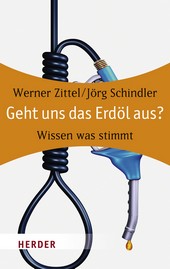 Yesterday, I received a postal delivery. It was the new book by Zittel/Schindler “Geht uns das Erdöl aus?” (Are we Running Out of Crude Oil) in the series “Wissen was stimmt” (Knowing What is Right), published by HERDER.
Herr Schindler is no unknown quantity for us. After all, he gave an important presentation in the IF forum last year. Click here to download the slides of this presentation.
Yesterday night, I read the entire book in one go. It is a concise and very down-to-earth report on the history and current state of affairs as far as crude oil is concerned. In particular, he presents many data and facts on the formation and production of crude oil and the estimated reserves. I was impressed by his objectivity and competence.
It is a book you can read fast and understand easily. It is based on wide research and broadly informative. Yet, it is as exciting as a criminal story.
As far as I am concerned, everybody who considers himself a little responsible for our future should read it. So: Order it immediately, or go and buy it in the bookshop!
RMD
(Translated by EG)


