
Roland DürreSaturday March 3rd, 2012
Entrepreneur’s Diary #75 – Meetings 2.0
After three years as a working student for Siemens, I (with a university degree in mathematics and computer science (TUM)) started as a “freelancer” with the same employer. In other words, I signed a tenure contract with them.
This situation was a more intimate connection with Siemens AG than I had had before. Consequently, I started getting more interested in my environment at the company. The first thing I noticed was how thick the telephone book was. Besides, among the leaders, the doctorial title and double-names were more common than with “ordinary ranks”.
But I also noticed in the organization chart that there were eight leadership levels above my own status. I was basically at the lowest of nine levels. As a proud post-graduate freshman, I found that a little strange.
In terms of mathematics, however, it made sense. Let us assume that the average number of teams, groups, departments, main departments, etc. a leader can control is five.
That is a rather high number. In those days, the lower teams had an average of five employees. Five elevated by the factor eight is 390,625. A main department, however, was only three departments. So it makes sense that you actually need many hierarchical levels in order to control 400,000 persons. In my memory, the Siemens of then was rather bigger than that.
Even in those days, we had many meetings. On my (the lowest) level, however, we worked. We had no time for meetings. My boss, who was in charge of all our groups, also did a lot of technical work. But he also had to attend diverse regular and sometimes also spontaneously arranged meetings.
The boss of my boss (a main group leader) was also available for technological work, but had to attend significantly more meetings than my boss. You saw the person above the main group leaders (I no longer remember their title) only once in a while, because mostly they had to attend some meeting or other.
Those working on the floor above us were known to us exclusively from pictures, because you only saw them in person on special occasions. Of course, the gentlemen (I cannot remember a single woman on the “higher echelons” in those days) were always travelling and attending meetings.
In other words: in former times, the higher your hierarchic position was, the more meetings you had to attend, and vice versa. In the lower echelons they were 0%, in the elevated echelons more than 100 % of your office hours.
The sum total was not bad. Because the huge majority of employees actually worked. Meetings were basically restricted to the so-called “overhead”. While the leaders hurried from meeting to meeting, they had excellent assistants, who, when I started, were still called secretaries. Basically, they were all women, and they represented their bosses quite adequately in the enterprise. Consequently, the system worked fairly well.
Of course, at the time we did not yet have all that nonsense with automatic calendars. And there were precise minutes of all meetings, distributed according to a very sophisticated system. In fact, some people actually read them!
Today, matters are different. Sharing the workload and Taylorism are disappearing among brain workers. In the enterprises, the work environment is more democratic. Hierarchies have become less pronounced. There are no longer any secretaries. The “overhead” is now shared by all in a “socialist” manner.
As a consequence, the brain workers now (have to) spend all their time in meetings and/or waste their time with administrative stuff. That is also why all the “important people” work 12 or more hours each day and will sooner or later fall victim to burnout.
And the overhead: I guess it is now considerably more than 30 years ago. Good new times. We run and run, but actually we tread on the mill.
Well, maybe “social media” will give us the opportunity to economise on many hours of meetings and yet to work towards one end more efficiently than in the old world. And then it might give us back more room for our own private lives and at least make more shared interests possible.
In my personal life, it happens. Using the most simple activities in facebook, I only take seconds for tasks that, in former times, would have required an intense dialogue, for example, on the telephone. And without “the new world” I would not even know many of my new friends.
RMd
(Translated by EG)
P.S.
Neither does the development stop in front of office doors. Just compare the situation at Siemens Hofmannstrasse or later at Neuperlach with the modern office buildings for brain workers (for instance at BMW). Even the increased number of meeting halls and the arrangement of team work-spaces in modules is remarkable.
Roland DürreFriday March 2nd, 2012
Entrepreneur’s Diary #74 – Competition-Free Shared Enterprises as Successors to State Monopolies?
A radical (utopian?) position!
What we experienced with state enterprises and so-called “companies owned by the people” (VEB) was rather bad. As a matter of principle, we hate monopolies (not only state-owned ones). Privatization and state-ownership also disappointed us. Consequently, here is what I think:
We need shared enterprises for the solution of the great problems and for shaping our future:
- These enterprises should be free of competition and organized as co-operative societies. Or else they should be owned publicly.
- They must subscribe to the values “fairness” and “transparency”. There must be a hundred per cent guarantee that these values are also realized.
- A modern and reasonably controlled (self) management must see to it that these enterprises remain lively, innovative and capable of change.
- These enterprises should no longer be restricted by job protection, strike laws, bidding laws when contracts are handed out or other legal super-regulations that make no sense at all.
Note:
An enterprise with guaranteed fairness needs no job protection and no strike law.
As a general rule, public bidding renders catastrophic results. In the days when public bidding still worked, the bidding process was a camouflaged type of cooperation between “state-ownership” and “industry”.
Absolute transparency makes corruption almost impossible and you can do without public bidding.
As to the rest of economy, they should allow and promote free enterprise. Mind you, they should give free enterprise exactly the rules written down in the Bavarian Constitution (Bayerischen Verfassung). Including competition and all the reglations appropriate in a social market economy. But, please, make them modern.
Incidentally, the factors 2 to 3 will be as crucial for cooperative enterprises as they are for private enterprises.
It is also interesting that, especially in German medium-sized enterprises, there are companies that almost enjoy monopolistic status, and still they are efficient and customer-oriented. And they have highly motivated employees and extremely satisfied customers. 😉
Dogmatic class struggle and protection of acquired possessions have no right to exist in a fair and transparent economy. And the same is true for the current regulation mania of several legal branches on several levels that have lost all sense of reality. And to top it: social justice is only possible (if at all) through an “unconditional basic income”. Everything else will swallow us whole, both in terms of bureaucracy and cost.
Just like many more things will have to change in this world. For instance the meaning of the word ownership.
Because in many cases, like mobility, ownership is a synonym for wastefulness.
RMD
(Translated by EG)
P.S.
I already wrote a little about this twice. Private Versus State-Owned (Privat- versus Staatsbetrieb) and Public Bidding (Ausschreibung). Many thanks to my readers for all the comments!
P.S.1
Click here Drehscheibe for all the articles of my entrepreneur’s diary!
P.S.2
🙁 I will no longer set “more”, because it eats up the English translations – problem with wordpress and foreign language plugin
Roland DürreThursday March 1st, 2012
Does it Make Sense to Have a Bidding for the Munich S-Bahn?
A short time ago, I supported the theory that state companies, and perhaps even monopolistic state companies, may not be a bad solution. If they meet certain requirements, they can even be more productive, efficient and customer-oriented than private enterprises. This article of mine instigated an exciting discussion.
Consequently, I will now discuss two items of news from the press on this same subject.
Firstly, I recently read that fewer and fewer interested parties can be found as bidders for regional railways. And that those who are in charge (state administration – it would be interesting to know who exactly that is and why) would be happy to hand the contract directly to an interested party without the bidding procedure. However, because of a Federal Court Decision, they are not allowed to do so.
I am not surprised. From personal experience, I know how much you have to invest if you want to bid in a public bidding process. As a general rule, the cost is nowhere near what you might eventually gain in turnover and result generation.
Especially since the final decision gets more and more uncertain and winning the bidding process gets less and less likely for decent companies. More and more bidders make an offer far below their actual cost, because they absolutely want or need the contract for some reason or other. At least that is the situation in the IT sector – for “strategic reasons” winning the bidding process is literally bought.
In the “Süddeutsche”, you could also read something interesting about the future bidding process for the “operator of the Munich S-Bahn”. If someone new wins the bidding, they will have to take over the rolling material of the old operator. Initially, this came as a surprise to me. After a little consideration, however, it sounds absolutely logical. Regardless of it basically being nonsense.
Let us assume a new bidder wins the operating rights to the Munich S-Bahn. If he has to take the old trains, he will have no chance of ingratiating himself with the users by using better and more modern vehicles. Maybe with structured first class. Or toilets in those trains that go longer distances (from Kreuzstrasse to Wolfratshausen, the train takes one hour and thirty minutes).
Nor can he shorten the intervals between trains. The same is true if he wants to change anything in the network (for instance more meeting points on one-track lanes or new two-track lanes). A future bidder also cannot come up with a new ticket price concept, since he will probably have to use the old ticket machines, cancelling machines and other logistics. Basically, he can offer the same as is offered now, with marginal changes or improvements. If he wants to make more profit, there is only one way to do it: charging the passengers less. And that is identical with less costly employees (or with fewer).
So what happens to all the employees who drove the trains for the old operator? Will they have to go to the new winner of the bidding? For less income? Presumably (and naturally) that will not be possible – due to labour legislation and job protection.
So where is the new operator supposed to recruit the people who are to drive the trains? We already saw what happened with regional coach lines. The new operator was less expensive because he managed to employ his coach drivers as sub-contractors and pay them less.
As I see it, there is a lot in this new concept of privatizing with operation and bidding that is less than thoroughly thought through. I would prefer a strong, integrated system. A shared venture that will not have to balance from bidding to bidding, but can instead make public transport more punctual and comfortable through a truly continuous improvement process, integrating the railroad network, transport and logistics. One that can also decide and realize the margin dimensions, such as reasonable prices and a simple paying system.
This, however, cannot be done with the current privatization model. What is worse: the bidding will not end with the best offer, but with the most cunning one. Which will not make public transport any more attractive. With negative consequences for our environment and our future.
And if they defend the concept, reasoning that the railway will be more efficient after privatization and consequently make a profit, instead of the loss the old “Deutsche Bundesbahn” made, then this, too, looks like thin ice to me. Today, the regional operators only start after they have been paid for by the communities. And I get the impression that what used to be called “loss” is now the active subsidies they get from the public administration.
But privatizing also caused something else: it seems to me that the new owners are even bolder with higher ticket prices than the former state companies were.
RMD
(Translated by EG)
Roland DürreThursday February 16th, 2012
Entrepreneur’s Diary #71 – About The Necessity To Make Irrational Decisions
During the last decades of the last century (millennium), huge concerns like Siemens AG had all the resources you can imagine at their disposal. The enterprise had capital to drown in and it boasted the best engineers of the world. They had an excellent reputation, the market expanded in the best possible way and their world-wide network in politics and business was perfect.
Nevertheless, these old and formerly so powerful enterprises are no longer existent in many of the segments they used to dominate. In the few areas where they are still successful, there is quite some competition. More often than not, they are endangered to become meaningless in these areas as well in the near future.
Simultaneously, new companies developed. Some of then are but a few decades younger than the old ones. And they quickly outstripped the old and formerly so powerful enterprises. As I see it, this is a fascinating development. So what exactly happened?
What strikes me is that the old enterprises tried to be very strict about only permitting “rational decisions” and “rational behaviour”. There was a high degree of planning in these organizations with the sole purpose of making “irrational decisions” well nigh impossible.
The new firms, such as Amazon, Apple, Cisco, Ebay, Facebook, Google, Microsoft, Oracle and many more – well, even SAP -, on the other hand, largely benefited from their “irrational decisions”.
Roland DürreWednesday February 15th, 2012
IF FORUM 2012 – Our Topic of 2012 is “Living (and Surviving) in a Sustainable Way”
After having paid a visit to philosophy with Klaus-Jürgen Grün talking about “The Art of Thinking Negative” Video) in an IF Forum EXTRA, we will start with our series of presentations:
“Living (and Surviving) in a Sustainable Way”
We will start on Tuesday, April, 17th, with a presentation by Heidi Schiller:
“Black – White – Multi-Coloured”
Impulses for looking upon this one world a little differently.”
The announcement for the presentation is already online.
Two more presentations are already in the planning stage, but we have not yet decided upon a day.
For the summer presentation, we hope to recruit a speaker who will bring delicacies. She will speak about good and healthy food produced in a sustainable way.
The third presentation in autumn of 2012 will be by Wilfried Bommert of the WDR who also wrote “Kein Brot für die Welt”. He will talk about how the world can be fed in the future.
RMD
(Translated by EG)
Roland DürreTuesday February 14th, 2012
New Video With Rupert Lay: “The New Dishonesty”
Last Saturday and Sunday, I downloaded another presentation by Rupert Lay to Youtube. It is about
The New Dishonesty
This presentation was given on April, 25th, 1999 on the HYPERLINK “http://www.ronneburg.de/” \o “Website zur Burg, die Zufluchtsort für viele Menschen war.” \t “_blank” Ronneburg castle.
At the beginning of the video, you will find a short introduction with pictures showing the castle. Rupert talks about a new form of dishonesty. I would perhaps have titled his presentation “Our New Way of Lying”, or, following Klaus-Jürgen Grün: “Lies Dressed Up as the Truth“.
It would make me happy if you took a look!
This is another one of the presentations held for the HYPERLINK “http://www.ronneburger-kreis.de/” \o “Website des Ronneburger Kreises” \t “_blank” Ronneburger Kreis. The video recording is by HYPERLINK “http://www.web-engineering.de” \o “Website von Bernd Sielaff” \t “_blank” Bernd Sielaff, HYPERLINK “http://cinema.fhlconsult.de/” \o “Website von f,hlconsult” \t “_blank” Friedrich Lehn did the editing.
RMD
(Translated by EG)
P.S.
Now I have six more presentations by Rupert that have not yet been published. Expect the next one in about four weeks.
Roland DürreSunday February 12th, 2012
EURO or NO EURO – That is the Question ?
🙂 EURO(PA) – Policy on Sunday
My poll on the EURO (or rather the results of same) – you can see it to the right – has stirred some emotions. Some of the comments I read motivate me to give my opinion on this subject a second scrutiny.
And the result is that there is probably no authority that can give reliable and valid information about the meaning of a common currency for EUROPE today (modern times 2.0?). Also, I am not sure that the EURO really is an advantage for some individual economies like Germany while being detrimental for the others. Or did the currency shared at the time by all states in the FRG “DM” favour the Free State of Bavaria while other northern states were at a disadvantage?
Moreover, I also can imagine that a tougher competition situation for Germany (without EURO) – for instance like they have in Switzerland – might be desirable. I often get the impression that we have a too easy time in Europe at the moment.
To me, both the global and the domestic economic system with their many absurdities seem too complicated to be predictable. As I see it, there is more speculation than understanding. Consequently, there is nothing I can contribute to the EURO discussion in the business dimension.
But there are several issues I am worried about:
Issue No 1:
If a country (a household, a human, a culture, …) has been living beyond is means, then it will get to pay the price sooner or later by being forced to live less pleasantly. That is probably unavoidable.
But what is “psychologically” the better thing?
If said country
a) gets the reckoning for its “misbehaviour” automatically – for example an inflation or degradation –, or if
b) they get it presented by someone who “always knows better as a matter of principle”, who then proceeds to force the appropriate “healing method” on them? Especially if the one who forces you to apply his methods seemingly lives in luxury and is perceived to only make a token effort at economizing.
🙂 Both with words and actions.
Issue No 2:
Roland DürreSaturday February 11th, 2012
EURO – POLL – A HUNDRED – VOTES
Current State of Affairs
Some time ago, I started the following poll in the IF Blog:
What would you do to overcome the EURO crisis?
- Introduce new currencies and consequently economic achievement! (36%, 36 votes)
- Re-establish the old currencies for all countries! (20%, 20 votes)
- Support the EURO by all possible means and more! (17%, 17 votes)
- The policy of the FRG and EU is the only one that makes sense and will therefore be successful. (15%, 15 votes)
- Free currency choice – the market will find its own way out! (12%, 12 votes)
Total number of votes: 100
First and foremost, I would like to thank all those 100 readers who voted. Isn’t that something to be proud of!
And here is a short comment on the current state of the poll. It is remarkable that 36 readers are in favour of introducing “new currencies” and 20 are for the “re-establishment of the old currencies”. Taken together, that is far more than half of all the votes.
And there were even 12 in favour of a free currency choice. Well, Amazon, Ebay and Paypal will like to hear that. World-wide private currencies. Now wouldn’t that be something?
But only 32 IF Blog readers supported the EURO!
🙂 Mind you, this is regardless of the fact that IF Blog readers are definitely not the most stupid citizens of this country!
You are still welcome to vote, but:
Are there any ideas for a new poll?
I would be delighted to have a new question to put to the reader’s vote! Just send me an email. Then I will stop this one and exchange it for a new poll.
RMD
(Translated by EG)
Roland DürreSunday February 5th, 2012
brand eins in February
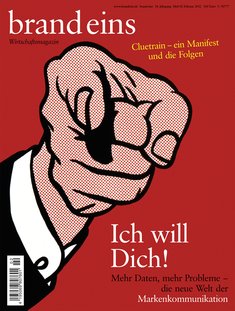 This time around, I had to wait quite long for my “brand eins“. After all, I had gotten used to finding it in my letter box shortly after the 20th of the previous month.
🙂 Remembering all the fuss they are making about information and data security, I already feared some evil person might have stolen it. How can I avoid getting mistrustful with all this hysteria? Why would the evil “data thief“ refrain from pilfering my letter box of all places? And can you still trust your own family? After all, I am not the only enthusiastic “brand eins“ reader in the family.
Last Wednesday, when I strolled through the newsagents at Munich Central Station in order to buy a replacement (shortly after having dumped my train ticket in the mail drop – see my story), I still saw a thick pile of the January edition sitting on the shelves on February, 1st. Well, that caused me to relax.
And then, on Thursday, February, 2nd, it finally arrived at my home. For the February edition, this is certainly just the right time. Barbara handed it to me in the evening. Again, all my mistrust had been unnecessary.
At first sight, the February edition strikes you because of the aggressive red. It looks quite out of place for the time of year. And then the cryptic question on the title page. A perfect fit for our times:
I Want You!
🙂 It has been a long time since someone said that to me. I am delighted. With respect to my military carreer, however, it was a nightmare.
Underneath, you can read:
More data, more problems – the new world of brand communication.
Yes – more data – more problems. That is exactly how I, too, see it. In fact, I even believe that all those wonderful new profiling technologies applied by Google and Amazon will eventually have the effect that people will only buy what they actually need. If you see it like this, it backfired, didn’t it? To me, that would look like a very positive develoopment, even if it does not seem to increase growth. Or maybe exactly because it does not.
Amazon has every reason to feel quite “relaxed“ about people buying less – as long as they only buy at Amazon. That scenario is easy to imagine.
So now let us take a look at the actual magazine:
Roland DürreWednesday February 1st, 2012
Entrerpeneur’s Diary #68 – So How Do You Generate Projects?
A polemic approach …
This is another article inspired by Jens Hofmann’s post “Projects are Detrimental for the Health of Your Enterprise!”
Well, they just happen all of a sudden: the projects. Like the sun, the moon and the stars. But how are they generated? How is a project born? To me, it seems like the procedure in administration and business is often as follows:
Someone has an idea because he wants to improve something. Perhaps he wants to optimize a process. Save time and resources.
Get a better transparency or better control production. Or he wants to advance his own profile and add a few browny points to his carreer ladder.
As a general rule, the protagonists of new ideas are “leaders“ who are fascinated by their own ideas and can also fascinate others. Sometimes they know more, sometimes less about the technological details. But that is not the decisive issue.
Change is on the agenda. You have to do some re-structuring. You need new technology, a new machine. And almost always an IT solution. The protagonist becomes the “champion“ of his idea, develops influence and gives his idea some credibility in the “enterprise“.


