
Roland DürreWednesday April 18th, 2012
Go: ISARNETZ!
I am glad to inform you about the “Munich Web Week”, sponsored by ISARNETZ is now getting under way. The Munich Web Week will be from May, 7th through May, 13th, 2012.
And even at this time, we can report that there will be as number of exciting events during that week. You can find them all if you open: ISARNETZ.com.
Without doubt, the most prominent event will be the “Reception at the Old City Hall with Podium Discussion and Awards Show for the Isar-Netz-Award”. It will be on Wednesday, May, 9th, at 6.30 p.m. in the Munich Old City Hall. If you want to attend, you have to register, which you can do through ISARNETZ.com.
However, if you are on the ISARNETZ website, why don’t you also take a look at the other events? I am sure you will find a lot of exciting and interesting things!
RMD
(Translated by EG)
Roland DürreSaturday March 31st, 2012
brand eins in April
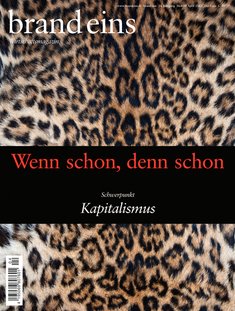 This time around, it sat in my post box on April, 29th, – the new “brand eins”.
It sprawls on the hunting-leopard’s fur – capitalism. There is a black ribbon running horizontally over the page – and on it, they wrote with red ink: No Half-Measures.
And underneath:
Focus capitalism.
After relevance in March!
Is there a special meaning to the red ink? Will “brand eins” become a leftist inflammatory pamphlet, like the Bavarian Constitution?
See my article on the world-wide financial crisis (Texte zur Weltfinanzkrise).
To be sure, we are now approaching the end of late capitalism. Is that why “brand eins” now has the focus on capitalism? Well, I quickly open the magazine and take a closer look.
The editorial by Frau Fischer calms me down. She is right: many things are topsy-turvy in this world. But there are worse things than capitalism. Even if it is to some degree responsible for what went wrong. Just like its small brother, communism. Well, it died already. Or at least, it disappeared (because the corpse has not yet been discovered).
No matter how you see it, capitalism is currently without competition. We all know the absence of competition makes you weak, but capitalism will survive even this phase. And it will change and always be resurrected. Because humans have this late-capitalistic gene.
“brand eins” in April tries to explain why so many people (I think by now it is the absolute majority) feel uncomfortable and are scared. And why we are so worried because of our extremely late-capitalist economic habits and the radically non-sustainable consequences. How, with gruesome thoroughness, we exploit everything, really everything that seems even the tiniest bit worth exploiting. We do this without any regard to loss and totally ignore all better knowledge to the contrary.
The few articles I managed to read yesterday want to explain the uncomfortable feeling. Speaking for myself, I must say they rather heightened my uncomfortable feeling, instead of lessening it. I find it great that a business magazine is courageous enough to look upon the system that, after all – just like we all – “brand eins” depends on for survival, from a totally different, critical perspective.
Consequently, even if it is quite heavy, the magazine will be part of my bike luggage when I go to Munich Central Station tonight. At the station, a late-capitalist, feudal 1st class compartment with its own shower will be waiting to bring me to Rome. I already look forward to occasionally, at the end of a beautiful bike day, taking “brand eins” out in the evening when I stay in a nice Hotel between Naples and Palermo and enjoying a good glass of wine. Surrounded by mafia environment, I am sure I will think a lot about how late capitalism makes sense or not!
😉 And, of course, I will also think about how I can best profit from it…
RMD
(Translated by EG)
Roland DürreFriday March 30th, 2012
What Annoys Me … #25 All Those Small Inaccuracies and Mistakes in Newspaper Articles
🙂 Before I start my vacation, I am going to be really grumpy!
Yesterday morning, as I read the SZ, I discovered the following note in the local section:
The number of the day – 2.9 – successful harbour!
It is about the “Bavarian Harbour at Regensburg”. Here is what it says:
General tendency is growth!
Because during the last year, the turnover increased by 2.9 per cent, now being 7.6 billion tons!
Well, I think to myself, maybe then the Rhein-Main-Donau-Channel makes some sense, after all? And I am a little surprised.
A few lines into the article, I am no longer surprised. Because here I can read:
The growth, however, is exclusively thanks to the products transported by trucks and railway. Shipping only has a turnover of 1.5 billion tons. That is a decrease of nine per cent compared with 2010.
That annoys me!
Is that what they call the number of the day for the “successful Bavarian Harbour of Regensburg”? Or are we talking a container reloading site with a little shipping as a by-product?
But then there is the explanation that saves the day. The decrease is easy to justify, because:
The director of the local branch, Andreas Pippig, put most of the blame on the difficult weather conditions last year. Danube flood, ice locks and the week-long low water level in autumn kept making it hard for shipping.
Well, maybe the gentleman has never heard about the climate change? Perhaps someone should come and enlighten him?
So what do I do about it?
I try to be honest, instead of lying to myself and to others in such an unscrupulous way as at least the headlines of newspaper articles do.
RMD
(Translated by EG)
I already wrote about the Schlecker insolvency. But the “schleck” continues.
Many of the German states have now negotiated the continuation of the remaining branches of the ailing chain. As always, the leading argument was that jobs must be saved.
That Annoys Me!
To be sure, a small minority of states refused the rescue investments. This might be painful for the employees, but it is probably the right decision.
I never understood why all the drugstores had to extend their product range in such an extensive way. Consequently, I also never understood why they could have been such a success. Especially if these drugstores were situated right next to the discount shops where you, basically, could get everything you need for personal hygiene.
For me, drugstores have always been the embodiment of a perverse combination of body-cult and consumption prurience. But the multitude of “stylish” products with their empty promises of beauty, nice smells and sexual success and whatever else they offered simply appealed to the “consumers”.
That made these chains money presses. With an unbelievable expansion speed, they generated billions of profits for their owners. It does not matter if they were called DM, Müller, Rossmann or Schlecker, all they sold was basically crude oil in the shape of over-expensive organic chemical products, dressed in extravagant packing and re-named hygiene articles. Well, it was plastic waste multiplied.
Now one of them is finished. One that never enjoyed the best of reputations. One for which probably there is no longer room on the market. And everybody starts lamenting and demanding money in order to preserve jobs. And the citizens are supposed to pay for it!
A short time ago, the consumption temples of a department store chain were suffering. The building supply stores will be next (you can already hear whispers about the “Praktiker” dynamically increasing its yearly loss on a high level (SZ). Another one of those former gold-mines that made their owners rich by selling cheap junk.
Neither do I have any confidence in the XXL furniture shops with their mega unethical price structures. They, too, are nothing but “Cheapies”, cheating their customers with inexpensive products for the bulky waste and super discounts.
Should we really rescue all the ailing department stores, discount stores, drugstores, building supply stores and furniture stores with our tax money? Or will there be a second rescue umbrella for the internal consumption?
So what do I do against it?
I try to reduce my consumption to a minimum! And I ask people not to buy all the rubbish they see. Instead, they should start thinking, before buying!
And if I really need something urgently (which, incidentally, happens rather seldom), then I buy quality.
So what else annoys me about today’s news?
The report about the solution they found for Müllerbrot, which certainly was also painful but probably the wrong solution. The fact that the EURO rescue umbrella is to be extended to one billion Euros, the confirmation by the SZ that the great statistics concerning the unemployment are really rather sugar-coated…
And I secretly do the calculations about how long it will take until the gas bubble in the North Sea will reach the small light burning on top of the drilling platform and when there will be the great POUFF.
So here we go – into the rain …
RMD
(Translated by EG)
Roland DürreSaturday March 24th, 2012
Work and BALANCE
Sitting on the podium at BALANCE – the conference about how work will be organized in the 21st century – I took part in discussing the following thesis:
Flexibility is a way out of the crisis. The crisis is stability.
Flexibility also includes the process of work getting more dynamic, for instance through “borrowed labour”.
The thesis has two sentences. I did (and still do) not agree with the first sentence of the thesis. After all, it assumes that we have a common crisis that also manifests itself in a work-life crisis. That is not how I see it.
To be sure, we perhaps have a social or a moral crisis, but there is certainly no work or luxury crisis. It may (and probably will) come in the future. Currently, however, we have a luxury problem. And many among us have a strange concept of work (and life). It is roughly:
After the housework in the design flat has been done (provided you have no cleaning service to do it for you), you take your extravagant Mini out of the underground parking and drive it from your home to the parking place at work. On arrival, you get into the lift of the even more extravagant “office tower” and ride to the upper floors.
All through the long day, you practice self-fulfilment in front of your PC and in all kinds of meetings – and in the process you even climb the career ladder (and as a by-product, you get rich). Since, however, the environment is so inimical, you suffer from monstrous ailments like stress and work pressure, so you have to recuperate from those in the evening by selecting various environments full of life style.
Except, that is not life and neither is it real work.
For me, however, the entire consideration is annoying for another reason. Basically, some things are totally neglected:
Work is a very special commodity
and
The “tenure working contract” is not at all something God-given in order to pay you for the work you did.
Work is a special commodity. The “generator” of work as we here understand it is the human being. Machines “do not work”. Well, you might call what some animals, such as horses, do work. In return, they get food. In order to achieve an optimum cost-usefulness relation with animals, you also have to give them a minimum of care.
All parties concerned agree that we do not wish such a systematization of humans as work products. Because with humans, it would be called “slavery”.
Let us still use another comparison of work with a “hard” product and look at the dairy cow. There is no doubt that it produces milk. Regardless, we often mean the farmer when we speak of milk, even if today he is often an agro-industrial enterprise.
During the endless years as a father of small children, I always went to the farmer by bike in order to get all the milk we needed. Due to the structural change in agriculture, this is no longer possible for me at reasonable cost. When I was a young boy, I took the milk can and fetched the milk at a branch of the dairy – it was called “milk shop”. That, too, is something you can hardly ever do today.
It comes down to me having to get my milk from one of the monopolistic merchants. More often than not, they only sell it extremely pasteurized in the tetra package. Getting fresh milk in the bottle – which is my favoured model – is quite hard.
The situation with the product work is not all that different. It rarely happens that the end user can get a service “legally” directly from the producer. If at all, it usually happens in the form of moonlighting or in a legally conspicuous and questionable way.
As a general rule, I, too, get work through a long chain of suppliers. Within this chain, the work comes more and more often as free-lance “employment”. These contracts are often “clandestine employments”, filling a grey zone that might easily be considered a violation of the AÜG. Incidentally, work is something that comes with some sort of “directive” and a dependency upon only one supplier is quite common.
But that, too, is not my main issue. Work is a special commodity, because the producer “human being” sells himself. He sells his conscience and his personal goals (system agent), his competence (expert), his experience and his knowledge (“innovation worker”), his health (physical labour) and in some cases even his body.
So the “labourer” gives away something of his own. And the really absurd thing about it is that the process of giving something away – except if an individual or a team do piecework (which in many cases is not possible and we do not want, either) – is measured in time units?!
Because we pay according to the TIME someone has spent doing something. During employment interviews, the income is always based on this aspect. The variable time components with target agreements – I personally consider them very deficient – do not change this. Basically, it is the working time account that determines your “achievement”. Incidentally, achievement is also a difficult term – try translating it.
To be sure, employment based on a working time account with respect to the income is certainly “better” than serfdom or slavery. But I am absolutely sure we still have a long way to go when it comes to “paying human labour”.
Let us think innovatively. Time is the relevant component.
In the highly civilized societies, time might even get the function of money. It might work like this: you can have my time, during which I do something for you. In exchange, you give me your time and you do something for me.
Here is what I feel about the second sentence of the thesis:
The crisis is stability.
I would like to improve a little on this sentence. There is no such thing as a life without crises. Not for humans as persons and not for humans in a society. The type, seriousness and frequency of crises, however, changes. But this does not mean that the crisis becomes stability (or even causes stability, as the sentence seems to suggest a little). No, there will be more and more serious crises – and they will get harder to overcome. And in the future, overcoming those crises will cost ever more real or so-called sacrifices. That is something we cannot ignore.
And do not let us forget: there is a chance in every crisis. My teacher – Dr. Baldur Kirchner – showed me that the great “CIC” can change even deep characteristics of a person’s personality. “CIC” is for catastrophe, illnesses and crisis. The same is probably true for societies.
But there is a second reason for us to be optimistic. We complain on a very high level. Because we have hoarded luxury that can be dissolved before we will have to pay the price with our own bodies.
I like to give the following examples for our hoarded luxury: individualized traffic, irrational consumption and eating habits (both with respect to quantity and quality), a life style that only allegedly makes us happy, in many cases very lavish living conditions…
In our society, we have wastefulness left, right and centre. A little Kaizen would certainly do no harm in our lives. Consequently, there is no reason to despair, because there are many things that do not really make us “happy” and that we can do without.
RMD
(Translated by EG)
Roland DürreTuesday March 20th, 2012
Entrepreneur’s Diary #78 – Let Us Assume I Am a Professor …
… I wonder if I would still be as driven by numbers as I am now.
As I see it, you cannot do the best of jobs controlling a medium-sized, manageable enterprise by numbers and target setting. On the contrary: I believe it is detrimental if you plan and report too much. The entrepreneur should make better use of his time by taking care of his employees, customers, partners and suppliers.
In order to give reasons for this opinion, let me today compare
professors with entrepreneurs, chairs with enterprises.
Holding a university chair can be compared with owning an enterprise in the brain-working sector, just like a chair holder is like an entrepreneur. The enterprise will be judged for its turnover and profit, along with its growth. So – what are the factors that determine the “performance” or achievement of a university chair?
Let me try to give a few indicators that might serve to evaluate the achievement of a university chair and the professor holding it.
- The number of students attending his lectures and seminars.
What should be the basis: the number of students who “registered” or the number of those who “actually go and listen to the lecture”? Is the relation between the two relevant? What about those who watch the lecture on the internet? What does it mean if the number of students dwindles? If you take this aspect, you would probably have to consider the general tendencies (lower birth-rate, trends). Is the percentage of non-German students relevant for the result of the evaluation? What about the number of female and male students? And how about the number of certificates awarded to the students and the grades they got in examinations?
That is also an area where you might be more sensitive. Maybe you could award extra bonuses for non-obligatory or inter-disciplinary achievements. Or you might distinguish between the grades in major and minor subjects? - The number of people working for the chair.
Perhaps the average age and the number of women is also relevant? - The number of diploma and doctorial theses supervised at the chair?
Should you only consider those that actually were finished each year? Or should you also take into account how they were graded and how long it took the students to write them? - The number of publications by the chair.
Would you have to count the number of publications or the number of pages? And what about the difference between those published in journals with a better reputation, as opposed to less relevant ones? - The sum of money acquired from third parties.
It might be quite a simple criterion for evaluating the performance of a university chair.
Well, it is quite simple – all you have to do is refine the list a little, then come up with a sophisticated evaluation pattern and then you add the results in order to get a fair evaluation grade.
At first sight, it all sounds quite plausible, doesn’t it? Yet, you will soon find out that it cannot and will not work. There will be very strange consequences, yet the quality of the lectures will not improve. Although they now actually started evaluating the quality of university chairs in precisely this way for the “excellence offensives”.
Thinking in terms of enterprises, it would mean that a good professor would have to increase the number of his students, assistants, doctorial and diploma theses, publications, etc. every year. Until at last the lecture hall will burst. You would have to structure your activities in a very target-oriented way in order to fulfil the relevant criteria. Unfortunately, this is exactly what happens – and it causes a flood of doctorial theses at some universities. It is more important to publish than to get excellent results. In fact, in the USA, the number of publications is already on the way up.
Except the quality of a professor should manifest itself in other ways. Basically, all he should be able to do is deliver good research and good teaching. And be a good leader to his team. He should put all his energy into making it possible for his students to learn a lot and making his customers (the students) happy. Then he will be highly regarded in various circles and his reputation and standing will grow.
But isn’t it the same with enterprises and entrepreneurs?
Do you have to – or can you – represent the reality of an enterprise in numbers at all? Do you need all those lists and spread sheets, especially if we are talking small and medium-sized enterprises? Do we need this high degree of precision in the planning process?
First and foremost, you have to invest a lot of precious time in the planning. And then there is the time you need for finding out what went wrong. That is what I call time wasted twice.
What about focussing on the people working in the enterprise and the customers? What about further developing the product, being ready to accept change and allowing good ideas to flourish? What about trying to remain close to reality and establishing a good entrepreneurial culture? Because if you gain those qualities, the numbers will automatically improve. Let it be accompanied by a budgeting that follows common sense in a reasonably economical way and you have all you need.
Neither reading numbers nor reading tea leaves will tell you what mistakes you made with the customers!
And why is it that enterprises always have to grow? Why should entrepreneurs constantly try to find out how they might best increase the turnover and profit? Why not look and see what you can improve, instead? You will not get bored.
Why not restrict yourself to one market, give quality priority over quantity and value over mass?
Isn’t the same true for entrepreneurs as for professors: If they do their job well, the turnover will grow and so will the outcome. Just like this.
So, my dear entrepreneurs, do not bother to analyse your BWA, burden centre, boss sheets and balance sheets for days. Instead, use the time for business, the customers and the employees! For the future!
And, dear Professors, why don’t you do the same? Let the score cards sent by the ministry not affect you.
Improve the quality of research and teaching at your university, take care of the people and the university. And forget criteria and growth.
Simply because we need a better future! As a result, both you and we will constantly get better and the success will come by itself on many levels.
But I notice more and more similarities between entrepreneurs and universities as time goes by. And then I prefer remaining an entrepreneur.
RMD
(Translated by EG)
P.S. Click here Drehscheibe for all the articles of my entrepreneur’s diary.
RMD
Roland DürreSunday March 18th, 2012
Copyright Math & Commons
Incidentally, I believe that in our “American-European Culture” (the term is used in the sense as by Edward T. Hall in his book “The dance of life”) the issue of “copyright” has been handled poorly – both socially and legally. In fact, perhaps an unspeakable mistake has been made.
Here is a comment worth watching on this from the TED world. It was found by Dr. Edwin Ederle – thank you, Edwin!
The following question(s) come to mind:
How much and what knowledge can belong to a single person? When are you obliged to share it, so that it belongs to the public? Because thinking in terms of Commons (common land, common property) will probably be relevant if not necessary if we want to solve the problems we face in the 21st century (and later).
I had hardly handed the link with this video on, and already the first comment by Thomas Mathoi in the subject came back. He recommends the free e-book #Incommunicado by @michelreimon (Michel Reimon) as an additional inspiration on the theme of copyright.
After having read the first few pages, I think #Incommunicado is a novel well worth reading and thinking about.
🙂 And on top of this, it looks like a very exciting “book” to me. I already downloaded it onto my kindle.
RMD
(Translated by EG)
Roland DürreSaturday March 17th, 2012
Entrepreneur’s Diary #77 – One Of My Own Irrational Decisions …
Back to the “irrational decisions”!
Continuation of Entrepreneur’s Diary #71:
“Notwendigkeit von unvernünftigen Entscheidungen” (The Necessity of Irrational Decisions “).
The InterFace, too, owes its origin to a very irrational decision. Woe if, at the time, we had had a decent person to control us. He would have called us “insane”. How could anybody try and strive towards such a utopian idea? With ZERO chance of success.
In retrospect, I am actually surprised how something so weird could have worked. All reasonable and rational arguments were certainly against what we had planned. Today, if asked, I would probably advise against what we did at the time.
Our most severe case of irrationality was when we, as “newcomers” and “nobodies” wanted to develop a UNIX text system. There were two of us, along with a few students. And in the process, we actually wanted to try to earn enough money for us and the students to live on quite well. Which meant that you had to delete the term “two of us” from the above sentence, because basically only the students were left.
What happened was the success story of HIT/CLOU. And a few years later, there was a time span of ten years during which Siemens AG created more turnover with HIT/CLOU than with their second SINIX product (which they also had taken under licence), the data base Informix of RDS (that was still the name of Informix for some time) .
At the time, we started developing HIT and CLOU with a colourful selection of young people. It happened against all rational business thinking, simply because we wanted to own a software product of our own.
Since data bases were too complex and the communication technology underwent a total re-structuring, we decided to develop an “electronic typewriter”. … To us, that seemed easier. So we took a closer look at the old “brother” and text machines such as Triumph-Adler and implemented the entire thing anew and a little better on UNIX. How simple the world can be.
And a few years later, we became the market leader in Europe – not just on SINIX, but on many UNIX systems of many producers!
Simultaneously, Siemens AG tried to develop a series of editors. At their place, the product planning team had more members than our entire development, project and sales units. They had planned everything “rationally”, developed it in the classical way and supplied huge budgets. With expensive developers and super consultants.
And still they failed again and again!
Incidentally, Siemens AG made a turnover of 500 million DM during the aforementioned ten years with HIT/CLOU. It is quite possible that, during the same period, they invested more money for all the new developments of theirs that failed either technologically or economically.
Those products were failures due to poor technological competence, such as the demand for a common (!) interface for BS2000, UNIX and DOS. I remember quite well some discussions about what nonsense such a venture was. These were discussions I took part in.
And if, for a change, they were not a failure technologically, then they failed on the market, like with ComfoText against Microsoft.
And everybody asked how it was possible that the small InterFace Connection GmbH with its limited budget could manage to do things that were out of reach for the huge Siemens AG with all the millions they invested and all those many planners, engineers, developers, testers.
Well, the reasons were quite simple: an irrational decision, the enthusiasm of great persons in a super team, an agile procedure, many partners and a little luck – and here we were working!
So here is the second part of my appeal to make “irrational decisions”. Even if they cost money and will worsen the results. We still need them in order to do great things. And, basically, there is something great to every enterprise.
RMD
(Translated by EG)
P.S.
Click Drehscheibe for all the articles of my entrepreneur’s diary.
Roland DürreSaturday March 10th, 2012
On Gene Technology
A short time ago, I again heard someone speaking in favour of gene technology. Well, maybe some of it was not to be dismissed lightly, since it sounded quite plausible.
But still:
The future sounded too beautiful and clinical. Too many simple problem solutions were promised. The strategies looked too easy. Consequently, the number of “abstract” reservations I already had are now more than before – and my personal discomfort grew.
Reservation No 1
Gene technology accelerates the development – whereas what we really need is some “deceleration”.
The longer I live, the more I come to the conclusion that we would really benefit from a “deceleration process”. Because “haste makes waste”. Consequently, I feel sceptical with everything that increases complexity or even speeds up the process. It would be better to “de-complicate” and to simplify our lives. We live in the “here and now” to an extremely huge degree. But we should also accept that there is no “today without yesterday” and no “tomorrow without today”. And that you have to be patient with the “tomorrow”.
Reservation No 2
Food is subjected to patent and licence regulations.
There are already concerns who announce that it is their entrepreneurial goal to dominate the sector “food production”. Will there be a “Foodle” after “Google”? Mind you, when I mention Google, I also include Amazon, Facebook and the other firms that want to rule the world.
Reservation No 3
Top quality is no longer the most important issue about food.
I get more and more horrified when I see the things we serve. And then I hear about retro tomatoes as the last hope for the return of sensible food. When I was young, Brussels sprouts still tasted bitter. Where did it go, the soft bitterness of Brussels sprouts? And there is much more of the same … In my opinion, there is a general trend towards a rapid increase of negative trends such as superficiality when it comes to taste through gene technology. It is also quite sad that quality will eventually be beaten by quantity.
Reservation No 4
It is dangerous to excuse negative effects by saying “they already happened, anyway”.
It reminds me of what was said about: “antibiotics are already in the soil because of the excrements from the cows raised with antibiotics”. Since this is already the case, why not let the soil be contaminated by plants that have been mutated with gene technology? Of course, I oppose this, as well. I believe first and foremost we should reverse the original wrong-doing.
Reservation No 5
We get more and more remote from a life appropriate to our species.
Gene technology is one of the developments called progress that create a more and more functional and efficient world. A simplified cultural world substitutes a natural world appropriate to the species. And it happens to a larger extent than ever before. Metaphorically spoken we are approaching some sort of modern “Resopal World”. It promises all kinds of things: longer life, improved health, …
But what is so nice about getting even older by using new medication while all we get is more time for suffering from lingering illnesses and dementia?
In this article, I consciously refrained from using “sturdy” arguments against gene technology. Instead, I focussed on the more “moral” issues.
RMD
(Translated by EG)
Werner LorbeerMonday March 5th, 2012
Desert Tec #015: How to Physically Transport Energy!
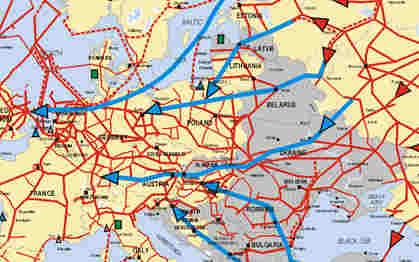 At long last, “power to gas” is recognized among politicians, too.
Basically, here is what it means: using wind energy, water is separated into H2 and O2 through electrolysis. Being a very tiny molecule, H2 is hard to store. Still it could already be used for energy transport, because the gas pipelines are allowed to hold a H2 rate of 5%. After a possible methanation, it will be identical with natural gas, anyway.
What are the advantages?
The natural gas industry is quite capable of solving its storage problems.
There are pressure storages and caverns which, allegely, can store the demand of two months (200 TWh). It is a realistic option that can be immediately realized without destroying nature. All we have to do is build storage lakes.
Besides, there is the advantage of increasing Germany’s energy transport capacity by 80 per cent through the already existing gas pipelines instantly, without having to build a single new energy line.
Another potential positive aspect is the methanation of H2 gas through CO2 or CO, which might again serve to economize matters. The process will produce “bio-gas”, i.e. reactively produced methane which, when burned, will return the CO2 to the atmosphere “in a CO2 neutral manner” (I put the “quotes” because this is just a modern euphemism).
The enormous advantage of methanation is that the entire transportation could be based on the already working technology of natural gas cars or fuel cells. The car production problem for electric vehicles, the unmentionable and really disgracefully huge ecological footprint of battery technology would be solved. And as a potential energy source for electric vehicles, we might take the fuel cells worked by bio-gas.
A crucial argument in favour of this concept is also that the energy content of 1 kg battery is only 2% of that produced by 1 kg of natural gas. The very weight of batteries threatens to eat up all the technological advance made by light-weight technology.
So here is my point of view in a nutshell: what really gives me pause is that they say we cannot afford a change in energy politics. Currently, the European nations eat the capital they have saved up for breakfast by “rescuing Greece”. At the same time, they forget that there are far more urgent problems that need solving and that you certainly cannot finance both of them simultaneously.
At this very moment, the target demands of the Bundesbank against the EZB are higher than the entire external German capital. According to Prof. Sinn, these are payment requests that “can never be called in” (as he said in the Augsburg IHK Konjunkturgespräch). And then there will be an additional 300 billion Euros for the change in energy policy. Dear China, can you, please, help the poor Europeans.
It is high time that we use the calculator for planning the change in energy policy, instead of the subsidy cart! I believe power to gas might be a really good option.
wl


