
Roland DürreMonday January 30th, 2012
ISARNETZ for MUNICH
Last Friday, the advisory board of the “ISARNETZ“ met for the first time. Between May, 7th and May, 13th, 2012, ISARNETZ will organize the first Munich WebWeek. It is supposed to help making innovative powers more visible and linking them in this region. In order to make Munich and Upper Bavaria again more attractive for young people.
 Because it appears that some German cities, in particular Berlin, have left Munich far behind when it comes to the category “attractive for young people“.
Consequently, I find ISARNETZ a good idea. And I hope the Munich WebWeek will be a success. I am certainly prepared to help it along a little.
Now we have to quickly find a small but refined team that can promote the WebWeek. But: as always, there is the principle: “Nothing goes without money”. The initiators want to get the “funny stuff“. Well, that is quite fine, isn’t it?
This is, however, a chicken-and-egg question. You will only attract sponsors if you have something attractive to offer. Without money, it is a little hard to come up with such an offer.
To prepare for the aforementioned advisory board meeting, a friend of mine did some research on what happens in Berlin. Well, I was surprised – because quite a few things happen in Berlin. They are rather active there.
 Especially when we are talking about preparing for innovative and creative entrepreneurship. Berlin and Brandenburg are really into this – and they actually spend quite a bit of money on it, too. And you can already see results. The time has come when venture capital enterprises are no longer the only ones who leave Munich for Berlin.
In the SZ you will find reports about a start-up scene, but in Berlin, rather than in Munich. Of course, the Ted.com conference was also in Berlin; re:publica and the Berlin WebWeek are events of long standing – and hugely successful. And they are all massively subsidized by the senate and the state of Brandenburg.
Well, you know, this does not really make sense to me. Each year, Bavaria sponsors Berlin by several billions of Euros through the “Länderausgleich“. And then Berlin uses this money in order to shine more brightly. The enterprises and the people are drawn towards the big party at Berlin financed with Bavarian money. With an additional detrimental effect for Munich? And our State Capital has no money left for promoting the WebWeek. Was that how the entire concept was meant to work out?
Well, it gets difficult. So if you want to help – why don’t you just send an email to the ISARNETZ initiators Thomas Pfeiffer and Wolf Groß? Helpers on an honorary basis are just as much appreciated as creative event managers and, of course, sponsors.
RMD
(Translated by EG)
P.S.
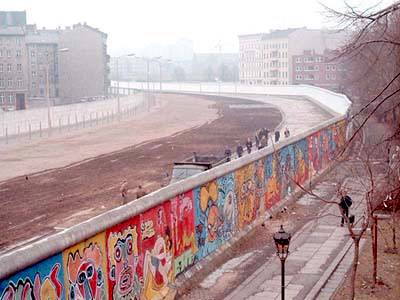
I took the picture of the wall fromt he central media archive Wikimedia Commons it was taken by Noir
Roland DürreSaturday January 28th, 2012
To Wulff
There is a new verb in the German language: “To Wulff” . It will probably become the word of the year …
I must admit, I “wulff” a lot.
All the time, I get invitations. Events organized by enterprises or interest groups. I get a good meal and a free bed. Once in a while, the first class train ticket to the location is also part of the package.
I wonder why?
The answer is simple: Those who send me the invitations overestimate my personal influence as a representative of a (slightly) successfull enterprise. And they want to acquire it (less me) as a customer.
However, they probably could not care less about both the enterprise and yours truly as a customer and person. All they want is more turnover, i.e. the money I supposedly can dispose of. That is what they want to hear jingling in their cash box. And those who send me the invitations could not possibly know that I am rather frugal and do not tend to throw the money I am the custodian of out of the window.
Yet I sometimes accept those “tempting” free invitations. Mind you, the reason is not because I want a free meal and night in a hotel. After all, I have a nice home and am constantly struggling against the few extra pounds I carry.
🙂 But I, too, have a goal! And therefore I turn the tables.
Because, I, too, am looking for turnover all the time! And turnover is an elusive piece of venison. If you want to catch it, you must meet many requirements. The first condition is that you are very visible and that your own enterprise is well-known. Without contacts and intensive communication, nothing goes. Building up the necessary trust happens in small steps. It is a tedious and very indirect business. You have to be extremely patient.
But – these kinds of events lead to contacts and your network will grow.
🙂 Consequently, I overcome my weaker self and get active – “mingling with the masses“
I go to where I get a free drink and food – sometimes even a free bed and trip. Once in a while, you luck out. Sometimes a good speaker for the IF Forum or a new knowledge provider for the IF AGORA is found faster than you would have expected.
Contacts through which (mostly over more than three angles) some business might arise are fewer. The way towards the actual deal, including the signature, is still a long way off. In our complex world, you have to do a lot of “wulffing” in order to be a success. That is hard work, indeed.
However, I am not a “wulffer” in the true sense of the word. I belong to no party. Neither am I a politician. And I hold no Federal Office. And I do not influence anybody for third parties.
I am only my own lobbyist. The enterprise I am “wulffing“ for is the one I hold considerable shares of. So the only people I “wulff” for is myself and our stakeholders. If it promotes my own interests – along with those of my partners – I happily agree to being invited and eating a free Schnitzel.
As you see, I do not criticize “wulffing” as such. Only “wulffing” in the true meaning of the word. I do not particularly like “wulffers” who pretend the state and the people living in it are their private property. And who move in the interest of any number of groups the Schnitzels of which they happen to eat at a certain time.
I particularly dislike it if I then get the impression that the citizens – who are actually the true shareholders and stakeholders of the state – are at best unwanted at the parties.
And I also dislike to see the “wulffers” showing a total disinterest in how we would have expected them to behave and how they should fulfill their public role and their mandate.
RMD
(Translated by EG)
Roland DürreTuesday January 24th, 2012
New Video with Rupert Lay
Between Sunday and Monday, I uploaded another one of Rupert Lay’s presentations to Youtube. The title is
A New Structure for the Political and Economic World.
The presentation was given on September, 13th, 1998 at the Bad Boll „Akademischer Akademie“.
It is a very important presentation, because it explains much that moves us today. I strongly recommend for you to at least watch the first five minutes. Rupert is referring to the actual problems of the time and has a few unpleasant things to say about future consequences. It seems that they all became reality. That makes it a presentation of almost prophetic dimensions.
It would make me very happy if you were to watch it!
RMD
(Translated by EG)
P.S.
Now I have seven more presentations by Rupert left that still need publishing. I plan to publish the next one in around four weeks. And it makes me particularly happy that I will – after a long pause – finally meet Rupert again a day and a week from now (on February, 1st).
Roland DürreMonday January 23rd, 2012
No-More-Schleck
Many were surprised to hear it – Schlecker is bankrupt.
For me, it was actually not quite such a huge surprise.
In my opinion, sheer size, never-ending growth and leadership when it comes to cost are no longer the critical competitive advantages. Additionally, the commerce is generally under pressure. The department stores can tell their stories about it – and I am sure the discount shops will soon follow suit. I already wonder when the first of those ALDIes, Lidls, etc. will have to throw in the towel.
Basically, the discount shops have exploited all there is to exploit in order to promote their turnover. The selection was enlarged all the time. First, the shelves containing tins and dry food were supplemented with vegetables, fruit, fresh food, a display refrigerator for dairy products, then with frozen products and fresh meat. Then they generated more and more sophisticated special bargains ever more frequently. Special bargains were supposed to stimulate the propensity to buy. Eventually, they even offered fotographic printing and travel, all just to generate more and more turnover.
Well, there is not much you can still think to introduce, is there? Or will they decide to sell motorbikes and cars? Or pets? No, growth through utilizing new product segments is probably at its end..
At the same time, the number of customers is on the way down. The consumers start getting more autonomous. They orientate themselves and buy less rubbish. Instead, they prefer quality.
Roland DürreFriday January 20th, 2012
Entrepreneur’s Diary #66 What Exactly Is – Projekct Management? (An Attempt at Definition – II)
Jens Hoffmann wrote an article on Artikel – and instigated an intense discussion.
Projects Have a Detrimental Effect on the Health of Your Enterprise!
🙂 For me, his article was a motivation to do greater things. Well, let us look and see…
My first attempt (Versuch) at defining project management by reading it up on wikipedia did not really render satisfying results. So here is another approach of mine…
There are various ways of tackling a term that is hard to define:
- If it is a German term, I look for synonyms – which is particularly easy today.
- If it is a foreign word in the classicalsense, I try to find the original meaning in Greek or Latin. In order to do that, I need some help from a humanist who knows Greek and Latin (because I do not).
- If it is an Anglicism, I just look it up in the dictionary.
Well, so here is what it says on leo.org or dict.cc on project management. There are many translations for to manage:
• administrieren • auskommen • beaufsichtigen • bedienen • besorgen • bewältigen • bewerkstelligen • bewirtschaften • erledigen • fertig werden • fertigbringen • führen • gelingen • handhaben • leiten • lenken • managen • manipulieren • regeln • schaffen • steuern • verwalten • zurecht kommen • zustande zubringen • zuwege bringen • zwingen •
In connection with other words, I also find
• ein Geschäft führen • ein Geschäft leiten • ein Unternehmen leiten • ein Konsortium leiten • Geldreserven verwalten • Gelder verwalten • es schaffen • mit etwas auskommen • kontokorrentmäßig führen • mengenmäßig führen • Menschen führen • Menschen leiten • etwas aufkriegen • mit etwas behelfen • mit weniger auskommen • die Arbeitsumgebung bereitstellen und aufrechterhalten • sich selbst verwalten • inszenieren •
Ok, so this is all part of “managing“. I am getting closer to understanding the term management. Now let us look up project. Project can be both a verb or a noun. For the noun, I find:
• Entwurf • Plan • Projekt • Projektierung • Vorhaben •
Remembering my wikipedia research, I get a little confused. Didn’t they say a project should lead an endeavor towards a goal? So we are looking for an endeavor in the endeavor… Something must be wrong. It looks like a limes by infinite definition … In programming, you call it “dead lock” …
( Please pardon my occasional silliness – I like to think you identify it as a jest)
But even here, I see that a project is somethng planable. Consequently, project management might be a pleonasm (Pleonasmus)or a tautology (Tautologie). That would mean I could remove one of the words – like with “free gift”. You can do without the word free, because a gift is already free by definition. For project management, it would mean I can remove the word project.
And, indeed, a project is probably the only thing you cannot manage. I can manage a building, a train, a computer centre, a market place, an enterprise … basically everything. Perhaps even a marriage or other partnership. Or something worse. But a project?
Maybe we need totally different organizational forms in a “new world“? We might well be heading towards challenges that call for fundamentally new strategies. Perhaps we need them just for our survival. Wasn’t this how we know it to have been for many millennia of human history? When you had to regulate and be responsible for everything together? It might just be that…
In my next article, I will try to think about the impact of management on our contemporary concept of humanity/society. Or maybe about the question if we really have to distinguish between private and social management. Or if, perhaps, it all forms a unit. Live is life…
Except that I will no longer talk about project management. This term is too obscure for my liking. In the future, I will just talk about management…
RMD
(Translated by EG)
P.S.
Jester’s Question:
What is the difference between a brimstone butterfly and a project manager?
Answer:
The brimstone butterfly knows it is not made of stone at the brim…
P.S.1
You can find all the articles of my enterpreneurs diary if you click here: Drehscheibe
Roland DürreWednesday January 18th, 2012
Entrepreneur’s Diary #65 What Exactly Is – Project Management? (An Attempt at Definition-I)
In my last entrepreneur’s diary, I gave you a few citations from the article
Project Have a Detrimental Effect on Your Enterprise!
by Jens Hoffmann in 23actions.com.
On me, the article had an electrifying effect. Does project management still do justice to a modern understanding of enterprises and society – and to our concept of humanity?
Perhaps the “New World“ currently rising over the horizon needs totally different organizational patterns? With no projects and therefore no project managers, but instead an agile transformation of the entire enterprise?
Maybe we will have to solve all our problems together if we want to survive together?
If I am confronted with such difficult questions, the first thing I do is try to understand the terminology of the discussion.
As usual, I start with wikipedia. What is Project Management? Here is what I find:
Project management is the discipline of planning, organizing, securing, and managing resources to achieve specific goals (Projekten).
Well, I can see that this does not really help. Planning, organizing, securing and manageing. That does not sound too bad. But what is being planned, secured and managed? A project! In that case, it must be an entity that can be subjected to planning organizing and managing.
Now I know: everything that can be planned, secured, organized and managed is a project! Is that a definition which would convince you? For me, it is not much help. So I continue reading in wikipedia. It says:
Roland DürreMonday January 9th, 2012
Entrepreneur’s Diary #62 – Reading Numbers, Following Numbers!?
I wrote this article after a gruelling discussion about numbers with persons who always want to know better (and who, incidentally, are wrong about) how to interpret numbers.
Here are a few and provocativebusiness theses.
- As a general rule, you cannot come to useful conclusions about strategy and the application thereof from looking at past and current numbers.
- Planning the future of an enterprise in the form of a “budget” is not conducive to entrepreneurially correct behaviour. In fact, it is counter-productive.
- Numbers about an enterprise might actually help you to discover where money was wasted.
Here some comments:
Roland DürreWednesday January 4th, 2012
Questioning What Seems To Be Self-Evident? – Very Dangerous – Cars!
What amazes me more and more often are general concepts that we all accept as something that goes without saying. I am talking ideas I was socialized with – and I used to believe them myself.
Mind you, this is regardless of the fact that, if you consider them reasonably, they get more and more doubtful. And you quickly realize that you definitely should question those concepts. Yet more often than not, you will not dare to contradict, because you do not wish to look stupid.
Here are two examples:
- Growth will solve the problems of our economy;
- Global trade will give us global wealth;
I am sure you will easily find more of those “totally-self-evident-concepts that are actually lies”.
Last autumn, I attended a philosophical workshop. It was about “lies made up to look like the truth”. Well, those “totally-self-evident concepts that are actually lies” could not have fitted more perfectly. Consequently, I described them in my presentation ( Vortrag) and also mentioned the problems I have with them.
The discussion about the following “totally-self-evident-concept that is actually a lie” was particularly exciting:
- Cars are something we cannot do without.
It came as quite a surprise to me how my anti-thesis
“It is quite possible to live without a car, in fact, you live better!”
mehr »
Chris WoodSunday December 25th, 2011
Does Humanity Benefit from Free Trade?
Roland presented his dire view of free trade in https://archiv.if-blog.de/rd/auch-so-ein-marchen. Soon after, the Templeton Foundation circulated some powerful arguments for free trade under the title “Free Markets are Morally Good”. I have copied this mailing to the end of my posting.
Of course free trade cannot solve all the World’s problems, but it does not cause them either. I am no great fan of the Templeton Foundation, (although it has improved greatly since the days when it was heavily supporting creationists). As regards the present state of the world, I find their arguments more convincing than Roland’s gloom. Yes, a billion people are hungering, but more people than ever before have enough to eat, and the proportion of well fed has increased in recent decades. Yes people are dieing from too much poor food and too little exercise, but average life expectation has never been so high. Yes, we are shocked by news of senseless violence, but violent crime per head of population is decreasing.
I was always sceptical about the view that capitalism exploits people. Generally the exploited people seem eager to cooperate. Without this “exploitation”, they would be in an even bigger mess. Capitalism often cooperates with the rulers of undemocratic countries. But the people would hardly be better off if their countries were boycotted.
Roland’s view is surprising in view of his extreme belief in the value of freedom. Free trade is an important aspect of freedom. Perhaps the greatest human injustice in the world is that the great majority of people are denied the right to sell their labour, (except via internet), in the country of their choice.
Of course free trade needs to be regulated, for instance regarding weapons, swindles and monopolies. Some new regulations are needed from time to time, currently for finance. There are also regulations that should be eliminated.
I find it very hard to separate the current rapid changes in the world according to whether they are caused by science, technology, democracy, capitalism, free trade, or religion. My generation in Europe has lived so far in a golden age. I was about 20 when the baby pill came, and was married for the second time before AIDS spread. We had a purpose in life, to rebuild prosperity after the World Wars. If I have grave doubts now about capitalism and free trade, it concerns what comes next, in terms of overpopulation, climate change and depletion of resources. A serious crash, perhaps ending civilisation, seems more likely than that these problems will be cleverly solved. Free trade contributes to these problems, but also to their solutions. Religion certainly contributes to the problems. Believers have more babies. Some clearly believe that God will solve the problems. Religion probably helps people to be nice to their friends and relatives, and to grin and bear it when things go wrong, but is that enough?
I hope the links in the Templeton stuff are still valid.
Roland DürreFriday December 16th, 2011
Entrepreneur’s Diary #58 – The Facts Manager
In the general assembly, his throne is the director’s dais. Or else, he will sit at the president’s table during the meeting of members. He is the boss and his line is strict. Of course, al he does is exclusively in the best interest of the enterprise or the club. He is a “facts manager”. The world is paved with them, he is certainly not the last of his kind.
There is a problem. Emotions rise. No problem. The “facts manager” knows what actions will have to be taken. With an air of superiority, he will tell everybody about leadership. He knows the truth, he is always informed. It is quite easy to do the managing. All you have to do is collect information. The next step is to evaluate them. This is how you will eventually know all about a situation!
Then a decision is made. No time is lost, everything is logical – totally factual and devoid of emotions. You have to break an egg to make an omelette. If there are reservations or differing opinions, you have to ignore them. Decisions must be put into practice. Collateral damage is something you must accept. Once in a while, you just have to sell your own grandmother. Simply in the interest of the good cause. It is quite easy to understand, isn’t it?
Woosh! That is how I feel. How can anybody say it is all quite easy? What a wonderful idea: do not think too much, but make clear texts.
“Facts managers” still live in the first half of the last century. Clubs and enterprises are their playgrounds and they have to function like programmed machines. You take your place at the lever of power and control them. What a pity that you need humans. Aren’t they just a hindrance? Consequently, they have to adapt themselves to the organization. If necessary, they will have to be adapted.
A “facts manager” could not care less about clubs and enterprises first and foremost being there for their members, employees and customers. Neither is he interested in the fact that they feel only worth existing if given meaning. The self-preservation of the system is the highest value. The end in itself becomes the meaning.
All the talk about “social systems” and the nonsense about humanity are anathema to the “facts manager”. Giving yourself meaning and culture are not part of his vocabulary. Humans are aliens in the system. After all, they are only a hindrance.
Both in the club and in the enterprise, what is most important is that the system can gain additional power. There is no space for super-sensitiveness. Why be considerate?
After all, this is about power and the preservation of the system. Nothing else matters. A good system, be it club or enterprise, must be “manageable”! The organisation must be structured in such a way that it can be controlled rationally and with minimum effort.
And at night, the “facts manager” sleeps the sleep of the just and dreams of a healthy fascism.
RMD
(Translated by EG)
P.S.
Of course, the facts manager is totally fictional. Similarities with living or dead persons are totally coincidental.
P.S.1
For more articles of my entrepreneur’s diary, click here: Drehscheibe.


