
Roland DürreMonday April 27th, 2015
Project & Product – #PMCampSTR
 The Stuttgart PM-Camp (Hashtag #PMCampSTR) will take place from May, 7th through May, 9th, 2015 at the Stuttgart “Hochschule der Medien” – and I already look forward to being part of it. I bought both the admission and train ticket and made my reservation for the room at the Commundo.
The team in charge of organising the event chose “Project and Product” as their title. This is how the Stuttgart Organizational Team wants to open its PM-Camp for interested persons outside the classical field of project management, for example for IKT (information and communication technologies), as well. Using the term “product”, for instance, they aim at engineers who build high-end products.
What is a project?
Let me cite Wikipedia:
A project is a goal-oriented, one-time proposition consisting of a number of coordinated and controlled activities. It has both a clearly defined beginning and an end and will be realized taking into consideration all necessary restrictions with respect to time, resources (such as money/cost, production and work conditions, employees) and quality in order to attain a goal .[1]
This definition, which in my opinion is a rather simplified view, of “project” means:
- Every project has a beginning (project start).
- Every project has an end (deadline for completion).
- The desired results have been defined as project goals.
- All resources to be used are pre-defined.
- The project goal must be attained on time.
- The planned resources must not be exceeded.
- There is a plan: the project plan.
- The milestones defined in the planning are to be adhered to.
As I see it, projects only deserve the name if they cause a considerable change or if they create something really innovative or new. And that tells you at first glance that something is obviously wrong with the above definition.
Regardless of excellent planning, we witness massive deviations from the goal with the resources often being enormously exceeded, even with simple engineering projects. The reason is probably that even tasks that sound simple have a surprising complexity.
Innovative Change!
The situation gets worse if we are talking projects that are supposed to creatively influence all kinds of social systems and the evolution that happens anyway. If you look at the way a project is described, you will realize that the motto “close your eyes and do is hands-on” is something you are basically forced to apply. In the process, you will not be able to integrate new and better findings into the developing project path at all times.
Even in retrospect, it will be hard to judge the causal connections between measures and their effect (usefulness?). So how is anybody supposed to do so in advance? Basically, innovative change is not something you can just plan linearly. Instead, you have to find a soft and agile way to reconcile change and permanent developments.
Consequently, projects are a contradiction to innovation. Innovation is creative destruction. Which is something that will additionally make the enemies of change interested, especially if they are parties concerned with the intended change. That will make it even harder.
Projects as a part of change?
Hence, I find a definition of project more appealing if it considers a project as one of many integrated parts of a continuing process of change and improvement. Controlled change is supposed to generate useful results. Basically, I consider all well-thought-through activities designed to change or influence developments projects. To me, it does not matter if the project is actually “tangible” or if it renders abstract “virtual” results.
What is a product?
The planning, development, and production of a product, as well as its marketing, sales, support and service are the result of many small and bigger projects. They are all multi-dimensionally linked and thus connected to form a multi-dimensional “mega project”. You will want to remember phrases such as network, dynamics, learning, trial and error, innovation… But then, this is not only true for the tangible product, but also for services.
Box product or service?
So a product might be a tangible object – meaning something you can “touch” – which has been developed by an organisation with engineering competence and in huge quantities. It is also “sold” to either many customers or produced individually and “on demand” in small numbers. As a general rule, such products need to be complemented by a support service if they are supposed to be a market success and generate a “sustainable business”.
However, a product may also be a service rendered at the customer’s place or for the customer by persons who acquired special qualifications and “best practice” with their organisation. Those qualifications are usually the result of decades of personal and collective learning.
Creating a “tangible” product might actually necessitate more projects than creating a “virtual” product.
The difference it makes for an entrepreneur.
Sometimes there is a huge difference for the entrepreneur between designing a “true” product enterprise and an enterprise the product of which is offering a special service.
For instance, whenever selling a “true” product, the entrepreneur should keep in mind that feedback from the customers and from the market usually takes a lot longer than if he offers a service. More often than not, you will invest long-term into a “true” product that still has to prove its value on the market. In that sense, such a product is easier to scale in case of success than a service. But then, it also involves a higher risk.
If you sell a service, you will have your feedback rather quickly, which also means that you can learn from mistakes and perhaps change your strategy.
Well, that is about all I can think of when it comes to product and project. Except that projects, basically, are the small modules of our lives. All conscious decisions for behaviour that makes a relevant difference – for yourself or for the market – are in some way projects.
RMD
(Translated by EG)
Roland DürreWednesday November 12th, 2014
Soon to Take Place: Dornbirn PM Camp!
This year, the InterFace AG is again sponsoring the Dornbirn PM-Camp. It takes place between November, 20th and 22nd.
Being a sponsor, I was permitted to answer three questions on the #PMcampDOR website. I was also asked to say why InterFace AG does the sponsoring. Here is what I wrote:
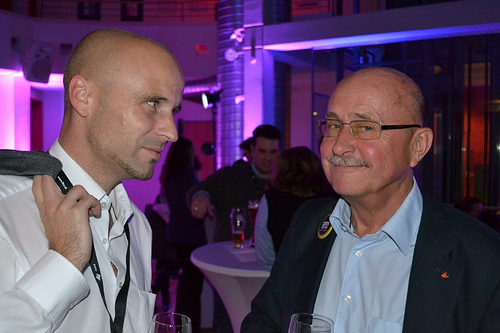
Yours truly at the PM-Camp with Dr. Marcus Raitner (left).
InterFace AG – why we support the PM Camp!
PM Camp is less boring than your common conference and gives you many insights. It is a free event, not controlled by ulterior interests. The “participants/partners” generate their own conference. Knowledge and experiences are shared at eye-level. PM Camp is a network for humans!
The more often a PM Camp takes place, the more intense it usually gets. We want PM Camp to be something everybody can afford. The costs must not be a barrier, because we want PM Camp to be accessible to all – young and old, female and male, poor and rich. That is why InterFace AG also supports some of the PM Camps financially. We want to help people to develop courage and joy and we want to give them a nice setting for a beautiful party. It makes us happy to see participants going back home from the Camp with a lot of newly gained knowledge, experience and adventures. If that happens, our investment was worth it.
Three questions and my answers on PM:
What is wrong with project management today?
- Project management is often considered deterministic “engineers work”, instead of value-based leadership.
- Project management is seen as a “taylorist” affair for experts.
- The use of tools is overrated.
- Hierarchical thinking patterns hardly allow an “organization as a network”.
What are the future challenges?
- Both in projects and enterprises, resilience will beat efficiency.
- People must learn to deal with uncertainty, because the future cannot be planned.
- We must think in terms of results, not in terms of goals.
- A project team must be seen as a biological being, not as a determined machine.
From your point of view, how can the PM possibly contribute?
- Bring the right kinds of people together.
- Provide a living supplement to the world of learning abstract knowledge by heart.
- Establish lasting networks between human beings.
- Train project managers for “Industry 4.0”.
About Me:

On the PM Camp with Dr. Stefan Hagen (right).
After “years of apprenticeship” at (6 years) and Sofllab (3 years), he founded the InterFace AG in 1984. He remained head of the company for more than 30 years. With the end of this year, he will stop being managing director of the IT enterprise. He will then be a member of the board of governors. Starting in 2015, he will work on important social topics.
RMD
(Translated by EG)
P.S.
The pictures have been taken at the 2012 Dornbirn PM Camp. In the first picture, you can see me with Dr. Marcus Raitner, on the second with Dr. Stefan Hagen. They are both very important PM Camp protagonists. In fact, PM Camp would not exist without them.
Roland DürreThursday October 30th, 2014
Soon to Be: Dornbirn PM Camp
 Again, the Dornbirn PM Camp is supposed to be a great event. The orga team: Eileen, Eberhard, Marcus, Stefan and yours truly very much wish for this. We want all participants to make many new experiences on the PM Camp and, as every year, we want you all to go back home especially satisfied with what you did.
In order to make our wish come true, I will be permitted to say a few things on the first day after the impulse presentation by Gebhard Borck and before the “barcamp rules” are repeated and the subsequent session is shaped.
Here is what I plan to say:
In November 2011, the first Dornbirn PM Camp took place. The initiative had lain with Kornelia Hietmann, Dr. Eberhard Huber, Jens Hoffmann, Dr. Marcus Raitner, Dr. Stefan Hagen and myself.
Since then, the PM Camps found their way into many towns, based on a rather strong “grass root movement”. PM Camp, however, is not an institution and consequently is not after making a profit. In a PM Camp, people who like sharing their knowledge make acquaintances and friends. They will meet totally free and without constraints!
Again, we want all the participants to go home and enjoy the rest of the weekend after the Camp totally happy and content. In order to make this come true to the best possible extent, let me voice a few requests for us all:
- We all wish to spend the next few days at eye-level. Consequently, we propose that everybody thou and thee everybody else.
- Be considerate and friendly – do not give enmity a chance!
- Treat the other party with respect, as you would wish to be treated with respect!
- Initially accept other ideas as they are!
- Give a trust advance and avoid making others look small!
- And even if you are ever so enthusiastic about your own discoveries: do not forget to “listen”!
This sound a little like morals – but that is not what is intended. On the contrary! What we want is a totally free and unrestricted PM Camp party. Two days we enjoy together and from which to take home as much as possible. Positive emotions, retrospection and enlightenment, friendships!
Neither is a PM Camp a fair or a display of products. Consequently, we would like to ask you to not abuse the sessions for product or service adverts.
Most importantly: we all want to feel really well. Consequently, it makes sense to avoid all that might be destructive. Why not enjoy the trust and tolerance of all of us, just like you give them back to us?
PM Camp has become a huge movement. Many will also participate from a distance. Here are two more requests:
- Do a lot of constructive twittering!
- Wherever suitable, write a short documentation of your session for openPM!
This would be nice because it might lead to us perhaps having a few more barcamps in 2015, for instance in Bremen, Dresden, Hamburg, Leipzig or even totally other places!
Now let me wish you all a lot of joy and fun – simply two wonderful days. Well, this is approximately what I have in mind.
RMD
(Translated by EG)
P.S.
I already wrote a few PM Camp articles some time ago. Here are the links:
Geschichte von und Leitfaden für PM-Camp (und barcamps allgemein).
barcamps und PM-Camp (2) – warum sie so erfolgreich sind.
Barcamps und PM-Camp (3) – “Typologie der Sitzungen”.
Barcamps und PM-Camp (4) – Twittern gehört dazu.
Barcamps und PM-Camp (5) – Regeln.
Here, I relate my personal experience and why I am such an enthusiastic PM Camper. Read my life-long education story – Personality Promotion, Seminars, Workshops, barcamps (Weiterbildungsstory – Perönlichkeitsförderung, Seminare, Workshops, barcamps.).
Roland DürreFriday September 26th, 2014
”Project: Without War” or “My Project #nowar!”
I started this article on my way back home from the 2014 Berlin PM Camp (#pmcamp14ber) in the train. It was meant to document my sessions on the Camp between June, 20th and June, 22nd, 2014. And tonight, on the second day of my bike trip from Toblach to Maribor along the river Drau, I finally manage to finish it.
On the 2014 Berlin PM Camp (#pmcamp14ber) I “disburdened my heart”, proposing and conducting a session on the “Project Peace!“. For me personally, this session meant new frontiers. Consequently, I was grateful that the participants were not too critical and tolerated my weaknesses during the session. After all, this is what is so nice about many barcamps and also about the PM Camp: people listen carefully, yet they are tolerant.
I came up with a few theses during the session, offered some personal ideas and tried to create awareness for this world’s main dilemma: war. Above all, I asked many questions. This was because I wanted us all to find answers and to discover how we all and each of us individually can act towards peace. In all kinds of projects – every day and very individually.
Here is the short report of my session on “peace” from the Berlin PM Camp, followed by my first thesis of the session:
If we want to live in a world of peace, we all – individually and collectively, locally and globally – have to behave friendly and act in the interest of peace.
So here is my first question:
Is a world and society in peace really such an unimaginable utopia?
Let me remind you of a sentence I already found fascinating when I was quite young:
Imagine they declare war and nobody goes there!
The opinions of the participants on how high the chances for peace were differed hugely. As I see it, a slim majority shared my opinion: it is imaginable to have a society where life in peace is possible both internally and externally. Others believed that human nature and war are simply inseparable. When I heard this argument, my reply was that in that case “human nature” would have to change, just like individual persons and the society as a collective mass of persons will have to change.
I personally believe this is possible. More questions of mine were:
Why do we frivolously subordinate our behaviour to unimportant goals? Why do we always have to be right? Why do you always find this “self-righteousness of the just ones”? Why do we so often fight for unimportant things, at the same time forgetting what is really important to us? Why do we demand “punishment” when in reality we almost always mean “revenge”? Why do we always plunder our resources in such a ruthless way and later try to steal what we no longer have from others?
After all, it is exactly this kind of thinking and behaviour which – so it seems to me – directly or indirectly causes “war”.
This, too, was a statement that triggered off totally different reactions among the participants. Especially the topic of “punishment and revenge” was discussed at great length. One of the questions was also if and to what extent punishment should be an indispensable part of “education”, also why/if force has to be the “ultima ratio” in politics? Maybe most of this world’s societies are actually “archaic force systems”? And maybe even our “developed” and “enlightened society” still is guilty in this sense in some areas?
My next theory was that, even if total peace is a utopia, we must still work towards it at all times. There are many rational reasons for this. And since the dangers humanity is facing are so immense, we simply cannot afford to waste our strength in wars. Basically, this is a rather reasonable approach, isn’t it?
Besides, some utopias in the past actually became reality. Just think of women’s rights. Not too long ago, they were not permitted to study at university – and the right to vote was truly utopian for women. The French Revolution, too, was just for men. And the first woman to demand exactly those rights for women was beheaded – by the revolutionaries!
During the session, I finally came up with the following statement:
As I see it, we need (to give) a purpose for social systems such as enterprises to be a success. And this is also necessary if we want our personal lives to be a success. How can anybody become a happy person without a purpose? Through all my life, this was what I believed. Consequently, I always tried to find a purpose in my life and my enterprises. Today, I see it a little differently. In fact, now I believe that, both in life and always, what matters is not having a purpose. What actually matters is the effect!
Let me re-formulate this:
Effect has priority over purpose.
(Perhaps the effect will then automatically show you the purpose).
Today, I believe that, basically, there is only one true purpose to life. And that is to work towards peace. Simply because there is nothing more important. Consequently, I believe: We all have to take part in working towards peace!
Well, obviously, this is also true for me, which is why I initiated the session. In fact, I believe I should have done so a long time ago. Now I wish to catch up by as much as possible and fight my ignorance. Consequently, I am looking for comrades in arms who might be able and willing to help me. I would like to strongly rely on the young generation, the so-called “generation y”. This generation gives me hope, because it believes in the following values:
Consideration, acceptance, appreciation, eye-level, honour, enlightenment, joy, shared experiences, harmony, individualism, life, love, courage, purpose, respect, sharing, wealth, understanding, contentedness.
And all these values do not go with war.
Except: life is full of conflicts (I wonder why). Consequently, we need the competence to deal with conflicts. So we found a few rules during our session:
First rule:
Serenity: never join a conflict that is not worthy of it.
Second Rule:
Stop hating! You simply need to remember the “paradox of hatred”: Those who hate want to destroy someone else, yet they always only destroy themselves.
So what do we need in order to gain peace?
Education, learning, experience, joy, courage, responsibility, knowledge.
How can we gain this?
During the session, we came up with the following results:
Let us never forget that there is no absolute truth, only certainty!
Let us always question “collective constructs” and the “absolute truth”!
Let us replace enmity by philanthropy!
Let us work towards social consensus.
Let us teach the people to behave “ethically responsible”.
We can succeed through civil courage and constructive disobedience. Let us all fight against “moral flippancy”. And let us always remember ourselves and our personal happiness. We can all learn and practice happiness.But it will not happen while we win over others or constantly increase our consumer habits.
However, we also talked about “being able to afford working towards peace”! Subsequently, we discusses if it is possible to modify our projects in this sense. And perhaps if we even could start peace projects.
The general agreement was that only a true grass root movement can bring peace. And that it will definitely not do any good to just join some Easter Peace March. Instead, we need persons who are seriously willing to work towards peace. Like John Lennon did. However, we also said that you have to be able to afford working towards peace. And that this is nowhere near as easy as it looks.
- Minimize damage! Avoid collateral damage! Break the vicious circle of force..
- Do good! You will find that collateral benefit follows suit!
- Respect other persons and their opinions!
- Never practice vengeance!
- Honour and appreciate yourself – because only those who value themselves will also appreciate (like, love, accept,…) others. And those who manage to do so will not start or like war.
- Contribute as far as possible towards the increase, rather than decrease, in many dimensions of your own and other person’s personal lives.
- Always treat others at eye-level and with respect..
- Always make other persons look bigger, rather than smaller.
(Making others small might well mean you turn others into beggars).
Here is my personal summary of the session:
I believe:
All these things must work both on a small and on a huge scale. If we can manage peace individually, then we will also succeed in bringing it to the systems we support.
The real challenge lies in our daily behaviour. Every one of us can and must contribute. The longer your lever because you are a manager, an entrepreneur or otherwise in a position where your ideas multiply, the more effect you can have! And the greater is your obligation to work towards peace.
Consequently, my vision for what should always motivate us is: All our projects promote peace. Both interior and exterior peace. And if some projects do not do so, let us re-define them! Let us make them peace projects.
Why should this not work out? How can we get there? Aren’t those some good questions for the next PM Camp?
RMD
(Translated by EG)
P.S.
I see quite a few encouraging factors. For instance the history of WW-1 (yesterday evening, I browsed through a program which illustrated battlefields of WW-1. Again, I felt how all this carnage is quite pointless).
The generally accepted tale about WW-1 is that the people in Germany and Austria actually wanted war. That is what I learned at school and never understood as a young boy.
Today, current historical research teaches me that this statement is simply wrong. The proof was manipulated at the time and later on simply taken at face value. Perhaps WW-1 was also history’s first media war. And the media were controlled by the powerful ruling “elite”. Consequently, the media did everything to boost and then document the war enthusiasm.
However, the majority of “simple” citizens never wanted war. Only some of them allowed themselves to be manipulated and went onto the streets to join the cries for war. And later, all of them had to pay a bitter price.
Roland DürreTuesday September 16th, 2014
Beyond (Project) Management
In his blog “führung-erfahren”, Marcus Raitner officially invites everybody to participate in a blog parade on “Beyond Project Management”.
The orga team of the Dornbirn PM Camp made “Beyond Project Management” their motto for the 2014 Dornbirn PM Camp. Incidentally, the orga team of the Dornbirn PM Camp is identical with the PM camp core team that started the entire PM Camp movement. We in the team thought it was a good idea to initiate such a blog parade, quasi as a preparation for the PM Camp. And thanks to Marcus, someone did all the work involved.
First and foremost, I wish to point out that our motto is not meant to be some catch phrase and consequently it is not supposed to have advertising value. A grass root movement such as PM Camp does not need advertising. After all, it is supported by persons who come voluntarily.
And the typical “PM Camp attendant” is an autonomous person who will not easily let himself or herself be influenced by buzzwords and marketing promises.
Consequently, we ask all the “participants” to view the three words “beyond project management” in a very objective and matter-of-fact way. They are supposed to remind us that we can and must look beyond our own horizons and to invite us to also “take a look at the insides of the brains of others” once in a while. As a general rule, this is something I would find more than desirable. In fact, I feel it might help to develop a little more tolerance, thus counteracting the intolerance as it is lived in our society and, as I see it, in all social systems due to collective constructs.
{Before I start with my actual article on the blog parade, here comes my first deviation from the topic}
I rather liked this motto. After all, it reminded me of a very big event organized by the very big US ACM (Association for Computing Machinery) in March of 1997. At the time, the association celebrated its fiftieth birthday, which means it was founded in 1947.
Said birthday was celebrated with a gigantic event. The motto was:
Beyond Calculation:
The Next Fifty Years of Computing
Here is what it says in the book with the same, which contains the presentations of the conference:
In March 1997, the Association for Computing Machinery celebrated the fiftieth anniversary of the electronic computer. To understand what an extraordinary fifty years the computer has had, you need only look around you–probably no farther than your desk. Computers are everywhere: in our cars, our homes, our supermarkets, at the phone company office, and at your local hospital. But as the contributors to this volume make clear, the scientific, social and economic impact of computers is only beginning to be felt. These sixteen invited essays on the future of computing take on a dazzling variety of topics, with opinions from such experts as Gordon Bell, Sherry Turkle, Edsger W. Dijkstra, Paul Abraham, Donald Norman, Franz Alt, and David Gelernter. This brilliantly eclectic collection, commissioned to celebrate a major milestone in an ongoing technological revolution, and now in its second printing, will fascinate anybody with an interest in computers and where they’re taking us.
Remarkable:
Among the invited speakers of the ACM event were the “most elevated and famous computer scientists alive tody”. But along with the computer scientists, they also had invited famous authors from the science fiction genre!
For me, this calls for a mental extension of our #pmcampdor motto by following the ACM and saying:
Beyond Project Managing:
The Next Fifty Years of Managing
{End of the first deviation from the topic and beginning of the second deviation, this time about terminology}
Before contemplating “Beyond Project Management”, I want to take a closer look at the term itself. As to the words Project and Management, you will know that I already wrote several articles about those in the IF Blog Entrepreneur’s Diary (Unternehmertagebuch).
Consequently, it is about time for us to look at the word “beyond”. Let me just insert a copy from “dict.cc” at this place:
| beyond {adv} {prep} |
2626
|
  |
|
|
beyond {prep} [outside] |
933
|
|
|
beyond {adv} |
529
|
|
|
beyond {adv} |
436
|
|
|
beyond {prep} [above] |
223
|
|
|
beyond {adv} | darüber hinaus | |
|
beyond {adv} | in Übersee | |
|
beyond {adv} | auf der anderen Seite | |
|
beyond {prep} [in addition to] | zusätzlich zu | |
|
beyond sth. | über etw. hinaus |
As you can see, translating these kinds of words from German into English gives you a wide range of potential meanings and associations.
{End of second deviation from the topic and start of the actual article about the blog parade. Now we are really into it!}
Beyond Project Managing:
The Next Fifty Years of Managing
I choose the meaning of “beyond” as in “on the other side of today”. So my article is meant to be a contribution to the discussion about what the future may look like – for instance in fifty years.
And looking at our suffering and tormented planet, it seems like fifty years might be a very long time, indeed. Much has to happen, because fifty years from now, matters might look rather bad, both here on this planet and for all of us individually.
For instance, I have a clear opinion about the collective and individual future of projects and the people involved therein:
The future of our society (collectively)!
First and foremost:
I no longer believe in projects that follow the “old” rules of the industrial era.
Just name me one non-trivial project anywhere on the world during the last few years which actually finished within the given time and cost limits. This goes for both the technological and social sectors. Even if you find “successful” projects by this definition, you will soon discover that they only were a success due to a huge amount of coincidence and/or due to a development that could not have been predicted in the way it happened and that led to the surprising success. They were simply lucky. Except that you cannot organize (and plan) good luck in a project.
When I say failed projects, I do not just mean the often mentioned big ones such as the Berlin Airport, the European Galileo or S21. No: I see so many small projects that are not doing any better either.
And I conclude that the ancient concepts and methods our fathers (and grandfathers) used will no longer work. They fail on a small scale and, of course, also on a huge scale.The challenges, however, which we are confronted with on this planet increase all the time.
How are we supposed to minimize the increased carbon dioxide production?
How are we supposed to reduce plastic waste or even to get it out of our oceans?
How are we supposed to create peace in this world?
All these are examples for challenges which cannot be solved by a project approach – which means they cannot be solved by project management.
How is a system and a “team” born from the system, such as for instance the EU commissars, supposed to even find an approximation for the “right project goals”? Can we expect prudent “management” as early as when the initial questions start to be asked?
Do not forget that, in the old project world, there are always also just a few persons (or often only one person with a “rod”) who determine the projects and give the orders.
Both collectively and in our social systems (enterprises, too, are social systems – they have the economic purpose of producing goods or offering service), projects defined from “above” and then controlled by project technocrats will not help us through the next few years. Consequently, we will need other solution strategies for the future – beyond the world of projects.
And, of course, it would be untruthful for me to write down the solution here and now. After all, I cannot know it, can I? Today, nobody can probably know how it might work and how it will be. All I seem to see is how it will definitely not work – which is why I dare to predict:
In the future, the classic project concept will no longer be a promising model for successfully realizing important enterprises. Relevant and constructive change will only work through evolution based on the “inter-connected wisdom of many” (and it probably already does so today):
For instance, how can you establish a consensus about where you all together want to and have to go in a large group? How can you come to a mutual decision about what you want to achieve in a widespread group? How to manage lived and intended unity? How can you make all “participants” willingly contribute towards the “shared goal” in a concentrated way or/and how can you make them do without things they thought were important in the past?
Perhaps our PM Camp can show a way towards finding first answers for an “about face”?
In the future, classic project management, both on a huge and a small scale, will be more and more about initiating legislation, proclaiming regulations, state sanctions and perhaps re-distribute resources. We cannot expect it to do more than that.
Yet we “passively” need to change our lifestyles and “actively” our shared activities in collaboration with many.
It is about time that we threw the idea (which was conceived during the industrial revolution, then established during the last century and is no longer justifiable) that the future is predictable and can be controlled over board as fast as possible. And hence we should do the same with projects in the classical sense.
The alternative to a common “about face” is probably some sort of (world) government which assigns us all to its huge projects (welcome NSA) reasoning that this is how they are saving us. Such a system would probably become independent of its own original purpose and develop fascist tendencies while the system agents would justify this development with “honourable” motives (saving the environment) or necessity (human survival or whatever).
This is not a scenario we – and in particular I – would be in favour of. Consequently, we have to solve the problems of the future in a new way – and project studies are probably the least appropriate of all possible means towards that end.
Incidentally, we are no longer even capable of defining the necessary “projects”. How to define social projects? How should a project look if it is meant to create social consensus? How to realize social consensus in a classic project?
And what is worse: even the structures and coordinates which are the requirements of the project concept disappear more and more often. And I am not just talking the big wide world, but also enterprises and social systems of all dimensions.
Consequently, we have to find something new. And we have to try it out both on a small and a large scale. And we have to improve on it all the time – by practice and learning. And maybe, for starters, we should think beyond the fringe of our own hat of collective system constructs!
The future of a person (individually)!
Let us assume that we and our descendants will continue to live in a developed society as it is today assumed to be a matter of course (although that is not what it is). But as of now (?), this is still the case, at least in Central Europe. Let us assume that our descendants, too, along with us, will remain untouched by the threats of hunger, thirst, poverty and, above all, that we can continue to live in peace.
Let us also assume that we will manage to support the lives of our children and grandchildren by an enlightened, violence-free and understanding education, “upbringing” and supervision in the future.
Then it might and should just be possible that most of the people in the next generation are willing and capable of leading their own lives as autonomous persons and thus can act self-responsibly and in ethic responsibility for their neighbours and their social systems.
Then these persons will be fed up with living and working in a Taylorist, deterministically controlled and hierarchically organized world. They will also refuse to single-handedly take responsibility for others and then be responsible (!). Also, they will not feel like working in a hierarchical team of “project leaders” (project functionaries).
Instead, it will be very important for them to have all important decisions originate with the aforementioned “wisdom of many” and thus also in the responsibility of and supported by all parties concerned.
Especially with young people, I witness this more and more often. Even today, respect, honour, appreciation, trust, symmetry and eye-level are extremely important for them. They no longer feel like spending their precious time (the currency of the future in developed societies) outside such worlds. And consequently, they will no longer be prepared to enter into the classical project world. Because they will prefer to work self-determinedly and at eye-level with other persons – for a goal they mutually agreed upon to be important and right.
As you can see, the “future of projects” depends on which concept of humanity we base it on for future generations.
It is my personal concept of humanity that our descendants wish to be “free” in the sense of self-responsibility.
Projects would only have a future if people were to reject this kind of freedom. And that is something I would find fatal.
RMD
(Translated by EG)
Roland DürreSaturday August 2nd, 2014
“For Freedom” or “My Post-InterFace Life“
“Minutes and notes on and how I felt and results of my session “project freedom” at the Berlin PM Camp on June, 24th, 2014″
In former times, I was in search of the meaning of life. I tried to find meaning in as many things as possible. When I founded an enterprise, this, too, of course, was to be meaningful. That was more than thirty years ago. At the time, I was totally convinced that all social systems – including the economically-oriented ones – should have meaning.
And today – with every speaker demanding that enterprises must have meaning – I think that this demand is correct and yet wrong. Today, I believe the important thing is not whether life or an enterprise makes sense. Instead, what matters is how a human being or an enterprise affects its or his environment.
When I was a child, I, like many of my friends, was surrounded by a traumatized generation. In the early 1950ies, this generation knew exactly what you do and what you do not do. They felt like they owned the truth – which was often defined through totally irrational categorizations. They had a strange understanding of freedom and peace. And we were victims of their advice.
At school, we were “educated” by traumatized persons. Seemingly purged, they now sublimely tried to pass their dogmata and hatred on to the new generation, which was: us. Mind you, it was not just the teachers. The parents and family were no different. Even strangers who passed us on the street abused us. Because we wore jeans or because our hair was too long – regardless of the parents having threatened us with the worst possible punishments.
But in other respects, too, this generation never appreciated us. They knew exactly what the world should look like and we simply did not fit. Consequently, they made us look small. Being beaten was normal. Both at home and at school. Having to stand in the corner or having to spend a few hours in the coal cellar or locked into the bathroom were the humane forms of punishment.
We suffered and never understood the reasoning behind this kind of education. Instead, we saw it as a revenge model. We had to pay for our non-conformity and undesirable behaviour. And then we opposed and reciprocated with hatred.
We felt particularly ill-treated when we were punished for activities we had felt truly courageous, noble or great about. How it hurt us when we had been doing good things and they made us pay for it! – When we were called traitors.
Even when we had enjoyed doing something too much, we were scolded. Because it definitely would not do to have too much fun and therefore the rulers of our childhood objected to it.
Do not play with the street urchins …
When I was an adolescent, I liberated myself and the question about the meaning of life was never far from my mind. I was totally devastated by the fear of death. What meaning can a life have if it ends with death? To me, eternal life did not seem to be the right answer, either.
And on top of the meaning of life, there was another hope – peace. Big, never-ending peace. Both between humans and with creation.
After all, I and my friends never understood the nonsense about war. John Lennon was one of our heroes. I never experienced war first-hand. But I experienced how US GI’s sobbed in Augsburg, because they were ordered to fly to Vietnam early on the next morning. They certainly knew what to expect and they also knew that many of them would never return.
I can imagine how cruel war always is and will be and how perverse it is when “industrialized”. For me, the concept of an idealized war where clean modern technology is used, the reduction to using weapons as some kind of high-tech game where fighters control the death-spelling drone standing behind the game board is horrifying. Not to mention all those necessities that make all these things mandatory: weapons, soldiers, mines, fighting robots, …
I know no war that changed anything for the better. Also, I doubt that there can ever be a justified war. Perhaps even the Nazi problem could have been solved in a better way. Without WW1, there would probably never have been a WW2.
However, I do not only wish to oppose the big war. The war inside and on a small scale, too, is bad for us. Is it really necessary that humans always integrate so much animosity into their daily communication? Why is it so hard to come to peaceful terms with oneself?
Why do we always tend to make other people look smaller, rather than bigger? Wouldn’t it be an obligation both for our “leaders” and everyone else to make others look bigger? Because this is the only way the social system might work in favour of humans, rather than against them. So why do we fight ourselves and prevent the flourishing of our own life in many possible dimensions?
Isn’t it a great project goal to reach your inner and outer peace? A goal everyone – not just leaders and managers – should work towards? Don’t we all “manage” something or other most of the time in our lives? And no matter what it is we manage, it will always have something to do with people.
Consequently, I wish to dedicate the years remaining in my life to working towards peace.
During the Berlin PM Camp was the first time I tried to contribute by a session on “project peace”. Ulf Brandes had inspired me with his introductory presentation. I wanted to fascinate as many persons as possible for a “project peace”. Regardless of the topic being a little beyond our usual range, quite a few people came to attend my session. What we discovered was both encouraging and discouraging:
- Working for peace is definitely worth the effort.
- There is a lot of scepticism whether the project goal can be reached.
- Peace will definitely not come through religion and dogmata.
- A project goal “peace” commanded “from the top” will not help.
- Peace will not be installed by politicians, functionaries and other system agents.
- Traditional forms of protest for peace, such as Easter Marches, etc. will not have any effect.
- The project peace needs persons whose personality has reached a certain degree of maturity.
- In order to get peace, we need a new social consensus.
- Said consensus can only be obtained through a network supporting the process of forming opinions.
- Only a grass-root movement can make the “project goal peace” a success.
Now we can start.
Many thanks to all those who attended my Berlin PM Camp session on “project goal peace” and helped me a lot. Today, all I want is to really live – both in peace and for peace.
I see myself doing this against the generation I witnessed as a child that is still present in such huge numbers.
RMD
(Translated by EG)
P.S.
Let me note that, almost exactly a hundred years ago, something ultimately unbelievable happened for many people – systemic mechanisms culminated in WW1.
This war was the first media war (see documentations for instance at ARTE) to be started so cunningly. For instance, historical research was convinced for a long time that a majority of the people living in the two empires actually went to war jubilantly.
New historical research reversed this concept. Today, it is generally accepted that the entry of war in 1914 was mostly against the wishes of the people living in Germany and Austria and that, in truth, it was something the then elites and powerful wanted and instigated.
Nobody can seriously doubt the uselessness of WW2. The world was burning and there was an industrial waging of war in many places aiming at the total destruction of the enemy without any consideration for all kinds of loss.
On the scale of atrocities committed during the war that, unfortunately, is open at the top, the trench warfare on the German-French border, as well as the “mountain fights” in the Alps are perhaps the outstanding examples of cruelty and irrationality.
War is no constructive means to solve problems!
Roland DürreSunday July 13th, 2014
Ute Rauscher doing an interview with Roger Dannenhauer
On June, 27th, before the InterFace jubilee party, my friend Roger gave an impressive presentation. Ute Rauscher took advantage of his being with us and interviewed him for the Bayerischen Rundfunk.
Here are the most important parts of the interview:
Enjoy!
RMD
(Translated by EG)
Roland DürreSunday June 15th, 2014
PM Camp, Munich and InterFace AG
In the internal InterFace AG Social Media System, one highly appreciated colleague of mine asked why there is not more about the PM Camp in Munich available at InterFace AG. And why, so far, so few persons have registered. Here is what I replied.
Thank you for your note about the PM-Camp 2014 in Munich – #pmcamp14muc – between July, 24th and 26th at LMU, which starts on Thursday evening. So far, I had little time for writing a lot about the PM Camp – also due to the rather time-consuming preparations now under way because of our “30ieth anniversary party”. This will, however, change with the end of June.
Participants:
There is no need to be worried about the Munich PM Camp. The organizational team are seven extremely well connected persons (Barbara Bucksch, Helene Neugebauer (who I cooperate with very closely at PM Camp Munich), Jolanta Czagin, Melania Melitopoulos, Martin Aigner, Michael Cramer and Sacha Storz). They will definitely manage to make it a great PM Camp, especially in the IT Capitol Munich. Currently, the marketing is just getting under way. As soon as our “30-Year-Anniversary-Party” is over – if not earlier – I will also get more active supporting the campaign. On our party, I also want to do some promotion work for the Munich PM Camp.
For the PM Camp, however, we actually look for persons who wish to “actively participate”. Which means that the active part begins as early as finding information about the PM Camp. Consequently, we do not wish to persuade anybody to attend. The best approach would be for participants to find us because they have been looking for this kind of modern “anti-conference” in barcamp format for project managers, all kinds of managers, entrepreneurs or persons who wish to shape the future actively and in a positive way.
Sponsors:
Naturally, both among those in the PM Camp core team – the normative level – and the PM Camp strategic level (this is where the regional organisational team representatives meet), there are some who view sponsoring rather critically. The same is true for the organizational teams themselves (the operative level). Sponsor money helps to make the event less expensive and offer more to the attendants (catering, party). However, PM Camp is an independent “grass root movement” and does not wish to make a profit. With this in mind, we are always extremely careful when it comes to sponsors, because PM Camp must not be damaged by the interest of any third party. Also, PM Camp cannot and does not wish to fulfil the requirements of “normal” sponsors (“What is in it for me?”). This means that a sponsor who “shanghai-s” PM Camp is not something we desire. InterFace, for instance, only sponsors if there is a special reason or if the PM Camp cannot take place otherwise.
About the individual PM Camps:
This year, we have only had two PM Camps so far: in Zurich and in Stuttgart. Both in Zurich and Stuttgart, we (the InterFace AG) were present. Thanks to our Stuttgart branch office, we were rather well represented there. The next PM Camp is in Berlin between June, 20th and 22nd. Incidentally, it is the only one scheduled for a Saturday and Sunday. Normally, Fridays and Saturdays are the main days. But the freelancers living in Berlin cannot/do not want to afford the lack of income on a weekday. I particularly look forward to Berlin. After Berlin, there will be the Rhein-Main PM Camp in Bad Homburg, which coincides with our “30-year-party”. At the July Camp in Munich, I definitely plan to attend. Later this year, we also plan another one in Dornbirn and other places. Dornbirn was where everything started in November 2011. Consequently, Dornbirn as a PM Camp for DACH is the very special baby of Stefan (Dr. Stefan Hagen) and yours truly.
Additional note:
After my tenure as managing director of InterFace AG ends on December, 31st, 2014, I plan to get even more active promoting the PM Camp movement.
RMD
(Translated by EG)
Roland DürreTuesday June 3rd, 2014
June, 20th, 21st, 22nd – PM Camp in Berlin #pmcamp14ber
”Cooperation in the 21st Century” and „Wisdom and Intuition of the Multitude“
Those are the two focal points of the Berlin PM Camp between June, 20th and June, 22nd, 2014 – which means from Friday evening until Sunday afternoon.
Doesn’t that sound exciting!
Consequently, late in the evening of my birthday, I will board the sleeping compartment of the night-train from Munich to Berlin and leave it to said train to bring me to my destination. And I already look forward to meeting many friends and in particular Heiko (Heiko Bartlog).
Heiko is a member of the organization team of Berlin PM Camp and put enormous energy into preparing for this event. He asked me if I would like to supervise a session about the two exciting topics of the Berlin PM Camp. Isn’t that nice of him?
Well, I would certainly always like to do just that. Consequently, I now start thinking about it. There are certainly a lot of topics. Here is a list of what comes to mind:
- Target Agreements
In 30 years as “The Boss” of InterFace AG (and even before that in my more passive role as employee at Siemens AG and Softlab GmbH) I made a lot of surprising experiences with goals and target agreements. I learned that target agreements are very problematic in many respects. Consequently, I believe it is quite possible that more and more of these “control mechanisms for humans by material rewards” will be abolished in the future.
For instance, I could tell my life story, including paying models and target agreement design as an entrepreneur and in projects.
- The Change in Management
In the early 1980ies, Hans Ulrich, perhaps the founder of the St. Gallen Management Model, wrote a wonderful essay on “8 Theses on Change” in management. By now, we already have the Version V4.0 of the St. Gallen Management Model. We did a review of this model with Professor Dr. Johannes Rüegg-Stürm and many Swiss enterprises. In the process, we discovered how unique and modern Hans Ulrich’s theses are still today.
- Leadership – Principles and Values
Being an active participant in a Blog Parade initiated by Bernd Geropp, I have recently been made aware of how diverse the answers to the simple question: “What are your three relevant leadership principles?” are. I took quite some time thinking about it, and then suddenly, it was very clear to me: I am an ALO man (agile, lean, open). But how does this translate into daily practice? Or why will this often not be possible? And what could we do in order to use this principle more frequently?
- Leadership is Communication!
Another topic is communication. Communication has always been a difficult issue. But here, too, humans and their values, expectations, interests and needs changed. And I mean radically. Similar to “basic beliefs” and “basic behaviour”. Except that some bosses, project managers, managing directors and superiors did not notice. And consequently, many of them communicate like in times long past – which is true in several respects. There is really a lot you could improve – and in fact, you have to improve on these things if you wish to make the “future” a success.
- “The Future Cannot be Predicted”
and all decisions will always have an “uncertainty factor”.Well, this is just how it is. And in managerial circles, the awareness that this is how it is now also is being heard. So this would be another exciting session topic.
I think a team cooperating at eye-level is better equipped to distinguish between “good” and “evil”, for instance when it comes to a project. And this is how, with a shared effort, more “right” than “wrong” decisions can be made than, for instance, if an isolated project manager has to make them.
- Discovering Collective Constructs!
Projects or enterprises are social systems, mostly with a decided goal. Social systems, however, tend to develop collective constructs which increase by themselves in a very special way, often also when those who are normatively and strategically responsible become system agents. Social systems can then easily make themselves independent and de-personalize.
The only way to prevent this phenomenon is to have a culture of civil courage lived by the majority in the enterprise or project, thus making it possible to fight back against a perversion of collective system constructs in constructive disobedience. In other words, an immunity guaranteed by a “Crowd” inhibits the social system.
These are all topics I find extremely fascinating. I also have lots of personal experience with these topics and learned much from my mentors. It is my pleasure to share my experiences. However, this kind of thing always has to be in harmony with the barcamp and consequently, with the PM Camp. That is why I always wish to decide at short notice what exactly I will talk about. For instance after having digested the impulse presentation and the feedback in the discussion. Or maybe after the first PM Camp day.
Besides, I am quite ready to let others do the speaking, only getting active when I notice that there seems to be a shortage of volunteers for session. Except if I find something really incentive :-).
So I look forward to being in Berlin. And as to the rest: let us wait and see. In other words: instead of planning, I just let things develop.
There is no doubt that the Berlin PM Camp will be a first-class event. I can promise!
RMD
(Translated by EG)
P.S.
At this time, I would also like to inform you about the next two PM Camps:
The PM Camp Rhein-Main is all about “project communication” It will be from the evening of June, 26th, until the afternoon of June, 28, in Bad Homburg #pmcamprm and #pmcamp14rm. Unfortunately, I cannot be there, because on June, 27th, we have our big 30-year-party – all PM Camp fans are invited.
In July, Munich will host an event between the 24th and the 26th (again Thursday evening through Saturday afternoon). The motto of the PM-Camp München is: “sharing knowledge – increasing knowledge”. And that certainly also sounds familiar: #pmcampmuc or #pmcamp14muc. Of course, I will again be one of the participants at the PM Camp in my home town!
Roland DürreSunday April 27th, 2014
The First PM Camp in Switzerland
 At long last, we did it this week – the first Swiss PM-Camp took place. I was part of it – and it was a wonderful experience.
Most of the attendants came from Switzerland – which means that I made many new acquaintances. It felt very good to be part of the event. In some way or other, much of what happened sounded quite familiar to me and I remembered our RISE workshops at Hochschule St. Gallen.
🙂 This time, PM Camp was not just short for Project Management Camp, but also for Premium Camp.
Because in Zurich, everything was premium quality: the location, the way people interacted with each other, the session quality, the food, the Friday evening party and the closing event. …
The venue was the “25hours”, a boutique hotel in Zurich West. We had truly creative surroundings with lots of space for an innovative exchange of ideas.
 In other words: the team around Silvio, Christian, Toni and Matthias has every reason in the world to be really content with this event. You did a marvellous job! Many thanks!
At the very outset on Friday morning, Mischa Ranseyer (here are his slides) fascinated the entire audience with his keynote on “Management in the 21st Century”.
Inspired by Mischa’s theses, we went ahead with many very illustrious and exciting sessions.
Naturally, I was also responsible for one of them. It is just too much fun taking up topics from other sessions and then mentally extending them in your own event.
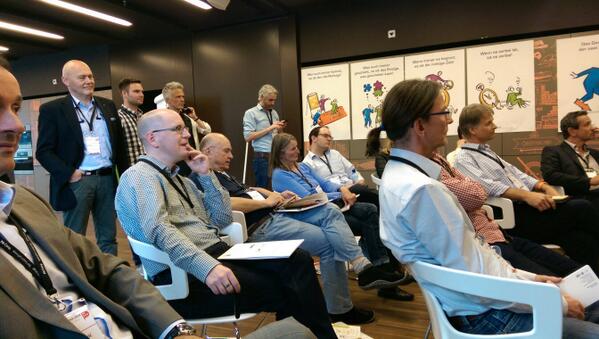 Zürich was our start into the PM Camp year 2014. Initially, we had a PM Camp where quality was the most important thing for all the fifty participants. It seemed a little like the motto had been “small but nice”.
Now everything comes in quick succession:
The next PM Camps will be in Stuttgart (May, 9th and 10th, 2014), Berlin (June, 20th through 22nd, 2014) and Bad Homburg (PM Camp Rhein-Main from June, 26th through June, 28th, 2014). After that, the first Bavarian PM Camp will have its premiere in Munich between July, 25th and July, 26th.<
 We have not yet set a date for Vienna, but in November, the PM Camp year 2014 will be closed with the great PM Camp DACH in Dornbirn (November, 20th through 22nd).
Whenever possible, I will be participating at most PM Camps. I am booked for Stuttgart, Berlin, München and Dornbirn. And, of course, I would be delighted to meet many friends.
So if now I raised your curiosity and you would like to attend a PM Camp for Project Management in order to share and increase your knowledge about management, entrepreneurship and shaping the future – and all this together with others while having a lot of fun and at high speed with surprisingly little cost – then you are welcome to contact me.
I am always at your service, both for more general information and very personal questions. Besides, you will already find quite a few articles in the IF blog which tell you about PM Camp in particular and barcamps in general. All you have to do is search for “barcamps und PM-Camp” in this blog.
Hoping to see you soon at one of our barcamps,
yours
RMD
(Translated by EG)
P.S.
Here are a few pictures taken during the weekend
And you can find more about the nice Zurich PM Camp on twitter – just look for the hashtag: #pmcamp14zhr


