
Roland DürreFriday October 16th, 2015
Five Weeks to Go until #PMCampDOR
 Late in 2010, a small group of entrepreneurs, nearly all of whom incidentally were also bloggers, met. They shared an idea and wanted to try organizing a project management barcamp. They called it PM-Camp (PM short for project management). The persons involved were: Kornelia, Eberhard, Jens, Marcus, Stefan and yours truly.
It was our intention to host a free meeting of persons, entrepreneurs, leaders and all kinds of “managers” in order to exchange experience and knowledge beyond conferences and workshops. Totally democratic and at eye-level. With a good mixture of female and male, young and old. In 2011, also in November, we had the first PM Camp world-wide in Dornbirn.
Time went by in a hurry. In exactly five weeks, the fifth Dornbirn PM-Camp will start. That means we celebrate a jubilee! In fact, we are a little proud of it. We are also proud about a movement having sprung from the first PM Camp. It is now thriving in many European places with local PM Camps.
For all of you, it is now about time to order tickets. Otherwise you might end up empty-handed. Because PMCampDOR is definitely something like the mother of all PM Camps – where many wish to attend.
This time around, we chose the metaphor “breaking with patterns” as our impulse. Consequently, the hashtags are #PMCampDOR and #musterbrechen.
🙂 Maybe #musterbrechen will become #mu5terbr3chen and #fuenf will turn into #drei … Because you never know what is going to happen on a PM Camp.
Naturally, the Dornbirn organizational team wants to celebrate the jubilee with a particularly nice and successful PM Camp. Consequently, we want to make it especially easy for our “newbies”, meaning those guests attending their first PM Camp or even their first barcamp to really get under way. So I now point out to you a series of articles I wrote as early as 2013/2014 – but it is certainly still up-to-date. In these articles, I am telling you what happens during a PM Camp.
Here are the links for the five articles:
My continuing education story – personality promotion, seminars, workshops barcamps
(how I first was introduced to the barcamp idea.)
barcamps und PM-Camp (2) – why they are such a success.
(because they are great fun and all participants are happy when they go home.)
barcamps und PM-Camp (3) – typology and sessionsbarcamps and PM-Camp (3) –
(what kinds of sessions are there?)
barcamps and PM-Camp (4) – Twittering is part of it .
(why PM Camps and social media complement each other so well.)
barcamps und PM-Camp (5) – rules
(on a barcmp, you can have freedom, because people behave socially responsible.)
Another article is a general one:
The Story of and guideline for a PM Camp
(and barcamps in general)
And for all of you – not just for the newbies – I would once again wish to point out our values as we summarized them in our guidelines. You will also find them in document.
I am sure it will be useful for you to take a second look at these materials. And perhaps you have a few recommendations for change, modification, improvement? The #PMCampDOR will definitely be the right stage to discuss all those things.
And here is a short Video on PM-Camp.
RMD
- also in the name of the Dornbirn organizational team
(Translated by EG)
Roland DürreThursday October 15th, 2015
(Deutsch) Mein letzter Tweet für heute – Reklame für PMCampDor 2015
Roland DürreSunday October 11th, 2015
Vintage Project Management #2 – My First Real Challenge
How I landed my second of many projects.
Project #2
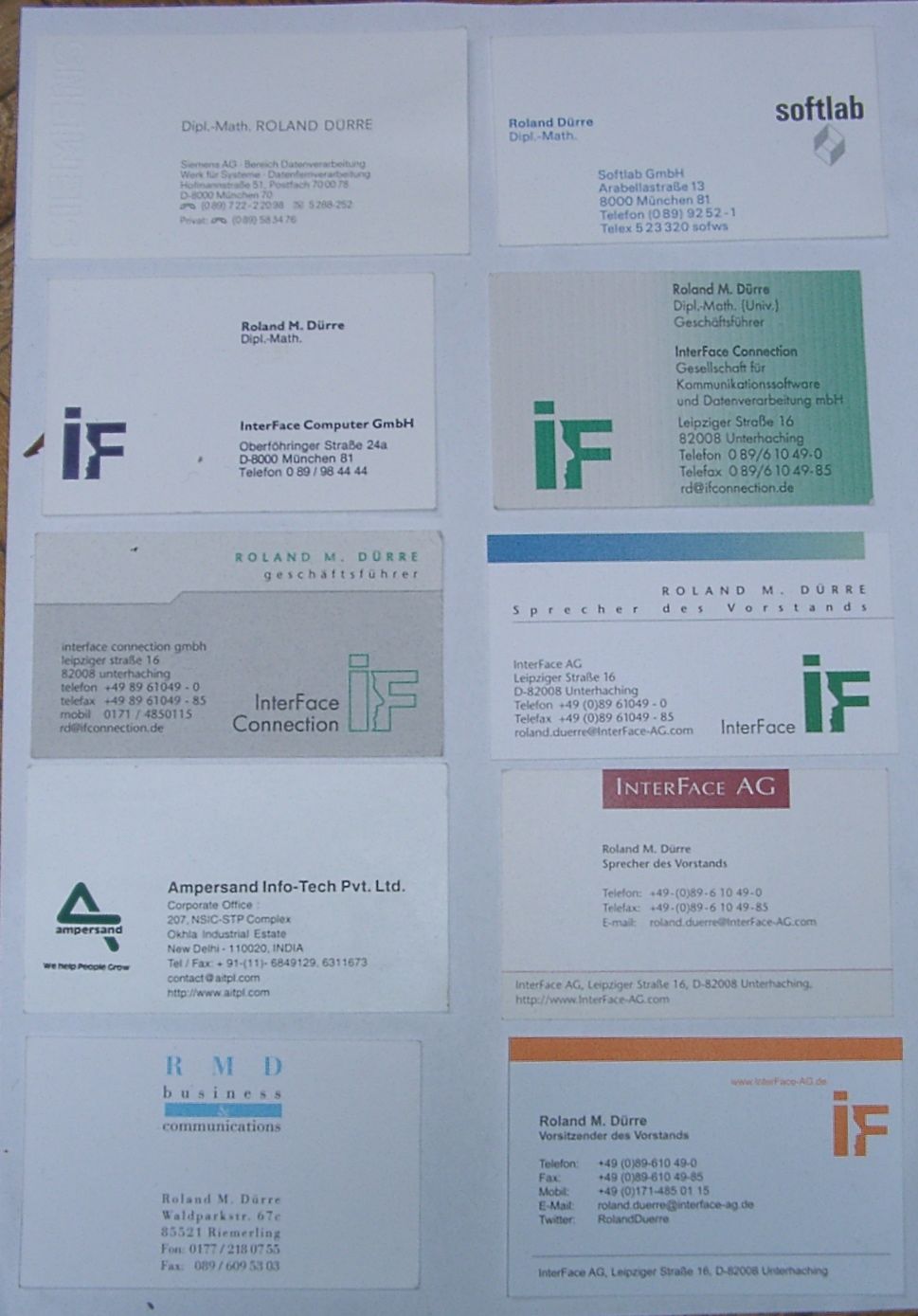
On the upper left hand, you can see my first Siemens visiting card – the first of a collection I am eternally proud of.
After my re-start in October 1971, I continued my university education, the successful finish of which lay in winning my diploma. Here is how it happened:
When I was in the then fourth semester in the summer of 1973, I noticed that it was about time to sit my interim diploma exams. And I noticed that, indeed, there was quite a knowledge gap.
Consequently, weeks of learning lay ahead. The weeks before the four oral examinations would be stressful. I fell victim to knowledge bulimia, a sickness widely spreading these days and actually an epidemic in all the school and university systems I know. After having passed the interim diploma as required (surprisingly even with quite a fair grade; “good”), I was rather worn-out and had to give myself some rest.
Resting was exceptionally great fun while breathing computer air at Siemens. They truly had a lot of hardware: large-capacity computers with BS2000 and BS1000, process computers, office systems, network computers and much more. I was truly over the top. At the TH – which was now called TU, because, after all, a university is something better than a college – the computing times allocated to students was rather scarce. Consequently, you seldom saw me there.
As a logical consequence, I spent more time at Siemens during the following four semesters than at the not very humane (and probably even then asbestos contaminated rooms) of the new southern TUM informatics building. Incidentally, said southern building was torn down several years ago. Just imagine that the building where I studied and which had been built more than 20 years after I was born was outlived by me. Now isn’t that somewhat strange? The old TH building is still prospering.
It was my good luck that my major topic, mathematics, could easily be studied out of books. They are a good substitute for attending and listening to lectures. After eight semesters, I noticed that there was a diploma thesis to be written before admission to the final exams. I found a professor (Dr. Werner Heise) – regardless of having been the youngest mathematics professor of all times at the TUM, he unfortunately died a few years ago – who was willing to hand me a really exciting combinatorics topic for said diploma thesis (it was about the assumption by George Polya which, however, had not yet been proved – which is how the theorem by Dürre came to be).
It was not easy, but it went well and was a truly great experience for me. I also enjoyed actually meeting Mr. Polya from Hungary on a combinatorics congress in Berlin. The trip to Berlin was especially fascinating because at the time Berlin was still a wonderful island in the middle of enemy country.
After the diploma thesis, the final exams lay looming – and again I fell victim to knowledge bulimia. It was even worse than before the interim diploma. But, again, the knowledge bulimia worked well. There came a day when, although totally exhausted, a very happy me held his diploma document in his hand. To be sure, I did not know if that was something to be proud of or not. But I was immensely happy to have finished the sad chapter “university”.
I was not in the mood to write dozens of applications or similar things. A journey around the world or even a vacation were also out of the question, and so I tried to find a job. I applied at Softlab. I found this company really great, because at Siemens, I had once read the hectography of a book by Peter Schnupp (structured programming) and I found said book a beacon in the darkness. And Peter Schnupp, whom I later met and who became a much-loved friend of mine, was one of the Softlab founders (along with the colleagues Neugebauer and Heldmann).
Consequently, I sent my first (four years later, there was a second one) application to Softlab. It seems, however, that at the time Softlab was undergoing minor crisis phase, which is why they sent me a very polite letter of refusal. It said that they actually were quite interested in me, but currently had no tasks appropriate for my skills. They also asked me to try again next year.
Naturally, that was not much help to me. But as matters developed, it turned out that, more than four years later, I landed with Softlab anyway – but that is another story.
“After finishing your university education, you have to work!” – that is what the bourgeois part of my super-ego told me. So I took the same documents I had sent to Softlab and used them to apply for a job at Siemens AG. I was optimistic, because, after all, they already knew me. And, yes, they took me – and they also had a real project waiting for me. It was part of a bigger project, which again was part of a really huge project.
I ended up at UB D WS ST DF 131, which is short for the department data processing, laboratory for systems, system technology, data transfer, 1st company, 3rd train, 1st battalion. The last three terms are my personal interpretation of 131. After all, the founder of the enterprise took the Reichswehr as a model for the organization of his company
The entire DF (which means an entire company of the Siemens army) worked on a hardware and operating system for realizing the data networks called TRANSDATA. Incidentally, I think it is another disgrace for the German IT that this term cannot be found in Wikipedia (I wanted to put a link right here). After all, this was the only and technologically superior competitor of “SNA“ (System Network Architecture) by IBM, who were our biggest and then perhaps only competition.
The Transdata software was called PDN (programmable data network technology) and we generated operating systems necessary for the data station computers, the network node computers and the mainframe model computers. Those two years were probably the most exciting years of my entire professional career. I could easily write several books about the time.
On this picture, you see a Siemens & Halske repair shop in the rear building at Schöneberger Straße, Berlin, on October, 19th, 1846 (Source: Wikipedia)
The official term for our facility was: laboratory. My group, the 131st of DF, developed software and was responsible for APS (short for user’s programming language). The language was supposed to make the “stupid” connecting computes do the (pre) processing as early as at the fringes of the network, for instance when it came to collecting data for a business process in the user’s dialogue. Also, it had a controlling and “intelligent routing” purpose.
Within DF, there were a number of teams, all of them developing new things. Because a computer network needs a lot of modules and, considering what times we are talking, it was rather complex (or highly complicated). And the team cooperated on a high intensity level.
Together with the customers and the partners of our FBZ (technological counselling centres at Siemens AG), we made Transdata the basis for the new big IT projects. And it all happened in a very agile, open and slim way. The minutes of the coordination meetings with the big projects and the technological counselling centres were our specification sheets. There was also a management, but their primary task was to see to it that all humans were happy. And to protect the teams from the Siemens management.
We worked in an enclave, in the Ortenburgstr. It was one of the many Siemens locations outside Hofmannstr. There was an actual bakery on the ground floor, which in itself made the location attractive. No barracks and instead tasty pretzels and rolls.
Some way or other, we all at DF were a good team and made the dice roll. We were all engineers and developed technology for real projects. And Transdata became a success. It made me proud to work on systems that often ran in important and revolutionary projects.
At the time, my job description was:
Synchronously programming on three versions. Version A (for example 4.0), which currently was on the market, was maintenance I had to do. This was about correcting errors and communication with users. For the next version, I developed the functionality as had been agreed upon and decided (version B, aka 4.1). And then, I had to plan version C – which would be 5.0 in our example – with the project partners.
Thus, the time we invested into the future was quite considerable. Because the market was demanding and very dynamical, the competitors were quick and consequently the speed had to be high.
On top of programming three versions simultaneously, I had more tasks, too. Of course, I wrote the manual for our programming language myself. I had to do the technological supervising of our large-scale projects and teach courses for the system engineers who used our system.
On top of this, I also organized the test of our new functions with our pilot users and wrote the product flyers for our marketing. In those days, new employees were recruited all the time. After half a year, I actually was an “oldie” at Siemens because of all those “newbies”. And we also had to continue our education – which was mainly done by reading the ACM or IEEE lecture notes.
As a side-line, we organized a coffee machine and a fridge for our office – which caused quite an earthquake with the Siemens administration. A coffee machine in a Siemens office – that was against all regulations (regardless of the fact that such a machine, allegedly, could be bought at a discount by the employees at “our” shop). But we managed even that.
And then the sad times started. Management grew more and more powerful. They introduced division of labour. It was some kind of development Taylorism in the laboratory. In addition, the administrative processes grew more and more time-consuming. That was in the second half of the 1970ies. We had to kiss our laboratory idyll good-bye.
First they introduced the manual editorial office. We had to teach persons who had not the slightest idea of how IT worked what needed to be written in a programming manual. Then came quality management. Those were people who had to have tested our software before said software was prototypically used by our customers. Except they had no clue about software and testing same.
Then they introduced product management and requirement engineering. All of a sudden, there were mile-stones, such as A20, A30, B20 … B50. The waterfall model came. Even the termination of the product was defined with enormous precision. That was T50 if I remember correctly. It was called project phase model. And we were no longer allowed to do any programming. Instead, we had to think about the level of maturity our work had now achieved.
They started the budget concept and expected us to make (guess) predictions about the expected cost for all discussed functions. Unfortunately, most of the new functions were very innovative and involved a high degree of creative research. Thus, predicting the expected cost soon became more time-consuming than the actual programming. Except that we were no longer permitted to do any programming, anyway, because in order to decide if there was to be any programming, you first needed a tested and approved cost estimation.
And thus it happened that what formerly we could discuss directly and decide with the customers and the FBZ on one afternoon now was discussed at greater and greater length. Weeks turned into months. Strange decisions were the often absurd results. Again, you had to discuss them at great length – or else you were secretly building u-boats. Which is not really without danger in a well-controlled concern. But then, there is nothing you would not do for a successful project, is there?
Additionally, they decreed working times that made it clear to us all that we were not permitted to work as much as the project would have required. As a logical consequence, they later installed time stamp machines in Neuperlach for the engineers. And if you were caught continuing with your work after you had stamped out, you had to be reprimanded by works committee decree.
Even taking work home got harder and harder, because plant protection had come up with a random generator at the company portals. If the generator sounded, you were controlled (shaken down) and it was absolutely forbidden to take documents home with you.
Thus, it got worse and worse. New sessions with three or four letter abbreviations were introduced (I forgot the abbreviations). Persons from new departments you never knew could exist suddenly sat around the table. “Cross section responsible persons” demonstrated how important they were. People who had no inkling of the market and the technology but were great with common phraseology were more and more powerful in product development. This cost a lot of money and much of what was decided was just nonsense which, naturally, never materialized. If decisions were made at all. All these measures caused helplessness and frustration.
In a nutshell – it was about time to leave. Consequently, I moved – inside Siemens AG – to a department where actual projects were still realized (UB D V S 3 – company sector data processing, sales and special projects, department3). After all, you were still supposed to work on true projects and remained free from bureaucracy and management mania – at least for a short time.
I had a nice offer, because at UB D V S 3, (not only) one project that was particularly important for the leadership was suffering from a crisis. And said project was behind schedule by quite a bit. It was called DISPOL and they had to develop it for the Bavarian Government. The task was to make the police fax machines (communication), the data storage cupboard (database and archive) and the typewriter (document processing) obsolete by introducing IT equipment.
This was the project during which I, for the first time in my life, met a true project manager … He was supposed to save the project – and that was my job, too. Together, we actually managed it. Because he left the technology experts to do their thing and did not interfere. But I am not yet going to tell you more about it here, because that is the third story from my series “vintage project management as told at the Berlin PM Camp”.
RMD
(Translated by EG)
P.S.
Today, you have personal managers and service managers. A short time ago, I read “coaching manager” on a BVS.de visiting card. Human resource is about BGM (company health management). The enterprises have their knowledge management and there are certified knowledge managers. If all this does not help, you install an innovation manager and if you need even more than that, you still have the change manager. What a brave new world …
P.S.1
Here a diagramm of Siemens – is it not a wonderful example for vintage project management? Andreas Weber has sent it to me – Thanks – dear Andi!
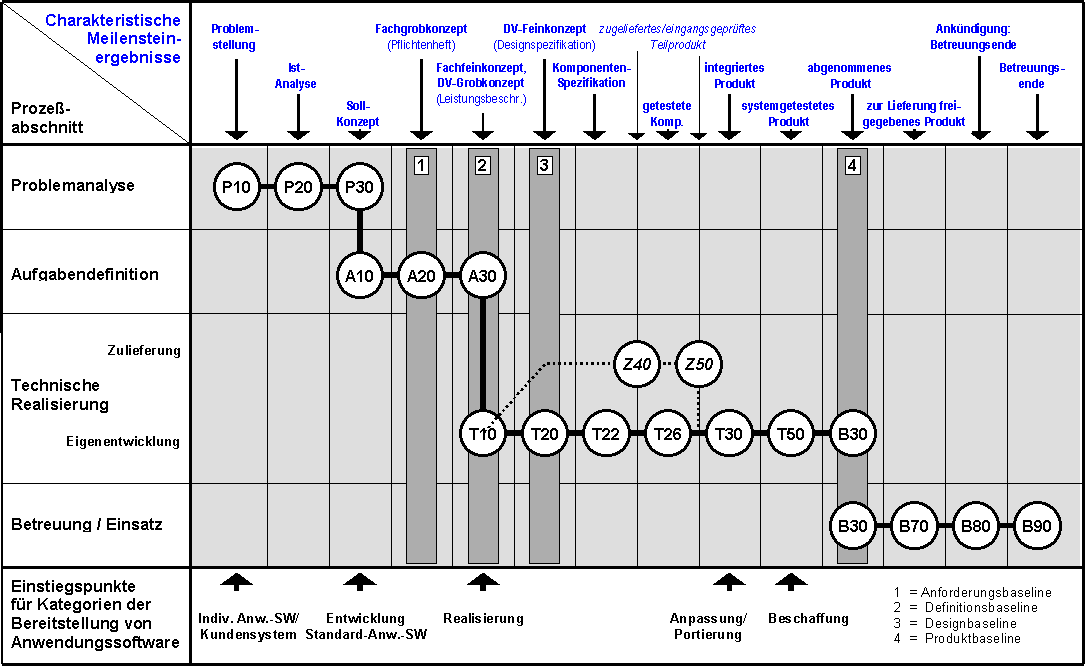
That was the way, we should develop innovative software and new products entwickeln – ridiculous.
Roland DürreThursday October 8th, 2015
Vintage Project Management #1 – My First Project

What you see on this picture did not yet exist – it only came when my project was over. My first project was realized in the Koppstr. (Hofmannstr.)
During the Berlin PM Camp, I told the stories of four projects from vintage times that were very important for me. And I also announced here that I was going to publish all four of them in the IF Blog.
So here I am now, beginning with the first small project:
Project #1
The first project of my life was but a small one. It was scheduled to last six weeks and it was my first professional activity in data processing.
In those days, I was a student of informatics starting for the second time. The first time had been in 1969, when I started studying mathematics and minored in informatics at Technische Hochschule München (THM). The only alternatives for the minor subject would have been physics – which I did not like – and business. However, I was a little sceptical, because I had been attending and graduating from the Jacob Fugger “Business Grammar School” in Augsburg. And at that school, accounting, which I was quite good at, had been an A-level subject. On the other hand, the knowledge taught in business and economics seemed a little questionable to me – which, incidentally, is even more true today. Consequently, the only thing to minor in left was informatics – and that sounded really exciting, too. Professor F.L. Bauer actually succeeded in whetting my appetite in the fall of 1969.
And then, on April, 1st, 1970, dark powers and a mixture of ill luck and ill advice forced me to serve in the Federal Army. That was not at all an April’s Fool Jest, which meant that I had to spend 18 months in rather questionable surroundings as a conscript.
And when, late in September 1971, I regained my freedom, I just started anew. Again in the first semester, again with the same combination of subjects, and again at the same college, which suddenly was called TUM (Technische Universität München).
But there was nothing new except the name. And I knew almost everything because in 1969 I had still been a rather diligent student who had listened attentively and learned with enthusiasm. Consequently, I was doing well and the Olympic Games of 1972 came along. Besides studying, I had a great job with good money at the German Railway (at the time still called Deutsche Bundesbahn) as a customer service person for guests from all over the world. And in some way or other, the entire world was mine for the asking …
In 1974, I finished my intermediate diploma successfully and again needed a little more money than I made as a TUM tutor (teaching Linear Algebra I and II and a programming course). I narrowly missed being eligible for BaföG and my parents – also working at the German Railway – said I could easily continue living at home in my room and commute to Munich like my father always did. But that was not what I wanted. Consequently, I was looking for a summer job – and, naturally, the favourite prospective employer was one of the leading high-tech and computer companies.
In those days, that was what Siemens was! Seen in retrospective, it is hard to believe what immense know-how was present in this company in a huge number of areas. They took me in at Siemens and so I was in the middle of the real high-tech world, first for six weeks in the summer of 1974 and then for the entire duration of my university education. I had direct access to computers, operating systems and programming languages – and I mean I was filled up with them to the brim, which was totally different from what they offered, for instance, at the so-called TUM.
And I got my first project at Siemens on my very first day! My (department) boss was Mr. Bieck. He was a hardware person and later became development head at one of the upcoming German computer manufacturers: Kienzle.
Kienzle was only one of the smaller Siemens competitors – but it was certainly remarkable to see what these enterprises – just like much larger enterprises, such as Nixdorf, or many smaller ones managed to accomplish in those days.
During my six weeks as a summer intern, I had total freedom – provided the actual task I had been assigned got finished. And they also told me that the problem I had been given might not be solvable at all. But that it would indeed be very much appreciated if I managed to solve it. It was actually the same I heard over the last few years from people about google: you give yourself unachievable goals, yet you get a nice tolerance for possible failure, which means you will be truly happy when eventually you actually manage to solve the problem.
The task was easy to formulate: The department wanted the highest possible Mersenne prime numbers. For a hardware prototype.
For non-mathematicians:
A number is a Mersenne prime number if it is a prime number derived from a power of two minus 1. In other words if (2 power n) – 1 or (2 power m) – 1, is a prime number.
That is my spontaneous definition.
Well – and my boss wanted as many n-s and m-s as possible. He was not interested in being shown how I did it – as long as I did it at all.
The background:
In those days, a lot of people were really active doing “research and development”. It was truly great. But it was not some R&D totally remote from practice. No: in almost all cases, your work would serve to promote actual applications and projects. That made it truly cool.
Practically applied R&D needs theoretical background. Business got that from the universities (in those days, there was still something you could get from them). And, naturally, Siemens AG also looked across the borders – particularly across the inter-state borders. Because the GDR universities were not so bad at all. And they gave us lots of great results.
For instance, there was a scientific work sitting on my desk – I think it had been written in Leipzig – in which someone had given the theoretical proof that it is possible to build an accidental generator from a ring connection with n binary switches.
And if you short-circuited the structure at the right place, the system would generate a maximum period of random numbers.
It would happen if and only if the number of used switches n is a Mersenne prime number. And if the short-circle is after the m-th switch – and if m is a Mersenne prime number. (please forgive my clumsy description, I was never much of a hardware person).
I never understood this work. Also those six weeks would probably be far too short. But then, this was totally irrelevant for my job. All I was supposed to do was deliver very high prime numbers of the type 2 power n -1. Even the prime numbers were unimportant. All that mattered were the m and the n.
For my software friends:
In the early 1970ies, it was totally utopian to build such a thing as random generator software. After all, the device was supposed to create the bit patterns rather quickly, because they were supposed to test the maximum flat modules for large-capacity computers. And those were rather fast gadgets, considering the times.
Also, Herr Bieck could not have cared less how I solved the problem – that meant it was up to me if I programmed something for the calculation or if I found the big Mersenne prime numbers somewhere else in the world. All options were open.
Consequently, I spent the next few days in various libraries (Siemens, StaBi, Unis – you have to remember that, in those days, the internet did not exist). And I quickly realized that there was no chance for me finding Mersenne prime numbers in this way, even if someone on this planet had already calculated them.
This is why I forced myself to come to a quick decision. I was going to forget the world around me and try it by myself – by just programming. I still had more than five weeks to go.
This was the first thing I learned about “project management”: Decide quickly, especially if it is a really hard decision and you basically know no way out.
Then I tried to do some traditional programming. I thought in terms of the decimal system, looking into integer and arithmetic calculation systems. And after two weeks, I noticed that I was never ever going to succeed with this strategy.
And this was the second thing I learned for future projects and for life: Whenever you do not know how to continue, you have to try new ways! Kiss old concepts and patterns good-bye, and do not hesitate!
So I decided to no longer look for huge numbers. Instead, I just saw a number as a field of bits. And all of a sudden, all those big numbers became small numbers. For instance, 2-to-the-power-of-256 was now a binary field with the length of 32 bytes. And you can calculate rather elegantly with bit fields each of which has the length of 32 bytes. All you have to do is some shifting. And suddenly, the huge number had lost all its scariness …
I told you this story for two reasons.
Firstly, because all of a sudden it became clear to me that, on top of deciding quickly and courageously, you also have to leave old mental concepts if you want to achieve something special. And I often suffered under this and under the typical “But this is how we always did it …”, because it blocked the way.
And because I am living proof that, more than 40 years ago, Siemens actually worked in the same way as they sometimes say Google does today. And that in those days they achieved really great things and that there was not much competition world-wide, perhaps IBM and Xerox or Hitachi. All the others were just in their initial phases.
In a short time, you will read my next Berlin #PMCampBER story on vintage project management. It is from a time when I had a contract as an employee – at the Siemens laboratory. That was in the late 1970ies. I will relate how Siemens did everything, and I mean really everything, to destroy its greatness.
It happened because they kissed their old virtues good-bye and introduced division of labour (Taylorism) in the creative areas such as product planning (Requirement Management) and quality management, specialized DV/IT teachers in their D-schools, manual copy editors and many more such roles.
And, above all, whenever there were things to decide, the questions they asked were: “What is the profit of this?” and “What is our advantage?”, instead of the question: “Why do we do this?” – as in former times.
At the time of my first project, there were no such things as project managers. The first project manager you will find in the world as I perceived it will come with my third project management vintage story. That was in the early 1980ies.
RMD
Roland DürreSunday September 27th, 2015
“Breaking with Patterns” at Dornbirn PM Camp #PMCampDOR
Now there are less than two months to go until the DornbirnPM-Camp on November, 20th and 21st. I already look forward to the meeting on the eve of the camp and the Camp itself.
This is already the
5th PM Camp in Dornbirn, PM-Camp celebrates an anniversary!
How fast time goes by! With Dornbirn, we close a great PM Camp year 2015. This year, we had wonderful PM camps – in Stuttgart, Zürich, Bad Homburg, München, Berlin, Karlsruhe, Barcelona and Vienna. I hope I did not forget any.
Again, the Dornbirn organizational team wants to host a very special PM Camp. In fact, the standards are extremely high this year. As a metaphor for Dornbirn, we chose “BREAKING WITH PATTERNS”. Since, to me, it seems a very good idea to change and rethink, I voted in favour of this motto.
During the last few days, I had to learn that “BREAKING WITH PATTERNS” has become accepted. In fact, it has even become hype. I found it in the program of workshops of Bavarian school directors, came upon it on story-telling exercises and it winds its way through the media like a hurricane. There is a nice Blog-Parade on the PM Camp with an anchor to the beautiful blog Experiencing Leadership (Führung-Erfahren) by Marcus.
Consequently, I now already heard and read a lot of wise things about it. Yet I am still not able to form my own opinion. Because in order to break with patterns, you probably will first have to see them. Also, it is quite possible that collectively valid patterns will generate individual habits. And it is always hard to change what you have come to love. More often than not, you hear and read: “We always did it in this way”. Well, after all, this is how we always did it, isn’t it? And now someone expects us to do it differently? That is hard.
But perhaps it is quite easy. Perhaps what you should do first and foremost is “turn things upside down”?
Here is an example:
There is an unwritten law in our “free-economy-society” that something gets less expensive the more of it is bought. This is even true for material that will become scarce in the foreseeable future and will eventually no longer be available, such as crude oil. The same is true for electricity or food. If you buy ten cars (or bicycles), you will get a better price than if you only buy one. It is called quantity discount, quantity rabat or quantity bonus.
Now let us look at the connection between the “climate” and “flying”. There is no doubt that air traffic generates an immense amount of greenhouse gas. Even in higher altitudes – where their detrimental effect is even higher than on the ground – huge amounts are ejected.
It is the goal of the airline industry to bring as many persons as possible into the plane by offering low prices. On the other hand, the models and calculations of various scientific disciplines agree in that they say global warming with the resulting change in living conditions for all of us will hugely depend on how we behave (in terms of burning fossil energy).
Consequently, it is clear for everybody – at least all those who do not believe in superstition – that, among other things, we have to fly less if we wish to cushion the downfall into the (climate) catastrophe at least a little bit. We have a discrepancy. We want to fly more because we need growth (which would actually be a second pattern to break with). Everywhere. And we should fly less. For our future.
So how to solve this dilemma?
A common and total ban of flying cannot be realized. In fact, for persons in special situations, it would actually not be just and reasonable. But then, the question is if the consequences of the climate catastrophe will be just and reasonable, isn’t it?
A common increase in flight prices would perhaps be asocial. Here is what a simple solution could look like: We turn the law of quantity rabat around and introduce a new law: the quantity malus. That would mean all citizens can fly a few thousand miles each year at prices similar to those we are now used to. As soon as the “flight buyer” has reached this limit, every extra mile will be more expensive. Maybe even geometrically more expensive. This would enable us to, on the one hand, maintain a realistic mobility, yet put the lid on at least the worst excess. And the extra money could be invested in reasonable progress.
The same pattern would, for instance, also make sense with electrical energy. Why should a company producing aluminium tins for beer and using up astronomically high amounts of electrical energy get it for a much lower price than the small one-family household that uses up almost no electric energy?
It would be better if this industrial waste were more expensive than the little used up in a household, wouldn’t it? This would not only lower the consumption cost pressure, but also cause human creativity to tackle (possible) solutions to such central problems. More often than not, better technology is already available, except that it is not used because the raw material is so much less expensive.
Why don’t we start by “putting things upside down”? I can imagine that “breaking with patterns” means a lot more than this, too. We are lucky to still have a bit of time to think about it until the PM Camp starts.
RMD
(Translated by EG)
Roland DürreSunday September 20th, 2015
I almost forgot: Karlsruhe PM Camp on September, 25th and 26th!
 I am angry with myself. I almost forgot the Karlsruhe PM Camp. And it would not have been advertised. This is not tolerable!
Dear organizational team in Karlsruhe: please accept my apologies. I feel truly contrite. And I promise to do better in the future.
In Karlsruhe, the motto will be:
Projects with enthusiasm – where does the magic come from?
Unfortunately, I cannot attend next Friday and Saturday. Which I find a true pity. Because the Karlsruhe organizational team did a fabulous job. And they would certainly have deserved a few more participants.
So here is my appeal to you: if you live near Karlsruhe and are at leisure this Friday and Saturday – and if you are at all interested in project management, management in general, leadership, entrepreneurship and such, you should definitely attend the PM camp at the Karlsruhe Hochschule für Technik.
As always, the program is exciting. It will be well worth the trip and, as always, all PM Camp participants will return home content, wiser and happier.
And, in absentia, I will follow the timeline of the tag #PMCampKA and be happy about many, many twitters from the camp by the participants!
And here is a special request by me:
If, to give Karlsruhe extra advertisement, you twitter this article more often than usual, you would also make me very happy!
RMD
(Translated by EG)
Roland DürreFriday September 18th, 2015
”Living/Loving Complexity” – Session at #PMCampBER
Here is my report on the session I triggered off with Maik (Maik Pfingsten) on Saturday, the second day – which was practically the end – of the Berlin PM Camp #PPMCampBER.
It had been our intention to relate and discuss a few ideas to show how, even in a complex environment, you can manage to live content and successfully, both in your private and professional (business) life.
In order to show this, we developed a few theses:
Truth
As we see it, there is no absolute truth. To be sure, there are more “correct” and more “incorrect” ideas. But you should not use correct and incorrect as terms. Instead, you should see them metaphorical, meaning “goal-oriented”. Other than that, it seems to us that people often discuss certainties and totally forget that much they believe in is just a construct of their brains.
Complicated versus complex
I used to believe that all that is determined is also complicated. And that complexity starts where “determinedness” ends. Whenever the end was not predictable or describable as an algorithm, I used the term complexity. Others used the metaphors “dead” for the “complicated” and “alive” for “complex”. This means that organic chemistry can only always be complicated, whereas inorganic chemistry might well become complex.
Maik provided us with a very nice description of “complex” – from the viewpoint of a system engineer. He draws an axis of coordinates. The x-axis represents the complicatedness, the y-axis the change and dynamics. And the system will change more and more from complicated to complex as complicatedness and dynamics increase.
I find it quite easy to come to terms with this pragmatic definition. Here, too, the decision whether something is complex or complicated is in the eye of the beholder. Incidentally, this is something Nico Banz gave a very nice session about at the #MCampBER – just before us and in the same lecture hall. Using an example, he showed us that judging whether something is complex or complicated is, indeed, a very subjective process.
By now, I have come to believe that the academic discussion about complex versus complicated is not very useful. What actually counts is right decisions and projects.
Decision
The definition of the term “decision” is based on two requirements: it has to happen under uncertainty and it must have relevant consequences. Otherwise, it is not really a decision.
In the context of decisions, it is also exciting that neural science keeps proving that decisions only seem to be made by ratio (cerebral cortex). The truth is that they are made by our subconscious, which means involuntarily.
Incidentally, they found out at St. Gallen college that the huge majority of management decisions are wrong decisions.
Mind you, the distinction between “right and wrong” decisions is not at all easy. In fact, it gets even harder: if you analyse an enterprise or a project in retrospective, it often becomes “story telling”. Even if there is no doubt that the stories might be useful, precise scientific research (studying the protocols, etc.) will show that it is not at all easy to judge “à posterio“ what decision caused which event.
I always wanted to be a “good” manager and entrepreneur. And I wanted to make the right decisions. And today, I ask myself how any manager can decide correctly “à priori“ if, even in retrospect, he cannot say with certainty how the causality was.
Projects
As I see it, it is not a good idea for us to distinguish between our professional and private lives. Living a life is more joy if you live it integrated. That means I have to act in the same way in my private life as I would act in my professional life. There is no difference.
I like asking third parties the question: what do you think is my most important project? They are often surprised by my reply – but for me, it is absolutely clear: my life.
There is no doubt that my life is a project. It has a beginning and an end. I have a multi-dimensional budget – which consists of time, talent, knowledge, experience and much more. The goal of my life project is my path of life. Part of it is my death. I would like to have made my peace with everybody I ever met when I die.
My life consists of many projects. Some are mostly private, others mostly business. Consequently, I need to act in the right way.
Acting Right
So this is the central question: how to learn to act right?
After all, I know that there is no absolute truth. Also, I know that the future cannot be predicted. I also know that I live inside the constructs of my subconscious and that the competence to act according to reason and ratio is a mere chimera!
As I see it, the only thing that will help us is finding behaviour-oriented values and live according to them.
Recommendations:
I no longer believe in best practice, methods and complex tools. I do not like tips (tipping me on the shoulder is beating me on the shoulder). These days, all I believe in is simplicity and reducing life to the essentials. And I believe in craftsmanship. Practice. On my way towards mastering things, I need support by a master. In my life, mentors and wise persons helped me a lot both interactively and as an ideal.
Consequently, I gave a short description of what Hans Ulrich and John Izzo recommend during our Berlin session.
Hans Ulrich
Hans Ulrich died several years ago. He was the father of the St. Gallen Management Model and wrote a wonderful and short essay about change in management in 1982. I read this article on December, 8th, 2011, sitting in the train and preparing for a workshop in St. Gallen. And I was totally electrified by it. I regretted not having read it earlier.
Here is the concise form of the “8 theses on the change in management” by Hans Ulrich, along with short comments:
- Accept the uncertainty and unpredictability of the future as the normal state of affairs!
Well, the future simply cannot be predicted.… - Set a broader horizon for your limits of thinking!
Against the “but”… and for freedom of ideas. Share knowledge. - Apply the categories “both”, instead of “either-or”!
Black-and-white is out, colourful is in. - Think multi-dimensional!
Ethically responsible balance of values. Basically, humans can only deal with three ideas simultaneously. - Use self-organization and self-control as formative models for all your enterprises!
Responsibility, principle of subsidiarity. - Consider managing things a meaningful and important function!
New management image. - Focus on what is really important!
Work economy. - Make use of group dynamic!
Cultures, symbols, rites, rituals …
Of course, the theses developed by Hans Ulrich were intended primarily for modern management. Yet they are also very useful for your private life.
For more information on leadership and Hans Ulrich, see the IF Blog underWandel im Management and under another Session Report, as well as, of course, my “Enterpreneur’s Diary“.
John Izzo
The second wise counsellor I mentioned is John Izzo. He did some research on values shared by elderly persons conceived as successful, happy and prudent. And he discovered a common characteristic among those people, which he summarized as the “five secrets”
First Secret Remain true to yourself! This is about “destina”, a term originally from South America. Mind you, it does not mean destiny or even kismet, but your own call and vocation in life.
Second Secret
Live in such a way that you will have nothing to regret later!
Also try new things! Have courage to start something that, at first sight, seems rather unusual. This might actually help you when you have to make a decision.
Third Secret
Love yourself and enjoy it!
First and foremost, you must learn to love yourself! Because only those who love themselves can also love others. Ban enmity from your life. Choose humanity as your life’s principle. Make persons you are surrounded by bigger, instead of smaller.
Fourth Secret
Carpe Diem!
Enjoy, instead of thinking too much. Remove “yes, but” from your active vocabulary. Replace them by “yes, and”. Do not capitulate before “that is not what you want to do!“
Fifth Secret
Give more than you take!
Those who give get a lot more in return. Give trust. Open yourself up and show others something of yourself.
I discussed the book by John Izzo at great length in a separate article. I think it is well worth reading and you should certainly think about those recommendations for life. And perhaps you would like to adapt them for your own life.
If these recommendations do not reach far enough for you, then why don’t you read the Agile Manifesto? Or maybe you want to become theALO-man (see also my article leadership-values-principles) who is only agile, lean and open? And when you come to “lean”, you want to remember the importance of the “Why?“-question in Kanban.
If you do this, you will find the path through the world even easier, regardless of it being complicated or complex. And it will not matter if you are talking your private or your business life, either.
RMD
(Translated by EG)
Roland DürreMonday September 14th, 2015
PM-Camp Berlin (Report)
 Last week, on Friday and Saturday, Berlin hosted its already third PM Camp. If you wish to find it ion twitter: the hashtag is #PMCampBER.
Weeks before the event, the Camp was sold out. Everything was fine. This time, the “anti-conference” took place at the Alexander von Humboldt University, where the impressive halls gave the PM Camp a wonderful glamour and beautiful patina. I was there and, again, it was just great.
This time, I was a little less active than usual, only in charge of two sessions. The first of them was early on Friday afternoon. I called it “PM Vintage” (project management vintage). Having prepared four stories about projects in my life between 1973 and 1985, I presented them to the audience. It was “story telling” with a little background information. I started with a small project I had been put in charge of all by myself when I was a student worker, then came more complex ones…
Here is an overview of my four projects:
- We need high Mersenne Prime Numbers for developing a random generator on HW basis (winter semester 1973 – WS at Siemens)!
This is where I learned the importance of decisions. Even at a time when there was no internet, etc. And that you can achieve nothing without courage. - Responsibility for a language in one of the teams that – in cooperation with many other teams – achieved great things (APS, Transdata, PDN – 1977 – 1978 – employee at Siemens).
This is where I made the experience how fast creativity and success can go down the drain if there is an excess of processes and Taylorism. - Technological responsibility for a huge project at Siemens for the Bavarian Police (DISPOL – 1979 – 1982 – originally as a Siemens employee, later as a Softlab employee)
This was the first time in my life I came to know a “true” project manager. He had to appease the overhead, which was not a very nice job. However, he could not contribute to the project success. - Foundation of a company and generation of our own product, the HIT/CLOU (starting 1984 – at InterFace Connection GmbH – today InterFace AG).
This was where my partner Wolf Geldmacher and yours truly were lucky in that there were many things we did right. Consequently, we had a really great team.
As soon as the opportunity arises, I will write down the story of those four projects and publish them here on the blog (including the links).
The second session was a spontaneous one on Friday evening during the great PM Camp Party at the Microsoft “Digital Eatery“ not far from the university. I met Maik Pfingsten during one of those many “after-the-pm-camp-conversations” of the evening event. And we decided to initiate a session together on the very next day.
We truly got into complexity. The title of the session was “Living/Loving Complexity”. I was going to recommend that all those confusing discussions about complexity and complicatedness should simply be forgotten or ignored. Because you always get all those complicated (complex?) mind games. And consequently, I was going to recommend that you should not spend a lot of time thinking about whether or not a project is complicated or even complex. Instead of talking, I was going to recommend you should act. And in preparation, I formulated some simple, behavioural theses which will make us successful and happy – regardless of the world being complicated or complex.
I guess Maik and I succeeded – and I was truly happy with the positive feedback I received after our presentation. The next thing I will do is write the article about this session “Living/Loving Complexity”. I hope to finish it by the day after tomorrow. Then you can read it in the IF blog. Of course, there will be a link.
It was a great PM Camp in Berlin and, for me, those were two happy days in Berlin. Consequently, I would like to thank the fantastic organizational team: Ralf Eicher, Christian Vogel, Fabian Fier and last not least Heiko Bartlog!
RMD
(Translated by EG)
P.S.
After the event, they gave me a book because I had been the first to register. So here is what you want to do: register extremely early for the then fourth Berlin PM Camp. It is well worth the effort.
Roland DürreSunday June 7th, 2015
PM Camp – Yesterday: Zürich – Tomorrow: Bad Homburg.
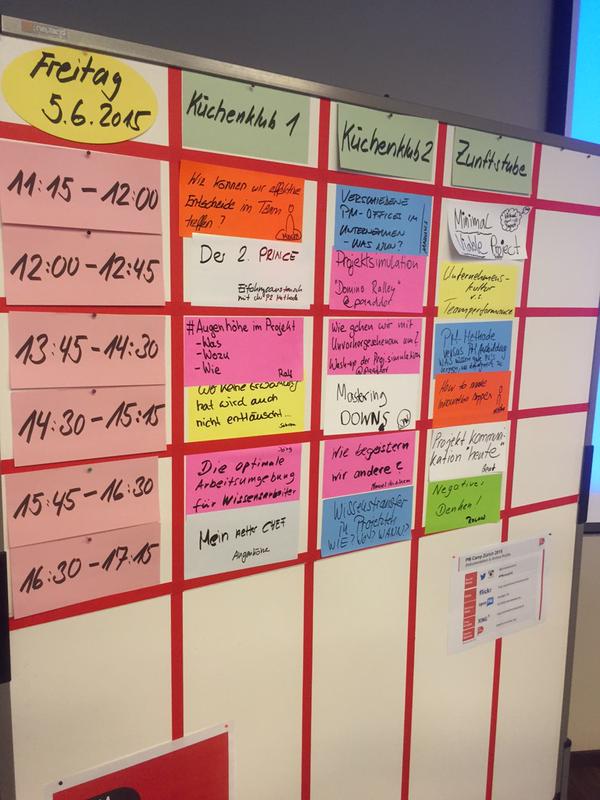 Yesterday evening, I arrived back home from the PM Camp in Zürich #pmcampzue. It was a small but very exquisite PM Camp and gave me two great days.
The first day was opened by Nadja Schnetzler who is also co-chair at word and deed. She bewitched the Camp participants with her wonderful postcards: and she showed us how you can “Embrace Chaos” in a very unobtrusive and serene way.
To me, it seemed that this nice impulse presentation went a long way towards many other sessions considering it important to talk about the situation of humans in their various roles whenever project-typical tasks are concerned.
Consequently, much was about the change in our society and consequently also the change in our projects that progress brings in its wake. It was all about intended and unintended change – and about “Innovation as creative destruction”.
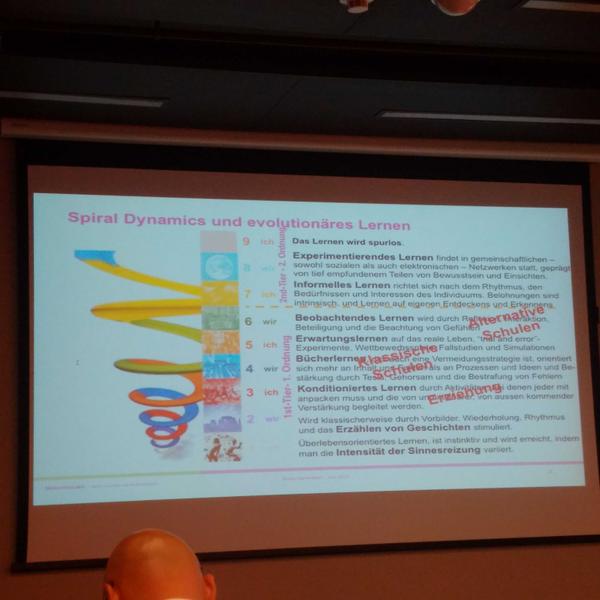 On Saturday, which was the second day, we all started the day with a drumbeat. Bruno Gantenbein, owner of Unschooling.ch, who has been a successful business counsellor for many years, started the day early in the morning with a strong impulse on “learning, too, is part of evolution”.
And his way of doing so was so emotional that some of the audience were moved to tears of emotion and joy.
And then he, too, spanned the bridge between what he had said and project management – asking the for me absolutely central question: “How, where and what do projects managers actually learn?”
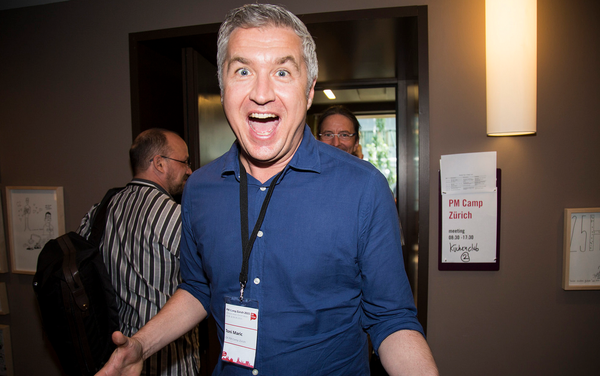
Toni (Anton Maric) in action.
It was no surprise that the second day eventually led to a broad exchange of knowledge about the question how meaningful, efficient and humane learning might, should or must be.
As you can see on the pictures taken at the PM-Camp Zuerich, it was a great event. You can also see the pictures on the Flickr Account of the Zurich PM Camp!
Consequently, I would like to say many thanks to the PM Camp Zürich Orga-Team, namely Dagmar, Bruno, Christian, Matthias, Silvio and Toni, who initiated the Zurich event.
And in less than one month, from July, 2nd to July, 4th, the next PM Camps are waiting. They will be held in Bad Homburg! Then the day will be called #pmcamprm!
I definitely also want to be there and, of course, you will also read my report on it in the IF Blog!
RMD
(Translated by EG)
Roland DürreWednesday May 27th, 2015
(Deutsch) PM-Camp in Zürich – “Umarme das Chaos” und “Unschooling” – 5./6. Juni
 PM-Camp Zürich – “Embrace Chaos” and “Unschooling” – June, 5th and 6th. I truly look forward to the next week. Our second PM Camp will take place in Zürich on Friday and Saturday (June, 5th and 6th). For me, Switzerland is a particularly innovative country. Having participated in many RISE workshops opened the doors for me to meet many great Swiss enterprises and entrepreneurs.
Consequently, I look forward to seeing many well-known faces, including my friend Ton (Anton Maric, important part of the organizational team and initiator of the #PMCampZUR), attending great sessions and, last not least – two impulse presentations.
Let me cite those two here:
Nadja Schnetzler, associate of word and deed will open the PM Camp with the presentation ‘Embrace Chaos’:
In an environment determined by dynamics and constant change, old and established project management technologies will not be much use. Today, what we need are persons and instruments who/that not only accept chaos but also see it as a necessary part of project work. Nadja Schnetzler has had 25 years of experience in project management and today counsels firms, organizations, teams and individuals on new collaboration and communication techniques. Her keynote «Embrace Chaos» will show you how to accept constant change, at the same time introducing key ideas from innovative management, collaboration and communication all project managers should be familiar with.
Bruno Gantenbein, associate at Unschooling.ch, will give a presentation on “Learning, too, is Evolution” on Saturday:
In his book: “Drive: Was wirklich motiviert” (What Really Motivates People), best-selling author Daniel H. Pink writes about intrinsic motivation. He also gives some interesting advice: “Ask the unschooled to give you a lesson!” The Swiss unschooling pioneer Bruno Gantenbein will let us take a glimpse at the practice when applying this new WAY of learning, at the same time building a philosophical bridge to project management.
For the entire program, click here: Programmseite.
If you know me, you will also know that I am a person who is immediately interested when hearing about these topics, especially in the context of management, leadership and entrepreneurship. And I also assume that very special sessions will spring from this initial topic. Consequently, I would like to encourage as many of you as possible to come and join me in Zürich.
And here are my best greetings to Zürich and an many thanks for the organizuational Team of #PMCampZUR in 2015!
RMD
(Translated by EG)


