
Roland DürreTuesday February 25th, 2014
PM Camp: Now Also in Zürich (April, 25th to 26th)
I am delighted!
In 2011, we (Kornelia Hietmann, Dr. Eberhard Huber, Jens Hoffmann, Dr. Marcus Raitner, Dr. Stefan Hagen and yours truly) initiated the first barcamp for Project Management in Dornbirn.
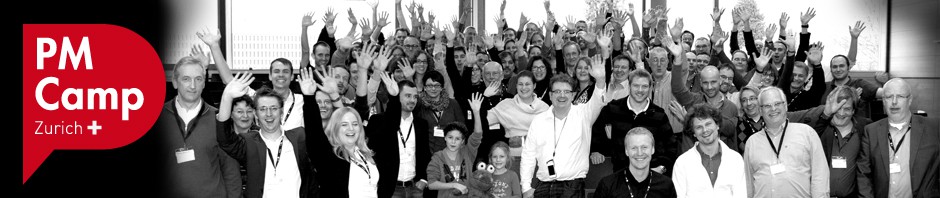
In 2012, we had PM Camps in Dornbirn and in Vienna.
And in 2013, we had PM Camps in
Bad Homburg, Berlin, Dornbirn, Stuttgart and Vienna!
And now matters continue to improve, because in 2014, there will also be such events in Munich and Zürich! The time for Zürich has already been determined: the first 2014 PM Camp of the year will be held there between 26. April 25th and April, 26th, 2014! Tickets are already available – to buy them, just click here: Ticket-Kauf.
For those of you who do not yet know what a PM Camp is, here is some information:
PM Camp is a high-quality barcamp for project managers. Persons who are prepared to share their knowledge and who wish to learn from others will meet there. And, as a general rule, we are talking persons who are prepared to accept entrepreneurial and social responsibility.
PM Camp is neither a club nor an institution. There is a core team which currently consists of the following persons: Eileen Hörtreiter, Dr. Eberhard Huber, Dr. Marcus Raitner, Dr. Stefan Hagen and myself. You could say that we accept the “normative responsibility”. The local events are organized by “organizational teams”. Their representatives meet once a year for the PM Camp closed meeting. During this meeting, strategy, future and operative agenda for the PM Camp are coordinated.
PM Camp closely cooperates with openPM. openPM is an open platform for project managers and all those who work in projects. You could say that PM Camp is the “face2face” partner of openPM. PM Camp creates a free environment to make it possible for project managers to meet face to face and exchange ideas. During a PM Camp, the “normal” barcamp procedures are usually supplemented by impulse presentations.
For lots of interesting information, such as a review of past events, general principles and values of PM Camp, publicly voiced opinions and much more, click here: PM-Camp Dornbirn.
My friend Toni Maric, who is one of the initiators and member of the Zürich organizational team, looks forward to many registrations. I, too, very much intend to go to Zürich.

RMD
(Translated by EG)
Roland DürreSunday November 17th, 2013
Uncertain and Unpredictable
In Google+, I am a member of several communities where problems that really move me are discussed. One of them is called Uncertainties and Unpredictables (Ungewissheit und Unvorhergesehenes). My Swiss friend Peter Addor founded this community – and he is also very diligent about nourishing it.
During the PM Camp of yesterday and the day before yesterday in Zürich, Peter initiated a great session on this topic, presenting a beautiful decision tree on risks. In doing so, he made a very clear distinction between the risks that can be planned, e.g. accepted – incidentally, the “MCA”, the Maximum Credible Accident, is one of them – and those that cannot be planned.
For me, this led to the understanding that a distinction between predictable and unpredictable (!) risks is basically only dependent on the fantasy of the beholder. And in retrospect, it mostly turns out that all risks might have been foreseen in some way or other.
The ultimate consequence of this is my idea that, actually, I should not waste energy planning against risks that might do damage to me. Instead, I should concentrate on being prepared for the imponderable. Wouldn’t it be a lot better for me if I managed to be flexible enough to cope with unpredictable risks just as well as with those that result from uncertainties?
After all, the risks I perceive in my concepts just follow the fear I likewise build up in my concepts. And, basically, they only constitute a small part of the huge number of risks I have to cope with eventually. This means that, in reality, I have to put up with many more risks than I can imagine. So why should I fear those I know, thus making my own life miserable?
Consequently, there is a conviction growing inside me that all this planning and balancing costs more than it gains me. A good piece of work will just need as much as it needs. No more and no less. And I can only do as much as I can afford to do.
Perhaps a free life is nothing other than doing without concepts of planning and balancing?
RMD
(Translated by EG)
Roland DürreSaturday October 12th, 2013
PM Camp DACH in Dornbirn, November, 14th to 16th #pmcamp13
SPONSOREN WANTED!
The picture was taken almost two years ago. Stefan Hagen and yours truly as co-founders of PM-Camp are absolutely delighted. During the evening party of the very first PM Camp in 2011, we realize that the event is a great success.
In a little more than four weeks, we will meet again. At the third Dornbirn PM CAMP. And much has happened in the time in between. We now have yearly PM Camps at Bad Homburg (Rhein-Main), Berlin, Stuttgart and Vienna. And we are positive that there will be even more of them in 2014.
The next Dornbirn PM Camp on November 14th to 16th has been well organized. The seminar rooms at Fachhochschule Vorarlberg are ideal for us. Again, the motto is “Work hard, party hard!”. There is no shortage of work. Fabulous participants with important topics already promised to come.
Just for the party, we could do with another sponsor or two. Because some of the sponsors who used to support Dornbirn do now support one of the many regional Barcamps. Consequently, there is an opening for new sponsors who wish to show by their contribution that they share a modern concept for the 21st century which I would formulate as follows:
 Share experience and knowledge openly and transparently, co-operate at eye-level and in respect with courage and joy and thus take care of a future in shared responsibility.
RMD
(Translated by)
Roland DürreSaturday September 28th, 2013
Still Wanted: Sponsor for PM Camp!
Three years ago, we had the first PM Camp in Dornbirn. It was initially intended for DACH (Germany, Austria, Switzerland). Many people liked it so much that this year more PM Camps have taken place in Vienna, Stuttgart, Bad Homburg (Rhein-Main) and Berlin.
However, this great development motivated some of the sponsors to support local Bar Camps close to their own home, rather than the far-off one on the lake Bodensee. Well, this is certainly an understandable development. Yet now its consequence is that we are still looking for some sponsors to support our Dornbirn PM Camp. After all, we want to maintain the high standards of this perhaps best-frequented PM Camp of all.
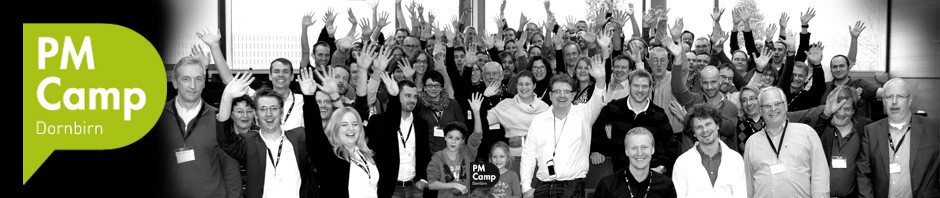 Here is the invitation for potential sponsors by the Dornbirn organization team:
As all other PM Camps, the one in Dornbirn is also a non-profit event. The entry fees are kept low on purpose (99 Euros plus added value tax for two days including all meals). They do not cover the actual costs of the event.
Consequently, we need sponsors who share the PM Camp vision and are prepared to contribute. As a sponsor, you will leave no doubts about your own innovative and future-oriented position. You can introduce your own topics during the open space sessions and gain many new impulses. Last not least, you can meet interesting people, either as potential future customers or employees.
Be part of the PM Camp movement which started three years ago in Dornbirn and now has been extended to also reach to Vienna, Berlin, Stuttgart and Bad Homburg! Show your potential employees and customers that you are prepared to leave the antiquated paths of established conferences and to think in new terms of project management. You can actively support the most important and (in-)famous anti-conference on project management in the German-speaking area!
For details of our sponsoring arrangement, click here. Do not wait too long, because sponsor opportunities, too, are limited.
Incidentally, sponsors do not pay a very high sum. I look forward to your questions!
RMD
(Translated by EG)
Roland DürreSunday September 15th, 2013
Before the #pmcamp is after the #pmcamp … (1)
My Contribution to #pmcamp13ber
I am sitting in the Berlin DB lounge, waiting for my train to Munich. The PM camp and sessions I attended yesterday and today is still on my mind. And since I received so much positive criticism, here is a concise version of today’s presentation by yours truly.
It is a description of what a modern manager who wants to be both successful and ethically responsible might (or should?) look like. From other sessions before my own presentation, I got the impression that it might be a good idea to start with a definition of “moral conduct” and “ethics”. So this is how my presentation started:
Moral Conduct and Ethics
As I understand it, moral conduct is characterized by rules and laws. Some of them have been written down, some of them are valid without the written form. It is generally assumed that moral conduct is a requirement for the common good (bonum commune) in social systems, or at least that it will be very useful in this sense.
If you violate the rules of moral conduct, this will have consequences: you will suffer either punishment – if you broke the law – or social ostracism or something similar. The fact that moral conduct can also cause damage is accepted. And this kind of damage is often done because, basically, laws cannot foresee all “morally problematic” situations in life, no matter how you amend or add to them.
Ideally, the citizens agree to adhere to the rules, since they understand how beneficial this is for the entire society. Unfortunately, however, this is not what usually happens.
Problems with moral conduct:
If you insist on moral conduct as being normative for your behaviour, this will cause lots of problems. More often than not, the accepted damage is too much. The world changes, yet moral conduct is more or less static, which makes it a contradiction to new developments. Different groups of society (age, sex, socialization, religion, …) might well have totally different opinions on some relevant topics.
Ethics, give you a rule. Behaving ethically means you make this rule the maxim for your own decisions and behaviour in a responsible way. In order to do so, you have to be able to decide and act according to an ethical balance of values following the rule. Consequently, “ethical behaviour”, too, will usually be in the interest of the “bonum commune”. It is an important goal of ethical behaviour to minimize damage.
Examples for ethics:
- Happiness-Ethics (Eudämonismus) Its roots are in Greek philosophy. It aims at maximizing lust yet avoiding pain
- The Golden Rule It means “treat others the way you would like to be treated“
- Duty Ethics Duty ethics simply tell you to follow the law (and the orders of your boss).
- Conscience Ethics “follow your conscience”
- The principle of biophile behaviour.
I do not think the Happiness Ethics and the Golden Rule can be practiced. Management is not the only sector where it probably will not be very helpful. Moreover, these two ethics only seem to be applicable to humans. Today, however, there is a broad consensus that ethics far exceeds human affairs.
The duty ethics are something I mistrust as a matter of principle. Too many atrocities and crimes have been committed “just doing your duty”.
“Follow your conscience” is not really conceivable to me, because as a general rule, conscience will always come after the decision and the act.
My next two articles will discuss the image of the “new manager” and the “biophile principle”.
RMD
(Translated by EG)
Roland DürreSunday September 8th, 2013
Entrepreneur’s Diary #90 – The Magic Management Triangle
At InterFace alone, I have now had thirty years to think about what exactly I am doing and what is my job. How to describe my job and what qualities you should have for it? And whether I am doing a good or a bad job in my position.
Because I am a manager.
Well, basically, I am a project manager, because my professional (and private) life consists of many projects. In these projects, I am sometimes more and sometimes less involved. But they always concern me in some way or other. Sometimes I initiate projects or try to direct them. Sometimes I delegate the responsibility. Occasionally, I also have to terminate them. But I am always involved. Even if it is only the results that are returned to me.
And during those many years, my view and understanding of management constantly developed. Sometimes it was a zig-zag line, yet as the years went by, the lines converged. Many friends, teachers, masters and mentors accompanied me on the way – and they helped me a lot. Consequently, I was able to write a lot about management, leadership, entrepreneurship and all other topics that move me (also in the IF blog). Also, I was able to give numerous presentations, particularly for young people.
This is how my small and totally private management model was created. I defined it as a triangle. To be sure, I could also have come up with a more multi-dimensional definition, but the number three has the advantage that our finite brain actually can manage three dimensions quite reasonably. Consequently, a model with three bases is probably easier to understand.
The three dimensions of my management model are:
- operative issues
- leadership and
- entrepreneurship.
Let me describe my concept of these three dimensions:
- Operative Issues
As I see it, the operative issues are about what is “self-evident” about the job of a manager. They are about the daily routine of decisions on the technological, mercantile or personal levels. A good technological education, common sense, the ability to judge quickly and such kind of things are useful and sometimes necessary. A certain degree of intelligence, a healthy ability to accept conflicts, a suitable socializing process and the like are desirable. A bit of an extrovert personality and self-esteem are helpful. It is a huge advantage if you have courage and can share what joy you have. The same is true for a positive communicative competence, both by word of mouth and in the written form. Besides, a good general education, or at least the ability and willingness to learn something new and alien will do no harm to an operative manager. - Leading and Leadership
Leading and leadership are two wonderful words. For me, the first and most important factor is that you are capable of leading yourself, i.e. to develop your own “leadership”. After this is achieved, you might perhaps be able to share some of your leadership capacity with others, thereby trying to “lead them” (careful: the very terminology is offensive). As I see it, “leading” requires a certain degree of humility towards the task and the people in the “social system” you are active in and surrounded by.
Here are some of the qualities that turn an operative “functionary” into a leadership personality:
being able to listen, having a healthy degree of empathy, embodying and living values as a person (both your own and those of the enterprise), accepting criticism, being critical with yourself and being immune against too many set statements, certainties or even dogmata; in other words, you have to have a certain amount of autonomy. - Entrepreneurship
In my opinion, a leader becomes an “Entrepreneur” if he is also willing to accept a special responsibility. For me, this means that the person will put himself beyond all randomness. He will “identify” with all “matters” concerning the enterprise in a healthy way. This means a commitment to actively participate, including the courage and willingness to change things. It necessitates a high readiness to take responsibility even on the normative level, thereby making you the protagonist for the promotion of the entrepreneurial values and culture. You can only achieve this if you, as an entrepreneur, are no longer pushed by having to say “I MUST” and/or by a strong “Super-Ego”. Instead, you have to have achieved a huge degree of inner freedom. This is how you will eventually be enabled to question all those established “worlds” every system seems to have developed without criticism. And again and again, you will ask the philosophic core questions: “How do you know this” or “How do you know this is the truth?”.
Because the mental concepts of the worlds as developed in social systems such as enterprises are, after all, just an attempt at mirroring reality. In the worst but most frequent case, they will become doctrines or dogmata. So if now the manager or leader tries to deduce decisions with “dominant logics” from the established world, these decisions will, of course, only too often turn out to be the wrong decisions. To be sure, even with correct logics, you can deduce correct things from erroneous assumptions. But that is mostly accidental. As a general rule, it will not happen. Basically, it is a very human desire to strive towards stable judgement. After all, they make life easier for the manager – but often with terrible consequences. I would name the qualities of an entrepreneur “agile competence”. For instance, a “top manager” fully competent in the operative issues and at the same time being a leading personality and entrepreneur, should be particularly good at adequately dealing with “errors and coincidence”.
On the whole, I think management means you have to be particularly good with combining the opposing ends of the individual and collective worlds (of the social system). Because the expectations, interests and needs of persons in the diverse social systems are basically very different from those of the social system. Yet the manager has to deal both with the persons and the social systems. He has to bring them together.
It all sounds like an almost super-human challenge. Since there are no super-humans, there are probably no persons who actually meet the ideal I just described. Consequently, there is no need to be ashamed of your own imperfection.
That means we should not despair too much when we discover the occasional shortcoming or fault in ourselves. But we can take this list of criteria to see how far we have already advanced towards being “Top Managers” – or if, perhaps, we are still on the level of “operative manager”. Or maybe we are already on our way to the leadership personality? And we can see what could be done in order to get better.
Wel l- this is my current view of things.
RMD
(Translated by EG)
P.S.
For all the articles of my entrepreneur’s diary, click here: Drehscheibe!
Roland DürreSaturday August 24th, 2013
barcamps and PM Camp (4) – Twittern is a Necessary Part of It.
In my little series of articles on barcamp and PM Camp (#pmcamp), I described some models for three kinds of sessions in the last instalmnt. Today’s article is about twittering and some behavioural rules directly related to it!
Can you twitter during a barcamp in general and during sessions in particular?
During a PM Camp, you not only can, but actually should (must) twitter. In fact, twittering is a very important part of the Camp. Incidentally, you are also permitted to play on your mobile phone in the middle of a session and to leave the room in order to attend another session.
As a general rule, you have a minimum of one “Twitterwall” at a PM Camp. On it, all tweets written in twitter and marked with the tag of the event will run there in real-time (for example #pmcamp13ber for the next PM Camp in Berlin). Thus, you get a central theme which actually can be taken as first documentation and comments on the entire event. You will know what happens on the PM Camp, how other persons feel and what their experiences and thoughts are.
Naturally, all participants can also take a look at the twitterwall on their individual devices. And they will often see that many persons who are not physically present will actually take part in “real-time” in this way. For instance when I first went to the Dornbirn PM Camp in November 2011, I could not come before noon of the first day. Sitting in the train on my way out, I read the barcamp tweets (#pmcamp) and was absolutely enthusiastic – I was literally driven towards getting to Dornbirn as fast as possible.
Through your own tweets, you also can and should make your own evaluation known to others as soon as possible. In this way, becoming part of the whole is even better guaranteed and you can again inform others. Taken together, all tweets are a nice retrospective report of the event. Later, you will enjoy looking at them and mentally reviving the camp.
Incidentally, there is no “official” documentation of a PM Camp, such as proceedings or the like. This is absolutely intentional! Because the documentation, too, is voluntary. It is organized and determined quasi automatically by the participants. This works quite well and thus you get a thorough multi-media documentation which, above all, is also correctly weighted. It contains text, images and videos and covers everything important, on top of being available centrally on openPM and inter-linked.
Of course, in twitter and on barcamps in general, the same rules should apply as in normal life:
You cannot make others small or hurt them. Personal attacks must be avoided, even if there are times when you are very disappointed. And if it happens that you really did something inexcusable, you have to apologize.
When all is said and done, it is particularly true for the internet and open communities that all you do will reflect upon yourself.
So, please, do also accept weaknesses – and if there is something that annoys you very much, you will just have to leave.
The only thing you cannot tolerate on a PM Camp is intolerance. But intolerance, in particular, is something you should address personally, rather than talk about behind people’s backs.
In this article, I only referred to twittering. Of course, you may also write in facebook or in Google+ during the Camp. You might even wish to create a community there – ideally after coordinating it with the other parties concerned. Twittering is very open and my personal favourite medium, because it is very short and thus will not distract you for too long. And after deducting the day, you have 100 characters left with which you can formulate quite much and with quite a high precision.
RMD
(Translated by EG)
Roland DürreWednesday August 21st, 2013
barcamps and PM Camp (3) – “Session Typology”
After having described in my last article why barcamps and PM Camps are such a great success, I will now introduce three exemplary model sessions in my barcamp and PM Camp series:
Type 1 – Sharing Knowledge!
The initiator of this kind of session believes he knows something that is important for him and wishes to share it!
Maybe someone had an extraordinary experience, learned something totally new or came to a basic understanding …
And he is assuming that, maybe, others also could be interested. Consequently, he will announce a session, telling people in advance what he will be talking about. Naturally, he will not want to bore his audience with a long presentation. Perhaps all he is going to do is come up with a few theses and then describe shortly what he experienced. And then the debate and discussion will start.
Type 2 – Make Use of Other People’s Experience!
The initiator finds himself in a new situation and is looking for help!
Perhaps someone would like to ask a question he has spent a lot of time thinking about already. Or maybe something happened in his life and he does not really know how to cope with it. He might even be facing a huge problem, wishing to talk about it with friends.
And then he will announce a session and see who is coming.
Of course, with this type of session, we need particularly “good” listeners. I mean listeners who try to first listen as carefully as possible and are then capable of mirroring what they understood with as little distortion as possible.
Most importantly, the participants should be capable of empathy and be persons who do not immediately wish to “know everything better”, wanting to make a good impression with “uncalled-for advice”.
If you get this kind of group, this type of session will often result in something really great. And I am surprised at how great the “participants” of these kinds of sessions behave.
Type 3 – New Experiences!
The initiator wants to do something active, play or try something out!
There is an unlimited number of possibilities for these kinds of sessions to be a success. Every PM Camp will give you a surprise. It can have something to do with movement or make people thoughtful. New experiences are actively made and relevant things are experienced playfully. Novelties and well-tried strategies are tested. More often than not, we discover “new frontiers” together. And if you try something new in one of these sessions and find out it is not a good concept, then it is not a problem if you just tried it during a PM Camp.
All you need is the courage to take part and also be prepared to leave your own shadow behind. And before you even notice it, something extraordinary will happen. There can be a regression and many creative and wise concepts are suddenly set free.
More Types …
Of course, these three types are just examples out of many. They are only three patterns for sessions you will often remember for a long time!
In my next article, I will write about PM Camp rules.
RMD
(Translated by EG)
Roland DürreMonday August 19th, 2013
barcamps and PM Camp (2) – Why They Are Such A Success.
Being one of the initiators of PM Camp, I will start by writing a series of articles with information and advice on barcamps and PM Camps. Simply because PM Camps are such a great thing and such a huge success. And because I will be truly happy if their number continues to grow!
I already told you how everything started for me with respect to barcamps. Today, I will tell you why I enjoy them so much.
Why are barcamps such a huge succes?
During a barcamp, everything depends on the people attending it. The realization and the success of the barcamp, the joy and delight, the quality of discussions and of the results, the degree of knowledge increase, the development of consensus, the experience of meeting new persons and the building up of new contacts – all of these things and much more cause people who attend to share their experience and knowledge.
All participants together take responsibility for the success of the “Camp”.
The same is true for the PM Camp. That is how we call our barcamp for Project Management (PM). “Project Management” is metaphorical for leadership, management and entrepreneurship. Actually, PM Camp wants to reach out to people who are prepared to take responsibility and to shape our social future together with other persons.
We have now come to the stage where PM Camps already take place in many locations. This September, there will be one Berlin #pmcamp13ber. The November PM at Dornbirn of 2013 will already be the third of its kind after 2012 and 2011. And this year we also already had PM Camps in Stuttgart #pmcamp13str, Vienna #pmcam13vie (this was the second time there) and in Bad Homburg #pmcamp13rm. And there will probably also soon be one in Hamburg.
Each PM Camp is organized by a local “organization team”, usually consisting of between three and five persons acting as honorary hosts. Together with the PM Camp protagonists and friends of openPM, they plan, communicate and prepare the event and try to organize everything as best they can.
The ideal number of participants is said to be between fifty and a hundred. You have to look for suitable locations, which is not always an easy task. In order to avoid collisions, the date must be coordinated with the other PM Camps. You have to find sponsors who pay part of the cost, yet do not wish to dominate the entire event. Thanks to these sponsors, the price for the participants can be kept low and still the PM Camps remain independent.
Where it makes sense, the organization team will also invite the rare impulse speaker, keeping in mind that the major part of a PM Camp must remain free of speakers. After all, the participants are supposed to shape “their” conference.
Organization teams also like giving their PM Camp a “motto”, thus communicating their “mind-set”. In Stuttgart, the message was “Humans Are Not Resources” and in Bad Homburg it was “Enterprises, Responsibility, Knowledge“. In my opinion, these are all very beautiful statements.
Once a year, the representatives of all organization teams meet with the PM Camp core team protagonists. These are the persons who organized the first PM Camp at Dornbirn in 2011, thereby initiating the PM Camps. Currently, the core team members are Eileen Hörtreiter, Dr. Eberhard Huber, Dr. Marcus Raitner, Roland Dürre and Dr. Stefan Hagen.
The Dornbirn PM Camp of 2011 was planned for DACH (Germany, Austria, Switzerland). It turned out to be a very nice experience, thus motivating many friends – as well as ourselves – to repeat the event on a yearly basis and transport it to as many regions as possible. We never dreamed that this one PM Camp might have so many other PM Camps following in its wake in so many more locations.
On the whole, PM Camp wants to be a face2face movement supplementing openPM. Besides the virtual platform #openPM, we also organize meetings “where you see each other”.
Usually, a PM Camp will be two days. During the day, you work hard, in the evening of the first day, you party hard. Some participants meet as early as the evening before the PM Camp starts for a walk&talk or cosy chat – simply in order to meet old friends and get into the mood for the PM Camp.
Then the day comes – and the PM Camp actually takes place. You meet at the agreed time and place, perhaps do a little “ice-breaking”, remind everybody of the central barcamp rules (“what happens is right”, “over is over”, “law of steps”, “freedom”,…) – even though most of the participants already know them. And then we start! “Consumers become producers” and in no time, you have a wonderful session schedule.
Here is another summary note: PM Camp and barcamps are such a success because they actually are self-organized and self-determined, both with respect to content and timing!
These sessions are the central piece of all PM Camps. For the participants, it may well be beneficial if they prepare in advance by thinking about topics important for them. That would enable them to have their own session as early as their first PM Camp. In order to give you a little help, my next article will describe what happens in a session.
RMD
(Translated by EG)
Roland DürreThursday May 9th, 2013
PM-Camp Goes Berlin!
Yesterday, at 22:03 hours, I received the following message by Heiko Bartlog at Google+:
Events: Save the date: September, 13th to 15th, 2013! Not to forget! Tell your friends (official invitation and information for registration to follow soon) #pmcamp13ber
Now isn’t that fantastic news? PM Camp goes Berlin! The Capitol City of barcamps and the city of re:publica! 🙂 You could almost say “#pmcamp returns home”!
Now this year will first have Stuttgart (#pmcamp13str – May, 3rd to 4th, 2013 – 3./4. Mai 2013), then Vienna (#pmcamp13vie – June, 21st to 22nd, 2013 – 21. / 22. Juni 2013) and then Bad Homburg
(#pmcampRM – June, 27th to 29th, 2013 – 27. – 29. Juni 2013). Besides Berlin. And perhaps even more.
Here are a few pictures from the Stuttgart meeting – maybe they can motivate you:
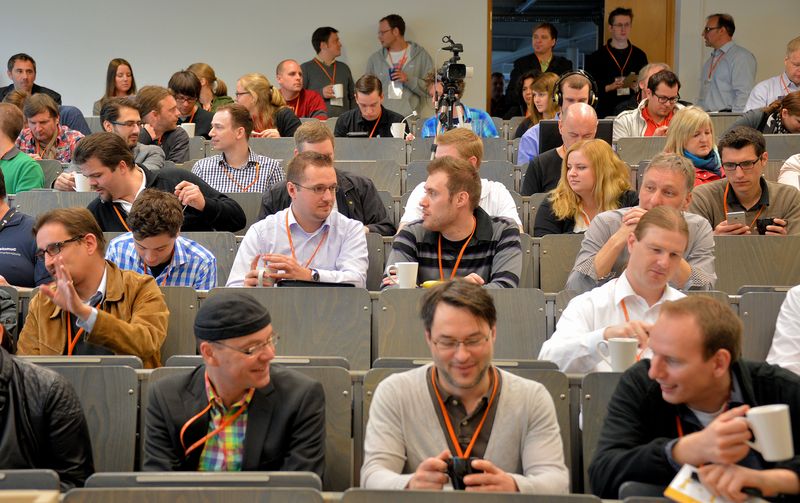
Again, the InterFace people took part and you can see them at the front!
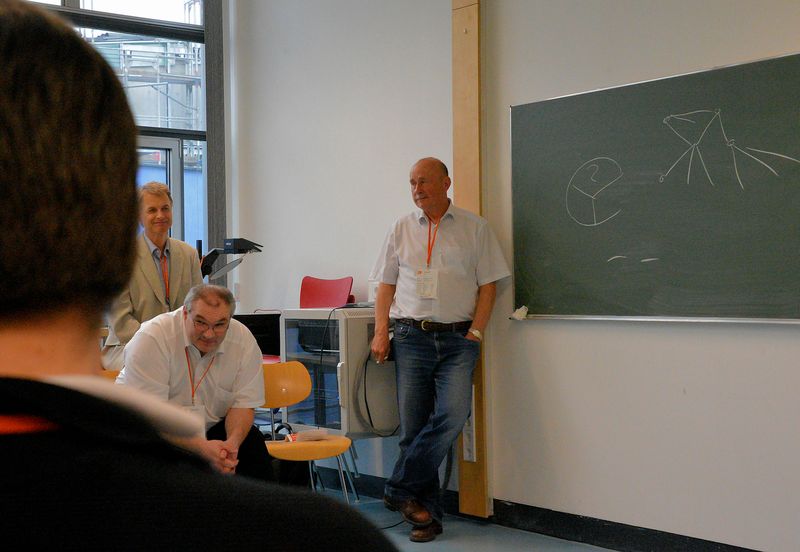
I was also permitted to do a session.
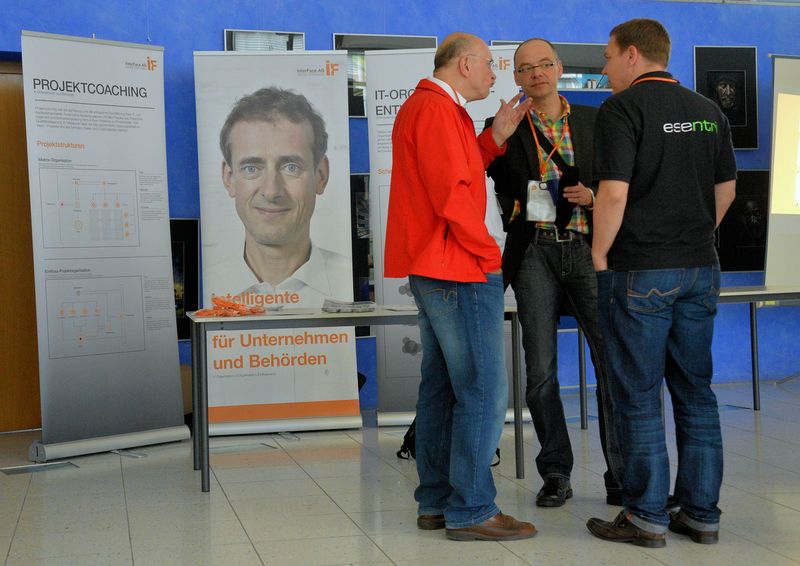
And, of course, there was plenty of networking!
RMD
(Translated by EG)


