
Roland DürreMonday December 9th, 2013
Pro Amiability/Philantropy, Contra Hostility
Christmas 2013
Over the last thirty years, I always gave a speech at the annual InterFace AG Christmas Party. In 2012, I talked about a good education being an excellent preparation but also a necessary requirement for designing both your own future and that of your neighbours more attractively and more successfully through courage in life and joyful behaviour.
Today, I know that “life-long learning” is necessary for “a good education”. However, what I mean is not “life-long” immersion in books. This is not about being a student all the time. Instead, it is about “opening up” towards the world and people. You have to leave your own snail shell and face life. This is how you collect life’s experience, which you might perhaps also call experience – and which is so important for a content and successful life.
Consequently, I started my small speech on this year’s Christmas Party with this idea and tried to describe more factors, all of which can make us all successful. In my book those factors are philanthropy and tolerance.
I also mentioned the opposites that, almost unavoidably, cause failure: fear and, in particular, hostility. Both terms were topics of “philosophical seminars” I attended several years ago (“fear” with Baldur Kirchner, “hostility” with Klaus-Jürgen Grün), which affected me very much.
So what is the origin of hostility?
Even brain research seems to prove that hostility is not something inborn. Instead, it appears that our brains reward “doing well” with an outpouring of “happiness hormones”, which makes us quasi construction-based social creatures.
Regardless, I witness small and also big attacks of hostility from almost all people and all social systems on a daily basis.
Like weeds, hostility creeps up out of even the smallest crack. And it happens for all varieties of reasons. More often than not, it is fear that governs humans and makes them hostile. Both carelessness and the urge to know things better, or also the tendency to grumble, can be the reasons. All these and much more of the same kinds of things might be sources of hostility. You are overworked, you are “fed up”, new ideas are refused and intolerance towards all that is alien or different is nurtured.
This is how frustration and dissatisfaction accumulate, before going off in the form of more or less superficial or intense hostility. I often perceive “moralizing” as hostile and do not feel well at all if, for instance, someone says “this is how it is done” or “we always did it this way” as a reason for behaviour that looks strange to me.
What does hostility trigger in me?
Whenever I am at the receiving end of hostility, I first and foremost feel small and uncertain. I ask myself if and how I am the reason for the other person’s hostility? Did I do something evil that might have caused it? However, this sentiment soon turns into something else. I get defiant and will turn away. Until my attitude becomes one of “kiss my a…”. Being confronted with personal hostility makes me insecure. If the hostility seems systemic to me, I retreat into inner resignation and refuse to cooperate.
Hostility is often perceived as an accusation. It will create fear and is detrimental for building up trust. And my problem is that I will answer hostility with hostility (of my own). Now isn’t that a stupid vicious circle?
How to reduce your own hostility?
The only thing that works with me is: minimizing my own fear. But this is certainly one of those things that are easier said than done. Also, I try to minimize the personal distance between myself and those that are important to me. I try to accept and give empathy. And I make myself develop more serenity as days go by – and always to find my inner freedom.
Only with philanthropy can I be a success.
Wherever I am met with kindliness, I feel well. Which gives me a good feeling and makes me bigger and stronger. My fear will vanish. I like the sender of friendliness, I receive it with pleasure and am prepared to invest in it. I am surrounded by people who also feel the same. If I am “philanthropic”, I will quickly have many friends and allies. People will take me seriously, believe me and will also be prepared to do something for me. My environment is no longer against me; instead, it is for me. I am no longer surrounded by enemies, but by friends.
Basically, it is quite simple, isn’t it? Hostility is detrimental for your success, friendliness will make you a success. Consequently, it is stupid to be hostile and prudent to be philanthropic.
Well, this is roughly what my InterFace-Christmas-2013-speech should be.
RMD
(Translated by EG)
Roland DürreThursday December 5th, 2013
Men Wearing Dark Suits are Not Lateral Thinkers (?)
At the Nuremberg 2013 DOAG Conference from November, 19th to 21st, I was permitted to be part of the Podium Discussion (Podiums-Diskussion) after the keynote by Dr. Peter Kreuz on “Instigation to Lateral Thinking”. And I had lots of fun.
 However the podium turned into something a little lateral. Regardless of the fact that the program committee had – for good reasons as I see it – decided against a “Twitterwall” in the big lecture hall, the tweets on the event were always provided directly to the podium by a friendly and helpful lady (you will find the tweets on the hashtag #DOAG2013).
And at least the “twitterers” in the lecture hall were not at all happy about the fact that, when the topic “thinking laterally” was discussed, there were six (mostly elderly) gentlemen on the stage – all of them wearing dark suits, four of them wearing a tie and five of them wearing shirts (which made them “tweedy”). Mind you, I had opted against wearing my “DOAG-Speaker”-T-shirt, because I considered it lacking respectability. …
 Apparently, some of the audience concluded from the dress code displayed on the stage that the people sitting there were all but “lateral thinkers”. Consequently, I did not find it very hard to play my role on the stage. After all, I firmly believe that the first thing you should do is think.
And that these days thinking apparently is something that happens less and less often. And if you start thinking, I recommend you first think straight. Instead of first around far too many corners. If, however, thinking straight does not help, then, of course, you have to think laterally. Publicly and noisily. Not just secretly.
 In order to be accepted as a lateral thinker, it was necessary for me to point out my “barefoot-shoes”. On the first picture, you can see them quite well. I like wearing them on barcamps (as well as on anti- as well as proper conferences). After all, I want to enjoy days spent there, rather than suffer from uncomfortable shoes all day long (and often half the night, as well).
This is how I managed to make a few persons think less poorly about our discussion. Simply by demanding that things you get served should always be thoroughly questioned. Simply with the question that is typical for children and philosophers: “How do you know that?”. And if then you hear whatever source, you can still ask: “How do you know that what this source says is true?”
And if you remain insistent, the most rigorous prejudices will easily become nothing but dust.
I myself learned a lot during this discussion. And I also understood very well how all my fellow discussants achieved a lot in their respective organisations through lateral thinking.
RMD
(Translated by EG)
P.S.
The pictures were taken by Bischof & Broel (http://www.bischof-und-broel.de/)
Roland Dürre
Tweets on Twittering and Blogging #196
Here are my tweets of last week on:
Blogging and Twittering, Wisdoms and Rules:
131212 If you want peace, it might be counterproductive to start an argument – something to remember when twittering and blogging? #Twitter #Blogging #Wisdom
131213 Those who have enough money will buy whatever they want – also true for twittering and blogging? #Twitter #Blogging #Wisdom
131214 Those who like to borrow money hate spending money – something to, please, avoid when blogging and twittering. #Twitter #Blogging #Wisdom
131215 Those who like telling lies often have news – also true for blogging and twittering? #Twitter #Blogging #Wisdom
131216 Having been hit makes you responsive – also true for twittering and blogging? #Twitter #Blogging #Wisdom
131217 If you want to win, you have to invest – also true for twittering and blogging? #Twitter #Blogging #Wisdom
131218 You will play best when you are winning – also true for twittering and blogging! #Twitter #Blogging #Wisdom
There is a new tweet each day. See twitter.com and “follow” RolandDuerre!
Enjoy!
RMD
(Translated by EG)
P.S.
I took the proverbs from Alle deutsche Sprichwörter.
Roland DürreMonday December 2nd, 2013
Entrepreneur’s Diary #92 – Good Advice/Bad Advice – Some Episodes
The “multiplication tables” and the “basics of management” are something you could call my hobby. Ever since I founded InterFace AG with Wolf Geldmacher (and even before), I always wondered what exactly is an enterprise. What is its potential meaning? What would be the correct mental concept of an entrepreneur? And what characterizes a good manager?
How can you continue your education in order to become a good manager? What competences can you actually learn and what personal talents do you have to develop in order to survive as a manager? So is it only natural to just ask some experienced managers and successful entrepreneurs you know and appreciate, isn’t it? Consequently, I always asked “managers” I looked up to: what can I do in order to become “better”?
One of them was Rudolf Jansche. At the time, he was an important business leader in the pharmaceutical sector in the Federal Republic of Germany. To me, his position seemed one that was unattainable for me and later he became both my teacher and friend. I asked Rudi:
Name a term which is particularly important for an entrepreneur or manager and/or for an enterprise!
After thinking about it for a short time, he said:
Clarity!
This answer convinced me. And the more I think about it, the more important the term “clarity” gets in this context. At an aside, I tried to define “clarity” (Klarheit) in Wikipedia, using a language game of leadership, management and business. In fact, I was fairly successful with my definition.
At the time – we are talking long ago – I also met another very prominent entrepreneur. His first name is Gerd. Gerd is a great person. He can motivate people, almost always manages to get them on his side and is very successful as a businessman. So I asked Gerd:
Can you recommend a book to me that might help me to become a good manager?
He took some time before answering. At long last, he recommended the “DAS BOSTON CONSULTING GROUP STRATEGIE-BUCH” (sub-title: “The most important management concepts in practice”). I bought the most current edition (that was the sixth edition of 1998, published by ECON) and was rather disappointed, because to me it looked like a series of platitudes. And then it even contained errors when it came to subject matters I knew something about – such as playing chess.
I told Gerd about my disappointment. His excuse was simple:
He had never read any books of the sort, but still wanted to recommend something to me. And he found the title promising.
This was a very long time ago. But somehow or other, not much changed until today.
RMD
(Translated by EG)
P.S.
The book is sitting in my office. I like to show it to people.
P.S.1
For more articles of me entrepreneurial diary, click here: Drehscheibe!
Roland DürreFriday November 29th, 2013
“brand eins” in December
 “brand ein”
is also available as “App”. Not just on paper. That is why you see this picture.
In this particular instance, however, I am making an exception of the rule and still choose the paper version. Consequently, I have now been carrying the “brand eins” magazine with me for more than a week already. So far, I only managed a few brief glimpses.
On this Friday, however, office life is a little more relaxed. And I take a closer look at the “brand eins”. You could call it looking forward to the weekend.
This time, the focal topic is spirit of the time. “Understanding the Spirit of the Time“ is what it says. The message on the front page is “you are so nineteen-ninety“. I must say that, for me, this does not really seem to be true. In fact, I feel more like a “sixties-person” – but not when it comes to soccer clubs – or maybe a “seventies-person” – perhaps even a “fifties-person”, which hopefully does not mean anything like “false fifty bills”. Even the nineteen-eighties are something I am not too comfortable with, not to mention the nineteen-nineties – whatever my reasons may be.
Besides: what is actually currently fashionable? The zero-zeroes?
About the magazine:
Again, I rather like it. Even if ten pages of adverts in the middle of the magazine seem to admonish me about dressing with more chic. Looking at those pages reminds me of my mother. She, too, kept criticising “the way I looked when running around”. Well, it was something I had to put up with – and today it helps to just turn the pages quickly.
Other than that, even the short articles I had a chance to glimpse earlier this week again told me much I had not known before. And this is not only true for the “world of numbers”. Just look at what they write under “using up raw materials”.
Some articles also give me various mental associations. For instance, twenty years ago, two brothers started to make bags out of truck tarpaulins (page 98). And they were quite successful. I remember immediately that my own bike bags are absolutely great. And that perhaps someone started making bike bags out of truck tarpaulins 25 years ago. But it might just as well be a coincidence, like so much in life.
For me, the “cultural good on four wheels” on page 112 is also rather remarkable. This, too, is one of those topics that leave a lot of space for interpretation. On top of all this, the magazine is again quite full of articles. It will provide me with plenty of reading material over the weekend (and beyond).
And since Christmas is approaching: as you all know, I no longer buy consumer goods to give anybody (because everybody already has everything). That means: no luxury rubbish for my friends. My presents are theatre tickets, perhaps self-made elderberry syrup, special wines or, at long last, also beer brands – and where I feel it is appropriate, I give someone a “brand eins”. And basically, I must say it is a good principle.
RMD
(Translated by EG)
Roland DürreThursday November 28th, 2013
Entrepreneur’s Diary #30 – “Rotary Disc, An Overview of All Articles”
 During my summer vacation of 2009 in Greece, I wrote no vacation diary. Instead, I wrote an „entrepreneur’s diary“. Well, as I lay on the beach under the Greek sun, I wrote down what moves me about enterprises and entrepreneurs.
In September of the same year, I started structuring all those comments – calling them Rotary Disc. And I kept adding more and more articles to my entrepreneur’s diary.
Perhaps today is a Sunday when the sun does not shine so brightly, which might motivate some of you to do some reading?
I would be delighted to know you do and would very much welcome all comments! Here are all my articles in chronological order:
#1 – der USP – Fall 1: CocaCola
#2 – der USP – Fall 2: Red Adair
#3 – der USP – Fall 3: Die Siemens AG
#4 – der USP – Fall 4: Metallbearbeitung im Mittelstand
#5 – der USP Fall 5: InterFace AG
#6 – der USP: “Summary” oder “Der Weg ist das Ziel”
#7 – “Elevator Pitch ” oder “Alles Müll”
#8 – Das ethische Unternehmen – Ausblick
#9 – Das ethische Unternehmen – 1. Notwendige Bedingungen für Sinngebung, Mission und Leitbild
#10 – Das ethische Unternehmen – 2. Notwendige Bedingung für den Umgang mit Gewinnen
#11 – Das ethische Unternehmen – 3. Notwendige Bedingungen für Produkt und Dienstleistungen
#12 – Das ethische Unternehmen – 4. Notwendige Bedingungen für Mitarbeiter
#13 – Das ethische Unternehmen – 5. Notwendige Bedingungen für den Umgang mit Kunden
#14 – Das ethische Unternehmen – 6. Notwendige Bedingungen für den Umgang mit Lieferanten
#15 – Das ethische Unternehmen – 7. Notwendige Bedingungen für die Unternehmenskultur
#16 – Das ethische Unternehmen – 8. Notwendige Bedingungen für die Führungskultur
#17 – Das ethische Unternehmen – Einschub – Zahlen – Pro Führungskraft – Pro Unternehmen 2.0!
#18 – Das ethische Unternehmen – 9. Notwendige Bedingungen für die Entscheidungskultur
#19 – Das ethische Unternehmen – 10. Notwendige Bedingungen für den Umgang mit Ressourcen
#20 – Das ethische Unternehmen – 11. Notwendige Bedingungen für den Umgang mit allen Stakeholdern
#21 – Das ethische Unternehmen – 12. Die trivialen Gebote des redlichen Kaufmanns
#22 – Das Ethisches Unternehmen – 13. Summary: “Ein biophiles Unternehmen”
#23 – Wir alle sind Unternehmer!
#24 – Die eigene Gründung – Motivation
#25 – Die eigene Gründung – Partnersuche
#26 – Die eigene Gründung – Planung
#27 – Die eigene Gründung – Start
#28 – “Eine kleine Geschichte” oder “Alles hängt von den Menschen ab”
#29 – “Das Tandem” oder “Eurasia”
#30 – Drehscheibe (hier befinden Sie sich)
#31 – Warum braucht man überhaupt Unternehmer?
#32 – “Prozessgläubig?” oder “Die Menschheit zerfällt in 2 Teile!”
#33 – “Prozesse über alles!” oder “Alles ISO?”
#34 – “Risk Management?” oder “Die Stärken sind wichtiger!”
#35 – “Die drei Erfolgskriterien!” oder “Unternehmenskultur oder Management?”
#36 – “Unternehmer: Jäger oder Sammler”
#37 – “Unternehmer: Hobbygärtner oder Modelleisenbahner”
#38 –”Das Joch des Unternehmers …”
#39 – “Das Risiko des Unternehmers …”
#40 – “Sind wir unser Geld wert?”
#41 – “Wie konnte Queen Victoria das britische Empire nur regieren?” ♫
#42 – “Die Entscheidungsinsel”
#43 – “Persönliche Haftung – ja gerne”
#44 – “Ungesunde Ziele – ungesunde Strategie”
#45 – “Planen&Ehrgeiz” oder “Was hat eine Radtour mit einem Unternehmen gemein?”
#46 – “Unternehmensforschung” versus “Operation Research”
#47 – Erfolgsrezept für Unternehmer – Reflektieren und Leben!
#49 – “Love it …” oder “Die Basics von Unternehmertum”
#50 – “Treiben oder getrieben werden” oder “Erfolg und Mittelmaß”
#51 – “Der Topmanager und die Menschen”
#53 – “Von Ego- und Alterozentrierten”
#54 – “Drei mal drei Buchstaben”
#56 – “Die Starken fördern, die Schwachen ignorieren”
#62 – Zahlen lesen, Zahlen folgen!?
#63 – Die Skills des “Führenden”
#64 – Project Management goes Brecht
#65 – Was ist das eigentlich – Projekt Management? (Definitionsversuch I)
#66 – Was ist das eigentlich – Projekt Management? (Definitionsversuch II)
#67 – Was ist das eigentlich – Projekt Management? (Definitionsversuch III)
#68 – Wie entstehen eigentlich Projekte?
#69 – Projekte sind schädlich für die Gesundheit Ihres Unternehmens!
#70 – Reporting – für wen berichte ich denn eigentlich?
#71 – Über die Notwendigkeit von unvernünftigen Entscheidungen
#73 – Die Rolle des AR in der kleinen AG
#74 – Konkurrenzfreie Gemeinschaftsunternehmen in der Nachfolge staatlicher Monopole?
#77 – Eigene unvernünftige Entscheidungen …
#78 – Ich stell mir mal vor, ich wär ein Professor …
#79 – “Boutique-Parabel” (Vertrieb&Marketing 2.0)
#80 – Mein Leben, Project Coaching und die InterFace
#81 – Projekt, Management und Projekt Management
#82 – Was ist das eigentlich, Strategie?
#83 – Was ist das eigentlich, ein Unternehmen?
#89 – Wissen und Organisation, Führen und Managen, Unternehmer sein
#90 – Das magische Dreieck des Managements.
#91 – Nicht agil oder agil mal anders.
#92 – Guter Rat / Schlechter Rat – Episoden
#93 – Effizienz versus Resilienz
#94 – Geisteshaltung, Vertrauen, Konstruktives & Destruktives
#95 – Entrepreneurship, Start ups, Unternehmertum – irgendwie überhöht?
#97 – Heute mal wieder zum Vertrieb
#98 – Die Ökonomisierung des Lebens
#99 – Goldene Regel für Unternehmen
#102 – Basics compact – Geschäftsmodell
#103 Basics kompakt – heute “Kategorische Bewertung von Geschäft”
#104 Basics kompakt – heute ”Kriterien des Erfolgs”
#106 – Umorganisation & Teamgröße
#107 – Jede Woche 20 Stunden Weiterbildung in der Freizeit?
#109 – Wie hoch soll die Rendite eines Unternehmens sein?
#111 – Risse im Führungsteam – Was tun?
#112 – Von sinnlosen Besprechungen.
#113 – Der Flow und die Wertegemeinschaft
#114 – Inspiration and Impulses
#116 – Social Media: Corporate Twittern
#117 – Warum können Erfolg und Misserfolg im gleichen Unternehmen so eng zusammen sein?
#121 – Kochrezept für Unternehmens-Gründer
#122 – Fahnenbildung mit Anleitung
#124 – INNOVATION – Nur so geht es!
I will write some articles more …
RMD
(Translated by EG)
Roland Dürre
Tweets on Twittering and Blogging #195
Here are my tweets of last week on:
Blogging and Twittering, Wisdoms and Rules:
131205 Once a thief, always a thief – a problem when twittering and blogging er? #Twitter #Blogging #Wisdom
131206 Those who have a distaste for many things will miss a lot of delicacies – also true for twittering and blogging? #Twitter #Blogging #Wisdom
131207 He who educates will also reign – hopefully not when blogging and twittering. #Twitter #Blogging #Wisdom
131208 If you want to do fencing, you have to wait for the attacks – also true for blogging and twittering? #Twitter #Blogging #Wisdom
131209 Fleeing even before you are hunted means you are too half-hearted – also true for twittering and blogging? #Twitter #Blogging #Wisdom
131210 If you flee, you will be hunted – also true for twittering and blogging. #Twitter #Blogging #Wisdom
131211 Thought freely is thought well – also when twittering and blogging? #Twitter #Blogging #Wisdom
There is a new tweet each day. See twitter.com and “follow” RolandDuerre!
Enjoy!
RMD
(Translated by EG)
P.S.
I took the proverbs from Alle deutsche Sprichwörter.
Roland DürreTuesday November 26th, 2013
Entrepreneur’s Diary #91 – Non-Agile or Agile in a Different Way.
In my last entrepreneurial article, I tried to describe what qualities a truly good manager should have. And I demanded that acting and deciding agile is one of those qualities.
But what exactly is the meaning of agile? Let me start by defining the opposite (dogmatic?).
I always witness non-agile decisions where decision makers think they alone own the truth and accordingly copy the world and the constructs of their social system unconditionally and without questions. In other words, these persons have a personal and systemic “structure of prejudices” which has never been subjected to criticism. If this structure of prejudices is what all considerations are based on and if then imperative decisions are developed from it through dominant logic, you mostly get stupid actions with detrimental consequences.
The reason for this is simple: the world ticks differently from what you think. If what is allegedly certain is not questioned, if emotional influences and your own empathic acceptance of other opinions is not permitted and if warnings are considered uncomfortable or being suppressed or ignored, then this is what happens: “ethics of responsibility” become “ethics of duty”, where all behaviour is justified with loyalty towards the system – even if it is detrimental to the people.
As opposed to this, being agile means that you always ask questions such as “how do you know this?” or “how do you know that this is correct?” both of yourself (!) and others – and perhaps not to avoid unpleasant replies. In other words, you have to be immune against “this is what everybody does” and “well, this is how it has always been”; instead, you have to try and compare your own constructs with those of other persons and, where possible, validate them against reality.
As I see it, this is the most important requirement for being an agile manager.
RMD
(Translated by EG)
P.S.
For all the articles of my entrepreneurial diary, click here: Drehscheibe!
Roland DürreFriday November 22nd, 2013
Indian Gods
Here is a short follow-up on the Indian trip I returned home from less than two weeks ago.
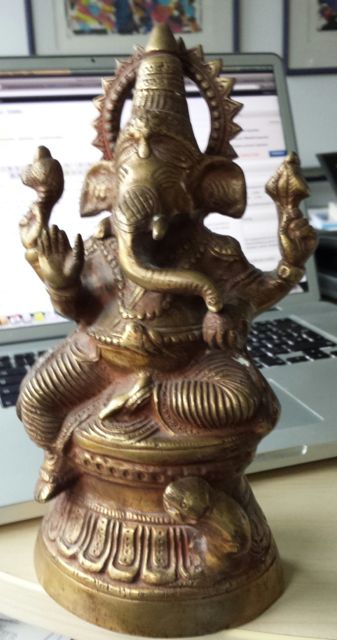 To me, the degree of religiousness – as far as I can judge from our guides and through close observation – seems amazing. Apparently, there are many Gods in India.
Naturally, this means that there are good and evil Gods. There are “utility Gods” used for a certain purpose. For instance in order to be prosperous as a merchant or in order not to be caught thieving. Some Gods seem to exist for the sole purpose of luxury. You do not need them, but they are quite impressive. For lovers, there are allegedly also very romantic types.
Also, the gods always have some connection or other with animals. For example someone told me that inside a cow’s stomach there are more than three million Gods, all of which, however, are a little different from the next one.
I also got the impression that Indians sometimes create their own God. In my opinion, this is quite an attractive idea – design your “do-it-yourself” God that exactly matches your personal need. After all, we are all individuals and have our very personal “world”, so why not also have our very personal/private God?
More often than not, I got the impression that, in India, there is plenty of religious freedom. However, there are also some Christians and Islamists. In Southern India, for instance, we saw many churches. This was particularly obvious in areas such as GOA, where the Portuguese influence used to be quite strong. Among the Christian Gods, the dominant ones are Jesus and Mary. You will find many images showing them, often pathetically kitschy.
The reason why I noticed Islamists was that I heard the Muezzin calling to prayers everywhere night after night. As I perceived it, there were fewer women on the streets in Islamic areas. And if they were seen, they were mostly wearing Burkas. I saw only few headscarves. Consequently, I am assuming that the Islam in Southern India is a stricter variety. Of course, you will not see images of God.
RMD
(Translated by EG)
P.S.
On the picture, you can see my office god Ganesh. He is sitting in my managing director’s office and sees to it that all is well at InterFace.
Roland DürreThursday November 21st, 2013
Interview
Here is the – non verbatim – text of an interview I gave a short time ago during the DOAG2013 for DOAG-TV. The questions are in cursive type.
You are managing director and co-founder of InterFace AG and full-time manager – both on the job and in your private life. You researched management models very intensely and developed your own model as you went.
Was there no existing model that might have met with your approval? And what model would that have been?
I think every entrepreneur or manager has to find his or her own ”Management Model“. Mine was inspired by the ”St. Gallen Management Model“, in particular the approach introduced by Hans Ulrich with its „8 Theses on the Change in Management” from the 1980ies. Another huge influence on me and my way of thinking is Rupert Lay, who was the Nestor of ethics in management of the last century.
You can hear a lot about leadership methods in the media. When speaking about it, terms such as entrepreneurial culture, ethics, morals, philosophy appear – these are words often used synonymously. Do they all mean the same thing?
That is exactly the problem: they do not all mean the same thing. In fact, you should only talk about these things after having read up on them and thoroughly informed yourself. Unfortunately, we live in an era when people like talking about things they do not understand. Just think of the term freedom – what does it mean to be free? Or the term sustainability.
What is expected of management today?
Management means taking exemplary responsibility, both on an operative, strategic and normative level:
- Operative means your behaviour, “what you do” – that is to say the actual interaction between all the stakeholders of an enterprise.
- Strategic means “leading” – that is “how” and in what way it happens.
- Normative is for taking entrepreneurial responsibility, for the “why”.
It seems like a leader must be quite flexible when trying to balance writing black numbers and ethics. How do you manage this in everyday life?
Mainly, there is a conflict between successful numbers and “ethical decisions” when “the leaders” think in terms of short-time success. The more you look upon things on a long-term basis, the more ethically responsible balance of values will pay. It seems that there is always a problem due to the fact that material values seem to be consistently easy to identify, whereas immaterial values basically cannot be counted. That makes the balancing process necessary for a decision difficult, especially if the shareholders decide their priority is the material: the shareholder value.
Communication is a powerful tool – often neglected. What forms of communications do you use at InterFace AG?
Nowadays, you cannot do anything without the internet and social media. But communication as a basis for collaboration must be ”hybrid“. That means we have to combine “Face2Face“ meetings with those in the virtual world. And that is what we try to do at our enterprise.
RMD
(Translated by EG)


